EP4568141A2 - Plattforminterferenzminderung in der drahtlosen kommunikation - Google Patents
Plattforminterferenzminderung in der drahtlosen kommunikation Download PDFInfo
- Publication number
- EP4568141A2 EP4568141A2 EP24208871.4A EP24208871A EP4568141A2 EP 4568141 A2 EP4568141 A2 EP 4568141A2 EP 24208871 A EP24208871 A EP 24208871A EP 4568141 A2 EP4568141 A2 EP 4568141A2
- Authority
- EP
- European Patent Office
- Prior art keywords
- wireless
- channel
- interference
- platform
- wireless communication
- Prior art date
- Legal status (The legal status is an assumption and is not a legal conclusion. Google has not performed a legal analysis and makes no representation as to the accuracy of the status listed.)
- Pending
Links
Images




Classifications
-
- H—ELECTRICITY
- H04—ELECTRIC COMMUNICATION TECHNIQUE
- H04B—TRANSMISSION
- H04B15/00—Suppression or limitation of noise or interference
- H04B15/02—Reducing interference from electric apparatus by means located at or near the interfering apparatus
- H04B15/04—Reducing interference from electric apparatus by means located at or near the interfering apparatus the interference being caused by substantially sinusoidal oscillations, e.g. in a receiver or in a tape-recorder
-
- H—ELECTRICITY
- H04—ELECTRIC COMMUNICATION TECHNIQUE
- H04B—TRANSMISSION
- H04B17/00—Monitoring; Testing
- H04B17/30—Monitoring; Testing of propagation channels
- H04B17/309—Measuring or estimating channel quality parameters
- H04B17/336—Signal-to-interference ratio [SIR] or carrier-to-interference ratio [CIR]
-
- H—ELECTRICITY
- H04—ELECTRIC COMMUNICATION TECHNIQUE
- H04L—TRANSMISSION OF DIGITAL INFORMATION, e.g. TELEGRAPHIC COMMUNICATION
- H04L1/00—Arrangements for detecting or preventing errors in the information received
- H04L1/0001—Systems modifying transmission characteristics according to link quality, e.g. power backoff
- H04L1/0002—Systems modifying transmission characteristics according to link quality, e.g. power backoff by adapting the transmission rate
- H04L1/0003—Systems modifying transmission characteristics according to link quality, e.g. power backoff by adapting the transmission rate by switching between different modulation schemes
-
- H—ELECTRICITY
- H04—ELECTRIC COMMUNICATION TECHNIQUE
- H04W—WIRELESS COMMUNICATION NETWORKS
- H04W48/00—Access restriction; Network selection; Access point selection
- H04W48/02—Access restriction performed under specific conditions
-
- H—ELECTRICITY
- H04—ELECTRIC COMMUNICATION TECHNIQUE
- H04W—WIRELESS COMMUNICATION NETWORKS
- H04W74/00—Wireless channel access
- H04W74/04—Scheduled access
-
- H—ELECTRICITY
- H04—ELECTRIC COMMUNICATION TECHNIQUE
- H04W—WIRELESS COMMUNICATION NETWORKS
- H04W72/00—Local resource management
- H04W72/50—Allocation or scheduling criteria for wireless resources
- H04W72/54—Allocation or scheduling criteria for wireless resources based on quality criteria
- H04W72/541—Allocation or scheduling criteria for wireless resources based on quality criteria using the level of interference
Definitions
- the disclosure relates generally to wireless communications, and in particular, to strategies for mitigation of platform-based interference on wireless communications.
- platform interference may be generated by any of the components of the computing platform
- platform-based interference in a wireless system is the noise associated with the clock of a memory, and in particular, double-data rate (DDR) and low-power DDR (LPDDR) memories.
- DDR double-data rate
- LPDDR low-power DDR
- Such platform-based wireless interference may occur at a frequency that is within the frequency spectrum used for wireless communications on the computing platform, and therefore causes interference on certain channels of the wireless communication system. This interference may degrade, impair, or fully disrupt wireless communication on the channels that are impacted by the platform-based wireless interference.
- the wireless communication system may simply avoid using the impacted channels, but this is not always feasible or desired, especially with complex communication protocols that may have limited bandwidth, grouped/combined channels (e.g., multi-link operation or tri-band dual concurrency), etc.
- the computing platform may simply change its operational settings (e.g., change the clock frequency of the memory that is generating interference within the wireless communication bandwidth) to move the interference outside the wireless communication band. However, this may reduce performance (e.g., slower memory speeds) of the computing platform and/or require a time-consuming reconfiguration (e.g., a memory validation/training at the new clock frequency). Neither of these solutions may be satisfactory in view of the desired features and desired user experience for a given computing platform.
- phrases "at least one” and “one or more” may be understood to include a numerical quantity greater than or equal to one (e.g., one, two, three, four,tinct, etc.).
- the phrase "at least one of” with regard to a group of elements may be used herein to mean at least one element from the group consisting of the elements.
- the phrase "at least one of” with regard to a group of elements may be used herein to mean a selection of: one of the listed elements, a plurality of one of the listed elements, a plurality of individual listed elements, or a plurality of a multiple of individual listed elements.
- any phrases explicitly invoking the aforementioned words e . g ., “plural [elements]", “multiple [elements]" referring to a quantity of elements expressly refers to more than one of the said elements.
- the phrase “a plurality” may be understood to include a numerical quantity greater than or equal to two ( e . g. , two, three, four, five, viscous, etc.).
- group (of) refers to a quantity equal to or greater than one, i.e., one or more.
- the terms “proper subset”, “reduced subset”, and “lesser subset” refer to a subset of a set that is not equal to the set, illustratively, referring to a subset of a set that contains less elements than the set.
- data may be understood to include information in any suitable analog or digital form, e.g ., provided as a file, a portion of a file, a set of files, a signal or stream, a portion of a signal or stream, a set of signals or streams, and the like. Further, the term “data” may also be used to mean a reference to information, e.g ., in the form of a pointer. The term “data”, however, is not limited to the aforementioned examples and may take various forms and represent any information as understood in the art.
- processor or “controller” as, for example, used herein may be understood as any kind of technological entity (e.g., hardware, software, and/or a combination of both) that allows handling of data.
- the data may be handled according to one or more specific functions executed by the processor or controller.
- a processor or controller as used herein may be understood as any kind of circuit, e.g ., any kind of analog or digital circuit.
- a processor or a controller may thus be or include an analog circuit, digital circuit, mixed-signal circuit, software, firmware, logic circuit, processor, microprocessor, Central Processing Unit (CPU), Graphics Processing Unit (GPU), Digital Signal Processor (DSP), Field Programmable Gate Array (FPGA), integrated circuit, Application Specific Integrated Circuit (ASIC), etc., or any combination thereof. Any other kind of implementation of the respective functions, which will be described below in further detail, may also be understood as a processor, controller, or logic circuit.
- any two (or more) of the processors, controllers, or logic circuits detailed herein may be realized as a single entity with equivalent functionality or the like, and conversely that any single processor, controller, or logic circuit detailed herein may be realized as two (or more) separate entities with equivalent functionality or the like.
- memory is understood as a computer-readable medium (e.g ., a non-transitory computer-readable medium) in which data or information can be stored for retrieval. References to "memory” included herein may thus be understood as referring to volatile or non-volatile memory, including random access memory (RAM), read-only memory (ROM), flash memory, solid-state storage, magnetic tape, hard disk drive, optical drive, 3D XPoint TM , among others, or any combination thereof. Registers, shift registers, processor registers, data buffers, among others, are also embraced herein by the term memory.
- the term "software” refers to any type of executable instruction, including firmware.
- the term “transmit” encompasses both direct (point-to-point) and indirect transmission (via one or more intermediary points).
- the term “receive” encompasses both direct and indirect reception.
- the terms “transmit,” “receive,” “communicate,” and other similar terms encompass both physical transmission ( e.g ., the transmission of radio signals) and logical transmission ( e.g. , the transmission of digital data over a logical software-level connection).
- a processor or controller may transmit or receive data over a software-level connection with another processor or controller in the form of radio signals, where the physical transmission and reception is handled by radio-layer components such as radio frequency (RF) transceivers and antennas, and the logical transmission and reception over the software-level connection is performed by the processors or controllers.
- the term “communicate” encompasses one or both of transmitting and receiving, i.e., unidirectional or bidirectional communication in one or both of the incoming and outgoing directions.
- the term “calculate” encompasses both "direct” calculations via a mathematical expression/formula/relationship and "indirect” calculations via lookup or hash tables and other array indexing or searching operations.
- platform-based interference caused by a computing platform may impact the performance of its wireless communications.
- platform-based wireless interference may be generated by any of the components of the computing platform
- one example of platform-based interference on wireless communications is the noise associated with the clock of a memory, and in particular, double-data rate (DDR) and low-power DDR (LPDDR) memories.
- DDR double-data rate
- LPDDR low-power DDR
- Such components may operate at a frequency (or harmonics thereof) that is within the frequency spectrum used for wireless communications, and therefore causes interference on certain channels of the wireless communication system.
- This platform-based wireless interference may degrade or impair wireless communication performance on the channels that overlap with the interference.
- one of the main sources of platform-based wireless interference/noise may be the clock of DDR and LPDDR memories
- the disclosed platform interference mitigation may be for any type of platform-originated interference that is caused or generated by any type of platform operation or any component(s) of the platform (generally referred to herein as operational setting(s)).
- the platform-based wireless interference caused by DDR/LPDDR memories is usually dealt with by changing the clock frequency of the DDR/LPDDR to a different frequency that does not cause interference in the operational bandwidth of the wireless communication system or does not cause interference on the currently-used channel of the wireless communication system.
- the DDR/LPDDR memory may be configured to operate at two different Dynamic Voltage Frequency Scaling (DVFS) points, where the DVFS operation point may be selected so that its associated interference does not impact the currently used channel/band.
- DVFS Dynamic Voltage Frequency Scaling
- FIG. 1 which plots signal noise caused by the DDR/LPDDR of a computing platform.
- the DDR/LPDDR has a DVFS operation point of 4267
- there is a significant noise spike at 6400 MHz (labeled in FIG. 1 as 110), which approximately overlaps with wireless communication channel 85 (centered at 6375 MHz) of the 6 GHz band.
- the DDR/LPDDR has a DVFS operation point of 3733
- there is a significant noise spike at 5600 MHz (labeled in FIG. 1 as 120), which approximately overlaps with wireless communication channel 120 (centered at 5600 MHz) of the 5 GHz band.
- the computing platform may alter the DVFS operation point of the DDR/LPDDR based on which wireless band/channel is being used by the wireless communication system.
- wireless communication standards such as Wi-Fi 7, that support multi-link operation (MLO) may have different modes of operation that include enhanced multi-link single radio (eMI,SR), tri-band dual concurrency (TBDC), and other wireless protocols that support concurrent transmit/receive operations in two different bands of the wireless communications protocol (e.g., in two different frequency bands and/or on two different channels defined by an IEEE 802.11 standard).
- MLO multi-link operation
- eMI,SR enhanced multi-link single radio
- TBDC tri-band dual concurrency
- other wireless protocols that support concurrent transmit/receive operations in two different bands of the wireless communications protocol (e.g., in two different frequency bands and/or on two different channels defined by an IEEE 802.11 standard).
- any new DVFS operating point (e.g., memory operation speed) requires validation and tuning, and therefore added resources and time to market.
- each new DVFS operating point would need be trained in the memory at boot, and such training would add to the already very restricted boot time limitations.
- the disclosed platform interference mitigation system may collect information about the interference the computing platform may be generating that could interfere with the wireless communications (generally referred to herein as platform-based wireless interference information or characteristics).
- the computing platform may collect information about the DDR operational speeds and notify the wireless communication system (e.g., the driver) or the wireless communication system may query the computing platform for information about the interference or the set of expected self-interfering frequency ranges on the platform (e.g., the frequencies at which the platform may be generating interference that would interfere with wireless communications of the computing platform).
- Such interference information also referred to herein as platform-based interference characteristics or platform-based wireless interference characteristics
- the wireless communication system of the computing platform may further process this information about platform-based interference characteristics to extract data and exchange it with the wireless access point (AP) that manages communications. Utilizing this platform-based interference characteristic information, the wireless communication system of the computing platform and the wireless AP may coordinate computing platform operation and channel assignments to avoid or mitigate the interference-dynamically during run-time-depending on the operational setting(s) of the computing platform.
- AP wireless access point
- the need to adjust/limit operating points of the computing platform is reduced.
- the computing platform may only need to adjust/limit operating points of the computing platform (e.g., by switching the DVFS point to avoid interference) when the platform-based interference exists on the primary channel (e.g., a primary 20 MHz channel) of the two channels allocated in eMLSR operation. If the interference is not on the primary channel, the computing platform may continue to select a DVFS point that optimizes power, thermal performance, computational performance, etc.
- the wireless communication system of the computing platform may use the platform-based interference information to communicate with the AP so that the AP avoids assigning certain channels for wireless communications to the computing platform that would be interfered with by the platform-based interference.
- the wireless communication system may not necessarily send the platform-based interference information to the AP, but instead, may send information about what bands, regions of the bands, and/or channels would be acceptable/unacceptable for wireless communications with the computing platform.
- An advantage of the disclosed platform interference mitigation system may be that a methodical approach may be used to resolve the impact of platform-based interference with wireless communications of the computing platform, rather than simply trying different wireless bands, channel configurations, computing platform operational settings (e.g., memory operational points, e.g., for each new computing platform with the model/make and memory configuration thereof), etc.
- the disclosed platform interference mitigation system may allow for configuring the computing platform and the wireless communication system to an operation point (operational setting) that is optimized for requirements on both the computing platform and the wireless communication system in terms of power, computing performance, battery life, thermal performance, wireless communication throughput/latency, etc., which may be context/application-aware and computing-platform specific.
- the disclosed platform interference mitigation system is discussed with respect to two examples below, one where the wireless communication interface is configured for an eMLSR mode of operation and one where the wireless communication interface is configured for a TBDC mode of operation. These examples are not limiting and are illustrated below as examples because the conventional way of mitigating interferences (e.g., moving the DVFS point) does not provide an adequate solution for these modes of operation.
- the examples below are discussed with respect to wireless communications according to the IEEE 802.11 standard, such as Wi-Fi 7 or 8, the concepts below may apply equally to any type of wireless communication system according to any communication standard.
- platform-based interference from DDR/LPDDR memories is used as an example, the concepts below may apply to any platform-based source of interference (e.g., noise) to the wireless communication system.
- the eMLSR mode of operation is a feature according to the IEEE 802.11be standard (Wi-Fi 7).
- eMLSR allows a nonaccess point (non-AP) multi-link device (MLD) with multiple receive chains to listen on a set of enabled links when the corresponding stations (STAs) are affiliated with the non-AP MLD.
- the client wireless device (referred to as STAs) are in the awake state for an initial control frame sent by an AP MLD in a non-high-throughput (non-HT) duplicate physical layer (PHY) protocol data unit (PPDU) with one spatial stream, followed by frame exchanges on the link on which the initial control frame was received.
- a client wireless device (STA) may be any type of computing platform such as a laptop, desktop, tablet, smartphone, wearable, etc.
- the computing platform may inform the wireless module of the center frequency, bandwidth and power of the DDR/LPDDR noise.
- This information may be stored in a memory of the computing system and may be based on the static and dynamic operating characteristics of the computing platform.
- the interference in low SNR regions would block the operation if the platform-based interference is wideband (e.g., almost 20 MHz, which may cover a channel) and has a center frequency that falls on one of the primary channels of the two allocated eMLSR channels.
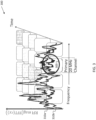
- the format of non-HT duplicated frame is shown in plot 200 of FIG. 2 .
- FIG. 3 shows in plot 300 an overlay of noise/RFI on the non-HT duplicated frame of FIG. 2 .
- the wireless system on the computing platform should be able to decode the control frame.
- the wireless system on the computing platform may still be able decode the control channel. This may be because the control frame uses the lowest modulation scheme.
- the wireless system receives information about the platform-based interference and, knowing the channels impacted by the platform-based interference and knowing that the channel allocated in the control frame is one impacted by the platform-based interference, the wireless system may decline to send an acknowledgement back to the wireless AP that sent the control message and expected an acknowledgment.
- the computing platform would, in any event, not send acknowledgment. Because the wireless AP does not receive an acknowledgment from the computing platform, the AP would not use the channel for its transmission to the computing platform.
- the wireless device of the computing platform may then switch to another wireless AP that does not utilize the channel(s) impacted by the platform-based interference. If there is no such other AP available (e.g., in the case of an area covered by a single AP, e.g., in a normal home environment), the wireless device of the computing platform may change its mode of operation to stop using eMLSR or TBDC operations.
- the higher-level software of the computing platform may inform, for example, a user through a pop-up window or message, that the AP's current channel suffers from interference and recommend changing the AP's channel by contacting its service provider.
- the computing platform may send a message to the AP requesting a channel switch and indicating which channel(s) or region(s) of channel(s) are to be avoided for wireless communications with the computing platform. For example, if a wireless channel is 160 MHz wide and only a 10 MHz portion of the channel is impacted by the platform-based interference, then the request may indicate that only that 10 MHz portion of the channel should be avoided.
- a channel may be divided into Resource Units (RUs), and the AP transmits wireless data to the wireless communication system of the computing platform via one (or multiple) resource units (RU(s)).
- an automated message may be provided, due to platform-based interference, to the third-party supplier of the AP, rather than or in addition to the end-user, requesting a reprogramming/re-planning of the AP.
- the wireless device of the computing platform may limit all operations on the conflicting channel to non-HT duplicate and a low modulation-coding scheme (MCS). In such a case, wireless communications may be lower performance but less impacted by the interference.
- MCS modulation-coding scheme
- the wireless device of the computing platform may request a change to the operational setting of the platform-specific resource that may be causing the interference (e.g., requesting a change to the DVFS point of a DDR/LPDDR that may be creating interference).
- the wireless device of the computing platform may adjust the automatic gain control on the primary channel to avoid saturation and/or a false alarm during initial packet acquisition.
- the wireless device of the computing platform may decode the eMLSR control frame using the duplicated portions of the nonprimary channel.
- the wireless device of the computing platform may request a change to the operational setting/parameter of the platform-specific resource that may be causing the interference (e.g., switching the interference to a "no-radio zone" by, e.g., changing the DVFS point of a DDR/LPDDR to a point where the interference is outside of the frequency band used for this set of communications) for the duration of the communications.
- the interference e.g., switching the interference to a "no-radio zone" by, e.g., changing the DVFS point of a DDR/LPDDR to a point where the interference is outside of the frequency band used for this set of communications
- the wireless device of the computing platform may decode the eMLSR control frame and if the information in the control frame indicates (1) that the next frame exchanges will fall on the channel/resource units (RUs) that will be impacted by the platform-based interference and (2) that interference characteristics and signal strength are such that wireless communication performance will be degraded by the platform-based interference, the wireless device of the computing platform may request a change to the operational setting of the platform-specific resource that may be causing the interference (e.g., switching the interference to a "no-radio zone”) for the duration of the exchanges.
- RUs channel/resource units
- the wireless communications may continue normal operation and there is no need for the wireless device of the computing platform to request a change to the operational setting of the platform-specific resource that may be causing the interference.
- RUs channel/resource units
- the wireless device of the computing platform may independently receive and transmit in two different channels allocated by the wireless communication system.
- information may be exchanged between the computing platform and the access point/controller of the wireless communication system.
- the information provided by the computing platform may include capability information and/or frame exchange sequence between the AP/controller and the computing platform (STA), where the computing platform may be able to request that the AP/controller use or not use certain channels/regions of the frequency band (e.g., at a granularity of multiple of RUs) for frame exchanges. This may be referred to as an MRU/puncturing request sent from and/or exchanged between the computing platform and the AP/controller.
- the AP/controller may collect and log requests from not only the computing platform but also other stations associated with the AP, where the requests indicate which channels/band regions should be avoided (black-listed) or to which it may change its operating channel (white-listed). The AP may then determine channels/bands that best serves the overall needs of the basic service set (BSS). The AP/controller may broadcast new operating channels and send a channel switch command(s) to associated stations, as needed.
- BSS basic service set
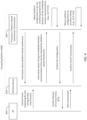
- FIG. 4 shows an example of information exchanges between an access point (AP) 405 and a wireless device 420 of a computing platform 400 that may be used to mitigate the impact of platform-based interference on wireless communications between the AP 405 and the wireless device 420.
- the computing platform 400 may provide information to the wireless device 420 that describes or characterizes the platform-based interference that may impact wireless communications.
- the computing platform 400 may, via one or more processors / platform-based interference characterizer 410, determine the operational settings of the computing platform 400 and use this information to determine platform-based interference characteristics.
- the processors / platform-based interference characterizer 410 may use the platform-based interference characteristics to determine and provide the wireless device 420 with restrictions to channels, portions of channels, bands, portions of bands, etc. that should be taken into account for wireless communications with the computing platform 400.
- a DDR/LPDDR memory of the computing platform 400 is operating with an operational parameter (e.g., a DVFS point) that creates interference on channel 85
- the processors / platform-based interference characterizer 410 may inform the wireless device 420 that all or a portion of channel 85 should be avoided for wireless communications with AP 405.
- the wireless device 420 may provide this information (e.g., timing information and channel information) to the processors / platform-based interference characterizer 410 so that it may adjust its operating parameters to an operational configuration that does not generate platform-based interference that would interfere with the scheduled transmission (e.g., switching to a DVFS point where the platform-based interference is outside the channel for the scheduled transmission).
- this information e.g., timing information and channel information
- the wireless device 420 may acknowledge receipt of the control message from AP 405 by sending, for example, a CTS. Then, the AP 405 may wirelessly transmit the transmission at the scheduled time using the channel(s) (RUs) indicated in the control message.
- the computing platform 400 may, via processors / platform-based interference characterizer 410, return its platform configuration to its previous setting.
- this is just one example of the exchanges that may take place between AP 430 and computing platform 400 for mitigating platform-based interference, and the system may make other exchanges to employ the other mitigation strategies discussed above.
- FIG. 5 shows an exemplary schematic drawing of a computing platform 500 for mitigating the impact of platform-based interference on wireless communications.
- the computing platform 500 may include one or more memory 530, one or more wireless communication interface 520 (e.g., a wireless device with a modem), and processing circuitry such as one or more processors 5 10a, a platform-based interference characterizer 5 10b, one or more platform control units (P-Unit) 510c, etc., that may analyze platform-based operational configurations, determine wireless interference that may be caused by the platform-based operational configurations, and adjust operational parameters on the computing platform 500 to mitigate the platform-based interference on wireless communications over the wireless communication interface 520.
- processors 5 10a e.g., a wireless device with a modem
- P-Unit platform control units
- the processing circuitry of computing platform 500 may be divided physically, logically, or not at all across any number of components and/or modules.
- the platform-based interference characterizer 510b may be part of the P-Unit 510c, part of processor 510a, or both, and the logical divisions shown in FIG. 5 is merely exemplary.
- the P-Unit 510c and the wireless communication interface 520 may exchange message to identify potential frequencies/channels that may be impacted by platform-based interference and to negotiate a change of frequency (e.g., with an access point) for wireless communications over the wireless communication interface 520, where the change in frequency may be based on the platform-based interference characteristics, wireless protocol, etc.
- a change of frequency e.g., with an access point
- FIG. 4 One example of such a message exchange is shown in and described above with respect to FIG. 4 .
- FIG. 6 shows an exemplary schematic drawing of a device 600 for mitigating the impact of platform-based interference on wireless communications.
- Device 600 may include any of the features for mitigating the impact of platform-based interference on wireless communications discussed above.
- the system for mitigating the impact of platform-based interference on wireless communications of FIG. 6 may be implemented as a device, a method, and/or a computer readable medium that, when executed, performs the features for mitigating the impact of platform-based interference on wireless communications described above. It should be understood that device 600 is only an example, and other configurations may be possible that include, for example, different components or additional components.
- Device 600 includes processing circuitry 610 connected to storage 630.
- processing circuitry 610 is configured to determine a platform-based wireless interference characteristic based on an operational setting of a computing platform.
- processing circuitry 610 is also configured to determine an interference mitigation parameter based on the platform-based wireless interference characteristic.
- processing circuitry 610 is also configured to control a wireless communication interface 620 of the computing platform based on the interference mitigation parameter.
- the operational setting may include operation of a component of the computing platform that induces the platform-based wireless interference characteristic within a frequency band of the wireless communication interface 620.
- the component may include a memory (e.g., as part of storage 620) of the computing platform and the operation includes a memory operation at a memory clock speed.
- the memory may include a double data rate (DDR) memory or a low power double data rate memory (LPDDR).
- the platform-based wireless interference characteristic may include an interference signal on a wireless channel of wireless communication interface 620.
- the interference signal may include platform-based noise on the wireless channel.
- the interference signal may be induced by a memory operation, a memory speed, or a clock of an operational component of the computing platform.
- the wireless channel may include at least one channel of two or more Enhanced Multilink Single-Radio Operation (eMLSR) channels.
- eMLSR Enhanced Multilink Single-Radio Operation
- the wireless channel may be defined by an IEEE 802.11 standard.
- the wireless channel may include one or more of a 20 MHz channel, a 40 MHz channel, a 80 MHz channel, a 160 MHz channel, and a 320 MHz channel.
- the at least one channel of two or more eMLSR channels may include a primary channel.
- processing circuitry 610 may be configured to determine whether the at least one channel includes a primary channel, wherein the interference mitigation parameter may be based on whether the at least one channel includes the primary channel.
- the interference mitigation parameter may include the processing circuitry 610 configured to refuse to send an acknowledgement of receipt of a control message indicating a reception channel for receiving wireless communications on wireless communication interface 620.
- the interference mitigation parameter may include the processing circuitry 610 configured to limit a type of communications over the wireless communication interface 620.
- the type of communications over wireless communication interface 620 may be limited to a non-high-throughput (non-HT) low modulation-coding-scheme (low MSC) type of communications.
- the interference mitigation parameter may include the processing circuitry 610 configured to adjust a gain setting for receiving wireless signals on wireless communication interface 620 during an initial packet acquisition; decode a received control frame using a duplicated portion of a non-primary channel, wherein the received control frame indicates a channel for scheduled wireless communication exchanges; and adjust, only if the platform-based wireless interference characteristic includes interference on the channel for the scheduled wireless communication exchanges, the operational setting of the computing platform to a non-interference operational setting.
- the non-interference operational setting may include a configuration of the computing platform that generates insignificant platform-based interference on the channel for the scheduled wireless communication exchanges.
- processing circuitry 610 may be configured to decode the received control frame after a start of packet detection and timing/frequency correction for the received control frame.
- processing circuitry 610 may be configured to determine a channel for scheduled wireless communication exchanges; and adjust, only if the platform-based wireless interference characteristic includes interference on the channel for the scheduled wireless communication exchanges, the operational setting of the computing platform to a non-interference operational setting.
- the wireless channel may include a transmit channel and a receive channel that are independent.
- an operation mode of wireless communication interface 620 may include a tri-band dual concurrency mode.
- device 600 may be is configured to generate a request that a blocked wireless region be restricted from use for wireless data transmissions over the wireless communication interface 620.
- the blocked wireless region may include one or more resource units for the wireless data transmissions.
- processing circuitry 610 may be configured to set up wireless communication interface 620 based on requests of other stations associated with an access point that defines wireless communications over wireless communication interface 620.
- the platform-based wireless interference characteristic may include a noise spectrum, a noise bandwidth, and/or an average noise power due to the operational setting of the computing platform.
- the interference mitigation parameter may include a usage restriction on a wireless channel of wireless communication interface 620.
- the usage restriction may include a blocked wireless channel that is restricted from use for wireless data transmissions over the wireless communication interface 620.
- wireless communication interface 620 may be defined by a wireless local area network protocol.
- the wireless local area network protocol may be defined by an IEEE 802.11 standard.
- processing circuitry 610 may be configured to provide the interference mitigation parameter to a wireless access point during a negotiation between the computing platform and the wireless access point, wherein the negotiation is over an allocated wireless channel resource for the wireless communication interface 620. Furthermore, in addition to or in combination with any of the features described in this or the preceding eight paragraphs, processing circuitry 610 may be configured to reject, based on the interference mitigation parameter, a channel allocation received from a wireless access point.
- processing circuitry 610 may be configured to send a non-acknowledgement of a channel allocation message from the wireless access point or configured to withhold from sending an acknowledgement of the channel allocation message. Furthermore, in addition to or in combination with any of the features described in this or the preceding eight paragraphs, processing circuitry 610 may be configured to switch wireless communications from a wireless access point to an other wireless access point that does not utilize a wireless channel impacted by the platform-based wireless interference characteristic.
- processing circuitry 610 may be configured to limit a type of communication over an allocated channel allocated to the computing platform. Furthermore, in addition to or in combination with any of the features described in this or the preceding nine paragraphs, processing circuitry 610 may be configured to adjust the operational setting of the computing platform that is associated with the platform-based wireless interference characteristic to an adjusted operational setting, wherein the adjusted operational setting may be configured to adjust the platform-based wireless interference characteristic to not interfere with wireless communication interface 620. Furthermore, in addition to or in combination with any of the features described in this or the preceding nine paragraphs, the operational setting may include a clock speed of a memory. Furthermore, in addition to or in combination with any of the features described in this or the preceding nine paragraphs, the operational setting may include a Dynamic Voltage Frequency Scaling (DVFS) point of a memory.
- DVFS Dynamic Voltage Frequency Scaling
- processing circuitry 610 may be configured to send a user message to a user of the computing platform informing the user that a channel allocation of wireless communication interface 620 conflicts with the platform-based wireless interference characteristic. Furthermore, in addition to or in combination with any of the features described in this or the preceding ten paragraphs, processing circuitry 610 may be configured to send a configuration message to the wireless access point indicating that one or more wireless channels are not to be used for wireless communication interface 620.
- processing circuitry 610 may be further configured to adjust, based on the interference mitigation parameter, the operational setting that gave rise to the platform-based wireless interference characteristic, during a negotiated time within a wireless frame to be received over wireless communication interface 620.
- the negotiation time may be based on a wireless communication protocol and/or a wireless system configuration of wireless communication interface 620.
- processing circuitry 610 may be further configured to revert to a previous operational setting based on whether the platform-based wireless interference characteristic interferes with a scheduled wireless communication on wireless communication interface 620.
- the operational setting may include an operating point of a memory.
- the operating point may include a speed of double-data rate memory.
- the operating point may include a Dynamic Voltage Frequency Scaling (DVFS) point of the memory.
- DVFS Dynamic Voltage Frequency Scaling
- FIG. 7 depicts a schematic flow diagram of an exemplary method 700 for mitigating the impact of platform-based interference on wireless communications.
- Method 700 may implement any of the features for mitigating the impact of platform-based interference on its wireless communications, as discussed above.
- Method 700 includes, in 710, determining a platform-based wireless interference characteristic based on an operational setting of a computing platform. Method 700 also includes, in 720, determining an interference mitigation parameter based on the platform-based wireless interference characteristic. Method 700 also includes, in 730, controlling a wireless communication interface of the computing platform based on the interference mitigation parameter.
- various examples may include one or more features of the platform-based interference mitigation system for mitigating the impact of platform-based interference on its wireless communications, as discussed above. It may be intended that aspects described in relation to the devices may apply also to the described method(s), and vice versa.
- Example 1 is a device including processing circuitry coupled to storage, the processing circuitry configured to determine a platform-based wireless interference characteristic based on an operational setting of a computing platform. The processing circuitry is also configured to determine an interference mitigation parameter based on the platform-based wireless interference characteristic. The processing circuitry is also configured to control a wireless communication interface of the computing platform based on the interference mitigation parameter.
- Example 2 is the device of example 1, wherein the operational setting includes operation of a component of the computing platform that induces the platform-based wireless interference characteristic within a frequency band of the wireless communication interface.
- Example 3 is the device of example 2, wherein the component includes a memory of the computing platform and the operation includes a memory operation at a memory clock speed.
- Example 4 is the device of example 3, wherein the memory includes a double data rate (DDR) memory or a low power double data rate memory (LPDDR).
- DDR double data rate
- LPDDR low power double data rate memory
- Example 5 is the device of any one of examples 1 to 4, wherein the platform-based wireless interference characteristic includes an interference signal on a wireless channel of the wireless communication interface.
- Example 6 is the device of example 5, wherein the interference signal includes platform-based noise on the wireless channel.
- Example 7 is the device of either one of examples 5 or 6, wherein the interference signal is induced by a memory operation, a memory speed, or a clock of an operational component of the computing platform.
- Example 8 is the device of any one of examples 5 to 7, wherein the wireless channel includes at least one channel of two or more Enhanced Multilink Single-Radio Operation (eMLSR) channels.
- eMLSR Enhanced Multilink Single-Radio Operation
- Example 9 is the device of any one of examples 5 to 8, wherein the wireless channel is defined by an IEEE 802.11 standard.
- Example 10 is the device of example 9, wherein the wireless channel includes one or more of a 20 MHz channel, a 40 MHz channel, a 80 MHz channel, a 160 MHz channel, and a 320 MHz channel.
- Example 11 is the device of any one of examples 8 to 10, wherein the at least one channel of two or more eMLSR channels includes a primary channel.
- Example 12 is the device of any one of examples 8 to 11, wherein the processing circuitry is configured to determine whether the at least one channel includes a primary channel, wherein the interference mitigation parameter is based on whether the at least one channel includes the primary channel.
- Example 13 is the device of example 12, wherein if the at least one channel includes the primary channel, the interference mitigation parameter includes the processing circuitry configured to refuse to send an acknowledgement of receipt of a control message indicating a reception channel for receiving wireless communications on the wireless communication interface.
- Example 14 is the device of either one of examples 12 or 13, wherein if the at least one channel includes the primary channel, the interference mitigation parameter includes the processing circuitry configured to limit a type of communications over the wireless communication interface.
- Example 15 is the device of example 14, wherein the type of communications over the wireless communication interface is limited to a non-high-throughput (non-HT) low modulation-coding-scheme (low MSC) type of communications.
- non-HT non-high-throughput
- low MSC low modulation-coding-scheme
- Example 16 is the device of any one of examples 12 to 15, wherein if the at least one channel includes the primary channel, the interference mitigation parameter includes the processing circuitry configured to adjust a gain setting for receiving wireless signals on the wireless communication interface during an initial packet acquisition.
- the processing circuitry is also configured to decode a received control frame using a duplicated portion of a non-primary channel, wherein the received control frame indicates a channel for scheduled wireless communication exchanges.
- the processing circuitry is also configured to adjust, only if the platform-based wireless interference characteristic includes interference on the channel for the scheduled wireless communication exchanges, the operational setting of the computing platform to a non-interference operational setting.
- Example 17 is the device of example 16, wherein the non-interference operational setting includes a configuration of the computing platform that generates insignificant platform-based interference on the channel for the scheduled wireless communication exchanges.
- Example 18 is the device of either one of examples 16 or 17, wherein the processing circuitry configured to decode the received control frame includes the processing circuitry configured to decode the received control frame after a start of packet detection and timing/frequency correction for the received control frame.
- Example 19 is the device of any one of examples 8 to 18, wherein if the at least one channel includes a non-primary channel, the processing circuitry is configured to determine a channel for scheduled wireless communication exchanges. The processing circuitry is also configured to adjust, only if the platform-based wireless interference characteristic includes interference on the channel for the scheduled wireless communication exchanges, the operational setting of the computing platform to a non-interference operational setting.
- Example 20 is the device of any one of examples 5 to 19, wherein the wireless channel includes a transmit channel and a receive channel that are independent.
- Example 21 is the device of example 20, wherein an operation mode of the wireless communication interface includes a tri-band dual concurrency mode.
- Example 22 is the device of any one of examples 20 to 21, wherein the computing platform is configured to generate a request that a blocked wireless region be restricted from use for wireless data transmissions over the wireless communication interface.
- Example 23 is the device of example 22, wherein the blocked wireless region includes one or more resource units for the wireless data transmissions.
- Example 24 is the device of any one of examples 20 to 23, wherein the processing circuitry is configured to set up the wireless communication interface based on requests of other stations associated with an access point that defines wireless communications over the wireless communication interface.
- Example 25 is the device of any one of examples 1 to 24, wherein the platform-based wireless interference characteristic includes a noise spectrum, a noise bandwidth, and/or an average noise power due to the operational setting of the computing platform.
- Example 26 is the device of any one of examples 1 to 25, wherein the interference mitigation parameter includes a usage restriction on a wireless channel of the wireless communication interface.
- Example 27 is the device of example 26, wherein the usage restriction includes a blocked wireless channel that is restricted from use for wireless data transmissions over the wireless communication interface.
- Example 28 is the device of any one of examples 1 to 27, wherein the wireless communication interface is defined by a wireless local area network protocol.
- Example 29 is the device of example 28, wherein the wireless local area network protocol is defined by an IEEE 802.11 standard.
- Example 30 is the device of any one of examples 1 to 29, wherein the processing circuitry configured to control the wireless communication interface of the computing platform based on the interference mitigation parameter includes the processing circuitry configured to provide the interference mitigation parameter to a wireless access point during a negotiation between the computing platform and the wireless access point, wherein the negotiation is over an allocated wireless channel resource for the wireless communication interface.
- Example 31 is the device of any one of examples 1 to 30, wherein the processing circuitry configured to control the wireless communication interface of the computing platform based on the interference mitigation parameter includes the processing circuitry configured to reject, based on the interference mitigation parameter, a channel allocation received from a wireless access point.
- Example 32 is the device of example 31, wherein the processing circuitry configured to reject the channel allocation includes sending a non-acknowledgement of a channel allocation message from the wireless access point or determining to withhold from sending an acknowledgement of the channel allocation message.
- Example 33 is the device of any one of examples 1 to 32, wherein the processing circuitry configured to control the wireless communication interface of the computing platform based on the interference mitigation parameter includes the processing circuitry configured to switch wireless communications from a wireless access point to an other wireless access point that does not utilize a wireless channel impacted by the platform-based wireless interference characteristic.
- Example 34 is the device of any one of examples 1 to 33, wherein the processing circuitry configured to control the wireless communication interface of the computing platform based on the interference mitigation parameter includes the processing circuitry configured to limit a type of communication over an allocated channel allocated to the computing platform.
- Example 35 is the device of any one of examples 1 to 34, wherein the processing circuitry is configured to adjust the operational setting of the computing platform that is associated with the platform-based wireless interference characteristic to an adjusted operational setting, wherein the adjusted operational setting is configured to adjust the platform-based wireless interference characteristic to not interfere with the wireless communication interface.
- Example 36 is the device of example 35, where in the operational setting includes a clock speed of a memory.
- Example 37 is the device of either one of examples 35 or 36, wherein the operational setting includes a Dynamic Voltage Frequency Scaling (DVFS) point of a memory.
- DVFS Dynamic Voltage Frequency Scaling
- Example 38 is the device of any one of examples 1 to 37, wherein the processing circuitry configured to control the wireless communication interface of the computing platform based on the interference mitigation parameter includes the processing circuitry configured to send a user message to a user of the computing platform informing the user that a channel allocation of the wireless communication interface conflicts with the platform-based wireless interference characteristic.
- Example 39 is the device of any one of examples 1 to 38, wherein the processing circuitry configured to control the wireless communication interface of the computing platform based on the interference mitigation parameter includes the processing circuitry configured to send a configuration message to the wireless access point indicating that one or more wireless channels are not to be used for the wireless communication interface.
- Example 40 is the device of any one of examples 1 to 39, wherein the processing circuitry is further configured to adjust, based on the interference mitigation parameter, the operational setting that gave rise to the platform-based wireless interference characteristic, during a negotiated time within a wireless frame to be received over the wireless communication interface.
- Example 41 is the device of example 40, wherein the negotiation time is based on a wireless communication protocol and/or a wireless system configuration of the wireless communication interface.
- the processing circuitry further configured to revert to a previous operational setting based on whether the platform-based wireless interference characteristic interferes with a scheduled wireless communication on the wireless communication interface.
- Example 43 is the device of either one of examples 41 or 42, wherein the operational setting includes an operating point of a memory.
- Example 44 is the device of example 43, wherein the operating point includes a speed of double-data rate memory.
- Example 45 is the device of either one of examples 43 or 44, wherein the operating point includes a Dynamic Voltage Frequency Scaling (DVFS) point of the memory.
- DVFS Dynamic Voltage Frequency Scaling
Landscapes
- Engineering & Computer Science (AREA)
- Computer Networks & Wireless Communication (AREA)
- Signal Processing (AREA)
- Quality & Reliability (AREA)
- Computer Security & Cryptography (AREA)
- Physics & Mathematics (AREA)
- Electromagnetism (AREA)
- Mobile Radio Communication Systems (AREA)
- Noise Elimination (AREA)
Applications Claiming Priority (1)
| Application Number | Priority Date | Filing Date | Title |
|---|---|---|---|
| US18/530,264 US20250192902A1 (en) | 2023-12-06 | 2023-12-06 | Platform interference mitigation in wireless communications |
Publications (2)
| Publication Number | Publication Date |
|---|---|
| EP4568141A2 true EP4568141A2 (de) | 2025-06-11 |
| EP4568141A3 EP4568141A3 (de) | 2025-08-20 |
Family
ID=93288714
Family Applications (1)
| Application Number | Title | Priority Date | Filing Date |
|---|---|---|---|
| EP24208871.4A Pending EP4568141A3 (de) | 2023-12-06 | 2024-10-25 | Plattforminterferenzminderung in der drahtlosen kommunikation |
Country Status (2)
| Country | Link |
|---|---|
| US (1) | US20250192902A1 (de) |
| EP (1) | EP4568141A3 (de) |
Family Cites Families (2)
| Publication number | Priority date | Publication date | Assignee | Title |
|---|---|---|---|---|
| EP4241383A4 (de) * | 2020-11-03 | 2024-07-17 | Intel Corporation | Verteiltes funkkopfsystem |
| US11558158B2 (en) * | 2020-11-10 | 2023-01-17 | Intel Corporation | Methods and devices for dynamically avoiding radio frequency interference |
-
2023
- 2023-12-06 US US18/530,264 patent/US20250192902A1/en active Pending
-
2024
- 2024-10-25 EP EP24208871.4A patent/EP4568141A3/de active Pending
Also Published As
| Publication number | Publication date |
|---|---|
| US20250192902A1 (en) | 2025-06-12 |
| EP4568141A3 (de) | 2025-08-20 |
Similar Documents
| Publication | Publication Date | Title |
|---|---|---|
| JP7799901B2 (ja) | 情報決定方法及び装置、コンピュータプログラム並びに電子装置 | |
| JP7203209B2 (ja) | サイドリンクリソース特定方法及び機器 | |
| EP3902315A1 (de) | Verfahren, gerät und vorrichtung zum energiesparenden steuern von endgeräten | |
| CN110035480B (zh) | 一种去激活bwp的方法、设备及系统 | |
| EP4301076A1 (de) | Kommunikationsverfahren und -vorrichtung | |
| EP4203602A1 (de) | Vorrichtungen und verfahren zur unterbrechung einer drahtlosen kommunikation | |
| US20250358879A1 (en) | Method and apparatus for dynamic reestablishment of multi-links | |
| US20250039901A1 (en) | Information receiving method, information transmitting method, and device | |
| CN113923718A (zh) | 多无线电共存感知的智能WiFi数据聚合 | |
| US20250374189A1 (en) | Method and device for low power operation in wireless lan supporting mlsr operation | |
| JP7620613B2 (ja) | セルラネットワークの基地局のための複数の同時帯域幅部分の帯域幅調整 | |
| EP4568141A2 (de) | Plattforminterferenzminderung in der drahtlosen kommunikation | |
| KR20250020426A (ko) | 채널 이용가능성 체크 동안의 혼합된 동적 주파수 선택 채널들 상에서의 송신 | |
| US20240381428A1 (en) | Method and device for low latency communication in wireless local area network | |
| WO2023036438A1 (en) | Method and apparatuses for communicating on a first channel and a second channel | |
| US20250267491A1 (en) | Method and device for low latency communication in dense environment | |
| WO2024256389A1 (en) | Load based bandwidth selection | |
| US20240406855A1 (en) | Transmitting data to a wireless communication device | |
| US20230062005A1 (en) | Method and device for transmitting control information | |
| CN111669237A (zh) | 一种先听后发传输方法、设备和系统 | |
| US20250365758A1 (en) | Method and apparatus for low latency communication in wireless lan supporting multiple links | |
| EP4598262A1 (de) | Bandsteuerung von verkehr eines drahtlosen lokalen netzwerks in koexistenzszenarien mit mehrfachverbindungsbetrieb | |
| EP4557840A1 (de) | Verfahren und vorrichtung für emmlmr-basierte kommunikation in einem drahtlosen lan | |
| EP4712587A1 (de) | Verfahren und vorrichtung zum sparen von ap-strom in einem drahtlosen lan | |
| EP4730889A1 (de) | Verfahren und vorrichtung zur kommunikation, wifi-vorrichtung und peer-vorrichtung |
Legal Events
| Date | Code | Title | Description |
|---|---|---|---|
| PUAI | Public reference made under article 153(3) epc to a published international application that has entered the european phase |
Free format text: ORIGINAL CODE: 0009012 |
|
| STAA | Information on the status of an ep patent application or granted ep patent |
Free format text: STATUS: THE APPLICATION HAS BEEN PUBLISHED |
|
| AK | Designated contracting states |
Kind code of ref document: A2 Designated state(s): AL AT BE BG CH CY CZ DE DK EE ES FI FR GB GR HR HU IE IS IT LI LT LU LV MC ME MK MT NL NO PL PT RO RS SE SI SK SM TR |
|
| PUAL | Search report despatched |
Free format text: ORIGINAL CODE: 0009013 |
|
| AK | Designated contracting states |
Kind code of ref document: A3 Designated state(s): AL AT BE BG CH CY CZ DE DK EE ES FI FR GB GR HR HU IE IS IT LI LT LU LV MC ME MK MT NL NO PL PT RO RS SE SI SK SM TR |
|
| RIC1 | Information provided on ipc code assigned before grant |
Ipc: H04B 15/04 20060101AFI20250715BHEP |
|
| STAA | Information on the status of an ep patent application or granted ep patent |
Free format text: STATUS: REQUEST FOR EXAMINATION WAS MADE |
|
| 17P | Request for examination filed |
Effective date: 20260212 |