EP4567680A1 - Verfahren zur überwachung eines systems - Google Patents
Verfahren zur überwachung eines systems Download PDFInfo
- Publication number
- EP4567680A1 EP4567680A1 EP24216025.7A EP24216025A EP4567680A1 EP 4567680 A1 EP4567680 A1 EP 4567680A1 EP 24216025 A EP24216025 A EP 24216025A EP 4567680 A1 EP4567680 A1 EP 4567680A1
- Authority
- EP
- European Patent Office
- Prior art keywords
- data
- anomaly
- time sequence
- absence
- sequence
- Prior art date
- Legal status (The legal status is an assumption and is not a legal conclusion. Google has not performed a legal analysis and makes no representation as to the accuracy of the status listed.)
- Pending
Links
Images


Classifications
-
- G—PHYSICS
- G06—COMPUTING OR CALCULATING; COUNTING
- G06F—ELECTRIC DIGITAL DATA PROCESSING
- G06F21/00—Security arrangements for protecting computers, components thereof, programs or data against unauthorised activity
- G06F21/50—Monitoring users, programs or devices to maintain the integrity of platforms, e.g. of processors, firmware or operating systems
- G06F21/55—Detecting local intrusion or implementing counter-measures
- G06F21/554—Detecting local intrusion or implementing counter-measures involving event detection and direct action
-
- G—PHYSICS
- G06—COMPUTING OR CALCULATING; COUNTING
- G06N—COMPUTING ARRANGEMENTS BASED ON SPECIFIC COMPUTATIONAL MODELS
- G06N20/00—Machine learning
-
- G—PHYSICS
- G06—COMPUTING OR CALCULATING; COUNTING
- G06N—COMPUTING ARRANGEMENTS BASED ON SPECIFIC COMPUTATIONAL MODELS
- G06N3/00—Computing arrangements based on biological models
- G06N3/02—Neural networks
- G06N3/04—Architecture, e.g. interconnection topology
- G06N3/045—Combinations of networks
-
- G—PHYSICS
- G06—COMPUTING OR CALCULATING; COUNTING
- G06N—COMPUTING ARRANGEMENTS BASED ON SPECIFIC COMPUTATIONAL MODELS
- G06N3/00—Computing arrangements based on biological models
- G06N3/02—Neural networks
- G06N3/08—Learning methods
-
- G—PHYSICS
- G06—COMPUTING OR CALCULATING; COUNTING
- G06N—COMPUTING ARRANGEMENTS BASED ON SPECIFIC COMPUTATIONAL MODELS
- G06N3/00—Computing arrangements based on biological models
- G06N3/02—Neural networks
- G06N3/08—Learning methods
- G06N3/092—Reinforcement learning
-
- G—PHYSICS
- G06—COMPUTING OR CALCULATING; COUNTING
- G06F—ELECTRIC DIGITAL DATA PROCESSING
- G06F2221/00—Indexing scheme relating to security arrangements for protecting computers, components thereof, programs or data against unauthorised activity
- G06F2221/03—Indexing scheme relating to G06F21/50, monitoring users, programs or devices to maintain the integrity of platforms
- G06F2221/034—Test or assess a computer or a system
Definitions
- the technical field of the invention is that of monitoring a system, in particular monitoring the occurrence of a particular event in the system.
- the invention thus relates to a method and a system for identifying an event in a temporal sequence of data representing a temporal evolution of the system.
- Detecting specific events (especially unwanted events) in time sequences of data is important in terms of security and risk prediction.
- a "time sequence of data” means a set of temporally ordered data, each data item in the time sequence being associated with a respective instant.
- each data item may be characterized by one or more spatial attributes such as a distance and/or a direction and/or a position.
- a time sequence of data according to the invention may in particular be a video sequence (i.e. a time sequence of images), for example obtained using a video surveillance system, but the invention is not limited to such data.
- the data in the time sequence may also be, for example, data from sensors, for example an electrocardiogram (ECG) signal, or a measurement associated with a system such as an engine or an aircraft wing, for example a vibration or heat measurement.
- ECG electrocardiogram
- an “event” typically refers to an abnormal behavior of the system.
- the event when the time sequence of data is a vibration signal, the event may correspond to an abnormal vibration in the analyzed system.
- the time sequence of data when the time sequence of data is a physiological signal such as an ECG, the event may correspond to an abnormal pattern of the targeted organ (in the case of the ECG, the event may be, for example, an arrhythmia).
- the analyzed system is a video surveillance system
- the event may correspond to an abnormal action in the scene captured by the video surveillance system, for example an explosion.
- the event that one seeks to detect may be one of a predetermined set of events.
- this predetermined set of events may include, for example: an act of vandalism, an explosion, a riot, an accident, a person running or throwing an object. It is understood that this set of events depends on the application for which the surveillance system is used. For example, depending on the intended applications, the presence of a person running in the video sequence may or may not be an event that one seeks to detect.
- the video surveillance system of the Figure 1 comprises a decision support system 120 (DSS) and a user interface 130 (UI).
- the decision support system 120 is configured to receive video sequences 110 as input and to detect events in these video sequences 110.
- the decision support system 120 may integrate a detection module comprising a machine learning model trained to detect events in video sequences automatically.
- a machine learning model may be previously trained by a supervised learning mechanism (in which the training data are labeled sequences, the labels indicating whether an event is present or not in the sequence or in certain images of the sequence).
- the decision support system 120 When the decision support system 120 detects an event, it sends an alert to a user 140 via the user interface 130, and the user 140 confirms or denies the presence of the event, for example by providing the user interface 130 with confirmation data. It is noted that confirmation by a user 140 is important in the case of critical applications, for which it is important on the one hand to reinforce the reliability of detection by human confirmation and on the other hand to ensure that the overall monitoring is not impacted in the event of a system failure (typically, that the user can take over temporarily if the system is unavailable, to avoid as much as possible not detecting an event during the unavailability of the server).
- the invention improves the situation.
- the invention provides a solution to the problems mentioned above, advantageously taking into account not only the quality of event identification, but also the quality of the data sequence itself - the quality of the data sequence having an impact on the quality of detection. False negatives linked to data degradation are thus largely avoided compared to prior art methods.
- a "system” is any entity that is being monitored.
- the system can be a scene to be monitored, filmed by one or more cameras.
- the system can also be a subject's cardiac system (cardiac signal monitoring), an electrical device, a motor, etc.
- time sequence of data representative of a temporal evolution of the system is meant a time sequence of data, said data relating to the operation or state of the system. In the case of video surveillance, this time sequence of data may be one or more video sequences of the scene to be monitored.
- An anomaly is any abnormal situation relating to the system being analyzed or the data sequence. There are two types of anomalies: “events” and “anomalies intrinsic to the data sequence.”
- Event is meant a particular behavior in the analyzed system, which one seeks to detect.
- the definition of an event must generally be carried out upstream (defining what the system is supposed to detect, according to the intended application).
- the event can advantageously be defined during the analysis of the data. This saves the user time defining events, avoids potential errors, and allows for adaptation to changing user needs (what is or is not an event can thus be easily changed, transparently to the user).
- intrinsic irregularity in the data time sequence is meant an irregularity in the data sequence itself.
- An intrinsic irregularity is distinct from the event, but it can influence the detection of the event.
- Intrinsic irregularities related to the quality of the received data time sequence are irregularities that concern the data but not its content, for example noisy data.
- the content is made less accessible due to the presence of noise, but the content is consistent with reality.
- Intrinsic irregularities related to the integrity of the received data time sequence are irregularities that concern the content itself, which has been modified. This is the case, for example, during a cyber attack, when a data sequence that comes from another system (or from the same system, but at a different time) replaces the "real" data sequence, or during a deliberate obstruction of the scene (in the case of video surveillance, when an object is deliberately placed in the field to mask an area of interest, in which an event occurs without it being able to be detected).
- the present invention is not a "standard” QoE that is used, but a so-called “specific” QoE, because it takes into account not only irregularities related to the quality of the data (which is the standard QoE, related to the quality of the network), but also irregularities related to the integrity of the data (called here "augmented” QoE).
- the augmented QoE takes into account all irregularities that could have an influence on the detection of the event.
- identification information is meant data indicating that an anomaly has been identified in the data sequence by the machine learning model.
- This data may be, for example, a binary indicator equal to 1 if an anomaly has been identified (without distinction between event and intrinsic irregularity).
- this data may be a pair of binary values, one of which is equal to 1 if an event has been detected and the other of which is equal to 1 if an intrinsic irregularity has been detected.
- confirmation information data indicating whether or not the user identifies an anomaly in the data sequence.
- the learning mechanism includes a reinforcement learning mechanism, wherein a reward associated with the reinforcement learning mechanism is a function of the confirmation information and, if the presence of an anomaly has been determined, the identification information.
- the identifying information relating to said anomaly comprises temporal data or spatial data in the temporal sequence of data.
- temporal data data that allows the anomaly to be located in time.
- spatial data data enabling the anomaly to be located in space.
- the temporal data may correspond to one or more temporal indices associated with the images concerned by the anomaly, and the spatial data may correspond to the pixels of the images concerned by the anomaly.
- the particular event belongs to a set of events, said set of events being determined by the learning mechanism.
- the events that are sought to be detected are not predefined by the user, they are determined by the method itself.
- sending said time sequence of data to the user interface is implemented only if the presence of an anomaly has been determined.
- the user is only prompted when an anomaly has been detected. It is therefore the detection, by the learning model, of an anomaly which triggers an action on the part of the user.
- the confirmation information is binary data indicating whether or not an anomaly is present in the time sequence of data.
- the identification information may also be binary data indicating whether or not an anomaly is present in the time sequence of data.
- the identification information and the confirmation information are pairs of binary data, in which one variable of the pair relates to the presence or absence of an event and the other variable of the pair relates to the presence or absence of an intrinsic irregularity in the temporal sequence of data.
- one variable of the pair relates to the presence or absence of an event
- the other variable of the pair relates to the presence or absence of an intrinsic irregularity in the temporal sequence of data.
- the confirmation information further comprises behavioral data of a user.
- Behavioral data means data relating to the behavior of a user while using the monitoring method.
- the data may relate to annoyance or dissatisfaction of the user (via the use of a camera, a microphone, a pressure sensor on an input device such as a touchscreen, a mouse or a keyboard, etc.).
- the system is a scene and wherein the time sequence of data comprises at least one time sequence of images of at least a portion of the scene.
- a computer program implementing all or part of the process described above, installed on pre-existing equipment, is in itself advantageous.
- the present invention also relates to a computer program comprising instructions for implementing the method described above, when this program is executed by a processor.
- This program may use any programming language (e.g., an object-oriented language or otherwise), and may be in the form of interpretable source code, partially compiled code, or fully compiled code.
- any programming language e.g., an object-oriented language or otherwise
- interpretable source code e.g., partially compiled code, or fully compiled code.
- FIG. 2 represents an example of a monitoring system according to a first embodiment of the invention.
- the surveillance system of the Figure 2 allows monitoring of an environment, also called a “system” or “analyzed system” (to distinguish it from the surveillance "system”).
- the analyzed system is typically a scene, and the time sequences of data received are sequences of images representing at least part of this scene.
- the system analyzed is the heart of the subject and the time sequences of data are for example ECG data of the subject.
- the system studied can be for example the engine and the time sequences of data can be for example vibration signals captured by vibration sensors located in the engine.
- the surveillance system of the Figure 2 comprises a decision support system 220 and a user interface 230.
- the decision support system 220 is configured to receive as input time sequences of data 210 and to identify, in these time sequences of data 210, anomalies.
- An anomaly in a time sequence of data is any abnormal situation relating to the time sequence of data.
- An anomaly may correspond to a particular event detectable in the time sequence of data - which may be described as extrinsic to the time sequence of data itself, or to an irregularity intrinsic to the time sequence of data.
- an “event” refers to a particular behavior in the system under analysis. It is therefore an “abnormal” or “particular” event that we wish to detect.
- the set of events that the decision support system must consider abnormal (and therefore must detect) must be defined during a pre-configuration step of the decision support system.
- the set of abnormal events can also be defined during a pre-configuration step of the decision support system 220, but it can also be updated, or even completely defined during use of the system, as described below.
- An intrinsic irregularity in the time sequence of data may correspond, for example, to a degradation of the received data.
- Such degradation may be, for example, a presence of excessive noise in the data (which may be due to various factors, such as environmental factors - for example the presence of fog or rain, contextual factors - for example the presence of smoke following an explosion, factors related to the telecommunications network through which the data are retrieved - for example a band insufficient bandwidth, etc.), data hacking (for example, the insertion, into the initial data sequence, of a sequence of "false" data from, for example, another surveillance system) or data compromise (for example, a deliberate occlusion in the scene to mask the presence of an event - typically a truck that hides the portion of the scene where an attack is taking place).
- an intrinsic irregularity in the temporal sequence of data corresponds to an irregularity likely to degrade the identification of an event in the temporal sequence of data.
- an irregularity intrinsic to the temporal sequence of data therefore corresponds to an irregularity in the data which is not the event itself, but which is likely to deteriorate the quality of the identification of the event.
- the decision support system 220 is therefore configured to identify at least one anomaly in a received time sequence of data 210.
- identifying an anomaly means identifying the presence or absence of an anomaly in the time sequence of data, and possibly characterizing the detected anomaly.
- an anomaly is present in the data sequence when a particular event or an irregularity intrinsic to the data sequence is present. Conversely, an anomaly is absent from the data sequence when the data sequence includes neither event nor irregularity. In other words, an absence of anomaly corresponds to an absence of a particular event in the data sequence and an absence of irregularity intrinsic to the data sequence. It is noted that this approach differs significantly from existing monitoring systems, for which the anomaly corresponds only to a particular event.
- the identification of an anomaly may include an indicator (e.g., binary) of a presence or absence of the anomaly, and/or a temporal and/or spatial location of the anomaly.
- an indicator e.g., binary
- a temporal location of an anomaly includes, for example, one or more data relating to one or more instants during which the anomaly is present in the time sequence of data (e.g., an event start time and/or an event end time, a duration of the irregularity, etc.). For example, in a one-minute video sequence captured by a video surveillance system, a particular event may be detected at the 3rd second of the video, or excessive data noise may be present between the 3rd second and the 20th second of the video sequence.
- a spatial location of an anomaly comprises, for example, one or more data relating to one or more locations of the anomaly in the temporal sequence of data.
- an event may be detected on the video from only one of the cameras of the video surveillance system, and the spatial location of the anomaly may comprise, for example, the identification of the camera as well as data relating to a position of the event in one or more images of the video sequence (for example, successive positions of a person running).
- the decision support system 220 typically comprises a detection module 222 using at least one pre-trained machine learning model to identify, in a temporal sequence of data, an anomaly.
- a machine learning model may be pre-trained by a supervised learning mechanism or by a reinforcement learning mechanism.
- the detection module 222 may comprise a first module 222a including a first machine learning model trained to extract, in a temporal sequence of data, spatio-temporal patterns.
- the first learning model may be a neural network previously trained on a database comprising annotated temporal sequences of data.
- the detection module 222 may further comprise a second module 222b configured to identify, from the spatio-temporal patterns extracted by the first module 222a, one or more anomalies in the temporal sequence of data.
- the second module 222b may include a second learning model intended to be trained on prediction data (i.e. on the temporal sequences received during the monitoring method according to the invention, as opposed to “training” data). used prior to the monitoring process, in particular to train the first model of the first module 222a).
- the decision support system may also receive data other than the time sequence of data, and use this other data to identify the presence of an anomaly - in particular the presence of an irregularity.
- this other data may include informative data relating to the network through which the time sequence of data is obtained, in particular data on the stability of the network.
- the other data may also be data indicating that a cyber attack has taken place, etc.
- the decision support system 220 When the decision support system 220 identifies the presence of an anomaly, it generates identification information relating to said identified anomaly.
- the identification information comprises binary data indicating the presence or absence of an anomaly in the data sequence, for example: 0 if no anomaly has been identified, 1 if an anomaly has been identified (regardless of the nature of the anomaly: particular event or irregularity intrinsic to the data).
- the identification information can differentiate the identified anomaly according to its nature: particular event or irregularity.
- the identifying information may include other data, including temporal and/or spatial location data as defined above.
- the decision support system 220 is configured to send the time sequence of data 210 to a user interface 230 - whether the detection module 222 has identified an anomaly or not. When an anomaly has been detected, the identification information relating to this anomaly is further sent to the user interface 230.
- the user interface may include a screen for displaying data, for example the time sequence of data in the case of a video surveillance system, or a system for monitoring a vibration or ECG signal - in the latter cases, the curve of variation of the signal over time may be displayed on the screen.
- An alert relating to possible identification information may also be displayed, for example in the form of a message including descriptive data and/or spatio-temporal data relating to the anomaly, and/or in the form for example of a frame superimposed on the data to indicate to the user where the identified anomaly is located.
- the user interface may of course include other components, for example a loudspeaker to “play” content associated with the time sequence of data (for example the signal itself if the signal is an audio signal, or the audio part of the signal if the signal is a video signal) and/or with the identification information relating to an anomaly (for example an audible alert).
- the user interface also includes any means for receiving data from the user, for example a mouse, a keyboard, a touch screen, etc.
- the user 240 therefore has access to the content of the time sequence of data, which he can analyze in real time. It is noted that even when no anomaly has been detected, the user has the possibility of analyzing this content, and of identifying an anomaly in this content. When an anomaly has been detected, the user 240 also receives the identification information and can confirm or deny that it is an anomaly.
- the user 240 can thus transmit to the decision support system 220 information, called confirmation information, via the user interface 230.
- This confirmation information is information relating to the presence or absence of an anomaly in the data sequence. It is noted that such confirmation data is not necessarily generated in response to the sending of identification information relating to an anomaly by the decision support system 220 to the user interface. It can be generated when the decision support system 220 has not identified an anomaly in the data sequence, but the user 240 nevertheless identifies the presence of an anomaly (false negative), or the user confirms the absence of an anomaly in the data sequence (true negative). When the detection assistance system 220 has identified an anomaly, the confirmation data makes it possible to confirm that it is indeed an anomaly (true positive) or, on the contrary, to indicate that there is no anomaly (false positive).
- the confirmation information may be worth 1 if an anomaly is actually present (according to the “ground truth” received via the user interface 230), and 0 otherwise, regardless of the value of the identification information.
- the confirmation information is not necessarily provided by the user 240 to the user interface 230. It can be generated indirectly, for example using a camera analyzing the facial expressions of the user 240 and/or using a microphone analyzing sounds emitted by the user 240. It is understood that the different ways of obtaining, via the user interface 230, the confirmation information are not mutually exclusive and can be combined.
- a data item 224 derived from the confirmation information is then sent to the detection assistance system 220 - and in particular to the detection module 222, to be used to train at least one learning model of the detection module 222.
- the detection module 222 comprises a first module 222a and a second module 222b as described above
- the derived data item 224 can be used to train the machine learning model of the second module 222b.
- the machine learning model of the second module 222b may be trained via a reinforcement learning mechanism (in which the model learns to detect events from rewards - positive or negative - attributed to successive decisions).
- the derived data 224 may be, for example, a reward to be provided to the machine learning model of the second module 222b, which is worth, for example, 1 if the identification information and the confirmation information are identical, and 0 otherwise.
- the module 222b therefore compares this binary reward to the prediction that it had made, which may also be binary, and is worth 1 if the module had detected an anomaly and 0 otherwise.
- the detection module 222 continues to learn during the system use phase (as opposed to the prior phase of training the model on training data).
- the configuration of the monitoring system is refined or even completely carried out during the system's use phase, in a manner that is almost transparent to the user. This saves pre-configuration time and avoids pre-configuration errors, allows adaptation to possible changes in user needs and/or better adaptation to user needs (even if these have not changed).
- the identification is not limited to an identification of an event, but extends to any anomaly - in particular an irregularity - which could influence the detection of an event.
- the derived data 224 advantageously makes it possible to take into account both parameters linked to the quality and performance of the detection module 222 itself (in other words, parameters linked to the architecture of the learning model) - called “endogenous parameters", but also parameters which are not directly linked to the architecture of the detection module, but which come from external phenomena - called “exogenous parameters”.
- endogenous parameters are linked to the events
- exogenous parameters are linked to the irregularities intrinsic to the data (linked either to the quality of the data or to the integrity of the data).
- Endogenous parameters include, in particular, in the case of a neural network architecture, the weights associated with the different nodes. Endogenous parameters are those directly linked to the detection of an event of interest. In existing machine learning algorithms, only these parameters are taken into account to train and/or improve the model.
- Exogenous parameters can be of multiple natures. For example, they can be linked to the network through which the data sequences are received. Indeed, a reduction in bandwidth can lead to a reduction in image quality, an increase in noise, packet loss, etc., which strongly impact the data and are likely to deteriorate or even prevent the detection of events in this data. They can also be linked to environmental factors, for example temperature or meteorological data. In the context of video surveillance, for example, heavy rain or thick fog can significantly degrade the images. They can also be linked to an intervention aimed at deteriorating the quality of the detection (for example, occlusion of part of the scene by a truck in order to mask the event, hacking of data by inserting corrupted data or data from a sequence of data without an event, etc.).
- an intervention aimed at deteriorating the quality of the detection (for example, occlusion of part of the scene by a truck in order to mask the event, hacking of data by inserting corrupted data or data from a sequence of data without an event, etc.).
- exogenous parameters are very important because they influence endogenous parameters.
- the detection module is unable to determine an event occurring in the obscured part.
- the user must be alerted to such masking in order to take appropriate measures (changing the viewing angle or camera, checking the premises, etc.).
- the invention advantageously integrates these exogenous parameters (in addition to the endogenous parameters) to improve the overall quality of the monitoring system.
- endogenous parameters can generally be controlled (by modifying the weights of the neural network for example), whereas exogenous parameters are, by nature, not controllable.
- the system proposed in the present invention advantageously uses the derived data 224, which integrates both the quality of the prediction made (did the system correctly detect an event?), but also the quality of the user's experience (did the system identify that the quality of the data had deteriorated?).
- the derived data 224 is a function of both a variable X 1 ( s t , a t ) and a variable X 2 ( s t ) .
- the variable X 1 ( s t , a t ) is associated with the “Quality of Prediction” QoP, which compares the prediction made by the trained model to the ground truth (i.e. user validation).
- the variable X 2 ( s t ) is associated with the “Quality of Experience” QoE, which in the present invention comprises two components: a “standard” component, which is due in particular to the quality of the network, and an “augmented” component, which takes into account all the other irregularities that may have an impact on the QoP.
- this augmented component reflects the integrity of the data (corruption of the received data, voluntary obstruction of a part of the scene in the case of video surveillance, etc.).
- Endogenous parameters are those that are not directly related to the event, but that may have an impact on the identification of an event. In the context of the present invention, they are represented by the presence of an irregularity in the temporal sequence of data.
- An irregularity within the meaning of the invention can therefore be seen as an anomaly in the perception of the content of the data sequence, while an event can be seen as an anomaly in the content analyzed.
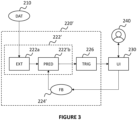
- FIG. 3 represents an example of a monitoring system according to a second embodiment of the invention.
- the information is no longer binary as in the first embodiment, but comprises two data, one relating to the identification of an event in the time sequence of data and the other to the identification of an irregularity in the time sequence of data.
- the 220' detection module of the Figure 3 can be configured to identify on the one hand the presence or absence of an event in the data sequence, and on the other hand the presence or absence of an irregularity in the temporal sequence of data.
- the identification information can therefore include two data: a data item relating to the presence or absence of an event in the data sequence and a data item relating to the presence or absence of an irregularity in the data sequence.
- such identifying information may be: [0, 0] if no event is identified and no irregularity is identified; [0, 1] if no event is identified but an irregularity is identified; [1, 0] if an event is identified but no irregularity is identified; and [1, 1] if an event is identified and an irregularity is identified.
- the confirmation information also incorporates two data: one data relating to the presence or absence of an event in the data sequence and one data relating to the presence or absence of an irregularity in the data sequence (as indicated by the user).
- the confirmation information can thus be, for example: [0, 0] if no event is present and no irregularity is present; [0, 1] if no event is present but an irregularity is present; [1, 0] if an event is present but no irregularity is present; and [1, 1] if an event is present and an irregularity is present.
- the derived data 224' may for example comprise two binary variables: a first binary variable relating to the presence of an event and a second variable relating to the presence of an irregularity.
- the first variable is equal to 1 if the identification and confirmation information relating to an event match and 0 otherwise.
- the second variable is equal to 1 if the identification and confirmation information relating to an irregularity match and 0 otherwise.
- the derived data 224' may thus be defined as follows, and may correspond to the reward provided to the learning model of the module 222'b: Identification information Confirmation information Derived data [0 ; 0] [0; 0] [1; 1] [0 ; 1] [1; 0] [1; 0] [0 ; 1] [1; 1] [0; 0] [0 ; 1] [0; 0] [0 ; 1] [0; ; 1] [1; 1] [1; 0] [0; 0] [0; 0] [1; 1] [0 ; 1] [0; ; 1] [0; 1] [0 ; 1] [0 ; 1] [0 ; 1] [0 ; 1] [0 ; 1] [0 ; 1] [0 ; 1] [0 ; 1] [0 ; 1] [0 ; 0] [1; 0] [1; 1] [1; 1] [1; 0] [1; 1
- the module 222a may be the same for both embodiments.
- the module 222'b receives as input the new derived data 224' and uses this new derived data 224' and the identification information to learn according to a learning mechanism, for example a reinforcement learning mechanism.
- the distinction made between the two possible types of anomaly allows several options for training the module 222'b: it can be decided that the new derived data 224' is used to train the module 222'b whenever an anomaly is identified (even if it is an irregularity), or that the new derived data 224' is used to train the module 222'b only when an event is identified (but not an anomaly). According to the latter option, the module 222'b only learns when the data quality is correct.
- the surveillance system shown in the Figure 3 further comprises a trigger module 226 which can be configured to issue an alert to the user interface 230 when an anomaly is detected by the detection module 222'.
- the confirmation information is only generated when an alert has been issued.
- the user 240 only intervenes to confirm or deny the presence of an anomaly, and if the anomaly is an irregularity, the user 240 can further take the necessary actions.
- the user 240 is less solicited (which is particularly advantageous for applications where anomalies are rare).
- trigger module can also be used as part of the monitoring system of the Figure 2 .
- user 240 does not know what type of anomaly was detected.
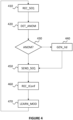
- FIG. 4 represents a monitoring method according to one or more embodiments of the invention.
- the monitoring method of the Figure 4 is typically implemented by the detection module 220, 220'.
- a time sequence of data relating to a system called “analyzed system” above, is received.
- this time sequence of data is analyzed to identify a possible anomaly.
- Step 420 is conventionally implemented using a machine learning model previously trained to identify, in a time sequence of data, a presence or absence of an anomaly in said time sequence of data.
- a step 430 it is checked whether or not an anomaly has been identified in the time sequence of data and if an anomaly has been identified, a step 440 is implemented, during which identification information relating to said identified anomaly is generated, as detailed above with reference to Figures 2 And 3 .
- identification information may also be implemented when no anomaly has been identified.
- the identification information may, for example, be set to a reference value corresponding to an absence of identification of an anomaly.
- the time sequence of the data is only sent when the identification information has been generated in step 440, i.e. when an anomaly has been identified in step 420.
- step 440 (and possibly 450)
- confirmation information relating to the presence or absence of an anomaly in the time sequence of data is received via the user interface during a step 460, as detailed above with reference to Figures 2 And 3 .
- this confirmation information is only received when the identification information has been generated in step 440, i.e. when an anomaly has been identified in step 420.
- This confirmation information is then used during a step 470 to train the machine learning model via a learning mechanism, for example a reinforcement learning mechanism.
- a data item 224, 224' derived from the confirmation information received in step 460 may be used as a reward for the reinforcement learning mechanism.
- this derived data item 224, 224' may be determined from the confirmation information and the identification information, when the latter is available.
- Steps 410 to 470 can of course be implemented iteratively, so as to monitor the analyzed system “continuously”, sequence by sequence.
- FIG. 5 represents an example of a monitoring device according to one or more embodiments of the invention.
- the monitoring device comprises a computer 500, comprising a memory 501 for storing instructions allowing the implementation of the method and temporary data for carrying out different steps of the methods described previously.
- the computer 500 can in particular perform the functions of the detection module 220, 220' of the Figures 2 And 3 .
- the computer 500 further comprises a circuit 502.
- This circuit may be, for example, a processor capable of interpreting instructions in the form of a computer program, an electronic card whose steps of the method of the invention are described in the silicon, or even a programmable electronic chip such as an FPGA chip (for “Field-Programmable Gate Array” in English).
- the computer 500 comprises an input interface 503 for receiving the time sequence of data, and a communication interface 504 for communicating with a user interface (which may or may not be part of the monitoring device), and in particular for sending to the user interface 230 the time sequence of data and the possible identification information and for receiving from the user interface 230 the confirmation information.
- a user interface which may or may not be part of the monitoring device
- the functional diagram presented on the Figure 4 is a typical example of a program some of whose instructions can be carried out on the device described. As such, the Figure 4 may correspond to the flowchart of the general algorithm of a computer program within the meaning of the invention.
Landscapes
- Engineering & Computer Science (AREA)
- Theoretical Computer Science (AREA)
- Software Systems (AREA)
- Physics & Mathematics (AREA)
- General Engineering & Computer Science (AREA)
- General Physics & Mathematics (AREA)
- Computing Systems (AREA)
- Mathematical Physics (AREA)
- Artificial Intelligence (AREA)
- Evolutionary Computation (AREA)
- Data Mining & Analysis (AREA)
- Biomedical Technology (AREA)
- Molecular Biology (AREA)
- Life Sciences & Earth Sciences (AREA)
- Health & Medical Sciences (AREA)
- Biophysics (AREA)
- Computational Linguistics (AREA)
- General Health & Medical Sciences (AREA)
- Computer Security & Cryptography (AREA)
- Computer Vision & Pattern Recognition (AREA)
- Medical Informatics (AREA)
- Computer Hardware Design (AREA)
- Alarm Systems (AREA)
- Testing And Monitoring For Control Systems (AREA)
- Debugging And Monitoring (AREA)
Applications Claiming Priority (1)
| Application Number | Priority Date | Filing Date | Title |
|---|---|---|---|
| FR2313544A FR3156228A1 (fr) | 2023-12-05 | 2023-12-05 | Procédé de surveillance d’un système |
Publications (1)
| Publication Number | Publication Date |
|---|---|
| EP4567680A1 true EP4567680A1 (de) | 2025-06-11 |
Family
ID=90810927
Family Applications (1)
| Application Number | Title | Priority Date | Filing Date |
|---|---|---|---|
| EP24216025.7A Pending EP4567680A1 (de) | 2023-12-05 | 2024-11-28 | Verfahren zur überwachung eines systems |
Country Status (3)
| Country | Link |
|---|---|
| US (1) | US20250181713A1 (de) |
| EP (1) | EP4567680A1 (de) |
| FR (1) | FR3156228A1 (de) |
Families Citing this family (1)
| Publication number | Priority date | Publication date | Assignee | Title |
|---|---|---|---|---|
| CN121564651A (zh) * | 2025-11-27 | 2026-02-24 | 中国标准化研究院 | 基于ai视觉识别的易腐肉制品保鲜减损智能监测系统 |
Citations (1)
| Publication number | Priority date | Publication date | Assignee | Title |
|---|---|---|---|---|
| WO2022048779A1 (en) * | 2020-09-04 | 2022-03-10 | Lytt Limited | Anomaly detection using time series data |
-
2023
- 2023-12-05 FR FR2313544A patent/FR3156228A1/fr active Pending
-
2024
- 2024-11-28 EP EP24216025.7A patent/EP4567680A1/de active Pending
- 2024-12-04 US US18/968,397 patent/US20250181713A1/en active Pending
Patent Citations (1)
| Publication number | Priority date | Publication date | Assignee | Title |
|---|---|---|---|---|
| WO2022048779A1 (en) * | 2020-09-04 | 2022-03-10 | Lytt Limited | Anomaly detection using time series data |
Non-Patent Citations (1)
| Title |
|---|
| DJEACHANDRANE ABHISHEK ET AL: "QoE-based Situational Awareness-Centric Decision Support for Network Video Surveillance", ICC 2022 - IEEE INTERNATIONAL CONFERENCE ON COMMUNICATIONS, IEEE, 16 May 2022 (2022-05-16), pages 335 - 340, XP034167370, DOI: 10.1109/ICC45855.2022.9838601 * |
Also Published As
| Publication number | Publication date |
|---|---|
| US20250181713A1 (en) | 2025-06-05 |
| FR3156228A1 (fr) | 2025-06-06 |
Similar Documents
| Publication | Publication Date | Title |
|---|---|---|
| US9525952B2 (en) | Real-time audience attention measurement and dashboard display | |
| EP4033399B1 (de) | It-gerät und verfahren zur schätzung der dichte einer menschenmenge | |
| FR2981561A1 (fr) | Procede de detection d'activite a capteur de mouvements, dispositif et programme d'ordinateur correspondants | |
| FR3048542A1 (fr) | Dispositif et methode de surveillance personnalises d'un conducteur d'un vehicule automobile | |
| EP4567680A1 (de) | Verfahren zur überwachung eines systems | |
| KR20190082149A (ko) | 녹내장 발생 예측 방법 | |
| EP4136417B1 (de) | System zur echtzeiterkennung und identifizierung von schallquellen | |
| EP3836014B1 (de) | Verfahren zur verfolgung eines elements, eines zugehörigen elektronischen geräts und eines computerprogrammprodukts | |
| EP3608836A1 (de) | Verfahren zum erfassen eines fingerabdruck-bilds | |
| WO2022068304A1 (zh) | 音质检测方法及装置 | |
| CN115848379A (zh) | 一种驾驶员危险驾驶的检测及警示方法 | |
| FR3089648A1 (fr) | Procede de detection non supervise d’attaques internes et systeme associe | |
| WO2023135253A1 (fr) | Procédé de traitement de transaction, système et programme correspondant | |
| FR3118489A1 (fr) | Procédé de contrôle non destructif pour une pièce aéronautique | |
| FR2875626A1 (fr) | Procede de detection et de pistage de cibles ponctuelles, dans un systeme de surveillance optronique | |
| CN115022589B (zh) | 一种图像显示控制方法、装置、设备及可读存储介质 | |
| TWI894931B (zh) | 一種具有誤判排除功能的駕駛違規行為偵測方法及電子裝置 | |
| EP4535777A2 (de) | Verfahren zur verbesserung einer konfiguration eines kamerasystems | |
| CN118364419B (zh) | 一种异常数据设备的检测方法、装置、设备及存储介质 | |
| CN116707965B (zh) | 一种威胁检测方法、装置、存储介质以及电子设备 | |
| FR3092423A1 (fr) | Cartographie de saillance d'images pendant une classification d'images par intelligence artificielle | |
| EP4657384A1 (de) | Verfahren und vorrichtung zur erkennung von betrug bei der identifizierung einer person | |
| FR3140958A1 (fr) | Procédé de détection d’anomalie dans une série temporelle observée de valeurs d’une grandeur physique représentative des performances d’un système. | |
| CN121010964A (zh) | 具有误判排除功能的驾驶违规行为侦测方法及电子装置 | |
| EP4602466A1 (de) | Verfahren zur erkennung einer anomalie in einer beobachteten zeitreihe von werten einer physikalischen grösse, die die leistung eines systems repräsentiert |
Legal Events
| Date | Code | Title | Description |
|---|---|---|---|
| PUAI | Public reference made under article 153(3) epc to a published international application that has entered the european phase |
Free format text: ORIGINAL CODE: 0009012 |
|
| STAA | Information on the status of an ep patent application or granted ep patent |
Free format text: STATUS: THE APPLICATION HAS BEEN PUBLISHED |
|
| AK | Designated contracting states |
Kind code of ref document: A1 Designated state(s): AL AT BE BG CH CY CZ DE DK EE ES FI FR GB GR HR HU IE IS IT LI LT LU LV MC ME MK MT NL NO PL PT RO RS SE SI SK SM TR |
|
| STAA | Information on the status of an ep patent application or granted ep patent |
Free format text: STATUS: REQUEST FOR EXAMINATION WAS MADE |
|
| 17P | Request for examination filed |
Effective date: 20251210 |