EP4567656A1 - Verfahren und system zur berechnung von temperaturparametern in einem transienten konjugierten wärmeübertragungssystem reduzierter ordnung - Google Patents
Verfahren und system zur berechnung von temperaturparametern in einem transienten konjugierten wärmeübertragungssystem reduzierter ordnung Download PDFInfo
- Publication number
- EP4567656A1 EP4567656A1 EP24217320.1A EP24217320A EP4567656A1 EP 4567656 A1 EP4567656 A1 EP 4567656A1 EP 24217320 A EP24217320 A EP 24217320A EP 4567656 A1 EP4567656 A1 EP 4567656A1
- Authority
- EP
- European Patent Office
- Prior art keywords
- reduced
- fluid
- battery
- temperature
- transient
- Prior art date
- Legal status (The legal status is an assumption and is not a legal conclusion. Google has not performed a legal analysis and makes no representation as to the accuracy of the status listed.)
- Granted
Links
Images




Classifications
-
- G—PHYSICS
- G06—COMPUTING OR CALCULATING; COUNTING
- G06F—ELECTRIC DIGITAL DATA PROCESSING
- G06F30/00—Computer-aided design [CAD]
- G06F30/20—Design optimisation, verification or simulation
- G06F30/23—Design optimisation, verification or simulation using finite element methods [FEM] or finite difference methods [FDM]
-
- G—PHYSICS
- G05—CONTROLLING; REGULATING
- G05D—SYSTEMS FOR CONTROLLING OR REGULATING NON-ELECTRIC VARIABLES
- G05D23/00—Control of temperature
- G05D23/19—Control of temperature characterised by the use of electric means
- G05D23/1917—Control of temperature characterised by the use of electric means using digital means
-
- G—PHYSICS
- G06—COMPUTING OR CALCULATING; COUNTING
- G06F—ELECTRIC DIGITAL DATA PROCESSING
- G06F30/00—Computer-aided design [CAD]
- G06F30/20—Design optimisation, verification or simulation
- G06F30/28—Design optimisation, verification or simulation using fluid dynamics, e.g. using Navier-Stokes equations or computational fluid dynamics [CFD]
-
- H—ELECTRICITY
- H01—ELECTRIC ELEMENTS
- H01M—PROCESSES OR MEANS, e.g. BATTERIES, FOR THE DIRECT CONVERSION OF CHEMICAL ENERGY INTO ELECTRICAL ENERGY
- H01M10/00—Secondary cells; Manufacture thereof
- H01M10/60—Heating or cooling; Temperature control
- H01M10/62—Heating or cooling; Temperature control specially adapted for specific applications
- H01M10/625—Vehicles
-
- G—PHYSICS
- G06—COMPUTING OR CALCULATING; COUNTING
- G06F—ELECTRIC DIGITAL DATA PROCESSING
- G06F2111/00—Details relating to CAD techniques
- G06F2111/10—Numerical modelling
-
- H—ELECTRICITY
- H01—ELECTRIC ELEMENTS
- H01M—PROCESSES OR MEANS, e.g. BATTERIES, FOR THE DIRECT CONVERSION OF CHEMICAL ENERGY INTO ELECTRICAL ENERGY
- H01M10/00—Secondary cells; Manufacture thereof
- H01M10/60—Heating or cooling; Temperature control
- H01M10/61—Types of temperature control
- H01M10/613—Cooling or keeping cold
-
- H—ELECTRICITY
- H01—ELECTRIC ELEMENTS
- H01M—PROCESSES OR MEANS, e.g. BATTERIES, FOR THE DIRECT CONVERSION OF CHEMICAL ENERGY INTO ELECTRICAL ENERGY
- H01M10/00—Secondary cells; Manufacture thereof
- H01M10/60—Heating or cooling; Temperature control
- H01M10/63—Control systems
- H01M10/633—Control systems characterised by algorithms, flow charts, software details or the like
-
- H—ELECTRICITY
- H01—ELECTRIC ELEMENTS
- H01M—PROCESSES OR MEANS, e.g. BATTERIES, FOR THE DIRECT CONVERSION OF CHEMICAL ENERGY INTO ELECTRICAL ENERGY
- H01M10/00—Secondary cells; Manufacture thereof
- H01M10/60—Heating or cooling; Temperature control
- H01M10/65—Means for temperature control structurally associated with the cells
- H01M10/656—Means for temperature control structurally associated with the cells characterised by the type of heat-exchange fluid
- H01M10/6567—Liquids
-
- H—ELECTRICITY
- H01—ELECTRIC ELEMENTS
- H01M—PROCESSES OR MEANS, e.g. BATTERIES, FOR THE DIRECT CONVERSION OF CHEMICAL ENERGY INTO ELECTRICAL ENERGY
- H01M2220/00—Batteries for particular applications
- H01M2220/20—Batteries in motive systems, e.g. vehicle, ship, plane
-
- Y—GENERAL TAGGING OF NEW TECHNOLOGICAL DEVELOPMENTS; GENERAL TAGGING OF CROSS-SECTIONAL TECHNOLOGIES SPANNING OVER SEVERAL SECTIONS OF THE IPC; TECHNICAL SUBJECTS COVERED BY FORMER USPC CROSS-REFERENCE ART COLLECTIONS [XRACs] AND DIGESTS
- Y02—TECHNOLOGIES OR APPLICATIONS FOR MITIGATION OR ADAPTATION AGAINST CLIMATE CHANGE
- Y02E—REDUCTION OF GREENHOUSE GAS [GHG] EMISSIONS, RELATED TO ENERGY GENERATION, TRANSMISSION OR DISTRIBUTION
- Y02E60/00—Enabling technologies; Technologies with a potential or indirect contribution to GHG emissions mitigation
- Y02E60/10—Energy storage using batteries
Definitions
- the disclosure herein generally relates to the field of battery management and, more particularly, to a method and system for computing temperature parameters in reduced-order transient conjugate heat transfer system.
- Conjugate heat transfer is a type of heat transfer analysis between solids and fluid(s). Heat transfer in batteries of electric vehicles is an example of conjugate heat transfer, where heat dissipation in solid battery is transferred to fluids surrounding the solid battery/battery.
- BMS Battery Management System
- BMS require numerous sensors for estimating the battery status and safety which is a costly process.
- real time models like digital twins are used for predicting battery parameters thereby ensuring status and safety/health of batteries.
- CFD computational fluid dynamics
- a method for Computing temperature parameters in reduced-order transient conjugate heat transfer system includes receiving, by one or more hardware processors, a plurality of input parameters pertaining to a transient conjugate heat transfer system, wherein the plurality of input parameters comprises a heat generation parameter, a plurality of fluid parameters and a plurality of battery parameters.
- the method includes computing by the one or more hardware processors, a plurality of fluid velocity reduced coefficients and a plurality of fluid pressure reduced coefficients associated with the conjugate heat transfer system based on a first plurality of fluid steady state reduced basis equations, the plurality of input parameters and a plurality of reduced order matrices, wherein the first plurality of fluid steady state reduced basis equations are generated by projecting a discretized form of Full Order Model (FOM) governing equations associated with the conjugate heat transfer system based on a first reduced subspace, wherein the first reduced subspace corresponding to fluid velocity and fluid pressure is computed based on the plurality of input parameters using a Proper Orthogonal Decomposition (POD) algorithm and, wherein the plurality of reduced order matrices are computed based on the first reduced subspace.
- FAM Full Order Model
- the method includes computing, by the one or more hardware processors, a fluid velocity field and a fluid pressure field based on the plurality of fluid velocity reduced coefficients, the plurality of fluid pressure reduced coefficients and the first reduced subspace. Furthermore, the method includes computing, by the one or more hardware processors, a fluid mass flux based on the fluid velocity field and the fluid pressure field using an equation solver.
- the method includes computing, by the one or more hardware processors, a plurality of fluid temperature reduced coefficients and a plurality of battery temperature reduced coefficients associated with the conjugate heat transfer system by solving a plurality of fluid temperature transient reduced basis equations and a plurality of battery temperature transient reduced basis equations based on the plurality of input parameters and the plurality of time invariant reduced order matrices, wherein the plurality of fluid temperature transient reduced basis equations and a plurality of battery temperature transient reduced basis equations are generated by projecting the discretized form of FOM governing equations associated with the transient conjugate heat transfer system and the second reduced subspace, wherein the second reduced subspace corresponding to fluid temperature and battery temperature is computed based on the plurality of input parameters using POD algorithm, wherein the plurality of time invariant reduced order matrices are computed based on the second reduced subspace, wherein the plurality of fluid temperature transient reduced basis equations and the plurality of battery temperature transient reduced basis equations are solved separately in a sequential manner
- the method includes computing, by the one or more hardware processors, the fluid temperature field and the battery temperature field associated with the transient conjugate heat transfer system based on the plurality of fluid temperature reduced coefficients and the plurality of battery temperature reduced coefficients, and the second reduced subspace.
- a system for computing temperature parameters in reduced-order transient conjugate heat transfer system includes at least one memory storing programmed instructions, one or more Input /Output (I/O) interfaces, and one or more hardware processors operatively coupled to the at least one memory, wherein the one or more hardware processors are configured by the programmed instructions to receive a plurality of input parameters pertaining to a transient conjugate heat transfer system, wherein the plurality of input parameters comprises a heat generation parameter, a plurality of fluid parameters and a plurality of battery parameters.
- I/O Input /Output
- the one or more hardware processors are configured by the programmed instructions to compute a plurality of fluid velocity reduced coefficients and a plurality of fluid pressure reduced coefficients associated with the conjugate heat transfer system based on a first plurality of fluid steady state reduced basis equations, the plurality of input parameters and a plurality of reduced order matrices, wherein the first plurality of fluid steady state reduced basis equations are generated by projecting a discretized form of Full Order Model (FOM) governing equations associated with the conjugate heat transfer system based on a first reduced subspace, wherein the first reduced subspace corresponding to fluid velocity and fluid pressure is computed based on the plurality of input parameters using a Proper Orthogonal Decomposition (POD) algorithm and, wherein the plurality of reduced order matrices are computed based on the first reduced subspace.
- FAM Full Order Model
- POD Proper Orthogonal Decomposition
- the one or more hardware processors are configured by the programmed instructions to compute a fluid velocity field and a fluid pressure field based on the plurality of fluid velocity reduced coefficients, the plurality of fluid pressure reduced coefficients and the first reduced subspace. Furthermore, the one or more hardware processors are configured by the programmed instructions to compute a fluid mass flux based on the fluid velocity field and the fluid pressure field using an equation solver.
- the one or more hardware processors are configured by the programmed instructions to compute a plurality of fluid temperature reduced coefficients and a plurality of battery temperature reduced coefficients associated with the conjugate heat transfer system by solving a plurality of fluid temperature transient reduced basis equations and a plurality of battery temperature transient reduced basis equations based on the plurality of input parameters and the plurality of time invariant reduced order matrices, wherein the plurality of fluid temperature transient reduced basis equations and a plurality of battery temperature transient reduced basis equations are generated by projecting the discretized form of FOM governing equations associated with the transient conjugate heat transfer system and the second reduced subspace, wherein the second reduced subspace corresponding to fluid temperature and battery temperature is computed based on the plurality of input parameters using POD algorithm, wherein the plurality of time invariant reduced order matrices are computed based on the second reduced subspace, wherein the plurality of fluid temperature transient reduced basis equations and the plurality of battery temperature transient reduced basis equations are solved separately in a
- the one or more hardware processors are configured by the programmed instructions to compute the fluid temperature field and the battery temperature field associated with the transient conjugate heat transfer system based on the plurality of fluid temperature reduced coefficients and the plurality of battery temperature reduced coefficients, and the second reduced subspace.
- a computer program product including a non-transitory computer-readable medium having embodied therein a computer program for computing temperature parameters in reduced-order transient conjugate heat transfer system.
- the computer readable program when executed on a computing device, causes the computing device to receive a plurality of input parameters pertaining to a transient conjugate heat transfer system, wherein the plurality of input parameters comprises a heat generation parameter, a plurality of fluid parameters and a plurality of battery parameters.
- the computer readable program when executed on a computing device, causes the computing device to compute a plurality of fluid velocity reduced coefficients and a plurality of fluid pressure reduced coefficients associated with the conjugate heat transfer system based on a first plurality of fluid steady state reduced basis equations, the plurality of input parameters and a plurality of reduced order matrices, wherein the first plurality of fluid steady state reduced basis equations are generated by projecting a discretized form of Full Order Model (FOM) governing equations associated with the conjugate heat transfer system based on a first reduced subspace, wherein the first reduced subspace corresponding to fluid velocity and fluid pressure is computed based on the plurality of input parameters using a Proper Orthogonal Decomposition (POD) algorithm and, wherein the plurality of reduced order matrices are computed based on the first reduced subspace.
- FAM Full Order Model
- the computer readable program when executed on a computing device, causes the computing device to compute a fluid velocity field and a fluid pressure field based on the plurality of fluid velocity reduced coefficients, the plurality of fluid pressure reduced coefficients and the first reduced subspace.
- the one or more hardware processors are configured by the programmed instructions to compute a fluid mass flux based on the fluid velocity field and the fluid pressure field using an equation solver.
- the computer readable program when executed on a computing device, causes the computing device to compute a plurality of fluid temperature reduced coefficients and a plurality of battery temperature reduced coefficients associated with the conjugate heat transfer system by solving a plurality of fluid temperature transient reduced basis equations and a plurality of battery temperature transient reduced basis equations based on the plurality of input parameters and the plurality of time invariant reduced order matrices, wherein the plurality of fluid temperature transient reduced basis equations and a plurality of battery temperature transient reduced basis equations are generated by projecting the discretized form of FOM governing equations associated with the transient conjugate heat transfer system and the second reduced subspace, wherein the second reduced subspace corresponding to fluid temperature and battery temperature is computed based on the plurality of input parameters using POD algorithm, wherein the plurality of time invariant reduced order matrices are computed based on the second reduced subspace, wherein the plurality of fluid temperature transient reduced basis equations and the plurality of battery temperature transient reduced basis equations are solved
- computer readable program when executed on a computing device, causes the computing device to compute the fluid temperature field and the battery temperature field associated with the transient conjugate heat transfer system based on the plurality of fluid temperature reduced coefficients and the plurality of battery temperature reduced coefficients, and the second reduced subspace.
- Electric Vehicles EV
- HEV Hybrid Electric Vehicles
- BMS Battery management system
- Digital twin is an efficient way to model the behavior of a real battery pack in a virtual environment and use the insights gained from the twin to optimize and predict future trends.
- a typical digital twin inside an electric vehicle consists of modules to predict State of Charge (SoC) and State of Health (SoH) of the battery stack.
- SoC State of Charge
- SoH State of Health
- the SoH and SoC of a battery have a strong dependence on its temperature and it is essential to compute temperature parameters in an accurate manner.
- the ideal operating range for the battery pack is between 25 C to 35 C. At higher temperatures above that limit, the capacity of the battery degrades faster and reduces the life of the battery.
- the BMS require numerous sensors for estimating parameters associated with the battery status and safety, which is a costly process.
- real time models like digital twins are used for predicting battery parameters thereby ensuring status and safety of batteries.
- Conventional heat transfer modeling using available empirical correlations work well for well-defined flow paths like in a rectangular or circular coolant channels.
- immersion cooling applications where the battery stack is cooled with a dielectric coolant fluid has complex flow patterns that are not modeled easily without high fidelity modeling.
- some conventional approaches utilized Machine Learning (ML) model which are data driven and the ML models are sensitive to change in boundary conditions of the system, that means their performance is poor when the boundary conditions of the system are different from that of boundary conditions of the data used to train the model. Similar problems exist with the empirical models.
- ML Machine Learning
- embodiments herein provide a method and system for computing temperature parameters in reduced-order transient conjugate heat transfer system.
- the present disclosure combines physics-based and data-driven techniques to compute temperature parameters of the conjugate heat transfer system in an accurate and faster manner. Combining physics-based and data-driven techniques is a challenging process due to discrepancies between the models, nonlinearities of the physical system, dimensionality reduction, complexity of integrating models effectively, computational complexity, and need for accurate training data. Initially, a plurality of input parameters pertaining to a transient conjugate heat transfer system is received.
- a plurality of fluid velocity reduced coefficients and a plurality of fluid pressure reduced coefficients associated with the conjugate heat transfer system is computed based on a first plurality of fluid steady state reduced basis equations, the plurality of input parameters and a plurality of reduced order matrices.
- a fluid velocity field and a fluid pressure field are computed based on the plurality of fluid velocity reduced coefficients, the plurality of fluid pressure reduced coefficients and the first reduced subspace.
- a fluid mass flux is computed based on the fluid velocity field and the fluid pressure field using an equation solver.
- a plurality of fluid temperature reduced coefficients and a plurality of battery temperature reduced coefficients associated with the conjugate heat transfer system are computed.
- the fluid temperature field and the battery temperature field associated with the transient conjugate heat transfer system is computed based on the plurality of fluid temperature reduced coefficients and the plurality of battery temperature reduced coefficients, and the second reduced subspace.
- FIG. 1A through FIG. 4 where similar reference characters denote corresponding features consistently throughout the figures, there are shown preferred embodiments and these embodiments are described in the context of the following exemplary system and/or method.
- FIG. 1A is a functional block diagram of a system 100 for Computing temperature parameters in reduced-order transient conjugate heat transfer system, in accordance with some embodiments of the present disclosure.
- the system 100 includes or is otherwise in communication with hardware processors 102, at least one memory such as a memory 104, an Input /Output (I/O) interface 112.
- the hardware processors 102, memory 104, and the I/O interface 112 may be coupled by a system bus such as a system bus 108 or a similar mechanism.
- the hardware processors 102 can be one or more hardware processors.
- the I/O interface 112 may include a variety of software and hardware interfaces, for example, a web interface, a graphical user interface, and the like.
- the I/O interface 112 may include a variety of software and hardware interfaces, for example, interfaces for peripheral device(s), such as a keyboard, a mouse, an external memory, a printer and the like. Further, the I/O interface 112 may enable the system 100 to communicate with other devices, such as web servers, and external databases.
- the I/O interface 112 can facilitate multiple communications within a wide variety of networks and protocol types, including wired networks, for example, local area network (LAN), cable, etc., and wireless networks, such as Wireless LAN (WLAN), cellular, or satellite.
- the I/O interface 112 may include one or more ports for connecting several computing systems with one another or to another server computer.
- the I/O interface 112 may include one or more ports for connecting several devices to one another or to another server.
- the one or more hardware processors 102 may be implemented as one or more microprocessors, microcomputers, microcontrollers, digital signal processors, central processing units, node machines, logic circuitries, and/or any devices that manipulate signals based on operational instructions.
- the one or more hardware processors 102 is configured to fetch and execute computer-readable instructions stored in the memory 104.
- the memory 104 may include any computer-readable medium known in the art including, for example, volatile memory, such as static random access memory (SRAM) and dynamic random access memory (DRAM), and/or non-volatile memory, such as read only memory (ROM), erasable programmable ROM, flash memories, hard disks, optical disks, and magnetic tapes.
- volatile memory such as static random access memory (SRAM) and dynamic random access memory (DRAM)
- non-volatile memory such as read only memory (ROM), erasable programmable ROM, flash memories, hard disks, optical disks, and magnetic tapes.
- the memory 104 includes a plurality of modules 106.
- the memory 104 also includes a data repository (or repository) 110 for storing data processed, received, and generated by the plurality of modules 106.
- the plurality of modules 106 include programs or coded instructions that supplement applications or functions performed by the system 100 for Computing temperature parameters in reduced-order transient conjugate heat transfer system.
- the plurality of modules 106 can include routines, programs, objects, components, and data structures, which performs particular tasks or implement particular abstract data types.
- the plurality of modules 106 may also be used as, signal processor(s), node machine(s), logic circuitries, and/or any other device or component that manipulates signals based on operational instructions.
- the plurality of modules 106 can be used by hardware, by computer-readable instructions executed by the one or more hardware processors 102, or by a combination thereof.
- the plurality of modules 106 can include various sub-modules (not shown).
- the plurality of modules 106 may include computer-readable instructions that supplement applications or functions performed by the system 100 for Computing temperature parameters in reduced-order transient conjugate heat transfer system.
- the data repository (or repository) 110 may include a plurality of abstracted piece of code for refinement and data that is processed, received, or generated as a result of the execution of the plurality of modules in the module(s) 106.
- the data repository 110 is shown internal to the system 100, it will be noted that, in alternate embodiments, the data repository 110 can also be implemented external to the system 100, where the data repository 110 may be stored within a database (repository 110) communicatively coupled to the system 100.
- the data contained within such external database may be periodically updated. For example, new data may be added into the database (not shown in FIG. 1 ) and/or existing data may be modified and/or non-useful data may be deleted from the database.
- the data may be stored in an external system, such as a Lightweight Directory Access Protocol (LDAP) directory and a Relational Database Management System (RDBMS).
- LDAP Lightweight Directory Access Protocol
- RDBMS Relational Database Management System
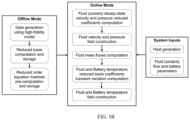
- FIG. 1B is a broad level process flow of system of FIG. 1A and can be understood with reference to method of FIG. 3
- the heat generated in batteries during charge and discharge is dissipated to surrounding coolant flow, as shown in FIG. 2 , to maintain the temperature of batteries in operating limit.
- the heat dissipation rate depends on many factors and coolant flow rate is one of them.
- the coolant flow rate can be adjusted by changing Reynolds number (Re) and vice versa.
- the Reynolds number is the ratio of inertial forces to viscous forces within a fluid that is subjected to relative internal movement due to different fluid velocities.
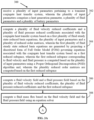
- FIG. 3 is an exemplary flow diagrams illustrating a method 300 for computing temperature parameters in reduced-order transient conjugate heat transfer system implemented by the system of FIG. 1A according to some embodiments of the present disclosure.
- the system 100 includes one or more data storage devices or the memory 104 operatively coupled to the one or more hardware processor(s) 102 and is configured to store instructions for execution of steps of the method 300 by the one or more hardware processors 102.
- the steps of the method 300 of the present disclosure will now be explained with reference to the components or blocks of the system 100 as depicted in FIG. 1A and the steps of flow diagram as depicted in FIG. 3 .
- the method 300 may be described in the general context of computer executable instructions.
- computer executable instructions can include routines, programs, objects, components, data structures, procedures, modules, functions, etc., that perform particular functions or implement particular abstract data types.
- the method 300 may also be practiced in a distributed computing environment where functions are performed by remote processing devices that are linked through a communication network.
- the order in which the method 300 is described is not intended to be construed as a limitation, and any number of the described method blocks can be combined in any order to implement the method 300, or an alternative method.
- the method 300 can be implemented in any suitable hardware, software, firmware, or combination thereof.
- the one or more hardware processors 102 are configured by the programmed instructions to receive a plurality of input parameters pertaining to a transient conjugate heat transfer system, wherein the plurality of input parameters comprises a heat generation parameter, a plurality of fluid parameters and a plurality of battery parameters.
- the plurality of fluid parameters includes fluid inlet velocity, fluid inlet temperature, fluid specific heat capacity, fluid density, fluid thermal conductivity, fluid viscosity, and coolant channel dimensions.
- the plurality of battery parameters includes ambient temperature, specific heat capacity of battery, battery density, thermal conductivity of battery, and battery dimensions.
- the one or more hardware processors 102 are configured by the programmed instructions to compute a plurality of fluid velocity reduced coefficients and a plurality of fluid pressure reduced coefficients associated with the conjugate heat transfer system based on a first plurality of fluid steady state reduced basis equations, the plurality of input parameters and a plurality of reduced order matrices.
- the first plurality of fluid steady state reduced basis equations are generated offline by projecting a discretized form of Full Order Model (FOM) governing equations associated with the conjugate heat transfer system based on a first reduced subspace.
- the first reduced subspace corresponding to fluid velocity and fluid pressure is computed based on the plurality of input parameters using a Proper Orthogonal Decomposition (POD) algorithm.
- POD Proper Orthogonal Decomposition
- the plurality of reduced order matrices are computed based on the first reduced subspace.
- a r n + 1 and b r n + 1 are the velocity and pressure reduced basis coefficients at the current time step.
- a r n and b r n are the velocity and pressure reduced basis coefficients of the previous time step.
- D r u , G r , L r , and M r are linear Reduced order discretization operators (Reduced order matrices) and they are precomputed in offline mode once.
- r r u , r r L , and r r M are Reduced order boundary vectors (matrices) and these are also precomputed in offline mode once.
- the one or more hardware processors 102 are configured by the programmed instructions to compute a fluid velocity field and a fluid pressure field based on the plurality of fluid velocity reduced coefficients, the plurality of fluid pressure reduced coefficients and the first reduced subspace.
- the one or more hardware processors 102 are configured by the programmed instructions to compute a fluid mass flux based on the fluid velocity field and the fluid pressure field using an equation solver.
- the one or more hardware processors 102 are configured by the programmed instructions to compute a plurality of fluid temperature reduced coefficients and a plurality of battery temperature reduced coefficients associated with the conjugate heat transfer system by solving a plurality of fluid temperature transient reduced basis equations and a plurality of battery temperature transient reduced basis equations based on the plurality of input parameters and the plurality of time invariant reduced order matrices.
- the plurality of fluid temperature transient reduced basis equations and a plurality of battery temperature transient reduced basis equations are generated offline by projecting the discretized form of FOM governing equations associated with the transient conjugate heat transfer system and the second reduced subspace.
- the second reduced subspace corresponding to fluid temperature and battery temperature is computed based on the plurality of input parameters using POD algorithm.
- the plurality of time invariant reduced order matrices are computed based on the second reduced subspace using.
- the plurality of fluid temperature transient reduced basis equations and the plurality of battery temperature transient reduced basis equations are solved separately in a sequential manner by coupling a plurality of boundary conditions associated with an interface of the battery and the fluid based on the fluid mass flux, the input parameters and the plurality of time invariant reduced order matrices.
- c r n + 1 and d r n + 1 are the fluid and battery temperature reduced basis coefficients at the current time step.
- c r n and d r n are the fluid and battery temperature reduced basis coefficients of the previous time step.
- C r a , D r a , and D r b are reduced order discretization operators (plurality of time invariant reduced order matrices).
- r r a and r r b are the reduced order boundary vectors (matrices).
- Q gr is the reduced order heat generation vector (matrix). All these matrices are precomputed once in offline mode.
- the battery domain temperature equation is solved first with the temperature at interface T SIF computed using heat flux as Neumann boundary condition from the fluid domain.
- the reduced basis solution of fluid and battery temperature are stored in separate matrices to couple them at the interface.
- the one or more hardware processors 102 are configured by the programmed instructions to compute the fluid temperature field and the battery temperature field associated with the transient conjugate heat transfer system based on the plurality of fluid temperature reduced coefficients and the plurality of battery temperature reduced coefficients, and the second reduced subspace.
- the reduced order solution is constructed for seven different Reynolds numbers, Re r ⁇ (250,500, 750, 1000, 1250, 1500, 1750).
- the reduced basis is calculated using three Reynolds numbers, Re p ⁇ (250,750, 1250), FOM simulation data and reduced order solution is constructed for all seven Reynolds numbers, Re r . Even though the reduced basis is extracted only from the data of Re p , the ROM solution constructed for all the Reynolds numbers Re r is accurate.
- RMS Root Mean Squared
- the embodiments of present disclosure herein address the unresolved problem of Computing temperature parameters in reduced-order transient conjugate heat transfer system.
- the present disclosure provides temperature results about orders of magnitude faster compared to FOM.
- the present disclosure works well both in the interpolation and extrapolation regions.
- the present solves FOM governing equations to compute reduced-order coefficients.
- the battery and fluid (coolant) domains are solved separately and coupled at interface by storing reduced sub space values of interface temperature in separate matrices in such a way that they can be used in the computations directly.
- the hardware device can be any kind of device which can be programmed including e.g. any kind of computer like a server or a personal computer, or the like, or any combination thereof.
- the device may also include means which could be e.g. hardware means like e.g. an application-specific integrated circuit (ASIC), a field-programmable gate array (FPGA), or a combination of hardware and software means, e.g.
- ASIC application-specific integrated circuit
- FPGA field-programmable gate array
- the means can include both hardware means and software means.
- the method embodiments described herein could be implemented in hardware and software.
- the device may also include software means.
- the embodiments may be implemented on different hardware devices, e.g. using a plurality of CPUs, GPUs and edge computing devices.
- the embodiments herein can comprise hardware and software elements.
- the embodiments that are implemented in software include but are not limited to, firmware, resident software, microcode, etc.
- the functions performed by various modules described herein may be implemented in other modules or combinations of other modules.
- a computer-usable or computer readable medium can be any apparatus that can comprise, store, communicate, propagate, or transport the program for use by or in connection with the instruction execution system, apparatus, or device.
- the illustrated steps are set out to explain the exemplary embodiments shown, and it should be anticipated that ongoing technological development will change the manner in which particular functions are performed. These examples are presented herein for purposes of illustration, and not limitation. Further, the boundaries of the functional building blocks have been arbitrarily defined herein for the convenience of the description.
- a computer-readable storage medium refers to any type of physical memory on which information or data readable by a processor may be stored.
- a computer-readable storage medium may store instructions for execution by one or more processors, including instructions for causing the processor(s) to perform steps or stages consistent with the embodiments described herein.
- the term "computer-readable medium” should be understood to include tangible items and exclude carrier waves and transient signals, i.e. non-transitory. Examples include random access memory (RAM), read-only memory (ROM), volatile memory, nonvolatile memory, hard drives, CD ROMs, DVDs, flash drives, disks, and any other known physical storage media.
Landscapes
- Engineering & Computer Science (AREA)
- Physics & Mathematics (AREA)
- General Physics & Mathematics (AREA)
- Theoretical Computer Science (AREA)
- Automation & Control Theory (AREA)
- Chemical Kinetics & Catalysis (AREA)
- General Chemical & Material Sciences (AREA)
- Electrochemistry (AREA)
- Computer Hardware Design (AREA)
- General Engineering & Computer Science (AREA)
- Chemical & Material Sciences (AREA)
- Manufacturing & Machinery (AREA)
- Geometry (AREA)
- Evolutionary Computation (AREA)
- Fluid Mechanics (AREA)
- Pure & Applied Mathematics (AREA)
- Mathematical Physics (AREA)
- Mathematical Optimization (AREA)
- Mathematical Analysis (AREA)
- Computing Systems (AREA)
- Algebra (AREA)
- Secondary Cells (AREA)
Applications Claiming Priority (1)
| Application Number | Priority Date | Filing Date | Title |
|---|---|---|---|
| IN202321083211 | 2023-12-06 |
Publications (3)
| Publication Number | Publication Date |
|---|---|
| EP4567656A1 true EP4567656A1 (de) | 2025-06-11 |
| EP4567656B1 EP4567656B1 (de) | 2026-01-14 |
| EP4567656C0 EP4567656C0 (de) | 2026-01-14 |
Family
ID=93799651
Family Applications (1)
| Application Number | Title | Priority Date | Filing Date |
|---|---|---|---|
| EP24217320.1A Active EP4567656B1 (de) | 2023-12-06 | 2024-12-04 | Verfahren und system zur berechnung von temperaturparametern in einem transienten konjugierten wärmeübertragungssystem reduzierter ordnung |
Country Status (2)
| Country | Link |
|---|---|
| US (1) | US20250190000A1 (de) |
| EP (1) | EP4567656B1 (de) |
-
2024
- 2024-12-04 EP EP24217320.1A patent/EP4567656B1/de active Active
- 2024-12-04 US US18/968,385 patent/US20250190000A1/en active Pending
Non-Patent Citations (3)
| Title |
|---|
| GERMAN P�TER ET AL: "GeN-ROM-An OpenFOAM -based multiphysics reduced-order modeling framework for the analysis of Molten Salt Reactors", PROGRESS IN NUCLEAR ENERGY, PERGAMON PRESS, OXFORD, GB, vol. 146, 25 February 2022 (2022-02-25), XP087001611, ISSN: 0149-1970, [retrieved on 20220225], DOI: 10.1016/J.PNUCENE.2022.104148 * |
| SOKRATIA GEORGAKA ET AL: "Parametric POD-Galerkin Model Order Reduction for Unsteady-State Heat Transfer Problems", ARXIV.ORG, CORNELL UNIVERSITY LIBRARY, 201 OLIN LIBRARY CORNELL UNIVERSITY ITHACA, NY 14853, 15 August 2018 (2018-08-15), XP081016251 * |
| XIANG LINYAN ET AL: "Efficient reduced order model for heat transfer in a battery pack of an electric vehicle", vol. 201, 29 October 2021 (2021-10-29), GB, pages 117641, XP093255849, ISSN: 1359-4311, Retrieved from the Internet <URL:https://pdf.sciencedirectassets.com/271641/1-s2.0-S1359431121X00166/1-s2.0-S135943112101067X/main.pdf?hash=eb82417f19dc04725903ad50ce62cb7f66e2f5185785533a99ffeca5bebb471a&host=68042c943591013ac2b2430a89b270f6af2c76d8dfd086a07176afe7c76c2c61&pii=S135943112101067X&tid=spdf-6123341c-6bc5-411b-b495-4a9> [retrieved on 20250305], DOI: 10.1016/j.applthermaleng.2021.117641 * |
Also Published As
| Publication number | Publication date |
|---|---|
| US20250190000A1 (en) | 2025-06-12 |
| EP4567656B1 (de) | 2026-01-14 |
| EP4567656C0 (de) | 2026-01-14 |
Similar Documents
| Publication | Publication Date | Title |
|---|---|---|
| Hashemi et al. | Machine learning‐based model for lithium‐ion batteries in BMS of electric/hybrid electric aircraft | |
| Ragone et al. | Data driven estimation of electric vehicle battery state-of-charge informed by automotive simulations and multi-physics modeling | |
| Naaz et al. | A generative adversarial network‐based synthetic data augmentation technique for battery condition evaluation | |
| CN116154900B (zh) | 一种电池储能电站的主动安全三级防控系统及方法 | |
| Anandavel et al. | Application of digital twins to the product lifecycle management of battery packs of electric vehicles | |
| Xu et al. | Capacity estimation of lithium-ion batteries with automatic feature extraction and graph-enhanced LSTM | |
| Myilsamy et al. | State-of-health prediction for Li-ion batteries for efficient battery management system using hybrid machine learning model | |
| Swarnkar et al. | A systematic literature review of state of health and state of charge estimation methods for batteries used in electric vehicle applications | |
| Naguib et al. | Thermal fault detection of lithium-ion battery packs through an integrated physics and deep neural network based model | |
| Liang et al. | Evaluation of battery modules state for electric vehicle using artificial neural network and experimental validation | |
| Zhang et al. | Method for Estimating the State of Health of Lithium-ion Batteries Based on Differential Thermal Voltammetry and Sparrow Search Algorithm-Elman Neural Network. | |
| Tian et al. | Anti‐interference lithium‐ion battery intelligent perception for thermal fault detection and localization | |
| Wang et al. | An inconsistency fault diagnosis method for lithium-ion cells in the battery pack based on piecewise dimensionality reduction and outlier identification | |
| EP4567656A1 (de) | Verfahren und system zur berechnung von temperaturparametern in einem transienten konjugierten wärmeübertragungssystem reduzierter ordnung | |
| Rao et al. | Comparison between organic and inorganic PCMs providing effective battery thermal management–A machine learning approach | |
| Li et al. | Synthetic thermal convolutional‐memory network for the lithium‐ion battery behaviour diagnosis against noise interruptions | |
| Azad et al. | Deep Learning for Dynamic Security Assessment of Power Systems with Adaptive Synthetic Sampling-Based Imbalanced Database: A Case Study | |
| US20250148175A1 (en) | Determining heat transfer rates between battery pack and coolant channel with varying coolant flow rate | |
| EP4550521A2 (de) | Verfahren und system zur vorhersage der temperaturverteilung in einem batteriepack | |
| Alani et al. | Applications of Big Data Analytics | |
| Obeid et al. | Supervised learning for early and accurate battery terminal voltage collapse detection | |
| Ali et al. | Thermal Management Technologies of Lithium-Ion Batteries Applied for Stationary Energy Storage Systems: Investigation on the Thermal Behavior of Lithium-Ion Batteries | |
| Couto et al. | Estimation of parameter probability distributions for lithium-ion battery string models using bayesian methods | |
| Gotz et al. | Application of anomaly detection algorithms in lithium-ion battery packs-a case study | |
| Lopez-Salazar et al. | A Probabilistic Approach for Electric Vehicle Battery Risk Estimation Based on a Safe Operating Area |
Legal Events
| Date | Code | Title | Description |
|---|---|---|---|
| PUAI | Public reference made under article 153(3) epc to a published international application that has entered the european phase |
Free format text: ORIGINAL CODE: 0009012 |
|
| STAA | Information on the status of an ep patent application or granted ep patent |
Free format text: STATUS: THE APPLICATION HAS BEEN PUBLISHED |
|
| AK | Designated contracting states |
Kind code of ref document: A1 Designated state(s): AL AT BE BG CH CY CZ DE DK EE ES FI FR GB GR HR HU IE IS IT LI LT LU LV MC ME MK MT NL NO PL PT RO RS SE SI SK SM TR |
|
| STAA | Information on the status of an ep patent application or granted ep patent |
Free format text: STATUS: REQUEST FOR EXAMINATION WAS MADE |
|
| 17P | Request for examination filed |
Effective date: 20250711 |
|
| GRAP | Despatch of communication of intention to grant a patent |
Free format text: ORIGINAL CODE: EPIDOSNIGR1 |
|
| STAA | Information on the status of an ep patent application or granted ep patent |
Free format text: STATUS: GRANT OF PATENT IS INTENDED |
|
| RIC1 | Information provided on ipc code assigned before grant |
Ipc: G06F 30/23 20200101AFI20250925BHEP Ipc: G06F 30/28 20200101ALI20250925BHEP |
|
| INTG | Intention to grant announced |
Effective date: 20251021 |
|
| GRAS | Grant fee paid |
Free format text: ORIGINAL CODE: EPIDOSNIGR3 |
|
| GRAA | (expected) grant |
Free format text: ORIGINAL CODE: 0009210 |
|
| STAA | Information on the status of an ep patent application or granted ep patent |
Free format text: STATUS: THE PATENT HAS BEEN GRANTED |
|
| AK | Designated contracting states |
Kind code of ref document: B1 Designated state(s): AL AT BE BG CH CY CZ DE DK EE ES FI FR GB GR HR HU IE IS IT LI LT LU LV MC ME MK MT NL NO PL PT RO RS SE SI SK SM TR |
|
| REG | Reference to a national code |
Ref country code: CH Ref legal event code: F10 Free format text: ST27 STATUS EVENT CODE: U-0-0-F10-F00 (AS PROVIDED BY THE NATIONAL OFFICE) Effective date: 20260114 Ref country code: GB Ref legal event code: FG4D |
|
| REG | Reference to a national code |
Ref country code: CH Ref legal event code: R17 Free format text: ST27 STATUS EVENT CODE: U-0-0-R10-R17 (AS PROVIDED BY THE NATIONAL OFFICE) Effective date: 20260116 |
|
| REG | Reference to a national code |
Ref country code: DE Ref legal event code: R096 Ref document number: 602024002067 Country of ref document: DE |
|
| REG | Reference to a national code |
Ref country code: IE Ref legal event code: FG4D |
|
| U01 | Request for unitary effect filed |
Effective date: 20260121 |
|
| U07 | Unitary effect registered |
Designated state(s): AT BE BG DE DK EE FI FR IT LT LU LV MT NL PT RO SE SI Effective date: 20260126 |