EP4567641A1 - Neuronale netzwerksicherheit - Google Patents
Neuronale netzwerksicherheit Download PDFInfo
- Publication number
- EP4567641A1 EP4567641A1 EP23213871.9A EP23213871A EP4567641A1 EP 4567641 A1 EP4567641 A1 EP 4567641A1 EP 23213871 A EP23213871 A EP 23213871A EP 4567641 A1 EP4567641 A1 EP 4567641A1
- Authority
- EP
- European Patent Office
- Prior art keywords
- input
- entity
- data
- neural network
- descrambling
- Prior art date
- Legal status (The legal status is an assumption and is not a legal conclusion. Google has not performed a legal analysis and makes no representation as to the accuracy of the status listed.)
- Pending
Links
Images




Classifications
-
- G—PHYSICS
- G06—COMPUTING OR CALCULATING; COUNTING
- G06F—ELECTRIC DIGITAL DATA PROCESSING
- G06F21/00—Security arrangements for protecting computers, components thereof, programs or data against unauthorised activity
- G06F21/10—Protecting distributed programs or content, e.g. vending or licensing of copyrighted material ; Digital rights management [DRM]
-
- G—PHYSICS
- G06—COMPUTING OR CALCULATING; COUNTING
- G06F—ELECTRIC DIGITAL DATA PROCESSING
- G06F21/00—Security arrangements for protecting computers, components thereof, programs or data against unauthorised activity
- G06F21/30—Authentication, i.e. establishing the identity or authorisation of security principals
- G06F21/31—User authentication
-
- G—PHYSICS
- G06—COMPUTING OR CALCULATING; COUNTING
- G06F—ELECTRIC DIGITAL DATA PROCESSING
- G06F21/00—Security arrangements for protecting computers, components thereof, programs or data against unauthorised activity
- G06F21/60—Protecting data
- G06F21/62—Protecting access to data via a platform, e.g. using keys or access control rules
- G06F21/6218—Protecting access to data via a platform, e.g. using keys or access control rules to a system of files or objects, e.g. local or distributed file system or database
-
- G—PHYSICS
- G06—COMPUTING OR CALCULATING; COUNTING
- G06N—COMPUTING ARRANGEMENTS BASED ON SPECIFIC COMPUTATIONAL MODELS
- G06N3/00—Computing arrangements based on biological models
- G06N3/02—Neural networks
-
- G—PHYSICS
- G06—COMPUTING OR CALCULATING; COUNTING
- G06N—COMPUTING ARRANGEMENTS BASED ON SPECIFIC COMPUTATIONAL MODELS
- G06N3/00—Computing arrangements based on biological models
- G06N3/02—Neural networks
- G06N3/04—Architecture, e.g. interconnection topology
- G06N3/045—Combinations of networks
-
- G—PHYSICS
- G06—COMPUTING OR CALCULATING; COUNTING
- G06N—COMPUTING ARRANGEMENTS BASED ON SPECIFIC COMPUTATIONAL MODELS
- G06N3/00—Computing arrangements based on biological models
- G06N3/02—Neural networks
- G06N3/08—Learning methods
-
- G—PHYSICS
- G06—COMPUTING OR CALCULATING; COUNTING
- G06N—COMPUTING ARRANGEMENTS BASED ON SPECIFIC COMPUTATIONAL MODELS
- G06N3/00—Computing arrangements based on biological models
- G06N3/02—Neural networks
- G06N3/08—Learning methods
- G06N3/084—Backpropagation, e.g. using gradient descent
Definitions
- the present invention relates to a means for improving security of a deployed neural network, and more specifically to protecting deployed neural networks from membership inference attacks.
- Neural network-based (i.e. machine learning) models have been applied to, and have become successful in solving, complex problems in a vast array of real-world contexts. Such models are often used in healthcare, finance, and ecommerce applications. To train such models, vast volumes of data are required. Often, the data used for training needs to be handled carefully. Indeed, training data often comprises sensitive and protected information such as medical records, location information, and other personally identifiable information (PII). Furthermore, training data is a source of competitive advantage for an organisation. It therefore follows that preventing unauthorised access to this protected information is an area of great concern.
- PII personally identifiable information
- models are designed to capture the various relationships and patterns across the features present in training data. As the model increases in accuracy, all the information described by the training data is compressed/converted into the form of the model. This can lead to the model leaking information about training data. Thus, models may be manipulated to reveal information about the data used for training. Specifically, in adversarial situations, attackers who only have black box access to the model can pass an input and infer, based on the model output, if the data was part of training data. This is called a membership inference attack.
- a system for improving security of a deployed neural network comprising:
- Embodiments thus provide improved security of a deployed neural network (i.e. improved security during inferencing of a neural network), in particular against membership inference attacks. Specifically, this is achieved by the provision of a data scrambler and a descrambling layer.
- the data scrambler receives an input from an entity (e.g., a user) and only scrambles the input if the entity is authenticated and authorized.
- the descrambling layer is attached to the deployed neural network, and descrambles the input so that the neural network may provide a correct output corresponding to the initial (unscrambled) input from the entity.
- the entity is not authenticated and/or authorized, then the input will not be scrambled and so the descrambling layer will provide an incorrect input to the neural network. Accordingly, unauthenticated, or unauthorized entities will not receive the correct output corresponding to the input from the entity from the deployed neural network (as the input provided by such entities will not be scrambled by the data scrambler).
- a deployed neural network is a neural network that has been trained and so is ready to generate model predictions based on model inputs. Values of weights of the deployed neural network may not be apparent to an entity using the neural network, and the training data used to train the deployed neural network is not available or accessible to the entity. However, at this stage training data used to train the neural network may be deduced by providing (often many) inputs to the deployed neural network, and assessing the corresponding output from the deployed neural network. That is, the output from the deployed neural network may be provided with a high degree of accuracy and/or confidence if the corresponding input is similar to data used to train the neural network. Accordingly, by providing large amounts of input to the deployed neural network and assessing the corresponding outputs, much of the training data may be deduced. This is a membership inference attack, which poses a threat to confidentiality and security of the training data.
- a descrambling layer is attached to the deployed neural network.
- the descrambling layer is provided such that all inputs to the deployed neural network are descrambled according to a descrambling algorithm. Accordingly, the descrambling layer alters a data distribution of the input to the neural network. As a result, unless the input is scrambled according to a scrambling algorithm before being input to the deployed neural network, the output from the deployed neural network will be incorrect. In some cases, it may not be known to the entity, or apparent to the entity, that a descrambling layer is attached to the deployed neural network.
- a data scrambler that processes the (intended) input to the neural network from the entity with a scrambling algorithm.
- the data scrambler only generates a scrambled input if the entity is authenticated and authorized.
- the scrambling algorithm may essentially negate the effect (i.e., the data redistribution of the input) of the descrambling algorithm applied by the descrambling layer.
- the data scrambler may be further configured to provide, responsive to unsuccessfully authenticating and/or authorizing the entity, the entity input as a non-scrambled input to the descrambling layer without processing the entity input with the scrambling algorithm.
- the descrambling layer may be further configured to receive the scrambled input or the non-scrambled input from the data scrambler; and generate an input for the deployed neural network by processing the non-scrambled input with the descrambling algorithm.
- the entity input is simply passed to the descrambling layer attached to the deployed neural network.
- the descrambling layer thus processes the non-scrambled entity input to generate the input for the deployed neural network. This will alter the input to the deployed neural network in a way that the output from the neural network will be incorrect.
- the authentication and authorization of the entity may be performed by an IAM system.
- the entity will need to provide an IAM access token indicating that the entity has a right to use the deployed neural network. This may ensure that unauthorized or unauthenticated entities are not able to provide an appropriately scrambled input to the deployed neural network.
- the data scrambler may be further configured to receive an unverified IAM access token from the entity; provide the unverified IAM access token to the IAM system; and receive a verification signal from the IAM system indicating whether the entity is successfully or unsuccessfully authenticated and authorized.
- the data scrambler itself may handle the IAM access token from the entity and consult the IAM system to verify the IAM access token. Accordingly, the data scrambler may selectively process the entity input with the scrambling algorithm based on the results from the IAM system.
- system may further comprise a license file system configured to receive a license file from the entity indicating a right to use the deployed neural network; determine an authenticity and validity of the license file; and provide access for the entity to the data scrambler responsive to determining that the license file is authentic and valid.
- a license file system configured to receive a license file from the entity indicating a right to use the deployed neural network; determine an authenticity and validity of the license file; and provide access for the entity to the data scrambler responsive to determining that the license file is authentic and valid.
- the license file system may be used offline to authenticate and authorize the user. That is, if the entity has a license file with a valid license key, then this may indicate they are authentic, and are authorized to use the deployed neural network. In this case, the license file system (either a separate component, or part of the data scrambler) will read the license file to perform scrambling. In addition, the descrambling layer may also read the license file to perform descrambling. Conversely, if the license file is not valid, then the entity is not an authentic and authorised entity, and the input from the entity will not be scrambled according to the scrambling algorithm.
- the descrambling algorithm may perform a reverse function of a function of the scrambling algorithm.
- the descrambling algorithm may directly execute the opposite processes of the scrambling algorithm on the input to the deployed neural network in order to undo the scrambling of data by the scrambling algorithm. For example, if a function of the scrambling algorithm is to rotate the input (being an image) 90 degrees clockwise, then a function of the descrambling algorithm may be to rotate the input to the deployed neural network 90 degrees anti-clockwise.
- the scrambling algorithm may comprise one or more randomized data transformations.
- the security of the deployed neural network may be improved. Indeed, as the data transform is randomized, it may be more difficult to deduce the process performed by the scrambling algorithm, and therefore more difficult circumvent the protection afforded by the system.
- the one or more randomized data transformations may include channel-wise image rotation, a scalar multiplication, an element-wise matrix subtraction, a data encryption using a secret key, a noise addition, and/or a data shuffling.
- the one or more randomized data transformations may include a scalar multiplication, an element-wise matrix subtraction, a data encryption using a secret key, a noise addition, and/or a data shuffling.
- the one or more randomized data transformations may include a scalar multiplication, an element-wise matrix subtraction, a data encryption using a secret key, a noise addition, and/or a data shuffling.
- Each of the above example data transformations may successfully change the data distribution of the input such that the deployed neural network will provide an incorrect output if the input is not scrambled before a descrambling is applied.
- the data scrambler may be deployed in machine code. Specifically, the data scrambler may be used as a shared library or dynamic linked library file.
- the system may further comprise a training module configured to train the descrambling layer using a training algorithm configured to receive an array of training inputs and respective known outputs.
- a training input may comprise a scrambled input obtained by processing a model input with the scrambling algorithm, and a respective known output may comprise the model input.
- the descrambling layer may be trained to process scrambled inputs into an original, unscrambled form by means of a training algorithm.
- the deployed neural network comprises one or more layers, and is configured to output a model prediction responsive to receiving a model input.
- the method comprises:
- a computer program comprising computer program code means adapted, when said computer program is run on a computer, to implement a method for improving security of a deployed neural network.
- Disclosed concepts provide improved security of a deployed neural network (i.e. improved security during inferencing of a neural network), in particular against membership inference attacks.
- a data scrambler and a descrambling layer are provided.
- the data scrambler receives an input from an entity (e.g., a user) and only scrambles the input if the entity is authenticated and authorized.
- the descrambling layer is attached to the deployed neural network, and descrambles the input so that the neural network may provide a correct output corresponding to the initial (unscrambled) input from the entity.
- the entity is not authenticated and/or authorized, then the input will not be scrambled and so the descrambling layer will provide an incorrect input to the neural network. Accordingly, unauthenticated, or unauthorized entities will not receive the correct output corresponding to the input from the entity from the deployed neural network (as the input provided by such entities will not be scrambled by the data scrambler).
- Neural networks are comprised of layers, each layer comprising a plurality of neurons.
- Each neuron comprises a mathematical operation.
- each neuron may comprise a different weighted combination of a single type of transformation (e.g. the same type of transformation, sigmoid etc. but with different weightings).
- the mathematical operation of each neuron is performed on the input data to produce a numerical output, and the outputs of each layer in the neural network are fed into the next layer sequentially. The final layer provides the output.
- CNNs convolutional neural networks
- RNNs recurrent neural networks
- GNNs graphical neural networks
- Methods of training a machine-learning algorithm are well known.
- such methods comprise obtaining a training dataset, comprising training input data entries and corresponding training output data entries.
- An initialized machine-learning algorithm is applied to each input data entry to generate predicted output data entries.
- An error between the predicted output data entries and corresponding training output data entries is used to modify the machine-learning algorithm. This process can be repeated until the error converges, and the predicted output data entries are sufficiently similar (e.g. ⁇ 1%) to the training output data entries. This is commonly known as a supervised learning technique.
- weightings of the mathematical operation of each neuron may be modified until the error converges.
- Known methods of modifying a neural network include gradient descent, backpropagation algorithms and so on.
- Said training dataset may contain confidential, sensitive, or valuable information. Accordingly, it is an object of the present invention to prevent such training data from being deduced from the operation of the deployed (e.g., trained and used for inferencing) neural network.
- embodiments of the invention are based on a technique to protect training data used to train a neural network once the neural network has been deployed (i.e. once the neural network is trained, and used for generating predictions based on new inputs).
- Embodiments combine a data scrambler and a descrambling layer, with access to the data scrambler only for entities that are authenticated and authorized to use the deployed neural network.
- the authentication and authorization of the entity is performed by an identity and access management (IAM) system.
- IAM identity and access management
- the authentication and authorization of the entity is performed by a license file system.
- data passed to the model i.e., an input from an entity
- an authentication and authorization system e.g., an IAM system, or a license file system
- only authorized entities can generate the scrambled input that is expected by the deployed neural network with descrambling layer attached.
- a valid input to the deployed neural network comprises scrambled data by virtue of the descrambling layer data. If the input data is not scrambled (e.g., due to the entity not being authorized or authenticated) the descrambling layer changes the data distribution of the input causing the deployed neural network to behave in an untrained manner.
- Generating training data (e.g., gathering data, converting data into a suitable format for training the neural network, etc.) for training a neural network is generally a cumbersome and time-consuming activity. Organizations spend significant resources to procure the training data and process it. If adversaries can extract the training data from trained models, there may be significant financial losses for the organization. Using the present invention, data leakage from deployed neural networks may be prevented.
- the deployed neural network is trained using medical health records or personally identifiable information, then membership inference attacks may lead to targeted discrimination of the subjects whose data is used for training. Through embodiments of the present invention, these kinds of targeted attacks may be prevented.
- disclosed embodiments are based on the principle that once a neural network is trained on a certain distribution of data (i.e., training data having a certain distribution), then during inferencing the neural network requires the input data to be in same distribution. If the distribution of the input data is altered, then the neural network will not perform as expected.
- Disclosed embodiments thus aim to control the distribution of data of the input provided to the deployed neural network. This is achieved by:
- FIG. 2 there is presented a system for improving security of a deployed neural network 110 configured to output a model prediction responsive to receiving a model input.
- the system comprises a data scrambler 120 and a descrambling layer 130.
- the data scrambler 120 and the descrambling layer 130 are provided in series. That is, an input intended for the model is first provided to the data scrambler 120, and then to the descrambling layer 130, before being provided to the deployed neural network 110. In essence, any input to the deployed neural network 110 is processed by the descrambling layer 130 before being provided to the deployed neural network 110.
- the descrambling layer 130 may be provided as part of the deployed neural network 110 (i.e., as an integrated layer of the deployed neural network 110). However, the descrambling layer 130 may alternatively be a separate entity attached to the deployed neural network 110. In any case, the descrambling layer 130 receives all (either scrambled or non-scrambled) inputs to the deployed neural network 110 as a result of being attached to the deployed neural network 110.
- the data scrambler 120 is configured to receive an entity input for the deployed neural network 110 from an entity. That is, an intended input for the deployed neural network 110 is provided to the data scrambler 120 by an entity.
- the entity may be a user, or may be a device controlled by a user or controlled by other mean.
- the entity input may comprise any data appropriate for receiving a predicted output from the deployed neural network 110. For example, if the deployed neural network 110 is configured to output a predicted fitness score based on a heart rate signal, the entity input may be a heart rate signal.
- the data scrambler 120 is configured to generate a scrambled input by processing the entity input with a scrambling algorithm.
- the data scrambler 120 is only configured to process the entity input with the scrambling algorithm if the entity is successfully authenticated and authorized. In other words, the data scrambler 120 only generates the scrambled input if the entity is authorized to use the deployed neural network 110, and such an authorization and associated identity of the entity is authenticated.
- the checking of the authorization and authentication of the entity may be achieved by any means and methods known to the skilled person. This may be performed by the data scrambler 120 itself, or by an alternative/external means. One such option will be discussed in relation to Figs. 3 and 4 below. In any case, the data scrambler 120 is configured to generate the scrambled input with the scrambling algorithm only when the entity is successfully authenticated and authorized.
- successfully authorized it is meant that the entity is allowed to use the deployed neural network 110.
- successfully authenticated it is meant that the entity is who they purport to be.
- the data scrambler 120 is a protected component used to change the distribution of the data of the entity input using (one or more different) scrambling algorithms.
- This component is a critical part of the system, as it scrambles the input as expected by the deployed neural network 110.
- the data scrambler 120 may be compiled to machine code and used as a shared library(.so) or a dynamic linked library(.dll) file. That is, the data scrambler 120 may be deployed in machine code, and optionally as a .so or .dll file.
- the data scrambler 120 may be further configured to provide the entity input as a non-scrambled input to the descrambling layer 130 without processing the entity input with the scrambling algorithm.
- the scrambling layer may pass the entity input in its raw (i.e., unchanged) form to the deployed neural network 110 (and hence, necessarily the descrambling layer 130).
- the data scrambler 120 may not provide the entity input to the descrambling layer 130/deployed neural network 110.
- the deployed neural network 110 will not provide a prediction/output. This may be less desirable when it is advantageous to present a false illusion of the deployed neural network 110 being fully available to the entity. Indeed, it may be advantageous to not directly inform the (potentially malicious) entity that they are unable to use the deployed neural network 110.
- the descrambling layer 130 is configured to receive the scrambled input (or non-scrambled/raw/unchanged input received from the entity) from the data scrambler 120. As stated above, the descrambling layer 130 receives all inputs to the deployed neural network 110. There may not be any way to provide an input to the deployed neural network 110 that does not first require input to the descrambling layer 130.
- the descrambling layer 130 is configured to generate an input for the deployed neural network 110 by processing the scrambled input (or non-scrambled/raw/unchanged input) with a descrambling algorithm.
- the input for the deployed neural network 110 will be substantially similar to the initial entity input. Accordingly, the deployed neural network 110 will provide an output corresponding to the intended entity input (i.e. a correct output/prediction for the given input).
- the input for the deployed neural network 110 will be different to the initial entity input. Indeed, the descrambling algorithm will change the data distribution of the input. Accordingly, the deployed neural network 110 will provide an output that does not correspond the intended entity input (i.e. an incorrect output/prediction for the given input).
- the descrambling layer 130 may be a custom neural network layer whose role is to reverse the data transformations applied by the data scrambler 120. This layer may be added on top of the trained neural network once its ready for inferencing.
- the descrambling layer 130 accepts scrambled data and an additional input from the data scrambler 120 to generate original dataset.
- the additional data that is obtained may be a sequence of rotations performed or a scalar used for multiplication or random matrix generated for subtraction, for example.
- the descrambling layer 130 reverses the operations performed by the scrambler. This additional input is only generated when the entity is authenticated and authorised for using the data scrambler 120. If additional input data is not provided along with the inference data, the descrambling layer 130 will perform random transformations so that data distribution is different from actual/intended input.
- the system 100 may further comprise a training module configured to train the descrambling layer 130 using a training algorithm configured to receive an array of training inputs and respective known outputs.
- a training input may comprise a scrambled input obtained by processing a model input with the scrambling algorithm, and a respective known output may comprise the model input.
- the descrambling layer may also adopt a rule-based approach for applying the descrambling algorithm. Therefore, a training module as above may not be required, with the descrambling algorithm applying a rule-based methodology to descramble the scrambled (or non-scrambled) input.
- the descrambling algorithm may perform a reverse function of a function of the scrambling algorithm.
- any function performed by the scrambling algorithm on the input e.g., a rotation, amplitude manipulation, convolution
- the descrambling algorithm e.g., an opposite rotation, reverse amplitude modulation, deconvolution, etc.
- an input processed by the scrambling algorithm, and subsequently the descrambling algorithm may not be changed in a substantial manner.
- the scrambling algorithm may perform a randomized function, increasing a complexity of deducing and overcoming the system for improving security. This randomization may be deduced and accounted for by the descrambling algorithm.
- the scrambling algorithm may rotate an image by a randomized degree. The descrambling algorithm may thus deduce the degree of rotation and undo the rotation. Alternatively, the scrambling algorithm may either rotate the image, or alter a magnitude of the values of the pixels of the image. The descrambling algorithm may thus deduce the mode of function of the scrambling algorithm, and undo the function.
- the scrambling algorithm may comprise one or more randomized data transformations.
- the scrambling algorithm may consist of one or more mathematical operations to change the distribution of data of the input.
- the scrambling algorithm thus generates scrambled data, providing the scrambled data to the descrambling layer 130 that reverses the scrambling operations.
- Potential scrambling algorithms/techniques may include:
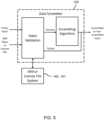
- Fig. 3 presents the block diagram of the system of Fig. 2 with the addition of an identity and access management (IAM) system.
- the IAM system 140 is provided in order to authenticate and manage authorization of the entity using the deployed neural network 110. In other words, the IAM system 140 determines access to use of the scrambling algorithm of the data scrambler 120.
- the IAM system 140 may be an external component to authenticate and authorize users, as depicted in Fig. 5 , or may be integrated as part of the data scrambler 120. Overall, this component helps to restrict access to data scrambler 120 to right set of entity. Thus, to generate scrambled input, entities need to first authenticate themselves by providing valid credentials. Once authenticated, an IAM access token may be generated which can be used to authorize use of the scrambling algorithm. With an IAM system 140, organizations can grant or revoke access from user to scramble input data and thus perform inferencing even when the neural network is deployed on the edge devices.
- the IAM system 140 is configured to receive access credentials from the entity indicating a right to use the deployed neural network 110. The IAM system 140 then determines an authenticity and validity of the access credentials. If the access credentials are authentic and valid, an IAM access token is provided to the entity. Accordingly, the data scrambler 120 will successfully authenticate and authorize the entity responsive to the entity being in possession of the IAM access token (and therefore process the entity input with the scrambling algorithm.
- the data scrambler 120 may receive an unverified IAM access token from the entity.
- the data scrambler 120 will then provide the unverified IAM access token to the IAM system 140.
- the IAM system 140 process the unverified IAM access token to determine whether the IAM access token is valid. That is, the IAM system 140 may generate a verification signal based on processing the unverified IAM token with an introspection algorithm.
- the data scrambler 120 then obtains the verification signal from the IAM system 140 indicating whether the entity is successfully or unsuccessfully authenticated and authorized. Appropriate processing of the entity input is then affected.
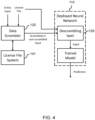
- Fig. 4 presents the block diagram of the system of Fig. 2 with the addition of a license file system.
- the license file system 141 is provided in order to authenticate and manage authorization of the entity using the deployed neural network 110.
- the license file system 141 determines access to use of the scrambling algorithm of the data scrambler 120.
- the license file system 141 enables authentication and verification of entities in offline scenarios, by using system licence keys for validating the authenticity of the user.
- the license file may be provided to the descrambling layer, which may attempt to read the license file to perform the descrambling. If the license file is not valid then the entity is not an authentic and authorised entity.
- a license file system 141 is a critical component of many software systems, used primarily in proprietary software applications.
- a license file includes information that helps to ensure that the software is being used in accordance with its licensing agreement.
- License files typically comprise the following information:
- the license file is typically provided by the software vendor at the time of purchase or is embedded within the software and gets activated upon entering a valid license key.
- the license file is checked by the license file system to authenticate the entity, check whether they are authorized to use the neural network, and authenticate the authorization.
- This may be performed by the data scrambler itself as a license file system, or by an external component configured to check the license file.
- Fig. 6 depicts a flow diagram of a method for improving security of a deployed neural network according to an embodiment of the invention.
- step 210 an entity input for the deployed neural network from an entity is received by a data scrambler.
- the data scrambler may any of the disclosed data scramblers described above.
- step 220 an authorization and authenticity of the entity is analysed. If the entity is successfully authenticated, and is authorized to use the deployed neural network, then the method proceeds to step 230. If the entity is either not authorized to use the deployed neural network, or the identify and/or authorization is not able to be authenticated, then step 230 is skipped, and the method proceeds to step 240.
- a scrambled input is generated by the data scrambler. This is achieved by processing the entity input with a scrambling algorithm, as described above. In other words, the entity input is only processed with the scrambling algorithm if the entity is authenticated, and it is determined that the entity is authorized, and the authenticity of the authorization is successful.
- a descrambling layer attached to the deployed neural network receives the scrambled input from the data scrambler.
- the descrambling layer may receive a non-scrambled input (i.e., the raw entity input).
- an input for the deployed neural network is generated by processing the scrambled input (or non-scrambled input if step 230 is skipped) with a descrambling algorithm. This input may then be provided to the deployed neural network for processing, such that the neural network provides an output (i.e., a prediction).
- the output from the deployed neural network may correspond to the output that is intended for the entity input by the trained neural network. If step 230 was not performed (as the entity was not authorized to scramble the input), the output from the deployed neural network may be essentially random. Accordingly, a threat of membership inference attacks by an entity may be reduced.
- Fig. 7 illustrates an example of a computer 1000 within which one or more parts of an embodiment may be employed.
- Various operations discussed above may utilize the capabilities of the computer 1000.
- one or more parts of a system for identifying a log file for resolution of a fault of a medical imaging device may be incorporated in any element, module, application, and/or component discussed herein.
- system functional blocks can run on a single computer or may be distributed over several computers and locations (e.g. connected via internet).
- the computer 1000 includes, but is not limited to, PCs, workstations, laptops, PDAs, palm devices, servers, storages, and the like.
- the computer 1000 may include one or more processors 1010, memory 1020 and one or more I/O devices 1030 that are communicatively coupled via a local interface (not shown).
- the local interface can be, for example but not limited to, one or more buses or other wired or wireless connections, as is known in the art.
- the local interface may have additional elements, such as controllers, buffers (caches), drivers, repeaters, and receivers, to enable communications. Further, the local interface may include address, control, and/or data connections to enable appropriate communications among the aforementioned components.
- the processor 1010 is a hardware device for executing software that can be stored in the memory 1020.
- the processor 1010 can be virtually any custom made or commercially available processor, a central processing unit (CPU), a digital signal processor (DSP), or an auxiliary processor among several processors associated with the computer 1000, and the processor 1010 may be a semiconductor based microprocessor (in the form of a microchip) or a microprocessor.
- the memory 1020 can include any one or combination of volatile memory elements (e.g., random access memory (RAM), such as dynamic random access memory (DRAM), static random access memory (SRAM), etc.) and non-volatile memory elements (e.g., ROM, erasable programmable read only memory (EPROM), electronically erasable programmable read only memory (EEPROM), programmable read only memory (PROM), tape, compact disc read only memory (CD-ROM), disk, diskette, cartridge, cassette or the like, etc.).
- RAM random access memory
- DRAM dynamic random access memory
- SRAM static random access memory
- non-volatile memory elements e.g., ROM, erasable programmable read only memory (EPROM), electronically erasable programmable read only memory (EEPROM), programmable read only memory (PROM), tape, compact disc read only memory (CD-ROM), disk, diskette, cartridge, cassette or the like, etc.
- the memory 1020 may incorporate electronic, magnetic, optical, and/or other types
- the software in the memory 1020 may include one or more separate programs, each of which comprises an ordered listing of executable instructions for implementing logical functions.
- the software in the memory 1020 includes a suitable operating system (O/S) 1050, compiler 1060, source code 1070, and one or more applications 1080 in accordance with exemplary embodiments.
- the application 1080 comprises numerous functional components for implementing the features and operations of the exemplary embodiments.
- the application 1080 of the computer 1000 may represent various applications, computational units, logic, functional units, processes, operations, virtual entities, and/or modules in accordance with exemplary embodiments, but the application 1080 is not meant to be a limitation.
- the operating system 1050 controls the execution of other computer programs, and provides scheduling, input-output control, file and data management, memory management, and communication control and related services. It is contemplated by the inventors that the application 1080 for implementing exemplary embodiments may be applicable on all commercially available operating systems.
- Application 1080 may be a source program, executable program (object code), script, or any other entity comprising a set of instructions to be performed.
- a source program then the program is usually translated via a compiler (such as the compiler 1060), assembler, interpreter, or the like, which may or may not be included within the memory 1020, so as to operate properly in connection with the O/S 1050.
- the application 1080 can be written as an object oriented programming language, which has classes of data and methods, or a procedure programming language, which has routines, subroutines, and/or functions, for example but not limited to, C, C++, C#, Pascal, BASIC, API calls, HTML, XHTML, XML, ASP scripts, JavaScript, FORTRAN, COBOL, Perl, Java, ADA, .NET, and the like.
- the I/O devices 1030 may include input devices such as, for example but not limited to, a mouse, keyboard, scanner, microphone, camera, etc. Furthermore, the I/O devices 1030 may also include output devices, for example but not limited to a printer, display, etc. Finally, the I/O devices 1030 may further include devices that communicate both inputs and outputs, for instance but not limited to, a NIC or modulator/demodulator (for accessing remote devices, other files, devices, systems, or a network), a radio frequency (RF) or other transceiver, a telephonic interface, a bridge, a router, etc. The I/O devices 1030 also include components for communicating over various networks, such as the Internet or intranet.
- a NIC or modulator/demodulator for accessing remote devices, other files, devices, systems, or a network
- RF radio frequency
- the I/O devices 1030 also include components for communicating over various networks, such as the Internet or intranet.
- the software in the memory 1020 may further include a basic input output system (BIOS) (omitted for simplicity).
- BIOS is a set of essential software routines that initialize and test hardware at start-up, start the O/S 1050, and support the transfer of data among the hardware devices.
- the BIOS is stored in some type of read-only-memory, such as ROM, PROM, EPROM, EEPROM or the like, so that the BIOS can be executed when the computer 800 is activated.
- the processor 1010 When the computer 1000 is in operation, the processor 1010 is configured to execute software stored within the memory 1020, to communicate data to and from the memory 1020, and to generally control operations of the computer 1000 pursuant to the software.
- the application 1080 and the O/S 1050 are read, in whole or in part, by the processor 1010, perhaps buffered within the processor 1010, and then executed.
- a computer readable medium may be an electronic, magnetic, optical, or other physical device or means that can contain or store a computer program for use by or in connection with a computer related system or method.
- the application 1080 can be embodied in any computer-readable medium for use by or in connection with an instruction execution system, apparatus, or device, such as a computer-based system, processor-containing system, or other system that can fetch the instructions from the instruction execution system, apparatus, or device and execute the instructions.
- a "computer-readable medium" can be any means that can store, communicate, propagate, or transport the program for use by or in connection with the instruction execution system, apparatus, or device.
- the computer readable medium can be, for example but not limited to, an electronic, magnetic, optical, electromagnetic, infrared, or semiconductor system, apparatus, device, or propagation medium.
- Fig. 6 and the systems of Figs. 2-5 may be implemented in hardware or software, or a mixture of both (for example, as firmware running on a hardware device).
- the functional steps illustrated in the process flowcharts may be performed by suitably programmed physical computing devices, such as one or more central processing units (CPUs) or graphics processing units (GPUs).
- CPUs central processing units
- GPUs graphics processing units
- Each process - and its individual component steps as illustrated in the flowcharts - may be performed by the same or different computing devices.
- a computer-readable storage medium stores a computer program comprising computer program code configured to cause one or more physical computing devices to carry out an encoding or decoding method as described above when the program is run on the one or more physical computing devices.
- Storage media may include volatile and non-volatile computer memory such as RAM, PROM, EPROM, and EEPROM, optical discs (like CD, DVD, BD), magnetic storage media (like hard discs and tapes).
- RAM random access memory
- PROM read-only memory
- EPROM erasable programmable read-only memory
- EEPROM electrically erasable programmable read-only memory
- optical discs like CD, DVD, BD
- magnetic storage media like hard discs and tapes.
- Various storage media may be fixed within a computing device or may be transportable, such that the one or more programs stored thereon can be loaded into a processor.
- the blocks shown in the block diagrams of Figs. 2-5 may be separate physical components, or logical subdivisions of single physical components, or may be all implemented in an integrated manner in one physical component.
- the functions of one block shown in the drawings may be divided between multiple components in an implementation, or the functions of multiple blocks shown in the drawings may be combined in single components in an implementation.
- Hardware components suitable for use in embodiments of the present invention include, but are not limited to, conventional microprocessors, application specific integrated circuits (ASICs), and field-programmable gate arrays (FPGAs).
- ASICs application specific integrated circuits
- FPGAs field-programmable gate arrays
- One or more blocks may be implemented as a combination of dedicated hardware to perform some functions and one or more programmed microprocessors and associated circuitry to perform other functions.
- a computer program may be stored/distributed on a suitable medium, such as an optical storage medium or a solid-state medium supplied together with or as part of other hardware, but may also be distributed in other forms, such as via the Internet or other wired or wireless telecommunication systems.
- a suitable medium such as an optical storage medium or a solid-state medium supplied together with or as part of other hardware, but may also be distributed in other forms, such as via the Internet or other wired or wireless telecommunication systems.
- each block in the block diagrams may represent a module, segment, or portion of instructions, which comprises one or more executable instructions for implementing the specified logical function(s).
- each block of the block diagrams, and combinations of blocks in the block diagrams can be implemented by special purpose hardware-based systems that perform the specified functions or acts or carry out combinations of special purpose hardware and computer instructions.
Landscapes
- Engineering & Computer Science (AREA)
- Theoretical Computer Science (AREA)
- Physics & Mathematics (AREA)
- Software Systems (AREA)
- General Physics & Mathematics (AREA)
- General Engineering & Computer Science (AREA)
- General Health & Medical Sciences (AREA)
- Health & Medical Sciences (AREA)
- Computing Systems (AREA)
- Life Sciences & Earth Sciences (AREA)
- Data Mining & Analysis (AREA)
- Molecular Biology (AREA)
- Computational Linguistics (AREA)
- Biophysics (AREA)
- Biomedical Technology (AREA)
- Mathematical Physics (AREA)
- Artificial Intelligence (AREA)
- Evolutionary Computation (AREA)
- Computer Security & Cryptography (AREA)
- Computer Hardware Design (AREA)
- Bioethics (AREA)
- Databases & Information Systems (AREA)
- Multimedia (AREA)
- Technology Law (AREA)
- Storage Device Security (AREA)
Priority Applications (2)
| Application Number | Priority Date | Filing Date | Title |
|---|---|---|---|
| EP23213871.9A EP4567641A1 (de) | 2023-12-04 | 2023-12-04 | Neuronale netzwerksicherheit |
| PCT/EP2024/083046 WO2025119657A1 (en) | 2023-12-04 | 2024-11-21 | Neural network security |
Applications Claiming Priority (1)
| Application Number | Priority Date | Filing Date | Title |
|---|---|---|---|
| EP23213871.9A EP4567641A1 (de) | 2023-12-04 | 2023-12-04 | Neuronale netzwerksicherheit |
Publications (1)
| Publication Number | Publication Date |
|---|---|
| EP4567641A1 true EP4567641A1 (de) | 2025-06-11 |
Family
ID=89076185
Family Applications (1)
| Application Number | Title | Priority Date | Filing Date |
|---|---|---|---|
| EP23213871.9A Pending EP4567641A1 (de) | 2023-12-04 | 2023-12-04 | Neuronale netzwerksicherheit |
Country Status (2)
| Country | Link |
|---|---|
| EP (1) | EP4567641A1 (de) |
| WO (1) | WO2025119657A1 (de) |
Citations (3)
| Publication number | Priority date | Publication date | Assignee | Title |
|---|---|---|---|---|
| US20200233979A1 (en) * | 2019-01-17 | 2020-07-23 | Koninklijke Philips N.V. | Machine learning model validation and authentication |
| US10956584B1 (en) * | 2018-09-25 | 2021-03-23 | Amazon Technologies, Inc. | Secure data processing |
| CN116561712A (zh) * | 2023-02-23 | 2023-08-08 | 东南大学 | 一种神经网络模型加密与功能细粒度授权的方法 |
-
2023
- 2023-12-04 EP EP23213871.9A patent/EP4567641A1/de active Pending
-
2024
- 2024-11-21 WO PCT/EP2024/083046 patent/WO2025119657A1/en active Pending
Patent Citations (3)
| Publication number | Priority date | Publication date | Assignee | Title |
|---|---|---|---|---|
| US10956584B1 (en) * | 2018-09-25 | 2021-03-23 | Amazon Technologies, Inc. | Secure data processing |
| US20200233979A1 (en) * | 2019-01-17 | 2020-07-23 | Koninklijke Philips N.V. | Machine learning model validation and authentication |
| CN116561712A (zh) * | 2023-02-23 | 2023-08-08 | 东南大学 | 一种神经网络模型加密与功能细粒度授权的方法 |
Also Published As
| Publication number | Publication date |
|---|---|
| WO2025119657A1 (en) | 2025-06-12 |
Similar Documents
| Publication | Publication Date | Title |
|---|---|---|
| US11687623B2 (en) | Anti-piracy framework for deep neural networks | |
| US11544411B2 (en) | Machine learning model validation and authentication | |
| US12353525B1 (en) | Methods, systems, and devices for an encrypted and obfuscated algorithm in a computing environment | |
| US11886579B2 (en) | Machine learning model validation and authentication | |
| US12106212B2 (en) | Machine learning model validation and authentication | |
| Gu et al. | Securing input data of deep learning inference systems via partitioned enclave execution | |
| Chen et al. | Protect your deep neural networks from piracy | |
| Alam | Cybersecurity: Past, present and future | |
| US20210150042A1 (en) | Protecting information embedded in a machine learning model | |
| NL2034177B1 (en) | Method for protecting deep learning model based on confidential computing | |
| EP4127981B1 (de) | Systeme, verfahren und speichermedien zur erzeugung eines gesicherten transformierten codes aus einem eingabecode unter verwendung eines neuronalen netzwerks zur verdeckung einer funktion | |
| US20170109525A1 (en) | Protecting an item of software | |
| Yocam et al. | Quantum adversarial machine learning and defense strategies: Challenges and opportunities | |
| Yellu et al. | Blurring boundaries: A new way to secure approximate computing systems | |
| EP4567641A1 (de) | Neuronale netzwerksicherheit | |
| Prabhavathy et al. | Prevention of Runtime Malware Injection Attack in Cloud Using Unsupervised Learning. | |
| Li et al. | Coreguard: Safeguarding foundational capabilities of llms against model stealing in edge deployment | |
| CN109635601A (zh) | 密码防盗方法和装置 | |
| Gupta | Towards secure-by-design artificial intelligence systems | |
| Rana | Analyzing and Detecting Android Malware and Deepfake | |
| EP4597340A1 (de) | Modellgewichte | |
| Malpure et al. | Securing AI and Agentic Systems in Medical Devices: Methods, Risks, and Defenses | |
| Deng et al. | Privacy-preserving deep learning for grey scale image classification with pixel-based encryption | |
| CN115834791B (zh) | 利用矩阵密钥的图像加解密传输方法和电子设备 | |
| WO2025162749A1 (en) | Model weights |
Legal Events
| Date | Code | Title | Description |
|---|---|---|---|
| PUAI | Public reference made under article 153(3) epc to a published international application that has entered the european phase |
Free format text: ORIGINAL CODE: 0009012 |
|
| STAA | Information on the status of an ep patent application or granted ep patent |
Free format text: STATUS: THE APPLICATION HAS BEEN PUBLISHED |
|
| AK | Designated contracting states |
Kind code of ref document: A1 Designated state(s): AL AT BE BG CH CY CZ DE DK EE ES FI FR GB GR HR HU IE IS IT LI LT LU LV MC ME MK MT NL NO PL PT RO RS SE SI SK SM TR |
|
| STAA | Information on the status of an ep patent application or granted ep patent |
Free format text: STATUS: THE APPLICATION IS DEEMED TO BE WITHDRAWN |