EP4567416A2 - Massenspektrometer zur analyse von fragmentionen und entsprechendes verfahren - Google Patents
Massenspektrometer zur analyse von fragmentionen und entsprechendes verfahren Download PDFInfo
- Publication number
- EP4567416A2 EP4567416A2 EP25165983.5A EP25165983A EP4567416A2 EP 4567416 A2 EP4567416 A2 EP 4567416A2 EP 25165983 A EP25165983 A EP 25165983A EP 4567416 A2 EP4567416 A2 EP 4567416A2
- Authority
- EP
- European Patent Office
- Prior art keywords
- ion
- mobility
- fragment ions
- electrodes
- ions
- Prior art date
- Legal status (The legal status is an assumption and is not a legal conclusion. Google has not performed a legal analysis and makes no representation as to the accuracy of the status listed.)
- Pending
Links
Images



Classifications
-
- H—ELECTRICITY
- H01—ELECTRIC ELEMENTS
- H01J—ELECTRIC DISCHARGE TUBES OR DISCHARGE LAMPS
- H01J49/00—Particle spectrometers or separator tubes
- H01J49/004—Combinations of spectrometers, tandem spectrometers, e.g. MS/MS, MSn
- H01J49/0045—Combinations of spectrometers, tandem spectrometers, e.g. MS/MS, MSn characterised by the fragmentation or other specific reaction
-
- H—ELECTRICITY
- H01—ELECTRIC ELEMENTS
- H01J—ELECTRIC DISCHARGE TUBES OR DISCHARGE LAMPS
- H01J49/00—Particle spectrometers or separator tubes
- H01J49/26—Mass spectrometers or separator tubes
- H01J49/34—Dynamic spectrometers
- H01J49/36—Radio frequency spectrometers, e.g. Bennett-type spectrometers, Redhead-type spectrometers
-
- G—PHYSICS
- G01—MEASURING; TESTING
- G01N—INVESTIGATING OR ANALYSING MATERIALS BY DETERMINING THEIR CHEMICAL OR PHYSICAL PROPERTIES
- G01N27/00—Investigating or analysing materials by the use of electric, electrochemical, or magnetic means
- G01N27/62—Investigating or analysing materials by the use of electric, electrochemical, or magnetic means by investigating the ionisation of gases, e.g. aerosols; by investigating electric discharges, e.g. emission of cathode
- G01N27/622—Ion mobility spectrometry
- G01N27/623—Ion mobility spectrometry combined with mass spectrometry
-
- H—ELECTRICITY
- H01—ELECTRIC ELEMENTS
- H01J—ELECTRIC DISCHARGE TUBES OR DISCHARGE LAMPS
- H01J49/00—Particle spectrometers or separator tubes
- H01J49/0027—Methods for using particle spectrometers
- H01J49/0031—Step by step routines describing the use of the apparatus
Definitions
- the present invention relates generally to mass spectrometers, and more particularly to mass spectrometers including drift cells for the analysis and separation of ions based on ion mobility.
- Spectral congestion in top down and native mass spectrometry analysis is a major drawback that hinders efficient data interpretation. This occurs when several (or many) different fragment ions in a mass spectrometry measurement possess comparable mass-to-charge ratios (m/z). The isotopic distributions for the different fragment ions with the same m/z will overlap when viewed on a m/z spectral graph and cannot be distinguished one from another
- the invention is to use differences in the ion mobility amongst a plurality of different ion species within an ion sample having comparable m/z, to spatially separate the different ion species according to their ion mobility. Once spatially separated, the individual ion species may be individually and separately trapped, moved and controlled as desired for analysis (e.g. to produce separate or fractional m/z spectra).
- the constant term "const.” is determined by the drift gas number density, the drift gas temperature, and the collision cross section between the ion and the drift gas molecules. Thus, ion mobility differs between ions of the same mass-to-charge ratio.
- Example devices are described in US 2011/0121170 A1 ; US 2002/0070338 A1 ; and US 2012/0256083 A1 .
- the fragmentation cell is disposed downstream from the ion mobility spectrometer, such that the ion mobility spectrometer does not receive fragment ions and any fragment ions generated from precursor ions in the gas phase are formed after the ion mobility separation step is performed on un-fragmented ions.
- ion mobility technology can be employed to distinguish between different ions having the same mass-to-charge ratio, to separate or disperse fragment ions in mobility space and to reduce congestion of complex fragmentation (m/z) spectra, particularly, complex fragmentation spectra produced by mass analysis of fragment ion populations produced in RF ion traps utilizing electron capture dissociation, photo-dissociation or other types of ion activation-dissociation methods applied in the analysis of intact macromolecular ions.
- complex fragmentation (m/z) spectra particularly, complex fragmentation spectra produced by mass analysis of fragment ion populations produced in RF ion traps utilizing electron capture dissociation, photo-dissociation or other types of ion activation-dissociation methods applied in the analysis of intact macromolecular ions.
- the invention is concerned with the simplification of complex fragmentation spectra produced in the analysis of intact proteins, polypeptide chains (top down and middle down) and native mass spectrometry including the analysis of protein complexes, protein-drug conjugates, and antibodies in a middle-down or top down approach, facilitating peak identification and precise peak annotation using both manual and automated data post-processing methods.
- the invention may be implemented using an ion drift cell containing a buffer gas within which a homogeneous (e.g. DC) electrical field is applied to impose a drift force to ions in the drift cell in a direction along the longitudinal axis of the drift cell.
- the electrical field drives ions through the drift cell where they interact with the neutral molecules of the buffer gas contained within the drift cell.
- the buffer gas contained in the drift cell is most preferably a gas in an equilibrium state. That is to say, the buffer gas contained in the drift cell is preferably a non-flowing gas.
- the different species of ions are separated based on ion mobility. Different species of ions traverse different distances within the drift cell in a given time interval. The spatially separated ions may be trapped, stored or confined in separate respective locations axially along the drift cell and ejected from the drift cell separately, or simply transmitted through the cell, without trapping, for direct mass analysis.
- the drift cell may be tubular e.g., with a series of ring-shaped electrodes arranged in a stack.
- Other drift cell designs can be used, for example a drift cell formed using separated, planar conductive plates or boards opposed/facing each other, e.g. two gold-plated printed circuit boards, for example, such as is described in: Hamid et al, Int J Mass Spectrom, 430, 8, 2018 ; or Deng et al, ChemistrySelect, 1(10), 2396, 2016 .
- the invention may provide a new method that utilizes a high performance ion mobility drift cell combined with an ion trap, preferably a radio-frequency (RF) ion trap, most preferably a segmented RF linear ion trap.
- Fragment ions which in a typical top-down fragmentation experiment may comprise of >100 or even >1000 distinct isotopic distributions simultaneously confined in a RF field of an ion trap, and originating from one or more precursor ions mass selected in an ion trap or in a quadrupole mass filter, may be injected and separated inside a pressurized drift cell at pressures in the range of 0.1mbar or higher (e.g. ⁇ 15mbar). Fragment ions will separate according to mass, shape and charge state.
- RF radio-frequency
- Fragment ions may be simply transmitted toward a mass analyser or divided and stored in trapping regions of the drift cell provided by applying pulsed or switched DC fields superimposed on the drift electric field (E).
- the static DC gradient of the drift electric field (E) may be combined with the pulsed or switched DC electric fields to form discrete mobility-separated ion groups, which may be stored in trapping regions within the drift cell.
- An RF field is preferably applied to the electrodes of the ion mobility spectrometer to store the mobility-separated ion groups in the trapping regions of the drift cell.
- the RF field may be generated by two anti-phase sinusoidal RF waveforms each applied to the odd and even numbered electrodes of the stack or system of electrodes of the drift cell, respectively.
- Reversing of the drift electric field (E) by reversing the static DC gradient applied across the drift cell may be implemented to move/transfer discrete mobility-separated ion groups separately into an ion trap and/or to a mass analyser.
- a mass analyser Preferably an orbitrap or a time-of-flight (TOF) mass analyser may be used for this purpose.
- the above-described fragment ion transfer method may be implemented in cycles, each being preferably of ⁇ 200ms per transferred ion group.
- the apparatus and method according to the present invention may greatly reduce spectral density since ions with different charge states appearing at the same position in the m/z scale may now be spatially separated, and/or trapped and ultimately mass analysed separately.
- the new method permits the simplification of complex m/z spectra and associated improvements in peak assignment to allow de-novo sequencing of proteins, for example.
- the invention may provide an apparatus and/or method as set out in the accompanying claims herein.
- the invention may provide a mass spectrometer for analysing fragment ions, the mass spectrometer comprising: an ion source for producing fragment ions; an ion mobility spectrometer for receiving fragment ions produced by the ion source and for separating at least a fraction of the received fragment ions according to their ion mobility into mobility-separated fragment ions; and, a system of electrodes configured to receive DC electrical potentials to transfer at least a fraction of the mobility-separated fragment ions to a mass analyser for generating a mass-to-charge (m/z) spectrum exhibiting reduced spectral complexity.
- m/z mass-to-charge
- the invention may provide a mass spectrometer comprising an ion trap for producing fragment ions, an ion mobility spectrometer for receiving and separating fragment ions (e.g. down-stream from the ion trap), and a mass analyser for producing a m/z spectrum (e.g. of the fragment ions).
- the mass spectrometer may provide at least one region along the ion optical path of the mass spectrometer for storing at least a fraction of the mobility separated fragment ions.
- the mass spectrometer may provide a control system of electrodes, or a system of electrodes and associated DC potentials switched, or switchable, for transferring the selected fraction to a mass analyser to create a m/z spectrum, where the generated m/z spectrum contains information from only a fraction of the initial population of the fragment ions (e.g. produced by the ion trap) to reduce spectral complexity.
- the control system may comprise the system of electrodes, and may be configured to drive the electrodes by applying DC electrical potentials to those electrodes. It may be configured to drive the electrodes by applying one or more switched DC signals and/or one or more RF signals.
- a switched DC signal has a DC level that is switchable between a plurality of separate and different DC levels.
- the control system of the mass spectrometer may also comprise electronics (e.g. one or more electronics units) configured for generating one or more RF electrical potentials, and/or one or more static DC electrical potentials (i.e. non-switched) and/or one or more switched DC electrical potentials.
- the control system may be arranged to distribute the generated one or more electrical potentials to the system of electrodes of the mass spectrometer, and may be configured to apply the distributed one or more electrical potentials to electrodes of the mass spectrometer apparatus in a synchronized manner.
- Synchronisation of the application of the distributed one or more electrical potentials to electrodes of the mass spectrometer apparatus may be achieved by switching different electrodes of the system of electrodes, so as to permit the trapping and/or transfer of the ions through the system using the electrical potentials applied to the ions by the system of driven electrodes.
- the control system may control the manner in which the system of electrodes transfers ions, e.g. to a mass analyser.
- the ion trap, the ion mobility spectrometer and the mass analyser units including all intermediate ion optical components for transferring ions between the separate units are all comprised of individual sets of electrodes collectively forming a system of electrodes for processing ions. Processing involves activating, fragmenting, separating and mass analysing ions in a mass spectrometer that incorporates the unique features outlined in the present invention.
- the invention may provide a mass spectrometer comprising an ion trap for fragmenting ions, an ion mobility spectrometer for receiving and separating fragment ions, and a mass analyser for producing a m/z spectrum.
- the mass spectrometer may provide a series of trapping regions established toward the exit end of the ion mobility spectrometer and switched during the separation step for splitting fragment ions into separate groups or fractions.
- the mass spectrometer may provide a set of switches, e.g.
- RF signals must be applied to all electrodes forming the trapping regions in the drift cell.
- electrodes are spaced apart by a gap of ⁇ 1mm and electrode pitch is preferably set to ⁇ 1.5mm.
- the number of spectra produced in a single cycle equals the number of groups separated in the ion mobility spectrometer.
- the mass spectrometer may be arranged such that the switching of the DC potentials applied to the ion mobility cell also includes reversing the DC gradient established across the stack of electrodes.
- the invention may provide a method for separating fragment ions in an ion mobility spectrometer, the method comprising generating fragment ions in a RF linear ion trap (e.g.
- a quadrupole ion trap injecting and separating ions inside a pressurized ion mobility cell, isolating or transmitting at least one group of fragment ions from the initial ion population of fragments, and transferring the at least one isolated or transmitted group of ions towards a mass analyser to produce a m/z spectrum containing reduced information compared to the m/z spectrum that includes all fragment ions.
- a mass spectrometer for receiving fragment ions from an ion source, comprising: an ion mobility spectrometer for receiving and separating fragment ions according to their ion mobility in to mobility-separated fragment ions; at least one region along an ion optical path of the ion mobility spectrometer for storing at least a fraction of the mobility-separated fragment ions; a control system comprising a system of electrodes and arranged for applying associated DC electrical potentials to the electrodes and for switching or changing at least one of the DC electrical potentials for transferring the stored fraction of the mobility-separated fragment ions to a mass analyser for generating a m/z spectrum therefrom; wherein the generated m/z spectrum contains only a fraction of the initial population of the fragment ions received from said ion source, thereby to reduce spectral complexity and facilitate peak assignment and data interpretation using a variety of post processing methods.
- the mass spectrometer may comprise an ion trap as said ion source for producing fragment ions.
- the mass spectrometer may comprise the mass analyser for producing a m/z spectrum from said stored fraction of the mobility-separated fragment ions transferred to it by said control system.
- the control system may be arranged to apply to the ion mobility spectrometer a series of radio-frequency (RF) and DC electrical potentials for generating electric fields defining ion trapping regions disposed toward an exit end of the ion mobility spectrometer, for trapping the mobility-separated fragment ions thereat.
- RF radio-frequency
- the control system may be arranged to switch electrical potentials from amongst said series of electrical potentials, for separating, partitioning or splitting the mobility-separated fragment ions into spatially separate groups.
- the control system may be arranged for switching at least a portion of the DC electrical potentials applied to the ion mobility spectrometer to release said spatially separate groups of ions in temporally consecutive steps to permit said m/z spectra to be generated therefrom.
- the control system may comprise a set of switches arranged for switching said electrical potentials from amongst said series of electrical potentials.
- control system which includes the system of electrodes arranged to guide, separate and/or trap (and desirably process) ions in a mass spectrometer of the present invention.
- the control system also comprises a set of electronics units for generating RF, static and switched DC electrical potentials that are distributed and applied to the system of electrodes of the mass spectrometer apparatus.
- the invention may provide a mass spectrometer comprising: an ion trap for fragmenting ions; an ion mobility spectrometer for receiving and separating fragment ions; a mass analyser for producing a m/z spectrum; a series of RF and DC trapping regions established toward the exit end of the ion mobility spectrometer and switched during the separation step for splitting the fragment ions into separate groups; a set of switches for switching at least one of the DC potentials applied to the ion mobility spectrometer to release separated groups of ions in consecutive steps to produce a number of m/z spectra in each step; where the number of spectra produced in a single cycle equals the number of groups separated in the ion mobility spectrometer.
- the switching of the DC potentials applied to the ion mobility cell may also include reversing the DC gradient established across the stack of electrodes.
- the invention may provide a method for separating fragment ions in an ion mobility spectrometer, the method comprising: generating fragment ions in a RF linear ion trap; injecting and separating ions inside a pressurized ion mobility cell; isolating at least one group of fragment ions from the initial ion population of fragments; and transferring the at least one isolated group of ions towards a mass analyser to produce a m/z spectrum containing reduced information compared to the m/z spectrum that includes all fragment ions.
- the invention may provide a method comprising: generating a population of fragment ions in an ion trap; injecting the generated population of fragment ions into a pressurized ion mobility drift cell and separating the injected population of fragment ions inside the pressurized ion mobility drift cell; trapping at least a fraction of the separated population of fragment ions; and, transferring the at least a fraction of trapped fragment ions towards a mass analyser to produce at least one m/z spectrum containing reduced information compared to a m/z spectrum that includes the population of fragment ions.
- the ion trap in this method, may be an RF linear ion trap.
- the method may include providing a system of electrodes, and driving the electrodes by applying DC electrical potentials to those electrodes. It may include driving the electrodes by applying one or more switched DC signals and/or one or more RF signals.
- a switched DC signal has a DC level that is switchable between a plurality of separate and different DC levels.
- the method may comprise generating one or more RF electrical potentials, and/or one or more static DC electrical potentials (i.e. non-switched) and/or one or more switched DC electrical potentials.
- the method may include distributing the generated one or more electrical potentials to the system of electrodes, and may include applying the distributed one or more electrical potentials to electrodes in a synchronized manner.
- Synchronisation of the application of the distributed one or more electrical potentials to electrodes may include switching different electrodes of the system of electrodes, so as to permit the trapping and/or transfer of the ions through the system using the electrical potentials applied to the ions by the system of driven electrodes.
- the control method may control the manner in which the system of electrodes transfers ions, e.g. to a mass analyser.
- FIG. 1 shows an ion mobility drift cell (hereafter also referred to as ion mobility spectrometer - IMS) 101 connected to a RF linear ion trap 102 (e.g. a quadrupole ion trap), and used for receiving, separating and returning separated packets of ions into the a mass analyser 103 which may be disposed upstream of the linear ion trap 102 for reducing spectral complexity and facilitating spectral interpretation with both automated and manual processing methods. Also shown are RF multipole (e.g.
- hexapole ion guides 104 for transferring fragment ions from the segmented RF linear ion trap 102 to the ion mobility drift cell 101 and operated at an intermediate pressure to bridge the large operating pressure differences that may be established between the RF linear ion trap and the ion mobility cell.
- Fragment ions can be stored in the RF multipole ion guide 104 and gated into the ion mobility drift cell 101.
- the RF multipole ion guide 104 is used to gate ions into the ion mobility drift cell and is segmented and arranged to apply a weak DC gradient 105 for forcing ions to accumulate near the exit-end of the device where thermalisation may be performed, e.g. at >10 -3 mbar pressure.
- This additional voltage can be switched to inject ions from the RF multipole ion guide 104 into the pressurized cell ( ⁇ 1 mbar) of the ion mobility drift cell 101.
- the RF multipole ion guide 104 is preferably operated in pulsed DC mode or switched DC mode 107, and ion potential energy is thereby raised, as denoted by the arrow 108, to the appropriate level prior to injection into the ion mobility drift cell 101.
- the pulsed high-voltage DC level 107 of the RF multipole ion guide 104 is reached simultaneously with the pulsed high-voltage DC level 109 of the ion mobility drift cell 101. Therefore, different ion optical components 101 and 104 disposed in different vacuum regions are pulsed simultaneously.
- Figure 1 also shows a schematic diagram of the pulsed or switched DC potential profile 109 created across the cell by the application of DC potentials to the electrodes of the mass spectrometer, individual trapping regions 110 for storing and separating ions and the ability to reverse the DC gradient 111 to return separated packets of fragment ions 112 towards the mass analyser 103.
- An RF field 113 is preferably applied to the electrodes of the drift cell 101 to confine ions radially and minimize losses due to diffusion.
- the ion trap 102, the ion mobility spectrometer 101 and the mass analyser 103 units including the RF hexapole ion guide 104 and all differential aperture lenses, for example lens 106, for transferring ions between the separate units are all comprised of individual sets of electrode(s) collectively forming a system of electrodes for processing ions.
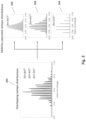
- Figure 2 shows an example of a m/z spectrum with three overlapping isotopic distributions of fragment ions 201 having different charge states, and the 2+ and 4+ charge state isotopic distributions buried beneath the 8+ distribution complicating peak assignment and identification.
- the ion mobility system will allow for separating the different charges states and generating individual spectra 202, 203 and 204, where each contains only one of the three original isotopic distributions, which would otherwise appear in the same m/z spectrum and would have been indistinguishable.
- Figure 1 shows the separation of three different ion groups, for example the different charge state fragment ions presented in Figure 2 , and sequential transfer of the separated groups to a mass analyser for producing fractional m/z spectra with reduced (i.e. less 'cluttered' and more clear) information following trapping and sequential release.
- the mass analyser can also be positioned beyond the drift cell and linear ion trap in the forward direction (i.e. left-hand side of Fig 1 ), in which case, ions will be released in the forward direction and there will be no need to reverse the DC gradient or even trap the mobility separated fractions in different regions of the drift cell prior to mass analysis.
- ions will be released in the forward direction and there will be no need to reverse the DC gradient or even trap the mobility separated fractions in different regions of the drift cell prior to mass analysis.
- Figure 3 shows a linear ion mobility drift cell 301 with a wire-free injection gate 302 incorporated at the front end of the system and an additional Bradbury-Nielsen (BN) gate 303 installed at the back end of the cell for selecting a narrow mobility range prior to trapping or prior to mass measurement in the mass analyser.
- the ion mobility drift cell 301 is enclosed in a pressurized chamber 304.
- the ion mobility drift cell 301 is differentially pumped by a mechanical vacuum pump and actively maintained at >0.1 mbar pressure, e.g. by admitting the buffer gas through a leak valve, for example.
- the buffer gas or drift gas where ions are pulled through by the application of an external electrical field is a gas in a state of equilibrium.
- Two guarding hexapoles (e.g. RF hexapole ion guides) 305 and 306 are disposed on either side of the ion mobility drift cell 301 and operated at a pressure of e.g. ⁇ 0.1 mbar, or preferably within a pressure range of >10 -3 mbar and ⁇ 0.5 mbar.
- the entrance RF hexapole 305 is used for receiving the ions from an ion source or an ion trap, (e.g. preferably an omnitrap ion trap platform, for example such as is described in US9978578B2 ) and storing ions at a first potential energy level 307.
- ion potential energy is lifted or raised to a second potential energy 308 level by fast switching of all DC voltages applied to the segments simultaneously.
- Ions are gently transferred (or gated) 309 through a differential aperture 310 into the ion mobility drift cell 301 and transferred to (e.g. and preferably re-trapped at) the injection gate region 302 (e.g. a wire-free injection gate, for example), where an additional voltage pulse, or a switched DC level 311 is applied to release ions and initiate the ion mobility separation step.
- the injection gate region 302 e.g. a wire-free injection gate, for example
- an additional voltage pulse, or a switched DC level 311 is applied to release ions and initiate the ion mobility separation step.
- Separated ions can be trapped in trapping regions as described in Figure 1 , or only a narrow mobility range can be transmitted beyond this point, either stored inside the pressurized cell, or transferred to the exit hexapole.
- ions may be stored inside the ion mobility drift cell 301 by switching at least two of the superimposed DC signals in a synchronized manner to select ions with a certain mobility range, or by using the BN gate 303 to select and transfer ions to the exit RF hexapole or to yet another trapping region within the mobility cell disposed further downstream from the BN gate. At least a portion of the mobility separated ions, e.g. whether trapped or transmitted through the ion mobility drift cell 301 for example, is subsequently transferred to a mass analyser for mass analysis or back to the RF linear ion trap for further processing.
- Ions introduced at the exit RF hexapole can be stored and their potential energy can be raised at an appropriate level 312 to facilitate transferring back to the linear ion trap or to a mass analyser. Both the linear ion trap and the mass analyser can be disposed either upstream or downstream from the ion mobility cell. Alternatively, the RF hexapole ion guide can be used as a simple transmission device.
- control system which includes the system of electrodes arranged to guide, separate and/or trap the ions (i.e. to control them) in the mass spectrometer and also the DC-RF signals applied to the electrodes of the mass spectrometer.
- Figure 4 shows the ion mobility drift cell 401 where the positions of the trapping regions inside the drift cell are highlighted 402, 403 and 404.
- the length of each of the trapping regions is optimized with the third trapping region designed with extended length to accommodate the faster mobility ions.
- the length of the trapping regions is optimized to disperse the information of a single m/z spectrum containing all fragment ions to multiple spectra, each of similar spectral density.
- a BN gate and preferably at least one trapping region utilizing at least one DC signal superimposed on the drift electric field E of the ion mobility drift cell is used to select a narrow mobility range, which is subsequently transmitted to the mass analyser producing a single m/z spectrum with reduced complexity.
- the signals applied to drive the BN gate and/or the trapping regions within the drift cell are preferably scanned to cover the entire range of ion mobilities of interest producing sequential m/z spectra of reduced complexity.
- the ion mobility spectrometer disclosed herein is designed with extended length or produced in a cyclic or folded configuration to enhance mobility separation of the ion population. Separated fragment ion populations can be subsequently transmitted to the mass analyser or stored in multiple trapping regions and finally separated fractions can be injected in a step wise manner without losses to the mass analyser or the linear ion trap for further processing.
- injection of ions in the drift cell disclosed here allows for separating the ion population in three fractions 506, and subsequently detecting these fractions independently. Spectral congestion is therefore significantly reduced. Consequently, the efficiency of automated peak processing is increased by reducing the number of false positive identifications while the confidence of the true positive fragments identified by algorithms developed for protein sequencing is considerably improved, especially de-novo sequencing algorithms.
- fractions A, B and C are separated in the ion mobility cell and released independently towards the mass analyser. Consequently, the detection of the entire population is reduced by a factor of 3x.
- a BN gate is used in transmission mode to select at least one desired fraction of the initial fragment ion population in order to resolve overlapping isotopic distributions of fragment ions.
- trapping is not performed.
- the mass analyser is disposed downstream from the drift cell, although an upstream arrangement is also envisaged with the DC gradient applied across the drift cell reversed immediately after the selection step performed with the BN gate or with the fast switching DC signals superimposed on the electric field E of the drift cell.
- Figure 6 shows a preferred embodiment of the present invention comprised of a RF linear ion trap 601 with hyperbolic electrodes 602 and further segmented in the axial direction for fragmenting ions in different regions designed to apply different methods of ion activation-dissociation, an ion mobility drift cell 603 for separating or selectively transmitting fragment ions according to ion mobility and a TOF mass analyser 604 disposed further downstream for producing m/z spectra.
- the different regions where ions can be trapped are also highlighted using the axial DC profile and corresponding transitions 605 established across the different ion optical components (trapping regions within the drift cell are not shown).
- field reversal of the drift electric field E is exercised for redirecting mobility selected ions back to the RF linear ion trap 601 for further processing.
- mobility separated ions are stored in the consecutive trapping regions of the drift cell 603, similarly to the examples disclosed with reference to Figure 1 and Figure 4 , and ejected separately and in a sequential manner to the TOF analyser (604) where the arrival time of the mobility separated fraction in the effective region of the orthogonal pulser of the TOF analyser 604 is synchronized with the TOF extraction voltage pulse.
- Sequential storage of the different fractions of the fragment ion population at the RF hexapole trap 607 following the separation process in the drift cell 603 may also be desirable to enhance the duty cycle of the experiment.
- the RF hexapole trap or ion guide 607 at the exit of the ion mobility drift cell 603 is also operated in the pressure range of >10 -3 mbar and ⁇ 0.1 mbar.
- the control system of the mass spectrometer shown in Figure 6 also comprises a set of electronics units (not shown) for generating RF, static and switched DC electrical potentials that are distributed and applied to the electrodes of the mass spectrometer apparatus in a synchronized manner.
- the control system is configured to drive the electrodes by applying one or more switched DC signals and/or one or more RF signals.
- the switched DC signals each have a DC level that is switchable between multiple separate and different DC levels.
- the electronics of the electronics units is configured for generating RF electrical potentials, and/or static DC electrical potentials (i.e. non-switched) and/or switched DC electrical potentials as desired.
- the control system is arranged to distribute the generated one or more electrical potentials to the system of electrodes of the mass spectrometer, and is configured to apply the distributed electrical potentials to electrodes of the mass spectrometer apparatus as indicated schematically in Figure 6 .
- This distribution is done in a synchronized manner whereby the application of the distributed electrical potentials to electrodes of the mass spectrometer is achieved by switching different electrodes of the system of electrodes in synchrony, so as to permit the control (e.g. trapping and/or transfer) of the ions through the system using the electrical potentials imposed on the ions by the driven electrodes.
- a narrow range in m/z can be isolated in the RF linear ion trap first and subsequently injected and separated in the ion mobility drift cell.
- This method allows for the simplification of the m/z spectrum prior to ion mobility separation. Concentrating in a highly congested region of the m/z spectrum only by injecting a narrow m/z band will enhance spectral interpretation further. Injection of selected mass ranges in the ion mobility spectrometer may include one or more fractions of the complete m/z spectrum.
- the hardware solutions disclosed herein for reducing spectral complexity is also associated with advances in fragment ion matching algorithms.
- a new method is disclosed for peak assignment where theoretical isotopic distributions from a known peptide or protein sequence are calculated and superimposed to experimental m/z spectra.
- a score function is created by subtracting the theoretical from the experimental m/z spectrum.
- an interpolation algorithm is applied to the theoretical isotopic distributions to match the m/z step values of the experimental spectrum. Least square differences of the matched theoretical and experimental m/z spectra are subsequently calculated (score values or calculated quantities are raised in the power of 2 prior to subtraction of the two spectra).
- This method involves all isotopic peaks present in the mass spectrum and does not require deconvolution typically performed in existing peak assignment algorithms.
- the algorithm is preferably applied in a sequential manner across the m/z spectrum, that is, fitting of the theoretical isotopic distributions is performed for specific or selected windows in the m/z scale to accelerate processing, preferably starting from the lowest m/.z values of interest. Entire spectra can be processed, starting from the low end to the high end in the m/z scale.
- Figure 7 shows a flow chart diagram highlighting the key elements of the software algorithm disclosed herein for annotating fragment ion m/z spectra.
- a known protein sequence 701 is imported into a fragment calculator 702 producing a list of fragment ions, for example a list containing primary fragments, internal fragments and side chain losses, also providing the chemical formula for each of the fragments that is used to produce isotopic distributions using an isotopic distribution calculator 703.
- a theoretical spectrum can therefore be constructed 704 using the theoretical isotopic distribution calculator 703 which is subsequently matched to the experimental spectrum 705 using the methods described above.
- De-novo sequencing algorithms can also be integrated with this method. Different sections of an unknown peptide of protein sequence can be ascertained by matching the m/z difference of isotopic distributions to particular amino acids (AA). Suggested AA sequences can then be aligned and subjected to the post-processing method disclosed with reference to Figure 7 . The same approach can be extended to lipids, DNA-RNA molecular ions and other biologically relevant species.
- the invention may relate to one or more of the following clauses:
Landscapes
- Chemical & Material Sciences (AREA)
- Physics & Mathematics (AREA)
- Analytical Chemistry (AREA)
- Spectroscopy & Molecular Physics (AREA)
- Life Sciences & Earth Sciences (AREA)
- Health & Medical Sciences (AREA)
- Chemical Kinetics & Catalysis (AREA)
- Electrochemistry (AREA)
- Biochemistry (AREA)
- General Health & Medical Sciences (AREA)
- General Physics & Mathematics (AREA)
- Immunology (AREA)
- Pathology (AREA)
- Molecular Biology (AREA)
- Other Investigation Or Analysis Of Materials By Electrical Means (AREA)
- Electron Tubes For Measurement (AREA)
Applications Claiming Priority (2)
| Application Number | Priority Date | Filing Date | Title |
|---|---|---|---|
| GBGB1807900.4A GB201807900D0 (en) | 2018-05-15 | 2018-05-15 | Improvements in and relating to the control of ions |
| EP19174615.5A EP3570312B1 (de) | 2018-05-15 | 2019-05-15 | Massenspektrometer für analyse von fragmentierten ionen und entsprechendes verfahren |
Related Parent Applications (1)
| Application Number | Title | Priority Date | Filing Date |
|---|---|---|---|
| EP19174615.5A Division EP3570312B1 (de) | 2018-05-15 | 2019-05-15 | Massenspektrometer für analyse von fragmentierten ionen und entsprechendes verfahren |
Publications (2)
| Publication Number | Publication Date |
|---|---|
| EP4567416A2 true EP4567416A2 (de) | 2025-06-11 |
| EP4567416A3 EP4567416A3 (de) | 2025-12-31 |
Family
ID=62623191
Family Applications (2)
| Application Number | Title | Priority Date | Filing Date |
|---|---|---|---|
| EP19174615.5A Active EP3570312B1 (de) | 2018-05-15 | 2019-05-15 | Massenspektrometer für analyse von fragmentierten ionen und entsprechendes verfahren |
| EP25165983.5A Pending EP4567416A3 (de) | 2018-05-15 | 2019-05-15 | Massenspektrometer zur analyse von fragmentionen und entsprechendes verfahren |
Family Applications Before (1)
| Application Number | Title | Priority Date | Filing Date |
|---|---|---|---|
| EP19174615.5A Active EP3570312B1 (de) | 2018-05-15 | 2019-05-15 | Massenspektrometer für analyse von fragmentierten ionen und entsprechendes verfahren |
Country Status (3)
| Country | Link |
|---|---|
| US (1) | US10763097B2 (de) |
| EP (2) | EP3570312B1 (de) |
| GB (1) | GB201807900D0 (de) |
Families Citing this family (4)
| Publication number | Priority date | Publication date | Assignee | Title |
|---|---|---|---|---|
| US12089932B2 (en) | 2018-06-05 | 2024-09-17 | Trace Matters Scientific Llc | Apparatus, system, and method for transferring ions |
| EP3916755A1 (de) * | 2020-05-26 | 2021-12-01 | Thermo Finnigan LLC | Verfahren und vorrichtung für hochgeschwindigkeitsmassenspektrometrie |
| US12235239B2 (en) * | 2022-04-05 | 2025-02-25 | Thermo Finnigan Llc | Ion mobility enhanced qualitative and quantitative methods |
| GB2634984A (en) * | 2023-05-22 | 2025-04-30 | Thermo Fisher Scient Bremen Gmbh | Calibration of analytical instrument |
Citations (4)
| Publication number | Priority date | Publication date | Assignee | Title |
|---|---|---|---|---|
| US20020070338A1 (en) | 2000-12-08 | 2002-06-13 | Loboda Alexander V. | Ion mobility spectrometer incorporating an ion guide in combination with an MS device |
| US20110121170A1 (en) | 2008-08-07 | 2011-05-26 | Bruker Daltonics, Inc. | Apparatus and method for parallel flow ion mobility spectrometry combined with mass spectrometry |
| US20120256083A1 (en) | 2011-04-11 | 2012-10-11 | Kovtoun Viatcheslav V | High Duty Cycle Ion Storage/Ion Mobility Separation Mass Spectrometer |
| US9978578B2 (en) | 2016-02-03 | 2018-05-22 | Fasmatech Science & Technology Ltd. | Segmented linear ion trap for enhanced ion activation and storage |
Family Cites Families (10)
| Publication number | Priority date | Publication date | Assignee | Title |
|---|---|---|---|---|
| US6960761B2 (en) * | 1997-06-02 | 2005-11-01 | Advanced Research & Technology Institute | Instrument for separating ions in time as functions of preselected ion mobility and ion mass |
| US6906319B2 (en) * | 2002-05-17 | 2005-06-14 | Micromass Uk Limited | Mass spectrometer |
| ATE512458T1 (de) * | 2004-12-07 | 2011-06-15 | Micromass Ltd | Massenspektrometer |
| GB0522933D0 (en) * | 2005-11-10 | 2005-12-21 | Micromass Ltd | Mass spectrometer |
| GB2476964A (en) * | 2010-01-15 | 2011-07-20 | Anatoly Verenchikov | Electrostatic trap mass spectrometer |
| US8822915B2 (en) * | 2010-06-24 | 2014-09-02 | Shimadzu Corporation | Atmospheric pressure ionization mass spectrometer |
| WO2013173813A1 (en) * | 2012-05-17 | 2013-11-21 | Georgia Tech Research Corporation | Sample analyzing system |
| CN104749264B (zh) * | 2013-12-27 | 2016-08-17 | 同方威视技术股份有限公司 | 气相色谱仪与离子迁移谱仪联用设备 |
| GB201617710D0 (en) * | 2016-10-19 | 2016-11-30 | Micromass Uk Limited | Ion separator |
| US10386372B1 (en) * | 2018-02-09 | 2019-08-20 | The Florida International University Board Of Trustees | Materials and methods for screening topoisomers |
-
2018
- 2018-05-15 GB GBGB1807900.4A patent/GB201807900D0/en not_active Ceased
-
2019
- 2019-05-13 US US16/411,079 patent/US10763097B2/en active Active
- 2019-05-15 EP EP19174615.5A patent/EP3570312B1/de active Active
- 2019-05-15 EP EP25165983.5A patent/EP4567416A3/de active Pending
Patent Citations (4)
| Publication number | Priority date | Publication date | Assignee | Title |
|---|---|---|---|---|
| US20020070338A1 (en) | 2000-12-08 | 2002-06-13 | Loboda Alexander V. | Ion mobility spectrometer incorporating an ion guide in combination with an MS device |
| US20110121170A1 (en) | 2008-08-07 | 2011-05-26 | Bruker Daltonics, Inc. | Apparatus and method for parallel flow ion mobility spectrometry combined with mass spectrometry |
| US20120256083A1 (en) | 2011-04-11 | 2012-10-11 | Kovtoun Viatcheslav V | High Duty Cycle Ion Storage/Ion Mobility Separation Mass Spectrometer |
| US9978578B2 (en) | 2016-02-03 | 2018-05-22 | Fasmatech Science & Technology Ltd. | Segmented linear ion trap for enhanced ion activation and storage |
Non-Patent Citations (2)
| Title |
|---|
| DENG ET AL., CHEMISTRYSELECT, vol. 1, no. 10, 2016, pages 2396 |
| HAMID ET AL., INT J MASS SPECTROM, vol. 430, 2018, pages 8 |
Also Published As
| Publication number | Publication date |
|---|---|
| US20190355568A1 (en) | 2019-11-21 |
| EP4567416A3 (de) | 2025-12-31 |
| EP3570312A1 (de) | 2019-11-20 |
| EP3570312B1 (de) | 2025-03-26 |
| GB201807900D0 (en) | 2018-06-27 |
| US10763097B2 (en) | 2020-09-01 |
Similar Documents
| Publication | Publication Date | Title |
|---|---|---|
| US11385202B2 (en) | Mass spectrometer | |
| EP1271138B1 (de) | Quadrupol-massenfilter synchronisiert mit einem Ionenmobilitätsspektrometer | |
| US7586088B2 (en) | Mass spectrometer and method of mass spectrometry | |
| EP3570312B1 (de) | Massenspektrometer für analyse von fragmentierten ionen und entsprechendes verfahren | |
| US9147563B2 (en) | Collision cell for tandem mass spectrometry | |
| EP3958290A1 (de) | Hybrides massenspektrometer | |
| US20040245452A1 (en) | Mass spectrometer | |
| CN107636795B (zh) | 过采样的飞行时间质谱 | |
| US20070205360A1 (en) | Time of Flight Ion Trap Tandem Mass Spectrometer System | |
| CN103460035A (zh) | 高负载循环离子存储/离子迁移率分离质谱仪 | |
| EP1365438B1 (de) | Massenspektrometer mit Ionenmobilitätspektrometer und Massenfilter | |
| US20250273451A1 (en) | Systems and methods for mass spectrometry | |
| WO2025235625A1 (en) | Systems and methods for multiplexed mass spectrometry | |
| GB2392305A (en) | An ion tunnel ion mobility spectrometer | |
| CA2714930C (en) | Mass spectrometer | |
| HK40114921A (zh) | 差分捕集离子淌度分离器 |
Legal Events
| Date | Code | Title | Description |
|---|---|---|---|
| PUAI | Public reference made under article 153(3) epc to a published international application that has entered the european phase |
Free format text: ORIGINAL CODE: 0009012 |
|
| STAA | Information on the status of an ep patent application or granted ep patent |
Free format text: STATUS: THE APPLICATION HAS BEEN PUBLISHED |
|
| AC | Divisional application: reference to earlier application |
Ref document number: 3570312 Country of ref document: EP Kind code of ref document: P |
|
| AK | Designated contracting states |
Kind code of ref document: A2 Designated state(s): AL AT BE BG CH CY CZ DE DK EE ES FI FR GB GR HR HU IE IS IT LI LT LU LV MC MK MT NL NO PL PT RO RS SE SI SK SM TR |
|
| REG | Reference to a national code |
Ref country code: DE Ref legal event code: R079 Free format text: PREVIOUS MAIN CLASS: G01N0027620000 Ipc: H01J0049000000 |
|
| PUAL | Search report despatched |
Free format text: ORIGINAL CODE: 0009013 |
|
| AK | Designated contracting states |
Kind code of ref document: A3 Designated state(s): AL AT BE BG CH CY CZ DE DK EE ES FI FR GB GR HR HU IE IS IT LI LT LU LV MC MK MT NL NO PL PT RO RS SE SI SK SM TR |
|
| RIC1 | Information provided on ipc code assigned before grant |
Ipc: H01J 49/00 20060101AFI20251127BHEP Ipc: G01N 27/62 20210101ALI20251127BHEP |