EP4567140A1 - Method for extracting calcium, method for fixing carbon dioxide, and apparatus for fixing carbon dioxide - Google Patents
Method for extracting calcium, method for fixing carbon dioxide, and apparatus for fixing carbon dioxide Download PDFInfo
- Publication number
- EP4567140A1 EP4567140A1 EP23857160.8A EP23857160A EP4567140A1 EP 4567140 A1 EP4567140 A1 EP 4567140A1 EP 23857160 A EP23857160 A EP 23857160A EP 4567140 A1 EP4567140 A1 EP 4567140A1
- Authority
- EP
- European Patent Office
- Prior art keywords
- solvent
- carbon dioxide
- slag
- calcium
- slag layer
- Prior art date
- Legal status (The legal status is an assumption and is not a legal conclusion. Google has not performed a legal analysis and makes no representation as to the accuracy of the status listed.)
- Pending
Links
Images


Classifications
-
- C—CHEMISTRY; METALLURGY
- C22—METALLURGY; FERROUS OR NON-FERROUS ALLOYS; TREATMENT OF ALLOYS OR NON-FERROUS METALS
- C22B—PRODUCTION AND REFINING OF METALS; PRETREATMENT OF RAW MATERIALS
- C22B3/00—Extraction of metal compounds from ores or concentrates by wet processes
- C22B3/04—Extraction of metal compounds from ores or concentrates by wet processes by leaching
- C22B3/16—Extraction of metal compounds from ores or concentrates by wet processes by leaching in organic solutions
-
- B—PERFORMING OPERATIONS; TRANSPORTING
- B01—PHYSICAL OR CHEMICAL PROCESSES OR APPARATUS IN GENERAL
- B01D—SEPARATION
- B01D53/00—Separation of gases or vapours; Recovering vapours of volatile solvents from gases; Chemical or biological purification of waste gases, e.g. engine exhaust gases, smoke, fumes, flue gases, aerosols
- B01D53/34—Chemical or biological purification of waste gases
- B01D53/74—General processes for purification of waste gases; Apparatus or devices specially adapted therefor
- B01D53/77—Liquid phase processes
- B01D53/78—Liquid phase processes with gas-liquid contact
-
- B—PERFORMING OPERATIONS; TRANSPORTING
- B01—PHYSICAL OR CHEMICAL PROCESSES OR APPARATUS IN GENERAL
- B01D—SEPARATION
- B01D53/00—Separation of gases or vapours; Recovering vapours of volatile solvents from gases; Chemical or biological purification of waste gases, e.g. engine exhaust gases, smoke, fumes, flue gases, aerosols
- B01D53/34—Chemical or biological purification of waste gases
- B01D53/46—Removing components of defined structure
- B01D53/62—Carbon oxides
-
- B—PERFORMING OPERATIONS; TRANSPORTING
- B01—PHYSICAL OR CHEMICAL PROCESSES OR APPARATUS IN GENERAL
- B01D—SEPARATION
- B01D53/00—Separation of gases or vapours; Recovering vapours of volatile solvents from gases; Chemical or biological purification of waste gases, e.g. engine exhaust gases, smoke, fumes, flue gases, aerosols
- B01D53/34—Chemical or biological purification of waste gases
- B01D53/74—General processes for purification of waste gases; Apparatus or devices specially adapted therefor
- B01D53/80—Semi-solid phase processes, i.e. by using slurries
-
- C—CHEMISTRY; METALLURGY
- C01—INORGANIC CHEMISTRY
- C01B—NON-METALLIC ELEMENTS; COMPOUNDS THEREOF; METALLOIDS OR COMPOUNDS THEREOF NOT COVERED BY SUBCLASS C01C
- C01B32/00—Carbon; Compounds thereof
- C01B32/50—Carbon dioxide
-
- C—CHEMISTRY; METALLURGY
- C01—INORGANIC CHEMISTRY
- C01F—COMPOUNDS OF THE METALS BERYLLIUM, MAGNESIUM, ALUMINIUM, CALCIUM, STRONTIUM, BARIUM, RADIUM, THORIUM, OR OF THE RARE-EARTH METALS
- C01F11/00—Compounds of calcium, strontium, or barium
- C01F11/18—Carbonates
- C01F11/181—Preparation of calcium carbonate by carbonation of aqueous solutions and characterised by control of the carbonation conditions
-
- C—CHEMISTRY; METALLURGY
- C22—METALLURGY; FERROUS OR NON-FERROUS ALLOYS; TREATMENT OF ALLOYS OR NON-FERROUS METALS
- C22B—PRODUCTION AND REFINING OF METALS; PRETREATMENT OF RAW MATERIALS
- C22B26/00—Obtaining alkali, alkaline earth metals or magnesium
- C22B26/20—Obtaining alkaline earth metals or magnesium
-
- C—CHEMISTRY; METALLURGY
- C22—METALLURGY; FERROUS OR NON-FERROUS ALLOYS; TREATMENT OF ALLOYS OR NON-FERROUS METALS
- C22B—PRODUCTION AND REFINING OF METALS; PRETREATMENT OF RAW MATERIALS
- C22B3/00—Extraction of metal compounds from ores or concentrates by wet processes
- C22B3/02—Apparatus therefor
-
- C—CHEMISTRY; METALLURGY
- C22—METALLURGY; FERROUS OR NON-FERROUS ALLOYS; TREATMENT OF ALLOYS OR NON-FERROUS METALS
- C22B—PRODUCTION AND REFINING OF METALS; PRETREATMENT OF RAW MATERIALS
- C22B7/00—Working up raw materials other than ores, e.g. scrap, to produce non-ferrous metals and compounds thereof; Methods of a general interest or applied to the winning of more than two metals
- C22B7/04—Working-up slag
-
- B—PERFORMING OPERATIONS; TRANSPORTING
- B01—PHYSICAL OR CHEMICAL PROCESSES OR APPARATUS IN GENERAL
- B01D—SEPARATION
- B01D2251/00—Reactants
- B01D2251/40—Alkaline earth metal or magnesium compounds
- B01D2251/404—Alkaline earth metal or magnesium compounds of calcium
-
- B—PERFORMING OPERATIONS; TRANSPORTING
- B01—PHYSICAL OR CHEMICAL PROCESSES OR APPARATUS IN GENERAL
- B01D—SEPARATION
- B01D2251/00—Reactants
- B01D2251/60—Inorganic bases or salts
- B01D2251/602—Oxides
-
- B—PERFORMING OPERATIONS; TRANSPORTING
- B01—PHYSICAL OR CHEMICAL PROCESSES OR APPARATUS IN GENERAL
- B01D—SEPARATION
- B01D2252/00—Absorbents, i.e. solvents and liquid materials for gas absorption
- B01D2252/20—Organic absorbents
- B01D2252/202—Alcohols or their derivatives
- B01D2252/2023—Glycols, diols or their derivatives
-
- B—PERFORMING OPERATIONS; TRANSPORTING
- B01—PHYSICAL OR CHEMICAL PROCESSES OR APPARATUS IN GENERAL
- B01D—SEPARATION
- B01D2257/00—Components to be removed
- B01D2257/50—Carbon oxides
- B01D2257/504—Carbon dioxide
-
- B—PERFORMING OPERATIONS; TRANSPORTING
- B01—PHYSICAL OR CHEMICAL PROCESSES OR APPARATUS IN GENERAL
- B01D—SEPARATION
- B01D2258/00—Sources of waste gases
- B01D2258/01—Engine exhaust gases
-
- B—PERFORMING OPERATIONS; TRANSPORTING
- B01—PHYSICAL OR CHEMICAL PROCESSES OR APPARATUS IN GENERAL
- B01D—SEPARATION
- B01D2258/00—Sources of waste gases
- B01D2258/02—Other waste gases
- B01D2258/0283—Flue gases
Definitions
- the present invention relates to a method for extracting calcium, a method for fixing carbon dioxide, and a carbon dioxide fixation apparatus.
- CO 2 Carbon dioxide
- Patent Document 1 Japanese Unexamined Patent Application, Publication No. 2005-097072
- Patent Document 1 the alkaline earth metal-containing substance is charged into an aqueous solution containing a weakly basic and strongly acidic salt and being put in a first reaction container, the resulting mixture is agitated, and a calcium chloride- (CaCl 2 -) containing aqueous solution after the agitation is transferred to a second reaction container and aerated with a carbon dioxide gas to generate calcium carbonate (CaCO 3 ); thus, CO 2 is fixed and a carbonate is obtained.
- CaCl 2 - calcium chloride-
- the agitation may cause fine powder of the alkaline earth metal-containing substance to be mixed in the aqueous solution.
- the aqueous solution after the aeration with the carbon dioxide gas and the resulting carbonate may have decreased purities due to the fine powder mixed, and their applications may be limited. Furthermore, since the agitation and the aeration are performed in different reaction containers, operation for fixing carbon dioxide may become complicated.
- an object of the present invention is to provide: a method for extracting calcium which enables efficiently extracting calcium in slag into a solvent while inhibiting generation of fine powder of the slag; and a method for fixing carbon dioxide and a carbon dioxide fixation apparatus which enable easily fixing carbon dioxide to a calcium extract extracted by the extraction method and improving purities of the solvent and a carbonate after fixing the carbon dioxide.
- a method for extracting calcium according to an aspect of the present invention for solving the above problems includes: circulating a solvent containing a polyol compound through a slag layer formed by charging slag containing calcium in a container, wherein in the circulating, the solvent is circulated at a velocity at which the slag layer does not flow.
- a method for fixing carbon dioxide according to another aspect of the present invention for solving the above problems includes: circulating a solvent containing a polyol compound through a slag layer formed by charging slag containing calcium in a container; aerating, with a gas containing carbon dioxide, a calcium extract obtained by passage of the solvent through the slag layer in the circulating; and separating, by solid-liquid separation, a precipitate precipitated from a mixed solution obtained in the aerating, wherein in the circulating, the solvent is circulated at a velocity at which the slag layer does not flow.
- a carbon dioxide fixation apparatus for solving the above problems includes: a container for forming a slag layer by being charged with slag containing calcium; a supply portion configured to supply the container with a solvent containing a polyol compound; an adjusting portion for adjusting an amount of the solvent supplied, to maintain a velocity at which the slag layer does not flow; a retaining portion configured to retain a calcium extract discharged from the container after passing through the slag layer; an aeration portion configured to aerate, with a gas containing carbon dioxide, the extract retained in the retaining portion; and a separation portion configured to subject, to solid-liquid separation, a precipitate in a mixed solution obtained by aeration by the aeration portion.
- the method for extracting calcium of the present invention enables efficiently extracting calcium in slag into a solvent while inhibiting generation of fine powder of the slag.
- the method for fixing carbon dioxide and the carbon dioxide fixation apparatus of the present invention enable easily fixing carbon dioxide to a calcium extract extracted by the extraction method and improving purities of the solvent and a carbonate after fixing the carbon dioxide.
- a method for extracting calcium includes a circulating step of circulating a solvent containing a polyol compound through a slag layer formed by charging slag containing calcium in a container, wherein in the circulating step, the solvent is circulated at a velocity at which the slag layer does not flow.
- the solvent containing the polyol compound is circulated through and brought into contact with the slag layer of the slag containing calcium (Ca). Therefore, the calcium can be efficiently extracted into the solvent as a calcium ion. Since the circulation of the solvent is performed at a velocity at which the slag layer does not flow, generation of fine powder (slag pieces) due to a collision or the like of slag particles in the solvent can be inhibited.
- a method for fixing carbon dioxide includes: a circulating step of circulating a solvent containing a polyol compound through a slag layer formed by charging slag containing calcium in a container; an aerating step of aerating, with a gas containing carbon dioxide, a calcium extract obtained by passage of the solvent through the slag layer in the circulating step; and a separating step of separating, by solid-liquid separation, a precipitate precipitated from a mixed solution obtained in the aerating step, wherein in the circulating step, the solvent is circulated at a velocity at which the slag layer does not flow.
- the method for fixing carbon dioxide enables the calcium in the slag to be efficiently extracted in an extracting step, more carbon dioxide can be fixed to the calcium. Furthermore, since generation of slag pieces in the extracting step can be inhibited, a decrease in purity of the solvent after fixing the carbon dioxide and a decrease in purity of a carbonate obtained by fixing the carbon dioxide can be inhibited.
- the method for fixing carbon dioxide preferably further includes a reusing step of reusing, as at least part of the solvent in the circulating step, a separate liquid separated in the separating step.
- the solvent is preferably circulated such that a pressure loss of the solvent circulated through the slag layer is less than or equal to 14 kPa/m.
- a pressure loss of the solvent circulated through the slag layer is less than or equal to 14 kPa/m.
- the solvent is preferably circulated such that a superficial velocity of the solvent circulated through the slag layer is less than or equal to 0.4 mm/s.
- a superficial velocity of the solvent circulated through the slag layer is less than or equal to 0.4 mm/s.
- the polyol compound is preferably a diol compound or a triol compound.
- the calcium in the slag can be more efficiently extracted as a calcium ion.
- the diol compound is preferably one or two or more selected from the group consisting of ethylene glycol, propylene glycol, and diethylene glycol.
- the triol compound is preferably glycerin.
- the calcium in the slag can be still more efficiently extracted as a calcium ion.
- a carbon dioxide fixation apparatus includes: a container for forming a slag layer by being charged with slag containing calcium; a supply portion configured to supply the container with a solvent containing a polyol compound; an adjusting portion for adjusting an amount of the solvent supplied, to maintain a velocity at which the slag layer does not flow; a retaining portion configured to retain a calcium extract discharged from the container after passing through the slag layer; an aeration portion configured to aerate, with a gas containing carbon dioxide, the extract retained in the retaining portion; and a separation portion configured to subject, to solid-liquid separation, a precipitate in a mixed solution obtained by aeration by the aeration portion.
- the carbon dioxide fixation apparatus includes the adjusting portion configured to adjust the amount of the solvent supplied to the slag layer to an amount at which the slag does not flow, generation of slag pieces can be inhibited, and the carbon dioxide can be efficiently fixed.
- the "polyol compound” means an organic compound having a plurality of alcoholic hydroxyl groups (groups each obtained by substituting a hydrogen atom of an aliphatic hydrocarbon with a hydroxy group (-OH)).
- the "diol compound” means an organic compound having two alcoholic hydroxyl groups
- the "triol compound” means an organic compound having three alcoholic hydroxyl groups.
- the present invention will be described in detail with reference to the drawings as appropriate. It is to be noted that the drawings are merely illustrative and schematically illustrate each component (each member); therefore, the shape, dimension, etc. thereof may be different in an actual case, and a member such as a pump for transferring a liquid (e.g., a solvent described later), a valve for appropriately controlling the timing of transferring the liquid, or the like may be omitted.
- the present specification may include a plurality of upper limit values and a plurality of lower limit values as numerical ranges of a component of the present invention. Such a plurality of upper limit values and such a plurality of lower limit values are presented as indicating that one value may be arbitrarily selected from each range, or that these values may be arbitrarily combined.
- the method for fixing carbon dioxide principally includes: a circulating step of circulating a solvent containing a polyol compound through a slag layer formed by charging slag containing calcium in a container; an aerating step of aerating, with a gas containing carbon dioxide, a calcium extract obtained by passage of the solvent through the slag layer in the circulating step; and a separating step of separating, by solid-liquid separation, a precipitate precipitated from a mixed solution obtained in the aerating step.
- the solvent is circulated at a velocity at which the slag layer does not flow.
- the method for fixing carbon dioxide further includes a reusing step of reusing, as at least part of the solvent in the circulating step, a separate liquid separated in the separating step.
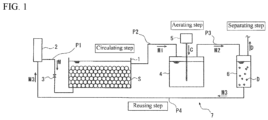
- the method for fixing carbon dioxide is carried out by using a carbon dioxide fixation apparatus as illustrated in FIG. 1 .
- the carbon dioxide fixation apparatus principally includes: a container 1 for forming a slag layer S by being charged with slag containing calcium; a supply portion 2 configured to supply the container 1 with a solvent M containing a polyol compound; an adjusting portion 3 for adjusting an amount of the solvent M supplied, to maintain a velocity at which the slag layer S does not flow; a retaining portion 4 configured to retain a calcium extract M1 discharged from the container 1 after passing through the slag layer S; an aeration portion 5 configured to aerate, with a gas C containing carbon dioxide, the extract M1 retained in the retaining portion 4; and a separation portion 6 configured to subject, to solid-liquid separation, a precipitate D in a mixed solution M2 obtained by aeration by the aeration portion 5.
- the carbon dioxide fixation apparatus further includes a circulation portion 7 configured to circulate, to the supply portion 2, a separate liquid M3 from which the precipitate D has been separated in the separation portion 6.
- the slag is not particularly limited as long as it contains calcium, and examples thereof include blast furnace slag, steel slag, cement, concrete waste, glass waste, coal ash, and sludge incineration ash.
- the blast furnace slag means a slag generated in a process of producing pig iron
- the steel slag means slag generated in a process of producing steel, such as converter slag or electric furnace slag.
- calcium is present in a form of calcium oxide (CaO).
- the solvent M contains the polyol compound.
- the polyol compound is a medium for extracting the calcium from the slag.
- the polyol compound is an organic compound having a plurality of alcoholic hydroxyl groups.
- An alcoholic hydroxyl group is a hydroxy group obtained by substituting a hydrogen atom of an aliphatic hydrocarbon and does not include a hydroxy group obtained by substituting a hydrogen atom of a hydrocarbon constituting an aromatic ring (for example, a hydroxy group of a phenol).
- the polyol compound is not particularly limited as long as it is an organic compound having a plurality of alcoholic hydroxyl groups, and a diol compound or a triol compound is preferred.
- the diol compound is not particularly limited as long as it is an organic compound having two alcoholic hydroxyl groups, and examples thereof include ethylene glycol, propylene glycol, diethylene glycol, butanediol, and diethanolamine. Of these, for example, the diol compound is preferably one or two or more selected from the group consisting of ethylene glycol, propylene glycol, and diethylene glycol.
- the solubility of calcium in ethylene glycol is approximately 10 times the solubility in water.
- the solubility of calcium in a diol compound is far higher than the solubility in water. Therefore, when the diol compound is one or two or more selected from the above group, the calcium can be more efficiently extracted from the slag layer S.
- the triol compound is not particularly limited as long as it is an organic compound having three alcoholic hydroxyl groups, and glycerin is preferred. By using glycerin, the calcium can be more efficiently extracted from the slag layer S.
- the upper limit value of a polyol compound concentration in the solvent M circulated through the slag layer S is preferably 60% by mass, more preferably 50% by mass, and still more preferably 40% by mass.
- the lower limit value of the polyol compound concentration in the solvent M in the circulating step is preferably 20% by mass and more preferably 30% by mass.
- the solvent M preferably further contains water. Since being typically in a liquid state under normal pressure and temperature, the diol compound and the triol compound can be relatively easily mixed with the water to be circulated through the slag layer S.
- the water serves as a supply source of protons (H + ) for ionizing (ionizing into carbonate ions) carbon dioxide.
- protons H +
- carbon dioxide is dissolved in the water as carbonate ions (CO 3 2- ).
- CO 3 2- carbonate ions
- Such water is not particularly limited as long as it functions as a catalyst as described above and is exemplified by pure water.
- the solvent M containing the polyol compound is circulated through the slag layer S formed by charging the slag containing calcium in the container 1.
- the container 1 is not particularly limited as long as the slag can be charged therein to form the slag layer S and the solvent M containing the polyol compound can be circulated through the slag layer S.
- the solvent M is circulated at a velocity at which the slag layer S does not flow. That is to say, the solvent M is circulated at a circulation velocity at which slag particles in the slag layer S do not mutually transfer in the container 1 and a collision or the like thereof does not occur. If a collision or the like of the slag particles occurs owing to the circulation of the solvent M, debris (slag pieces) is mixed in the solvent M to be discharged from the container 1. Owing to the slag pieces mixed in the solvent M, the solvent M after the fixation treatment of carbon dioxide may have a decreased purity, and use or reuse applications thereof may be limited.
- a carbonate is obtained from the solvent M discharged from the container 1; if the slag pieces are also mixed in the carbonate, the purity thereof may decrease, and use applications thereof may be limited.
- treatment for removing the slag pieces is required, and thus, cost for using or reusing the solvent M discharged from the container 1 and the carbonate may increase.
- the carbon dioxide fixation apparatus includes: the supply portion 2 configured to supply the solvent M; and the adjusting portion 3 for adjusting the amount of the solvent M supplied.
- the adjusting portion 3 adjusts a flow rate of the solvent M supplied by the supply portion 2 to the container 1 and controls a flow velocity of the solvent M in the container 1 such that the slag layer S does not flow.
- the supply portion 2 is not particularly limited and is, for example, a pump for liquid.
- the adjusting portion 3 is not particularly limited and is, for example, an adjusting valve having a variable opening size.
- the adjusting portion 3 is provided on a solvent supply pipe P1 which connects the container 1 to the supply portion 2.
- the solvent M is preferably circulated such that a pressure loss of the solvent M circulated through the slag layer S is less than or equal to 14 kPa/m.
- the upper limit value of the pressure loss of the solvent M circulated through the slag layer S is more preferably 12 kPa/m, still more preferably 10 kPa/m, and particularly preferably 6 kPa/m.
- the pressure loss of the solvent M circulated through the slag layer S is greater than the upper limit value, the slag particles in the slag layer S may mutually transfer in the container 1 and a collision or the like thereof may occur.
- the solvent M is preferably circulated such that a superficial velocity of the solvent M circulated through the slag layer S is less than or equal to 0.4 mm/s.
- the upper limit value of the superficial velocity of the solvent M circulated through the slag layer S is more preferably 0.3 mm/s.
- the lower limit value of the superficial velocity of the solvent M circulated through the slag layer S is not particularly limited and is, for example, 0.08 mm/s.
- the slag from which calcium has been removed in the circulating step can be removed from the container 1 and then dried to be used as resources such as a base course material (road material), a fertilizer, and the like.
- the calcium extract obtained by passage of the solvent M through the slag layer S in the circulating step is aerated with the gas C containing carbon dioxide.
- the solvent (calcium extract) M1 discharged from the container 1 is retained in the retaining portion 4, and the calcium extract M1 retained is aerated with the gas C containing carbon dioxide.
- the retaining portion 4 is a tank for retaining the calcium extract M1 supplied from the container 1 through an extract supply pipe P2.
- the aeration portion 5 aerates, with the gas C, the calcium extract M1 retained in the retaining portion 4.
- the aeration portion 5 is not particularly limited and is, for example, a known gas blowing apparatus.
- the aeration with the gas C by the aeration portion 5 is preferably performed while agitating the calcium extract M1 in the retaining portion 4.
- the solvent M containing the polyol compound is discharged from the container 1 as the calcium extract M1 containing many calcium ions (Ca 2+ ).
- the calcium extract M1 containing many calcium ions (Ca 2+ ).
- the carbon dioxide is dissolved in the calcium extract M1 as carbonate ions.
- a carbonate (calcium carbonate: CaCO 3 ) is precipitated as a precipitate.
- the method for fixing carbon dioxide since the calcium extract M1 contains many calcium ions, a large amount of carbon dioxide can be fixed.
- an exhaust gas containing carbon dioxide discharged in industrial activities such as factory or power plant operation, transportation, etc. is preferably used.
- a concentration of carbon dioxide in the gas C is not particularly limited and may be a concentration equal to the concentration of carbon dioxide in the atmosphere or the exhaust gas or may be a concentration obtained by diluting or concentrating the atmosphere or the exhaust gas.
- the gas C may be a gas consisting exclusively of carbon dioxide.
- the precipitate D precipitated from the mixed solution M2 obtained in the aerating step is subjected to solid-liquid separation.
- the calcium extract (mixed solution) M2 after the aerating step which is supplied through a mixed solution supply pipe P3, is separated by solid-liquid separation in the separation portion 6 into a solid (precipitate D) and a liquid (separate liquid M3).
- the separation portion 6 is not particularly limited and is, for example, a known centrifuge.
- the precipitate D and the separate liquid M3 separated in the separation portion 6 are high in purity because mixing of the slag pieces is inhibited, and thus can be used or reused for wide applications.
- the separate liquid M3 can be reused, for example, as part of the solvent M in the circulating step as described later.
- the precipitate D carbonate
- the precipitate D can be used, for example, as a filler for resin.
- the separate liquid M3 separated is reused as at least part of the solvent M in the circulating step.
- the separate liquid M3 is circulated through the circulation portion 7 to the supply portion 2 and then used as part of the solvent mixed solution to come in contact with the slag layer S.
- the circulation portion 7 includes a separate liquid supply pipe P4. Since mixing of the slag pieces is inhibited and the precipitate D has been removed from in the separating step, the separate liquid M3 circulated has quality comparable to that of the solvent M before contact with the slag layer S.
- the method for fixing carbon dioxide enables efficiently extracting calcium in the slag. Therefore, the slag through which the solvent has been circulated has a reduced calcium content and thus can be efficiently used or reused, and the solvent after contact with the slag contains much calcium and thus enables efficiently fixing carbon dioxide by being aerated with the gas containing carbon dioxide. Furthermore, since in the circulating step, the solvent is circulated at a velocity at which the slag does not flow, the method for fixing carbon dioxide enables inhibiting mixing of the slag pieces of the slag in the solvent after the circulation. Therefore, the precipitate precipitated by the aeration and the solvent after the aeration are high in purity and thus can be used or reused at low cost for wide applications.
- the carbon dioxide fixation apparatus includes the supply portion and the adjusting portion; however, the supply portion may incorporate the adjusting portion. That is to say, a supply portion integrated with an adjusting portion may be used.
- the solvent may contain other solution(s) and/or additive(s) besides the polyol compound and the water within a range not leading to inhibition of the extraction efficiency of calcium in the slag.
- the other solution(s) include a hydrophilic solution and the like.
- the hydrophilic solution include ethanol, methanol, and the like.
- a mixed solution of the polyol compound and an aqueous solution in which an additive other than the solvent is dissolved in water may be used.
- the supply of the solvent may be started after the slag is charged in the container, or the slag and the solvent may be concurrently supplied to (charged in) the container.
- the solvent may be supplied to the container at a constant flow rate or at a variable flow rate. Furthermore, the solvent may be continuously supplied or may be intermittently supplied.
- An obstacle for preventing linear circulation of the solvent may be provided in the container. That is to say, the container may be provided with an obstacle for partly or entirely generating turbulence of the solvent in the container.
- f-CaO is 13% by mass.
- f-CaO means unreacted calcium oxide (CaO) and unreacted calcium hydroxide (Ca(OH) 2 ).
- Content percentages of components of the slag are shown in Table 1. The content percentages are rounded to two decimal places.
- Table 1 Component [% by mass] CaO SiO 2 Al 2 O 3 MgO MnO 43.80 11.30 1.27 2.19 6.86
- a solvent M11 containing a polyol compound a mixture of water and glycerin (produced by FUJIFILM Wako Pure Chemical Corporation; purity: greater than 99.5%), the mixture having a glycerin concentration of 40% by mass, was prepared.
- calcium was extracted in such a manner that the solvent M11 was supplied to the container 11 and circulated through the slag layer S1.
- the solvent M11 was retained in a solvent container 12, and then supplied to the container 11 by applying pressure with a nitrogen gas N to the solvent container 12.
- the flow velocity (supply velocity) of the solvent M1 was controlled by the amount of the nitrogen gas N supplied, whereby the superficial velocity was varied.
- the amount of the nitrogen gas N supplied was adjusted using a valve V while checking a flowmeter 13.
- a solvent (calcium extract) M12 discharged from the container 11 in which the slag layer S1 was formed was separated at predetermined time intervals, and a calcium ion concentration in the solution was measured to calculate an extraction percentage E of calcium.
- Test Example 3 400 g of the solvent M11 and 40 g of the slag were charged in another container (beaker) and agitated to extract calcium. The agitation was performed using an agitator at 300 rpm for 1.5 hrs. under conditions involving room temperature and nitrogen atmosphere. The solvent after agitation (calcium extract) was subjected to filtration under reduced pressure (filter medium: filter paper No. 5A), and the calcium concentration in the filtrate was quantified to calculate the extraction percentage.
- filter medium filter paper No. 5A
- Test Examples 1 to 3 were visually checked to confirm the presence or absence of fine powder (slag pieces) in the calcium extracts. Evaluation of Test Examples 1 to 3 is shown in Table 2. Table 2 Superficial velocity Calcium extraction percentage Presence/absence of fine powder Test Example 1 0.08 mm/s 40% transparent Test Example 2 0.25 mm/s 27% transparent Test Example 3 - 40% turbid
- Test Example 3 shows a calcium extraction percentage comparable to that of Test Example 1, fine powder is present in the calcium extract; therefore, treatment for removing the fine powder is necessary to use or reuse the calcium extract.
- the amount of fine powder in the calcium extracts is negligible; therefore, these calcium extracts can be reduced into a solvent to be used or reused without performing treatment for removing the fine powder.
- Test Example 4 was conducted under the same conditions as Test Example 1 except for the superficial velocity.
- the test was conducted at superficial velocities varied in a range of greater than 0 mm/s and less than or equal to 1.4 mm/s.
- run 1 and run 2 were performed at a relatively high superficial velocity and at a relatively low superficial velocity, respectively.
- a pressure loss of the solvent in the container 11 was measured with a manometer. With regard to the pressure loss, a height by which a liquid level of the manometer is greater than the upper end of the slag layer S1 was measured and converted, and a change of the height was observed.
- FIG. 3 shows a relation between a change in superficial velocity and a change in pressure loss of the solvent.
- FIG. 3 indicates that there exists a folding point of the pressure loss at a superficial velocity of 0.4 mm/s. That is to say, it can be seen that the slag begins to flow when the superficial velocity exceeds 0.4 mm/s. Therefore, from FIG. 3 , it is found that the superficial velocity of the solvent M11 circulated through the slag layer S1 is preferably less than or equal to 0.4 mm/s, and that the pressure loss thereof is preferably less than or equal to 14 kPa/m.
- carbon dioxide can be efficiently fixed at low cost, and thus, the slag containing calcium can be effectively used; in addition, since the purities of the solvent after fixing the carbon dioxide and the precipitate in the solvent can be increased, the solvent and the precipitate can be easily used or reused. Therefore, the present invention is suitably used for fixing carbon dioxide.
Landscapes
- Chemical & Material Sciences (AREA)
- Engineering & Computer Science (AREA)
- Environmental & Geological Engineering (AREA)
- Organic Chemistry (AREA)
- Life Sciences & Earth Sciences (AREA)
- Geology (AREA)
- Metallurgy (AREA)
- General Life Sciences & Earth Sciences (AREA)
- Manufacturing & Machinery (AREA)
- Materials Engineering (AREA)
- Mechanical Engineering (AREA)
- Chemical Kinetics & Catalysis (AREA)
- Health & Medical Sciences (AREA)
- General Chemical & Material Sciences (AREA)
- Analytical Chemistry (AREA)
- Oil, Petroleum & Natural Gas (AREA)
- Biomedical Technology (AREA)
- Geochemistry & Mineralogy (AREA)
- Inorganic Chemistry (AREA)
- Compounds Of Alkaline-Earth Elements, Aluminum Or Rare-Earth Metals (AREA)
- Treating Waste Gases (AREA)
- Carbon And Carbon Compounds (AREA)
- Manufacture And Refinement Of Metals (AREA)
- Processing Of Solid Wastes (AREA)
Abstract
Description
- The present invention relates to a method for extracting calcium, a method for fixing carbon dioxide, and a carbon dioxide fixation apparatus.
- In recent years, global warming has brought problems of climate change. Carbon dioxide (CO2) in the atmosphere is one of greenhouse effect gases and is considered to be a main factor of global warming. Therefore, a reduction of CO2 emissions and the like are required.
- As a means for reducing CO2 emissions, there is a technology for fixing CO2. Known is a method for fixing CO2 by using, as an object which fixes CO2, an alkaline earth metal-containing substance such as slag or the like (
Japanese Unexamined Patent Application, Publication No. 2005-097072 - Patent Document 1:
Japanese Unexamined Patent Application, Publication No. 2005-097072 - In
Patent Document 1, the alkaline earth metal-containing substance is charged into an aqueous solution containing a weakly basic and strongly acidic salt and being put in a first reaction container, the resulting mixture is agitated, and a calcium chloride- (CaCl2-) containing aqueous solution after the agitation is transferred to a second reaction container and aerated with a carbon dioxide gas to generate calcium carbonate (CaCO3); thus, CO2 is fixed and a carbonate is obtained. - In
Patent Document 1, the agitation may cause fine powder of the alkaline earth metal-containing substance to be mixed in the aqueous solution. The aqueous solution after the aeration with the carbon dioxide gas and the resulting carbonate may have decreased purities due to the fine powder mixed, and their applications may be limited. Furthermore, since the agitation and the aeration are performed in different reaction containers, operation for fixing carbon dioxide may become complicated. - In view of the foregoing circumstances, an object of the present invention is to provide: a method for extracting calcium which enables efficiently extracting calcium in slag into a solvent while inhibiting generation of fine powder of the slag; and a method for fixing carbon dioxide and a carbon dioxide fixation apparatus which enable easily fixing carbon dioxide to a calcium extract extracted by the extraction method and improving purities of the solvent and a carbonate after fixing the carbon dioxide.
- A method for extracting calcium according to an aspect of the present invention for solving the above problems includes: circulating a solvent containing a polyol compound through a slag layer formed by charging slag containing calcium in a container, wherein in the circulating, the solvent is circulated at a velocity at which the slag layer does not flow.
- A method for fixing carbon dioxide according to another aspect of the present invention for solving the above problems includes: circulating a solvent containing a polyol compound through a slag layer formed by charging slag containing calcium in a container; aerating, with a gas containing carbon dioxide, a calcium extract obtained by passage of the solvent through the slag layer in the circulating; and separating, by solid-liquid separation, a precipitate precipitated from a mixed solution obtained in the aerating, wherein in the circulating, the solvent is circulated at a velocity at which the slag layer does not flow.
- A carbon dioxide fixation apparatus according to still another aspect of the present invention for solving the above problems includes: a container for forming a slag layer by being charged with slag containing calcium; a supply portion configured to supply the container with a solvent containing a polyol compound; an adjusting portion for adjusting an amount of the solvent supplied, to maintain a velocity at which the slag layer does not flow; a retaining portion configured to retain a calcium extract discharged from the container after passing through the slag layer; an aeration portion configured to aerate, with a gas containing carbon dioxide, the extract retained in the retaining portion; and a separation portion configured to subject, to solid-liquid separation, a precipitate in a mixed solution obtained by aeration by the aeration portion.
- The method for extracting calcium of the present invention enables efficiently extracting calcium in slag into a solvent while inhibiting generation of fine powder of the slag. The method for fixing carbon dioxide and the carbon dioxide fixation apparatus of the present invention enable easily fixing carbon dioxide to a calcium extract extracted by the extraction method and improving purities of the solvent and a carbonate after fixing the carbon dioxide.
-
-
FIG. 1 is a schematic view illustrating a carbon dioxide fixation apparatus according to one embodiment of the present invention. -
FIG. 2 is a schematic view illustrating a test apparatus used in Examples of the present invention. -
FIG. 3 is a graph showing a relation between a superficial velocity and a pressure loss of a solvent circulated through a slag layer formed in a container of the test apparatus inFIG. 2 . - A method for extracting calcium according to an aspect of the present invention includes a circulating step of circulating a solvent containing a polyol compound through a slag layer formed by charging slag containing calcium in a container, wherein in the circulating step, the solvent is circulated at a velocity at which the slag layer does not flow.
- In the method for extracting calcium (hereinafter, may be also referred to as "the extraction method"), the solvent containing the polyol compound is circulated through and brought into contact with the slag layer of the slag containing calcium (Ca). Therefore, the calcium can be efficiently extracted into the solvent as a calcium ion. Since the circulation of the solvent is performed at a velocity at which the slag layer does not flow, generation of fine powder (slag pieces) due to a collision or the like of slag particles in the solvent can be inhibited.
- A method for fixing carbon dioxide according to another aspect of the present invention includes: a circulating step of circulating a solvent containing a polyol compound through a slag layer formed by charging slag containing calcium in a container; an aerating step of aerating, with a gas containing carbon dioxide, a calcium extract obtained by passage of the solvent through the slag layer in the circulating step; and a separating step of separating, by solid-liquid separation, a precipitate precipitated from a mixed solution obtained in the aerating step, wherein in the circulating step, the solvent is circulated at a velocity at which the slag layer does not flow.
- Since the method for fixing carbon dioxide enables the calcium in the slag to be efficiently extracted in an extracting step, more carbon dioxide can be fixed to the calcium. Furthermore, since generation of slag pieces in the extracting step can be inhibited, a decrease in purity of the solvent after fixing the carbon dioxide and a decrease in purity of a carbonate obtained by fixing the carbon dioxide can be inhibited.
- The method for fixing carbon dioxide preferably further includes a reusing step of reusing, as at least part of the solvent in the circulating step, a separate liquid separated in the separating step. By thus circularly reusing the solvent, the method for fixing carbon dioxide can be carried out at low cost.
- In the circulating step, the solvent is preferably circulated such that a pressure loss of the solvent circulated through the slag layer is less than or equal to 14 kPa/m. Thus, generation of slag pieces can be further inhibited.
- In the circulating step, the solvent is preferably circulated such that a superficial velocity of the solvent circulated through the slag layer is less than or equal to 0.4 mm/s. Thus, generation of slag pieces can be still further inhibited.
- The polyol compound is preferably a diol compound or a triol compound. Thus, the calcium in the slag can be more efficiently extracted as a calcium ion.
- The diol compound is preferably one or two or more selected from the group consisting of ethylene glycol, propylene glycol, and diethylene glycol. Thus, the calcium in the slag can be still more efficiently extracted as a calcium ion.
- The triol compound is preferably glycerin. Thus, the calcium in the slag can be still more efficiently extracted as a calcium ion.
- A carbon dioxide fixation apparatus according to still another aspect of the present invention includes: a container for forming a slag layer by being charged with slag containing calcium; a supply portion configured to supply the container with a solvent containing a polyol compound; an adjusting portion for adjusting an amount of the solvent supplied, to maintain a velocity at which the slag layer does not flow; a retaining portion configured to retain a calcium extract discharged from the container after passing through the slag layer; an aeration portion configured to aerate, with a gas containing carbon dioxide, the extract retained in the retaining portion; and a separation portion configured to subject, to solid-liquid separation, a precipitate in a mixed solution obtained by aeration by the aeration portion.
- Since the carbon dioxide fixation apparatus includes the adjusting portion configured to adjust the amount of the solvent supplied to the slag layer to an amount at which the slag does not flow, generation of slag pieces can be inhibited, and the carbon dioxide can be efficiently fixed.
- As referred to herein, the "polyol compound" means an organic compound having a plurality of alcoholic hydroxyl groups (groups each obtained by substituting a hydrogen atom of an aliphatic hydrocarbon with a hydroxy group (-OH)). Similarly, the "diol compound" means an organic compound having two alcoholic hydroxyl groups, and the "triol compound" means an organic compound having three alcoholic hydroxyl groups.
- Hereinafter, the present invention will be described in detail with reference to the drawings as appropriate. It is to be noted that the drawings are merely illustrative and schematically illustrate each component (each member); therefore, the shape, dimension, etc. thereof may be different in an actual case, and a member such as a pump for transferring a liquid (e.g., a solvent described later), a valve for appropriately controlling the timing of transferring the liquid, or the like may be omitted. Furthermore, the present specification may include a plurality of upper limit values and a plurality of lower limit values as numerical ranges of a component of the present invention. Such a plurality of upper limit values and such a plurality of lower limit values are presented as indicating that one value may be arbitrarily selected from each range, or that these values may be arbitrarily combined.
- The method for fixing carbon dioxide principally includes: a circulating step of circulating a solvent containing a polyol compound through a slag layer formed by charging slag containing calcium in a container; an aerating step of aerating, with a gas containing carbon dioxide, a calcium extract obtained by passage of the solvent through the slag layer in the circulating step; and a separating step of separating, by solid-liquid separation, a precipitate precipitated from a mixed solution obtained in the aerating step. In the circulating step, the solvent is circulated at a velocity at which the slag layer does not flow.
- The method for fixing carbon dioxide further includes a reusing step of reusing, as at least part of the solvent in the circulating step, a separate liquid separated in the separating step. The method for fixing carbon dioxide is carried out by using a carbon dioxide fixation apparatus as illustrated in
FIG. 1 . - The carbon dioxide fixation apparatus principally includes: a
container 1 for forming a slag layer S by being charged with slag containing calcium; a supply portion 2 configured to supply thecontainer 1 with a solvent M containing a polyol compound; an adjusting portion 3 for adjusting an amount of the solvent M supplied, to maintain a velocity at which the slag layer S does not flow; a retaining portion 4 configured to retain a calcium extract M1 discharged from thecontainer 1 after passing through the slag layer S; anaeration portion 5 configured to aerate, with a gas C containing carbon dioxide, the extract M1 retained in the retaining portion 4; and a separation portion 6 configured to subject, to solid-liquid separation, a precipitate D in a mixed solution M2 obtained by aeration by theaeration portion 5. - The carbon dioxide fixation apparatus further includes a
circulation portion 7 configured to circulate, to the supply portion 2, a separate liquid M3 from which the precipitate D has been separated in the separation portion 6. - The slag is not particularly limited as long as it contains calcium, and examples thereof include blast furnace slag, steel slag, cement, concrete waste, glass waste, coal ash, and sludge incineration ash. The blast furnace slag means a slag generated in a process of producing pig iron, and the steel slag means slag generated in a process of producing steel, such as converter slag or electric furnace slag. In such slag, for example, calcium is present in a form of calcium oxide (CaO).
- The solvent M contains the polyol compound. The polyol compound is a medium for extracting the calcium from the slag. The polyol compound is an organic compound having a plurality of alcoholic hydroxyl groups. An alcoholic hydroxyl group is a hydroxy group obtained by substituting a hydrogen atom of an aliphatic hydrocarbon and does not include a hydroxy group obtained by substituting a hydrogen atom of a hydrocarbon constituting an aromatic ring (for example, a hydroxy group of a phenol).
- The polyol compound is not particularly limited as long as it is an organic compound having a plurality of alcoholic hydroxyl groups, and a diol compound or a triol compound is preferred.
- The diol compound is not particularly limited as long as it is an organic compound having two alcoholic hydroxyl groups, and examples thereof include ethylene glycol, propylene glycol, diethylene glycol, butanediol, and diethanolamine. Of these, for example, the diol compound is preferably one or two or more selected from the group consisting of ethylene glycol, propylene glycol, and diethylene glycol.
- For example, it is generally known that the solubility of calcium in ethylene glycol is approximately 10 times the solubility in water. In other words, the solubility of calcium in a diol compound is far higher than the solubility in water. Therefore, when the diol compound is one or two or more selected from the above group, the calcium can be more efficiently extracted from the slag layer S.
- The triol compound is not particularly limited as long as it is an organic compound having three alcoholic hydroxyl groups, and glycerin is preferred. By using glycerin, the calcium can be more efficiently extracted from the slag layer S.
- The upper limit value of a polyol compound concentration in the solvent M circulated through the slag layer S is preferably 60% by mass, more preferably 50% by mass, and still more preferably 40% by mass. When the polyol compound concentration is greater than the upper limit value, precipitation of the precipitate (carbonate) in the aerating step described later may decrease. That is to say, the efficiency of fixing carbon dioxide may decrease. The lower limit value of the polyol compound concentration in the solvent M in the circulating step is preferably 20% by mass and more preferably 30% by mass. When the polyol compound concentration is less than the lower limit value, a sufficient amount of calcium may not be eluted from the slag layer S into the solvent M.
- The solvent M preferably further contains water. Since being typically in a liquid state under normal pressure and temperature, the diol compound and the triol compound can be relatively easily mixed with the water to be circulated through the slag layer S. The water serves as a supply source of protons (H+) for ionizing (ionizing into carbonate ions) carbon dioxide. Furthermore, in the circulating step described later, calcium ions extracted by the polyol compound are transferred to (diffused in) the water, and carbon dioxide is dissolved in the water as carbonate ions (CO3 2-). As a result, the calcium ions and the carbonate ions react with each other in the water as a reaction field to be precipitated as calcium carbonate. Such water is not particularly limited as long as it functions as a catalyst as described above and is exemplified by pure water.
- In the circulating step, the solvent M containing the polyol compound is circulated through the slag layer S formed by charging the slag containing calcium in the
container 1. Thecontainer 1 is not particularly limited as long as the slag can be charged therein to form the slag layer S and the solvent M containing the polyol compound can be circulated through the slag layer S. - In the circulating step, the solvent M is circulated at a velocity at which the slag layer S does not flow. That is to say, the solvent M is circulated at a circulation velocity at which slag particles in the slag layer S do not mutually transfer in the
container 1 and a collision or the like thereof does not occur. If a collision or the like of the slag particles occurs owing to the circulation of the solvent M, debris (slag pieces) is mixed in the solvent M to be discharged from thecontainer 1. Owing to the slag pieces mixed in the solvent M, the solvent M after the fixation treatment of carbon dioxide may have a decreased purity, and use or reuse applications thereof may be limited. Furthermore, through the fixation treatment of carbon dioxide, a carbonate is obtained from the solvent M discharged from thecontainer 1; if the slag pieces are also mixed in the carbonate, the purity thereof may decrease, and use applications thereof may be limited. To improve the purity of the solvent M discharged from thecontainer 1, treatment for removing the slag pieces is required, and thus, cost for using or reusing the solvent M discharged from thecontainer 1 and the carbonate may increase. - The carbon dioxide fixation apparatus includes: the supply portion 2 configured to supply the solvent M; and the adjusting portion 3 for adjusting the amount of the solvent M supplied. The adjusting portion 3 adjusts a flow rate of the solvent M supplied by the supply portion 2 to the
container 1 and controls a flow velocity of the solvent M in thecontainer 1 such that the slag layer S does not flow. The supply portion 2 is not particularly limited and is, for example, a pump for liquid. The adjusting portion 3 is not particularly limited and is, for example, an adjusting valve having a variable opening size. The adjusting portion 3 is provided on a solvent supply pipe P1 which connects thecontainer 1 to the supply portion 2. - In the circulating step, the solvent M is preferably circulated such that a pressure loss of the solvent M circulated through the slag layer S is less than or equal to 14 kPa/m. The upper limit value of the pressure loss of the solvent M circulated through the slag layer S is more preferably 12 kPa/m, still more preferably 10 kPa/m, and particularly preferably 6 kPa/m. When the pressure loss of the solvent M circulated through the slag layer S is greater than the upper limit value, the slag particles in the slag layer S may mutually transfer in the
container 1 and a collision or the like thereof may occur. - Furthermore, in the circulating step, the solvent M is preferably circulated such that a superficial velocity of the solvent M circulated through the slag layer S is less than or equal to 0.4 mm/s. The upper limit value of the superficial velocity of the solvent M circulated through the slag layer S is more preferably 0.3 mm/s. When the superficial velocity of the solvent M circulated through the slag layer S is greater than the upper limit value, the slag particles in the slag layer S may mutually transfer in the
container 1 and a collision or the like thereof may occur. The lower limit value of the superficial velocity of the solvent M circulated through the slag layer S is not particularly limited and is, for example, 0.08 mm/s. - For example, in a case in which the slag is steel slag, the slag from which calcium has been removed in the circulating step can be removed from the
container 1 and then dried to be used as resources such as a base course material (road material), a fertilizer, and the like. - In the aerating step, the calcium extract obtained by passage of the solvent M through the slag layer S in the circulating step is aerated with the gas C containing carbon dioxide. Specifically, the solvent (calcium extract) M1 discharged from the
container 1 is retained in the retaining portion 4, and the calcium extract M1 retained is aerated with the gas C containing carbon dioxide. The retaining portion 4 is a tank for retaining the calcium extract M1 supplied from thecontainer 1 through an extract supply pipe P2. Theaeration portion 5 aerates, with the gas C, the calcium extract M1 retained in the retaining portion 4. Theaeration portion 5 is not particularly limited and is, for example, a known gas blowing apparatus. The aeration with the gas C by theaeration portion 5 is preferably performed while agitating the calcium extract M1 in the retaining portion 4. - Owing to the contact with the slag, the solvent M containing the polyol compound is discharged from the
container 1 as the calcium extract M1 containing many calcium ions (Ca2+). By aerating the calcium extract M1 with the gas C containing carbon dioxide, the carbon dioxide is dissolved in the calcium extract M1 as carbonate ions. When the calcium ions and the carbonate ions react with each other, a carbonate (calcium carbonate: CaCO3) is precipitated as a precipitate. According to the method for fixing carbon dioxide, since the calcium extract M1 contains many calcium ions, a large amount of carbon dioxide can be fixed. - As the gas C containing carbon dioxide, an exhaust gas containing carbon dioxide discharged in industrial activities such as factory or power plant operation, transportation, etc. is preferably used. A concentration of carbon dioxide in the gas C is not particularly limited and may be a concentration equal to the concentration of carbon dioxide in the atmosphere or the exhaust gas or may be a concentration obtained by diluting or concentrating the atmosphere or the exhaust gas. The gas C may be a gas consisting exclusively of carbon dioxide.
- In the separating step, the precipitate D precipitated from the mixed solution M2 obtained in the aerating step is subjected to solid-liquid separation. Specifically, the calcium extract (mixed solution) M2 after the aerating step, which is supplied through a mixed solution supply pipe P3, is separated by solid-liquid separation in the separation portion 6 into a solid (precipitate D) and a liquid (separate liquid M3). The separation portion 6 is not particularly limited and is, for example, a known centrifuge.
- The precipitate D and the separate liquid M3 separated in the separation portion 6 are high in purity because mixing of the slag pieces is inhibited, and thus can be used or reused for wide applications. The separate liquid M3 can be reused, for example, as part of the solvent M in the circulating step as described later. The precipitate D (carbonate) can be used, for example, as a filler for resin.
- In the reusing step, the separate liquid M3 separated is reused as at least part of the solvent M in the circulating step. The separate liquid M3 is circulated through the
circulation portion 7 to the supply portion 2 and then used as part of the solvent mixed solution to come in contact with the slag layer S. Thecirculation portion 7 includes a separate liquid supply pipe P4. Since mixing of the slag pieces is inhibited and the precipitate D has been removed from in the separating step, the separate liquid M3 circulated has quality comparable to that of the solvent M before contact with the slag layer S. - Since the solvent containing the polyol compound is circulated through the slag containing calcium in the circulating step, the method for fixing carbon dioxide enables efficiently extracting calcium in the slag. Therefore, the slag through which the solvent has been circulated has a reduced calcium content and thus can be efficiently used or reused, and the solvent after contact with the slag contains much calcium and thus enables efficiently fixing carbon dioxide by being aerated with the gas containing carbon dioxide. Furthermore, since in the circulating step, the solvent is circulated at a velocity at which the slag does not flow, the method for fixing carbon dioxide enables inhibiting mixing of the slag pieces of the slag in the solvent after the circulation. Therefore, the precipitate precipitated by the aeration and the solvent after the aeration are high in purity and thus can be used or reused at low cost for wide applications.
- The above embodiments do not limit the configuration of the present invention. Therefore, in the above embodiments, the components of each part of the above embodiments can be omitted, replaced, or added based on the description in the present specification and general technical knowledge, and such omission, replacement, or addition should be construed as falling within the scope of the present invention.
- In the above-described embodiments, the carbon dioxide fixation apparatus includes the supply portion and the adjusting portion; however, the supply portion may incorporate the adjusting portion. That is to say, a supply portion integrated with an adjusting portion may be used.
- The solvent may contain other solution(s) and/or additive(s) besides the polyol compound and the water within a range not leading to inhibition of the extraction efficiency of calcium in the slag. Examples of the other solution(s) include a hydrophilic solution and the like. Examples of the hydrophilic solution include ethanol, methanol, and the like. Furthermore, in the circulating step, a mixed solution of the polyol compound and an aqueous solution in which an additive other than the solvent is dissolved in water may be used.
- The reusing step is not an essential step of the method for fixing carbon dioxide, and the separate liquid may be used for other applications.
- With regard to a method for charging the slag in the container of the carbon dioxide fixation apparatus, the supply of the solvent may be started after the slag is charged in the container, or the slag and the solvent may be concurrently supplied to (charged in) the container.
- Furthermore, the solvent may be supplied to the container at a constant flow rate or at a variable flow rate. Furthermore, the solvent may be continuously supplied or may be intermittently supplied.
- An obstacle for preventing linear circulation of the solvent may be provided in the container. That is to say, the container may be provided with an obstacle for partly or entirely generating turbulence of the solvent in the container.
- Hereinafter, the present invention is further described by way of Examples; the present invention is not limited to the Examples.
- The following comparison test was conducted using the test apparatus illustrated in
FIG. 2 . As slag, 450 g of steel slag adjusted by sieving to have a grain size of less than or equal to 10 mm was charged in acontainer 11 having an internal diameter of 42 mm and a height of 230 mm to form a slag layer S1. - With regard to characteristics of the slag, f-CaO is 13% by mass. As referred to herein, f-CaO means unreacted calcium oxide (CaO) and unreacted calcium hydroxide (Ca(OH)2). Content percentages of components of the slag are shown in Table 1. The content percentages are rounded to two decimal places.
Table 1 Component [% by mass] CaO SiO2 Al2O3 MgO MnO 43.80 11.30 1.27 2.19 6.86 - As a solvent M11 containing a polyol compound, a mixture of water and glycerin (produced by FUJIFILM Wako Pure Chemical Corporation; purity: greater than 99.5%), the mixture having a glycerin concentration of 40% by mass, was prepared. In Test Example 1 and Test Example 2 in Table 2 described later, calcium was extracted in such a manner that the solvent M11 was supplied to the
container 11 and circulated through the slag layer S1. The solvent M11 was retained in asolvent container 12, and then supplied to thecontainer 11 by applying pressure with a nitrogen gas N to thesolvent container 12. In Test Example 1 and Test Example 2, the flow velocity (supply velocity) of the solvent M1 was controlled by the amount of the nitrogen gas N supplied, whereby the superficial velocity was varied. The amount of the nitrogen gas N supplied was adjusted using a valve V while checking aflowmeter 13. - A solvent (calcium extract) M12 discharged from the
container 11 in which the slag layer S1 was formed was separated at predetermined time intervals, and a calcium ion concentration in the solution was measured to calculate an extraction percentage E of calcium. The extraction percentage E [%] of calcium was calculated according to the following equation 1:
- In Test Example 3, 400 g of the solvent M11 and 40 g of the slag were charged in another container (beaker) and agitated to extract calcium. The agitation was performed using an agitator at 300 rpm for 1.5 hrs. under conditions involving room temperature and nitrogen atmosphere. The solvent after agitation (calcium extract) was subjected to filtration under reduced pressure (filter medium: filter paper No. 5A), and the calcium concentration in the filtrate was quantified to calculate the extraction percentage.
- The turbidity of the calcium extracts of Test Examples 1 to 3 were visually checked to confirm the presence or absence of fine powder (slag pieces) in the calcium extracts. Evaluation of Test Examples 1 to 3 is shown in Table 2.
Table 2 Superficial velocity Calcium extraction percentage Presence/absence of fine powder Test Example 1 0.08 mm/s 40% transparent Test Example 2 0.25 mm/s 27% transparent Test Example 3 - 40% turbid - Although Test Example 3 shows a calcium extraction percentage comparable to that of Test Example 1, fine powder is present in the calcium extract; therefore, treatment for removing the fine powder is necessary to use or reuse the calcium extract. On the other hand, in Test Examples 1 and 2, the amount of fine powder in the calcium extracts is negligible; therefore, these calcium extracts can be reduced into a solvent to be used or reused without performing treatment for removing the fine powder.
- Next, Test Example 4 was conducted under the same conditions as Test Example 1 except for the superficial velocity. The test was conducted at superficial velocities varied in a range of greater than 0 mm/s and less than or equal to 1.4 mm/s. In the test,
run 1 and run 2 were performed at a relatively high superficial velocity and at a relatively low superficial velocity, respectively. A pressure loss of the solvent in thecontainer 11 was measured with a manometer. With regard to the pressure loss, a height by which a liquid level of the manometer is greater than the upper end of the slag layer S1 was measured and converted, and a change of the height was observed.FIG. 3 shows a relation between a change in superficial velocity and a change in pressure loss of the solvent. -
FIG. 3 indicates that there exists a folding point of the pressure loss at a superficial velocity of 0.4 mm/s. That is to say, it can be seen that the slag begins to flow when the superficial velocity exceeds 0.4 mm/s. Therefore, fromFIG. 3 , it is found that the superficial velocity of the solvent M11 circulated through the slag layer S1 is preferably less than or equal to 0.4 mm/s, and that the pressure loss thereof is preferably less than or equal to 14 kPa/m. - According to the present invention, carbon dioxide can be efficiently fixed at low cost, and thus, the slag containing calcium can be effectively used; in addition, since the purities of the solvent after fixing the carbon dioxide and the precipitate in the solvent can be increased, the solvent and the precipitate can be easily used or reused. Therefore, the present invention is suitably used for fixing carbon dioxide.
-
- 1, 11: Container
- 2: Supply portion
- 3: Adjusting portion
- 4: Retaining portion
- 5: Aeration portion
- 6: Separation portion
- 7: Circulation portion
- 12: Solvent container
- 13: Flowmeter
- D: Precipitate
- M, M11: Solvent
- M1, M12: Calcium extract
- M2: Mixed solution
- M3: Separate liquid
- N: Nitrogen gas
- P1: Solvent supply pipe
- P2: Extract supply pipe
- P3: Mixed solution supply pipe
- P4: Separate liquid supply pipe
- S, S1: Slag layer
- V: Valve
Claims (9)
- A method for extracting calcium, the method comprising:circulating a solvent comprising a polyol compound through a slag layer formed by charging slag comprising calcium in a container,wherein in the circulating, the solvent is circulated at a velocity at which the slag layer does not flow.
- A method for fixing carbon dioxide, the method comprising:circulating a solvent comprising a polyol compound through a slag layer formed by charging slag comprising calcium in a container;aerating, with a gas comprising carbon dioxide, a calcium extract obtained by passage of the solvent through the slag layer in the circulating; andseparating, by solid-liquid separation, a precipitate precipitated from a mixed solution obtained in the aerating,wherein in the circulating, the solvent is circulated at a velocity at which the slag layer does not flow.
- The method for fixing carbon dioxide according to claim 2, the method further comprising:
reusing, as at least part of the solvent in the circulating, a separate liquid separated in the separating. - The method for fixing carbon dioxide according to claim 2, wherein in the circulating, the solvent is circulated such that a pressure loss of the solvent circulated through the slag layer is less than or equal to 14 kPa/m.
- The method for fixing carbon dioxide according to claim 2 or 4, wherein in the circulating, the solvent is circulated such that a superficial velocity of the solvent circulated through the slag layer is less than or equal to 0.4 mm/s.
- The method for fixing carbon dioxide according to claim 2 or 3, wherein the polyol compound is a diol compound or a triol compound.
- The method for fixing carbon dioxide according to claim 6, wherein the diol compound is one or two or more selected from the group consisting of ethylene glycol, propylene glycol, and diethylene glycol.
- The method for fixing carbon dioxide according to claim 6, wherein the triol compound is glycerin.
- A carbon dioxide fixation apparatus comprising:a container for forming a slag layer by being charged with slag comprising calcium;a supply portion configured to supply the container with a solvent comprising a polyol compound;an adjusting portion for adjusting an amount of the solvent supplied, to maintain a velocity at which the slag layer does not flow;a retaining portion configured to retain a calcium extract discharged from the container after passing through the slag layer;an aeration portion configured to aerate, with a gas comprising carbon dioxide, the extract retained in the retaining portion; anda separation portion configured to subject, to solid-liquid separation, a precipitate in a mixed solution obtained by aeration by the aeration portion.
Applications Claiming Priority (2)
| Application Number | Priority Date | Filing Date | Title |
|---|---|---|---|
| JP2022132038A JP7834604B2 (en) | 2022-08-22 | 2022-08-22 | Calcium extraction method, carbon dioxide fixation method, and carbon dioxide fixation apparatus |
| PCT/JP2023/028627 WO2024043046A1 (en) | 2022-08-22 | 2023-08-04 | Method for extracting calcium, method for fixing carbon dioxide, and apparatus for fixing carbon dioxide |
Publications (2)
| Publication Number | Publication Date |
|---|---|
| EP4567140A1 true EP4567140A1 (en) | 2025-06-11 |
| EP4567140A4 EP4567140A4 (en) | 2025-07-02 |
Family
ID=90013083
Family Applications (1)
| Application Number | Title | Priority Date | Filing Date |
|---|---|---|---|
| EP23857160.8A Pending EP4567140A4 (en) | 2022-08-22 | 2023-08-04 | Process for extracting calcium, process for fixing carbon dioxide and device for fixing carbon dioxide |
Country Status (5)
| Country | Link |
|---|---|
| US (1) | US20260097362A1 (en) |
| EP (1) | EP4567140A4 (en) |
| JP (1) | JP7834604B2 (en) |
| CN (1) | CN119654430A (en) |
| WO (1) | WO2024043046A1 (en) |
Family Cites Families (6)
| Publication number | Priority date | Publication date | Assignee | Title |
|---|---|---|---|---|
| JP3954009B2 (en) | 2003-08-18 | 2007-08-08 | 財団法人地球環境産業技術研究機構 | Carbon dioxide immobilization method |
| US7964170B2 (en) * | 2007-10-19 | 2011-06-21 | Fluegen, Inc. | Method and apparatus for the removal of carbon dioxide from a gas stream |
| JP5751823B2 (en) * | 2010-12-20 | 2015-07-22 | 日新製鋼株式会社 | Method for producing modified steel slag |
| US12434185B2 (en) * | 2018-12-20 | 2025-10-07 | Universidade Federal De Minas Gerais | Process for capturing CO2 and process for continuously regenerating solvent |
| JP2021070868A (en) * | 2019-10-30 | 2021-05-06 | 株式会社神戸製鋼所 | Method for extracting calcium, method for recovering calcium and method for fixing carbon dioxide |
| JP7401415B2 (en) * | 2020-09-08 | 2023-12-19 | 株式会社神戸製鋼所 | Method for suppressing expansion of steelmaking slag, method for utilizing steelmaking slag, and method for producing low f-CaO-containing slag |
-
2022
- 2022-08-22 JP JP2022132038A patent/JP7834604B2/en active Active
-
2023
- 2023-08-04 EP EP23857160.8A patent/EP4567140A4/en active Pending
- 2023-08-04 US US19/103,941 patent/US20260097362A1/en active Pending
- 2023-08-04 WO PCT/JP2023/028627 patent/WO2024043046A1/en not_active Ceased
- 2023-08-04 CN CN202380060544.4A patent/CN119654430A/en active Pending
Also Published As
| Publication number | Publication date |
|---|---|
| EP4567140A4 (en) | 2025-07-02 |
| JP7834604B2 (en) | 2026-03-24 |
| WO2024043046A1 (en) | 2024-02-29 |
| JP2024029661A (en) | 2024-03-06 |
| CN119654430A (en) | 2025-03-18 |
| US20260097362A1 (en) | 2026-04-09 |
Similar Documents
| Publication | Publication Date | Title |
|---|---|---|
| KR100988916B1 (en) | Organic drainage and sludge treatment method and treatment device | |
| WO2009102142A2 (en) | Nitrogen-rich waste water treatment method and method for producing struvite | |
| JP2014213479A (en) | Water for concrete production, and method for producing the same | |
| JP2018130697A (en) | Biogas production promoter, biogas production promotion method using the same, organic waste treatment method, treatment apparatus | |
| JP2021070868A (en) | Method for extracting calcium, method for recovering calcium and method for fixing carbon dioxide | |
| KR101303051B1 (en) | Apparatus and Method for Treating Slag | |
| JP2021070599A (en) | Method for extracting calcium, method for recovering calcium and method for fixing carbon dioxide | |
| US20260097362A1 (en) | Method for extracting calcium, method for fixing carbon dioxide, and carbon dioxide fixation apparatus | |
| JP2002292393A (en) | Methane fermentation treatment apparatus and treatment method | |
| TWI403467B (en) | Treatment device for drainage containing organic sulfur compounds | |
| JP2006043511A (en) | Organic acid generation method, organic acid generation apparatus, and wastewater treatment apparatus | |
| CN115780096A (en) | Collector for collecting carbon and silicon by reverse flotation, and preparation method and application thereof | |
| EP4617235A1 (en) | Method for fixing carbon dioxide | |
| JP2019037912A (en) | Denitrification treatment method and denitrification treatment apparatus for ammonia nitrogen containing wastewater | |
| US6776958B1 (en) | Method and device for treating a heavily loaded liquid effluent in particular with nitrogen and with phosphorus | |
| CN110104827A (en) | A kind of phosphate fertilizer sewage treatment process | |
| CN210287073U (en) | Diamond Wire Slicing Wastewater Treatment System | |
| JP4156820B2 (en) | Organic wastewater treatment method and treatment apparatus | |
| WO2024075414A1 (en) | Method for producing calcium carbonate | |
| JPH0994596A (en) | Phosphorus removal method for organic wastewater | |
| JP2007098279A (en) | Apparatus and method for treating waste water by using microbe | |
| CN115650479A (en) | Method for deeply removing uranium from uranium-containing wastewater treated by polymeric ferric sulfate | |
| CN110240426A (en) | A kind of cement slurry additive and its application and cement production process | |
| JPS555733A (en) | Method and apparatus for denitrification treatment of waste water | |
| JP2008246484A (en) | Method and apparatus for treating organic waste water |
Legal Events
| Date | Code | Title | Description |
|---|---|---|---|
| STAA | Information on the status of an ep patent application or granted ep patent |
Free format text: STATUS: THE INTERNATIONAL PUBLICATION HAS BEEN MADE |
|
| PUAI | Public reference made under article 153(3) epc to a published international application that has entered the european phase |
Free format text: ORIGINAL CODE: 0009012 |
|
| STAA | Information on the status of an ep patent application or granted ep patent |
Free format text: STATUS: REQUEST FOR EXAMINATION WAS MADE |
|
| REG | Reference to a national code |
Ref country code: DE Ref legal event code: R079 Free format text: PREVIOUS MAIN CLASS: C22B0007040000 Ipc: B01D0053780000 |
|
| 17P | Request for examination filed |
Effective date: 20250305 |
|
| AK | Designated contracting states |
Kind code of ref document: A1 Designated state(s): AL AT BE BG CH CY CZ DE DK EE ES FI FR GB GR HR HU IE IS IT LI LT LU LV MC ME MK MT NL NO PL PT RO RS SE SI SK SM TR |
|
| A4 | Supplementary search report drawn up and despatched |
Effective date: 20250604 |
|
| RIC1 | Information provided on ipc code assigned before grant |
Ipc: C22B 26/20 20060101ALI20250528BHEP Ipc: C22B 3/16 20060101ALI20250528BHEP Ipc: C01B 32/50 20170101ALI20250528BHEP Ipc: B01D 53/92 20060101ALI20250528BHEP Ipc: C22B 7/04 20060101ALI20250528BHEP Ipc: B01D 53/62 20060101ALI20250528BHEP Ipc: B01D 53/78 20060101AFI20250528BHEP |
|
| DAV | Request for validation of the european patent (deleted) | ||
| DAX | Request for extension of the european patent (deleted) | ||
| STAA | Information on the status of an ep patent application or granted ep patent |
Free format text: STATUS: EXAMINATION IS IN PROGRESS |
|
| 17Q | First examination report despatched |
Effective date: 20260205 |