-
The present invention relates to specific compounds, a material, preferably an emitter material, for an organic electroluminescence device comprising said specific compounds, an organic electroluminescence device comprising said specific compounds, an electronic equipment comprising said organic electroluminescence device, a light emitting layer comprising at least one host and at least one dopant, wherein the dopant comprises at least one of said specific compounds, and the use of said compounds in an organic electroluminescence device.
-
When a voltage is applied to an organic electroluminescence device (hereinafter may be referred to as an organic EL device), holes are injected to an emitting layer from an anode and electrons are injected to an emitting layer from a cathode. In the emitting layer, injected holes and electrons are re-combined and excitons are formed.
-
An organic EL device comprises an emitting layer between the anode and the cathode. Further, there may be a case where it has a stacked layer structure comprising an organic layer such as a hole-injecting layer, a hole-transporting layer, an electron-injecting layer, an electron-transporting layer, etc.
-
WO 2022/203403 A1 relates to a heterocyclic compound of formula (1) and more specifically, to a heterocyclic compound of formula (1) exhibiting thermally activated delayed fluorescence (TADF), and to an organic light-emitting device comprising the heterocyclic compound.
-
EP 4 230 630 A1 relates to a compound represented of formula (1) and an organic light emitting device comprising the same,
wherein
- at least one of R1 is
- the rest are R2,
- Ar1 and Ar2 are each independently a C6-60 aryl substituted with R2, or a C2-60 heteroaryl substituted with R2 and containing at least one heteroatom selected from the group consisting of N, O and S,
- at least one of R2 is benzofuranyl, dibenzofuranyl, benzothiophenyl, or dibenzothiophenyl; the rest are each independently hydrogen, deuterium, halogen, cyano, a substituted or unsubstituted C1-60 alkyl, a substituted or unsubstituted C2-60 alkenyl, a substituted or unsubstituted C2-60 alkynyl, a substituted or unsubstituted C3-30 cycloalkyl, or a substituted or unsubstituted C6-60 aryl; or two adjacent R2 s are connected to each other to form a substituted or unsubstituted C1-6 alkylene, and
- R3 is a substituted or unsubstituted C1-60 alkyl.
-
WO 2023/139526 A1 relates to a compound represented by formula (I) an organic electroluminescence device comprising said compounds.
wherein
at least one of R
1, R
2, R
3, R
4, R
5, R
6, R
7, R
8, R
9 and R
11, preferably at least one of R
1, R
2, R
3, R
4, R
5, R
6, R
7 and R
8, represents an amino group NR
84R
85.
-
The specific structure and substitution pattern of compounds has a significant impact on the performance of the compounds in organic electronic devices.
-
Notwithstanding the developments described above, there remains a need for organic electroluminescence devices comprising new materials, especially dopant (= emitter) materials, to provide improved performance of electroluminescence devices.
-
Accordingly, it is an object of the present invention, with respect to the aforementioned related art, to provide materials suitable for providing organic electroluminescence devices which ensure good performance of the organic electroluminescence devices. It is especially an object of the present invention to provide dopant (= emitter) materials, especially blue light emitting dopant materials having a narrow spectrum (small FWHM), i.e. good color purity when used as dopant in organic electroluminescence devices and/or high external quantum efficiencies (EQE) and/or low sublimation temperatures.
-
Said object is solved by a compound represented by formula (I):
wherein
- p is 0 or 1;
- HAr is represented by formula (II)
- R1, R2, R3, R4, R5, R6, R7, R8, R21, R22 and R23 each independently represents hydrogen; an aryl group having from 6 to 30 ring carbon atoms which is unsubstituted or substituted; a heteroaryl group having from 5 to 30 ring atoms which is unsubstituted or substituted; an aralkyl group having from 7 to 30 carbon atoms which is unsubstituted or substituted; an alkyl group having from 1 to 20 carbon atoms which is unsubstituted or substituted; an alkylhalide group having from 1 to 20 carbon atoms which is unsubstituted or substituted; an alkenyl group having from 2 to 20 carbon atoms which is unsubstituted or substituted; an alkynyl group having from 2 to 20 carbon atoms which is unsubstituted or substituted; a cycloalkyl group having from 3 to 20 ring carbon atoms which is unsubstituted or substituted, preferably a mono- or bicyclic cycloalkyl group having from 3 to 20 ring carbon atoms which is unsubstituted or substituted; CN; NO2; OR30; SR31; C(=O)R32; COOR33; SiR34R35R36, NR84R85, or halogen;
or - two adjacent residues together form a carbocyclic or N-heterocyclic ring structure which is unsubstituted or substituted;
- wherein
- when p is 1, one of R21, R22 and R23 is a bonding site to HAr;
- at least one of R1, R2, R3, R4, R5, R6, R7 and R8 preferably at least one of R2, R3, R6 and R7 represents NR84R85, or
- R1 and R2, R2 and R3 and/or R3 and R4, and/or R5 and R6, R6 and R7 and/or R7 and R8,preferably R2 and R3 and/or R6 and R7 together represent a group of formula (III), preferably a group of formula (IIIa)
preferably
- R90 represents an aryl group having from 6 to 30 ring carbon atoms which is unsubstituted or substituted; a heteroaryl group having from 5 to 30 ring atoms which is unsubstituted or substituted; an aralkyl group having from 7 to 30 carbon atoms which is unsubstituted or substituted; an alkyl group having from 1 to 20 carbon atoms which is unsubstituted or substituted; an alkylhalide group having from 1 to 20 carbon atoms which is unsubstituted or substituted; or a cycloalkyl group having from 3 to 20 ring carbon atoms which is unsubstituted or substituted; preferably R90 represents an aryl group having from 6 to 30 ring carbon atoms which is unsubstituted or substituted; or a heteroaryl group having from 5 to 30 ring atoms which is unsubstituted or substituted;
- R91 and R92 each independently represents hydrogen; an aryl group having from 6 to 30 ring carbon atoms which is unsubstituted or substituted; a heteroaryl group having from 5 to 30 ring atoms which is unsubstituted or substituted; an aralkyl group having from 7 to 30 carbon atoms which is unsubstituted or substituted; an alkyl group having from 1 to 20 carbon atoms which is unsubstituted or substituted; an alkylhalide group having from 1 to 20 carbon atoms which is unsubstituted or substituted; an alkenyl group having from 2 to 20 carbon atoms which is unsubstituted or substituted; an alkynyl group having from 2 to 20 carbon atoms which is unsubstituted or substituted; a cycloalkyl group having from 3 to 20 ring carbon atoms which is unsubstituted or substituted; CN; NO2; OR30; SR31; C(=O)R32; COOR33; SiR34R35R36, NR84R85, or halogen; or
- R91 and R92 together form a ring structure which is unsubstituted or substituted, preferably a 5- or 6-membered aromatic or heteroaromatic ring structure which is unsubstituted or substituted, more preferably a 6-membered aromatic ring structure which is unsubstituted or substituted,
- R93, R94, R95 and R96 each independently represents hydrogen; an aryl group having from 6 to 30 ring carbon atoms which is unsubstituted or substituted; a heteroaryl group having from 5 to 30 ring atoms which is unsubstituted or substituted; an aralkyl group having from 7 to 30 carbon atoms which is unsubstituted or substituted; an alkyl group having from 1 to 20 carbon atoms which is unsubstituted or substituted; an alkylhalide group having from 1 to 20 carbon atoms which is unsubstituted or substituted; an alkenyl group having from 2 to 20 carbon atoms which is unsubstituted or substituted; an alkynyl group having from 2 to 20 carbon atoms which is unsubstituted or substituted; a cycloalkyl group having from 3 to 20 ring carbon atoms which is unsubstituted or substituted; CN; NO2; OR30; SR31; C(=O)R32; COOR33; SiR34R35R36, NR84R85, or halogen;
or - two adjacent residues together form a ring structure which is unsubstituted or substituted, preferably a 5- or 6-membered aromatic or heteroaromatic ring structure which is unsubstituted or substituted, more preferably a 6-membered aromatic ring structure which is unsubstituted or substituted;
- R84 and R85 each independently represents an aryl group having from 6 to 30 ring carbon atoms which is unsubstituted or substituted; a heteroaryl group having from 5 to 30 ring atoms which is unsubstituted or substituted; an alkyl group having from 1 to 20 carbon atoms which is unsubstituted or substituted or a cycloalkyl group having from 3 to 20 ring carbon atoms which is unsubstituted or substituted;
- R9, R10, R11 each independently represents hydrogen; an aryl group having from 6 to 30 ring carbon atoms which is unsubstituted or substituted; a heteroaryl group having from 5 to 30 ring atoms which is unsubstituted or substituted; an aralkyl group having from 7 to 30 carbon atoms which is unsubstituted or substituted; an alkyl group having from 1 to 20 carbon atoms which is unsubstituted or substituted; an alkylhalide group having from 1 to 20 carbon atoms which is unsubstituted or substituted; an alkenyl group having from 2 to 20 carbon atoms which is unsubstituted or substituted; an alkynyl group having from 2 to 20 carbon atoms which is unsubstituted or substituted; a cycloalkyl group having from 3 to 20 ring carbon atoms which is unsubstituted or substituted; CN; NO2; OR30; SR31; C(=O)R32; COOR33; SiR34R35R36, or halogen;
- Ak1, and Ak2 represents a linear or branched alkyl group having from 1 to 20 carbon atoms;
- Y represents a group HAr1 or RY, wherein
- RY represents hydrogen; an aryl group having from 6 to 30 ring carbon atoms which is unsubstituted or substituted; a heteroaryl group having from 5 to 30 ring atoms which is unsubstituted or substituted; an aralkyl group having from 7 to 30 carbon atoms which is unsubstituted or substituted; an alkyl group having from 1 to 20 carbon atoms which is unsubstituted or substituted; an alkylhalide group having from 1 to 20 carbon atoms which is unsubstituted or substituted; an alkenyl group having from 2 to 20 carbon atoms which is unsubstituted or substituted; an alkynyl group having from 2 to 20 carbon atoms which is unsubstituted or substituted; a cycloalkyl group having from 3 to 20 ring carbon atoms which is unsubstituted or substituted; CN; NO2; OR30; SR31; C(=O)R32; COOR33; SiR34R35R36, NR84R85, or halogen;
- HAr1 is represented by formula (IV)
- L represents a divalent aryl group having from 6 to 30 ring carbon atoms which is unsubstituted or substituted; a divalent heteroaryl group having from 5 to 30 ring atoms which is unsubstituted or substituted; or a divalent aralkyl group having from 7 to 30 carbon atoms which is unsubstituted or substituted;
- R12, R13, R14, R15, R16, R17, R18, R19, R121, R131, R141, R151, R161, R171 R181 R191 each independently represents hydrogen; an aryl group having from 6 to 30 ring carbon atoms which is unsubstituted or substituted; a heteroaryl group having from 5 to 30 ring atoms which is unsubstituted or substituted; an aralkyl group having from 7 to 30 carbon atoms which is unsubstituted or substituted; an alkyl group having from 1 to 20 carbon atoms which is unsubstituted or substituted; an alkylhalide group having from 1 to 20 carbon atoms which is unsubstituted or substituted; an alkenyl group having from 2 to 20 carbon atoms which is unsubstituted or substituted; an alkynyl group having from 2 to 20 carbon atoms which is unsubstituted or substituted; a cycloalkyl group having from 3 to 20 ring carbon atoms which is unsubstituted or substituted; CN; NO2; OR30; SR31; C(=O)R32; COOR33; SiR34R35R36, NR84R85, or halogen;
or - two adjacent residues together form a ring structure which is unsubstituted or substituted;
- wherein one of R12, R13, R14 and R15 represents a bonding site to R21, R22 or R23, and
- one of R121, R131, R141, R151 represents a bonding site to L or in case of n = 0 to N;
- n = 0, 1, 2, 3 preferably, 0, 1, 2;
- when n is 0 (L)n represents a single bond;
- X and X1 each independently represent O, S, CR25R26 ;
- R25 and R26 each independently represents hydrogen; an aryl group having from 6 to 30 ring carbon atoms which is unsubstituted or substituted; a heteroaryl group having from 5 to 30 ring atoms which is unsubstituted or substituted; an aralkyl group having from 7 to 30 carbon atoms which is unsubstituted or substituted; an alkyl group having from 1 to 20 carbon atoms which is unsubstituted or substituted; an alkylhalide group having from 1 to 20 carbon atoms which is unsubstituted or substituted; an alkenyl group having from 2 to 20 carbon atoms which is unsubstituted or substituted; an alkynyl group having from 2 to 20 carbon atoms which is unsubstituted or substituted; a cycloalkyl group having from 3 to 20 ring carbon atoms which is unsubstituted or substituted; CN; NO2; OR30; SR31; C(=O)R32; COOR33; SiR34R35R36, NR84R85, or halogen; or
- R25 and R26 together form a ring structure which is unsubstituted or substituted;
- R30, R31, R32 and R33 each independently represents an aryl group having from 6 to 30 ring carbon atoms which is unsubstituted or substituted; a heteroaryl group having from 5 to 30 ring atoms which is unsubstituted or substituted; an alkyl group having from 1 to 20 carbon atoms which is unsubstituted or substituted or a cycloalkyl group having from 3 to 20 ring carbon atoms which is unsubstituted or substituted;
- R34, R35 and R36 each independently represents an aryl group having from 6 to 30 ring carbon atoms which is unsubstituted or substituted; a heteroaryl group having from 5 to 30 ring atoms which is unsubstituted or substituted; an alkyl group having from 1 to 20 carbon atoms which is unsubstituted or substituted or a cycloalkyl group having from 3 to 20 ring carbon atoms which is unsubstituted or substituted.
-
Preferably, p is 0 or 1 and when p is 0 then Y is HAr1.
-
Preferably, the object is therefore further solved by a compound of formula (I)
wherein
- p is 0 or 1 and when p is 0 then Y is HAr1;
- HAr is represented by formula (II)
- R1, R2, R3, R4, R5, R6, R7, R8, R21, R22 and R23 each independently represents hydrogen; an aryl group having from 6 to 30 ring carbon atoms which is unsubstituted or substituted; a heteroaryl group having from 5 to 30 ring atoms which is unsubstituted or substituted; an aralkyl group having from 7 to 30 carbon atoms which is unsubstituted or substituted; an alkyl group having from 1 to 20 carbon atoms which is unsubstituted or substituted; an alkylhalide group having from 1 to 20 carbon atoms which is unsubstituted or substituted; an alkenyl group having from 2 to 20 carbon atoms which is unsubstituted or substituted; an alkynyl group having from 2 to 20 carbon atoms which is unsubstituted or substituted; a cycloalkyl group having from 3 to 20 ring carbon atoms which is unsubstituted or substituted, preferably a mono- or bicyclic cycloalkyl group having from 3 to 20 ring carbon atoms which is unsubstituted or substituted; CN; NO2; OR30; SR31; C(=O)R32; COOR33; SiR34R35R36, NR84R85, or halogen;
or - two adjacent residues together form a carbocyclic or N-heterocyclic ring structure which is unsubstituted or substituted;
- wherein
- when p is 1, one of R21, R22 and R23 is a bonding site to HAr;
- at least one of R1, R2, R3, R4, R5, R6, R7 and R8 preferably at least one of R2, R3, R6 and R7 represents NR84R85, or
- R1 and R2, R2 and R3 and/or R3 and R4, and/or R5 and R6, R6 and R7 and/or R7 and R8,preferably R2 and R3 and/or R6 and R7 together represent a group of formula (III), preferably a group of formula (Illa)
preferably
- R90 represents an aryl group having from 6 to 30 ring carbon atoms which is unsubstituted or substituted; a heteroaryl group having from 5 to 30 ring atoms which is unsubstituted or substituted; an aralkyl group having from 7 to 30 carbon atoms which is unsubstituted or substituted; an alkyl group having from 1 to 20 carbon atoms which is unsubstituted or substituted; an alkylhalide group having from 1 to 20 carbon atoms which is unsubstituted or substituted; or a cycloalkyl group having from 3 to 20 ring carbon atoms which is unsubstituted or substituted; preferably R90 represents an aryl group having from 6 to 30 ring carbon atoms which is unsubstituted or substituted; or a heteroaryl group having from 5 to 30 ring atoms which is unsubstituted or substituted;
- R91 and R92 each independently represents hydrogen; an aryl group having from 6 to 30 ring carbon atoms which is unsubstituted or substituted; a heteroaryl group having from 5 to 30 ring atoms which is unsubstituted or substituted; an aralkyl group having from 7 to 30 carbon atoms which is unsubstituted or substituted; an alkyl group having from 1 to 20 carbon atoms which is unsubstituted or substituted; an alkylhalide group having from 1 to 20 carbon atoms which is unsubstituted or substituted; an alkenyl group having from 2 to 20 carbon atoms which is unsubstituted or substituted; an alkynyl group having from 2 to 20 carbon atoms which is unsubstituted or substituted; a cycloalkyl group having from 3 to 20 ring carbon atoms which is unsubstituted or substituted; CN; NO2; OR30; SR31; C(=O)R32; COOR33; SiR34R35R36, NR84R85, or halogen; or
- R91 and R92 together form a ring structure which is unsubstituted or substituted, preferably a 5- or 6-membered aromatic or heteroaromatic ring structure which is unsubstituted or substituted, more preferably a 6-membered aromatic ring structure which is unsubstituted or substituted,
- R93, R94, R95 and R96 each independently represents hydrogen; an aryl group having from 6 to 30 ring carbon atoms which is unsubstituted or substituted; a heteroaryl group having from 5 to 30 ring atoms which is unsubstituted or substituted; an aralkyl group having from 7 to 30 carbon atoms which is unsubstituted or substituted; an alkyl group having from 1 to 20 carbon atoms which is unsubstituted or substituted; an alkylhalide group having from 1 to 20 carbon atoms which is unsubstituted or substituted; an alkenyl group having from 2 to 20 carbon atoms which is unsubstituted or substituted; an alkynyl group having from 2 to 20 carbon atoms which is unsubstituted or substituted; a cycloalkyl group having from 3 to 20 ring carbon atoms which is unsubstituted or substituted; CN; NO2; OR30; SR31; C(=O)R32; COOR33; SiR34R35R36, NR84R85, or halogen;
or - two adjacent residues together form a ring structure which is unsubstituted or substituted, preferably a 5- or 6-membered aromatic or heteroaromatic ring structure which is unsubstituted or substituted, more preferably a 6-membered aromatic ring structure which is unsubstituted or substituted;
- R84 and R85 each independently represents an aryl group having from 6 to 30 ring carbon atoms which is unsubstituted or substituted; a heteroaryl group having from 5 to 30 ring atoms which is unsubstituted or substituted; an alkyl group having from 1 to 20 carbon atoms which is unsubstituted or substituted or a cycloalkyl group having from 3 to 20 ring carbon atoms which is unsubstituted or substituted;
- R9, R10, R11 each independently represents hydrogen; an aryl group having from 6 to 30 ring carbon atoms which is unsubstituted or substituted; a heteroaryl group having from 5 to 30 ring atoms which is unsubstituted or substituted; an aralkyl group having from 7 to 30 carbon atoms which is unsubstituted or substituted; an alkyl group having from 1 to 20 carbon atoms which is unsubstituted or substituted; an alkylhalide group having from 1 to 20 carbon atoms which is unsubstituted or substituted; an alkenyl group having from 2 to 20 carbon atoms which is unsubstituted or substituted; an alkynyl group having from 2 to 20 carbon atoms which is unsubstituted or substituted; a cycloalkyl group having from 3 to 20 ring carbon atoms which is unsubstituted or substituted; CN; NO2; OR30; SR31; C(=O)R32; COOR33; SiR34R35R36, or halogen;
- Ak1, and Ak2 represents a linear or branched alkyl group having from 1 to 20 carbon atoms;
- Y represents a group HAr1 or RY, wherein
- RY represents hydrogen; an aryl group having from 6 to 30 ring carbon atoms which is unsubstituted or substituted; a heteroaryl group having from 5 to 30 ring atoms which is unsubstituted or substituted; an aralkyl group having from 7 to 30 carbon atoms which is unsubstituted or substituted; an alkyl group having from 1 to 20 carbon atoms which is unsubstituted or substituted; an alkylhalide group having from 1 to 20 carbon atoms which is unsubstituted or substituted; an alkenyl group having from 2 to 20 carbon atoms which is unsubstituted or substituted; an alkynyl group having from 2 to 20 carbon atoms which is unsubstituted or substituted; a cycloalkyl group having from 3 to 20 ring carbon atoms which is unsubstituted or substituted; CN; NO2; OR30; SR31; C(=O)R32; COOR33; SiR34R35R36, NR84R85, or halogen;
- HAr1 is represented by formula (IV)
- L represents a divalent aryl group having from 6 to 30 ring carbon atoms which is unsubstituted or substituted; a divalent heteroaryl group having from 5 to 30 ring atoms which is unsubstituted or substituted; or a divalent aralkyl group having from 7 to 30 carbon atoms which is unsubstituted or substituted;
- R12, R13, R14, R15, R16, R17, R18, R19, R121, R131, R141, R151, R161, R171, R181, R191 each independently represents hydrogen; an aryl group having from 6 to 30 ring carbon atoms which is unsubstituted or substituted; a heteroaryl group having from 5 to 30 ring atoms which is unsubstituted or substituted; an aralkyl group having from 7 to 30 carbon atoms which is unsubstituted or substituted; an alkyl group having from 1 to 20 carbon atoms which is unsubstituted or substituted; an alkylhalide group having from 1 to 20 carbon atoms which is unsubstituted or substituted; an alkenyl group having from 2 to 20 carbon atoms which is unsubstituted or substituted; an alkynyl group having from 2 to 20 carbon atoms which is unsubstituted or substituted; a cycloalkyl group having from 3 to 20 ring carbon atoms which is unsubstituted or substituted; CN; NO2; OR30; SR31; C(=O)R32; COOR33; SiR34R35R36, NR84R85, or halogen;
or - two adjacent residues together form a ring structure which is unsubstituted or substituted;
- wherein one of R12, R13, R14 and R15 represents a bonding site to R21, R22 or R23, and one of R121, R131, R141, R151 represents a bonding site to L or in case of n = 0 to N;
- n = 0, 1, 2, 3 preferably, 0, 1, 2;
- when n is 0 (L)n represents a single bond;
- X and X1 each independently represent O, S, CR25R26 ;
- R25 and R26 each independently represents hydrogen; an aryl group having from 6 to 30 ring carbon atoms which is unsubstituted or substituted; a heteroaryl group having from 5 to 30 ring atoms which is unsubstituted or substituted; an aralkyl group having from 7 to 30 carbon atoms which is unsubstituted or substituted; an alkyl group having from 1 to 20 carbon atoms which is unsubstituted or substituted; an alkylhalide group having from 1 to 20 carbon atoms which is unsubstituted or substituted; an alkenyl group having from 2 to 20 carbon atoms which is unsubstituted or substituted; an alkynyl group having from 2 to 20 carbon atoms which is unsubstituted or substituted; a cycloalkyl group having from 3 to 20 ring carbon atoms which is unsubstituted or substituted; CN; NO2; OR30; SR31; C(=O)R32; COOR33; SiR34R35R36, NR84R85, or halogen; or
- R25 and R26 together form a ring structure which is unsubstituted or substituted;
- R30, R31, R32 and R33 each independently represents an aryl group having from 6 to 30 ring carbon atoms which is unsubstituted or substituted; a heteroaryl group having from 5 to 30 ring atoms which is unsubstituted or substituted; an alkyl group having from 1 to 20 carbon atoms which is unsubstituted or substituted or a cycloalkyl group having from 3 to 20 ring carbon atoms which is unsubstituted or substituted;
- R34, R35 and R36 each independently represents an aryl group having from 6 to 30 ring carbon atoms which is unsubstituted or substituted; a heteroaryl group having from 5 to 30 ring atoms which is unsubstituted or substituted; an alkyl group having from 1 to 20 carbon atoms which is unsubstituted or substituted or a cycloalkyl group having from 3 to 20 ring carbon atoms which is unsubstituted or substituted.
-
The compounds of formula (I) can be in principal used in any layer of an EL device. Preferably, the compound of formula (I) is a dopant (= emitter) in organic EL elements, especially in the light-emitting layer, more preferably a fluorescent dopant. Particularly, the compounds of formula (I) are used as fluorescent dopants in organic EL devices, especially in the light-emitting layer, more particularly, the compounds of formula (I) are used as blue fluorescent dopants in organic EL devices.
-
The term organic EL device (organic electroluminescence device) is used interchangeably with the term organic light-emitting diode (OLED) in the present application.
-
It has been found that organic EL devices comprising the compounds of the present invention are generally characterized by a good overall performance of the organic electroluminescence devices. Especially, the compounds of formula (I) having a narrow spectrum (small FWHM), i.e. good color purity when used as dopant in organic electroluminescence devices and/or high external quantum efficiencies (EQE) and/or low sublimation temperatures.
-
The specific compounds of formula (I) preferably show a blue emission, more preferably a blue fluorescence. Further, the specific compounds of formula (I) preferably show a narrow emission characteristic, preferably a narrow fluorescence, more preferably a narrow blue fluorescence. Such a narrow emission characteristic is suitable to prevent energy losses by outcoupling. The compounds of formula (I) according to the present invention preferably have a Full width at half maximum (FWHM) of lower than 30 nm.
-
Examples of the optional substituent(s) indicated by "substituted or unsubstituted" and "may be substituted" referred to above or hereinafter include an aryl group having from 6 to 30 preferably from 6 to 18 ring carbon atoms which is in turn unsubstituted or substituted, a heteroaryl group having from 5 to 30, preferably 5 to 18 ring atoms which is in turn unsubstituted or substituted, an alkyl group having 1 to 20, preferably 1 to 8 carbon atoms, a group OR30, an alkylhalide group having 1 to 20, preferably 1 to 8 carbon atoms, a cycloalkyl group having from 3 to 20, preferably 3 to 6 ring carbon atoms which is unsubstituted or substituted, an aralkyl group having from 7 to 30 carbon atoms which is unsubstituted or substituted, a halogen atom (fluorine, chlorine, bromine, iodine), CN, C(=O)R32, COOR33, a silyl group SiR34R35R36, a group SR31, NO2 and NR84R85;
or
- two adjacent substituents together form a ring structure which is in turn unsubstituted or substituted;
- R30, R31, R32, R33, R34, R35, R36, R84 and R85 are defined above.
-
The terms hydrogen, halogen, an alkyl group having from 1 to 20 carbon atoms which is unsubstituted or substituted, an alkylhalide group having from 1 to 20 carbon atoms which is unsubstituted or substituted, a cycloalkyl group having from 3 to 20 ring carbon atoms which is unsubstituted or substituted, a substituted or unsubstituted aryl group having 6 to 30, preferably from 6 to 18 ring carbon atoms; a substituted or unsubstituted heteroaryl group having 5 to 30, preferably 5 to 18 ring atoms, C(=O)R32, OR30, SR31, COOR33, SiR34R35R36, an aralkyl group having from 7 to 30 carbon atoms which is unsubstituted or substituted, an alkenyl group having from 2 to 20 carbon atoms which is unsubstituted or substituted and an alkynyl group having from 2 to 20 carbon atoms which is unsubstituted or substituted, and NR84R85; are known in the art and generally have the following meaning, if said groups are not further specified in specific embodiments mentioned below.
-
The hydrogen atom referred to herein includes isotopes different from neutron numbers, i.e., light hydrogen (protium), heavy hydrogen (deuterium) and tritium.
-
In chemical formulae herein, it is meant that a hydrogen atom (i.e. protium, deuterium, or tritium) is bonded to each of bondable positions that are not annexed with symbols "R" etc., or a "D" representing a deuterium.
-
The term "unsubstituted" referred to by "unsubstituted or substituted" means that a hydrogen atom is not substituted by one of the groups mentioned above. The hydrogen atom(s) in the "unsubstituted" group is protium, deuterium, or tritium.
-
The substituted or unsubstituted aryl group having 6 to 30, preferably from 6 to 18 ring carbon atoms more preferably having from 6 to 13 ring carbon atoms, may be a non-condensed aromatic group or a condensed aromatic group. Specific examples thereof include phenyl group, naphthyl group, phenanthryl group, biphenyl group, terphenyl group, fluoranthenyl group, triphenylenyl group, phenanthrenyl group, fluorenyl group, indenyl group, anthracenyl, chrysenyl, spirofluorenyl group, benzo[c]phenanthrenyl group, with phenyl group, naphthyl group, biphenyl group, terphenyl group, phenanthryl group, triphenylenyl group, fluorenyl group, indenyl group and fluoranthenyl group being preferred, phenyl group, 1-naphthyl group, 2-naphthyl group, biphenyl-2-yl group, biphenyl-3-yl group, biphenyl-4-yl group, phenanthrene-9-yl group, phenanthrene-3-yl group, phenanthrene-2-yl group, triphenylene-2-yl group, fluorene-2-yl group, especially a 9,9-di-C1-20alkylfluorene-2-yl group, like a 9,9-dimethylfluorene-2-yl group, a 9,9-di-C6-18arylfluorene-2-yl group, like a 9,9-diphenylfluorene-2-yl group, or a 9,9-di-C5-18heteroarylfluorene-2-yl group, fluorene-4-yl group, especially a 9,9-di-C1-20alkylfluorene-4-yl group, like a 9,9-dimethylfluorene-4-yl group, a 9,9-di-C6-18arylfluorene-4-yl group, like a 9,9-diphenylfluorene-4-yl group, or a 9,9-di-C5-18heteroarylfluorene-4-yl group, 1,1-dimethylindenyl group, fluoranthene-3-yl group, fluoranthene-2-yl group and fluoranthene-8-yl group being more preferred, and phenyl group being most preferred.
-
The substituted or unsubstituted heteroaryl group having 5 to 30, preferably 5 to 18 ring atoms, more preferably having from 5 to 13 ring atoms, may be a non-condensed heteroaromatic group or a condensed heteroaromatic group. Specific examples thereof include the residues of pyrrole ring, isoindole ring, benzofuran ring, isobenzofuran ring, benzothiophene, dibenzothiophene ring, isoquinoline ring, quinoxaline ring, quinazoline, phenanthridine ring, phenanthroline ring, pyridine ring, pyrazine ring, pyrimidine ring, pyridazine ring, indole ring, quinoline ring, acridine ring, carbazole ring, furan ring, thiophene ring, benzoxazole ring, benzothiazole ring, benzimidazole ring, dibenzofuran ring, triazine ring, oxazole ring, oxadiazole ring, thiazole ring, thiadiazole ring, triazole ring, imidazole ring, indolidine ring, imidazopyridine ring, 4-imidazo[1,2-a]benzimidazoyl, 5-benzimidazo[1,2-a]benzimidazoyl, and benzimidazolo[2,1-b][1,3]benzothiazolyl, with the residues of benzofuran ring, indole ring, benzothiophene ring, dibenzofuran ring, carbazole ring, and dibenzothiophene ring being preferred, and the residues of benzofuran ring, 1-phenylindol ring, benzothiophene ring, dibenzofuran-1-yl group, dibenzofuran-3-yl group, dibenzofuran-2-yl group, dibenzofuran-4-yl group, 9-phenylcarbazole-3-yl group, 9-phenylcarbazole-2-yl group, 9-phenylcarbazole-4-yl group, dibenzothiophene-2-yl group, and dibenzothiophene-4-yl, dibenzothiophene-1-yl group, and dibenzothiophene-3-yl group being more preferred.
-
The substituted or unsubstituted N-heteroaryl group having 5 to 30, preferably 5 to 18 ring atoms, more preferably having from 5 to 13 ring atoms, is described as the substituted or unsubstituted heteroaryl group mentioned above, wherein at least one of the ring atoms is nitrogen.
-
Examples of the alkyl group having from 1 to 20 carbon atoms which is unsubstituted or substituted, linear or branched include methyl group, ethyl group, n-propyl group, isopropyl group, n-butyl group, s-butyl group, isobutyl group, t-butyl group, n-pentyl group, isopentyl, t-pentyl group (t-amyl group), neopentyl, n-hexyl group, n-heptyl group, n-octyl group, n-nonyl group, n-decyl group, n-undecyl group, n-dodecyl group, n-tridecyl group, n-tetradecyl group, n-pentadecyl group, n-hexadecyl group, n-heptadecyl group, n-octadecyl group, neopentyl group, 1-methylpentyl group, with methyl group, ethyl group, n-propyl group, isopropyl group, n-butyl group, s-butyl group, isobutyl group, t-butyl group being preferred. Preferred are alkyl groups having 1 to 8 carbon atoms, more preferably 1 to 4 carbon atoms. Suitable examples for alkyl groups having 1 to 8 carbon atoms respectively 1 to 4 carbon atoms are mentioned before.
-
Most preferred are methyl, isopropyl and t-butyl. Preferably, the alkyl group is unsubstituted, i.e. it does not comprise atoms other than C and H and does not comprise unsaturated or aromatic groups. However, the alkyl group is linear or branched.
-
Examples of the alkylhalide group having from 1 to 20 carbon atoms which is unsubstituted or substituted include those disclosed as alkyl groups wherein the hydrogen atoms thereof are partly or entirely substituted by halogen atoms. Preferred alkylhalide groups are fluoroalkyl groups having 1 to 20 carbon atoms including the alkyl groups mentioned above wherein the hydrogen atoms thereof are partly or entirely substituted by fluorine atoms, for example CF3.
-
Examples of the alkenyl group having from 2 to 20 carbon atoms which is unsubstituted or substituted include ethene group, n-propene group, isopropene group, n-butene group, isobutene group, n-pentene group, n-hexene group, n-heptene group, n-octene group, n-nonene group, n-decene group, n-undecene group, n-dodecene group, n-tridecene group, n-tetradecene group, n-pentadecene group, n-hexadecene group, n-heptadecene group, n-octadecene group, with ethene group, n-propene group, isopropene group, n-butene group, isobutene group being preferred. Preferred are alkenyl groups having 2 to 8 carbon atoms, more preferably 2 to 4 carbon atoms. Suitable examples for alkenyl groups having 2 to 8 carbon atoms respectively 2 to 4 carbon atoms are mentioned before.
-
Examples of the alkynyl group having from 2 to 20 carbon atoms which is unsubstituted or substituted include ethynyl group, n-propynyl group, n-butynyl group, n-pentynyl group, n-hexynyl group, n-heptynyl group, n-octynyl group, with ethynyl group, n-propynyl group, n-butynyl group being preferred. Preferred are alkynyl groups having 2 to 8 carbon atoms, more preferably 2 to 4 carbon atoms. Suitable examples for alkynyl groups having 2 to 8 carbon atoms respectively 2 to 4 carbon atoms are mentioned before.
-
The cycloalkyl group having from 3 to 20 ring carbon atoms which is unsubstituted or substituted is preferably a mono- or bicyclic cycloalkyl group having from 3 to 20 ring carbon atoms which is unsubstituted or substituted, more preferably a monocyclic cycloalkyl group having from 3 to 20 ring carbon atoms which is unsubstituted or substituted. Examples include cyclopropyl group, cyclobutyl group, cyclopentyl group, cyclohexyl group and cyclooctyl group, with cyclopentyl group, and cyclohexyl group being preferred. Preferred are cycloalkyl groups having 3 to 6 carbon atoms. Suitable examples for cycloalkyl groups having 3 to 6 carbon atoms are mentioned before.
-
An example for an aralkyl group having from 7 to 30 carbon atoms which is unsubstituted or substituted includes a benzyl group.
-
Examples of halogen atoms include fluorine, chlorine, bromine, and iodine, with fluorine being preferred.
-
The group OR30 is preferably a C1-20alkoxy group or a C6-18aryloxy group. Examples of an alkoxy group having 1 to 20 carbon atoms, preferably 1 to 8 carbon atoms, include those having an alkyl portion selected from the alkyl groups mentioned above. Examples of an aryloxy group having 6 to 18 ring carbon atoms include those having an aryl portion selected from the aryl groups mentioned above, for example -OPh.
-
The group SR31 is preferably a C1-20alkylthio group or a C6-18arylthio group. Examples of an alkylthio group having 1 to 20 carbon atoms, preferably 1 to 8 carbon atoms, include those having an alkyl portion selected from the alkyl groups mentioned above. Examples of an arylthio group having 6 to 18 ring carbon atoms include those having an aryl portion selected from the aryl groups mentioned above, for example -SPh.
-
The group SiR34R35R36 is preferably a C1-20alkyl and/or C6-18aryl substituted silyl group. Preferred examples of C1-20alkyl and/or C6-18aryl substituted silyl groups include alkylsilyl groups having 1 to 8 carbon atoms in each alkyl residue, preferably 1 to 4 carbon atoms, including trimethylsilyl group, triethylsilyl group, tributylsilyl group, dimethylethylsilyl group, t-butyldimethylsilyl group, propyldimethylsilyl group, dimethylisopropylsilyl group, dimethylpropylsilyl group, dimethylbutylsilyl group, dimethyltertiarybutylsilyl group, diethylisopropylsilyl group, and arylsilyl groups having 6 to 18 ring carbon atoms in each aryl residue, preferably triphenylsilyl group, and alkyl/arylsilyl groups, preferably phenyldimethylsilyl group, diphenylmethylsilyl group, and diphenyltertiarybutylsilyl group, with diphenyltertiarybutylsilyl group and t-butyldimethylsilyl group being preferred.
-
The group NR84R85 is an amino group, wherein R84 and R85 are described above. Preferably, R84 and R85 each independently represents an aryl group having from 6 to 30 ring carbon atoms which is unsubstituted or substituted; or a heteroaryl group having from 5 to 30 ring atoms which is unsubstituted or substituted, more preferably, R84 and R85 each independently represents represents an aryl group having from 6 to 30 ring carbon atoms which is unsubstituted or substituted by an aryl group having from 6 to 18 ring carbon atoms which is in turn unsubstituted or substituted; by a heteroaryl group having from 5 to 18 ring atoms which is in turn unsubstituted or substituted; or by an alkyl group having from 1 to 8 carbon atoms which is in turn unsubstituted or substituted, or a heteroaryl group having from 5 to 30 ring atoms which is unsubstituted or substituted by an aryl group having from 6 to 18 ring carbon atoms which is in turn unsubstituted or substituted; by a heteroaryl group having from 5 to 18 ring atoms which is in turn unsubstituted or substituted; or by an alkyl group having from 1 to 8 carbon atoms which is in turn unsubstituted or substituted.
-
Most preferably, R84 and R85 each independently represents represents an aryl group having from 6 to 30 ring carbon atoms which is unsubstituted or substituted by an aryl group having from 6 to 18 ring carbon atoms which is unsubstituted; or by a linear or branched alkyl group having from 1 to 4 carbon atoms which is unsubstituted, or a heteroaryl group having from 5 to 30 ring atoms which is unsubstituted or substituted by an aryl group having from 6 to 18 ring carbon atoms which is unsubstituted; or by a linear or branched alkyl group having from 1 to 4 carbon atoms which is unsubstituted.
-
The optional substituents preferably each independently represents an aryl group having from 6 to 18 ring carbon atoms which is unsubstituted or substituted; a heteroaryl group having from 5 to 18 ring atoms which is unsubstituted or substituted; an alkyl group having from 1 to 20 carbon atoms which is unsubstituted or substituted; a cycloalkyl group having from 3 to 20, preferably 3 to 6 ring carbon atoms which is unsubstituted or substituted; halogen, CN; SiR34R35R36, SR31 or OR30;
or
two adjacent substituents together form a ring structure which is in turn unsubstituted or substituted.
-
More preferably, the optional substituents each independently represents an aryl group having from 6 to 18 ring carbon atoms which is unsubstituted or substituted; a heteroaryl group having from 5 to 18 ring atoms which is unsubstituted or substituted; an alkyl group having from 1 to 20 carbon atoms which is unsubstituted or substituted; halogen, SiR34R35R36 or CN;
or
two adjacent substituents together form a ring structure which is in turn unsubstituted or substituted.
-
Most preferably, the optional substituents each independently represents an alkyl group having 1 to 5 carbon atoms which is unsubstituted or substituted; an aryl group having 6 to 13 ring carbon atoms which is unsubstituted or substituted; a heteroaryl group having from 5 to 13 ring atoms which is unsubstituted or substituted; halogen, SiR34R35R36 or CN.
-
R30, R31, R32, R33, R34, R35 and R36 each independently represents an aryl group having from 6 to 30 ring carbon atoms which is unsubstituted or substituted; a heteroaryl group having from 5 to 30 ring atoms which is unsubstituted or substituted; or an alkyl group having from 1 to 20 carbon atoms which is unsubstituted or substituted.
-
The optional substituents mentioned above may be further substituted by one or more of the optional substituents mentioned above.
-
The number of the optional substituents depends on the group which is substituted by said substituent(s). The maximum number of possible substituents is defined by the number of hydrogen atoms present.
-
According to the present invention,
- at least one of R1, R2, R3, R4, R5, R6, R7 and R8 preferably at least one of R2, R3, R6 and R7 represents NR84R85, or
- R1 and R2, R2 and R3 and/or R3 and R4, and/or R5 and R6, R6 and R7 and/or R7 and
- R8,preferably R2 and R3 and/or R6 and R7 together represent a group of formula (III), preferably a group of formula (IIIa)
preferably
- Ak1 and Ak2 each independently represents a linear or branched alkyl group having from 1 to 20 carbon atoms;
- in one preferred embodiment, at least one of the groups selected from HAr of formula (II) and HAr1 of formula (IV) is present.
-
The "carbon number of a to b" in the expression of "X group having a to b carbon atoms which is substituted or unsubstituted" is the carbon number of the unsubstituted X group and does not include the carbon atom(s) of an optional substituent.
-
The term "unsubstituted" referred to by "unsubstituted or substituted" means that a hydrogen atom is not substituted by one the substituents mentioned above.
-
An index of 0 in the definition in the formulae mentioned above and below means that a hydrogen atom is present at the position defined by said index.
-
Examples for ring structures formed by two adjacent substituents are shown below:
e.g.
e.g.
e.g.
e.g.
e.g.
e.g.
like
e.g.
e.g.
e.g.
e.g.
like
wherein
- X' represents O, S or CR68R69;
- R42, R43, R44, R45, R46, R47, R48, R49, R50, R51, R52, R53, R54, R55, R56, R57, R58, R59, R60, R61, R62, R63, R64, R65, R66 and R67, R70, R71, R72, R73, R74, R75, R76, R77 and R78 each independently represents hydrogen, an aryl group having from 6 to 30 ring carbon atoms which is unsubstituted or substituted; a heteroaryl group having from 5 to 30 ring atoms which is unsubstituted or substituted; an alkyl group having from 1 to 20 carbon atoms which is unsubstituted or substituted; or
- two adjacent residues together form a ring structure which is unsubstituted or substituted, wherein the dotted lines are bonding sites;
- R68 and R69 each independently represents hydrogen; an aryl group having from 6 to 30 ring carbon atoms which is unsubstituted or substituted; a heteroaryl group having from 5 to 30 ring atoms which is unsubstituted or substituted or an alkyl group having from 1 to 20 carbon atoms which is unsubstituted or substituted;
or - R68 and R69 together form an aromatic ring structure having from 3 to 13 ring atoms which is unsubstituted or substituted or an aliphatic ring structure having from 3 to 9 ring atoms which is unsubstituted or substituted;
- X" and Y" each independently represents CRc, B or N,
- Xʺʺ and Yʺʺ each independently represents CRcRd, S, BRe or NRe,
- Rc and Rd each independently represents C1 to C8 alkyl or substituted or unsubstituted C6 to C18 aryl, preferably C1 to C4 alkyl or substituted or unsubstituted C6 to C10 aryl, more preferably methyl or unsubstituted or substituted phenyl,
- Re represents C1 to C8 alkyl, preferably C1 to C4 alkyl, or substituted or unsubstituted C6 to C10 aryl, preferably unsubstituted or substituted phenyl,
and - the dotted lines are bonding sites.
-
Preferred examples for ring structures formed by two adjacent substituents are the ring structures (A), (D), (G) and (H), more preferred ring structures formed by two adjacent substituents are
The compounds of formula (I)
-
In the compounds of formula (I):
- at least one of R1, R2, R3, R4, R5, R6, R7 and R8 preferably at least one of R2, R3, R6 and R7 represents NR84R85, or
R1 and R2, R2 and R3 and/or R3 and R4, and/or R5 and R6, R6 and R7 and/or R7 and R8, preferably R2 and R3 and/or R6 and R7 together represent a group of formula (III), preferably a group of formula (IIIa)
preferably
- Ak1 and Ak2 each independently represents a linear or branched alkyl group having from 1 to 20 carbon atoms;
- in one preferred embodiment, at least one of the groups selected from HAr of formula (II) and HAr1 of formula (IV) is present.
-
At least one of R1, R2, R3, R4, R5, R6, R7 and R8 preferably at least one of R2, R3, R6 and R7 represents NR84R85, or
-
R
1 and R
2, R
2 and R
3 and/or R
3 and R
4, and/or R
5 and R
6, R
6 and R
7 and/or R
7 and R
8, preferably R
2 and R
3 and/or R
6 and R
7 together represent a group of formula (III), preferably a group of formula (Illa)
preferably
-
Preferably, exactly one of R2, R3, R6 and R7, more preferably exactly one of R2 and R7 represents an amino group NR84R85; or
either R2 and R3 or R6 and R7 together represent a group of formula (III), preferably a group of formula (IIIa).
-
More preferably, exactly one of R2, R3, R6 and R7, more preferably exactly one of R2 and R7 represents an amino group NR84R85; or
- either R2 and R3 or R6 and R7 together represent a group of formula (III), preferably a group of formula (Illa);
and - at least one of the remaining residues of R2, R3, R6 and R7 is an alkyl group having from 1 to 20 carbon atoms which is unsubstituted or substituted.
- In the amino group NR84R85:
-
Suitable and preferred residues R84 and R85 are defined above.
-
Preferably, the amino group NR84R85 is represented by the following formula NAr2Ar3,
wherein
Ar2 and Ar3 each independently represents an aryl group having from 6 to 30 ring carbon atoms which is unsubstituted or substituted; a heteroaryl group having from 5 to 30 ring atoms which is unsubstituted or substituted, preferably, Ar2 and Ar3 each independently represents an aryl group having from 6 to 18 ring carbon atoms which is unsubstituted or substituted; a heteroaryl group having from 5 to 18 ring atoms which is unsubstituted or substituted.
-
More preferably, the the amino group NAr
2Ar
3 is represented by the following formula (III):
wherein
- R127, R128, R129, R130, R131, R132, R133, R134, R135 and R136 each independently represents hydrogen, an aryl group having from 6 to 30 ring carbon atoms which is unsubstituted or substituted; a heteroaryl group having from 5 to 30 ring atoms which is unsubstituted or substituted; an alkyl group having from 1 to 20 carbon atoms which is unsubstituted or substituted, halogen, SiR34R35R36 or CN;
or - two adjacent residues R127, R128, R129, R130 and R131 and/or two adjacent residues R132, R133, R134, R135 and R136 together form a ring structure which is unsubstituted or substituted, preferably
- R127, R128, R129, R130, R131, R132, R133, R134 R135 and R136 each independently represents hydrogen, an alkyl group having from 1 to 20 carbon atoms which is unsubstituted or substituted, an aryl group having from 6 to 10 ring carbon atoms which is unsubstituted or substituted,
or - two adjacent residues R127, R128, R129, R130 and R131 and/or two adjacent residues R132, R133, R134, R135 and R136 together form a ring structure of the following formula (A) or (D),
wherein
- X' represents O, S or CR68R69, NR86;
- R42, R43, R44, R45, R60, R61, R62 and R63 each independently represents hydrogen, an aryl group having from 6 to 30 ring carbon atoms which is unsubstituted or substituted; a heteroaryl group having from 5 to 30 ring atoms which is unsubstituted or substituted; an alkyl group having from 1 to 20 carbon atoms which is unsubstituted or substituted or halogen, SiR34R35R36 or CN;
or - two adjacent residues together form a ring structure which is unsubstituted or substituted, wherein the dotted lines are bonding sites;
- R68 and R69 each independently represents hydrogen; an aryl group having from 6 to 30 ring carbon atoms which is unsubstituted or substituted; a heteroaryl group having from 5 to 30 ring atoms which is unsubstituted or substituted or an alkyl group having from 1 to 20 carbon atoms which is unsubstituted or substituted;
or - R68 and R69 together form an aromatic ring structure having from 3 to 13 ring atoms which is unsubstituted or substituted or an aliphatic ring structure having from 3 to 9 ring atoms which is unsubstituted or substituted;
- R86 represents an aryl group having from 6 to 30 ring carbon atoms which is unsubstituted or substituted; a heteroaryl group having from 5 to 30 ring atoms which is unsubstituted or substituted; an alkyl group having from 1 to 20 carbon atoms which is unsubstituted or substituted or a cycloalkyl group having from 3 to 20 ring carbon atoms which is unsubstituted or substituted, preferably an aryl group having from 6 to 30 ring carbon atoms which is unsubstituted or substituted; a heteroaryl group having from 5 to 30 ring atoms which is unsubstituted or substituted or an alkyl group having from 1 to 20 carbon atoms which is unsubstituted or substituted.
-
Preferably, 0, 1 or 2 of R127, R128, R129, R130 and R131 and/or 0, 1 or 2 of R132, R133, R134, R135 and R136 each independently represents an aryl group having from 6 to 30 ring carbon atoms which is unsubstituted or substituted; a heteroaryl group having from 5 to 30 ring atoms which is unsubstituted or substituted; an alkyl group having from 1 to 20 carbon atoms which is unsubstituted or substituted, preferably an aryl group having from 6 to 10 ring carbon atoms which is unsubstituted or substituted or an alkyl group having from 1 to 5 carbon atoms,
or
- two adjacent residues R127, R128, R129, R130 and R131 and/or two adjacent residues R132, R133, R134, R135 and R136 together form a ring structure which is unsubstituted or substituted, preferably a ring structure of the following formula (A) or (D)
- X' represents O, S or CR68R69, NR86, preferably O;
- R42, R43, R44, R45, R60, R61, R62 and R63 each independently represents hydrogen, an aryl group having from 6 to 30 ring carbon atoms which is unsubstituted or substituted; a heteroaryl group having from 5 to 30 ring atoms which is unsubstituted or substituted; an alkyl group having from 1 to 20 carbon atoms which is unsubstituted or substituted; preferably hydrogen, an aryl group having from 6 to 13 ring carbon atoms which is unsubstituted or substituted; a heteroaryl group having from 5 to 13 ring atoms which is unsubstituted or substituted; an alkyl group having from 1 to 4 carbon atoms which is unsubstituted or substituted; more preferably, R42, R43, R44 and R45 are hydrogen; and
- R68 and R69 each independently represents hydrogen; an aryl group having from 6 to 13 ring carbon atoms which is unsubstituted or substituted; a heteroaryl group having from 5 to 13 ring atoms which is unsubstituted or substituted or an alkyl group having from 1 to 4 carbon atoms which is unsubstituted or substituted;
- R86 represents an aryl group having from 6 to 30 ring carbon atoms which is unsubstituted or substituted; a heteroaryl group having from 5 to 30 ring atoms which is unsubstituted or substituted; an alkyl group having from 1 to 20 carbon atoms which is unsubstituted or substituted or a cycloalkyl group having from 3 to 20 ring carbon atoms which is unsubstituted or substituted, preferably an aryl group having from 6 to 30 ring carbon atoms which is unsubstituted or substituted; a heteroaryl group having from 5 to 30 ring atoms which is unsubstituted or substituted or an alkyl group having from 1 to 20 carbon atoms which is unsubstituted or substituted;
and - the remaining residues of R127, R128, R129, R130, R131, R132, R133, R134, R135 and R136 are hydrogen, an aryl group having from 6 to 10 ring carbon atoms which is unsubstituted or substituted or an alkyl group having from 1 to 5 carbon atoms,
or - two adjacent residues R127, R128, R129, R130 and R131 and/or two adjacent residues R132, R133, R134, R135 and R136 together form a ring structure of the abovementioned formula (A) or (D), more preferably of the following formula (A).
-
More preferably, R127, R128, R129, R130, R131, R132, R133, R134, R135 and R136 are hydrogen, an aryl group having from 6 to 10 ring carbon atoms which is unsubstituted or substituted or an alkyl group having from 1 to 5 carbon atoms,
or
two adjacent residues R127, R128, R129, R130 and R131 and/or two adjacent residues R132, R133, R134, R135 and R136 together form a ring structure of the abovementioned formula (A) or (D), more preferably of the formula (A).
-
In the group of formula (III), preferably of formula (IIIa), more preferably a group of formula (IIIaa):
preferably
R
90, R
91 and R
92 in the group of formula (III) and R
93, R
94, R
95 and R
96 in the group of formula (Illa) and (IIIaa) are defined above.
-
Preferably, R90 represents an aryl group having from 6 to 30 ring carbon atoms which is unsubstituted or substituted; a heteroaryl group having from 5 to 30 ring atoms which is unsubstituted or substituted; an aralkyl group having from 7 to 30 carbon atoms which is unsubstituted or substituted; an alkyl group having from 1 to 20 carbon atoms which is unsubstituted or substituted; an alkylhalide group having from 1 to 20 carbon atoms which is unsubstituted or substituted; or a cycloalkyl group having from 3 to 20 ring carbon atoms which is unsubstituted or substituted; more preferably R90 represents an aryl group having from 6 to 30 ring carbon atoms which is unsubstituted or substituted; or a heteroaryl group having from 5 to 30 ring atoms which is unsubstituted or substituted;
-
Most preferably, R
96 represents a group of formula (V)
wherein
- R90a, R90b, R90c, R90d and R90e each independently represents hydrogen, an aryl group having from 6 to 60 ring carbon atoms which is unsubstituted or substituted; a heteroaryl group having from 5 to 60 ring atoms which is unsubstituted or substituted; an alkyl group having from 1 to 20 carbon atoms which is unsubstituted or substituted, halogen, SiR34R35R36, or CN,
or - two adjacent residues together form a ring structure which is unsubstituted or substituted, wherein the dotted line is a bonding site.
-
Preferably, R90a, R90b, R90c, R90d and R90e each independently represents hydrogen, an aryl group having from 6 to 13 ring carbon atoms which is unsubstituted or substituted; a heteroaryl group having from 5 to 13 ring atoms which is unsubstituted or substituted; an alkyl group having from 1 to 8 carbon atoms which is unsubstituted or substituted.
-
Most preferably, R90a, R90b, R90c, R90d and R90e each independently represents hydrogen, a phenyl group which is unsubstituted or substituted; a heteroaryl group having from 5 to 13 ring atoms which is unsubstituted or substituted; an alkyl group having from 1 to 4 carbon atoms which is unsubstituted or substituted.
- R91 and R92 each independently represents hydrogen; an aryl group having from 6 to 30 ring carbon atoms which is unsubstituted or substituted; a heteroaryl group having from 5 to 30 ring atoms which is unsubstituted or substituted; an aralkyl group having from 7 to 30 carbon atoms which is unsubstituted or substituted; an alkyl group having from 1 to 20 carbon atoms which is unsubstituted or substituted; an alkylhalide group having from 1 to 20 carbon atoms which is unsubstituted or substituted; an alkenyl group having from 2 to 20 carbon atoms which is unsubstituted or substituted; an alkynyl group having from 2 to 20 carbon atoms which is unsubstituted or substituted; a cycloalkyl group having from 3 to 20 ring carbon atoms which is unsubstituted or substituted; CN; NO2; OR30; SR31; C(=O)R32; COOR33; SiR34R35R36, NR84R85, or halogen;
or - R91 and R92 together form a ring structure which is unsubstituted or substituted, preferably a 5- or 6-membered aromatic or heteroaromatic ring structure which is unsubstituted or substituted, more preferably a 6-membered aromatic ring structure which is unsubstituted or substituted.
- R93, R94, R95 and R96 each independently represents hydrogen; an aryl group having from 6 to 30 ring carbon atoms which is unsubstituted or substituted; a heteroaryl group having from 5 to 30 ring atoms which is unsubstituted or substituted; an aralkyl group having from 7 to 30 carbon atoms which is unsubstituted or substituted; an alkyl group having from 1 to 20 carbon atoms which is unsubstituted or substituted; an alkylhalide group having from 1 to 20 carbon atoms which is unsubstituted or substituted; an alkenyl group having from 2 to 20 carbon atoms which is unsubstituted or substituted; an alkynyl group having from 2 to 20 carbon atoms which is unsubstituted or substituted; a cycloalkyl group having from 3 to 20 ring carbon atoms which is unsubstituted or substituted; CN; NO2; OR30; SR31; C(=O)R32; COOR33; SiR34R35R36, NR84R85, or halogen;
or - two adjacent residues together form a ring structure which is unsubstituted or substituted, preferably a 5- or 6-membered aromatic or heteroaromatic ring structure which is unsubstituted or substituted, more preferably a 6-membered aromatic ring structure which is unsubstituted or substituted.
-
Preferably, R93, R94, R95 and R96 each independently represents hydrogen; an aryl group having from 6 to 30 ring carbon atoms which is unsubstituted or substituted; a heteroaryl group having from 5 to 30 ring atoms which is unsubstituted or substituted; or an alkyl group having from 1 to 20 carbon atoms which is unsubstituted or substituted.
-
More preferably, R93, R94, R95 and R96 each independently represents hydrogen, an aryl group having from 6 to 13 ring carbon atoms which is unsubstituted or substituted; a heteroaryl group having from 5 to 13 ring atoms which is unsubstituted or substituted; an alkyl group having from 1 to 8 carbon atoms which is unsubstituted or substituted.
-
Most preferably, R93, R94, R95 and R96 each independently represents hydrogen, an aryl group having from 6 to 13 ring carbon atoms which is unsubstituted or substituted; or an alkyl group having from 1 to 4 carbon atoms which is unsubstituted or substituted.
-
Further most preferably, R93 and R94 represent hydrogen and R95 and R96 each independently represents hydrogen, an aryl group having from 6 to 13 ring carbon atoms which is unsubstituted or substituted; or an alkyl group having from 1 to 4 carbon atoms which is unsubstituted or substituted.
-
Ak1 and Ak2 each independently represents a linear or branched alkyl group having from 1 to 20 carbon atoms
-
Preferably, Ak1 and Ak2 each independently represents a linear or branched alkyl group having from 1 to 8 carbon atoms, more preferably, Ak1 and Ak2 each independently represents a linear or branched alkyl group having from 1 to 4 carbon atoms.
-
Most preferably, Ak1 and Ak2 each represents CH3. In one further most preferred embodiment, at least one of Ak1 and Ak2 represents CD3 and in another further most preferred embodiment Ak1 and Ak2 represent CD3.
-
At least one of the groups selected from HAr of formula (II) and HAr1 of formula (IV) is present
-
In the compounds of formula (I), p is 0 or 1, i.e. one group HAr of formula (II) may be present:
further, Y represents a group HAr
1 of formula (IV) or R
Y:
wherein in a preferred embodiment:
when p = 0 then Y = HAr
1.
-
In the group HAr of formula (II) and in the goup HAr1 of formula (IV):
- R12, R13, R14, R15, R16, R17, R18, R19, R121, R131, R141, R151, R161, R171, R181, R191 each independently represents hydrogen; an aryl group having from 6 to 30 ring carbon atoms which is unsubstituted or substituted; a heteroaryl group having from 5 to 30 ring atoms which is unsubstituted or substituted; an aralkyl group having from 7 to 30 carbon atoms which is unsubstituted or substituted; an alkyl group having from 1 to 20 carbon atoms which is unsubstituted or substituted; an alkylhalide group having from 1 to 20 carbon atoms which is unsubstituted or substituted; an alkenyl group having from 2 to 20 carbon atoms which is unsubstituted or substituted; an alkynyl group having from 2 to 20 carbon atoms which is unsubstituted or substituted; a cycloalkyl group having from 3 to 20 ring carbon atoms which is unsubstituted or substituted; CN; NO2; OR30; SR31; C(=O)R32; COOR33; SiR34R35R36, NR84R85, or halogen;
or - two adjacent residues together form a ring structure which is unsubstituted or substituted, wherein preferred ring structures are mentioned above;
- wherein one of R12, R13, R14 and R15 represents a bonding site to R21, R22 or R23, and one of R121, R131, R141, R151 represents a bonding site to L or in case of n = 0 to N;
- X and X1 each independently represent O, S or CR25R26.
-
Preferably, R12, R13, R14, R15, R16, R17, R18, R19, R121, R131, R141, R151, R161, R171, R181, R191 each independently represents hydrogen; an aryl group having from 6 to 30 ring carbon atoms which is unsubstituted or substituted; a heteroaryl group having from 5 to 30 ring atoms which is unsubstituted or substituted; an alkyl group having from 1 to 20 carbon atoms which is unsubstituted or substituted; a cycloalkyl group having from 3 to 20 ring carbon atoms which is unsubstituted or substituted; or halogen;
or
- two adjacent residues together form a ring structure which is unsubstituted or substituted, wherein preferred ring structures are mentioned above;
- wherein one of R12, R13, R14 and R15 represents a bonding site to R21, R22 or R23, and one of R121, R131, R141, R151 represents a bonding site to L or in case of n = 0 to N;
- X and X1 each independently represent O, S or CR25R26.
-
More preferably, R12, R13, R14, R15, R16, R17, R18, R19, R121, R131, R141, R151, R161, R171, R181, R191 each independently represents hydrogen; an aryl group having from 6 to 30 ring carbon atoms which is unsubstituted or substituted; a heteroaryl group having from 5 to 30 ring atoms which is unsubstituted or substituted; an alkyl group having from 1 to 20 carbon atoms which is unsubstituted or substituted;
or
- two adjacent residues together form a ring structure which is unsubstituted or substituted, wherein preferred ring structures are mentioned above;
- wherein one of R12, R13, R14 and R15 represents a bonding site to R21, R22 or R23, and
- one of R121, R131, R141, R151 represents a bonding site to L or in case of n = 0 to N;
- X and X1 each independently represent O, S or CR25R26.
-
Most preferably, R12, R13, R14, R15, R16, R17, R18, R19, R121, R131, R141, R151, R161, R171, R181, R191 each independently represents hydrogen; an aryl group having from 6 to 30 ring carbon atoms which is unsubstituted or substituted; an alkyl group having from 1 to 20 carbon atoms which is unsubstituted or substituted;
- wherein one of R12, R13, R14 and R15 represents a bonding site to R21, R22 or R23, and one of R121, R131, R141, R151 represents a bonding site to L or in case of n = 0 to N;
- X and X1 each independently represent O, S or CR25R26.
-
Further most preferably, 0, 1 or 2 of R12, R13, R14, R15, R16, R17, R18 and R19 each independently represents hydrogen; an alkyl group having from 1 to 20 carbon atoms which is unsubstituted or substituted; or a cycloalkyl group having from 3 to 20 ring carbon atoms which is unsubstituted or substituted and the remaining residues are H;
- wherein one of R12, R13, R14 and R15 represents a bonding site;
and/or - 0, 1 or 2 of R121, R131, R141, R151, R161, R171, R181 and R191 each independently represents hydrogen; an alkyl group having from 1 to 20 carbon atoms which is unsubstituted or substituted; or a cycloalkyl group having from 3 to 20 ring carbon atoms which is unsubstituted or substituted and the remaining residues are H;
- wherein one of one of R121, R131, R141, R151 represents a bonding site to L or in case of n = 0 to N;
- X and X1 each independently represent O, S or CR25R26.
- R25 and R26 each independently represents an alkyl group having from 1 to 20 carbon atoms which is unsubstituted or substituted; an aryl group having from 6 to 30 ring carbon atoms which is unsubstituted or substituted; a heteroaryl group having from 5 to 30 ring atoms which is unsubstituted or substituted; an aralkyl group having from 7 to 30 carbon atoms which is unsubstituted or substituted; or
- R25 and R26 together form an aromatic ring structure which is unsubstituted or substituted.
-
Preferably, R25 and R26 each independently represents an alkyl group having from 1 to 8 carbon atoms which is unsubstituted, more preferably an alkyl group having from 1 to 5 carbon atoms which is unsubstituted, most preferably methyl; or an aryl group having from 6 to 18 ring carbon atoms which is unsubstituted or substituted, preferably a phenyl group which is unsubstituted or substituted; or a heteroaryl group having from 5 to 18 ring atoms which is unsubstituted or substituted.
-
Examples for suitable groups of formula (II) and formula (IV) are:
wherein
- R17, R18, R19, R171, R181, R191, R25 and R26 are described above, and
- the dotted line is a bonding site.
-
In a preferred embodiment, either Y is HAr1 and p is 0 or Y is RY and p is 1; i.e. exactly one of the groups selected from HAr of formula (II) and HAr1 of formula (IV) is present. Preferred groups of formula (II) and formula (IV) are mentioned above.
-
The remaining residues R1, R2, R3, R4, R5, R6, R7, R8, R9, R10 , R11, R21, R22 and R23
-
The remaining residues R1, R2, R3, R4, R5, R6, R7, R8, R21, R22 and R23, i.e. the groups which are not mandatorily defined as an amino group NR84R85 or a group of formula (III), each independently represents each independently represents hydrogen; an aryl group having from 6 to 30 ring carbon atoms which is unsubstituted or substituted; a heteroaryl group having from 5 to 30 ring atoms which is unsubstituted or substituted; a cycloalkyl group having from 3 to 20 ring carbon atoms which is unsubstituted or substituted, preferably a mono- or bicyclic cycloalkyl group having from 3 to 20 ring carbon atoms which is unsubstituted or substituted; an aralkyl group having from 7 to 30 carbon atoms which is unsubstituted or substituted; an alkyl group having from 1 to 20 carbon atoms which is unsubstituted or substituted; an alkylhalide group having from 1 to 20 carbon atoms which is unsubstituted or substituted; an alkenyl group having from 2 to 20 carbon atoms which is unsubstituted or substituted; an alkynyl group having from 2 to 20 carbon atoms which is unsubstituted or substituted; CN; NO2; OR30; SR31; C(=O)R32; COOR33; SiR34R35R36, NR84R85, or halogen;
or
two adjacent residues together form a carbocyclic or N-heterocyclic ring structure which is unsubstituted or substituted.
-
Preferably, remaining residues R1, R2, R3, R4, R5, R6, R7, R8, R21, R22 and R23 each independently represents hydrogen; an aryl group having from 6 to 30 ring carbon atoms which is unsubstituted or substituted; a heteroaryl group having from 5 to 30 ring atoms which is unsubstituted or substituted; a cycloalkyl group having from 3 to 20 ring carbon atoms which is unsubstituted or substituted, preferably a mono- or bicyclic cycloalkyl group having from 3 to 20 ring carbon atoms which is unsubstituted or substituted; an aralkyl group having from 7 to 30 carbon atoms which is unsubstituted or substituted; an alkyl group having from 1 to 20 carbon atoms which is unsubstituted or substituted; an alkylhalide group having from 1 to 20 carbon atoms which is unsubstituted or substituted; an alkenyl group having from 2 to 20 carbon atoms which is unsubstituted or substituted; an alkynyl group having from 2 to 20 carbon atoms which is unsubstituted or substituted; CN; NO2; OR30; SR31; C(=O)R32; COOR33; SiR34R35R36; NR84R85, or halogen;
or
two adjacent residues together form a carbocyclic or N-heterocyclic ring structure which is unsubstituted or substituted.
-
More preferably, the remaining residues R1, R2, R3, R4, R5, R6, R7, R8, R21, R22 and R23 each independently represents hydrogen; an aryl group having from 6 to 30 ring carbon atoms which is unsubstituted or substituted; a heteroaryl group having from 5 to 30 ring atoms which is unsubstituted or substituted; a cycloalkyl group having from 3 to 20 ring carbon atoms which is unsubstituted or substituted, preferably a mono- or bicyclic cycloalkyl group having from 3 to 20 ring carbon atoms which is unsubstituted or substituted; an aralkyl group having from 7 to 30 carbon atoms which is unsubstituted or substituted; an alkyl group having from 1 to 20 carbon atoms which is unsubstituted or substituted; OR30; or an amino group NR84R85.
-
Preferably, R1, R4, R5 and R8 represent hydrogen. More preferably, R1, R4, R5, R8, R21 and R23 each represents hydrogen.
-
Preferably, R2, R3, R6, R7 and R22 each independently represents hydrogen, an aryl group having from 6 to 30 ring carbon atoms which is unsubstituted or substituted; a heteroaryl group having from 5 to 30 ring atoms which is unsubstituted or substituted; a cycloalkyl group having from 3 to 20 ring carbon atoms which is unsubstituted or substituted, preferably a mono- or bicyclic cycloalkyl group having from 3 to 20 ring carbon atoms which is unsubstituted or substituted; an aralkyl group having from 7 to 30 carbon atoms which is unsubstituted or substituted; an alkyl group having from 1 to 20 carbon atoms which is unsubstituted or substituted; a cycloalkyl group having from 3 to 20 ring carbon atoms which is unsubstituted or substituted; or an amino group NR84R85;
or
- two adjacent residues together form a carbocyclic or N-heterocyclic ring structure which is unsubstituted or substituted,
- wherein at least one of R2, R3, R6 and R7 represents NR84R85, or
- R2 and R3 and/or R6 and R7 together represent a group of formula (III), preferably a group of formula (Illa)
preferably
-
More preferably, R2, R3, R7, R7 and R22 each independently represents hydrogen, an aryl group having from 6 to 30 ring carbon atoms which is unsubstituted or substituted; or an alkyl group having from 1 to 20 carbon atoms which is unsubstituted or substituted,
- wherein at least one of R2, R3, R6 and R7 represents NR84R85, or
- R2 and R3 and/or R6 and R7 together represent a group of formula (III), preferably a group of formula (IIIa)
preferably
-
Further preferred and more preferred groups and residues NR84R85, formula (III), R2, R3, R6, R7, and R22 are mentioned above; also, preferred residues R1, R4, R5, R8, R21 and R23 are mentioned above.
-
R9, R10 and R11 each independently represents hydrogen; an aryl group having from 6 to 30 ring carbon atoms which is unsubstituted or substituted; a heteroaryl group having from 5 to 30 ring atoms which is unsubstituted or substituted; an aralkyl group having from 7 to 30 carbon atoms which is unsubstituted or substituted; an alkyl group having from 1 to 20 carbon atoms which is unsubstituted or substituted; an alkylhalide group having from 1 to 20 carbon atoms which is unsubstituted or substituted; an alkenyl group having from 2 to 20 carbon atoms which is unsubstituted or substituted; an alkynyl group having from 2 to 20 carbon atoms which is unsubstituted or substituted; a cycloalkyl group having from 3 to 20 ring carbon atoms which is unsubstituted or substituted; CN; NO2; OR30; SR31; C(=O)R32; COOR33; SiR34R35R36, or halogen.
-
Preferably, R9, R10 and R11 each independently represents hydrogen; an aryl group having from 6 to 30 ring carbon atoms which is unsubstituted or substituted; a heteroaryl group having from 5 to 30 ring atoms which is unsubstituted or substituted; an aralkyl group having from 7 to 30 carbon atoms which is unsubstituted or substituted; a cycloalkyl group having from 3 to 20 ring carbon atoms which is unsubstituted or substituted, preferably a mono- or bicyclic cycloalkyl group having from 3 to 20 ring carbon atoms which is unsubstituted or substituted; an alkyl group having from 1 to 20 carbon atoms which is unsubstituted or substituted; an alkylhalide group having from 1 to 20 carbon atoms which is unsubstituted or substituted; an alkenyl group having from 2 to 20 carbon atoms which is unsubstituted or substituted; an alkynyl group having from 2 to 20 carbon atoms which is unsubstituted or substituted; CN; NO2; OR30; SR31; C(=O)R32; COOR33; SiR34R35R36, or halogen.
-
More preferably, R9, R10 and R11 each independently represents hydrogen; an aryl group having from 6 to 30 ring carbon atoms which is unsubstituted or substituted; a heteroaryl group having from 5 to 30 ring atoms which is unsubstituted or substituted; a cycloalkyl group having from 3 to 20 ring carbon atoms which is unsubstituted or substituted, preferably a mono- or bicyclic cycloalkyl group having from 3 to 20 ring carbon atoms which is unsubstituted or substituted; an aralkyl group having from 7 to 30 carbon atoms which is unsubstituted or substituted; an alkyl group having from 1 to 20 carbon atoms which is unsubstituted or substituted, or OR30.
-
Preferably, R9 and R11 represent hydrogen.
-
Preferably, R10 represents hydrogen, an aryl group having from 6 to 30 ring carbon atoms which is unsubstituted or substituted; a heteroaryl group having from 5 to 30 ring atoms which is unsubstituted or substituted; a cycloalkyl group having from 3 to 20 ring carbon atoms which is unsubstituted or substituted, preferably a mono- or bicyclic cycloalkyl group having from 3 to 20 ring carbon atoms which is unsubstituted or substituted; an aralkyl group having from 7 to 30 carbon atoms which is unsubstituted or substituted; an alkyl group having from 1 to 20 carbon atoms which is unsubstituted or substituted; or a cycloalkyl group having from 3 to 20 ring carbon atoms which is unsubstituted or substituted.
-
More preferably, R10 represents hydrogen, an aryl group having from 6 to 30 ring carbon atoms which is unsubstituted or substituted; or an alkyl group having from 1 to 20 carbon atoms which is unsubstituted or substituted.
The remaining group Y
-
In the case that Y is not HAr1, i.e. a group of formula (IV), Y represents RY.
-
RY represents hydrogen; an aryl group having from 6 to 30 ring carbon atoms which is unsubstituted or substituted; a heteroaryl group having from 5 to 30 ring atoms which is unsubstituted or substituted; an aralkyl group having from 7 to 30 carbon atoms which is unsubstituted or substituted; an alkyl group having from 1 to 20 carbon atoms which is unsubstituted or substituted; an alkylhalide group having from 1 to 20 carbon atoms which is unsubstituted or substituted; an alkenyl group having from 2 to 20 carbon atoms which is unsubstituted or substituted; an alkynyl group having from 2 to 20 carbon atoms which is unsubstituted or substituted; a cycloalkyl group having from 3 to 20 ring carbon atoms which is unsubstituted or substituted; CN; NO2; OR30; SR31; C(=O)R32; COOR33; SiR34R35R36, NR84R85, or halogen.
-
Preferably, RY represents an unsubstituted or substituted phenyl group, unsubstituted or substituted naphthyl group, unsubstituted or substituted phenanthryl group, unsubstituted or substituted biphenyl group, unsubstituted or substituted terphenyl group, unsubstituted or substituted fluoranthenyl group, unsubstituted or substituted triphenylenyl group, unsubstituted or substituted phenanthrenyl group, unsubstituted or substituted fluorenyl group, unsubstituted or substituted indenyl group, unsubstituted or substituted anthracenyl, unsubstituted or substituted chrysenyl group, unsubstituted or substituted spirofluorenyl group or an unsubstituted or substituted benzo[c]phenanthrenyl group,
more preferably an unsubstituted or substituted phenyl group, unsubstituted or substituted naphthyl group, unsubstituted or substituted biphenyl group, unsubstituted or substituted terphenyl group, unsubstituted or substituted phenanthryl group, unsubstituted or substituted triphenylenyl group, unsubstituted or substituted fluorenyl group, unsubstituted or substituted indenyl group or an unsubstituted or substituted fluoranthenyl group.
-
Suitable substituents for RY are the substituents mentioned above.
-
Most preferred substituents are
- an unsubstituted aryl group having from 6 to 18 ring carbon atoms;
- an aryl group having from 6 to 18 ring carbon atoms substituted by an unsubstituted phenyl group, a phenyl group substituded by a C1-C4alkyl group or a C1-C4alkyl group;
- an unsubstituted heteroaryl group having from 5 to 18 ring atoms; a unsubstituted heteroaryl group having from 5 to 18 ring atoms substituted by an unsubstituted phenyl group, a phenyl group substituded by a C1-C4alkyl group or a C1-C4alkyl group; or
- an unsubstituted alkyl group having from 1 to 8 carbon atoms;
- further most preferred substituents are
- an unsubstituted phenyl group;
- a phenyl group substituted by an unsubstituted phenyl group, a phenyl group substituded by a C1-C4alkyl group or a C1-C4alkyl group;
- an unsubstituted heteroaryl group having from 5 or 6 ring atoms;
- a heteroaryl group having from 5 or 6 ring atoms substituted by an unsubstituted phenyl group, a phenyl group substituded by a C1-C4alkyl group or a C1-C4alkyl group; or
- an unsubstituted alkyl group having from 1 to 4 carbon atoms.
-
The alkyl groups are linear or branched.
L, n
-
L represents a divalent aryl group having from 6 to 30 ring carbon atoms which is unsubstituted or substituted; a divalent heteroaryl group having from 5 to 30 ring atoms which is unsubstituted or substituted; or a divalent aralkyl group having from 7 to 30 carbon atoms which is unsubstituted or substituted.
-
Preferably, L represents a phenylene group which is unsubstituted or substituted, a naphthyl group which is unsubstituted or substituted, an anthryl group which is unsubstituted or substituted, a phenanthryl group which is unsubstituted or substituted, a triphenylenyl group which is unsubstituted or substituted, a 9,9-dimethyl fluorene group which is unsubstituted or substituted, a 9,9-diphenyl fluorene group which is unsubstituted or substituted.
-
More preferably, L represents an unsubstituted or substituted phenylene group, an unsubstituted or substituted naphthyl group, an unsubstituted or substituted anthryl, an unsubstituted or substituted phenanthryl group, an unsubstituted or substituted triphenylenyl group, an unsubstituted or substituted 9,9-dimethyl fluorene group, an unsubstituted or substituted 9,9-diphenyl fluorene group; or an unsubstituted or substituted heteroaryl group having 5 or 6 ring atoms.
-
Most preferably, L represents an unsubstituted or substituted phenylene group, e.g. an unsubstituted or substituted 1,2-phenylene group, an unsubstituted or substituted 1,3-phenylene group or an unsubstituted or substituted 1,4-phenylene group, or an unsubstituted or substituted naphthyl group.
-
Suitable substituents for L are the substituents mentioned above.
-
Most preferred substituents are
- an unsubstituted aryl group having from 6 to 18 ring carbon atoms;
- an aryl group having from 6 to 18 ring carbon atoms substituted by an unsubstituted phenyl group, a phenyl group substituded by a C1-C4alkyl group or a C1-C4alkyl group;
- an unsubstituted heteroaryl group having from 5 to 18 ring atoms; a unsubstituted heteroaryl group having from 5 to 18 ring atoms substituted by an unsubstituted phenyl group, a phenyl group substituded by a C1-C4alkyl group or a C1-C4alkyl group; or
- an unsubstituted alkyl group having from 1 to 8 carbon atoms;
- further most preferred substituents are
- an unsubstituted phenyl group;
- a phenyl group substituted by an unsubstituted phenyl group, a phenyl group substituded by a C1-C4alkyl group or a C1-C4alkyl group;
- an unsubstituted heteroaryl group having from 5 or 6 ring atoms;
- a heteroaryl group having from 5 or 6 ring atoms substituted by an unsubstituted phenyl group, a phenyl group substituded by a C1-C4alkyl group or a C1-C4alkyl group; or
- an unsubstituted alkyl group having from 1 to 4 carbon atoms.
-
The alkyl groups are linear or branched.
-
Further most preferably, L represents an unsubstituted or substituted phenylene group.
- n represents 0, 1, 2, 3 preferably, 0, 1, 2, more preferably 0 or 1;
- when n is 0 (L)n represents a single bond.
-
Most preferably, in the compound of formula (I), either Y is HAr1 and p is 0 or Y is RY and p is 1.
-
L preferably represents a group of the following formula:
wherein
- R37, R38, R39, R40 and R41
- each independently represents hydrogen; an aryl group having from 6 to 30 preferably from 6 to 18 ring carbon atoms which is in turn unsubstituted or substituted, a heteroaryl group having from 5 to 30, preferably 5 to 18 ring atoms which is in turn unsubstituted or substituted, an alkyl group having 1 to 20, preferably 1 to 8 carbon atoms, a group OR30, an alkylhalide group having 1 to 20, preferably 1 to 8 carbon atoms, a cycloalkyl group having from 3 to 20, preferably 3 to 6 ring carbon atoms which is unsubstituted or substituted, an aralkyl group having from 7 to 30 carbon atoms which is unsubstituted or substituted, a halogen atom (fluorine, chlorine, bromine, iodine), CN, C(=O)R32, COOR33, a silyl group SiR34R35R36, a group SR31, NO2 and NR84R85; or
- two adjacent substituents together form a ring structure which is in turn unsubstituted or substituted;
- wherein
- one of R37, R38, R39, R40 and R41, preferably R39 or R40, more preferably R39 is a bonding site to Y.
-
Preferably, R37, R38, R39, R40 and R41
- each independently represents hydrogen; an aryl group having from 6 to 30 preferably from 6 to 18 ring carbon atoms which is in turn unsubstituted or substituted, a heteroaryl group having from 5 to 30, preferably 5 to 18 ring atoms which is in turn unsubstituted or substituted, or an alkyl group having 1 to 20, preferably 1 to 8 carbon atoms, more preferably 1 to 4 carbom atoms;
- wherein
- one of R37, R38, R39, R40 and R41, preferably R39 or R40, more preferably R39 is a bonding site to Y.
-
Most preferably, R37, R38, R39, R40 and R41
- each independently represents hydrogen; or an alkyl group having 1 to 20, preferably 1 to 8 carbon atoms, more preferably 1 to 4 carbom atoms;
- wherein
- one of R37, R38, R39, R40 and R41, preferably R39 or R40, more preferably R39 is a bonding site to Y.
-
More preferably, L represents a goup of the following formula:
wherein the dotted lines are bonding sites and R
37 and R
41 are defined above.
-
In the case that n is 2 or 3, the groups L may be the same or different. In this case, the group -(L)n- can be described as -L1-L2- in the case of n = 2 and -L1-L2-L3- in the case of n = 3.
-
In this case (n = 2 or 3), L1 is the group farthest from N and L2 (in the case of n = 2) or L3 (in the case of n = 3) respectively are the groups closest to N.
-
L1, L2 and L3 are defined in the same way as L.
-
Examples for groups Y-(L)
n-, wherein Y is a group of formula (IV) are each independently
wherein the residues and groups R
181 and X
1 are described above and below.
-
Examples for groups Y-(L)
n-, wherein Y is a residue R
Y are
more preferred examples are:
wherein the residue R
Y is described above and below.
-
More preferred groups Y-(L)
n-, wherein Y is a group of formula (IV) are
-
Preferred groups Y-(L)
n-, wherein Y is a residue R
Y are
-
More preferred groups Y-(L)
n-, wherein Y is a residue R
Y are
-
Preferred compounds of formula (I) are shown in the following, wherein the residues and groups and indices are defined above:
-
More preferred compounds of formula (I) are:
wherein the residues and groups and indices are defined above.
-
More preferred compounds of formula (I) are the compounds (IA1), (IA4), (IA5), (IA7), (IB1), (IB4), (IB5) and (IB7).
-
Below, examples for compounds of formula (I) are given:
Preparation of the compounds of formula (I)
-
The compounds represented by formula (I) can be synthesized in accordance with the reactions conducted in the examples of the present application, and by using alternative reactions or raw materials suited to an intended product, in analogy to reactions and raw materials known in the art.
-
The compounds of formula (I), wherein Y is RY and p is 1 (formula (I***) are for example prepared by the following steps:
- (i) Addition of BHal'3 to the intermediate (I*) or to the intermediate (I'*), whereby intermediate (I**) is obtained:
wherein
- Hal' represents halogen, preferably F, Cl, Br or I, more preferably Cl or Br and most preferably Cl;
- X represents H, Br, Cl or I, more preferably H, Br or Cl, and most preferably H or Br, where at least one X is Br;
- R represents a substituted or unsubstituted alkyl group having 1 to 8 carbon atoms which may be linear or branched, a substituted or unsubstituted cycloalkyl group having 3 to 6 carbon atoms or a substituted or unsubstituted aryl group having 6 to 13 carbon atoms, preferably, A represents an unsubstituted alkyl group having 1 to 6 carbon atoms which may be linear or branched;
- all other residues, groups and indices are as defined before, wherein one of R21, R22 and R23 is Hal';
or
- wherein the residues, groups and indices are described above.
- (ii) Reaction of the halogen atom of intermediate (I**) with BQ2-(formula (II)), whereby the compound of formula (I***) is obtained
wherein
- one of R12, R13, R14 and R15 in BQ2-(formula (II)) is -BQ2;
- Q is an unsubstituted alkoxy group having 1 to 8 carbon atoms, a hydroxyl group, wherein two alkyl groups Q or two alkoxy groups Q together may form a five or six membered substituted or unsubstituted ring;
- catalyst: preferred catalysts are Pd catalysts;
- all other residues, groups and indices are as defined before.
- One example for a preferred intermediate BQ2-(formula (II)) is the following intermediate, wherein R14 is -BQ2:
-
Suitable Pd catalysts are for example Pd(0) complexes with bidentate ligands like dba (dibenzylideneacetone), or Pd(II) salts like PdCl2 or Pd(OAc)2 in combination with bidentate phosphine ligands such as dppf ((diphenylphosphino)ferrocene), dppp ((diphenylphosphino)propane), BINAP (2,2'-Bis(diphenylphosphino)-1,1'-binaphthyl), Xantphos (4,5-Bis(diphenylphosphino)-9,9-dimethylxanthene), DPEphos (Bis[(2-diphenylphosphino)phenyl] ether) or Josiphos, or in combination with monodentate phosphine-ligands like triphenylphosphine, tri-ortho-tolyl phosphine, tri-tertbutylphosphine, tricyclohexylphosphine, 2-Dicyclohexylphosphino-2',6'-dimethox-ybiphenyl (SPhos), 2-Dicyclohexylphosphino-2',4',6'-triisopropylbiphenyl (XPhos), or N-heterocyclic carbenes such as 1,3-Bis(2,6-diisopropylphenyl)imidazol-2-ylidene (IPr), 1,3-Dimesitylim-idazol-2-ylidene (Imes).
Josiphos:
-
, wherein R and R' are generally substituted or unsubstituted phenyl.
-
It is generally possible to change the sequence of steps (i) and (ii) in the process mentioned above, i.e. to carry out the addition of BQ2-(formula (II)) (equivalent to step (ii)) first and to carry out the borylation of the obtained intermediate (equivalent to step (i)) subsequently.
-
Suitable reaction conditions are known by a person skilled in the art. Reaction steps for obtaining intermediates mentioned above are shown in the examples of the present application.
-
The other compounds of formula (I) are prepared in analogy to the compounds of formula (I***) as known by a person skilled in the art.
-
Details of all reaction steps and process conditions are mentioned in the examples of the present application.
Organic electroluminescence device
-
According to one aspect of the present invention a material for an organic electroluminescence device comprising at least one compound of formula (I) is provided.
-
According to another aspect of the present invention, an organic electroluminescence device comprising at least one compound of formula (I) is provided.
-
According to another aspect of the invention, the following organic electroluminescence device is provided: An organic electroluminescence device comprising a cathode, an anode, and one or more organic thin film layers comprising a light emitting layer disposed between the cathode and the anode, wherein at least one layer of the organic thin film layers comprises at least one compound of formula (I).
-
According to another aspect of the invention an organic electroluminescence device is provided, wherein the light emitting layer comprises at least one compound of formula (I).
-
According to another aspect of the invention an organic electroluminescence device is provided, wherein the light emitting layer comprises at least one compound of formula (I) as a dopant material and an anthracene compound as a host material.
-
According to another aspect of the invention an electronic equipment provided with the organic electroluminescence device according to the present invention is provided.
-
According to another aspect of the invention an emitter material is provided comprising at least one compound of formula (I).
-
According to another aspect of the invention a light emitting layer is provided comprising at least one host and at least one dopant, wherein the dopant comprises at least one compound of formula (I).
-
According to another aspect of the invention the use of a compound of formula (I) according to the present invention in an organic electroluminescence device is provided.
-
In one embodiment, the organic EL device comprises a hole-transporting layer between the anode and the emitting layer.
-
In one embodiment, the organic EL device comprises an electron-transporting layer between the cathode and the emitting layer.
-
In the present specification, regarding the "one or more organic thin film layers between the emitting layer and the anode", if only one organic layer is present between the emitting layer and the anode, it means that layer, and if plural organic layers are present, it means at least one layer thereof. For example, if two or more organic layers are present between the emitting layer and the anode, an organic layer nearer to the emitting layer is called the "hole-transporting layer", and an organic layer nearer to the anode is called the "hole-injecting layer". Each of the "hole-transporting layer" and the "hole-injecting layer" may be a single layer or may be formed of two or more layers. One of these layers may be a single layer and the other may be formed of two or more layers.
-
Similarly, regarding the "one or more organic thin film layers between the emitting layer and the cathode", if only one organic layer is present between the emitting layer and the cathode, it means that layer, and if plural organic layers are present, it means at least one layer thereof. For example, if two or more organic layers are present between the emitting layer and the cathode, an organic layer nearer to the emitting layer is called the "electron-transporting layer", and an organic layer nearer to the cathode is called the "electron-injecting layer". Each of the "electron-transporting layer" and the "electron-injecting layer" may be a single layer or may be formed of two or more layers. One of these layers may be a single layer and the other may be formed of two or more layers.
-
The "one or more organic thin film layers comprising an emitting layer" mentioned above, preferably the emitting layer, comprises a compound represented by formula (I). The compound represented by formula (I) preferably functions as an emitter material, more preferably as a fluorescent emitter material, most preferably as a blue fluorescent emitter material. By the presence of a compound of formula (I) in the organic EL device, preferably in the emitting layer, organic EL devices characterized by high external quantum efficiencies (EQE) and long lifetimes are provided.
-
According to another aspect of the invention, an emitting layer of the organic electroluminescence device is provided which comprises at least one compound of formula (I).
-
Preferably, the emitting layer comprises at least one emitting material (dopant material) and at least one host material, wherein the emitting material is at least one compound of formula (I).
-
In one embodiment, the host is not selected from CBP (4,4'-Bis-(N-carbazolyl)-biphenyl), mCP, mCBP Sif87 (dibenzo[b,d]thiophen-2-yltriphenylsilane), CzSi, Sif88 (dibenzo[b,d]thiophen-2-yl)diphenylsilane), DPEPO (bis[2-(diphenylphosphino)phenylj ether oxide), 9-[3- (dibenzofuran-2-yl)phenyl]-9H-carbazole, 9-[3-(dibenzofuran-2-yl)phenyl]-9H-carbazole, 9-[3- (dibenzothio-phen-2-yl)phenyl]-9H-carbazole, 9-[3,5-bis(2-dibenzofuranyl)phenyl]-9H- carbazole, 9-[3,5-bis(2-dibenzothiophenyl)phenyl]-9H-carbazole, T2T (2,4,6-tris(biphenyl-3- yl)-1 ,3,5-triazine), T3T (2,4,6-tris(triphenyl-3-yl)-1 ,3,5-triazine) and/or TST (2,4,6-tris(9,9'- spirobifluorene-2-yl)-1,3,5-triazine).
-
Preferred host materials are substituted or unsubstituted polyaromatic hydrocarbon (PAH) compounds, substituted or unsubstituted polyheteroaromatic compounds, substituted or unsubstituted anthracene compounds, or substituted or unsubstituted pyrene compounds.
-
More preferably, the organic electroluminescence device according to the present invention comprises in the emitting layer at least one compound of formula (I) as a dopant material and at least one host material selected from the group consisting of substituted or unsubstituted polyaromatic hydrocarbon (PAH) compounds, substituted or unsubstituted polyheteroaromatic compounds, substituted or unsubstituted anthracene compounds, and substituted or unsubstituted pyrene compounds. Preferably, the at least one host is at least one substituted or unsubstituted anthracene compound.
-
In a further preferred embodiment, the organic electroluminescence device according to the present invention comprises in the emitting layer at least one compound of formula (I) as a dopant material and at least one host material selected from the group consisting of substituted or unsubstituted polyaromatic hydrocarbon (PAH) compounds, substituted or unsubstituted anthracene compounds, and substituted or unsubstituted pyrene compounds. Preferably, the at least one host is at least one substituted or unsubstituted anthracene compound.
-
According to another aspect of the invention, an emitting layer of the organic electroluminescence device is provided which comprises at least one compound of formula (I) as a dopant material and an anthracene compound as a host material.
-
Suitable anthracene compounds are represented by the following formula (10):
wherein
- one or more pairs of two or more adjacent R101 to R110 may form a substituted or unsubstituted, saturated or unsaturated ring;
- R101 to R110 that do not form the substituted or unsubstituted, saturated or unsaturated ring are independently a hydrogen atom, a substituted or unsubstituted alkyl group including 1 to 50 carbon atoms, a substituted or unsubstituted haloalkyl group including 1 to 50 carbon atoms, a substituted or unsubstituted alkenyl group including 2 to 50 carbon atoms, a substituted or unsubstituted alkynyl group including 2 to 50 carbon atoms, a substituted or unsubstituted cycloalkyl group including 3 to 50 ring carbon atoms, a substituted or unsubstituted alkoxy group including 1 to 50 carbon atoms, a substituted or unsubstituted alkylene group including 1 to 50 carbon atoms, a substituted or unsubstituted aryloxy group including 6 to 50 ring carbon atoms, a substituted or unsubstituted arylthio group including 6 to 50 ring carbon atoms, a substituted or unsubstituted aralkyl group including 7 to 50 carbon atoms, -Si(R121)(R122)(R123), -C(=O)R124, - COOR125, -N(R126)(R127), a halogen atom, a cyano group, a nitro group, a substituted or unsubstituted aryl group including 6 to 50 ring carbon atoms, a substituted or unsubstituted monovalent heterocyclic group including 5 to 50 ring atoms, or a group represented by the following formula (31);
- R121 to R127 are independently a hydrogen atom, a substituted or unsubstituted alkyl group including 1 to 50 carbon atoms, a substituted or unsubstituted cycloalkyl group including 3 to 50 ring carbon atoms, a substituted or unsubstituted aryl group including 6 to 50 ring carbon atoms or a substituted or unsubstituted monovalent heterocyclic group including 5 to 50 ring atoms; when each of R121 to R127 is present in plural, each of the plural R121 to R127 may be the same or different;
- provided that at least one of R101 to R110 that do not form the substituted or unsubstituted, saturated or unsaturated ring is a group represented by the following formula (31). If two or more groups represented by the formula (31) are present, each of these groups may be the same or different;
-L101-A101 (31)
- wherein in the formula (31),
L101 is a single bond, a substituted or unsubstituted arylene group including 6 to 30 ring carbon atoms or a substituted or unsubstituted divalent heterocyclic group including 5 to 30 ring atoms; Ar101 is a substituted or unsubstituted aryl group including 6 to 50 ring carbon atoms or a substituted or unsubstituted monovalent heterocyclic group including 5 to 50 ring atoms.
-
Specific examples of each substituent, substituents for "substituted or unsubstituted" and the halogen atom in the compound (10) are the same as those mentioned above.
-
An explanation will be given on "one or more pairs of two or more adjacent R101 to R110 may form a substituted or unsubstituted, saturated or unsaturated ring".
-
The "one pair of two or more adjacent R101 to R110" is a combination of R101 and R102, R102 and R103, R103 and R104, R105 and R106, R106 and R107, R107 and R108, R108 and R109, R101 and R102 and R103 or the like, for example.
-
The substituent in "substituted" in the "substituted or unsubstituted" for the saturated or unsaturated ring is the same as those for "substituted or unsubstituted" mentioned in the formula (10).
-
The "saturated or unsaturated ring" means, when R101 and R102 form a ring, for example, a ring formed by a carbon atom with which R101 is bonded, a carbon atom with which R102 is bonded and one or more arbitrary elements. Specifically, when a ring is formed by R101 and R102, when an unsaturated ring is formed by a carbon atom with which R101 is bonded, a carbon atom with R102 is bonded and four carbon atoms, the ring formed by R101 and R102 is a benzene ring.
-
The "arbitrary element" is preferably a C element, a N element, an O element or a S element. In the arbitrary element (C element or N element, for example), atomic bondings that do not form a ring may be terminated by a hydrogen atom, or the like.
-
The "one or more arbitrary element" is preferably 2 or more and 15 or less, more preferably 3 or more and 12 or less, and further preferably 3 or more and 5 or less arbitrary elements.
-
For example, R
101 and R
102 may form a ring, and simultaneously, R
105 and R
106 may form a ring. In this case, the compound represented by the formula (10) is a compound represented by the following formula (10A), for example:
-
In one embodiment, R101 to R110 are independently a hydrogen atom, a substituted or unsubstituted alkyl group including 1 to 50 carbon atoms, a substituted or unsubstituted aryl group including 6 to 50 ring carbon atoms, a substituted or unsubstituted heterocyclic group including 5 to 50 ring atoms or a group represented by the formula (31).
-
Preferably, R101 to R110 are independently a hydrogen atom, a substituted or unsubstituted aryl group including 6 to 50 ring carbon atoms, a substituted or unsubstituted heterocyclic group including 5 to 50 ring atoms or a group represented by the formula (31).
-
More preferably, R101 to R110 are independently a hydrogen atom, a substituted or unsubstituted aryl group including 6 to 18 ring carbon atoms, a substituted or unsubstituted heterocyclic group including 5 to 18 ring atoms or a group represented by the formula (31).
-
Most preferably, at least one of R109 and R110 is a group represented by the formula (31).
-
Further most preferably, R109 and R110 are independently a group represented by the formula (31).
-
In one embodiment, the compound (10) is a compound represented by the following formula (10-1):
wherein in the formula (10-1), R
101 to R
108, L
101 and Ar
101 are as defined in the formula (10).
-
In one embodiment, the compound (10) is a compound represented by the following formula (10-2):
wherein in the formula (10-2), R
101, R
103 to R
108, L
101 and Ar
101 are as defined in the formula (10).
-
In one embodiment, the compound (10) is a compound represented by the following formula (10-3):
wherein in the formula (10-3),
- R101A to R108A are independently a hydrogen atom or a substituted or unsubstituted aryl group including 6 to 50 ring carbon atoms;
- L101A is a single bond or a substituted or unsubstituted arylene group including 6 to 30 ring carbon atoms, and the two L101As may be the same or different;
- Ar101A is a substituted or unsubstituted aryl group including 6 to 50 ring carbon atoms, and the two Ar101As may be the same or different.
-
In one embodiment, the compound (10) is a compound represented by the following formula (10-4):
wherein in the formula (10-4),
- L101 and Ar101 are as defined in the formula (10);
- R101A to R108A are independently a hydrogen atom or a substituted or unsubstituted aryl group including 6 to 50 ring carbon atoms;
- X11 is O, S, or N(R61');
- R61' is a hydrogen atom, a substituted or unsubstituted alkyl group including 1 to 50 carbon atoms or a substituted or unsubstituted aryl group including 6 to 50 ring carbon atoms;
- one of R62' to R69' is an atomic bonding that is bonded with L101;
- one or more pairs of adjacent R62' to R69' that are not bonded with L101 may be bonded with each other to form a substituted or unsubstituted, saturated or unsaturated ring; and
- R62' to R69' that are not bonded with L101 and do not form the substituted or unsubstituted, saturated or unsaturated ring are independently a hydrogen atom, a substituted or unsubstituted alkyl group including 1 to 50 carbon atoms or a substituted or unsubstituted aryl group including 6 to 50 ring carbon atoms.
-
In one embodiment, the compound (10) is a compound represented by the following formula (10-4A):
wherein in the formula (10-4A),
- L101 and Ar101 are as defined in the formula (10);
- R101A to R108A are independently a hydrogen atom or a substituted or unsubstituted aryl group including 6 to 50 ring carbon atoms;
- X11 is O, S or N(R61);
- R61 is a hydrogen atom, a substituted or unsubstituted alkyl group including 1 to 50 carbon atoms or a substituted or unsubstituted aryl group including 6 to 50 ring carbon atoms;
- one or more pairs of adjacent two or more of R62A to R69A may form a substituted or unsubstituted, saturated or unsaturated ring, and adjacent two of R62A to R69A form a ring represented by the following formula (10-4A-1); and
- R62A to R69A that do not form a substituted or unsubstituted, saturated or unsaturated ring are independently a hydrogen atom, a substituted or unsubstituted alkyl group including 1 to 50 carbon atoms or a substituted or unsubstituted aryl group including 6 to 50 ring carbon atoms.
wherein in the formula (10-4A-1),
- each of the two atomic bondings * is bonded with adjacent two of R62A to R69A;
- one of R70' to R73' is an atomic bonding that is bonded with L101; and
- R70' to R73' that are not bonded with L101 are independently a hydrogen atom, a substituted or unsubstituted alkyl group including 1 to 50 carbon atoms or a substituted or unsubstituted aryl group including 6 to 50 ring carbon atoms.
-
In one embodiment, the compound (10) is a compound represented by the following formula (10-6):
wherein in the formula (10-6),
- L101 and Ar101 are as defined in the formula (10);
- R101A to R108A are as defined in the formula (10-4);
- R66' to R69' are as defined in the formula (10-4); and
- X12 is O or S.
-
In one embodiment, the compound represented by the formula (10-6) is a compound represented by the following formula (10-6H):
wherein in the formula (10-6H),
- L101 and Ar101 are as defined in the formula (10);
- R66' to R69' are as defined in the formula (10-4); and
- X12 is O or S.
-
In one embodiment, the compound represented by the formulae (10-6) and (10-6H) is a compound represented by the following formula (10-6Ha):
wherein in the formula (10-6Ha),
- L101 and Ar101 are as defined in the formula (10); and
- X12 is O or S.
-
In one embodiment, the compound represented by the formulae (10-6), (10-6H) and (10-6Ha) is a compound represented by the following formula (10-6Ha-1) or (10-6Ha-2):
wherein in the formula (10-6Ha-1) and (10-6Ha-2),
- L101 and Ar101 are as defined in the formula (10); and
- X12 is O or S.
-
In one embodiment, the compound (10) is a compound represented by the following formula (10-7):
wherein in the formula (10-7),
- L101 and Ar101 are as defined in the formula (10);
- R101A to R108A are as defined in the formula (10-4);
- X11 is as defined in the formula (10-4); and
- R62' to R69' are as defined in the formula (10-4), provided that any one pair of R66' and R67', R67' and R68', and R68' and R69' are bonded with each other to form a substituted or unsubstituted, saturated or unsaturated ring.
-
In one embodiment, the compound (10) is a compound represented by the following formula (10-7H):
wherein in the formula (10-7H),
- L101 and Ar101 are as defined in the formula (10);
- X11 is as defined in the formula (10-4); and
- R62' to R69' are as defined in the formula (10-4), provided that any one pair of R66' and R67', R67' and R68', and R68' and R69' are bonded with each other to form a substituted or unsubstituted, saturated or unsaturated ring.
-
In one embodiment, the compound (10) is a compound represented by the following formula (10-8):
wherein in the formula (10-8),
- L101 and Ar101 are as defined in the formula (10);
- R101A to R108A are as defined in the formula (10-4);
- X12 is O or S; and
- R66' to R69' are as defined in the formula (10-4), provided that any one pair of R66' and R67', R67' and R68', as well as R68' and R69' are bonded with each other to form a substituted or unsubstituted, saturated or unsaturated ring.
-
In one embodiment, the compound represented by the formula (10-8) is a compound represented by the following formula (10-8H):
In the formula (10-8H), L
101 and Ar
101 are as defined in the formula (10).
R
66' to R
69' are as defined in the formula (10-4), provided that any one pair of R
66' and R
67', R
67' and R
68', as well as R
68' and R
69' are bonded with each other to form a substituted or unsubstituted, saturated or unsaturated ring. Any one pair of R
66' and R
67', R
67' and R
68', as well as R
68' and R
69' may preferably be bonded with each other to form an unsubstituted benzene ring; and X
12 is O or S.
-
In one embodiment, as for the compound represented by the formula (10-7), (10-8) or (10-8H), any one pair of R
66' and R
67', R
67' and R
68', as well as R
68' and R
69' are bonded with each other to form a ring represented by the following formula (10-8-1) or (10-8-2), and R
66' to R
69' that do not form the ring represented by the formula (10-8-1) or (10-8-2) do not form a substituted or unsubstituted, saturated or unsaturated ring.
wherein in the formulae (10-8-1) and (10-8-2),
- the two atomic bondings * are independently bonded with one pair of R66' and R67', R67' and R68', or R68' and R69';
- R80 to R83 are independently a hydrogen atom, a substituted or unsubstituted alkyl group including 1 to 50 carbon atoms or a substituted or unsubstituted aryl group including 6 to 50 ring carbon atoms; and
- X13 is O or S.
-
In one embodiment, the compound (10) is a compound represented by the following formula (10-9):
wherein in the formula (10-9),
- L101 and Ar101 are as defined in the formula (10);
- R101A to R108A are as defined in the formula (10-4);
- R66' to R69' are as defined in the formula (10-4), provided that R66' and R67', R67' and R68', as well as R68' and R69' are not bonded with each other and do not form a substituted or unsubstituted, saturated or unsaturated ring; and
- X12 is O or S.
-
In one embodiment, the compound (10) is selected from the group consisting of compounds represented by the following formulae (10-10-1) to (10-10-4).
-
In the formulae (10-10-1H) to (10-10-4H), L101A and Ar101A are as defined in the formula (10-3).
-
In one embodiment, in the compound represented by the formula (10-1), at least one Ar
101 is a monovalent group having a structure represented by the following formula (50).
-
In the formula (50),
X151 is O, S, or C(R161)(R162).
-
One of R151 to R160 is a single bond which bonds with L101.
-
One or more sets of adjacent two or more of R151 to R154 and one or more sets of adjacent two or more of R155 to R160, which are not a single bond which bonds with L101, form a substituted or unsubstituted, saturated or unsaturated ring by bonding with each other, or do not form a substituted or unsubstituted, saturated or unsaturated ring.
-
R161 and R162 form a substituted or unsubstituted, saturated or unsaturated ring by bonding with each other, or do not form a substituted or unsubstituted, saturated or unsaturated ring.
-
R161 and R162 which do not form the substituted or unsubstituted, saturated or unsaturated ring, and R151 to R160 which are not a single bond which bonds with L101 and do not form the substituted or unsubstituted, saturated or unsaturated ring are independently a hydrogen atom, a substituted or unsubstituted alkyl group including 1 to 50 carbon atoms, a substituted or unsubstituted haloalkyl group including 1 to 50 carbon atoms, a substituted or unsubstituted alkenyl group including 2 to 50 carbon atoms, a substituted or unsubstituted alkynyl group including 2 to 50 carbon atoms, a substituted or unsubstituted cycloalkyl group including 3 to 50 ring carbon atoms, a substituted or unsubstituted alkoxy group including 1 to 50 carbon atoms, a substituted or unsubstituted alkylene group including 1 to 50 carbon atoms, a substituted or unsubstituted aryloxy group including 6 to 50 ring carbon atoms, a substituted or unsubstituted arylthio group including 6 to 50 ring carbon atoms, a substituted or unsubstituted aralkyl group including 7 to 50 carbon atoms, -Si(R121)(R122)(R123), -C(=O)R124, -COOR125, -N(R126)(R127), a halogen atom, a cyano group, a nitro group, a substituted or unsubstituted aryl group including 6 to 50 ring carbon atoms, or a substituted or unsubstituted monovalent heterocyclic group including 5 to 50 ring atoms.
-
Ar101, which is not a monovalent group having the structure represented by the formula (50) is a substituted or unsubstituted aryl group including 6 to 50 ring carbon atoms, or a substituted or unsubstituted divalent heterocyclic group including 5 to 50 ring atoms.
-
The position to be the single bond which bonds with L101 in the formula (50) is not particularly limited. In one embodiment, one of R151 to R160 in the formula (50) is a single bond which bonds with L101.
-
In one embodiment, Ar
101 is a monovalent group represented by the following formula (50-R
152), (50-R
153), (50-R
154), (50-R
157), or (50-R
158).
-
In the formulas (50-R152), (50-R153), (50-R154), (50-R157), and (50-R158), X151, R151 to R160 are as defined in the formula (50).
-
* is a single bond which bonds with L101.
-
As for the compound represented by the formula (10), the following compounds can be given as specific examples. The compound represented by the formula (10) is not limited to these specific examples. In the following specific examples, "D" represents a deuterium atom.
-
In the case that the emitting layer comprises the compound represented by formula (I) as a dopant and at least one host, wherein preferred hosts are mentioned above, and the host is more preferably at least one compound represented by formula (10), the content of the at least one compound represented by formula (I) is preferably 0.5 mass% to 70 mass%, more preferably 0.5 to 30 mass%, further preferably 1 to 30 mass%, still further preferably 1 to 20 mass%, and particularly preferably 1 to 10 mass%, further particularly preferably 1 to 5 mass%, relative to the entire mass of the emitting layer.
-
The content of the at least one host, wherein preferred hosts are mentioned above, preferably the at least one compound represented by formula (10) is preferably 30 mass% to 99.9 mass%, more preferably 70 to 99.5 mass%, further preferably 70 to 99 mass%, still further preferably 80 to 99 mass%, and particularly preferably 90 to 99 mass%, further particularly preferably 95 to 99 mass %, relative to the entire mass of the emitting layer.
-
An explanation will be made on the layer configuration of the organic EL device according to one aspect of the invention.
-
An organic EL device according to one aspect of the invention comprises a cathode, an anode, and one or more organic thin film layers comprising an emitting layer disposed between the cathode and the anode. The organic layer comprises at least one layer composed of an organic compound. Alternatively, the organic layer is formed by laminating a plurality of layers composed of an organic compound. The organic layer may further comprise an inorganic compound in addition to the organic compound.
-
At least one of the organic layers is an emitting layer. The organic layer may be constituted, for example, as a single emitting layer, or may comprise other layers which can be adopted in the layer structure of the organic EL device. The layer that can be adopted in the layer structure of the organic EL device is not particularly limited, but examples thereof include a hole-transporting zone (comprising at least one hole-transporting layer and preferably in addition at least one of a hole-injecting layer, an electron-blocking layer, an exciton-blocking layer, etc.), an emitting layer, a spacing layer, and an electron-transporting zone (comprising at least one electron-transporting layer and preferably in addition at least one of an electron-injecting layer, a hole-blocking layer, etc.) provided between the cathode and the emitting layer.
-
The organic EL device according to one aspect of the invention may be, for example, a fluorescent or phosphorescent monochromatic light emitting device or a fluorescent/phosphorescent hybrid white light emitting device. Preferably, the organic EL device is a fluorescent monochromatic light emitting device, more preferably a blue fluorescent monochromatic light emitting device or a fluorescent/phosphorescent hybrid white light emitting device. Blue fluorescence means a fluorescence at 400 to 500 nm (peak maximum), preferably at 430 nm to 490 nm (peak maximum).
-
Further, it may be a simple type device having a single emitting unit or a tandem type device having a plurality of emitting units.
-
The "emitting unit" in the specification is the smallest unit that comprises organic layers, in which at least one of the organic layers is an emitting layer and light is emitted by recombination of injected holes and electrons.
-
In addition, the "emitting layer" described in the present specification is an organic layer having an emitting function. The emitting layer is, for example, a phosphorescent emitting layer, a fluorescent emitting layer or the like, preferably a fluorescent emitting layer, more preferably a blue fluorescent emitting layer, and may be a single layer or a stack of a plurality of layers.
-
The emitting unit may be a stacked type unit having a plurality of phosphorescent emitting layers or fluorescent emitting layers. In this case, for example, a spacing layer for preventing excitons generated in the phosphorescent emitting layer from diffusing into the fluorescent emitting layer may be provided between the respective light-emitting layers.
-
As the simple type organic EL device, a device configuration such as anode/emitting unit/cathode can be given.
-
Examples for representative layer structures of the emitting unit are shown below. The layers in parentheses are provided arbitrarily.
- (a) (Hole-injecting layer/) Hole-transporting layer/Fluorescent emitting layer (/Electron- transporting layer/Electron-injecting layer)
- (b) (Hole-injecting layer/) Hole-transporting layer/Phosphorescent emitting layer (/Electron-transporting layer/Electron-injecting layer)
- (c) (Hole-injecting layer/) Hole-transporting layer/First fluorescent emitting layer/Second fluorescent emitting layer (/Electron-transporting layer/Electron-injecting layer)
- (d) (Hole-injecting layer/) Hole-transporting layer/First phosphorescent layer/Second phosphorescent layer (/Electron-transporting layer/Electron-injecting layer)
- (e) (Hole-injecting layer/) Hole-transporting layer/Phosphorescent emitting layer/Spacing layer /Fluorescent emitting layer (/Electron-transporting layer/Electron-injecting layer)
- (f) (Hole-injecting layer/) Hole-transporting layer/First phosphorescent emitting layer/Second phosphorescent emitting layer/Spacing layer/Fluorescent emitting layer (/Electron-transporting layer/Electron-injecting layer)
- (g) (Hole-injecting layer/) Hole-transporting layer/First phosphorescent layer/Spacing layer/ Second phosphorescent emitting layer/Spacing layer/Fluorescent emitting layer (/Electron-transporting layer / Electron-injecting layer)
- (h) (Hole-injecting layer/) Hole-transporting layer/Phosphorescent emitting layer/Spacing layer/First fluorescent emitting layer/Second fluorescent emitting layer (/Electron-transporting Layer/Electron-injecting Layer)
- (i) (Hole-injecting layer/) Hole-transporting layer/Electron-blocking layer/Fluorescent emitting layer (/Electron-transporting layer/Electron-injecting layer)
- (j) (Hole-injecting layer/) Hole-transporting layer/Electron-blocking layer/Phosphorescent emitting layer (/Electron-transporting layer /Electron-injecting layer)
- (k) (Hole-injecting layer/) Hole-transporting layer/Exciton-blocking layer/Fluorescent emitting layer (/Electron-transporting layer/Electron-injecting layer)
- (l) (Hole-injecting layer/) Hole-transporting layer/Exciton-blocking layer/Phosphorescent emitting layer (/Electron-transporting layer/Electron-injecting layer)
- (m) (Hole-injecting layer/) First hole-transporting Layer/Second hole-transporting Layer/ Fluorescent emitting layer (/Electron-transporting layer/electron-injecting Layer)
- (n) (Hole-injecting layer/) First hole-transporting layer/Second hole-transporting layer/ Fluorescent emitting layer (/First electron-transporting layer/Second electron-transporting layer /Electron-injection layer)
- (o) (Hole-injecting layer/) First hole-transporting layer /Second hole-transporting layer/Phosphorescent emitting layer (/Electron-transporting layer /Electron-injecting Layer)
- (p) (Hole-injecting layer/) First hole-transporting layer/Second hole-transporting layer /Phosphorescent emitting layer (/First electron-transporting Layer/Second electron-transporting layer /Electron-injecting layer)
- (q) (Hole-injecting layer/) Hole-transporting layer/Fluorescent emitting layer/Hole-blocking layer (/Electron-transporting layer/Electron-injecting layer)
- (r) (Hole-injecting layer /) Hole-transporting layer/Phosphorescent emitting layer/ Hole-blocking layer (/ Electron-transport layer/ Electron-injecting layer)
- (s) (Hole-injecting layer/) Hole-transporting layer/Fluorescent emitting layer /Exciton-blocking layer (/Electron-transporting layer/Electron-injecting layer)
- (t) (Hole-injecting layer/) Hole-transporting layer/Phosphorescent emitting layer /Exciton- blocking layer (/Electron-transporting layer/Electron-injecting layer)
-
The layer structure of the organic EL device according to one aspect of the invention is not limited to the examples mentioned above.
-
For example, when the organic EL device has a hole-injecting layer and a hole-transporting layer, it is preferred that a hole-injecting layer be provided between the hole-transporting layer and the anode. Further, when the organic EL device has an electron-injecting layer and an electron-transporting layer, it is preferred that an electron-injecting layer be provided between the electron-transporting layer and the cathode. Further, each of the hole-injecting layer, the hole-transporting layer, the electron-transporting layer and the electron-injecting layer may be formed of a single layer or be formed of a plurality of layers.
-
The plurality of phosphorescent emitting layer, and the plurality of the phosphorescent emitting layer and the fluorescent emitting layer may be emitting layers that emit mutually different colors. For example, the emitting unit (f) may include a hole-transporting layer/first phosphorescent layer (red light emission)/ second phosphorescent emitting layer (green light emission)/spacing layer/fluorescent emitting layer (blue light emission)/electron-transporting layer.
-
An electron-blocking layer may be provided between each light emitting layer and the hole-transporting layer or the spacing layer. Further, a hole-blocking layer may be provided between each emitting layer and the electron-transporting layer. By providing the electron-blocking layer or the hole-blocking layer, it is possible to confine electrons or holes in the emitting layer, thereby to improve the recombination probability of carriers in the emitting layer, and to improve light emitting efficiency.
-
As a representative device configuration of a tandem type organic EL device, for example, a device configuration such as anode/first emitting unit/intermediate layer/second emitting unit/cathode can be given.
-
The first emitting unit and the second emitting unit are independently selected from the above-mentioned emitting units, for example.
-
The intermediate layer is also generally referred to as an intermediate electrode, an intermediate conductive layer, a charge generating layer, an electron withdrawing layer, a connecting layer, a connector layer, or an intermediate insulating layer. The intermediate layer is a layer that supplies electrons to the first emitting unit and holes to the second emitting unit, and can be formed from known materials.
-
FIG. 1 shows a schematic configuration of one example of the organic EL device of the invention. The organic EL device 1 comprises a substrate 2, an anode 3, a cathode 4 and an emitting unit 10 provided between the anode 3 and the cathode 4. The emitting unit 10 comprises an emitting layer 5 preferably comprising a host material and a dopant. A hole injecting and transporting layer 6 or the like may be provided between the emitting layer 5 and the anode 3 and an electron injecting layer 8 and an electron transporting layer 7 or the like (electron injecting and transporting unit 11) may be provided between the emitting layer 5 and the cathode 4. An electron-barrier layer may be provided on the anode 3 side of the emitting layer 5 and a hole-barrier layer may be provided on the cathode 4 side of the emitting layer 5. Due to such configuration, electrons or holes can be confined in the emitting layer 5, whereby possibility of generation of excitons in the emitting layer 5 can be improved.
-
Hereinbelow, an explanation will be made on function, materials, etc. of each layer constituting the organic EL device described in the present specification.
(Substrate)
-
The substrate is used as a support of the organic EL device. The substrate preferably has a light transmittance of 50% or more in the visible light region with a wavelength of 400 to 700 nm, and a smooth substrate is preferable. Examples of the material of the substrate include soda-lime glass, aluminosilicate glass, quartz glass, plastic and the like. As a substrate, a flexible substrate can be used. The flexible substrate means a substrate that can be bent (flexible), and examples thereof include a plastic substrate and the like. Specific examples of the material for forming the plastic substrate include polycarbonate, polyallylate, polyether sulfone, polypropylene, polyester, polyvinyl fluoride, polyvinyl chloride, polyimide, polyethylene naphthalate and the like. Also, an inorganic vapor deposited film can be used.
(Anode)
-
As the anode, for example, it is preferable to use a metal, an alloy, a conductive compound, a mixture thereof or the like and having a high work function (specifically, 4.0 eV or more). Specific examples of the material of the anode include indium oxide-tin oxide (ITO: Indium Tin Oxide), indium oxide-tin oxide containing silicon or silicon oxide, indium oxide-zinc oxide, indium oxide containing tungsten oxide or zinc oxide, graphene and the like. In addition, it is also possible to use gold, silver, platinum, nickel, tungsten, chromium, molybdenum, iron, cobalt, copper, palladium, titanium, and nitrides of these metals (e.g. titanium oxide).
-
The anode is normally formed by depositing these materials on the substrate by a sputtering method. For example, indium oxide-zinc oxide can be formed by a sputtering method by using a target in which 1 to 10 mass% zinc oxide is added relative to indium oxide. Further, indium oxide containing tungsten oxide or zinc oxide can be formed by a sputtering method by using a target in which 0.5 to 5 mass% of tungsten oxide or 0.1 to 1 mass% of zinc oxide is added relative to indium oxide.
-
As other methods for forming the anode, a vacuum deposition method, a coating method, an inkjet method, a spin coating method or the like can be given. When silver paste or the like is used, it is possible to use a coating method, an inkjet method or the like.
-
The hole-injecting layer formed in contact with the anode is formed by using a material that allows easy hole injection regardless of the work function of the anode. For this reason, in the anode, it is possible to use a common electrode material, e.g. a metal, an alloy, a conductive compound and a mixture thereof. Specifically, a material having a small work function such as alkaline metals such as lithium and cesium; alkaline earth metals such as calcium and strontium; alloys containing these metals (for example, magnesium-silver and aluminum-lithium); rare earth metals such as europium and ytterbium; and an alloy containing rare earth metals.
(Hole-transporting layer) / (Hole-injecting layer)
-
The hole-transporting layer is an organic layer that is formed between the emitting layer and the anode, and has a function of transporting holes from the anode to the emitting layer. If the hole-transporting layer is composed of plural layers, an organic layer that is nearer to the anode may often be defined as the hole-injecting layer. The hole-injecting layer has a function of injecting holes efficiently to the organic layer unit from the anode. Said hole injection layer is generally used for stabilizing hole injection from anode to hole transporting layer which is generally consist of organic materials. Organic material having good contact with anode or organic material with p-type doping is preferably used for the hole injection layer.
-
p-doping usually consists of one or more p-dopant materials and one or more matrix materials. Matrix materials preferably have shallower HOMO level and p-dopant preferably have deeper LUMO level to enhance the carrier density of the layer. Specific examples for p-dopants are the below mentioned acceptor materials. Suitable matrix materials are the hole transport materials mentioned below, preferably aromatic or heterocyclic amine compounds.
-
Acceptor materials, or fused aromatic hydrocarbon materials or fused heterocycles which have high planarity, are preferably used as p-dopant materials for the hole injection layer.
-
Specific examples for acceptor materials are, quinone compounds with one or more electron withdrawing groups, such as F4TCNQ (2,3,5,6-tetrafluoro-7,7,8,8-tetracyanoquinodimethane), and 1,2,3-tris[(cyano)(4-cyano-2,3,5,6-tetrafluorophenyl)methylene]cyclopropane; hexa-azatri-phenylene compounds with one or more electron withdrawing groups, such as hexa-azatri-phenylene-hexanitrile; aromatic hydrocarbon compounds with one or more electron withdrawing groups; and aryl boron compounds with one or more electron withdrawing groups. Preferred p-dopants are quinone compounds with one or more electron withdrawing groups, such as F4TCNQ, 1,2,3-Tris[(cyano)(4-cyano-2,3,5,6-tetrafluorophenyl)methylene]cyclopropane.
-
The ratio of the p-type dopant is preferably less than 20% of molar ratio, more preferably less than 10%, such as 1%, 3%, or 5%, related to the matrix material.
-
The hole transporting layer is generally used for injecting and transporting holes efficiently, and aromatic or heterocyclic amine compounds are preferably used.
-
Specific examples for compounds for the hole transporting layer are represented by the general formula (H),
wherein
Ar
1' to Ar
3' each independently represents substituted or unsubstituted aryl group having 5 to 50 carbon atoms or substituted or unsubstituted heterocyclic group having 5 to 50 cyclic atoms, preferably phenyl group, biphenyl group, terphenyl group, naphthyl group, phenanthryl group, triphenylenyl group, fluorenyl group, spirobifluorenyl group, indenofluorenyl group, carbazolyl group, dibenzofuranyl group, dibenzothiophenyl group, carbazole substituted aryl group, dibenzofuran substituted aryl group or dibenzothiophene substituted aryl group; two or more substituents selected among Ar
1' to Ar
3' may be bonded to each other to form a ring structure, such as a carbazole ring structure, or a acridane ring structure.
-
Preferably, at least one of Ar
1' to Ar
3' have additional one aryl or heterocyclic amine substituent, more preferably Ar
1' has an additional aryl amino substituent, at the case of that it is preferable that Ar
1' represents substituted or unsubstituted biphenylene group, substituted or unsubstituted fluorenylene group. Specific examples for the hole transport material are
and
and the like.
-
A second hole transporting layer is preferably inserted between the first hole transporting layer and the emitting layer to enhance device performance by blocking excess electrons or excitons. Specific examples for second hole transporting layer are the same as for the first hole transporting layer. It is preferred that second hole transporting layer has higher triplet energy to block triplet excitons, especially for phosphorescent devices, such as bicarbazole compounds, biphenyl-amine compounds, triphenylenyl amine compounds, fluorenyl amine compounds, carbazole substituted arylamine compounds, dibenzofuran substituted arylamine compounds, and dibenzothiophene substituted arylamine compounds.
(Emitting layer)
-
The emitting layer is a layer containing a substance having a high emitting property (emitter material or dopant material). As the dopant material, various materials can be used. For example, a fluorescent emitting compound (fluorescent dopant), a phosphorescent emitting compound (phosphorescent dopant) or the like can be used. A fluorescent emitting compound is a compound capable of emitting light from the singlet excited state, and an emitting layer containing a fluorescent emitting compound is called a fluorescent emitting layer. Further, a phosphorescent emitting compound is a compound capable of emitting light from the triplet excited state, and an emitting layer containing a phosphorescent emitting compound is called a phosphorescent emitting layer.
-
Preferably, the emitting layer in the organic EL device of the present application comprises a compound of formula (I) as a dopant material.
-
The emitting layer preferably comprises at least one dopant material and at least one host material that allows it to emit light efficiently. In some literatures, a dopant material is called a guest material, an emitter or an emitting material. In some literatures, a host material is called a matrix material.
-
A single emitting layer may comprise plural dopant materials and plural host materials. Further, plural emitting layers may be present.
-
In the present specification, a host material combined with the fluorescent dopant is referred to as a "fluorescent host" and a host material combined with the phosphorescent dopant is referred to as the "phosphorescent host". Note that the fluorescent host and the phosphorescent host are not classified only by the molecular structure. The phosphorescent host is a material for forming a phosphorescent emitting layer containing a phosphorescent dopant, but does not mean that it cannot be used as a material for forming a fluorescent emitting layer. The same can be applied to the fluorescent host.
-
In one embodiment, it is preferred that the emitting layer comprises the compound represented by formula (I) according to the present invention (hereinafter, these compounds may be referred to as the "compound (I)"). More preferably, it is contained as a dopant material. Further, it is preferred that the compound (I) be contained in the emitting layer as a fluorescent dopant. Even further, it is preferred that the compound (I) be contained in the emitting layer as a blue fluorescent dopant.
-
In one embodiment, no specific restrictions are imposed on the content of the compound (I) as the dopant material in the emitting layer. In respect of sufficient emission and concentration quenching, the content is preferably 0.5 to 70 mass%, more preferably 0.8 to 30 mass%, further preferably 1 to 30 mass%, still further preferably 1 to 20 mass%, and particularly preferably 1 to 10 mass%, further particularly preferably 1 to 5 mass%, even further particularly preferably 2 to 4 mass%, related to the mass of the emitting layer.
(Fluorescent dopant)
-
As a fluorescent dopant other than the compound (I), a fused polycyclic aromatic compound, a styrylamine compound, a fused ring amine compound, a boron-containing compound, a pyrrole compound, an indole compound, a carbazole compound can be given, for example. Among these, a fused ring amine compound, a boron-containing compound, carbazole compound is preferable.
-
As the fused ring amine compound, a diaminopyrene compound, a diaminochrysene compound, a diaminoanthracene compound, a diaminofluorene compound, a diaminofluorene compound with which one or more benzofuro skeletons are fused, or the like can be given.
-
As the boron-containing compound, a pyrromethene compound, a triphenylborane compound or the like can be given.
-
As a blue fluorescent dopant, pyrene compounds, styrylamine compounds, chrysene compounds, fluoranthene compounds, fluorene compounds, diamine compounds, triarylamine compounds and the like can be given, for example. Specifically, N,N'-bis[4-(9H-carbazol-9-yl)phenyl]-N,N'-diphenylstilbene-4,4'-diamine (abbreviation: YGA2S), 4-(9H-carbazol-9-yl)-4'-(10-phenyl-9-anthryl)triphenyamine (abbreviation: YGAPA), 4-(10-phenyl-9-anthryl)-4'-(9-phenyl-9H-carbazole-3-yl)triphenylamine (abbreviation: PCBAPA) or the like can be given.
-
As a green fluorescent dopant, an aromatic amine compound or the like can be given, for example. Specifically, N-(9,10-diphenyl-2-anthryl)-N,9-diphenyl-9H-carbazole-3-amine (abbreviation: 2PCAPA), N-[9,10-bis(1,1'-biphenyl-2-yl)-2-anthryl]-N,9-diphenyl-9H-carbazole-3-amine (abbreviation: 2PCABPhA), N-(9,10-diphenyl-2-anthryl)-N,N',N'-triphenyl-1,4-phenylenediamine (abbreviation: 2DPAPA), N-[9,10-bis(1,1'-biphenyl-2-yl)-2-anthryl]-N,N',N'-triphenyl-1,4-phenylenediamine (abbreviation: 2DPABPhA), N-[9,10-bis(1,1'-biphenyl-2-yl)]-N-[4-(9H-carbazole-9-yl)phenyl]-N-phenylanthracene-2-amine (abbreviation: 2YGABPhA), N,N,9-triphenylanthracene-9-amine (abbreviation: DPhAPhA) or the like can be given, for example.
-
As a red fluorescent dopant, a tetracene compound, a diamine compound or the like can be given. Specifically, N,N,N',N'-tetrakis(4-methylphenyl)tetracene-5,11-diamine (abbreviation: p-mPhTD), 7,14-diphenyl-N,N,N',N'-tetrakis(4-methylphenyl)acenaphtho[1,2-a]fluoranthene-3,10-diamine (abbreviation: p-mPhAFD) or the like can be given.
(Phosphorescent dopant)
-
As a phosphorescent dopant, a phosphorescent emitting heavy metal complex and a phosphorescent emitting rare earth metal complex can be given.
-
As the heavy metal complex, an iridium complex, an osmium complex, a platinum complex or the like can be given. The heavy metal complex is for example an ortho-metalated complex of a metal selected from iridium, osmium and platinum.
-
Examples of rare earth metal complexes include terbium complexes, europium complexes and the like. Specifically, tris(acetylacetonate)(monophenanthroline)terbium(III) (abbreviation: Tb(acac)3(Phen)), tris(1,3-diphenyl-1,3-propandionate)(monophenanthroline)europium(III) (abbreviation: Eu(DBM)3(Phen)), tris[1-(2-thenoyl)-3,3,3-trifluoroacetonate](monophenanthroli-ne)europium(III) (abbreviation: Eu(TTA)3(Phen)) or the like can be given. These rare earth metal complexes are preferable as phosphorescent dopants since rare earth metal ions emit light due to electronic transition between different multiplicity.
-
As a blue phosphorescent dopant, an iridium complex, an osmium complex, a platinum complex, or the like can be given, for example. Specifically, bis[2-(4',6'-difluorophenyl)pyridinate-N,C2']iridium(III) tetrakis(1-pyrazolyl)borate (abbreviation: Flr6), bis[2-(4',6'-difluorophenyl) pyri-dinato-N,C2']iridium(III) picolinate (abbreviation: Ir(CF3ppy)2(pic)), bis[2-(4',6'-difluorophenyl)pyr-idinato-N,C2']iridium(III) acetylacetonate (abbreviation: Flracac) or the like can be given.
-
As a green phosphorescent dopant, an iridium complex or the like can be given, for example. Specifically, tris(2-phenylpyridinato-N,C2') iridium(III) (abbreviation: Ir(ppy)3), bis(1,2-diphenyl-1H-benzimidazolato)iridium(III) acetylacetonate (abbreviation: Ir(pbi)2(acac)), bis(benzo[h]quino-linato)iridium(III) acetylacetonate (abbreviation: Ir(bzq)2(acac)) or the like can be given.
-
As a red phosphorescent dopant, an iridium complex, a platinum complex, a terbium complex, a europium complex or the like can be given. Specifically, bis[2-(2'-benzo[4,5-α]thienyl)pyridinato-N,C3']iridium(III) acetylacetonate (abbreviation: Ir(btp)2(acac)), bis(1-phenylisoquinolinato-N,C2')iridium(III) acetylacetonate (abbreviation: Ir(piq)2(acac)), (acetylacetonato)bis[2,3-bis(4-fluorophenyl)quinoxalinato]iridium(III) (abbreviation: Ir(Fdpq)2(acac)), 2,3,7,8,12,13,17,18-octaethyl-21H,23H-porphyrin platinum(II) (abbreviation PtOEP) or the like can be given.
-
As mentioned above, the emitting layer preferably comprises at least one compound (I) as a dopant.
(Host material)
-
As host material, metal complexes such as aluminum complexes, beryllium complexes and zinc complexes; heterocyclic compounds such as indole compounds, pyridine compounds, pyrimidine compounds, triazine compounds, quinoline compounds, isoquinoline compounds, quinazoline compounds, dibenzofuran compounds, dibenzothiophene compounds, oxadiazole compounds, benzimidazole compounds, phenanthroline compounds; fused polyaromatic hydrocarbon (PAH) compounds such as a naphthalene compound, a triphenylene compound, a carbazole compound, an anthracene compound, a phenanthrene compound, a pyrene compound, a chrysene compound, a naphthacene compound, a fluoranthene compound; and aromatic amine compound such as triarylamine compounds and fused polycyclic aromatic amine compounds can be given, for example. Plural types of host materials can be used in combination.
-
As a fluorescent host, a compound having a higher singlet energy level than a fluorescent dopant is preferable. For example, a heterocyclic compound, a fused aromatic compound or the like can be given. As a fused aromatic compound, an anthracene compound, a pyrene compound, a chrysene compound, a naphthacene compound or the like are preferable. An anthracene compound is preferentially used as blue fluorescent host.
-
In the case that compound (I) is employed as at least one dopant material, preferred host materials are substituted or unsubstituted polyaromatic hydrocarbon (PAH) compounds, substituted or unsubstituted polyheteroaromatic compounds, substituted or unsubstituted anthracene compounds, or substituted or unsubstituted pyrene compounds, preferably substituted or unsubstituted anthracene compounds or substituted or unsubstituted pyrene compounds, more preferably substituted or unsubstituted anthracene compounds, most preferably anthracene compounds represented by formula (10), as mentioned above.
-
As a phosphorescent host, a compound having a higher triplet energy level as compared with a phosphorescent dopant is preferable. For example, a metal complex, a heterocyclic compound, a fused aromatic compound or the like can be given. Among these, an indole compound, a carbazole compound, a pyridine compound, a pyrimidine compound, a triazine compound, a quinolone compound, an isoquinoline compound, a quinazoline compound, a dibenzofuran compound, a dibenzothiophene compound, a naphthalene compound, a triphenylene compound, a phenanthrene compound, a fluoranthene compound or the like can be given.
(Electron-transporting layer) / (Electron-injecting layer)
-
The electron-transporting layer is an organic layer that is formed between the emitting layer and the cathode and has a function of transporting electrons from the cathode to the emitting layer. When the electron-transporting layer is formed of plural layers, an organic layer or an inorganic layer that is nearer to the cathode is often defined as the electron injecting layer (see for example layer 8 in FIG. 1, wherein an electron injecting layer 8 and an electron transporting layer 7 form an electron injecting and transporting unit 11). The electron injecting layer has a function of injecting electrons from the cathode efficiently to the organic layer unit. Preferred electron injection materials are alkali metal, alkali metal compounds, alkali metal complexes, the alkaline earth metal complexes and the rare earth metal complexes.
-
According to one embodiment, it is preferred that the electron-transporting layer further comprises one or more layer(s) like a second electron-transporting layer, an electron injection layer to enhance efficiency and lifetime of the device, a hole blocking layer, an exciton blocking layer or a triplet blocking layer.
-
According to one embodiment, it is preferred that an electron-donating dopant be contained in the interfacial region between the cathode and the emitting unit. Due to such a configuration, the organic EL device can have an increased luminance or a long life. Here, the electron-donating dopant means one having a metal with a work function of 3.8 eV or less. As specific examples thereof, at least one selected from an alkali metal, an alkali metal complex, an alkali metal compound, an alkaline earth metal, an alkaline earth metal complex, an alkaline earth metal compound, a rare earth metal, a rare earth metal complex and a rare earth metal compound or the like can be mentioned.
-
As the alkali metal, Li (work function: 2.9 eV), Na (work function: 2.36 eV), K (work function: 2.28 eV), Rb (work function: 2.16 eV), Cs (work function: 1.95 eV) and the like can be given. One having a work function of 2.9 eV or less is particularly preferable. Among them, K, Rb and Cs are preferable. Rb or Cs is further preferable. Cs is most preferable. As the alkaline earth metal, Ca (work function: 2.9 eV), Sr (work function: 2.0 eV to 2.5 eV), Ba (work function: 2.52 eV) and the like can be given. One having a work function of 2.9 eV or less is particularly preferable. As the rare-earth metal, Sc, Y, Ce, Tb, Yb and the like can be given. One having a work function of 2.9 eV or less is particularly preferable.
-
Examples of the alkali metal compound include an alkali oxide such as Li2O, Cs2O or K2O, and an alkali halide such as LiF, NaF, CsF and KF. Among them, LiF, Li2O and NaF are preferable. Examples of the alkaline earth metal compound include BaO, SrO, CaO, and mixtures thereof such as BaxSr1-xO (0<x<1) and BaxCa1-xO (0<x<1). Among them, BaO, SrO and CaO are preferable. Examples of the rare earth metal compound include YbF3, ScF3, ScOs, Y2O3, Ce2O3, GdF3 and TbF3. Among these, YbF3, ScF3 and TbF3 are preferable.
-
The alkali metal complexes, the alkaline earth metal complexes and the rare earth metal complexes are not particularly limited as long as they contain, as a metal ion, at least one of alkali metal ions, alkaline earth metal ions, and rare earth metal ions. Meanwhile, preferred examples of the ligand include, but are not limited to, quinolinol, benzoquinolinol, acridinol, phenanthridinol, hydroxyphenyloxazole, hydroxyphenylthiazole, hydroxydiaryloxadiazole, hydroxydiarylthiadiazole, hydroxyphenylpyridine, hydroxyphenylbenzimidazole, hydroxybenzotriazole, hydroxyfluborane, bipyridyl, phenanthroline, phthalocyanine, porphyrin, cyclopentadiene, β-diketones, and azomethines.
-
Regarding the addition form of the electron-donating dopant, it is preferred that the electron-donating dopant be formed in a shape of a layer or an island in the interfacial region. A preferred method for the formation is a method in which an organic compound (a light emitting material or an electron-injecting material) for forming the interfacial region is deposited simultaneously with deposition of the electron-donating dopant by a resistant heating deposition method, thereby dispersing the electron-donating dopant in the organic compound.
-
In a case where the electron-donating dopant is formed into the shape of a layer, the light-emitting material or electron-injecting material which serves as an organic layer in the interface is formed into the shape of a layer. After that, a reductive dopant is solely deposited by the resistant heating deposition method to form a layer preferably having a thickness of from 0.1 nm to 15 nm. In a case where the electron-donating dopant is formed into the shape of an island, the emitting material or the electron-injecting material which serves as an organic layer in the interface is formed into the shape of an island. After that, the electron-donating dopant is solely deposited by the resistant heating deposition method to form an island preferably having a thickness of from 0.05 nm to 1 nm. As the electron-transporting material used in the electron-transporting layer other than a compound of the formula (I), an aromatic heterocyclic compound having one or more hetero atoms in the molecule may preferably be used. In particular, a nitrogen-containing heterocyclic compound is preferable.
-
According to one embodiment, it is preferable that the electron-transporting layer comprises a nitrogen-containing heterocyclic metal chelate.
-
According to the other embodiment, it is preferable that the electron-transporting layer comprises a substituted or unsubstituted nitrogen containing heterocyclic compound. Specific examples of preferred heterocyclic compounds for the electron-transporting layer are, 6-membered azine compounds; such as pyridine compounds, pyrimidine compounds, triazine compounds, pyrazine compounds, preferably pyrimidine compounds or triazine compounds; 6-membered fused azine compounds, such as quinolone compounds, isoquinoline compounds, quinoxaline compounds, quinazoline compounds, phenanthroline compounds, benzoquinoline compounds, benzoisoquinoline compounds, dibenzoquinoxaline compounds, preferably quinolone compounds, isoquinoline compounds, phenanthroline compounds; 5-membered heterocyclic compounds, such as imidazole compounds, oxazole compounds, oxadiazole compounds, triazole compounds, thiazole compounds, thiadiazole compounds; fused imidazole compounds, such as benzimidazole compounds, imidazopyridine compounds, naphthoimidazole compounds, benzimidazophenanthridine compounds, benzimidzobenzimidazole compounds, preferably benzimidazole compounds, imidazopyridine compounds or benzimidazophenanthridine compounds.
-
According to another embodiment, it is preferable the electron-transporting layer comprises a phosphine oxide compound represented as Arp1Arp2ArP3P=O.
-
Arp1 to Arp3 are the substituents of phosphor atom and each independently represent substituted or unsubstituted above mentioned aryl group or substituted or unsubstituted above mentioned heterocyclic group.
-
According to another embodiment, it is preferable that the electron-transporting layer comprises aromatic hydrocarbon compounds. Specific examples of preferred aromatic hydrocarbon compounds for the electron-transporting layer are, oligo-phenylene compounds, naphthalene compounds, fluorene compounds, fluoranthenyl group, anthracene compounds, phenanthrene compounds, pyrene compounds, triphenylene compounds, benzanthracene compounds, chrysene compounds, benzphenanthrene compounds, naphthacene compounds, and benzochrysene compounds, preferably anthracene compounds, pyrene compounds and fluoranthene compounds.
(Cathode)
-
For the cathode, a metal, an alloy, an electrically conductive compound, and a mixture thereof, each having a small work function (specifically, a work function of 3.8 eV or less) are preferably used. Specific examples of a material for the cathode include an alkali metal such as lithium and cesium; an alkaline earth metal such as magnesium, calcium, and strontium; aluminum, an alloy containing these metals (for example, magnesium-silver, aluminum-lithium); a rare earth metal such as europium and ytterbium; and an alloy containing a rare earth metal.
-
The cathode is usually formed by a vacuum vapor deposition or a sputtering method. Further, in the case of using a silver paste or the like, a coating method, an inkjet method, or the like can be employed.
-
Moreover, various electrically conductive materials such as silver, ITO, graphene, indium oxide-tin oxide containing silicon or silicon oxide, selected independently from the work function, can be used to form a cathode. These electrically conductive materials are made into films using a sputtering method, an inkjet method, a spin coating method, or the like.
(Insulating layer)
-
In the organic EL device, pixel defects based on leakage or a short circuit are easily generated since an electric field is applied to a thin film. In order to prevent this, it is preferred to insert an insulating thin layer between a pair of electrodes. Examples of materials used in the insulating layer include aluminum oxide, lithium fluoride, lithium oxide, cesium fluoride, cesium oxide, magnesium oxide, magnesium fluoride, calcium oxide, calcium fluoride, aluminum nitride, titanium oxide, silicon oxide, germanium oxide, silicon nitride, boron nitride, molybdenum oxide, ruthenium oxide, and vanadium oxide. A mixture thereof may be used in the insulating layer, and a laminate of a plurality of layers that include these materials can be also used for the insulating layer.
(Spacing layer)
-
A spacing layer is a layer provided between a fluorescent emitting layer and a phosphorescent emitting layer when a fluorescent emitting layer and a phosphorescent emitting layer are stacked in order to prevent diffusion of excitons generated in the phosphorescent emitting layer to the fluorescent emitting layer or in order to adjust the carrier balance. Further, the spacing layer can be provided between the plural phosphorescent emitting layers.
-
Since the spacing layer is provided between the emitting layers, the material used for the spacing layer is preferably a material having both electron-transporting capability and hole-transporting capability. In order to prevent diffusion of the triplet energy in adjacent phosphorescent emitting layers, it is preferred that the spacing layer have a triplet energy of 2.6 eV or more. As the material used for the spacing layer, the same materials as those used in the above-mentioned hole-transporting layer can be given.
(Electron-blocking layer, hole-blocking layer, exciton-blocking layer)
-
An electron-blocking layer, a hole-blocking layer, an exciton (triplet)-blocking layer, and the like may be provided in adjacent to the emitting layer.
-
The electron-blocking layer has a function of preventing leakage of electrons from the emitting layer to the hole-transporting layer. The hole-blocking layer has a function of preventing leakage of holes from the emitting layer to the electron-transporting layer. In order to improve hole blocking capability, a material having a deep HOMO level is preferably used. The exciton-blocking layer has a function of preventing diffusion of excitons generated in the emitting layer to the adjacent layers and confining the excitons within the emitting layer. In order to improve triplet block capability, a material having a high triplet level is preferably used.
(Method for forming a layer)
-
The method for forming each layer of the organic EL device of the invention is not particularly limited unless otherwise specified. A known film-forming method such as a dry film-forming method, a wet film-forming method or the like can be used. Specific examples of the dry film-forming method include a vacuum deposition method, a sputtering method, a plasma method, an ion plating method, and the like. Specific examples of the wet film-forming method include various coating methods such as a spin coating method, a dipping method, a flow coating method, an inkjet method, and the like.
(Film thickness)
-
The film thickness of each layer of the organic EL device of the invention is not particularly limited unless otherwise specified. If the film thickness is too small, defects such as pinholes are likely to occur to make it difficult to obtain a sufficient luminance. If the film thickness is too large, a high driving voltage is required to be applied, leading to a lowering in efficiency. In this respect, the film thickness is preferably 0.1 nm to 10 µm, and more preferably 5 nm to 0.2 µm.
(Electronic apparatus (electronic equipment))
-
The present invention further relates to an electronic equipment (electronic apparatus) comprising the organic electroluminescence device according to the present application. Examples of the electronic apparatus include display parts such as an organic EL panel module; display devices of television sets, mobile phones, smart phones, and personal computer, and the like; and emitting devices of a lighting device and a vehicle lighting device.
EXAMPLES
-
Next, the invention will be explained in more detail in accordance with the following synthesis examples, examples, and comparative examples, which should not be construed as limiting the scope of the invention.
-
The percentages and ratios mentioned in the examples below - unless stated otherwise - are % by weight and weight ratios.
I Synthesis Examples
-
All experiments are carried out in protective gas atmosphere.
-
In a 250 mL degassed 3-necked round bottom flask was added iodobenzene (4.87 g, 23.9 mmol), 2-Bromo-6-(1,1-dimethylethyl)-9H-carbazole (CAS: 1899877-48-5) (6.08 g, 20.1 mmol), Copper(I) Iodide (303 mg, 8 mol%), trans-1,2-cyclohexanediamine (348 mg, 15 mol%) and potassium phosphate (8.78 g, 41.4 mmol). Toluene (140 mL) was then added and the reaction heated under an atmosphere of nitrogen in an oil bath temperature of 90 °C for 66 hours. The reaction was then allowed to cool to room temperature and the mixture filtered over hyflo. The filtrate was washed with aqueous saturated sodium hydrogencarbonate, water and then saturated aqueous sodium chloride and dried over magnesium sulfate. The crude product was purified by column chromatography using hexane/ethyl acetate as eluent (8:1 ratio) to give the Intermediate 1-1 (4.60 g, 62% yield) as an oil (partially contaminated with iodine instead of bromine atom) which was characterized by ESI-MS (electrospray ionisation mass spectrometry). The results are shown below.
-
ESI-MS: calcd. for C22H20BrN = 377, mass found=378 (M+1)
-
In a 1 L degassed 3-necked round bottom flask was added 3-(tert-butyl)aniline (
CAS: 5369-19-7)(20.0 g, 131 mmol), 2-bromo-5-chloro-1,3-dimethylbenzene (
CAS: 103724-99-8) (30.3 g, 135 mmol), Tris(dibenzylideneacetone)dipalladium(0) (1.86 g, 1.5 mol%), 2,2'-Bis(diphenylphos-phino)-1,1'-binaphthalene (2.50 g, 3 mol%) and sodium tert-butoxide (26.0 g, 263 mmol). Toluene (600 mL) was then added and the reaction heated under an atmosphere of nitrogen in an oil bath temperature of 95 °C for 18 hours. The reaction was then allowed to cool to room temperature and the mixture was washed with water, saturated aqueous sodium chloride and dried over magnesium sulfate. The solution was then filtered over a pad of silica flushing through with toluene. The solvent was removed under reduced pressure. The crude product was dissolved in a minumum amont of toluene and ethanol, and sonicated until a precipitate was formed. The precipitate thus formed was then collected by filtration and washed with ethanol to give the Intermediate 1-2 (8.61 g, 23% yield) as a beige solid which was characterized by ESI-MS (electrospray ionisation mass spectrometry). The results are shown below.
ESI-MS: calcd. for C18H22CIN = 287, mass found=288 (M+1)
-
In a 1 L degassed 3-necked round bottom flask was added Intermediate 1-2 (14.3 g, 49.2 mmol), 1-Bromo-3-(1,1-dimethylethyl)-5-iodobenzene (
CAS: 186772-43-0) (12.6 g, 36.9 mmol), Tris(dibenzylideneacetone)dipalladium(0) (0.901 g, 2 mol%), 4,5-Bis(diphenylphosphino)-9,9-dimethylxanthene (2.28 g, 8 mol%) and sodium tert-butoxide (6.62 g, 68.9 mmol). Toluene (500 mL) was then added and the reaction heated under an atmosphere of nitrogen in an oil bath temperature of 120 °C for 18 hours. The reaction was then allowed to cool to room temperature and the mixture was washed with water, saturated aqueous sodium chloride and dried over magnesium sulfate. The solution was then filtered over a pad of silica flushing through with toluene. The solvent was removed under reduced pressure. The crude product was dissolved in a minimum amount of dichloromethane, and 100 mL of ethanol was added. The resulting precipitate was heated to just below reflux, and toluene was added until a solution formed. The solution was cooled to room temperature and the precipitate thus formed was then collected by filtration and washed with ethanol to give the Intermediate 1-3 (11.4 g, 47% yield) as a white solid which was characterized by ESI-MS (electrospray ionisation mass spectrometry). The results are shown below.
ESI-MS: calcd. for C28H33BrCIN = 497, mass found=498 (M+1)
-
In a 250 mL degassed 3-necked round bottom flask was added Intermediate 1-3 (5.55 g, 11.1 mmol), 4-(tert-butyl)-2,6-dimethylaniline (
CAS: 42014-60-8) (2.01 g, 11.1 mmol), Tris(dibenzylideneacetone)dipalladium(0) (0.158 g, 1.5 mol%), 2,2'-Bis(diphenylphosphino)-1,1'-binaphtha-lene (0.212 g, 3 mol%) and sodium tert-butoxide (1.65 g, 16.7 mmol). Toluene (120 mL) was then added and the reaction heated under an atmosphere of nitrogen in an oil bath temperature of 90 °C for 18 hours. The reaction was then allowed to cool to room temperature and the mixture was washed with water, saturated aqueous sodium chloride and dried over magnesium sulfate. The solution was then filtered over a pad of silica flushing through with toluene and the solvent was removed under reduced pressure. The crude product was purified by column chromatography using hexane/toluene as eluent (8:1 ratio) to give the Intermediate 1-4 (4.92 g, 74% yield) as a colorless oil which was characterized by ESI-MS (electrospray ionisation mass spectrometry). The results are shown below.
ESI-MS: calcd. for C40H51CIN2 = 594, mass found=595 (M+1)
-
In a 500 mL degassed 3-necked round bottom flask was added Intermediate 1-4 (4.92 g, 7.85 mmol), 1-Intermediate 1-1 (5.94 g, 15.7 mmol), Tris(dibenzylideneacetone)dipalladium(0) (0.148 g, 2 mol%), dicyclohexyl(2',4',6'-triisopropyl-[1,1'-biphenyl]-3-yl)phosphane (0.306 g, 8 mol%) and Toluene (200 mL) and the reaction heated under an atmosphere of nitrogen in an oil bath temperature of 75 °C. A 1M solution of Lithium bis(trimethylsilyl)amide in toluene (15.7 mL) was then added, and the reaction was kept at this temperature for 2 hours. The reaction was then allowed to cool to room temperature and 10% ammonium chloride solution was added to quench the reaction. The mixture was washed with water, saturated aqueous sodium chloride and dried over magnesium sulfate. The solution was then filtered over a pad of silica flushing through with toluene into 3 fractions. The middle fraction was collected, and the solvent was re-moved under reduced pressure. The crude product was crystallised from a mixture of dichloromethane and methanol to give the Intermediate 1-5 (4.92 g, 69% yield) as a white solid which was characterized by ESI-MS (electrospray ionisation mass spectrometry). The results are shown below.
ESI-MS: calcd. for C62H70CIN3 = 891, mass found=892 (M+1)
-
In a 1 L degassed 3-necked round bottom flask under an inert atmosphere of nitrogen was added Intermediate 1-5 (3.87 g, 4.34 mmol), boron tribromide (10.9 g, 43.4 mmol) and tert-butylbenzene (225 mL). The reaction was heated under an atmosphere of nitrogen in an oil bath temperature of 110 °C for 12 hours. The reaction was cooled to room temperature, N,N-Diisopropylethylamine (5.60 g, 43.4 mmol) was added and the reaction stirred for 1 hour, then an aqueous 10% solution of sodium acetate (200 mL) and stirred for a further 1 hour. The mixture was washed with water, saturated aqueous sodium chloride and dried over magnesium sulfate. The solution was then filtered over a pad of silica flushing through with toluene and the solvent was removed under reduced pressure. The crude product was purified by column chromatography using hexane/dichloromethane as eluent (8:1 ratio) to give the Intermediate 1-6 (0.312 g, 8% yield) as a yellow solid which was characterized by ESI-MS (electrospray ionisation mass spectrometry). The results are shown below.
ESI-MS: calcd. for C62H67BCIN3= 900, mass found=901 (M+1)
-
In a 100 mL degassed 3-necked round bottom flask was added Intermediate 1-5 (0.755 g, 0.838 mmol), dibenzo[b,d]furan-4-ylboronic acid (
CAS: 100124-06-9) (0.453 g, 2.10 mmol), palladium(II) acetate (9.8 mg, 5 mol%), dicyclohexyl(2',4',6'-triisopropyl-[1,1'-biphenyl]-3-yl)phosphane (41 mg, 10 mol%), cesium carbonate (0.697, 2.10 mmol), toluene (21 mL), ethanol (7 mL) and water (7 mL). The reaction was heated for 2 hours under an atmosphere of nitrogen in an oil bath temperature of 75 °C. The reaction was then allowed to cool to room temperature and 10% ammonium chloride solution was added to quench the reaction. The mixture was washed with water, saturated aqueous sodium chloride and dried over magnesium sulfate. The solution was then filtered over a pad of silica flushing through with toluene and the solvent was removed under reduced pressure. The crude product was purified by column chromatography using hexane/dichloromethane as eluent (8:1 ratio) to give Compound 1 (0.583 g, 67% yield) as a yellow solid which was characterized by ESI-MS (electrospray ionisation mass spectrometry). The results are shown below.
ESI-MS: calcd. for C74H74BN3O = 1032, mass found=1033 (M+1)
-
In a 250 mL degassed 3-necked round bottom flask was added N-(4-(tert-butyl)phenyl)-2,6-dimethylaniline (
CAS: 628333-88-0) (3.00 g, 11.8 mmol), 1-bromo-4-chloro-2-iodobenzene (CAS: 148836-41-3) (5.64 g, 17.8 mmol), bis(tri-t-butylphosphine)palladium(0) (0.242 g, 4 mol%) and sodium tert-butoxide (3.98 g, 41.4 mmol). Toluene (50 mL) was then added and the reaction heated under an atmosphere of nitrogen in an oil bath temperature of 80 °C for 18 hours. The reaction was then allowed to cool to room temperature and the mixture was washed with water, saturated aqueous sodium chloride and dried over magnesium sulfate. The solution was then filtered over a pad of silica flushing through with toluene. The solvent was removed under reduced pressure, and the crude product was used for the next reaction without further purification.
-
In a 500 mL degassed 3-necked round bottom flask was added Intermediate 2-1 (24 g, 54.2 mmol), Tris(dibenzylideneacetone)dipalladium(0) (1.00 g, 2 mol%), tri-tert-butylphosphonium tetrafluoroborate (1.26 g, 8 mol%) and sodium tert-butoxide (10.4 g, 108 mmol). Toluene (250 mL) was then added and the reaction heated under an atmosphere of nitrogen in an oil bath temperature of 125 °C for 1 hour. The reaction was then allowed to cool to room temperature and the mixture was washed with water, saturated aqueous sodium chloride and dried over magnesium sulfate. The solution was then filtered over a pad of silica flushing through with toluene. The solvent was removed under reduced pressure, and the crude product was purified by column chromatography using hexane/toluene as eluent (95:5 ratio) to give Intermediate 2-2 (17.7 g, 86 % yield) as a colorless oil which was characterized by 1H NMR. The results are shown below:
1H NMR (300 MHz, Methylene Chloride-d2) δ 8.15 (dd, J = 1.9, 0.7 Hz, 1H), 8.09 (dd, J = 8.3, 0.6 Hz, 1H), 7.48 (dd, J = 8.6, 1.9 Hz, 1H), 7.38 (dd, J = 8.6, 6.3 Hz, 1H), 7.32 - 7.27 (m, 2H), 7.22 (dd, J = 8.3, 1.8 Hz, 1H), 6.91 (dd, J = 1.9, 0.5 Hz, 1H), 6.87 (dd, J = 8.6, 0.7 Hz, 1H), 1.85 (s, 6H), 1.44 (s, 9H).
-
In a 750 mL degassed 3-necked round bottom flask was added Intermediate 2-2 (17.7 g, 46.8 mmol), Tris(dibenzylideneacetone)dipalladium(0) (0.858 g, 2 mol%), [1,1'-biphenyl]-2-yldicyclohexylphosphane (0.788 g, 5 mol%) and tetrahydrofuran (220 mL) and the reaction was stirred at room temperature. A 1M solution of Lithium bis(trimethylsilyl)amide in toluene (94 mL) was then added, and the reaction was heated to 70 °C for 3 hours. The reaction was then allowed to cool to room temperature and 10% ammonium chloride solution was added to quench the reaction. Toluene (100 mL) was then added, and the mixture was washed with water, saturated aqueous sodium chloride and dried over magnesium sulfate. The solvent was removed under reduced pressure, and the crude product was purified by column chromatography using hexane/toluene as eluent (1:2 ratio) to give Intermediate 2-3 (12.59 g, 78% yield) as a colorless oil which was characterized by ESI-MS (electrospray ionisation mass spectrometry). The results are shown below.
ESI-MS: calcd. for C24H26N2 = 342, mass found=343 (M+1)
-
The procedure for the synthesis of Intermediate 1-4 was followed except for using Intermediate 2-3 in place of 4-(tert-butyl)-2,6-dimethylaniline. Intermediate 2-4 was obtained in 77% yield as a colorless foam which was characterized by ESI-MS (electrospray ionisation mass spectrometry). The results are shown below.
ESI-MS: calcd. for C52H58CIN3 = 759, mass found=760 (M+1)
-
In a 250 mL degassed 3-necked round bottom flask was added Intermediate 2-4 (12.9 g, 17.0 mmol), 2-Bromo-1,3-di(methyl-d3)benzene (
CAS: 919785-80-1) (7.19g, 37.3 mmol), Tris(dibenzylideneacetone)dipalladium(0) (0.32 g, 2 mol%), tri-tert-butylphosphonium tetrafluoroborate (0.41 g, 8 mol%) and sodium tert-butoxide (4.20 g, 42.4 mmol). Toluene (130 mL) was then added and the reaction heated under an atmosphere of nitrogen in an oil bath temperature of 90 °C for 1 hour. The reaction was then allowed to cool to room temperature and the mixture was washed with water, saturated aqueous sodium chloride and dried over magnesium sulfate. The solution was then filtered over a pad of silica flushing through with toluene. The solvent was removed under reduced pressure, and the crude product was triturated in methanol to give Intermediate 2-5 (12.4 g, 83 % yield) as a white solid which was characterized by ESI-MS (electrospray ionisation mass spectrometry). The results are shown below.
ESI-MS: calcd. for C60H60D6CIN3 = 869, mass found=870 (M+1)
-
In a 25 mL degassed 3-necked round bottom flask was added Intermediate 2-6 (0.46 g, 0.53 mmol) was dissolved in tert-butylbenzene (15 mL). DMSO-
d6 (2.32 g, 27.5 mmol) was added, followed by potassium tert-butoxide (0.122 g, 1.06 mmol). The reaction was heated to 50 °C for 24 hours then allowed to cool to room temperature. The mixture was quenched with D
2O, diluted with ethyl acetate, washed with water, saturated aqueous sodium chloride and dried over magnesium sulfate. The solvent was removed under reduced pressure, and the crude product was purified by column chromatography using hexane/dichloromethane as eluent (gradient 0 to 100% dichloromethane) to give Intermediate 2-6 (0.321 g, 68% yield) as a white solid which was characterized by ESI-MS (electrospray ionisation mass spectrometry). The results are shown below.
ESI-MS: calcd. for C60H48D18CIN3 = 881, mass found=882 (M+1)
-
The procedure for the synthesis of Intermediate 1-6 was followed except for using Intermediate 2-6 in place of Intermediate 1-5. Intermediate 2-7 was obtained in 12% yield as a yellow solid which was characterized by ESI-MS (electrospray ionisation mass spectrometry). The results are shown below.
ESI-MS: calcd. for C60H45D18BCIN3 = 890, mass found=891 (M+1)
-
The procedure for the synthesis of
Compound 1 was followed except for using Intermediate 2-7 in place of Intermediate 1-6.
Compound 2 was obtained in 65% yield as a yellow solid which was characterized by ESI-MS (electrospray ionisation mass spectrometry). The results are shown below.
ESI-MS: calcd. for C72H52D18BN3O = 1021, mass found=1022 (M+1)
-
In a 750 mL degassed 3-necked round bottom flask was added 2,6-dimethylbenzene (CAS: 5345-05-1) (39.2 g, 163 mmol). DMSO-
d6 (205 g, 2.438 mol) was added, followed by potassium tert-butoxide (9.12 g, 81 mmol). The reaction was heated to 50 °C for 24 hours then allowed to cool to room temperature. The mixture was quenched with D
2O, diluted with heptane, washed with water, saturated aqueous sodium chloride and dried over magnesium sulfate. The solvent was removed under reduced pressure to give Intermediate 3-1 (36.9 g, 92% yield) as a colorless oil which was used as is without further purification.
-
The procedure for the synthesis of Intermediate 2-6 was followed except for using Intermediate 2-2 in place of Intermediate 2-5. Intermediate 3-2 was obtained in 77% yield as a yellow oil. The crude product was used as is without further purification
-
The procedure for the synthesis of Intermediate 2-3 was followed except for using Intermediate 3-2 in place of Intermediate 2-2. Intermediate 3-3 was obtained in 91% yield as a yellow foam which was characterized by ESI-MS (electrospray ionisation mass spectrometry). The results are shown below.
ESI-MS: calcd. for C24H20D6N2 = 348, mass found=349 (M+1)
-
The procedure for the synthesis of Intermediate 1-4 was followed except for using Intermediate 3-3 in place of 4-(tert-butyl)-2,6-dimethylaniline. Intermediate 3-4 was obtained in 42% yield as a beige foam which was characterized by ESI-MS (electrospray ionisation mass spectrometry). The results are shown below.
ESI-MS: calcd. for C52H52D6CIN3= 765, mass found=766 (M+1)
-
The procedure for the synthesis of Intermediate 2-5 was followed except for using Intermediate 3-1 in place of 2-Bromo-1,3-di(methyl-d3)benzene. Intermediate 3-5 was obtained in 63% yield as an off-white foam which was characterized by ESI-MS (electrospray ionisation mass spectrometry). The results are shown below.
ESI-MS: calcd. for C64H62D12CIN3 = 931, mass found=932 (M+1)
-
The procedure for the synthesis of Intermediate 2-6 was followed except for using Intermediate 3-5 in place of Intermediate 2-5. The crude product was purified by column chromatography using hexane/dichloromethane as eluent (gradient 0 to 100% dichloromethane) to give Intermediate 3-6 in 91 % yield as a white foam which was characterized by ESI-MS (electrospray ionisation mass spectrometry). The results are shown below.
ESI-MS: calcd. for C64H56D18CIN3 = 937, mass found=938 (M+1)
-
The procedure for the synthesis of Intermediate 1-6 was followed except for using Intermediate 3-6 in place of Intermediate 1-5. Intermediate 3-7 was obtained in 5% yield as a yellow solid which was characterized by ESI-MS (electrospray ionisation mass spectrometry). The results are shown below.
ESI-MS: calcd. for C64H53D18BCIN3 = 945, mass found=946 (M+1)
-
The procedure for the synthesis of
Compound 1 was followed except for using Intermediate 3-7 in place of Intermediate 1-6.
Compound 3 was obtained in 92% yield as a yellow solid which was characterized by ESI-MS (electrospray ionisation mass spectrometry). The results are shown below.
ESI-MS: calcd. for C76H60D18BN3O = 1077, mass found=1078 (M+1)
-
The procedure for the synthesis of Intemediate 1-2 was followed except for using Intermediate 3-1 in place of 2-bromo-5-chloro-1,3-dimethylbenzene, and 4-(tert-butyl)aniline (CAS: 769-92-6) instead of 3-(tert-butyl)aniline. Intermediate 4-1 was obtained in 65% yield as a yellow solid which was characterized by ESI-MS (electrospray ionisation mass spectrometry). The results are shown below.
ESI-MS: calcd. for C22H25D6N = 315, mass found=316 (M+1)
-
The procedure for the synthesis of Intemediate 1-3 was followed except for using Intermediate 4-1 in place of Intermediate 1-2. Intermediate 4-2 was obtained in 69% yield as a yellow solid which was characterized by ESI-MS (electrospray ionisation mass spectrometry). The results are shown below.
ESI-MS: calcd. for C32H36D6BrN = 525, mass found=526 (M+1)
-
In a 250 mL degassed 3-necked round bottom flask was added Intermediate 4-2 (7.20 g, 13.7 mmol), 4-Chloro-2,6-dimethylaniline hydrochloride (
CAS: 5769-32-4) (2.63 g, 13.7 mmol), Tris(dibenzylideneacetone)dipalladium(0) (0.194 g, 1.5 mol%), 2,2'-Bis(diphenylphosphino)-1,1'-binaphthalene (0.261 g, 3 mol%) and sodium tert-butoxide (3.00 g, 31.2 mmol). Toluene (150 mL) was then added and the reaction heated under an atmosphere of nitrogen in an oil bath temperature of 100 °C for 18 hours. The reaction was then allowed to cool to room temperature and the mixture was washed with water, saturated aqueous sodium chloride and dried over magnesium sulfate. The solution was then filtered over a pad of silica flushing through with toluene and the solvent was removed under reduced pressure. The crude product was purified by column chromatography using hexane/dichloromethane as eluent (7:3 ratio) to give the Intermediate 4-3 (6.70 g, 81% yield) as a white foam which was characterized by ESI-MS (electrospray ionisation mass spectrometry). The results are shown below.
ESI-MS: calcd. for C40H45D6CIN2 = 600, mass found=601 (M+1)
-
The procedure for the synthesis of
Compound 1 was followed except for using Intermediate 4-3 in place of Intermediate 1-6. Intermediate 4-4 was obtained in 89% yield as a white foam which was characterized by ESI-MS (electrospray ionisation mass spectrometry). The results are shown below.
ESI-MS: calcd. for C52H52D6N2O = 732, mass found=733 (M+1)
-
In a 250 mL degassed 3-necked round bottom flask was added Intermediate 4-4 (5.80 g, 7.91 mmol), 1-bromo-4-chloro-2-iodobenzene (6.28 g, 19.8 mmol), Tris(dibenzylideneacetone)dipalladium(0) (0.145 g, 2 mol%), 4,5-Bis(diphenylphosphino)-9,9-dimethylxanthene (0.366 g, 8 mol%) and sodium tert-butoxide (1.90 g, 19.8 mmol). Xylene (90 mL) was then added and the reaction heated under an atmosphere of nitrogen in an oil bath temperature of 140 °C for 18 hours. The reaction was then allowed to cool to room temperature and the mixture was washed with water, saturated aqueous sodium chloride and dried over magnesium sulfate. The solution was then filtered over a pad of silica flushing through with toluene and the solvent was removed under reduced pressure. The crude product was purified by column chromatography using hexane/dichloromethane as eluent (
gradient 10 to 100% dichloromethane) to give the Intermediate 4-5 (2.5 g, 34% yield) as a yellow foam which was characterized by ESI-MS (electrospray ionisation mass spectrometry). The results are shown below.
ESI-MS: calcd. for C58H54D6BrCIN2O = 920, mass found=921 (M+1)
-
In a 250 mL degassed 3-necked round bottom flask was added Intermediate 4-6 (2.5 g, 2.7 mmol) and tert-butylbenzene (225 mL) and the solution degassed under nitrogen. The solution was cooled to -50 °C in a acetone-dry ice bath. A 1.4M solution of sec-butyllithium in cyclohexane (2.32 mL, 3.25 mmol) was added via a syringe and the reaction kept below -15°C. After 30 minutes, trimethyl borate (1.41 g, 13.6 mmol) was added, and the reaction was stirred at room temperature for 30 minutes. The reaction was then cooled to 0 °C in an ice bath, and Boron tribromide (6.79 g, 27.1 mmol) was added and then reaction was allowed to warm slowly to room temperature overnight. The reaction was then heated at 60°C for 1 hour, then allowed to cool to room temperature and N,N-Diisopropylethylamine (7.01 g, 54.2 mmol) was added and the resulting reaction mixture stirred at room temperature for 30 mins. Aqueous 10% solution of sodium acetate (200 mL) was then added and the mixture stirred for a further 1 hour. The mixture was then washed with water, saturated aqueous sodium chloride and dried over magnesium sulfate. The solution was filtered over a pad of silica flushing through with toluene and the solvent was removed under reduced pressure. The crude product was purified by column chromatography using hexane/dichloromethane as eluent (9:1 ratio) to give the Intermediate 4-6 (1.45 g, 63% yield) as a yellow solid which was characterized by ESI-MS (electrospray ionisation mass spectrometry). The results are shown below.
ESI-MS: calcd. for C58H52D6BCIN2O= 850, mass found=851 (M+1)
-
In a 10 mL degassed 2-necked round bottom flask was added Intermediate 4-6 (0.17 g, 0.20 mmol), N-[4-(1,1-Dimethylethyl)phenyl][1,1'-biphenyl]-4-amine (
CAS: 950917-84-7) (0.12 g, 0.40 mmol), Tris(dibenzylideneacetone)dipalladium(0) (3.7 mg, 2 mol%), dicyclohexyl(2',4',6'-triisopropyl-[1,1'-biphenyl]-3-yl)phosphane (7.8 mg, 8 mol%) and Toluene (5 mL) and the reaction heated under an atmosphere of nitrogen in an oil bath temperature of 70 °C. A 1M solution of Lithium bis(trimethylsilyl)amide in toluene (0.40 mL) was then added, and the reaction was kept at this temperature for 18 hours. The reaction was then allowed to cool to room temperature and 10% ammonium chloride solution was added to quench the reaction. The mixture was washed with water, saturated aqueous sodium chloride and dried over magnesium sulfate. The solution was filtered over a pad of silica flushing through with toluene and the solvent was removed under reduced pressure. The crude product was purified by column chromatography using hexane/dichloromethane as eluent (8:2 ratio) to give Compound 4 (0.12 g, 54% yield) as a yellow solid which was characterized by ESI-MS (electrospray ionisation mass spectrometry). The results are shown below.
ESI-MS: calcd. for C80H74D6BN3O= 1115, mass found=1116 (M+1)
-
The procedure for the synthesis of
Compound 4 was followed except for using N-(Phenyl-2,3,4,5,6-d5)benzen-2,3,4,5,6-d5-amine (
CAS: 37055-51-9) in place of N-[4-(1,1-Dimethylethyl)phenyl][1,1'-biphenyl]-4-amine (
CAS: 950917-84-7).
Compound 5 was obtained in 81% yield as a yellow powder which was characterized by ESI-MS (electrospray ionisation mass spectrometry). The results are shown below.
ESI-MS: calcd. for C70H52D16BN3O = 994, mass found=995 (M+1)
-
The procedure for the synthesis of
Compound 1 was followed except for using 4-Chloro-2,6-dimethylaniline (
CAS: 24596-18-7) in place of Intermediate 1-6. Intermediate 6-1 was obtained in 42% yield as a brown oil which was characterized by ESI-MS (electrospray ionisation mass spectrometry). The results are shown below.
ESI-MS: calcd. for C20H17NO = 287, mass found=288 (M+1)
-
In a 250 mL degassed 3-necked round bottom flask was added Intermediate 6-1 (6.30 g, 21.9 mmol), 1-chloro-3-iodobenzene (
CAS: 625-99-0) (5.75 g, 24.12 mmol), Allylpalladium(II) chloride dimer (80 mg, 1 mol%), 2,2'-Bis(diphenylphosphino)-1,1'-binaphthalene (546 mg, 4 mol%) and sodium tert-butoxide (3.04 g, 30.7 mmol). Toluene (110 mL) was then added and the reaction heated under an atmosphere of nitrogen in an oil bath temperature of 95 °C for 18 hours. The reaction was then allowed to cool to room temperature and the mixture was washed with water, saturated aqueous sodium chloride and dried over magnesium sulfate. The solution was then filtered over a pad of silica flushing through with toluene. The solvent was removed under reduced pressure. The crude product was purified by column chromatography using hexane/dichloromethane as eluent (7:3 ratio) to give the Intermediate 6-2 (4.30 g, 49% yield) as a colorless oil which was characterized by ESI-MS (electrospray ionisation mass spectrometry). The results are shown below.
ESI-MS: calcd. for C26H20CINO = 397, mass found=398 (M+1)
-
The procedure for the synthesis of Intermediate 2-5 was followed except for using Intermediate 6-2 in place of Intermediate 2-4 and 2,3-Dibromo-5-(1,1-dimethylethyl)-N,N-bis[4-(1,1-dimethylethyl)phenyl]benzenamine (
CAS: 2803656-73-5) in place of 2-Bromo-1,3-di(methyl-d3)benzene. The crude product was purified by column chromatography using hexane/toluene as eluent (7:3 ratio). Intermediate 6-3 was obtained in 85% yield as a colorless oil which was characterized by ESI-MS (electrospray ionisation mass spectrometry). The results are shown below.
ESI-MS: calcd. for C56H56BrCIN2O= 886, mass found=887 (M+1)
-
In a 100 mL degassed 3-necked round bottom flask was added Intermediate 6-3 (5.01 g, 5.64 mmol) and tert-butylbenzene (55 mL) and the solution degassed under nitrogen. The solution was cooled to -20 °C in a acetone-dry ice bath. A 1.4M solution of sec-butyllithium in cyclohexane (6.04 mL, 8.46 mmol) was added via a syringe and the reaction warmed to room temperate. After 30 minutes the reaction was cooled to -20 °C and trimethyl borate (1.76 g, 16.9 mmol) was added, and the reaction was stirred at room temperature for 30 minutes. The reaction was then cooled to -20 °C and diisopropylethylamine (4.37 g, 33.8 mmol) and Boron tribromide (5.65 g, 22.56 mmol) were added and then reaction heated to reflux for 4 days. Aqueous 10% solution of sodium acetate (50 mL) was then added and the mixture stirred for a further 1 hour. The mixture was then washed with water, saturated aqueous sodium chloride and dried over magnesium sulfate. The solution was filtered over a pad of silica flushing through with toluene and the solvent was removed under reduced pressure. The crude product recrystallized from ethyl acetate/isopropanol to give the Intermediate 6-4 (0.77 g, 17% yield) as a yellow solid which was characterized by ESI-MS (electrospray ionisation mass spectrometry). The results are shown below.
ESI-MS: calcd. for C56H54BCIN2O= 816, mass found=817 (M+1)
-
The procedure for the synthesis of Intemediate 1-2 was followed except for using Intermediate 3-1 in place of 2-bromo-5-chloro-1,3-dimethylbenzene, and 4-aminobiphenyl (
CAS: 92-67-1) instead of 3-(tert-butyl)aniline. The crude product was purified by column chromatography using hexane/dichloromethane as eluent (9:1 ratio) to give the Intermediate 6-5 in 65% yield as an orange solid which was characterized by ESI-MS (electrospray ionisation mass spectrometry). The results are shown below.
ESI-MS: calcd. for C24H21D6N = 335, mass found=336 (M+1)
-
The procedure for the synthesis of
Compound 4 was followed except for using Intermediate 6-4 in place of Intermediate 4-6, and Intermediate 6-5 in place of N-[4-(1,1-Dimethylethyl)phenyl][1,1'-biphenyl]-4-amine.
Compound 6 was obtained in 73% yield as a yellow powder which was characterized by ESI-MS (electrospray ionisation mass spectrometry). The results are shown below.
ESI-MS: calcd. for C80H74D6BN3O = 1115, mass found=1116 (M+1)
-
The procedure for the synthesis of
Compound 1 was followed except for using Intermediate 2-7 in place of Intermediate 1-6, and dibenzo[b,d]thiophen-4-ylboronic acid (
CAS: 108847-20-7) in place of dibenzo[b,d]furan-4-ylboronic acid.
Compound 7 was obtained in 56% yield as a yellow solid which was characterized by ESI-MS (electrospray ionisation mass spectrometry). The results are shown below.
ESI-MS: calcd. for C72H52D18BN3S = 1037, mass found=1038 (M+1)
-
The procedure for the synthesis of
Compound 1 was followed except for using Intermediate 2-7 in place of Intermediate 1-6, and phenylboronic acid (
CAS: 98-80-6) in place of dibenzo[b,d]furan-4-ylboronic acid.
Compound 8 was obtained in 94% yield as a yellow solid which was characterized by ESI-MS (electrospray ionisation mass spectrometry). The results are shown below. ESI-MS: calcd. for C66H50D18BN3 = 931, mass found=932 (M+1)
-
The procedure for the synthesis of
Compound 1 was followed except for using Intermediate 2-7 in place of Intermediate 1-6, and (Naphthalen-1-yl)boronic acid (
CAS: 13922-41-3) in place of dibenzo[b,d]furan-4-ylboronic acid. Compound 9 was obtained in 98% yield as a yellow solid which was characterized by ESI-MS (electrospray ionisation mass spectrometry). The results are shown below.
ESI-MS: calcd. for C70H52D18BN3 = 981, mass found=982 (M+1)
-
The procedure for the synthesis of Intermediate 2-5 was followed except for using Intermediate 3-1 in place of 2-bromo-1,3-di(methyl-d3)benzene and 3-(tert-butyl)aniline (
CAS: 5369-19-7) in place of Intermediate 2-4. Intermediate 10-1 was obtained in 95% yield as an off white solid which was characterized by ESI-MS (electrospray ionisation mass spectrometry). The results are shown below.
ESI-MS: calcd. for C22H25D6N = 315, mass found=316 (M+1)
-
The procedure for the synthesis of Intermediate 1-3 was followed except for using Intermediate 10-1 in place of Intermediate 1-2. Intermediate 10-2 was obtained in 72% yield as an white solid which was characterized by ESI-MS (electrospray ionisation mass spectrometry). The results are shown below.
ESI-MS: calcd. for C32H36D6BrN = 525, mass found=526 (M+1)
-
The procedure for the synthesis of Intermediate 1-4 was followed except for using Intermediate 10-2 in place of Intermediate 1-3 and Intermediate 2-3 in place of 4-(tert-butyl)-2,6-dimethylaniline. Intermediate 10-3 was obtained in 53% yield as a beige foam which was characterized by ESI-MS (electrospray ionisation mass spectrometry). The results are shown below.
ESI-MS: calcd. for C56H61D6N3 = 787, mass found=788 (M+1)
-
The procedure for the synthesis of Intermediate 2-5 was followed except for using Intermediate 10-3 in place of Intermediate 2-4. Intermediate 10-4 was obtained in 96% yield as a white solid which was characterized by ESI-MS (electrospray ionisation mass spectrometry). The results are shown below.
ESI-MS: calcd. for C64H63D12N3 = 897, mass found=898 (M+1)
-
In a 500 mL degassed 3-necked round bottom flask was added Intermediate 10-4 (21.0 g, 23.3 mmol) was dissolved in tert-butylbenzene (200 mL). DMSO-
d6 (39.3 g, 467 mmol) was added, followed by potassium tert-butoxide (10.5 g, 93 mmol). The reaction was heated to 50 °C for 24 hours then allowed to cool to room temperature. The mixture was quenched with D
2O, diluted with ethyl acetate, washed with water, saturated aqueous sodium chloride and dried over magnesium sulfate. The solvent was removed under reduced pressure, and the crude product was purified by column chromatography using hexane/dichloromethane as eluent (gradient 0 to 100% dichloromethane) to give Intermediate 10-5 (20.5 g, 96% yield) as a white solid which was characterized by ESI-MS (electrospray ionisation mass spectrometry). The results are shown below.
ESI-MS: calcd. for C64H57D18N3 = 903, mass found=904 (M+1)
-
The procedure for the synthesis of Intermediate 1-6 was followed except for using Intermediate 10-5 in place of Intermediate 1-5, using 6 molecular equivalents of boron tribromide, and including sodium iodide (3 molar equivalents) and 2,6-dimethylpyridine (3 molar equivalents). These additives were found to improve the yield of the reaction.
Compound 10 was obtained in 68% yield as a yellow solid which was characterized by ESI-MS (electrospray ionisation mass spectrometry). The results are shown below.
ESI-MS: calcd. for C64H54D18BN3 = 911, mass found=912 (M+1)
-
The procedure for the synthesis of Intermediate 2-5 was followed except for using Intermediate 10-3 in place of Intermediate 2-4, and Intermediate 3-1 in place of 2-Bromo-1,3-di(methyl-d3)benzene. Intermediate 11-1 was obtained in 96% yield as a white solid which was characterized by ESI-MS (electrospray ionisation mass spectrometry). The results are shown below.
ESI-MS: calcd. for C68H71 D12N3 = 953, mass found=954 (M+1)
-
The procedure for the synthesis of Intermediate 10-5 was followed except for using Intermediate 11-1 in place of Intermediate 10-4. Intermediate 11-2 was obtained in 89% yield as a white solid which was characterized by ESI-MS (electrospray ionisation mass spectrometry). The results are shown below.
ESI-MS: calcd. for C68H65D18N3 = 959, mass found=960 (M+1)
-
The procedure for the synthesis of Intermediate 1-6 was followed except for using Intermediate 11-2 in place of Intermediate 1-5, and using 6 molecular equivalents of boron tribromide, and including sodium iodide (3 molar equivalents) and 2,6-dimethylpyridine (3 molar equivalents). These additives were found to improve the yield of the reaction.
Compound 11 was obtained in 61% yield as a yellow solid which was characterized by ESI-MS (electrospray ionisation mass spectrometry). The results are shown below.
ESI-MS: calcd. for C68H62D18BN3= 967, mass found=968 (M+1)
-
The procedure for the synthesis of Intermediate 2-5 was followed except for using 1-bromobenzene-2,3,4,5,6-d5 (
CAS: 4165-57-5) in place of 2-bromo-1,3-di(methyl-d3)benzene and 2,6-dimethylaniline (
CAS: 87-62-7) in place of Intermediate 2-4 at a temperature of 55 °C. Intermediate 12-1 was obtained in 88% yield as a colorless oil which was characterized by ESI-MS (electrospray ionisation mass spectrometry). The results are shown below.
ESI-MS: calcd. for C14H10D5N = 202, mass found=203 (M+1)
-
In a 250 mL degassed 3-necked round bottom flask was added Intermediate 12-1 (10.8 g, 52.8 mmol), 1-bromo-4-chloro-2-iodobenzene (
CAS: 148836-41-3) (18.1 g, 57.1 mmol), Tris(dibenzylideneacetone)dipalladium(0) (1.45 g, 3 mol%), tri-tert-butylphosphonium tetrafluoroborate (1.84 g, 12 mol%) and sodium tert-butoxide (17.8 g, 185 mmol). Toluene (130 mL) was then added and the reaction heated under an atmosphere of nitrogen in an oil bath temperature of 80 °C for 1 hour, then the reaction was heated to reflux for 17 hours. The reaction was then allowed to cool to room temperature and the mixture was washed with water, saturated aqueous sodium chloride and dried over magnesium sulfate. The solution was then filtered over a pad of silica flushing through with toluene. The solvent was removed under reduced pressure, and the crude product was triturated in methanol, and used for the next reaction without further purification.
-
The procedure for the synthesis of Intermediate 2-3 was followed except for using Intermediate 12-2 in place of Intermediate 2-2. Intermediate 12-3 was obtained in 89% yield as a colorless oil which was characterized by ESI-MS (electrospray ionisation mass spectrometry). The results are shown below.
ESI-MS: calcd. for C20H14D4N2 = 290, mass found=291 (M+1)
-
The procedure for the synthesis of Intermediate 1-3 was followed except for using Intermediate 12-3 in place of Intermediate 1-2, and 2-Bromo-1 ,3-di(methyl-d3)benzene in place of 1-Bromo-3-(1,1-dimethylethyl)-5-iodobenzene. Intermediate 12-4 was obtained in 60% yield as a white solid which was characterized by ESI-MS (electrospray ionisation mass spectrometry). The results are shown below.
ESI-MS: calcd. for C28H16D10N2 = 400, mass found=401 (M+1)
-
The procedure for the synthesis of Intermediate 2-5 was followed except for using Intermediate 1-3 in place of 2-Bromo-1,3-di(methyl-d3)benzene, and Intermediate 12-4 in place of Intermediate 2-4. Intermediate 12-5 was obtained in 79% yield as a white solid which was characterized by ESI-MS (electrospray ionisation mass spectrometry). The results are shown below.
ESI-MS: calcd. for C56H48D10CIN3 = 817, mass found=818 (M+1)
-
The procedure for the synthesis of Intermediate 10-5 was followed except for using Intermediate 12-5 in place of Intermediate 10-4. Intermediate 12-6 was obtained in 81% yield as a white solid which was characterized by ESI-MS (electrospray ionisation mass spectrometry). The results are shown below.
ESI-MS: calcd. for C56H36D22CIN3 = 829, mass found=830 (M+1)
-
The procedure for the synthesis of Intermediate 1-6 was followed except for using Intermediate 12-6 in place of Intermediate 1-5, using 4 molar equivalents of boron tribromide and including sodium iodide (3 molar equivalents). This additive was found to improve the yield of the reaction. Intermediate 12-7 was obtained in 28% yield as a yellow solid which was characterized by ESI-MS (electrospray ionisation mass spectrometry). The results are shown below.
ESI-MS: calcd. for C56H33D22BCIN3 = 837, mass found=838 (M+1)
-
The procedure for the synthesis of
Compound 1 was followed except for using Intermediate 12-7 in place of Intermediate 1-6. Compound 12 was obtained in 77% yield as a yellow solid which was characterized by ESI-MS (electrospray ionisation mass spectrometry). The results are shown below.
ESI-MS: calcd. for C68H40D22BN3O = 969, mass found=970 (M+1)
-
The procedure for the synthesis of Intermediate 12-2 was followed except for using 2,6-dimethyl-N-phenylaniline (
CAS: 4058-04-2) in place of Intermediate 12-1. Intermediate 13-1 was obtained in 67% yield as a white solid which was used without further purification.
-
The procedure for the synthesis of Intermediate 2-3 was followed except for using Intermediate 13-1 in place of Intermediate 2-2. Intermediate 13-2 was obtained in 57% yield as a colorless oil which was characterized by ESI-MS (electrospray ionisation mass spectrometry). The results are shown below.
ESI-MS: calcd. for C20H18N2= 286, mass found=286 (M+1)
-
The procedure for the synthesis of Intermediate 1-3 was followed except for using Intermediate 13-2 in place of Intermediate 1-2, and 2-Bromo-1,3-di(methyl-d3)benzene in place of 1-Bromo-3-(1,1-dimethylethyl)-5-iodobenzene. Intermediate 13-3 was obtained in 84% yield as a white solid which was characterized by ESI-MS (electrospray ionisation mass spectrometry). The results are shown below.
ESI-MS: calcd. for C28H20D6N2 = 396, mass found=397 (M+1)
-
The procedure for the synthesis of Intermediate 2-5 was followed except for using Intermediate 1-3 in place of 2-Bromo-1,3-di(methyl-d3)benzene, and Intermediate 13-3 in place of Intermediate 2-4. Intermediate 13-4 was obtained in 90% yield as a white solid which was characterized by ESI-MS (electrospray ionisation mass spectrometry). The results are shown below.
ESI-MS: calcd. for C56H52D6CIN3 = 813, mass found=814 (M+1)
-
The procedure for the synthesis of Intermediate 10-5 was followed except for using Intermediate 13-4 in place of Intermediate 10-4. Intermediate 13-5 was obtained in 81% yield as a white solid which was characterized by ESI-MS (electrospray ionisation mass spectrometry). The results are shown below.
ESI-MS: calcd. for C56H40D18CIN3 = 825, mass found=826 (M+1)
-
The procedure for the synthesis of Intermediate 1-6 was followed except for using Intermediate 13-5 in place of Intermediate 1-5, using 4 molar equivalents of boron tribromide and including sodium iodide (6 molar equivalents). This additive was found to improve the yield of the reaction. Intermediate 13-6 was obtained in 77% yield as a yellow solid which was characterized by ESI-MS (electrospray ionisation mass spectrometry). The results are shown below.
ESI-MS: calcd. for C56H37D18BCIN3 = 833, mass found=834 (M+1)
-
The procedure for the synthesis of
Compound 2 was followed except for using Intemediate 13-6 instead of Intermediate 2-7. Compound 13 was obtained in 86% yield as a yellow solid which was characterized by ESI-MS (electrospray ionisation mass spectrometry). The results are shown below.
ESI-MS: calcd. for C68H44D18BN3O = 965, mass found=966 (M+1)
-
The procedure for the synthesis of Intermediate 1-3 was followed except for using Intermediate 13-2 in place of Intermediate 1-2, and Intermediate 3-1 in place of 1-Bromo-3-(1,1-dimethylethyl)-5-iodobenzene. Intermediate 14-1 was obtained in 77% yield as a white solid which was characterized by ESI-MS (electrospray ionisation mass spectrometry). The results are shown below.
ESI-MS: calcd. for C32H28D6N2 = 452, mass found=453 (M+1)
-
The procedure for the synthesis of Intermediate 2-5 was followed except for using Intermediate 1-3 in place of 2-Bromo-1,3-di(methyl-d3)benzene, and Intermediate 14-1 in place of Intermediate 2-4. Intermediate 14-2 was obtained in 70% yield as a white solid which was characterized by ESI-MS (electrospray ionisation mass spectrometry). The results are shown below.
ESI-MS: calcd. for C60H60D6CIN3 = 869, mass found=870 (M+1)
-
The procedure for the synthesis of Intermediate 10-5 was followed except for using Intermediate 14-2 in place of Intermediate 10-4. Intermediate 14-3 was obtained in 100% yield as a white solid which was characterized by ESI-MS (electrospray ionisation mass spectrometry). The results are shown below.
ESI-MS: calcd. for C60H48D18CIN3 = 881, mass found=882 (M+1)
-
The procedure for the synthesis of Intermediate 1-6 was followed except for using Intermediate 14-3 in place of Intermediate 1-5, and using 4 molar equivalents of boron tribromide and including sodium iodide (6 molar equivalents). This additive was found to improve the yield of the reaction. Intermediate 14-4 was obtained in 37% yield as a yellow solid which was characterized by ESI-MS (electrospray ionisation mass spectrometry). The results are shown below.
ESI-MS: calcd. for C60H45D18BCIN3 = 889, mass found=890 (M+1)
-
The procedure for the synthesis of
Compound 1 was followed except for using Intemediate 14-4 instead of Intermediate 1-6 and phenylboronic acid (
CAS: 98-80-6) in place of dibenzo[b,d]furan-4-ylboronic acid. Compound 14 was obtained in 64% yield as a yellow solid which was characterized by ESI-MS (electrospray ionisation mass spectrometry). The results are shown below.
ESI-MS: calcd. for C66H50D18BN3 = 931, mass found=932 (M+1)
-
The procedure for the synthesis of
Compound 1 was followed except for using Intemediate 14-4 instead of Intermediate 1-6. Compound 15 was obtained in 80% yield as a yellow solid which was characterized by ESI-MS (electrospray ionisation mass spectrometry). The results are shown below.
ESI-MS: calcd. for C72H52D18BN3O = 1021, mass found=1022 (M+1)
-
The procedure for the synthesis of Intermediate 1-2 was followed except for using 2-bromo-1,3-dimethylbenzene (
CAS: 576-22-7) in place of 2-bromo-5-chloro-1 ,3-dimethylbenzene. The crude product was purified by column chromatography using hexane/dichloromethane as eluent (8:1 ratio) to give the Intermediate 16-1 in 80% yield as a yellow oil which was characterized by ESI-MS (electrospray ionisation mass spectrometry). The results are shown below.
ESI-MS: calcd. for C18H23N = 253, mass found=254 (M+1)
-
The procedure for the synthesis of Intermediate 12-2 was followed except for using Intermediate 16-1 in place of Intermediate 12-1. Intermediate 16-2 was obtained in 67% yield as a white solid which was used without further purification.
-
The procedure for the synthesis of Intermediate 2-3 was followed except for using Intermediate 16-2 in place of Intermediate 2-2. Intermediate 16-3 was obtained in 89% yield as a beige solid which was characterized by ESI-MS (electrospray ionisation mass spectrometry). The results are shown below.
ESI-MS: calcd. for C24H26N2 = 342, mass found=343 (M+1)
-
The procedure for the synthesis of Intermediate 1-3 was followed except for using Intermediate 16-3 in place of Intermediate 1-2, and Intermediate 3-1 in place of 1-Bromo-3-(1,1-dimethylethyl)-5-iodobenzene. The crude product was purified by column chromatography using hexane/dichloromethane as eluent (8:1 ratio) to give the Intermediate 16-4 in 82% yield as a yellow foam which was characterized by ESI-MS (electrospray ionisation mass spectrometry). The results are shown below.
ESI-MS: calcd. for C36H36D6N2 = 508, mass found=509 (M+1)
-
The procedure for the synthesis of Intermediate 2-5 was followed except for using Intermediate 10-2 in place of 2-Bromo-1,3-di(methyl-d3)benzene, and Intermediate 16-4 in place of Intermediate 2-4. The crude product was purified by column chromatography using hexane/dichloromethane as eluent (8:1 ratio) to give the Intermediate 16-5 in 84% yield as a colorless foam which was characterized by ESI-MS (electrospray ionisation mass spectrometry). The results are shown below.
ESI-MS: calcd. for C68H71D12N3 = 953, mass found=954 (M+1)
-
The procedure for the synthesis of Intermediate 1-6 was followed except for using Intermediate 16-5 in place of Intermediate 1-5, using 6 molecular equivalents of boron tribromide, and including sodium iodide (3 molar equivalents) and 2,6-dimethylpyridine (3 molar equivalents). These additives were found to improve the yield of the reaction. Compound 16 was obtained in 75% yield as a yellow solid which was characterized by ESI-MS (electrospray ionisation mass spectrometry). The results are shown below.
ESI-MS: calcd. for C68H68D12BN3 = 961, mass found=962 (M+1)
-
The procedure for the synthesis of Intermediate 10-5 was followed except for using Intermediate 16-5 in place of Intermediate 10-4. Intermediate 17-1 was obtained in 100% yield as a yellow oil which was characterized by ESI-MS (electrospray ionisation mass spectrometry). The results are shown below.
ESI-MS: calcd. for C68H65D18N3 = 959, mass found=960 (M+1)
-
The procedure for the synthesis of Intermediate 1-6 was followed except for using Intermediate 17-1 in place of Intermediate 1-5, using 6 molecular equivalents of boron tribromide, and including sodium iodide (3 molar equivalents) and 2,6-dimethylpyridine (3 molar equivalents). These additives were found to improve the yield of the reaction. Compound 17 was obtained in 83% yield as a yellow solid which was characterized by ESI-MS (electrospray ionisation mass spectrometry). The results are shown below.
ESI-MS: calcd. for C68H62D18BN3 = 967, mass found=968 (M+1)
-
The procedure for the synthesis of
Compound 4 was followed except for using N-[4-(1,1-Dimethylethyl)phenyl]-1-naphthalenamine (
CAS: 4572-48-9) in place of N-[4-(1,1-Dimethylethyl)phenyl][1,1'-biphenyl]-4-amine (
CAS: 950917-84-7). Compound 18 was obtained in 38% yield as a yellow powder which was characterized by ESI-MS (electrospray ionisation mass spectrometry). The results are shown below.
ESI-MS: calcd. for C78H72D6BN3O = 1089, mass found=1090 (M+1)
-
The procedure for the synthesis of Intermediate 2-3 was followed except for using Intermediate 4-2 in place of Intermediate 2-2. Intermediate 19-1 was obtained in 83% yield as a brown oil which was characterized by ESI-MS (electrospray ionisation mass spectrometry). The results are shown below.
ESI-MS: calcd. for C32H38D6N2 = 462, mass found=463 (M+1)
-
The procedure for the synthesis of Intemediate 1-2 was followed except for using Intermediate 3-1 in place of 2-bromo-5-chloro-1,3-dimethylbenzene, and Intermediate 19-1 instead of 3-(tert-butyl)aniline. The crude product was purified by column chromatography using hexane/dichloromethane as eluent (8:1 ratio) to give the Intermediate 19-2 in 81% yield as a white foam which was characterized by ESI-MS (electrospray ionisation mass spectrometry). The results are shown below.
ESI-MS: calcd. for C44H48D12N2 = 628, mass found=629 (M+1)
-
The procedure for the synthesis of Intemediate 4-5 was followed except for using Intermediate 19-2 in place of Intermediate 4-4. The crude product was purified by column chromatography using hexane/dichloromethane as eluent (9:1 ratio) to give the Intermediate 19-3 in 89% yield as a white foam which was characterized by ESI-MS (electrospray ionisation mass spectrometry). The results are shown below.
ESI-MS: calcd. for C50H50D12BrCIN2 = 816, mass found=817 (M+1)
-
The procedure for the synthesis of Intemediate 4-6 was followed except for using Intermediate 19-3 in place of Intermediate 4-5. Intermediate 19-4 was obtained in 41% yield as a yellow solid which was characterized by ESI-MS (electrospray ionisation mass spectrometry). The results are shown below.
ESI-MS: calcd. for C50H48D12BCIN2 = 746, mass found=747 (M+1)
-
The procedure for the synthesis of
Compound 4 was followed except for using bis(4-(tert-butyl)phenyl-2,6-d2)amine (
CAS: 2489401-11-6) in place of N-[4-(1,1-Dimethylethyl)phenyl][1,1'-biphenyl]-4-amine, and Intemediate 19-4 in place of Intermediate 4-6. Compound 19 was obtained in 93% yield as a yellow powder which was characterized by ESI-MS (electrospray ionisation mass spectrometry). The results are shown below.
ESI-MS: calcd. for C70H70D16BN3 = 995, mass found=996 (M+1)
-
The procedure for the synthesis of
Compound 4 was followed except for using Intermediate 4-1 in place of N-[4-(1,1-Dimethylethyl)phenyl][1,1'-biphenyl]-4-amine and Intemediate 19-4 in place of Intermediate 4-6. Compound 20 was obtained in 29% yield as a yellow powder which was characterized by ESI-MS (electrospray ionisation mass spectrometry). The results are shown below.
ESI-MS: calcd. for C72H72D18BN3 = 1025, mass found=1026 (M+1)
-
The procedure for the synthesis of Intermediate 1-3 was followed except for using Intermediate 2-3 in place of Intermediate 1-2, and 2-Bromo-1,3-di(methyl-d3)benzene in place of 1-Bromo-3-(1,1-dimethylethyl)-5-iodobenzene. Intermediate 21-1 was obtained in 88% yield as a beige solid which was characterized by ESI-MS (electrospray ionisation mass spectrometry). The results are shown below.
ESI-MS: calcd. for C32H28D6N2 = 452, mass found=453 (M+1)
-
The procedure for the synthesis of Intermediate 1-3 was followed except for using Intermediate 21-1 in place of Intermediate 1-2. Intermediate 21-2 was obtained in 67% yield as a white solid which was characterized by ESI-MS (electrospray ionisation mass spectrometry). The results are shown below.
ESI-MS: calcd. for C42H39D6BrN2 = 662, mass found=663 (M+1)
-
The procedure for the synthesis of Intermediate 2-3 was followed except for using Intermediate 21-2 in place of Intermediate 2-2. Intermediate 21-3 was obtained in 47% yield as a yellow foam which was characterized by ESI-MS (electrospray ionisation mass spectrometry). The results are shown below.
ESI-MS: calcd. for C42H41 D6N3 = 599, mass found=600 (M+1)
-
The procedure for the synthesis of Intermediate 10-5 was followed except for using 3-Chloro-4-methyl-1,1'-biphenyl (
CAS: 19482-09-8) in place of Intermediate 10-4. Intermediate 21-4 was used as is without further purification.
-
The procedure for the synthesis of
Compound 4 was followed except for using Intermediate 21-3 in place of N-[4-(1,1-Dimethylethyl)phenyl][1,1'-biphenyl]-4-amine and Intermediate 21-4 in place of Intermediate 4-6. Intermediate 21-5 was obtained in 47% yield as a white solid which was characterized by ESI-MS (electrospray ionisation mass spectrometry). The results are shown below.
ESI-MS: calcd. for C55H48D9N3 = 768, mass found=769 (M+1)
-
The procedure for the synthesis of Intemediate 4-5 was followed except for using Intermediate 19-2 in place of Intermediate 4-4, and 1-Bromo-4-(1,1-dimethylethyl)-2-iodobenzene (
CAS: 916747-51-8) in place of 1-bromo-4-chloro-2-iodobenzene. Intermediate 21-6 was obtained in 56% yield as a white foam which was characterized by ESI-MS (electrospray ionisation mass spectrometry). The results are shown below.
ESI-MS: calcd. for C65H59D9BrN2 = 978, mass found=979 (M+1)
-
The procedure for the synthesis of Intermediate 10-5 was followed except for using Intermediate 21-6 in place of Intermediate 10-4. Intermediate 21-7 was obtained in 80% yield as a white foam which was characterized by ESI-MS (electrospray ionisation mass spectrometry). The results are shown below.
ESI-MS: calcd. for C65H53D15BrN3 = 984, mass found=985 (M+1)
-
The procedure for the synthesis of Intemediate 4-6 was followed except for using Intermediate 21-7 in place of Intermediate 4-5. Compound 21 was obtained in 53% yield as a yellow solid which was characterized by ESI-MS (electrospray ionisation mass spectrometry). The results are shown below.
ESI-MS: calcd. for C65H51D15BN3 = 914, mass found=915 (M+1)
-
The procedure for the synthesis of Compound 4 was followed except for using N-[4-(1,1-Dimethylethyl)phenyl]-1-naphthalenamine (CAS: 4572-48-9) in place of N-[4-(1,1-Dimethylethyl)phenyl][1,1'-biphenyl]-4-amine (CAS: 950917-84-7), and Intermediate 19-4 in place of Intermediate 4-6. Compound 22 was obtained in 60% yield as a yellow powder which was characterized by ESI-MS (electrospray ionisation mass spectrometry). The results are shown below.
ESI-MS: calcd. for C70H68D12BN3 = 985, mass found=986 (M+1)
Device (invented compound as emitter/dopant)
Preparation and Evaluation of Organic EL Devices
-
The organic EL devices were prepared and evaluated as follows:
Application Example 1
-
A glass substrate with 130 nm-thick indium-tin-oxide (ITO) transparent electrode (manufactured by Geomatec Co., Ltd.) used as an anode was first treated with N2 plasma for 100 sec. This treatment also improved the hole injection properties of the ITO. The cleaned substrate was mounted on a substrate holder and loaded into a vacuum chamber. Thereafter, the organic materials specified below were applied by vapour deposition to the ITO substrate at a rate of approx. 0.2-1 Å/sec at about 10-6 -10-8 mbar. As a hole injection layer, 10 nm-thick mixture of Compound HT-1 and 3% by weight of compound HI was applied. Then 80 nm-thick of compound HT-1 and 10 nm of Compound HT-2 were applied as hole-transporting
layer 1 and hole-transporting
layer 2, respectively. Subsequently, a mixture of 2% by weight of an
emitter Compound 1 and 98% by weight of host Compound BH-1 was applied to form a 25 nm-thick fluorescent emitting layer. On the emitting layer, 10 nm-thick Compound ET-1 was applied as an hole-blocking layer and 15 nm of Compound ET-2 as electron-transporting layer. Finally, 1 nm-thick LiF was deposited as an electron-injection layer and 50 nm-thick Al was then deposited as a cathode to complete the device. The device was sealed with a glass lid and a getter in an inert nitrogen atmosphere with less than 1 ppm of water and oxygen. To characterize the OLED, electroluminescence (EL) spectra were recorded at various currents and voltages. FWHM - (Full width at half maximum) is a measurement of the width of the electroluminescent spectrum being generated at half its amplitude. EL peak intensity and FWHM were recorded at a current density of 10mA/cm2. The device results are shown in Table 1.
Application Examples 2 to 5
-
Application example 1 was repeated except for using Compounds 2, 3, 4 and 5, respectively in place of Compound 1 in the emitter layer. The device result is shown in Table 1.
Comparative Application Example 1
-
Application example 1 was repeated except for using Comparative Compound 1 (disclosed in
WO2023139526A1 ) in place of
Compound 1 in the emitter layer. The device result is shown in Table 1.
Table 1 | Compound 1 | Compound 2 | Compound 3 | Compound 4 |
| | | | |
| Compound 5 | Comparative Compound 1 | |
| | | | |
| Application Example | Emitter | FWHM (EL) | EL intensity |
| Application Example 1 | Compound 1 | 19.4 | 0.361 |
| Application Example 2 | Compound 2 | 19.1 | 0.367 |
| Application Example 3 | Compound 3 | 19.3 | 0.364 |
| Application Example 4 | Compound 4 | 21.2 | 0.327 |
| Application Example 5 | Compound 5 | 21.6 | 0.314 |
| Comparative Example 1 | Comparative Compound 1 | 24.6 | 0.277 |
-
These results demonstrate that the full-width-half-maximum (FWHM) and the EL (electroluminescence) intensity are improved in the case that the inventive Compounds are used instead of the Comparative Compounds as the fluorescent emitting material.
-
It has been found by the inventors that the specific substitution pattern of the compounds of formula (I) of the present invention, wherein
- at least one of R1, R2, R3, R4, R5, R6, R7 and R8 preferably at least one of R2, R3, R6 and R7 represents NR84R85, or
- R1 and R2, R2 and R3 and/or R3 and R4, and/or R5 and R6, R6 and R7 and/or R7 and
- R8,preferably R2 and R3 and/or R6 and R7 together represent a group of formula (III), preferably a group of formula (IIIa)
preferably
- Ak1 and Ak2 each independently represents a linear or branched alkyl group having from 1 to 20 carbon atoms;
- at least one of the groups selected from HAr of formula (II) and HAr1 of formula (IV) is present.
has an impact on the sublimation temperature of the compounds of formula (I), as indicated by the 4 mg weight loss temperature:
4 mg Weight Loss Temperature
-
The 4 mg loss temperature was recorded from the weight loss curve of a thermogravimetry and differential thermal analysis (TG-DTA). The TG-DTA was measured using a Netzsch STA2500 Regulus instrument at a vacuum level of 10-3 mbar with a flow of N2 at 5 mL/min. 5.2-5.4 mg of material was analysed in a Al2O3 crucible from a 30 to 500 °C at a rate of 3 °C/min. The 4 mg loss temperature for each compound are shown in Table 2.
Table 2 | Emitter | TG-DTA 4 mg loss (°C) |
| Compound 1 | 316 |
| Compound 2 | 303 |
| Compound 3 | 313 |
| Compound 4 | 332 |
| Compound 5 | 301 |
| Comparative Compound 1 | 339 |
-
As can be seen in table 2, the 4 mg weight loss temperature of the inventive compounds of formula (I) is lower than the 4 mg weight loss temperature of comparative compound 1.
Application Examples 6-18
-
Application Example 1 was repeated except for using the compounds shown in Table 3 respectively instead of the
compound 1 in the fluorescent emitting layer. The device results are shown in Table 3.
Table 3 | Application Example | Emitter | FWHM (EL) | EL intensity |
| Application Example 6 | Compound 6 | 21.0 | 0.324 |
| Application Example 7 | Compound 7 | 19.2 | 0.357 |
| Application Example 8 | Compound 8 | 19.2 | 0.355 |
| Application Example 9 | Compound 9 | 19.0 | 0.357 |
| Application Example 10 | Compound 10 | 19.3 | 0.344 |
| Application Example 11 | Compound 11 | 19.2 | 0.351 |
| Application Example 12 | Compound 12 | 19.2 | 0.354 |
| Application Example 13 | Compound 13 | 19.3 | 0.352 |
| Application Example 14 | Compound 16 | 19.1 | 0.351 |
| Application Example 15 | Compound 17 | 19.1 | 0.355 |
| Application Example 16 | Compound 19 | 20.6 | 0.329 |
| Application Example 17 | Compound 20 | 20.1 | 0.337 |
| Application Example 18 | Compound 22 | 20.7 | 0.323 |
Table 4 | Emitter | TG-DTA 4 mg loss temperature(°C) |
| Compound 6 | 338.4 |
| Compound 7 | 311.8 |
| Compound 8 | 292.9 |
| Compound 9 | 302.7 |
| Compound 10 | 277.3 |
| Compound 11 | 274.5 |
| Compound 12 | 305.7 |
| Compound 13 | 303.5 |
| Compound 16 | 273.1 |
| Compound 17 | 273.0 |
| Compound 19 | 266.1 |
| Compound 20 | 255.9 |
| Compound 22 | 300.2 |
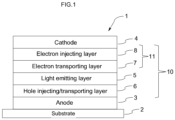


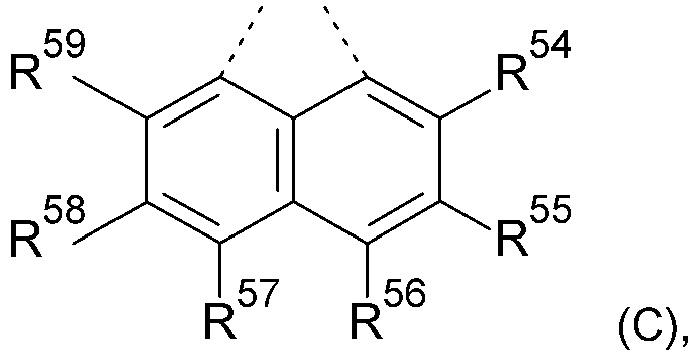


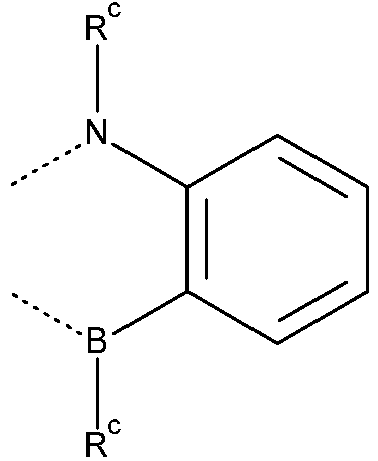


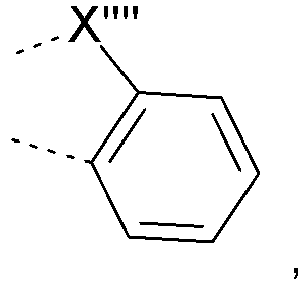


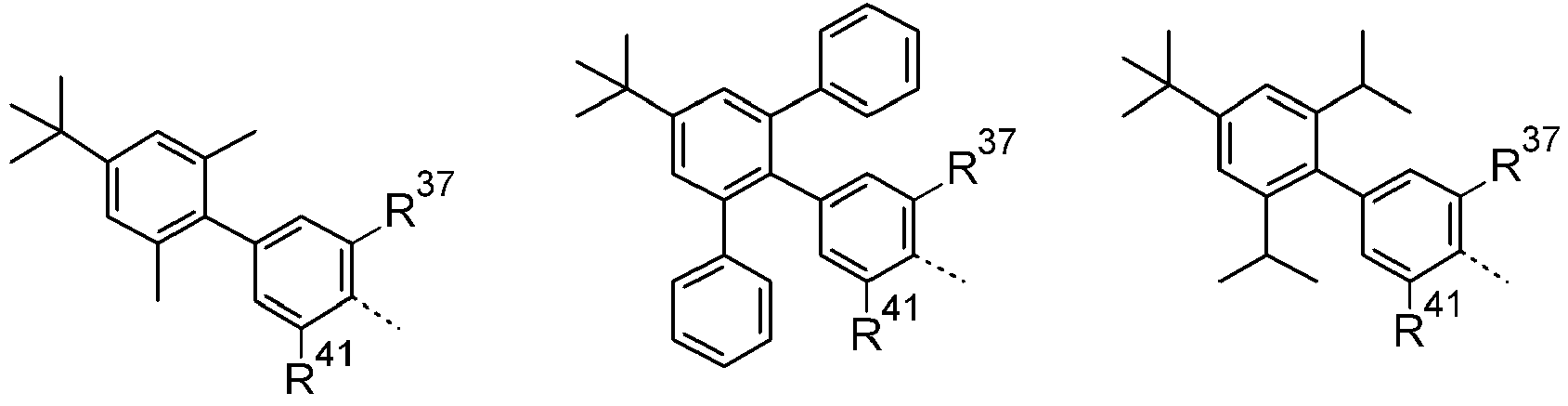



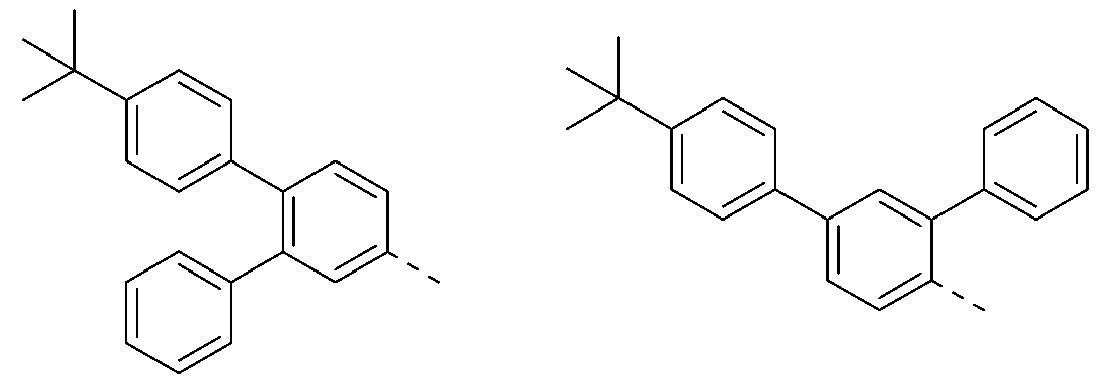


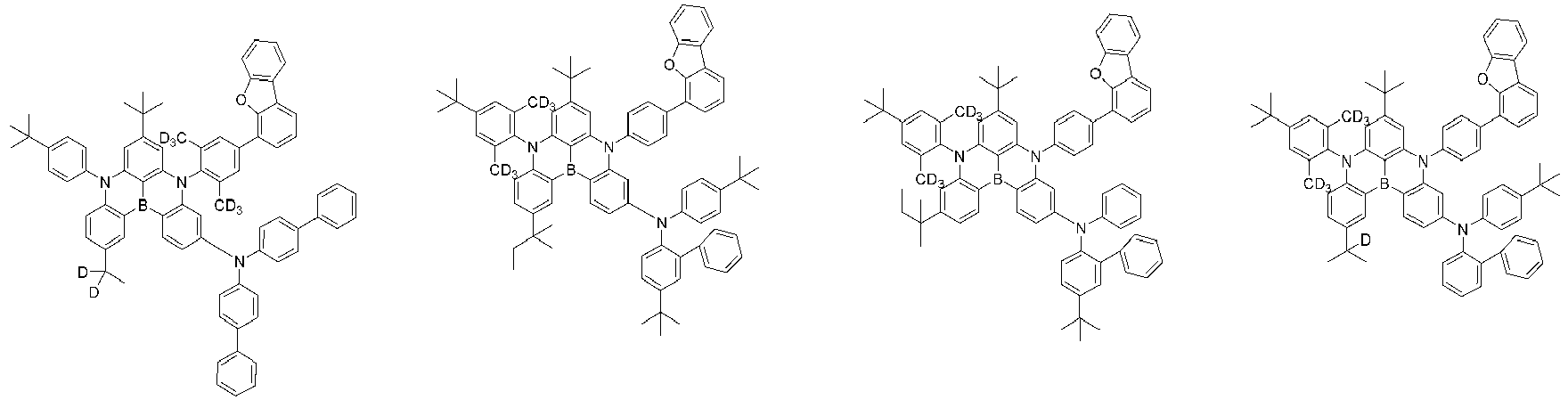


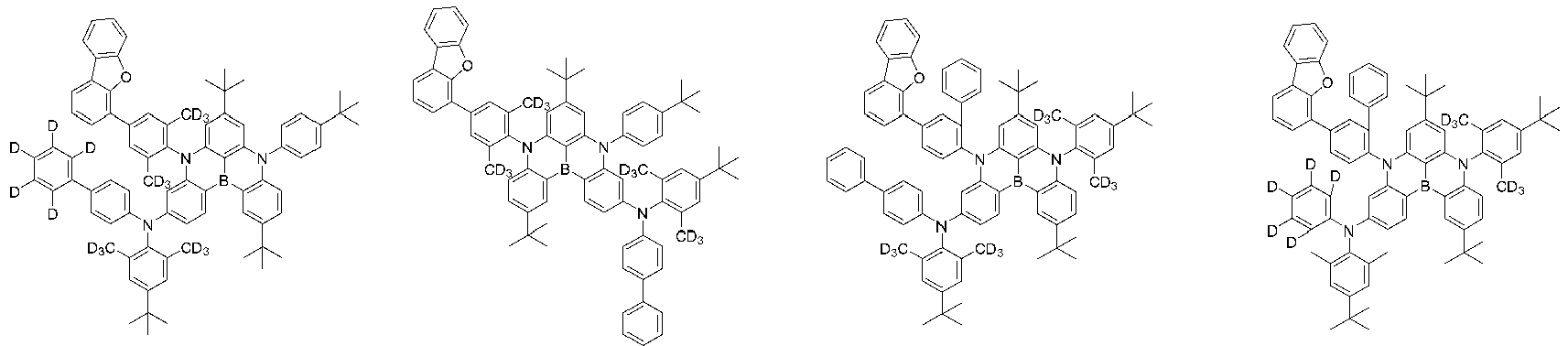


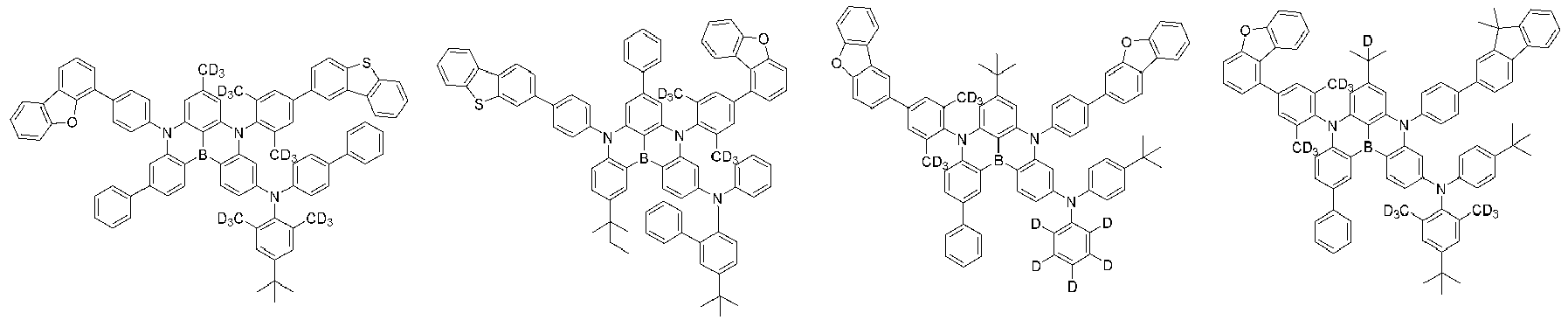


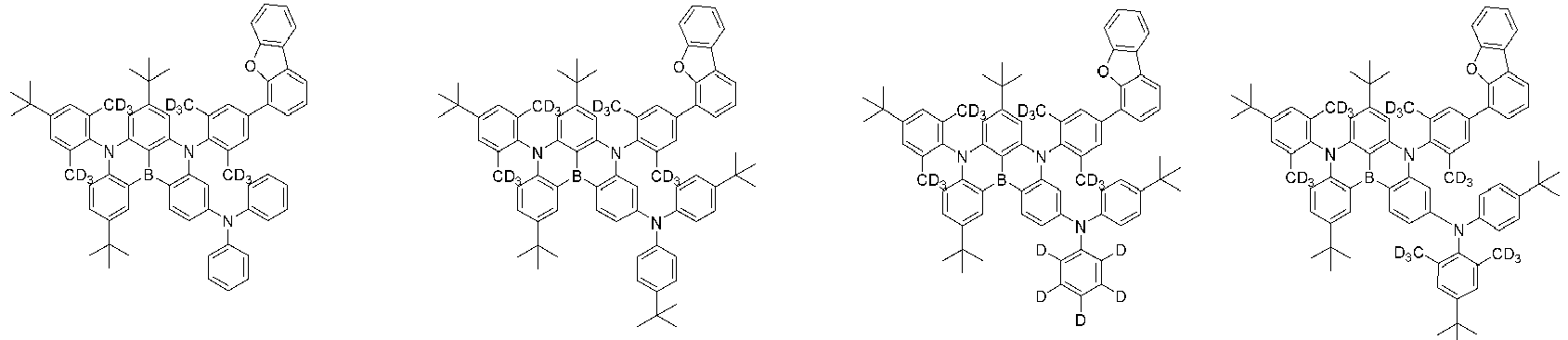


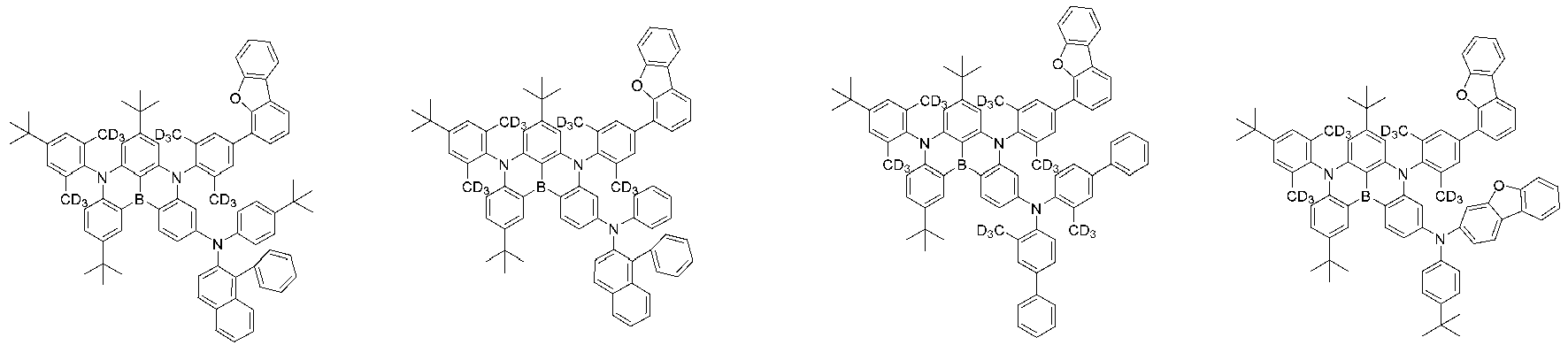


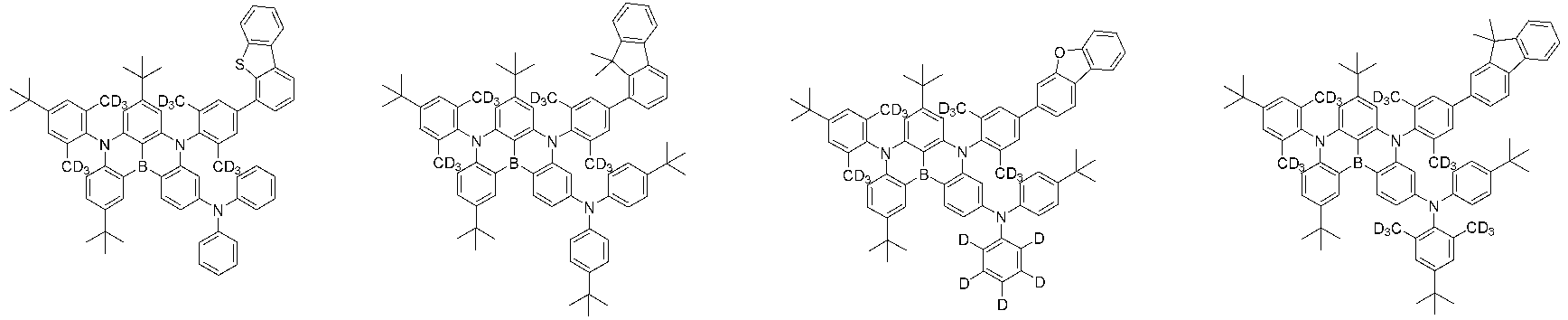

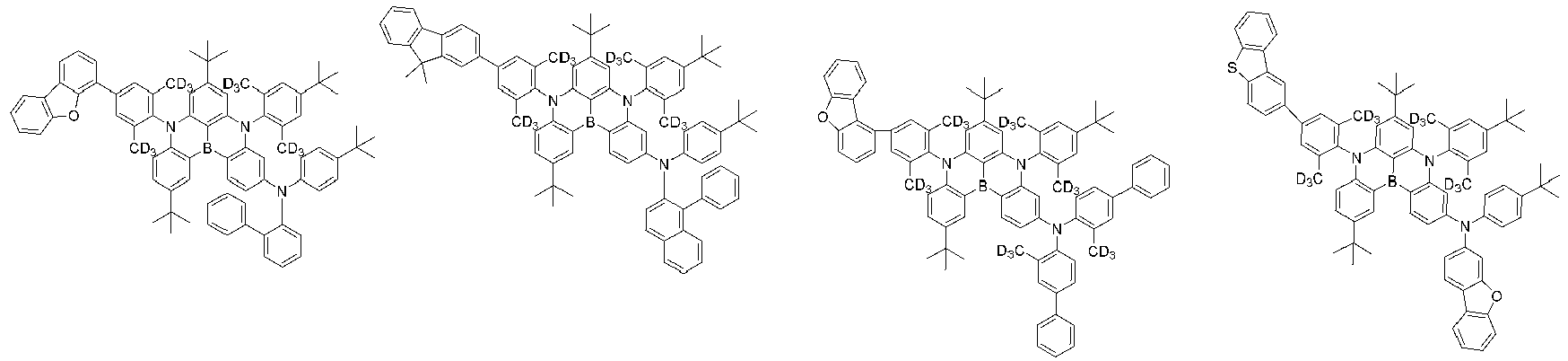











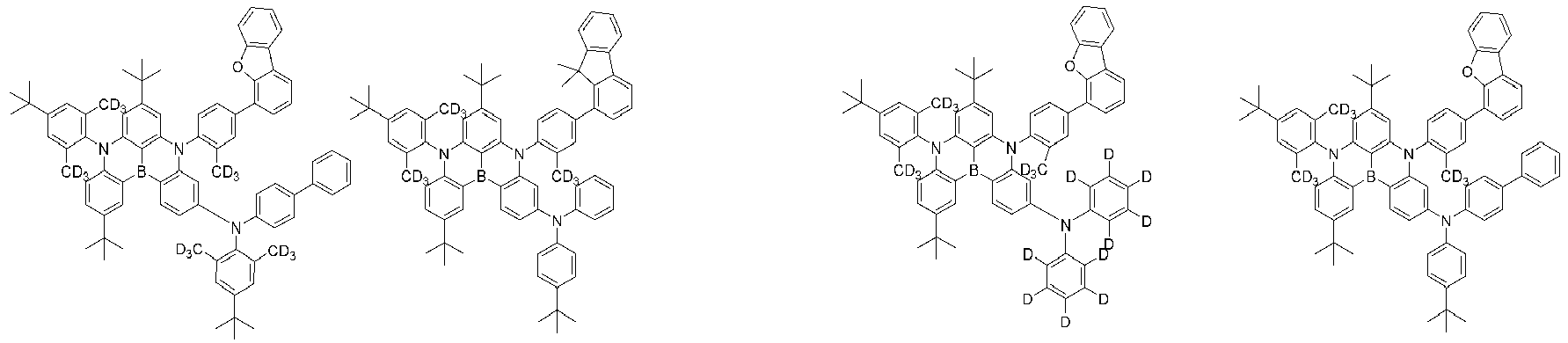


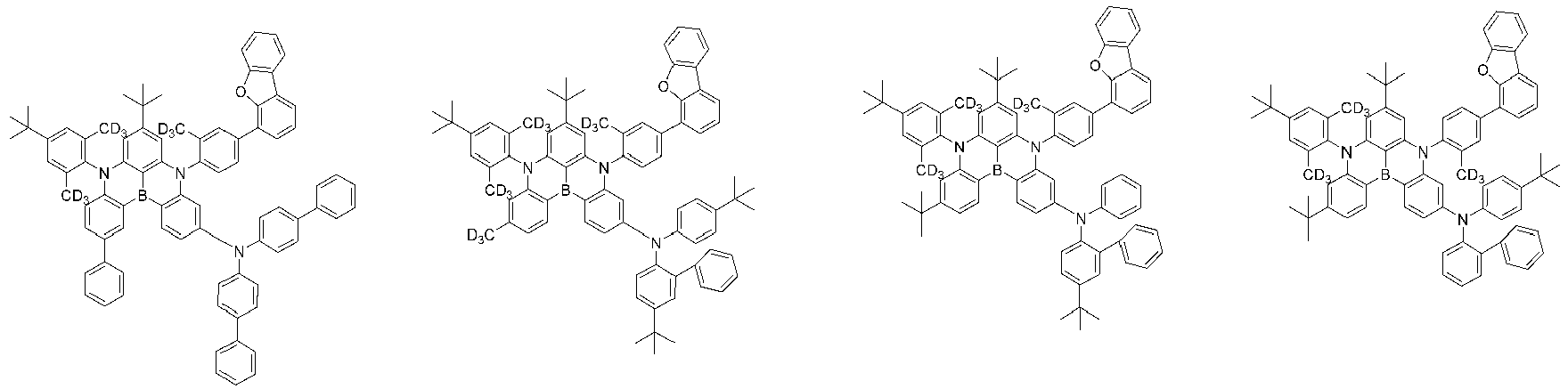


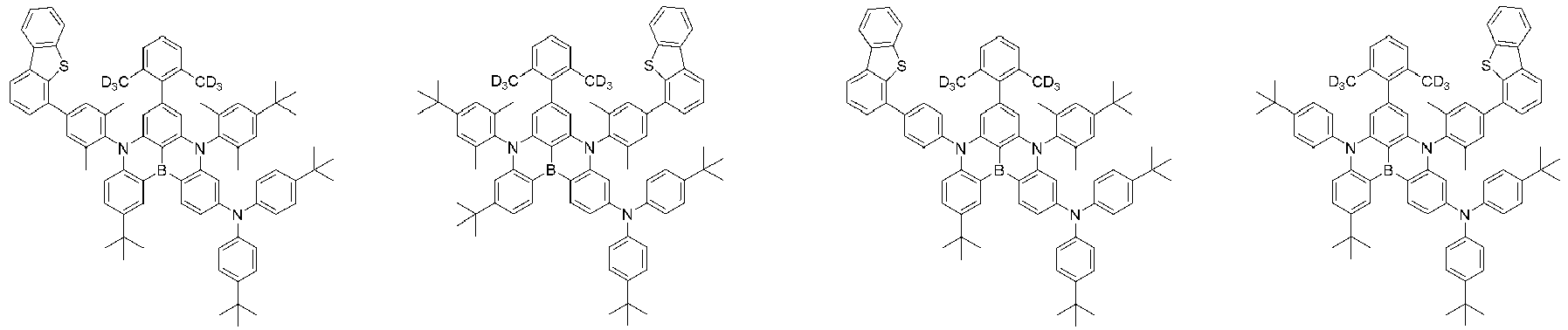



































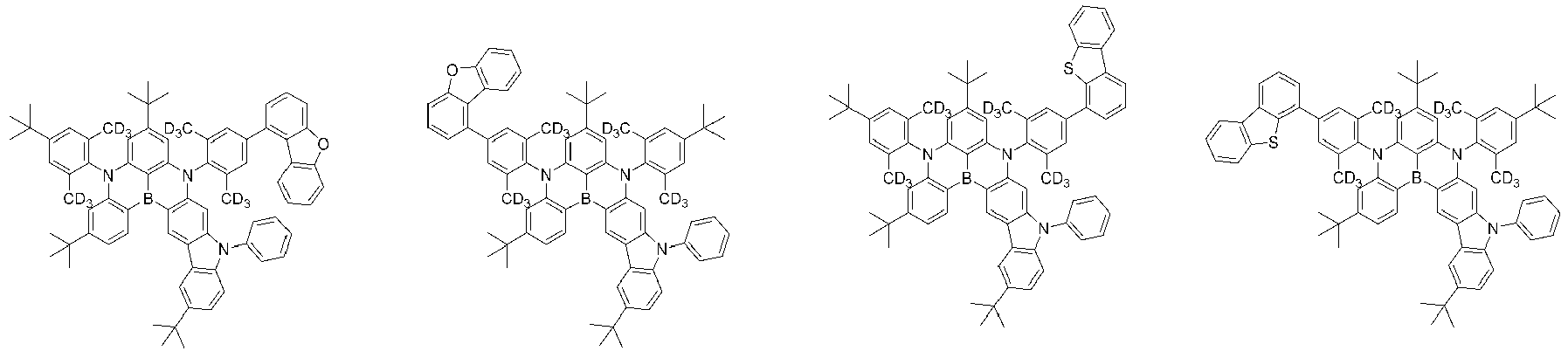




















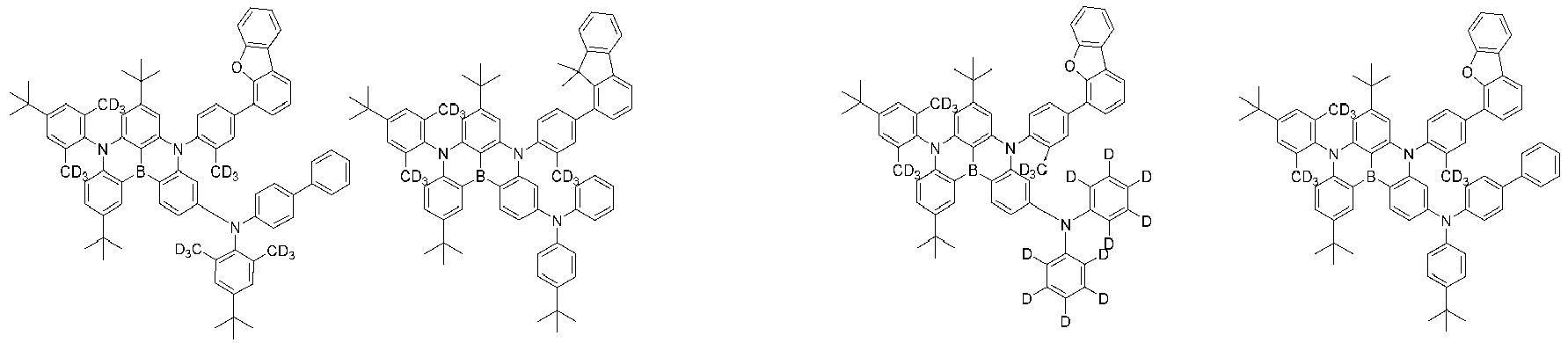

















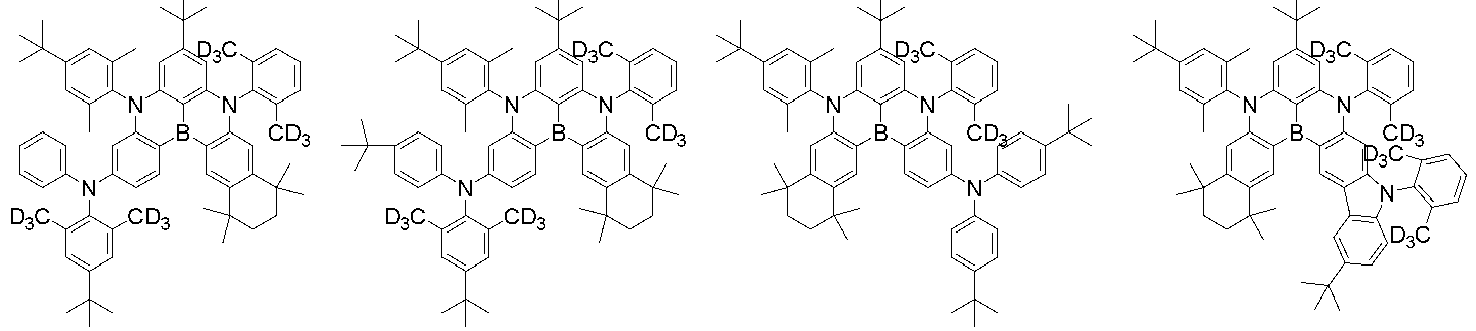


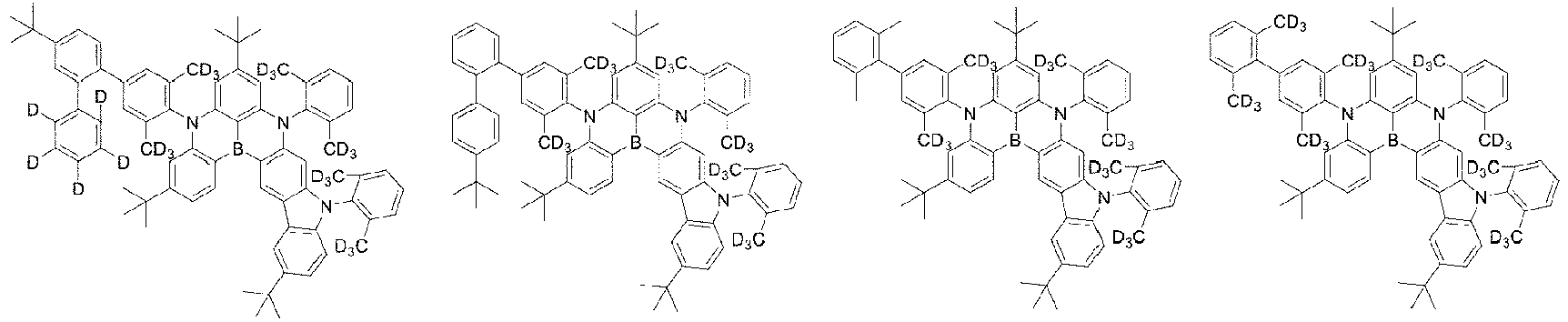


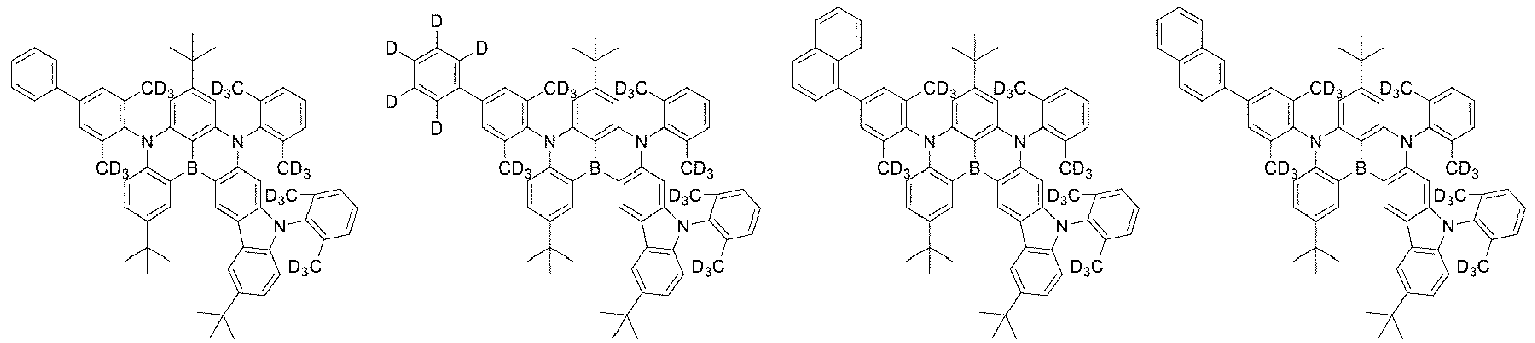


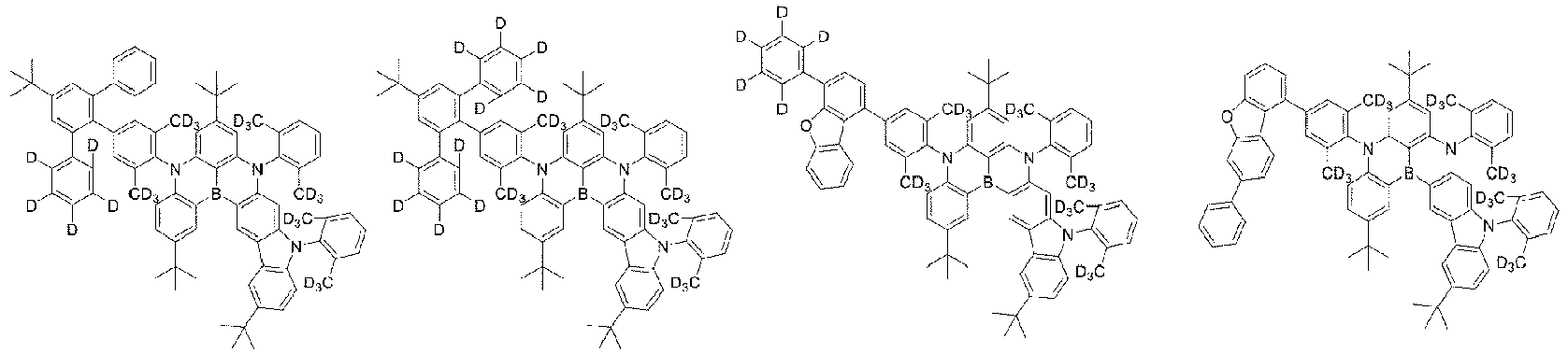


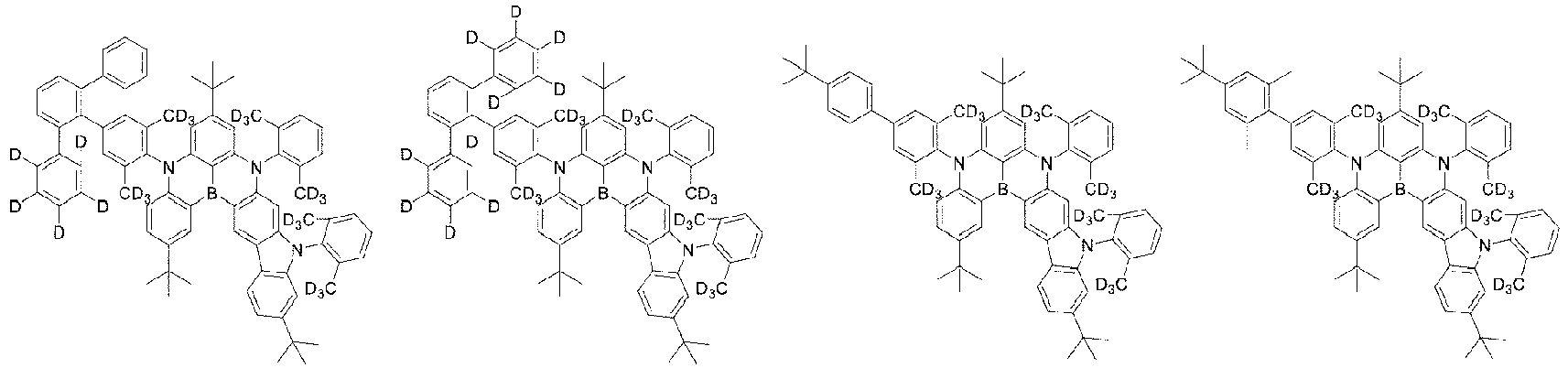





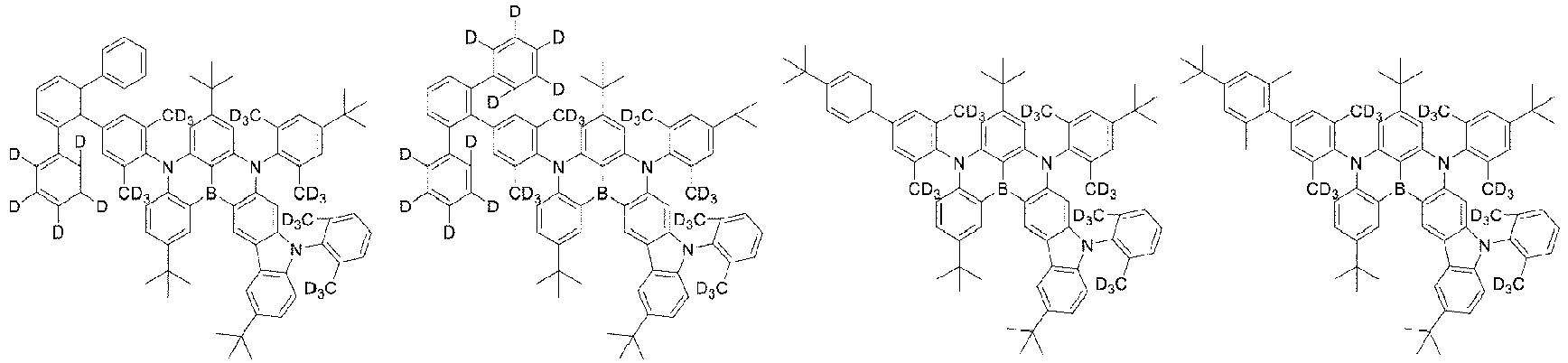


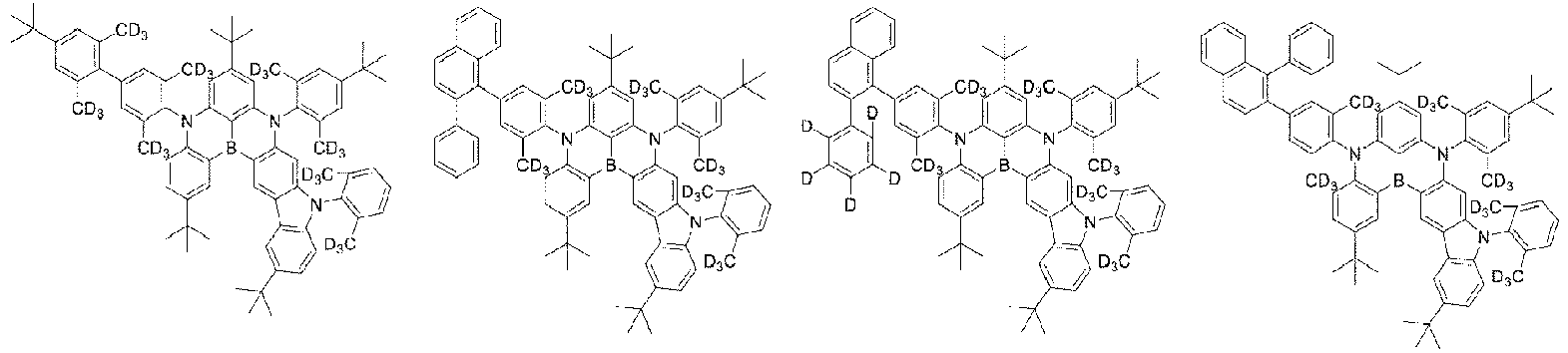


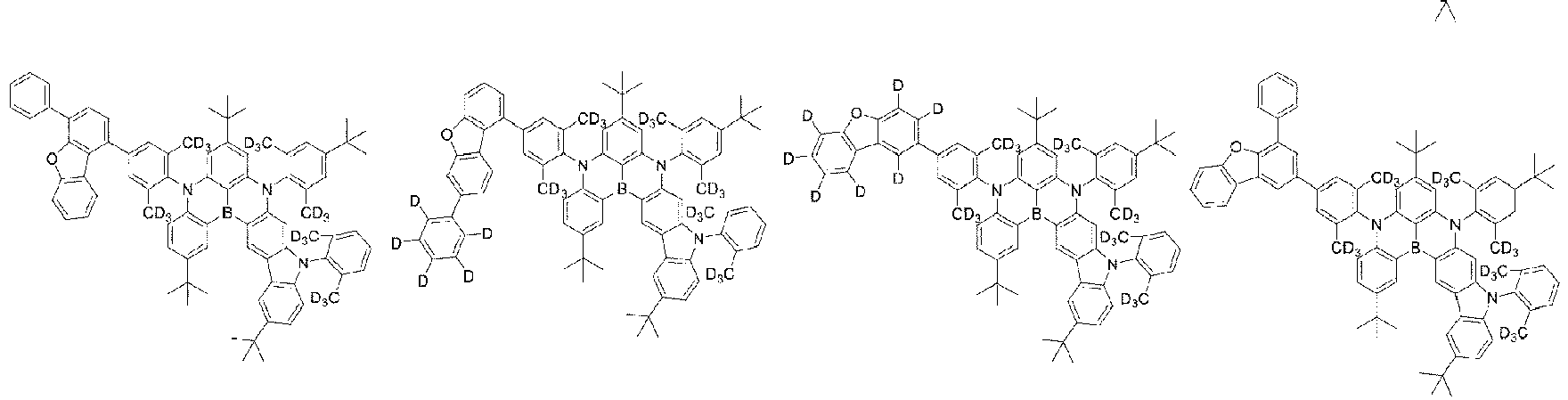


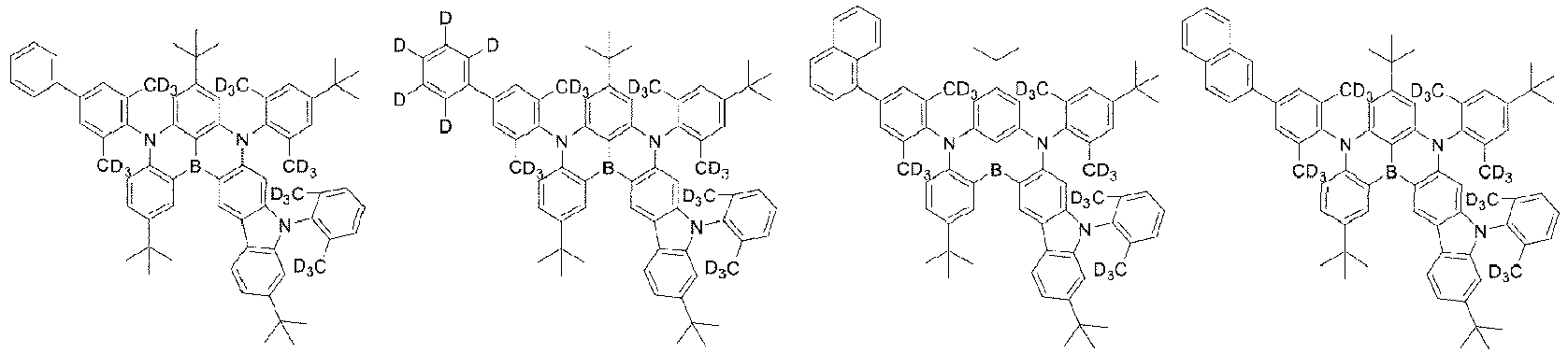








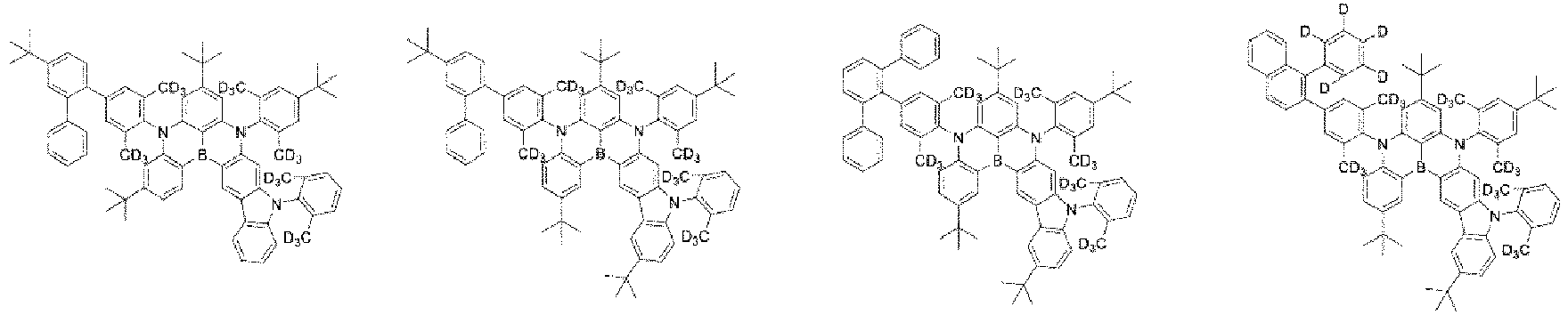


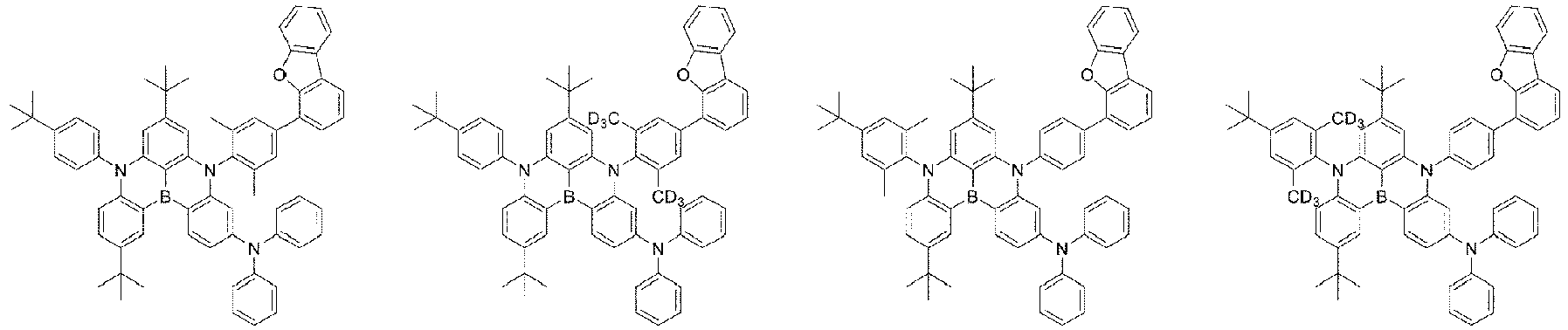
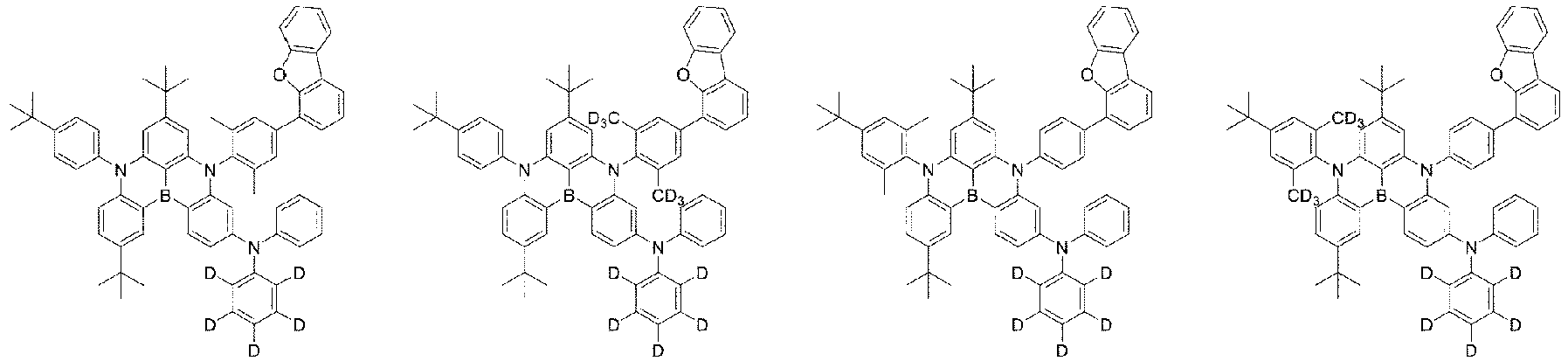


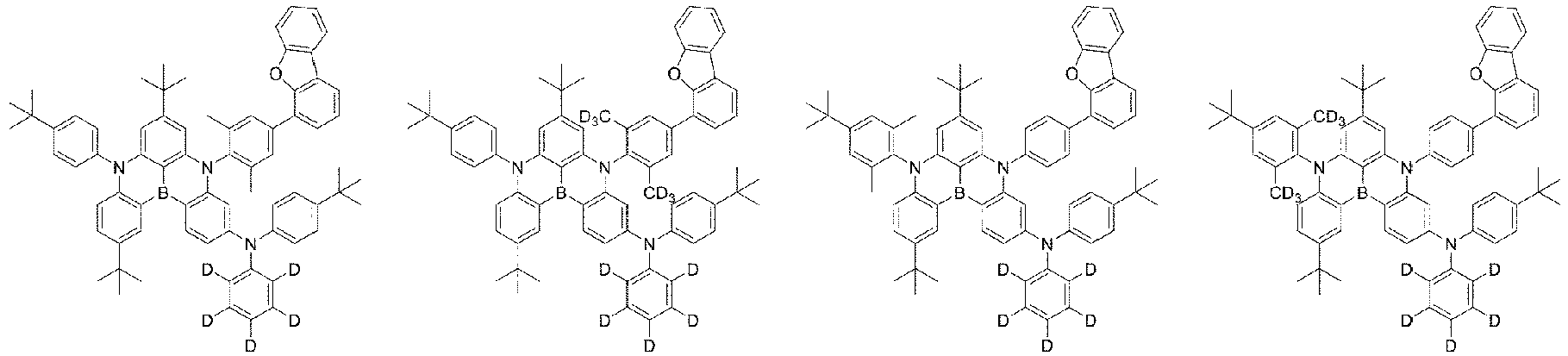








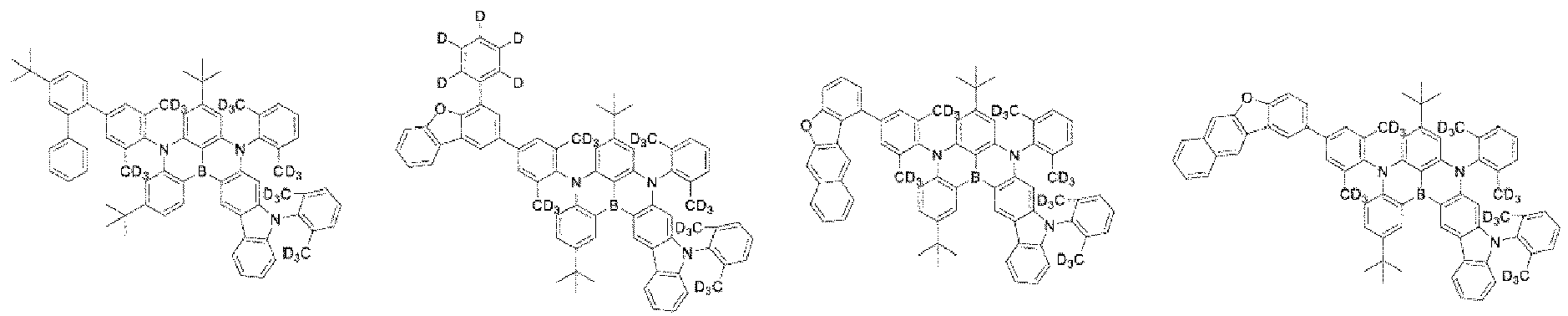





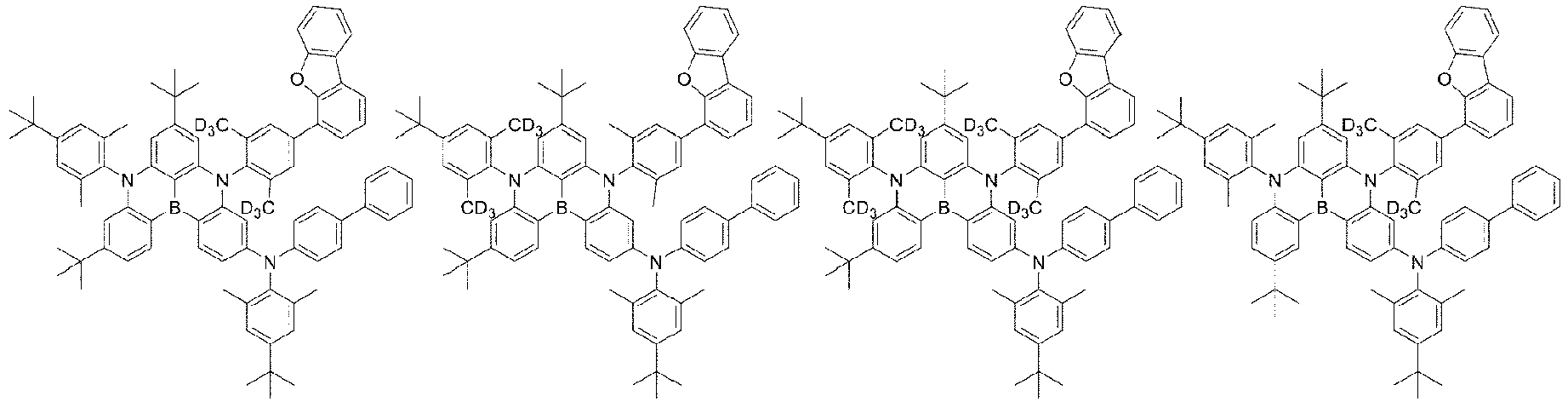


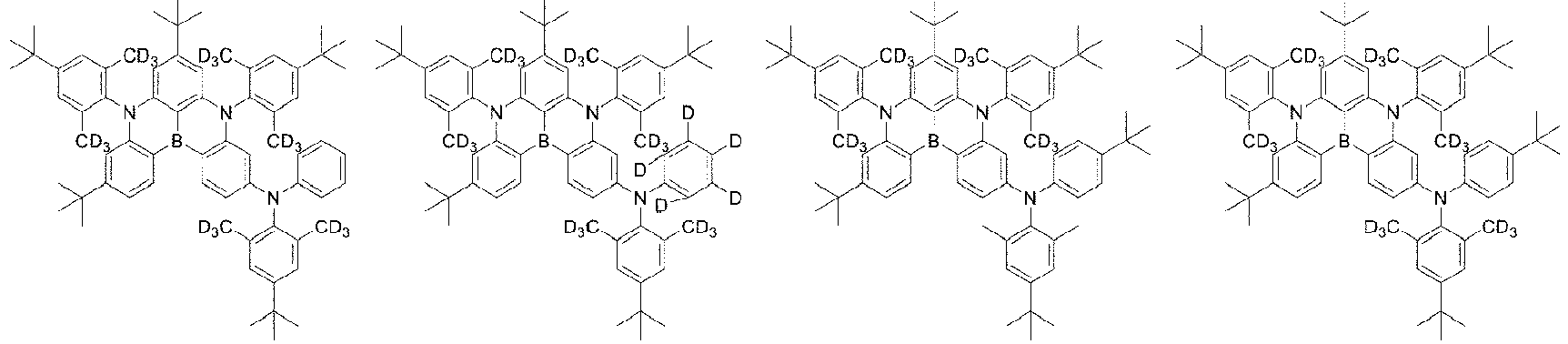


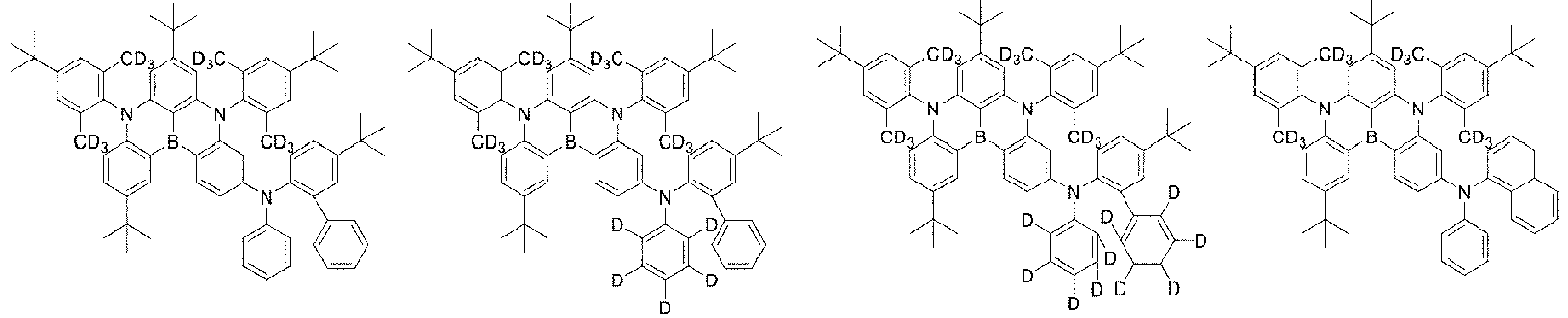
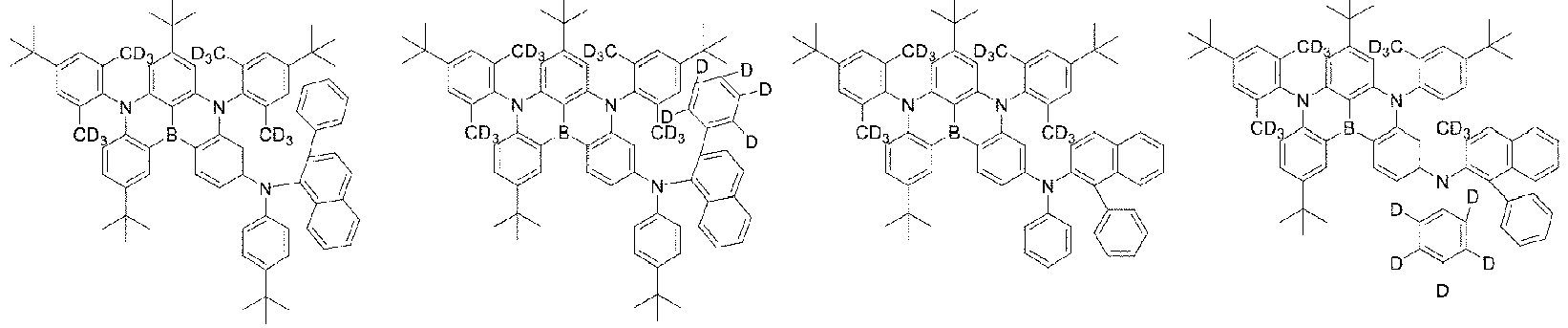


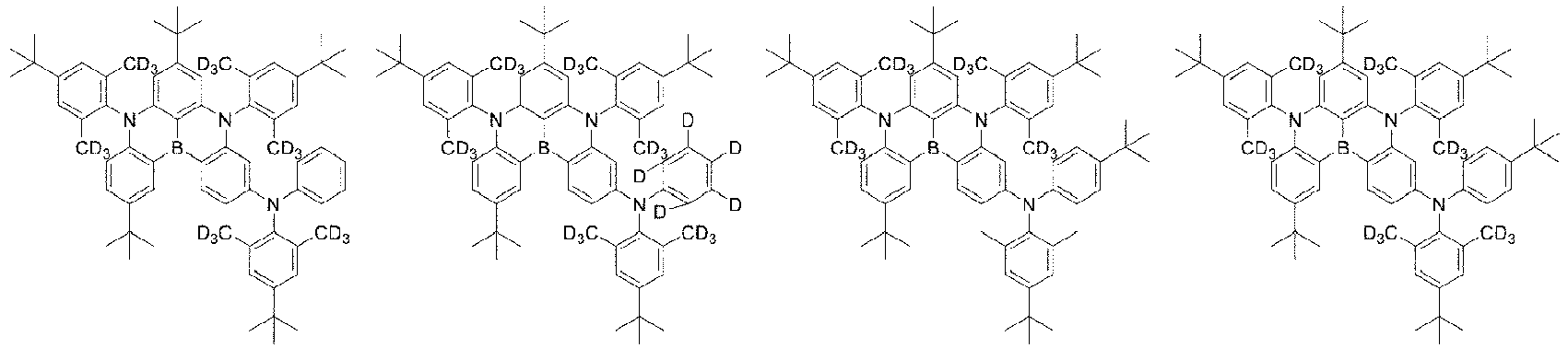


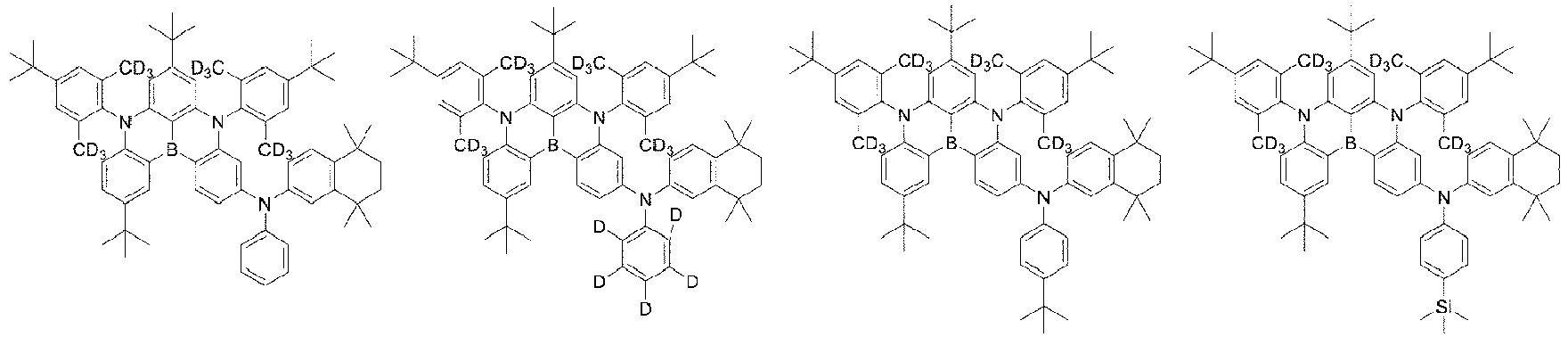








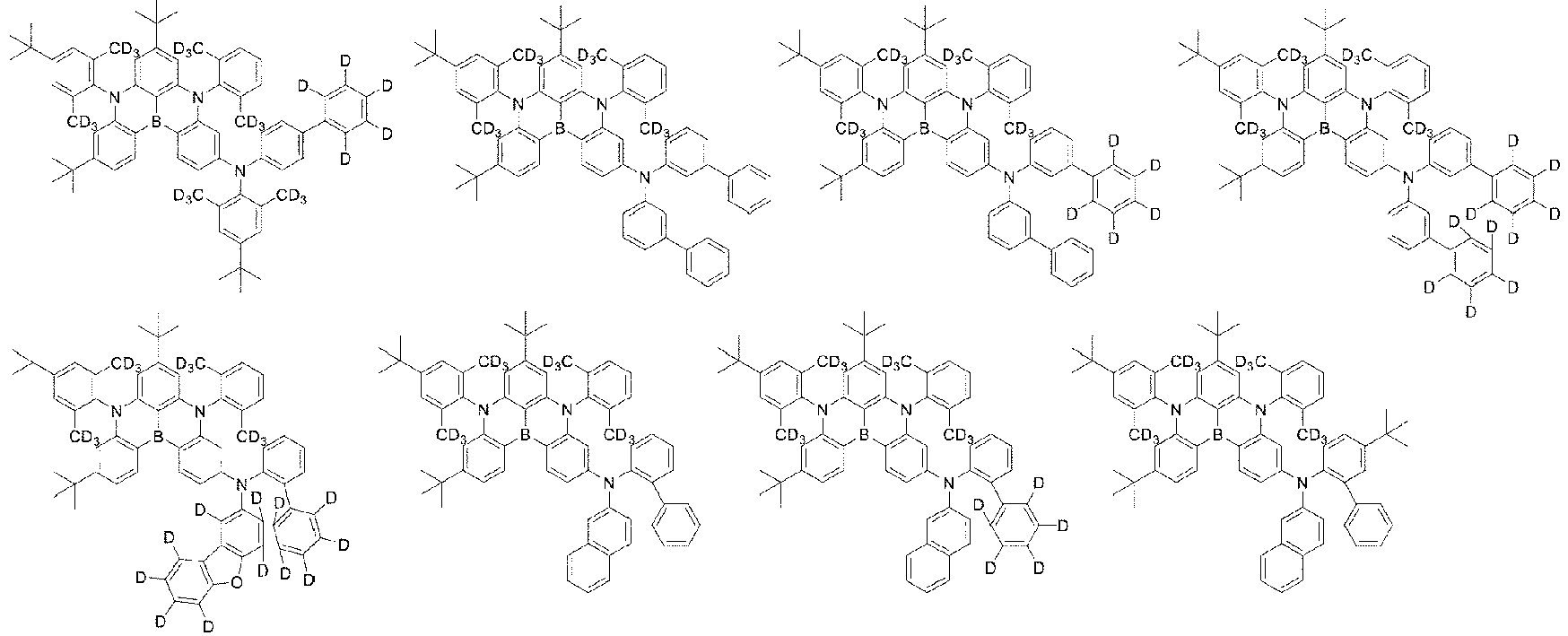


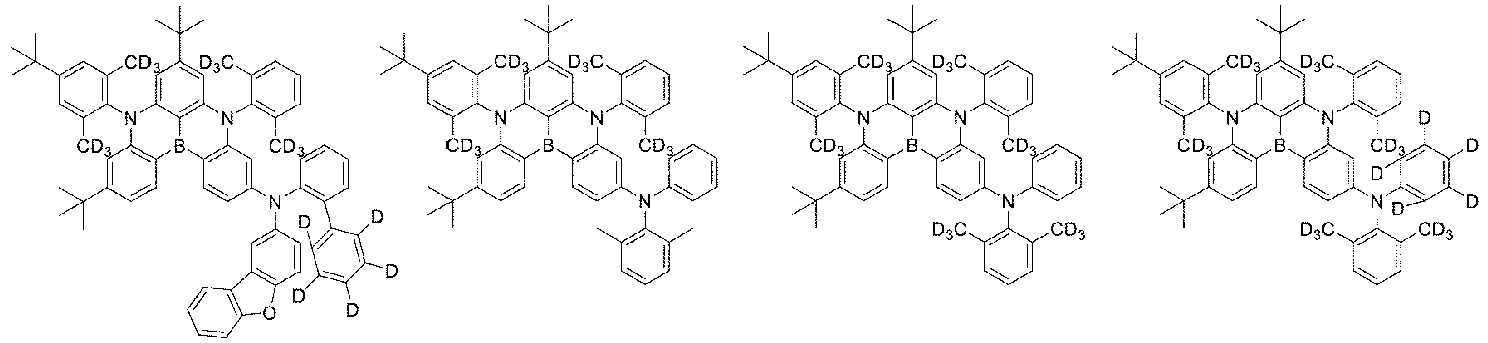


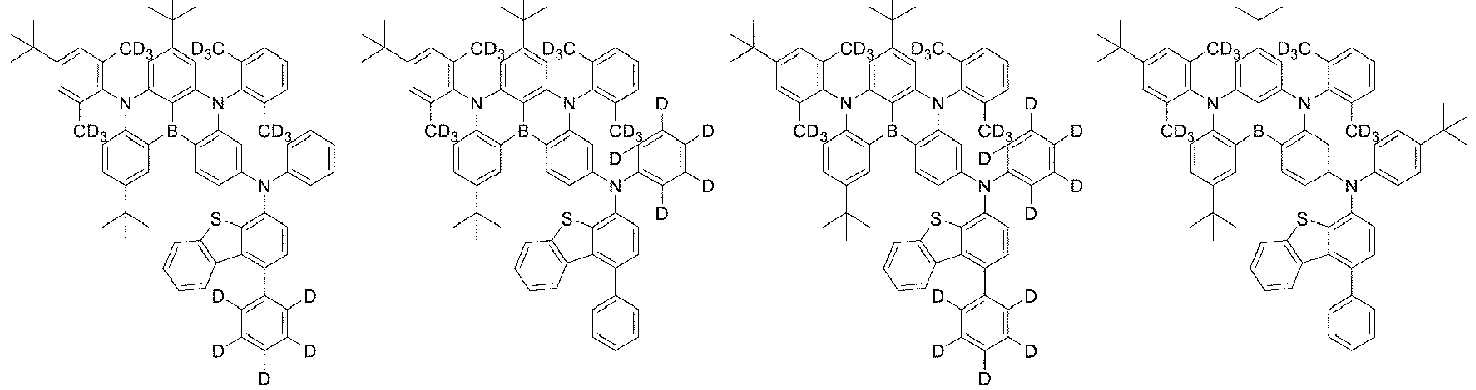


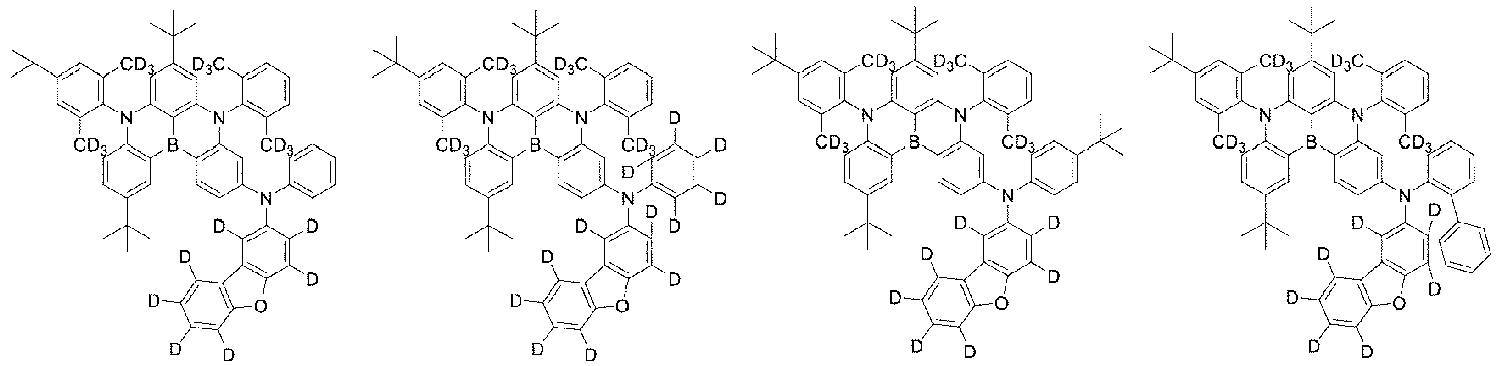











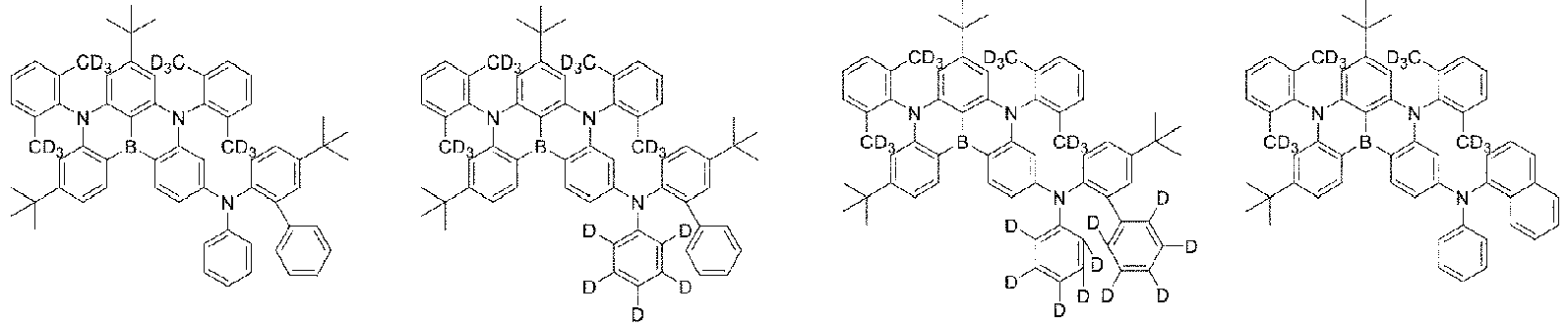


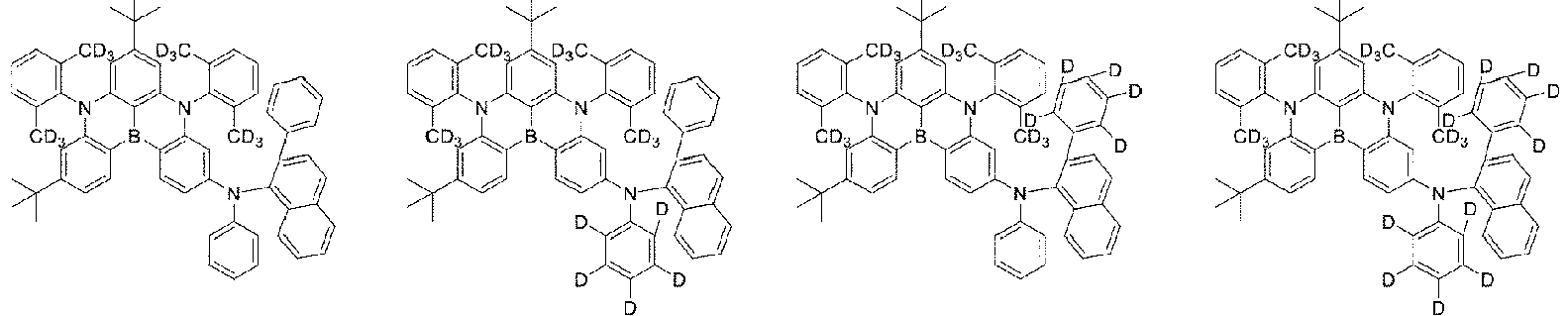


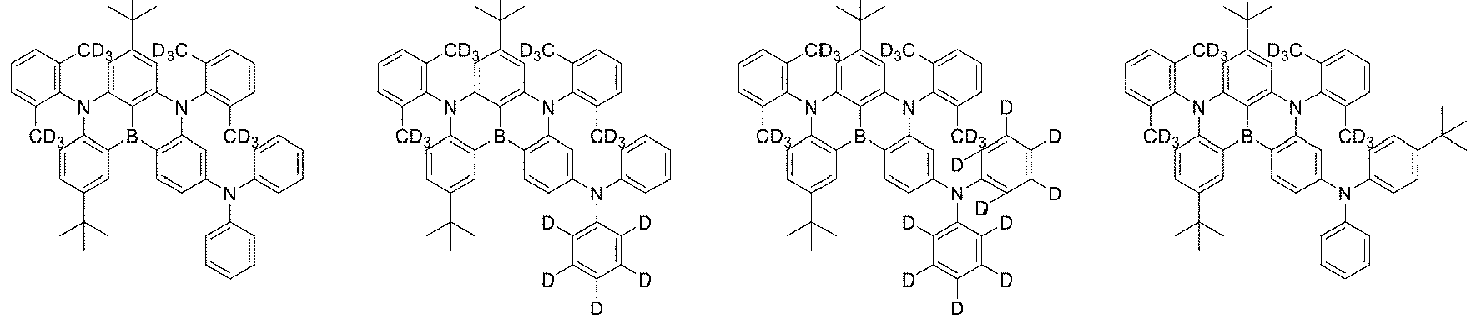





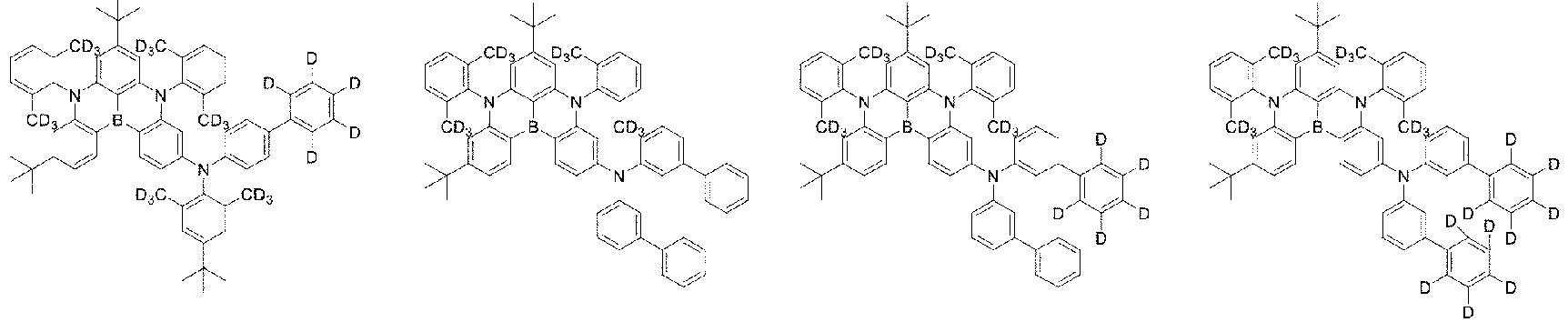


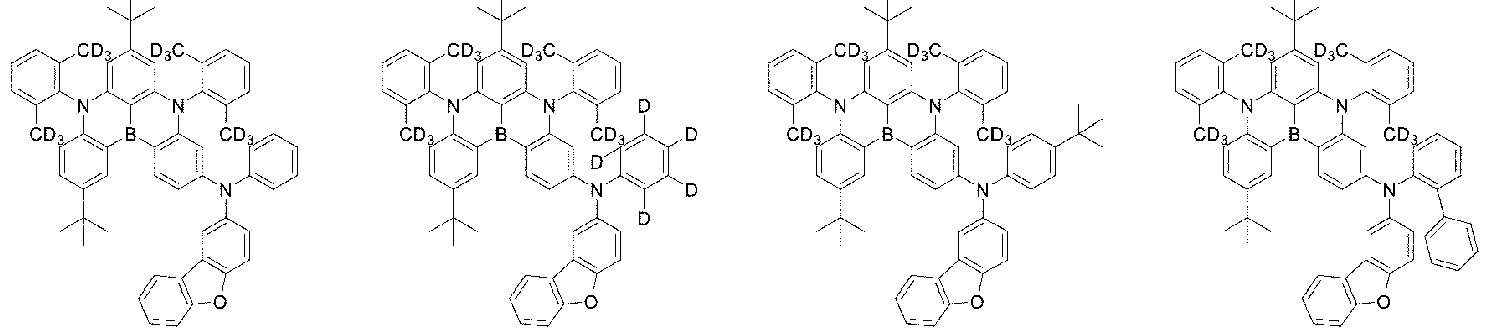


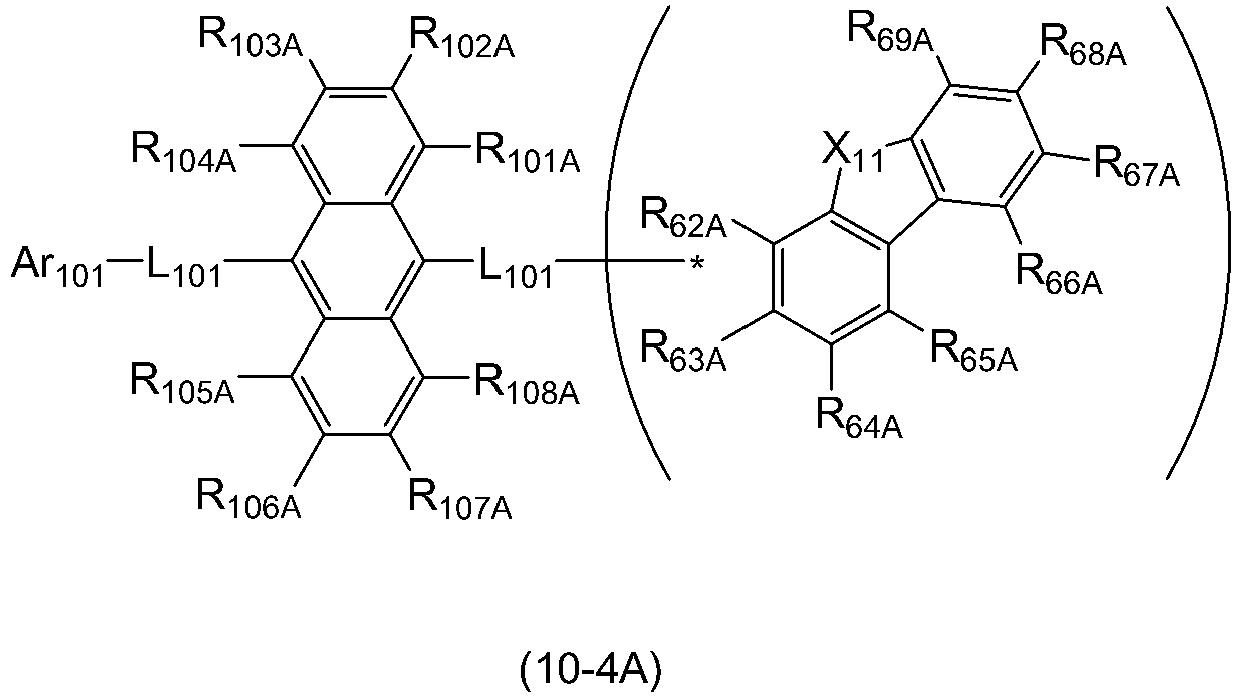


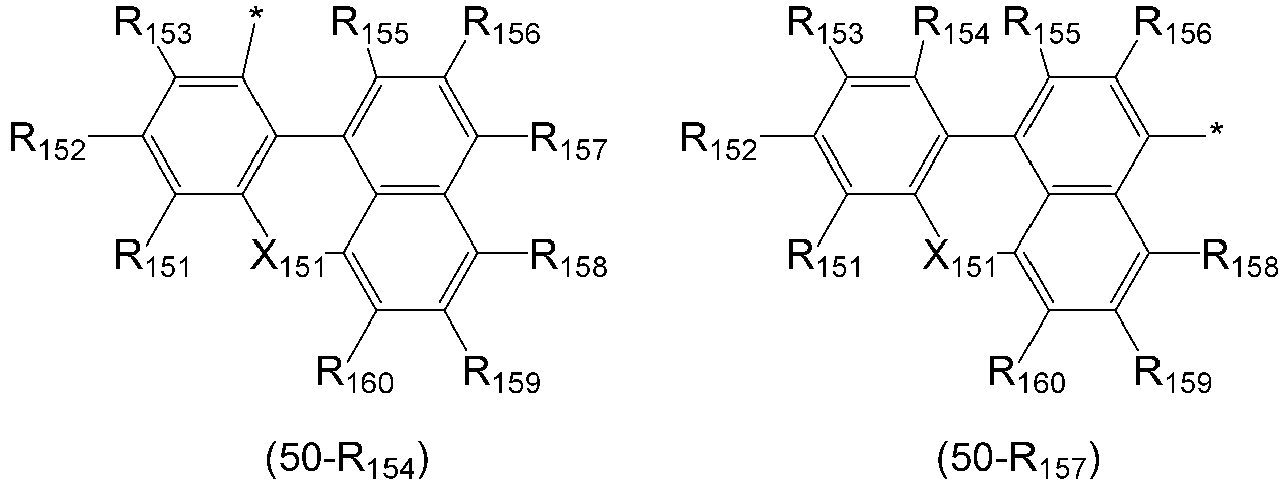











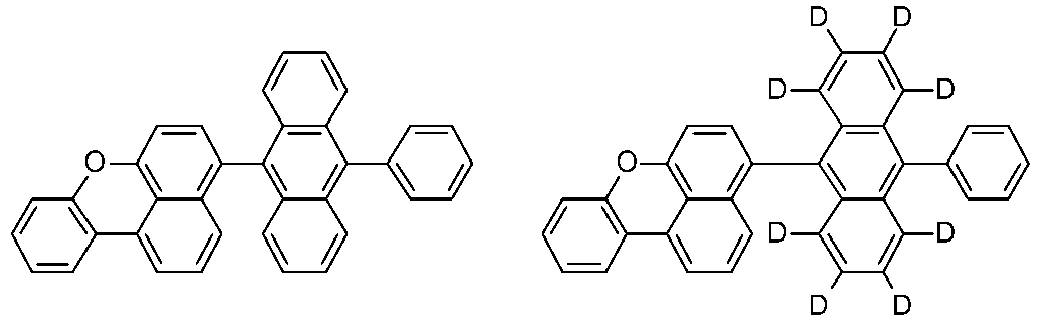


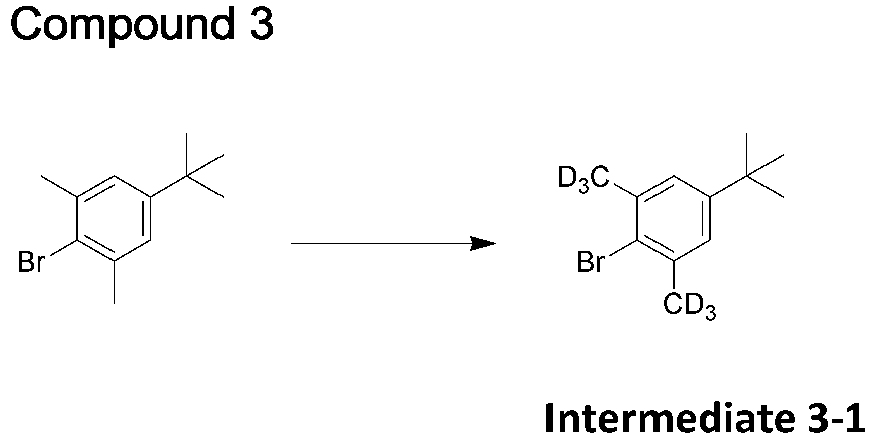


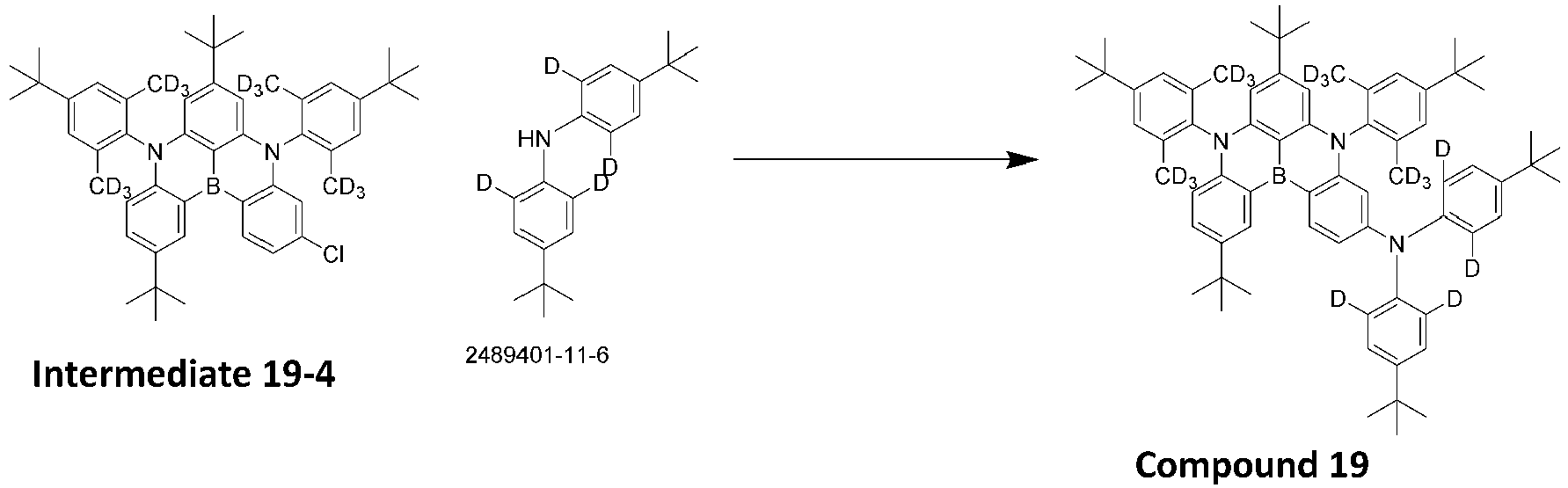
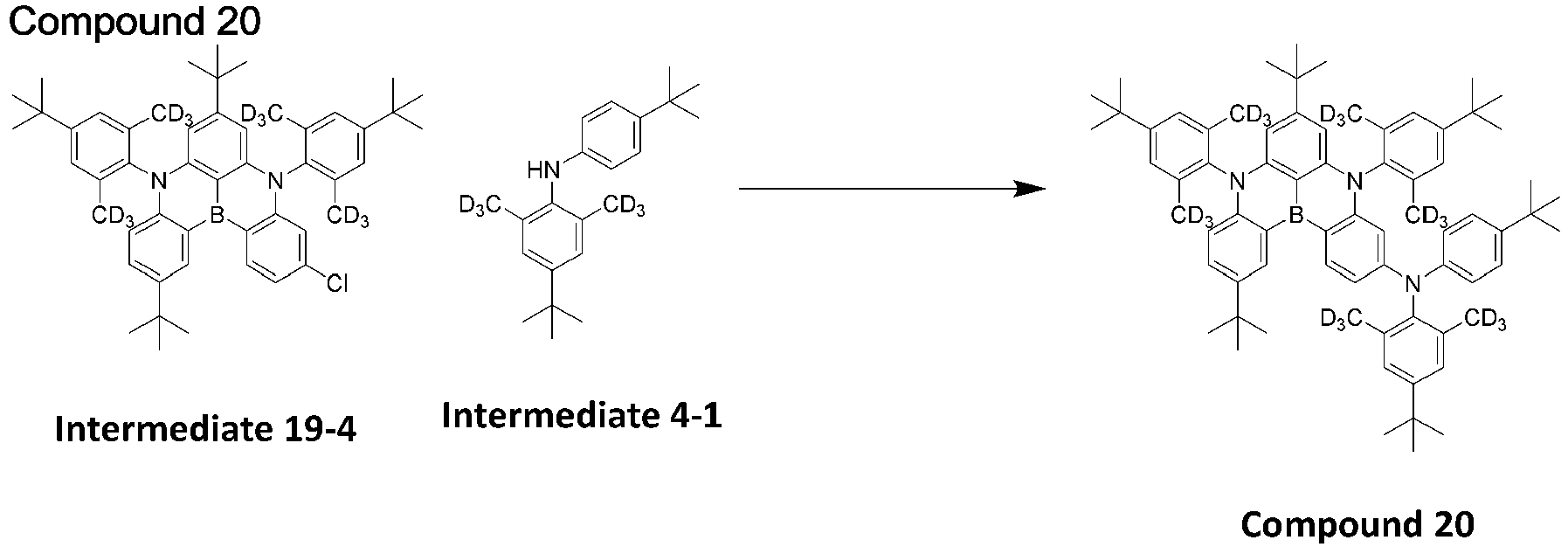


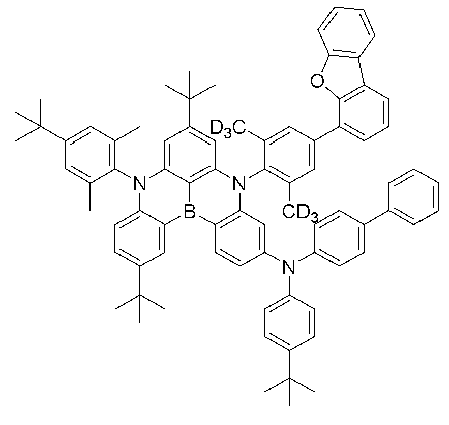


 p is 0 or 1;HAr is represented by formula (II)
 R1, R2, R3, R4, R5, R6, R7, R8, R21, R22 and R23 each independently represents hydrogen; an aryl group having from 6 to 30 ring carbon atoms which is unsubstituted or substituted; a heteroaryl group having from 5 to 30 ring atoms which is unsubstituted or substituted; an aralkyl group having from 7 to 30 carbon atoms which is unsubstituted or substituted; an alkyl group having from 1 to 20 carbon atoms which is unsubstituted or substituted; an alkylhalide group having from 1 to 20 carbon atoms which is unsubstituted or substituted; an alkenyl group having from 2 to 20 carbon atoms which is unsubstituted or substituted; an alkynyl group having from 2 to 20 carbon atoms which is unsubstituted or substituted; a cycloalkyl group having from 3 to 20 ring carbon atoms which is unsubstituted or substituted, preferably a mono- or bicyclic cycloalkyl group having from 3 to 20 ring carbon atoms which is unsubstituted or substituted; CN; NO2; OR30; SR31; C(=O)R32; COOR33; SiR34R35R36, NR84R85, or halogen;
 R90 represents an aryl group having from 6 to 30 ring carbon atoms which is unsubstituted or substituted; a heteroaryl group having from 5 to 30 ring atoms which is unsubstituted or substituted; an aralkyl group having from 7 to 30 carbon atoms which is unsubstituted or substituted; an alkyl group having from 1 to 20 carbon atoms which is unsubstituted or substituted; an alkylhalide group having from 1 to 20 carbon atoms which is unsubstituted or substituted; or a cycloalkyl group having from 3 to 20 ring carbon atoms which is unsubstituted or substituted; preferably R90 represents an aryl group having from 6 to 30 ring carbon atoms which is unsubstituted or substituted; or a heteroaryl group having from 5 to 30 ring atoms which is unsubstituted or substituted;R91 and R92 each independently represents hydrogen; an aryl group having from 6 to 30 ring carbon atoms which is unsubstituted or substituted; a heteroaryl group having from 5 to 30 ring atoms which is unsubstituted or substituted; an aralkyl group having from 7 to 30 carbon atoms which is unsubstituted or substituted; an alkyl group having from 1 to 20 carbon atoms which is unsubstituted or substituted; an alkylhalide group having from 1 to 20 carbon atoms which is unsubstituted or substituted; an alkenyl group having from 2 to 20 carbon atoms which is unsubstituted or substituted; an alkynyl group having from 2 to 20 carbon atoms which is unsubstituted or substituted; a cycloalkyl group having from 3 to 20 ring carbon atoms which is unsubstituted or substituted; CN; NO2; OR30; SR31; C(=O)R32; COOR33; SiR34R35R36, NR84R85, or halogen;
 L represents a divalent aryl group having from 6 to 30 ring carbon atoms which is unsubstituted or substituted; a divalent heteroaryl group having from 5 to 30 ring atoms which is unsubstituted or substituted; or a divalent aralkyl group having from 7 to 30 carbon atoms which is unsubstituted or substituted;R12, R13, R14, R15, R16, R17, R18, R19, R121, R131, R141, R151, R161, R171, R181, R191 each independently represents hydrogen; an aryl group having from 6 to 30 ring carbon atoms which is unsubstituted or substituted; a heteroaryl group having from 5 to 30 ring atoms which is unsubstituted or substituted; an aralkyl group having from 7 to 30 carbon atoms which is unsubstituted or substituted; an alkyl group having from 1 to 20 carbon atoms which is unsubstituted or substituted; an alkylhalide group having from 1 to 20 carbon atoms which is unsubstituted or substituted; an alkenyl group having from 2 to 20 carbon atoms which is unsubstituted or substituted; an alkynyl group having from 2 to 20 carbon atoms which is unsubstituted or substituted; a cycloalkyl group having from 3 to 20 ring carbon atoms which is unsubstituted or substituted; CN; NO2; OR30; SR31; C(=O)R32; COOR33; SiR34R35R36, NR84R85, or halogen;
 p is 0 or 1 and when p is 0 then Y is HAr1;HAr is represented by formula (II)
 R1, R2, R3, R4, R5, R6, R7, R8, R21, R22 and R23 each independently represents hydrogen; an aryl group having from 6 to 30 ring carbon atoms which is unsubstituted or substituted; a heteroaryl group having from 5 to 30 ring atoms which is unsubstituted or substituted; an aralkyl group having from 7 to 30 carbon atoms which is unsubstituted or substituted; an alkyl group having from 1 to 20 carbon atoms which is unsubstituted or substituted; an alkylhalide group having from 1 to 20 carbon atoms which is unsubstituted or substituted; an alkenyl group having from 2 to 20 carbon atoms which is unsubstituted or substituted; an alkynyl group having from 2 to 20 carbon atoms which is unsubstituted or substituted; a cycloalkyl group having from 3 to 20 ring carbon atoms which is unsubstituted or substituted, preferably a mono- or bicyclic cycloalkyl group having from 3 to 20 ring carbon atoms which is unsubstituted or substituted; CN; NO2; OR30; SR31; C(=O)R32; COOR33; SiR34R35R36, NR84R85, or halogen;
 R90 represents an aryl group having from 6 to 30 ring carbon atoms which is unsubstituted or substituted; a heteroaryl group having from 5 to 30 ring atoms which is unsubstituted or substituted; an aralkyl group having from 7 to 30 carbon atoms which is unsubstituted or substituted; an alkyl group having from 1 to 20 carbon atoms which is unsubstituted or substituted; an alkylhalide group having from 1 to 20 carbon atoms which is unsubstituted or substituted; or a cycloalkyl group having from 3 to 20 ring carbon atoms which is unsubstituted or substituted; preferably R90 represents an aryl group having from 6 to 30 ring carbon atoms which is unsubstituted or substituted; or a heteroaryl group having from 5 to 30 ring atoms which is unsubstituted or substituted;R91 and R92 each independently represents hydrogen; an aryl group having from 6 to 30 ring carbon atoms which is unsubstituted or substituted; a heteroaryl group having from 5 to 30 ring atoms which is unsubstituted or substituted; an aralkyl group having from 7 to 30 carbon atoms which is unsubstituted or substituted; an alkyl group having from 1 to 20 carbon atoms which is unsubstituted or substituted; an alkylhalide group having from 1 to 20 carbon atoms which is unsubstituted or substituted; an alkenyl group having from 2 to 20 carbon atoms which is unsubstituted or substituted; an alkynyl group having from 2 to 20 carbon atoms which is unsubstituted or substituted; a cycloalkyl group having from 3 to 20 ring carbon atoms which is unsubstituted or substituted; CN; NO2; OR30; SR31; C(=O)R32; COOR33; SiR34R35R36, NR84R85, or halogen;
 L represents a divalent aryl group having from 6 to 30 ring carbon atoms which is unsubstituted or substituted; a divalent heteroaryl group having from 5 to 30 ring atoms which is unsubstituted or substituted; or a divalent aralkyl group having from 7 to 30 carbon atoms which is unsubstituted or substituted;R12, R13, R14, R15, R16, R17, R18, R19, R121, R131, R141, R151, R161, R171, R181, R191 each independently represents hydrogen; an aryl group having from 6 to 30 ring carbon atoms which is unsubstituted or substituted; a heteroaryl group having from 5 to 30 ring atoms which is unsubstituted or substituted; an aralkyl group having from 7 to 30 carbon atoms which is unsubstituted or substituted; an alkyl group having from 1 to 20 carbon atoms which is unsubstituted or substituted; an alkylhalide group having from 1 to 20 carbon atoms which is unsubstituted or substituted; an alkenyl group having from 2 to 20 carbon atoms which is unsubstituted or substituted; an alkynyl group having from 2 to 20 carbon atoms which is unsubstituted or substituted; a cycloalkyl group having from 3 to 20 ring carbon atoms which is unsubstituted or substituted; CN; NO2; OR30; SR31; C(=O)R32; COOR33; SiR34R35R36, NR84R85, or halogen;


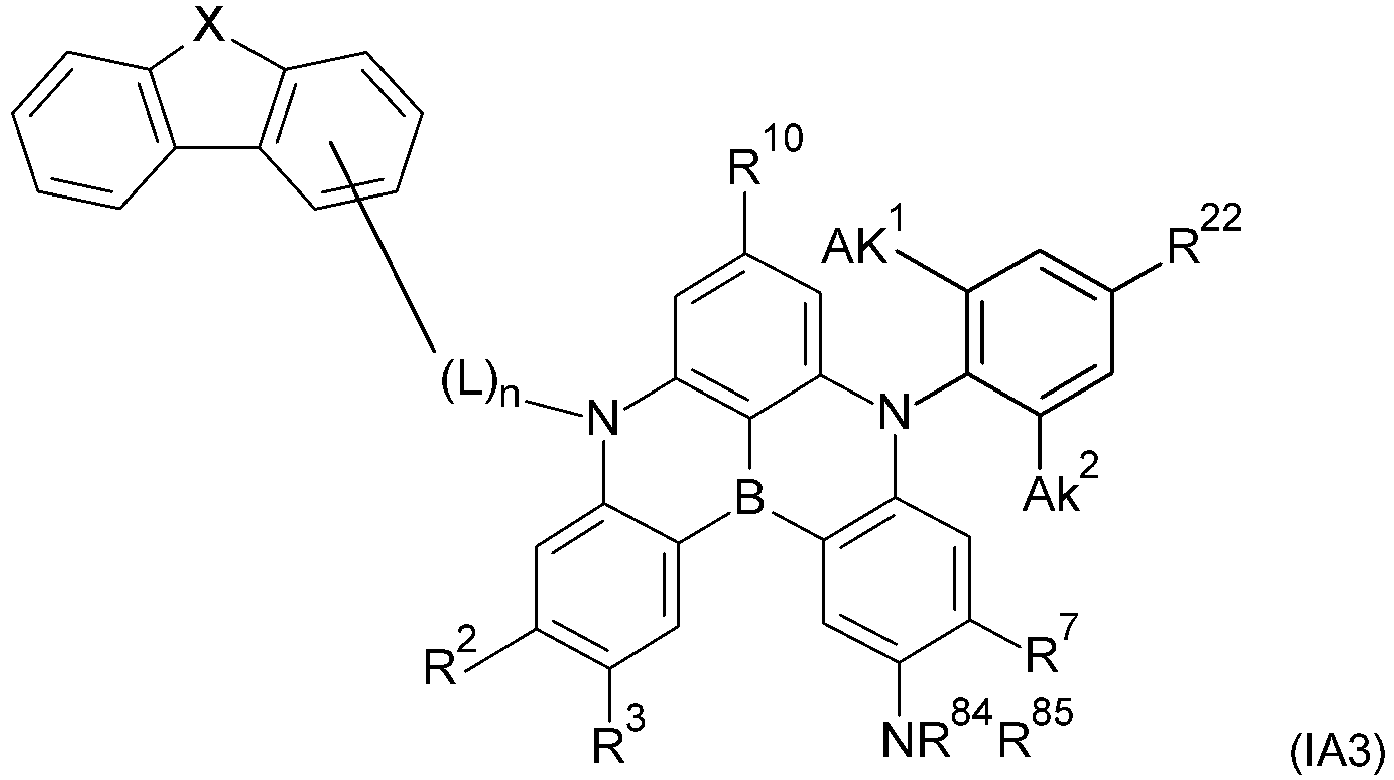


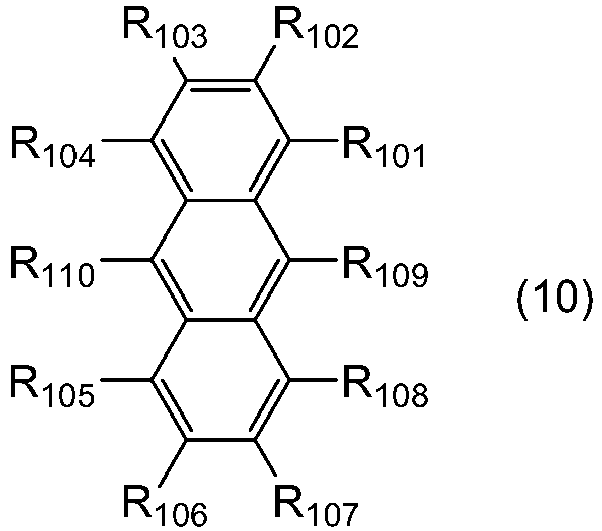 one or more pairs of two or more adjacent R101 to R110 may form a substituted or unsubstituted, saturated or unsaturated ring;R101 to R110 that do not form the substituted or unsubstituted, saturated or unsaturated ring are independently a hydrogen atom, a substituted or unsubstituted alkyl group including 1 to 50 carbon atoms, a substituted or unsubstituted haloalkyl group including 1 to 50 carbon atoms, a substituted or unsubstituted alkenyl group including 2 to 50 carbon atoms, a substituted or unsubstituted alkynyl group including 2 to 50 carbon atoms, a substituted or unsubstituted cycloalkyl group including 3 to 50 ring carbon atoms, a substituted or unsubstituted alkoxy group including 1 to 50 carbon atoms, a substituted or unsubstituted alkylene group including 1 to 50 carbon atoms, a substituted or unsubstituted aryloxy group including 6 to 50 ring carbon atoms, a substituted or unsubstituted arylthio group including 6 to 50 ring carbon atoms, a substituted or unsubstituted aralkyl group including 7 to 50 carbon atoms, -Si(R121)(R122)(R123), -C(=O)R124, -COOR125, -N(R126)(R127), a halogen atom, a cyano group, a nitro group, a substituted or unsubstituted aryl group including 6 to 50 ring carbon atoms, a substituted or unsubstituted monovalent heterocyclic group including 5 to 50 ring atoms, or a group represented by the following formula (31);R121 to R127 are independently a hydrogen atom, a substituted or unsubstituted alkyl group including 1 to 50 carbon atoms, a substituted or unsubstituted cycloalkyl group including 3 to 50 ring carbon atoms, a substituted or unsubstituted aryl group including 6 to 50 ring carbon atoms or a substituted or unsubstituted monovalent heterocyclic group including 5 to 50 ring atoms; when each of R121 to R127 is present in plural, each of the plural R121 to R127 may be the same or different;provided that at least one of R101 to R110 that do not form the substituted or unsubstituted, saturated or unsaturated ring is a group represented by the following formula (31). If two or more groups represented by the formula (31) are present, each of these groups may be the same or different;