EP4566488A2 - Carrycot cover and carrycot including the carrycot cover - Google Patents
Carrycot cover and carrycot including the carrycot cover Download PDFInfo
- Publication number
- EP4566488A2 EP4566488A2 EP24218011.5A EP24218011A EP4566488A2 EP 4566488 A2 EP4566488 A2 EP 4566488A2 EP 24218011 A EP24218011 A EP 24218011A EP 4566488 A2 EP4566488 A2 EP 4566488A2
- Authority
- EP
- European Patent Office
- Prior art keywords
- side wall
- wall part
- carrycot
- sheet
- foldable
- Prior art date
- Legal status (The legal status is an assumption and is not a legal conclusion. Google has not performed a legal analysis and makes no representation as to the accuracy of the status listed.)
- Pending
Links
Images






Classifications
-
- A—HUMAN NECESSITIES
- A47—FURNITURE; DOMESTIC ARTICLES OR APPLIANCES; COFFEE MILLS; SPICE MILLS; SUCTION CLEANERS IN GENERAL
- A47D—FURNITURE SPECIALLY ADAPTED FOR CHILDREN
- A47D13/00—Other nursery furniture
- A47D13/02—Baby-carriers; Carry-cots
- A47D13/027—Baby-carriers with rigid frames
-
- A—HUMAN NECESSITIES
- A47—FURNITURE; DOMESTIC ARTICLES OR APPLIANCES; COFFEE MILLS; SPICE MILLS; SUCTION CLEANERS IN GENERAL
- A47D—FURNITURE SPECIALLY ADAPTED FOR CHILDREN
- A47D13/00—Other nursery furniture
- A47D13/02—Baby-carriers; Carry-cots
Definitions
- the present disclosure relates to the technical field of infant products, particularly to a carrycot.
- an upright sheet is provided at the end of the carrycot cover adjacent to the baby's head.
- most carrycot covers currently extend and elongate the upright sheet, and install buckling member on the end of the upright sheet or the webbing connected to the end of the upright sheet to fasten and fix it to the outside of the carrycot.
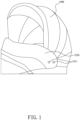
- the disadvantage of this approach is that it will cover the rotating mechanism of the hood part (which is not conducive to operating the canopy rotating mechanism). As shown in Figure 1 , after the buckling member 1211 of the upright sheet 1210 is fastened and fixed to the outside of the carrycot, the upright sheet 1210 completely covers the rotating mechanism of the hood part 1300.
- the purpose of the present disclosure is to provide a carrycot upright sheet that is structurally simple, does not cover the rotating mechanism of the hood part, and can stand very upright.
- the term 'upright' herein refers to the installation of the carrycot cover on the carrycot, with the upright sheet of the carrycot cover almost perpendicular to the cover sheet.
- the purpose of the present disclosure is also to provide a foldable carrycot that can be folded and closed as a whole, facilitating storage and carrying.
- the present disclosure provides a carrycot cover, wherein the carrycot cover includes an upright sheet and a cover sheet connected together, and before connection, a virtual auxiliary line perpendicular to the longitudinal axis of the upright sheet extends along the connecting side of the upright sheet, before connection, the size of the connecting side of the upright sheet is X centimeters inward relative to the auxiliary line from the outer end of the connecting side of the upright sheet to the opposite side of the connecting side of the upright sheet, where X is greater than or equal to zero, before connection, the size of the connecting side of the cover sheet is Y centimeters inward from the center point of the connecting side of the cover sheet along the longitudinal axis of the cover sheet towards the opposite side of the connection side of the cover sheet, where Y is greater than zero, and Y-X is greater than or equal to 2 centimeters.
- the connecting side of the upright sheet and the connecting side of the cover sheet are sewn together to produce a seam allowance.
- the upright sheet is topstitched with grid-shape.
- a tube rope is provided inside the edge of the upright sheet.
- the cover sheet includes a first part and a second part, the first part is used to connect with the upright sheet, and the second part is connected with a skirt sheet used to cover the side of the cover sheet, and the skirt sheet has an extension section towards the baby's head, and the seam allowance of the upright sheet and the cover sheet after sewing is sewn to the extension section.
- the present disclosure also provides a foldable carrycot, including a bottom, a side wall part and a hood part, wherein: the side wall part is formed of filling material and fabric material, with the fabric material covering the filling material; the side wall part is connected to the bottom by its lower edge, thereby defining an accommodating space when unfolded; the side wall part and the hood part may be symmetrically folded into a folding state along the longitudinal axis of the foldable carrycot.
- the side wall part and the hood part are jointly formed of filling material and fabric material; a cover sheet is detachably connected to part of the upper edge of the side wall part, thereby covering the accommodating space.
- the hood part is provided with a longitudinally extending folded line part, and the hood part is folded through the folded line part.
- the hood part may be folded towards the accommodating space to fit the inner side of the side wall part.
- the hood part is provided with a crosswise extending folded line part, and the hood part is folded towards the accommodating space through the folded line part.
- the hood part is connected to a first upper edge of the side wall part, to at least partially cover the accommodating space when unfolded, and to present the same contour as the side wall part when bent towards the accommodating space and fitted to the inner side of the side wall part.
- the first upper edge has an arc-shaped contour when viewed from a top view of the foldable carrycot; as well as the first upper edge has an arc-shaped contour when viewed from the side view of the foldable carrycot, and a continuous gradient height from the first upper edge to one of the two upper edges of the side wall part.
- the side wall part includes a first side wall part, a second side wall part, a third side wall part, and a fourth side wall part connected in sequence, wherein the first side wall part is opposite to the third side wall part, the second side wall part is opposite to the fourth side wall part, and wherein the first upper edge corresponds to the upper edge of the first side wall part, and the two upper edges of the side wall part correspond to the respective upper edges of the second side wall part and the fourth side wall part.
- the first side wall part is provided with a longitudinally extending folded line part, and the first side wall part may be folded through the folded line part.
- the respective upper edges of the first side wall part, the second side wall part, the third side wall part, and the fourth side wall part collectively form a continuous upper edge
- the respective lower edge parts thereof collectively form a continuous lower edge
- the hood part is a sheet-like structure and is detachably connected to the first upper edge of the side wall part.
- FIG 2 is a schematic view of the dimensions of an upright sheet 1110 and a cover sheet 1120 before connecting according to an embodiment of the present disclosure.
- the present disclosure provides a carrycot cover 1100, including the upright sheet 1110 and the cover sheet 1120 connected together. Before connecting, a virtual auxiliary line 1113 perpendicular to the longitudinal axis 1112 of the upright sheet 1110 extends along the connecting side 1111 of the upright sheet 1110.
- the size of the connecting side 1111 of the upright sheet 1110 is such that the outer end 11110 of the connecting side 1111 of the upright sheet 1110 shrinks X centimeters relative to the auxiliary line 1113 towards the opposite side 1114 of the connecting side 1111 of the upright sheet 1110, wherein X is greater than or equal to zero.
- the size of the connecting side 1121 of the cover sheet 1120 is such that the center point 11210 of the connecting side 1121 of the cover sheet 1120 shrinks inward by Y centimeters along the longitudinal axis 1122 of the cover sheet 1120 towards the opposite side 1124 of the connecting side 1121 of the cover sheet 1120, wherein Y is greater than zero and Y-X is greater than or equal to 2 centimeters.
- the connecting side 1111 of the upright sheet 1110 is convex (when X is equal to zero, the connecting side 1111 of the upright sheet 1110 is straight), and from the overall contour of the cover sheet 1120, the connecting side 1121 of the cover sheet 1120 is concave.
- the orientation “inside” herein refers to the direction towards the center ("outside” is the opposite direction to "inside”). Unless otherwise specified, the shape (contour) and size of the upright sheet 1110 and the cover sheet 1120 herein are in their pre-connection state.
- connection method between the upright sheet 1110 and the cover sheet 1120 can be known or easily thought of by those skilled in the art, such as sewing, bonding, or even welding.
- connecting side 1111 of the upright sheet 1110 is concave when viewed from the overall contour of the upright sheet 1110 (as shown in Figure 3 , the connecting side 1111 of the upright sheet 1110 is concave, and the connecting side 1121 of the cover sheet 1120 is concave), it will cause the cover sheet 1120 after connection to arch (be uneven).
- both the connecting side 1111 of the upright sheet 1110 and the connecting side 1121 of the cover sheet 1120 are arc-shaped.
- the connecting side 1111 of the upright sheet 1110 and the connecting side 1121 of the cover sheet 1120 are seamed (sewn) together to produce a seam allowance 1130 (as shown in Figure 4A ).
- the seam allowance 1130 formed by sewing the upright sheet 1110 and the cover sheet 1120 is wrapped with an edge binding cloth 1131, as shown in Figure 4A.
- Figure 4B shows the stitch 1132 seen from the back of the carrycot cover (the side facing the baby) after the edge binding is completed.
- Figure 4C shows the front of the carrycot cover (the side facing away from the baby) after the edge binding is completed.
- the seam allowance 1130 is then fixed by topstitching after edge binding, as shown in Figure 5A . Further topstitching seam allowance 1130 after edge binding is to strengthen the fixation of the edge binding.
- Figure 5B shows the stitch 1132 seen from the back of the carrycot cover (the side facing the baby) after edge binding and then topstitching being completed.
- Figure 5C shows the stitch 1132 as seen from the front of the carrycot cover (the side facing away from the baby) after edge binding and then topstitching being completed.
- a larger difference between Y-X is required because the upright sheet 1110 will tilt due to the topstitching.
- the seam allowance 1130 is folded over and then fixed by topstitching (as shown in Figure 6A ), which is similar to the principle of "fixing by topstitching after edge binding". Therefore, a larger difference between Y-X is required to prevent the upright sheet 1110 from tilting due to topstitching.
- Figure 6B shows the stitch 1132 seen from the opposite side of the carrycot cover (the side facing the baby) after the seam allowance 1130 being folded over and fixed by topstitching.
- Figure 6C shows the stitch 1132 seen from the front of the carrycot cover (the side facing away from the baby) after the seam allowance 1130 being folded over and fixed by topstitching.
- a tube rope 1140 is placed inside the edge of the upright sheet 1110, and the tube rope 1140 is wrapped with a sewn tube cloth 1150, as shown in Figure 7A .
- the tube rope 1140 can make the upright sheet 1110 stand more upright.
- Figure 7B shows the back side of the carrycot cover after the tube is wrapped (the side facing the baby).
- Figure 7C shows the front side of the carrycot cover after the tube is wrapped (the side facing away from the baby).
- the upright sheet 1110 is topstitched with grid-shape (the upright sheet 1110 and the cotton lining 1115 are divided into several grids by topstitching to increase the hardness of the upright sheet 1110), so as to make the upright sheet 1110 stand more upright.
- the seam allowance 1130 is tilted towards the direction of the baby's head on the carrycot cover to make the upright sheet 1110 stand more upright.
- a zipper 1125 is provided at a position adjacent to the upright sheet 1110 on the front side (the side facing away from the baby) of the cover sheet 1120 (for example, to open the zipper 1125 and remove the lining inside the cover sheet 1120).
- the width of the opening 1129 located at the connection between the cover sheet 1120 and the upright sheet 1110 for accommodating (sewing) the zipper 1125 is greater than or equal to the width of the zipper 1125 to prevent the zipper head 11250 and the zipper piece 11251 from pressing against the upright sheet 1110 after the zipper 1125 is closed, causing deformation of the upright sheet 1110 at that location.
- the cover sheet 1120 includes a first part 1126 and a second part 1127.
- the first part 1126 is used to connect with the upright sheet 1110
- the second part 1127 is connected with a skirt sheet 1128 (the skirt sheet 1128 is used to cover the side of the upper edge of the carrycot main body) to shield the side of the cover sheet 1120.
- the skirt sheet 1128 has an extension section 11280 in the direction of the baby's head (the end of the skirt sheet 1128 has an extension section 11280 in the direction of the baby's head), and the seam allowance of the upright sheet 1110 and the cover sheet 1120 after sewing is sewn to the extension section 11280 of the skirt sheet 1128.
- Figure 11 is a perspective view of the carrycot cover of Figure 10 installed on the carrycot.
- the skirt sheet 1128 and its extension section 11280 hang downward (towards the ground), so the direction of the seam allowance sewn to the extension section 11280 of the skirt sheet 1128 is fixed by a downward (towards the ground) force, making the upright sheet 1110 connected with the seam allowance stand more upright.
- a larger difference between Y-X is required.
- the third dimension is equal to the second dimension.
- FIGS 12A , 12B , and 13 are schematic views of the appearance of a foldable carrycot 2100 according to an embodiment of the present disclosure from different perspectives.
- the foldable carrycot 2100 of this embodiment includes a bottom 2110, a side wall part 2120, a hood part 2130, and a cover sheet 2140.
- the side wall part 2120 includes a first part, a second part, a third part, and a fourth part that are sequentially connected to each other and connected to the bottom 2110 to jointly enclose an accommodating space 2S with the bottom 2110, wherein the first part and the second part are opposite, and the third part and the fourth part are opposite.
- the cover sheet 2140 is detachably connected to part of the upper edge 2120A of the side wall part 2120, thereby covering the accommodating space 2S.
- the opposing first and second parts of the side wall part 2120 are the head part 2122 and foot part 2128 of the foldable carrycot 2100, respectively.
- the opposing third and fourth parts of the side wall part 2120 are the two opposing side parts 2124 and 2126 of the foldable carrycot 2100, respectively.
- the side wall part 2120 and the hood part 2130 are jointly formed of an outer layer fabric material 210, an inner layer fabric material 212, and a filling material wrapped between the outer layer fabric material 210 and the inner layer fabric material 212. That is to say, in this embodiment, the side wall part 2120 and the hood part 2130 of the foldable carrycot 2100 are formed as a whole from the same fabric material and filling material.
- the side wall part 2120 and the hood part 2130 of this embodiment are formed of the outer layer fabric material 210 and the inner layer fabric material 212 enclosing the filling material, wherein the filling material can be a stacked multi-layer structure, including but not limited to: a foam upper layer 214, a foam lower layer 216, and a polyethylene (PE) sheet layer 218 sandwiched between them.
- the filling material may be a stacked multi-layer structure, including but not limited to: at least one foam layer and at least one polyethylene (PE) sheet layer bonded to the foam layer.
- the PE sheet layer 218 has a certain hardness, which not only provides the necessary safety for the foldable carrycot 2100, but also helps to shape the carrycot and facilitate the overall production of the foldable carrycot 2100.
- the foam upper layer 214 and the foam lower layer 216 provide comfort and cushioning for infants and young children accommodated in the accommodating space 2S.
- the side wall part 2120 is connected to the bottom 2110, thereby defining the accommodating space 2S for accommodating infants and young children when unfolded.
- the cover sheet 2140 is detachably connected to part of the upper edge 2120A of the side wall part 2120, thereby covering the accommodating space 2S.
- the bottom 2110 and cover sheet 2140 are also made of the same fabric and filling material as the side wall part 2120 and hood part 2130, forming the soft foldable carrycot 2100 of this embodiment.
- the head part 2122 and hood part 2130 of the carrycot 2100 are provided with multiple longitudinally extending folded line parts 21221, 21223, 21225, 21227, and 21229.
- the folded line parts 21221, 21223, 21225, 21227, and 21229 extend along the entire longitudinal direction from the connection point 2110A between the side wall part 2120 and the bottom 2110 along the head part 2122 to the hood part 2130.
- multiple folded line parts 21221, 21223, 21225, 21227, and 21229 can be formed along the direction of the longitudinal axis 2L of the foldable carrycot 2100 from the head part 2122 to the hood part 2130, for example, by sewing.
- the sections of each folded line part 21221, 21223, 21225, 21227, and 21229 located at the hood part 2130 have a roughly arc-shaped shape that conforms to the contour of the hood part 2130.
- the foldable carrycot 2100 has five folded line parts 21221, 21223, 21225, 21227, and 21229, which are centered around the folded line part 21225, the folded line parts 21221, 21229 and the folded line parts 21223, 21227 are symmetrically distributed on both sides of the folded line part 21225, thereby further separating the head part 2122 to the hood part 2130 into four connected sub regions 21222, 21224, 21226, and 21228.
- the five folded line parts 21221, 21223, 21225, 21227, and 21229 are used as an example to illustrate the configuration of folded line part in the foldable carrycot 2100, those skilled in the art can understand that the number and position of the folded line part can be determined according to the size and configuration of the carrycot 2100 (especially the hood part 2130), and are not limited to the form of this embodiment.
- the space formed by the hood part 2130 is connected to the outside through the opening 2131 of the hood part 2130.
- the setting of the folded line parts 21221, 21223, 21225, 21227, and 21229 gives the opening 2131 of the hood part 2130 a roughly arc-shaped contour.
- the setting of the folded line parts 21221, 21223, 21225, 21227, and 21229 helps to stably fix the inner and outer layer fabric materials 210 and 212, as well as the filling materials 214 and 216, and further enhances the rigidity of the hood part 2130.
- the foldable carrycot 2100 can be folded and closed by setting the folded line parts 21221, 21223, 21225, 21227, and 21229, which will be explained below with reference to Figure 14 .
- the foot part 2128 of the foldable carrycot 2100 is provided with the longitudinally extending folded line part 21283, for example, by sewing.
- the folded line part 21283 extends along the entire longitudinal direction from the connection point 2110A between the side wall part 2120 and the bottom 2110 along the foot part 2128.
- between the foot part 2128 and the two opposing side parts 2124, 2126, for example, at the end point of the approximately arc-shaped shape of the foot part 2128 there are respectively provided folded line parts 21281, 21285, for example, by sewing.
- the folded line part 21283 of foot part 2128 is located at the central longitudinal axis of the foot part 2128.
- the folded line parts 21281 and 21285 are symmetrically distributed on both sides of the folded line part 21283, further separating the foot part 2128 into two connected sub regions 21282 and 21284.
- the number and position of the folded line parts can be determined based on the size and configuration of the carrycot 2100 (especially the foot part 2128), and are not limited to the form of this embodiment.
- the foldable carrycot 2100 can be folded and closed by setting the folded line part 21283 of the foot part 2128, which will be explained below with reference to Figure 14 .
- the hood part 2130, head part 2122, two opposing side parts 2124 and 2126, and foot part 2128 of the foldable carrycot 2100 are formed as a whole from the same fabric and filling material.
- the inner and outer layer fabric materials 210 and 212 of the hood part 2130, head part 2122, two opposite side parts 2124 and 2126, and foot part 2128 of the carrycot 2100 are formed as a whole from the same inner and outer layer fabric materials, while the folded line parts 21221-21229 and 21281-21285 divide the entire carrycot 2100 into multiple sub regions 21222-21228, 21282, and 21284, each of which is equipped with corresponding filling materials.
- the head 2122 extends upward from the bottom 2110 and extends towards the foot part 2128 to form the hood part 2130 as a whole, and the filling material also extends as a whole from the head part 2122 to the hood part 2130.
- the cover sheet 2140 includes an upright sheet 2142 on one side near the hood part 2130.
- the upright sheet 2142 can also be made of the same fabric materials 210, 212 and filling material 214 as the side wall part 2120 and the hood part 2130.
- the filling material of the upright sheet 2142 may also include a hard sheet material, such as but not limited to polyethylene (PE) sheet, so that the upright sheet 2142 can effectively stand up when the cover sheet 2140 covers the accommodating space 2S, providing a windproof effect for infants and young children in the accommodating space 2S.
- PE polyethylene
- the cover sheet 2140 is connected to part of the upper edge 2120A of the side wall part 2120 through a connecting member 2144 (such as, but not limited to, a zipper, hook-and-loop fastener, snap fastener, etc.).
- the cover sheet 2140 is connected to part of the upper edge 2120A of the side wall part 2120, excluding the connection with the hood part 2130, to cover the accommodating space S and maintain external communication of the space formed by the hood part 130.
- the connecting member 2144 is a zipper, which is set at the periphery of the cover sheet 2140 except for the upright sheet 2142.
- the cover sheet 2140 can be connected or partially connected to the corresponding part of the side wall part 2120 through a zipper, as shown in Figure 13 .
- the foldable carrycot 2100 further includes a pair of lifting straps 2151, 2152, which can be fixed to the outside of the foldable carrycot 2100 by webbing, such as fixed to the outside of the side wall part 2120 or further fixed to the outside of the bottom 2110. Considering the weight of infants and young children and the load of the foldable carrycot 2100, the webbing can be fixed to the outer side of the side wall part 2120 by sewing or hot pressing.
- the foldable carrycot 2100 may further include a lifting strap grip 2153, which is detachably connected to the lifting straps 2151 and 2152 to provide a comfortable grip for the user when lifting the foldable carrycot 2100 of this embodiment.
- both ends of the lifting straps 2151 and 2152 are fixed to the same side of the side wall part 2120.
- the lifting straps 2151 and 2152 can also be fixed on opposite sides of the side wall part 2120 by their respective ends, meaning that the lifting straps 2151 and 2152 respectively cross the foldable carrycot 2100 and are fixedly connected to both sides of the side wall part 2120.
- the foldable carrycot 2100 further includes a storage part 2160, which is arranged on the outer side of the side wall part 2120, for the user to place a small amount of items.
- Figure 14 illustrates the folding state of the foldable carrycot 2100 according to an embodiment of the present disclosure.
- the foldable carrycot 2100 is equipped with multiple longitudinally extending folded line parts 21221-22129 and 21281-21285 on its head part 2122 and foot part 2128.
- the user can partially or completely remove the connection between the cover sheet 2140 and the side wall part 2120, and fold the foldable carrycot 2100 symmetrically along its longitudinal axis 2L with the central folded line parts 21225 and 21283, and stack it with the cover sheet 2140 to fold, reducing the overall volume of the foldable carrycot 2100 for easier storage.
- FIGS 15 and 16 are schematic views of the appearance of a foldable carrycot 400 according to another embodiment of the present disclosure.
- the foldable carrycot 2400 of this embodiment has a configuration and composition similar to the foldable carrycot 2100 described above, including a bottom 2410, side wall part 2420, hood part 2430 and cover sheet 2440, upright sheet 2442, lifting straps 2451 and 2452, grip 2453, and storage part 2460, etc.
- the hood part 2430 of the foldable carrycot 2400 as well as the head part 2422, foot part, and two opposing side parts (only labeled 2424 in the figure due to viewing angle) of the side wall part 2420 are formed as a whole from the same fabric and filling material.
- the side wall part 2420 is connected to the bottom 2410, thereby defining the accommodating space 2S for accommodating infants and young children when unfolded.
- the cover sheet 2440 is detachably connected to part of the upper edge 2420A of the side wall part 2420, thereby covering the accommodating space 2S.
- the bottom 2410 and cover sheet 2440 are also made of the same fabric and filling material as the side wall part 2420, forming the soft foldable carrycot 2400 of this embodiment.
- the folded line parts 24221, 24222, and 24223 of the hood part 2430 are formed as crosswise extending arcs, meaning that multiple folded line parts 24221, 24222, and 24223 traverse the entire arc-shaped hood part 2430, allowing the hood part 2430 to be folded towards the accommodating space 2S through the folded line parts 24221, 24222, and 24223, and then fitted to the interior of the side wall part 2420.
- the fabric and filling materials that make up the arc-shaped hood part 2430 can conform to the inner edge contour of the side wall part 2420 as a whole.
- the hood part 2430 can be attached to the side wall part 2420 to provide enhanced cushioning protection in the space corresponding to the top of the baby's head, avoiding injury caused by the baby's head shaking during movement.
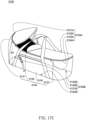
- Figure 17C illustrates the body structure of the foldable carrycot according to an embodiment of the present disclosure.
- the foldable carrycot 3100 of this embodiment includes a bottom 3110 and a side wall part 3120.
- the side wall part 3120 includes a first side wall part 3121, a second side wall part 3122, a third side wall part 3123, and a fourth side wall part 3124 that are sequentially connected to each other, wherein the first side wall part 3121 is opposite to the third side wall part 3123, and the second side wall part 3122 is opposite to the fourth side wall part 3124.
- the upper edges 3121A, 3122A, 3123A, and 3124A of the first side wall part 3121, the second side wall part 3122, the third side wall part 3123, and the fourth side wall part 3124 of the side wall part 3120 collectively form a continuous upper edge 3120A.
- the upper edge 3120A forms an opening, and the accommodating space 3S is connected to the outside through this opening.
- the upper edge 3121A of the first side wall part 3121 has an arc-shaped contour.
- the upper edge 3121A of the first side wall part 3121 also presents an arc-shaped contour, and has a continuous gradient height of 3H that transitions from the upper edge 3121A to the two upper edges of the side wall part 3120 (i.e., the upper edge 3122A of the second side wall part 3122 and the upper edge 3124A of the fourth side wall part 3124).
- the height 3H from the upper edge 3121A of the first side wall part 3121 to the bottom 310 of the carrycot gradually decreases from the first side wall part 3121 towards the second side wall part 3122 or the fourth side wall part 3124.
- the lower edge parts 3121B, 3122B, 3123B, and 3124B of the first side wall part 3121, the second side wall part 3122, the third side wall part 3123, and the fourth side wall part 3124 together form a continuous lower edge 3120B, the side wall part 3120 is connected to the bottom 3110 by the lower edge 3120B, thereby defining an accommodating space 3S enclosed by the first side wall part 3121, the second side wall part 3122, the third side wall part 3123, and the fourth side wall part 3124 in the unfolded state.
- An additional bottom plate e.g., bottom plate 3112 as shown in Figure 20
- the foldable carrycot 3100 of this embodiment further includes a hood part 3130, which is detachably connected to the first part of the upper edge 3120A of the side wall part 3120 (i.e., connected to the upper edge 3121A of the first side wall part 3121), to at least partially cover the accommodating space 3S when unfolded.
- the opposite first side wall part 3121 and the third side wall part 3123 of the side wall part 3120 are respectively the head part and foot part of the foldable carrycot 3100.
- the head part and foot part of the foldable carrycot 3100 correspond to the direction of the baby's head and feet, respectively.
- the hood part 3130 is located near the head part of the foldable carrycot 3100, to cover or at least partially cover the upper half of the baby's body (such as covering the chest to the head) when the baby is accommodated in the accommodating space 3S of the foldable carrycot 3100, providing functions such as shading for the baby.
- the opposite second side wall part 3122 and fourth side wall part 3124 of the side wall part 3120 are respectively the two opposite side parts of the foldable carrycot 3100, which extend along the longitudinal axis 3L of the foldable carrycot 3100.
- the foldable carrycot 3100 may further include a cover sheet 3140, which is detachably connected to the second part of the upper edge 3120A of the side wall part 3120 (i.e., connected to part of the upper edge 3122A of the second side wall part 3122, the upper edge 3123A of the third side wall part 3123, and part of the upper edge 3124A of the fourth side wall part 3124 of the upper edge 3120A), thereby covering the accommodating space 3S.
- a cover sheet 3140 which is detachably connected to the second part of the upper edge 3120A of the side wall part 3120 (i.e., connected to part of the upper edge 3122A of the second side wall part 3122, the upper edge 3123A of the third side wall part 3123, and part of the upper edge 3124A of the fourth side wall part 3124 of the upper edge 3120A), thereby covering the accommodating space 3S.
- the cover sheet 3140 is provided near the foot part of the foldable carrycot 3100 to cover the lower half of the baby's body (such as from the chest to the feet) when the baby is accommodated in the accommodating space 3S of the foldable carrycot 3100, which helps to moderately prevent external environmental interference (such as wind, rain, vibration, etc.).
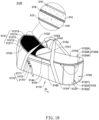
- the side wall part 3120 is formed of an outer layer fabric material 310, an inner layer fabric material 312, and a filling material wrapped between the outer layer fabric material 310 and the inner layer fabric material 312. That is to say, in this embodiment, the first side wall part 3121, the second side wall part 3122, the third side wall part 3123, and the fourth side wall part 3124 of the side wall part 3120 are formed as a whole from the same fabric and filling material. Specifically, as shown in the partial cross-sectional view in Figure 18 , the side wall part 3120 of this embodiment is formed of an outer layer fabric material 310 and an inner layer fabric material 312 enclosing a filling material.
- the filling material may be a stacked multi-layer structure, which may include, but is not limited to, a foam outer layer 314, a foam inner layer 316, and a polyethylene (PE) sheet layer 318 sandwiched between them.
- the filling material may be a stacked multi-layer structure of different combinations, including but not limited to: at least one foam layer and at least one polyethylene (PE) sheet layer bonded to the foam layer.
- the PE sheet layer 318 has a certain degree of hardness, which not only provides necessary safety for the foldable carrycot 3100, but also helps to shape the carrycot and facilitate the overall production of the foldable carrycot 3100.
- the foam outer layer 314 and foam inner layer 316 provide comfort and cushioning for infants and young children accommodated in the accommodating space 3S.
- the side wall part 3120 is connected to the bottom 3110, thereby defining an accommodating space 3S for accommodating infants and young children when unfolded.
- the cover sheet 3140 is detachably connected to part of the upper edge 3120A of the side wall part 3120, thereby covering the accommodating space 3S.
- the bottom 3110 and cover sheet 3140 are also made of the same fabric and filling material as the side wall part 3120, forming the soft foldable carrycot 3100 of this embodiment.
- first side wall part 3121, the second side wall part 3122, the third side wall part 3123, and the fourth side wall part 3124 of the side wall part 3120 may also include filling materials formed of stacked multi-layer structures of different combinations.
- first side wall part 3121 and the third side wall part 3123, which serve as the head part and foot part include a PE sheet layer 318.
- the head part of the foldable carrycot 3100 i.e., the first side wall part 3121 of the side wall part 3120
- the head part of the foldable carrycot 3100 is provided with multiple longitudinally extending folded line parts 31211, 31213, 31215.
- the folded line parts 31211, 31213, and 31215 extend in the entire longitudinal direction from the lower edge 3121B of the first side wall part 3121 to the upper edge 3121A of the first side wall part 3121, starting from the connection point 3110A between the side wall part 3120 and the bottom 3110.
- multiple fold line parts 31211, 31213, and 31215 can be formed along the longitudinal axis 3L of the foldable carrycot 3100 in the first side wall part 3121, for example, by sewing, and each of fold line parts 31211, 31213, and 31215 has a roughly arc-shaped shape that conforms to the contour of the first side wall part 3121.
- the first side wall part 3121 of the foldable carrycot 3100 has three folded line parts 31211, 31213, and 31215, and with the folded line part 31213 as the center, the folded line parts 31211 and 31215 are symmetrically distributed on both sides of the folded line part 31213, thereby further dividing the first side wall part 3121 into two connected sub regions 31212 and 31214.
- first side wall part 3121 is slightly higher than the other side wall parts of the side wall part 3120 (i.e., the second side wall part 3122, the third side wall part 3123, and the fourth side wall part 3124).
- the slightly raised first side wall part 3121 as well as its folded line parts 31211, 31213, 31215, are designed to give the upper edge 3121A of the first side wall part 3121 a roughly arc-shaped contour, which helps to stably fix the inner and outer layer fabric materials 310, 312 and filling materials 314, 316, and further enhances the rigidity of the head part of the foldable carrycot 3100.
- the foldable carrycot 3100 can be folded and closed by setting the folded line parts 31211, 31213, and 31215, which will be explained below with reference to Figure 20 .
- the foot part of the foldable carrycot 3100 i.e., the third side wall part 3123 of the side wall part 3120
- the foot part of the foldable carrycot 3100 can also be optionally provided with longitudinally extending folded line parts, such that the folded line parts extend from the connection point 3110A between the side wall part 3120 and the bottom 3110 along the lower edge 3123B to the upper edge 3123A of the third side wall part 3123 in the entire longitudinal direction.
- the setting of the folded line part at the foot part also helps to fold and close the carrycot 3100 and stabilize the filling material.
- the foot part of the foldable carrycot 3100 i.e., the third side wall part 3123 of the side wall part 3120
- the foot part of the foldable carrycot 3100 can also be selectively provided with longitudinally extending folded line parts.
- multiple sheets (taking two sheets as an example) of filling materials 31231 and 31232 can be provided inside the third side wall part 3123.
- the filling materials 31231 and 31232 are adjacent to each other and wrapped in the fabric material of the third side wall part 3123, and the third side wall part 3123 can be folded and closed through the gap 31233 between the filling materials 31231 and 31232.
- the first side wall part 3121, the second side wall part 3122, the third side wall part 3123, and the fourth side wall part 3124 of the side wall part 3120 of the foldable carrycot 3100 are formed as a whole from the same fabric and filling material.
- the inner and outer layer fabric materials 310 and 312 of the first side wall part 3 121, second side wall part 3122, third side wall part 3123, and fourth side wall part 3124 of the carrycot 3100 are formed as a whole from the same inner and outer layer fabric materials, while the folded line parts 31211, 31213, and 31215 divide the entire carrycot 3100 into multiple sub regions 31212 and 31214, each of the sub regions 31212 and 31214 is provided with corresponding filling materials.
- the first side wall part 3121 extends upward from the bottom 3110 and slightly towards the foot part (i.e., the third side wall part 3123) to form an integrated carrycot head part, and the filling material also extends integrally within the entire first side wall part 3121.
- the number of filling materials in the third side wall part 3123 may correspond to the number of sub regions 31212-31214 defined by the folded line parts 31211-31215 in the first side wall part 3121.
- the foldable carrycot 3100 further includes a hood part 3130, which is detachably connected to the upper edge 3121A of the first side wall part 3121 of the side wall part 3120, to at least partially cover the accommodating space 3S when unfolded.
- the hood part 3130 is also formed of a filling material wrapped with a fabric material, such as an outer layer fabric material 310, an inner layer fabric material 320, and a filling material sandwiched between them, wherein the filling material can be a single-layer foam layer 322 or a stacked multi-layer structure with different compositions, as shown in the partial cross-sectional view in Figure 17B .
- the selection of the filling material for the hood part 3130 is such that when the hood part 3130 is connected to the upper edge 3121A of the first side wall part 3121, it can be stably unfolded with the assistance of the curvature of the upper edge 3121A, thereby providing sufficient shielding effect for infants and young children accommodated in the accommodating space 3S.
- the outer layer fabric material 310 of the hood part 3130 can be selected to be the same as the outer layer fabric material 310 of the side wall part 3120 of the carrycot 3100, in order to provide a consistent and simple appearance when connected to the first side wall part 3121.
- the inner layer fabric material 320 of the hood part 3130 can be selected according to actual needs. For example, based on ventilation considerations, mesh fabric can be chosen as the inner layer fabric material 320 of the hood part 3130 to provide a more comfortable feeling for infants and young children within the accommodating space 3S.
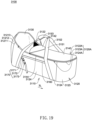
- the hood part 3130 is detachably connected to the first side wall part 3121 of the foldable carrycot 3100, and can be detached from the body of the carrycot 3100 when storing or carrying it, without hindering the folding and closing of the carrycot 3100, as shown in Figure 18 .
- the hood part 3130 has a sheet-like structure and can be bent towards the accommodating space 3S to adaptively fit the inner side of the first side wall part 3121, as shown in Figure 19 .
- the hood part 3130 can be detachably connected to the first side wall part 3121 using various methods or connectors.
- the hood part 3130 is connected to the first side wall part 3121 using a zipper 3132 as a connector, and can be separated from the first side wall part 3121 when not needed.
- the hood part 3130 can also be connected to the first side wall part 3121 using other methods or connectors, including but not limited to snap fasteners, magnetic fasteners, or hook-and-loop fastener, etc.
- the hood part 3130 can also be formed of the same filling material and fabric material as the side wall part 3120, wherein the PE sheet layer 318 has a certain hardness, which can provide support for the hood part 3130, so that in the unfolded state, the hood part 3130 can not only be detachably connected to the upper edge 3121A of the first side wall part 3121 with its lower edge 3130B, but also maintain a certain rigidity through the hardness of the PE sheet layer 318, so that the upper edge 3130A of the hood part 3130 can be supported and kept away from the upper edge 3121A of the first side wall part 3121, thereby at least partially shielding the accommodating space.
- the PE sheet layer 318 has a certain hardness, which can provide support for the hood part 3130, so that in the unfolded state, the hood part 3130 can not only be detachably connected to the upper edge 3121A of the first side wall part 3121 with its lower edge 3130B, but also maintain a certain rigidity through the hard
- the first upper edge 3121A presents an arc-shaped contour, so that the hood part 3130 and the first side wall part 3121 are connected to each other in an arc-shaped contour.
- the hood part 3130 in the unfolded state, can maintain a predetermined height due to the hardness of the PE sheet inside the filling material, so that its upper edge 3130A does not contact the side wall part 3120 of the foldable carrycot 3100, and thus the hood part 3130 can be unfolded to maintain an angle with the side wall part 3120 (specifically, an angle with the second side wall part 3122 and the fourth side wall part 3124);
- its inner side (the surface formed by the inner layer fabric material 312) forms a curved surface with an arc opening facing the accommodating space.
- the filling material structure of the hood part 3130 which includes a foam upper layer 314, a foam lower layer 316, and a PE sheet layer 318 sandwiched between them, this material structure endows the hood part 3130 with certain support strength and bending toughness. Therefore, when the hood part 3130 is not needed, users (such as caregivers of children or infants) can not only remove the hood part 3130, but also press the hood part 3130 towards the first side wall part, so that the hood part 3130 can bend into the accommodating space of the side wall part 3120 and be accommodated, forming a folding state.
- the hood part 3130 when in the folding state, the hood part 3130 forms an arc-shaped surface with its outer surface (the surface formed by the outer layer fabric material 310) facing outward in the accommodating space defined by the side wall part 3120, and the hood part 3130 as a whole is in contact with the first side wall part 3121.
- the hood part 3130 of this embodiment is formed of a skin friendly and soft outer layer fabric material 310, an inner layer fabric material 312, and a filling material wrapped within them. Therefore, when the hood part 3130 is accommodated in the accommodating space and attached to the first side wall part 3121, it can also provide comfort and cushioning effect for infants and young children accommodated in the foldable carrycot 3100, with both storage convenience and improved safety.
- ethylene-vinyl acetate (EVA) foam material can also be used as the filling material, its porous nature is more conducive to improving the bending ability of the hood part 3130, so that the hood part 3130 can be more closely attached to the first side wall part 3121 in the folding state.
- EVA ethylene-vinyl acetate
- the cover sheet 3140 include an upright sheet 3142 on one side near the first side wall part 3121 (i.e., the head part of the carrycot 3100).
- the upright sheet 3142 can also be made of the same fabric materials 310, 312 and filling material 314 as the side wall part 3120;
- the filling material of the upright sheet 3142 may also include a hard sheet material, such as but not limited to polyethylene (PE) sheet, so that the upright sheet 3142 can effectively and stably stand up when the cover sheet 3140 covers the accommodating space 3S, providing a windproof effect for infants and young children in the accommodating space 3S.
- PE polyethylene
- the cover sheet 3140 is connected to part of the upper edge 3120A of the side wall part 3120 through a connecting member 3144 (such as, but not limited to, a zipper, hook-and-loop fastener, snap fastener, magnetic fastener, etc.).
- a connecting member 3144 such as, but not limited to, a zipper, hook-and-loop fastener, snap fastener, magnetic fastener, etc.
- the cover sheet 3140 is part of the upper edge 3122A of the second side wall part 3122, the upper edge 3123 of the third side wall part 3123, and part of the upper edge 3124A of the fourth side wall part 3124, to cover the accommodating space 3S and maintain external communication of the space formed by the connection between the hood part 3130 and the first side wall part 3121.
- the connecting member 3144 is a zipper, which is set at the periphery of the cover sheet 3140 except for the upright sheet 3142.
- the cover sheet 3140 can be connected or partially connected to the corresponding part of the side wall part 3120 through the zipper.
- the foldable carrycot 3100 further includes a pair of lifting straps 3151, 3152, which can be fixed to the outside of the foldable carrycot 3100 by webbing, such as fixed to the outside of the side wall part 3120 or further fixed to the outside of the bottom 3110. Considering the weight of infants and young children and the load of the foldable carrycot 3100, the webbing can be fixed to the outer side of the side wall part 3120 by sewing or hot pressing.
- the foldable carrycot 3100 may further include a lifting strap grip 3153, which is detachably connected to the lifting straps 3151 and 3152 to provide a comfortable grip for the user when lifting the foldable carrycot 3100 of this embodiment.
- both ends of the lifting straps 3151 and 3152 are fixed to the same side of the side wall part 3120.
- the lifting straps 3151 and 3152 can also be fixed on opposite sides of the side wall part 3120 by their respective ends, meaning that the lifting straps 3151 and 3152 respectively cross the foldable carrycot 3100 and are fixedly connected to both sides of the side wall part 3120.
- the foldable carrycot 3100 further includes a storage part 3160, which is arranged on the outer side of the side wall part 3120, and can be used by the user to place a small amount of items, or to store the lifting straps 3151, 3152 and the lifting strap grip 3153, as well as to connect the webbing component 3170 (as described below).
- a storage part 3160 which is arranged on the outer side of the side wall part 3120, and can be used by the user to place a small amount of items, or to store the lifting straps 3151, 3152 and the lifting strap grip 3153, as well as to connect the webbing component 3170 (as described below).
- the foldable carrycot 3100 further includes a connecting webbing component 3170, which is provided on outside of both sides of the side wall part 3120 (due to the viewing angle, only one side of the carrycot can be shown), which is used to connect the foldable carrycot 3100 to a carrier (such as a stroller 3500 shown in Figures 21A and 21B ) and fixed on the carrier.
- the connecting webbing component 3170 includes a connecting webbing 3171, a connecting fastener 3172, and a length adjusting fastener 3173.
- the length adjusting fastener 3173 can be used to adjust the length of the connecting webbing 3171 to fit the connection on the carrier, and then the connecting fastener 3172 can be used to fasten and fix it. Further explanation will be provided with reference to Figures 21A and 21A in the following.
- Figure 20 illustrates the folding state of the foldable carrycot 3100 according to an embodiment of the present disclosure.
- the foldable carrycot 3100 of this embodiment is provided with longitudinally extending folded line parts 31211-31213 at its head part (first side wall part 3122), and folded line parts can also be provided at its foot part.
- the hood part 3130 has a complete sheet-like structure, which means that the hood part 3130 is a flat single-piece structure.
- the upper edge 3130A and lower edge 3130B of the hood part 3130 have arc-shaped contours, and their arc-shaped contours are not the same.
- the lower edge 3130B of the hood part 3130 has an arc-shaped contour corresponding to the upper edge 3121A of the first side wall part 3121, thereby tightly connecting to the upper edge 3121A of the first side wall part 3121.
- the upper edge 3130A of the hood part 3130 has a curved contour with a smaller curvature (i.e., a greater camber) than the lower edge 3130B, thus more effectively forming a curved surface with an arc opening facing the accommodating space to provide better shielding effect.
- the arc-shaped contour design of the upper edge 3130A and lower edge 3130B of the hood part 3130 is such that when the hood part 3130 is connected to the first side wall part 3121 of the carrycot, it can maintain a predetermined height due to the hardness of the PE sheet in the filling material in the unfolded state, so as to unfold and support to maintain an angle with the side wall part, providing a shielding effect, at the same time, its inner side forms a curved surface with an arc opening facing the accommodating space.
- the foldable carrycot 3100 of this embodiment includes a connecting webbing component 3170, which is used to connect and fix the carrycot 3100 to the stroller 3500.
- users can adjust the connecting webbing 3171 to the appropriate length by using the length adjusting fastener 3173 of the connecting webbing component 3170, and then loop the connecting webbing 3171 onto the appropriate connection of the frame 3510.
- the connecting fastener 3172 can be fastened to ensure that the connecting webbing 3171 is in a tensioned state and in engagement with the frame 3510, thereby fixing the foldable carrycot 3100 to the seat 3530 of the stroller 3500.
- the foldable carrycot 3100 can also be equipped with a connecting part on the outer side of the bottom (such as using a snap fastener, magnetic buckle, or hook-and-loop fastener) to fix its bottom to the seat 3530 of the stroller 3500.
- the connecting webbing component 3170 can be used as an auxiliary fixed connection to further enhance the stability of the connection between the foldable carrycot 3100 and the stroller 3500.
- the hood part 3130 of the foldable carrycot 3100 in this embodiment can be used in conjunction with a canopy 3520 of the stroller 3500 to provide appropriate shielding for infants and young children in the carrycot 3100 in different usage scenarios.
- the hood part 3130 of the carrycot 3100 can be in the unfolded state and the canopy 3520 of the stroller 3500 can be folded to facilitate the user's observation of the baby in the carrycot 3100;
- the hood part 3130 of the carrycot 3100 can be retracted inward to fit the inner side of the side wall part 3120 of the carrycot 3100, or even the hood part 3130 can be removed to avoid obstructing the canopy 3520 and blocking the user's sight.
- a carrycot cover includes an upright sheet and a cover sheet connected together, and before connection, a virtual auxiliary line perpendicular to the longitudinal axis of the upright sheet extends along the connecting side of the upright sheet, before connection, the size of the connecting side of the upright sheet is X centimeters inward relative to the auxiliary line from the outer end of the connecting side of the upright sheet to the opposite side of the connecting side of the upright sheet, where X is greater than or equal to zero, before connection, the size of the connecting side of the cover sheet is Y centimeters inward from the center point of the connecting side of the cover sheet along the longitudinal axis of the cover sheet towards the opposite side of the connection side of the cover sheet, where Y is greater than zero, and Y-X is greater than or equal to 2 centimeters.
- the connecting side of the upright sheet and the connecting side of the cover sheet are sewn together to produce a seam allowance.
- the seam allowance is edge bound.
- the seam allowance is edge bound and then fixed by topstitching.
- the seam allowance is folded over and then fixed by topstitching.
- the upright sheet is topstitched with grid-shape.
- a tube rope is provided inside the edge of the upright sheet.
- the seam allowance is tilted towards the direction of the carrycot cover towards the baby's head.
- the cover sheet includes a first part and a second part, the first part is used to connect with the upright sheet, and the second part is connected with a skirt sheet used to cover the side of the cover sheet, and the skirt sheet has an extension section towards the baby's head, and the seam allowance of the upright sheet and the cover sheet after sewing is sewn to the extension section.
- the seam allowance is tilted towards the direction of the carrycot cover towards the baby's feet.
- the width of the opening for accommodating a zipper located at the connection between the cover sheet and the upright sheet is greater than or equal to the width of the zipper.
- the carrycot includes the carrycot cover as previously described.
- the foldable carrycot includes a bottom, a side wall part, a hood part, and a cover sheet, wherein the side wall part and the hood part are jointly formed of a filling material and a fabric material, and the fabric material covers the filling material;
- the side wall part is connected to the bottom, thereby defining an accommodating space when unfolded;
- the cover sheet is detachably connected to part of the upper edge of the side wall part, thereby covering the accommodating space;
- the side wall part and the hood part can be symmetrically folded into a folding state along the longitudinal axis of the foldable carrycot.
- the hood part is provided with a longitudinally extending folded line part, and the hood part is folded through the folded line part.
- the hood part can be folded towards the accommodating space to fit the inner side of the side wall part.
- the hood part is equipped with a crosswise extending folded line part, and the hood part is folded towards the accommodating space through the folded line part.
- the cover sheet includes an upright sheet on the side of the cover sheet close to the hood part.
- the foldable carrycot further includes a lifting strap connected to the outer side of the side wall part.
- the foldable carrycot further includes a storage part arranged on the outer side of the side wall part.
- the filling material includes a stacked multi-layer structure.
- the foldable carrycot includes a bottom and a side wall part, the side wall part is connected to the bottom at its lower edge to define an accommodating space in an unfolded state, wherein the side wall part is formed of a filling material and a fabric material, the fabric material covers the filling material, and the side wall part can be symmetrically folded along the longitudinal axis of the foldable carrycot to a folding state; and the foldable carrycot further includes a hood part, which is connected to a first upper edge of the side wall part, to at least partially cover the accommodating space when unfolded, and to present the same contour as the side wall part when bent towards the accommodating space and fitted to the inner side of the side wall part.
- the first upper edge has an arc-shaped contour when viewed from a top view of the foldable carrycot; as well as the first upper edge has an arc-shaped contour when viewed from the side view of the foldable carrycot, and a continuous gradient height from the first upper edge to one of the two upper edges of the side wall part.
- the side wall part includes a first side wall part, a second side wall part, a third side wall part, and a fourth side wall part connected in sequence, wherein the first side wall part is opposite to the third side wall part, the second side wall part is opposite to the fourth side wall part, and wherein the first upper edge corresponds to the upper edge of the first side wall part, and the two upper edges of the side wall part correspond to the respective upper edges of the second side wall part and the fourth side wall part.
- the first side wall part is provided with a longitudinally extending folded line part, and the first side wall part can be folded through the folded line part.
- the third side wall part is provided with multiple sheets of filling material, which are adjacent to each other and wrapped in the fabric material, and the third side wall part can be folded through the gaps between the multiple sheets of filling material.
- the respective upper edges of the first side wall part, the second side wall part, the third side wall part, and the fourth side wall part collectively form a continuous upper edge
- the respective lower edge parts thereof collectively form a continuous lower edge
- the hood part is a sheet-like structure and is detachably connected to the first upper edge of the side wall part.
- the hood part includes a stacked multi-layer structure.
- the foldable carrycot further includes a connecting webbing component arranged on the outer side of the side wall part, wherein the foldable carrycot is connected to a carrier through the connecting webbing component.
- the foldable carrycot further includes a cover sheet that is detachably connected to a second upper edge of the side wall part, thereby at least partially covering the accommodating space.
- the cover sheet includes an upright sheet arranged on one side of the cover sheet near the first upper edge.
- a carrycot cover wherein the carrycot cover 1100, 2140, 2440 comprises an upright sheet 1110, 2142, 2442, 3142 and a cover sheet 1120, 3140 connected together, and before connection, a virtual auxiliary line 1113 perpendicular to the longitudinal axis 1112 of the upright sheet 1110 extends along the connecting side 1111 of the upright sheet 1110, before connection, the size of the connecting side 1111 of the upright sheet 1110 is X centimeters inward relative to the auxiliary line 1113 from the outer end 11110 of the connecting side 1111 of the upright sheet 1110 to the opposite side 1114 of the connecting side 1111 of the upright sheet 1110, where X is greater than or equal to zero, before connection, the size of the connecting side 1121 of the cover sheet 1120 is Y centimeters inward from the center point 11210 of the connecting side 1121 of the cover sheet 1120 along the longitudinal axis 1122 of the cover sheet 1120 towards the opposite side 1124 of the connection side 1121 of the cover sheet 1120,
Landscapes
- Purses, Travelling Bags, Baskets, Or Suitcases (AREA)
- Packaging Of Machine Parts And Wound Products (AREA)
- Wrappers (AREA)
- Electrophotography Configuration And Component (AREA)
- Carriages For Children, Sleds, And Other Hand-Operated Vehicles (AREA)
Abstract
Description
- The present disclosure relates to the technical field of infant products, particularly to a carrycot.
- In order to prevent the baby's head in the carrycot from being blown by the wind, an upright sheet is provided at the end of the carrycot cover adjacent to the baby's head. In order to make the upright sheet stand upright and achieve windproof effect, most carrycot covers currently extend and elongate the upright sheet, and install buckling member on the end of the upright sheet or the webbing connected to the end of the upright sheet to fasten and fix it to the outside of the carrycot. The disadvantage of this approach is that it will cover the rotating mechanism of the hood part (which is not conducive to operating the canopy rotating mechanism). As shown in
Figure 1 , after the bucklingmember 1211 of theupright sheet 1210 is fastened and fixed to the outside of the carrycot, theupright sheet 1210 completely covers the rotating mechanism of thehood part 1300. - Therefore, there is an urgent need for a carrycot upright sheet that is structurally simple, does not cover the rotating mechanism of the hood part, and can stand very upright.
- In addition, most carrycots are formed of plastic shells that are integrally formed currently, which is not conducive to storage and occupies space in homes or cars. Even though there are various foldable carrycots available on the market for storage, they are still constructed on hard frames such as plastic or metal, which is not conducive to being combined with other carriers (such as a stroller).
- The purpose of the present disclosure is to provide a carrycot upright sheet that is structurally simple, does not cover the rotating mechanism of the hood part, and can stand very upright. The term 'upright' herein refers to the installation of the carrycot cover on the carrycot, with the upright sheet of the carrycot cover almost perpendicular to the cover sheet.
- The purpose of the present disclosure is also to provide a foldable carrycot that can be folded and closed as a whole, facilitating storage and carrying.
- To achieve the above objectives, the present disclosure provides a carrycot cover, wherein the carrycot cover includes an upright sheet and a cover sheet connected together, and before connection, a virtual auxiliary line perpendicular to the longitudinal axis of the upright sheet extends along the connecting side of the upright sheet, before connection, the size of the connecting side of the upright sheet is X centimeters inward relative to the auxiliary line from the outer end of the connecting side of the upright sheet to the opposite side of the connecting side of the upright sheet, where X is greater than or equal to zero, before connection, the size of the connecting side of the cover sheet is Y centimeters inward from the center point of the connecting side of the cover sheet along the longitudinal axis of the cover sheet towards the opposite side of the connection side of the cover sheet, where Y is greater than zero, and Y-X is greater than or equal to 2 centimeters.
- In one embodiment, the connecting side of the upright sheet and the connecting side of the cover sheet are sewn together to produce a seam allowance.
- In one embodiment, the upright sheet is topstitched with grid-shape.
- In one embodiment, a tube rope is provided inside the edge of the upright sheet.
- In one embodiment, the cover sheet includes a first part and a second part, the first part is used to connect with the upright sheet, and the second part is connected with a skirt sheet used to cover the side of the cover sheet, and the skirt sheet has an extension section towards the baby's head, and the seam allowance of the upright sheet and the cover sheet after sewing is sewn to the extension section.
- The present disclosure also provides a foldable carrycot, including a bottom, a side wall part and a hood part, wherein: the side wall part is formed of filling material and fabric material, with the fabric material covering the filling material; the side wall part is connected to the bottom by its lower edge, thereby defining an accommodating space when unfolded; the side wall part and the hood part may be symmetrically folded into a folding state along the longitudinal axis of the foldable carrycot.
- In one embodiment, the side wall part and the hood part are jointly formed of filling material and fabric material; a cover sheet is detachably connected to part of the upper edge of the side wall part, thereby covering the accommodating space.
- In one embodiment, the hood part is provided with a longitudinally extending folded line part, and the hood part is folded through the folded line part.
- In one embodiment, the hood part may be folded towards the accommodating space to fit the inner side of the side wall part.
- In one embodiment, the hood part is provided with a crosswise extending folded line part, and the hood part is folded towards the accommodating space through the folded line part.
- In one embodiment, the hood part is connected to a first upper edge of the side wall part, to at least partially cover the accommodating space when unfolded, and to present the same contour as the side wall part when bent towards the accommodating space and fitted to the inner side of the side wall part.
- In one embodiment, the first upper edge has an arc-shaped contour when viewed from a top view of the foldable carrycot; as well as the first upper edge has an arc-shaped contour when viewed from the side view of the foldable carrycot, and a continuous gradient height from the first upper edge to one of the two upper edges of the side wall part.
- In one embodiment, the side wall part includes a first side wall part, a second side wall part, a third side wall part, and a fourth side wall part connected in sequence, wherein the first side wall part is opposite to the third side wall part, the second side wall part is opposite to the fourth side wall part, and wherein the first upper edge corresponds to the upper edge of the first side wall part, and the two upper edges of the side wall part correspond to the respective upper edges of the second side wall part and the fourth side wall part.
- In one embodiment, the first side wall part is provided with a longitudinally extending folded line part, and the first side wall part may be folded through the folded line part.
- In one embodiment, the respective upper edges of the first side wall part, the second side wall part, the third side wall part, and the fourth side wall part collectively form a continuous upper edge, and the respective lower edge parts thereof collectively form a continuous lower edge.
- In one embodiment, the hood part is a sheet-like structure and is detachably connected to the first upper edge of the side wall part.
-
-
Figure 1 is a schematic view of carrycot upright sheet and the outer side of the carrycot being fastened and fixed of the relevant state of the art. -
Figure 2 is a schematic view of the dimensions of the upright sheet and the cover sheet before connecting according to an embodiment of the present disclosure. -
Figure 3 is a schematic view of the contour of the upright sheet and the cover sheet before connecting that causes the cover sheet to arch after connecting. -
Figures 4A-4C are schematic views of the seam allowance being edge bound. -
Figures 5A-5C are schematic views of the seam allowance being edge bound and then top stitched. -
Figures 6A-6C are schematic views of the seam allowance being folded over and then top stitched. -
Figures 7A-7C are schematic views of the upright sheet wrapping a tube. -
Figure 8 is a schematic view of the upright sheet with cotton lining and is topstitched with grid-shape. -
Figure 9 is a schematic view of the cover sheet with a zipper arranged adjacent to the upright sheet. -
Figure 10 is a schematic view of a carrycot cover according to another embodiment of the present disclosure. -
Figure 11 is a perspective view of the carrycot cover ofFigure 10 installed on the carrycot. -
Figures 12A and12B are schematic views of the appearance of a foldable carrycot according to an embodiment of the present disclosure from different perspectives. -
Figure 13 is a schematic view of the appearance of a foldable carrycot according to an embodiment of the present disclosure. -
Figure 14 illustrates the folding state of the foldable carrycot according to an embodiment of the present disclosure. -
Figure 15 is a schematic view of the appearance of a foldable carrycot according to another embodiment of the present disclosure. -
Figure 16 is a schematic view of the appearance of a foldable carrycot according to an embodiment of the present disclosure. -
Figures 17A and17B are schematic views of the appearance of a foldable carrycot according to an embodiment of the present disclosure from different perspectives. -
Figure 17C illustrates the body structure of a foldable carrycot according to an embodiment of the present disclosure. -
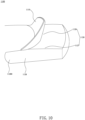
Figure 18 is a schematic view of the appearance of a foldable carrycot according to an embodiment of the present disclosure, in which the shielding part has been separated from the carrycot. -
Figure 19 is a schematic view of the appearance of a foldable carrycot according to an embodiment of the present disclosure, in which the shielding part is connected to the carrycot and fitted to the inner side of the side wall part. -
Figure 20 illustrates the folding state of the foldable carrycot according to an embodiment of the present disclosure; as well as -
Figures 21A and21B illustrate the combined use state of the foldable carrycot and the carrier according to an embodiment of the present disclosure. -
- 1300 hood part
- 1210 upright sheet
1211 buckling member - 1100 carrycot cover
- 1110 upright sheet
- 1111 connecting side of the upright sheet
11110 outer end of the connecting side of the upright sheet - 1114 opposite side of the connecting side of the upright sheet
- 1112 longitudinal axis of the upright sheet
- 1113 auxiliary line
- 1115 cotton lining
- 1111 connecting side of the upright sheet
- 1120 cover sheet
- 1121 connecting side of the cover sheet
11210 center point of the connecting side of the cover sheet - 1122 longitudinal axis of the cover sheet
- 1124 opposite side of the connecting side of the cover sheet
- 1125 zipper
- 11250zipper head
- 11251 zipper piece
- 1126 first part
- 1127 second part
- 1128 skirt sheet
11280 extension section of the skirt sheet - 1129 opening
- 1121 connecting side of the cover sheet
- 1130 seam allowance
- 1131 edge binding cloth
- 1132 stitch
- 1140 tube rope
- 1150 tube cloth
- 210 outer layer fabric material
- 1110 upright sheet
- 212 inner layer fabric material
- 214 foam upper layer
- 218 PE sheet layer
- 216 foam lower layer
- 2100, 2400 foldable carrycot
- 2110, 2410 bottom
- 2120, 2420 side wall part
- 2120A, 2420A side wall part upper edge

- 2130, 2430 hood part
- 2131, 2431 opening
- 2122, 2422 head part
- 2124, 2126, 2424 side part
- 2128 foot part
- 21221∼21229, 21281∼21285, 24221∼24223, 24281, 24283 folded line part
- 21222~21228, 21282, 21284 sub region
- 2140, 2440 carrycot cover
- 2142, 2442 upright sheet
- 2144, 2444 connecting member
- 2151, 2152, 2451, 2452 lifting strap
- 2153, 2453 grip
- 2160, 2460 storage part
- 2L longitudinal axis
2S accommodating space - 310 outer layer fabric material
- 312 inner layer fabric material
- 314 foam outer layer
- 316 PEsheet layer
- 318 foam inner layer
- 320 inner layer fabric material
- 322 foam layer
- 3100 carrycot
- 3110 bottom
- 3112 bottom plate
- 3120 side wall part
- 3120A upper edge of the side wall part
- 3121∼3124 side wall part
- 3121A∼3124A upper edge of the side wall part
- 31211, 31213, 31215 folded line part
- 31212, 31214 sub region
- 31231, 31232 filling material
- 3130 hood part
- 3130A upper edge
- 3130B lower edge
- 3132 zipper
- 3140 cover sheet
- 3142 upright sheet
- 3144 connecting member
- 3151, 3152 lifting strap
- 3153 grip
- 3160 storage part
- 3170 connecting webbing component
- 3171 connecting webbing
- 3172 connecting fastener
- 3173 length adjusting fastener
- 3180 pillow
- 3500 stroller
- 3510 frame
- 3520 canopy
- 3L longitudinal axis
- 3S accommodating space
- 3H height
- In order to provide a detailed illustration of the technical contents and structural features of the present disclosure, further illustration will be made in conjunction with the embodiments and accompanying drawings.
- Please refer to
Figure 2 , which is a schematic view of the dimensions of anupright sheet 1110 and acover sheet 1120 before connecting according to an embodiment of the present disclosure. The present disclosure provides acarrycot cover 1100, including theupright sheet 1110 and thecover sheet 1120 connected together. Before connecting, a virtualauxiliary line 1113 perpendicular to thelongitudinal axis 1112 of theupright sheet 1110 extends along the connectingside 1111 of theupright sheet 1110. Before connecting, the size of the connectingside 1111 of theupright sheet 1110 is such that theouter end 11110 of the connectingside 1111 of theupright sheet 1110 shrinks X centimeters relative to theauxiliary line 1113 towards theopposite side 1114 of the connectingside 1111 of theupright sheet 1110, wherein X is greater than or equal to zero. Before connecting, the size of the connectingside 1121 of thecover sheet 1120 is such that thecenter point 11210 of the connectingside 1121 of thecover sheet 1120 shrinks inward by Y centimeters along thelongitudinal axis 1122 of thecover sheet 1120 towards theopposite side 1124 of the connectingside 1121 of thecover sheet 1120, wherein Y is greater than zero and Y-X is greater than or equal to 2 centimeters. That is to say, before connecting, from the overall contour of theupright sheet 1110, when X is greater than zero, the connectingside 1111 of theupright sheet 1110 is convex (when X is equal to zero, the connectingside 1111 of theupright sheet 1110 is straight), and from the overall contour of thecover sheet 1120, the connectingside 1121 of thecover sheet 1120 is concave. The orientation "inside" herein refers to the direction towards the center ("outside" is the opposite direction to "inside"). Unless otherwise specified, the shape (contour) and size of theupright sheet 1110 and thecover sheet 1120 herein are in their pre-connection state. - The connection method between the
upright sheet 1110 and thecover sheet 1120 can be known or easily thought of by those skilled in the art, such as sewing, bonding, or even welding. - If the connecting
side 1111 of theupright sheet 1110 is concave when viewed from the overall contour of the upright sheet 1110 (as shown inFigure 3 , the connectingside 1111 of theupright sheet 1110 is concave, and the connectingside 1121 of thecover sheet 1120 is concave), it will cause thecover sheet 1120 after connection to arch (be uneven). - In one embodiment, when X is greater than zero, both the connecting
side 1111 of theupright sheet 1110 and the connectingside 1121 of thecover sheet 1120 are arc-shaped. - In one embodiment, the connecting
side 1111 of theupright sheet 1110 and the connectingside 1121 of thecover sheet 1120 are seamed (sewn) together to produce a seam allowance 1130 (as shown inFigure 4A ). - In one embodiment, the
seam allowance 1130 formed by sewing theupright sheet 1110 and thecover sheet 1120 is wrapped with anedge binding cloth 1131, as shown inFigure 4A. Figure 4B shows thestitch 1132 seen from the back of the carrycot cover (the side facing the baby) after the edge binding is completed.Figure 4C shows the front of the carrycot cover (the side facing away from the baby) after the edge binding is completed. - In one embodiment, the
seam allowance 1130 is then fixed by topstitching after edge binding, as shown inFigure 5A . Furthertopstitching seam allowance 1130 after edge binding is to strengthen the fixation of the edge binding.Figure 5B shows thestitch 1132 seen from the back of the carrycot cover (the side facing the baby) after edge binding and then topstitching being completed.Figure 5C shows thestitch 1132 as seen from the front of the carrycot cover (the side facing away from the baby) after edge binding and then topstitching being completed. Compared to only edge binding, ifseam allowance 1130 is edge bound and then topstitched, a larger difference between Y-X is required because theupright sheet 1110 will tilt due to the topstitching. - In one embodiment, the
seam allowance 1130 is folded over and then fixed by topstitching (as shown inFigure 6A ), which is similar to the principle of "fixing by topstitching after edge binding". Therefore, a larger difference between Y-X is required to prevent theupright sheet 1110 from tilting due to topstitching.Figure 6B shows thestitch 1132 seen from the opposite side of the carrycot cover (the side facing the baby) after theseam allowance 1130 being folded over and fixed by topstitching.Figure 6C shows thestitch 1132 seen from the front of the carrycot cover (the side facing away from the baby) after theseam allowance 1130 being folded over and fixed by topstitching. - In short, if the difference between Y-X is larger, the connection between the
upright sheet 1110 and thecover sheet 1120 will generate a larger standing force to make theupright sheet 1110 stand upright. - In one embodiment, a
tube rope 1140 is placed inside the edge of theupright sheet 1110, and thetube rope 1140 is wrapped with a sewntube cloth 1150, as shown inFigure 7A . Thetube rope 1140 can make theupright sheet 1110 stand more upright.Figure 7B shows the back side of the carrycot cover after the tube is wrapped (the side facing the baby).Figure 7C shows the front side of the carrycot cover after the tube is wrapped (the side facing away from the baby). - In one embodiment, as shown in
Figure 8 , there is acotton lining 1115 with a thickness of about 9mm inside theupright sheet 1110. Theupright sheet 1110 is topstitched with grid-shape (theupright sheet 1110 and thecotton lining 1115 are divided into several grids by topstitching to increase the hardness of the upright sheet 1110), so as to make theupright sheet 1110 stand more upright. - In one embodiment, the
seam allowance 1130 is tilted towards the direction of the baby's head on the carrycot cover to make theupright sheet 1110 stand more upright. - In an experimental test, when X=0, Y is equal to 2cm, 3cm, and 4cm, respectively. The result is that the larger the difference between Y-X, the more upright the
upright sheet 1110 is. - In an experimental test, when X=1.5cm, Y is equal to 2cm, 3cm, and 4cm, respectively. The result is that the larger the difference between Y-X, the more upright the
upright sheet 1110 is. Especially when X=1.5cm and Y=2cm (Y-X=0.5cm, the arc of the connectingside 1111 of theupright sheet 1110 and the arc of the connectingside 1121 of thecover sheet 1120 are almost parallel), the upright of theupright sheet 1110 is very insufficient. - In an experimental test, when Y=4.5cm, X is equal to 5cm, 2.5cm, 1.5cm, and 0.5cm, respectively. The result is that the larger the absolute value of the difference between Y-X, the more upright the
upright sheet 1110 is. - In one embodiment, as shown in
Figure 9 , azipper 1125 is provided at a position adjacent to theupright sheet 1110 on the front side (the side facing away from the baby) of the cover sheet 1120 (for example, to open thezipper 1125 and remove the lining inside the cover sheet 1120). The width of theopening 1129 located at the connection between thecover sheet 1120 and theupright sheet 1110 for accommodating (sewing) thezipper 1125 is greater than or equal to the width of thezipper 1125 to prevent thezipper head 11250 and thezipper piece 11251 from pressing against theupright sheet 1110 after thezipper 1125 is closed, causing deformation of theupright sheet 1110 at that location. - In one embodiment, as shown in
Figure 10 , thecover sheet 1120 includes afirst part 1126 and asecond part 1127. Thefirst part 1126 is used to connect with theupright sheet 1110, and thesecond part 1127 is connected with a skirt sheet 1128 (theskirt sheet 1128 is used to cover the side of the upper edge of the carrycot main body) to shield the side of thecover sheet 1120. Theskirt sheet 1128 has anextension section 11280 in the direction of the baby's head (the end of theskirt sheet 1128 has anextension section 11280 in the direction of the baby's head), and the seam allowance of theupright sheet 1110 and thecover sheet 1120 after sewing is sewn to theextension section 11280 of theskirt sheet 1128. -
Figure 11 is a perspective view of the carrycot cover ofFigure 10 installed on the carrycot. As shown inFigure 11 , due to the installation of thecarrycot cover 1100 on the carrycot, theskirt sheet 1128 and itsextension section 11280 hang downward (towards the ground), so the direction of the seam allowance sewn to theextension section 11280 of theskirt sheet 1128 is fixed by a downward (towards the ground) force, making theupright sheet 1110 connected with the seam allowance stand more upright. Preferably, there is askirt sheet 1128 on each symmetrical side of thesecond part 1127 of thecover sheet 1120, and the two ends of theseam allowance 1130 after edge binding theupright sheet 1110 are sewn to theextension section 11280. - In one embodiment, compared to the
seam allowance 1130 tilting towards the direction of the carrycot cover towards the baby's head, when theseam allowance 1130 is tilted towards the direction of the carrycot cover towards the baby's feet, a larger difference between Y-X is required. - In one embodiment, the present disclosure provides a
carrycot cover 1100, wherein the dimension Y-X before the connection of theupright sheet 1110 and thecover sheet 1120 is greater than zero, for example, Y-X=the first dimension, and theseam allowance 1130 after theupright sheet 1110 and thecover sheet 1120 are sewn together only being edge binding. Furthermore, the arc of the connectingside 1111 of theupright sheet 1110 and the arc of the connectingside 1121 of thecover sheet 1120 are not parallel before connecting. Furthermore, the dimension X of theupright sheet 1110 is greater than zero before connecting. - In one embodiment, the present disclosure provides a
carrycot cover 1100, wherein the dimension Y-X before the connection of theupright sheet 1110 and thecover sheet 1120 is greater than zero, for example, Y-X=the second dimension, which is greater than the first dimension, and theseam allowance 1130 after theupright sheet 1110 and thecover sheet 1120 are sewn together being edge binding and then fixed by topstitching. - In one embodiment, the present disclosure provides a
carrycot cover 1100, wherein the dimension Y-X before the connection of theupright sheet 1110 and thecover sheet 1120 is greater than zero, for example, Y-X=the third dimension, which is greater than the first dimension, and theseam allowance 1130 after theupright sheet 1110 and thecover sheet 1120 are sewn together is folded over and then fixed by topstitching. - In one embodiment, the third dimension is equal to the second dimension.
- Please refer to
Figures 12A ,12B , and13 , which are schematic views of the appearance of afoldable carrycot 2100 according to an embodiment of the present disclosure from different perspectives. Thefoldable carrycot 2100 of this embodiment includes a bottom 2110, aside wall part 2120, ahood part 2130, and acover sheet 2140. Theside wall part 2120 includes a first part, a second part, a third part, and a fourth part that are sequentially connected to each other and connected to the bottom 2110 to jointly enclose anaccommodating space 2S with the bottom 2110, wherein the first part and the second part are opposite, and the third part and the fourth part are opposite. Thecover sheet 2140 is detachably connected to part of theupper edge 2120A of theside wall part 2120, thereby covering theaccommodating space 2S. In this embodiment, the opposing first and second parts of theside wall part 2120 are thehead part 2122 andfoot part 2128 of thefoldable carrycot 2100, respectively. The opposing third and fourth parts of theside wall part 2120 are the two opposingside parts foldable carrycot 2100, respectively. - The
side wall part 2120 and thehood part 2130 are jointly formed of an outerlayer fabric material 210, an innerlayer fabric material 212, and a filling material wrapped between the outerlayer fabric material 210 and the innerlayer fabric material 212. That is to say, in this embodiment, theside wall part 2120 and thehood part 2130 of thefoldable carrycot 2100 are formed as a whole from the same fabric material and filling material. Specifically, as shown in the partial cross-sectional view inFigure 12A , theside wall part 2120 and thehood part 2130 of this embodiment are formed of the outerlayer fabric material 210 and the innerlayer fabric material 212 enclosing the filling material, wherein the filling material can be a stacked multi-layer structure, including but not limited to: a foamupper layer 214, a foamlower layer 216, and a polyethylene (PE)sheet layer 218 sandwiched between them. In other embodiments, the filling material may be a stacked multi-layer structure, including but not limited to: at least one foam layer and at least one polyethylene (PE) sheet layer bonded to the foam layer. In this embodiment, thePE sheet layer 218 has a certain hardness, which not only provides the necessary safety for thefoldable carrycot 2100, but also helps to shape the carrycot and facilitate the overall production of thefoldable carrycot 2100. The foamupper layer 214 and the foamlower layer 216 provide comfort and cushioning for infants and young children accommodated in theaccommodating space 2S. Theside wall part 2120 is connected to the bottom 2110, thereby defining theaccommodating space 2S for accommodating infants and young children when unfolded. Thecover sheet 2140 is detachably connected to part of theupper edge 2120A of theside wall part 2120, thereby covering theaccommodating space 2S. Optionally, the bottom 2110 andcover sheet 2140 are also made of the same fabric and filling material as theside wall part 2120 andhood part 2130, forming thesoft foldable carrycot 2100 of this embodiment. - As shown in
Figure 12A , in this embodiment, thehead part 2122 andhood part 2130 of thecarrycot 2100 are provided with multiple longitudinally extending foldedline parts line parts side wall part 2120 and the bottom 2110 along thehead part 2122 to thehood part 2130. Specifically, multiple foldedline parts longitudinal axis 2L of thefoldable carrycot 2100 from thehead part 2122 to thehood part 2130, for example, by sewing. The sections of each foldedline part hood part 2130 have a roughly arc-shaped shape that conforms to the contour of thehood part 2130. In this embodiment, thefoldable carrycot 2100 has five foldedline parts line part 21225, the foldedline parts line parts line part 21225, thereby further separating thehead part 2122 to thehood part 2130 into fourconnected sub regions line parts foldable carrycot 2100, those skilled in the art can understand that the number and position of the folded line part can be determined according to the size and configuration of the carrycot 2100 (especially the hood part 2130), and are not limited to the form of this embodiment. The space formed by thehood part 2130 is connected to the outside through theopening 2131 of thehood part 2130. The setting of the foldedline parts opening 2131 of the hood part 2130 a roughly arc-shaped contour. The setting of the foldedline parts layer fabric materials materials hood part 2130. In addition, thefoldable carrycot 2100 can be folded and closed by setting the foldedline parts Figure 14 . - In this embodiment, the
foot part 2128 of thefoldable carrycot 2100 is provided with the longitudinally extending foldedline part 21283, for example, by sewing. In this embodiment, the foldedline part 21283 extends along the entire longitudinal direction from the connection point 2110A between theside wall part 2120 and the bottom 2110 along thefoot part 2128. In this embodiment, between thefoot part 2128 and the two opposingside parts foot part 2128, there are respectively provided foldedline parts line part 21283 offoot part 2128 is located at the central longitudinal axis of thefoot part 2128. With the foldedline part 21283 as the center, the foldedline parts line part 21283, further separating thefoot part 2128 into twoconnected sub regions foldable carrycot 2100 can be folded and closed by setting the foldedline part 21283 of thefoot part 2128, which will be explained below with reference toFigure 14 . - As described above, in this embodiment, the
hood part 2130,head part 2122, two opposingside parts foot part 2128 of thefoldable carrycot 2100 are formed as a whole from the same fabric and filling material. In detail, in this embodiment, the inner and outerlayer fabric materials hood part 2130,head part 2122, twoopposite side parts foot part 2128 of thecarrycot 2100 are formed as a whole from the same inner and outer layer fabric materials, while the folded line parts 21221-21229 and 21281-21285 divide theentire carrycot 2100 into multiple sub regions 21222-21228, 21282, and 21284, each of which is equipped with corresponding filling materials. In addition, in this embodiment, in the sub regions 21222-21228 separated by the folded line parts 21221-22129, thehead 2122 extends upward from the bottom 2110 and extends towards thefoot part 2128 to form thehood part 2130 as a whole, and the filling material also extends as a whole from thehead part 2122 to thehood part 2130. - In this embodiment, the
cover sheet 2140 includes anupright sheet 2142 on one side near thehood part 2130. Theupright sheet 2142 can also be made of thesame fabric materials material 214 as theside wall part 2120 and thehood part 2130. Alternatively, the filling material of theupright sheet 2142 may also include a hard sheet material, such as but not limited to polyethylene (PE) sheet, so that theupright sheet 2142 can effectively stand up when thecover sheet 2140 covers theaccommodating space 2S, providing a windproof effect for infants and young children in theaccommodating space 2S. - In this embodiment, the
cover sheet 2140 is connected to part of theupper edge 2120A of theside wall part 2120 through a connecting member 2144 (such as, but not limited to, a zipper, hook-and-loop fastener, snap fastener, etc.). Specifically, thecover sheet 2140 is connected to part of theupper edge 2120A of theside wall part 2120, excluding the connection with thehood part 2130, to cover the accommodating space S and maintain external communication of the space formed by the hood part 130. As shown in the figure, in this embodiment, the connectingmember 2144 is a zipper, which is set at the periphery of thecover sheet 2140 except for theupright sheet 2142. Thecover sheet 2140 can be connected or partially connected to the corresponding part of theside wall part 2120 through a zipper, as shown inFigure 13 . - In this embodiment, the
foldable carrycot 2100 further includes a pair of liftingstraps foldable carrycot 2100 by webbing, such as fixed to the outside of theside wall part 2120 or further fixed to the outside of the bottom 2110. Considering the weight of infants and young children and the load of thefoldable carrycot 2100, the webbing can be fixed to the outer side of theside wall part 2120 by sewing or hot pressing. Optionally, thefoldable carrycot 2100 may further include a liftingstrap grip 2153, which is detachably connected to the liftingstraps foldable carrycot 2100 of this embodiment. - In this embodiment, both ends of the lifting
straps side wall part 2120. However, those skilled in the art should understand that the liftingstraps side wall part 2120 by their respective ends, meaning that the liftingstraps foldable carrycot 2100 and are fixedly connected to both sides of theside wall part 2120. - In this embodiment, the
foldable carrycot 2100 further includes astorage part 2160, which is arranged on the outer side of theside wall part 2120, for the user to place a small amount of items. - Please refer to
Figure 14 , which illustrates the folding state of thefoldable carrycot 2100 according to an embodiment of the present disclosure. As mentioned earlier, thefoldable carrycot 2100 is equipped with multiple longitudinally extending folded line parts 21221-22129 and 21281-21285 on itshead part 2122 andfoot part 2128. When there is no need to use thefoldable carrycot 2100, the user can partially or completely remove the connection between thecover sheet 2140 and theside wall part 2120, and fold thefoldable carrycot 2100 symmetrically along itslongitudinal axis 2L with the central foldedline parts cover sheet 2140 to fold, reducing the overall volume of thefoldable carrycot 2100 for easier storage. - Please refer to
Figures 15 and16 , which are schematic views of the appearance of a foldable carrycot 400 according to another embodiment of the present disclosure. Thefoldable carrycot 2400 of this embodiment has a configuration and composition similar to thefoldable carrycot 2100 described above, including a bottom 2410, side wall part 2420,hood part 2430 andcover sheet 2440,upright sheet 2442, liftingstraps grip 2453, andstorage part 2460, etc. Similarly, in this embodiment, thehood part 2430 of thefoldable carrycot 2400 as well as thehead part 2422, foot part, and two opposing side parts (only labeled 2424 in the figure due to viewing angle) of the side wall part 2420 are formed as a whole from the same fabric and filling material. The side wall part 2420 is connected to the bottom 2410, thereby defining theaccommodating space 2S for accommodating infants and young children when unfolded. Thecover sheet 2440 is detachably connected to part of theupper edge 2420A of the side wall part 2420, thereby covering theaccommodating space 2S. Optionally, the bottom 2410 andcover sheet 2440 are also made of the same fabric and filling material as the side wall part 2420, forming thesoft foldable carrycot 2400 of this embodiment. - Unlike the previous embodiments, in this embodiment, the folded
line parts hood part 2430 are formed as crosswise extending arcs, meaning that multiple foldedline parts hood part 2430, allowing thehood part 2430 to be folded towards theaccommodating space 2S through the foldedline parts hood part 2430 is folded inward towards theaccommodating space 2S, the fabric and filling materials that make up the arc-shapedhood part 2430 can conform to the inner edge contour of the side wall part 2420 as a whole. In this way, when there is no need to use thehood part 2430, thehood part 2430 can be attached to the side wall part 2420 to provide enhanced cushioning protection in the space corresponding to the top of the baby's head, avoiding injury caused by the baby's head shaking during movement. - Please refer to
Figures 17A to 17C , as well asFigure 18 , which are schematic views of the appearance of afoldable carrycot 3100 according to an embodiment of the present disclosure from different perspectives.Figure 17C illustrates the body structure of the foldable carrycot according to an embodiment of the present disclosure. Thefoldable carrycot 3100 of this embodiment includes a bottom 3110 and aside wall part 3120. Theside wall part 3120 includes a firstside wall part 3121, a secondside wall part 3122, a thirdside wall part 3123, and a fourthside wall part 3124 that are sequentially connected to each other, wherein the firstside wall part 3121 is opposite to the thirdside wall part 3123, and the secondside wall part 3122 is opposite to the fourthside wall part 3124. The upper edges 3121A, 3122A, 3123A, and 3124A of the firstside wall part 3121, the secondside wall part 3122, the thirdside wall part 3123, and the fourthside wall part 3124 of theside wall part 3120 collectively form a continuousupper edge 3120A. Theupper edge 3120A forms an opening, and the accommodating space 3S is connected to the outside through this opening. From a top view of thefoldable carrycot 3100, theupper edge 3121A of the firstside wall part 3121 has an arc-shaped contour. From the side view of thefoldable carrycot 3100, theupper edge 3121A of the firstside wall part 3121 also presents an arc-shaped contour, and has a continuous gradient height of 3H that transitions from theupper edge 3121A to the two upper edges of the side wall part 3120 (i.e., theupper edge 3122A of the secondside wall part 3122 and theupper edge 3124A of the fourth side wall part 3124). In other words, theheight 3H from theupper edge 3121A of the firstside wall part 3121 to thebottom 310 of the carrycot gradually decreases from the firstside wall part 3121 towards the secondside wall part 3122 or the fourthside wall part 3124. Thelower edge parts side wall part 3121, the secondside wall part 3122, the thirdside wall part 3123, and the fourthside wall part 3124 together form a continuouslower edge 3120B, theside wall part 3120 is connected to the bottom 3110 by thelower edge 3120B, thereby defining an accommodating space 3S enclosed by the firstside wall part 3121, the secondside wall part 3122, the thirdside wall part 3123, and the fourthside wall part 3124 in the unfolded state. An additional bottom plate (e.g.,bottom plate 3112 as shown inFigure 20 ) can be installed at thebottom 3110 of thefoldable carrycot 3100 to enhance strength and support of the bottom of thefoldable carrycot 3100. Thefoldable carrycot 3100 of this embodiment further includes ahood part 3130, which is detachably connected to the first part of theupper edge 3120A of the side wall part 3120 (i.e., connected to theupper edge 3121A of the first side wall part 3121), to at least partially cover the accommodating space 3S when unfolded. - In this embodiment, the opposite first
side wall part 3121 and the thirdside wall part 3123 of theside wall part 3120 are respectively the head part and foot part of thefoldable carrycot 3100. When a baby is accommodated in the accommodating space 3S of thefoldable carrycot 3100, the head part and foot part of thefoldable carrycot 3100 correspond to the direction of the baby's head and feet, respectively. In this embodiment, thehood part 3130 is located near the head part of thefoldable carrycot 3100, to cover or at least partially cover the upper half of the baby's body (such as covering the chest to the head) when the baby is accommodated in the accommodating space 3S of thefoldable carrycot 3100, providing functions such as shading for the baby. In this embodiment, the opposite secondside wall part 3122 and fourthside wall part 3124 of theside wall part 3120 are respectively the two opposite side parts of thefoldable carrycot 3100, which extend along thelongitudinal axis 3L of thefoldable carrycot 3100. - In one embodiment, the
foldable carrycot 3100 may further include acover sheet 3140, which is detachably connected to the second part of theupper edge 3120A of the side wall part 3120 (i.e., connected to part of theupper edge 3122A of the secondside wall part 3122, theupper edge 3123A of the thirdside wall part 3123, and part of theupper edge 3124A of the fourthside wall part 3124 of theupper edge 3120A), thereby covering the accommodating space 3S. In this embodiment, thecover sheet 3140 is provided near the foot part of thefoldable carrycot 3100 to cover the lower half of the baby's body (such as from the chest to the feet) when the baby is accommodated in the accommodating space 3S of thefoldable carrycot 3100, which helps to moderately prevent external environmental interference (such as wind, rain, vibration, etc.). - In this embodiment, the
side wall part 3120 is formed of an outerlayer fabric material 310, an innerlayer fabric material 312, and a filling material wrapped between the outerlayer fabric material 310 and the innerlayer fabric material 312. That is to say, in this embodiment, the firstside wall part 3121, the secondside wall part 3122, the thirdside wall part 3123, and the fourthside wall part 3124 of theside wall part 3120 are formed as a whole from the same fabric and filling material. Specifically, as shown in the partial cross-sectional view inFigure 18 , theside wall part 3120 of this embodiment is formed of an outerlayer fabric material 310 and an innerlayer fabric material 312 enclosing a filling material. The filling material may be a stacked multi-layer structure, which may include, but is not limited to, a foamouter layer 314, a foaminner layer 316, and a polyethylene (PE)sheet layer 318 sandwiched between them. In other embodiments, the filling material may be a stacked multi-layer structure of different combinations, including but not limited to: at least one foam layer and at least one polyethylene (PE) sheet layer bonded to the foam layer. In this embodiment, thePE sheet layer 318 has a certain degree of hardness, which not only provides necessary safety for thefoldable carrycot 3100, but also helps to shape the carrycot and facilitate the overall production of thefoldable carrycot 3100. The foamouter layer 314 and foaminner layer 316 provide comfort and cushioning for infants and young children accommodated in the accommodating space 3S. Theside wall part 3120 is connected to the bottom 3110, thereby defining an accommodating space 3S for accommodating infants and young children when unfolded. Thecover sheet 3140 is detachably connected to part of theupper edge 3120A of theside wall part 3120, thereby covering the accommodating space 3S. Optionally, the bottom 3110 andcover sheet 3140 are also made of the same fabric and filling material as theside wall part 3120, forming thesoft foldable carrycot 3100 of this embodiment. In other embodiments, the firstside wall part 3121, the secondside wall part 3122, the thirdside wall part 3123, and the fourthside wall part 3124 of theside wall part 3120 may also include filling materials formed of stacked multi-layer structures of different combinations. For example, only the filling materials inside the firstside wall part 3121 and the thirdside wall part 3123, which serve as the head part and foot part, include aPE sheet layer 318. - As shown in the figure, in this embodiment, the head part of the foldable carrycot 3100 (i.e., the first
side wall part 3121 of the side wall part 3120) is provided with multiple longitudinally extending foldedline parts line parts lower edge 3121B of the firstside wall part 3121 to theupper edge 3121A of the firstside wall part 3121, starting from the connection point 3110A between theside wall part 3120 and the bottom 3110. Specifically, multiplefold line parts longitudinal axis 3L of thefoldable carrycot 3100 in the firstside wall part 3121, for example, by sewing, and each offold line parts side wall part 3121. In this embodiment, the firstside wall part 3121 of thefoldable carrycot 3100 has three foldedline parts line part 31213 as the center, the foldedline parts line part 31213, thereby further dividing the firstside wall part 3121 into twoconnected sub regions line parts foldable carrycot 3100 of this embodiment, those skilled in the art can understand that the number and position of folded line part can be determined according to the size and configuration of the carrycot 3100 (especially the first side wall part 3121), and are not limited to the form of this embodiment. In this embodiment, the firstside wall part 3121 is slightly higher than the other side wall parts of the side wall part 3120 (i.e., the secondside wall part 3122, the thirdside wall part 3123, and the fourth side wall part 3124). The slightly raised firstside wall part 3121, as well as its foldedline parts upper edge 3121A of the first side wall part 3121 a roughly arc-shaped contour, which helps to stably fix the inner and outerlayer fabric materials materials foldable carrycot 3100. In addition, thefoldable carrycot 3100 can be folded and closed by setting the foldedline parts Figure 20 . - Although not shown, it should be understood by those skilled in the art that in this embodiment, the foot part of the foldable carrycot 3100 (i.e., the third
side wall part 3123 of the side wall part 3120) can also be optionally provided with longitudinally extending folded line parts, such that the folded line parts extend from the connection point 3110A between theside wall part 3120 and the bottom 3110 along thelower edge 3123B to theupper edge 3123A of the thirdside wall part 3123 in the entire longitudinal direction. Similarly, the setting of the folded line part at the foot part also helps to fold and close thecarrycot 3100 and stabilize the filling material. In other embodiments, the foot part of the foldable carrycot 3100 (i.e., the thirdside wall part 3123 of the side wall part 3120) can also be selectively provided with longitudinally extending folded line parts. In this case, multiple sheets (taking two sheets as an example) of fillingmaterials side wall part 3123. The fillingmaterials side wall part 3123, and the thirdside wall part 3123 can be folded and closed through thegap 31233 between the fillingmaterials - As described above, in this embodiment, the first
side wall part 3121, the secondside wall part 3122, the thirdside wall part 3123, and the fourthside wall part 3124 of theside wall part 3120 of thefoldable carrycot 3100 are formed as a whole from the same fabric and filling material. In detail, in this embodiment, the inner and outerlayer fabric materials side wall part 3122, thirdside wall part 3123, and fourthside wall part 3124 of thecarrycot 3100 are formed as a whole from the same inner and outer layer fabric materials, while the foldedline parts entire carrycot 3100 intomultiple sub regions sub regions side wall part 3121 extends upward from the bottom 3110 and slightly towards the foot part (i.e., the third side wall part 3123) to form an integrated carrycot head part, and the filling material also extends integrally within the entire firstside wall part 3121. As mentioned earlier, when only the head part (first side wall part 3121) is provided with folded line parts 31211-31215, multiple sheets of fillingmaterials foldable carrycot 3100 for infants and young children, but also makes the assembly of thecarrycot 3100 easier. In another embodiment, the number of filling materials in the thirdside wall part 3123 may correspond to the number of sub regions 31212-31214 defined by the folded line parts 31211-31215 in the firstside wall part 3121. - As mentioned earlier, the
foldable carrycot 3100 further includes ahood part 3130, which is detachably connected to theupper edge 3121A of the firstside wall part 3121 of theside wall part 3120, to at least partially cover the accommodating space 3S when unfolded. In this embodiment, thehood part 3130 is also formed of a filling material wrapped with a fabric material, such as an outerlayer fabric material 310, an innerlayer fabric material 320, and a filling material sandwiched between them, wherein the filling material can be a single-layer foam layer 322 or a stacked multi-layer structure with different compositions, as shown in the partial cross-sectional view inFigure 17B . In this embodiment, the selection of the filling material for thehood part 3130 is such that when thehood part 3130 is connected to theupper edge 3121A of the firstside wall part 3121, it can be stably unfolded with the assistance of the curvature of theupper edge 3121A, thereby providing sufficient shielding effect for infants and young children accommodated in the accommodating space 3S. In addition, the outerlayer fabric material 310 of thehood part 3130 can be selected to be the same as the outerlayer fabric material 310 of theside wall part 3120 of thecarrycot 3100, in order to provide a consistent and simple appearance when connected to the firstside wall part 3121. Optionally, the innerlayer fabric material 320 of thehood part 3130 can be selected according to actual needs. For example, based on ventilation considerations, mesh fabric can be chosen as the innerlayer fabric material 320 of thehood part 3130 to provide a more comfortable feeling for infants and young children within the accommodating space 3S. - Referring to
Figures 18 and19 , in this embodiment, thehood part 3130 is detachably connected to the firstside wall part 3121 of thefoldable carrycot 3100, and can be detached from the body of thecarrycot 3100 when storing or carrying it, without hindering the folding and closing of thecarrycot 3100, as shown inFigure 18 . Thehood part 3130 has a sheet-like structure and can be bent towards the accommodating space 3S to adaptively fit the inner side of the firstside wall part 3121, as shown inFigure 19 . In addition, thehood part 3130 can be detachably connected to the firstside wall part 3121 using various methods or connectors. In this embodiment, thehood part 3130 is connected to the firstside wall part 3121 using azipper 3132 as a connector, and can be separated from the firstside wall part 3121 when not needed. In other embodiments, thehood part 3130 can also be connected to the firstside wall part 3121 using other methods or connectors, including but not limited to snap fasteners, magnetic fasteners, or hook-and-loop fastener, etc. - In this embodiment, the
hood part 3130 can also be formed of the same filling material and fabric material as theside wall part 3120, wherein thePE sheet layer 318 has a certain hardness, which can provide support for thehood part 3130, so that in the unfolded state, thehood part 3130 can not only be detachably connected to theupper edge 3121A of the firstside wall part 3121 with itslower edge 3130B, but also maintain a certain rigidity through the hardness of thePE sheet layer 318, so that theupper edge 3130A of thehood part 3130 can be supported and kept away from theupper edge 3121A of the firstside wall part 3121, thereby at least partially shielding the accommodating space. - The first
upper edge 3121A presents an arc-shaped contour, so that thehood part 3130 and the firstside wall part 3121 are connected to each other in an arc-shaped contour. Thus, in the unfolded state, thehood part 3130 can maintain a predetermined height due to the hardness of the PE sheet inside the filling material, so that itsupper edge 3130A does not contact theside wall part 3120 of thefoldable carrycot 3100, and thus thehood part 3130 can be unfolded to maintain an angle with the side wall part 3120 (specifically, an angle with the secondside wall part 3122 and the fourth side wall part 3124); At the same time, its inner side (the surface formed by the inner layer fabric material 312) forms a curved surface with an arc opening facing the accommodating space. - Due to the filling material structure of the
hood part 3130, which includes a foamupper layer 314, a foamlower layer 316, and aPE sheet layer 318 sandwiched between them, this material structure endows thehood part 3130 with certain support strength and bending toughness. Therefore, when thehood part 3130 is not needed, users (such as caregivers of children or infants) can not only remove thehood part 3130, but also press thehood part 3130 towards the first side wall part, so that thehood part 3130 can bend into the accommodating space of theside wall part 3120 and be accommodated, forming a folding state. As shown inFigure 19 , when in the folding state, thehood part 3130 forms an arc-shaped surface with its outer surface (the surface formed by the outer layer fabric material 310) facing outward in the accommodating space defined by theside wall part 3120, and thehood part 3130 as a whole is in contact with the firstside wall part 3121. As described above, thehood part 3130 of this embodiment is formed of a skin friendly and soft outerlayer fabric material 310, an innerlayer fabric material 312, and a filling material wrapped within them. Therefore, when thehood part 3130 is accommodated in the accommodating space and attached to the firstside wall part 3121, it can also provide comfort and cushioning effect for infants and young children accommodated in thefoldable carrycot 3100, with both storage convenience and improved safety. In addition to the foam layer, ethylene-vinyl acetate (EVA) foam material can also be used as the filling material, its porous nature is more conducive to improving the bending ability of thehood part 3130, so that thehood part 3130 can be more closely attached to the firstside wall part 3121 in the folding state. - Referring back to
Figures 17A ,7B , and18 , in this embodiment, thecover sheet 3140 include anupright sheet 3142 on one side near the first side wall part 3121 (i.e., the head part of the carrycot 3100). Theupright sheet 3142 can also be made of thesame fabric materials material 314 as theside wall part 3120; Alternatively, the filling material of theupright sheet 3142 may also include a hard sheet material, such as but not limited to polyethylene (PE) sheet, so that theupright sheet 3142 can effectively and stably stand up when thecover sheet 3140 covers the accommodating space 3S, providing a windproof effect for infants and young children in the accommodating space 3S. - In this embodiment, the
cover sheet 3140 is connected to part of theupper edge 3120A of theside wall part 3120 through a connecting member 3144 (such as, but not limited to, a zipper, hook-and-loop fastener, snap fastener, magnetic fastener, etc.). Specifically, thecover sheet 3140 is part of theupper edge 3122A of the secondside wall part 3122, theupper edge 3123 of the thirdside wall part 3123, and part of theupper edge 3124A of the fourthside wall part 3124, to cover the accommodating space 3S and maintain external communication of the space formed by the connection between thehood part 3130 and the firstside wall part 3121. As shown in the figure, in this embodiment, the connectingmember 3144 is a zipper, which is set at the periphery of thecover sheet 3140 except for theupright sheet 3142. Thecover sheet 3140 can be connected or partially connected to the corresponding part of theside wall part 3120 through the zipper. - In this embodiment, the
foldable carrycot 3100 further includes a pair of liftingstraps foldable carrycot 3100 by webbing, such as fixed to the outside of theside wall part 3120 or further fixed to the outside of the bottom 3110. Considering the weight of infants and young children and the load of thefoldable carrycot 3100, the webbing can be fixed to the outer side of theside wall part 3120 by sewing or hot pressing. Optionally, thefoldable carrycot 3100 may further include a liftingstrap grip 3153, which is detachably connected to the liftingstraps foldable carrycot 3100 of this embodiment. - In this embodiment, both ends of the lifting
straps side wall part 3120. However, those skilled in the art can understand that the liftingstraps side wall part 3120 by their respective ends, meaning that the liftingstraps foldable carrycot 3100 and are fixedly connected to both sides of theside wall part 3120. - In this embodiment, the
foldable carrycot 3100 further includes astorage part 3160, which is arranged on the outer side of theside wall part 3120, and can be used by the user to place a small amount of items, or to store the lifting straps 3151, 3152 and the liftingstrap grip 3153, as well as to connect the webbing component 3170 (as described below). - In this embodiment, the
foldable carrycot 3100 further includes a connectingwebbing component 3170, which is provided on outside of both sides of the side wall part 3120 (due to the viewing angle, only one side of the carrycot can be shown), which is used to connect thefoldable carrycot 3100 to a carrier (such as astroller 3500 shown inFigures 21A and21B ) and fixed on the carrier. The connectingwebbing component 3170 includes a connectingwebbing 3171, a connectingfastener 3172, and alength adjusting fastener 3173. When installing thefoldable carrycot 3100 of this embodiment onto a carrier for movement, thelength adjusting fastener 3173 can be used to adjust the length of the connectingwebbing 3171 to fit the connection on the carrier, and then the connectingfastener 3172 can be used to fasten and fix it. Further explanation will be provided with reference toFigures 21A and 21A in the following. - Please refer to
Figure 20 , which illustrates the folding state of thefoldable carrycot 3100 according to an embodiment of the present disclosure. As described above, thefoldable carrycot 3100 of this embodiment is provided with longitudinally extending folded line parts 31211-31213 at its head part (first side wall part 3122), and folded line parts can also be provided at its foot part. When there is no need to use thefoldable carrycot 3100, the user can release the connection between thehood part 3130 and the firstside wall part 3121, as well as partially or completely remove the connection between thecover sheet 3140 and theside wall part 3120, and fold thefoldable carrycot 3100 symmetrically along itslongitudinal axis 3L with the central foldedline part 31213 and overlap it with thecover sheet 3140 to fold, reducing the overall volume of thefoldable carrycot 3100 for easy storage. In this embodiment, thehood part 3130 andcover sheet 3140 of thefoldable carrycot 3100 can be completely separated from thefoldable carrycot 3100 and stacked together with the sheet-like or plate-shaped structures such as thebottom plate 3112 andpillow 3180, as well as the folded and closed carrycot body for storage. - It is worth noting that in this embodiment, the
hood part 3130 has a complete sheet-like structure, which means that thehood part 3130 is a flat single-piece structure. As mentioned earlier, theupper edge 3130A andlower edge 3130B of thehood part 3130 have arc-shaped contours, and their arc-shaped contours are not the same. Specifically, thelower edge 3130B of thehood part 3130 has an arc-shaped contour corresponding to theupper edge 3121A of the firstside wall part 3121, thereby tightly connecting to theupper edge 3121A of the firstside wall part 3121. Theupper edge 3130A of thehood part 3130 has a curved contour with a smaller curvature (i.e., a greater camber) than thelower edge 3130B, thus more effectively forming a curved surface with an arc opening facing the accommodating space to provide better shielding effect. In other words, the arc-shaped contour design of theupper edge 3130A andlower edge 3130B of thehood part 3130 is such that when thehood part 3130 is connected to the firstside wall part 3121 of the carrycot, it can maintain a predetermined height due to the hardness of the PE sheet in the filling material in the unfolded state, so as to unfold and support to maintain an angle with the side wall part, providing a shielding effect, at the same time, its inner side forms a curved surface with an arc opening facing the accommodating space. - Please refer to
Figures 21A and21B , which illustrate the combined use of the foldable carrycot and the carrier in the embodiment of the present disclosure. As described above, thefoldable carrycot 3100 of this embodiment includes a connectingwebbing component 3170, which is used to connect and fix thecarrycot 3100 to thestroller 3500. In detail, users (such as caregivers of infants and young children) can adjust the connectingwebbing 3171 to the appropriate length by using thelength adjusting fastener 3173 of the connectingwebbing component 3170, and then loop the connectingwebbing 3171 onto the appropriate connection of theframe 3510. After further adjusting the length of the connectingwebbing 3171, the connectingfastener 3172 can be fastened to ensure that the connectingwebbing 3171 is in a tensioned state and in engagement with theframe 3510, thereby fixing thefoldable carrycot 3100 to theseat 3530 of thestroller 3500. Although not shown, in other embodiments, thefoldable carrycot 3100 can also be equipped with a connecting part on the outer side of the bottom (such as using a snap fastener, magnetic buckle, or hook-and-loop fastener) to fix its bottom to theseat 3530 of thestroller 3500. In this case, the connectingwebbing component 3170 can be used as an auxiliary fixed connection to further enhance the stability of the connection between thefoldable carrycot 3100 and thestroller 3500. - When used in conjunction with the
stroller 3500, thehood part 3130 of thefoldable carrycot 3100 in this embodiment can be used in conjunction with acanopy 3520 of thestroller 3500 to provide appropriate shielding for infants and young children in thecarrycot 3100 in different usage scenarios. For example, when it is only necessary to cover the head of the baby, thehood part 3130 of thecarrycot 3100 can be in the unfolded state and thecanopy 3520 of thestroller 3500 can be folded to facilitate the user's observation of the baby in thecarrycot 3100; When it is necessary to unfold thecanopy 3520 of thestroller 3500 to cover largely of the baby in thecarrycot 3100, thehood part 3130 of thecarrycot 3100 can be retracted inward to fit the inner side of theside wall part 3120 of thecarrycot 3100, or even thehood part 3130 can be removed to avoid obstructing thecanopy 3520 and blocking the user's sight. - In one embodiment, a carrycot cover includes an upright sheet and a cover sheet connected together, and before connection, a virtual auxiliary line perpendicular to the longitudinal axis of the upright sheet extends along the connecting side of the upright sheet, before connection, the size of the connecting side of the upright sheet is X centimeters inward relative to the auxiliary line from the outer end of the connecting side of the upright sheet to the opposite side of the connecting side of the upright sheet, where X is greater than or equal to zero, before connection, the size of the connecting side of the cover sheet is Y centimeters inward from the center point of the connecting side of the cover sheet along the longitudinal axis of the cover sheet towards the opposite side of the connection side of the cover sheet, where Y is greater than zero, and Y-X is greater than or equal to 2 centimeters.
- In one embodiment, the connecting side of the upright sheet and the connecting side of the cover sheet are sewn together to produce a seam allowance.
- In one embodiment, the seam allowance is edge bound.
- In one embodiment, the seam allowance is edge bound and then fixed by topstitching.
- In one embodiment, the seam allowance is folded over and then fixed by topstitching.
- In one embodiment, there is a lining inside the upright sheet.
- In one embodiment, the upright sheet is topstitched with grid-shape.
- In one embodiment, a tube rope is provided inside the edge of the upright sheet.
- In one embodiment, the seam allowance is tilted towards the direction of the carrycot cover towards the baby's head.
- In one embodiment, the cover sheet includes a first part and a second part, the first part is used to connect with the upright sheet, and the second part is connected with a skirt sheet used to cover the side of the cover sheet, and the skirt sheet has an extension section towards the baby's head, and the seam allowance of the upright sheet and the cover sheet after sewing is sewn to the extension section.
- In one embodiment, the seam allowance is tilted towards the direction of the carrycot cover towards the baby's feet.
- In one embodiment, the width of the opening for accommodating a zipper located at the connection between the cover sheet and the upright sheet is greater than or equal to the width of the zipper.
- In one embodiment, the carrycot includes the carrycot cover as previously described.
- In one embodiment, the foldable carrycot includes a bottom, a side wall part, a hood part, and a cover sheet, wherein the side wall part and the hood part are jointly formed of a filling material and a fabric material, and the fabric material covers the filling material; The side wall part is connected to the bottom, thereby defining an accommodating space when unfolded; The cover sheet is detachably connected to part of the upper edge of the side wall part, thereby covering the accommodating space; The side wall part and the hood part can be symmetrically folded into a folding state along the longitudinal axis of the foldable carrycot.
- In one embodiment, the hood part is provided with a longitudinally extending folded line part, and the hood part is folded through the folded line part.
- In one embodiment, the hood part can be folded towards the accommodating space to fit the inner side of the side wall part.
- In one embodiment, the hood part is equipped with a crosswise extending folded line part, and the hood part is folded towards the accommodating space through the folded line part.
- In one embodiment, the cover sheet includes an upright sheet on the side of the cover sheet close to the hood part.
- In one embodiment, the foldable carrycot further includes a lifting strap connected to the outer side of the side wall part.
- In one embodiment, the foldable carrycot further includes a storage part arranged on the outer side of the side wall part.
- In one embodiment, the filling material includes a stacked multi-layer structure.
- In one embodiment, the foldable carrycot includes a bottom and a side wall part, the side wall part is connected to the bottom at its lower edge to define an accommodating space in an unfolded state, wherein the side wall part is formed of a filling material and a fabric material, the fabric material covers the filling material, and the side wall part can be symmetrically folded along the longitudinal axis of the foldable carrycot to a folding state; and the foldable carrycot further includes a hood part, which is connected to a first upper edge of the side wall part, to at least partially cover the accommodating space when unfolded, and to present the same contour as the side wall part when bent towards the accommodating space and fitted to the inner side of the side wall part.
- In one embodiment, the first upper edge has an arc-shaped contour when viewed from a top view of the foldable carrycot; as well as the first upper edge has an arc-shaped contour when viewed from the side view of the foldable carrycot, and a continuous gradient height from the first upper edge to one of the two upper edges of the side wall part.
- In one embodiment, the side wall part includes a first side wall part, a second side wall part, a third side wall part, and a fourth side wall part connected in sequence, wherein the first side wall part is opposite to the third side wall part, the second side wall part is opposite to the fourth side wall part, and wherein the first upper edge corresponds to the upper edge of the first side wall part, and the two upper edges of the side wall part correspond to the respective upper edges of the second side wall part and the fourth side wall part.
- In one embodiment, the first side wall part is provided with a longitudinally extending folded line part, and the first side wall part can be folded through the folded line part.
- In one embodiment, the third side wall part is provided with multiple sheets of filling material, which are adjacent to each other and wrapped in the fabric material, and the third side wall part can be folded through the gaps between the multiple sheets of filling material.
- In one embodiment, the respective upper edges of the first side wall part, the second side wall part, the third side wall part, and the fourth side wall part collectively form a continuous upper edge, and the respective lower edge parts thereof collectively form a continuous lower edge.
- In one embodiment, the hood part is a sheet-like structure and is detachably connected to the first upper edge of the side wall part.
- In one embodiment, the hood part includes a stacked multi-layer structure.
- In one embodiment, the foldable carrycot further includes a connecting webbing component arranged on the outer side of the side wall part, wherein the foldable carrycot is connected to a carrier through the connecting webbing component.
- In one embodiment, the foldable carrycot further includes a cover sheet that is detachably connected to a second upper edge of the side wall part, thereby at least partially covering the accommodating space.
- In one embodiment, the cover sheet includes an upright sheet arranged on one side of the cover sheet near the first upper edge.
- There is disclosed a carrycot cover, wherein the
carrycot cover upright sheet cover sheet auxiliary line 1113 perpendicular to thelongitudinal axis 1112 of theupright sheet 1110 extends along the connectingside 1111 of theupright sheet 1110, before connection, the size of the connectingside 1111 of theupright sheet 1110 is X centimeters inward relative to theauxiliary line 1113 from theouter end 11110 of the connectingside 1111 of theupright sheet 1110 to theopposite side 1114 of the connectingside 1111 of theupright sheet 1110, where X is greater than or equal to zero, before connection, the size of the connectingside 1121 of thecover sheet 1120 is Y centimeters inward from thecenter point 11210 of the connectingside 1121 of thecover sheet 1120 along thelongitudinal axis 1122 of thecover sheet 1120 towards theopposite side 1124 of theconnection side 1121 of thecover sheet 1120, where Y is greater than zero, and Y-X is greater than or equal to about 2 centimeters.
Claims (15)
- A carrycot cover (1100, 2140, 2440), comprising:a cover sheet (1120, 3 140); andan upright sheet (1110, 2142, 2442, 3142) connected to the cover sheet (1120, 3140);wherein:before connection, a virtual auxiliary line (1113) perpendicular to the longitudinal axis (1112) of the upright sheet (1110) extends along a connecting side (1111) of the upright sheet (1110),before connection, the size of the connecting side (1111) of the upright sheet (1110) is X centimeters inward relative to the auxiliary line (1113) from the outer end (11110) of the connecting side (1111) of the upright sheet (1110) to the opposite side (1114) of the connecting side (1111) of the upright sheet (1110), where X is greater than or equal to zero,before connection, the size of a connecting side (1121) of the cover sheet (1120) is Y centimeters inward from the center point (11210) of the connecting side (1121) of the cover sheet (1120) along the longitudinal axis (1122) of the cover sheet (1120) towards the opposite side (1124) of the connection side (1121) of the cover sheet (1120), where Y is greater than zero, and Y-X is greater than or equal to 2 centimeters.
- The carrycot cover (1100, 2140, 2440) according to claim 1, wherein the connecting side (1111) of the upright sheet (1110) and the connecting side (1121) of the cover sheet (1120) are sewn together to produce a seam allowance (1130).
- The carrycot cover (1100, 2140, 2440) according to any one of the preceding claims, wherein the upright sheet (1110) is topstitched with grid-shape; and/or,
a tube rope (1140) is provided inside the edge of the upright sheet (1110). - The carrycot cover (1100, 2140, 2440) according to any one of the preceding claims, wherein the cover sheet (1120) comprises a first part (1126) and a second part (1127), the first part (1126) is used to connect with the upright sheet (1110), and the second part (1127) is connected with a skirt sheet (1128) used to cover the side of the cover sheet (1120), and the skirt sheet (1128) has an extension section (11280) towards the baby's head, and the seam allowance (1130) of the upright sheet (1110) and the cover sheet (1120) after sewing is sewn to the extension section (11280).
- A foldable carrycot (2100, 2400, 3100) comprising a bottom (2110, 2410, 3110), a side wall part (2120, 2420, 3120) and a hood part (2130, 2430, 3130), wherein:the side wall part (2120, 2420, 3120) is formed of filling material (31231, 31232) and fabric material (210, 212, 310, 312, 320), with the fabric material (310, 312, 320) covering the filling material (31231, 31232);the side wall part (3120) is connected to the bottom (3110) by its lower edge (3130B), thereby defining an accommodating space (3S) when unfolded;the side wall part (2120, 3120) and the hood part (2130, 3130) can be symmetrically folded into a folding state along the longitudinal axis (2L) of the foldable carrycot (2100, 2400).
- The foldable carrycot (2100, 2400, 3100) according to claim 5, wherein:the side wall part (3120) and the hood part (3130) are jointly formed of filling material (31231, 31232) and fabric material (310, 312, 320);a cover sheet (3140) is detachably connected to part of the upper edge (3120A) of the side wall part (3120), thereby covering the accommodating space (3S).
- The foldable carrycot (2100, 2400, 3100) according to claim 5 or 6, wherein:
the hood part (2130, 3130) is provided with a longitudinally extending folded line part (21221, 21223, 21225, 21227, 21229, 31211, 31213, 31215), and the hood part (2130, 3130) is folded through the folded line part (21221, 21223, 21225, 21227, 21229, 31211, 31213, 31215). - The foldable carrycot (2100, 2400, 3100) according to claim 5, 6 or 7, wherein:
the hood part (2130, 2430, 3130) can be folded towards the accommodating space (2S, 3 S) to fit the inner side of the side wall part (2120, 2420, 3120). - The foldable carrycot (2100, 2400, 3100) according to any one of the preceding claims 5 to 8, wherein:
the hood part (2430) is provided with a crosswise extending folded line part (24221, 24222, 24223), and the hood part (2430) is folded towards the accommodating space (2S) through the folded line part (24221, 24222, 24223). - The foldable carrycot (2100, 2400, 3100) according to any one of the preceding claims 5 to 9, wherein:
the hood part (3130) is connected to a first upper edge (3121A) of the side wall part (3120), to at least partially cover the accommodating space (3S) when unfolded, and to present the same contour as the side wall part (3120) when bent towards the accommodating space (3S) and fitted to the inner side of the side wall part (3120). - The foldable carrycot (2100, 2400, 3100) according to claim 10, wherein the first upper edge (3121A) has an arc-shaped contour when viewed from a top view of the foldable carrycot (3100); as well as
the first upper edge (3121A) has an arc-shaped contour when viewed from the side view of the foldable carrycot (3100), and a continuous gradient height (3H) from the first upper edge (3121A) to one of the two upper edges (3122A, 3124A) of the side wall part (3120). - The foldable carrycot (2100, 2400, 3100) according to claim 10 or 11, wherein the side wall part (3120) comprises a first side wall part (3121), a second side wall part (3122), a third side wall part (3123), and a fourth side wall part (3124) connected in sequence, wherein the first side wall part (3121) is opposite to the third side wall part (3123), the second side wall part (3122) is opposite to the fourth side wall part (3124), and wherein the first upper edge (3121A) corresponds to the upper edge of the first side wall part, and the two upper edges (3122A, 3124A) of the side wall part correspond to the respective upper edges of the second side wall part (3122) and the fourth side wall part (3124).
- The foldable carrycot (2100, 2400, 3100) according to claim 12, wherein the first side wall part (3121) is provided with a longitudinally extending folded line part (31211, 31213, 31215), and the first side wall part (3121) can be folded through the folded line part (31211, 31213, 31215).
- The foldable carrycot (2100, 2400, 3100) according to claim 12 or 13, wherein the respective upper edges (3121A, 3122A, 3123A, 3124A) of the first side wall part (3121), the second side wall part (3122), the third side wall part (3123), and the fourth side wall part (3124) collectively form a continuous upper edge (3120A), and the respective lower edge parts (3121B, 3122B, 3123B, 3124B) thereof collectively form a continuous lower edge (3120B).
- The foldable carrycot (2100, 2400, 3100) according to any one of the preceding claims 10 to 14, wherein the hood part (3130) is a sheet-like structure and is detachably connected to the first upper edge (3121A) of the side wall part (3120).
Applications Claiming Priority (4)
| Application Number | Priority Date | Filing Date | Title |
|---|---|---|---|
| CN202311671462 | 2023-12-06 | ||
| US202463651993P | 2024-05-25 | 2024-05-25 | |
| US202463682586P | 2024-08-13 | 2024-08-13 | |
| US202463684182P | 2024-08-16 | 2024-08-16 |
Publications (2)
| Publication Number | Publication Date |
|---|---|
| EP4566488A2 true EP4566488A2 (en) | 2025-06-11 |
| EP4566488A3 EP4566488A3 (en) | 2025-09-17 |
Family
ID=93842026
Family Applications (1)
| Application Number | Title | Priority Date | Filing Date |
|---|---|---|---|
| EP24218011.5A Pending EP4566488A3 (en) | 2023-12-06 | 2024-12-06 | Carrycot cover and carrycot including the carrycot cover |
Country Status (7)
| Country | Link |
|---|---|
| US (1) | US20250185822A1 (en) |
| EP (1) | EP4566488A3 (en) |
| JP (1) | JP2025091409A (en) |
| CN (1) | CN120093118A (en) |
| AU (1) | AU2024278188A1 (en) |
| DE (1) | DE102024136479A1 (en) |
| TW (1) | TW202523541A (en) |
Family Cites Families (8)
| Publication number | Priority date | Publication date | Assignee | Title |
|---|---|---|---|---|
| JP2912191B2 (en) * | 1995-05-11 | 1999-06-28 | カイタック株式会社 | Trunks pants |
| US5819341A (en) * | 1996-05-24 | 1998-10-13 | Simantob; Constance | Collapsible and convertible combination baby bed and baby carrier system |
| JP2006328579A (en) * | 2005-05-25 | 2006-12-07 | Toray Ind Inc | clothes |
| KR20080003820U (en) * | 2007-03-07 | 2008-09-11 | 현태섭 | Protective cover for baby carriage |
| DK2030865T3 (en) * | 2007-08-31 | 2014-12-08 | Odder Barnevogsnfabrik As | Pram comprehensive removable apron |
| CN204105495U (en) * | 2013-09-25 | 2015-01-21 | 明门香港股份有限公司 | Carrier bags and baby carriers |
| JP2017222947A (en) * | 2016-06-15 | 2017-12-21 | 株式会社ヒラマツ | Transparent mask |
| CN210842416U (en) * | 2019-03-15 | 2020-06-26 | 黄今玮 | Multifunctional baby crib and cradle capable of being disassembled and washed |
-
2024
- 2024-12-06 EP EP24218011.5A patent/EP4566488A3/en active Pending
- 2024-12-06 JP JP2024213794A patent/JP2025091409A/en active Pending
- 2024-12-06 AU AU2024278188A patent/AU2024278188A1/en active Pending
- 2024-12-06 TW TW113147391A patent/TW202523541A/en unknown
- 2024-12-06 DE DE102024136479.3A patent/DE102024136479A1/en active Pending
- 2024-12-06 US US18/971,418 patent/US20250185822A1/en active Pending
- 2024-12-06 CN CN202411784479.2A patent/CN120093118A/en active Pending
Also Published As
| Publication number | Publication date |
|---|---|
| JP2025091409A (en) | 2025-06-18 |
| DE102024136479A1 (en) | 2025-06-12 |
| TW202523541A (en) | 2025-06-16 |
| US20250185822A1 (en) | 2025-06-12 |
| AU2024278188A1 (en) | 2025-06-26 |
| EP4566488A3 (en) | 2025-09-17 |
| CN120093118A (en) | 2025-06-06 |
Similar Documents
| Publication | Publication Date | Title |
|---|---|---|
| US8042869B2 (en) | Child seat liner | |
| EP1767125B1 (en) | Sling type baby holding carrier | |
| US11540638B2 (en) | Bichambered convertible headrest cover with padded insert | |
| CN102595976B (en) | Receiving structure for small children fitted with a dynamic backrest | |
| KR101829876B1 (en) | Baby carrier | |
| JP3231714U (en) | Stroller for pets | |
| US20100288802A1 (en) | Baby carrier | |
| AU2002336726A1 (en) | Foldable baby's chair | |
| WO2003017804A1 (en) | Foldable baby's chair | |
| CN114762559B (en) | Baby Hammocks and Cribs | |
| US20120084917A1 (en) | Infant Seat Carrier Blanket | |
| US20250185822A1 (en) | Carrycot cover and carrycot including the carrycot cover | |
| CN202911768U (en) | Handcart with storage container | |
| TWI916292B (en) | Carrier | |
| KR101219152B1 (en) | backpack with folding chair | |
| KR200492261Y1 (en) | The Folding Bag for Pet | |
| WO2010146205A1 (en) | Convertible backpack with wheels | |
| JP2025184855A (en) | Child carrier with foldable shielding structure and auxiliary headrest part | |
| JP6573495B2 (en) | Folding bike storage bag | |
| CN223913157U (en) | Vehicle | |
| CN1927088A (en) | Box with back carrying system, roller wheel and extension rod type traction system | |
| JP3168552U (en) | Storage stool | |
| JP2956926B2 (en) | Sun visor for vehicles | |
| US20230210276A1 (en) | Foldable Carry Cot | |
| KR102826536B1 (en) | Pet stroller carrier |
Legal Events
| Date | Code | Title | Description |
|---|---|---|---|
| PUAI | Public reference made under article 153(3) epc to a published international application that has entered the european phase |
Free format text: ORIGINAL CODE: 0009012 |
|
| STAA | Information on the status of an ep patent application or granted ep patent |
Free format text: STATUS: REQUEST FOR EXAMINATION WAS MADE |
|
| 17P | Request for examination filed |
Effective date: 20241212 |
|
| AK | Designated contracting states |
Kind code of ref document: A2 Designated state(s): AL AT BE BG CH CY CZ DE DK EE ES FI FR GB GR HR HU IE IS IT LI LT LU LV MC ME MK MT NL NO PL PT RO RS SE SI SK SM TR |
|
| PUAL | Search report despatched |
Free format text: ORIGINAL CODE: 0009013 |
|
| AK | Designated contracting states |
Kind code of ref document: A3 Designated state(s): AL AT BE BG CH CY CZ DE DK EE ES FI FR GB GR HR HU IE IS IT LI LT LU LV MC ME MK MT NL NO PL PT RO RS SE SI SK SM TR |
|
| RIC1 | Information provided on ipc code assigned before grant |
Ipc: A47D 13/02 20060101AFI20250811BHEP |