EP4564896A1 - Verfahren zur übertragung von zeitbereichskanaleigenschaftsinformationen von benutzergeräten an eine basisstation in einem drahtloskommunikationssystem und vorrichtung dafür - Google Patents
Verfahren zur übertragung von zeitbereichskanaleigenschaftsinformationen von benutzergeräten an eine basisstation in einem drahtloskommunikationssystem und vorrichtung dafür Download PDFInfo
- Publication number
- EP4564896A1 EP4564896A1 EP23846908.4A EP23846908A EP4564896A1 EP 4564896 A1 EP4564896 A1 EP 4564896A1 EP 23846908 A EP23846908 A EP 23846908A EP 4564896 A1 EP4564896 A1 EP 4564896A1
- Authority
- EP
- European Patent Office
- Prior art keywords
- tdcp
- csi
- trs
- request signal
- report request
- Prior art date
- Legal status (The legal status is an assumption and is not a legal conclusion. Google has not performed a legal analysis and makes no representation as to the accuracy of the status listed.)
- Pending
Links
Images



Classifications
-
- H—ELECTRICITY
- H04—ELECTRIC COMMUNICATION TECHNIQUE
- H04L—TRANSMISSION OF DIGITAL INFORMATION, e.g. TELEGRAPHIC COMMUNICATION
- H04L5/00—Arrangements affording multiple use of the transmission path
- H04L5/003—Arrangements for allocating sub-channels of the transmission path
- H04L5/0053—Allocation of signalling, i.e. of overhead other than pilot signals
- H04L5/0057—Physical resource allocation for CQI
-
- H—ELECTRICITY
- H04—ELECTRIC COMMUNICATION TECHNIQUE
- H04L—TRANSMISSION OF DIGITAL INFORMATION, e.g. TELEGRAPHIC COMMUNICATION
- H04L5/00—Arrangements affording multiple use of the transmission path
- H04L5/003—Arrangements for allocating sub-channels of the transmission path
- H04L5/0048—Allocation of pilot signals, i.e. of signals known to the receiver
- H04L5/0051—Allocation of pilot signals, i.e. of signals known to the receiver of dedicated pilots, i.e. pilots destined for a single user or terminal
Definitions
- the present disclosure relates to a wireless communication system. More particularly, it relates to a method of transmitting, by a user equipment (UE), time domain channel property information to a base station in a wireless communication system, and an apparatus therefor.
- UE user equipment
- Wireless communication systems are being widely deployed to provide various types of communication services such as voice and data.
- a wireless communication system is a multiple access system that can support communication with multiple users by sharing available system resources (bandwidth, transmission power, etc.).
- multiple access systems include code division multiple access (CDMA) systems, frequency division multiple access (FDMA) systems, time division multiple access (TDMA) systems, orthogonal frequency division multiple access (OFDMA) systems, and single carrier frequency division multiple access (SC-FDMA) systems.
- CDMA code division multiple access
- FDMA frequency division multiple access
- TDMA time division multiple access
- OFDMA orthogonal frequency division multiple access
- SC-FDMA single carrier frequency division multiple access
- a method performed by a user equipment (UE) in a wireless communication system may include receiving a time domain channel property (TDCP) report request signal from a base station (BS), receiving at least one tracking reference signal (TRS) from the BS based on the TDCP report request signal, calculating the TDCP based on the at least one TRS, and transmitting channel status information (CSI) to the BS, the CSI containing the TDCP as a single part.
- TDCP time domain channel property
- TRS tracking reference signal
- CSI channel status information
- a user equipment in a wireless communication system.
- the UE may include at least one transceiver, at least one processor, and at least one computer memory operably connectable to the at least one processor and storing instructions that, when executed, cause the at least one processor to perform operations.
- the operations may include receiving a time domain channel property (TDCP) report request signal from a base station (BS), receiving at least one tracking reference signal (TRS) from the BS based on the TDCP report request signal, calculating the TDCP based on the at least one TRS, and transmitting channel status information (CSI) to the BS, the CSI containing the TDCP as a single part.
- TDCP time domain channel property
- TRS tracking reference signal
- CSI channel status information
- the processing apparatus may include at least one processor, and at least one computer memory operably connectable to the at least one processor and storing instructions that, when executed, cause the at least one processor to perform operations.
- the operations may include receiving a time domain channel property (TDCP) report request signal from a base station (BS), receiving at least one tracking reference signal (TRS) from the BS based on the TDCP report request signal, calculating the TDCP based on the at least one TRS, and transmitting channel status information (CSI) to the BS, the CSI containing the TDCP as a single part.
- TDCP time domain channel property
- TRS tracking reference signal
- CSI channel status information
- the computer-readable storage medium stores at least one program code including instructions that, when executed, cause at least one processor to perform operations for a user equipment (UE).
- the operations may include receiving a time domain channel property (TDCP) report request signal from a base station (BS), receiving at least one tracking reference signal (TRS) from the BS based on the TDCP report request signal, calculating the TDCP based on the at least one TRS, and transmitting channel status information (CSI) to the BS, the CSI containing the TDCP as a single part.
- TDCP time domain channel property
- TRS tracking reference signal
- CSI channel status information
- the at least one TRS may include at least one of an aperiodic TRS or a periodic TRS.
- the aperiodic TRS may be indicated by the TDCP report request signal
- the periodic TRS may be configured as a Quasi-Co-Located (QCL) reference signal (RS) of the aperiodic TRS.
- QCL Quasi-Co-Located
- the number of CSI processing units configured to for calculate the CSI containing the TDCP as a single part may be determined based on the number of TRSs related to the calculation of the TDCP.
- a first minimum time interval between the receiving of the TDCP report request signal and reporting of the CSI, and a second minimum time interval between the receiving of the at least one TRS and the reporting of the CSI may be determined based on the number of TRSs related to the calculation of the TDCP.
- a method performed by a base station (BS) in a wireless communication system may include transmitting a time domain channel property (TDCP) report request signal to a user equipment (UE), transmitting at least one tracking reference signal (TRS) to the UE based on the TDCP report request signal, and receiving channel status information (CSI) from the UE, wherein the CSI may contain, as a single part, a TDCP calculated based on the at least one TRS.
- TDCP time domain channel property
- TRS tracking reference signal
- CSI channel status information
- a base station in a wireless communication system.
- the BS may include at least one transceiver, at least one processor, and at least one computer memory operably connectable to the at least one processor and storing instructions that, when executed, cause the at least one processor to perform operations.
- the operations may include transmitting a time domain channel property (TDCP) report request signal to a user equipment (UE), transmitting at least one tracking reference signal (TRS) to the UE based on the TDCP report request signal, and receiving channel status information (CSI) from the UE, wherein the CSI may contain, as a single part, a TDCP calculated based on the at least one TRS.
- TDCP time domain channel property
- TRS tracking reference signal
- CSI channel status information
- wireless signal transmission and reception may be efficiently performed in a wireless communication system.
- CDMA code division multiple access
- FDMA frequency division multiple access
- TDMA time division multiple access
- OFDMA orthogonal frequency division multiple access
- SC-FDMA single carrier-frequency division multiple access
- CDMA may be implemented as a radio technology such as universal terrestrial radio access (UTRA) or CDMA2000.
- TDMA may be implemented as a radio technology such as global system for mobile communications (GSM)/general packet radio service (GPRS)/Enhanced Data Rates for GSM Evolution (EDGE).
- GSM global system for mobile communications
- GPRS general packet radio service
- EDGE Enhanced Data Rates for GSM Evolution
- OFDMA may be implemented as a radio technology such as IEEE 802.11 (Wi-Fi), IEEE 802.16 (WiMAX), IEEE 802.20, evolved-UTRA (E-UTRA) etc.
- UTRA is a part of universal mobile telecommunications system (UMTS).
- 3GPP LTE is a part of Evolved UMTS (E-UMTS) using E-UTRA.
- 3GPP LTE employs OFDMA for downlink and SC-FDMA for uplink.
- LTE-A is an evolution of 3GPP LTE.
- 3GPP NR New Radio or New Radio Access Technology
- 3GPP LTE/LTE-A/LTE-A pro is an evolved version of 3GPP LTE/LTE-A/LTE-A pro.
- a next-generation radio access technology in consideration of enhanced mobile broadband communication, massive Machine Type Communication (MTC), and Ultra-Reliable and Low Latency Communication (URLLC) may be referred to as new radio access technology (RAT) or new radio (NR).
- RAT new radio access technology
- NR new radio
- the expression “setting” may be replaced with the expression “configure/configuration”, and the two may be used interchangeably.
- conditional expressions e.g., "if ⁇ ", “in a case ⁇ ", “when ⁇ ”, or the like
- UE user equipment
- BS base station
- SW/HW configuration an operation of a user equipment (UE)/base station (BS) or an SW/HW configuration according to the satisfaction of the condition may be inferred/understood.
- a process of a receiving (or transmitting) side may be inferred/understood from a process of the transmitting (or receiving) side in signal transmission/reception between wireless communication devices (e.g., a BS and a UE), its description may be omitted.
- signal determination/generation/encoding/transmission on the transmitting side may be understood as signal monitoring reception/decoding/determination on the receiving side.
- a UE performs (or does not perform) a specific operation this may also be interpreted as meaning that a BS operates expecting/assuming that the UE performs the specific operation (or expecting/assuming that the UE does not perform the specific operation).
- a UE receives information through downlink (DL) from a BS and transmit information to the BS through uplink (UL).
- the information transmitted and received by the BS and the UE includes data and various control information and includes various physical channels according to type/usage of the information transmitted and received by the UE and the BS.
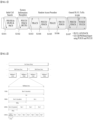
- FIG. 1 is a diagram illustrating physical channels and a signal transmission method using the physical channels, in 3GPP NR system.
- the UE When powered on or when a UE initially enters a cell, the UE performs initial cell search involving synchronization with a BS in step S101.
- the UE receives a synchronization signal block (SSB).
- the SSB includes a primary synchronization signal (PSS), a secondary synchronization signal (SSS), and a physical broadcast channel (PBCH).
- PSS primary synchronization signal
- SSS secondary synchronization signal
- PBCH physical broadcast channel
- the UE synchronizes with the BS and acquires information such as a cell Identifier (ID) based on the PSS/SSS.
- ID cell Identifier
- the UE may receive broadcast information from the cell on the PBCH.
- the UE may check a downlink channel status by receiving a downlink reference signal (DL RS) during initial cell search.
- DL RS downlink reference signal
- the UE may acquire more specific system information by receiving a physical downlink control channel (PDCCH) and receiving a physical downlink shared channel (PDSCH) based on information of the PDCCH in step S102.
- a physical downlink control channel (PDCCH)
- PDSCH physical downlink shared channel
- the UE may perform a random access procedure with the eNB (S103 to S106).
- the UE may transmit a preamble on a physical random access channel (PRACH) (S103) and may receive a PDCCH and a random access response (RAR) for the preamble on a PDSCH associated with the PDCCH (S 104).
- PRACH physical random access channel
- RAR random access response
- the UE may transmit a physical uplink shared channel (PUSCH) by using scheduling information in the RAR (S105), and perform a contention resolution procedure including reception of a PDCCH signal and a PDSCH signal corresponding to the PDCCH signal (S106).
- PUSCH physical uplink shared channel
- the UE may receive a PDCCH and/or a PDSCH from the eNB (S107) and transmit a Physical Uplink Shared Channel (PUSCH) and/or a Physical Uplink Control Channel (PUCCH) to the eNB (S108), which is a general DL and UL signal transmission procedure.
- the UE receives Downlink Control Information (DCI) on a PDCCH.
- DCI Downlink Control Information
- Control information transmitted from a UE to an eNB is collectively referred to as uplink control information (UCI).
- the UCI includes a hybrid automatic repeat and request acknowledgement/negative-acknowledgment (HARQ ACK/NACK), a scheduling request (SR), channel state information (CSI), and so on.
- HARQ ACK/NACK hybrid automatic repeat and request acknowledgement/negative-acknowledgment
- SR scheduling request
- CSI channel state information
- the CSI includes a channel quality indicator (CQI), a precoding matrix indicator (PMI), a rank indication (RI), and so on.
- CQI channel quality indicator
- PMI precoding matrix indicator
- RI rank indication
- the UCI is generally transmitted through a PUCCH, it may be transmitted through a PUSCH, when control information and traffic data should be transmitted simultaneously.
- the UCI may be transmitted aperiodically through a PUSCH by a request/indication of the network.
- FIG. 2 illustrates the structure of a radio frame.
- the radio frame may be used for UL transmission and DL transmission in NR.
- a radio frame is 10 ms in length and may be defined by two 5-ms half-frames.
- An HF may include five 1-ms subframes.
- a subframe may be divided into one or more slots, and the number of slots in an SF may be determined according to a subcarrier spacing (SCS).
- SCS subcarrier spacing
- Each slot may include 12 or 14 OFDM(A) symbols according to a cyclic prefix (CP).
- CP cyclic prefix
- NCP normal CP
- ECP extended CP
- each slot may include 12 symbols.
- a symbol may be an OFDM symbol (or CP-OFDM symbol) or an SC-FDMA symbol (or DFT-s-OFDM symbol).
- Table 1 below lists the number of symbols per slot N slot symb , the number of slots per frame N frame,u slot , and the number of slots per subframe N subframe,u slot according to an SCS configuration ⁇ in the NCP case.
- Table 2 below lists the number of symbols per slot N slot symb , the number of slots per frame N frame,u slot , and the number of slots per subframe N subframe,u slot according to an SCS configuration ⁇ in the ECP case. [Table 2] u N s lot symb N frame,u slot N subframe,u slot 2 12 40 4
- the structure of the frame is merely an example.
- the number of subframes, the number of slots, and the number of symbols in a frame may vary.
- OFDM numerology e.g., SCS
- SCS single-frame duration
- a time resource e.g., an SF, a slot or a TTI
- TU time unit
- the symbols may include an OFDM symbol (or a CP-OFDM symbol) and an SC-FDMA symbol (or a discrete Fourier transform-spread-OFDM (DFT-s-OFDM) symbol).
- OFDM symbol or a CP-OFDM symbol
- SC-FDMA symbol or a discrete Fourier transform-spread-OFDM (DFT-s-OFDM) symbol.
- DFT-s-OFDM discrete Fourier transform-spread-OFDM
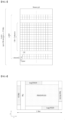
- FIG. 3 illustrates an exemplary resource grid for the duration of a slot.
- a slot inlcudes a plurality of symbols in the time domain. For example, one slot inlcudes 14 symbols in a normal CP case, whereas one slot inlcudes 12 symbols in an extended CP case.
- a carrier includes a plurality of subcariers in the frequency domain.
- a resource block (RB) is defined as a plurality of (e.g., 12) contiguous subcarriers in the frequency domain.
- a bandwidth part (BWP) may be defined as a plurality of physical RBs (PRBs) in the frequency domain, and correspond to one numerology (e.g., an SCS, a CP length, or the like).
- PRBs physical RBs
- a carrier may include up to N (e.g., 5) BWPs. Data communication may be performed in an active BWP, and only one BWP may be activated for one UE.
- N e.g., 5
- Each element of a resource grid may be referred to as a resource element (RE) and mapped to one complex symbol.
- RE resource element
- FIG. 4 illustrates an example of mapping physical channels in a slot.
- a PDCCH may be transmitted in a DL control region, and a PDSCH may be transmitted in a DL data region.
- APUCCH may be transmitted in a UL control region, and a PUSCH may be transmitted in a UL data region.
- a GP provides a time gap for switching from a transmisison mode to a reception mode or switching from the reception mode to the transmisison mode at the BS and the UE. Some symbols at a DL-to-UL switching time point within a subcrame may be configured as a GP.
- the PDCCH delivers DCI.
- the PDCCH i.e., DCI
- the PDCCH may carry information about a transport format and resource allocation of a DL shared channel (DL-SCH), resource allocation information of an uplink shared channel (UL-SCH), paging information on a paging channel (PCH), system information on the DL-SCH, information on resource allocation of a higher-layer control message such as an RAR transmitted on a PDSCH, a transmit power control command, information about activation/release of configured scheduling, and so on.
- the DCI includes a cyclic redundancy check (CRC).
- the CRC is masked with various identifiers (IDs) (e.g.
- RNTI radio network temporary identifier
- the CRC is masked by a UE ID (e.g., cell-RNTI (C-RNTI)).
- C-RNTI cell-RNTI
- P-RNTI paging-RNTI
- SIB system information block
- SI-RNTI system information RNTI
- RA-RNTI random access-RNTI
- the PDCCH includes 1, 2, 4, 8, or 16 control channel elements (CCEs) according to an aggregation level (AL).
- a CCE is a logical allocation unit used to provide a PDCCH with a specific code rate according to a wireless channel state.
- a CCE includes six resource element groups (REGs).
- An REG is defined as one OFDM symbol and one (P)RB.
- the PDCCH is transmitted in a control resource set (CORESET).
- a CORESET is defined as an REG set having a given numerology (e.g., an SCS, a CP length, and so on).
- a plurality of CORESETs for one UE may overlap with each other in the time/frequency domain.
- the CORESET may be configured by system information (e.g., a master information block (MIB)) or UE-specific higher layer (e.g., radio resource control (RRC) layer) signaling.
- system information e.g., a master information block (MIB)
- UE-specific higher layer e.g., radio resource control (RRC) layer
- RRC radio resource control
- the number of RBs and the number (up to 3) of OFDM symbols included in the CORESET may be configured by higher layer signaling.
- a PDCCH candidate represents CCE(s) that the UE should monitor for PDCCH detection.
- Each PDCCH candidate is defined as 1, 2, 4, 8, or 16 CCEs according to an AL.
- the monitoring includes (blind) decoding of the PDCCH candidates.
- a set of PDCCH candidates that the UE monitors are defined as a PDCCH search space (SS).
- the SS includes a common search space (CSS) or a UE-specific search space (USS).
- the UE may acquire DCI by monitoring PDCCH candidates in one or more SSs configured by an MIB or higher layer signaling.
- Each CORESET is associated with one or more SSs, and each SS is associated with one COREST.
- the SS may be defined based on the following parameters.
- Table 3 illustrates characteristics of each SS type.
- Type Search Space RNTI Use Case Type0-PDCCH Common SI-RNTI on a primary cell SIB Decoding Type0A-PDCCH Common SI-RNTI on a primary cell SIB Decoding Type1-PDCCH Common RA-RNTI or TC-RNTI on a primary cell Msg2, Msg4 decoding in RACH Type2-PDCCH Common P-RNTI on a primary cell Paging Decoding Type3-PDCCH Common INT-RNTI, SFI-RNTI, TPC-PUSCH-RNTI, TPC-PUCCH-RNTI, TPC-SRS-RNTI, C-RNTI, MCS-C-RNTI, or CS-RNTI(s) UE Specific UE Specific C-RNTI, or MCS-C-RNTI, or CS-RNTI(s) User specific PDSCH decoding
- Table 4 shows DCI formats transmitted on the PDCCH.
- DCI format 0_0 may be used to schedule a TB-based (or TB-level) PUSCH
- DCI format 0_1 may be used to schedule a TB-based (or TB-level) PUSCH or a code block group (CBG)-based (or CBG-level) PUSCH
- DCI format 1_0 may be used to schedule a TB-based (or TB-level) PDSCH
- DCI format 1_1 may be used to schedule a TB-based (or TB-level) PDSCH or a CBG-based (or CBG-level) PDSCH (DL grant DCI).
- DCI format 0_0/0_1 may be referred to as UL grant DCI or UL scheduling information
- DCI format 1_0/1_1 may be referred to as DL grant DCI or DL scheduling information
- DCI format 2_0 is used to deliver dynamic slot format information (e.g., dynamic SFI) to the UE
- DCI format 2_1 may be used to deliver DL pre-emption information to the UE.
- DCI format 2_0 and/or DCI format 2_1 may be transmitted to UEs within a group through a group common PDCCH, which is a PDCCH delivered to UEs defined as a group.
- DCI format 0_0 and DCI format 1_0 may be referred to as fallback DCI formats, whereas DCI format 0_1 and DCI format 1_1 may be referred to as non-fallback DCI formats.
- a DCI size/field configuration is maintained to be the same irrespective of a UE configuration.
- the DCI size/field configuration varies depending on a UE configuration in the non-fallback DCI formats.
- the PDSCH carries DL data (e.g., a DL-SCH transport block (DL-SCH TB)), and modulation schemes such as quadrature phase shift keying (QPSK), 16 quadrature amplitude modulation (16 QAM), 64 QAM, 256 QAM, or the like is applied to the PDSCH.
- a TB is encoded to generate a codeword.
- the PDSCH may carry up to two codewords. Each codeword may be subject to scrambling and modulation mapping, and modulation symbols generated from the codeword may be mapped to one or more layers. Each layer is mapped to resources along with a demodulation reference signal (DMRS)), generated as an OFDM symbol signal, and transmitted through a corresponding antenna port.
- DMRS demodulation reference signal
- the PUCCH carries UCI.
- the UCI includes the following.
- Table 5 illustrates an example of PUCCH formats. Depending on PUCCH transmission durations, they may be classified into short PUCCH (Formats 0 and 2) and long PUCCH (Formats 1, 3 and 4). [Table 5] PUCC H format Length in OFDM symbols NPUCCHsym b Number of bits Usage Etc 0 1 - 2 ⁇ 2 HARQ, SR Sequence selection 1 4 - 14 ⁇ 2 HARQ, [SR] Sequence modulation 2 1 - 2 >2 HARQ, CSI, [SR] CP-OFDM 3 4 - 14 >2 HARQ, CSI, [SR] DFT-s-OFDM (no UE multiplexing) 4 4 - 14 >2 HARQ, CSI, [SR] DFT-s-OFDM (Pre DFT OCC)
- PUCCH format 0 carries UCI of up to 2 bits, and is mapped to and transmitted based on a sequence. Specifically, the UE transmits one of a plurality of sequences through a PUCCH of PUCCH format 0 to transmit specific UCI to the BS. The UE transmits the PUCCH of PUCCH format 0 in PUCCH resources for a corresponding SR configuration, only when transmitting a positive SR.
- PUCCH format 1 carries UCI of up to 2 bits, and modulation symbols are spread with an orthogonal cover code (OCC) (which is configured differently depending on whether frequency hopping is performed) in the time domain.
- OCC orthogonal cover code
- ADMRS is transmitted in a symbol which does not carry modulation symbols (i.e., transmitted in time division multiplexing (TDM)).
- PUCCH format 2 carries UCI of more than two bits, and modulation symbols are transmitted with a DMRS in frequency division multiplexing (FDM).
- the DMRS is located in symbol indexes #1, #4, #7 and #10 within a given RB with a density of 1/3.
- a pseudo noise (PN) sequence is used for a DMRS sequence.
- Frequency hopping may be activated for 2-symbol PUCCH format 2.
- PUCCH format 3 UEs are not multiplexed within the same PRB, and UCI with more than two bits is delivered. In other words, PUCCH resources of PUCCH format 3 do not include an OCC. A modulation symbol is transmitted with a DMRS in TDM.
- PUCCH format 4 supports multiplexing of up to four UEs within the same physical RS and carries UCI with more than two bits.
- PUCCH resources of PUCCH format 3 include an OCC.
- a modulation symbol is transmitted with a DMRS in TDM.
- At least one of one or more cells configured for the UE may be configured for PUCCH transmission.
- At least a primary cell may be configured as a cell for the PUCCH transmission.
- At least one PUCCH cell group may be configured for the UE based on the at least one cell configured for the PUCCH transmission, and each PUCCH cell group includes one or more cells.
- a PUCCH cell group may be simply referred to as a PUCCH group.
- the PUCCH transmission may be configured not only for the primary cell but also for an SCell, and the primary cell belongs to a primary PUCCH group, while the PUCCH-SCell configured for the PUCCH transmission belongs to a secondary PUCCH group.
- a PUCCH on the primary cell may be used for cells belonging to the primary PUCCH group, and a PUCCH on the PUCCH-SCell may be used for cells belonging to the secondary PUCCH group.
- the PUSCH carries UL data (e.g., a UL-SCH TB) and/or UCI, and is transmitted based on a cyclic prefix-orthogonal frequency division multiplexing (CP-OFDM) waveform or a discrete Fourier transform-spread-orthogonal frequency division multiplexing (DFT-s-OFDM) waveform.
- CP-OFDM cyclic prefix-orthogonal frequency division multiplexing
- DFT-s-OFDM discrete Fourier transform-spread-orthogonal frequency division multiplexing
- the UE may transmit the PUSCH based on the CP-OFDM waveform
- transform precoding e.g., transform precoding is disabled
- the UE may transmit the PUSCH based on the CP-OFDM waveform or the DFT-s-OFDM waveform.
- PUSCH transmission may be dynamically scheduled by a UL grant in DCI or semi-statically scheduled based on higher layer (e.g. RRC) signaling (and/or layer 1 (L1) signaling (e.g. a PDCCH)).
- PUSCH transmission may be performed in a codebook-based or non-codebook-based manner.
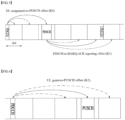
- FIG. 5 illustrates an ACK/NACK transmission process.
- the UE may detect a PDCCH in slot #n.
- the PDCCH includes DL scheduling information (e.g., DCI format 1_0 or DCI format 1_1).
- the PDCCH indicates a DL assignment-to-PDSCH offset, K0 and a PDSCH-to-HARQ-ACK reporting offset, K1.
- DCI format 1_0 or DCI format 1_1 may include the following information.
- the UE may receive a PDSCH from slot #(n+K0) according to scheduling information in slot #n.
- the UE may transmit UCI through a PUCCH in slot #(n1+K1).
- the UCI may include a HARQ-ACK response to the PDSCH.
- K1 may be indicated/interpreted based on the SCS of the PUCCH.
- the HARQ-ACK response may include one bit.
- the HARQ-ACK response may include two bits in the case of not configuring spatial bundling, and include one bit in the case of configuring spatial bundling.
- Whether the UE should perform spatial bundling for a HARQ-ACK response may be configured (e.g., by RRC/higher layer signaling) for each cell group.
- spatial bundling may be individually configured for each HARQ-ACK response transmitted through a PUCCH and/or each HARQ-ACK response transmitted through a PUSCH.
- spatial bundling may be supported. Meanwhile, more than 4 layers may be used for 2-TB transmission, and up to 4 layers may be used for 1-TB transmission. Consequently, when spatial bundling is configured for a corresponding cell group, spatial bundling may be performed for a serving cell for which more than 4 layers are schedulable among the serving cells of the cell group.
- the UE that wants to transmit a HARQ-ACK response through spatial bundling may generate the HARQ-ACK response by performing a bitwise logical AND operation on A/N bits for a plurality of TBs.
- the UE performing spatial bundling may generate a single A/N bit by performing a logical AND operation on a first A/N bit for a first TB and a second A/N bit for a second TB.
- the UE reports an ACK bit value to the BS, and when any one of the TBs is a NACK, the UE reports a NACK bit value to the BS.
- the UE may generate a single A/N bit by performing a logical AND operation on an A/N bit for the one TB and a bit value of 1. As a result, the UE reports the A/N bit for the one TB to the BS as it is.
- Each HARQ process is associated with a HARQ buffer of a medium access control (MAC) layer.
- MAC medium access control
- Each DL HARQ process manages state variables such as the number of transmissions of a MAC physical data block (PDU) in a buffer, a HARQ feedback for the MAC PDU in the buffer, and a current redundancy version.
- Each HARQ process is identified by a HARQ process ID.
- FIG. 6 illustrates an exemplary PUSCH transmission process.
- the UE may detect a PDCCH in slot #n.
- the PDCCH may include UL scheduling information (e.g., DCI format 0_0 or DCI format 0_1).
- DCI format 0_0 and DCI format 0_1 may include the following information.
- the UE may then transmit a PUSCH in slot #(n+K2) according to the scheduling information in slot #n.
- the PUSCH includes a UL-SCH TB.
- FIG. 7 shows an example of a CSI related procedure.
- the UE receives configuration information related to CSI from the BS via RRC signaling (710).
- the CSI-related configuration information may include at least one of channel state information-interference measurement (CSI-IM)-related information, CSI measurementrelated information, CSI resource configuration-related information, CSI-RS resource-related information, or CSI report configuration-related information.
- CSI-IM channel state information-interference measurement
- the UE measures CSI based on configuration information related to CSI.
- the CSI measurement may include receiving the CSI-RS (720) and acquiring the CSI by computing the received CSI-RS (730).
- the UE may transmit a CSI report to the BS (740).
- the time and frequency resource available to the UE are controlled by the BS.
- Channel state information includes at least one of a channel quality indicator (CQI), a precoding matrix indicator (PMI), a CSI-RS resource indicator (CRI), a SS/PBCH block resource indicator (SSBRI), a layer indicator (LI), a rank indicator (RI), an L1-RSRP, and/or an L-SINR.
- CQI channel quality indicator
- PMI precoding matrix indicator
- CSI-RS resource indicator CRI
- SSBRI SS/PBCH block resource indicator
- LI layer indicator
- RI rank indicator
- L1-RSRP L1-RSRP
- L-SINR L-SINR
- a time domain behavior of CSI reporting supports periodic, semi-persistent, aperiodic.
- Periodic CSI reporting is performed in a short PUCCH, a long PUCCH.
- Periodicity and a slot offset of periodic CSI reporting may be configured by RRC and refers to a CSI-ReportConfig IE.
- SP (semi-periodic) CSI reporting is performed in a short PUCCH, a long PUCCH, or a PUSCH.
- periodicity and a slot offset are configured by RRC and a CSI report is activated/deactivated by separate MAC CE/DCI.
- SP CSI in a PUSCH periodicity of SP CSI reporting is configured by RRC, but a slot offset is not configured by RRC and SP CSI reporting is activated/deactivated by DCI (format 0_1).
- DCI format 0_1
- SP-CSI C-RNTI a separated RNTI
- An initial CSI report timing follows a PUSCH time domain allocation value indicated by DCI and a subsequent CSI report timing follows a periodicity configured by RRC.
- DCI format 0_1 may include a CSI request field and activate/deactivate a specific configured SP-CSI trigger state.
- SP CSI reporting has activation/deactivation equal or similar to a mechanism having data transmission in a SPS PUSCH.
- Aperiodic CSI reporting is performed in a PUSCH and is triggered by DCI.
- information related to trigger of aperiodic CSI reporting may be delivered/indicated/configured through MAC-CE.
- AP CSI-RS timing is configured by RRC and timing for AP CSI reporting is dynamically controlled by DCI.
- the channel properties of an antenna port may be derived from a channel of another antenna port, the two antenna ports are quasi co-located.
- the channel properties may include one or more of delay spread, Doppler spread, frequency/Doppler shift, average received power, received timing/average delay, and spatial RX parameter.
- the UE may be configured with a list of a plurality of TCI-State configurations through a higher layer parameter, PDSCH-Config. Each TCI-State is associated with a QCL configuration parameter between one or two DL RSs and a DMRS port of a PDSCH.
- QCL may include qcl-Type1 for a first DS RS and qcl-Type2 for a second DL RS.
- a QCL type may correspond to one of the following types.
- BM is a series of processes for acquiring and maintaining a set of BS (or transmission and reception point (TRP)) beams and/or UE beams available for DL and UL transmissions/receptions.
- BM may include the following processes and terminology.
- the BM process may be divided into (1) a DL BM process using an SSB or a CSI-RS and (2) a UL BM process using a sounding reference signal (SRS). Further, each BM process may include Tx beam sweeping for determining a Tx beam and Rx beam sweeping for determining an Rx beam.
- SRS sounding reference signal
- the DL BM process may include (1) transmission of a beamformed DL RS (e.g., a CSI-RS or SSB) from the BS, and (2) beam reporting from the UE.
- a beamformed DL RS e.g., a CSI-RS or SSB
- the beam report may include preferred DL RS ID(s) and reference signal received power (RSRP) corresponding to the DL RS ID(s).
- a DL RS ID may be an SSB resource indicator (SSBRI) or a CSI-RS resource indicator (CRI).
- M-TRP multi-transmission and reception point
- NR Release 17 supports M-TRP PDCCH repeated transmission, M-TRP PDCCH/PDSCH SFN transmission, S-DCI-based M-TRP PUSCH repeated transmission, and single PUCCH resource-based M-TRP PUCCH repeated transmission.
- the same content i.e., DCI, a UL TB, or UCI
- URLLC target enhancement for increased reliability.
- Repeated transmissions are performed in TDM or FDM in the case of M-TRP PDCCH repeated transmission, repeated transmissions are performed in the same time/frequency/layer in the case of M-TRP PDCCH/PDSCH SFN transmission, repeated transmissions are performed in TDM in the case of S-DCI-based M-TRP PUSCH repeated transmission, and repeated transmissions are performed in TDM in the case of single PUCCH resource-based M-TRP PUCCH repeated transmission.
- a plurality of CORESETs configured with different TCI states are configured for the UE, and a plurality of SS sets connected to the CORESETs, respectively are configured.
- the BS indicates/configures linkage between an SS set connected to one CORESET and an SS set connected to another CORESET, for repeated transmission, to/for the UE, so that the UE may be aware that PDCCH candidates of the SS sets are repeatedly transmitted.
- two CORESETs, CORESET #0 and CORESET #1 may be configured for the UE and connected to SS sets #0 and #1, respectively, and SS set #0 and SS set #1 may be linked.
- the UE may be aware that the same DCI is repeatedly transmitted on a PDCCH candidate of SS set #0 and a PDCCH candidate of SS set #1, and through a specific rule, that the specific PDCCH candidate of SS set #0 and the specific PDCCH candidate of SS set #1 are a pair configured for repeated transmission of the same DCI.
- These two PDCCH candidates are referred to as linked PDCCH candidates, and when the UE successfully receives either of the two PDCCH candidates, the UE may successfully decode the DCI.
- the UE when receiving the PDCCH candidate of SS set #0, uses a QCL RS (i.e., DL beam) of the TCI state of CORESET #0 connected to SS set #0, and when receiving the PDCCH candidate of SS set #1, it uses a QCL RS (i.e., DL beam) of the TCI state of CORESET #1 connected to SS set #1, so that the UE receives the linked PDCCH candidates with different beams.
- QCL RS i.e., DL beam
- multiple TRPs may repeatedly transmit the same DCI through the same time/frequency/DM-RS port, which may be called SFN PDCCH transmission.
- the BS configures a plurality of TCI states for one CORESET rather than a plurality of CORESETs with different TCI states.
- the UE receives a PDCCH candidate in an SS set connected to the one CORESET, it performs channel estimation on a PDCCH DM-RS and attempts to decode the PDCCH DM-RS using all of the plurality of TCI states.
- the two TRPs repeatedly transmit the corresponding channel in different resources.
- the two TRPs use the same resource, that is, even when the same channel is repeatedly transmitted in the same frequency, time, and layer (or DM-RS port)
- the reliability of the channel may be improved.
- the same channels that are repeatedly transmitted are combined on the air and received because their resources are not distinguished. Therefore, they are recognized as one channel from the receiver's perspective.
- two DL TCI states may be configured for PDSCH DM-RS reception.
- the BS configures two SRS sets for the UE, and the SRS sets are used to indicate UL transmission ports and UL beam/QCL information for TRP #1 and TRP #2, respectively.
- the BS may indicate SRS resources for the respective SRS sets by two SRI fields in one DCI, and indicate up to two power control (PC) parameter sets.
- PC power control
- a first SRI field may indicate SRS resources and a PC parameter set defined for set 0
- a second SRI field may indicate SRS resources and a PC parameter set defined for set 1.
- the UE receives the indication of a UL Tx port, a PC parameter set, and UL beam/QCL information for TRP #1 through the first SRI field, and performs PUSCH transmission in a TO corresponding to SRS set #0. Similarly, the UE receives the indication of a UL Tx port, a PC parameter set, and UL beam/QCL information for TRP #2 through the second SRI field, and performs PUSCH transmission in a TO corresponding to SRS set #1.
- the BS activates/configures two spatial relation infos for the single PUCCH resource, for the UE, and when the UE transmits UCI in the PUCCH resource, the spatial relation infos are used to indicate spatial relation information for TRP #1 and TRP #2, respectively.
- the UE receives an indication of a Tx beam/PC parameter for TRP #1 through a value indicated by a first spatial relation info, and performs PUCCH transmission in a TO corresponding to TRP #1 using this information.
- the UE receives an indication of a Tx beam/PC parameter for TRP #2 through a value indicated by a second spatial relation info, and performs PUCCH transmission in a TO corresponding to TRP #2 using this information.
- a configuration method was enhanced so that two spatial relation infos may be configured for a PUCCH resource, for M-TRP PUCCH repeated transmission. That is, when a PC parameter is set in each spatial relation info, a spatial relation RS may be configured. As a result, PC information and spatial relation RS information corresponding to two TRPs may be configured through the two spatial relation infos, and the UE transmits UCI in TO 1 through a PUCCH using the first spatial relation info, and transmits the same UCI (i.e., CSI, ACKNAK, SR) in TO 2 through the PUCCH using the second spatial relation info.
- UCI i.e., CSI, ACKNAK, SR
- a PUCCH resource configured with two spatial relation infos is referred to as an M-TRP PUCCH resource
- a PUCCH resource configured with one spatial relation info is referred to as an S-TRP PUCCH resource.
- Using or mapping a specific TCI state (or TCI) when data/DCI/UCI is received in a certain frequency/time/spatial resource may mean that in DL, a channel is estimated from a DM-RS in the frequency/time/spatial resource, using a QCL type and QCL RS indicated by the DL TCI state, and data/DCI is received/demodulated based on the estimated channel.
- a DM-RS and data/UCI are transmitted/modulated in the frequency/time/spatial resource using a Tx beam and/or Tx power indicated by the UL TCI state.
- a UL TCI state includes information about a Tx beam or Tx power for the UE, and the information may be configured for the UE by other parameters such as a spatial relation info, instead of the TCI state.
- the UL TCI state may be directly indicated by DCI carrying a UL grant, or may mean a spatial relation info for an SRS resource indicated by an SRI field in the UL grant DCI. Alternatively, it may mean an open-loop Tx power control parameter linked to the value indicated by the SRI field in the UL grant DCI. Alternatively, a UL TCI may be indicated by the DL grant DCI.
- AI/ML Artificial intelligence/machine learning
- node(s) and UE(s) constituting a wireless communication network are becoming intelligent/advanced, and in particular, due to intelligence of a network/BS, it is expected that various network/BS determination parameter values (e.g., transmission and reception power of each BS, transmission power of each UE, precoder/beam of BS/UE, time/frequency resource allocation for each UE, or a duplex method of BS) are rapidly optimized and derived/applied according to various environmental parameters (e.g., distribution/location of BSs, distribution/location/material of building/furniture, location/moving direction/speed of UEs, and climate information).
- 3GPP or O-RAN In line with this trend, many standardization organizations (e.g., 3GPP or O-RAN) consider introduction of the network/BS determination parameter values, and research on this is also actively underway.
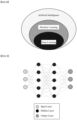
- AI/ML may be easily referred to as deep learning-based artificial intelligence, but is conceptually shown in FIG. 8 .
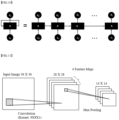
- FIG. 9 shows an example of a feed-forward neural network (FFNN) AI/ML model.
- the FFNN AI/ML model includes an input layer, a hidden layer, and an output layer.
- FIG. 10 illustrates a recurrent neural network (RNN) AI/ML model.
- the RNN AI/ML model is a type of artificial neural network with a directed cycle, where hidden nodes are connected by directed edges, which is suitable for processing sequential data such as speech and text.
- One type of RNN is a long short-term memory (LSTM), which adds a cell state to the hidden state of the RNN. Specifically, in the LSTM, input gates, forget gates, and output gates are added to an RNN cell, along with a cell state.
- LSTM long short-term memory
- FIG. 11 illustrates a convolutional neural network (CNN) AI/ML model.
- CNN applies convolution operations, commonly used in image or video processing, to achieve two purposes: reducing the complexity of AI/ML models and extracting valuable features.
- a kernel or filter
- a stride refers to the movement range of a kernel within an input.
- a feature map refers to the result of applying a kernel to an input.
- Padding refers to a value added to adjust the size of a feature map. Pooling refers to an operation (e.g., max pooling, average pooling) used to downsample a feature map to reduce the size of the feature map.
- FIG. 12 illustrates an autoencoder AI/ML model.
- an autoencoder is a neural network that receives a feature vector x as an input and outputs the same vector or a similar vector x'.
- the autoencoder has the characteristic that input and output nodes are the same and is a type of unsupervised learning.
- FIG. 13 is a diagram for explaining a framework for 3GPP radio access network (RAN) intelligence.
- RAN radio access network
- data collection is a function that provides input data for AI/ML model training and inference.
- Data preparation for each AI/ML algorithm e.g., data preprocessing, cleaning, formatting, and transformation
- data preprocessing e.g., cleaning, formatting, and transformation
- Examples of input data may include measurements from a UE or other network entities, feedback from actors, and outputs of an AI/ML model.
- Training data refers to input data required for the AI/ML model training function.
- Inference data is input data required for the AI/ML model inference function.
- AI/ML model training is a function that performs training, validation, and testing of AI/ML models as part of an AI/ML model testing procedure and generates performance metrics for the AI/ML models. If necessary, he AI/ML model training function may handle data preparation (e.g., data pre-processing, cleaning, forming, and transformation) based on the training data provided by the data collection function.
- data preparation e.g., data pre-processing, cleaning, forming, and transformation
- AI/ML model deployment/update is used to initially deploy a trained, validated, and tested AI/ML model to the AI/ML model inference function or to provide an updated AI/ML model to the AI/ML model inference function.
- Model inference is a function that provides AI/ML model inference outputs (e.g., predictions or decisions).
- the AI/ML model inference function may provide performance feedback to the AI/ML model training function.
- the AI/ML model inference function may also perform data preparation (e.g., data preprocessing, cleaning, formatting, and transformation) based on the inference data provided by the data collection function.
- An output refers to the inference output of the AI model generated by the AI/ML model inference function.
- AI/ML model performance feedback may be used to monitor the performance of the AI/ML model.
- An actor is a function that receives the output of the AI/ML model inference function and triggers or performs related operations.
- the actor may trigger tasks directed toward other entities or the actor itself.
- Feedback refers to information that may be necessary to derive training data, inference data, or performance feedback.
- Data used in AI/ML may include at least one of the following: AI/ML model training data, validation data, or test data.
- AI/ML model training data refers to a dataset used for training an AI/ML model.
- Validation data is a dataset used to validate an AI/ML model after training is complete.
- the validation data may be used to prevent overfitting of the AI/ML model training dataset.
- the validation data may also serve as a dataset for selecting the best model among various AI/ML models trained during the training process. Thus, the validation data may also be considered a type of learning.
- Test data is a dataset used for final evaluation and may be independent of training.
- AI/ML model training data and validation data may be used in a ratio of approximately 8:2 or 7:3. If test data is also considered, a ratio of 6:2:2 (training: validation: test) may be used.
- collaboration levels may be defined as follows, depending on the capability of the AI/ML functions between the BS and UE. Modifications through combinations or separations of the following levels may also be possible.
- a modified wireless interface is provided to implement a more efficient AI/ML algorithm.
- the UE may receive assistance from the BS or provide assistance to the BS for training, adaptation, etc. However, the exchange of AI/ML model information between network nodes is not required.
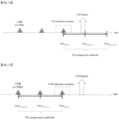
- FIGS. 14 and 15 illustrate examples of reporting precoding matrix indices (PMIs) for multiple time instances.
- PMI ref_rsc , PMI ref_rsc+ ⁇ and PMI ref_rsc+2 ⁇ shown in FIGS. 14 and 15 are compressed based on a TD compression codebook to reduce PMI feedback overhead.
- the BS may perform the following signaling to the UE as shown in FIGS. 14 and 15 .
- the signaling may be provided as parameters for a codebook configuration through RRC signaling.
- the number of time instances to be represented by the PMI is indicated.
- the number of time instances is 3.
- the number of time instances may be configured in consideration of the time variability of the channel.
- the UE may report information on the speed thereof, Doppler information (Doppler shift/spread), etc., to the BS.
- the UE may report a preferred number of time instances to the BS based on the speed thereof or Doppler information, and the BS may confirm or make the final selection.
- the UE may report candidate values for the number of time instances as a UE capability.
- the value of ⁇ which represents an interval between time instances, may be indicated as shown in FIGS. 14 and 15 .
- the value of ⁇ may be configured considering the time variability of the channel, and for this purpose, the UE may report information on the speed thereof, Doppler information (Doppler shift/spread), etc., to the BS. Alternatively, the UE may report a preferred value of ⁇ to the BS based on the speed thereof or Doppler information, and the BS may confirm or make the final selection.
- the value of ⁇ may be expressed as an absolute time, slots, OFDM symbols, etc. The UE may report candidate values for the value of ⁇ as a UE capability.
- a CSI reference resource may be used to indicate which time instance among the configured time instances the corresponding time instance corresponds to.
- a CSI reference resource is configured on the first time instance among three time instances. To this end, the BS may configure a time instance offset for the CSI reference resource to 0. Since the CSI reference resource is configured on the first time instance, the remaining time instances after the first time instance are configured behind the CSI reference resource. In FIG. 15 , a CSI reference resource is configured on the last (third) time instance among three time instances. To this end, the BS may configure a time instance offset for the CSI reference resource to 2. Since the CSI reference resource is configured on the third time instance, the remaining time instances before the last (third) time instance are configured prior to the CSI reference resource.
- the time instance offset may be configured considering the time variability of the channel, and for this purpose, the UE may report information on the speed thereof, Doppler information (Doppler shift/spread), etc., to the BS. Alternatively, the UE may report a preferred time instance offset to the BS based on the speed thereof or Doppler information, and the BS may confirm or make the final selection. Additionally, depending on the UE implementation, UEs are classified into two types: a UE capable of configuring the time instance offset on time instances other than the last time instance as shown in FIG. 14 ; and a UE capable of configuring the time instance offset may only on the last time instance as shown in FIG. 15 , which may be reported as a UE capability. The latter is simpler to implement because no channel prediction is required, while the former is more complex because channel prediction is required.
- the minimum value of a configurable time instance offset or candidates for the configurable time instance offset may be additionally reported.
- the UE calculates the time domain channel property (TDCP) from the TRS and reports TDCP to the BS.
- TDCP may be reported as one of the CSI reporting quantities in the CSI or may be reported as new UCI separate from the CSI.
- the former case is referred to as a non-stand-alone mode, and the latter case as a stand-alone mode.
- the encoding order of CSI quantities is CRI, RI, LI, PMI, and CQI.
- the encoding order of TDCP is determined as CRI, RI, LI, TDCP, PMI, and CQI.
- TDCP is placed before PMI because it is a value for PMI compensation for time-varying channels.
- TDCP may be placed between CRI and RI because it may be used to compensate for RI/CQI as well as PMI for time varying channels.
- TDCP may be encoded first (before CRI) or last (after CQI) to reuse existing UE implementations by maintaining the existing encoding order as much as possible.
- the existing subband (SB) CSI is divided into CSI part 1 and CSI part 2, and the CSI parts are encoded separately.
- TDCP may be encoded in CSI part 1 because the payload size is not varied by the existing CSI part 1.
- the existing encoding order of CSI part 1 includes CRI, RI, and CQI for the first transport block, and the number of non-zero amplitude coefficients (NZC) is configured after CQI as PMI.
- TDCP is placed before CQI because it may be used for CQI compensation for time-varying channels.
- TDCP may be placed between CRI and RI because it may be used for RI compensation as well as CQI/PMI compensation for time-varying channels.
- TDCP may be encoded first (before CRI) or last (after the non-zero amplitude coefficients) to reuse existing UE implementations by maintaining the existing encoding order as much as possible.
- TDCP may be encoded in CSI part 2.
- TDCP Since TDCP is a general value used for CSI compensation and determination of a CSI-related configuration, it may be reported with a higher priority than the SB CSI. That is, when CSI omission is applied, TDCP may belong to group 0 in priority grouping of groups 0 to 2, and may have a higher priority than group 1 and group 2. In addition, when CSI omission is applied, TDCP has the same priority as WB CSI and has a higher priority than evennumbered SB CSI and odd-numbered SB CSI.
- encoding is performed in order of WB CQI, LI, and WB PMI.
- TDCP in the WB CSI may be encoded first (i.e., before WB CQI) or last (i.e., after WB PMI).
- Pri iCSI y k c s 2 ⁇ N cells ⁇ M s ⁇ y + N cells ⁇ M s ⁇ k + M s ⁇ c + s
- the determination of k depends on the presence or absence of L1-RSRP/L1-SINR.
- CSI that includes L1-RSRP/L1-SINR has a higher priority than CSI that does not.
- Embodiments propose a method to subdivide the determination of k into a case where TDCP is included in the CSI and a case where it is not.
- the CSI may be classified into three types as follows:
- the priorities may be determined in order of CSI #1, CSI #2, and CSI #3.
- CSI that does not include L1-RSRP/L1-SINR
- CSI that includes TDCP has a higher priority than CSI that does not.
- k is determined as 0, 1, and 2 respectively.
- CSI #2 may be considered to have the same priority as L1-RSRP/SINR (i.e., CSI #1) or have the same priority as general CSI (i.e., CSI #3).
- the priorities of the three CSIs may be determined in order of CSI #2, CSI #1, and CSI #3.
- k is determined as 1, 0, and 2, respectively.
- CSI including TDCP has a higher prioritiy than CSI that does not.
- CSI that includes L1-RSRP/L1-SINR has a higher prioritiy than CSI that does not.
- Pri iCSI y k c s 3 ⁇ N cells ⁇ M s ⁇ y + N cells ⁇ M s ⁇ k + M s ⁇ c + s
- the number of CSI processing units (CPUs) for the CSI is determined as the sum of the existing number of CPUs and alpha (e.g., 1). In other words, additional CPUs whose number is alpha are used to calculate TDCP.
- Z and Z' which are values used to determine the CSI processing time, are determined as the sums of the existing values of Z and Z' and alpha (e.g., 1 symbol). In other words, time as much as additional alpha symbols may be needed to calculate TDCP.
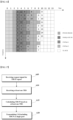
- FIG. 16 illustrates RE positions of UCI and data when UCI is multiplexed on PUSCH in the 3GPP NR standard.
- ACK/NACK information is sequentially transmitted from the first symbol after the DM-RS symbol. Once the ACK/NACK RE is determined, CSI part 1 is transmitted on and after the next available symbol. Once the ACK/NACK RE and CSI part 1 RE are determined, CSI part 2 is transmitted on and after the next available symbol, followed by data transmission in the remaining RE.
- the ACK/NACK(/SR) RE may be determined, and TDCP information may be transmitted on and after the next available symbol. Then, when the TDCP RE is determined, the transmission symbols and REs are determined for CSI part 1, CSI part 2, and data in the existing order.
- TDCP is not as significant as ACK/NACK(/SR), but it is more important than CSI because it is commonly used for CSI compensation and CSI-related configuration. Therefore, TDCP may be placed closer to the DM-RS symbols than CSI to improve the channel estimation accuracy for TDCP demodulation.
- an RE for the existing UCI may be determined while the symbol and RE mapping order of the existing UCI are maintained. Then, TDCP information may be transmitted on and after the next available symbol, data may be transmitted in the remaining REs. This is intended to facilitate UE implementation by reusing the RE mapping order of the existing UCI as much as possible.
- the UCIs may be multiplexed into one PUCCH/PUSCH based on the BS configuration or UE capability and transmitted, or UCIs with lower priority may be dropped while reporting UCIs with higher priority.
- ACK/NACK(/SR) is assigned a higher priority than CSI, and the CSI is dropped.
- the priorities may be determined in order of ACK/NACK(/SR) > TDCP > CSI.
- TDCP is not as important as ACK/NACK for reporting the status of successful downlink reception or SR for requesting uplink scheduling, but it is more important than the CSI because it is commonly used for CSI compensation and CSI-related configuration.
- CSI may be prioritized over TDCP, and thus the priorities may be determined in order of ACK/NACK(/SR) > CSI > TDCP.
- TDCP may have the same priority as the CSI.
- the UE implementation may be facilitated, and TDCP may be treated as a kind of single-part CSI part, rather than being divided into part 1 and part 2.
- TDCP follows the same rules as CSI.
- TDCP reporting is performed in an aperiodic (AP) manner
- the UE uses an AP TRS configured for the reporting.
- the AP TRS is transmitted only once over 1 slot or 2 slots, it does not provide a sufficient measurement time window for TDCP calculation for Doppler information or the like. Therefore, even for aperiodic (AP) TDCP reporting, TDCP may be calculated/reported using periodic-TRS (P-TRS) together with or independently of the AP-TRS.
- P-TRS periodic-TRS
- the UE calculates/reports TDCP using a P-TRS configured as type A QCL RS for the AP-TRS.
- TDCP is determined as UCI separate from CSI, but similar operations to CSI must be performed in terms of performing channel measurements to calculate/report channel information. Therefore, even when TDCP is reported stand-alone, CPUs, Z, and Z' may be applied. Since TDCP is calculated by measuring one TRS, the number of CPUs is determined to be 1. Alternatively, when TDCP is calculated by measuring N TRSs, the number of CPUs is determined to be N. For Z and Z', new values (Z4 and Z4') different from the existing values (Z1, Z2, Z3, Z1', Z2', and Z3') may be defined/applied.
- FIG. 17 is a flowchart illustrating the process of reporting TDCP according to the present disclosure.
- the UE receives a TDCP report request signal from the BS.
- the TDCP report request signal may indicate at least one AP-TRS.
- the UE may receive at least one AP-TRS from the BS based on the TDCP report request signal.
- the UE calculates the TDCP based on the at least one AP-TRS.
- at least one P-TRS may be used together with at least one AP-TRS in the TDCP calculation.
- the at least one P-TRS may be configured as type A QCL (Quasi-Co-Located) RS of the at least one AP-TRS.
- the number of CSI processing units (CPUs) configured to calculate the CSI containing the TDCP is determined based on the number of TRSs related to the calculation of the TDCP. Additionally, a first minimum time interval (i.e., Z) from receiving the TDCP report request signal to reporting the CSI and a second minimum time interval (i.e., Z') from receiving the at least one TRS to reporting the CSI are determined based on the number of TRSs related to the calculation of the TDCP.
- the UE transmits the CSI containing the TDCP as a single part to the BS.
- the TDCP is processed as a kind of single-part CSI, not divided into part 1 and part 2.
- the TDCP is subject to rules as the CSI regarding the UCI multiplexing/dropping.
- a final application may be implemented with a combination/integration of the proposals in the present disclosure.
- the parameters referred to in the proposals in the present disclosure, the applicability of the proposals, and the like may be indicated by the BS to the UE, reported to the BS by the UE, or set as fixed values.
- the Proposals for non-stand-alone reporting may also be applied to stand-alone reporting. Conversely, the proposals for stand-alone reporting may also be applied to non-stand-alone reporting.
- FIG. 18 illustrates an exemplary communication system to which the embodiment is applied.
- a communication system 1 applied to the embodiment includes wireless devices, Base Stations (BSs), and a network.
- the wireless devices represent devices performing communication using Radio Access Technology (RAT) (e.g., 5G New RAT (NR)) or Long-Term Evolution (LTE)) and may be referred to as communication/radio/5G devices.
- RAT Radio Access Technology
- the wireless devices may include, without being limited to, a robot 100a, vehicles 100b-1 and 100b-2, an eXtended Reality (XR) device 100c, a hand-held device 100d, a home appliance 100e, an Internet of Things (IoT) device 100f, and an Artificial Intelligence (AI) device/server 400.
- RAT Radio Access Technology
- NR 5G New RAT
- LTE Long-Term Evolution
- the wireless devices may include, without being limited to, a robot 100a, vehicles 100b-1 and 100b-2, an eXtended Reality (XR) device 100c, a hand-held device 100d, a home appliance 100e
- the vehicles may include a vehicle having a wireless communication function, an autonomous driving vehicle, and a vehicle capable of performing communication between vehicles.
- the vehicles may include an Unmanned Aerial Vehicle (UAV) (e.g., a drone).
- UAV Unmanned Aerial Vehicle
- the XR device may include an Augmented Reality (AR)/Virtual Reality (VR)/Mixed Reality (MR) device and may be implemented in the form of a Head-Mounted Device (HMD), a Head-Up Display (HUD) mounted in a vehicle, a television, a smartphone, a computer, a wearable device, a home appliance device, a digital signage, a vehicle, a robot, etc.
- the hand-held device may include a smartphone, a smartpad, a wearable device (e.g., a smartwatch or a smartglasses), and a computer (e.g., a notebook).
- the home appliance may include a TV, a refrigerator, and a washing machine.
- the IoT device may include a sensor and a smartmeter.
- the BSs and the network may be implemented as wireless devices and a specific wireless device 200a may operate as a BS/network node with respect to other wireless devices.
- the wireless devices 100a to 100f may be connected to the network 300 via the BSs 200.
- An AI technology may be applied to the wireless devices 100a to 100f and the wireless devices 100a to 100f may be connected to the AI server 400 via the network 300.
- the network 300 may be configured using a 3G network, a 4G (e.g., LTE) network, or a 5G (e.g., NR) network.
- the wireless devices 100a to 100f may communicate with each other through the BSs 200/network 300, the wireless devices 100a to 100f may perform direct communication (e.g., sidelink communication) with each other without passing through the BSs/network.
- the vehicles 100b-1 and 100b-2 may perform direct communication (e.g., Vehicle-to-Vehicle (V2V)/Vehicle-to-everything (V2X) communication).
- the IoT device e.g., a sensor
- the IoT device may perform direct communication with other IoT devices (e.g., sensors) or other wireless devices 100a to 100f.
- Wireless communication/connections 150a, 150b, or 150c may be established between the wireless devices 100a to 100f/BS 200, or BS 200/BS 200.
- the wireless communication/connections may be established through various RATs (e.g., 5G NR) such as uplink/downlink communication 150a, sidelink communication 150b (or, D2D communication), or inter BS communication (e.g., relay, Integrated Access Backhaul (IAB)).
- the wireless devices and the BSs/the wireless devices may transmit/receive radio signals to/from each other through the wireless communication/connections 150a and 150b.
- the wireless communication/connections 150a and 150b may transmit/receive signals through various physical channels.
- various configuration information configuring processes various signal processing processes (e.g., channel encoding/decoding, modulation/demodulation, and resource mapping/demapping), and resource allocating processes, for transmitting/receiving radio signals, may be performed based on the various proposals of the embodiment.
- various signal processing processes e.g., channel encoding/decoding, modulation/demodulation, and resource mapping/demapping
- resource allocating processes for transmitting/receiving radio signals
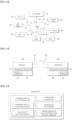
- FIG. 19 illustrates exemplary wireless devices to which the embodiment is applicable.
- a first wireless device 100 and a second wireless device 200 may transmit radio signals through a variety of RATs (e.g., LTE and NR).
- ⁇ the first wireless device 100 and the second wireless device 200 ⁇ may correspond to ⁇ the wireless device 100x and the BS 200 ⁇ and/or ⁇ the wireless device 100x and the wireless device 100x ⁇ of FIG. 18 .
- the first wireless device 100 may include one or more processors 102 and one or more memories 104 and additionally further include one or more transceivers 106 and/or one or more antennas 108.
- the processor(s) 102 may control the memory(s) 104 and/or the transceiver(s) 106 and may be configured to implement the descriptions, functions, procedures, proposals, methods, and/or operational flowcharts disclosed in this document.
- the processor(s) 102 may process information within the memory(s) 104 to generate first information/signals and then transmit radio signals including the first information/signals through the transceiver(s) 106.
- the processor(s) 102 may receive radio signals including second information/signals through the transceiver 106 and then store information obtained by processing the second information/signals in the memory(s) 104.
- the memory(s) 104 may be connected to the processor(s) 102 and may store a variety of information related to operations of the processor(s) 102.
- the memory(s) 104 may store software code including commands for performing a part or the entirety of processes controlled by the processor(s) 102 or for performing the descriptions, functions, procedures, proposals, methods, and/or operational flowcharts disclosed in this document.
- the processor(s) 102 and the memory(s) 104 may be a part of a communication modem/circuit/chip designed to implement RAT (e.g., LTE or NR).
- the transceiver(s) 106 may be connected to the processor(s) 102 and transmit and/or receive radio signals through one or more antennas 108.
- Each of the transceiver(s) 106 may include a transmitter and/or a receiver.
- the transceiver(s) 106 may be interchangeably used with Radio Frequency (RF) unit(s).
- the wireless device may represent a communication modem/circuit/chip.
- the second wireless device 200 may include one or more processors 202 and one or more memories 204 and additionally further include one or more transceivers 206 and/or one or more antennas 208.
- the processor(s) 202 may control the memory(s) 204 and/or the transceiver(s) 206 and may be configured to implement the descriptions, functions, procedures, proposals, methods, and/or operational flowcharts disclosed in this document.
- the processor(s) 202 may process information within the memory(s) 204 to generate third information/signals and then transmit radio signals including the third information/signals through the transceiver(s) 206.
- the processor(s) 202 may receive radio signals including fourth information/signals through the transceiver(s) 106 and then store information obtained by processing the fourth information/signals in the memory(s) 204.
- the memory(s) 204 may be connected to the processor(s) 202 and may store a variety of information related to operations of the processor(s) 202.
- the memory(s) 204 may store software code including commands for performing a part or the entirety of processes controlled by the processor(s) 202 or for performing the descriptions, functions, procedures, proposals, methods, and/or operational flowcharts disclosed in this document.
- the processor(s) 202 and the memory(s) 204 may be a part of a communication modem/circuit/chip designed to implement RAT (e.g., LTE or NR).
- the transceiver(s) 206 may be connected to the processor(s) 202 and transmit and/or receive radio signals through one or more antennas 208.
- Each of the transceiver(s) 206 may include a transmitter and/or a receiver.
- the transceiver(s) 206 may be interchangeably used with RF unit(s).
- the wireless device may represent a communication modem/circuit/chip.
- One or more protocol layers may be implemented by, without being limited to, one or more processors 102 and 202.
- the one or more processors 102 and 202 may implement one or more layers (e.g., functional layers such as PHY, MAC, RLC, PDCP, RRC, and SDAP).
- the one or more processors 102 and 202 may generate one or more Protocol Data Units (PDUs) and/or one or more Service Data Unit (SDUs) according to the descriptions, functions, procedures, proposals, methods, and/or operational flowcharts disclosed in this document.
- PDUs Protocol Data Units
- SDUs Service Data Unit
- the one or more processors 102 and 202 may generate messages, control information, data, or information according to the descriptions, functions, procedures, proposals, methods, and/or operational flowcharts disclosed in this document.
- the one or more processors 102 and 202 may generate signals (e.g., baseband signals) including PDUs, SDUs, messages, control information, data, or information according to the descriptions, functions, procedures, proposals, methods, and/or operational flowcharts disclosed in this document and provide the generated signals to the one or more transceivers 106 and 206.
- the one or more processors 102 and 202 may receive the signals (e.g., baseband signals) from the one or more transceivers 106 and 206 and acquire the PDUs, SDUs, messages, control information, data, or information according to the descriptions, functions, procedures, proposals, methods, and/or operational flowcharts disclosed in this document.
- signals e.g., baseband signals
- the one or more processors 102 and 202 may be referred to as controllers, microcontrollers, microprocessors, or microcomputers.
- the one or more processors 102 and 202 may be implemented by hardware, firmware, software, or a combination thereof.
- ASICs Application Specific Integrated Circuits
- DSPs Digital Signal Processors
- DSPDs Digital Signal Processing Devices
- PLDs Programmable Logic Devices
- FPGAs Field Programmable Gate Arrays
- the descriptions, functions, procedures, proposals, methods, and/or operational flowcharts disclosed in this document may be implemented using firmware or software and the firmware or software may be configured to include the modules, procedures, or functions.
- Firmware or software configured to perform the descriptions, functions, procedures, proposals, methods, and/or operational flowcharts disclosed in this document may be included in the one or more processors 102 and 202 or stored in the one or more memories 104 and 204 so as to be driven by the one or more processors 102 and 202.
- the descriptions, functions, procedures, proposals, methods, and/or operational flowcharts disclosed in this document may be implemented using firmware or software in the form of code, commands, and/or a set of commands.
- the one or more memories 104 and 204 may be connected to the one or more processors 102 and 202 and store various types of data, signals, messages, information, programs, code, instructions, and/or commands.
- the one or more memories 104 and 204 may be configured by Read-Only Memories (ROMs), Random Access Memories (RAMs), Electrically Erasable Programmable Read-Only Memories (EPROMs), flash memories, hard drives, registers, cash memories, computer-readable storage media, and/or combinations thereof.
- the one or more memories 104 and 204 may be located at the interior and/or exterior of the one or more processors 102 and 202.
- the one or more memories 104 and 204 may be connected to the one or more processors 102 and 202 through various technologies such as wired or wireless connection.
- the one or more transceivers 106 and 206 may transmit user data, control information, and/or radio signals/channels, mentioned in the methods and/or operational flowcharts of this document, to one or more other devices.
- the one or more transceivers 106 and 206 may receive user data, control information, and/or radio signals/channels, mentioned in the descriptions, functions, procedures, proposals, methods, and/or operational flowcharts disclosed in this document, from one or more other devices.
- the one or more transceivers 106 and 206 may be connected to the one or more processors 102 and 202 and transmit and receive radio signals.
- the one or more processors 102 and 202 may perform control so that the one or more transceivers 106 and 206 may transmit user data, control information, or radio signals to one or more other devices.
- the one or more processors 102 and 202 may perform control so that the one or more transceivers 106 and 206 may receive user data, control information, or radio signals from one or more other devices.
- the one or more transceivers 106 and 206 may be connected to the one or more antennas 108 and 208 and the one or more transceivers 106 and 206 may be configured to transmit and receive user data, control information, and/or radio signals/channels, mentioned in the descriptions, functions, procedures, proposals, methods, and/or operational flowcharts disclosed in this document, through the one or more antennas 108 and 208.
- the one or more antennas may be a plurality of physical antennas or a plurality of logical antennas (e.g., antenna ports).
- the one or more transceivers 106 and 206 may convert received radio signals/channels etc.
- the one or more transceivers 106 and 206 may convert the user data, control information, radio signals/channels, etc. processed using the one or more processors 102 and 202 from the base band signals into the RF band signals.
- the one or more transceivers 106 and 206 may include (analog) oscillators and/or filters.
- FIG. 20 illustrates other exemplary wireless devices to which the embodiment is applied.
- the wireless devices may be implemented in various forms according to a use case/service (see FIG. 18 )
- wireless devices 100 and 200 may correspond to the wireless devices 100 and 200 of FIG. 19 and may be configured by various elements, components, units/portions, and/or modules.
- each of the wireless devices 100 and 200 may include a communication unit 110, a control unit 120, a memory unit 130, and additional components 140.
- the communication unit may include a communication circuit 112 and transceiver(s) 114.
- the communication circuit 112 may include the one or more processors 102 and 202 and/or the one or more memories 104 and 204 of FIG. 19 .
- the transceiver(s) 114 may include the one or more transceivers 106 and 206 and/or the one or more antennas 108 and 208 of FIG. 19 .
- the control unit 120 is electrically connected to the communication unit 110, the memory 130, and the additional components 140 and controls overall operation of the wireless devices. For example, the control unit 120 may control an electric/mechanical operation of the wireless device based on programs/code/commands/information stored in the memory unit 130.
- the control unit 120 may transmit the information stored in the memory unit 130 to the exterior (e.g., other communication devices) via the communication unit 110 through a wireless/wired interface or store, in the memory unit 130, information received through the wireless/wired interface from the exterior (e.g., other communication devices) via the communication unit 110.
- the additional components 140 may be variously configured according to types of wireless devices.
- the additional components 140 may include at least one of a power unit/battery, input/output (I/O) unit, a driving unit, and a computing unit.
- the wireless device may be implemented in the form of, without being limited to, the robot (100a of FIG. 18 ), the vehicles (100b-1 and 100b-2 of FIG. 18 ), the XR device (100c of FIG. 18 ), the hand-held device (100d of FIG. 18 ), the home appliance (100e of FIG. 18 ), the IoT device (100f of FIG.
- the wireless device may be used in a mobile or fixed place according to a use-example/service.
- the entirety of the various elements, components, units/portions, and/or modules in the wireless devices 100 and 200 may be connected to each other through a wired interface or at least a part thereof may be wirelessly connected through the communication unit 110.
- the control unit 120 and the communication unit 110 may be connected by wire and the control unit 120 and first units (e.g., 130 and 140) may be wirelessly connected through the communication unit 110.
- Each element, component, unit/portion, and/or module within the wireless devices 100 and 200 may further include one or more elements.
- the control unit 120 may be configured by a set of one or more processors.
- control unit 120 may be configured by a set of a communication control processor, an application processor, an Electronic Control Unit (ECU), a graphical processing unit, and a memory control processor.
- memory 130 may be configured by a Random Access Memory (RAM), a Dynamic RAM (DRAM), a Read Only Memory (ROM)), a flash memory, a volatile memory, a non-volatile memory, and/or a combination thereof.
- RAM Random Access Memory
- DRAM Dynamic RAM
- ROM Read Only Memory
- flash memory a volatile memory
- non-volatile memory and/or a combination thereof.
- FIG. 21 illustrates an exemplary vehicle or autonomous driving vehicle to which the embodiment.
- the vehicle or autonomous driving vehicle may be implemented as a mobile robot, a car, a train, a manned/unmanned aerial vehicle (AV), a ship, or the like.
- AV manned/unmanned aerial vehicle
- the one or more memories 104 and 204 may be connected to the one or more processors 102 and 202 and store various types of data, signals, messages, information, programs, code, instructions, and/or commands.
- the one or more memories 104 and 204 may be configured by Read-Only Memories (ROMs), Random Access Memories (RAMs), Electrically Erasable Programmable Read-Only Memories (EPROMs), flash memories, hard drives, registers, cash memories, computer-readable storage media, and/or combinations thereof.
- the one or more memories 104 and 204 may be located at the interior and/or exterior of the one or more processors 102 and 202.
- the one or more memories 104 and 204 may be connected to the one or more processors 102 and 202 through various technologies such as wired or wireless connection.
- the one or more transceivers 106 and 206 may transmit user data, control information, and/or radio signals/channels, mentioned in the methods and/or operational flowcharts of this document, to one or more other devices.
- the one or more transceivers 106 and 206 may receive user data, control information, and/or radio signals/channels, mentioned in the descriptions, functions, procedures, proposals, methods, and/or operational flowcharts disclosed in this document, from one or more other devices.
- the one or more transceivers 106 and 206 may be connected to the one or more processors 102 and 202 and transmit and receive radio signals.
- the one or more processors 102 and 202 may perform control so that the one or more transceivers 106 and 206 may transmit user data, control information, or radio signals to one or more other devices.
- the one or more processors 102 and 202 may perform control so that the one or more transceivers 106 and 206 may receive user data, control information, or radio signals from one or more other devices.
- the one or more transceivers 106 and 206 may be connected to the one or more antennas 108 and 208 and the one or more transceivers 106 and 206 may be configured to transmit and receive user data, control information, and/or radio signals/channels, mentioned in the descriptions, functions, procedures, proposals, methods, and/or operational flowcharts disclosed in this document, through the one or more antennas 108 and 208.
- the one or more antennas may be a plurality of physical antennas or a plurality of logical antennas (e.g., antenna ports).
- the one or more transceivers 106 and 206 may convert received radio signals/channels etc.
- the one or more transceivers 106 and 206 may convert the user data, control information, radio signals/channels, etc. processed using the one or more processors 102 and 202 from the base band signals into the RF band signals.
- the one or more transceivers 106 and 206 may include (analog) oscillators and/or filters.
- FIG. 20 illustrates other exemplary wireless devices to which the embodiment is applied.
- the wireless devices may be implemented in various forms according to a use case/service. (see FIG. 18 )
- wireless devices 100 and 200 may correspond to the wireless devices 100 and 200 of FIG. 19 and may be configured by various elements, components, units/portions, and/or modules.
- each of the wireless devices 100 and 200 may include a communication unit 110, a control unit 120, a memory unit 130, and additional components 140.
- the communication unit may include a communication circuit 112 and transceiver(s) 114.
- the communication circuit 112 may include the one or more processors 102 and 202 and/or the one or more memories 104 and 204 of FIG. 19 .
- the transceiver(s) 114 may include the one or more transceivers 106 and 206 and/or the one or more antennas 108 and 208 of FIG. 19 .
- the control unit 120 is electrically connected to the communication unit 110, the memory 130, and the additional components 140 and controls overall operation of the wireless devices. For example, the control unit 120 may control an electric/mechanical operation of the wireless device based on programs/code/commands/information stored in the memory unit 130.
- the control unit 120 may transmit the information stored in the memory unit 130 to the exterior (e.g., other communication devices) via the communication unit 110 through a wireless/wired interface or store, in the memory unit 130, information received through the wireless/wired interface from the exterior (e.g., other communication devices) via the communication unit 110.
- the additional components 140 may be variously configured according to types of wireless devices.
- the additional components 140 may include at least one of a power unit/battery, input/output (I/O) unit, a driving unit, and a computing unit.
- the wireless device may be implemented in the form of, without being limited to, the robot (100a of FIG. 18 ), the vehicles (100b-1 and 100b-2 of FIG. 18 ), the XR device (100c of FIG. 18 ), the hand-held device (100d of FIG. 18 ), the home appliance (100e of FIG. 18 ), the IoT device (100f of FIG.
- the wireless device may be used in a mobile or fixed place according to a use-example/service.
- the entirety of the various elements, components, units/portions, and/or modules in the wireless devices 100 and 200 may be connected to each other through a wired interface or at least a part thereof may be wirelessly connected through the communication unit 110.
- the control unit 120 and the communication unit 110 may be connected by wire and the control unit 120 and first units (e.g., 130 and 140) may be wirelessly connected through the communication unit 110.
- Each element, component, unit/portion, and/or module within the wireless devices 100 and 200 may further include one or more elements.
- the control unit 120 may be configured by a set of one or more processors.
- control unit 120 may be configured by a set of a communication control processor, an application processor, an Electronic Control Unit (ECU), a graphical processing unit, and a memory control processor.
- memory 130 may be configured by a Random Access Memory (RAM), a Dynamic RAM (DRAM), a Read Only Memory (ROM)), a flash memory, a volatile memory, a non-volatile memory, and/or a combination thereof.
- RAM Random Access Memory
- DRAM Dynamic RAM
- ROM Read Only Memory
- flash memory a volatile memory
- non-volatile memory and/or a combination thereof.
- FIG. 21 illustrates an exemplary vehicle or autonomous driving vehicle to which the embodiment.
- the vehicle or autonomous driving vehicle may be implemented as a mobile robot, a car, a train, a manned/unmanned aerial vehicle (AV), a ship, or the like.
- AV manned/unmanned aerial vehicle
- a vehicle or autonomous driving vehicle 100 may include an antenna unit 108, a communication unit 110, a control unit 120, a driving unit 140a, a power supply unit 140b, a sensor unit 140c, and an autonomous driving unit 140d.
- the antenna unit 108 may be configured as a part of the communication unit 110.
- the blocks 110/130/140a to 140d correspond to the blocks 110/130/140 of FIG. 20 , respectively.
- the communication unit 110 may transmit and receive signals (e.g., data and control signals) to and from external devices such as other vehicles, BSs (e.g., gNBs and road side units), and servers.
- the control unit 120 may perform various operations by controlling elements of the vehicle or the autonomous driving vehicle 100.
- the control unit 120 may include an Electronic Control Unit (ECU).
- the driving unit 140a may cause the vehicle or the autonomous driving vehicle 100 to drive on a road.
- the driving unit 140a may include an engine, a motor, a powertrain, a wheel, a brake, a steering device, etc.
- the power supply unit 140b may supply power to the vehicle or the autonomous driving vehicle 100 and include a wired/wireless charging circuit, a battery, etc.
- the sensor unit 140c may acquire a vehicle state, ambient environment information, user information, etc.
- the sensor unit 140c may include an Inertial Measurement Unit (IMU) sensor, a collision sensor, a wheel sensor, a speed sensor, a slope sensor, a weight sensor, a heading sensor, a position module, a vehicle forward/backward sensor, a battery sensor, a fuel sensor, a tire sensor, a steering sensor, a temperature sensor, a humidity sensor, an ultrasonic sensor, an illumination sensor, a pedal position sensor, etc.
- IMU Inertial Measurement Unit
- the autonomous driving unit 140d may implement technology for maintaining a lane on which a vehicle is driving, technology for automatically adjusting speed, such as adaptive cruise control, technology for autonomously driving along a determined path, technology for driving by automatically setting a path if a destination is set, and the like.
- the communication unit 110 may receive map data, traffic information data, etc. from an external server.
- the autonomous driving unit 140d may generate an autonomous driving path and a driving plan from the obtained data.
- the control unit 120 may control the driving unit 140a such that the vehicle or the autonomous driving vehicle 100 may move along the autonomous driving path according to the driving plan (e.g., speed/direction control).
- the communication unit 110 may aperiodically/periodically acquire recent traffic information data from the external server and acquire surrounding traffic information data from neighboring vehicles.
- the sensor unit 140c may obtain a vehicle state and/or surrounding environment information.
- the autonomous driving unit 140d may update the autonomous driving path and the driving plan based on the newly obtained data/information.
- the communication unit 110 may transfer information about a vehicle position, the autonomous driving path, and/or the driving plan to the external server.
- the external server may predict traffic information data using AI technology, etc., based on the information collected from vehicles or autonomous driving vehicles and provide the predicted traffic information data to the vehicles or the autonomous driving vehicles.
- the present disclosure is applicable to UEs, BSs, or other apparatuses in a wireless mobile communication system.
Landscapes
- Engineering & Computer Science (AREA)
- Signal Processing (AREA)
- Computer Networks & Wireless Communication (AREA)
- Mobile Radio Communication Systems (AREA)
Applications Claiming Priority (2)
| Application Number | Priority Date | Filing Date | Title |
|---|---|---|---|
| KR20220092240 | 2022-07-26 | ||
| PCT/KR2023/010487 WO2024025249A1 (ko) | 2022-07-26 | 2023-07-20 | 무선 통신 시스템에서 단말이 기지국으로 시간 도메인 채널 특성 정보를 송신하는 방법 및 이를 위한 장치 |
Publications (1)
| Publication Number | Publication Date |
|---|---|
| EP4564896A1 true EP4564896A1 (de) | 2025-06-04 |
Family
ID=89706854
Family Applications (1)
| Application Number | Title | Priority Date | Filing Date |
|---|---|---|---|
| EP23846908.4A Pending EP4564896A1 (de) | 2022-07-26 | 2023-07-20 | Verfahren zur übertragung von zeitbereichskanaleigenschaftsinformationen von benutzergeräten an eine basisstation in einem drahtloskommunikationssystem und vorrichtung dafür |
Country Status (3)
| Country | Link |
|---|---|
| EP (1) | EP4564896A1 (de) |
| CN (1) | CN119547488A (de) |
| WO (1) | WO2024025249A1 (de) |
Families Citing this family (1)
| Publication number | Priority date | Publication date | Assignee | Title |
|---|---|---|---|---|
| WO2025171656A1 (en) * | 2024-02-18 | 2025-08-21 | Apple Inc. | Enhancements to time domain channel properties reporting |
Family Cites Families (1)
| Publication number | Priority date | Publication date | Assignee | Title |
|---|---|---|---|---|
| WO2021159439A1 (en) * | 2020-02-14 | 2021-08-19 | Qualcomm Incorporated | Delay spread scaling |
-
2023
- 2023-07-20 WO PCT/KR2023/010487 patent/WO2024025249A1/ko not_active Ceased
- 2023-07-20 CN CN202380053785.6A patent/CN119547488A/zh active Pending
- 2023-07-20 EP EP23846908.4A patent/EP4564896A1/de active Pending
Also Published As
| Publication number | Publication date |
|---|---|
| WO2024025249A1 (ko) | 2024-02-01 |
| CN119547488A (zh) | 2025-02-28 |
Similar Documents
| Publication | Publication Date | Title |
|---|---|---|
| US20250088870A1 (en) | Method and apparatus for transmitting and receiving signal in wireless communication system | |
| US20260012832A1 (en) | Method for transmitting channel status information in wireless communication system, and apparatus therefor | |
| US20250300903A1 (en) | Method and device for transmitting and receiving signal in wireless communication system | |
| EP4668825A1 (de) | Verfahren und vorrichtung zum senden und empfangen eines signals in einem drahtloskommunikationssystem | |
| EP4554107A1 (de) | Verfahren und vorrichtung zur übertragung von persistenten strahlvorhersageberichten in einem drahtloskommunikationssystem | |
| EP4598100A1 (de) | Verfahren und vorrichtung zum senden und empfangen eines signals in einem drahtloskommunikationssystem | |
| JP2026050424A (ja) | 無線通信システムにおいて多重時間インスタンスに対するチャネル状態情報を送信する方法及びそのための装置 | |
| EP4564896A1 (de) | Verfahren zur übertragung von zeitbereichskanaleigenschaftsinformationen von benutzergeräten an eine basisstation in einem drahtloskommunikationssystem und vorrichtung dafür | |
| EP4554119A1 (de) | Verfahren und vorrichtung zur übertragung eines strahlvorhersageberichts in einem drahtloskommunikationssystem | |
| US20250323768A1 (en) | Method and device for transmitting and receiving signal in wireless communication system | |
| EP4668605A1 (de) | Verfahren und vorrichtung zum senden und empfangen eines signals in einem drahtloskommunikationssystem | |
| EP4597869A1 (de) | Verfahren und vorrichtung zum senden und empfangen eines signals in einem drahtloskommunikationssystem | |
| EP4568131A1 (de) | Verfahren und vorrichtung zum senden und empfangen eines signals in einem drahtloskommunikationssystem | |
| EP4560948A1 (de) | Verfahren zur übertragung eines kanalqualitätsindikators in einem drahtloskommunikationssystem und vorrichtung dafür | |
| EP4668837A1 (de) | Verfahren und vorrichtung zum senden und empfangen eines signals in einem drahtloskommunikationssystem | |
| EP4668838A1 (de) | Verfahren und vorrichtung zum senden und empfangen eines signals in einem drahtloskommunikationssystem | |
| EP4694008A1 (de) | Verfahren und vorrichtung zum senden und empfangen eines signals in einem drahtloskommunikationssystem | |
| EP4554106A1 (de) | Verfahren und vorrichtung zum senden und empfangen eines signals in einem drahtloskommunikationssystem | |
| EP4712540A1 (de) | Verfahren und vorrichtung zum senden/empfangen eines signals in einem drahtloskommunikationssystem | |
| KR20260048480A (ko) | 무선 통신 시스템에서 신호 송수신 방법 및 장치 | |
| KR20260041683A (ko) | 무선 통신 시스템에서 신호 송수신 방법 및 장치 | |
| KR20260051274A (ko) | 무선 통신 시스템에서 신호 송수신 방법 및 장치 |
Legal Events
| Date | Code | Title | Description |
|---|---|---|---|
| STAA | Information on the status of an ep patent application or granted ep patent |
Free format text: STATUS: THE INTERNATIONAL PUBLICATION HAS BEEN MADE |
|
| PUAI | Public reference made under article 153(3) epc to a published international application that has entered the european phase |
Free format text: ORIGINAL CODE: 0009012 |
|
| STAA | Information on the status of an ep patent application or granted ep patent |
Free format text: STATUS: REQUEST FOR EXAMINATION WAS MADE |
|
| 17P | Request for examination filed |
Effective date: 20250211 |
|
| AK | Designated contracting states |
Kind code of ref document: A1 Designated state(s): AL AT BE BG CH CY CZ DE DK EE ES FI FR GB GR HR HU IE IS IT LI LT LU LV MC ME MK MT NL NO PL PT RO RS SE SI SK SM TR |
|
| DAV | Request for validation of the european patent (deleted) | ||
| DAX | Request for extension of the european patent (deleted) |