EP4564773A2 - Optimierung der metrik eines internen gateway-protokolls - Google Patents
Optimierung der metrik eines internen gateway-protokolls Download PDFInfo
- Publication number
- EP4564773A2 EP4564773A2 EP25162999.4A EP25162999A EP4564773A2 EP 4564773 A2 EP4564773 A2 EP 4564773A2 EP 25162999 A EP25162999 A EP 25162999A EP 4564773 A2 EP4564773 A2 EP 4564773A2
- Authority
- EP
- European Patent Office
- Prior art keywords
- network
- igp
- failure state
- flow
- metrics
- Prior art date
- Legal status (The legal status is an assumption and is not a legal conclusion. Google has not performed a legal analysis and makes no representation as to the accuracy of the status listed.)
- Pending
Links
Images




Classifications
-
- H—ELECTRICITY
- H04—ELECTRIC COMMUNICATION TECHNIQUE
- H04L—TRANSMISSION OF DIGITAL INFORMATION, e.g. TELEGRAPHIC COMMUNICATION
- H04L41/00—Arrangements for maintenance, administration or management of data switching networks, e.g. of packet switching networks
- H04L41/12—Discovery or management of network topologies
-
- H—ELECTRICITY
- H04—ELECTRIC COMMUNICATION TECHNIQUE
- H04L—TRANSMISSION OF DIGITAL INFORMATION, e.g. TELEGRAPHIC COMMUNICATION
- H04L41/00—Arrangements for maintenance, administration or management of data switching networks, e.g. of packet switching networks
- H04L41/14—Network analysis or design
-
- H—ELECTRICITY
- H04—ELECTRIC COMMUNICATION TECHNIQUE
- H04L—TRANSMISSION OF DIGITAL INFORMATION, e.g. TELEGRAPHIC COMMUNICATION
- H04L45/00—Routing or path finding of packets in data switching networks
- H04L45/02—Topology update or discovery
-
- H—ELECTRICITY
- H04—ELECTRIC COMMUNICATION TECHNIQUE
- H04L—TRANSMISSION OF DIGITAL INFORMATION, e.g. TELEGRAPHIC COMMUNICATION
- H04L45/00—Routing or path finding of packets in data switching networks
- H04L45/02—Topology update or discovery
- H04L45/036—Updating the topology between route computation elements, e.g. between OpenFlow controllers
-
- H—ELECTRICITY
- H04—ELECTRIC COMMUNICATION TECHNIQUE
- H04L—TRANSMISSION OF DIGITAL INFORMATION, e.g. TELEGRAPHIC COMMUNICATION
- H04L45/00—Routing or path finding of packets in data switching networks
- H04L45/02—Topology update or discovery
- H04L45/08—Learning-based routing, e.g. using neural networks or artificial intelligence
Definitions
- IGP Interior Gateway Protocol
- L3 Layer 3
- IGP Interior Gateway Protocol
- network managers compute a baseline IGP metric for each link between nodes. Such baseline IGP metrics may be based on measured round-trip time (RTT) for data traversing the links between the nodes.
- RTT round-trip time
- routing paths between nodes which many include one or more links, may be determined.
- Inefficient assignments of routing paths based on IGP metric values can cause operation of the network domain to operate inefficiently and in some instances, cause the network domain to not meet service level objectives (SLOs), such as maintaining latency below a particular level.
- SLOs service level objectives
- the baseline IGP metrics may be manually overwritten when assigned routing paths are determined to be inefficient or when other such issues are identified.
- Network managers typically use their discretion to identify and overwrite IGP metrics of links between nodes to address network inefficiencies or failures and to meet SLOs. Typically, network managers need to analyze the routing results at the steady-state, when everything in the network domain works as expected but also at various failure states, when some components in the network domain fail. Due to the large number of links and failure states, it is extremely challenging, and in some instances not possible, to evaluate and decide optimal IGP metrics to overwrite while considering all possible failure states. Thus, in practice, IGP metric overwrites usually result from local analysis with only a few failure states. Additionally, network managers typically have no ability to evaluate the quality of a given set of IGP metrics absent implementing them. As a result, the proposed IGP metrics are usually not optimal. Poor IGP metrics can lead to various issues, such as elevated network failure risk, latency, poor user experience, and higher network build costs.
- the baseline IGP metrics are generally correlated with latency.
- links assigned with baseline IGP metrics indicative of low latency are often selected for routing paths as they likely correspond to the shortest, and thus quickest paths on the network.
- baseline IGP metrics based on latency do not work well in all network settings.
- many properties other than latency can contribute to the decision on the best routing paths for a network. For instance, a path between a source node and destination node may have the lowest latency but may also have the highest failure probability and/or limited bandwidth capabilities that are detrimental to data transmission on the network domain.
- IGP metrics are not typically correlated with properties such as failure probability and capacity, the baseline IGP metrics cannot account for these properties.
- the present disclosure relates to optimizing interior gateway protocol (IGP) metrics using reinforcement learning (RL).
- An IGP metric optimizer may optimize IGP metrics with respect to any deterministic network-based optimization objective function.
- the inputs to the IGP metric optimizer may be the network cross-layer topology, a list of demands, a set of probabilistic failures and a subset of links to tune.
- the IGP metric optimizer may use RL to optimize the objective function to determine an updated set of IGP metrics based on the inputs.
- the updated set of IGP metrics may then be used to assign routing paths between nodes for a network domain.
- One aspect of the disclosure provides a method for tuning IGP metrics for a network domain.
- the method includes receiving, by one or more processors, a topology (G) of a network and a set of flows (F); receiving, by the one or more processors, an objective function; and optimizing, by the one or more processors using reinforcement learning, the objective function based on the received topology and the one or more flows F.
- G topology
- F set of flows
- the one or more processors are configured to receive a topology (G) of a network domain and a set of flows (F); receive an objective function; and optimize, using reinforcement learning, the objective function based on the received topology and the one or more flows F.
- G topology
- F set of flows
- Yet another aspect of the disclosure provides a non-transitory computer readable medium storing instruction, that when executed by one or more processors, cause the one or more processors to: receive a topology (G) of a network domain and a set of flows (F); receive an objective function; and optimize, using reinforcement learning, the objective function based on the received topology and the one or more flows F.
- G topology
- F set of flows
- the topology G equals (V, E), where V is a set of nodes on the domain network and E is the set of edges between each node in the set of nodes on the domain network.
- SLO service level objective
- a network utility is determined by a routing simulator for each failure state. In some examples, optimizing the objective function is further based on the network utility of each failure state determined by the routing simulator.
- updated IGP metrics are determined based on the optimization of the objective function.
- the IGP metrics for the network domain are updated with the updated IGP metrics.
- the technology described herein address the deficiencies of known techniques for identifying and overwriting IGP metrics, by identifying and overwriting IGP metric values with values that improve network performance determined by optimizing an objective function formulated as a reinforcement learning problem solvable by an IGP metric optimizer.
- the IGP metric optimizer is a framework that is configured to optimize the given objective function by tuning the IGP metrics of given links.
- the updated set of IGP metrics may then be used to assign routing paths between nodes for a network domain.
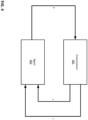
- Fig. 1 illustrates an example software architecture and dataflow of an IGP metric optimizer 100.
- the software architecture includes a routing simulator 106 and reinforcement learning (RL) agent 102.
- the IGP metric optimizer 100 receives a set of inputs 110.
- the inputs may include network topology 112 of a network domain, demands 114, probable failure states 116 of the links connecting nodes in the network domain, and an objective function 118.
- the inputs 110 may include a subset of links within the network topology to tune.
- the routing simulator 106 may determine a network utility 108 for a set of flows and network topology at some or all failure states.
- the RL agent 102 may use the determined network utilities along with the inputs 110 to optimize the objective function 118 to determine updated IGP metric values 104.
- the final set of updated IGP metric values may be output by the IGM metric optimizer 100, illustrated as the outputted IGP metric values 122 in Fig. 1 .
- the outputted IGP metric values may be used to assign routing paths between nodes in the network domain.
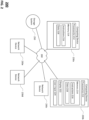
- the network devices 230 may include switches, routers, modems, gateways, software-defined-network applications, or other such components that may be connected to or otherwise form part of the network 260.
- the network devices 230 may include physical devices, virtualized devices, replicas, etc.
- network devices may include computing devices such as servers, general purpose computers, PDAs, tablets, mobile phones, smartwatches, terminals, set top boxes, and other such devices.
- network devices 230a and 230b are computing devices.
- network device 230c may be a top-of-rack switch that has a set of servers attached to it.
- network device 230d may be a router that is attached to a plurality of switches, which in turn connect to a plurality of computing devices. Additionally, network devices 230 may also include services that are implemented on the network devices. Although Fig. 2 illustrates only network devices 230a and 230b as computing devices, the system 200 can include any number of computing devices. Moreover, although only network devices 230a-230e are illustrated in system 200, the system may include any number of network devices.
- Fig. 2 illustrates the network devices 230a-230e as being connected directly to the network 260
- the network devices may be connected to the network 260 via other network devices.
- network devices 230a and 230b may be connected to the network 260 through another network device, such as one of network devices 230c-230e.
- network devices 230c-230e may be connected to the network 230 via other network devices.
- Network devices 230 may be coupled to other network devices to form a link on a communication pathway on the network 260.
- a first network device may connect to a second network device, which may connect to other network devices or directly to the network.
- Fig. 3 illustrates an example network domain 300 including network devices 302-312, also referred to herein as nodes.
- the nodes may be connected by edges 322-336, also referred to herein as links.
- node 302 is connected to node 308 via links 322, 324, and 326, with link 322 being between nodes 302 and 304, link 324 being between nodes 304 and 306, and link 326 being between nodes 306 and 308.
- nodes may be connected via multiple paths.
- node 302 is illustrated as being connect to node 308 via another including links 328, 332, and 326, with link 328 being between nodes 302 and 310, link 332 being between nodes 310 and 306, and link 326 being between nodes 306 and 308.
- the routing path selected between nodes may be based on updated IGP metrics, as described further in.
- a network domain may include a collection of network devices, such as network devices 230, referred to herein as "nodes," that share a common domain.
- a network domain may include a domain and one or more sub-domains. Each domain and sub-domain may be under common control by one or more administrators.
- Network devices may include components typically present in general purposes computers, servers, and routers.
- network device 230a is a computing device containing a processor 212 and memory 214.
- the memory 214 can store information accessible by the processor 212, including instructions 216 that can be executed by the processor 212.
- Memory 214 can also include data 218 that can be retrieved, manipulated or stored by the processor 212.
- the memory 214 may be a type of non-transitory computer readable medium capable of storing information accessible by the processor 220, such as a hard-drive, solid state drive, flash drive, tape drive, optical storage, memory card, ROM, RAM, DVD, CD-ROM, write-capable, and read-only memories.
- the subject matter disclosed herein may include different combinations of the foregoing, whereby different portions of the instructions 216 and data 218 are stored on different types of media.
- the processor 212 can be a well-known processor or other lesser-known types of processors.
- the processor 112 can be a dedicated controller such as an ASIC.
- the instructions 216 can be a set of instructions executed directly, such as machine code, or indirectly, such as scripts, by the processor 212.
- the terms "instructions,” “steps” and “programs” can be used interchangeably herein.
- the instructions 216 can be stored in object code format for direct processing by the processor 220, or other types of computer language including scripts or collections of independent source code modules that are interpreted on demand or compiled in advance.
- the instructions 216 may provide for implementing an IGP metric optimizer, such as IGP metric optimizer 100, including RL agent 102 and routing simulator 106, as described herein.
- the data 218 can be retrieved, stored or modified by the processor 212 in accordance with the instructions 216.
- the data 218 can be stored in computer registers, in a distributed storage system as a structure having a plurality of different fields and records, or documents, or buffers.
- the data 218 can also be formatted in a computer-readable format such as, but not limited to, binary values, ASCII or Unicode.
- the data 218 can include information sufficient to identify relevant information, such as numbers, descriptive text, proprietary codes, pointers, references to data stored in other memories, including other network locations, or information that is used by a function to calculate relevant data.
- Fig. 2 functionally illustrates the processor 212 and memory 214 as being within the same block, it will be understood by those of ordinary skill in the art that the processor and memory may actually comprise multiple processors and memories that may or may not be stored within the same physical housing. For example, some of the instructions and data may be stored on removable CD-ROM and others within a read-only computer chip. Some or all of the instructions and data may be stored in a location physically remote from, yet still accessible by, the processor. Similarly, the processor may actually comprise a collection of processors that may or may not operate in parallel.
- Computing device 230b may be configured similarly to computing device 230a.
- computing device 230b may have some or all of the same components of computing device 230a.
- computing device 230b includes a processor 212 and memory 214 storing instructions 216 and data 218.
- computing device 230b may include other components normally found in a personal computer such as a CD-ROM/DVD/Blu-ray drive, hard drive, and a display device 222, for example, a monitor having a screen, a projector, a touch-screen, a small LCD screen, a television, or another device such as an electrical device that can be operable to display information processed by a processor, speakers, a modem and/or network interface device, user input 224, such as a mouse, keyboard, touch screen or microphone, and all of the components used for connecting these elements to one another.
- Other computing devices and network devices in accordance with the systems and methods described herein may be configured similar to computing devices 230a and 230b.
- the components in system 200 may be capable of direct and indirect communication such as over network 260.
- the network device 230a can communicate with another network device attached to network 260, through an Internet protocol.
- the network devices 230a-230e can set up listening sockets that may accept an initiating connection for sending and receiving information.
- the network 260 itself can include various configurations and protocols including the Internet, World Wide Web, intranets, virtual private networks, wide area networks, local networks, private networks, collections of private networks, such as a network domain, etc., using general communication protocols and/or communication protocols proprietary to one or more companies.
- the network 260 can support a variety of short- and long-range connections.
- the short- and long-range connections may be made over different bandwidths, such as 2.402 GHz to 2.480 GHz (commonly associated with the Bluetooth ® standard), 2.4 GHz and 5 GHz (commonly associated with the Wi-Fi ® communication protocol); or with a variety of communication standards, such as the LTE ® standard for wireless broadband communication.
- the network 260 in addition or alternatively, can also support wired connections between the devices 260a-260e, as well as with the storage system 250, including over various types of Ethernet connection.
- aspects of the disclosure can be implemented according to a variety of different configurations and quantities of computing devices, including in paradigms for sequential or parallel processing, or over a distributed network of multiple devices.
- aspects of this disclosure can be implemented in digital circuits, computer-readable storage media, as one or more computer programs, or a combination of one or more of the foregoing.
- the computer-readable storage media can be non-transitory, e.g., as one or more instructions executable by a cloud computing platform and stored on a tangible storage device.
- the IGP metric optimizer 100 may be implemented by multiple computing devices, such as computing devices 230a and 230b.
- computing device 230a may implement the RL agent 102 and computing device 230b may implement the routing simulator.
- inputs 110 may be provided by computing devices 230a, 230b, and/or some other network device or storage system.
- the IGP metric optimizer may be implemented by one or more computing devices not connected to the network.
- the IGP metric optimizer 100 may receive a set of inputs 110, as shown in Fig. 1 .
- the routing simulator 106 within the IGP metric optimizer 100, may determine a network utility 108 for a set of flows and network topology at some or all failure states.
- the RL agent 102 may use the determined network utilities along with the inputs 110 to optimize the objective function 118 to determine updated IGP metric values 104. This process may repeat, with the updated IGP metric values may be provided to the routing simulator 106.
- the routing simulator may determine an updated network utility for each link based on the updated IGP metrics. Using these updated IGP metrics, the RL agent 102 may optimize the objective function 118 again to determine a new set of updated IGP metric values.
- the IGP metric optimizer 100 may output IGP metric values that can be used to assign routing paths between nodes in the network domain.
- the MDP may respond by transiting the current state to another one that includes the newly decided IGP metric.
- the environment 401 may send a reward signal to the RL agent. After multiple steps, when all the links get IGP metrics, the reward will be the network utility for the newly generated IGP metric. Before that, the reward at each step is 0.
- each link on a network may be assigned an index. Then for each link, an IGP metric value may be assigned in the same order as the link indices.
- the procedure for generating IGP metrics is illustrated in Fig. 5.
- Fig. 5 illustrates an IGP metric generation procedure for an 8-link network topology across nine steps. In the first 8 steps, the RL agent, such as RL agent 102 of the IGP metric optimizer 100, generates the IGP metric of one link at each step. In the last step, the RL agent evaluates the whole IGP metric using the objective function.
Landscapes
- Engineering & Computer Science (AREA)
- Computer Networks & Wireless Communication (AREA)
- Signal Processing (AREA)
- Artificial Intelligence (AREA)
- Evolutionary Computation (AREA)
- Medical Informatics (AREA)
- Computing Systems (AREA)
- Theoretical Computer Science (AREA)
- Data Exchanges In Wide-Area Networks (AREA)
- Mobile Radio Communication Systems (AREA)
Applications Claiming Priority (2)
| Application Number | Priority Date | Filing Date | Title |
|---|---|---|---|
| US17/323,464 US11601336B2 (en) | 2021-05-18 | 2021-05-18 | Assigning routing paths based on interior gateway protocol metric optimization |
| EP22155024.7A EP4092991B1 (de) | 2021-05-18 | 2022-02-03 | Optimierung der metrik von innenraum-gateway-protokollen |
Related Parent Applications (2)
| Application Number | Title | Priority Date | Filing Date |
|---|---|---|---|
| EP22155024.7A Division EP4092991B1 (de) | 2021-05-18 | 2022-02-03 | Optimierung der metrik von innenraum-gateway-protokollen |
| EP22155024.7A Division-Into EP4092991B1 (de) | 2021-05-18 | 2022-02-03 | Optimierung der metrik von innenraum-gateway-protokollen |
Publications (2)
| Publication Number | Publication Date |
|---|---|
| EP4564773A2 true EP4564773A2 (de) | 2025-06-04 |
| EP4564773A3 EP4564773A3 (de) | 2025-08-20 |
Family
ID=80225353
Family Applications (2)
| Application Number | Title | Priority Date | Filing Date |
|---|---|---|---|
| EP22155024.7A Active EP4092991B1 (de) | 2021-05-18 | 2022-02-03 | Optimierung der metrik von innenraum-gateway-protokollen |
| EP25162999.4A Pending EP4564773A3 (de) | 2021-05-18 | 2022-02-03 | Optimierung der metrik eines internen gateway-protokolls |
Family Applications Before (1)
| Application Number | Title | Priority Date | Filing Date |
|---|---|---|---|
| EP22155024.7A Active EP4092991B1 (de) | 2021-05-18 | 2022-02-03 | Optimierung der metrik von innenraum-gateway-protokollen |
Country Status (2)
| Country | Link |
|---|---|
| US (2) | US11601336B2 (de) |
| EP (2) | EP4092991B1 (de) |
Families Citing this family (2)
| Publication number | Priority date | Publication date | Assignee | Title |
|---|---|---|---|---|
| US11848838B2 (en) * | 2021-06-24 | 2023-12-19 | Hewlett Packard Enterprise Development Lp | Communicating node events in network configuration |
| US11695651B2 (en) * | 2021-10-12 | 2023-07-04 | Google Llc | Availability SLO-aware network optimization |
Family Cites Families (19)
| Publication number | Priority date | Publication date | Assignee | Title |
|---|---|---|---|---|
| US7023808B2 (en) | 2003-12-23 | 2006-04-04 | Cisco Technology, Inc. | System and method for distributing route selection in an implementation of a routing protocol |
| US8320255B2 (en) | 2005-02-02 | 2012-11-27 | Cisco Technology, Inc. | Inter-domain path computation technique |
| US7581022B1 (en) * | 2005-12-29 | 2009-08-25 | At&T Corp. | Method for tunable inter domain egress selection |
| US7904586B1 (en) | 2005-12-29 | 2011-03-08 | At&T Intellectual Property Ii, L.P. | Traffic engineering method with tunable inter-domain egress selection |
| US7903573B2 (en) | 2006-02-01 | 2011-03-08 | Cisco Technology, Inc. | Method and system for network traffic matrix analysis |
| CN102142972B (zh) * | 2010-01-28 | 2014-02-19 | 华为技术有限公司 | 一种ip网络的组网方法和装置 |
| US8700801B2 (en) | 2010-12-01 | 2014-04-15 | Juniper Networks, Inc. | Dynamically generating application-layer traffic optimization protocol maps |
| US20130232193A1 (en) * | 2012-03-04 | 2013-09-05 | Zafar Ali | Control-Plane Interface Between Layers in a Multilayer Network |
| US9652720B2 (en) * | 2013-02-05 | 2017-05-16 | Cisco Technology, Inc. | Triggering on-the-fly requests for supervised learning of learning machines |
| US9967170B2 (en) * | 2014-07-21 | 2018-05-08 | Cisco Technology, Inc. | Dynamic capacity-based routing domain load balancing |
| US10097449B2 (en) | 2015-02-20 | 2018-10-09 | Cisco Technology, Inc. | Optimized border gateway protocol best path selection for optimal route reflection |
| US10015073B2 (en) | 2015-02-20 | 2018-07-03 | Cisco Technology, Inc. | Automatic optimal route reflector root address assignment to route reflector clients and fast failover in a network environment |
| US9847939B2 (en) | 2015-10-08 | 2017-12-19 | Cisco Technology, Inc. | Optimal route reflection using efficient border gate protocol best path selection |
| US10958559B2 (en) | 2016-06-15 | 2021-03-23 | Juniper Networks, Inc. | Scaled inter-domain metrics for link state protocols |
| US20200036624A1 (en) | 2017-01-31 | 2020-01-30 | The Mode Group | High performance software-defined core network |
| US10305780B1 (en) | 2017-11-30 | 2019-05-28 | Juniper Networks, Inc. | Controlling accumulated interior gateway protocol (“AIGP”) attribute updates |
| US10574536B2 (en) | 2018-02-27 | 2020-02-25 | Microsoft Technology Licensing, Llc | Capacity engineering in distributed computing systems |
| US11240142B2 (en) * | 2019-06-21 | 2022-02-01 | Juniper Networks, Inc. | Class-based traffic engineering in an IP network |
| US20210119882A1 (en) * | 2020-04-13 | 2021-04-22 | Intel Corporation | Methods and apparatus to determine topologies for networks |
-
2021
- 2021-05-18 US US17/323,464 patent/US11601336B2/en active Active
-
2022
- 2022-02-03 EP EP22155024.7A patent/EP4092991B1/de active Active
- 2022-02-03 EP EP25162999.4A patent/EP4564773A3/de active Pending
-
2023
- 2023-02-27 US US18/175,127 patent/US11811614B2/en active Active
Also Published As
| Publication number | Publication date |
|---|---|
| US11601336B2 (en) | 2023-03-07 |
| US20230208720A1 (en) | 2023-06-29 |
| US11811614B2 (en) | 2023-11-07 |
| US20220376984A1 (en) | 2022-11-24 |
| EP4092991B1 (de) | 2025-04-23 |
| EP4564773A3 (de) | 2025-08-20 |
| EP4092991A1 (de) | 2022-11-23 |
Similar Documents
| Publication | Publication Date | Title |
|---|---|---|
| US11032150B2 (en) | Automatic prediction of behavior and topology of a network using limited information | |
| CN109768940B (zh) | 多业务sdn网络的流量分配方法及装置 | |
| US20220158913A1 (en) | Method for Network Slicing, Device and Storage Medium thereof | |
| US11811614B2 (en) | Assigning routing paths based on interior gateway protocol metric optimization | |
| US20160057061A1 (en) | Learning Or Emulation Approach to Traffic Engineering in Information-Centric Networks | |
| CN111800501B (zh) | 处理业务请求的方法及装置、存储介质、电子设备 | |
| WO2017007727A1 (en) | Parallelized network traffic flow availability simulation using stochastic process and traffic engineering algorithms | |
| CN115169570A (zh) | 量子网络协议仿真方法、装置及电子设备 | |
| US10050853B2 (en) | Neural network learning methods to identify network ports responsible for packet loss or delay | |
| WO2014042753A1 (en) | Generating and evaluating expert networks | |
| US20120198093A1 (en) | Interconnection Fabric Connection | |
| JPH1168750A (ja) | ネットワーク管理システム | |
| CN115048254A (zh) | 数据分配策略的仿真测试方法、系统、设备和可读介质 | |
| CN102142991A (zh) | 网络割接仿真的方法和系统 | |
| JP3430930B2 (ja) | パケット交換ネットワーク網におけるトラフィック推定方法および装置 | |
| CN108494597B (zh) | 智能光网络仿真系统及方法 | |
| Farreras et al. | GNNetSlice: A GNN-based performance model to support network slicing in B5G networks | |
| CN113079038A (zh) | 一种网络质量的评估方法、装置、服务器和存储介质 | |
| US20160065657A1 (en) | Message and subscription information processing | |
| CN116938777A (zh) | 网络遥测的方法及装置、电子设备和存储介质 | |
| CN115580573A (zh) | 服务功能链路径规划方法及相关设备 | |
| CN106850253A (zh) | 一种基于多状态网络的传输时间可靠性测量的方法 | |
| CN114900430A (zh) | 容器网络优化方法、装置、计算机设备和存储介质 | |
| CN120200924A (zh) | 基于图卷积神经网络的计算机网络性能评估方法及系统 | |
| CN119544605A (zh) | 网络调整方法、装置、电子设备及存储介质 |
Legal Events
| Date | Code | Title | Description |
|---|---|---|---|
| PUAI | Public reference made under article 153(3) epc to a published international application that has entered the european phase |
Free format text: ORIGINAL CODE: 0009012 |
|
| STAA | Information on the status of an ep patent application or granted ep patent |
Free format text: STATUS: THE APPLICATION HAS BEEN PUBLISHED |
|
| AC | Divisional application: reference to earlier application |
Ref document number: 4092991 Country of ref document: EP Kind code of ref document: P |
|
| AK | Designated contracting states |
Kind code of ref document: A2 Designated state(s): AL AT BE BG CH CY CZ DE DK EE ES FI FR GB GR HR HU IE IS IT LI LT LU LV MC MK MT NL NO PL PT RO RS SE SI SK SM TR |
|
| REG | Reference to a national code |
Ref country code: DE Ref legal event code: R079 Free format text: PREVIOUS MAIN CLASS: H04L0045036000 Ipc: H04L0045020000 |
|
| PUAL | Search report despatched |
Free format text: ORIGINAL CODE: 0009013 |
|
| AK | Designated contracting states |
Kind code of ref document: A3 Designated state(s): AL AT BE BG CH CY CZ DE DK EE ES FI FR GB GR HR HU IE IS IT LI LT LU LV MC MK MT NL NO PL PT RO RS SE SI SK SM TR |
|
| RIC1 | Information provided on ipc code assigned before grant |
Ipc: H04L 45/02 20220101AFI20250714BHEP Ipc: H04L 45/036 20220101ALI20250714BHEP |
|
| STAA | Information on the status of an ep patent application or granted ep patent |
Free format text: STATUS: REQUEST FOR EXAMINATION WAS MADE |
|
| 17P | Request for examination filed |
Effective date: 20260220 |