EP4564380A2 - Non-oriented electrical steel sheet and manufacturing method therefor - Google Patents
Non-oriented electrical steel sheet and manufacturing method therefor Download PDFInfo
- Publication number
- EP4564380A2 EP4564380A2 EP25171783.1A EP25171783A EP4564380A2 EP 4564380 A2 EP4564380 A2 EP 4564380A2 EP 25171783 A EP25171783 A EP 25171783A EP 4564380 A2 EP4564380 A2 EP 4564380A2
- Authority
- EP
- European Patent Office
- Prior art keywords
- less
- steel sheet
- oriented electrical
- iron loss
- average
- Prior art date
- Legal status (The legal status is an assumption and is not a legal conclusion. Google has not performed a legal analysis and makes no representation as to the accuracy of the status listed.)
- Pending
Links
Classifications
-
- C—CHEMISTRY; METALLURGY
- C21—METALLURGY OF IRON
- C21D—MODIFYING THE PHYSICAL STRUCTURE OF FERROUS METALS; GENERAL DEVICES FOR HEAT TREATMENT OF FERROUS OR NON-FERROUS METALS OR ALLOYS; MAKING METAL MALLEABLE, e.g. BY DECARBURISATION OR TEMPERING
- C21D6/00—Heat treatment of ferrous alloys
- C21D6/008—Heat treatment of ferrous alloys containing Si
-
- C—CHEMISTRY; METALLURGY
- C21—METALLURGY OF IRON
- C21D—MODIFYING THE PHYSICAL STRUCTURE OF FERROUS METALS; GENERAL DEVICES FOR HEAT TREATMENT OF FERROUS OR NON-FERROUS METALS OR ALLOYS; MAKING METAL MALLEABLE, e.g. BY DECARBURISATION OR TEMPERING
- C21D6/00—Heat treatment of ferrous alloys
- C21D6/002—Heat treatment of ferrous alloys containing Cr
-
- C—CHEMISTRY; METALLURGY
- C21—METALLURGY OF IRON
- C21D—MODIFYING THE PHYSICAL STRUCTURE OF FERROUS METALS; GENERAL DEVICES FOR HEAT TREATMENT OF FERROUS OR NON-FERROUS METALS OR ALLOYS; MAKING METAL MALLEABLE, e.g. BY DECARBURISATION OR TEMPERING
- C21D6/00—Heat treatment of ferrous alloys
- C21D6/005—Heat treatment of ferrous alloys containing Mn
-
- C—CHEMISTRY; METALLURGY
- C21—METALLURGY OF IRON
- C21D—MODIFYING THE PHYSICAL STRUCTURE OF FERROUS METALS; GENERAL DEVICES FOR HEAT TREATMENT OF FERROUS OR NON-FERROUS METALS OR ALLOYS; MAKING METAL MALLEABLE, e.g. BY DECARBURISATION OR TEMPERING
- C21D8/00—Modifying the physical properties of ferrous metals or ferrous alloys by deformation combined with, or followed by, heat treatment
-
- C—CHEMISTRY; METALLURGY
- C21—METALLURGY OF IRON
- C21D—MODIFYING THE PHYSICAL STRUCTURE OF FERROUS METALS; GENERAL DEVICES FOR HEAT TREATMENT OF FERROUS OR NON-FERROUS METALS OR ALLOYS; MAKING METAL MALLEABLE, e.g. BY DECARBURISATION OR TEMPERING
- C21D8/00—Modifying the physical properties of ferrous metals or ferrous alloys by deformation combined with, or followed by, heat treatment
- C21D8/12—Modifying the physical properties of ferrous metals or ferrous alloys by deformation combined with, or followed by, heat treatment during manufacturing of articles with special electromagnetic properties
-
- C—CHEMISTRY; METALLURGY
- C21—METALLURGY OF IRON
- C21D—MODIFYING THE PHYSICAL STRUCTURE OF FERROUS METALS; GENERAL DEVICES FOR HEAT TREATMENT OF FERROUS OR NON-FERROUS METALS OR ALLOYS; MAKING METAL MALLEABLE, e.g. BY DECARBURISATION OR TEMPERING
- C21D8/00—Modifying the physical properties of ferrous metals or ferrous alloys by deformation combined with, or followed by, heat treatment
- C21D8/12—Modifying the physical properties of ferrous metals or ferrous alloys by deformation combined with, or followed by, heat treatment during manufacturing of articles with special electromagnetic properties
- C21D8/1244—Modifying the physical properties of ferrous metals or ferrous alloys by deformation combined with, or followed by, heat treatment during manufacturing of articles with special electromagnetic properties characterised by the heat treatment
- C21D8/1261—Modifying the physical properties of ferrous metals or ferrous alloys by deformation combined with, or followed by, heat treatment during manufacturing of articles with special electromagnetic properties characterised by the heat treatment following hot rolling
-
- C—CHEMISTRY; METALLURGY
- C21—METALLURGY OF IRON
- C21D—MODIFYING THE PHYSICAL STRUCTURE OF FERROUS METALS; GENERAL DEVICES FOR HEAT TREATMENT OF FERROUS OR NON-FERROUS METALS OR ALLOYS; MAKING METAL MALLEABLE, e.g. BY DECARBURISATION OR TEMPERING
- C21D9/00—Heat treatment, e.g. annealing, hardening, quenching or tempering, adapted for particular articles; Furnaces therefor
- C21D9/46—Heat treatment, e.g. annealing, hardening, quenching or tempering, adapted for particular articles; Furnaces therefor for sheet metals
-
- C—CHEMISTRY; METALLURGY
- C22—METALLURGY; FERROUS OR NON-FERROUS ALLOYS; TREATMENT OF ALLOYS OR NON-FERROUS METALS
- C22C—ALLOYS
- C22C38/00—Ferrous alloys, e.g. steel alloys
- C22C38/001—Ferrous alloys, e.g. steel alloys containing N
-
- C—CHEMISTRY; METALLURGY
- C22—METALLURGY; FERROUS OR NON-FERROUS ALLOYS; TREATMENT OF ALLOYS OR NON-FERROUS METALS
- C22C—ALLOYS
- C22C38/00—Ferrous alloys, e.g. steel alloys
- C22C38/004—Very low carbon steels, i.e. having a carbon content of less than 0,01%
-
- C—CHEMISTRY; METALLURGY
- C22—METALLURGY; FERROUS OR NON-FERROUS ALLOYS; TREATMENT OF ALLOYS OR NON-FERROUS METALS
- C22C—ALLOYS
- C22C38/00—Ferrous alloys, e.g. steel alloys
- C22C38/02—Ferrous alloys, e.g. steel alloys containing silicon
-
- C—CHEMISTRY; METALLURGY
- C22—METALLURGY; FERROUS OR NON-FERROUS ALLOYS; TREATMENT OF ALLOYS OR NON-FERROUS METALS
- C22C—ALLOYS
- C22C38/00—Ferrous alloys, e.g. steel alloys
- C22C38/04—Ferrous alloys, e.g. steel alloys containing manganese
-
- C—CHEMISTRY; METALLURGY
- C22—METALLURGY; FERROUS OR NON-FERROUS ALLOYS; TREATMENT OF ALLOYS OR NON-FERROUS METALS
- C22C—ALLOYS
- C22C38/00—Ferrous alloys, e.g. steel alloys
- C22C38/06—Ferrous alloys, e.g. steel alloys containing aluminium
-
- C—CHEMISTRY; METALLURGY
- C22—METALLURGY; FERROUS OR NON-FERROUS ALLOYS; TREATMENT OF ALLOYS OR NON-FERROUS METALS
- C22C—ALLOYS
- C22C38/00—Ferrous alloys, e.g. steel alloys
- C22C38/18—Ferrous alloys, e.g. steel alloys containing chromium
- C22C38/24—Ferrous alloys, e.g. steel alloys containing chromium with vanadium
-
- C—CHEMISTRY; METALLURGY
- C22—METALLURGY; FERROUS OR NON-FERROUS ALLOYS; TREATMENT OF ALLOYS OR NON-FERROUS METALS
- C22C—ALLOYS
- C22C38/00—Ferrous alloys, e.g. steel alloys
- C22C38/18—Ferrous alloys, e.g. steel alloys containing chromium
- C22C38/34—Ferrous alloys, e.g. steel alloys containing chromium with more than 1.5% by weight of silicon
-
- H—ELECTRICITY
- H01—ELECTRIC ELEMENTS
- H01F—MAGNETS; INDUCTANCES; TRANSFORMERS; SELECTION OF MATERIALS FOR THEIR MAGNETIC PROPERTIES
- H01F1/00—Magnets or magnetic bodies characterised by the magnetic materials therefor; Selection of materials for their magnetic properties
- H01F1/01—Magnets or magnetic bodies characterised by the magnetic materials therefor; Selection of materials for their magnetic properties of inorganic materials
- H01F1/03—Magnets or magnetic bodies characterised by the magnetic materials therefor; Selection of materials for their magnetic properties of inorganic materials characterised by their coercivity
- H01F1/12—Magnets or magnetic bodies characterised by the magnetic materials therefor; Selection of materials for their magnetic properties of inorganic materials characterised by their coercivity of soft-magnetic materials
- H01F1/14—Magnets or magnetic bodies characterised by the magnetic materials therefor; Selection of materials for their magnetic properties of inorganic materials characterised by their coercivity of soft-magnetic materials metals or alloys
- H01F1/147—Alloys characterised by their composition
- H01F1/14766—Fe-Si based alloys
- H01F1/14791—Fe-Si-Al based alloys, e.g. Sendust
-
- H—ELECTRICITY
- H01—ELECTRIC ELEMENTS
- H01F—MAGNETS; INDUCTANCES; TRANSFORMERS; SELECTION OF MATERIALS FOR THEIR MAGNETIC PROPERTIES
- H01F1/00—Magnets or magnetic bodies characterised by the magnetic materials therefor; Selection of materials for their magnetic properties
- H01F1/01—Magnets or magnetic bodies characterised by the magnetic materials therefor; Selection of materials for their magnetic properties of inorganic materials
- H01F1/03—Magnets or magnetic bodies characterised by the magnetic materials therefor; Selection of materials for their magnetic properties of inorganic materials characterised by their coercivity
- H01F1/12—Magnets or magnetic bodies characterised by the magnetic materials therefor; Selection of materials for their magnetic properties of inorganic materials characterised by their coercivity of soft-magnetic materials
- H01F1/14—Magnets or magnetic bodies characterised by the magnetic materials therefor; Selection of materials for their magnetic properties of inorganic materials characterised by their coercivity of soft-magnetic materials metals or alloys
- H01F1/16—Magnets or magnetic bodies characterised by the magnetic materials therefor; Selection of materials for their magnetic properties of inorganic materials characterised by their coercivity of soft-magnetic materials metals or alloys in the form of sheets
-
- C—CHEMISTRY; METALLURGY
- C21—METALLURGY OF IRON
- C21D—MODIFYING THE PHYSICAL STRUCTURE OF FERROUS METALS; GENERAL DEVICES FOR HEAT TREATMENT OF FERROUS OR NON-FERROUS METALS OR ALLOYS; MAKING METAL MALLEABLE, e.g. BY DECARBURISATION OR TEMPERING
- C21D2201/00—Treatment for obtaining particular effects
- C21D2201/05—Grain orientation
-
- C—CHEMISTRY; METALLURGY
- C21—METALLURGY OF IRON
- C21D—MODIFYING THE PHYSICAL STRUCTURE OF FERROUS METALS; GENERAL DEVICES FOR HEAT TREATMENT OF FERROUS OR NON-FERROUS METALS OR ALLOYS; MAKING METAL MALLEABLE, e.g. BY DECARBURISATION OR TEMPERING
- C21D8/00—Modifying the physical properties of ferrous metals or ferrous alloys by deformation combined with, or followed by, heat treatment
- C21D8/12—Modifying the physical properties of ferrous metals or ferrous alloys by deformation combined with, or followed by, heat treatment during manufacturing of articles with special electromagnetic properties
- C21D8/1216—Modifying the physical properties of ferrous metals or ferrous alloys by deformation combined with, or followed by, heat treatment during manufacturing of articles with special electromagnetic properties characterised by the working steps
- C21D8/1222—Hot rolling
-
- C—CHEMISTRY; METALLURGY
- C21—METALLURGY OF IRON
- C21D—MODIFYING THE PHYSICAL STRUCTURE OF FERROUS METALS; GENERAL DEVICES FOR HEAT TREATMENT OF FERROUS OR NON-FERROUS METALS OR ALLOYS; MAKING METAL MALLEABLE, e.g. BY DECARBURISATION OR TEMPERING
- C21D8/00—Modifying the physical properties of ferrous metals or ferrous alloys by deformation combined with, or followed by, heat treatment
- C21D8/12—Modifying the physical properties of ferrous metals or ferrous alloys by deformation combined with, or followed by, heat treatment during manufacturing of articles with special electromagnetic properties
- C21D8/1216—Modifying the physical properties of ferrous metals or ferrous alloys by deformation combined with, or followed by, heat treatment during manufacturing of articles with special electromagnetic properties characterised by the working steps
- C21D8/1233—Cold rolling
-
- C—CHEMISTRY; METALLURGY
- C21—METALLURGY OF IRON
- C21D—MODIFYING THE PHYSICAL STRUCTURE OF FERROUS METALS; GENERAL DEVICES FOR HEAT TREATMENT OF FERROUS OR NON-FERROUS METALS OR ALLOYS; MAKING METAL MALLEABLE, e.g. BY DECARBURISATION OR TEMPERING
- C21D8/00—Modifying the physical properties of ferrous metals or ferrous alloys by deformation combined with, or followed by, heat treatment
- C21D8/12—Modifying the physical properties of ferrous metals or ferrous alloys by deformation combined with, or followed by, heat treatment during manufacturing of articles with special electromagnetic properties
- C21D8/1244—Modifying the physical properties of ferrous metals or ferrous alloys by deformation combined with, or followed by, heat treatment during manufacturing of articles with special electromagnetic properties characterised by the heat treatment
- C21D8/1272—Final recrystallisation annealing
-
- C—CHEMISTRY; METALLURGY
- C22—METALLURGY; FERROUS OR NON-FERROUS ALLOYS; TREATMENT OF ALLOYS OR NON-FERROUS METALS
- C22C—ALLOYS
- C22C2202/00—Physical properties
- C22C2202/02—Magnetic
Definitions
- the present invention relates to a non-oriented electrical steel sheet and a manufacturing method thereof.
- the magnetic characteristic of the non-oriented electrical steel sheet is typically evaluated through iron loss and magnetic flux density.
- the iron loss means energy loss occurring at a specific magnetic flux density and frequency
- the magnetic flux density means a degree of magnetization obtained in a specific magnetic field.
- the iron loss and the magnetic flux density have different values depending on a measurement direction because they have anisotropy.
- magnetic properties in a rolling direction are the best, and when the rolling direction is rotated by 55 to 90 degrees, the magnetic properties are significantly degraded.
- the non-oriented electrical steel sheet is used in a rotating machine, lower anisotropy is advantageous for stable operation thereof, and the anisotropy may be reduced by improving a texture of the steel.
- a typically used method for increasing the magnetic properties of the non-oriented electrical steel sheet is to add an alloying element such as Si.
- the addition of the alloying element can increase specific resistance of the steel, and as the specific resistance is higher, eddy current loss decreases, thereby reducing the total iron loss.
- an element such as Al and Mn together with Si.
- a method for manufacturing a non-oriented electrical steel sheet having excellent strength and excellent high frequency magnetic properties by appropriately controlling contents of Ti, C, N, and the like has been proposed.
- the strength of the non-oriented electrical steel sheet according to the proposed method is superior to that of a conventional high-grade non-oriented electrical steel sheet, since an amount of carbonitride significantly increases due to excessive contents of C and N, the magnetism of the steel is actually deteriorated.
- the present invention has been made in an effort to provide a non-oriented electrical steel sheet and a manufacturing method thereof. Specifically, a non-oriented electrical steel sheet having excellent magnetic properties is provided at a low cost.
- An embodiment of the present invention provides a non-oriented electrical steel sheet including: Si at 2.0 to 4.0 wt%, Al at 1.5 wt% or less (excluding 0 wt%), Mn at 1.5 wt% or less (excluding 0 wt%), Cr at 0.01 to 0.5 wt%, V at 0.0080 to 0.015 wt%, C at 0.015 wt% or less (excluding 0 wt%), N at 0.015 wt% or less (excluding 0 wt%), and the remainder including Fe and other impurities unavoidably added thereto, and satisfying Equation 1 below.
- Equation 1 Equation 1 below.
- Equation 2 0.5 ⁇ C + N + 0.001 ⁇ V (In Equation 2, [C], [N], and [V] represent a content (wt%) of C, N, and V, respectively.)
- At least one of S at 0.005 wt% or less (excluding 0 wt%), Ti at 0.005 wt% or less (excluding 0 wt%), Nb at 0.005 wt% or less (excluding 0 wt%), Cu at 0.025 wt% or less (excluding 0 wt%), B at 0.001 wt% or less (excluding 0 wt%), Mg at 0.005 wt% or less (excluding 0 wt%), and Zr at 0.005 wt% or less (excluding 0 wt%) may be further included.
- Grains having a crystal orientation with respect to a cross-section in a thickness direction of a steel sheet that is within 15 degrees from ⁇ 113 ⁇ ⁇ uvw> may be included at 35 % or more.
- Grains having a crystal orientation with respect to a cross-section in a thickness direction of a steel sheet that is within 15 degrees from ⁇ 111 ⁇ ⁇ uvw> may be included at 20 % or less.
- Grains having a crystal orientation with respect to a cross-section in a thickness direction of a steel sheet that is within 15 degrees from ⁇ 001 ⁇ ⁇ uvw> may be included at 15 % to 25 %.
- Equation 3 may be satisfied. ([Average circular iron loss] - [Average LC iron loss])/([Average circular iron loss] + [Average LC iron loss]) ⁇ 0.03 (In Equation 3, [Average circular iron loss] represents an average value of W15/50 measured at 0, 15, 30, 45, 60, 75, and 90 degrees in a rolling direction, and [Average LC iron loss] represents an average value of W15/50 measured at 0 and 90 degrees in a rolling direction.)
- the average circular iron loss (W 15/50 ) may be 2.60 W/Kg or less, and the average LC iron loss (W 15/50 ) may be 2.50 W/kg or less.
- a magnetic flux density (B 50 ) may be 1.68 T or more.
- Another exemplary embodiment of the present invention provides a manufacturing method of a non-oriented electrical steel sheet, wherein the non-oriented electrical steel sheet includes Si at 2.0 to 4.0 wt%, Al at 1.5 wt% or less (excluding 0 wt%), Mn at 1.5 wt% or less (excluding 0 wt%), Cr at 0.01 to 0.5 wt%, V at 0.0080 to 0.015 wt%, C at 0.015 wt% or less (excluding 0 wt%), N at 0.015 wt% or less (excluding 0 wt%), and the remainder including Fe and other impurities unavoidably added thereto, including: heating a slab satisfying Equation 1 below; hot-rolling the slab to produce a hot-rolled sheet; cold-rolling the hot-rolled sheet to produce a cold-rolled sheet; and finally annealing the cold-rolled sheet.
- Equation 1 Equation 1 below
- the slab may satisfy Equation 2 below.
- Equation 2 0.5 ⁇ C + N + 0.001 ⁇ V (In Equation 2, [C], [N], and [V] represent a content (wt%) of C, N, and V, respectively.)
- the slab may further include at least one of S at 0.005 wt% or less (excluding 0 wt%), Ti at 0.005 wt% or less (excluding 0 wt%), Nb at 0.005 wt% or less (excluding 0 wt%), Cu at 0.025 wt% or less (excluding 0 wt%), B at 0.001 wt% or less (excluding 0 wt%), Mg at 0.005 wt% or less (excluding 0 wt%), and Zr at 0.005 wt% or less (excluding 0 wt%).
- the manufacturing method of the non-oriented electrical steel sheet may further include, after the preparing of the hot-rolled sheet, hot-annealing the hot-rolled sheet.
- grains having a crystal orientation with respect to a cross-section in a thickness direction of a steel sheet that is within 15 degrees from ⁇ 113 ⁇ ⁇ uvw> may be included at 35 % or more.
- Equation 3 ([Average circular iron loss] - [Average LC iron loss])/([Average circular iron loss] + [Average LC iron loss]) ⁇ 0.03 (In Equation 3, [Average circular iron loss] represents an average value of W15/50 measured at 0, 15, 30, 45, 60, 75, and 90 degrees in a rolling direction, and [Average LC iron loss] represents an average value of W15/50 measured at 0 and 90 degrees in a rolling direction.)
- non-oriented electrical steel sheet and the manufacturing method thereof of the embodiment it is possible to provide a non-oriented electrical steel sheet that is excellent in magnetic properties even with a sufficiently high content of V, C, and N at a low cost.
- first, second, third, etc. may be used herein to describe various elements, components, regions, layers, and/or sections, they are not limited thereto. These terms are only used to distinguish one element, component, region, layer, or section from another element, component, region, layer, or section. Thus, a first component, constituent element, or section described below may be referred to as a second component, constituent element, or section, without departing from the range of the present invention.
- % means % by weight, and 1 ppm is 0.0001 % by weight.
- the meaning of further comprising/including an additional element implies replacing a remaining iron (Fe) by an additional amount of the additional element.
- a composition of a non-oriented electrical steel sheet particularly to optimize amounts of Si, Al, and Mn as main additive components, and it is possible to provide a non-oriented electrical steel sheet that is excellent in magnetic properties at a low cost by increasing a grain growth rate by adding an appropriate amount of Cr even when contents of V, C, and N are sufficiently high.
- a non-oriented electrical steel sheet includes: Si at 2.0 to 4.0 wt%, Al at 1.5 wt% or less (excluding 0 wt%), Mn at 1.5 wt% or less (excluding 0 wt%), Cr at 0.01 to 0.5 wt%, V at 0.0080 to 0.015 wt%, C at 0.015 wt% or less (excluding 0 wt%), N at 0.015 wt% or less (excluding 0 wt%), and the remainder including Fe and other impurities unavoidably added thereto.
- Si serves to reduce iron loss by increasing specific resistance of a material, and when too little is added, an effect of improving high frequency iron loss may be insufficient. In contrast, when too much is added, hardness of the material increases and thus a cold-rolling property is extremely deteriorated, so that productivity and a punching property may deteriorate. Therefore, Si may be added in the above-mentioned range.
- Aluminum (Al) serves to reduce iron loss by increasing specific resistance of a material, and when to much is added, nitrides may be excessively formed to deteriorate magnetism, thereby causing problems in all processes including steel-making and continuous casting processes, which may greatly reduce productivity. Therefore, Al may be added in the above-mentioned range. Specifically, Al may be contained in an amount of 0.1 to 1.3 wt%.
- Manganese (Mn) serves to increase specific resistance of a material to improve iron loss and form sulfides, and when too much is added, a magnetic flux density may be reduced by promoting formation of ⁇ 111 ⁇ texture that is disadvantageous to magnetism. Therefore, Mn may be added in the above-mentioned range. Specifically, Mn may be contained in an amount of 0.1 to 1.2 wt%.
- Chromium (Cr) has an effect of improving grain growth while increasing specific resistance of a material. Cr reduces activity of C and N to suppress carbonitride formation, and allows larger grains to be formed at the same annealing temperature by lowering recrystallization-starting temperature. Particularly, the addition of Cr causes ⁇ 113 ⁇ ⁇ uvw> texture to grow, and the ⁇ 113 ⁇ ⁇ uvw> texture reduces magnetic anisotropy compared to ⁇ 001 ⁇ ⁇ uvw> texture. When too little Cr is added, the above-mentioned effect is insignificant, and when too much Cr is added, Cr produces carbides, thereby degrading magnetism. Specifically, Cr may be contained in an amount of 0.02 to 0.35 wt%.
- Vanadium (V) forms carbonitride in a material to suppress grain growth and interfere with movement of a magnetic domain, which mainly degrade magnetism.
- V Vanadium
- the carbonitride produced by the combination of Cr and V is remarkably suppressed by the addition of Cr, an effect of magnetic deterioration is small, and the addition of V may reduce a fraction of ⁇ 111 ⁇ ⁇ uvw> texture that is disadvantageous to magnetism.
- V may be contained in an amount of 0.008 to 0.012 wt%.
- Carbon (C) causes magnetic aging and combines with other impurity elements to generate carbides, thereby lowering the magnetic properties. Therefore, it is preferable that carbon (C) is contained in a small amount.
- an appropriate amount of Cr may be added, thus a large amount of C up to 0.015 wt% or less may be contained.
- C may be contained in an amount of 0.0040 to 0.0140 wt%.
- Nitrogen (N) forms fine and long AIN precipitates inside a base material and forms fine mixtures by combining with other impurities to suppress grain growth and degrade iron loss. Therefore, it is preferable that nitrogen (N) is contained in a small amount.
- an appropriate amount of Cr may be added, thus a large amount of N up to 0.015 wt% or less may be contained.
- N may be contained in an amount of 0.0040 wt% to 0.0145 wt%.
- the carbon and nitrogen is required to be managed not only individually but also in a sum amount thereof.
- the carbon and nitrogen may satisfy Equation 1 below. 0.004 ⁇ C + N ⁇ 0.022 (In Equation 1, [C] and [N] represent a content (wt%) of C and N, respectively.)
- the carbon and nitrogen form carbides and nitrides to deteriorate magnetism, so it is preferable that they are contained in as little an amount as possible.
- an appropriate amount of Cr may be added, thus large contents of C and N may be contained.
- their content exceeds 0.022 wt%, they degrade magnetism, so that their contents are limited to 0.022 wt%.
- the vanadium, carbon, and nitrogen may satisfy Equation 2 below.
- Equation 2 0.5 ⁇ C + N + 0.001 ⁇ V (In Equation 2, [C], [N], and [V] represent a content (wt%) of C, N, and V, respectively.)
- Equation 2 When Equation 2 is not satisfied, ⁇ 111 ⁇ ⁇ uvw> texture is insufficiently suppressed, the magnetism may deteriorate.
- impurities such as S, Ti, Nb, Cu, B, Mg, and Zr may be included.
- impurities such as S, Ti, Nb, Cu, B, Mg, and Zr may be included.
- these elements are trace amounts, since they form inclusions in the steel to cause magnetic deterioration, Sat 0.005 wt% or less, Ti at 0.005 wt% or less, Nb at 0.005 wt% or less, Cu at 0.025 wt% or less, B at 0.001 wt% or less, Mg at 0.005 wt% or less, and Zr at 0.005 wt% or less should be managed.
- the non-oriented electrical steel sheet according to the embodiment of the present invention may precisely control the component thereof to form a crystal structure that is excellent in magnetism and in which magnetic anisotropy is not large.
- the grains having a crystal orientation with respect to a cross-section in a thickness direction of the steel sheet that is within 15 degrees from ⁇ 113 ⁇ ⁇ uvw> may be included at 35 % or more.
- a content of the grains means an area fraction of the grains relative to the entire area when the cross-section of the steel sheet is measured by EBSD.
- the EBSD is a method of calculating an orientation fraction by measuring the cross-section of a steel sheet including the entire thickness layer by an area of 15 mm 2 or more.
- the grains having a crystal orientation with respect to a cross-section in a thickness direction of the steel sheet that is within 15 degrees from ⁇ 111 ⁇ ⁇ uvw> may be included at 20 % or less. Since the grains having the crystal orientation of ⁇ 111 ⁇ ⁇ uvw> are low in average magnetism, they may be less included in the embodiment of the present invention. In addition, the grains of which a crystal orientation with respect to a cross-section in a thickness direction of the steel sheet is within 15 degrees from ⁇ 001 ⁇ ⁇ uvw> may be included at 15 to 25 %. Although the grains having the crystal orientation of ⁇ 001 ⁇ ⁇ uvw>, and have a high average magnetic property, it is preferable to maintain an appropriate fraction because the magnetic anisotropy thereof is also high.
- Equation 3 [Average circular iron loss] - [Average LC iron loss])/([Average circular iron loss] + [Average LC iron loss]) ⁇ 0.03
- [Average circular iron loss] represents an average value of W 15/50 measured at 0, 15, 30, 45, 60, 75, and 90 degrees in a rolling direction
- [Average LC iron loss] represents an average value of W 15/50 measured at 0 and 90 degrees in a rolling direction.
- the non-oriented electrical steel sheet according to the embodiment of the present invention does not have high magnetic anisotropy since a difference between the average value of the circular iron loss and the average value of the LC iron loss is not large.
- the average circular iron loss (W 15/50 ) may be 2.60 W/Kg or less, and the average LC iron loss (W 15/50 ) may be 2.50 W/kg or less.
- a magnetic flux density B 50 may be 1.68 T or more.
- a manufacturing method of the non-oriented electrical steel sheet according to the embodiment of the present invention wherein the non-oriented electrical steel sheet includes Si at 2.0 to 4.0 wt%, Al at 1.5 wt% or less (excluding 0 wt%), Mn at 1.5 wt% or less (excluding 0 wt%), Cr at 0.01 to 0.5 wt%, V at 0.0080 to 0.015 wt%, C at 0.015 wt% or less (excluding 0 wt%), N at 0.015 wt% or less (excluding 0 wt%), and the remainder including Fe and other impurities unavoidably added thereto, includes: heating a slab satisfying Equation 1 below; hot-rolling the slab to produce a hot-rolled sheet; cold-rolling the hot-rolled sheet to produce a cold-rolled sheet; and finally annealing the cold-rolled sheet.
- Equation 1 Equation 1 below
- a slab is heated.
- the reason why the addition ratio of each composition in the slab is limited is the same as the reason for limiting the composition of the non-oriented electrical steel sheet described above, so repeated description is omitted.
- the composition of the slab is substantially the same as that of the non-oriented electrical steel sheet because the composition of the slab is not substantially changed during the manufacturing processes such as hot-rolling, annealing of a hot-rolled sheet, cold-rolling, and final annealing, which will be described later.
- the slab is fed into a furnace and heated at 1100 to 1250 °C.
- a precipitate may be redissolved, and it may be finely precipitated after the hot-rolling.
- the heated slab is hot-rolled to 2 to 2.3 mm to produce a hot-rolled sheet.
- a finishing temperature may be 800 to 1000 °C.
- an annealing temperature of the hot-rolled sheet may be 850 to 1150 °C.
- the annealing temperature of the hot-rolled sheet is less than 850 °C, since the structure does not grow or finely grows, the synergy effect of the magnetic flux density is less, while when the annealing temperature exceeds 1150 °C, since the magnetic characteristic deteriorates, rolling workability may be degraded due to deformation of a sheet shape.
- the annealing temperature may be 950 to 1125 °C. More specifically, the annealing temperature of the hot-rolled sheet is 900 to 1100 °C.
- the hot-rolled sheet annealing is performed in order to increase the orientation favorable to magnetism as required, and it may be omitted.
- the hot-rolled sheet is pickled and cold-rolled to a predetermined thickness.
- a reduction ratio of 70 to 95 % may be applied thereto, and it may be cold-rolled to have a final thickness of 0.2 to 0.65 mm to prepare a cold-rolled steel sheet.
- the final cold-rolled sheet is subjected to final annealing.
- the final annealing temperature may be 750 to 1150 °C.
- the final annealing temperature is too low, recrystallization may not sufficiently occur, and when the final annealing temperature is too high, rapid growth of the grains may occur, thus the magnetic flux density and high frequency iron loss may deteriorate.
- the final annealing may be performed at a temperature of 900 to 1000 °C. In the final annealing process, all (in other words, 99 % or more) of the processed crystals formed in the previously cold-rolling step may be recrystallized.
- the grains of the final annealed steel sheet may have an average grain size of 50 to 95 ⁇ m.
- a slab that is formed as shown in Table 1 below and that contains the remainder of Fe and unavoidable impurities was prepared.
- the slab was heated at 1140 °C and hot-rolled at a finishing temperature of 880 °C to prepare a hot-rolled sheet having a thickness of 2.3 mm.
- the hot-rolled sheet was subjected to hot-rolled sheet annealing at 1030 °C for 100 seconds, pickled and cold-rolled to a thickness of 0.35 mm, and then final-annealed at 1000 °C for 110 seconds.
- the magnetic flux density (B 50 ), the average value of the circular iron loss (W 15/50 ), the average value of the the LC iron loss (W 15/50 ), the value of Equation 3, and the orientation fractions (%) of ⁇ 001 ⁇ , ⁇ 113 ⁇ , and ⁇ 111 ⁇ are shown in Table 2 below.
- the magnetic properties such as the magnetic flux density and the iron loss were measured with an Epstein tester after cutting samples of width 30 mm ⁇ length 305 mm ⁇ 20 pieces for each sample.
- B 50 is a magnetic flux density induced at the magnetic field of 5000 A/m
- W 15/50 is an iron loss when the magnetic flux density of 1.5 T is induced at the frequency of 50 Hz.
- the circular iron loss average is the average of the iron loss values measured with the samples cut in the directions rotated 0, 15, 30, 45, 60, 75, and 90 degrees in the rolling direction
- the LC iron loss average is the average of the iron loss value measured with the samples cut in the directions rotated 0 and 90 degrees in the rolling direction.
- the orientation fractions of ⁇ 001 ⁇ , ⁇ 113 ⁇ , and ⁇ 111 ⁇ were results that were measured 10 times by EBSD using the area of 350 ⁇ m ⁇ 5000 ⁇ m and the 2 ⁇ m step interval without overlapping and then calculated as the orientation fractions ⁇ 001 ⁇ ⁇ uvw>, ⁇ 113 ⁇ ⁇ uvw>, and ⁇ 111 ⁇ ⁇ uvw> within the error range of 15 degrees by merging the measured data.
- A3, A4, B3, B4, C3, C4, D3, and D4 corresponding to the range of the present invention had excellent magnetic properties, the values of Equation 3 were 0.03 or less, and the orientation fractions satisfied 35 % or more.
- all of A1, A2, B1, B2, C1, C2, D1 and D2 having the contents of Cr, V, C, and, N out of the range of the present invention had poor magnetic properties, the values of Equation 3 exceeded 0.03, the orientation fractions were 35 % or less, and the anisotropies were high.
- a non-oriented electrical steel sheet comprising: Si at 2.0 to 4.0 wt%, Al at 1.5 wt% or less (excluding 0 wt%), Mn at 1.5 wt% or less (excluding 0 wt%), Cr at 0.01 to 0.5 wt%, V at 0.0080 to 0.015 wt%, C at 0.015 wt% or less (excluding 0 wt%), N at 0.015 wt% or less (excluding 0 wt%), and the remainder including Fe and other impurities unavoidably added thereto, and satisfying Equation 1 below: 0.004 ⁇ C + N ⁇ 0.022 (in Equation 1, [C] and [N] represent a content (wt%) of C and N, respectively.)
- non-oriented electrical steel sheet of aspect 1 wherein grains having a crystal orientation with respect to a cross-section in a thickness direction of a steel sheet that is within 15 degrees from ⁇ 113 ⁇ ⁇ uvw> are included at 35 % or more.
- non-oriented electrical steel sheet of aspect 4 wherein grains having a crystal orientation with respect to a cross-section in a thickness direction of a steel sheet that is within 15 degrees from ⁇ 111 ⁇ ⁇ uvw> are included at 20 % or less.
- non-oriented electrical steel sheet of aspect 5 wherein grains having a crystal orientation with respect to a cross-section in a thickness direction of a steel sheet that is within 15 degrees from ⁇ 001 ⁇ ⁇ uvw> are included at 15 % to 25 %.
- a manufacturing method of a non-oriented electrical steel sheet wherein the non-oriented electrical steel sheet includes Si at 2.0 to 4.0 wt%, Al at 1.5 wt% or less (excluding 0 wt%), Mn at 1.5 wt% or less (excluding 0 wt%), Cr at 0.01 to 0.5 wt%, V at 0.0080 to 0.015 wt%, C at 0.015 wt% or less (excluding 0 wt%), N at 0.015 wt% or less (excluding 0 wt%), and the remainder including Fe and other impurities unavoidably added thereto, comprising:
- the slab further includes at least one of S at 0.005 wt% or less (excluding 0 wt%), Ti at 0.005 wt% or less (excluding 0 wt%), Nb at 0.005 wt% or less (excluding 0 wt%), Cu at 0.025 wt% or less (excluding 0 wt%), B at 0.001 wt% or less (excluding 0 wt%), Mg at 0.005 wt% or less (excluding 0 wt%), and Zr at 0.005 wt% or less (excluding 0 wt%).
- Equation 3 ([Average circular iron loss] - [Average LC iron loss])/([Average circular iron loss] + [Average LC iron loss]) ⁇ 0.03
- Equation 3 [Average circular iron loss] represents an average value of W15/50 measured at 0, 15, 30, 45, 60, 75, and 90 degrees in a rolling direction, and [Average LC iron loss] represents an average value of W15/50 measured at 0 and 90 degrees in a rolling direction.)
Landscapes
- Chemical & Material Sciences (AREA)
- Engineering & Computer Science (AREA)
- Materials Engineering (AREA)
- Mechanical Engineering (AREA)
- Metallurgy (AREA)
- Organic Chemistry (AREA)
- Physics & Mathematics (AREA)
- Thermal Sciences (AREA)
- Crystallography & Structural Chemistry (AREA)
- Electromagnetism (AREA)
- Manufacturing & Machinery (AREA)
- Dispersion Chemistry (AREA)
- Power Engineering (AREA)
- Soft Magnetic Materials (AREA)
- Manufacturing Of Steel Electrode Plates (AREA)
Abstract
Description
- The present invention relates to a non-oriented electrical steel sheet and a manufacturing method thereof.
- A non-oriented electrical steel sheet is mainly used in a motor that converts electrical energy to mechanical energy, and an excellent magnetic characteristic of the non-oriented electrical steel sheet is required to achieve high efficiency while the motor converts the electrical energy to the mechanical energy. Recently, as environmentally-friendly technology has been highlighted, it has become very important to increase efficiency of the motor using about half of the total electrical energy, and for this, demand for non-oriented electrical steel with an excellent magnetic characteristic is also increasing.
- The magnetic characteristic of the non-oriented electrical steel sheet is typically evaluated through iron loss and magnetic flux density. The iron loss means energy loss occurring at a specific magnetic flux density and frequency, and the magnetic flux density means a degree of magnetization obtained in a specific magnetic field. As the core loss decreases, a more energy efficient motor may be manufactured in the same conditions, and as the magnetic flux density is higher, it is possible to downsize the motor and to reduce copper loss, thus it is important to manufacture the non-oriented electrical steel sheet having low iron loss and high magnetic flux density.
- The iron loss and the magnetic flux density have different values depending on a measurement direction because they have anisotropy. Generally, magnetic properties in a rolling direction are the best, and when the rolling direction is rotated by 55 to 90 degrees, the magnetic properties are significantly degraded. Since the non-oriented electrical steel sheet is used in a rotating machine, lower anisotropy is advantageous for stable operation thereof, and the anisotropy may be reduced by improving a texture of the steel. When {011} <uvw> orientation or {001} <uvw> orientation increases, the average magnetism property is excellent, but the anisotropy is very large; when {111} <uvw> orientation increases, the average magnetism is low, and the anisotropy is small; and when {113} <uvw> orientation increases, the average magnetism is relatively good, and the anisotropy is not so great.
- A typically used method for increasing the magnetic properties of the non-oriented electrical steel sheet is to add an alloying element such as Si. The addition of the alloying element can increase specific resistance of the steel, and as the specific resistance is higher, eddy current loss decreases, thereby reducing the total iron loss. In order to increase the specific resistance of the steel, it is possible to produce an excellent non-oriented electrical steel sheet by adding an element such as Al and Mn together with Si.
- In order to improve the magnetic properties of the non-oriented electrical steel sheet, reduction of steel-making impurities is particularly important. Impurities inevitably included in a steel-making process precipitate as carbides, nitrides, sulfides, and the like in a final product, which interferes with grain growth and magnetic wall movement, thereby deteriorating the magnetic properties of the non-oriented electrical steel sheet. Therefore, for the production of the non-oriented electrical steel sheet, it is essential to clean up the steel-making process to minimize the content of all impurities, which leads to a decrease in productivity and an increase in a process cost.
- In order to solve the above problems, a method for manufacturing a non-oriented electrical steel sheet having excellent strength and excellent high frequency magnetic properties by appropriately controlling contents of Ti, C, N, and the like has been proposed. However, while the strength of the non-oriented electrical steel sheet according to the proposed method is superior to that of a conventional high-grade non-oriented electrical steel sheet, since an amount of carbonitride significantly increases due to excessive contents of C and N, the magnetism of the steel is actually deteriorated.
- The present invention has been made in an effort to provide a non-oriented electrical steel sheet and a manufacturing method thereof. Specifically, a non-oriented electrical steel sheet having excellent magnetic properties is provided at a low cost.
- An embodiment of the present invention provides a non-oriented electrical steel sheet including: Si at 2.0 to 4.0 wt%, Al at 1.5 wt% or less (excluding 0 wt%), Mn at 1.5 wt% or less (excluding 0 wt%), Cr at 0.01 to 0.5 wt%, V at 0.0080 to 0.015 wt%, C at 0.015 wt% or less (excluding 0 wt%), N at 0.015 wt% or less (excluding 0 wt%), and the remainder including Fe and other impurities unavoidably added thereto, and satisfying Equation 1 below.

- Equation 2 below may be satisfied.

- At least one of S at 0.005 wt% or less (excluding 0 wt%), Ti at 0.005 wt% or less (excluding 0 wt%), Nb at 0.005 wt% or less (excluding 0 wt%), Cu at 0.025 wt% or less (excluding 0 wt%), B at 0.001 wt% or less (excluding 0 wt%), Mg at 0.005 wt% or less (excluding 0 wt%), and Zr at 0.005 wt% or less (excluding 0 wt%) may be further included.
- Grains having a crystal orientation with respect to a cross-section in a thickness direction of a steel sheet that is within 15 degrees from {113} <uvw> may be included at 35 % or more.
- Grains having a crystal orientation with respect to a cross-section in a thickness direction of a steel sheet that is within 15 degrees from {111} <uvw> may be included at 20 % or less.
- Grains having a crystal orientation with respect to a cross-section in a thickness direction of a steel sheet that is within 15 degrees from {001} <uvw> may be included at 15 % to 25 %.
- Equation 3 below may be satisfied.
([Average circular iron loss] - [Average LC iron loss])/([Average circular iron loss] + [Average LC iron loss]) ≤ 0.03 - The average circular iron loss (W15/50) may be 2.60 W/Kg or less, and the average LC iron loss (W15/50) may be 2.50 W/kg or less.
- A magnetic flux density (B50) may be 1.68 T or more.
- Another exemplary embodiment of the present invention provides a manufacturing method of a non-oriented electrical steel sheet, wherein the non-oriented electrical steel sheet includes Si at 2.0 to 4.0 wt%, Al at 1.5 wt% or less (excluding 0 wt%), Mn at 1.5 wt% or less (excluding 0 wt%), Cr at 0.01 to 0.5 wt%, V at 0.0080 to 0.015 wt%, C at 0.015 wt% or less (excluding 0 wt%), N at 0.015 wt% or less (excluding 0 wt%), and the remainder including Fe and other impurities unavoidably added thereto, including: heating a slab satisfying Equation 1 below; hot-rolling the slab to produce a hot-rolled sheet; cold-rolling the hot-rolled sheet to produce a cold-rolled sheet; and finally annealing the cold-rolled sheet.
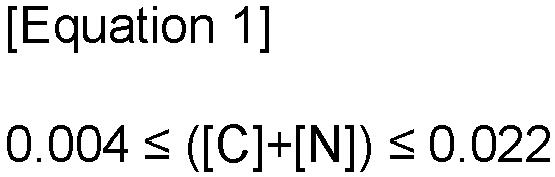
- (In Equation 1, [C] and [N] represent a content (wt%) of C and N, respectively.)
- The slab may satisfy Equation 2 below.

- The slab may further include at least one of S at 0.005 wt% or less (excluding 0 wt%), Ti at 0.005 wt% or less (excluding 0 wt%), Nb at 0.005 wt% or less (excluding 0 wt%), Cu at 0.025 wt% or less (excluding 0 wt%), B at 0.001 wt% or less (excluding 0 wt%), Mg at 0.005 wt% or less (excluding 0 wt%), and Zr at 0.005 wt% or less (excluding 0 wt%).
- The manufacturing method of the non-oriented electrical steel sheet may further include, after the preparing of the hot-rolled sheet, hot-annealing the hot-rolled sheet.
- After the finally annealing, grains having a crystal orientation with respect to a cross-section in a thickness direction of a steel sheet that is within 15 degrees from {113} <uvw> may be included at 35 % or more.
- After the finally annealing, Equation 3 below may be satisfied.
([Average circular iron loss] - [Average LC iron loss])/([Average circular iron loss] + [Average LC iron loss]) ≤ 0.03 - According to the non-oriented electrical steel sheet and the manufacturing method thereof of the embodiment, it is possible to provide a non-oriented electrical steel sheet that is excellent in magnetic properties even with a sufficiently high content of V, C, and N at a low cost.
- It will be understood that, although the terms first, second, third, etc. may be used herein to describe various elements, components, regions, layers, and/or sections, they are not limited thereto. These terms are only used to distinguish one element, component, region, layer, or section from another element, component, region, layer, or section. Thus, a first component, constituent element, or section described below may be referred to as a second component, constituent element, or section, without departing from the range of the present invention.
- The terminologies used herein are used just to illustrate a specific exemplary embodiment, but are not intended to limit the present invention. An expression used in the singular encompasses the expression of the plural, unless it has a clearly different meaning in the context. It will be further understood that the term "comprises" or "includes", used in this specification, specifies stated properties, regions, integers, steps, operations, elements, and/or components, but does not preclude the presence or addition of other properties, regions, integers, steps, operations, elements, components, and/or groups.
- When referring to a part as being "on" or "above" another part, it may be positioned directly on or above another part, or another part may be interposed therebetween. In contrast, when referring to a part being "directly above" another part, no other part is interposed therebetween.
- Unless defined otherwise, all terms including technical and scientific terms used herein have the same meaning as commonly understood by one of ordinary skill in the art to which the present invention belongs. Terms defined in commonly used dictionaries are further interpreted as having meanings consistent with the relevant technical literature and the present disclosure, and are not to be construed as idealized or very formal meanings unless defined otherwise.
- Unless otherwise stated, % means % by weight, and 1 ppm is 0.0001 % by weight.
- In an exemplary embodiment of the present invention, the meaning of further comprising/including an additional element implies replacing a remaining iron (Fe) by an additional amount of the additional element.
- The present invention will be described more fully hereinafter with reference to the accompanying drawings, in which exemplary embodiments of the invention are shown. As those skilled in the art would realize, the described embodiments may be modified in various different ways, all without departing from the spirit or scope of the present invention.
- According to an embodiment of the present invention, it is possible to optimize a composition of a non-oriented electrical steel sheet, particularly to optimize amounts of Si, Al, and Mn as main additive components, and it is possible to provide a non-oriented electrical steel sheet that is excellent in magnetic properties at a low cost by increasing a grain growth rate by adding an appropriate amount of Cr even when contents of V, C, and N are sufficiently high.
- A non-oriented electrical steel sheet according to an embodiment of the present invention includes: Si at 2.0 to 4.0 wt%, Al at 1.5 wt% or less (excluding 0 wt%), Mn at 1.5 wt% or less (excluding 0 wt%), Cr at 0.01 to 0.5 wt%, V at 0.0080 to 0.015 wt%, C at 0.015 wt% or less (excluding 0 wt%), N at 0.015 wt% or less (excluding 0 wt%), and the remainder including Fe and other impurities unavoidably added thereto.
- First, the reason for limiting the components of the non-oriented electrical steel sheet will be described.
- Silicon (Si) serves to reduce iron loss by increasing specific resistance of a material, and when too little is added, an effect of improving high frequency iron loss may be insufficient. In contrast, when too much is added, hardness of the material increases and thus a cold-rolling property is extremely deteriorated, so that productivity and a punching property may deteriorate. Therefore, Si may be added in the above-mentioned range.
- Aluminum (Al) serves to reduce iron loss by increasing specific resistance of a material, and when to much is added, nitrides may be excessively formed to deteriorate magnetism, thereby causing problems in all processes including steel-making and continuous casting processes, which may greatly reduce productivity. Therefore, Al may be added in the above-mentioned range. Specifically, Al may be contained in an amount of 0.1 to 1.3 wt%.
- Manganese (Mn) serves to increase specific resistance of a material to improve iron loss and form sulfides, and when too much is added, a magnetic flux density may be reduced by promoting formation of {111} texture that is disadvantageous to magnetism. Therefore, Mn may be added in the above-mentioned range. Specifically, Mn may be contained in an amount of 0.1 to 1.2 wt%.
- Chromium (Cr) has an effect of improving grain growth while increasing specific resistance of a material. Cr reduces activity of C and N to suppress carbonitride formation, and allows larger grains to be formed at the same annealing temperature by lowering recrystallization-starting temperature. Particularly, the addition of Cr causes {113} <uvw> texture to grow, and the {113} <uvw> texture reduces magnetic anisotropy compared to {001} <uvw> texture. When too little Cr is added, the above-mentioned effect is insignificant, and when too much Cr is added, Cr produces carbides, thereby degrading magnetism. Specifically, Cr may be contained in an amount of 0.02 to 0.35 wt%.
- Vanadium (V) forms carbonitride in a material to suppress grain growth and interfere with movement of a magnetic domain, which mainly degrade magnetism. However, in the embodiment of the present invention, since the carbonitride produced by the combination of Cr and V is remarkably suppressed by the addition of Cr, an effect of magnetic deterioration is small, and the addition of V may reduce a fraction of {111} <uvw> texture that is disadvantageous to magnetism. When too little V is added, the above-mentioned effect is insignificant, and when too much V is added, V produces carbonitride, thereby degrading magnetism. Specifically, V may be contained in an amount of 0.008 to 0.012 wt%.
- Carbon (C) causes magnetic aging and combines with other impurity elements to generate carbides, thereby lowering the magnetic properties. Therefore, it is preferable that carbon (C) is contained in a small amount. In the embodiment of the present invention, an appropriate amount of Cr may be added, thus a large amount of C up to 0.015 wt% or less may be contained. Specifically, C may be contained in an amount of 0.0040 to 0.0140 wt%.
- Nitrogen (N) forms fine and long AIN precipitates inside a base material and forms fine mixtures by combining with other impurities to suppress grain growth and degrade iron loss. Therefore, it is preferable that nitrogen (N) is contained in a small amount. In the embodiment of the present invention, an appropriate amount of Cr may be added, thus a large amount of N up to 0.015 wt% or less may be contained. Specifically, N may be contained in an amount of 0.0040 wt% to 0.0145 wt%.
- The above-described carbon and nitrogen is required to be managed not only individually but also in a sum amount thereof. In the exemplary embodiment of the present invention, the carbon and nitrogen may satisfy Equation 1 below.

- The carbon and nitrogen form carbides and nitrides to deteriorate magnetism, so it is preferable that they are contained in as little an amount as possible. In the embodiment of the present invention, an appropriate amount of Cr may be added, thus large contents of C and N may be contained. However, when their content exceeds 0.022 wt%, they degrade magnetism, so that their contents are limited to 0.022 wt%.
- The above-mentioned carbon and nitrogen need to be managed in conjunction with vanadium. In the exemplary embodiment of the present invention, the vanadium, carbon, and nitrogen may satisfy Equation 2 below.

- When Equation 2 is not satisfied, {111} <uvw> texture is insufficiently suppressed, the magnetism may deteriorate.
- In addition to the above-mentioned elements, inevitably added impurities such as S, Ti, Nb, Cu, B, Mg, and Zr may be included. Although these elements are trace amounts, since they form inclusions in the steel to cause magnetic deterioration, Sat 0.005 wt% or less, Ti at 0.005 wt% or less, Nb at 0.005 wt% or less, Cu at 0.025 wt% or less, B at 0.001 wt% or less, Mg at 0.005 wt% or less, and Zr at 0.005 wt% or less should be managed.
- As described above, the non-oriented electrical steel sheet according to the embodiment of the present invention may precisely control the component thereof to form a crystal structure that is excellent in magnetism and in which magnetic anisotropy is not large. Specifically, the grains having a crystal orientation with respect to a cross-section in a thickness direction of the steel sheet that is within 15 degrees from {113} <uvw> may be included at 35 % or more. In the embodiment of the present invention, a content of the grains means an area fraction of the grains relative to the entire area when the cross-section of the steel sheet is measured by EBSD. The EBSD is a method of calculating an orientation fraction by measuring the cross-section of a steel sheet including the entire thickness layer by an area of 15 mm2 or more. By containing a large amount of grains having a crystal orientation of {113} <uvw>, it is possible to obtain a non-oriented electrical steel sheet that is excellent in magnetism and not high in magnetic anisotropy.
- In addition, the grains having a crystal orientation with respect to a cross-section in a thickness direction of the steel sheet that is within 15 degrees from {111} <uvw> may be included at 20 % or less. Since the grains having the crystal orientation of {111} <uvw> are low in average magnetism, they may be less included in the embodiment of the present invention. In addition, the grains of which a crystal orientation with respect to a cross-section in a thickness direction of the steel sheet is within 15 degrees from {001} <uvw> may be included at 15 to 25 %. Although the grains having the crystal orientation of {001} <uvw>, and have a high average magnetic property, it is preferable to maintain an appropriate fraction because the magnetic anisotropy thereof is also high.
- As described above, by precisely controlling the component thereof, it is possible to obtain a non-oriented electrical steel sheet that is excellent in magnetic properties and also having small magnetic anisotropy. Specifically, it may satisfy Equation 3.
([Average circular iron loss] - [Average LC iron loss])/([Average circular iron loss] + [Average LC iron loss]) ≤ 0.03 - As such, the non-oriented electrical steel sheet according to the embodiment of the present invention does not have high magnetic anisotropy since a difference between the average value of the circular iron loss and the average value of the LC iron loss is not large.
- More specifically, the average circular iron loss (W15/50) may be 2.60 W/Kg or less, and the average LC iron loss (W15/50) may be 2.50 W/kg or less. In addition, a magnetic flux density B50 may be 1.68 T or more. As described above, the non-oriented electrical steel sheet according to the embodiment of the present invention has excellent magnetism.
- A manufacturing method of the non-oriented electrical steel sheet according to the embodiment of the present invention, wherein the non-oriented electrical steel sheet includes Si at 2.0 to 4.0 wt%, Al at 1.5 wt% or less (excluding 0 wt%), Mn at 1.5 wt% or less (excluding 0 wt%), Cr at 0.01 to 0.5 wt%, V at 0.0080 to 0.015 wt%, C at 0.015 wt% or less (excluding 0 wt%), N at 0.015 wt% or less (excluding 0 wt%), and the remainder including Fe and other impurities unavoidably added thereto, includes: heating a slab satisfying Equation 1 below; hot-rolling the slab to produce a hot-rolled sheet; cold-rolling the hot-rolled sheet to produce a cold-rolled sheet; and finally annealing the cold-rolled sheet. Hereinafter, each step will be described in detail.
- First, a slab is heated. The reason why the addition ratio of each composition in the slab is limited is the same as the reason for limiting the composition of the non-oriented electrical steel sheet described above, so repeated description is omitted. The composition of the slab is substantially the same as that of the non-oriented electrical steel sheet because the composition of the slab is not substantially changed during the manufacturing processes such as hot-rolling, annealing of a hot-rolled sheet, cold-rolling, and final annealing, which will be described later.
- The slab is fed into a furnace and heated at 1100 to 1250 °C. When heated at a temperature exceeding 1250 °C, a precipitate may be redissolved, and it may be finely precipitated after the hot-rolling.
- The heated slab is hot-rolled to 2 to 2.3 mm to produce a hot-rolled sheet. In the producing of the hot-rolled sheet, a finishing temperature may be 800 to 1000 °C.
- After the producing the hot-rolled sheet, a step of annealing the hot-rolled sheet may be further performed. In this case, an annealing temperature of the hot-rolled sheet may be 850 to 1150 °C. When the annealing temperature of the hot-rolled sheet is less than 850 °C, since the structure does not grow or finely grows, the synergy effect of the magnetic flux density is less, while when the annealing temperature exceeds 1150 °C, since the magnetic characteristic deteriorates, rolling workability may be degraded due to deformation of a sheet shape. Specifically, the annealing temperature may be 950 to 1125 °C. More specifically, the annealing temperature of the hot-rolled sheet is 900 to 1100 °C. The hot-rolled sheet annealing is performed in order to increase the orientation favorable to magnetism as required, and it may be omitted.
- Next, the hot-rolled sheet is pickled and cold-rolled to a predetermined thickness. Although differently applied depending on the thickness of the hot-rolled sheet, a reduction ratio of 70 to 95 % may be applied thereto, and it may be cold-rolled to have a final thickness of 0.2 to 0.65 mm to prepare a cold-rolled steel sheet.
- The final cold-rolled sheet is subjected to final annealing. The final annealing temperature may be 750 to 1150 °C. When the final annealing temperature is too low, recrystallization may not sufficiently occur, and when the final annealing temperature is too high, rapid growth of the grains may occur, thus the magnetic flux density and high frequency iron loss may deteriorate. Specifically, the final annealing may be performed at a temperature of 900 to 1000 °C. In the final annealing process, all (in other words, 99 % or more) of the processed crystals formed in the previously cold-rolling step may be recrystallized. The grains of the final annealed steel sheet may have an average grain size of 50 to 95 µm.
- Hereinafter, the present invention will be described in more detail through examples. However, the examples are only for illustrating the present invention, and the present invention is not limited thereto.
- A slab that is formed as shown in Table 1 below and that contains the remainder of Fe and unavoidable impurities was prepared. The slab was heated at 1140 °C and hot-rolled at a finishing temperature of 880 °C to prepare a hot-rolled sheet having a thickness of 2.3 mm. The hot-rolled sheet was subjected to hot-rolled sheet annealing at 1030 °C for 100 seconds, pickled and cold-rolled to a thickness of 0.35 mm, and then final-annealed at 1000 °C for 110 seconds.
- For each sample, the magnetic flux density (B50), the average value of the circular iron loss (W15/50), the average value of the the LC iron loss (W15/50), the value of Equation 3, and the orientation fractions (%) of {001}, {113}, and {111} are shown in Table 2 below. The magnetic properties such as the magnetic flux density and the iron loss were measured with an Epstein tester after cutting samples of width 30 mm × length 305 mm × 20 pieces for each sample. In this case, B50 is a magnetic flux density induced at the magnetic field of 5000 A/m, and W15/50 is an iron loss when the magnetic flux density of 1.5 T is induced at the frequency of 50 Hz. The circular iron loss average is the average of the iron loss values measured with the samples cut in the directions rotated 0, 15, 30, 45, 60, 75, and 90 degrees in the rolling direction, and the LC iron loss average is the average of the iron loss value measured with the samples cut in the directions rotated 0 and 90 degrees in the rolling direction.
- The orientation fractions of {001}, {113}, and {111} were results that were measured 10 times by EBSD using the area of 350 µm × 5000 µm and the 2 µm step interval without overlapping and then calculated as the orientation fractions {001} <uvw>, {113} <uvw>, and {111} <uvw> within the error range of 15 degrees by merging the measured data.
(Table 1) Sample number Si Al Mn Cr V C N Satisfaction of Equation 1 Satisfaction of Equation 2 (%) (%) (%) (%) (%) (%) (%) A1 2.2 0.3 0.15 0.007 0.0076 0.0061 0.0026 ○ ○ A2 2.2 0.3 0.15 0.036 0.019 0.0036 0.0067 ○ ○ A3 2.2 0.3 0.15 0.021 0.0086 0.0042 0.0088 ○ ○ A4 2.2 0.3 0.15 0.47 0.0132 0.012 0.0091 ○ ○ B1 2.7 1 0.3 0.271 0.0129 0.018 0.0014 ○ ○ B2 2.7 1 0.3 0.61 0.0133 0.0139 0.0064 ○ ○ B3 2.7 1 0.3 0.032 0.0098 0.0043 0.0091 ○ ○ B4 2.7 1 0.3 0.345 0.0137 0.0062 0.0141 ○ ○ C1 3 1.3 0.2 0.388 0.023 0.0051 0.0102 ○ ○ C2 3 1.3 0.2 0.218 0.0127 0.0028 0.017 ○ ○ C3 3 1.3 0.2 0.252 0.0119 0.0078 0.0091 ○ ○ C4 3 1.3 0.2 0.031 0.0095 0.0051 0.0072 ○ ○ D1 3.5 0.2 1.2 0.109 0.0144 0.012 0.013 X ○ D2 3.5 0.2 1.2 0.82 0.0092 0.0082 0.0042 ○ ○ D3 3.5 0.2 1.2 0.177 0.0109 0.0046 0.012 ○ ○ D4 3.5 0.2 1.2 0.082 0.0103 0.0077 0.0054 ○ ○ (Table 2) Sample number B50 (T) Circular iron loss average (W15/50, W/kg) LC iron loss average (W15/50, W/kg) Value of Equation 3 {001} orientation fraction (%) {113} orientation fraction (%) {111} orientation fraction (%) Remarks A1 1.7 3.05 2.83 0.037 14 28 25 Comparative Example A2 1.7 3.03 2.79 0.041 13 27 27 Comparative Example A3 1.73 2.54 2.46 0.016 15 45 19 Inventive Example A4 1.73 2.51 2.44 0.014 16 43 20 Inventive Example B1 1.68 2.54 2.35 0.039 18 31 23 Comparative Example B2 1.68 2.53 2.36 0.035 16 28 25 Comparative Example B3 1.7 2.08 2.01 0.017 21 51 16 Inventive Example B4 1.7 2.08 2.02 0.015 20 49 16 Inventive Example C1 1.66 2.44 2.28 0.034 15 27 23 Comparative Example C2 1.66 2.47 2.3 0.036 15 29 26 Comparative Example C3 1.69 2.01 1.93 0.02 18 52 17 Inventive Example C4 1.69 1.98 1.91 0.018 20 48 16 Inventive Example D1 1.65 2.41 2.21 0.043 17 27 18 Comparative Example D2 1.65 2.44 2.25 0.041 16 25 20 Comparative Example D3 1.68 1.94 1.88 0.016 21 41 14 Inventive Example D4 1.68 1.96 1.89 0.018 22 38 13 Inventive Example - As shown in Table 1 and Table 2, A3, A4, B3, B4, C3, C4, D3, and D4 corresponding to the range of the present invention had excellent magnetic properties, the values of Equation 3 were 0.03 or less, and the orientation fractions satisfied 35 % or more. In contrast, all of A1, A2, B1, B2, C1, C2, D1 and D2 having the contents of Cr, V, C, and, N out of the range of the present invention had poor magnetic properties, the values of Equation 3 exceeded 0.03, the orientation fractions were 35 % or less, and the anisotropies were high.
- The present invention may be embodied in many different forms, and should not be construed as being limited to disclosed embodiments. In addition, it will be understood by those skilled in the art that various changes in form and details may be made thereto without departing from the technical spirit and essential features of the present invention. Therefore, it is to be understood that the above-described exemplary embodiments are for illustrative purposes only, and the scope of the present invention is not limited thereto.
- The invention is described in further detail with reference to the following aspects:
- A non-oriented electrical steel sheet, comprising:
Si at 2.0 to 4.0 wt%, Al at 1.5 wt% or less (excluding 0 wt%), Mn at 1.5 wt% or less (excluding 0 wt%), Cr at 0.01 to 0.5 wt%, V at 0.0080 to 0.015 wt%, C at 0.015 wt% or less (excluding 0 wt%), N at 0.015 wt% or less (excluding 0 wt%), and the remainder including Fe and other impurities unavoidably added thereto, and satisfying Equation 1 below:
- The non-oriented electrical steel sheet of aspect 1, wherein Equation 2 below is satisfied:

- The non-oriented electrical steel sheet of aspect 1, wherein
at least one of S at 0.005 wt% or less (excluding 0 wt%), Ti at 0.005 wt% or less (excluding 0 wt%), Nb at 0.005 wt% or less (excluding 0 wt%), Cu at 0.025 wt% or less (excluding 0 wt%), B at 0.001 wt% or less (excluding 0 wt%), Mg at 0.005 wt% or less (excluding 0 wt%), and Zr at 0.005 wt% or less (excluding 0 wt%) is further included. - The non-oriented electrical steel sheet of aspect 1, wherein
grains having a crystal orientation with respect to a cross-section in a thickness direction of a steel sheet that is within 15 degrees from {113} <uvw> are included at 35 % or more. - The non-oriented electrical steel sheet of aspect 4, wherein
grains having a crystal orientation with respect to a cross-section in a thickness direction of a steel sheet that is within 15 degrees from {111} <uvw> are included at 20 % or less. - The non-oriented electrical steel sheet of aspect 5, wherein
grains having a crystal orientation with respect to a cross-section in a thickness direction of a steel sheet that is within 15 degrees from {001} <uvw> are included at 15 % to 25 %. - The non-oriented electrical steel sheet of aspect 1, wherein Equation 3 below is satisfied:
([Average circular iron loss] - [Average LC iron loss])/([Average circular iron loss] + [Average LC iron loss]) ≤ 0.03 - The non-oriented electrical steel sheet of aspect 7, wherein
the average circular iron loss (W15/50) is 2.60 W/Kg or less, and the average LC iron loss (W15/50) is 2.50 W/kg or less. - The non-oriented electrical steel sheet of aspect 8, wherein
a magnetic flux density (B50) is 1.68 T or more. - A manufacturing method of a non-oriented electrical steel sheet, wherein the non-oriented electrical steel sheet includes Si at 2.0 to 4.0 wt%, Al at 1.5 wt% or less (excluding 0 wt%), Mn at 1.5 wt% or less (excluding 0 wt%), Cr at 0.01 to 0.5 wt%, V at 0.0080 to 0.015 wt%, C at 0.015 wt% or less (excluding 0 wt%), N at 0.015 wt% or less (excluding 0 wt%), and the remainder including Fe and other impurities unavoidably added thereto, comprising:
- heating a slab satisfying Equation 1 below;
- hot-rolling the slab to produce a hot-rolled sheet;
- cold-rolling the hot-rolled sheet to produce a cold-rolled sheet; and
- finally annealing the cold-rolled sheet:

- The manufacturing method of the non-oriented electrical steel sheet of aspect 10, wherein
the slab satisfies Equation 2 below:
- The manufacturing method of the non-oriented electrical steel sheet of aspect 10, wherein
the slab further includes at least one of S at 0.005 wt% or less (excluding 0 wt%), Ti at 0.005 wt% or less (excluding 0 wt%), Nb at 0.005 wt% or less (excluding 0 wt%), Cu at 0.025 wt% or less (excluding 0 wt%), B at 0.001 wt% or less (excluding 0 wt%), Mg at 0.005 wt% or less (excluding 0 wt%), and Zr at 0.005 wt% or less (excluding 0 wt%). - The manufacturing method of the non-oriented electrical steel sheet of aspect 10, further comprising
- after the preparing of the hot-rolled sheet,
- hot-annealing the hot-rolled sheet.
- The manufacturing method of the non-oriented electrical steel sheet of aspect 10, wherein
after the finally annealing, grains having a crystal orientation with respect to a cross-section in a thickness direction of a steel sheet that is within 15 degrees from {113} <uvw> are included at 35 % or more. - The manufacturing method of the non-oriented electrical steel sheet of aspect 10, wherein
after the finally annealing, Equation 3 below is satisfied:([Average circular iron loss] - [Average LC iron loss])/([Average circular iron loss] + [Average LC iron loss]) ≤ 0.03 - (in Equation 3, [Average circular iron loss] represents an average value of W15/50 measured at 0, 15, 30, 45, 60, 75, and 90 degrees in a rolling direction, and [Average LC iron loss] represents an average value of W15/50 measured at 0 and 90 degrees in a rolling direction.)
Claims (13)
- A non-oriented electrical steel sheet, comprising:Si: 2.0% to 4.0%,Al: 0.2% to 1.2%,Mn: 1.5% or less excluding 0%,Cr: 0.01% to 0.032%,V: 0.015% or less excluding 0%,C: 0.015% or less excluding 0%,N: 0.015% or less excluding 0%,S: 0.005% or less,Ti: 0.005% or less,Nb: 0.005% or less,Cu: 0.025% or less,B: 0.001% or less,Mg: 0.005% or less,Zr: 0.005% or less, andthe remainder of Fe and other impurities unavoidably added thereto, andsatisfying Equation 1 below,
 wherein in Equation 1, [C] and [N] represent a content of C and N in wt%, respectively.
 - The non-oriented electrical steel sheet of claim 1, wherein Equation 2 below is satisfied:

- The non-oriented electrical steel sheet of claim 1, wherein
grains having a crystal orientation with respect to a cross-section in a thickness direction of a steel sheet that is within 15 degrees from {113} <uvw> are included at 35 % or more. - The non-oriented electrical steel sheet of claim 3, wherein
grains having a crystal orientation with respect to a cross-section in a thickness direction of a steel sheet that is within 15 degrees from {111} <uvw> are included at 20 % or less. - The non-oriented electrical steel sheet of claim 4, wherein
grains having a crystal orientation with respect to a cross-section in a thickness direction of a steel sheet that is within 15 degrees from {001} <uvw> are included at 15 % to 25 %. - The non-oriented electrical steel sheet of claim 1, wherein Equation 3 below is satisfied:
([Average circular iron loss] - [Average LC iron loss])/([Average circular iron loss] + [Average LC iron loss]) ≤ 0.03 - The non-oriented electrical steel sheet of claim 6, wherein
the average circular iron loss (W15/50) is 2.60 W/Kg or less, and the average LC iron loss (W15/50) is 2.50 W/kg or less. - The non-oriented electrical steel sheet of claim 7, wherein
a magnetic flux density (B50) is 1.68 T or more. - A manufacturing method of a non-oriented electrical steel sheet comprising:heating a slab comprising Si: 2.0% to 4.0%, Al: 0.2% to 1.2%, Mn: 1.5% or less excluding 0%, Cr: 0.01% to 0.032%, V: 0.015% or less excluding 0%, C: 0.015% or less excluding 0%, N: 0.015% or less excluding 0%, S: 0.005% or less, Ti: 0.005% or less, Nb: 0.005% or less, Cu: 0.025% or less, B: 0.001% or less, Mg: 0.005% or less, Zr: 0.005% or less, and the remainder of Fe and other impurities unavoidably added thereto, and satisfying Equation 1 below;hot-rolling the slab to produce a hot-rolled sheet;cold-rolling the hot-rolled sheet to produce a cold-rolled sheet; andfinally annealing the cold-rolled sheet,
 wherein in Equation 1, [C] and [N] represent a content of C and N in wt%, respectively.
 - The manufacturing method of the non-oriented electrical steel sheet of claim 9, whereinthe slab satisfies Equation 2 below:
 (in Equation 2, [C], [N], and [V] represent a content (wt%) of C, N, and V, respectively.)
 - The manufacturing method of the non-oriented electrical steel sheet of claim 9, further comprisingafter the preparing of the hot-rolled sheet,hot-annealing the hot-rolled sheet.
- The manufacturing method of the non-oriented electrical steel sheet of claim 9, wherein
after the finally annealing, grains having a crystal orientation with respect to a cross-section in a thickness direction of a steel sheet that is within 15 degrees from {113} <uvw> are included at 35 % or more. - The manufacturing method of the non-oriented electrical steel sheet of claim 9, whereinafter the finally annealing, Equation 3 below is satisfied:
([Average circular iron loss] - [Average LC iron loss])/([Average circular iron loss] + [Average LC iron loss]) ≤ 0.03 (in Equation 3, [Average circular iron loss] represents an average value of W15/50 measured at 0, 15, 30, 45, 60, 75, and 90 degrees in a rolling direction, and [Average LC iron loss] represents an average value of W15/50 measured at 0 and 90 degrees in a rolling direction.)
Applications Claiming Priority (3)
| Application Number | Priority Date | Filing Date | Title |
|---|---|---|---|
| KR1020160173922A KR101892231B1 (en) | 2016-12-19 | 2016-12-19 | Non-oriented electrical steel sheet and method for manufacturing the same |
| PCT/KR2017/015026 WO2018117601A1 (en) | 2016-12-19 | 2017-12-19 | Non-oriented electrical steel sheet and manufacturing method therefor |
| EP17883674.8A EP3556891B1 (en) | 2016-12-19 | 2017-12-19 | Non-oriented electrical steel sheet and manufacturing method therefor |
Related Parent Applications (1)
| Application Number | Title | Priority Date | Filing Date |
|---|---|---|---|
| EP17883674.8A Division EP3556891B1 (en) | 2016-12-19 | 2017-12-19 | Non-oriented electrical steel sheet and manufacturing method therefor |
Publications (2)
| Publication Number | Publication Date |
|---|---|
| EP4564380A2 true EP4564380A2 (en) | 2025-06-04 |
| EP4564380A3 EP4564380A3 (en) | 2025-12-03 |
Family
ID=62626634
Family Applications (2)
| Application Number | Title | Priority Date | Filing Date |
|---|---|---|---|
| EP17883674.8A Active EP3556891B1 (en) | 2016-12-19 | 2017-12-19 | Non-oriented electrical steel sheet and manufacturing method therefor |
| EP25171783.1A Pending EP4564380A3 (en) | 2016-12-19 | 2017-12-19 | Non-oriented electrical steel sheet and manufacturing method therefor |
Family Applications Before (1)
| Application Number | Title | Priority Date | Filing Date |
|---|---|---|---|
| EP17883674.8A Active EP3556891B1 (en) | 2016-12-19 | 2017-12-19 | Non-oriented electrical steel sheet and manufacturing method therefor |
Country Status (6)
| Country | Link |
|---|---|
| US (1) | US11254997B2 (en) |
| EP (2) | EP3556891B1 (en) |
| JP (1) | JP6931075B2 (en) |
| KR (1) | KR101892231B1 (en) |
| CN (1) | CN110088340B (en) |
| WO (1) | WO2018117601A1 (en) |
Families Citing this family (9)
| Publication number | Priority date | Publication date | Assignee | Title |
|---|---|---|---|---|
| KR102120276B1 (en) * | 2018-09-27 | 2020-06-08 | 주식회사 포스코 | Non-oriented electrical steel sheet and method for manufacturing the same |
| KR102325011B1 (en) * | 2019-12-20 | 2021-11-11 | 주식회사 포스코 | Non-oriented electrical steel sheet and method for manufacturing the same |
| NL2027728B1 (en) * | 2021-03-09 | 2022-09-26 | Bilstein Gmbh & Co Kg | Method for manufacturing a soft magnetic metal precursor |
| CN117467888A (en) * | 2022-07-20 | 2024-01-30 | 宝山钢铁股份有限公司 | Non-oriented electrical steel plate and manufacturing method thereof |
| KR20250093743A (en) * | 2023-12-15 | 2025-06-25 | 주식회사 포스코 | Iron core comprisng non-oriented electrical steel sheet and method for manufacturing the same |
| KR102942122B1 (en) * | 2023-12-29 | 2026-03-23 | 현대제철 주식회사 | Non-oriented electrical steel sheet and method for manufacturing the same |
| KR102942072B1 (en) * | 2023-12-29 | 2026-03-23 | 현대제철 주식회사 | Non-oriented electrical steel sheet |
| WO2025230003A1 (en) * | 2024-05-02 | 2025-11-06 | 日本製鉄株式会社 | Non-oriented electromagnetic steel sheet, motor core, and motor |
| WO2026095309A1 (en) * | 2024-10-30 | 2026-05-07 | 현대제철 주식회사 | Non-oriented electrical steel sheet, motor including same, and method for manufacturing non-oriented electrical steel sheet |
Family Cites Families (27)
| Publication number | Priority date | Publication date | Assignee | Title |
|---|---|---|---|---|
| JP2639227B2 (en) * | 1991-03-15 | 1997-08-06 | 住友金属工業株式会社 | Manufacturing method of non-oriented electrical steel sheet |
| JP3350214B2 (en) | 1994-05-06 | 2002-11-25 | 新日本製鐵株式会社 | Manufacturing method of non-oriented electrical steel sheet with excellent surface properties and magnetic properties |
| JPH0841542A (en) * | 1994-07-28 | 1996-02-13 | Nippon Steel Corp | Manufacturing method of non-oriented electrical steel sheet with excellent magnetic properties |
| KR100479992B1 (en) * | 1999-09-22 | 2005-03-30 | 주식회사 포스코 | A non-oriented steel sheet with excellent magnetic property and a method for producing it |
| JP4507316B2 (en) * | 1999-11-26 | 2010-07-21 | Jfeスチール株式会社 | DC brushless motor |
| US20050000596A1 (en) * | 2003-05-14 | 2005-01-06 | Ak Properties Inc. | Method for production of non-oriented electrical steel strip |
| CN101218362B (en) | 2005-07-07 | 2010-05-12 | 住友金属工业株式会社 | Non-oriented electromagnetic steel sheet and method for producing same |
| JP5028992B2 (en) | 2005-12-15 | 2012-09-19 | Jfeスチール株式会社 | Non-oriented electrical steel sheet and manufacturing method thereof |
| JP5119710B2 (en) | 2007-03-28 | 2013-01-16 | Jfeスチール株式会社 | High strength non-oriented electrical steel sheet and manufacturing method thereof |
| JP2010121150A (en) * | 2008-11-17 | 2010-06-03 | Sumitomo Metal Ind Ltd | Non-oriented electrical steel sheet for rotating machine, the rotating machine, and method of manufacturing the same |
| JP5515451B2 (en) * | 2009-06-24 | 2014-06-11 | Jfeスチール株式会社 | Core material for split motor |
| KR101110257B1 (en) | 2009-08-07 | 2012-02-16 | 주식회사 포스코 | Non-oriented electrical steel sheet with high magnetic flux density and manufacturing method thereof |
| JP5573147B2 (en) * | 2009-12-22 | 2014-08-20 | Jfeスチール株式会社 | Method for producing non-oriented electrical steel sheet |
| US8591671B2 (en) | 2010-02-25 | 2013-11-26 | Nippon Steel & Sumitomo Metal Corporation | Non-oriented electrical steel sheet |
| JP5614063B2 (en) * | 2010-03-11 | 2014-10-29 | 新日鐵住金株式会社 | High tension non-oriented electrical steel sheet with excellent high-frequency iron loss |
| JP2012112015A (en) | 2010-11-26 | 2012-06-14 | Jfe Steel Corp | Nondirectional electromagnetic steel sheet, and method for manufacturing the same |
| KR101296130B1 (en) | 2010-12-27 | 2013-08-19 | 주식회사 포스코 | Non-oriented electrical steel sheet with excellent magnetic properties, and Method for manufacturing the same |
| WO2013046661A1 (en) | 2011-09-27 | 2013-04-04 | Jfeスチール株式会社 | Non-grain-oriented magnetic steel sheet |
| KR20150016434A (en) * | 2013-08-01 | 2015-02-12 | 주식회사 포스코 | Non-oriented electrical steel sheet and method for manufacturing the same |
| JP5995002B2 (en) | 2013-08-20 | 2016-09-21 | Jfeスチール株式会社 | High magnetic flux density non-oriented electrical steel sheet and motor |
| KR20150062245A (en) * | 2013-11-28 | 2015-06-08 | 주식회사 포스코 | Non-oriented electrical steel sheets and method for manufacturing the same |
| JP6432173B2 (en) | 2014-06-17 | 2018-12-05 | 新日鐵住金株式会社 | Non-oriented electrical steel sheet with good all-round magnetic properties |
| JP5975076B2 (en) * | 2014-08-27 | 2016-08-23 | Jfeスチール株式会社 | Non-oriented electrical steel sheet and manufacturing method thereof |
| KR101648334B1 (en) * | 2014-12-16 | 2016-08-16 | 주식회사 포스코 | Non-oriented electrical steel sheet and method for manufacturing the same |
| CN105296849B (en) | 2015-10-10 | 2017-07-07 | 武汉钢铁(集团)公司 | A kind of large-scale generator rotor non-oriented electrical steel and production method |
| CN105908072B (en) | 2016-05-24 | 2017-12-19 | 嵊州北航投星空众创科技有限公司 | A kind of preparation method of high intensity non-orientation silicon steel |
| KR102329385B1 (en) * | 2017-05-12 | 2021-11-19 | 제이에프이 스틸 가부시키가이샤 | Grain-oriented electrical steel sheet and method for producing the same |
-
2016
- 2016-12-19 KR KR1020160173922A patent/KR101892231B1/en active Active
-
2017
- 2017-12-19 JP JP2019554464A patent/JP6931075B2/en active Active
- 2017-12-19 EP EP17883674.8A patent/EP3556891B1/en active Active
- 2017-12-19 CN CN201780078694.2A patent/CN110088340B/en active Active
- 2017-12-19 US US16/470,786 patent/US11254997B2/en active Active
- 2017-12-19 EP EP25171783.1A patent/EP4564380A3/en active Pending
- 2017-12-19 WO PCT/KR2017/015026 patent/WO2018117601A1/en not_active Ceased
Also Published As
| Publication number | Publication date |
|---|---|
| EP3556891B1 (en) | 2025-04-23 |
| WO2018117601A1 (en) | 2018-06-28 |
| KR101892231B1 (en) | 2018-08-27 |
| EP3556891A4 (en) | 2019-12-04 |
| JP6931075B2 (en) | 2021-09-01 |
| EP3556891A1 (en) | 2019-10-23 |
| CN110088340A (en) | 2019-08-02 |
| EP4564380A3 (en) | 2025-12-03 |
| EP3556891C0 (en) | 2025-04-23 |
| US11254997B2 (en) | 2022-02-22 |
| JP2020509245A (en) | 2020-03-26 |
| KR20180071103A (en) | 2018-06-27 |
| US20200087749A1 (en) | 2020-03-19 |
| CN110088340B (en) | 2021-08-31 |
Similar Documents
| Publication | Publication Date | Title |
|---|---|---|
| EP3556891B1 (en) | Non-oriented electrical steel sheet and manufacturing method therefor | |
| KR102325005B1 (en) | Non-oriented electrical steel sheet and method for manufacturing the same | |
| KR102325008B1 (en) | Non-oriented electrical steel sheet and method for manufacturing the same | |
| EP3733880B1 (en) | Non-oriented electrical steel sheet and manufacturing method therefor | |
| KR102348508B1 (en) | Non-oriented electrical steel sheet and method for manufacturing the same | |
| EP3556883B1 (en) | Non-oriented electrical steel sheet and manufacturing method therefor | |
| KR102493776B1 (en) | Non-oriented electrical steel sheet and method for manufacturing the same | |
| KR102271303B1 (en) | Non-oriented electrical steel sheet and method for manufacturing the same | |
| EP3940104A2 (en) | Non-oriented electrical steel sheet and method for producing same | |
| EP3889284A1 (en) | Non-oriented electrical steel sheet having superior magnetic properties and method of manufacturing same | |
| EP4060061A1 (en) | Non-oriented electromagnetic steel sheet | |
| US12215400B2 (en) | Non-directional electrical steel sheet and method for producing same | |
| KR20230125156A (en) | Non-oriented electrical steel sheet and method for manufacturing the same | |
| EP3889291A2 (en) | Non-oriented electrical steel sheet and method for manufacturing same | |
| EP4386100A1 (en) | Non-oriented electrical steel sheet and method for manufacturing same | |
| US12454732B2 (en) | Non-directional electrical steel sheet and method for producing same | |
| EP3859036A1 (en) | Non-oriented electrical steel sheet and manufacturing method therefor | |
| US12435399B2 (en) | Non-oriented electrical steel sheet and manufacturing method therefor | |
| KR20190078167A (en) | Non-oriented electrical steel sheet and method for manufacturing the same |
Legal Events
| Date | Code | Title | Description |
|---|---|---|---|
| PUAI | Public reference made under article 153(3) epc to a published international application that has entered the european phase |
Free format text: ORIGINAL CODE: 0009012 |
|
| STAA | Information on the status of an ep patent application or granted ep patent |
Free format text: STATUS: THE APPLICATION HAS BEEN PUBLISHED |
|
| AC | Divisional application: reference to earlier application |
Ref document number: 3556891 Country of ref document: EP Kind code of ref document: P |
|
| AK | Designated contracting states |
Kind code of ref document: A2 Designated state(s): AL AT BE BG CH CY CZ DE DK EE ES FI FR GB GR HR HU IE IS IT LI LT LU LV MC MK MT NL NO PL PT RO RS SE SI SK SM TR |
|
| REG | Reference to a national code |
Ref country code: DE Ref legal event code: R079 Free format text: PREVIOUS MAIN CLASS: H01F0001160000 Ipc: C22C0038340000 |
|
| PUAL | Search report despatched |
Free format text: ORIGINAL CODE: 0009013 |
|
| AK | Designated contracting states |
Kind code of ref document: A3 Designated state(s): AL AT BE BG CH CY CZ DE DK EE ES FI FR GB GR HR HU IE IS IT LI LT LU LV MC MK MT NL NO PL PT RO RS SE SI SK SM TR |
|
| RIC1 | Information provided on ipc code assigned before grant |
Ipc: C22C 38/34 20060101AFI20251030BHEP Ipc: C22C 38/02 20060101ALI20251030BHEP Ipc: C22C 38/06 20060101ALI20251030BHEP Ipc: C22C 38/04 20060101ALI20251030BHEP Ipc: C22C 38/24 20060101ALI20251030BHEP Ipc: C22C 38/00 20060101ALI20251030BHEP Ipc: C21D 6/00 20060101ALI20251030BHEP Ipc: C21D 9/46 20060101ALI20251030BHEP Ipc: C21D 8/12 20060101ALI20251030BHEP Ipc: H01F 1/16 20060101ALI20251030BHEP |