EP4564347A1 - Audio system and method - Google Patents
Audio system and method Download PDFInfo
- Publication number
- EP4564347A1 EP4564347A1 EP23212578.1A EP23212578A EP4564347A1 EP 4564347 A1 EP4564347 A1 EP 4564347A1 EP 23212578 A EP23212578 A EP 23212578A EP 4564347 A1 EP4564347 A1 EP 4564347A1
- Authority
- EP
- European Patent Office
- Prior art keywords
- reverberation
- audio
- input signals
- audio input
- frames
- Prior art date
- Legal status (The legal status is an assumption and is not a legal conclusion. Google has not performed a legal analysis and makes no representation as to the accuracy of the status listed.)
- Pending
Links
Images

Classifications
-
- H—ELECTRICITY
- H04—ELECTRIC COMMUNICATION TECHNIQUE
- H04S—STEREOPHONIC SYSTEMS
- H04S7/00—Indicating arrangements; Control arrangements, e.g. balance control
- H04S7/30—Control circuits for electronic adaptation of the sound field
-
- H—ELECTRICITY
- H04—ELECTRIC COMMUNICATION TECHNIQUE
- H04R—LOUDSPEAKERS, MICROPHONES, GRAMOPHONE PICK-UPS OR LIKE ACOUSTIC ELECTROMECHANICAL TRANSDUCERS; ELECTRIC HEARING AIDS; PUBLIC ADDRESS SYSTEMS
- H04R3/00—Circuits for transducers
-
- G—PHYSICS
- G10—MUSICAL INSTRUMENTS; ACOUSTICS
- G10K—SOUND-PRODUCING DEVICES; METHODS OR DEVICES FOR PROTECTING AGAINST, OR FOR DAMPING, NOISE OR OTHER ACOUSTIC WAVES IN GENERAL; ACOUSTICS NOT OTHERWISE PROVIDED FOR
- G10K15/00—Acoustics not otherwise provided for
- G10K15/08—Arrangements for producing a reverberation or echo sound
-
- H—ELECTRICITY
- H04—ELECTRIC COMMUNICATION TECHNIQUE
- H04R—LOUDSPEAKERS, MICROPHONES, GRAMOPHONE PICK-UPS OR LIKE ACOUSTIC ELECTROMECHANICAL TRANSDUCERS; ELECTRIC HEARING AIDS; PUBLIC ADDRESS SYSTEMS
- H04R2430/00—Signal processing covered by H04R, not provided for in its groups
-
- H—ELECTRICITY
- H04—ELECTRIC COMMUNICATION TECHNIQUE
- H04S—STEREOPHONIC SYSTEMS
- H04S5/00—Pseudo-stereo systems, e.g. in which additional channel signals are derived from monophonic signals by means of phase shifting, time delay or reverberation
- H04S5/005—Pseudo-stereo systems, e.g. in which additional channel signals are derived from monophonic signals by means of phase shifting, time delay or reverberation of the pseudo five- or more-channel type, e.g. virtual surround
Definitions
- the disclosure relates to an audio system and related method, in particular an audio system and method for adding reverberation to an audio signal.
- an audio signal with surround or 3D information By extending an audio signal with surround or 3D information, e.g. adding a reverberation effect to an audio signal that matches a reverberation already existent in the audio signal, thereby simulating a certain listening environment, the listening experience of a user to whom the audio signal is presented can be significantly increased.
- An audio signal may be expanded, e.g., in the context of an upmixing process, by adding a reverberation which matches the original audio signal, or by creating additional reverberation channels or signals which match the existing audio signal.
- Acoustically simulating a concert hall, or any other kind of listening space by suitably adding and reproducing a matching reverberation, however, can be challenging.
- the resulting audio signal may comprise unwanted artifacts, may not be satisfying to listen to, and high computational load may be required to generate an extended audio signal.
- An audio system includes a processing unit, and a reverb classification unit, wherein the reverb classification unit is configured to receive a first plurality of audio input signals, estimate a class of reverberation suitable for the first plurality of audio input signals by means of a deep learning, DL, classification algorithm, and output a prediction to the processing unit, the prediction including information concerning the estimated class of reverberation, and the processing unit is configured to receive the first plurality of audio input signals, generate a second plurality of audio output signals based on the first plurality of audio input signals, and output the second plurality of audio output signals, wherein generating the second plurality of audio output signals includes adding reverberation to at least one of the second plurality of audio output signals based on the prediction received from the reverb classification unit.
- a method includes estimating a class of reverberation suitable for a first plurality of audio input signals by means of a deep learning, DL, classification algorithm, and make a prediction including information concerning the estimated class of reverberation, generating a second plurality of audio output signals based on the first plurality of audio input signals, wherein generating the second plurality of audio output signals includes adding reverberation to at least one of the second plurality of audio output signals based on the prediction, and outputting the second plurality of audio output signals.
- the audio system and related method according to the various embodiments described herein allow to simulate different listening environments by adding reverberation to an audio signal. Only comparably little computational load is required, and the resulting audio signal is highly satisfying to listen to, as it comprises only few or even no artifacts. Instead of "blindly" processing an audio signal as is done in conventional audio systems, the audio system and method disclosed herein preform an "informed" processing on an audio signal.
- the listening experience for a user listening to the audio signal can be significantly increased.
- multi-channel playback provides the possibility of providing the impression to the user that they are located at a certain location or event, while listening to a musical piece.
- Additional ambience playback can create an envelopment that can be compared to the experience of being at a live event. For example, if a center signal of a multi-channel audio signal is extracted and added to a centrally positioned speaker, an optimum listening area (so-called sweet spot) can be enlarged and the stability of the front image can be significantly improved.
- Using 3D speakers the feeling of a realistic immersion into an audio event can be improved further. There is even the possibility of lifting the stage and playing back overhead effects.
- the perception of the sound scene is often modeled as a combination of the foreground sound and the background sound, which are often also referred to as primary (or direct) and ambient (or diffuse) components, respectively.
- the primary components consist of point-like directional sound sources, whereas the ambient components are generally made up of diffuse environmental sound (reverberation). Due to perceptual differences between the primary components and the ambient components, different rendering schemes are generally applied to the primary components and the ambient components for optimal spatial audio reproduction of sound scenes.
- Channel-based audio only provides mixed signals. Some approaches, therefore, focus on extracting the primary components and the ambient components from the mixed signals.
- Known methods which may include, e.g., ambience estimation in the frequency domain, often require a large computational load, and the resulting audio signal often is not satisfying to listen to, as it comprises a significant amount of artifacts.
- the audio system and related method disclosed herein in contrast to conventional methods, use artificial intelligence (deep learning, DL) algorithms in order to classify the spatial component of an existing audio signal, and further use this information in order to create artificial reverberation that matches the original reverberation. That is, instead of extracting the ambient components from the mixed signal, an environment in which a musical piece might have been recorded is estimated by means of artificial intelligence.
- a musical piece generally includes a specific class of reverberation.
- the reverberation included in the musical piece generally has certain characteristics that are typical for the specific class of reverberation, e.g., long reverb tail, specific room modes, early reflections, etc.
- reverberation may be added to the audio signal that matches the reverberation included in the musical piece. That is, based on an estimated class of reverberation, for example, a matching artificial reverberation is added to the audio signal.
- the audio system comprises a processing unit 100, and a reverb classification unit 200.
- the reverb classification unit 200 is configured to receive a first plurality of audio input signals IN 1 , ..., IN N , estimate a class of reverberation suitable for the first plurality of audio input signals IN 1 , ..., IN N by means of a deep learning, DL, classification algorithm, and output a prediction P1 to the processing unit 100, the prediction P1 including information concerning the estimated class of reverberation.
- the processing unit 100 is configured to receive the first plurality of audio input signals IN 1 , ..., IN N , generate a second plurality of audio output signals OUT 1 , ..., OUT M based on the first plurality of audio input signals IN 1 , ..., IN N , and output the second plurality of audio output signals OUT 1 , ..., OUT M , wherein generating the second plurality of audio output signals OUT 1 , ..., OUT M comprises adding reverberation to at least one of the second plurality of audio output signals OUT 1 , ..., OUT M based on the prediction P1 received from the reverb classification unit 200.
- the first plurality of audio input signals IN 1 , ..., IN N may be two channels (e.g., left (L) and right (R) channel) of a stereo audio signal.
- the second plurality of audio output signals OUT 1 , ..., OUT M may be the different channels (e.g., front left (FL) channel, front right (FR) channel, center (C) channel, surround left (LS) channel, surround right (RS) channel) of an upmixed 5.1 surround signal.
- Reverberation may be added to each of a plurality of audio output signals OUT 1 , ..., OUT M , or only to some of a plurality of audio output signals OUT 1 , ..., OUT M .
- reverberation may only be added to the surround left (LS) and surround right (RS) channels of an upmixed 5.1 surround signal, to name just one example.
- the reverb classification unit 200 is configured to estimate the class of reverberation suitable for the first plurality of audio input signals IN 1 , ..., IN N (a class of reverberation that matches the first plurality of audio input signals IN 1 , ..., IN N ).
- estimating a class of reverberation suitable for the first plurality of audio input signals IN 1 , ..., IN N comprises separating the first plurality of audio input signals IN 1 , ..., IN N into a plurality of successive separate frames, extracting one or more features from each of the separate frames, each of the one or more features being characteristic for one of a plurality of types of listening environments, identifying a specific pattern in each of the separate frames by means of the extracted features, and estimating a class of reverberation suitable for each of the separate frames based on the identified specific pattern.
- the length of each frame may influence the accuracy of the deep learning, DL, classification algorithm and may be chosen in any suitable way.
- the reverb classification unit 200 may comprise a receiving unit 202 configured to receive the first plurality of audio input signals IN 1 , ..., IN N .
- the reverb classification unit 200 may further comprise a pre-processing unit 204.
- the pre-processing unit 204 may be configured to, in a first step, pre-process the input audio signal according to the requirements of the deep learning, DL, classification algorithm.
- the pre-processing unit 204 may re-sample the audio input signals to a target sampling rate and slice the audio input signals into frames of a defined length. The length of each frame may correspond to a desired temporal window for the output predictions.
- the reverb classification unit 200 may further comprise a feature extraction unit 206 that is configured to transform the separate signal frames into a signal representation that allows the classification algorithm to more easily identify patterns in the frames, the patterns being related to an amount of reverberation present in the respective frame of the audio input signal.
- a feature extraction unit 206 that is configured to transform the separate signal frames into a signal representation that allows the classification algorithm to more easily identify patterns in the frames, the patterns being related to an amount of reverberation present in the respective frame of the audio input signal.
- Suitable signal representations may include time-frequency representations such as, e.g., log-frequency spectrograms, for example. This is schematically illustrated in Figure 3. Figure 3 schematically illustrates that a log-frequency spectrogram may be generated for each of the different frames the audio input signal has been sliced into.
- a (log-frequency) spectrogram is a standard sound visualization tool, which allows to visualize the distribution of energy in both time and frequency.
- a log-frequency spectrogram is simply an image formed by the magnitude of the short-time Fourier transform, on a log-intensity axis (e.g., dB).
- the transformed audio input signal frames may then be processed in batches in a classification unit 208, by means of the classification algorithm. This results in a prediction of a suitable reverberation class for each of the audio input signal segments (frames).
- the reverb classification unit 200 may further comprise a prediction unit 210 that is configured to make and output the prediction P1 to the processing unit 100.
- the reverb classification unit 200 may be configured to make a global prediction P1 based on the estimated classes of reverberation in a defined plurality of separate successive frames.
- the defined plurality of separate successive frames may constitute a musical piece, and the global prediction P1 may include information concerning the estimated class of reverberation suitable for the entire musical piece. That is, a musical piece may be separated into a plurality of separate frames.
- a suitable reverberation may be determined for each of the plurality of separate frames. For example, a suitable reverberation may either be "high reverberation" or "low reverberation".
- high reverberation may be added to the entire musical piece, or vice versa.
- High reverberation and “low reverberation”, however, are merely examples.
- Other classes of reverberation may include, but are not limited to, e.g., "large/medium/small jazz hall”, “large/medium/small living room”, “wooden large/medium/small concert hall”, etc.
- Other even more generic classes of reverberation may include "Hall 1", “Hall 2", “Hall 3", etc.
- a sub-prediction P1 is made based on the estimated classes of reverberation in a sub-set of a defined plurality of separate successive frames.
- the defined plurality of separate successive frames may constitute a musical piece, and the sub-prediction P1 may include information concerning the estimated class of reverberation suitable for a fraction of the musical piece. That is, a musical piece may be separated into a plurality of separate frames.
- a suitable reverberation may be determined for each of the plurality of separate frames. For example, a suitable reverberation may either be "high reverberation" or "low reverberation".
- a different reverberation may be added to each of the different frames of the audio input signal based on the respective predictions. It is, however, also possible to make a combined prediction for several of the separate frames, but not to all.
- a suitable reverberation may be determined for each of the plurality of frames, resulting in the predictions illustrated on the right side of Figure 3 .
- Several frames e.g., frames 1 to 5 (or any other number of frames) may then be combined to a group of frames and a sub-prediction P1 may be determined and output for this group of frames. If, in the example illustrated in Figure 3 , frames 1 to 5 are combined, the result "high reverberation" is predominant. That is, the sub-prediction P1 "high reverberation" may be output to the processing unit 100, which may then add "high reverberation" to respective frames 1 to 5.
- a musical piece may comprise more than frames 1 to 5. That is, different reverberation may be added to different segments of a musical piece, each segment comprising more than one frame. This allows to add reverberation to a musical piece in a very accurate way, resulting in a very satisfying listening experience.
- the deep learning, DL, classification algorithm may be based on a deep learning, DL, model, wherein the DL model is trained using annotated data consisting of audio signals with different known grades of reverberation.
- the DL model may learn hierarchical representations from input samples, for example. In order to be able to predict reverberation classes with a high accuracy, it may be trained with annotated data consisting of audio signals with different known grades of reverberation. The grades of reverberation may be perceptually measured, for example.
- One or more different databases may generally be used for this purpose. The one or more databases may be obtained in any suitable way.
- the audio systems described herein are able to directly classify an amount of reverberation present in an audio input signal, which is directly aligned with the perceptual measure for reverberation.
- the audio signal is highly flexible concerning the amount of reverberation classes that can be estimated.
- two reverberation classes e.g., "high reverberation” and "low reverberation” may be estimated.
- three reverberation classes e.g., "high reverberation”, “mid reverberation”, and “low reverberation” may be estimated, wherein “mid reverberation” is a reverberation that is less than "high reverberation” and greater than "low reverberation”. Any other intermediate reverberation classes between "high reverberation” and “low reverberation” may generally be estimated as well.
- reverberation may include, but are not limited to, e.g., "large/medium/small jazz hall”, “large/medium/small living room”, “wooden large/medium/small concert hall”, “Hall 1", “Hall 2”, “Hall 3”, etc.
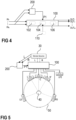
- the audio systems described above may be surround sound systems, or any kind of 3D audio systems (e.g., VR/AR applications), for example. That is, the number of audio input signals included in the first plurality of audio input signals IN 1 , ..., IN N may equal the number of audio signals included in the second plurality of audio output signals OUT 1 , ..., OUT M , as is illustrated in Figure 1 . It is, however, also possible that the number of audio input signals included in the first plurality of audio input signals IN 1 , ..., IN N is less than the number of audio signals included in the second plurality of audio output signals OUT 1 , ..., OUT M , as is schematically illustrated in Figures 4 and 5 (N ⁇ M). That is, the processing unit 100 may be or may comprise an upmixing processor 102, as is exemplarily illustrated in Figure 4 .
- a surround sound system is schematically illustrated in Figure 5 .
- the surround sound system comprises a stereo source 30.
- the processing unit 100 may receive a first plurality of audio input signals IN 1 , ..., IN N from the stereo source 30, e.g., two channels (left (L) and right (R) channel) of a stereo audio signal.
- the second plurality of audio output signals OUT 1 , ..., OUT M may be the different channels (e.g., front left (L') channel, front right (R') channel, center (C) channel, surround left (LS) channel, surround righ (RS) channel) of an upmixed 5.1 surround signal.
- a plurality of loudspeakers may be arranged in a listening environment 50.
- the loudspeakers may be arranged at suitable positions with respect to a listener 40 present in the listening environment 50.
- the different channels of the audio output signal OUT may be fed to the respective loudspeakers.
- a surround sound system as exemplarily illustrated in Figures 4 and 5 , may generate artificial spatiality (ambience) in order to achieve an acoustic envelopment of the listener 40 in the listening environment 50.
- the output signals generated by the surround sound system may be routed to the surround and height channels of a multi-channel speaker system.
- the reverberation added to the one or more audio output signals OUT 1 , ..., OUT M may be generated based on the prediction P1, e.g., by means of a reverberation engine 104, as exemplarily illustrated in Figure 4 .
- the spatial information (prediction P1) obtained and provided by the reverb classification unit 200 may be used to adjust parameters of an artificial reverb generator algorithm (reverb engine 104). That is, for different predictions P1 received from the reverb classification unit 200, a reverb engine 104 may apply different parameters when generating artificial reverberation.
- the artificially generated reverberation may be then fed to a distribution block 106 of the processing unit 100.
- the distribution block 106 may route the reverberation ("ambience" signal component) to the desired speakers (e.g., the surround and/or height speakers of a surround sound system) according to a desired upmixing setting.
- the processing unit 100 comprises or is coupled to a memory 110, wherein different types of reverberation are stored in the memory 110.
- the processing unit 100 i.e. a reverberation engine 104 of the processing unit 100, based on the prediction P1, can retrieve a suitable reverberation from the memory 110 and add it to the one or more audio output signals OUT 1 , ..., OUT M accordingly.
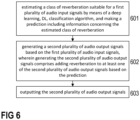
- a method comprises estimating a class of reverberation suitable for a first plurality of audio input signals IN 1 , ..., IN N by means of a deep learning, DL, classification algorithm, and make a prediction P1 including information concerning the estimated class of reverberation (step 601), and generating a second plurality of audio output signals OUT 1 , ..., OUT M based on the first plurality of audio input signals IN 1 , ..., IN N , wherein generating the second plurality of audio output signals OUT 1 , ..., OUT M comprises adding reverberation to at least one of the second plurality of audio output signals OUT 1 , ..., OUT M based on the prediction P1 (step 602).
- the method further comprises outputting the second plurality of audio output signals OUT 1 , ..., OUT M (step 603).
- estimating a class of reverberation suitable for the first plurality of audio input signals IN 1 , ..., IN N may comprise separating the first plurality of audio input signals IN 1 , ..., IN N into a plurality of successive separate frames, extracting one or more features from each of the separate frames, each of the one or more features being characteristic for one of a plurality of types of listening environments, identifying a specific pattern in each of the separate frames by means of the extracted features, and estimating a class of reverberation suitable for each of the separate frames based on the identified specific pattern.
- the method may further comprise, after separating the first plurality of audio input signals IN 1 , ..., IN N into a plurality of successive separate frames and before extracting one or more features from each of the separate frames, transforming the separate signal frames into a log-frequency spectrogram.
- the artificially generated spatiality matches the (possibly) existing spatiality present in the original audio signal (first plurality of audio input signals IN 1 , ..., IN N ). Ideally, it has the same room acoustic properties.
- Classic ambience extraction methods that may be used to extract the original ambience signal from an input signal are algorithmically complex and cause perceptually relevant artefacts.
- a multiplication and distribution of an extracted ambience signal to the speaker channels of a multi-channel system further increases the perceived artefacts.
- the audio system described above overcomes these drawbacks.
- the reverberation class information of the ambience portion of the original signal is used to control or configure an algorithm that artificially generates the output ambience signals.
- the manner in which the artificial ambience component is created is generally not relevant.
- the artificial ambience component may generally be created in any suitable way. Any type of reverb method can generally be used, e.g., Feedback Delay Networks (FDNs), convolution reverb, etc.
- FDNs Feedback Delay Networks
- the number and semantic properties of the reverb classes are adjusted, and the deep learning, DL, classification network may be trained accordingly.
- the classes may be defined based on perceptually relevant characteristics (e.g., reverberation length, density of reflections, early reflection patterns, dry/wet ratio, decay rate, spectral behavior, etc.), and the artificial reverberation algorithm may be configured accordingly. For example, if the DL network was trained to estimate reverberation lengths in the input signal, the output predictions can be used to set the same parameter in an artificial reverb engine.
Landscapes
- Physics & Mathematics (AREA)
- Engineering & Computer Science (AREA)
- Acoustics & Sound (AREA)
- Multimedia (AREA)
- Signal Processing (AREA)
- Stereophonic System (AREA)
Abstract
An audio system comprises a processing unit, and a reverb classification unit, wherein the reverb classification unit is configured to receive a first plurality of audio input signals, estimate a class of reverberation suitable for the first plurality of audio input signals by means of a deep learning, DL, classification algorithm, and output a prediction to the processing unit, the prediction including information concerning the estimated class of reverberation, and the processing unit is configured to receive the first plurality of audio input signals, generate a second plurality of audio output signals based on the first plurality of audio input signals, and output the second plurality of audio output signals, wherein generating the second plurality of audio output signals comprises adding reverberation to at least one of the second plurality of audio output signals based on the prediction received from the reverb classification unit.
Description
- The disclosure relates to an audio system and related method, in particular an audio system and method for adding reverberation to an audio signal.
- By extending an audio signal with surround or 3D information, e.g. adding a reverberation effect to an audio signal that matches a reverberation already existent in the audio signal, thereby simulating a certain listening environment, the listening experience of a user to whom the audio signal is presented can be significantly increased. An audio signal may be expanded, e.g., in the context of an upmixing process, by adding a reverberation which matches the original audio signal, or by creating additional reverberation channels or signals which match the existing audio signal. Acoustically simulating a concert hall, or any other kind of listening space by suitably adding and reproducing a matching reverberation, however, can be challenging. The resulting audio signal may comprise unwanted artifacts, may not be satisfying to listen to, and high computational load may be required to generate an extended audio signal.
- There is a need for an audio system and related method that allow to simulate a listening environment by extending an audio signal with surround or 3D information, resulting in a highly satisfying listening experience for a listener, while requiring comparably little computational load.
- An audio system includes a processing unit, and a reverb classification unit, wherein the reverb classification unit is configured to receive a first plurality of audio input signals, estimate a class of reverberation suitable for the first plurality of audio input signals by means of a deep learning, DL, classification algorithm, and output a prediction to the processing unit, the prediction including information concerning the estimated class of reverberation, and the processing unit is configured to receive the first plurality of audio input signals, generate a second plurality of audio output signals based on the first plurality of audio input signals, and output the second plurality of audio output signals, wherein generating the second plurality of audio output signals includes adding reverberation to at least one of the second plurality of audio output signals based on the prediction received from the reverb classification unit.
- A method includes estimating a class of reverberation suitable for a first plurality of audio input signals by means of a deep learning, DL, classification algorithm, and make a prediction including information concerning the estimated class of reverberation, generating a second plurality of audio output signals based on the first plurality of audio input signals, wherein generating the second plurality of audio output signals includes adding reverberation to at least one of the second plurality of audio output signals based on the prediction, and outputting the second plurality of audio output signals.
- Other systems, features and advantages of the disclosure will be or will become apparent to one with skill in the art upon examination of the following detailed description and figures. It is intended that all such additional systems, methods, features and advantages included within this description, be within the scope of the invention and be protected by the following claims.
- The arrangements and methods may be better understood with reference to the following description and drawings. The components in the figures are not necessarily to scale, emphasis instead being placed upon illustrating the principles of the invention. Moreover, in the figures, like referenced numerals designate corresponding parts throughout the different views.
-
Figure 1 schematically illustrates an audio system according to embodiments of the disclosure. -
Figure 2 schematically illustrates a reverb classification unit according to embodiments of the disclosure. -
Figure 3 schematically illustrates different steps performed in a reverb classification unit according to embodiments of the disclosure. -
Figure 4 schematically illustrates an audio system according to further embodiments of the disclosure. -
Figure 5 schematically illustrates an audio system according to further embodiments of the disclosure. -
Figure 6 schematically illustrates a method according to embodiments of the disclosure. - The audio system and related method according to the various embodiments described herein allow to simulate different listening environments by adding reverberation to an audio signal. Only comparably little computational load is required, and the resulting audio signal is highly satisfying to listen to, as it comprises only few or even no artifacts. Instead of "blindly" processing an audio signal as is done in conventional audio systems, the audio system and method disclosed herein preform an "informed" processing on an audio signal.
- Generally, by adding 3D or surround information to an audio signal, the listening experience for a user listening to the audio signal can be significantly increased. Especially multi-channel playback provides the possibility of providing the impression to the user that they are located at a certain location or event, while listening to a musical piece. Additional ambience playback can create an envelopment that can be compared to the experience of being at a live event. For example, if a center signal of a multi-channel audio signal is extracted and added to a centrally positioned speaker, an optimum listening area (so-called sweet spot) can be enlarged and the stability of the front image can be significantly improved. Using 3D speakers, the feeling of a realistic immersion into an audio event can be improved further. There is even the possibility of lifting the stage and playing back overhead effects.
- In order to improve the quality of a reproduced sound scene, the perception of the sound scene is often modeled as a combination of the foreground sound and the background sound, which are often also referred to as primary (or direct) and ambient (or diffuse) components, respectively. The primary components consist of point-like directional sound sources, whereas the ambient components are generally made up of diffuse environmental sound (reverberation). Due to perceptual differences between the primary components and the ambient components, different rendering schemes are generally applied to the primary components and the ambient components for optimal spatial audio reproduction of sound scenes. Channel-based audio, however, only provides mixed signals. Some approaches, therefore, focus on extracting the primary components and the ambient components from the mixed signals. Known methods which may include, e.g., ambience estimation in the frequency domain, often require a large computational load, and the resulting audio signal often is not satisfying to listen to, as it comprises a significant amount of artifacts.
- The audio system and related method disclosed herein, in contrast to conventional methods, use artificial intelligence (deep learning, DL) algorithms in order to classify the spatial component of an existing audio signal, and further use this information in order to create artificial reverberation that matches the original reverberation. That is, instead of extracting the ambient components from the mixed signal, an environment in which a musical piece might have been recorded is estimated by means of artificial intelligence. A musical piece generally includes a specific class of reverberation. The reverberation included in the musical piece generally has certain characteristics that are typical for the specific class of reverberation, e.g., long reverb tail, specific room modes, early reflections, etc. As a result, reverberation may be added to the audio signal that matches the reverberation included in the musical piece. That is, based on an estimated class of reverberation, for example, a matching artificial reverberation is added to the audio signal.
- Now referring to
Figure 1 , an audio system according to embodiments of the disclosure is schematically illustrated. The audio system comprises aprocessing unit 100, and areverb classification unit 200. Thereverb classification unit 200 is configured to receive a first plurality of audio input signals IN1, ..., INN, estimate a class of reverberation suitable for the first plurality of audio input signals IN1, ..., INN by means of a deep learning, DL, classification algorithm, and output a prediction P1 to theprocessing unit 100, the prediction P1 including information concerning the estimated class of reverberation. Theprocessing unit 100 is configured to receive the first plurality of audio input signals IN1, ..., INN, generate a second plurality of audio output signals OUT1, ..., OUTM based on the first plurality of audio input signals IN1, ..., INN, and output the second plurality of audio output signals OUT1, ..., OUTM, wherein generating the second plurality of audio output signals OUT1, ..., OUTM comprises adding reverberation to at least one of the second plurality of audio output signals OUT1, ..., OUTM based on the prediction P1 received from thereverb classification unit 200. - In
Figure 1 , a single input signal IN and a single output signal OUT are schematically illustrated. However, there may be more than one input signal IN, and more than one output signal OUT, as is schematically illustrated inFigure 4 , for example. According to one example, the first plurality of audio input signals IN1, ..., INN may be two channels (e.g., left (L) and right (R) channel) of a stereo audio signal. The second plurality of audio output signals OUT1, ..., OUTM may be the different channels (e.g., front left (FL) channel, front right (FR) channel, center (C) channel, surround left (LS) channel, surround right (RS) channel) of an upmixed 5.1 surround signal. Any other number N, M of input signals IN1, ..., INN and output signals OUT1, ..., OUTM, with M ≥ N, however, is also possible. Reverberation may be added to each of a plurality of audio output signals OUT1, ..., OUTM, or only to some of a plurality of audio output signals OUT1, ..., OUTM. In a 5.1 surround signal, reverberation may only be added to the surround left (LS) and surround right (RS) channels of an upmixed 5.1 surround signal, to name just one example. - The
reverb classification unit 200 is configured to estimate the class of reverberation suitable for the first plurality of audio input signals IN1, ..., INN (a class of reverberation that matches the first plurality of audio input signals IN1, ..., INN). According to some embodiments of the disclosure, estimating a class of reverberation suitable for the first plurality of audio input signals IN1, ..., INN comprises separating the first plurality of audio input signals IN1, ..., INN into a plurality of successive separate frames, extracting one or more features from each of the separate frames, each of the one or more features being characteristic for one of a plurality of types of listening environments, identifying a specific pattern in each of the separate frames by means of the extracted features, and estimating a class of reverberation suitable for each of the separate frames based on the identified specific pattern. The length of each frame may influence the accuracy of the deep learning, DL, classification algorithm and may be chosen in any suitable way. - Referring to
Figure 2 , areverb classification unit 200 according to embodiments of the disclosure is schematically illustrated. Thereverb classification unit 200 may comprise a receivingunit 202 configured to receive the first plurality of audio input signals IN1, ..., INN. Thereverb classification unit 200 may further comprise apre-processing unit 204. Thepre-processing unit 204 may be configured to, in a first step, pre-process the input audio signal according to the requirements of the deep learning, DL, classification algorithm. Thepre-processing unit 204 may re-sample the audio input signals to a target sampling rate and slice the audio input signals into frames of a defined length. The length of each frame may correspond to a desired temporal window for the output predictions. Thereverb classification unit 200 may further comprise afeature extraction unit 206 that is configured to transform the separate signal frames into a signal representation that allows the classification algorithm to more easily identify patterns in the frames, the patterns being related to an amount of reverberation present in the respective frame of the audio input signal. - Suitable signal representations may include time-frequency representations such as, e.g., log-frequency spectrograms, for example. This is schematically illustrated in
Figure 3. Figure 3 schematically illustrates that a log-frequency spectrogram may be generated for each of the different frames the audio input signal has been sliced into. A (log-frequency) spectrogram is a standard sound visualization tool, which allows to visualize the distribution of energy in both time and frequency. A log-frequency spectrogram is simply an image formed by the magnitude of the short-time Fourier transform, on a log-intensity axis (e.g., dB). - The transformed audio input signal frames (i.e. input samples) may then be processed in batches in a
classification unit 208, by means of the classification algorithm. This results in a prediction of a suitable reverberation class for each of the audio input signal segments (frames). Thereverb classification unit 200 may further comprise aprediction unit 210 that is configured to make and output the prediction P1 to theprocessing unit 100. - The
reverb classification unit 200 may be configured to make a global prediction P1 based on the estimated classes of reverberation in a defined plurality of separate successive frames. The defined plurality of separate successive frames may constitute a musical piece, and the global prediction P1 may include information concerning the estimated class of reverberation suitable for the entire musical piece. That is, a musical piece may be separated into a plurality of separate frames. A suitable reverberation may be determined for each of the plurality of separate frames. For example, a suitable reverberation may either be "high reverberation" or "low reverberation". If it is determined that within the plurality of separate frames of a musical piece the result "high reverberation" is predominant as compared to "low reverberation", high reverberation may be added to the entire musical piece, or vice versa. "High reverberation", and "low reverberation", however, are merely examples. Other classes of reverberation may include, but are not limited to, e.g., "large/medium/small Jazz hall", "large/medium/small living room", "wooden large/medium/small concert hall", etc. Other even more generic classes of reverberation may include "Hall 1", "Hall 2", "Hall 3", etc. - Alternatively, it is also possible that a sub-prediction P1 is made based on the estimated classes of reverberation in a sub-set of a defined plurality of separate successive frames. The defined plurality of separate successive frames may constitute a musical piece, and the sub-prediction P1 may include information concerning the estimated class of reverberation suitable for a fraction of the musical piece. That is, a musical piece may be separated into a plurality of separate frames. A suitable reverberation may be determined for each of the plurality of separate frames. For example, a suitable reverberation may either be "high reverberation" or "low reverberation". A different reverberation may be added to each of the different frames of the audio input signal based on the respective predictions. It is, however, also possible to make a combined prediction for several of the separate frames, but not to all.
- Referring to
Figure 3 , a suitable reverberation may be determined for each of the plurality of frames, resulting in the predictions illustrated on the right side ofFigure 3 . Several frames, e.g., frames 1 to 5 (or any other number of frames) may then be combined to a group of frames and a sub-prediction P1 may be determined and output for this group of frames. If, in the example illustrated inFigure 3 , frames 1 to 5 are combined, the result "high reverberation" is predominant. That is, the sub-prediction P1 "high reverberation" may be output to theprocessing unit 100, which may then add "high reverberation" torespective frames 1 to 5. A musical piece, however, may comprise more thanframes 1 to 5. That is, different reverberation may be added to different segments of a musical piece, each segment comprising more than one frame. This allows to add reverberation to a musical piece in a very accurate way, resulting in a very satisfying listening experience. - The deep learning, DL, classification algorithm may be based on a deep learning, DL, model, wherein the DL model is trained using annotated data consisting of audio signals with different known grades of reverberation. The DL model may learn hierarchical representations from input samples, for example. In order to be able to predict reverberation classes with a high accuracy, it may be trained with annotated data consisting of audio signals with different known grades of reverberation. The grades of reverberation may be perceptually measured, for example. One or more different databases may generally be used for this purpose. The one or more databases may be obtained in any suitable way.
- The audio systems described herein are able to directly classify an amount of reverberation present in an audio input signal, which is directly aligned with the perceptual measure for reverberation. The audio signal is highly flexible concerning the amount of reverberation classes that can be estimated. According to one example, two reverberation classes, e.g., "high reverberation" and "low reverberation" may be estimated. According to another example, three reverberation classes, e.g., "high reverberation", "mid reverberation", and "low reverberation" may be estimated, wherein "mid reverberation" is a reverberation that is less than "high reverberation" and greater than "low reverberation". Any other intermediate reverberation classes between "high reverberation" and "low reverberation" may generally be estimated as well. As mentioned above, other additional or alternative classes of reverberation may include, but are not limited to, e.g., "large/medium/small Jazz hall", "large/medium/small living room", "wooden large/medium/small concert hall", "
Hall 1", "Hall 2", "Hall 3", etc. - The audio systems described above may be surround sound systems, or any kind of 3D audio systems (e.g., VR/AR applications), for example. That is, the number of audio input signals included in the first plurality of audio input signals IN1, ..., INN may equal the number of audio signals included in the second plurality of audio output signals OUT1, ..., OUTM, as is illustrated in
Figure 1 . It is, however, also possible that the number of audio input signals included in the first plurality of audio input signals IN1, ..., INN is less than the number of audio signals included in the second plurality of audio output signals OUT1, ..., OUTM, as is schematically illustrated inFigures 4 and 5 (N < M). That is, theprocessing unit 100 may be or may comprise anupmixing processor 102, as is exemplarily illustrated inFigure 4 . - A surround sound system is schematically illustrated in
Figure 5 . The surround sound system comprises astereo source 30. Theprocessing unit 100 may receive a first plurality of audio input signals IN1, ..., INN from thestereo source 30, e.g., two channels (left (L) and right (R) channel) of a stereo audio signal. The second plurality of audio output signals OUT1, ..., OUTM may be the different channels (e.g., front left (L') channel, front right (R') channel, center (C) channel, surround left (LS) channel, surround righ (RS) channel) of an upmixed 5.1 surround signal. A plurality of loudspeakers may be arranged in a listening environment 50.The loudspeakers may be arranged at suitable positions with respect to alistener 40 present in the listeningenvironment 50. The different channels of the audio output signal OUT may be fed to the respective loudspeakers. A surround sound system as exemplarily illustrated inFigures 4 and 5 , may generate artificial spatiality (ambience) in order to achieve an acoustic envelopment of thelistener 40 in the listeningenvironment 50. The output signals generated by the surround sound system may be routed to the surround and height channels of a multi-channel speaker system. - The reverberation added to the one or more audio output signals OUT1, ..., OUTM may be generated based on the prediction P1, e.g., by means of a
reverberation engine 104, as exemplarily illustrated inFigure 4 . For example, the spatial information (prediction P1) obtained and provided by thereverb classification unit 200 may be used to adjust parameters of an artificial reverb generator algorithm (reverb engine 104). That is, for different predictions P1 received from thereverb classification unit 200, areverb engine 104 may apply different parameters when generating artificial reverberation. The artificially generated reverberation may be then fed to adistribution block 106 of theprocessing unit 100. Thedistribution block 106 may route the reverberation ("ambience" signal component) to the desired speakers (e.g., the surround and/or height speakers of a surround sound system) according to a desired upmixing setting. - It is, however, also possible that the
processing unit 100 comprises or is coupled to amemory 110, wherein different types of reverberation are stored in thememory 110. Theprocessing unit 100, i.e. areverberation engine 104 of theprocessing unit 100, based on the prediction P1, can retrieve a suitable reverberation from thememory 110 and add it to the one or more audio output signals OUT1, ..., OUTM accordingly. - Referring to
Figure 6 , a method according to embodiments of the disclosure comprises estimating a class of reverberation suitable for a first plurality of audio input signals IN1, ..., INN by means of a deep learning, DL, classification algorithm, and make a prediction P1 including information concerning the estimated class of reverberation (step 601), and generating a second plurality of audio output signals OUT1, ..., OUTM based on the first plurality of audio input signals IN1, ..., INN, wherein generating the second plurality of audio output signals OUT1, ..., OUTM comprises adding reverberation to at least one of the second plurality of audio output signals OUT1, ..., OUTM based on the prediction P1 (step 602). The method further comprises outputting the second plurality of audio output signals OUT1, ..., OUTM (step 603). - According to some embodiments of the disclosure, estimating a class of reverberation suitable for the first plurality of audio input signals IN1, ..., INN may comprise separating the first plurality of audio input signals IN1, ..., INN into a plurality of successive separate frames, extracting one or more features from each of the separate frames, each of the one or more features being characteristic for one of a plurality of types of listening environments, identifying a specific pattern in each of the separate frames by means of the extracted features, and estimating a class of reverberation suitable for each of the separate frames based on the identified specific pattern.
- According to some embodiments, the method may further comprise, after separating the first plurality of audio input signals IN1, ..., INN into a plurality of successive separate frames and before extracting one or more features from each of the separate frames, transforming the separate signal frames into a log-frequency spectrogram.
- The artificially generated spatiality matches the (possibly) existing spatiality present in the original audio signal (first plurality of audio input signals IN1, ..., INN). Ideally, it has the same room acoustic properties. Classic ambience extraction methods that may be used to extract the original ambience signal from an input signal are algorithmically complex and cause perceptually relevant artefacts. A multiplication and distribution of an extracted ambience signal to the speaker channels of a multi-channel system further increases the perceived artefacts. The audio system described above overcomes these drawbacks. The reverberation class information of the ambience portion of the original signal is used to control or configure an algorithm that artificially generates the output ambience signals. The manner in which the artificial ambience component is created is generally not relevant. The artificial ambience component may generally be created in any suitable way. Any type of reverb method can generally be used, e.g., Feedback Delay Networks (FDNs), convolution reverb, etc.
- Based on the requirements of the specific application (e.g., upmix technology), the number and semantic properties of the reverb classes are adjusted, and the deep learning, DL, classification network may be trained accordingly. Further, the classes may be defined based on perceptually relevant characteristics (e.g., reverberation length, density of reflections, early reflection patterns, dry/wet ratio, decay rate, spectral behavior, etc.), and the artificial reverberation algorithm may be configured accordingly. For example, if the DL network was trained to estimate reverberation lengths in the input signal, the output predictions can be used to set the same parameter in an artificial reverb engine.
- It may be understood, that the illustrated systems are merely examples. While various embodiments of the invention have been described, it will be apparent to those of ordinary skill in the art that many more embodiments and implementations are possible within the scope of the invention. In particular, the skilled person will recognize the interchangeability of various features from different embodiments. Although these techniques and systems have been disclosed in the context of certain embodiments and examples, it will be understood that these techniques and systems may be extended beyond the specifically disclosed embodiments to other embodiments and/or uses and obvious modifications thereof. Accordingly, the invention is not to be restricted except in light of the attached claims and their equivalents.
- The description of embodiments has been presented for purposes of illustration and description. Suitable modifications and variations to the embodiments may be performed in light of the above description or may be acquired from practicing the methods. The described arrangements are exemplary in nature, and may include additional elements and/or omit elements. As used in this application, an element recited in the singular and proceeded with the word "a" or "an" should be understood as not excluding plural of said elements, unless such exclusion is stated. Furthermore, references to "one embodiment" or "one example" of the present disclosure are not intended to be interpreted as excluding the existence of additional embodiments that also incorporate the recited features. The terms "first," "second," and "third," etc. are used merely as labels, and are not intended to impose numerical requirements or a particular positional order on their objects. The described systems are exemplary in nature, and may include additional elements and/or omit elements. The subject matter of the present disclosure includes all novel and non-obvious combinations and subcombinations of the various systems and configurations, and other features, functions, and/or properties disclosed. The following claims particularly point out subject matter from the above disclosure that is regarded as novel and non-obvious.
Claims (15)
- An audio system comprisesa processing unit (100); anda reverb classification unit (200), whereinthe reverb classification unit (200) is configured to receive a first plurality of audio input signals (IN1, ..., INN), estimate a class of reverberation suitable for the first plurality of audio input signals (IN1, ..., INN) by means of a deep learning, DL, classification algorithm, and output a prediction (P1) to the processing unit (100), the prediction (P1) including information concerning the estimated class of reverberation, andthe processing unit (100) is configured to receive the first plurality of audio input signals (IN1, ..., INN), generate a second plurality of audio output signals (OUT1, ..., OUTM) based on the first plurality of audio input signals (IN1, ..., INN), and output the second plurality of audio output signals (OUT1, ..., OUTM), wherein generating the second plurality of audio output signals (OUT1, ..., OUTM) comprises adding reverberation to at least one of the second plurality of audio output signals (OUT1, ..., OUTM) based on the prediction (P1) received from the reverb classification unit (200).
- The audio system of claim 1, wherein estimating a class of reverberation suitable for the first plurality of audio input signals (IN1, ..., INN) comprisesseparating the first plurality of audio input signals (IN1, ..., INN) into a plurality of successive separate frames,extracting one or more features from each of the separate frames, each of the one or more features being characteristic for one of a plurality of types of listening environments,identifying a specific pattern in each of the separate frames by means of the extracted features, andestimating a class of reverberation suitable for each of the separate frames based on the identified specific pattern.
- The audio system of claim 2, further comprising, after separating the first plurality of audio input signals (IN1, ..., INN) into a plurality of successive separate frames and before extracting one or more features from each of the separate frames, transforming each frame of the plurality of successive separate frames into a log-frequency spectrogram.
- The audio system of claim 2 or 3, further comprising making a global prediction (P1) based on the estimated classes of reverberation in a defined plurality of separate successive frames.
- The audio system of claim 4, wherein the defined plurality of separate successive frames constitute a musical piece, and the global prediction (P1) includes information concerning the estimated class of reverberation suitable for the musical piece.
- The audio system of claim 2 or 3, further comprising making a sub-prediction (P1) based on the estimated classes of reverberation in a sub-set of a defined plurality of separate successive frames.
- The audio system of claim 6, wherein the defined plurality of separate successive frames constitute a musical piece, and the sub-prediction (P1) includes information concerning the estimated class of reverberation suitable for a fraction of the musical piece.
- The audio system of any of the preceding claims, wherein the number of audio input signals included in the first plurality of audio input signals (IN1, ..., INN) equals the number of audio signals included in the second plurality of audio output signals (OUT1, ..., OUTM).
- The audio system of any of the preceding claims, wherein the number of audio input signals included in the first plurality of audio input signals (IN1, ..., INN) is less than the number of audio signals included in the second plurality of audio output signals (OUT1, ..., OUTM).
- The audio system of claim 9, wherein the first plurality of audio input signals (IN1, ..., INN) consists of two channels (L, R) of a stereo audio signal, and wherein the second plurality of audio output signals (OUT1, ..., OUTM) consists of five channels (FL, FR, C, LS, RS) of an upmixed 5.1 surround signal.
- The audio system of any of the preceding claims, wherein the deep learning, DL, classification algorithm is based on a deep learning, DL, model, wherein the DL model is trained using annotated data consisting of audio signals with different known grades of reverberation.
- The audio system of any of the preceding claims, wherein the estimated class of reverberation suitable for the first plurality of audio input signals (IN1, ..., INN) is one of low reverberation, mid reverberation, and high reverberation.
- A method comprises:estimating a class of reverberation suitable for a first plurality of audio input signals (IN1, ..., INN) by means of a deep learning, DL, classification algorithm, and make a prediction (P1) including information concerning the estimated class of reverberation,generating a second plurality of audio output signals (OUT1, ..., OUTM) based on the first plurality of audio input signals (IN1, ..., INN), wherein generating the second plurality of audio output signals (OUT1, ..., OUTM) comprises adding reverberation to at least one of the second plurality of audio output signals (OUT1, ..., OUTM) based on the prediction (P1), andand outputting the second plurality of audio output signals (OUT1, ..., OUTM).
- The method of claim 13, wherein estimating a class of reverberation suitable for the first plurality of audio input signals (IN1, ..., INN) comprisesseparating the first plurality of audio input signals (IN1, ..., INN) into a plurality of successive separate frames,extracting one or more features from each of the separate frames, each of the one or more features being characteristic for one of a plurality of types of listening environments,identifying a specific pattern in each of the separate frames by means of the extracted features, andestimating a class of reverberation suitable for each of the separate frames based on the identified specific pattern.
- The method of claim 14, further comprising, after separating the first plurality of audio input signals (IN1, ..., INN) into a plurality of successive separate frames and before extracting one or more features from each of the separate frames, transforming the separate signal frames into a log-frequency spectrogram.
Priority Applications (3)
| Application Number | Priority Date | Filing Date | Title |
|---|---|---|---|
| EP23212578.1A EP4564347A1 (en) | 2023-11-28 | 2023-11-28 | Audio system and method |
| CN202411626001.7A CN120075696A (en) | 2023-11-28 | 2024-11-14 | Audio system and method |
| US18/957,031 US20250174221A1 (en) | 2023-11-28 | 2024-11-22 | Audio system and method |
Applications Claiming Priority (1)
| Application Number | Priority Date | Filing Date | Title |
|---|---|---|---|
| EP23212578.1A EP4564347A1 (en) | 2023-11-28 | 2023-11-28 | Audio system and method |
Publications (1)
| Publication Number | Publication Date |
|---|---|
| EP4564347A1 true EP4564347A1 (en) | 2025-06-04 |
Family
ID=88978278
Family Applications (1)
| Application Number | Title | Priority Date | Filing Date |
|---|---|---|---|
| EP23212578.1A Pending EP4564347A1 (en) | 2023-11-28 | 2023-11-28 | Audio system and method |
Country Status (3)
| Country | Link |
|---|---|
| US (1) | US20250174221A1 (en) |
| EP (1) | EP4564347A1 (en) |
| CN (1) | CN120075696A (en) |
Citations (2)
| Publication number | Priority date | Publication date | Assignee | Title |
|---|---|---|---|---|
| WO2019229199A1 (en) * | 2018-06-01 | 2019-12-05 | Sony Corporation | Adaptive remixing of audio content |
| US20210160617A1 (en) * | 2019-11-27 | 2021-05-27 | Roku, Inc. | Sound generation with adaptive directivity |
Family Cites Families (2)
| Publication number | Priority date | Publication date | Assignee | Title |
|---|---|---|---|---|
| US11190898B2 (en) * | 2019-11-05 | 2021-11-30 | Adobe Inc. | Rendering scene-aware audio using neural network-based acoustic analysis |
| EP4247011A1 (en) * | 2022-03-16 | 2023-09-20 | Fraunhofer-Gesellschaft zur Förderung der angewandten Forschung e.V. | Apparatus and method for an automated control of a reverberation level using a perceptional model |
-
2023
- 2023-11-28 EP EP23212578.1A patent/EP4564347A1/en active Pending
-
2024
- 2024-11-14 CN CN202411626001.7A patent/CN120075696A/en active Pending
- 2024-11-22 US US18/957,031 patent/US20250174221A1/en active Pending
Patent Citations (2)
| Publication number | Priority date | Publication date | Assignee | Title |
|---|---|---|---|---|
| WO2019229199A1 (en) * | 2018-06-01 | 2019-12-05 | Sony Corporation | Adaptive remixing of audio content |
| US20210160617A1 (en) * | 2019-11-27 | 2021-05-27 | Roku, Inc. | Sound generation with adaptive directivity |
Non-Patent Citations (2)
| Title |
|---|
| ANONYMOUS: "Get started with smart:reverb - sonible", 10 August 2020 (2020-08-10), pages 1 - 6, XP093155376, Retrieved from the Internet <URL:https://www.sonible.com/blog/smartreverb-intro-tutorial/> [retrieved on 20240424] * |
| SAFAVI SAEID ET AL: "Predicting the perceived level of reverberation using machine learning", 2018 52ND ASILOMAR CONFERENCE ON SIGNALS, SYSTEMS, AND COMPUTERS, IEEE, 28 October 2018 (2018-10-28), pages 27 - 30, XP033520980, DOI: 10.1109/ACSSC.2018.8645201 * |
Also Published As
| Publication number | Publication date |
|---|---|
| CN120075696A (en) | 2025-05-30 |
| US20250174221A1 (en) | 2025-05-29 |
Similar Documents
| Publication | Publication Date | Title |
|---|---|---|
| JP5149968B2 (en) | Apparatus and method for generating a multi-channel signal including speech signal processing | |
| US10645518B2 (en) | Distributed audio capture and mixing | |
| CN112205006B (en) | Adaptive remixing of audio content | |
| CN103402169B (en) | For extracting and change the method and apparatus of reverberation content of audio input signal | |
| KR101471798B1 (en) | Apparatus and method for decomposing an input signal using downmixer | |
| RU2650026C2 (en) | Device and method for multichannel direct-ambient decomposition for audio signal processing | |
| JP5957446B2 (en) | Sound processing system and method | |
| KR101764175B1 (en) | Method and apparatus for reproducing stereophonic sound | |
| KR101646540B1 (en) | Converter and method for converting an audio signal | |
| CN115226022B (en) | Content-based spatial remixing | |
| US12363494B2 (en) | Signal processing apparatus and method | |
| CN114631142B (en) | Electronic device, method and computer program | |
| RU2768974C2 (en) | Audio signal processor, a system and methods for distributing an ambient signal to a plurality of ambient signal channels | |
| EP2946573B1 (en) | Audio signal processing apparatus | |
| Ibrahim et al. | Primary-ambient source separation for upmixing to surround sound systems | |
| US12014710B2 (en) | Device, method and computer program for blind source separation and remixing | |
| Hsu et al. | Model-matching principle applied to the design of an array-based all-neural binaural rendering system for audio telepresence | |
| US20250174221A1 (en) | Audio system and method | |
| Pawlak et al. | Spatial segmentation of an early part of the room impulse response into prominent sound events | |
| Negru et al. | Automatic audio upmixing based on source separation and ambient extraction algorithms | |
| JP2001236084A (en) | Acoustic signal processing device and signal separation device used therefor | |
| WO2025186171A1 (en) | Method for processing audio and audio processing system | |
| Ibrahim | PRIMARY-AMBIENT SEPARATION OF AUDIO SIGNALS | |
| AU2015255287B2 (en) | Apparatus and method for generating an output signal employing a decomposer | |
| CN120917772A (en) | Method for multi-channel audio reconstruction and speaker system using the same |
Legal Events
| Date | Code | Title | Description |
|---|---|---|---|
| PUAI | Public reference made under article 153(3) epc to a published international application that has entered the european phase |
Free format text: ORIGINAL CODE: 0009012 |
|
| STAA | Information on the status of an ep patent application or granted ep patent |
Free format text: STATUS: THE APPLICATION HAS BEEN PUBLISHED |
|
| AK | Designated contracting states |
Kind code of ref document: A1 Designated state(s): AL AT BE BG CH CY CZ DE DK EE ES FI FR GB GR HR HU IE IS IT LI LT LU LV MC ME MK MT NL NO PL PT RO RS SE SI SK SM TR |
|
| STAA | Information on the status of an ep patent application or granted ep patent |
Free format text: STATUS: REQUEST FOR EXAMINATION WAS MADE |
|
| 17P | Request for examination filed |
Effective date: 20251118 |