EP4563126A2 - Herzklappenprothese - Google Patents
Herzklappenprothese Download PDFInfo
- Publication number
- EP4563126A2 EP4563126A2 EP25157086.7A EP25157086A EP4563126A2 EP 4563126 A2 EP4563126 A2 EP 4563126A2 EP 25157086 A EP25157086 A EP 25157086A EP 4563126 A2 EP4563126 A2 EP 4563126A2
- Authority
- EP
- European Patent Office
- Prior art keywords
- struts
- frame
- segments
- recessed portions
- seated
- Prior art date
- Legal status (The legal status is an assumption and is not a legal conclusion. Google has not performed a legal analysis and makes no representation as to the accuracy of the status listed.)
- Pending
Links
Images




Classifications
-
- A—HUMAN NECESSITIES
- A61—MEDICAL OR VETERINARY SCIENCE; HYGIENE
- A61F—FILTERS IMPLANTABLE INTO BLOOD VESSELS; PROSTHESES; DEVICES PROVIDING PATENCY TO, OR PREVENTING COLLAPSING OF, TUBULAR STRUCTURES OF THE BODY, e.g. STENTS; ORTHOPAEDIC, NURSING OR CONTRACEPTIVE DEVICES; FOMENTATION; TREATMENT OR PROTECTION OF EYES OR EARS; BANDAGES, DRESSINGS OR ABSORBENT PADS; FIRST-AID KITS
- A61F2/00—Filters implantable into blood vessels; Prostheses, i.e. artificial substitutes or replacements for parts of the body; Appliances for connecting them with the body; Devices providing patency to, or preventing collapsing of, tubular structures of the body, e.g. stents
- A61F2/02—Prostheses implantable into the body
- A61F2/24—Heart valves ; Vascular valves, e.g. venous valves; Heart implants, e.g. passive devices for improving the function of the native valve or the heart muscle; Transmyocardial revascularisation [TMR] devices; Valves implantable in the body
- A61F2/2412—Heart valves ; Vascular valves, e.g. venous valves; Heart implants, e.g. passive devices for improving the function of the native valve or the heart muscle; Transmyocardial revascularisation [TMR] devices; Valves implantable in the body with soft flexible valve members, e.g. tissue valves shaped like natural valves
- A61F2/2418—Scaffolds therefor, e.g. support stents
-
- A—HUMAN NECESSITIES
- A61—MEDICAL OR VETERINARY SCIENCE; HYGIENE
- A61F—FILTERS IMPLANTABLE INTO BLOOD VESSELS; PROSTHESES; DEVICES PROVIDING PATENCY TO, OR PREVENTING COLLAPSING OF, TUBULAR STRUCTURES OF THE BODY, e.g. STENTS; ORTHOPAEDIC, NURSING OR CONTRACEPTIVE DEVICES; FOMENTATION; TREATMENT OR PROTECTION OF EYES OR EARS; BANDAGES, DRESSINGS OR ABSORBENT PADS; FIRST-AID KITS
- A61F2/00—Filters implantable into blood vessels; Prostheses, i.e. artificial substitutes or replacements for parts of the body; Appliances for connecting them with the body; Devices providing patency to, or preventing collapsing of, tubular structures of the body, e.g. stents
- A61F2/02—Prostheses implantable into the body
- A61F2/24—Heart valves ; Vascular valves, e.g. venous valves; Heart implants, e.g. passive devices for improving the function of the native valve or the heart muscle; Transmyocardial revascularisation [TMR] devices; Valves implantable in the body
- A61F2/2427—Devices for manipulating or deploying heart valves during implantation
- A61F2/243—Deployment by mechanical expansion
-
- A—HUMAN NECESSITIES
- A61—MEDICAL OR VETERINARY SCIENCE; HYGIENE
- A61F—FILTERS IMPLANTABLE INTO BLOOD VESSELS; PROSTHESES; DEVICES PROVIDING PATENCY TO, OR PREVENTING COLLAPSING OF, TUBULAR STRUCTURES OF THE BODY, e.g. STENTS; ORTHOPAEDIC, NURSING OR CONTRACEPTIVE DEVICES; FOMENTATION; TREATMENT OR PROTECTION OF EYES OR EARS; BANDAGES, DRESSINGS OR ABSORBENT PADS; FIRST-AID KITS
- A61F2220/00—Fixations or connections for prostheses classified in groups A61F2/00 - A61F2/26 or A61F2/82 or A61F9/00 or A61F11/00 or subgroups thereof
- A61F2220/0025—Connections or couplings between prosthetic parts, e.g. between modular parts; Connecting elements
- A61F2220/0091—Connections or couplings between prosthetic parts, e.g. between modular parts; Connecting elements connected by a hinged linkage mechanism, e.g. of the single-bar or multi-bar linkage type
Definitions
- the application relates to prosthetic heart valves, and to associated systems and methods.
- a mechanical frame for a prosthetic heart valve include a plurality of crossing struts, attached to each other at junctions and forming a grid.
- the grid of struts forms the wall of the frame that is essentially cylindrical but may vary from a perfect cylinder per any specific frame design.
- This grid has two layers of struts -- radially inner layer and radially outer layer. All struts in each layer are essentially parallel to each other and cross the struts of the other layer. All inner faces of the inner layer struts form the inner diameter face of the frame. All outer faces of the outer layer struts form the outer diameter face of the frame.
- Prosthetic valves disclosed herein can be implanted within any of the native valves of the heart (e.g., the aortic, mitral, tricuspid and pulmonary valves).
- the prosthetic valve can be delivered through the vasculature and implanted to the heart of a patient by using a delivery apparatus, such as a catheter-based delivery apparatus.
- Frames disclosed herein may also be used for prosthetic valves in other conduits of the body, or as stents without a valve structure.
- the assembly can include a radially expandable and compressible annular frame.
- the frames can be expanded within an implant location by applying radially outward forces on the frame, such as by a balloon or mechanical means, or by applying circumferential separation forces on the frame, or by applying axial shortening forces on the frame.
- the frame can include a plurality of interconnected struts.
- the plurality of interconnected struts can include a plurality of inner struts and a plurality of outer struts.
- the inner struts can overlap adjacent outer struts at a plurality of pivot joints, coupled together with pins or other fasteners that permit the struts to pivot relative to each other.
- the interconnected struts can be arrayed in a lattice or grid, which each strut extending diagonally or helically around the frame. Radial expansion or compression of the annular frame can cause the inner struts to pivot relative to the outer struts at the pivot joints.
- FIG. 1 shows an entire prosthetic valve using a mechanical frame comprising interconnected struts pivotably coupled at pivot joints
- FIGS. 2A and 2B show just the frame and illustrate the radially expanded and compressed configurations
- FIGS. 3 and 4 show examples of how other components are attached the frame
- FIGS. 6A and 6B show individual struts
- FIG. 6C shows a pivot joint in detail.
- Other components and details of the valves and frames are also described in U.S.
- Provisional Application 62/854,702 such as the valve leaflets, inner skirts, outer skirts, frame expansion mechanisms, delivery devices, exemplary materials and dimensions, and related methods of assembly and use.
- the valves and frames disclosed herein can have an analogous structure to those illustrated in U.S. Provisional Application 62/854,702 , except as described herein.
- Further details regarding transcatheter prosthetic heart valves, including the manner in which the valvular structure can be mounted to the frame of the prosthetic valve can be found, for example, in U.S. Patent Nos. 6,730,118, 7,393,360, 7,510,575, 7,993,394 , and 8,252,202 , and U.S. Publication No.
- At least some of the struts comprise recessed portions at the pivot joints and segments of others of the struts are seated in the recessed portions at the pivot joints.
- at least some of the outer struts comprise recessed portions and segments of at least some of the inner struts are seated in the recessed portions, and in some embodiments at least some of the inner struts comprise recessed portions and segments of at least some of the outer struts are seated in the recessed portions.
- at least some of the inner struts comprise recessed portions that receive segments of the outer struts and at least some of the outer struts comprise recessed portions that receive segments of the inner struts.
- the pivot joints where the segments are seated in the recessed portions can be configured such that they have a generally continuous inner or outer surface, which can facilitate attachment of leaflets or skirts to the frame and provide other benefits.
- the pivot joints where the segments are seated in the recessed portions have a generally continuous inner surface, such that inner surfaces of the seated segments and adjacent inner surfaces the struts joined to the seated segments have about equal radial dimensions from a centerline of the frame. This can help with attachment of the leaflets and inner skirt to the inside of the frame.
- the pivot joints where the segments are seated in the recessed portions have a generally continuous outer surface, such that outer surfaces of the seated segments and adjacent outer surfaces the struts joined to the seated segments have about equal radial dimensions from a centerline of the frame. This can help with attachment of an out skirt and/or help prevent perivalvular leakage.
- the struts can comprise multiple recessed portions located at respective pivot joints and segments of all the crossing struts can be seated in the recessed portions at the respective pivot joints.
- the recesses defined by the recessed portions can be sized to receive the crossing strut segments while allowing for pivoting motion between the struts.
- the recesses of the recessed portions can have a radial depth that is about equal to the radial thickness of the segments seated in the recessed portions, such that their radially facing surfaces can be flush or coplanar, providing a continuous overall frame surface.
- the recesses of the recessed portions can have a length that is greater that a width of the segments seated in the recessed portions to allow room for the seated segments to pivot within the recesses.
- prosthetic heart valves that can be implanted within any of the native valves of the heart (e.g., the aortic, mitral, tricuspid and pulmonary valves).
- the present disclosure also provides frames for use with such prosthetic implants.
- Prosthetic valves disclosed herein can be radially compressible and expandable between a radially compressed state and a radially expanded state.
- the prosthetic valves can be retained by an implant delivery apparatus in the radially compressed state during delivery, and then expanded to the radially expanded state once the prosthetic valve reaches the implantation site.
- Each leaflet can be connected to an inner strut at one edge, and to an outer strut at its other edge.
- the edge of the leaflet connected to the inner strut can be attached to a uniform surface, while the edge connected to an outer strut is on a non-uniform surface (e.g., "zig-zags" along a changing diameter relative to the center of the frame, since it must "climb" over the crossing inner struts).
- Such a pattern can affect the accuracy and uniformity of leaflet attachment because: (a) it can create folds in the leaflet that alter its shape and interfere with its motion ability, and (b) attachment to different diameters can create asymmetric leaflets such that leaflets coaptation is less than optimal.
- the total wall thickness of the frame can be equal to or greater than twice the thickness of a strut, which is a significant factor in crimping.
- (4) In designs that do not include an outer cloth component or a perivalvular seal component, it is likely to result in the parallel outer struts forming channels of perivalvular leakage
- Valve frames disclosed herein can include struts that have recessed intermediate segments that are configured to accommodate a respective straight intermediate segment of an adjacent crossing strut. Junctions between the crossing struts may bulge along only one surface (outer or inner) of the frame, while the opposite surface remains relatively flat or continuous.
- Determination of which surface is provided as a flat/continuous surface can be based on the arrangement of the crossing struts.
- the outer struts can be formed with recessed intermediate segments, overlaid over "straight" inner struts, so as to form an inner continuous surface, thereby enabling both edges of the leaflets to attach to continuous inner surfaces of an equal diameter.
- the inner struts can be formed with recessed intermediate segments, overlaid over "straight" outer struts, so as to form an outer continuous surface, thereby enabling providing additional free luminal volume in the crimped frame, to accommodate inner soft components.
- Recessed portions of a strut can be formed by punching a straight strut at the desired regions. Both geometries (of a continuous outer surface or a continuous inner surface) can provide a tight interface with the anatomy of the blood vessel's wall, resulting in a one layer grid that does not form leak channels.
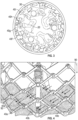
- Figs. 1A and 1B show a frame 10 of a prosthetic heart valve comprising a plurality of interconnected struts 40a, 40b, 40c, 40d, etc.
- Figs. 2A and 2B show schematic representations of the frame 10.
- the struts each include a plurality of segments disposed between two end portions thereof, and intermediate segments 42a, 42b, etc. disposed between each couple of adjacent segments in a strut.
- the end portions and the intermediate segments of each strut can comprise apertures, through which the struts can be connected to each other, for example via fasteners such as pins passing through the apertures, to form pivot junctions J1, J2, etc.
- fasteners such as pins passing through the apertures
- the width of the junctions J1, J2 is twice the width of a single strut, and the resulting frame geometry forms uneven outer and/or inner surfaces, wherein the junctions bulge radially relative to the straight segments of the struts.
- Fig. 2A illustrates how the frame bulges at junctions J1, J2, J3.
- Figs. 1A-1B show a valve leaflet 20 attached to a skirt portion or a cloth at scallop suture line 22, and an outer skirt 30, wherein the leaflet 20 and the outer skirt 30 are attached to an outer strut 40a of the frame 10 via suture loops 32a, 32b, etc., and wherein the leaflet 20 contacts an inner surface of the frame 10 and the outer skirt 30 contacts an outer surface of the frame 10.
- Fig. 1A shows an example of an overlapping outer strut 40a and inner strut 40b, connected to each other at a junction J1, such that the junction J1 bulges radially inwards, i.e. towards a centerline 12 (see Fig. 2B ) of the frame 10.
- An edge of the leaflet 20 is attached via suture loops 32a, 32b to the outer strut 40a, and the radial inward bulging of junction J1 between the suture loops 32a and 32b forms a noncontinuous interface between the leaflet 20 and the strut 40a.
- Fig. 1B shows an example of overlapping inner strut 40c and outer strut 40d connected to each other at a pivot junction J2, such that the junction J2 bulges radially outwards.
- An edge of the leaflet 20 is attached via suture loops 32c, 32d to the inner strut 40c, and a continuous interface is formed between the leaflet 20 and the strut 40a at this region.
- the radially outward bulging of junction J2 between the suture loops 32c and 32d creates a non-continuous interface between the outer skirt 30 and the strut 40c.
- Fig. 2B shows a further challenge of the structure of the frame 10, wherein during crimping of the frame 10, the position of adjacent struts 40, such as struts 40f, 40g, 40g, 40i, may change such that they approach each other while the frame 10 is compressed or crimped, thereby creating undesired folds of either the leaflets 20 or the outer skirt 30 attached thereto, and may even exert scissor-like shearing forces that may further damage the leaflets 20 or outer skirt 30.
- the position of adjacent struts 40 such as struts 40f, 40g, 40g, 40i
- Fig. 3 shows a cross-sectional view of the radial displacement of adjacent struts 40f, 40g, 40g, 40i during compression of the valve, which may exert shearing forces that may damage the tissues of the leaflets 20 or the skirt 30.
- Fig. 4 shows an exemplary prosthetic heart valve wherein the outer skirt is not included.
- the leaflets in the embodiment of Fig. 4 are connected to the frame via an inner skirt.
- a disadvantage of this design is that leak channels may form between parallel outer struts 40a and the surrounding blood vessel wall the valve is expanded against, directing blood flow through such channels in the direction of arrows 92, thereby resulting in an overall perivalvular leak flow in the direction of arrow 90.
- Novel frames disclosed herein can provide an improved strut geometry wherein some or all of the intermediate strut segments are bent to form recessed intermediate segments, configured to accommodate straight or also bent intermediate segments of overlapping struts.
- Fig. 5 shows a schematic representation of a straight strut segment 40 overlaid over a bent strut 50 that has a recessed intermediate segment 52, such that an intermediate segment 44 of the straight strut is received within and coupled to the recessed intermediate segment 52 at a junction JN.
- each end portion of the bent strut 50 can also include a recessed end portion.
- recessed intermediate segments 52 or recessed end portions can be formed by providing a straight strut and punching it (e.g., plastically deforming it) at the regions of such desirable recesses.
- relatively straight struts are overlaid over struts having recessed intermediate segments such that at least one surface of the resulting frame is continuous or flush, such that the continuous surface does not include any substantial radial protrusion at the junctions JN (as well as at the apices).
- a strut 50 having recessed intermediate segments is coupled to struts 40, such that while the junctions JN1 and JN2 bulge towards one side (lower side in this view, radially outer side of frame), the surface of the opposite side (upper side in this view, radially inner side of frame) remains substantially continuous adjacent to the leaflet 20.
- a frame is formed by connecting a set or layer of parallel outer struts 50 having recessed intermediate segments 52, with a set or layer of parallel crossing inner (straight) struts 40, in the manner shown in FIG. 6A , such that the inner surface of the frame is substantially continuous adjacent to the leaflet 20.
- the leaflets 20 can be connected via both of the edges to a continuous inner surface of the frame in such a geometry.
- a frame is formed by connecting a set or layer of parallel inner struts 50 having recessed intermediate segments 52, with a set or layer of parallel crossing outer (straight) struts 40, such that the outer surface of the frame is substantially continuous.
- additional free inner volume may be achieved in the crimped frame of such a geometry, to accommodate inner soft components such as the leaflets and the inner skirt.
- a further advantage of the disclosed embodiments is that they can enable adoption of a prosthetic heart valve that lacks an outer skirt, without the risk of leak channels forming along the outer surface of the frame. This may be accomplished at both proposed assemblages mentioned above, such that: (a) if the outer surface is continuous (i.e. junctions JN are bulging inwardly towards the lumen of the frame), no space will be formed between a frame fully expanded against the blood vessel's wall, thereby avoiding formation of leak channels, and (b) if the inner surface is continuous (i.e. junctions JN are bulging outwards the blood vessel's wall), the frame can be further expanded such that the junctions JN press against the blood vessel's wall (i.e. slightly penetrate the inner surface of the blood vessel), until the segments of the struts are tightly pressed against the blood vessel's wall, thereby avoiding formation of leak channels there between.
- a further advantage of the disclosed technology is that the risk of shear forces acting on the leaflet or the skirt (see e.g., Figs. 2B and 3 ) during compression or crimping is mitigated.
- Fig. 6B as adjacent struts 40 and 50 are approaching each other along the same circumferential plane during frame compression, thereby avoiding shearing of the soft layers disposed there between while substantially avoiding the radial displacement between adjacent struts which may result in detrimental shear or "scissor"-like forces.
- the disclosed embodiments can be adapted for delivering and implanting prosthetic devices in any of the native annuluses of the heart (e.g., the aortic, pulmonary, mitral, and tricuspid annuluses), and can be used with any of various delivery devices for delivering the prosthetic valve using any of various delivery approaches (e.g., retrograde, antegrade, transseptal, transventricular, transatrial, etc.).
- the native annuluses of the heart e.g., the aortic, pulmonary, mitral, and tricuspid annuluses
- delivery approaches e.g., retrograde, antegrade, transseptal, transventricular, transatrial, etc.
- valves and frames disclosed herein are described using an axial direction defined by the centerline of the annular frame and the overall bloodflow direction from an inflow end to an outflow end, a radial direction that is defined as radiating perpendicularly from the centerline of the frame, and a circumferential direction that is perpendicular to the axial and radial directions and extends around the centerline of the frame.
- inner refers to objects, surfaces and areas proximal to the centerline of the frame and the term “outer” refers objects, surfaces and areas that are farther from the centerline of the frame.
Landscapes
- Health & Medical Sciences (AREA)
- Cardiology (AREA)
- Engineering & Computer Science (AREA)
- Biomedical Technology (AREA)
- Oral & Maxillofacial Surgery (AREA)
- Transplantation (AREA)
- Heart & Thoracic Surgery (AREA)
- Vascular Medicine (AREA)
- Life Sciences & Earth Sciences (AREA)
- Animal Behavior & Ethology (AREA)
- General Health & Medical Sciences (AREA)
- Public Health (AREA)
- Veterinary Medicine (AREA)
- Mechanical Engineering (AREA)
- Prostheses (AREA)
Applications Claiming Priority (3)
| Application Number | Priority Date | Filing Date | Title |
|---|---|---|---|
| US201962893621P | 2019-08-29 | 2019-08-29 | |
| EP20767676.8A EP4021348B1 (de) | 2019-08-29 | 2020-08-24 | Herzklappenprothesen |
| PCT/US2020/047593 WO2021041294A1 (en) | 2019-08-29 | 2020-08-24 | Prosthetic heart valves |
Related Parent Applications (1)
| Application Number | Title | Priority Date | Filing Date |
|---|---|---|---|
| EP20767676.8A Division EP4021348B1 (de) | 2019-08-29 | 2020-08-24 | Herzklappenprothesen |
Publications (2)
| Publication Number | Publication Date |
|---|---|
| EP4563126A2 true EP4563126A2 (de) | 2025-06-04 |
| EP4563126A3 EP4563126A3 (de) | 2025-11-12 |
Family
ID=72356524
Family Applications (2)
| Application Number | Title | Priority Date | Filing Date |
|---|---|---|---|
| EP25157086.7A Pending EP4563126A3 (de) | 2019-08-29 | 2020-08-24 | Herzklappenprothese |
| EP20767676.8A Active EP4021348B1 (de) | 2019-08-29 | 2020-08-24 | Herzklappenprothesen |
Family Applications After (1)
| Application Number | Title | Priority Date | Filing Date |
|---|---|---|---|
| EP20767676.8A Active EP4021348B1 (de) | 2019-08-29 | 2020-08-24 | Herzklappenprothesen |
Country Status (6)
| Country | Link |
|---|---|
| US (1) | US20220168100A1 (de) |
| EP (2) | EP4563126A3 (de) |
| JP (1) | JP2022546164A (de) |
| CN (1) | CN114364340B (de) |
| CA (1) | CA3143293A1 (de) |
| WO (1) | WO2021041294A1 (de) |
Citations (6)
| Publication number | Priority date | Publication date | Assignee | Title |
|---|---|---|---|---|
| US6730118B2 (en) | 2001-10-11 | 2004-05-04 | Percutaneous Valve Technologies, Inc. | Implantable prosthetic valve |
| US7993394B2 (en) | 2008-06-06 | 2011-08-09 | Ilia Hariton | Low profile transcatheter heart valve |
| US8252202B2 (en) | 2007-05-17 | 2012-08-28 | Dic Corporation | Nematic liquid crystal composition and bistable nematic liquid crystal display |
| US20180153689A1 (en) | 2016-12-06 | 2018-06-07 | Edwards Lifesciences Corporation | Mechanically expanding heart valve and delivery apparatus therefor |
| US20180325665A1 (en) | 2017-05-15 | 2018-11-15 | Edwards Lifesciences Corporation | Devices and methods of commissure formation for prosthetic heart valve |
| US20180344456A1 (en) | 2017-06-05 | 2018-12-06 | Edwards Lifesciences Corporation | Mechanically expandable heart valve |
Family Cites Families (12)
| Publication number | Priority date | Publication date | Assignee | Title |
|---|---|---|---|---|
| US5116366A (en) * | 1989-08-11 | 1992-05-26 | Ned H. S. Hwang | Prosthetic heart valve |
| US6875231B2 (en) * | 2002-09-11 | 2005-04-05 | 3F Therapeutics, Inc. | Percutaneously deliverable heart valve |
| US9566178B2 (en) * | 2010-06-24 | 2017-02-14 | Edwards Lifesciences Cardiaq Llc | Actively controllable stent, stent graft, heart valve and method of controlling same |
| US9814611B2 (en) * | 2007-07-31 | 2017-11-14 | Edwards Lifesciences Cardiaq Llc | Actively controllable stent, stent graft, heart valve and method of controlling same |
| EP2334261B1 (de) * | 2008-07-21 | 2021-01-13 | Jenesis Surgical, LLC | Endoluminale stützstruktur und ihr herstellungsverfahren |
| CA2795292A1 (en) * | 2010-04-10 | 2011-10-13 | Reva Medical, Inc. | Expandable slide and lock stent |
| CN103391756B (zh) * | 2010-12-14 | 2016-06-01 | 科利柏心脏瓣膜有限责任公司 | 包括具有整合瓣叶的折叠膜尖瓣的可经皮输送的心脏瓣膜 |
| CA3253491A1 (en) * | 2011-12-09 | 2025-05-13 | Edwards Lifesciences Corporation | PROSTHETIC VALVE WITH IMPROVED COMMISSURE SUPPORTS |
| US10064718B2 (en) * | 2015-04-16 | 2018-09-04 | Edwards Lifesciences Corporation | Low-profile prosthetic heart valve for replacing a mitral valve |
| US11096781B2 (en) * | 2016-08-01 | 2021-08-24 | Edwards Lifesciences Corporation | Prosthetic heart valve |
| US11083575B2 (en) * | 2017-08-14 | 2021-08-10 | Edwards Lifesciences Corporation | Heart valve frame design with non-uniform struts |
| US10874513B2 (en) * | 2018-02-12 | 2020-12-29 | 4C Medical Technologies, Inc. | Expandable frames and paravalvular leak mitigation systems for implantable prosthetic heart valve devices |
-
2020
- 2020-08-24 CN CN202080060927.8A patent/CN114364340B/zh active Active
- 2020-08-24 EP EP25157086.7A patent/EP4563126A3/de active Pending
- 2020-08-24 CA CA3143293A patent/CA3143293A1/en active Pending
- 2020-08-24 EP EP20767676.8A patent/EP4021348B1/de active Active
- 2020-08-24 JP JP2021574851A patent/JP2022546164A/ja active Pending
- 2020-08-24 WO PCT/US2020/047593 patent/WO2021041294A1/en not_active Ceased
-
2022
- 2022-02-14 US US17/671,180 patent/US20220168100A1/en active Pending
Patent Citations (8)
| Publication number | Priority date | Publication date | Assignee | Title |
|---|---|---|---|---|
| US6730118B2 (en) | 2001-10-11 | 2004-05-04 | Percutaneous Valve Technologies, Inc. | Implantable prosthetic valve |
| US7393360B2 (en) | 2001-10-11 | 2008-07-01 | Edwards Lifesciences Pvt, Inc. | Implantable prosthetic valve |
| US7510575B2 (en) | 2001-10-11 | 2009-03-31 | Edwards Lifesciences Corporation | Implantable prosthetic valve |
| US8252202B2 (en) | 2007-05-17 | 2012-08-28 | Dic Corporation | Nematic liquid crystal composition and bistable nematic liquid crystal display |
| US7993394B2 (en) | 2008-06-06 | 2011-08-09 | Ilia Hariton | Low profile transcatheter heart valve |
| US20180153689A1 (en) | 2016-12-06 | 2018-06-07 | Edwards Lifesciences Corporation | Mechanically expanding heart valve and delivery apparatus therefor |
| US20180325665A1 (en) | 2017-05-15 | 2018-11-15 | Edwards Lifesciences Corporation | Devices and methods of commissure formation for prosthetic heart valve |
| US20180344456A1 (en) | 2017-06-05 | 2018-12-06 | Edwards Lifesciences Corporation | Mechanically expandable heart valve |
Also Published As
| Publication number | Publication date |
|---|---|
| CN114364340B (zh) | 2026-01-09 |
| CN114364340A (zh) | 2022-04-15 |
| CA3143293A1 (en) | 2021-03-04 |
| EP4021348B1 (de) | 2025-02-12 |
| JP2022546164A (ja) | 2022-11-04 |
| WO2021041294A1 (en) | 2021-03-04 |
| EP4563126A3 (de) | 2025-11-12 |
| US20220168100A1 (en) | 2022-06-02 |
| EP4021348A1 (de) | 2022-07-06 |
Similar Documents
| Publication | Publication Date | Title |
|---|---|---|
| US12396851B2 (en) | Prosthetic valve with arms and flanges | |
| EP3496664B1 (de) | Klappenprothese mit konzentrischen rahmen | |
| US20200297486A1 (en) | Prosthetic valve with pivoting tissue anchor portions | |
| WO2022132632A1 (en) | Collapsible gasket seal for heart valve | |
| US20240180696A1 (en) | Prosthetic heart valve | |
| US20220280295A1 (en) | Prosthetic heart valve having non-linear struts | |
| EP4021348B1 (de) | Herzklappenprothesen | |
| EP4663165A2 (de) | Herzklappenprothese | |
| EP4013355B1 (de) | Herzklappenprothesen |
Legal Events
| Date | Code | Title | Description |
|---|---|---|---|
| PUAI | Public reference made under article 153(3) epc to a published international application that has entered the european phase |
Free format text: ORIGINAL CODE: 0009012 |
|
| STAA | Information on the status of an ep patent application or granted ep patent |
Free format text: STATUS: THE APPLICATION HAS BEEN PUBLISHED |
|
| AC | Divisional application: reference to earlier application |
Ref document number: 4021348 Country of ref document: EP Kind code of ref document: P |
|
| AK | Designated contracting states |
Kind code of ref document: A2 Designated state(s): AL AT BE BG CH CY CZ DE DK EE ES FI FR GB GR HR HU IE IS IT LI LT LU LV MC MK MT NL NO PL PT RO RS SE SI SK SM TR |
|
| P01 | Opt-out of the competence of the unified patent court (upc) registered |
Free format text: CASE NUMBER: APP_30340/2025 Effective date: 20250625 |
|
| REG | Reference to a national code |
Ref country code: DE Ref legal event code: R079 Free format text: PREVIOUS MAIN CLASS: A61F0002844000 Ipc: A61F0002240000 |
|
| PUAL | Search report despatched |
Free format text: ORIGINAL CODE: 0009013 |
|
| AK | Designated contracting states |
Kind code of ref document: A3 Designated state(s): AL AT BE BG CH CY CZ DE DK EE ES FI FR GB GR HR HU IE IS IT LI LT LU LV MC MK MT NL NO PL PT RO RS SE SI SK SM TR |
|
| RIC1 | Information provided on ipc code assigned before grant |
Ipc: A61F 2/24 20060101AFI20251006BHEP Ipc: A61F 2/844 20130101ALN20251006BHEP |