EP4561008A1 - Verfahren, computerprogramm und vorrichtung zur aufrechterhaltung der dienstqualität in einer mehrweg-kommunikationssitzung - Google Patents
Verfahren, computerprogramm und vorrichtung zur aufrechterhaltung der dienstqualität in einer mehrweg-kommunikationssitzung Download PDFInfo
- Publication number
- EP4561008A1 EP4561008A1 EP23212056.8A EP23212056A EP4561008A1 EP 4561008 A1 EP4561008 A1 EP 4561008A1 EP 23212056 A EP23212056 A EP 23212056A EP 4561008 A1 EP4561008 A1 EP 4561008A1
- Authority
- EP
- European Patent Office
- Prior art keywords
- communication
- qos
- path
- communication path
- access
- Prior art date
- Legal status (The legal status is an assumption and is not a legal conclusion. Google has not performed a legal analysis and makes no representation as to the accuracy of the status listed.)
- Granted
Links
Images

Classifications
-
- H—ELECTRICITY
- H04—ELECTRIC COMMUNICATION TECHNIQUE
- H04L—TRANSMISSION OF DIGITAL INFORMATION, e.g. TELEGRAPHIC COMMUNICATION
- H04L45/00—Routing or path finding of packets in data switching networks
- H04L45/24—Multipath
-
- H—ELECTRICITY
- H04—ELECTRIC COMMUNICATION TECHNIQUE
- H04L—TRANSMISSION OF DIGITAL INFORMATION, e.g. TELEGRAPHIC COMMUNICATION
- H04L45/00—Routing or path finding of packets in data switching networks
- H04L45/22—Alternate routing
-
- H—ELECTRICITY
- H04—ELECTRIC COMMUNICATION TECHNIQUE
- H04L—TRANSMISSION OF DIGITAL INFORMATION, e.g. TELEGRAPHIC COMMUNICATION
- H04L45/00—Routing or path finding of packets in data switching networks
- H04L45/302—Route determination based on requested QoS
-
- H—ELECTRICITY
- H04—ELECTRIC COMMUNICATION TECHNIQUE
- H04W—WIRELESS COMMUNICATION NETWORKS
- H04W28/00—Network traffic management; Network resource management
- H04W28/02—Traffic management, e.g. flow control or congestion control
- H04W28/0268—Traffic management, e.g. flow control or congestion control using specific QoS parameters for wireless networks, e.g. QoS class identifier [QCI] or guaranteed bit rate [GBR]
-
- H—ELECTRICITY
- H04—ELECTRIC COMMUNICATION TECHNIQUE
- H04W—WIRELESS COMMUNICATION NETWORKS
- H04W28/00—Network traffic management; Network resource management
- H04W28/02—Traffic management, e.g. flow control or congestion control
- H04W28/08—Load balancing or load distribution
- H04W28/09—Management thereof
- H04W28/0925—Management thereof using policies
- H04W28/0942—Management thereof using policies based on measured or predicted load of entities- or links
-
- H—ELECTRICITY
- H04—ELECTRIC COMMUNICATION TECHNIQUE
- H04W—WIRELESS COMMUNICATION NETWORKS
- H04W28/00—Network traffic management; Network resource management
- H04W28/02—Traffic management, e.g. flow control or congestion control
- H04W28/08—Load balancing or load distribution
- H04W28/09—Management thereof
- H04W28/0925—Management thereof using policies
- H04W28/095—Management thereof using policies based on usage history, e.g. usage history of devices
-
- H—ELECTRICITY
- H04—ELECTRIC COMMUNICATION TECHNIQUE
- H04W—WIRELESS COMMUNICATION NETWORKS
- H04W28/00—Network traffic management; Network resource management
- H04W28/02—Traffic management, e.g. flow control or congestion control
- H04W28/08—Load balancing or load distribution
- H04W28/09—Management thereof
- H04W28/0958—Management thereof based on metrics or performance parameters
- H04W28/0967—Quality of Service [QoS] parameters
Definitions
- Examples relate to a method, a computer program, and an apparatus for maintaining Quality of Service (QoS) in a multi-path communication session between two communication nodes in a communication network, more particularly, but not exclusively, to a concept for compensating QoS degradations of individual paths in a multi-path communication session.
- QoS Quality of Service
- data rate, error rate and latency are key performance indicators.
- data of some services may be more delay tolerant than others.
- Email traffic or web browsing are examples of rather delay-tolerant services.
- Other data services may be rather delay-intolerant, such as communication-class services as voice and video calls. Similar diversity exists with respect to error tolerance. QoS maintenance can therefore be critical for some services and for user experience.
- Hybrid Access is a technology that combines different internet access connections, e.g., via landline and mobile communications, to a common network connection.
- a similar technology is the 3GPP (3 rd Generation Partnership Project) ATSSS (Access Traffic Steering, Switching, and Splitting), which specifies the usage of a 3GPP and a non-3GPP access and can be used for the purpose of Hybrid Access but also the combination of e.g., Wi-Fi (Wireless Fidelity) and 5G (5 th Generation mobile communication system) in a UE (User Equipment, e.g. a smartphone).
- Wi-Fi Wireless Fidelity
- 5G 5 th Generation mobile communication system
- the goal is to use the bandwidth of several available network connections at the same time and thus improve the reliability of the internet connection. It is a technology to strengthen broadband deployment initiatives, particularly in underserved rural areas.
- a DSL (Digital Subscriber Line)/Wi-Fi connection is combined with a cellular connection - called Hybrid Access. Traffic is then steered or routed via multiple paths using different access technologies.
- DSL Digital Subscriber Line
- Wi-Fi Wireless Fidelity
- Hybrid Access traffic within a cellular network might be treated with a lower priority, also referred to as "iron class".
- a drawback of this approach might be that in case of the absence of the DSL/Wi-Fi connection, the connectivity of the customer relies on the cellular path in which traffic is treated with low priority. Hence, in case of overloaded cells, the customer would experience very low performance, leading to a bad user experience.
- the Hybrid Access traffic is treated with lower priority (iron class) compared with the regular MBB (Mobile Broadband) customers.
- MBB Mobile Broadband
- Examples provide a method for maintaining Quality of Service, QoS, in a multi-path communication session between two communication nodes in a communication network.
- the multi-path communication session comprises at least first and second communication paths.
- the method comprises monitoring a provided QoS on the second communication path and adapting a provided QoS on the first communication path based on the provided QoS on the second communication path. Examples may enable compensation of QoS degradations on the second communication path by adapting a provided QoS on the first communication path accordingly.
- the first and second communication paths use different access technologies in the communication network.
- the first communication path may use wireless access and the second communication path may use wired access.
- the first and second communication paths may use different radio access technologies, such as 3GPP, Wi-Fi, satellite etc. Examples may enable QoS compensation, which can be between different access technologies, or different communication paths, even if they use the same access technology (e.g between protocol tunnels).
- the adapting of the provided QoS on the first communication path may comprise changing a QoS profile associated with the communication on the first communication path.
- Examples may enable to use and adapt QoS profiles on the first communication path as defined or given by the access technology and/or protocols used on the first communication path. For example, a QoS on the first communication path is increased if the monitoring of the provided QoS on the second communication path indicates that the second communication path is interrupted. Hence, if the second path drops or gets overloaded, the first path may compensate. A QoS on the first communication path may be decreased if the monitoring of the provided QoS on the second communication path indicates that the second communication path is available again after having been interrupted. Examples may enable dynamic QoS adaptation.
- the method may comprise monitoring a provided QoS on the first communication path and adapting a provided QoS on the second communication path based to the provided QoS on the first communication path. Examples may enable mutual QoS compensation between multiple paths. Even further, in some examples the method may comprise monitoring a combined QoS provided via the first and second communication paths and adapting individual QoS provided on the first and second communication paths based on the combined QoS. In principle, examples may monitor an overall QoS experienced by the user and dynamically adapt the underlying load distribution onto multiple communication paths based on their individual capacities.
- the method may comprise predicting QoS changes for the second communication path and adapting the provided QoS on the first communication path based on the predicted QoS change for the second communication path. Examples may enable prediction based QoS profile adaptation.
- the multi-path communication session between the two communication nodes may be a Multi-Access Packet Data Unit, MA-PDU, session in a 3rd Generation Partnership Project Access Traffic Steering, Switching, and Splitting, ATSSS, system. Examples may hence enable dynamic QoS adaption on paths of an ATSSS system.
- the multi-path communication session between the two communication nodes may be a hybrid access system and/or a multi-path system.
- the method may, in further examples, comprise detecting a manipulation of the second communication path and refraining from increasing a provided QoS on the first communication path if a manipulation of the second communication path is detected.
- Examples may enable countermeasures in case mal use of the QoS compensation mechanism is detected.
- Examples also provide a computer program having a program code for performing one of the methods described herein, when the computer program is executed on a computer, a processor, or a programmable hardware component.
- Another embodiment is an apparatus for maintaining Quality of Service, QoS, in a multi-path communication session between two communication nodes in a communication network, the multi-path communication session comprises at least first and second communication paths.
- the apparatus comprises one or more interfaces configured to communicate in the communication network and one or more processing devices configured to perform one of the methods described herein.
- User equipment or a network node comprising the apparatus are further examples.
- a communication system comprising user equipment with an example of an apparatus as described above, one or more access networks and a core network node with example of an apparatus as described above is another example.
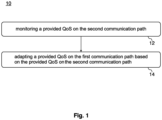
- Fig. 1 shows a block diagram of an example of a method 10 for maintaining Quality of Service, QoS, in a multi-path communication session between two communication nodes in a communication network.
- the multi-path communication session comprises at least a first communication path and a second communication path.
- the method 10 comprises monitoring 12 a provided QoS on the second communication path and adapting 14 a provided QoS on the first communication path based on the provided QoS on the second communication path.
- the first and second communication paths may be established subsequently, e.g. the multi-path session may be setup with the first path only the second communication path may be added later on.
- the provided QoS on a communication path is the QoS that is actually available on the communication path and it can be different from what an assigned QoS profile or requirement for a certain service demands, since the actual QoS (e.g. data rate, error rate, latency) depends on the load and channel conditions of the respective path.
- the actual QoS e.g. data rate, error rate, latency
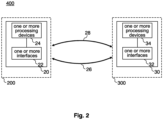
- Fig. 2 shows a block diagram of an example of an apparatus 20, 30 for maintaining Quality of Service, QoS, in a multi-path communication session between two communication nodes 200, 300 in a communication network 400.
- the multi-path communication session comprises at least a first communication path 26 and a second communication path 28.
- the apparatus 20, 30 comprises one or more interfaces 22, 32 configured to communicate in the communication network 400.
- the apparatus 20, 30 further comprises one or more processing devices 24, 34 configured to perform one of the methods 10 described herein.
- Further examples illustrated in Fig. 2 as optionally (using dashed lines) are user equipment 200 comprising an example of the apparatus 20 and a network node 300 (e.g. a core network component) comprising an example of the apparatus 30.
- a network node 300 e.g. a core network component
- Fig. 2 further illustrates an example of a communication system or network 400 comprising an example of user equipment 200 and an example of a network node.
- the respective one or more processing devices 24, 34 are coupled to the one or more interfaces 22, 32.
- the one or more interfaces 22, 32 may correspond to one or more inputs and/or outputs for receiving and/or transmitting information, which may be in digital (bit) values according to a specified code or protocol, within a module, between modules or between modules of different entities.
- an interface 22, 32 may comprise interface circuitry configured to receive and/or transmit information.
- an interface 22, 32 may correspond to any means for obtaining, receiving, transmitting or providing analog or digital signals or information, e.g., any connector, contact, pin, register, input port, output port, conductor, lane, etc., which allows providing or obtaining a signal or information.
- An interface 22, 32 may be configured to communicate (transmit, receive, or both) in a wireless or wireline manner and it may be configured to communicate, i.e., transmit and/or receive signals, information with further internal or external components.
- the one or more interfaces 22, 32 may comprise further components to enable communication in a (mobile) communication system or network, such components may include transceiver (transmitter and/or receiver) components, such as one or more Low-Noise Amplifiers (LNAs), one or more Power-Amplifiers (PAs), one or more duplexers, one or more diplexers, one or more filters or filter circuitry, one or more converters, one or more mixers, accordingly adapted radio frequency components, etc.
- an interface 22, 32 may be a physical interface (e.g. a WiFi (Wireless Fidelity) interface or a 5G interface) or a virtual interface (e.g. a tunnel endpoint).
- the one or more processing devices 24, 34 may be implemented using one or more processing units, one or more circuitries, any means for processing, such as a processor, a computer or a programmable hardware component being operable with accordingly adapted software.
- the described function of the one or more processing devices 24, 34 may as well be implemented in software, which is then executed on one or more programmable hardware components.
- Such hardware components may comprise a general-purpose processor, a Digital Signal Processor (DSP), a micro-controller, etc.
- Examples may provide dynamic cellular QoS in multi-path scenarios.
- Such a dynamic QoS adaption in a regulated first path may reflect the absence of a second path in a multipath setup.
- the first path may be a cellular path and the second path may be a fixed or Wi-Fi path.
- the first path is a satellite path and the second path is a cellular/fixed/Wi-Fi path.
- the first and second communication paths may use different access technologies in the communication network 400.
- the first communication path may use wireless access and the second communication path may use wired access.
- the first and second communication paths may use different Radio Access Technologies (RATs), such as cellular, WiFi, satellite, etc. or different protocol tunnels.
- RATs Radio Access Technologies
- the same RAT might be used with multiple protocol tunnels as communication paths.
- a regulated first path in a multipath system becomes less or non-regulated if a second path in a multi-path system is not usable.
- this may require a detection mechanism/entity for the absence of the second path, e.g. 3GPP PMF (Performance Measurement Function), a polling mechanism (e.g. ping) or access related information from MSAN (Multi-Service Access Node), BNG (Broadband Network Gateway), AGF (Access Gateway Function), Radio Unit, UE information.
- 3GPP PMF Performance Measurement Function
- a polling mechanism e.g. ping
- MSAN Multi-Service Access Node
- BNG Broadband Network Gateway
- AGF Access Gateway Function
- Radio Unit UE information.
- examples may provide a QoS adaptation engine, which is in charge of controlling the QoS level (e.g. via a QoS profile, QoS flow, etc.) of the first path.
- the adapting 14 of the provided QoS on the first communication path may comprise changing a QoS profile associated with the communication on the first communication path.
- the adaptation engine (apparatus 20, 30 for maintaining QoS) triggers a new QoS indication on the first path. Preferably this increases an existing QoS indication or applies a better QoS than the default one.
- a QoS on the first communication path is then increased if the monitoring of the provided QoS on the second communication path indicates that the second communication path is interrupted.
- DiffServ Differentiated Services
- IP ToS Internet Protocol Type off Service
- QCI QoS Class Identifier
- QFI QoS Flow indicator
- Network Slicing Slices with different QoS profiles/settings.
- diffserv short for Differentiated Services
- Diffserv effectively classifies, manages, and directs network traffic by dividing it into different classes based on business requirements. Each class reflects a specific level of service quality.
- Diffserv uses a field in the IP header for packet classification, enabling routers and switches to assign the appropriate priority to each data packet and forward them according to a predetermined service policy, allowing prioritization of certain types of traffic over others. This makes Diffserv crucial for networks where certain data traffic requires a higher priority, like VoIP (Voice over IP) or streaming media, ensuring high performance and minimizing latency.
- IP ToS is a mechanism applied to managing the QoS on networks that deploy IP for data transmission. It is essentially a field in an IP packet's header that allows for packets to be classified and prioritized accordingly for traffic control purposes. This prioritization primarily addresses aspects such as speed, reliability, and security on data networks. By setting particular ToS values, you can effectively control how various network devices handle packets.
- the IP ToS system has maintained relevance even with the introduction of newer technologies, including Differentiated Services Code Point (DSCP), due to its foundational role in network data handling.
- DSCP Differentiated Services Code Point
- the QoS level of the first path is reduced to a lower value.
- the first path QoS level is set to the value, which was applied in the previous period of the present second path.
- the same technologies as above for changing the QoS level can be used for this.
- a QoS on the first communication path may be decreased if the monitoring of the provided QoS on the second communication path indicates that the second communication path is available again after having been interrupted.
- the method 10 may comprise monitoring a provided QoS on the first communication path 26 and adapting a provided QoS on the second communication path 28 based to the provided QoS on the first communication path.
- the QoS compensation may be mutual among the communication paths.
- Another example may address the overall QoS a user experiences in the multi-path communication session.
- the method 10 may then comprise monitoring a combined QoS provided via the first and second communication paths. Based on the combined QoS, and an overall or combined QoS target, individual QoS provided on the first and second communication paths may be adapted.
- the above method 10 is applied in a 3GPP ATSSS system, a Hybrid Access system, or an end-to-end multipath system.
- the multi-path communication session between the two communication nodes may then be a Multi-Access Packet Data Unit, MA-PDU, session in a 3rd Generation Partnership Project Access Traffic Steering, Switching, and Splitting, ATSSS, system.
- the multi-path communication session between the two communication nodes is a hybrid access system and/or an end-to-end multipath system.
- examples may interact with a MA-PDU session according to Fig. 3 and modify the QoS parameter(s) of the MA-PDU session. This is necessary because so far Technical Specification (TS) 23.501 V18.0 clause 5.23.4 advises to apply the same QoS for 3GPP and non-3GPP access according to the specified MA-PDU QoS Flow. That will lead to a performance bottleneck on the remaining access if the other access of the MA-PDU session is not available and more data need to be delivered over the remaining access.
- TS Technical Specification
- a possible scenario might be setting a low QoS level if a MA-PDU session is connected over two accesses (3GPP and non-3GPP) and if for example the PMF (Performance Measurement Function) detects an outage of one access path, the MA-PDU session is provisioned for a higher QoS level.
- PMF Performance Measurement Function
- Fig. 3 shows a block diagram of an example of a MA-PDU session.
- Fig. 3 shows an application 302 being executed on a UE 304 on the very left. From the UE 304 there are two communication paths, a first communication path uses 3GPP access 306 at the top, which optionally connects through interface N3 to User Plane Function (UPF) 308.
- the 3GPP access 306 offers a Radio Access Network (RAN) and connects to the UPF 308.
- RAN Radio Access Network
- the UPF 308 is a component of the core network, e.g. in the New Radio (NR) mobile core infrastructure system as defined by 3GPP.
- the UPF 308 handles the user data.
- an Access and Mobility management Function accesses the UE and the (R)AN.
- the reference point between the access 306 and the core network is called "NG". This reference point is constituted of several interfaces, e.g. N3.
- the UPF 308 provides the interconnect point between the mobile infrastructure and the Data Network (DN, Server 312), i.e. encapsulation and decapsulation of GPRS Tunnelling Protocol for the user plane (GTPU).
- UPF 308 further provides a Protocol Data Unit (PDU) Session Anchor point (PSA) 310 for enabling mobility within and between Radio Access Technologies (RATs).
- PDU Protocol Data Unit
- PSA Session Anchor point
- the UPF (PSA) 310 is the protocol entity relevant for ATSSS as the 3GPP and the non-3GPP paths are terminated.
- UPF (PSA) 310 is also shown in Fig. 3 .
- the interface N9 lies between two UPF's (i.e. an Intermediate UPF 308 and the UPF Session Anchor 310).
- the UPF (PSA) 310 is then coupled via interface N6 to the server 312.
- a second path at the bottom shows a non-3GPP access 314, for example, this may be a wired or a wireless access, e.g. WiFi-access (Wireless Fidelity).
- the non-3GPP access 314 is coupled to a non-3GPP InterWorking Function (N3IWF) 316. Details on the function of the N3IWF 316 can be found, for example, in 3GPP TS 24.502 V16.10.0 and later versions thereof.
- the N3IWF 316 enables a UE to establish a secure connection to the 5G core network over untrusted non-3GPP access.
- Another N3 interface optionally couples to the UPF 318.
- An N9 interface further couples to the UPF (PSA) 310.
- Fig. 3 further illustrates the MA-PDU 320 session, which comprises two paths 322 (via 3GPP access) and 324 (via non-3GPP access).
- Fig. 3 depicts the principle of a MA-PDU session. Following Section 5.32.2 of TS 23.501 (v16.17.0) the establishment procedure is in large parts similar to the one of a traditional single access PDU session but defines instead the request type of the PDU session to be "MA PDU request" on the 3GPP and non-3GPP access using the same PDU Session ID (IDentification). This procedure is followed by an establishment of two N3/N9 tunnels (322, 324, one per access) within this MA-PDU session, which both can be used for NAS (Non-Access Stratum) communication and routing of traffic towards the N6 interface connecting to the server 312.
- NAS Non-Access Stratum
- the tunnels can be distinguished by the definition of the access type (3GPP or non-3GPP) defined during the first step of a PDU session establishment as defined in section 4.3.2.2 of TS 23.502.
- the usage and traffic distribution of the two tunnels is up to the selected ATSSS (Access Traffic Steering, Switching, and Splitting) steering function (section 5.32.6, TS 23.501) and steering mode (section 5.32.8, TS 23.501).
- ATSSS Access Traffic Steering, Switching, and Splitting
- ATSSS steering mode selection may be pre-set for a scheduler, assigning data packets to the different paths.
- ATSSS Rules may be communicated by a Session Management Function (SMF).
- SMF Session Management Function
- Each ATSSS rule may contain an Access Selection Descriptor that may contain the following components:
- the ATSSS rule may also contain a Steering Functionality, which identifies whether the MPTCP (Multi-Path Transmission Control Protocol) functionality or the ATSSS-LL functionality should be used to steer the traffic of the matching SDF. This is used when the UE supports multiple functionalities for ATSSS, as specified in clause 5.32.6 ("Support of Steering Functions") in TS 23.501 V16.17.0 (2023-06 ).
- MPTCP Multi-Path Transmission Control Protocol
- a MA-PDU session can carry QoS flows, which is further described in section 5.32.4 of TS 23.501 to be access agnostic:
- One difference compared to the Single-Access PDU Session is that in a MA-PDU session there can be separate user-plane tunnels between the AN and the PSA, each one associated with a different access.
- the QoS Flow is conventionally not associated with specific access, i.e. it is access agnostic, so the same QoS is supported when the traffic is distributed over 3GPP and non-3GPP accesses.
- a session management function shall provide the same QFI (QoS Flow Indicator) in 3GPP and non-3GPP accesses so that the same QoS is supported in both accesses.
- Network API Application Programming Interface
- NEF Network Exposure Function
- the QoS level of the first path is modified according to the previous or anticipated QoS adaptations of the second path.
- the method 10 may then further comprise predicting QoS changes for the second communication path and adapting the provided QoS on the first communication path based on the predicted QoS change for the second communication path. This may have the advantage of avoiding signaling congestion, when QoS changes are expected at high frequency or potential resource conflict when a cell can be expected heavily loaded at a particular time.
- a manipulation of the second path is detected which aims to gain better QoS on the first path.
- an MSAN or BNG measurement proves that the DSL (Digital Subscriber Line) copper cable works and provides this information to the detection or adaptation entity.
- the method 10 then further comprises detecting a manipulation of the second communication path and refraining from increasing a provided QoS on the first communication path if a manipulation of the second communication path is detected. This may have the benefit that, for example, the intended pulling out of the DSL cable is detected and avoids high QoS cellular or satellite usage.
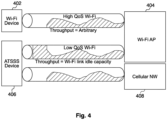
- Fig. 4 shows throughput charts in an example of an MA-PDU session with concurrent use of a WiFi path.
- Fig. 4 illustrates a WiFi device 402 that communicates with a WiFi Access Point (AP) 404.
- AP WiFi Access Point
- an ATSSS device 406 is shown that has a MA-PDU session with the WiFi AP 404 and a cellular network 408.
- the multi-path communication session is an MA-PDU session
- the communication network is a 3rd Generation Partnership Project communication core network.
- one of the communication nodes is user equipment, e.g. the ATSSS device 406.
- Fig. 4 shows an ATSSS capable device 406 spanning a MA-PDU session across Wi-Fi and cellular access for traffic splitting and a Wi-Fi device 402 connected over Wi-Fi.
- the Wi-Fi QoS is set high and for the ATSSS device 406 low. The effect becomes visible when the ATSSS device 406 starts a transmission in the order of magnitude of the Wi-Fi link capacity and prefers to send the traffic via the Wi-Fi access. This occupies the whole Wi-Fi link until the time when the Wi-Fi device 402 starts a fluctuating transmission.
- the Wi-Fi device 402 uses the resources of the Wi-Fi arbitrarily, which will lead to a reduced resource availability of the Wi-Fi for the MA-PDU session. Since the ATSSS splitting function can distribute traffic across links, the cellular link is then used to compensate the lower resource availability of the Wi-Fi. In an example, once the WiFi path becomes loaded the QoS profile for the cellular path of the ATSSS device 406 is reconfigured from "iron" to a higher class, for the cellular path to compensate for the decrease in transmission capacity on the WiFi path.
- Examples may further be or relate to a (computer) program including a program code to execute one or more of the above methods when the program is executed on a computer, processor or other programmable hardware component.
- steps, operations or processes of different ones of the methods described above may also be executed by programmed computers, processors or other programmable hardware components.
- Examples may also cover program storage devices, such as digital data storage media, which are machine-, processor- or computer-readable and encode and/or contain machine-executable, processor-executable or computer-executable programs and instructions.
- Program storage devices may include or be digital storage devices, magnetic storage media such as magnetic disks and magnetic tapes, hard disk drives, or optically readable digital data storage media, for example.
- Other examples may also include computers, processors, control units, (field) programmable logic arrays ((F)PLAs), (field) programmable gate arrays ((F)PGAs), graphics processor units (GPU), application-specific integrated circuits (ASICs), integrated circuits (ICs) or system-on-a-chip (SoCs) systems programmed to execute the steps of the methods described above.
- FPLAs field programmable logic arrays
- F field) programmable gate arrays
- GPU graphics processor units
- ASICs application-specific integrated circuits
- ICs integrated circuits
- SoCs system-on-a-chip
- aspects described in relation to a device or system should also be understood as a description of the corresponding method.
- a block, device or functional aspect of the device or system may correspond to a feature, such as a method step, of the corresponding method.
- aspects described in relation to a method shall also be understood as a description of a corresponding block, a corresponding element, a property or a functional feature of a corresponding device or a corresponding system.
Landscapes
- Engineering & Computer Science (AREA)
- Computer Networks & Wireless Communication (AREA)
- Signal Processing (AREA)
- Quality & Reliability (AREA)
- Mobile Radio Communication Systems (AREA)
- Computer And Data Communications (AREA)
Priority Applications (3)
| Application Number | Priority Date | Filing Date | Title |
|---|---|---|---|
| ES23212056T ES3054259T3 (en) | 2023-11-24 | 2023-11-24 | Method, computer program, and apparatus for maintaining quality of service in a multi-path communication session |
| EP23212056.8A EP4561008B1 (de) | 2023-11-24 | 2023-11-24 | Verfahren, computerprogramm und vorrichtung zur aufrechterhaltung der dienstqualität in einer mehrweg-kommunikationssitzung |
| PCT/EP2024/083132 WO2025109085A1 (en) | 2023-11-24 | 2024-11-21 | Method, computer program, and apparatus for maintaining quality of service in a multi-path communication session |
Applications Claiming Priority (1)
| Application Number | Priority Date | Filing Date | Title |
|---|---|---|---|
| EP23212056.8A EP4561008B1 (de) | 2023-11-24 | 2023-11-24 | Verfahren, computerprogramm und vorrichtung zur aufrechterhaltung der dienstqualität in einer mehrweg-kommunikationssitzung |
Publications (2)
| Publication Number | Publication Date |
|---|---|
| EP4561008A1 true EP4561008A1 (de) | 2025-05-28 |
| EP4561008B1 EP4561008B1 (de) | 2025-11-05 |
Family
ID=88969811
Family Applications (1)
| Application Number | Title | Priority Date | Filing Date |
|---|---|---|---|
| EP23212056.8A Active EP4561008B1 (de) | 2023-11-24 | 2023-11-24 | Verfahren, computerprogramm und vorrichtung zur aufrechterhaltung der dienstqualität in einer mehrweg-kommunikationssitzung |
Country Status (3)
| Country | Link |
|---|---|
| EP (1) | EP4561008B1 (de) |
| ES (1) | ES3054259T3 (de) |
| WO (1) | WO2025109085A1 (de) |
Citations (3)
| Publication number | Priority date | Publication date | Assignee | Title |
|---|---|---|---|---|
| US20200404609A1 (en) * | 2019-06-18 | 2020-12-24 | Mediatek Inc. | Handling of Multi-Access PDU Session when Inter-System Change |
| WO2022098696A1 (en) * | 2020-11-03 | 2022-05-12 | Convida Wireless LLC | Communication of adaptive traffic steering |
| US20220361038A1 (en) * | 2021-05-10 | 2022-11-10 | Samsung Electronics Co., Ltd. | Method and apparatus for managing quality of service in wireless communication system |
-
2023
- 2023-11-24 ES ES23212056T patent/ES3054259T3/es active Active
- 2023-11-24 EP EP23212056.8A patent/EP4561008B1/de active Active
-
2024
- 2024-11-21 WO PCT/EP2024/083132 patent/WO2025109085A1/en active Pending
Patent Citations (3)
| Publication number | Priority date | Publication date | Assignee | Title |
|---|---|---|---|---|
| US20200404609A1 (en) * | 2019-06-18 | 2020-12-24 | Mediatek Inc. | Handling of Multi-Access PDU Session when Inter-System Change |
| WO2022098696A1 (en) * | 2020-11-03 | 2022-05-12 | Convida Wireless LLC | Communication of adaptive traffic steering |
| US20220361038A1 (en) * | 2021-05-10 | 2022-11-10 | Samsung Electronics Co., Ltd. | Method and apparatus for managing quality of service in wireless communication system |
Non-Patent Citations (4)
| Title |
|---|
| "3rd Generation Partnership Project; Technical Specification Group Services and System Aspects; System architecture for the 5G System (5GS); Stage 2 (Release 18)", 31 March 2023 (2023-03-31), XP052454774, Retrieved from the Internet <URL:https://ftp.3gpp.org/tsg_sa/WG2_Arch/Latest_SA2_Specs/DRAFT_INTERIM/Archive/23501-i10_CRs_Implemented_rev5.zip 23501-i10_CRs_Implemented_rev5.docx> [retrieved on 20230331] * |
| 3GPP TS 23.501, June 2023 (2023-06-01) |
| 3GPP TS 24.502 |
| COGALAN TEZCAN ET AL: "Enhanced Access Traffic Steering Splitting Switching with Utility-Based Decisioning", 2022 IEEE CONFERENCE ON STANDARDS FOR COMMUNICATIONS AND NETWORKING (CSCN), IEEE, 28 November 2022 (2022-11-28), pages 138 - 143, XP034301423, DOI: 10.1109/CSCN57023.2022.10050977 * |
Also Published As
| Publication number | Publication date |
|---|---|
| ES3054259T3 (en) | 2026-02-02 |
| WO2025109085A1 (en) | 2025-05-30 |
| EP4561008B1 (de) | 2025-11-05 |
Similar Documents
| Publication | Publication Date | Title |
|---|---|---|
| AU2021256599B2 (en) | Communication method and apparatus | |
| EP3782401B1 (de) | Client-vorrichtung, netzwerksteuerungsknoten und upf zum senden und empfangen von strömen von datenpaketen in multikonnektivität | |
| US9584337B2 (en) | Method and apparatus for network and service controlled hybrid access | |
| CN112788680B (zh) | 一种数据传输的方法及相关设备 | |
| EP2764747B1 (de) | Stauabwicklung in einer basisstation eines mobilfunknetzes | |
| JP4224458B2 (ja) | 無線リソースを管理する方法及び無線システム | |
| US8804532B2 (en) | Method and arrangement for adapting to variations in an available bandwidth to a local network | |
| JP2021518684A (ja) | アクセストラフィックステアリング、スイッチング、及び/又は、分割動作のための装置及び方法 | |
| US20100284278A1 (en) | Adaptive multi-rate codec bit rate control in a wireless system | |
| CN105637923B (zh) | 无线电接入网(ran)传输演进分组核心(epc)协同作用 | |
| EP3025544B1 (de) | Verfahren und netzwerkknoten zur überlastungsverwaltung in einem drahtloskommunikationsnetzwerk | |
| CN114071494A (zh) | 通信方法和装置 | |
| US20150055490A1 (en) | System and method for managing access point communication channel utilization | |
| US20150045030A1 (en) | Method and Apparatus for Controlling Transfer of Network Traffic | |
| EP3518576B1 (de) | Datenflussmanager zum verteilen von daten für einen datenstrom eines benutzergeräts, kommunikationssystem und -verfahren | |
| EP4561008B1 (de) | Verfahren, computerprogramm und vorrichtung zur aufrechterhaltung der dienstqualität in einer mehrweg-kommunikationssitzung | |
| US12513084B1 (en) | Protocol data unit systems and methods | |
| US20140126373A1 (en) | Dynamic traffic offloading | |
| Kumar et al. | Device‐centric data reordering and buffer management for mobile Internet using Multipath Transmission Control Protocol | |
| EP4561009B1 (de) | Verfahren, computerprogramme und vorrichtungen für benutzergerät und eine kernnetz-arbeitskomponente und zur verwaltung der dienstgüte | |
| US20250385855A1 (en) | Method of operating a telecommunications network | |
| Al-Najjar | Traffic control for multi-homed end-hosts via software defined networking | |
| GB2620187A (en) | Method of operating a telecommunications network | |
| CN120034986A (zh) | 一种通信方法、装置及系统 |
Legal Events
| Date | Code | Title | Description |
|---|---|---|---|
| STAA | Information on the status of an ep patent application or granted ep patent |
Free format text: STATUS: EXAMINATION IS IN PROGRESS |
|
| PUAI | Public reference made under article 153(3) epc to a published international application that has entered the european phase |
Free format text: ORIGINAL CODE: 0009012 |
|
| 17P | Request for examination filed |
Effective date: 20241025 |
|
| AK | Designated contracting states |
Kind code of ref document: A1 Designated state(s): AL AT BE BG CH CY CZ DE DK EE ES FI FR GB GR HR HU IE IS IT LI LT LU LV MC ME MK MT NL NO PL PT RO RS SE SI SK SM TR |
|
| GRAP | Despatch of communication of intention to grant a patent |
Free format text: ORIGINAL CODE: EPIDOSNIGR1 |
|
| STAA | Information on the status of an ep patent application or granted ep patent |
Free format text: STATUS: GRANT OF PATENT IS INTENDED |
|
| INTG | Intention to grant announced |
Effective date: 20250613 |
|
| GRAS | Grant fee paid |
Free format text: ORIGINAL CODE: EPIDOSNIGR3 |
|
| GRAA | (expected) grant |
Free format text: ORIGINAL CODE: 0009210 |
|
| STAA | Information on the status of an ep patent application or granted ep patent |
Free format text: STATUS: THE PATENT HAS BEEN GRANTED |
|
| AK | Designated contracting states |
Kind code of ref document: B1 Designated state(s): AL AT BE BG CH CY CZ DE DK EE ES FI FR GB GR HR HU IE IS IT LI LT LU LV MC ME MK MT NL NO PL PT RO RS SE SI SK SM TR |
|
| REG | Reference to a national code |
Ref country code: CH Ref legal event code: F10 Free format text: ST27 STATUS EVENT CODE: U-0-0-F10-F00 (AS PROVIDED BY THE NATIONAL OFFICE) Effective date: 20251105 Ref country code: GB Ref legal event code: FG4D |
|
| REG | Reference to a national code |
Ref country code: DE Ref legal event code: R096 Ref document number: 602023008286 Country of ref document: DE |
|
| REG | Reference to a national code |
Ref country code: IE Ref legal event code: FG4D |
|
| PGFP | Annual fee paid to national office [announced via postgrant information from national office to epo] |
Ref country code: AT Payment date: 20260113 Year of fee payment: 3 |
|
| PGFP | Annual fee paid to national office [announced via postgrant information from national office to epo] |
Ref country code: IT Payment date: 20251201 Year of fee payment: 3 |
|
| PGFP | Annual fee paid to national office [announced via postgrant information from national office to epo] |
Ref country code: FR Payment date: 20251230 Year of fee payment: 3 |
|
| REG | Reference to a national code |
Ref country code: ES Ref legal event code: FG2A Ref document number: 3054259 Country of ref document: ES Kind code of ref document: T3 Effective date: 20260202 |
|
| REG | Reference to a national code |
Ref country code: NL Ref legal event code: MP Effective date: 20251105 |