EP4560464A2 - Aktualisierungsverfahren für ein betriebssystem - Google Patents
Aktualisierungsverfahren für ein betriebssystem Download PDFInfo
- Publication number
- EP4560464A2 EP4560464A2 EP25169602.7A EP25169602A EP4560464A2 EP 4560464 A2 EP4560464 A2 EP 4560464A2 EP 25169602 A EP25169602 A EP 25169602A EP 4560464 A2 EP4560464 A2 EP 4560464A2
- Authority
- EP
- European Patent Office
- Prior art keywords
- virtual disk
- data
- computing device
- sets
- identified
- Prior art date
- Legal status (The legal status is an assumption and is not a legal conclusion. Google has not performed a legal analysis and makes no representation as to the accuracy of the status listed.)
- Pending
Links
Images







Classifications
-
- G—PHYSICS
- G06—COMPUTING OR CALCULATING; COUNTING
- G06F—ELECTRIC DIGITAL DATA PROCESSING
- G06F8/00—Arrangements for software engineering
- G06F8/60—Software deployment
- G06F8/65—Updates
- G06F8/654—Updates using techniques specially adapted for alterable solid state memories, e.g. for EEPROM or flash memories
-
- G—PHYSICS
- G06—COMPUTING OR CALCULATING; COUNTING
- G06F—ELECTRIC DIGITAL DATA PROCESSING
- G06F9/00—Arrangements for program control, e.g. control units
- G06F9/06—Arrangements for program control, e.g. control units using stored programs, i.e. using an internal store of processing equipment to receive or retain programs
- G06F9/44—Arrangements for executing specific programs
- G06F9/4401—Bootstrapping
- G06F9/4411—Configuring for operating with peripheral devices; Loading of device drivers
-
- G—PHYSICS
- G06—COMPUTING OR CALCULATING; COUNTING
- G06F—ELECTRIC DIGITAL DATA PROCESSING
- G06F11/00—Error detection; Error correction; Monitoring
- G06F11/07—Responding to the occurrence of a fault, e.g. fault tolerance
- G06F11/14—Error detection or correction of the data by redundancy in operations
- G06F11/1402—Saving, restoring, recovering or retrying
- G06F11/1415—Saving, restoring, recovering or retrying at system level
- G06F11/1417—Boot up procedures
-
- G—PHYSICS
- G06—COMPUTING OR CALCULATING; COUNTING
- G06F—ELECTRIC DIGITAL DATA PROCESSING
- G06F11/00—Error detection; Error correction; Monitoring
- G06F11/07—Responding to the occurrence of a fault, e.g. fault tolerance
- G06F11/14—Error detection or correction of the data by redundancy in operations
- G06F11/1402—Saving, restoring, recovering or retrying
- G06F11/1415—Saving, restoring, recovering or retrying at system level
- G06F11/1433—Saving, restoring, recovering or retrying at system level during software upgrading
-
- G—PHYSICS
- G06—COMPUTING OR CALCULATING; COUNTING
- G06F—ELECTRIC DIGITAL DATA PROCESSING
- G06F11/00—Error detection; Error correction; Monitoring
- G06F11/07—Responding to the occurrence of a fault, e.g. fault tolerance
- G06F11/14—Error detection or correction of the data by redundancy in operations
- G06F11/1446—Point-in-time backing up or restoration of persistent data
- G06F11/1448—Management of the data involved in backup or backup restore
- G06F11/1451—Management of the data involved in backup or backup restore by selection of backup contents
-
- G—PHYSICS
- G06—COMPUTING OR CALCULATING; COUNTING
- G06F—ELECTRIC DIGITAL DATA PROCESSING
- G06F11/00—Error detection; Error correction; Monitoring
- G06F11/07—Responding to the occurrence of a fault, e.g. fault tolerance
- G06F11/14—Error detection or correction of the data by redundancy in operations
- G06F11/1446—Point-in-time backing up or restoration of persistent data
- G06F11/1458—Management of the backup or restore process
- G06F11/1461—Backup scheduling policy
-
- G—PHYSICS
- G06—COMPUTING OR CALCULATING; COUNTING
- G06F—ELECTRIC DIGITAL DATA PROCESSING
- G06F11/00—Error detection; Error correction; Monitoring
- G06F11/07—Responding to the occurrence of a fault, e.g. fault tolerance
- G06F11/14—Error detection or correction of the data by redundancy in operations
- G06F11/1471—Error detection or correction of the data by redundancy in operations involving logging of persistent data for recovery
-
- G—PHYSICS
- G06—COMPUTING OR CALCULATING; COUNTING
- G06F—ELECTRIC DIGITAL DATA PROCESSING
- G06F8/00—Arrangements for software engineering
- G06F8/60—Software deployment
- G06F8/65—Updates
-
- G—PHYSICS
- G06—COMPUTING OR CALCULATING; COUNTING
- G06F—ELECTRIC DIGITAL DATA PROCESSING
- G06F9/00—Arrangements for program control, e.g. control units
- G06F9/06—Arrangements for program control, e.g. control units using stored programs, i.e. using an internal store of processing equipment to receive or retain programs
- G06F9/46—Multiprogramming arrangements
- G06F9/50—Allocation of resources, e.g. of the central processing unit [CPU]
- G06F9/5061—Partitioning or combining of resources
- G06F9/5077—Logical partitioning of resources; Management or configuration of virtualized resources
-
- G—PHYSICS
- G06—COMPUTING OR CALCULATING; COUNTING
- G06F—ELECTRIC DIGITAL DATA PROCESSING
- G06F2201/00—Indexing scheme relating to error detection, to error correction, and to monitoring
- G06F2201/815—Virtual
-
- G—PHYSICS
- G06—COMPUTING OR CALCULATING; COUNTING
- G06F—ELECTRIC DIGITAL DATA PROCESSING
- G06F2201/00—Indexing scheme relating to error detection, to error correction, and to monitoring
- G06F2201/84—Using snapshots, i.e. a logical point-in-time copy of the data
-
- G—PHYSICS
- G06—COMPUTING OR CALCULATING; COUNTING
- G06F—ELECTRIC DIGITAL DATA PROCESSING
- G06F9/00—Arrangements for program control, e.g. control units
- G06F9/06—Arrangements for program control, e.g. control units using stored programs, i.e. using an internal store of processing equipment to receive or retain programs
- G06F9/44—Arrangements for executing specific programs
- G06F9/4401—Bootstrapping
- G06F9/4406—Loading of operating system
- G06F9/4408—Boot device selection
Definitions
- Operating systems may also have an update feature that will download and install new versions and patches to the operating system.
- various files and data may be downloaded, and the process may involve additional files and data being downloaded as the update process continues.
- the updated software may be loaded for execution, and the files and data that were used for the update may be deleted.
- a known good state for an operating system may refer generally to an operating system state that is configured to boot the computing device and support normal operational scenarios in a predictable and repeatable manner.
- the computing device can maintain data that defines and/or is usable to reenter the known good operating system state when the device is rebooted.
- an operating system When an operating system is updated, various portions of the operating system are typically updated.
- the system may be rebooted and the updated operating system may be loaded.
- the reboot with the updated operating system fails, it is important to return the system to a known clean state, such as the known good state for the operating system.
- a known clean state such as the known good state for the operating system.
- it may be difficult to return to such a state as some artifacts of the updates may remain in the reverted operating system.
- One solution is to retain and store a full copy of the existing operating system and load a full and separate version of the new operating system.
- maintaining two full versions of an operating system may take a significant amount of storage space.
- the space usage may be exacerbated when rollbacks are desired, requiring multiple versions of the operating system to be retained. It is desirable therefore to be able to achieve a clean separation between current and new versions of the operating system while minimizing the required storage space, and at the same time allowing for a clean recovery in the event of a failed boot or if other issues occur during the updated, such as a power loss during the boot.
- updates to various operating system sets or groupings may be stored.
- the sets may include a main operating system space, which may include the OS binaries, as well as data, applications, user data, and driver sets.
- a snapshot may be taken of the sets.
- a snapshot may be a set of data that defines an application and its states at the point in time that the snapshot is taken.
- the snapshot may be saved indefinitely to allow for reversion to the snapshot at a future point in time.
- a copy of the snapshot may be used for updates, therefore allowing both the original version and the updated version to be maintained.
- the snapshots may be taken when system setup is started for those sets that are read-only, since these sets will not be changed during the course of operation of the computing system.
- the operating system update may then begin. Changes to the other sets may be tracked.
- the snapshot may be taken at the last possible point before rebooting the computing system.
- the snapshots for different sets may be taken at different times, based on requirements for each set.
- the snapshots may be taken opportunistically, based on a predetermined schedule, or based on system conditions and other triggers.
- the differences between the updated operating system and the current operating system may be tracked in order to reduce required storage space as well as to limit the scope of changes so that the operating system can be reverted in the event of a failure of the updated operating system.
- the differences may be tracked using virtual disks or virtual storage volumes.
- the sets that make up the current operating system version may be saved as one or more virtual disks.
- a virtual disk is a virtual representation of the underlying data that is stored on a physical storage device.
- Updates to the operating system can be tracked in the newly created virtual disks, and the updates may be tracked as deltas to the version that was stored in the original version.
- a snapshot of an operating system or a portion thereof may be implemented as a virtual disk.
- the computing system may be rebooted with the updated operating system. If an updated operating system version is successfully used for boot, then the current operation system version that has been snapshotted can be discarded, or can be saved in the event that reversion is desired at a future point in time. After some specified period of time, or after one or more events such as the operating system version being considered obsolete, then that version may be discarded.
- One solution is to retain and store a full copy of the existing operating system and load a full and separate version of the new operating system.
- maintaining two full versions of an operating system may take a significant amount of storage space.
- the space usage may be exacerbated when rollbacks are desired, requiring multiple versions of the operating system to be retained. It is desirable therefore to be able to achieve a clean separation between current and new versions of the operating system while minimizing the required storage space, and at the same time allowing for a clean recovery in the event of a failed boot or if other issues occur during the updated, such as a power loss during the boot.
- updates to various operating system sets or groupings may be stored.
- the sets or groupings may include a main operating system space, which may include the OS binaries, as well as data, applications, user data, and driver sets.
- a snapshot may be taken of all the sets.
- a snapshot may be a set of data that defines an application and its states at the point in time that the snapshot is taken.
- the snapshot may be saved indefinitely to allow for reversion to the snapshot at a future point in time.
- a copy of the snapshot may be used for updates, therefore allowing both the original version and the updated version to be maintained.
- the snapshots may be taken when system setup is started for those sets that are read-only, since these sets will not be changed during the course of operation of the computing system.
- the operating system update may then be initiated. Changes to the other sets may be tracked.
- the snapshot may be taken at the last possible point before rebooting the computing system.
- only the differences between the updated operating system and the current operating system may be tracked in order to reduce required storage space as well as to limit the scope of changes so that the operating system can be reverted in the event of a failure of the updated operating system.
- a snapshot of an application or a portion thereof may be implemented using virtual disks or virtual storage volumes.
- the differences between current and new versions of an application such as an operating system may be tracked using virtual disks or virtual storage volumes.
- the sets that make up the current operating system version may be saved as one or more virtual disks.
- a virtual disk is a virtual representation of the underlying data that is stored on a physical storage device. As such, other than metadata that define the virtual disk and its mappings, a separate physical copy of the current operating system version need not be separately created.
- Updates to the operating system can be tracked in the newly created virtual disks, which are tracked as differences or deltas to the version that was stored in the original version. For example, if the original version is a clean-install operating system virtual disk and a new virtual disk is created and designated as the virtual disk for the system to use for updates, then the operating system on the parent virtual disk may kept in its original state as an immutable snapshot for recovery purposes or for creating additional virtual disks.
- Metadata may be stored that describes the sets for each operating system version.
- Each set may be tagged with an operating system version.
- main OS may be a Main OS1 for set 1, and Main OS2 for set 2. Only one set may be active at any given time, thus preventing multiple operating system versions to appear to be valid.
- the current operation system version that has been snapshotted can be discarded, or can be saved in the event that reversion is desired at a future point in time. After some specified period of time, or after one or more events such as the operating system version being considered obsolete, then that version may be discarded.
- the techniques described herein improve efficiencies with respect to configuring computing devices to repeatedly attempt to install operating system updates or even to lose the ability to boot the computing device into a known operational state. Furthermore, the techniques described enable a clean operating system state to be persisted, and in some embodiments, for multiple states to be snapshotted and persisted. Thus, the described techniques improve computing efficiencies and/or human interaction with computers at least due to mitigating the burden of failed operating system updates. The described techniques also allow for a clean operating system state to be maintained while improving the efficient utilization of storage and processing to efficiently enable updates in a controlled and predictable manner.
- the known good state may refer generally to an operating system state that is configured to successfully boot the computing device and support normal operational scenarios.
- the computing device can maintain data that defines and/or is usable to reenter the known good operating system state when the device is rebooted.
- the computing device may further track updates to the known good state in a way that maintains a clean separation between updates such that earlier versions are not compromised and rollbacks are easily achieved.
- virtual disks may be used to allow underlying data to be shared among multiple update processes while maintaining separation between the processes without cross-contaminating one another. Maintaining separation between the processes may be implemented using multiple virtual disk mappings.
- Virtual disks may be implemented as virtual representations of underlying storage volumes. Any set of stored data may be represented as a virtual disk. By defining a set of data as a virtual disk, the defined virtual disk may be updated and treated as a separate update that is distinguished from the original set of data. At the same time, the original data may be defined as its own virtual disk that represents a snapshot of the data prior to applying the updates. Some virtual disks may be treated as immutable.
- An immutable virtual disk may be considered a snapshot of a set of data at a point in time that is preserved in its state for future retrieval.
- a mutable virtual disk may be considered a working or updatable version of the set of data that may be used to apply updates and other changes.
- an operating system may be separated into a number of sets that provided separation into separate states.
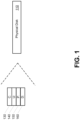
- an operating system is separated into virtual disks represented by C 130, U 140, P 150, and D 160 that share the same physical disk 110.
- the sets may be OS binaries, data, applications, user data, and driver sets. To effect a clean copy, one solution is to create a copy of the sets, as illustrated in FIG. 2 .
- a new set of volumes 230, 240, 250, and 260 may be created and the contents may be copied from the volumes 130, 140, 150, and 160.
- a download storage location 270 may be allocated for receiving the download, which may be used to update the copies of the volumes. The result is a clean copy of the original sets and a separate copy that may be used for installing the updates to the sets. However, a significant amount of space is used by this method.
- each of the sets of an operating system may be represented as their own virtual disk and may be encapsulated from the same underlying physical device.
- the result is a clean set of virtual disks that represent the original sets and a separate set of virtual disks that may be used for installing the updates to the sets.
- the updates may then be applied to the virtual disks that represent the new version.
- a snapshot set of the original operating system sets may be created as a clean copy of the current operating system, and another set may be created to track and manage the updates.
- Creating a virtual disk incurs minimal total storage cost, aside from creating and storing metadata that records and maintains the mapping between the virtual disk and the underlying data on the physical device.
- the virtual disk When the virtual disk is created based on a desired snapshot, the virtual disk is mapped to the stored data that it represents, but no new copies are created. New data is only created and stored when the contents of the virtual disk are modified in some way, after which the virtual disk starts diverging from the original virtual disk.
- a virtual disk VD1 300 may include metadata that points to the underlying device for its allocations.
- VD1 300 may be created based on VDS 310.
- VDS 310 then takes all of the metadata allocations of VD1 300, and VD1 300 is linked to VDS 310.
- VD1 300 is thus a copy of VDS 310 via the mapping of VDS 310. If a read is requested for an area in VD1 300, then it may be determined if VD1 300 has a mapping. If VD1 300 does not have the mapping, then it may be attempted to obtain the mapping from VDS 310.
- VD1 300 can create its own mapping to record the write (e.g., to a new file G).
- the portion of VD1 300 that is modified may be obtained via VDS 310 and modified.
- the modified portion may then be stored on the underlying physical device, and the mapping on VD1 300 may be updated to point to the modified portion on the physical device rather than the mapping to VDS 310.
- VDS 310 still maintains its mapping to the original physical location and thus VD1 300 has diverged from VDS 310. For unchanged portions, VD1 300 may continue to map to VDS 310.
- VD2 400 may be created from VDS 310.
- VD2 400 like VD1 300, may depend on VDS 310.
- any number N virtual disks may be created that can be based on VDS 310.
- Each copy (virtual disk) can diverge from VDS 310, and modified areas can be mapped to the underlying physical disk 410. Areas that are not modified may copy the mapping from VDS 310.
- VD1 300 may have a block updated that originally pointed to block F in VDS 310. The modified block is represented as block H and written to the physical disk 410.
- VD1 300 may have a block updated that originally pointed to block F in VDS 310.
- the modified block is represented as block J and written to the physical disk.
- Additional virtual disks VD(N) may be created that can be based on VDS 310.
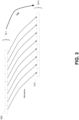
- New snapshots may be represented by leaves that depend on a parent or root node.
- the dependency means that a leaf empties its contents to the node that it depends on. Once a leaf is formed, only the leaf can be changed and the root node becomes immutable. In other words, when a leaf is snapshotted, that leaf in turn becomes immutable and only the snap (new) leaf is mutable.
- a root node and its leaf may be collapsed or merged, if there were no other nodes that depend on the root node.
- the point of a snapshot is where the virtual disks may start differing. Snapshots may be taken at different times as needed, using this approach.
- the relationships between snapshots may be represented as a tree as described with reference to FIG. 5D .
- Each node represents a snapshot (virtual disk), and each node can be the basis for further snapshots.
- a given node may only be modified when that virtual disk is modified, and otherwise cannot be modified by any other node.
- a node is thus a snapshot that can be made read-only if the snapshot is to be preserved as a permanent clean copy, or can be modified with the snapshot as the starting point.
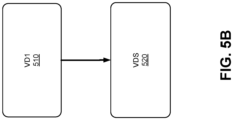
- a virtual disk 510 may be generated and indicated as VD1 510.
- FIG. 5B illustrates that VD1 510 points to VDS 520.
- the mappings of VD1 510 may be pointed to the mappings of VDS 520.
- VDS 520 is thus a snapshot at the point of time that the snapshot is taken and may be treated as immutable.
- FIG. 5C illustrates creation of an additional virtual disk 530 represented as VD2 that also points to VDS 520.
- FIG. 5D illustrates that each virtual disk may further be forked to create additional virtual disk nodes. In this way, any nodes can become roots that are snapshots and thus may be treated as immutable. Leaf nodes may be mutable until they themselves become a snapshot and become immutable root nodes.
- multiple snapshots N may be taken to preserve one version or state, and updates may only be made to N-1 (or fewer) of the snapshots.
- nodes may be removed. This may be referred to as collapsing. For example, if a rollback is desired, changes made to a virtual disk may be removed, returning the virtual disk to its original state.
- snapshots can be taken automatically as determined by the file system or other function. In some embodiments, the snapshots may be in response to user input or may require user presence.
- optimizations may be added to increase the efficiency of the I/O operations performed for a given virtual disk. For example, when a write is desired for a virtual disk which ultimately is to be written to the underlying physical disk, a read/modify/write may be performed. The portion of the physical disk that is affected by the write may be read, and the changed portion may written.
- on-demand allocation may be used.
- the affected portion of storage may be allocated and then the new content may written. Any other writes that are needed for that portion can then be written to the allocated portion. For example, if the portion size is 1 Mb, and the new part is 4 Kb, then the 1 Mb may be copied, and then the new 4 Kb may be written.
- a number of blocks of storage may be reserved for snapshots and associated updating tasks.
- the unit of allocation may be larger than unit of writing, and the described optimizations be allow for only the affected unit of writing to be written while copying or pointing to the unchanged portion of the unit of allocation.
- a journal may be used to record changes that are committed to the disk opportunistically. In this way, I/O operations are not immediately committed to disk in response to every operation.
- a journal may be implemented as its own virtual disk and may be used record all the writes to the virtual disk that are occurring dynamically and not yet committed and/or fixed in the metadata.
- the journal may record that 4K out of a 1 Mb unit of allocation at location X is updated.
- the journal may track which parts are changed on the current (local) virtual disk that are still on the original virtual disk.
- the recorded writes may then be written to disk in chunks when a threshold amount of writes is reached. Portions of the disk that have multiple writes may thus be copied once to perform the multiple writes.
- the journal may be implemented as a bitmap to record where the new writes have occurred.
- the bitmap thus maps which volumes and portions thereof hold writes that need to be committed.
- the journal may be persisted on a virtual disk and released if no longer needed.
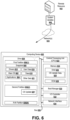
- FIG. 6 illustrated is an example computing system 600 for maintaining operating system state data 620 to maintain an ability to repeatedly attempt operating system boots and/or revert to a known state.
- the computing device 602 provides an ability to modify and persist the operating system state by updating the operating system state data 620.
- Example system components include, but are not limited to, drivers 610, an operating system (OS) 629, an application 664, a registry 616, and/or libraries 618.
- the example computing system 600 enables the computing device 602 to execute any aspects of the software components and/or functionality presented herein.
- the example computing architecture 600 illustrated in FIG. 6 shows an example architecture for a personal computer (e.g., a laptop and/or desktop computer), a tablet computer, a smart phone, a server computer, a server rack, a network of server computers, or any other types of computing devices suitable for implementing the functionality described herein.
- the computing device 602 may include one or more drive(s) 604 (hereinafter referred to as the "drive") having computer-readable media that provides nonvolatile storage for the computing device 602.
- Example drives include, but are not limited to, SATA-type solid-state hard drives, SATA-type hard disks, PATA-type solid-state hard drives, PATA-type hard disks, and/or any other drive-type suitable for providing non-volatile computer-readable media to a computing device.
- the drive 604 may include multiple partitions 606 for logically separating one or more system components and/or data objects.
- the drive 604 is separated into a first partition 606(1), a second partition 606(2), and an N-th partition 606(N).
- at least one of the partitions 606 stores drivers 610, main operating system (OS) 629, application set 664, user data set 616, and data set 618.
- Boot manager 630 may be configured to initiate the drivers 610 and to load the OS 629 and other sets into a memory 624.
- the memory 624 includes a random-access memory (“RAM”) 626 and a read-only memory (“ROM”) 628.
- the computing device 602 includes a central processing unit (“CPU") 622 that is connected, via a bus 636, to the drive 604, the memory 624, and the boot manager 630.
- the bus 636 further connects an input/output (I/O) controller 632 and/or a network interface 634.
- the system components described herein may, when loaded into the CPU 622 and executed, transform the CPU 622 and the overall computing device 602 from a general-purpose computing system into a special-purpose computing system customized to facilitate the functionality presented herein.
- the CPU 622 may be constructed from any number of transistors or other discrete circuit elements, which may individually or collectively assume any number of states. More specifically, the CPU 622 may operate as a finite-state machine, in response to executable instructions contained within the software modules disclosed herein. These computer-executable instructions may transform the CPU 622 by specifying how the CPU 622 transitions between states, thereby transforming the transistors or other discrete hardware elements constituting the CPU 622.
- the drive 604 and associated computer-readable media provide non-volatile storage for the computing device 602.
- computer-readable media can be any available non-transitory computer storage media or communication media that can be accessed by a computing architecture such as, for example, the computing architecture 600.
- Communication media includes computer-readable instructions, data structures, and/or program modules.
- communication media includes wired media such as a wired network or direct-wired connection. Combinations of the any of the above are also included within the scope of computer-readable media.
- computer storage media may include volatile and non-volatile, removable and non-removable media implemented in any method or technology for storage of information such as computer-readable instructions, data structures, program modules or other data.
- computer storage media includes, but is not limited to, RAM, ROM, EPROM, EEPROM, flash memory or other solid-state memory technology, CD-ROM, digital versatile disks ("DVD"), HD-DVD, BLU-RAY, or other optical storage, magnetic cassettes, magnetic tape, magnetic disk storage or other magnetic storage devices, or any other medium which can be used to store the desired information and which can be accessed by the computing device 602.
- DVD digital versatile disks
- HD-DVD high definition digital versatile disks
- BLU-RAY blue ray
- computer storage medium does not include waves, signals, and/or other transitory and/or intangible communication media, per se.
- the boot manager 630 may access the main OS 629 from the drive 604 (or a partition thereof) and may load the main OS 629 into the memory 624 for runtime execution by the computing device 602 (e.g., by invoking an OS boot loader). During execution of an OS booting protocol, the boot manager 630 (and/or an OS boot loader thereof) may identify the presence of (and/or verify a validity of) the operation system update data 620. The boot manager 630 may load the operation system update data 620 into the memory 624 to access data for an updated operating system state.
- the I/O controller 632 may receive and process input from a number of other devices, including a keyboard, mouse, or electronic stylus (not shown in FIG. 6 ). Similarly, the I/O controller 632 may provide output to a display screen, a printer, or other type of output device (also not shown in FIG. 6 ).
- the network interface 634 may enable the computing device 602 to connect to one or more network(s) 644 such as a local area network (LAN), a wide area network (WAN), a wireless local area network (WLAN), or any other suitable network for passing information between the computing device 602 and a remote resource 642.
- LAN local area network
- WAN wide area network
- WLAN wireless local area network
- the drive 604 may include multiple partitions 606 for logically separating one or more system components and/or data objects.
- the drive 604 includes the first partition 606(1) which stores instances of the drivers 610, the main OS 629, the application set 664, the user data set 616, the data set 618, and the operating system update data 620.
- the drivers 610 may include one or more programs for controlling one or more devices that are communicatively coupled to the computing device 602 such as, for example, printers, displays, cameras, soundcards, network cards, computer storage devices, etc.
- the main OS 629 may be any suitable system software for managing computer hardware and/or software resources and for providing services to the application set 664 and/or other applications (not shown).
- An example main OS 629 may include, but is not limited to, various versions of MICROSOFT WINDOWS (e.g., WINDOWS 8.1 or 60, WINDOWS EMBEDDED STANDARD 7, etc.), Mac OS X, iOS, etc.
- MICROSOFT WINDOWS e.g., WINDOWS 8.1 or 60, WINDOWS EMBEDDED STANDARD 7, etc.
- Mac OS X e.g., iOS, etc.
- the application set 664 may be a computer program that is configured to be run by the main OS 629 to perform one or more coordinated functions, tasks, and/or activities.
- Example applications 664 include, but are not limited to, applications configured to support one or more specific operations and/or general applications (e.g., a word processor and/or spreadsheet application, a web browser application, etc.).
- the main OS 629 may include a database containing information usable to boot and/or configure the main OS 629, system-wide software settings that control the operation of the OS 629, security databases, and/or user specific configuration settings.
- the main OS 629 may further contain information associated with in-memory volatile data such as, for example, a current hardware state of the main OS 629 (e.g., which drivers are currently loaded and in use by the OS 629).
- the main OS 629 may include libraries which may be a collection of non-volatile resources that are usable (e.g., callable) by the application set 664 and/or other applications (not shown).
- Example resources include, but are not limited to, pre-written code and/or subroutines, configuration data, and/or classes (e.g., extensible program-code-templates for creating objects of various types).
- the libraries may enable the application 664 to call upon various system services provided by the main OS 629.
- the libraries may include one or more subsystem Dynamic Link Libraries (DLLs) configured for implementing and/or exposing Application Programming Interface (API) functionalities of the main OS 629 to the application set 664.
- DLLs subsystem Dynamic Link Libraries
- the operation system update data 620 may define an operating system state of the computing device 602 and/or system components thereof. From a known good state of the operating system, the operation system update data 620 may be loaded into the memory 624 to attempt a boot of the updated operating system.
- the operation system update data 620 may correspond to a snapshot 608 of the current operating system of the computing device 602 and may include data about the drivers 610, the main OS 629, and other sets that are operational at the time the current operating system state is snapshotted (recorded).
- the computing device 602 may access and compress contents of the memory 624 that pertain to the current operating system and save the compressed contents of the memory 624 to snapshot data 608.
- the operation system update data 620 is stored on the drive 604, which provides non-volatile storage for the computing device 602.
- the computing device 602 may be fully powered down (or even abruptly lose power) without losing access to the operation system update data 620.
- the computing device 602 When the computing device 602 is later turned on it may automatically transition to the current operating system state because the boot manager 630 may identify that the current operating system state has a count of infinity and no other operating system version has a count great than zero.
- the updated operating system 620' stored in the second partition 606(2) has a count greater than zero, then the operation system update data 620' has priority for the current boot, and the boot manager 630 may execute a specific booting protocol to cause the computing device 602 to load and execute the updated operating system 620'.
- the example computing device 602 is illustrated following the incorporation of an updated operating system resulting in at least some of the system components being updated based on the successful boot of the updated operating system.
- the first partition 606(1) is shown to include updated drivers 610(U), an updated main OS 612(U), updated application set 614(U), updated user data set 616(U), and updated data set 618(U).
- FIG. 8 depicts a timing diagram 800 illustrating start-up 802 of a device at time t1, where the device is initially booted using the known operating system state. Until time t2 when the updated operating system is received, snapshots of the current operating system set may be captured. The changes are depicted as snapshot sets 810.
- operating system updates 820 are added to the current operating system in preparation for reboot 806.
- the snapshots 810 are persisted and can be made available for future reboots if needed.
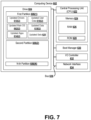
- FIG. 9 depicts an operating system set comprising drivers 923, main OS 929, data 926, applications 927, and user set 928.
- snapshots of the drivers 910, main OS 930, data 931, applications 932, and user set 933 may be taken of the operating system set comprising drivers 923, main OS 929, data 926, applications 927, and user set 928.
- the operating system updates may be loaded included drivers 933, main OS 939, data 936, applications 937, and user set 938. In some embodiments only the deltas may be saved such as changes 990 to drivers 933 and changes 950 to main OS 939.
- the sets show in FIG. 9 are examples, and other sets may be defined for a given operating system.
- FIG. 10 depicts a storage volume 1020 that includes metadata 1030 for a storage pool for the operating system versions.
- the metadata 1030 may describe a first set 1006(1) that may define a current operating system comprising drivers set 1 1012(1), main OS set 1 1010(1), data set 1 1014(1), applications set 1 1016(1), and user data set 1 1018(1).
- Operating system set 1 1006(1) may be associated with an active count of infinity to indicate that there is no limit to the number of reboots that may be performed with this operating system version.
- Metadata 1030 may further describe a second set 1006(2) that may define an updated operating system comprising drivers set 2 1012(2), main OS set 2 1010(2), data set 2 1014(2), applications set 2 1016(2), and user data set 2 1018(2).
- Operating system set 2 1006(2) may be associated with an override count of one to indicate that the number of reboots that may be performed with this operating system version is limited to one.
- Operation 1100 begins the procedure, and operation 1102 illustrates identifying data that defines a known good state for a current operating system that is operable to launch the computing device to the known good state in response to a reboot of the computing device.
- the identified data includes read-only sets that are not updated during operation of the computing device, and modifiable sets that can be updated during operation of the computing device. Additionally and optionally, the read-only sets are captured on an opportunistic basis and the modifiable sets are captured when the computing device is to be rebooted.
- Operation 1102 may be followed by Operation 1104.
- Operation 1104 illustrates allocating a first virtual disk and a second virtual disk as snapshots of the identified data that defines the known good state.
- Operation 1104 may be followed by Operation 1106.
- Operation 1106 illustrates updating the first virtual disk to generate an updated state that is operable to launch the computing device to the updated state in response to a reboot of the computing device. In an embodiment, updates to the first virtual disk are isolated from the second virtual disk.
- Operation 1106 may be followed by Operation 1108.
- Operation 1108 illustrates maintaining the second virtual disk as an immutable snapshot of the identified data.
- Operation 1108 may be followed by Operation 1110.
- Operation 1110 illustrates in response to a failed reboot of the computing device with the updated state, reverting to the known good state using the snapshot of the identified data as allocated by the second virtual disk.
- Operation 1200 begins the procedure, and operation 1202 illustrates identifying one or more sets of data that are to be updated in whole or in part.
- Operation 1202 may be followed by Operation 1204.
- Operation 1204 illustrates allocating a first virtual disk as a mutable snapshot of the identified sets of data.
- Operation 1204 may be followed by Operation 1206.
- Operation 1206 illustrates associating the first virtual disk with metadata that maps currently stored locations of the identified sets of data.
- Operation 1206 may be followed by Operation 1208.
- Operation 1208 illustrates allocating a second virtual disk as an immutable snapshot of the identified sets of data.
- Operation 1208 may be followed by Operation 1210.
- Operation 1210 illustrates associating the second virtual disk with metadata that maps the currently stored locations of the identified sets of data.
- Operation 1210 may be followed by operation 1212.
- Operation 1212 illustrates updating the first virtual disk to generate an updated version of the identified sets of data, wherein updates to the first virtual disk are isolated from the second virtual disk.
- Operation 1212 may be followed by operation 1214.
- Operation 1214 illustrates maintaining the second virtual disk as a clean representation of the identified sets of data.
- Operation 1214 may be followed by operation 1216.
- Operation 1216 illustrates reverting to the clean representation of the identified sets of data as allocated by the second virtual disk.
- a computing device that implements a portion or all of one or more of the technologies described herein, including the techniques to implement the functionality of a device may include a general-purpose computer system that includes or is configured to access one or more computer-accessible media.
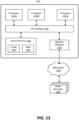
- FIG. 13 illustrates such a general-purpose computing device 1300.
- computing device 1300 includes one or more processors 1310a, 1310b, and/or 1310n (which may be referred herein singularly as “a processor 1310" or in the plural as “the processors 1310") coupled to a system memory 1320 via an input/output (I/O) interface 1330.
- Computing device 1300 further includes a network interface 1340 coupled to I/O interface 1330.
- computing device 1300 may be a uniprocessor system including one processor 1310 or a multiprocessor system including several processors 1310 (e.g., two, four, eight, or another suitable number).
- Processors 1310 may be any suitable processors capable of executing instructions.
- processors 1310 may be general-purpose or embedded processors implementing any of a variety of instruction set architectures (ISAs), such as the x136, PowerPC, SPARC, or MIPS ISAs, or any other suitable ISA.
- ISAs instruction set architectures
- each of processors 1310 may commonly, but not necessarily, implement the same ISA.
- System memory 1320 may be configured to store instructions and data accessible by processor(s) 1310.
- system memory 1320 may be implemented using any suitable memory technology, such as static random access memory (SRAM), synchronous dynamic RAM (SDRAM), nonvolatile/Flash-type memory, or any other type of memory.
- SRAM static random access memory
- SDRAM synchronous dynamic RAM
- program instructions and data implementing one or more desired functions, such as those methods, techniques and data described above, are shown stored within system memory 1320 as code 1325 and data 1326.
- I/O interface 1330 may be configured to coordinate I/O traffic between processor 1310, system memory 1320, and any peripheral devices in the device, including network interface 1340 or other peripheral interfaces.
- I/O interface 1330 may perform any necessary protocol, timing, or other data transformations to convert data signals from one component (e.g., system memory 1320) into a format suitable for use by another component (e.g., processor 1310).
- I/O interface 1330 may include support for devices attached through various types of peripheral buses, such as a variant of the Peripheral Component Interconnect (PCI) bus standard or the Universal Serial Bus (USB) standard, for example.
- PCI Peripheral Component Interconnect
- USB Universal Serial Bus
- I/O interface 1330 may be split into two or more separate components, such as a north bridge and a south bridge, for example. Also, in some embodiments some or all of the functionality of I/O interface 1330, such as an interface to system memory 1320, may be incorporated directly into processor 1310.
- Network interface 1340 may be configured to allow data to be exchanged between computing device 1300 and other device or devices 1360 attached to a network or network(s) 1350, such as other computer systems or devices as illustrated in FIGs. 1 through 12 , for example.
- network interface 1340 may support communication via any suitable wired or wireless general data networks, such as types of Ethernet networks, for example.
- network interface 1340 may support communication via telecommunications/telephony networks such as analog voice networks or digital fiber communications networks, via storage area networks such as Fibre Channel SANs or via any other suitable type of network and/or protocol.
- system memory 1320 may be one embodiment of a computer-accessible medium configured to store program instructions and data as described above for FIGS. 1-12 for implementing embodiments of the corresponding methods and apparatus.
- program instructions and/or data may be received, sent or stored upon different types of computer-accessible media.
- a computer-accessible medium may include non-transitory storage media or memory media, such as magnetic or optical media, e.g., disk or DVD/CD coupled to computing device 1300 via I/O interface 1330.
- a non-transitory computer-accessible storage medium may also include any volatile or non-volatile media, such as RAM (e.g.
- a computer-accessible medium may include transmission media or signals such as electrical, electromagnetic or digital signals, conveyed via a communication medium such as a network and/or a wireless link, such as may be implemented via network interface 1340.
- a communication medium such as a network and/or a wireless link, such as may be implemented via network interface 1340.
- Portions or all of multiple computing devices, such as those illustrated in FIG. 13 may be used to implement the described functionality in various embodiments; for example, software components running on a variety of different devices and servers may collaborate to provide the functionality.
- portions of the described functionality may be implemented using storage devices, network devices, or special-purpose computer systems, in addition to or instead of being implemented using general-purpose computer systems.
- the term "computing device,” as used herein, refers to at least all these types of devices and is not limited to these types of devices.
- the phrase "computer-readable storage medium” and variations thereof, does not include waves, signals, and/or other transitory and/or intangible communication media.
- Each of the processes, methods and algorithms described in the preceding sections may be embodied in, and fully or partially automated by, code modules executed by one or more computers or computer processors.
- the code modules may be stored on any type of non-transitory computer-readable medium or computer storage device, such as hard drives, solid state memory, optical disc and/or the like.
- the processes and algorithms may be implemented partially or wholly in application-specific circuitry.
- the results of the disclosed processes and process steps may be stored, persistently or otherwise, in any type of non-transitory computer storage such as, e.g., volatile or non-volatile storage.
- some or all of the systems and/or modules may be implemented or provided in other ways, such as at least partially in firmware and/or hardware, including, but not limited to, one or more application-specific integrated circuits (ASICs), standard integrated circuits, controllers (e.g., by executing appropriate instructions, and including microcontrollers and/or embedded controllers), field-programmable gate arrays (FPGAs), complex programmable logic devices (CPLDs), etc. Accordingly, the present invention may be practiced with other computer system configurations.
- ASICs application-specific integrated circuits
- controllers e.g., by executing appropriate instructions, and including microcontrollers and/or embedded controllers
- FPGAs field-programmable gate arrays
- CPLDs complex programmable logic devices
- Example Clause A a computer-implemented method for updating an operating system of a computing device, the method comprising: identifying data that defines a known good state for a current operating system that is operable to launch the computing device to the known good state in response to a reboot of the computing device, wherein:
- Example Clause B the computer-implemented method of Example Clause A, further comprising allocating additional virtual disks as representations of the identified data that defines the known good state.
- Example Clause C the computer-implemented method of any one of Example Clauses A through B, further comprising discarding the first virtual disk.
- Example Clause D the computer-implemented method of any one of Example Clauses A through C, wherein the first and second virtual disks are mapped to physical locations where the identified data is stored.
- Example Clause E the computer-implemented method of any one of Example Clauses A through D, wherein updating the first virtual disk comprises reading data from physical locations where updated portions of the identified data are stored, updating the read data, writing the updated data to new physical locations, and updating metadata for the first virtual disk to map to the new physical locations.
- Example Clause F the computer-implemented method of any one of Example Clauses A through E, wherein the operating system is implemented as sets of partitions that are separately updatable.
- Example Clause G the computer-implemented method of any one of Example Clauses A through F, wherein the updated sets comprise delta changes to the current operating system.
- Example Clause H the computer-implemented method of any one of Example Clauses A through G, further comprising storing multiple operating system updates that each define a known operating system state, wherein only one operating system state is allowed to be used for reboot.
- Example Clauses A through H are described above with respect to a computer-implemented method, it is understood in the context of this disclosure that the subject matter of Example Clauses A through H can additionally or alternatively be implemented by a system or device or computer readable medium.
- Example Clause I a computing device comprising:
- Example Clause J the system of Example Clause I, further comprising computer-readable instructions stored thereupon which, when executed by the one or more processors, cause the computing device to:
- Example Clause K the system of any one of Example Clauses H through J, further comprising computer-readable instructions stored thereupon which, when executed by the one or more processors, cause the computing device to:
- Example Clause L the system of any one of Example Clauses H through K, further comprising computer-readable instructions stored thereupon which, when executed by the one or more processors, cause the computing device to: allocate additional virtual disks as snapshots of defined subsets of data.
- Example Clause M the system of any one of Example Clauses H through L, wherein the identified one or more sets of data are partitions of a current operating system.
- Example Clause N the system of any one of Example Clauses H through M, further comprising computer-readable instructions stored thereupon which, when executed by the one or more processors, cause the computing device to: discard the first virtual disk and updates associated with the first virtual disk.
- Example Clause O the system of any one of Example Clauses H through N, further comprising computer-readable instructions stored thereupon which, when executed by the one or more processors, cause the computing device to: revert to the second virtual disk as a clean copy of the identified sets of data.
- Example Clauses H through O are described above with respect to a system, it is understood in the context of this disclosure that the subject matter of Example Clauses H through O can additionally or alternatively be implemented by a device3 or method or computer readable medium.
- Example Clause P a computer-readable medium having encoded thereon computer-executable instructions that, when executed, cause one or more processing units of a computing device to execute a method comprising:
- Example Clause Q the computer-readable medium of any one of Example Clause P, further comprising computer-executable instructions that, when executed, cause one or more processing units of a computing device to execute a method comprising: allocating additional virtual disks as additional snapshots are needed.
- Example Clause R the computer-readable medium of any one of Example Clauses Q through P, wherein updating the first virtual disk comprises reading data from physical locations where updated portions of the identified data are stored, updating the read data, writing the updated data to new physical locations, and updating metadata for the first virtual disk to map to the new physical locations.
- Example Clause S the computer-readable medium of any one of Example Clauses Q through R, wherein updating the first virtual disk comprises reading physical locations on an on-demand basis.
- Example Clause T the computer-readable medium of any one of Example Clauses Q through S, wherein updating the first virtual disk comprises tracking updates in a journal prior to committing the updates to permanent storage.
- Example Clauses Q through T are described above with respect to a computer-readable medium, it is understood in the context of this disclosure that the subject matter of Example Clauses Q through T can additionally or alternatively be implemented by a method or via a device or via a system.
Landscapes
- Engineering & Computer Science (AREA)
- Theoretical Computer Science (AREA)
- General Engineering & Computer Science (AREA)
- Software Systems (AREA)
- Physics & Mathematics (AREA)
- General Physics & Mathematics (AREA)
- Quality & Reliability (AREA)
- Computer Security & Cryptography (AREA)
- Information Retrieval, Db Structures And Fs Structures Therefor (AREA)
- Retry When Errors Occur (AREA)
- Hardware Redundancy (AREA)
Applications Claiming Priority (3)
| Application Number | Priority Date | Filing Date | Title |
|---|---|---|---|
| US16/411,018 US11620136B2 (en) | 2019-05-13 | 2019-05-13 | Space snapshots |
| PCT/US2020/026981 WO2020231546A1 (en) | 2019-05-13 | 2020-04-07 | Method for updating an operating system of a computing device |
| EP20722830.5A EP3970019B1 (de) | 2019-05-13 | 2020-04-07 | Procédé de mise à jour d'un système d'exploitation |
Related Parent Applications (2)
| Application Number | Title | Priority Date | Filing Date |
|---|---|---|---|
| EP20722830.5A Division EP3970019B1 (de) | 2019-05-13 | 2020-04-07 | Procédé de mise à jour d'un système d'exploitation |
| EP20722830.5A Division-Into EP3970019B1 (de) | 2019-05-13 | 2020-04-07 | Procédé de mise à jour d'un système d'exploitation |
Publications (2)
| Publication Number | Publication Date |
|---|---|
| EP4560464A2 true EP4560464A2 (de) | 2025-05-28 |
| EP4560464A3 EP4560464A3 (de) | 2025-07-30 |
Family
ID=70476443
Family Applications (2)
| Application Number | Title | Priority Date | Filing Date |
|---|---|---|---|
| EP25169602.7A Pending EP4560464A3 (de) | 2019-05-13 | 2020-04-07 | Aktualisierungsverfahren für ein betriebssystem |
| EP20722830.5A Active EP3970019B1 (de) | 2019-05-13 | 2020-04-07 | Procédé de mise à jour d'un système d'exploitation |
Family Applications After (1)
| Application Number | Title | Priority Date | Filing Date |
|---|---|---|---|
| EP20722830.5A Active EP3970019B1 (de) | 2019-05-13 | 2020-04-07 | Procédé de mise à jour d'un système d'exploitation |
Country Status (3)
| Country | Link |
|---|---|
| US (1) | US11620136B2 (de) |
| EP (2) | EP4560464A3 (de) |
| WO (1) | WO2020231546A1 (de) |
Families Citing this family (3)
| Publication number | Priority date | Publication date | Assignee | Title |
|---|---|---|---|---|
| US20240028456A1 (en) * | 2022-07-22 | 2024-01-25 | Vmware, Inc | Unattended snapshot reversion for upgrades |
| US12450126B2 (en) | 2023-02-13 | 2025-10-21 | Pure Storage, Inc. | Automated backups in a distributed storage system |
| US12405860B2 (en) * | 2024-01-30 | 2025-09-02 | Dell Products L.P. | System and method for secure backup and restore |
Family Cites Families (8)
| Publication number | Priority date | Publication date | Assignee | Title |
|---|---|---|---|---|
| US7231544B2 (en) * | 2003-02-27 | 2007-06-12 | Hewlett-Packard Development Company, L.P. | Restoring data from point-in-time representations of the data |
| US7805409B2 (en) * | 2008-02-21 | 2010-09-28 | Oracle America, Inc. | Dynamic composition of an execution environment from multiple immutable file system images |
| US8099553B2 (en) * | 2009-01-20 | 2012-01-17 | Dell Products L.P. | Refactoring virtual data storage hierarchies |
| US9141368B2 (en) * | 2011-03-10 | 2015-09-22 | Microsoft Technology Licensing, Llc | Managing boot loaders for virtual hard disks |
| US8904081B1 (en) * | 2012-05-08 | 2014-12-02 | Vmware, Inc. | Composing a virtual disk using application delta disk images |
| US20160162278A1 (en) * | 2014-12-05 | 2016-06-09 | Cyanogen Inc. | System and method for applying an update to a device system via a system snapshot |
| US10896100B2 (en) * | 2017-03-24 | 2021-01-19 | Commvault Systems, Inc. | Buffered virtual machine replication |
| US10509646B2 (en) * | 2017-06-02 | 2019-12-17 | Apple Inc. | Software update rollbacks using file system volume snapshots |
-
2019
- 2019-05-13 US US16/411,018 patent/US11620136B2/en active Active
-
2020
- 2020-04-07 EP EP25169602.7A patent/EP4560464A3/de active Pending
- 2020-04-07 EP EP20722830.5A patent/EP3970019B1/de active Active
- 2020-04-07 WO PCT/US2020/026981 patent/WO2020231546A1/en not_active Ceased
Also Published As
| Publication number | Publication date |
|---|---|
| EP3970019A1 (de) | 2022-03-23 |
| US20200364058A1 (en) | 2020-11-19 |
| EP4560464A3 (de) | 2025-07-30 |
| US11620136B2 (en) | 2023-04-04 |
| EP3970019B1 (de) | 2025-09-10 |
| WO2020231546A1 (en) | 2020-11-19 |
Similar Documents
| Publication | Publication Date | Title |
|---|---|---|
| EP3769224B1 (de) | Konfigurierbare wiederherstellungszustände | |
| CN106227579B (zh) | 一种Docker容器构建方法及Docker管理控制台 | |
| US8495351B2 (en) | Preparing and preserving a system configuration during a hot upgrade | |
| US8712968B1 (en) | Systems and methods for restoring images | |
| EP3678019B1 (de) | Verfahren und vorrichtung zur verbesserung eines spiegelbildes | |
| US10606800B1 (en) | Policy-based layered filesystem management | |
| CN102591675B (zh) | 使用共享存储块管理多软件镜像的方法和系统 | |
| US20200341746A1 (en) | Snapshot recovery states | |
| US9678966B2 (en) | Swat command and API for atomic swap and trim of LBAs | |
| EP3970019B1 (de) | Procédé de mise à jour d'un système d'exploitation | |
| US20150363323A1 (en) | Non-volatile memory write mechanism | |
| US20070226436A1 (en) | File system based offline disk management | |
| US20140123122A1 (en) | System and method for virtual machine offline patching without mount the virtual disk | |
| WO2019212727A1 (en) | Storage reserve in a file system | |
| EP3769225B1 (de) | Freiraum-durchgang | |
| CN116049207A (zh) | 应用程序sql脚本处理方法、装置、处理器及电子设备 | |
| CN111913753A (zh) | 一种windows系统云迁移中启动方式的变更方法及系统 | |
| JP2018195046A (ja) | プログラム更新装置、プログラム更新方法、プログラム更新プログラム及びプログラム更新システム | |
| KR102423056B1 (ko) | 부팅 디스크 변경 방법 및 시스템 | |
| US20220011938A1 (en) | System and method for selectively restoring data | |
| CN119201330B (zh) | 一种虚拟机的还原方法、装置及电子设备 | |
| US20260064301A1 (en) | Flash partition upgrade method and device, appatatus, and storage nedium | |
| US12169730B2 (en) | Handling memory accounting when suspending and resuming virtual machines to/from volatile memory | |
| CN112631637B (zh) | 基于rtos的ota升级方法、系统、设备及存储介质 |
Legal Events
| Date | Code | Title | Description |
|---|---|---|---|
| PUAI | Public reference made under article 153(3) epc to a published international application that has entered the european phase |
Free format text: ORIGINAL CODE: 0009012 |
|
| STAA | Information on the status of an ep patent application or granted ep patent |
Free format text: STATUS: REQUEST FOR EXAMINATION WAS MADE |
|
| 17P | Request for examination filed |
Effective date: 20250410 |
|
| AC | Divisional application: reference to earlier application |
Ref document number: 3970019 Country of ref document: EP Kind code of ref document: P |
|
| AK | Designated contracting states |
Kind code of ref document: A2 Designated state(s): AL AT BE BG CH CY CZ DE DK EE ES FI FR GB GR HR HU IE IS IT LI LT LU LV MC MK MT NL NO PL PT RO RS SE SI SK SM TR |
|
| REG | Reference to a national code |
Ref country code: DE Ref legal event code: R079 Free format text: PREVIOUS MAIN CLASS: G06F0009440100 Ipc: G06F0011140000 |
|
| PUAL | Search report despatched |
Free format text: ORIGINAL CODE: 0009013 |
|
| AK | Designated contracting states |
Kind code of ref document: A3 Designated state(s): AL AT BE BG CH CY CZ DE DK EE ES FI FR GB GR HR HU IE IS IT LI LT LU LV MC MK MT NL NO PL PT RO RS SE SI SK SM TR |
|
| RIC1 | Information provided on ipc code assigned before grant |
Ipc: G06F 11/14 20060101AFI20250624BHEP Ipc: G06F 8/654 20180101ALI20250624BHEP Ipc: G06F 9/4401 20180101ALN20250624BHEP |
|
| GRAP | Despatch of communication of intention to grant a patent |
Free format text: ORIGINAL CODE: EPIDOSNIGR1 |
|
| STAA | Information on the status of an ep patent application or granted ep patent |
Free format text: STATUS: GRANT OF PATENT IS INTENDED |
|
| RIC1 | Information provided on ipc code assigned before grant |
Ipc: G06F 11/14 20060101AFI20260217BHEP Ipc: G06F 8/654 20180101ALI20260217BHEP Ipc: G06F 11/1446 20260101ALI20260217BHEP Ipc: G06F 11/1471 20260101ALI20260217BHEP Ipc: G06F 9/4401 20180101ALN20260217BHEP |
|
| RIC1 | Information provided on ipc code assigned before grant |
Ipc: G06F 11/14 20060101AFI20260302BHEP Ipc: G06F 8/654 20180101ALI20260302BHEP Ipc: G06F 11/1446 20260101ALI20260302BHEP Ipc: G06F 11/1471 20260101ALI20260302BHEP Ipc: G06F 9/4401 20180101ALN20260302BHEP |
|
| INTG | Intention to grant announced |
Effective date: 20260311 |