EP4560282A1 - Information processing device, information processing method, and program - Google Patents
Information processing device, information processing method, and program Download PDFInfo
- Publication number
- EP4560282A1 EP4560282A1 EP23859835.3A EP23859835A EP4560282A1 EP 4560282 A1 EP4560282 A1 EP 4560282A1 EP 23859835 A EP23859835 A EP 23859835A EP 4560282 A1 EP4560282 A1 EP 4560282A1
- Authority
- EP
- European Patent Office
- Prior art keywords
- gas
- information processing
- image
- inspection image
- processing device
- Prior art date
- Legal status (The legal status is an assumption and is not a legal conclusion. Google has not performed a legal analysis and makes no representation as to the accuracy of the status listed.)
- Pending
Links
Images

Classifications
-
- G—PHYSICS
- G06—COMPUTING OR CALCULATING; COUNTING
- G06T—IMAGE DATA PROCESSING OR GENERATION, IN GENERAL
- G06T7/00—Image analysis
- G06T7/0002—Inspection of images, e.g. flaw detection
- G06T7/0004—Industrial image inspection
- G06T7/0008—Industrial image inspection checking presence/absence
-
- G—PHYSICS
- G01—MEASURING; TESTING
- G01M—TESTING STATIC OR DYNAMIC BALANCE OF MACHINES OR STRUCTURES; TESTING OF STRUCTURES OR APPARATUS, NOT OTHERWISE PROVIDED FOR
- G01M3/00—Investigating fluid-tightness of structures
- G01M3/02—Investigating fluid-tightness of structures by using fluid or vacuum
- G01M3/04—Investigating fluid-tightness of structures by using fluid or vacuum by detecting the presence of fluid at the leakage point
-
- G—PHYSICS
- G01—MEASURING; TESTING
- G01M—TESTING STATIC OR DYNAMIC BALANCE OF MACHINES OR STRUCTURES; TESTING OF STRUCTURES OR APPARATUS, NOT OTHERWISE PROVIDED FOR
- G01M3/00—Investigating fluid-tightness of structures
- G01M3/38—Investigating fluid-tightness of structures by using light
-
- G—PHYSICS
- G06—COMPUTING OR CALCULATING; COUNTING
- G06N—COMPUTING ARRANGEMENTS BASED ON SPECIFIC COMPUTATIONAL MODELS
- G06N3/00—Computing arrangements based on biological models
- G06N3/02—Neural networks
- G06N3/04—Architecture, e.g. interconnection topology
- G06N3/044—Recurrent networks, e.g. Hopfield networks
-
- G—PHYSICS
- G06—COMPUTING OR CALCULATING; COUNTING
- G06N—COMPUTING ARRANGEMENTS BASED ON SPECIFIC COMPUTATIONAL MODELS
- G06N3/00—Computing arrangements based on biological models
- G06N3/02—Neural networks
- G06N3/04—Architecture, e.g. interconnection topology
- G06N3/045—Combinations of networks
-
- G—PHYSICS
- G06—COMPUTING OR CALCULATING; COUNTING
- G06T—IMAGE DATA PROCESSING OR GENERATION, IN GENERAL
- G06T7/00—Image analysis
- G06T7/0002—Inspection of images, e.g. flaw detection
-
- G—PHYSICS
- G06—COMPUTING OR CALCULATING; COUNTING
- G06T—IMAGE DATA PROCESSING OR GENERATION, IN GENERAL
- G06T7/00—Image analysis
- G06T7/20—Analysis of motion
-
- G—PHYSICS
- G06—COMPUTING OR CALCULATING; COUNTING
- G06V—IMAGE OR VIDEO RECOGNITION OR UNDERSTANDING
- G06V10/00—Arrangements for image or video recognition or understanding
- G06V10/40—Extraction of image or video features
- G06V10/54—Extraction of image or video features relating to texture
-
- G—PHYSICS
- G06—COMPUTING OR CALCULATING; COUNTING
- G06V—IMAGE OR VIDEO RECOGNITION OR UNDERSTANDING
- G06V10/00—Arrangements for image or video recognition or understanding
- G06V10/70—Arrangements for image or video recognition or understanding using pattern recognition or machine learning
- G06V10/82—Arrangements for image or video recognition or understanding using pattern recognition or machine learning using neural networks
-
- G—PHYSICS
- G06—COMPUTING OR CALCULATING; COUNTING
- G06V—IMAGE OR VIDEO RECOGNITION OR UNDERSTANDING
- G06V20/00—Scenes; Scene-specific elements
- G06V20/10—Terrestrial scenes
- G06V20/17—Terrestrial scenes taken from planes or by drones
-
- G—PHYSICS
- G06—COMPUTING OR CALCULATING; COUNTING
- G06V—IMAGE OR VIDEO RECOGNITION OR UNDERSTANDING
- G06V20/00—Scenes; Scene-specific elements
- G06V20/50—Context or environment of the image
- G06V20/52—Surveillance or monitoring of activities, e.g. for recognising suspicious objects
-
- G—PHYSICS
- G06—COMPUTING OR CALCULATING; COUNTING
- G06N—COMPUTING ARRANGEMENTS BASED ON SPECIFIC COMPUTATIONAL MODELS
- G06N3/00—Computing arrangements based on biological models
- G06N3/02—Neural networks
- G06N3/04—Architecture, e.g. interconnection topology
- G06N3/044—Recurrent networks, e.g. Hopfield networks
- G06N3/0442—Recurrent networks, e.g. Hopfield networks characterised by memory or gating, e.g. long short-term memory [LSTM] or gated recurrent units [GRU]
-
- G—PHYSICS
- G06—COMPUTING OR CALCULATING; COUNTING
- G06T—IMAGE DATA PROCESSING OR GENERATION, IN GENERAL
- G06T2207/00—Indexing scheme for image analysis or image enhancement
- G06T2207/10—Image acquisition modality
- G06T2207/10016—Video; Image sequence
-
- G—PHYSICS
- G06—COMPUTING OR CALCULATING; COUNTING
- G06T—IMAGE DATA PROCESSING OR GENERATION, IN GENERAL
- G06T2207/00—Indexing scheme for image analysis or image enhancement
- G06T2207/10—Image acquisition modality
- G06T2207/10032—Satellite or aerial image; Remote sensing
-
- G—PHYSICS
- G06—COMPUTING OR CALCULATING; COUNTING
- G06T—IMAGE DATA PROCESSING OR GENERATION, IN GENERAL
- G06T2207/00—Indexing scheme for image analysis or image enhancement
- G06T2207/10—Image acquisition modality
- G06T2207/10048—Infrared image
-
- G—PHYSICS
- G06—COMPUTING OR CALCULATING; COUNTING
- G06T—IMAGE DATA PROCESSING OR GENERATION, IN GENERAL
- G06T2207/00—Indexing scheme for image analysis or image enhancement
- G06T2207/20—Special algorithmic details
- G06T2207/20081—Training; Learning
-
- G—PHYSICS
- G06—COMPUTING OR CALCULATING; COUNTING
- G06T—IMAGE DATA PROCESSING OR GENERATION, IN GENERAL
- G06T2207/00—Indexing scheme for image analysis or image enhancement
- G06T2207/20—Special algorithmic details
- G06T2207/20084—Artificial neural networks [ANN]
-
- G—PHYSICS
- G06—COMPUTING OR CALCULATING; COUNTING
- G06T—IMAGE DATA PROCESSING OR GENERATION, IN GENERAL
- G06T2207/00—Indexing scheme for image analysis or image enhancement
- G06T2207/30—Subject of image; Context of image processing
- G06T2207/30108—Industrial image inspection
-
- G—PHYSICS
- G06—COMPUTING OR CALCULATING; COUNTING
- G06T—IMAGE DATA PROCESSING OR GENERATION, IN GENERAL
- G06T2207/00—Indexing scheme for image analysis or image enhancement
- G06T2207/30—Subject of image; Context of image processing
- G06T2207/30181—Earth observation
- G06T2207/30184—Infrastructure
-
- G—PHYSICS
- G06—COMPUTING OR CALCULATING; COUNTING
- G06T—IMAGE DATA PROCESSING OR GENERATION, IN GENERAL
- G06T7/00—Image analysis
- G06T7/40—Analysis of texture
Definitions
- the present disclosure relates to an information processing device, an information processing method, and a program.
- PTL 1 discloses a technology for visualizing a flow of a fluid by acquiring temperature image data of a fluid captured by an infrared camera for a predetermined time, creating partial temperature data obtained by shifting temperature data for a certain period of time in a time direction by a certain analysis step from the temperature image data, performing a frequency analysis (Fourier transform processing) for each of the created partial temperature data, detecting a temperature fluctuation distribution for each of the certain periods of time, and displaying the temperature fluctuation distribution in time series.
- a frequency analysis Frier transform processing
- an infrared camera is fixedly installed, and it is premised that a background of a gas is uniform, for example, a wall or the like.
- a background of a gas is uniform, for example, a wall or the like.
- false detection of gas leakage may occur due to fluctuation of the background of the gas.
- the fluctuation of the background for example, sunlight, clouds, wind, dust, and fluctuation (heat haze) due to an air temperature can be considered.
- An object of the present disclosure is to provide an information processing device, an information processing method, and a program capable of accurately detecting presence of a gas.
- an information processing device including an acquisition unit that acquires an inspection image obtained by capturing an inspection target, and a detection unit that detects presence of a gas in a vicinity of the inspection target by using a prediction model in which a temporal and spatial change rate in the inspection image is set as an input parameter and information where whether or not the gas is present in the inspection image is detectable is set as an output parameter.
- an information processing method including a step of acquiring an inspection image obtained by capturing an inspection target, and a step of detecting presence of a gas in a vicinity of the inspection target by using a prediction model in which a temporal and spatial change rate in the inspection image is set as an input parameter and information where whether or not the gas is present in the inspection image is detectable is set as an output parameter.
- a program that causes an information processing device to execute a step of acquiring an inspection image obtained by capturing an inspection target, and a step of detecting presence of a gas in a vicinity of the inspection target by using a prediction model in which a temporal and spatial change rate in the inspection image is set as an input parameter and information where whether or not the gas is present in the inspection image is detectable is set as an output parameter.
- Fig. 1 is a schematic diagram showing an overall configuration of an information processing system according to an embodiment.
- An information processing system 1 is a system for detecting presence (leakage) of a gas G (spray F of the gas G) in a vicinity of a gas pipe 9.
- the gas pipe 9 is installed at a gas use site or the like and is a pipe for circulating the gas G therein.
- the gas pipe 9 is an example of an inspection target according to the present embodiment. In another embodiment, for example, a storage tank of the gas G or the like may be set as an inspection target.
- the information processing system 1 includes an information processing device 10, a moving body 20, and a camera 30.
- the moving body 20 is, for example, an unmanned aerial vehicle such as a drone, and moves in an installation area of the gas pipe 9 in accordance with a preset monitoring path or an operation instruction of an operator.
- the camera 30 is mounted on the moving body 20 and captures the gas pipe 9.
- the camera 30 is, for example, an infrared camera that can detect a gas absorption wavelength (specific wavelength) of the gas G.
- the camera 30 can capture each part of an upper surface, a side surface, and the like of the gas pipe 9 by changing an orientation (capturing direction) of a capturing range R in accordance with a positional relationship between the moving body 20 and the gas pipe 9.
- the camera 30 continuously captures the gas pipe 9.
- the moving body 20 transmits the image (moving image) captured by the camera 30 to the information processing device 10.
- the information processing device 10 is communicably connected to the moving body 20.
- the information processing device 10 trains a prediction model for detecting presence of the gas G based on an image (hereinafter, also referred to as a training image) captured by the camera 30 in a case where there is no leakage of the gas G. Details of the prediction model will be described later.
- the information processing device 10 detects whether or not the gas G is present (leaked) in the vicinity of the gas pipe 9 based on an image (hereinafter, also referred to as an inspection image) captured by the camera 30 during the actual operation and the prediction model.
- Fig. 1 shows an example in which the information processing device 10 is provided at a monitoring base separated from the installation area of the gas pipe 9, but the present disclosure is not limited to this. In another embodiment, the information processing device 10 may be incorporated into the moving body 20.
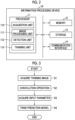
- Fig. 2 is a block diagram showing a functional configuration of an information processing device according to the embodiment.
- the information processing device 10 includes a processor 11, a memory 12, a storage 13, and a communication interface 14.
- the processor 11 operates in accordance with a predetermined program to exhibit functions as an acquisition unit 110, an image processing unit 111, a detection unit 112, and a training unit 113.
- the acquisition unit 110 acquires an inspection image obtained by capturing the gas pipe 9.
- the image processing unit 111 performs a convolution operation on the inspection image to generate a texture image.
- the detection unit 112 detects the presence of the gas G in the vicinity of the gas pipe 9 by using a prediction model in which a temporal change and a spatial change of a brightness of the inspection image are set as input parameters and information where whether or not the gas G is present in the inspection image is detectable is set as an output parameter.
- the training unit 113 trains the prediction model based on the temporal change and the spatial change in the brightness of the training image captured in a case where the gas G is not present in the vicinity of the gas pipe 9.
- the memory 12 includes a memory area necessary for an operation of the processor 11.
- the storage 13 is a so-called auxiliary storage device, and is, for example, a hard disk drive (HDD), a solid state drive (SSD), or the like.
- HDD hard disk drive
- SSD solid state drive
- the communication interface 14 is an interface for transmitting and receiving various kinds of information to and from an external device (moving body 20).
- the predetermined program executed by the processor 11 of the information processing device 10 is stored in a computer-readable recording medium.
- the computer-readable recording medium include a magnetic disk, a magneto-optical disk, a CD-ROM, a DVD-ROM, a semiconductor memory, and the like.
- this computer program may be transferred to a computer through a communication line, and the computer receiving the transfer may execute the program.
- the program described above may be a program for implementing a part of the above-described functions.
- the program may be a program, so-called a difference file (difference program) that can implement the above-mentioned functions in combination with a program already recorded in a computer system.
- Fig. 3 is a flowchart showing an example of training processing of a prediction model according to the embodiment.
- the acquisition unit 110 acquires the training image captured by the camera 30 (step S1).
- the training image is an image captured in a case where the gas G is not present in the vicinity of the gas pipe 9.
- the image processing unit 111 performs the convolution operation on the training image as a gray scale arrangement to generate a texture image (step S2).
- the convolution operation is a method of creating a coarse pixel in which any pixel of the training image and adjacent pixels (for example, eight surrounding pixels) surrounding the periphery of the pixel using a filter of any size are integrated.
- a value of the coarse pixel a sum, an average, a maximum value, or the like of the original values of any pixel and the adjacent pixels is adopted.
- the "texture” means a “feature” such as unevenness due to brightness or the like
- the "texture image” means an image having unevenness.
- the noise does not refer to the fluctuation of a jet and the background, but refers to, for example, noise generated by affecting ambient radio waves mixed in a case where the image is transmitted.
- the training unit 113 trains the prediction model using the texture image.
- the prediction model predicts whether or not an object reflected in the image is the gas G or the background (the object other than the gas G) based on a feature amount of the texture image, and outputs information with which it is possible to detect whether or not the gas G is present in each pixel.
- the training unit 113 trains the prediction model using a long short-term memory (LSTM).
- LSTM long short-term memory
- LSTM is one of the recurrent neural networks (RNNs).
- RNNs recurrent neural networks
- the LSTM there are already accumulated data and newly obtained data, and in a case where the prediction model is updated, a network independently determines a feature amount of the newly obtained data, and updates the prediction model by referring to data in which data close to the found feature amount is accumulated.
- the LSTM has a forgetting gate, an input gate, and an output gate.
- the forgetting gate performs selection and rejection of the accumulated data (long-term memory) in which the data correlated with a previous output (short-term memory) and the newly obtained data are left and the data not correlated are forgotten, among the accumulated data.
- the input gate accumulates the previous output (short-term memory) and the newly obtained data.
- the output gate outputs a prediction based on the previous output (short-term memory), the newly obtained data, and the data remaining in the forgetting gate (long-term memory). Therefore, the LSTM has an advantage in which prediction can also be performed in cyclic data having a plurality of cyclic features.
- the brightness of a part of the region is reduced due to an influence of the cloud.
- the gas G is set to be reflected in another region separated from this region.
- the feature amount of the region in which the brightness is decreased due to the cloud is information not necessary for predicting whether or not the object is the gas G. Since the entire image, that is, the region (region in which the brightness is lowered due to the cloud) not spatially connected to the gas G is also trained in the normal RNN, the prediction accuracy may be decreased.
- the normal LSTM the temporal fluctuation is generally handled.
- the LSTM trains not only the temporal fluctuation but also the spatial fluctuation as the feature amount, so that the spatial feature is also selected and rejected, and the accuracy of predicting whether or not the object is gas G. Since the spatial fluctuation also serves as the temporal fluctuation, the spatial fluctuation is added as one of the data (input parameters) used for the training.
- the training unit 113 acquires the input parameter that is the training data, from the texture image of the training image (step S3).
- the input parameter is an evaluation item of the fluctuation of the background included in the training image, and is a temporal and spatial change rate of the texture image in the present embodiment.
- a temporal and spatial change rate of the texture image in the present embodiment is a temporal and spatial change rate of the texture image in the present embodiment.
- a temporal and spatial brightness change rate is information indicating a change rate of brightness with respect to time (frame) and a range (distance) over which the change in brightness extends on each image space of each time, for an element (pixel) in the arrangement of the texture images.
- This distance may be a distance represented by two-dimensional coordinates (xy coordinates) or may be a distance represented by polar coordinates.
- the training unit 113 trains a prediction model that uses the LSTM, sets the input parameter as training data, and outputs information (for example, a presence probability of the gas G) capable of detecting whether or not the gas G is present in each pixel (step S4).
- the training image that is the source of the training data is an image captured in a case where the gas G is not present in the vicinity of the gas pipe 9. Therefore, the prediction model according to the present embodiment trains the change of the background other than the gas G in a series of images (moving images) in which the scenery changes from moment to moment, and removes data (for example, a change in the brightness value due to the influence of the cloud or a range on the image space in which the brightness value changes) related to the fluctuation of the background to perform prediction.
- the prediction model predicts that, after removing the fluctuation of the background, in a case where there is a fluctuation in the brightness for a certain pixel, the probability that the gas G is present in this pixel is high.
- step S2 may not be shown.
- the training unit 113 acquires the input parameter from the original training image to perform training.
- the example has been described in which the temporal and spatial brightness change rate of the training image (texture image) is used as the input parameters (change rate), but the present disclosure is not limited to this.
- (1) an average and a standard deviation of the brightness change rate of elements of the texture image, (2) an average and a standard deviation of a movement amount of corners of the elements of the texture image, and (3) a histogram shape change rate (the average and the standard deviation) in the brightness of the texture image may be adopted as the input parameters for each predetermined time interval.
- the predetermined time interval is set for each of (1) to (3).
- the corners of the elements are feature points detected by known corner detection processing.
- a fluctuation due to sunlight or a heat haze can be evaluated.
- a fluctuation of wind or sand dust can be evaluated by a parameter of (2).
- a fluctuation of the cloud can be evaluated by a parameter of (3).
- the interval between two data for obtaining the brightness change rate is determined, for example, as an interval at which an average value of the brightness change rates of all elements is maximized.
- environmental conditions for each time may be added as the input parameters.
- An environmental condition is, for example, data such as an air temperature, a humidity, weather, and an atmospheric pressure.
- each data of the environmental condition is acquired in accordance with time intervals set for each of (1) to (3). As a result, it is possible to train a prediction model capable of predicting under any environmental condition by the LSTM neural network with a forgetting gate.
- the training unit 113 acquires the input parameter from the training image (texture image), but the present disclosure is not limited to thereto.
- another computer, an engineer, or the like may extract the feature amount set as the input parameter from the image and use the extracted feature amount as the training data of the prediction model.
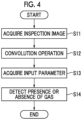
- Fig. 4 is a flowchart showing an example of gas detection processing according to the embodiment.
- the information processing device 10 is set to sequentially acquire the inspection images captured by the camera 30 to perform detection of the gas G in real time.
- the information processing device 10 may perform detection of the gas G based on the inspection image acquired as a whole after the camera 30 captures a part or the whole of the gas pipe 9.
- the acquisition unit 110 acquires the inspection image captured by the camera 30 (step S11).
- the image processing unit 111 performs the convolution operation on the inspection image as a gray scale arrangement to generate a texture image (step S12). Contents of the processing are the same as those in step S2 of Fig. 3 . By this processing, it is possible to obtain a texture image in which a size of the arrangement is reduced while a texture of the inspection image is maintained, so that an operation speed in the subsequent processing (steps S13 and S14) can be increased. In addition, since the change of the pixel group in a certain range can be evaluated, the fluctuation due to a noise in each of pixels of the original image can be eliminated.
- the detection unit 112 performs detection of the gas G based on the texture image and the trained prediction model. Specifically, first, the detection unit 112 acquires an input parameter to be input to the prediction model from the texture image of the inspection image (step S13).
- the input parameter is a temporal and spatial brightness change rate of the texture image.
- the detection unit 112 inputs the input parameter to the prediction model and obtains the presence probability of the gas G of each pixel as an output.
- the detection unit 112 detects that the gas G is present in this pixel in a case where the presence probability of the gas G exceeds a predetermined threshold value (step S14).
- the information processing device 10 executes a series of pieces of processing of Fig. 4 each time the inspection image is acquired from the moving body 20 (camera 30) to monitor presence or absence of leaking of the gas G from the gas pipe 9.
- step S12 may not be shown.
- the detection unit 112 acquires the input parameter from an original inspection image to perform detection of the gas G.
- environmental conditions for each time may be added as the input parameters.
- An environmental condition is, for example, data such as an air temperature, a humidity, weather, and an atmospheric pressure.
- each data of the environmental condition is acquired in accordance with time intervals set for each of (1) to (3). As a result, it is possible to detect the presence or absence of the gas G under any environmental condition by the LSTM neural network with a forgetting gate.
- the detection unit 112 acquires the input parameter from the inspection image (texture image) has been described.
- another computer, an engineer, or the like may extract the feature amount set as the input parameter from the image, and the detection unit 112 may detect the gas G by using the input parameter designated by the other computer, the engineer, or the like.
- the prediction model predicts the presence or absence of the gas G of each pixel (outputs the presence probability), but the present disclosure is not limited thereto.
- the prediction model may output, for each element of arrangement of images (texture images) acquired in a certain period, (1) the brightness change rate, (2) the change rate in the movement amount of the corner, and (3) the histogram shape change rate in the brightness of the texture image for the predetermined time interval.
- the predetermined time interval is set for each of (1) to (3). In this case, in step S14 of Fig.
- the detection unit 112 detects that the gas G is present in this element.
- the detection unit 112 may further apply a background difference method to the pixels corresponding to the elements in which the gas G is detected, to extract only a movement of a spray F portion.
- the information processing device 10 includes the acquisition unit 110 that acquires the inspection image obtained by capturing the gas pipe 9, and the detection unit 112 that detects the presence of the gas G in the vicinity of the gas pipe 9 by using the prediction model in which the temporal and spatial brightness change rate of the inspection image is set as the input parameter and the information where whether or not the gas G is present in the inspection image is detectable as the output parameter.
- the information processing device 10 can distinguish whether or not the object reflected in each part of the inspection image is the gas G or the background other than the gas G by considering not only the temporal change of the background other than the gas G in the inspection image but also the spatial change. With this, the information processing device 10 can accurately detect the presence (leakage) of the gas G in the vicinity of the gas pipe 9.
- the evaluation item (in the present embodiment, the brightness change rate) is a long-term frequency due to seasonal variation, climate change, and the like, but such a long-term frequency cannot be trained by a normal machine learning method (for example, RNN).
- the prediction model according to the present embodiment can hold and train data having a similar tendency in the evaluation item among accumulated past data by the forgetting gate of the LSTM. Therefore, by using such a prediction model, the information processing device 10 can accurately detect the gas G without being affected by a seasonal variation, a climate change, and the like.
- the input parameter include the average and the standard deviation of the brightness change rate, the average and the standard deviation of the movement amount of the corners of the elements included in the inspection image, and the histogram shape change rate in the brightness of the inspection image.
- the information processing device 10 can distinguish the change in the brightness due to various factors such as the sunlight, the heat haze, the wind, the sand dust, and the cloud and the change in the brightness due to the presence of the gas G.
- the information processing device 10 further includes the image processing unit 111 that performs the convolution operation on the inspection image to generate the texture image.
- the detection unit 112 acquires the input parameter from the texture image.
- the information processing device 10 can obtain the texture image in which the size of the arrangement is reduced while holding the texture of the inspection image, so that the operation speed in the detection unit 112 can be increased.
- the change of the pixel group in a certain range can be evaluated, the fluctuation due to a noise in each of pixels of the original image can be eliminated. As a result, the detection accuracy of the gas G can be improved.
- the information processing device 10 may be configured by a single computer, or the configuration of the information processing device 10 may be divided and disposed in a plurality of computers, and the plurality of computers may function as the information processing device 10 by cooperating with each other.
- a part of the computers configuring the information processing device 10 may be mounted in the moving body 20, and the other computers may be provided outside the moving body 20.
- the camera 30 is mounted on the moving body 20, but the present disclosure is not limited thereto.
- the camera 30 may be a fixed camera installed at a predetermined interval in the installation area of the gas pipe 9.
- the information processing device, the information processing method, and the program described in the above-described embodiment are understood, for example, as follows.
- the information processing device 10 can distinguish whether or not the object reflected in each part of the inspection image is the gas G or the background other than the gas G by considering not only the temporal change of the background other than the gas G in the inspection image but also the spatial change. With this, the information processing device 10 can accurately detect the presence (leakage) of the gas G in the vicinity of the gas pipe 9.
- the information processing device 10 can accurately detect the gas G without being affected by a seasonal variation, a climate change, and the like.
- the input parameter includes an average and a standard deviation of a brightness change rate, an average and a standard deviation of a corner movement amount in an element included in the inspection image, and a histogram shape change rate in a brightness of the inspection image.
- the information processing device 10 can distinguish the change in the brightness due to various factors such as the sunlight, the heat haze, the wind, the sand dust, and the cloud and the change in the brightness due to the presence of the gas G.
- the information processing device 10 further includes an image processing unit 111 that performs a convolution operation on the inspection image to generate a texture image, and the detection unit 112 acquires the input parameter from the texture image.
- the information processing device 10 can obtain the texture image in which the size of the arrangement is reduced while holding the texture of the inspection image, so that the operation speed in the detection unit 112 can be increased.
- the change of the pixel group in a certain range can be evaluated, the fluctuation due to a noise in each of pixels of the original image can be eliminated. As a result, the detection accuracy of the gas G can be improved.
Landscapes
- Engineering & Computer Science (AREA)
- Physics & Mathematics (AREA)
- Theoretical Computer Science (AREA)
- General Physics & Mathematics (AREA)
- Multimedia (AREA)
- Computer Vision & Pattern Recognition (AREA)
- Evolutionary Computation (AREA)
- Software Systems (AREA)
- General Health & Medical Sciences (AREA)
- Computing Systems (AREA)
- Artificial Intelligence (AREA)
- Health & Medical Sciences (AREA)
- Quality & Reliability (AREA)
- Computational Linguistics (AREA)
- Molecular Biology (AREA)
- Life Sciences & Earth Sciences (AREA)
- Biomedical Technology (AREA)
- Biophysics (AREA)
- Mathematical Physics (AREA)
- Data Mining & Analysis (AREA)
- General Engineering & Computer Science (AREA)
- Remote Sensing (AREA)
- Medical Informatics (AREA)
- Databases & Information Systems (AREA)
- Image Analysis (AREA)
- Image Processing (AREA)
- Examining Or Testing Airtightness (AREA)
Abstract
Description
- The present disclosure relates to an information processing device, an information processing method, and a program.
- Priority is claimed on
Japanese Patent Application No. 2022-136947, filed August 30, 2022 - As a technology for visualizing a fluid such as a gas, it is considered to visualize a flow of a measurement target airflow by measuring a distribution of temperature fluctuations and displaying the distribution in time series. For example,
PTL 1 discloses a technology for visualizing a flow of a fluid by acquiring temperature image data of a fluid captured by an infrared camera for a predetermined time, creating partial temperature data obtained by shifting temperature data for a certain period of time in a time direction by a certain analysis step from the temperature image data, performing a frequency analysis (Fourier transform processing) for each of the created partial temperature data, detecting a temperature fluctuation distribution for each of the certain periods of time, and displaying the temperature fluctuation distribution in time series. - [PTL 1]
Japanese Unexamined Patent Application Publication No. 2020-52036 - In a technology of the related art, an infrared camera is fixedly installed, and it is premised that a background of a gas is uniform, for example, a wall or the like. On the other hand, in a case where gas leakage is detected and visualized in a petrochemical plant, a pipeline, a storage site, or the like, false detection of gas leakage may occur due to fluctuation of the background of the gas. As the fluctuation of the background, for example, sunlight, clouds, wind, dust, and fluctuation (heat haze) due to an air temperature can be considered. These behaviors are non-stationary phenomena with strong randomness in an instant, and it may be difficult to separate an airflow of the gas and the fluctuation of the background only by a time-series frequency analysis as the technology in the related art.
- An object of the present disclosure is to provide an information processing device, an information processing method, and a program capable of accurately detecting presence of a gas.
- According to an aspect of the present disclosure, there is provided an information processing device including an acquisition unit that acquires an inspection image obtained by capturing an inspection target, and a detection unit that detects presence of a gas in a vicinity of the inspection target by using a prediction model in which a temporal and spatial change rate in the inspection image is set as an input parameter and information where whether or not the gas is present in the inspection image is detectable is set as an output parameter.
- According to an aspect of the present disclosure, there is provided an information processing method including a step of acquiring an inspection image obtained by capturing an inspection target, and a step of detecting presence of a gas in a vicinity of the inspection target by using a prediction model in which a temporal and spatial change rate in the inspection image is set as an input parameter and information where whether or not the gas is present in the inspection image is detectable is set as an output parameter.
- According to an aspect of the present disclosure, there is provided a program that causes an information processing device to execute a step of acquiring an inspection image obtained by capturing an inspection target, and a step of detecting presence of a gas in a vicinity of the inspection target by using a prediction model in which a temporal and spatial change rate in the inspection image is set as an input parameter and information where whether or not the gas is present in the inspection image is detectable is set as an output parameter.
- According to the above-described aspect, presence of a gas can be accurately detected.
-
-
Fig. 1 is a schematic diagram showing an overall configuration of an information processing system according to an embodiment. -
Fig. 2 is a block diagram showing a functional configuration of an information processing device according to the embodiment. -
Fig. 3 is a flowchart showing an example of training processing of a prediction model according to the embodiment. -
Fig. 4 is a flowchart showing an example of gas detection processing according to the embodiment. - Hereinafter, embodiments will be described in detail with reference to the drawings.
-
Fig. 1 is a schematic diagram showing an overall configuration of an information processing system according to an embodiment. - An
information processing system 1 is a system for detecting presence (leakage) of a gas G (spray F of the gas G) in a vicinity of agas pipe 9. Thegas pipe 9 is installed at a gas use site or the like and is a pipe for circulating the gas G therein. Thegas pipe 9 is an example of an inspection target according to the present embodiment. In another embodiment, for example, a storage tank of the gas G or the like may be set as an inspection target. - As shown in
Fig. 1 , theinformation processing system 1 includes aninformation processing device 10, a movingbody 20, and acamera 30. - The moving
body 20 is, for example, an unmanned aerial vehicle such as a drone, and moves in an installation area of thegas pipe 9 in accordance with a preset monitoring path or an operation instruction of an operator. - The
camera 30 is mounted on the movingbody 20 and captures thegas pipe 9. Thecamera 30 is, for example, an infrared camera that can detect a gas absorption wavelength (specific wavelength) of the gas G. In addition, thecamera 30 can capture each part of an upper surface, a side surface, and the like of thegas pipe 9 by changing an orientation (capturing direction) of a capturing range R in accordance with a positional relationship between the movingbody 20 and thegas pipe 9. - As the moving
body 20 moves in the installation area, thecamera 30 continuously captures thegas pipe 9. In addition, the movingbody 20 transmits the image (moving image) captured by thecamera 30 to theinformation processing device 10. - The
information processing device 10 is communicably connected to the movingbody 20. Theinformation processing device 10 trains a prediction model for detecting presence of the gas G based on an image (hereinafter, also referred to as a training image) captured by thecamera 30 in a case where there is no leakage of the gas G. Details of the prediction model will be described later. In addition, theinformation processing device 10 detects whether or not the gas G is present (leaked) in the vicinity of thegas pipe 9 based on an image (hereinafter, also referred to as an inspection image) captured by thecamera 30 during the actual operation and the prediction model. - In addition,
Fig. 1 shows an example in which theinformation processing device 10 is provided at a monitoring base separated from the installation area of thegas pipe 9, but the present disclosure is not limited to this. In another embodiment, theinformation processing device 10 may be incorporated into the movingbody 20. -
Fig. 2 is a block diagram showing a functional configuration of an information processing device according to the embodiment. - As shown in
Fig. 2 , theinformation processing device 10 includes aprocessor 11, amemory 12, astorage 13, and acommunication interface 14. - The
processor 11 operates in accordance with a predetermined program to exhibit functions as anacquisition unit 110, animage processing unit 111, adetection unit 112, and atraining unit 113. - The
acquisition unit 110 acquires an inspection image obtained by capturing thegas pipe 9. - The
image processing unit 111 performs a convolution operation on the inspection image to generate a texture image. - The
detection unit 112 detects the presence of the gas G in the vicinity of thegas pipe 9 by using a prediction model in which a temporal change and a spatial change of a brightness of the inspection image are set as input parameters and information where whether or not the gas G is present in the inspection image is detectable is set as an output parameter. - The
training unit 113 trains the prediction model based on the temporal change and the spatial change in the brightness of the training image captured in a case where the gas G is not present in the vicinity of thegas pipe 9. - The
memory 12 includes a memory area necessary for an operation of theprocessor 11. - The
storage 13 is a so-called auxiliary storage device, and is, for example, a hard disk drive (HDD), a solid state drive (SSD), or the like. - The
communication interface 14 is an interface for transmitting and receiving various kinds of information to and from an external device (moving body 20). - The predetermined program executed by the
processor 11 of theinformation processing device 10 is stored in a computer-readable recording medium. Further, examples of the computer-readable recording medium include a magnetic disk, a magneto-optical disk, a CD-ROM, a DVD-ROM, a semiconductor memory, and the like. Further, this computer program may be transferred to a computer through a communication line, and the computer receiving the transfer may execute the program. Further, the program described above may be a program for implementing a part of the above-described functions. Further, the program may be a program, so-called a difference file (difference program) that can implement the above-mentioned functions in combination with a program already recorded in a computer system. -
Fig. 3 is a flowchart showing an example of training processing of a prediction model according to the embodiment. - Hereinafter, a flow of processing in which the prediction model is trained by the
information processing device 10 will be described with reference toFig. 3 . - First, the
acquisition unit 110 acquires the training image captured by the camera 30 (step S1). The training image is an image captured in a case where the gas G is not present in the vicinity of thegas pipe 9. - The
image processing unit 111 performs the convolution operation on the training image as a gray scale arrangement to generate a texture image (step S2). The convolution operation is a method of creating a coarse pixel in which any pixel of the training image and adjacent pixels (for example, eight surrounding pixels) surrounding the periphery of the pixel using a filter of any size are integrated. As a value of the coarse pixel, a sum, an average, a maximum value, or the like of the original values of any pixel and the adjacent pixels is adopted. By this processing, it is possible to obtain a texture image in which a size of the arrangement is reduced while a texture of the training image is maintained, so that an operation speed in the subsequent processing (steps S3 and S4) can be increased. Here, the "texture" means a "feature" such as unevenness due to brightness or the like, and the "texture image" means an image having unevenness. In addition, since the change of the pixel group in a certain range can be evaluated, the fluctuation due to a noise in each of pixels of the original image can be eliminated. It should be noted that the noise here does not refer to the fluctuation of a jet and the background, but refers to, for example, noise generated by affecting ambient radio waves mixed in a case where the image is transmitted. - Next, the
training unit 113 trains the prediction model using the texture image. The prediction model predicts whether or not an object reflected in the image is the gas G or the background (the object other than the gas G) based on a feature amount of the texture image, and outputs information with which it is possible to detect whether or not the gas G is present in each pixel. In the present embodiment, thetraining unit 113 trains the prediction model using a long short-term memory (LSTM). - LSTM is one of the recurrent neural networks (RNNs). In the LSTM, there are already accumulated data and newly obtained data, and in a case where the prediction model is updated, a network independently determines a feature amount of the newly obtained data, and updates the prediction model by referring to data in which data close to the found feature amount is accumulated. Specifically, the LSTM has a forgetting gate, an input gate, and an output gate. The forgetting gate performs selection and rejection of the accumulated data (long-term memory) in which the data correlated with a previous output (short-term memory) and the newly obtained data are left and the data not correlated are forgotten, among the accumulated data. The input gate accumulates the previous output (short-term memory) and the newly obtained data. The output gate outputs a prediction based on the previous output (short-term memory), the newly obtained data, and the data remaining in the forgetting gate (long-term memory). Therefore, the LSTM has an advantage in which prediction can also be performed in cyclic data having a plurality of cyclic features.
- In addition, for example, for a certain image, the brightness of a part of the region is reduced due to an influence of the cloud. Further, the gas G is set to be reflected in another region separated from this region. In this case, the feature amount of the region in which the brightness is decreased due to the cloud is information not necessary for predicting whether or not the object is the gas G. Since the entire image, that is, the region (region in which the brightness is lowered due to the cloud) not spatially connected to the gas G is also trained in the normal RNN, the prediction accuracy may be decreased. In addition, in the normal LSTM, the temporal fluctuation is generally handled. On the other hand, in a case where it is assumed that the brightness of the region changes due to the influence of the cloud for a certain image, in a case where the gas G is not reflected in the region, and in a case where a cycle of the change in the brightness of the region due to the influence of the cloud is approximately the same as the cycle due to the gas G, the influence of the cloud and the fluctuation due to the gas G are predicted with confusion, and the prediction accuracy may be reduced.
- Therefore, in the present embodiment, the LSTM trains not only the temporal fluctuation but also the spatial fluctuation as the feature amount, so that the spatial feature is also selected and rejected, and the accuracy of predicting whether or not the object is gas G. Since the spatial fluctuation also serves as the temporal fluctuation, the spatial fluctuation is added as one of the data (input parameters) used for the training.
- Specifically, first, the
training unit 113 acquires the input parameter that is the training data, from the texture image of the training image (step S3). The input parameter is an evaluation item of the fluctuation of the background included in the training image, and is a temporal and spatial change rate of the texture image in the present embodiment. Here, an example of using the brightness change rate will be described. - A temporal and spatial brightness change rate is information indicating a change rate of brightness with respect to time (frame) and a range (distance) over which the change in brightness extends on each image space of each time, for an element (pixel) in the arrangement of the texture images. This distance may be a distance represented by two-dimensional coordinates (xy coordinates) or may be a distance represented by polar coordinates.
- Next, the
training unit 113 trains a prediction model that uses the LSTM, sets the input parameter as training data, and outputs information (for example, a presence probability of the gas G) capable of detecting whether or not the gas G is present in each pixel (step S4). - As described above, the training image that is the source of the training data is an image captured in a case where the gas G is not present in the vicinity of the
gas pipe 9. Therefore, the prediction model according to the present embodiment trains the change of the background other than the gas G in a series of images (moving images) in which the scenery changes from moment to moment, and removes data (for example, a change in the brightness value due to the influence of the cloud or a range on the image space in which the brightness value changes) related to the fluctuation of the background to perform prediction. The prediction model predicts that, after removing the fluctuation of the background, in a case where there is a fluctuation in the brightness for a certain pixel, the probability that the gas G is present in this pixel is high. - In a case where the
information processing device 10 has a sufficient operation ability, step S2 may not be shown. In this case, in steps S3 to S4, thetraining unit 113 acquires the input parameter from the original training image to perform training. - In addition, in the present embodiment, the example has been described in which the temporal and spatial brightness change rate of the training image (texture image) is used as the input parameters (change rate), but the present disclosure is not limited to this. In another embodiment, (1) an average and a standard deviation of the brightness change rate of elements of the texture image, (2) an average and a standard deviation of a movement amount of corners of the elements of the texture image, and (3) a histogram shape change rate (the average and the standard deviation) in the brightness of the texture image may be adopted as the input parameters for each predetermined time interval. The predetermined time interval is set for each of (1) to (3). The corners of the elements are feature points detected by known corner detection processing. For example, by a parameter of (1), a fluctuation due to sunlight or a heat haze can be evaluated. A fluctuation of wind or sand dust can be evaluated by a parameter of (2). A fluctuation of the cloud can be evaluated by a parameter of (3). In addition, the interval between two data for obtaining the brightness change rate is determined, for example, as an interval at which an average value of the brightness change rates of all elements is maximized.
- In addition, environmental conditions for each time may be added as the input parameters. An environmental condition is, for example, data such as an air temperature, a humidity, weather, and an atmospheric pressure. In addition, in a case where the above-described (1) to (3) are adopted as the input parameters, each data of the environmental condition is acquired in accordance with time intervals set for each of (1) to (3). As a result, it is possible to train a prediction model capable of predicting under any environmental condition by the LSTM neural network with a forgetting gate.
- In addition, in the present embodiment, the example is described, in which the
training unit 113 acquires the input parameter from the training image (texture image), but the present disclosure is not limited to thereto. In another embodiment, another computer, an engineer, or the like may extract the feature amount set as the input parameter from the image and use the extracted feature amount as the training data of the prediction model. -
Fig. 4 is a flowchart showing an example of gas detection processing according to the embodiment. - Here, a flow of processing of detecting the gas G by the
information processing device 10 will be described with reference toFig. 4 . It should be noted that, in the present embodiment, theinformation processing device 10 is set to sequentially acquire the inspection images captured by thecamera 30 to perform detection of the gas G in real time. In another embodiment, theinformation processing device 10 may perform detection of the gas G based on the inspection image acquired as a whole after thecamera 30 captures a part or the whole of thegas pipe 9. - First, the
acquisition unit 110 acquires the inspection image captured by the camera 30 (step S11). - The
image processing unit 111 performs the convolution operation on the inspection image as a gray scale arrangement to generate a texture image (step S12). Contents of the processing are the same as those in step S2 ofFig. 3 . By this processing, it is possible to obtain a texture image in which a size of the arrangement is reduced while a texture of the inspection image is maintained, so that an operation speed in the subsequent processing (steps S13 and S14) can be increased. In addition, since the change of the pixel group in a certain range can be evaluated, the fluctuation due to a noise in each of pixels of the original image can be eliminated. - Next, the
detection unit 112 performs detection of the gas G based on the texture image and the trained prediction model. Specifically, first, thedetection unit 112 acquires an input parameter to be input to the prediction model from the texture image of the inspection image (step S13). The input parameter is a temporal and spatial brightness change rate of the texture image. - Further, the
detection unit 112 inputs the input parameter to the prediction model and obtains the presence probability of the gas G of each pixel as an output. Thedetection unit 112 detects that the gas G is present in this pixel in a case where the presence probability of the gas G exceeds a predetermined threshold value (step S14). - The
information processing device 10 executes a series of pieces of processing ofFig. 4 each time the inspection image is acquired from the moving body 20 (camera 30) to monitor presence or absence of leaking of the gas G from thegas pipe 9. - In a case where the
information processing device 10 has a sufficient operation ability, step S12 may not be shown. In this case, in steps S13 and S14, thedetection unit 112 acquires the input parameter from an original inspection image to perform detection of the gas G. - In addition, environmental conditions for each time may be added as the input parameters. An environmental condition is, for example, data such as an air temperature, a humidity, weather, and an atmospheric pressure. In addition, in a case where the above-described (1) to (3) are adopted as the input parameters, each data of the environmental condition is acquired in accordance with time intervals set for each of (1) to (3). As a result, it is possible to detect the presence or absence of the gas G under any environmental condition by the LSTM neural network with a forgetting gate.
- In addition, in the present embodiment, an example in which the
detection unit 112 acquires the input parameter from the inspection image (texture image) has been described. However, the present disclosure is not limited thereto. In another embodiment, another computer, an engineer, or the like may extract the feature amount set as the input parameter from the image, and thedetection unit 112 may detect the gas G by using the input parameter designated by the other computer, the engineer, or the like. - In addition, in the present embodiment, the example has been described in which the prediction model predicts the presence or absence of the gas G of each pixel (outputs the presence probability), but the present disclosure is not limited thereto. In another embodiment, the prediction model may output, for each element of arrangement of images (texture images) acquired in a certain period, (1) the brightness change rate, (2) the change rate in the movement amount of the corner, and (3) the histogram shape change rate in the brightness of the texture image for the predetermined time interval. The predetermined time interval is set for each of (1) to (3). In this case, in step S14 of
Fig. 4 , for example, in a case where the standard deviation of the brightness change rate obtained from the data in a case where the gas G is not present exceeds ± 3 times (± 3σ), thedetection unit 112 detects that the gas G is present in this element. In addition, thedetection unit 112 may further apply a background difference method to the pixels corresponding to the elements in which the gas G is detected, to extract only a movement of a spray F portion. - As described above, the
information processing device 10 according to the present embodiment includes theacquisition unit 110 that acquires the inspection image obtained by capturing thegas pipe 9, and thedetection unit 112 that detects the presence of the gas G in the vicinity of thegas pipe 9 by using the prediction model in which the temporal and spatial brightness change rate of the inspection image is set as the input parameter and the information where whether or not the gas G is present in the inspection image is detectable as the output parameter. - As a result, the
information processing device 10 can distinguish whether or not the object reflected in each part of the inspection image is the gas G or the background other than the gas G by considering not only the temporal change of the background other than the gas G in the inspection image but also the spatial change. With this, theinformation processing device 10 can accurately detect the presence (leakage) of the gas G in the vicinity of thegas pipe 9. - In addition, the prediction model is a machine learning model trained using LSTM.
- The evaluation item (in the present embodiment, the brightness change rate) is a long-term frequency due to seasonal variation, climate change, and the like, but such a long-term frequency cannot be trained by a normal machine learning method (for example, RNN). On the other hand, the prediction model according to the present embodiment can hold and train data having a similar tendency in the evaluation item among accumulated past data by the forgetting gate of the LSTM. Therefore, by using such a prediction model, the
information processing device 10 can accurately detect the gas G without being affected by a seasonal variation, a climate change, and the like. - In addition, the input parameter include the average and the standard deviation of the brightness change rate, the average and the standard deviation of the movement amount of the corners of the elements included in the inspection image, and the histogram shape change rate in the brightness of the inspection image.
- As a result, the
information processing device 10 can distinguish the change in the brightness due to various factors such as the sunlight, the heat haze, the wind, the sand dust, and the cloud and the change in the brightness due to the presence of the gas G. - In addition, the
information processing device 10 further includes theimage processing unit 111 that performs the convolution operation on the inspection image to generate the texture image. Thedetection unit 112 acquires the input parameter from the texture image. - In this way, the
information processing device 10 can obtain the texture image in which the size of the arrangement is reduced while holding the texture of the inspection image, so that the operation speed in thedetection unit 112 can be increased. In addition, since the change of the pixel group in a certain range can be evaluated, the fluctuation due to a noise in each of pixels of the original image can be eliminated. As a result, the detection accuracy of the gas G can be improved. - While one embodiment has been described in detail with reference to the drawings, the specific configuration is not limited to the above description, and various design changes and the like can be made. That is, in other embodiments, the procedures of processing described above may be changed as appropriate. In addition, some of the processing may be executed in parallel.
- The
information processing device 10 according to the embodiment described above may be configured by a single computer, or the configuration of theinformation processing device 10 may be divided and disposed in a plurality of computers, and the plurality of computers may function as theinformation processing device 10 by cooperating with each other. In this case, a part of the computers configuring theinformation processing device 10 may be mounted in the movingbody 20, and the other computers may be provided outside the movingbody 20. - In addition, in the embodiment described above, the example is described in which the
camera 30 is mounted on the movingbody 20, but the present disclosure is not limited thereto. For example, in another embodiment, thecamera 30 may be a fixed camera installed at a predetermined interval in the installation area of thegas pipe 9. - The information processing device, the information processing method, and the program described in the above-described embodiment are understood, for example, as follows.
-
- (1) With a first aspect, an
information processing device 10 includes anacquisition unit 110 that acquires an inspection image obtained by capturing aninspection target 9, and adetection unit 112 that detects presence of a gas G in a vicinity of theinspection target 9 by using a prediction model in which a temporal and spatial change rate in the inspection image is set as an input parameter and information where whether or not the gas G is present in the inspection image is detectable is set as an output parameter. - As a result, the
information processing device 10 can distinguish whether or not the object reflected in each part of the inspection image is the gas G or the background other than the gas G by considering not only the temporal change of the background other than the gas G in the inspection image but also the spatial change. With this, theinformation processing device 10 can accurately detect the presence (leakage) of the gas G in the vicinity of thegas pipe 9. -
- (2) With a second aspect, in the
information processing device 10 according to the first aspect, the change rate is a brightness change rate in the inspection image. - (3) With the third aspect, in the
information processing device 10 according to the first or second aspect, the prediction model is a machine learning model trained by using a long short-term memory (LSTM). - By using such a prediction model, the
information processing device 10 can accurately detect the gas G without being affected by a seasonal variation, a climate change, and the like. - (4) With a fourth aspect, in the
information processing device 10 according to any one of the first to third aspects, the input parameter includes an average and a standard deviation of a brightness change rate, an average and a standard deviation of a corner movement amount in an element included in the inspection image, and a histogram shape change rate in a brightness of the inspection image. - As a result, the
information processing device 10 can distinguish the change in the brightness due to various factors such as the sunlight, the heat haze, the wind, the sand dust, and the cloud and the change in the brightness due to the presence of the gas G. - (5) With a fifth aspect, in the
information processing device 10 according to any one of the first to fourth aspects, theinformation processing device 10 further includes animage processing unit 111 that performs a convolution operation on the inspection image to generate a texture image, and thedetection unit 112 acquires the input parameter from the texture image. - In this way, the
information processing device 10 can obtain the texture image in which the size of the arrangement is reduced while holding the texture of the inspection image, so that the operation speed in thedetection unit 112 can be increased. In addition, since the change of the pixel group in a certain range can be evaluated, the fluctuation due to a noise in each of pixels of the original image can be eliminated. As a result, the detection accuracy of the gas G can be improved. -
- (6) With a sixth aspect, an information processing method includes a step of acquiring an inspection image obtained by capturing an
inspection target 9, and a step of detecting presence of a gas G in a vicinity of theinspection target 9 by using a prediction model in which a temporal and spatial change rate in the inspection image is set as an input parameter and information where whether or not the gas G is present in the inspection image is detectable is set as an output parameter. - (7) With a seventh aspect, a program that causes an
information processing device 10 to execute a step of acquiring an inspection image obtained by capturing aninspection target 9, and a step of detecting presence of a gas G in a vicinity of theinspection target 9 by using a prediction model in which a temporal and spatial change rate in the inspection image is set as an input parameter and information where whether or not the gas G is present in the inspection image is detectable is set as an output parameter. - According to the above-described aspect, presence of a gas can be accurately detected.
-
- 1: information processing system
- 9: gas pipe (inspection target)
- 10: information processing device
- 11: processor
- 110: acquisition unit
- 111: image processing unit
- 112: detection unit
- 113: training unit
- 12: memory
- 13: storage
- 14: communication interface
- 20: moving body
- 30: camera
Claims (7)
- An information processing device comprising:an acquisition unit that acquires an inspection image obtained by capturing an inspection target; anda detection unit that detects presence of a gas in a vicinity of the inspection target by using a prediction model in which a temporal and spatial change rate in the inspection image is set as an input parameter and information where whether or not the gas is present in the inspection image is detectable is set as an output parameter.
- The information processing device according to claim 1,
wherein the change rate is a brightness change rate in the inspection image. - The information processing device according to claim 1,
wherein the prediction model is a machine learning model trained by using a long short-term memory (LSTM). - The information processing device according to claim 1,
wherein the input parameter includes an average and a standard deviation of a brightness change rate and an average and a standard deviation of a corner movement amount in an element included in the inspection image, and a histogram shape change rate in a brightness of the inspection image. - The information processing device according to any one of claims 1 to 4, further comprising:an image processing unit that performs a convolution operation on the inspection image to generate a texture image,wherein the detection unit acquires the input parameter from the texture image.
- An information processing method comprising:a step of acquiring an inspection image obtained by capturing an inspection target; anda step of detecting presence of a gas in a vicinity of the inspection target by using a prediction model in which a temporal and spatial change rate in the inspection image is set as an input parameter and information where whether or not the gas is present in the inspection image is detectable is set as an output parameter.
- A program that causes an information processing device to execute:a step of acquiring an inspection image obtained by capturing an inspection target; anda step of detecting presence of a gas in a vicinity of the inspection target by using a prediction model in which a temporal and spatial change rate in the inspection image is set as an input parameter and information where whether or not the gas is present in the inspection image is detectable is set as an output parameter.
Applications Claiming Priority (2)
| Application Number | Priority Date | Filing Date | Title |
|---|---|---|---|
| JP2022136947A JP2024033396A (en) | 2022-08-30 | 2022-08-30 | Information processing device, information processing method, and program |
| PCT/JP2023/024765 WO2024048065A1 (en) | 2022-08-30 | 2023-07-04 | Information processing device, information processing method, and program |
Publications (2)
| Publication Number | Publication Date |
|---|---|
| EP4560282A1 true EP4560282A1 (en) | 2025-05-28 |
| EP4560282A4 EP4560282A4 (en) | 2025-08-27 |
Family
ID=90099519
Family Applications (1)
| Application Number | Title | Priority Date | Filing Date |
|---|---|---|---|
| EP23859835.3A Pending EP4560282A4 (en) | 2022-08-30 | 2023-07-04 | INFORMATION PROCESSING DEVICE, INFORMATION PROCESSING METHOD AND PROGRAM |
Country Status (6)
| Country | Link |
|---|---|
| US (1) | US20260056078A1 (en) |
| EP (1) | EP4560282A4 (en) |
| JP (1) | JP2024033396A (en) |
| CN (1) | CN119678025A (en) |
| AU (1) | AU2023333953B2 (en) |
| WO (1) | WO2024048065A1 (en) |
Families Citing this family (1)
| Publication number | Priority date | Publication date | Assignee | Title |
|---|---|---|---|---|
| KR102865774B1 (en) * | 2024-10-29 | 2025-09-30 | 세안기술 주식회사 | A fluid leakage detector and method using thereof |
Family Cites Families (9)
| Publication number | Priority date | Publication date | Assignee | Title |
|---|---|---|---|---|
| JP4999794B2 (en) * | 2008-07-04 | 2012-08-15 | 日本電信電話株式会社 | Still region detection method and apparatus, program and recording medium |
| JP2012093334A (en) * | 2010-09-30 | 2012-05-17 | Jvc Kenwood Corp | Foreign matter detection device, foreign matter detection method, and foreign matter detection program |
| EP3583405B1 (en) * | 2017-02-20 | 2026-02-18 | Yoran Imaging Ltd. | Method and system for determining package integrity |
| JP6878067B2 (en) * | 2017-03-20 | 2021-05-26 | 株式会社Subaru | Landmine detection system and landmine detection method |
| WO2019181059A1 (en) * | 2018-03-22 | 2019-09-26 | パナソニックIpマネジメント株式会社 | Axle load measurement device and axle load measurement method |
| WO2019187138A1 (en) * | 2018-03-30 | 2019-10-03 | 株式会社牧野フライス製作所 | Remaining lifespan prediction device and machine tool |
| JP7065060B2 (en) | 2018-08-20 | 2022-05-11 | Jfeテクノリサーチ株式会社 | Fluid flow measuring device and gas detecting device |
| JP7232610B2 (en) * | 2018-10-16 | 2023-03-03 | 千代田化工建設株式会社 | Fluid leak detection system, fluid leak detection device, design support system, design support device, and learning device |
| JP2022136947A (en) | 2021-03-08 | 2022-09-21 | 朗兒 谷川 | Foot or toe operational mouse |
-
2022
- 2022-08-30 JP JP2022136947A patent/JP2024033396A/en active Pending
-
2023
- 2023-07-04 CN CN202380055848.1A patent/CN119678025A/en active Pending
- 2023-07-04 US US19/103,363 patent/US20260056078A1/en active Pending
- 2023-07-04 AU AU2023333953A patent/AU2023333953B2/en active Active
- 2023-07-04 WO PCT/JP2023/024765 patent/WO2024048065A1/en not_active Ceased
- 2023-07-04 EP EP23859835.3A patent/EP4560282A4/en active Pending
Also Published As
| Publication number | Publication date |
|---|---|
| CN119678025A (en) | 2025-03-21 |
| JP2024033396A (en) | 2024-03-13 |
| AU2023333953B2 (en) | 2026-04-02 |
| US20260056078A1 (en) | 2026-02-26 |
| EP4560282A4 (en) | 2025-08-27 |
| WO2024048065A1 (en) | 2024-03-07 |
| AU2023333953A1 (en) | 2025-02-06 |
Similar Documents
| Publication | Publication Date | Title |
|---|---|---|
| CN113023293B (en) | Inspection method, device, equipment and system of belt conveyor | |
| CN111047568A (en) | Steam leakage defect detection and identification method and system | |
| CN113056665A (en) | Detection and fault detection of corrosion under fire-resistant insulation using hybrid sensing system | |
| US20160314571A1 (en) | Method and System for Automated Inspection Utilizing A Multi-Modal Database | |
| KR20190139808A (en) | A behavior pattern abnormality discrimination system and method for providing the same | |
| CN114267012B (en) | Ship type detection method, device, electronic device and readable storage medium | |
| US20240053287A1 (en) | Probability of detection of lifecycle phases of corrosion under insulation using artificial intelligence and temporal thermography | |
| US20230093034A1 (en) | Target area detection device, target area detection method, and target area detection program | |
| CN111899373B (en) | Method and device for determining inspection points of machine room, robot and storage medium | |
| CN111178424A (en) | Petrochemical production site safety compliance real-time detection system and method | |
| CN120594560B (en) | Boiler heating surface crack detection method based on millimeter wave radar imaging | |
| US10611495B2 (en) | Sea state estimation | |
| AU2023333953B2 (en) | Information processing device, information processing method, and program | |
| CN110318953B (en) | Temperature monitoring method and device for wind turbine generator electric control system | |
| CN109598712A (en) | Quality determining method, device, server and the storage medium of plastic foam cutlery box | |
| CN119478823A (en) | A method, device, equipment and storage medium for monitoring power tower status | |
| JP7720276B2 (en) | Gas monitoring method, gas monitoring device, gas monitoring system, and gas monitoring program | |
| WO2024070965A1 (en) | Gas leak detection device, gas leak detection method, and gas leak detection program | |
| CN111580049A (en) | Dynamic target sound source tracking monitoring method and terminal equipment | |
| CN113743395B (en) | A method, device and apparatus for reading an instrument | |
| CN113112726B (en) | Intrusion detection method, device, equipment, system and readable storage medium | |
| WO2019224707A1 (en) | A method for the remote detection of the internal temperature of a cabin of an aircraft through at least one thermal imaging camera, and means for carrying out such method | |
| CN109470708A (en) | Quality inspection method, device, server and storage medium for plastic foam lunch box | |
| CN119557750B (en) | A cruise ship oil pipeline oil spill monitoring system and method based on machine learning | |
| CN119714704B (en) | A liquid hydrogen leak remote rapid detection method, system, medium and program product |
Legal Events
| Date | Code | Title | Description |
|---|---|---|---|
| STAA | Information on the status of an ep patent application or granted ep patent |
Free format text: STATUS: THE INTERNATIONAL PUBLICATION HAS BEEN MADE |
|
| PUAI | Public reference made under article 153(3) epc to a published international application that has entered the european phase |
Free format text: ORIGINAL CODE: 0009012 |
|
| STAA | Information on the status of an ep patent application or granted ep patent |
Free format text: STATUS: REQUEST FOR EXAMINATION WAS MADE |
|
| 17P | Request for examination filed |
Effective date: 20250219 |
|
| AK | Designated contracting states |
Kind code of ref document: A1 Designated state(s): AL AT BE BG CH CY CZ DE DK EE ES FI FR GB GR HR HU IE IS IT LI LT LU LV MC ME MK MT NL NO PL PT RO RS SE SI SK SM TR |
|
| REG | Reference to a national code |
Ref country code: DE Ref legal event code: R079 Free format text: PREVIOUS MAIN CLASS: G01M0003020000 Ipc: G06T0007000000 |
|
| A4 | Supplementary search report drawn up and despatched |
Effective date: 20250728 |
|
| RIC1 | Information provided on ipc code assigned before grant |
Ipc: G06T 7/00 20170101AFI20250722BHEP Ipc: G06T 7/40 20170101ALI20250722BHEP Ipc: G01M 3/38 20060101ALN20250722BHEP Ipc: G06N 3/0442 20230101ALN20250722BHEP Ipc: G06V 10/54 20220101ALN20250722BHEP |
|
| DAV | Request for validation of the european patent (deleted) | ||
| DAX | Request for extension of the european patent (deleted) |