EP4559698A1 - Luftreifen - Google Patents
Luftreifen Download PDFInfo
- Publication number
- EP4559698A1 EP4559698A1 EP24208339.2A EP24208339A EP4559698A1 EP 4559698 A1 EP4559698 A1 EP 4559698A1 EP 24208339 A EP24208339 A EP 24208339A EP 4559698 A1 EP4559698 A1 EP 4559698A1
- Authority
- EP
- European Patent Office
- Prior art keywords
- tire
- pneumatic tire
- width
- belt
- rim
- Prior art date
- Legal status (The legal status is an assumption and is not a legal conclusion. Google has not performed a legal analysis and makes no representation as to the accuracy of the status listed.)
- Granted
Links
Images

Classifications
-
- B—PERFORMING OPERATIONS; TRANSPORTING
- B60—VEHICLES IN GENERAL
- B60C—VEHICLE TYRES; TYRE INFLATION; TYRE CHANGING; CONNECTING VALVES TO INFLATABLE ELASTIC BODIES IN GENERAL; DEVICES OR ARRANGEMENTS RELATED TO TYRES
- B60C3/00—Tyres characterised by the transverse section
- B60C3/04—Tyres characterised by the transverse section characterised by the relative dimensions of the section, e.g. low profile
-
- B—PERFORMING OPERATIONS; TRANSPORTING
- B60—VEHICLES IN GENERAL
- B60C—VEHICLE TYRES; TYRE INFLATION; TYRE CHANGING; CONNECTING VALVES TO INFLATABLE ELASTIC BODIES IN GENERAL; DEVICES OR ARRANGEMENTS RELATED TO TYRES
- B60C11/00—Tyre tread bands; Tread patterns; Anti-skid inserts
- B60C11/0008—Tyre tread bands; Tread patterns; Anti-skid inserts characterised by the tread rubber
-
- B—PERFORMING OPERATIONS; TRANSPORTING
- B60—VEHICLES IN GENERAL
- B60C—VEHICLE TYRES; TYRE INFLATION; TYRE CHANGING; CONNECTING VALVES TO INFLATABLE ELASTIC BODIES IN GENERAL; DEVICES OR ARRANGEMENTS RELATED TO TYRES
- B60C9/00—Reinforcements or ply arrangement of pneumatic tyres
- B60C9/18—Structure or arrangement of belts or breakers, crown-reinforcing or cushioning layers
- B60C9/28—Structure or arrangement of belts or breakers, crown-reinforcing or cushioning layers characterised by the belt or breaker dimensions or curvature relative to carcass
-
- B—PERFORMING OPERATIONS; TRANSPORTING
- B60—VEHICLES IN GENERAL
- B60C—VEHICLE TYRES; TYRE INFLATION; TYRE CHANGING; CONNECTING VALVES TO INFLATABLE ELASTIC BODIES IN GENERAL; DEVICES OR ARRANGEMENTS RELATED TO TYRES
- B60C11/00—Tyre tread bands; Tread patterns; Anti-skid inserts
- B60C11/0008—Tyre tread bands; Tread patterns; Anti-skid inserts characterised by the tread rubber
- B60C2011/0016—Physical properties or dimensions
-
- B—PERFORMING OPERATIONS; TRANSPORTING
- B60—VEHICLES IN GENERAL
- B60C—VEHICLE TYRES; TYRE INFLATION; TYRE CHANGING; CONNECTING VALVES TO INFLATABLE ELASTIC BODIES IN GENERAL; DEVICES OR ARRANGEMENTS RELATED TO TYRES
- B60C11/00—Tyre tread bands; Tread patterns; Anti-skid inserts
- B60C11/03—Tread patterns
- B60C2011/0337—Tread patterns characterised by particular design features of the pattern
- B60C2011/0339—Grooves
- B60C2011/0341—Circumferential grooves
-
- Y—GENERAL TAGGING OF NEW TECHNOLOGICAL DEVELOPMENTS; GENERAL TAGGING OF CROSS-SECTIONAL TECHNOLOGIES SPANNING OVER SEVERAL SECTIONS OF THE IPC; TECHNICAL SUBJECTS COVERED BY FORMER USPC CROSS-REFERENCE ART COLLECTIONS [XRACs] AND DIGESTS
- Y02—TECHNOLOGIES OR APPLICATIONS FOR MITIGATION OR ADAPTATION AGAINST CLIMATE CHANGE
- Y02T—CLIMATE CHANGE MITIGATION TECHNOLOGIES RELATED TO TRANSPORTATION
- Y02T10/00—Road transport of goods or passengers
- Y02T10/80—Technologies aiming to reduce greenhouse gasses emissions common to all road transportation technologies
- Y02T10/86—Optimisation of rolling resistance, e.g. weight reduction
Definitions
- the present invention relates to a pneumatic tire having a tread portion.
- Patent Document 1 Japanese unexamined patent application publication No. 2023-102627
- Patent Document 1 has proposed a pneumatic tire with improved durability performance in bead portions, where strain is concentrated due to the small diameter, for example.
- small-diameter pneumatic tires used for heavy vehicles such as those described in the Patent Document 1 have a short ground contact length and a wide ground contact width, i.e., a so-called wide ground contact patch shape, and there has been room for improvement in ride comfort performance due to issues such as the dispersion of road surface input, input sensitivity, and frequency.
- the present invention was made in view of the above, and a primary object thereof is to provide a wide, small-diameter pneumatic tire capable of improving the ride comfort performance.
- the present invention is a pneumatic tire configured to be mounted on a tire rim having a rim width RW, and including:
- the pneumatic tire of the present invention improves ride comfort performance by having the configuration described above.
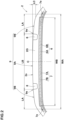
- FIG. 1 is a tire meridian section of a pneumatic tire 1 according to the present embodiment in a standard state.
- standard state refers to a state in which the pneumatic tire 1 is mounted on a standard rim, inflated to a standard inner pressure, and loaded with no tire load.
- dimensions and the like of various parts of the pneumatic tire 1 are the values measured in this standard state.
- standard rim refers to a wheel rim specified for the concerned tire by a standard included in a standardization system on which the tire is based, for example, the "normal wheel rim” in JATMA, "Design Rim” in TRA, and “Measuring Rim” in ETRTO.
- the "standard rim” is a rim with the smallest rim diameter RD and the smallest rim width RW among rims that can be assembled with the pneumatic tire 1 and do not cause air leakage.
- the "standard inner pressure” refers to air pressure specified for the concerned tire by a standard included in a standardization system on which the tire is based, for example, the maximum air pressure in JATMA, the maximum value listed in the "TIRE LOAD LIMITS AT VARIOUS COLD INFLATION PRESSURES" table in TRA, and "INFLATION PRESSURE” in ETRTO.
- the "standard inner pressure” is an air pressure set by the manufacturer and the like for each tire.
- the pneumatic tire 1 in the present embodiment has a small diameter and has a so-called wide ground contact surface shape with a short ground contact length and a wide ground contact width.
- the pneumatic tire 1 configured as such can increase the interior space of the vehicle and the space inside the rim, and thus can improve transportation efficiency and accommodating larger brakes, larger in-wheel motors, and the like.
- the pneumatic tire 1 has an outer diameter SD from 350 to 600 mm. Since the outer diameter SD of the pneumatic tire 1 is 350 mm or more, the space inside the rim can be secured. The outer diameter SD of the pneumatic tire 1 is 600 mm or less, which helps to increase the interior space of a small bus, a low-floor electric vehicle, and the like.
- the rim width RW of the rim on which the pneumatic tire 1 is mounted is from 78% to 99% of a tire section width SW.
- the rim width RW is the width between a pair of outer surfaces (4s) in the tire axial direction at radially inner portions of the pneumatic tire 1 in the standard state.
- rim width RW is 78% or more of the tire section width SW, a large volume can be secured for the tire inner cavity, which helps to improve the ride comfort performance.
- the rim width RW is 99% or less of the tire section width SW, which helps to support heavy loads such as small buses and low-floor electric vehicles.
- the pneumatic tire 1 has a tread portion 2, a pair of sidewall portions 3, and a pair of bead portions 4.
- the sidewall portions 3 are portions extending radially inward from the tread portion 2 on both sides in the tire axial direction, for example.
- the bead portions 4 are the portions located radially inside the sidewall portions 3, for example.
- Each of the bead portions 4 has an annular bead core 5 extending in the tire circumferential direction, for example.
- the bead core 5 is formed from steel wires, for example.
- the above-mentioned outer surfaces (4s) in the tire axial direction at the radially inner portions of the pneumatic tire 1 are the outer surfaces (4s) in the tire axial direction of the bead portions 4.
- the pneumatic tire 1 includes a carcass 6 extending between the bead portions 4 and a belt layer 7 arranged in the tread portion 2.
- the tread portion 2 in the present embodiment includes a tread rubber 2G forming a ground contact surface (2s), the belt layer 7 disposed radially inside the tread rubber 2G, and the carcass 6 disposed radially inside the belt layer 7.
- FIG. 2 is an enlarged cross-sectional view of the tread portion 2.
- the ground contact surface (2s) is divided into a plurality of land regions 9 by at least two circumferential grooves 8, two circumferential grooves 8 in the present embodiment, each extending continuously and linearly in the tire circumferential direction on the tread portion 2.
- the number of the circumferential grooves 8 is not limited to two, but it is preferred that the tread portion 2 is provided with 2 to 4 circumferential grooves 8 in order to ensure a sufficient ground contacting area of the land regions 9 for supporting a heavy load.
- the land regions 9 include at least a crown land region 9A located on the axially inner side (on the tire equator (C) in the present embodiment), and a pair of shoulder land regions 9B each located on the axially outermost side among the land regions 9 in a respective axial half of the pneumatic tire 1, ie., one shoulder land region 9B on each axially outermost side, for example.
- Each of the shoulder land regions 9B in the present embodiment has an inner edge (9e) in the tire axial direction.
- Each of the inner edges (9e) in the present embodiment is located axially inside a respective one of outer edges (7e) in the tire axial direction of the belt layer 7. Since the shoulder land regions 9B configured as such are reinforced by the belt layer 7, the shoulder land regions 9B can exhibit high rigidity and thus are suitable for supporting heavy loads.
- a distance LA in the tire axial direction between the inner edge (9e) and outer edges (7e) axially adjacent to each other is from 10% to 30% of a maximum belt width WA in the tire axial direction of the belt layer 7.
- each shoulder land region 9B is increased, which makes it possible to support heavy loads. Since the distance LA between the inner edge (9e) and the outer edge (7e) is 30% or less of the maximum belt width WA in each axial half of the pneumatic tire 1, the rigidity of each shoulder land region 9B is prevented from becoming excessively large, therefore, it is possible that the ride comfort performance during cornering is improved.
- a hardness (Hs) of the tread rubber 2G in the present embodiment satisfies the following Expression 1. Hs ⁇ 75 ⁇ 20 ⁇ LA SW
- the hardness (Hs) of the tread rubber 2G has an upper limit set in relation to the structural rigidity of the shoulder land regions 9B according to Expression (1).
- the tread rubber 2G configured as such can reinforce the shoulder land regions 9B when the structural rigidity is low, and can mitigate the impact force acting on the shoulder land regions 9B when the structural rigidity is high. Thereby, it is possible that the pneumatic tire 1 in the present embodiment improves the ride comfort performance for a wide, small-diameter tire capable of supporting a heavy load.
- the outer edge (7e) of the belt layer 7 is positioned axially outside a tread edge (Te) in each axial half of the pneumatic tire 1.
- the maximum belt width WA is larger than a tire tread width TW.
- the belt layer 7 configured as such can increase the rigidity of the entire ground contact surface (2s) of the tread portion 2 and is suitable for supporting high loads.
- the tread edges (Te) are the axially outermost ground contacting positions of the pneumatic tire 1 when the pneumatic tire 1 in the standard state is in contact with a flat surface with zero camber angle by being loaded with 70% of a standard tire load.
- the tire tread width TW is the distance in the tire axial direction between a pair of the tread edges (Te).
- the center position in the axial direction between the tread edges (Te) is the tire equator (C).
- the tire equator (C) is located at the outermost position in the tire radial direction.
- the term “standard tire load” refers to a tire load specified for the concerned tire by the standard, for example, the “maximum load capacity” in JATMA, maximum value listed in “TIRE LOAD LIMITS AT VARIOUS COLD INFLATION PRESSURES" table in TRA, and "LOAD CAPACITY” in ETRTO.
- the standard tire load is the maximum load that can be applied to the pneumatic tire 1 and is determined by the manufacturer and the like.
- each of the shoulder land regions 9B comes into contact with a flat plane when the pneumatic tire 1 is placed on the flat plane with zero camber angle by being loaded with 50% of the standard tire load.
- the shoulder land regions 9B are in contact with the ground even when the load is relatively small, such as when a small bus is empty (i.e., no passengers), therefore, it is possible that uneven wear of the tread portion 2 is suppressed.
- a camber amount LC at the outer edges (7e) in the tire axial direction is in the range from 2.5% to 12.5% of the maximum belt width WA. It should be noted that the camber amount LC at the positions of the outer edges (7e) is the distance in the tire radial direction between the tire equator (C) and the radial position of the outer edges (7e) in the tire profile.
- the camber amount LC is 2.5% or more of the maximum belt width WA, the impact on the shoulder land regions 9B at the time of contact with the ground is mitigated, thereby, it is possible that the ride comfort performance is improved. Since the camber amount LC is 12.5% or less of the maximum belt width WA, the shoulder land regions 9B can be brought into contact with the ground even when the load applied is relatively small, therefore, it is possible that the uneven wear of the tread portion 2 is suppressed.
- a distance LB in the tire axial direction between the inner edges (9e) of the shoulder land regions 9B is in the range from 25% to 95% of the maximum belt width WA. Since the distance LB between the inner edges (9e) is 25% or more of the maximum belt width WA, the shoulder land regions 9B are prevented from becoming excessively large, thereby, it is possible that the ride comfort performance during cornering is improved. Since the distance LB between the inner edges (9e) is 95% or less of the maximum belt width WA, the rigidity of the shoulder land regions 9B can be maintained, which makes it suitable for supporting heavy loads.
- the belt layer 7 includes at least one, preferably two or more belt plies, and two belt plies 7A and 7B in the present embodiment.
- the belt plies 7A and 7B include a first belt ply 7A disposed on an inner side in the tire radial direction, and a second belt ply 7B disposed radially outside the first belt ply 7A, for example.
- the outer edges (7e) of the belt layer 7 in the present embodiment are the outer edges (7e) in the tire axial direction of the first belt ply 7A.
- the belt layer 7 configured as such can increase the rigidity of the tread portion 2 and is suitable for supporting a high load.
- the belt plies 7A and 7B include belt cords (not shown) made of steel cords, for example.
- the belt cords may be single steel wires or may be stranded wires made of multiple steel filaments twisted together, for example.
- the belt cords are arranged at an angle of 10 to 30 degrees with respect to the tire circumferential direction, for example. It is preferred that the belt cords of the first belt ply 7A are inclined to a side opposite to the belt cords of the second belt ply 7B with respect to the tire circumferential direction.
- the belt layer 7 configured as such increases the rigidity of the tread portion 2 in a good balance, therefore, both the rigidity capable of supporting a heavy load and good ride comfort performance can be achieved.
- the angle of the belt cords mentioned above is the angle when the pneumatic tire 1 is in the standard state, which can be checked by partially peeling off the tread portion 2, for example.
- the belt layer 7 includes an outermost belt ply disposed radially outermost among the belt plies.
- the outermost belt ply in the present embodiment is the second belt ply 7B.
- the belt layer 7 includes only one belt ply 7A, for example, the first belt ply 7A is the outermost belt ply.
- a belt width WB in the tire axial direction of the outermost belt ply is in the range from 80% to 100% of the maximum belt width WA.
- the belt layer 7 configured as such can achieve both the rigidity and weight reduction of the tread portion 2, and is useful for improving the ride comfort performance in a wide, small-diameter tire capable of supporting a heavy load.
- the carcass 6 includes at least one carcass ply, and two carcass plies 6A and 6B in the present embodiment.
- the two carcass plies 6A and 6B include a first carcass ply 6A disposed on an inner side in the tire radial direction and a second carcass ply 6B disposed radially outside the first carcass ply 6A in the tread portion 2, for example.
- At least one of the carcass plies 6A and 6B includes a main body portion (6a) extending from the bead core 5 of one of the bead portions 4 to the bead core 5 of the other one of the bead portions 4 via the tread portion 2 and the sidewall portions 3, and turned up portions (6b) each turned up around a respective one of the bead cores 5 from the inside to the outside in the tire axial direction.
- Each of the first carcass ply 6A and the second carcass ply 6B in the present embodiment includes the main body portion (6a) and the turned up portions (6b).
- At least one of the carcass plies 6A and 6B has outer ends (6e) in the tire radial direction of the turned up portions (6b) positioned radially outside the tire maximum width positions (P) where the tire section width SW is at its maximum.
- the outer ends (6e) of the turned up portions (6b) of the first carcass ply 6A are located radially outward of the tire maximum width positions (P)
- the outer ends (6e) of the turned up portions (6b) of the second carcass ply 6B are located radially inward of the tire maximum width positions (P).
- the carcass 6 configured as such can achieve both the rigidity and the weight reduction of the sidewall portions 3, and is useful for improving the ride comfort performance for a wide, small-diameter tire capable of supporting a heavy load.
- the carcass plies 6A and 6B include carcass cords (not shown) made of organic fiber cords, for example.
- the organic fiber cords include cords made of one type of fibers or hybrid fibers made of two or more types of fibers selected from the group consisting of polyethylene terephthalate fiber, polyethylene naphthalate fiber, nylon fiber, aramid fiber, and rayon fiber, for example.
- the carcass cords are arranged at an angle from 25 to 90 degrees with respect to the tire circumferential direction. It should be noted that the above-mentioned angle of the carcass cords is the angle when the pneumatic tire 1 is in the standard state, and can be confirmed by partially peeling off the tread portion 2, for example.
- the carcass cords When the carcass cords are inclined at an angle of less than 90 degrees with respect to the tire circumferential direction, it is preferred that the carcass cords of the first carcass ply 6A and the carcass cords of the second carcass ply 6B are inclined to opposite sides to each other with respect to the tire circumferential direction.
- the carcass 6 may have a bias structure, for example.
- tire section width SW is in the range from 145 to 285 mm. Since the tire section width SW is 145 mm or more, a large volume can be ensured in the tire inner cavity, thereby, it is possible that the ride comfort performance is improved. Since the tire section width SW is 285 mm or less, the tire weight is prevented from becoming excessively large, therefore, the ride comfort performance can be improved.
- a ratio SH/SW of a tire section height SH to the tire section width SW is in the range from 35% to 75%. Since the ratio SH/SW is 35% or more, a large volume can be secured in the tire inner cavity, thereby, it is possible that the ride comfort performance is improved. Since the ratio SH/SW is 75% or less, excessive increase in the tire weight is suppressed, therefore, it is possible that the ride comfort performance is improved.
- the tire section height SH is a height in the tire radial direction from a bead base line BL to the tire equator (C). Further, the bead base line BL is an imaginary line that corresponds to the rim diameter RD. It should also be noted that the ratio SH/SW is a value generally known as the aspect ratio.
- the rim width RW of the rim on which the pneumatic tire 1 is mounted is 9 inches or less.
- the pneumatic tire 1 configured as such suppresses the size of the rim, prevents the rim weight from becoming excessively large, and thus helps to improve the ride comfort performance.
- the rim diameter RD of the rim on which the pneumatic tire 1 is mounted is in the range from 10 to 18 inches. Since the rim diameter RD is 10 inches or more, it is possible that the space inside the rim is ensured. Since the rim diameter RD is 18 inches or less, excessive increase in the rim weight and the tire weight can be prevented, therefore, it is possible that the ride comfort performance is improved.
- Pneumatic tires having the basic structure shown in FIG. 1 were made by way of test according to the specifications in Table 1. The ride comfort performance of the test pneumatic tires was evaluated.
- the main common specifications and test methods are as follows.
- test tires were mounted on the test vehicle, and then a test driver evaluated the ride comfort performance based on a sensory perception of the test driver while the test driver alone drove the test vehicle on a dry asphalt road of a test course.
- the test results are indicated by an index based on Reference 1 being 100, wherein the higher the numerical value, the better the ride comfort performance is.
- the present invention includes the following aspects.
- a pneumatic tire configured to be mounted on a tire rim having a rim width RW, and including:
- the pneumatic tire according to anu one of Present Inventions 1 to 4, wherein the pneumatic tire is configured to be mounted on the tire rim having a rim diameter RD in the range from 10 to 18 inches.
- a ratio SH/SW of a tire section height SH to the tire section width SW is in the range from 35% to 75%.
- a distance LB in the tire axial direction between the inner edges of the shoulder land regions is in the range from 25% to 95% of the maximum belt width WA.
- the belt layer includes an outermost belt ply disposed outermost in the tire radial direction, and a belt width WB in the tire axial direction of the outermost belt ply is in the range from 80% to 100% of the maximum belt width WA.
- a camber amount LC at the outer edges of the belt layer is in the range from 2.5% to 12.5% of the maximum belt width WA.
- both of the shoulder land regions are configured to be in contact with a plane when the pneumatic tire is placed on the plane with zero camber angle by being loaded with 50% of a standard tire load.
- the pneumatic tire according to any one of Present Inventions 1 to 14 further including:
- the pneumatic tire according to Present Invention 19 wherein the distance LA is from 10% to 20% of the tire section width SW.
Landscapes
- Engineering & Computer Science (AREA)
- Mechanical Engineering (AREA)
- Tires In General (AREA)
Applications Claiming Priority (1)
| Application Number | Priority Date | Filing Date | Title |
|---|---|---|---|
| JP2023198537A JP2025084553A (ja) | 2023-11-22 | 2023-11-22 | 空気入りタイヤ |
Publications (2)
| Publication Number | Publication Date |
|---|---|
| EP4559698A1 true EP4559698A1 (de) | 2025-05-28 |
| EP4559698B1 EP4559698B1 (de) | 2026-03-04 |
Family
ID=93258947
Family Applications (1)
| Application Number | Title | Priority Date | Filing Date |
|---|---|---|---|
| EP24208339.2A Active EP4559698B1 (de) | 2023-11-22 | 2024-10-23 | Luftreifen |
Country Status (3)
| Country | Link |
|---|---|
| US (1) | US20250162351A1 (de) |
| EP (1) | EP4559698B1 (de) |
| JP (1) | JP2025084553A (de) |
Citations (5)
| Publication number | Priority date | Publication date | Assignee | Title |
|---|---|---|---|---|
| US20220016929A1 (en) * | 2018-12-13 | 2022-01-20 | Bridgestone Corporation | Pneumatic tire |
| US20220055407A1 (en) * | 2018-12-13 | 2022-02-24 | Bridgestone Corporation | Pneumatic tire |
| JP2022153347A (ja) * | 2021-03-29 | 2022-10-12 | 横浜ゴム株式会社 | タイヤ |
| JP2023102627A (ja) | 2022-01-12 | 2023-07-25 | 住友ゴム工業株式会社 | 空気入りタイヤ |
| DE112022000645T5 (de) * | 2021-04-07 | 2023-11-02 | The Yokohama Rubber Co., Ltd. | R e i f e n |
-
2023
- 2023-11-22 JP JP2023198537A patent/JP2025084553A/ja active Pending
-
2024
- 2024-10-23 EP EP24208339.2A patent/EP4559698B1/de active Active
- 2024-11-01 US US18/934,476 patent/US20250162351A1/en active Pending
Patent Citations (5)
| Publication number | Priority date | Publication date | Assignee | Title |
|---|---|---|---|---|
| US20220016929A1 (en) * | 2018-12-13 | 2022-01-20 | Bridgestone Corporation | Pneumatic tire |
| US20220055407A1 (en) * | 2018-12-13 | 2022-02-24 | Bridgestone Corporation | Pneumatic tire |
| JP2022153347A (ja) * | 2021-03-29 | 2022-10-12 | 横浜ゴム株式会社 | タイヤ |
| DE112022000645T5 (de) * | 2021-04-07 | 2023-11-02 | The Yokohama Rubber Co., Ltd. | R e i f e n |
| JP2023102627A (ja) | 2022-01-12 | 2023-07-25 | 住友ゴム工業株式会社 | 空気入りタイヤ |
Also Published As
| Publication number | Publication date |
|---|---|
| JP2025084553A (ja) | 2025-06-03 |
| US20250162351A1 (en) | 2025-05-22 |
| EP4559698B1 (de) | 2026-03-04 |
Similar Documents
| Publication | Publication Date | Title |
|---|---|---|
| EP2777949B1 (de) | Luftreifen | |
| EP0844110B1 (de) | Luftreifen | |
| US5988247A (en) | Pneumatic tire with crown reinforcing rubber layer and side reinforcing rubber layers | |
| EP1186450B1 (de) | Notlaufreifen | |
| US20010003998A1 (en) | Heavy duty tire | |
| EP4079543B1 (de) | Reifen | |
| EP3059100B1 (de) | Luftreifen | |
| US6739364B2 (en) | Pneumatic tire having tire shoulder provided with curved surface | |
| EP4559698A1 (de) | Luftreifen | |
| EP4480715B1 (de) | Luftreifen | |
| EP3936660A1 (de) | Reifen | |
| EP2602125A1 (de) | Luftreifen | |
| EP3943660A1 (de) | Reifen | |
| EP4116109B1 (de) | Schwerlastreifen | |
| EP4585429B1 (de) | Luftreifen | |
| EP4570532A1 (de) | Luftreifen | |
| EP4385758B1 (de) | Luftreifen | |
| EP4678421A1 (de) | Luftreifen | |
| EP4592092A1 (de) | Luftreifen | |
| EP4227114B1 (de) | Schwerlastreifen | |
| EP4000959B1 (de) | Reifensatz und dreirad | |
| EP1013477B1 (de) | Luftreifen | |
| JP2025134480A (ja) | 空気入りタイヤ | |
| EP3981615A1 (de) | Reifen | |
| JP2025134481A (ja) | 空気入りタイヤ |
Legal Events
| Date | Code | Title | Description |
|---|---|---|---|
| PUAI | Public reference made under article 153(3) epc to a published international application that has entered the european phase |
Free format text: ORIGINAL CODE: 0009012 |
|
| STAA | Information on the status of an ep patent application or granted ep patent |
Free format text: STATUS: THE APPLICATION HAS BEEN PUBLISHED |
|
| AK | Designated contracting states |
Kind code of ref document: A1 Designated state(s): AL AT BE BG CH CY CZ DE DK EE ES FI FR GB GR HR HU IE IS IT LI LT LU LV MC ME MK MT NL NO PL PT RO RS SE SI SK SM TR |
|
| STAA | Information on the status of an ep patent application or granted ep patent |
Free format text: STATUS: REQUEST FOR EXAMINATION WAS MADE |
|
| 17P | Request for examination filed |
Effective date: 20251027 |
|
| GRAP | Despatch of communication of intention to grant a patent |
Free format text: ORIGINAL CODE: EPIDOSNIGR1 |
|
| STAA | Information on the status of an ep patent application or granted ep patent |
Free format text: STATUS: GRANT OF PATENT IS INTENDED |
|
| INTG | Intention to grant announced |
Effective date: 20251217 |
|
| GRAS | Grant fee paid |
Free format text: ORIGINAL CODE: EPIDOSNIGR3 |
|
| GRAA | (expected) grant |
Free format text: ORIGINAL CODE: 0009210 |
|
| STAA | Information on the status of an ep patent application or granted ep patent |
Free format text: STATUS: THE PATENT HAS BEEN GRANTED |
|
| AK | Designated contracting states |
Kind code of ref document: B1 Designated state(s): AL AT BE BG CH CY CZ DE DK EE ES FI FR GB GR HR HU IE IS IT LI LT LU LV MC ME MK MT NL NO PL PT RO RS SE SI SK SM TR |
|
| REG | Reference to a national code |
Ref country code: CH Ref legal event code: F10 Free format text: ST27 STATUS EVENT CODE: U-0-0-F10-F00 (AS PROVIDED BY THE NATIONAL OFFICE) Effective date: 20260304 Ref country code: GB Ref legal event code: FG4D |
|
| REG | Reference to a national code |
Ref country code: DE Ref legal event code: R096 Ref document number: 602024002994 Country of ref document: DE |
|
| P01 | Opt-out of the competence of the unified patent court (upc) registered |
Free format text: CASE NUMBER: UPC_APP_0005162_4559698/2026 Effective date: 20260212 |
|
| REG | Reference to a national code |
Ref country code: IE Ref legal event code: FG4D |