EP4557809A1 - Kommunikationsverfahren in einem atg-system - Google Patents
Kommunikationsverfahren in einem atg-system Download PDFInfo
- Publication number
- EP4557809A1 EP4557809A1 EP23839898.6A EP23839898A EP4557809A1 EP 4557809 A1 EP4557809 A1 EP 4557809A1 EP 23839898 A EP23839898 A EP 23839898A EP 4557809 A1 EP4557809 A1 EP 4557809A1
- Authority
- EP
- European Patent Office
- Prior art keywords
- altitude
- threshold value
- base station
- cell measurement
- terminal
- Prior art date
- Legal status (The legal status is an assumption and is not a legal conclusion. Google has not performed a legal analysis and makes no representation as to the accuracy of the status listed.)
- Pending
Links
Images






Classifications
-
- H—ELECTRICITY
- H04—ELECTRIC COMMUNICATION TECHNIQUE
- H04W—WIRELESS COMMUNICATION NETWORKS
- H04W24/00—Supervisory, monitoring or testing arrangements
- H04W24/08—Testing, supervising or monitoring using real traffic
-
- H—ELECTRICITY
- H04—ELECTRIC COMMUNICATION TECHNIQUE
- H04W—WIRELESS COMMUNICATION NETWORKS
- H04W36/00—Hand-off or reselection arrangements
- H04W36/0005—Control or signalling for completing the hand-off
- H04W36/0083—Determination of parameters used for hand-off, e.g. generation or modification of neighbour cell lists
- H04W36/0085—Hand-off measurements
-
- H—ELECTRICITY
- H04—ELECTRIC COMMUNICATION TECHNIQUE
- H04W—WIRELESS COMMUNICATION NETWORKS
- H04W36/00—Hand-off or reselection arrangements
- H04W36/0005—Control or signalling for completing the hand-off
- H04W36/0055—Transmission or use of information for re-establishing the radio link
- H04W36/0061—Transmission or use of information for re-establishing the radio link of neighbour cell information
-
- H—ELECTRICITY
- H04—ELECTRIC COMMUNICATION TECHNIQUE
- H04W—WIRELESS COMMUNICATION NETWORKS
- H04W24/00—Supervisory, monitoring or testing arrangements
- H04W24/10—Scheduling measurement reports ; Arrangements for measurement reports
-
- H—ELECTRICITY
- H04—ELECTRIC COMMUNICATION TECHNIQUE
- H04W—WIRELESS COMMUNICATION NETWORKS
- H04W36/00—Hand-off or reselection arrangements
- H04W36/0005—Control or signalling for completing the hand-off
- H04W36/0083—Determination of parameters used for hand-off, e.g. generation or modification of neighbour cell lists
- H04W36/0085—Hand-off measurements
- H04W36/0088—Scheduling hand-off measurements
-
- H—ELECTRICITY
- H04—ELECTRIC COMMUNICATION TECHNIQUE
- H04W—WIRELESS COMMUNICATION NETWORKS
- H04W36/00—Hand-off or reselection arrangements
- H04W36/24—Reselection being triggered by specific parameters
- H04W36/32—Reselection being triggered by specific parameters by location or mobility data, e.g. speed data
- H04W36/328—Reselection being triggered by specific parameters by location or mobility data, e.g. speed data by altitude
-
- H—ELECTRICITY
- H04—ELECTRIC COMMUNICATION TECHNIQUE
- H04W—WIRELESS COMMUNICATION NETWORKS
- H04W52/00—Power management, e.g. Transmission Power Control [TPC] or power classes
- H04W52/04—Transmission power control [TPC]
- H04W52/30—Transmission power control [TPC] using constraints in the total amount of available transmission power
- H04W52/36—Transmission power control [TPC] using constraints in the total amount of available transmission power with a discrete range or set of values, e.g. step size, ramping or offsets
- H04W52/367—Power values between minimum and maximum limits, e.g. dynamic range
-
- H—ELECTRICITY
- H04—ELECTRIC COMMUNICATION TECHNIQUE
- H04W—WIRELESS COMMUNICATION NETWORKS
- H04W64/00—Locating users or terminals or network equipment for network management purposes, e.g. mobility management
-
- H—ELECTRICITY
- H04—ELECTRIC COMMUNICATION TECHNIQUE
- H04W—WIRELESS COMMUNICATION NETWORKS
- H04W84/00—Network topologies
- H04W84/02—Hierarchically pre-organised networks, e.g. paging networks, cellular networks, WLAN [Wireless Local Area Network] or WLL [Wireless Local Loop]
- H04W84/04—Large scale networks; Deep hierarchical networks
- H04W84/06—Airborne or Satellite Networks
-
- H—ELECTRICITY
- H04—ELECTRIC COMMUNICATION TECHNIQUE
- H04W—WIRELESS COMMUNICATION NETWORKS
- H04W8/00—Network data management
- H04W8/22—Processing or transfer of terminal data, e.g. status or physical capabilities
- H04W8/24—Transfer of terminal data
-
- H—ELECTRICITY
- H04—ELECTRIC COMMUNICATION TECHNIQUE
- H04W—WIRELESS COMMUNICATION NETWORKS
- H04W88/00—Devices specially adapted for wireless communication networks, e.g. terminals, base stations or access point devices
- H04W88/02—Terminal devices
Definitions
- the present specification relates to mobile communications.
- 3rd generation partnership project (3GPP) long-term evolution (LTE) is a technology for enabling high-speed packet communications.
- 3GPP 3rd generation partnership project
- LTE long-term evolution
- Many schemes have been proposed for the LTE objective including those that aim to reduce user and provider costs, improve service quality, and expand and improve coverage and system capacity.
- the 3GPP LTE requires reduced cost per bit, increased service availability, flexible use of a frequency band, a simple structure, an open interface, and adequate power consumption of a terminal as an upper-level requirement.
- ITU international telecommunication union
- NR new radio
- 3GPP has to identify and develop the technology components needed for successfully standardizing the new RAT timely satisfying both the urgent market needs, and the more long-term requirements set forth by the ITU radio communication sector (ITU-R) international mobile telecommunications (IMT)-2020 process.
- ITU-R ITU radio communication sector
- IMT international mobile telecommunications
- the NR should be able to use any spectrum band ranging at least up to 100 GHz that may be made available for wireless communications even in a more distant future.
- the NR targets a single technical framework addressing all usage scenarios, requirements and deployment scenarios including enhanced mobile broadband (eMBB), massive machine-type-communications (mMTC), ultra-reliable and low latency communications (URLLC), etc.
- eMBB enhanced mobile broadband
- mMTC massive machine-type-communications
- URLLC ultra-reliable and low latency communications
- the NR shall be inherently forward compatible.
- Cell measurement if the terminal's altitude is below the threshold may not be performed.
- CDMA code division multiple access
- FDMA frequency division multiple access
- TDMA time division multiple access
- OFDMA orthogonal frequency division multiple access
- SC-FDMA single carrier frequency division multiple access
- MC-FDMA multicarrier frequency division multiple access
- CDMA may be embodied through radio technology such as universal terrestrial radio access (UTRA) or CDMA2000.
- TDMA may be embodied through radio technology such as global system for mobile communications (GSM), general packet radio service (GPRS), or enhanced data rates for GSM evolution (EDGE).
- GSM global system for mobile communications
- GPRS general packet radio service
- EDGE enhanced data rates for GSM evolution
- OFDMA may be embodied through radio technology such as institute of electrical and electronics engineers (IEEE) 802.11 (Wi-Fi), IEEE 802.16 (WiMAX), IEEE 802.20, or evolved UTRA (E-UTRA).
- IEEE institute of electrical and electronics engineers
- Wi-Fi Wi-Fi
- WiMAX IEEE 802.16
- E-UTRA evolved UTRA
- UTRA is a part of a universal mobile telecommunications system (UMTS).
- 3rd generation partnership project (3GPP) long term evolution (LTE) is a part of evolved UMTS (E-UMTS) using E-UTRA.
- 3GPP LTE employs OFDMA in DL and SC-FDMA in UL.
- Evolution of 3GPP LTE includes LTE-A (advanced), LTE-A Pro, and/or 5G NR (new radio).
- implementations of the present disclosure are mainly described in regards to a 3GPP based wireless communication system.
- the technical features of the present disclosure are not limited thereto.
- the following detailed description is given based on a mobile communication system corresponding to a 3GPP based wireless communication system, aspects of the present disclosure that are not limited to 3GPP based wireless communication system are applicable to other mobile communication systems.
- a or B may mean “only A”, “only B”, or “both A and B”.
- a or B in the present disclosure may be interpreted as “A and/or B”.
- A, B or C in the present disclosure may mean “only A”, “only B”, “only C”, or "any combination of A, B and C”.
- At least one of A and B may mean “only A”, “only B” or “both A and B”.
- the expression “at least one of A or B” or “at least one of A and/or B” in the present disclosure may be interpreted as same as “at least one of A and B”.
- At least one of A, B and C may mean “only A”, “only B”, “only C”, or “any combination of A, B and C”.
- at least one of A, B or C or “at least one of A, B and/or C” may mean “at least one of A, B and C”.
- parentheses used in the present disclosure may mean “for example”.
- control information PDCCH
- PDCCH control information
- PDCCH control information
- PDCCH control information
- FIG. 1 shows an example of a communication system to which implementations of the present disclosure is applied.
- the 5G usage scenarios shown in FIG. 1 are only exemplary, and the technical features of the present disclosure can be applied to other 5G usage scenarios which are not shown in FIG. 1 .
- Three main requirement categories for 5G include (1) a category of enhanced mobile broadband (eMBB), (2) a category of massive machine type communication (mMTC), and (3) a category of ultra-reliable and low latency communications (URLLC).
- eMBB enhanced mobile broadband
- mMTC massive machine type communication
- URLLC ultra-reliable and low latency communications
- the communication system 1 includes wireless devices 100a to 100f, base stations (BSs) 200, and a network 300.
- FIG. 1 illustrates a 5G network as an example of the network of the communication system 1, the implementations of the present disclosure are not limited to the 5G system, and can be applied to the future communication system beyond the 5G system.
- the wireless devices 100a to 100f represent devices performing communication using radio access technology (RAT) (e.g., 5G new RAT (NR)) or LTE) and may be referred to as communication/radio/5G devices.
- RAT radio access technology
- the wireless devices 100a to 100f may include, without being limited to, a robot 100a, vehicles 100b-1 and 100b-2, an extended reality (XR) device 100c, a hand-held device 100d, a home appliance 100e, an IoT device 100f, and an artificial intelligence (AI) device/server 400.
- the vehicles may include a vehicle having a wireless communication function, an autonomous driving vehicle, and a vehicle capable of performing communication between vehicles.
- the vehicles may include an unmanned aerial vehicle (UAV) (e.g., a drone).
- UAV unmanned aerial vehicle
- the XR device may include an AR/VR/Mixed Reality (MR) device and may be implemented in the form of a head-mounted device (HMD), a head-up display (HUD) mounted in a vehicle, a television, a smartphone, a computer, a wearable device, a home appliance device, a digital signage, a vehicle, a robot, etc.
- the hand-held device may include a smartphone, a smartpad, a wearable device (e.g., a smartwatch or a smartglasses), and a computer (e.g., a notebook).
- the home appliance may include a TV, a refrigerator, and a washing machine.
- the IoT device may include a sensor and a smartmeter.
- the wireless devices 100a to 100f may be called user equipments (UEs).
- a UE may include, for example, a cellular phone, a smartphone, a laptop computer, a digital broadcast terminal, a personal digital assistant (PDA), a portable multimedia player (PMP), a navigation system, a slate personal computer (PC), a tablet PC, an ultrabook, a vehicle, a vehicle having an autonomous traveling function, a connected car, an UAV, an AI module, a robot, an AR device, a VR device, an MR device, a hologram device, a public safety device, an MTC device, an IoT device, a medical device, a FinTech device (or a financial device), a security device, a weather/environment device, a device related to a 5G service, or a device related to a fourth industrial revolution field.
- PDA personal digital assistant
- PMP portable multimedia player
- PC slate personal computer
- tablet PC a tablet PC
- ultrabook a vehicle, a vehicle having an autonomous
- the UAV may be, for example, an aircraft aviated by a wireless control signal without a human being onboard.
- the VR device may include, for example, a device for implementing an object or a background of the virtual world.
- the AR device may include, for example, a device implemented by connecting an object or a background of the virtual world to an object or a background of the real world.
- the MR device may include, for example, a device implemented by merging an object or a background of the virtual world into an object or a background of the real world.
- the hologram device may include, for example, a device for implementing a stereoscopic image of 360 degrees by recording and reproducing stereoscopic information, using an interference phenomenon of light generated when two laser lights called holography meet.
- the public safety device may include, for example, an image relay device or an image device that is wearable on the body of a user.
- the MTC device and the IoT device may be, for example, devices that do not require direct human intervention or manipulation.
- the MTC device and the IoT device may include smartmeters, vending machines, thermometers, smartbulbs, door locks, or various sensors.
- the medical device may be, for example, a device used for the purpose of diagnosing, treating, relieving, curing, or preventing disease.
- the medical device may be a device used for the purpose of diagnosing, treating, relieving, or correcting injury or impairment.
- the medical device may be a device used for the purpose of inspecting, replacing, or modifying a structure or a function.
- the medical device may be a device used for the purpose of adjusting pregnancy.
- the medical device may include a device for treatment, a device for operation, a device for (in vitro) diagnosis, a hearing aid, or a device for procedure.
- the security device may be, for example, a device installed to prevent a danger that may arise and to maintain safety.
- the security device may be a camera, a closed-circuit TV (CCTV), a recorder, or a black box.
- CCTV closed-circuit TV
- the FinTech device may be, for example, a device capable of providing a financial service such as mobile payment.
- the FinTech device may include a payment device or a point of sales (POS) system.
- POS point of sales
- the weather/environment device may include, for example, a device for monitoring or predicting a weather/environment.
- the wireless devices 100a to 100f may be connected to the network 300 via the BSs 200.
- An AI technology may be applied to the wireless devices 100a to 100f and the wireless devices 100a to 100f may be connected to the AI server 400 via the network 300.
- the network 300 may be configured using a 3G network, a 4G (e.g., LTE) network, a 5G (e.g., NR) network, and a beyond-5G network.
- the wireless devices 100a to 100f may communicate with each other through the BSs 200/network 300, the wireless devices 100a to 100f may perform direct communication (e.g., sidelink communication) with each other without passing through the BSs 200/network 300.
- the vehicles 100b-1 and 100b-2 may perform direct communication (e.g., vehicle-to-vehicle (V2V)/vehicle-to-everything (V2X) communication).
- the IoT device e.g., a sensor
- the IoT device may perform direct communication with other IoT devices (e.g., sensors) or other wireless devices 100a to 100f.
- the wireless communication/connections 150a, 150b and 150c may transmit/receive signals through various physical channels.
- various configuration information configuring processes e.g., channel encoding/decoding, modulation/demodulation, and resource mapping/de-mapping
- resource allocating processes for transmitting/receiving radio signals, may be performed based on the various proposals of the present disclosure.
- AI refers to the field of studying artificial intelligence or the methodology that can create it
- machine learning refers to the field of defining various problems addressed in the field of AI and the field of methodology to solve them.
- Machine learning is also defined as an algorithm that increases the performance of a task through steady experience on a task.
- Robot means a machine that automatically processes or operates a given task by its own ability.
- robots with the ability to recognize the environment and make self- determination to perform actions can be called intelligent robots.
- Robots can be classified as industrial, medical, home, military, etc., depending on the purpose or area of use.
- the robot can perform a variety of physical operations, such as moving the robot joints with actuators or motors.
- the movable robot also includes wheels, brakes, propellers, etc., on the drive, allowing it to drive on the ground or fly in the air.
- Autonomous driving means a technology that drives on its own, and autonomous vehicles mean vehicles that drive without user's control or with minimal user's control.
- autonomous driving may include maintaining lanes in motion, automatically adjusting speed such as adaptive cruise control, automatic driving along a set route, and automatically setting a route when a destination is set.
- the vehicle covers vehicles equipped with internal combustion engines, hybrid vehicles equipped with internal combustion engines and electric motors, and electric vehicles equipped with electric motors, and may include trains, motorcycles, etc., as well as cars.
- Autonomous vehicles can be seen as robots with autonomous driving functions.
- VR technology provides objects and backgrounds of real world only through computer graphic (CG) images.
- AR technology provides a virtual CG image on top of a real object image.
- MR technology is a CG technology that combines and combines virtual objects into the real world.
- MR technology is similar to AR technology in that they show real and virtual objects together. However, there is a difference in that in AR technology, virtual objects are used as complementary forms to real objects, while in MR technology, virtual objects and real objects are used as equal personalities.
- NR supports multiples numerologies (and/or multiple subcarrier spacings (SCS)) to support various 5G services. For example, if SCS is 15 kHz, wide area can be supported in traditional cellular bands, and if SCS is 30 kHz/60 kHz, dense-urban, lower latency, and wider carrier bandwidth can be supported. If SCS is 60 kHz or higher, bandwidths greater than 24.25 GHz can be supported to overcome phase noise.
- numerologies and/or multiple subcarrier spacings (SCS)
- the NR frequency band may be defined as two types of frequency range, i.e., FR1 and FR2.
- the numerical value of the frequency range may be changed.
- the frequency ranges of the two types may be as shown in Table 1 below.
- FR1 may mean "sub 6 GHz range”
- FR2 may mean "above 6 GHz range”
- mmW millimeter wave
- the radio communication technologies implemented in the wireless devices in the present disclosure may include narrowband internet-of-things (NB-IoT) technology for low-power communication as well as LTE, NR and 6G.
- NB-IoT technology may be an example of low power wide area network (LPWAN) technology, may be implemented in specifications such as LTE Cat NB1 and/or LTE Cat NB2, and may not be limited to the above-mentioned names.
- LPWAN low power wide area network
- the radio communication technologies implemented in the wireless devices in the present disclosure may communicate based on LTE-M technology.
- LTE-M technology may be an example of LPWAN technology and be called by various names such as enhanced machine type communication (eMTC).
- eMTC enhanced machine type communication
- LTE-M technology may be implemented in at least one of the various specifications, such as 1) LTE Cat 0, 2) LTE Cat M1, 3) LTE Cat M2, 4) LTE non-bandwidth limited (non-BL), 5) LTE-MTC, 6) LTE Machine Type Communication, and/or 7) LTE M, and may not be limited to the above-mentioned names.
- the radio communication technologies implemented in the wireless devices in the present disclosure may include at least one of ZigBee, Bluetooth, and/or LPWAN which take into account low-power communication, and may not be limited to the above-mentioned names.
- ZigBee technology may generate personal area networks (PANs) associated with small/low-power digital communication based on various specifications such as IEEE 802.15.4 and may be called various names.
- PANs personal area networks
- FIG. 2 shows an example of wireless devices to which implementations of the present disclosure is applied.
- the first wireless device 100 and/or the second wireless device 200 may be implemented in various forms according to use cases/services.
- ⁇ the first wireless device 100 and the second wireless device 200 ⁇ may correspond to at least one of ⁇ the wireless device 100a to 100f and the BS 200 ⁇ , ⁇ the wireless device 100a to 100f and the wireless device 100a to 100f ⁇ and/or ⁇ the BS 200 and the BS 200 ⁇ of FIG. 1 .
- the first wireless device 100 and/or the second wireless device 200 may be configured by various elements, devices/parts, and/or modules.
- the first wireless device 100 may include at least one transceiver, such as a transceiver 106, at least one processing chip, such as a processing chip 101, and/or one or more antennas 108.
- a transceiver such as a transceiver 106
- a processing chip such as a processing chip 101
- antennas 108 one or more antennas 108.
- the processing chip 101 may include at least one processor, such a processor 102, and at least one memory, such as a memory 104. Additional and/or alternatively, the memory 104 may be placed outside of the processing chip 101.
- the processor 102 may control the memory 104 and/or the transceiver 106 and may be adapted to implement the descriptions, functions, procedures, suggestions, methods and/or operational flowcharts described in the present disclosure. For example, the processor 102 may process information within the memory 104 to generate first information/signals and then transmit radio signals including the first information/signals through the transceiver 106. The processor 102 may receive radio signals including second information/signals through the transceiver 106 and then store information obtained by processing the second information/signals in the memory 104.
- the memory 104 may be operably connectable to the processor 102.
- the memory 104 may store various types of information and/or instructions.
- the memory 104 may store a firmware and/or a software code 105 which implements codes, commands, and/or a set of commands that, when executed by the processor 102, perform the descriptions, functions, procedures, suggestions, methods and/or operational flowcharts disclosed in the present disclosure.
- the firmware and/or the software code 105 may implement instructions that, when executed by the processor 102, perform the descriptions, functions, procedures, suggestions, methods and/or operational flowcharts disclosed in the present disclosure.
- the firmware and/or the software code 105 may control the processor 102 to perform one or more protocols.
- the firmware and/or the software code 105 may control the processor 102 to perform one or more layers of the radio interface protocol.
- the processor 102 and the memory 104 may be a part of a communication modem/circuit/chip designed to implement RAT (e.g., LTE or NR).
- the transceiver 106 may be connected to the processor 102 and transmit and/or receive radio signals through one or more antennas 108.
- Each of the transceiver 106 may include a transmitter and/or a receiver.
- the transceiver 106 may be interchangeably used with Radio Frequency (RF) unit(s).
- the first wireless device 100 may represent a communication modem/circuit/chip.
- the second wireless device 200 may include at least one transceiver, such as a transceiver 206, at least one processing chip, such as a processing chip 201, and/or one or more antennas 208.
- the processing chip 201 may include at least one processor, such a processor 202, and at least one memory, such as a memory 204. Additional and/or alternatively, the memory 204 may be placed outside of the processing chip 201.
- the processor 202 may control the memory 204 and/or the transceiver 206 and may be adapted to implement the descriptions, functions, procedures, suggestions, methods and/or operational flowcharts described in the present disclosure. For example, the processor 202 may process information within the memory 204 to generate third information/signals and then transmit radio signals including the third information/signals through the transceiver 206. The processor 202 may receive radio signals including fourth information/signals through the transceiver 106 and then store information obtained by processing the fourth information/signals in the memory 204.
- the memory 204 may be operably connectable to the processor 202.
- the memory 204 may store various types of information and/or instructions.
- the memory 204 may store a firmware and/or a software code 205 which implements codes, commands, and/or a set of commands that, when executed by the processor 202, perform the descriptions, functions, procedures, suggestions, methods and/or operational flowcharts disclosed in the present disclosure.
- the firmware and/or the software code 205 may implement instructions that, when executed by the processor 202, perform the descriptions, functions, procedures, suggestions, methods and/or operational flowcharts disclosed in the present disclosure.
- the firmware and/or the software code 205 may control the processor 202 to perform one or more protocols.
- the firmware and/or the software code 205 may control the processor 202 to perform one or more layers of the radio interface protocol.
- the processor 202 and the memory 204 may be a part of a communication modem/circuit/chip designed to implement RAT (e.g., LTE or NR).
- the transceiver 206 may be connected to the processor 202 and transmit and/or receive radio signals through one or more antennas 208.
- Each of the transceiver 206 may include a transmitter and/or a receiver.
- the transceiver 206 may be interchangeably used with RF unit.
- the second wireless device 200 may represent a communication modem/circuit/chip.
- One or more protocol layers may be implemented by, without being limited to, one or more processors 102 and 202.
- the one or more processors 102 and 202 may implement one or more layers (e.g., functional layers such as Physical (PHY) layer, Media Access Control (MAC) layer, Radio Link Control (RLC) layer, Packet Data Convergence Protocol (PDCP) layer, Radio Resource Control (RRC) layer, and Service Data Adaptation Protocol (SDAP) layer).
- layers e.g., functional layers such as Physical (PHY) layer, Media Access Control (MAC) layer, Radio Link Control (RLC) layer, Packet Data Convergence Protocol (PDCP) layer, Radio Resource Control (RRC) layer, and Service Data Adaptation Protocol (SDAP) layer).
- PHY Physical
- MAC Media Access Control
- RLC Radio Link Control
- PDCP Packet Data Convergence Protocol
- RRC Radio Resource Control
- SDAP Service Data Adaptation Protocol
- the one or more processors 102 and 202 may generate one or more Protocol Data Units (PDUs), one or more Service Data Unit (SDUs), messages, control information, data, or information according to the descriptions, functions, procedures, suggestions, methods and/or operational flowcharts disclosed in the present disclosure.
- the one or more processors 102 and 202 may generate signals (e.g., baseband signals) including PDUs, SDUs, messages, control information, data, or information according to the descriptions, functions, procedures, suggestions, methods and/or operational flowcharts disclosed in the present disclosure and provide the generated signals to the one or more transceivers 106 and 206.
- signals e.g., baseband signals
- the one or more processors 102 and 202 may receive the signals (e.g., baseband signals) from the one or more transceivers 106 and 206 and acquire the PDUs, SDUs, messages, control information, data, or information according to the descriptions, functions, procedures, suggestions, methods and/or operational flowcharts disclosed in the present disclosure.
- signals e.g., baseband signals
- the one or more processors 102 and 202 may be referred to as controllers, microcontrollers, microprocessors, or microcomputers.
- the one or more processors 102 and 202 may be implemented by hardware, firmware, software, or a combination thereof.
- ASICs Application Specific Integrated Circuits
- DSPs Digital Signal Processors
- DSPDs Digital Signal Processing Devices
- PLDs Programmable Logic Devices
- FPGAs Field Programmable Gate Arrays
- the one or more processors 102 and 202 may be configured by a set of a communication control processor, an Application Processor (AP), an Electronic Control Unit (ECU), a Central Processing Unit (CPU), a Graphic Processing Unit (GPU), and a memory control processor.
- AP Application Processor
- ECU Electronic Control Unit
- CPU Central Processing Unit
- GPU Graphic Processing Unit
- memory control processor a memory control processor
- the one or more memories 104 and 204 may be connected to the one or more processors 102 and 202 and store various types of data, signals, messages, information, programs, code, instructions, and/or commands.
- the one or more memories 104 and 204 may be configured by Random Access Memory (RAM), Dynamic RAM (DRAM), Read-Only Memory (ROM), electrically Erasable Programmable Read-Only Memory (EPROM), flash memory, volatile memory, non-volatile memory, hard drive, register, cash memory, computer-readable storage medium, and/or combinations thereof.
- the one or more memories 104 and 204 may be located at the interior and/or exterior of the one or more processors 102 and 202.
- the one or more memories 104 and 204 may be connected to the one or more processors 102 and 202 through various technologies such as wired or wireless connection.
- the one or more processors 102 and 202 may perform control so that the one or more transceivers 106 and 206 may transmit user data, control information, or radio signals to one or more other devices.
- the one or more processors 102 and 202 may perform control so that the one or more transceivers 106 and 206 may receive user data, control information, or radio signals from one or more other devices.
- the one or more transceivers 106 and 206 may be connected to the one or more antennas 108 and 208. Additionally and/or alternatively, the one or more transceivers 106 and 206 may include one or more antennas 108 and 208. The one or more transceivers 106 and 206 may be adapted to transmit and receive user data, control information, and/or radio signals/channels, mentioned in the descriptions, functions, procedures, suggestions, methods and/or operational flowcharts disclosed in the present disclosure, through the one or more antennas 108 and 208. In the present disclosure, the one or more antennas 108 and 208 may be a plurality of physical antennas or a plurality of logical antennas (e.g., antenna ports).
- the one or more transceivers 106 and 206 may convert received user data, control information, radio signals/channels, etc., from RF band signals into baseband signals in order to process received user data, control information, radio signals/channels, etc., using the one or more processors 102 and 202.
- the one or more transceivers 106 and 206 may convert the user data, control information, radio signals/channels, etc., processed using the one or more processors 102 and 202 from the base band signals into the RF band signals.
- the one or more transceivers 106 and 206 may include (analog) oscillators and/or filters.
- the one or more transceivers 106 and 206 can up-convert OFDM baseband signals to OFDM signals by their (analog) oscillators and/or filters under the control of the one or more processors 102 and 202 and transmit the up-converted OFDM signals at the carrier frequency.
- the one or more transceivers 106 and 206 may receive OFDM signals at a carrier frequency and down-convert the OFDM signals into OFDM baseband signals by their (analog) oscillators and/or filters under the control of the one or more processors 102 and 202.
- the wireless devices 100 and 200 may further include additional components.
- the additional components 140 may be variously configured according to types of the wireless devices 100 and 200.
- the additional components 140 may include at least one of a power unit/battery, an Input/Output (I/O) device (e.g., audio I/O port, video I/O port), a driving device, and a computing device.
- the additional components 140 may be coupled to the one or more processors 102 and 202 via various technologies, such as a wired or wireless connection.
- a UE may operate as a transmitting device in Uplink (UL) and as a receiving device in Downlink (DL).
- a BS may operate as a receiving device in UL and as a transmitting device in DL.
- the first wireless device 100 acts as the UE
- the second wireless device 200 acts as the BS.
- the processor(s) 102 connected to, mounted on or launched in the first wireless device 100 may be adapted to perform the UE behavior according to an implementation of the present disclosure or control the transceiver(s) 106 to perform the UE behavior according to an implementation of the present disclosure.
- the processor(s) 202 connected to, mounted on or launched in the second wireless device 200 may be adapted to perform the BS behavior according to an implementation of the present disclosure or control the transceiver(s) 206 to perform the BS behavior according to an implementation of the present disclosure.
- a BS is also referred to as a node B (NB), an eNode B (eNB), or a gNB.
- NB node B
- eNB eNode B
- gNB gNode B
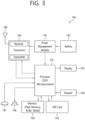
- FIG. 3 shows an example of UE to which implementations of the present disclosure is applied.
- FIG. 3 shows an example of UE to which implementations of the present disclosure is applied.
- a UE 100 may correspond to the first wireless device 100 of FIG. 2 .
- a UE 100 includes a processor 102, a memory 104, a transceiver 106, one or more antennas 108, a power management module 141, a battery 142, a display 143, a keypad 144, a Subscriber Identification Module (SIM) card 145, a speaker 146, and a microphone 147.
- SIM Subscriber Identification Module
- the processor 102 may be adapted to implement the descriptions, functions, procedures, suggestions, methods and/or operational flowcharts disclosed in the present disclosure.
- the processor 102 may be adapted to control one or more other components of the UE 100 to implement the descriptions, functions, procedures, suggestions, methods and/or operational flowcharts disclosed in the present disclosure.
- Layers of the radio interface protocol may be implemented in the processor 102.
- the processor 102 may include ASIC, other chipset, logic circuit and/or data processing device.
- the processor 102 may be an application processor.
- the processor 102 may include at least one of DSP, CPU, GPU, a modem (modulator and demodulator).
- processor 102 may be found in SNAPDRAGON TM series of processors made by Qualcomm ® , EXYNOS TM series of processors made by Samsung ® , A series of processors made by Apple ® , HELIO TM series of processors made by MediaTek ® , ATOM TM series of processors made by Intel ® or a corresponding next generation processor.
- the memory 104 is operatively coupled with the processor 102 and stores a variety of information to operate the processor 102.
- the memory 104 may include ROM, RAM, flash memory, memory card, storage medium and/or other storage device.
- modules e.g., procedures, functions, etc.
- the modules can be stored in the memory 104 and executed by the processor 102.
- the memory 104 can be implemented within the processor 102 or external to the processor 102 in which case those can be communicatively coupled to the processor 102 via various means as is known in the art.
- the transceiver 106 is operatively coupled with the processor 102, and transmits and/or receives a radio signal.
- the transceiver 106 includes a transmitter and a receiver.
- the transceiver 106 may include baseband circuitry to process radio frequency signals.
- the transceiver 106 controls the one or more antennas 108 to transmit and/or receive a radio signal.
- the power management module 141 manages power for the processor 102 and/or the transceiver 106.
- the battery 142 supplies power to the power management module 141.
- the display 143 outputs results processed by the processor 102.
- the keypad 144 receives inputs to be used by the processor 102.
- the keypad 144 may be shown on the display 143.
- the SIM card 145 is an integrated circuit that is intended to securely store the International Mobile Subscriber Identity (IMSI) number and its related key, which are used to identify and authenticate subscribers on mobile telephony devices (such as mobile phones and computers). It is also possible to store contact information on many SIM cards.
- IMSI International Mobile Subscriber Identity
- the speaker 146 outputs sound-related results processed by the processor 102.
- the microphone 147 receives sound-related inputs to be used by the processor 102.
- a 6G (wireless communication) system has purposes such as (i) very high data rate per device, (ii) a very large number of connected devices, (iii) global connectivity, (iv) very low latency, (v) decrease in energy consumption of battery-free IoT devices, (vi) ultra-reliable connectivity, and (vii) connected intelligence with machine learning capacity.
- the vision of the 6G system may include four aspects such as “intelligent connectivity”, “deep connectivity”, “holographic connectivity” and “ubiquitous connectivity", and the 6G system may satisfy the requirements shown in Table 3 below. That is, Table 3 shows the requirements of the 6G system. [Table 3] Per device peak data rate 1 Tbps E2E latency 1 ms Maximum spectral efficiency 100bps/Hz Mobility support Up to 1000km/hr Satellite integration Fully AI Fully Autonomous vehicle Fully XR Fully Haptic Communication Fully
- the 6G system may have key factors such as enhanced mobile broadband (eMBB), ultra-reliable low latency communications (URLLC), massive machine type communications (mMTC), AI integrated communication, tactile Internet, high throughput, high network capacity, high energy efficiency, low backhaul and access network congestion and enhanced data security.
- eMBB enhanced mobile broadband
- URLLC ultra-reliable low latency communications
- mMTC massive machine type communications
- AI integrated communication tactile Internet, high throughput, high network capacity, high energy efficiency, low backhaul and access network congestion and enhanced data security.
- FIG. 4 is a diagram showing an example of a communication structure that can be provided in a 6G system.
- the 6G system will have 50 times higher simultaneous wireless communication connectivity than a 5G wireless communication system.
- URLLC which is the key feature of 5G, will become more important technology by providing end-to-end latency less than 1 ms in 6G communication.
- the 6G system may have much better volumetric spectrum efficiency unlike frequently used domain spectrum efficiency.
- the 6G system may provide advanced battery technology for energy harvesting and very long battery life and thus mobile devices may not need to be separately charged in the 6G system.
- new network characteristics may be as follows.
- AI was not involved in the 4G system.
- a 5G system will support partial or very limited AI.
- the 6G system will support AI for full automation.
- Advance in machine learning will create a more intelligent network for real-time communication in 6G.
- AI may determine a method of performing complicated target tasks using countless analysis. That is, AI may increase efficiency and reduce processing delay.
- AI may play an important role even in M2M, machine-to-human and human-to-machine communication.
- AI may be rapid communication in a brain computer interface (BCI).
- An AI based communication system may be supported by meta materials, intelligent structures, intelligent networks, intelligent devices, intelligent recognition radios, self-maintaining wireless networks and machine learning.
- AI-based physical layer transmission means applying a signal processing and communication mechanism based on an AI driver rather than a traditional communication framework in a fundamental signal processing and communication mechanism. For example, channel coding and decoding based on deep learning, signal estimation and detection based on deep learning, multiple input multiple output (MIMO) mechanisms based on deep learning, resource scheduling and allocation based on AI, etc. may be included.
- MIMO multiple input multiple output
- Machine learning may be used for channel estimation and channel tracking and may be used for power allocation, interference cancellation, etc. in the physical layer of DL. In addition, machine learning may be used for antenna selection, power control, symbol detection, etc. in the MIMO system.
- Machine learning refers to a series of operations to train a machine in order to create a machine which can perform tasks which cannot be performed or are difficult to be performed by people.
- Machine learning requires data and learning models.
- data learning methods may be roughly divided into three methods, that is, supervised learning, unsupervised learning and reinforcement learning.
- Neural network learning is to minimize output error.
- Neural network learning refers to a process of repeatedly inputting training data to a neural network, calculating the error of the output and target of the neural network for the training data, backpropagating the error of the neural network from the output layer of the neural network to an input layer in order to reduce the error and updating the weight of each node of the neural network.
- Supervised learning may use training data labeled with a correct answer and the unsupervised learning may use training data which is not labeled with a correct answer. That is, for example, in case of supervised learning for data classification, training data may be labeled with a category.
- the labeled training data may be input to the neural network, and the output (category) of the neural network may be compared with the label of the training data, thereby calculating the error.
- the calculated error is backpropagated from the neural network backward (that is, from the output layer to the input layer), and the connection weight of each node of each layer of the neural network may be updated according to backpropagation. Change in updated connection weight of each node may be determined according to the learning rate.
- Calculation of the neural network for input data and backpropagation of the error may configure a learning cycle (epoch).
- the learning data is differently applicable according to the number of repetitions of the learning cycle of the neural network. For example, in the early phase of learning of the neural network, a high learning rate may be used to increase efficiency such that the neural network rapidly ensures a certain level of performance and, in the late phase of learning, a low learning rate may be used to increase accuracy.
- the learning model corresponds to the human brain and may be regarded as the most basic linear model.
- a paradigm of machine learning using a neural network structure having high complexity, such as artificial neural networks, as a learning model is referred to as deep learning.
- Neural network cores used as a learning method may roughly include a deep neural network (DNN) method, a convolutional deep neural network (CNN) method, a recurrent Boltzmman machine (RNN) method and a spiking neural networks (SNN). Such a learning model is applicable.
- DNN deep neural network
- CNN convolutional deep neural network
- RNN recurrent Boltzmman machine
- SNN spiking neural networks
- a data rate may increase by increasing bandwidth. This may be performed by using sub-TH communication with wide bandwidth and applying advanced massive MIMO technology.
- THz waves which are known as sub-millimeter radiation, generally indicates a frequency band between 0.1 THz and 10 THz with a corresponding wavelength in a range of 0.03 mm to 3 mm.
- a band range of 100 GHz to 300 GHz (sub THz band) is regarded as a main part of the THz band for cellular communication.
- the 6G cellular communication capacity increases.
- 300 GHz to 3 THz of the defined THz band is in a far infrared (IR) frequency band.
- IR far infrared
- a band of 300 GHz to 3 THz is a part of an optical band but is at the border of the optical band and is just behind an RF band. Accordingly, the band of 300 GHz to 3 THz has similarity with RF.
- FIG. 5 shows an example of an electromagnetic spectrum.
- the main characteristics of THz communication include (i) bandwidth widely available to support a very high data rate and (ii) high path loss occurring at a high frequency (a high directional antenna is indispensable).
- a narrow beam width generated in the high directional antenna reduces interference.
- the small wavelength of a THz signal allows a larger number of antenna elements to be integrated with a device and BS operating in this band. Therefore, an advanced adaptive arrangement technology capable of overcoming a range limitation may be used.
- MIMO technology One of core technologies for improving spectrum efficiency is MIMO technology.
- MIMO technology When MIMO technology is improved, spectrum efficiency is also improved. Accordingly, massive MIMO technology will be important in the 6G system. Since MIMO technology uses multiple paths, multiplexing technology and beam generation and management technology suitable for the THz band should be significantly considered such that data signals are transmitted through one or more paths.
- Beamforming is a signal processing procedure that adjusts an antenna array to transmit radio signals in a specific direction. This is a subset of smart antennas or advanced antenna systems. Beamforming technology has several advantages, such as high signal-to-noise ratio, interference prevention and rejection, and high network efficiency.
- Hologram Beamforming (HBF) is a new beamforming method that differs significantly from MIMO systems because this uses a software-defined antenna. HBF will be a very effective approach for efficient and flexible transmission and reception of signals in multi-antenna communication devices in 6G.
- Optical wireless communication is a form of optical communication that uses visible light, infrared light (IR), or ultraviolet light (UV) to transmit signals.
- OWC that operates in the visible light band (e.g., 390 to 750 nm) is commonly referred to as visible light communication (VLC).
- VLC visible light communication
- VLC implementations may utilize light-emitting diodes (LEDs).
- LEDs light-emitting diodes
- VLC has the following advantages over RF-based technologies.
- Fourth, VLC can use any light source as a base station, eliminating the need for expensive base stations.
- Free-space optical communication is an optical communication technology that uses light propagating in free space, such as air, outer space, and vacuum, to wirelessly transmit data for telecommunications or computer networking.
- FSO can be used as a point-to-point OWC system on the ground.
- FSOs can operate in the near-infrared frequencies (750-1600 nm).
- Laser transmitters can be used in FSO implementations, and FSO can provide high data rates (e.g., 10 Gbit/s), offering a potential solution to backhaul bottlenecks.
- OWC technologies are planned for 6G communications, in addition to RF-based communications for any possible device-to-access network. These networks will access network-to-backhaul/fronthaul network connections.
- OWC technology has already been in use since 4G communication systems, but will be more widely used to meet the needs of 6G communication systems.
- OWC technologies such as light fidelity, visible light communication, optical camera communication, and FSO communication based on optical bands are already well-known technologies. Communication based on optical wireless technology can provide extremely high data rates, low latency, and secure communication.
- LiDAR Light Detection And Ranging
- LiDAR is a remote sensing method that uses near-infrared, visible, and ultraviolet light to shine a light on an object, and the reflected light is detected by a light sensor to measure distance. LiDAR can be used for fully automated driving of cars.
- FSO may be a good technology for providing backhaul connection in the 6G system along with the optical fiber network.
- FSO supports mass backhaul connections for remote and non-remote areas such as sea, space, underwater and isolated islands.
- FSO also supports cellular base station connections.
- NTN Non-Terrestrial Networks
- NTN Non-Terrestrial Networks
- GEO satellites and UAS are used to provide continental, regional, or local services.
- constellations in LEO and MEO are used to provide service in both the Northern and Southern Hemispheres.
- constellations can also provide global coverage, including polar regions. The latter requires proper orbital inclination, sufficient beams generated, and links between satellites.
- Quantum communication is a next-generation communication technology that can overcome the limitations of existing communication technologies such as security and ultra-high-speed computation by applying quantum mechanical properties to the field of information and communication.
- Quantum communication provides a means of generating, transmitting, processing, and storing information that cannot be expressed in the form of 0s and 1s according to the binary bit information used in conventional communication technologies.
- wavelengths or amplitudes are used to transmit information between the sender and receiver, but in quantum communication, photons, the smallest unit of light, are used to transmit information between the sender and receiver.
- quantum uncertainty and quantum irreversibility can be used for the polarization or phase difference of photons (light), so quantum communication has the characteristic of being able to communicate with perfect security.
- Quantum communication may also enable ultrafast communication using quantum entanglement under certain conditions.
- Cell-free communication is defined as "a system in which multiple geographically distributed antennas (APs) cooperatively serve a small number of terminals using the same time/frequency resources with the help of a fronthaul network and a CPU.”
- a single terminal is served by a set of multiple APs, called an AP cluster.
- There are several ways to form AP clusters among which the method of organizing AP clusters with APs that can significantly contribute to improving the reception performance of a terminal is called the terminal-centric clustering method, and the configuration is dynamically updated as the terminal moves.
- This device-centric AP clustering technique ensures that the device is always at the center of the AP cluster and is therefore immune to inter-cluster interference that can occur when a device is located at the boundary of an AP cluster.
- This cell-free communication will be achieved through multi-connectivity and multi-tier hybrid technologies and different heterogeneous radios in the device.
- WIET Wireless Information and Energy Transfer
- WIET uses the same field and wave as a wireless communication system.
- a sensor and a smartphone will be charged using wireless power transfer during communication.
- WIET is a promising technology for extending the life of battery charging wireless systems. Therefore, devices without batteries will be supported in 6G communication.
- An autonomous wireless network is a function for continuously detecting a dynamically changing environment state and exchanging information between different nodes.
- sensing will be tightly integrated with communication to support autonomous systems.
- each access network is connected by optical fiber and backhaul connection such as FSO network.
- FSO network optical fiber and backhaul connection
- Big data analysis is a complex process for analyzing various large data sets or big data. This process finds information such as hidden data, unknown correlations, and customer disposition to ensure complete data management. Big data is collected from various sources such as video, social networks, images and sensors. This technology is widely used for processing massive data in the 6G system.
- SRE Smart Radio Environment
- IRE Intelligent Radio Environment
- Various terms have been proposed for reconfigurable intelligent antenna (or intelligent reconfigurable antenna technology) technologies to enable SRE, including Reconfigurable Metasurfaces, Smart Large Intelligent Surfaces (SLIS), Large Intelligent Surfaces (LIS), Reconfigurable Intelligent Surface (RIS), and Intelligent Reflecting Surface (IRS).
- RIS is an artificial surface made of electromagnetic materials that can alter the propagation of incoming and outgoing radio waves.
- RIS can be seen as an extension of massive MIMO, it has a different array structure and operating mechanism than massive MIMO.
- RIS has the advantage of low power consumption because it operates as a reconfigurable reflector with passive elements, i.e., it only passively reflects signals without using active RF chains.
- each of the passive reflectors in the RIS must independently adjust the phase shift of the incoming signal, which can be advantageous for the wireless communication channel.
- the reflected signals can be gathered at the target receiver to boost the received signal power.
- Metaverse is a combination of the words “meta” meaning virtual, transcendent, and “universe” meaning space. Generally speaking, the term is used to describe a three-dimensional virtual space in which social and economic activities are the same as in the real world.
- Extended Reality a key technology that enables the metaverse, is the fusion of the virtual and the real, which can extend the experience of reality and provide a unique immersive experience.
- the high bandwidth and low latency of 6G networks will enable users to experience more immersive virtual reality (VR) and augmented reality (AR) experiences.
- V2X Vehicle-to-Everything
- V2V vehicle-to-vehicle
- V2I vehicle-to-infrastructure
- UAV Unmanned Aerial Vehicle
- UAV unmanned aerial vehicle
- a base station entity is installed in the UAV to provide cellular connectivity.
- UAVs have certain features, which are not found in fixed base station infrastructures, such as easy deployment, strong line-of-sight links, and mobility-controlled degrees of freedom.
- the UAV can easily handle this situation.
- the UAV will be a new paradigm in the field of wireless communications. This technology facilitates the three basic requirements of wireless networks, such as eMBB, URLLC and mMTC.
- the UAV can also serve a number of purposes, such as network connectivity improvement, fire detection, disaster emergency services, security and surveillance, pollution monitoring, parking monitoring, and accident monitoring. Therefore, UAV technology is recognized as one of the most important technologies for 6G communication.
- a blockchain will be important technology for managing large amounts of data in future communication systems.
- the blockchain is a form of distributed ledger technology, and distributed ledger is a database distributed across numerous nodes or computing devices. Each node duplicates and stores the same copy of the ledger.
- the blockchain is managed through a peer-to-peer (P2P) network. This may exist without being managed by a centralized institution or server.
- P2P peer-to-peer
- Blockchain data is collected together and organized into blocks. The blocks are connected to each other and protected using encryption.
- the blockchain completely complements large-scale IoT through improved interoperability, security, privacy, stability and scalability. Accordingly, the blockchain technology provides several functions such as interoperability between devices, high-capacity data traceability, autonomous interaction of different IoT systems, and large-scale connection stability of 6G communication systems.
- FIG. 6 shows an example of subframe types in NR.
- the TTI (transmission time interval) shown in FIG. 6 may be referred to as a subframe or a slot for NR (or new RAT).
- the subframe (or slot) of FIG. 6 may be used in a TDD system of NR (or new RAT) to minimize data transmission delay.
- a subframe (or slot) includes 14 symbols, like the current subframe.
- the front symbol of the subframe (or slot) may be used for the DL control channel, and the rear symbol of the subframe (or slot) may be used for the UL control channel.
- the remaining symbols may be used for DL data transmission or UL data transmission.
- downlink transmission and uplink transmission may be sequentially performed in one subframe (or slot).
- downlink data may be received within a subframe (or slot), and uplink acknowledgment (ACK/NACK) may be transmitted within the subframe (or slot).
- ACK/NACK uplink acknowledgment
- the structure of such a subframe (or slot) may be referred to as a self-contained subframe (or slot).
- a self-contained subframe (or slot) structure a time gap, from the transmission mode to the reception mode or from the reception mode to the transmission mode, may be required in a transition process. To this, some OFDM symbols when switching from DL to UL in the subframe structure may be set as a guard period (GP).
- GP guard period
- SS block include information necessary for the terminal to perform initial access in 5G NR, that is, a physical broadcast channel (PBCH) including a master information block (MIB) and a synchronization signal (Synchronization Signal: SS) (PSS and SSS).
- PBCH physical broadcast channel
- MIB master information block
- SS Synchronization Signal
- a plurality of SSBs may be bundled to define an SS burst, and a plurality of SS bursts may be bundled to define an SS burst set. It is assumed that each SSB is beamformed in a specific direction, and several SSBs in the SS burst set are designed to support terminals existing in different directions, respectively.
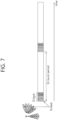
- the SS burst is transmitted every predetermined period. Accordingly, the terminal receives the SS block, and performs cell detection and measurement.
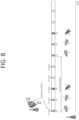
- FIG. 8 is an exemplary diagram illustrating an example of beam sweeping in NR.
- the base station transmits each SS block in the SS burst while performing beam sweeping according to time.
- several SS blocks in the SS burst set are transmitted to support terminals existing in different directions, respectively.
- the terminal moves continuously, and accordingly, in order to maintain the radio section between the terminal and the base station in an optimal state, the terminal may continuously perform a cell selection/reselection process.
- the terminal may evaluate cells.
- the UE may use parameters provided by the serving cell.
- the UE may use parameters provided by the target cell for cell reselection.
- the NAS may control the RAT(s) on which cell selection should be performed. For example, by indicating the RAT associated with the selected PLMN and maintaining a list of prohibited registration areas(s) and an equivalent PLMN list, the terminal may select an appropriate cell based on the RRC_IDLE or RRC_INACTIVE state measurement and cell selection criteria.
- Information stored for multiple RATs may be used by the UE to expedite the cell selection process.
- the UE may periodically search for a better cell based on the criteria for cell reselection. When a better cell is found, the UE may select that cell.
- a change in cell may imply a change in RAT.
- the NAS may be notified.
- the measurements for cell reselection have the following rules:
- ATG Air-to-Ground
- ATG Air-to-Ground
- ATG systems typically rely on existing cellular infrastructure on the ground, and provide connectivity to aircraft using technologies such as 4G LTE or 5G networks.
- Ground-based cellular towers or base stations are strategically placed to cover the airspace and communicate with airborne equipment, with antennas pointed toward the airspace rather than the ground.
- ATG communications serve several purposes:
- cell sizes may be up to 300 km, and terminals may travel at speeds of up to 1200 km/h. It has also been proposed that 5G NR ATG (Air to Ground) uses antennas on the back of the aircraft to communicate with a base station on the ground.
- 5G NR ATG Air to Ground
- This specification proposes operations and procedures that can be used for a flight terminal/NW.
- the operations and procedures proposed in this specification may also be used for UAVs (unmanned aerial vehicles) or VSAT aircraft of NTN.
- the flight terminal of the ATG communicates using the antenna on the back of the aircraft, its use may be limited below a certain altitude. Therefore, it may be efficient in terms of energy consumption and operation process of the flight terminal to limit procedures such as measurement and initial access below a certain altitude.
- the measurement may be cell measurement.
- the measurement may be for collecting information about network status, neighboring cells, and signal quality.
- the terminal may obtain information such as reference signal reception power (RSRP), reference signal reception quality (RSRQ), signal-to-noise ratio (SNR), channel quality indicator (CQI), and timing advance (TA).
- RSRP reference signal reception power
- RSRQ reference signal reception quality
- SNR signal-to-noise ratio
- CQI channel quality indicator
- TA timing advance
- the terminal may perform tasks such as cell selection and reselection, handover, power control, and overall network performance optimization.
- the threshold may be set in the network.
- the network may set the threshold to the terminal.
- the network may determine the altitude of the terminal and instruct the terminal whether the terminal performs the measurement.
- the above threshold may be preset in the terminal.
- the terminal may determine its altitude and determine whether to perform the measurement.
- the threshold value may be set in the network.
- the network may set the threshold value to the terminal.
- the network may determine the altitude of the terminal and instruct the terminal whether or not to perform measurement.
- the threshold value may be preset in the terminal.
- the terminal may determine whether or not to perform measurement by determining its altitude.
- the terminal may determine its position, speed, or altitude through the GNSS (Global Navigation Satellite System).
- GNSS Global Navigation Satellite System
- the terminal may receive a reference signal and determine its position, speed, or altitude through information included in the reference signal.
- the terminal may indirectly determine its position, speed, or altitude by using the degree of change in the channel or the state of the channel.
- Measurement point triggering operations based on the aforementioned speed and altitude may be used separately or in combination.
- the aforementioned procedures are about triggering for measurement points, but may be replaced with measurement reporting points instead.
- the ATG's flight terminal may decide whether to perform measurement reporting.
- the measurement cycle in ATG may vary depending on speed, altitude, and direction. Specific examples are as follows:
- the measurement cycle may be changed step by step according to a threshold.
- the threshold may be set from the network. Or, the threshold may be set in advance in the terminal.
- a flight terminal may receive information about the location of a base station located on the route path from the network. Or, the flight terminal may know the location of a base station located on the route path through information embedded in the flight terminal.
- the distance between the location of the terminal and the location of the base station may be used as a condition for conditional handover or triggering (or stopping) for measurement.
- It may be applied in combination with determining whether to perform measurement depending on the altitude.
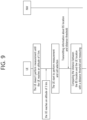
- FIG. 9 is an example diagram according to an embodiment of the present specification.
- the altitude of the terminal may be higher than or equal to the threshold value (e.g., 3 km) during flight.
- the threshold value e.g., 3 km
- the network may be a serving base station. Or, the network may be a target base station.
- the terminal may receive a location of the serving base station and/or a distance threshold value from the serving base station.
- the terminal may receive a location of the target base station and/or a distance threshold value from the target base station.
- the serving base station may be a base station serving the terminal.
- the target base station may be a base station that the terminal is subject to handover/cell selection/cell reselection, etc.
- Steps 3 and 4 are optional and may not be performed.
- step 3 whenever the terminal reselects a cell, the terminal may receive a new BS location from the network.
- step 3 whenever the terminal reselects a cell, the terminal may receive a new distance threshold from the network.
- step 4 When the terminal is in Idle/Inactive mode and the altitude of the terminal is maintained above the threshold (e.g., 3 km), step 4 may be performed.
- the threshold e.g. 3 km
- the altitude of the flight terminal is very diverse.
- the altitude difference between the flight terminals may be up to thousands of km. Therefore, the path loss according to the distance may be different between the terminals. Therefore, the altitude of the terminal may affect the coexistence with the ground network or the local regulations.
- the terminal may report the power class to the network as a UE capability.
- the flight terminal of ATG may report the power class according to the operating altitude to the network.
- a flight terminal operating at a low altitude may report a power class using a low maximum output (e.g., PC3; 23 dBm) to the network.
- a flight terminal operating at a high altitude may report a power class using a relatively high maximum output (e.g., PC2; 26 dBm) to the network.
- a flight terminal operating at both low and high altitudes may report power classes (low power class for low altitude, high power class for high altitude) according to altitude to the network.
- the terminal may report its altitude to the network, or the terminal may report its capability to measure altitude to the network.
- the network may transmit the maximum output or the value used to adjust the output value (e.g., P_E_Max) to the terminal with different values according to the operating altitude.
- high output may be used for a high-altitude terminal
- relatively low output may be used for a low-altitude terminal.
- the network may transmit MPR, A-MPR, which adjust the output of the terminal, to the terminal differently according to altitude.
- measurement reporting may be triggered only above a certain altitude. Conversely, measurement reporting may be restricted below a certain altitude.
- the threshold for a certain altitude may be configured by the NW or pre-configured according to the ATG terminal.
- FIG. 10 is an example diagram according to an embodiment of the present specification.
- the ATG base station does not have an additional antenna panel facing the sky, there may be a blind area right above the base station.
- the terminal may obtain information about the blind area of the base station in the following way:
- the information about the blind spot of the base station may be utilized by the terminal as follows:
- FIG. 11 shows the procedure of the UE according to disclosure of the present specification.
- the UE may skip to perform the cell measurement, based on an altitude of the UE being be equal to or less than an altitude threshold value.
- the performing of the cell measurement may be triggered, based on the altitude of the UE being equal to or greater than the altitude threshold value.
- the reporting of the result of the cell measurement may be triggered, based on the altitude of the UE being equal to or greater than the altitude threshold value.
- the altitude threshold value may be 3 km.
- the UE may receive, from the base station, the altitude threshold value.
- the reporting of the result of the cell measurement may be triggered, based on a speed of the UE being greater than or equal to a speed threshold value.
- the UE may skip to perform the cell measurement, based on the speed of the UE being less than the speed threshold value,
- the UE may receive, from the base station, location of the base station and a distance threshold value.
- the UE may determine a distance between the location of the base station and location of the UE, The UE may skip to perform the cell measurement, based on the distance being smaller than the distance threshold value.
- the performing of the cell measurement may be triggered, based on the distance being greater than the distance threshold value.
- the UE may transmit, to the base station, capability of power class of the UE, wherein the capability of power class is based on the altitude of the UE.
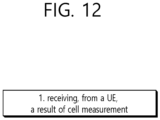
- FIG. 12 shows the procedure of the UE according to disclosure of the present specification.
- the base station may skip to receive the result of cell measurement, based on an altitude of the UE being be equal to or less than an altitude threshold value.
- the base station may configure, to the UE, the altitude threshold value.
- the altitude threshold value may be 3 km.
- the base station may transmit, to the UE, location of the base station and a distance threshold value.
- the base station may skip to receive the result of cell measurement, based on a distance being smaller than the distance threshold value.
- the base station may receive, from the UE, capability of power class of the UE.
- the capability of power class may be based on the altitude of the UE.
- the base station may configure, to the UE, a maximum power.
- the maximum power may be based on operating altitude of the UE.
- the apparatus may include a processor, a transceiver, and a memory.
- a processor may be configured to be operably coupled with a memory and a processor.
- the processor may perform: performing cell measurement; and reporting a result of the cell measurement to a base station, wherein the UE skips the cell measurement on the basis that the altitude of the UE has a value equal to or smaller than an altitude threshold.
- the processor is configured to: performing cell measurement; and reporting a result of the cell measurement to a base station, wherein the UE skips the cell measurement on the basis that the altitude of the UE has a value equal to or smaller than an altitude threshold.
- non-volatile computer readable medium storing one or more instructions for providing multicast service in wireless communication according to some embodiments of the present specification will be described.
- the technical features of the present disclosure may be directly implemented as hardware, software executed by a processor, or a combination of the two.
- a method performed by a wireless device may be implemented in hardware, software, firmware, or any combination thereof.
- the software may reside in RAM memory, flash memory, ROM memory, EPROM memory, EEPROM memory, registers, hard disk, removable disk, CD-ROM, or other storage medium.
- a storage medium are coupled to the processor such that the processor can read information from the storage medium.
- the storage medium may be integrated into the processor.
- the processor and storage medium may reside in the ASIC.
- a processor and a storage medium may reside as separate components.
- Computer-readable media can include tangible and non-volatile computer-readable storage media.
- non-volatile computer-readable media may include random access memory (RAM), such as synchronization dynamic random access memory (SDRAM), read-only memory (ROM), or non-volatile random access memory (NVRAM).
- RAM random access memory
- SDRAM synchronization dynamic random access memory
- ROM read-only memory
- NVRAM non-volatile random access memory
- EEPROM Read-only memory
- flash memory magnetic or optical data storage media, or other media that can be used to store instructions or data structures
- Non-volatile computer readable media may also include combinations of the above.
- the methods described herein may be realized at least in part by computer-readable communication media that carry or carry code in the form of instructions or data structures and that can be accessed, read, and/or executed by a computer.
- a non-transitory computer-readable medium has one or more instructions stored thereon.
- the stored one or more instructions may be executed by a processor of the base station.
- the stored one or more instructions cause performing cell measurement; and reporting a result of the cell measurement to a base station, wherein the UE skips the cell measurement on the basis that the altitude of the UE has a value equal to or smaller than an altitude threshold.
- the present specification may have various effects.
Landscapes
- Engineering & Computer Science (AREA)
- Computer Networks & Wireless Communication (AREA)
- Signal Processing (AREA)
- Physics & Mathematics (AREA)
- Astronomy & Astrophysics (AREA)
- General Physics & Mathematics (AREA)
- Databases & Information Systems (AREA)
- Mobile Radio Communication Systems (AREA)
Applications Claiming Priority (4)
| Application Number | Priority Date | Filing Date | Title |
|---|---|---|---|
| US202263359894P | 2022-07-11 | 2022-07-11 | |
| US202363445728P | 2023-02-15 | 2023-02-15 | |
| US202363457418P | 2023-04-06 | 2023-04-06 | |
| PCT/KR2023/009758 WO2024014805A1 (ko) | 2022-07-11 | 2023-07-10 | Atg 시스템에서의 통신 방법 |
Publications (1)
| Publication Number | Publication Date |
|---|---|
| EP4557809A1 true EP4557809A1 (de) | 2025-05-21 |
Family
ID=89536993
Family Applications (1)
| Application Number | Title | Priority Date | Filing Date |
|---|---|---|---|
| EP23839898.6A Pending EP4557809A1 (de) | 2022-07-11 | 2023-07-10 | Kommunikationsverfahren in einem atg-system |
Country Status (5)
| Country | Link |
|---|---|
| US (1) | US20260006502A1 (de) |
| EP (1) | EP4557809A1 (de) |
| KR (1) | KR20250036139A (de) |
| CN (1) | CN119769127A (de) |
| WO (1) | WO2024014805A1 (de) |
Families Citing this family (3)
| Publication number | Priority date | Publication date | Assignee | Title |
|---|---|---|---|---|
| GB202305224D0 (en) * | 2023-04-06 | 2023-05-24 | Samsung Electronics Co Ltd | Adaptation of non-terrestrial network procedures for air-to-ground networks |
| US20250159516A1 (en) * | 2023-11-15 | 2025-05-15 | Qualcomm Incorporated | Reporting enhancements for user equipments |
| WO2025193038A1 (en) * | 2024-03-12 | 2025-09-18 | Lg Electronics Inc. | Atg communication |
Family Cites Families (5)
| Publication number | Priority date | Publication date | Assignee | Title |
|---|---|---|---|---|
| WO2019020178A1 (en) * | 2017-07-26 | 2019-01-31 | Telefonaktiebolaget Lm Ericsson (Publ) | METHOD AND APPARATUS FOR CELL MEASUREMENT IN A COMMUNICATION SYSTEM |
| CN110915261B (zh) * | 2017-08-11 | 2022-02-18 | 华为技术有限公司 | 一种测量上报方法及装置 |
| US11722209B2 (en) * | 2017-12-13 | 2023-08-08 | Telefonaktiebolaget Lm Ericsson (Publ) | Methods, base station and wireless device for handling of connections of wireless devices to airborne base stations |
| JP2021114635A (ja) * | 2018-04-05 | 2021-08-05 | ソニーグループ株式会社 | 通信装置、方法およびプログラム |
| US20210227442A1 (en) * | 2020-04-01 | 2021-07-22 | Intel Corporation | Location-based event trigger and conditional handover |
-
2023
- 2023-07-10 US US18/881,708 patent/US20260006502A1/en active Pending
- 2023-07-10 KR KR1020257001237A patent/KR20250036139A/ko active Pending
- 2023-07-10 CN CN202380060234.2A patent/CN119769127A/zh active Pending
- 2023-07-10 WO PCT/KR2023/009758 patent/WO2024014805A1/ko not_active Ceased
- 2023-07-10 EP EP23839898.6A patent/EP4557809A1/de active Pending
Also Published As
| Publication number | Publication date |
|---|---|
| KR20250036139A (ko) | 2025-03-13 |
| CN119769127A (zh) | 2025-04-04 |
| WO2024014805A1 (ko) | 2024-01-18 |
| US20260006502A1 (en) | 2026-01-01 |
Similar Documents
| Publication | Publication Date | Title |
|---|---|---|
| EP4557809A1 (de) | Kommunikationsverfahren in einem atg-system | |
| EP4557810A1 (de) | Kommunikationsverfahren in erdbewegungszelle | |
| EP4572377A1 (de) | Emr-messergebnis-verwaltungsverfahren | |
| EP4576889A1 (de) | Sendeleistungsverwaltung für sidelink | |
| EP4593450A1 (de) | Messverfahren für sidelink-benutzergerät | |
| EP4576618A1 (de) | Verfahren zur rssi-messung | |
| EP4542871A1 (de) | Verfahren zur verwaltung mehrerer empfangsketten | |
| EP4543092A1 (de) | S-zell-aktivierung | |
| EP4557844A1 (de) | Luft-boden-kommunikation | |
| EP4697787A1 (de) | Kommunikationsverfahren in einem atg-system | |
| EP4693934A1 (de) | Verfahren zur strahlverwaltung | |
| EP4593479A1 (de) | Synchronisationsverfahren in der sidelink-kommunikation | |
| EP4694425A1 (de) | Sidelink-positionierungsverfahren | |
| EP4572378A1 (de) | Verfahren zur verwaltung von emr-messergebnissen | |
| EP4694426A1 (de) | Sidelink-positionierungsverfahren | |
| EP4716319A1 (de) | Ssb-loses verfahren in interband-ca | |
| EP4694424A1 (de) | Positionierungsverfahren | |
| EP4564689A1 (de) | Kommunikationsverfahren für ein multi-empfangskettenendgerät | |
| EP4648498A1 (de) | Slss-übertragungsverfahren in einem unlizenzierten band | |
| EP4648532A1 (de) | Kommunikation in einem sl-drx-bezogenen unlizenzierten band | |
| EP4664952A1 (de) | Kommunikationsverfahren für ein musim-endgerät | |
| EP4542876A1 (de) | Verfahren zur verwaltung einer mehrfachempfangskette | |
| EP4694352A1 (de) | Sidelink-relais | |
| EP4694386A1 (de) | Maximale ausgangsleistung | |
| EP4654725A1 (de) | Sidelink-kommunikation |
Legal Events
| Date | Code | Title | Description |
|---|---|---|---|
| STAA | Information on the status of an ep patent application or granted ep patent |
Free format text: STATUS: THE INTERNATIONAL PUBLICATION HAS BEEN MADE |
|
| PUAI | Public reference made under article 153(3) epc to a published international application that has entered the european phase |
Free format text: ORIGINAL CODE: 0009012 |
|
| STAA | Information on the status of an ep patent application or granted ep patent |
Free format text: STATUS: REQUEST FOR EXAMINATION WAS MADE |
|
| 17P | Request for examination filed |
Effective date: 20250110 |
|
| AK | Designated contracting states |
Kind code of ref document: A1 Designated state(s): AL AT BE BG CH CY CZ DE DK EE ES FI FR GB GR HR HU IE IS IT LI LT LU LV MC ME MK MT NL NO PL PT RO RS SE SI SK SM TR |
|
| DAV | Request for validation of the european patent (deleted) | ||
| DAX | Request for extension of the european patent (deleted) |