EP4557576A1 - Inductively coupled electric charging devices - Google Patents
Inductively coupled electric charging devices Download PDFInfo
- Publication number
- EP4557576A1 EP4557576A1 EP22765172.6A EP22765172A EP4557576A1 EP 4557576 A1 EP4557576 A1 EP 4557576A1 EP 22765172 A EP22765172 A EP 22765172A EP 4557576 A1 EP4557576 A1 EP 4557576A1
- Authority
- EP
- European Patent Office
- Prior art keywords
- inductively coupled
- active
- electric charging
- charging device
- window
- Prior art date
- Legal status (The legal status is an assumption and is not a legal conclusion. Google has not performed a legal analysis and makes no representation as to the accuracy of the status listed.)
- Pending
Links
Images


Classifications
-
- H—ELECTRICITY
- H02—GENERATION; CONVERSION OR DISTRIBUTION OF ELECTRIC POWER
- H02J—ELECTRIC POWER NETWORKS; CIRCUIT ARRANGEMENTS OR SYSTEMS FOR SUPPLYING OR DISTRIBUTING ELECTRIC POWER; SYSTEMS FOR STORING ELECTRIC ENERGY
- H02J50/00—Circuit arrangements or systems for wireless supply or distribution of electric power
- H02J50/10—Circuit arrangements or systems for wireless supply or distribution of electric power using inductive coupling
-
- E—FIXED CONSTRUCTIONS
- E05—LOCKS; KEYS; WINDOW OR DOOR FITTINGS; SAFES
- E05F—DEVICES FOR MOVING WINGS INTO OPEN OR CLOSED POSITION; CHECKS FOR WINGS; WING FITTINGS NOT OTHERWISE PROVIDED FOR, CONCERNED WITH THE FUNCTIONING OF THE WING
- E05F15/00—Power-operated mechanisms for wings
- E05F15/60—Power-operated mechanisms for wings using electrical actuators
- E05F15/603—Power-operated mechanisms for wings using electrical actuators using rotary electromotors
- E05F15/665—Power-operated mechanisms for wings using electrical actuators using rotary electromotors for vertically-sliding wings
- E05F15/689—Power-operated mechanisms for wings using electrical actuators using rotary electromotors for vertically-sliding wings specially adapted for vehicle windows
-
- E—FIXED CONSTRUCTIONS
- E05—LOCKS; KEYS; WINDOW OR DOOR FITTINGS; SAFES
- E05F—DEVICES FOR MOVING WINGS INTO OPEN OR CLOSED POSITION; CHECKS FOR WINGS; WING FITTINGS NOT OTHERWISE PROVIDED FOR, CONCERNED WITH THE FUNCTIONING OF THE WING
- E05F15/00—Power-operated mechanisms for wings
- E05F15/60—Power-operated mechanisms for wings using electrical actuators
- E05F15/603—Power-operated mechanisms for wings using electrical actuators using rotary electromotors
- E05F15/665—Power-operated mechanisms for wings using electrical actuators using rotary electromotors for vertically-sliding wings
- E05F15/689—Power-operated mechanisms for wings using electrical actuators using rotary electromotors for vertically-sliding wings specially adapted for vehicle windows
- E05F15/6892—Fixing of window glass to the carrier of the operating mechanism
-
- E—FIXED CONSTRUCTIONS
- E05—LOCKS; KEYS; WINDOW OR DOOR FITTINGS; SAFES
- E05F—DEVICES FOR MOVING WINGS INTO OPEN OR CLOSED POSITION; CHECKS FOR WINGS; WING FITTINGS NOT OTHERWISE PROVIDED FOR, CONCERNED WITH THE FUNCTIONING OF THE WING
- E05F15/00—Power-operated mechanisms for wings
- E05F15/60—Power-operated mechanisms for wings using electrical actuators
- E05F15/603—Power-operated mechanisms for wings using electrical actuators using rotary electromotors
- E05F15/665—Power-operated mechanisms for wings using electrical actuators using rotary electromotors for vertically-sliding wings
- E05F15/689—Power-operated mechanisms for wings using electrical actuators using rotary electromotors for vertically-sliding wings specially adapted for vehicle windows
- E05F15/6907—Power-operated mechanisms for wings using electrical actuators using rotary electromotors for vertically-sliding wings specially adapted for vehicle windows operated by cords or chains or other flexible elongated pulling elements, e.g. tapes
- E05F15/6909—Power-operated mechanisms for wings using electrical actuators using rotary electromotors for vertically-sliding wings specially adapted for vehicle windows operated by cords or chains or other flexible elongated pulling elements, e.g. tapes by cables
- E05F15/6914—Power-operated mechanisms for wings using electrical actuators using rotary electromotors for vertically-sliding wings specially adapted for vehicle windows operated by cords or chains or other flexible elongated pulling elements, e.g. tapes by cables with one cable connection to the window glass
-
- E—FIXED CONSTRUCTIONS
- E05—LOCKS; KEYS; WINDOW OR DOOR FITTINGS; SAFES
- E05Y—INDEXING SCHEME ASSOCIATED WITH SUBCLASSES E05D AND E05F, RELATING TO CONSTRUCTION ELEMENTS, ELECTRIC CONTROL, POWER SUPPLY, POWER SIGNAL OR TRANSMISSION, USER INTERFACES, MOUNTING OR COUPLING, DETAILS, ACCESSORIES, AUXILIARY OPERATIONS NOT OTHERWISE PROVIDED FOR, APPLICATION THEREOF
- E05Y2201/00—Constructional elements; Accessories therefor
- E05Y2201/60—Suspension or transmission members; Accessories therefor
- E05Y2201/622—Suspension or transmission members elements
- E05Y2201/684—Rails; Tracks
-
- E—FIXED CONSTRUCTIONS
- E05—LOCKS; KEYS; WINDOW OR DOOR FITTINGS; SAFES
- E05Y—INDEXING SCHEME ASSOCIATED WITH SUBCLASSES E05D AND E05F, RELATING TO CONSTRUCTION ELEMENTS, ELECTRIC CONTROL, POWER SUPPLY, POWER SIGNAL OR TRANSMISSION, USER INTERFACES, MOUNTING OR COUPLING, DETAILS, ACCESSORIES, AUXILIARY OPERATIONS NOT OTHERWISE PROVIDED FOR, APPLICATION THEREOF
- E05Y2400/00—Electronic control; Electrical power; Power supply; Power or signal transmission; User interfaces
- E05Y2400/61—Power supply
- E05Y2400/612—Batteries
- E05Y2400/614—Batteries charging thereof
-
- E—FIXED CONSTRUCTIONS
- E05—LOCKS; KEYS; WINDOW OR DOOR FITTINGS; SAFES
- E05Y—INDEXING SCHEME ASSOCIATED WITH SUBCLASSES E05D AND E05F, RELATING TO CONSTRUCTION ELEMENTS, ELECTRIC CONTROL, POWER SUPPLY, POWER SIGNAL OR TRANSMISSION, USER INTERFACES, MOUNTING OR COUPLING, DETAILS, ACCESSORIES, AUXILIARY OPERATIONS NOT OTHERWISE PROVIDED FOR, APPLICATION THEREOF
- E05Y2400/00—Electronic control; Electrical power; Power supply; Power or signal transmission; User interfaces
- E05Y2400/65—Power or signal transmission
- E05Y2400/654—Power or signal transmission by electrical cables
-
- E—FIXED CONSTRUCTIONS
- E05—LOCKS; KEYS; WINDOW OR DOOR FITTINGS; SAFES
- E05Y—INDEXING SCHEME ASSOCIATED WITH SUBCLASSES E05D AND E05F, RELATING TO CONSTRUCTION ELEMENTS, ELECTRIC CONTROL, POWER SUPPLY, POWER SIGNAL OR TRANSMISSION, USER INTERFACES, MOUNTING OR COUPLING, DETAILS, ACCESSORIES, AUXILIARY OPERATIONS NOT OTHERWISE PROVIDED FOR, APPLICATION THEREOF
- E05Y2900/00—Application of doors, windows, wings or fittings thereof
- E05Y2900/50—Application of doors, windows, wings or fittings thereof for vehicles
- E05Y2900/53—Type of wing
- E05Y2900/55—Windows
-
- H—ELECTRICITY
- H02—GENERATION; CONVERSION OR DISTRIBUTION OF ELECTRIC POWER
- H02J—ELECTRIC POWER NETWORKS; CIRCUIT ARRANGEMENTS OR SYSTEMS FOR SUPPLYING OR DISTRIBUTING ELECTRIC POWER; SYSTEMS FOR STORING ELECTRIC ENERGY
- H02J2105/00—Networks for supplying or distributing electric power characterised by their spatial reach or by the load
- H02J2105/30—Networks for supplying or distributing electric power characterised by their spatial reach or by the load the load networks being external to vehicles, i.e. exchanging power with vehicles
- H02J2105/33—Networks for supplying or distributing electric power characterised by their spatial reach or by the load the load networks being external to vehicles, i.e. exchanging power with vehicles exchanging power with road vehicles
- H02J2105/37—Networks for supplying or distributing electric power characterised by their spatial reach or by the load the load networks being external to vehicles, i.e. exchanging power with vehicles exchanging power with road vehicles exchanging power with electric vehicles [EV] or with hybrid electric vehicles [HEV]
Definitions
- the object of the present invention relates to inductively coupled electric charging devices for window lift systems for vehicle doors and to window lift systems comprising said electric charging devices.
- Automotive side glasses have traditionally been clear, or in some cases permanently tinted.
- Active glasses have started to make their way into the sunroof of vehicles.
- there are technical problems when it comes to inserting active glasses in the side doors of vehicles since active glasses are actuated by a current flow and conventional glasses in side doors of vehicles are mobile and located on a window lift system that allows its movement (i.e. up and down). Therefore, the substitution of a conventional glass for an active glass in window lift systems, as well as applying said current flow poses complex technical difficulties.
- the present invention proposes a solution that solves the previously mentioned technical drawbacks for the incorporation of active glasses in the side doors of vehicles.
- the present invention obtains a solution to the technical problems associated with the implementation of active glasses in the doors of vehicles by means of an inductively coupled electric charging device that comprises a pair of inductive elements that allows electrical energy to be brought to the active glass window in a way that minimizes the problems to which a mobile element is subjected: noise, vibrations, humidity, direct water intake, dust, saline environment (corrosion), etc.
- the present invention allows the glass to be activated when both elements (i.e. a pair of inductive elements) are opposite each other, usually when the glass is in the closed position.
- the present invention refers to an inductively coupled electric charging device for a window lift system for vehicle doors.
- the window lift system comprises an active system comprising an active glass window.
- the inductively coupled electric charging device comprises a transmitter coil comprising wiring that can be connected to a current source of the vehicle, wherein the transmitter coil is configured to be charged through said current source.
- the inductively coupled electric charging device also comprises a receiver coil that can be connected to the active system.
- the inductively coupled electric charging device is configured to actuate the active glass window by means of a current flow obtained by inductive coupling of the transmitter coil in the state of charge and the receiver coil.
- the actuation of the active glass window causes the darkening of the active glass window.
- the inductively coupled electric charging device also comprises control electronics configured for transmitting energy between the transmitter coil and the receiver coil.
- the window lift system may comprise a drag car, and wherein the receiver coil is connectable to the drag car.
- the receiver coil is connectable to the active glass window of the active system.
- the window lift system comprises a rail configured to allow the movement of the active glass window by means of the drag car, and wherein the transmitter coil is connectable to said rail.
- the transmitter coil is connectable to a vehicle door.
- the transmitter coil wiring may comprise a charging connector connectable to the energy source.
- the window lift system comprises the inductively coupled electric charging device according to the first aspect of the invention.
- the active system comprises an active glass window, a drag car for the active glass window, and a rail on which said active glass window moves by means of the drag car.
- the transmitter coil is connected to said rail. In another example, the transmitter coil is connected to the door of a vehicle.
- the receiver coil is connected to the active glass window drag car or directly to the active glass window of the active system.
- Figure 1 shows a first example of a window lift system (1000) comprising an inductively coupled electric charging device (100) according to the present invention.
- the window lift system (1000) comprises an active system (1010) comprising an active glass window (1020).
- the window lift system (1000) also comprises a rail (1050) and a drag car (1060).
- the inductively coupled electric charging device (100) comprises a transmitter coil (110) comprising wiring (120) connectable to a current source of the vehicle (not shown in Figure 1 ).
- the transmitter coil (110) is connected to the rail (1050) of the window lift system (1000).
- the transmitter coil (110) is configured to charge via the current source.
- the receiver coil (130) is connected to the drag car (1060) of the window lift system.
- the inductively coupled electric charging device (100) is configured to actuate the active glass window (1020) by means of a current flow obtained by means of the inductive coupling of the transmitter coil (110) in the state of charge and the receiver coil (130), wherein the actuation of the active glass window (1020) causes the darkening of the active glass window (1020).
- the transmitter coil (110) and the receiver coil (130) are facing each other to cause an inductive coupling that allows the generation of the electrical flow that acts on the active glass window (1020).
- Wiring (120) connectable to a vehicle current source (not shown in Figure 1 ) is also seen.
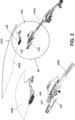
- FIG 2 shows a second example of a window lift system (1000) comprising an inductively coupled electric charging device (100) according to the present invention.
- the receiver coil (130) is connected to the active glass window (1020) of the active system (1010) and the transmitter coil (110) is connected to the rail (1050) of the window lift system (1000).
- the receiver coil (130) connected to the active glass window (1020) of the active system (1010) and the transmitter coil (110) connected to the rail (1050) of the window lift system (1000) can be seen, as well as the active glass window (1020) of the window lift system (1000).
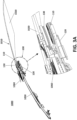
- FIG 3A shows a third example of a window lift system (1000) comprising an inductively coupled electric charging device (100) according to the present invention.
- the receiver coil (130) is connected to the drag car (1060) of the window lift system (1000) and facing the transmitter coil (110), which is connected (or connectable) to the door (1080) of a vehicle.
- Said door (1080) is shown in Figure 3B , wherein the rail (1050) of the window lift system can also be seen.
Landscapes
- Engineering & Computer Science (AREA)
- Computer Networks & Wireless Communication (AREA)
- Power Engineering (AREA)
- Charge And Discharge Circuits For Batteries Or The Like (AREA)
- Power-Operated Mechanisms For Wings (AREA)
Abstract
Inductively coupled electric charging device (100) for a window lift system (1000) for vehicle doors, wherein the window lift system (1000) comprises an active system (1010) comprising an active glass window (1020), wherein the inductively coupled electric charging device (100) comprises a transmitter coil (110) comprising wiring (120) connectable to a current source of the vehicle, wherein the transmitter coil (110) is configured to be charged through said current source, a receiver coil (130) connectable to the active system (1010), wherein the inductively coupled electric charging device (100) is configured to actuate the active glass window (1020) by means of a current flow obtained by inductively coupling the transmitter coil (110) in the state of charge and the receiver coil (130), wherein the actuation of the active glass window (1020) causes the darkening of the active glass window (1020).
Description
- The object of the present invention relates to inductively coupled electric charging devices for window lift systems for vehicle doors and to window lift systems comprising said electric charging devices.
- Automotive side glasses have traditionally been clear, or in some cases permanently tinted.
- Recently, technological developments from other technical fields such as those of architecture or decoration have reached the automobile, as is the case with active glasses that darken on demand and by receiving a current flow.
- Active glasses have started to make their way into the sunroof of vehicles. However, there are technical problems when it comes to inserting active glasses in the side doors of vehicles, since active glasses are actuated by a current flow and conventional glasses in side doors of vehicles are mobile and located on a window lift system that allows its movement (i.e. up and down). Therefore, the substitution of a conventional glass for an active glass in window lift systems, as well as applying said current flow poses complex technical difficulties.
- The present invention proposes a solution that solves the previously mentioned technical drawbacks for the incorporation of active glasses in the side doors of vehicles.
- The present invention obtains a solution to the technical problems associated with the implementation of active glasses in the doors of vehicles by means of an inductively coupled electric charging device that comprises a pair of inductive elements that allows electrical energy to be brought to the active glass window in a way that minimizes the problems to which a mobile element is subjected: noise, vibrations, humidity, direct water intake, dust, saline environment (corrosion), etc.
- The present invention allows the glass to be activated when both elements (i.e. a pair of inductive elements) are opposite each other, usually when the glass is in the closed position.
- Thus, in a first aspect, the present invention refers to an inductively coupled electric charging device for a window lift system for vehicle doors. The window lift system comprises an active system comprising an active glass window.
- The inductively coupled electric charging device comprises a transmitter coil comprising wiring that can be connected to a current source of the vehicle, wherein the transmitter coil is configured to be charged through said current source. The inductively coupled electric charging device also comprises a receiver coil that can be connected to the active system.
- The inductively coupled electric charging device is configured to actuate the active glass window by means of a current flow obtained by inductive coupling of the transmitter coil in the state of charge and the receiver coil. The actuation of the active glass window causes the darkening of the active glass window.
- The inductively coupled electric charging device also comprises control electronics configured for transmitting energy between the transmitter coil and the receiver coil. The window lift system may comprise a drag car, and wherein the receiver coil is connectable to the drag car.
- In the second example, the receiver coil is connectable to the active glass window of the active system.
- The window lift system comprises a rail configured to allow the movement of the active glass window by means of the drag car, and wherein the transmitter coil is connectable to said rail.
- In another example, the transmitter coil is connectable to a vehicle door.
- In another example, the transmitter coil wiring may comprise a charging connector connectable to the energy source.
- Another aspect of the invention relates to a window lift system for vehicle doors, wherein the window lift system comprises the inductively coupled electric charging device according to the first aspect of the invention. The active system comprises an active glass window, a drag car for the active glass window, and a rail on which said active glass window moves by means of the drag car.
- In one example, the transmitter coil is connected to said rail. In another example, the transmitter coil is connected to the door of a vehicle.
- In other examples, the receiver coil is connected to the active glass window drag car or directly to the active glass window of the active system.
- To complement the description that is being made and in order to help a better understanding of the characteristics of the inductively coupled electric charging devices and the window lift systems according to the present invention, a set of drawings is attached as an integral part of said description where, by way of illustration and not limitation, the following has been represented:
-
Figure 1 shows a window lift system comprising an inductively coupled electric charging device according to the present invention wherein the transmitter coil is located on the window lift system rail and wherein the receiver coil is located on the window lift system drag car. -
Figure 2 shows a window lift system comprising an inductively coupled electric charging device according to the present invention wherein the transmitter coil is located on the rail of the window lift system and wherein the receiver coil is located on the active glass window. -
Figures 3A and3B show a window lift system comprising an inductively coupled electric charging device according to the present invention wherein the transmitter coil is located on the door of a vehicle and wherein the receiver coil is located on the drag car of the active glass window. -
Figure 1 shows a first example of a window lift system (1000) comprising an inductively coupled electric charging device (100) according to the present invention. The window lift system (1000) comprises an active system (1010) comprising an active glass window (1020). The window lift system (1000) also comprises a rail (1050) and a drag car (1060). - As can be seen in the detailed view of
Figure 1 , the inductively coupled electric charging device (100) comprises a transmitter coil (110) comprising wiring (120) connectable to a current source of the vehicle (not shown inFigure 1 ). As can be seen inFigure 1 , the transmitter coil (110) is connected to the rail (1050) of the window lift system (1000). - The transmitter coil (110) is configured to charge via the current source. The receiver coil (130) is connected to the drag car (1060) of the window lift system.
- The inductively coupled electric charging device (100) is configured to actuate the active glass window (1020) by means of a current flow obtained by means of the inductive coupling of the transmitter coil (110) in the state of charge and the receiver coil (130), wherein the actuation of the active glass window (1020) causes the darkening of the active glass window (1020).
- As can be seen in the detailed view, the transmitter coil (110) and the receiver coil (130) are facing each other to cause an inductive coupling that allows the generation of the electrical flow that acts on the active glass window (1020). Wiring (120) connectable to a vehicle current source (not shown in
Figure 1 ) is also seen. -
Figure 2 shows a second example of a window lift system (1000) comprising an inductively coupled electric charging device (100) according to the present invention. In this particular example, the receiver coil (130) is connected to the active glass window (1020) of the active system (1010) and the transmitter coil (110) is connected to the rail (1050) of the window lift system (1000). - In the detailed view of
Figure 2 , the receiver coil (130) connected to the active glass window (1020) of the active system (1010) and the transmitter coil (110) connected to the rail (1050) of the window lift system (1000) can be seen, as well as the active glass window (1020) of the window lift system (1000). -
Figure 3A shows a third example of a window lift system (1000) comprising an inductively coupled electric charging device (100) according to the present invention. As shown in the detailed view ofFigure 3A , in this particular example, the receiver coil (130) is connected to the drag car (1060) of the window lift system (1000) and facing the transmitter coil (110), which is connected (or connectable) to the door (1080) of a vehicle. Said door (1080) is shown inFigure 3B , wherein the rail (1050) of the window lift system can also be seen.
Claims (10)
- Inductively coupled electric charging device (100) for a window lift system (1000) for vehicle doors, wherein the window lift system (1000) comprises an active system (1010) comprising an active glass window (1020), wherein the inductively coupled electric charging device (100) comprises:- a transmitter coil (110) comprising wiring (120) connectable to a current source of the vehicle, wherein the transmitter coil (110) is configured to charge via said current source,- a receiver coil (130) connectable to the active system (1010);- wherein the inductively coupled electric charging device (100) is configured to actuate the active glass window (1020) by means of a current flow obtained by inductive coupling of the transmitter coil (110) in the state of charge and the receiver coil (130),- wherein the actuation of the active glass window (1020) causes the darkening of the active glass window (1020).
- Inductively coupled electric charging device (100) according to claim 1, further comprising control electronics configured for transmitting energy between the transmitter coil (110) and the receiver coil (130).
- Inductively coupled electric charging device (100) according to claims 1 or 2, wherein the window lift system (1000) also comprises a drag car (1060), and wherein the receiver coil (130) is configured to be connectable to the drag car (1060).
- Inductively coupled electric charging device (100) according to claims 1 or 2, wherein the receiver coil (130) is configured to be connectable to the active glass window (1020) of the active system (1010).
- Inductively coupled electric charging device (100) according to claims 3 or 4, wherein the window lift system (1000) comprises a rail (1050) configured to allow the movement of the active glass window (1020) by means of the drag car (1060), and wherein the transmitter coil (110) is configured to be connectable to said rail (1050).
- Inductively coupled electric charging device (100) according to claims 1 to 4, wherein the transmitter coil (110) is configured to be connectable to a door (1080) of a vehicle.
- Inductively coupled electric charging device (100) according to the preceding claims, wherein the wiring (120) comprises a charging connector connectable to the energy source.
- Window lift system (1000) for vehicle doors, wherein the window lift system (1000) comprises:- the inductively coupled electric charging device (100) according to claims 1 to 7,- an active system (1010) comprising an active glass window (1020),- to a drag car (1060) of the active glass window (1020), and- a rail (1050) on which said active glass window (1020) moves by means of the drag car (1060).
- Window lift system (1000) for vehicle doors according to claim 8, wherein the receiver coil (130) is connected:- to the drag car (1060) of the active glass window (1020); or- to the active glass window (1020) of the active system (1010).
- Window lift system (1000) for vehicle doors according to claims 8 or 9, wherein the transmitter coil is connected to said rail (1050).
Applications Claiming Priority (1)
| Application Number | Priority Date | Filing Date | Title |
|---|---|---|---|
| PCT/ES2022/070463 WO2024013410A1 (en) | 2022-07-15 | 2022-07-15 | Inductively coupled electric charging devices |
Publications (1)
| Publication Number | Publication Date |
|---|---|
| EP4557576A1 true EP4557576A1 (en) | 2025-05-21 |
Family
ID=83193331
Family Applications (1)
| Application Number | Title | Priority Date | Filing Date |
|---|---|---|---|
| EP22765172.6A Pending EP4557576A1 (en) | 2022-07-15 | 2022-07-15 | Inductively coupled electric charging devices |
Country Status (3)
| Country | Link |
|---|---|
| EP (1) | EP4557576A1 (en) |
| CN (1) | CN119790569A (en) |
| WO (1) | WO2024013410A1 (en) |
Family Cites Families (3)
| Publication number | Priority date | Publication date | Assignee | Title |
|---|---|---|---|---|
| FR2989319B1 (en) * | 2012-04-16 | 2014-10-24 | Peugeot Citroen Automobiles Sa | GLAZING HAVING OBSCURING MEANS. |
| KR101730155B1 (en) * | 2016-07-25 | 2017-04-26 | 경운대학교 산학협력단 | Apparatus for controlling smart window |
| KR102506864B1 (en) * | 2017-12-12 | 2023-03-08 | 현대자동차주식회사 | Apparatus for varying a transparency of window glass using wireless power transfer |
-
2022
- 2022-07-15 CN CN202280098183.8A patent/CN119790569A/en active Pending
- 2022-07-15 EP EP22765172.6A patent/EP4557576A1/en active Pending
- 2022-07-15 WO PCT/ES2022/070463 patent/WO2024013410A1/en not_active Ceased
Also Published As
| Publication number | Publication date |
|---|---|
| WO2024013410A1 (en) | 2024-01-18 |
| CN119790569A (en) | 2025-04-08 |
Similar Documents
| Publication | Publication Date | Title |
|---|---|---|
| CN109910568B (en) | Device for changing transparency of vehicle window glass by using wireless power transmission | |
| US6072436A (en) | Incorporation of antenna into vehicle door pillar | |
| US10220687B2 (en) | Vehicle electrical system | |
| CN103745514A (en) | Automatic opening system and method for automobile trunk, and sensor device | |
| KR20120039739A (en) | Trainable wireless control system | |
| CN107407122B (en) | Drive for closing elements of motor vehicles | |
| US20200262388A1 (en) | Handleless door for vehicle | |
| CN112722085A (en) | Engine compartment cover opening and closing system based on keyless entry system | |
| KR102732163B1 (en) | Apparatus for controlling door of vehicle | |
| EP4556667A1 (en) | Retractable electric charging device | |
| CN119790569A (en) | Inductively coupled charging device | |
| US11787356B2 (en) | Method of wirelessly powering and controlling a dimmable device | |
| US20220144207A1 (en) | Handleless door for vehicle | |
| US12023996B2 (en) | Door assembly with transmitter and receiver units for the wireless transmission of energy and/or data | |
| DE10208573A1 (en) | Door handle for vehicle has mounted within it transmitting/receiving arrangement for radar system for detecting distances and/or directions of objects/persons in vicinity of motor vehicle | |
| US10442400B2 (en) | Wiper assembly and method | |
| CN113859173A (en) | Automatic opening and closing control system for automobile side door | |
| JPS6343405A (en) | On-vehicle antenna system | |
| CN1492962A (en) | Starting device for locking device | |
| DE102004033009A1 (en) | Vehicle unit with a portable vehicle box that has a communications capability, e.g. a portable toll unit, is positioned in the vehicle in a mounting so that the box aerial makes a contactless connection to the vehicle's own aerial | |
| EP1040948A1 (en) | Door and door module for vehicle | |
| EP4479617B1 (en) | A window control device for controlling the up and down displacement of a window glass | |
| CN114056459B (en) | Method for contacting a functionalized pane of a vehicle door and vehicle door | |
| CN216374474U (en) | Password strip for comfortable vehicle entering | |
| CN213262315U (en) | Vehicle-mounted face recognition device |
Legal Events
| Date | Code | Title | Description |
|---|---|---|---|
| STAA | Information on the status of an ep patent application or granted ep patent |
Free format text: STATUS: UNKNOWN |
|
| STAA | Information on the status of an ep patent application or granted ep patent |
Free format text: STATUS: THE INTERNATIONAL PUBLICATION HAS BEEN MADE |
|
| PUAI | Public reference made under article 153(3) epc to a published international application that has entered the european phase |
Free format text: ORIGINAL CODE: 0009012 |
|
| STAA | Information on the status of an ep patent application or granted ep patent |
Free format text: STATUS: REQUEST FOR EXAMINATION WAS MADE |
|
| 17P | Request for examination filed |
Effective date: 20250214 |
|
| AK | Designated contracting states |
Kind code of ref document: A1 Designated state(s): AL AT BE BG CH CY CZ DE DK EE ES FI FR GB GR HR HU IE IS IT LI LT LU LV MC MK MT NL NO PL PT RO RS SE SI SK SM TR |
|
| DAV | Request for validation of the european patent (deleted) | ||
| DAX | Request for extension of the european patent (deleted) |