EP4557490A2 - Separator und elektrochemische vorrichtung damit, verfahren zur bestimmung der stabilität einer batterie und batteriepack - Google Patents
Separator und elektrochemische vorrichtung damit, verfahren zur bestimmung der stabilität einer batterie und batteriepack Download PDFInfo
- Publication number
- EP4557490A2 EP4557490A2 EP24212935.1A EP24212935A EP4557490A2 EP 4557490 A2 EP4557490 A2 EP 4557490A2 EP 24212935 A EP24212935 A EP 24212935A EP 4557490 A2 EP4557490 A2 EP 4557490A2
- Authority
- EP
- European Patent Office
- Prior art keywords
- separator
- battery
- porous substrate
- binder
- example embodiment
- Prior art date
- Legal status (The legal status is an assumption and is not a legal conclusion. Google has not performed a legal analysis and makes no representation as to the accuracy of the status listed.)
- Pending
Links
Images


Classifications
-
- H—ELECTRICITY
- H01—ELECTRIC ELEMENTS
- H01M—PROCESSES OR MEANS, e.g. BATTERIES, FOR THE DIRECT CONVERSION OF CHEMICAL ENERGY INTO ELECTRICAL ENERGY
- H01M50/00—Constructional details or processes of manufacture of the non-active parts of electrochemical cells other than fuel cells, e.g. hybrid cells
- H01M50/40—Separators; Membranes; Diaphragms; Spacing elements inside cells
- H01M50/409—Separators, membranes or diaphragms characterised by the material
- H01M50/449—Separators, membranes or diaphragms characterised by the material having a layered structure
-
- H—ELECTRICITY
- H01—ELECTRIC ELEMENTS
- H01M—PROCESSES OR MEANS, e.g. BATTERIES, FOR THE DIRECT CONVERSION OF CHEMICAL ENERGY INTO ELECTRICAL ENERGY
- H01M50/00—Constructional details or processes of manufacture of the non-active parts of electrochemical cells other than fuel cells, e.g. hybrid cells
- H01M50/10—Primary casings; Jackets or wrappings
- H01M50/116—Primary casings; Jackets or wrappings characterised by the material
- H01M50/121—Organic material
-
- H—ELECTRICITY
- H01—ELECTRIC ELEMENTS
- H01M—PROCESSES OR MEANS, e.g. BATTERIES, FOR THE DIRECT CONVERSION OF CHEMICAL ENERGY INTO ELECTRICAL ENERGY
- H01M10/00—Secondary cells; Manufacture thereof
- H01M10/05—Accumulators with non-aqueous electrolyte
- H01M10/052—Li-accumulators
-
- H—ELECTRICITY
- H01—ELECTRIC ELEMENTS
- H01M—PROCESSES OR MEANS, e.g. BATTERIES, FOR THE DIRECT CONVERSION OF CHEMICAL ENERGY INTO ELECTRICAL ENERGY
- H01M10/00—Secondary cells; Manufacture thereof
- H01M10/05—Accumulators with non-aqueous electrolyte
- H01M10/052—Li-accumulators
- H01M10/0525—Rocking-chair batteries, i.e. batteries with lithium insertion or intercalation in both electrodes; Lithium-ion batteries
-
- H—ELECTRICITY
- H01—ELECTRIC ELEMENTS
- H01M—PROCESSES OR MEANS, e.g. BATTERIES, FOR THE DIRECT CONVERSION OF CHEMICAL ENERGY INTO ELECTRICAL ENERGY
- H01M50/00—Constructional details or processes of manufacture of the non-active parts of electrochemical cells other than fuel cells, e.g. hybrid cells
- H01M50/40—Separators; Membranes; Diaphragms; Spacing elements inside cells
- H01M50/409—Separators, membranes or diaphragms characterised by the material
- H01M50/411—Organic material
- H01M50/414—Synthetic resins, e.g. thermoplastics or thermosetting resins
-
- H—ELECTRICITY
- H01—ELECTRIC ELEMENTS
- H01M—PROCESSES OR MEANS, e.g. BATTERIES, FOR THE DIRECT CONVERSION OF CHEMICAL ENERGY INTO ELECTRICAL ENERGY
- H01M50/00—Constructional details or processes of manufacture of the non-active parts of electrochemical cells other than fuel cells, e.g. hybrid cells
- H01M50/40—Separators; Membranes; Diaphragms; Spacing elements inside cells
- H01M50/409—Separators, membranes or diaphragms characterised by the material
- H01M50/411—Organic material
- H01M50/414—Synthetic resins, e.g. thermoplastics or thermosetting resins
- H01M50/417—Polyolefins
-
- H—ELECTRICITY
- H01—ELECTRIC ELEMENTS
- H01M—PROCESSES OR MEANS, e.g. BATTERIES, FOR THE DIRECT CONVERSION OF CHEMICAL ENERGY INTO ELECTRICAL ENERGY
- H01M50/00—Constructional details or processes of manufacture of the non-active parts of electrochemical cells other than fuel cells, e.g. hybrid cells
- H01M50/40—Separators; Membranes; Diaphragms; Spacing elements inside cells
- H01M50/409—Separators, membranes or diaphragms characterised by the material
- H01M50/411—Organic material
- H01M50/414—Synthetic resins, e.g. thermoplastics or thermosetting resins
- H01M50/42—Acrylic resins
-
- H—ELECTRICITY
- H01—ELECTRIC ELEMENTS
- H01M—PROCESSES OR MEANS, e.g. BATTERIES, FOR THE DIRECT CONVERSION OF CHEMICAL ENERGY INTO ELECTRICAL ENERGY
- H01M50/00—Constructional details or processes of manufacture of the non-active parts of electrochemical cells other than fuel cells, e.g. hybrid cells
- H01M50/40—Separators; Membranes; Diaphragms; Spacing elements inside cells
- H01M50/409—Separators, membranes or diaphragms characterised by the material
- H01M50/411—Organic material
- H01M50/414—Synthetic resins, e.g. thermoplastics or thermosetting resins
- H01M50/423—Polyamide resins
-
- H—ELECTRICITY
- H01—ELECTRIC ELEMENTS
- H01M—PROCESSES OR MEANS, e.g. BATTERIES, FOR THE DIRECT CONVERSION OF CHEMICAL ENERGY INTO ELECTRICAL ENERGY
- H01M50/00—Constructional details or processes of manufacture of the non-active parts of electrochemical cells other than fuel cells, e.g. hybrid cells
- H01M50/40—Separators; Membranes; Diaphragms; Spacing elements inside cells
- H01M50/409—Separators, membranes or diaphragms characterised by the material
- H01M50/431—Inorganic material
-
- H—ELECTRICITY
- H01—ELECTRIC ELEMENTS
- H01M—PROCESSES OR MEANS, e.g. BATTERIES, FOR THE DIRECT CONVERSION OF CHEMICAL ENERGY INTO ELECTRICAL ENERGY
- H01M50/00—Constructional details or processes of manufacture of the non-active parts of electrochemical cells other than fuel cells, e.g. hybrid cells
- H01M50/40—Separators; Membranes; Diaphragms; Spacing elements inside cells
- H01M50/409—Separators, membranes or diaphragms characterised by the material
- H01M50/431—Inorganic material
- H01M50/434—Ceramics
-
- H—ELECTRICITY
- H01—ELECTRIC ELEMENTS
- H01M—PROCESSES OR MEANS, e.g. BATTERIES, FOR THE DIRECT CONVERSION OF CHEMICAL ENERGY INTO ELECTRICAL ENERGY
- H01M50/00—Constructional details or processes of manufacture of the non-active parts of electrochemical cells other than fuel cells, e.g. hybrid cells
- H01M50/40—Separators; Membranes; Diaphragms; Spacing elements inside cells
- H01M50/409—Separators, membranes or diaphragms characterised by the material
- H01M50/443—Particulate material
-
- H—ELECTRICITY
- H01—ELECTRIC ELEMENTS
- H01M—PROCESSES OR MEANS, e.g. BATTERIES, FOR THE DIRECT CONVERSION OF CHEMICAL ENERGY INTO ELECTRICAL ENERGY
- H01M50/00—Constructional details or processes of manufacture of the non-active parts of electrochemical cells other than fuel cells, e.g. hybrid cells
- H01M50/40—Separators; Membranes; Diaphragms; Spacing elements inside cells
- H01M50/409—Separators, membranes or diaphragms characterised by the material
- H01M50/446—Composite material consisting of a mixture of organic and inorganic materials
-
- H—ELECTRICITY
- H01—ELECTRIC ELEMENTS
- H01M—PROCESSES OR MEANS, e.g. BATTERIES, FOR THE DIRECT CONVERSION OF CHEMICAL ENERGY INTO ELECTRICAL ENERGY
- H01M50/00—Constructional details or processes of manufacture of the non-active parts of electrochemical cells other than fuel cells, e.g. hybrid cells
- H01M50/40—Separators; Membranes; Diaphragms; Spacing elements inside cells
- H01M50/409—Separators, membranes or diaphragms characterised by the material
- H01M50/449—Separators, membranes or diaphragms characterised by the material having a layered structure
- H01M50/451—Separators, membranes or diaphragms characterised by the material having a layered structure comprising layers of only organic material and layers containing inorganic material
-
- H—ELECTRICITY
- H01—ELECTRIC ELEMENTS
- H01M—PROCESSES OR MEANS, e.g. BATTERIES, FOR THE DIRECT CONVERSION OF CHEMICAL ENERGY INTO ELECTRICAL ENERGY
- H01M50/00—Constructional details or processes of manufacture of the non-active parts of electrochemical cells other than fuel cells, e.g. hybrid cells
- H01M50/40—Separators; Membranes; Diaphragms; Spacing elements inside cells
- H01M50/409—Separators, membranes or diaphragms characterised by the material
- H01M50/449—Separators, membranes or diaphragms characterised by the material having a layered structure
- H01M50/457—Separators, membranes or diaphragms characterised by the material having a layered structure comprising three or more layers
-
- H—ELECTRICITY
- H01—ELECTRIC ELEMENTS
- H01M—PROCESSES OR MEANS, e.g. BATTERIES, FOR THE DIRECT CONVERSION OF CHEMICAL ENERGY INTO ELECTRICAL ENERGY
- H01M50/00—Constructional details or processes of manufacture of the non-active parts of electrochemical cells other than fuel cells, e.g. hybrid cells
- H01M50/40—Separators; Membranes; Diaphragms; Spacing elements inside cells
- H01M50/489—Separators, membranes, diaphragms or spacing elements inside the cells, characterised by their physical properties, e.g. swelling degree, hydrophilicity or shut down properties
-
- H—ELECTRICITY
- H01—ELECTRIC ELEMENTS
- H01M—PROCESSES OR MEANS, e.g. BATTERIES, FOR THE DIRECT CONVERSION OF CHEMICAL ENERGY INTO ELECTRICAL ENERGY
- H01M50/00—Constructional details or processes of manufacture of the non-active parts of electrochemical cells other than fuel cells, e.g. hybrid cells
- H01M50/40—Separators; Membranes; Diaphragms; Spacing elements inside cells
- H01M50/489—Separators, membranes, diaphragms or spacing elements inside the cells, characterised by their physical properties, e.g. swelling degree, hydrophilicity or shut down properties
- H01M50/491—Porosity
-
- Y—GENERAL TAGGING OF NEW TECHNOLOGICAL DEVELOPMENTS; GENERAL TAGGING OF CROSS-SECTIONAL TECHNOLOGIES SPANNING OVER SEVERAL SECTIONS OF THE IPC; TECHNICAL SUBJECTS COVERED BY FORMER USPC CROSS-REFERENCE ART COLLECTIONS [XRACs] AND DIGESTS
- Y02—TECHNOLOGIES OR APPLICATIONS FOR MITIGATION OR ADAPTATION AGAINST CLIMATE CHANGE
- Y02E—REDUCTION OF GREENHOUSE GAS [GHG] EMISSIONS, RELATED TO ENERGY GENERATION, TRANSMISSION OR DISTRIBUTION
- Y02E60/00—Enabling technologies; Technologies with a potential or indirect contribution to GHG emissions mitigation
- Y02E60/10—Energy storage using batteries
Definitions
- the following disclosure relates to a separator and an electrochemical device comprising the same.
- the disclosure also relates to a method of determining the stability of a battery over time, and/or of testing decrease of battery capacity or decomposition of electrolyte.
- the disclosure also relates to a battery package.
- An insulating separator interposed between a positive electrode and a negative electrode is being studied in the direction of thinning for high capacity and high output characteristics of an electrochemical device, and when the separator is thinned, its mechanical strength and/or heat resistance is/are usually decreased. When mechanical strength and/or heat resistance is/are decreased, a safety problem during manufacturing process and use of a battery is more likely to occur. As an example, a short circuit between electrodes due to damage or deformation of the separator caused by a temperature rise in the battery may occur, increasing a risk of overheating or fire of the battery.
- Patent Document 1 Korean Patent Laid-Open Publication No. 2016-0109669 (September 21, 2016 )
- An embodiment of the present disclosure is directed to providing a separator having excellent heat resistance and adhesion, optionally even at a small thickness, and an electrochemical device comprising the separator.
- Another embodiment of the present disclosure is directed to providing a separator having improved mechanical strength and permeability, optionally even at a small thickness, and an electrochemical device comprising the separator.
- Still another embodiment of the present disclosure is directed to providing an electrochemical device having excellent resistance properties and thermal safety.
- the separator of the present disclosure may be widely applied to a green technology field such as electric vehicles, battery charging stations, and other solar power generations and wind power generations using batteries.
- the separator of the present disclosure may be used in eco-friendly electric vehicles, hybrid vehicles, and other electric devices and systems for suppressing air pollution and greenhouse gas emissions to prevent or diminish climate change.
- a separator comprises: a porous substrate; and an inorganic particle layer which is formed on at least one surface of the porous substrate and comprises a binder and inorganic particles, wherein the separator has a peak shown in a range of 1082.5 to 1086.5 cm -1 in a spectrum by Fourier-transform infrared spectroscopy (FT-IR), and has a saturated moisture content measured by a Karl Fischer method of 350 to 1000 ppm.
- FT-IR Fourier-transform infrared spectroscopy
- the saturated moisture content may be 450 to 1000 ppm.
- the porous substrate may have an average thickness of 5 to 15 um, and/or a ratio of the average thickness of the porous substrate to an average thickness of the separator may be 0.7 or more.
- a total thickness of the inorganic particle layer formed on the porous substrate may be 3.2 ⁇ m or less.
- the binder may comprise a polyacrylamide-based resin.
- the polyacrylamide-based resin may be a copolymer comprising a unit derived from a (meth)acrylamide-based monomer and a unit derived from a comonomer.
- the polyacrylamide-based resin may comprise a structural unit derived from the (meth)acrylamide-based monomer and a structural unit derived from a (meth)acryl-based monomer containing a hydroxyl group.
- the polyacrylamide-based resin may have a weight average molecular weight of 100,000 to 2,000,000 g/mol.
- the binder may further comprise any one or two or more additional binders selected from the group consisting of polyvinyl alcohol, polyvinylidene fluoride, carboxymethyl cellulose, styrene butadiene rubber, polyacrylic acid, polyethylene glycol, polyacrylonitrile, polyvinylpyrrolidone, and copolymers thereof.
- additional binders selected from the group consisting of polyvinyl alcohol, polyvinylidene fluoride, carboxymethyl cellulose, styrene butadiene rubber, polyacrylic acid, polyethylene glycol, polyacrylonitrile, polyvinylpyrrolidone, and copolymers thereof.
- a content of the additional binder may be 0.1 to 30 wt% of the total content of the binder.
- the inorganic particles may have a BET specific surface area of 3 to 7 m 2 /g.
- the inorganic particles may have an average particle diameter (D50) of 0.5 to 1.5 um.
- the inorganic particles may comprise any one or two or more selected from the group consisting of metal hydroxides, metal oxides, metal nitrides, and metal carbides.
- heat shrinkage rates in the machine direction and/or the transverse direction which are measured after leaving the separator at 130°C for 60 minutes may be 5% or less.
- the inorganic particle layer may have a weight ratio between the inorganic particles and the binder of 50:50 to 99.9:0.1.
- the inorganic particle layer may be formed at 0.5 to 10 g/m 2 .
- an electrochemical device comprises the separator described above.
- the present disclosure provides a method of determining stability of a battery over time, and/or of testing decrease of battery capacity or decomposition of electrolyte, by measuring whether the separator has a peak shown in a range of 1082.5 to 1086.5 cm -1 in a spectrum by Fourier-transform infrared spectroscopy (FT-IR), and whether the separator has a saturated moisture content measured by a Karl Fischer method of 350 to 1000 ppm.
- FT-IR Fourier-transform infrared spectroscopy
- the present disclosure provides a battery package comprising one or more battery cells, and a packaging material made of polyethylene, wherein each battery cell comprising a separator and the separator has a peak shown in a range of 1082.5 to 1086.5 cm -1 in a spectrum by Fourier-transform infrared spectroscopy (FT-IR), and has a saturated moisture content measured by a Karl Fischer method of 350 to 1000 ppm.
- FT-IR Fourier-transform infrared spectroscopy
- the packaging material is entirely free of aluminum material.
- the numerical range used in the present specification includes all values within the range including the lower limit and the upper limit, increments logically derived in a form and span of a defined range, all double limited values, and all possible combinations of the upper limit and the lower limit in the numerical range defined in different forms. Unless otherwise defined in the present specification, values which may be outside a numerical range due to experimental error or rounding off of a value are also included in the defined numerical range.
- average particle diameter refers to "D50”
- D50 refers to a particle diameter of an inorganic particle corresponding to 50% in terms of a volume-based integrated fraction.
- the average particle diameter may be derived from particle size distribution results obtained by collecting a sample of inorganic particles to be measured in accordance with the standard of ISO 13320-1 and performing analysis using S3500 available from MICROTRAC.
- D90 refers to a particle diameter of a particle corresponding to 90% in the volume-based integrated fraction
- D10 refers to a particle diameter of an inorganic particle corresponding to 10% in a volume-based integrated fraction. D90 and D10 may be derived in the same manner as D50.
- the present disclosure provides a separator comprising: a porous substrate; and inorganic particle layer which is formed on at least one surface of the porous substrate and comprises a binder and inorganic particles, wherein the separator has a peak shown in a range of 1082.5 to 1086.5 cm -1 (hereinafter, referred to as a first peak) in a spectrum by Fourier-transform infrared spectroscopy (FT-IR), and has a saturated moisture content measured by a Karl Fischer method of 350 to 1000 ppm.
- FT-IR Fourier-transform infrared spectroscopy
- the separator having a peak shown in a range of 1082.5 to 1086.5 cm -1 in a spectrum by Fourier-transform infrared spectroscopy (FT-IR) and also a saturated moisture content measured by a Karl Fischer method of 350 to 1000 ppm may have excellent heat resistance and adhesion and excellent permeability, optionally even at a small thickness.
- FT-IR Fourier-transform infrared spectroscopy
- an electrochemical device may have both excellent resistance properties and thermal safety by comprising the separator which satisfies both the first peak in the specific range shown in the FT-IR spectrum and the saturated moisture content in the specific range. Specifically, since the electrochemical device according to an example embodiment may show significantly low discharge resistance after 600 cycles, it may have improved charge and discharge performance.
- moisture content in a battery may increase after assembly and/or during storage depending on the features of the constituted material.
- moisture content in a battery can also increase after battery assembly, and the increase in moisture content as such may be a cause of decreasing a battery capacity by causing electrolyte decomposition. Accordingly, by determining whether the separator has a peak shown in a range of 1082.5 to 1086.5 cm -1 (i.e.
- FT-IR Fourier-transform infrared spectroscopy
- useful indicators have been identified for determining the stability of a battery, in particular for determining the stability over time (such as up to 6 months or one, two, three, four or more years), and/or for testing whether battery capacity has decreased, and/or whether electrolyte is decomposed at an unsatisfactory level, optionally during the lifetime of the battery over such longer time periods.
- the separator according to the present disclosure may maintain a low increase rate of moisture content during storage, by satisfying both the first peak in the specific range shown in the FT-IR spectrum and the saturated moisture content in the specific range. Accordingly, since the present disclosure has a low moisture content remaining in the battery, a battery having excellent performance may be provided even when a packaging material of polyethylene instead of an aluminum material.
- the first peak being controlled in the specific range shown in the FT-IR spectrum, and the saturated moisture content being controlled in the specific range are both useful indicators that a battery with a polyethylene packaging material, optionally without any aluminum packaging material and preferably polyethylene alone, has and maintains excellent performance, optionally during the lifetime of the battery over time periods such as up to 6 months or one, two, three, four or more years. That is, according to the present disclosure, battery costs may be reduced while battery performance is improved.
- the separator has a very thin inorganic particle layer e.g. the average thickness of the porous substrate is 15 um or less and the thickness of the porous substrate is 0.7 times or more of the entire thickness of the separator, it may have excellent mechanical properties, electrical properties, and thermal properties described later.
- Manufacture of the separator having the above properties may be achieved by adjusting any one or more selected from the thickness of each layer, the size of inorganic particles, the type of binder, the type of binder which is additionally used, surface properties of the porous substrate, the size and/or the surface area of inorganic particles, and the saturated moisture content of the separator, but the means are not particularly limited as long as it is achieved.
- the separator having the first peak in the specific range shown in the FT-IR spectrum and the saturated moisture content in the specific range may be manufactured using inorganic particles having a certain specific surface area.
- the separator according to an example embodiment may have a BET specific surface area of the inorganic particles included of 3 m 2 /g or more, 4 m 2 /g or more and 7 m 2 /g or less, 6 m 2 /g or less, or a value between the numerical values, and specifically, 3 to 7 m 2 /g or 4 to 6 m 2 /g.
- the separator as described above may be manufactured by adjusting a thickness ratio of the porous substrate and the seperator in a specific range.
- the ratio of the average thickness of the porous substrate to the average thickness of the separator may be 0.7 or more, 0.75 or more, 0.77 or more and 0.99 or less, 0.9 or less, 0.85 or less, or a value between the numerical values, and specifically, 0.7 to 0.99, 0.75 to 0.9, or 0.77 to 0.85.
- the separator as described above may be manufactured using the binder included in the separator as a specific resin.
- the binder may include a polyacrylamide-based resin, and preferably a polyacrylamide-based resin including a structural unit derived from a (meth)acrylamide-based monomer and a structural unit derived from a (meth)acryl-based monomer containing a hydroxyl group.
- the separator as described above may be manufactured by using a specific additional binder with the polyacrylamide-based resin described above as a binder.
- the specific additional binder may be any one or two or more selected from the group consisting of polyvinyl alcohol (PVA), polyvinylidene fluoride (PVDF), carboxymethyl cellulose (CMC), styrene-butadiene rubber (SBR), polyacrylic acid (PAA), polyethylene glycol (PEG), polyacrylonitrile (PAN), polyvinylpyrrolidone (PVP), and copolymers thereof.
- PVA polyvinyl alcohol
- PVDF polyvinylidene fluoride
- CMC carboxymethyl cellulose
- SBR styrene-butadiene rubber
- PAA polyacrylic acid
- PEG polyethylene glycol
- PAN polyacrylonitrile
- PVP polyvinylpyrrolidone
- the separator as described above may be manufactured by using the polyacrylamide-based resin described above as the binder and using the porous substrate including a polar functional group on the surface.
- a non-limiting example of the polar functional group may include a carboxyl group, an aldehyde group, a hydroxyl group, and the like, but is not particularly limited.
- the polar functional group may be, according to an example, introduced by a hydrophilic surface treatment, and the hydrophilic surface treatment may be performed by including, according to an example, one or more of a corona discharge treatment and a plasma discharge treatment.
- the separator which has the first peak in the specific range shown in the FT-IR spectrum and the saturated moisture content in the specific range as described above may be obtained by adjusting any one or a combination of two or more selected from the thickness and the thickness ratio of each layer, the size of the inorganic particles, the type of binder, the type of additionally used binder, the surface properties of the porous substrate, and the surface area of the inorganic particles of the separator.
- the separator satisfies the first peak shown in the FT-IR spectrum and the saturated moisture content in the specific range, it is included in the range of the present disclosure, and the means are not particularly limited as long as they are satisfied.
- the first peak is a peak having the highest intensity in a range of 1082.5 to 1086.5 cm -1 , and specifically, may be a peak having the highest intensity in a range of 1083 to 1086.5 cm -1 or in a range of 1083.5 to 1086 cm -1 .
- the separator may further have a second peak shown in a range of 1140 to 1160 cm -1 in the FT-IR spectrum.
- the second peak is a peak having the highest intensity in the range described above, and specifically, may be a peak having the highest intensity in a range of 1145 to 1155 cm -1 .
- the separator may further have a third peak shown in a range of 2910 to 2930 cm -1 in the FT-IR spectrum.
- the third peak is a peak having the highest intensity in the range described above, and specifically, may be a peak having the highest intensity in a range of 2915 to 2925 cm -1 or in a range of 2915 to 2920 cm -1 .
- the separator may further have a fourth peak shown in a range of 3090 to 3100 cm -1 in the FT-IR spectrum.
- the fourth peak is a peak having the highest intensity in the range described above, and specifically, may be a peak having the highest intensity in a range of 3092 to 3098 cm -1 .
- the separator may further have a fifth peak shown in a range of 3270 to 3295 cm -1 in the FT-IR spectrum.
- the fifth peak is a peak having the highest intensity in the range described above, and specifically, may be a peak having the highest intensity in a range of 3275 to 3290 cm -1 or in a range of 3275 to 3285 cm -1 .
- the FT-IR spectrum of the separator may be measured using a FT-IR instrument equipped with a mercury cadmium telluride (MCT) detector, and specifically, may be measured in a transmission mode by scanning 5 to 200 times at a resolution of 4 cm -2 in a range of 4000 to 675 cm -1 .
- MCT mercury cadmium telluride
- the separator may have a Gurley permeability of 250 sec/100 cc or less, 230 sec/100 cc or less, 200 sec/100 cc or less, 180 sec/100 cc or less, 10 sec/100 cc or more, 50 sec/100 cc or more, 90 sec/100 cc or more, 100 sec/100 cc or more, or a value between the numerical values.
- the Gurley permeability may be 10 to 250 sec/100 cc, 50 to 200 sec/100 cc, 90 to 230 sec/100 cc, or 100 to 180 sec/100 cc. Since the gas Gurley permeability range described above is satisfied, ion conductivity may be excellent, and charge and discharge properties of the electrochemical device may be improved due to low internal resistance of the electrochemical device.
- the separator may have a puncture strength of 0.3 N/ ⁇ m or more, 0.32 N/um or more, 0.35 N/um or more and 1.0 N/um or less, 0.8 N/ ⁇ m or less, 0.5 N/ ⁇ m or less, or a value between the numerical values.
- the puncture strength may be 0.3 to 1.0 N/ ⁇ m, 0.32 to 0.8 N/pm, or 0.35 N/um to 0.5 N/um.
- the separator may have a tensile strength in the machine direction (MD) of 1500 to 2500 kgf/cm 2 or 1500 to 2000 kgf/cm 2 .
- the separator may have a tensile strength in the transverse direction (TD) of 1500 kgf/cm 2 or more, 1600 kgf/cm 2 or more, 1700 kgf/cm 2 or more and 2500 kgf/cm 2 or less, 2000 kgf/cm 2 or less, or a value between the numerical values.
- the tensile strength in the transverse direction may be 1500 to 2500 kgf/cm 2 , 1600 to 2000 kgf/cm 2 , or 1700 to 2000 kgf/cm 2 .
- the saturated moisture content is measured after leaving the separator in a thermo-hygrostat set to 40°C and a relative humidity of 90% for 24 hours, and may be 350 ppm or more, 450 ppm or more, 500 ppm or more, 550 ppm or more, 600 ppm or more and 1000 ppm or less, 900 ppm or less, 800 ppm or less, 750 ppm or less, 700 or less, 670 or less, or a value between the numerical values.
- the saturated moisture content may be 350 to 1000 ppm, 450 to 1000 ppm, 500 to 900 ppm, 550 to 800 ppm, or 600 to 750 ppm.
- the average thickness (t 1 ) of the porous substrate may be 5 to 15 um. Further, in an example embodiment a ratio (t 1 /t 2 ) of the average thickness of the porous substrate to the average thickness (t 2 ) of the separator may be 0.7 or more.
- the separator according to an example embodiment may implement the Gurley permeability, the puncture strength, the tensile strength, and the saturated moisture content in the ranges described above even under the thickness conditions described above simultaneously. Accordingly, a separator for a secondary battery may be thinned, and is appropriate for being applied to a high capacity/high output battery.
- the average thickness of the porous substrate is not necessarily limited thereto, but may be 5 um or more, 8 um or more and 15 ⁇ m or less, 12 ⁇ m or less, or a value between the numerical values. Specifically, the average thickness of the porous substrate may be 5 to 15 um or 8 to 12 um.
- a ratio of the average thickness of the porous substrate to an average thickness of the separator may be 0.7 or more, 0.75 or more, 0.77 or more and 0.99 or less, 0.9 or less, 0.85 or less, or a value between the numerical values.
- a ratio of the average thickness of the porous substrate to the average thickness of the separator may be 0.7 to 0.99, 0.75 to 0.9, or 0.77 to 0.85.
- the average thickness of the separator is not necessarily limited thereto, but may be 7 um or more, 10 um or more, 12 um or more and 20 ⁇ m or less, 15 um or less, or a value between the numerical values. Specifically, the average thickness of the separator may be 7 to 20 ⁇ m, 10 to 15 um, or 12 to 15 um.
- the inorganic particle layer may be coated on one or both surfaces of the porous substrate, and when both surfaces of the porous substrate are coated with the inorganic particle layer, the thicknesses of the inorganic particle layers coated on one surface and the other surface may be the same as or different from each other.
- the total thickness of the inorganic particle layer formed on the porous substrate is not necessarily limited thereto, but may be 4 ⁇ m or less, 3.5 um or less and 1 um or more, 1.5 um or more, or a value between the numerical values.
- the total thickness of the inorganic particle layer may be 3.2 ⁇ m or less.
- the total thickness of the inorganic particle layer may be 1 to 4 ⁇ m, 1.5 to 3.5 ⁇ m, 1 to 3.2 um, or 1.5 to 3.2 um.
- the binder may include a polyacrylamide-based resin.
- the polyacrylamide-based resin may be polyacrylamide or a copolymer including the same.
- the copolymer may be a block copolymer or a random copolymer, but the copolymer described in an example embodiment refers to a random copolymer which is polymerized by mixing two or more monomers together.
- the polyacrylamide-based resin may be a copolymer including a unit derived from a (meth)acrylamide-based monomer and a unit derived from a comonomer.
- the polyacrylamide-based resin may include a structural unit derived from the (meth)acrylamide-based monomer and a structural unit derived from a (meth)acryl-based monomer containing a hydroxyl group.
- the separator comprises the above copolymer rather than a homopolymer derived from an acrylamide-based monomer, mechanical strength, gas permeability, heat resistance, and adhesion may be further improved.
- the electrochemical device since the electrochemical device includes the separator, it may have better resistance properties and heat stability.
- the unit derived from the (meth)acrylamide-based monomer of the polyacrylamide-based resin may be represented by the following Chemical Formula 1: wherein R 1 is hydrogen or a C1 to C6 alkyl group.
- the unit derived from the hydroxyl group-containing (meth)acryl-based monomer of the polyacrylamide-based resin may be represented by the following Chemical Formula 2: wherein R 2 is hydrogen or a C1 to C6 alkyl group.
- L 1 is a linear or branched C1 to C6 alkylene group, preferably C1 to C3 alkylene group, or more preferably C2 ethylene group.
- the (meth)acrylamide-based monomer may be included at 65 to 98 mol%, 70 to 97 mol%, or 75 to 95 mol%.
- the (meth)acryl-based monomer containing a hydroxyl group may be included at 2 to 35 mol%, 3 to 30 mol%, or 5 to 25 mol%.
- the polyacrylamide-based resin may have a weight average molecular weight in terms of polyethylene glycol of 100,000 g/mol or more, 200,000 g/mol or more and 2,000,000 g/mol or less, 1,000,000 g/mol or less, 500,000 g/mol or less, or a value between the numerical values as measured using gel permeation chromatography.
- the polyacrylamide-based resin may have a weight average molecular weight of 100,000 to 2,000,000 g/mol, 200,000 to 1,000,000 g/mol, or 200,000 to 500,000 g/mol.
- heat resistance and adhesion may be further improved.
- the binder may further comprise any one or two or more additional binders selected from the group consisting of polyvinyl alcohol (PVA), polyvinylidene fluoride (PVDF), carboxymethyl cellulose (CMC), styrene-butadiene rubber (SBR), polyacrylic acid (PAA), polyethylene glycol (PEG), polyacrylonitrile (PAN), polyvinylpyrrolidone (PVP), copolymers thereof.
- PVA polyvinyl alcohol
- PVDF polyvinylidene fluoride
- CMC carboxymethyl cellulose
- SBR styrene-butadiene rubber
- PAA polyacrylic acid
- PEG polyethylene glycol
- PAN polyacrylonitrile
- PVP polyvinylpyrrolidone
- the separator according to an example embodiment uses the additional binder described above with the polyacrylamide-based resin as a binder, mechanical strength, gas permeability, heat resistance, and adhesion may be further improved.
- improvement of the physical properties as described above may be achieved without pretreatment such as corona discharge treatment on the porous substrate, time and material costs in terms of process may be reduced.
- a content of the additional binder may be 0.1 wt% or more, 1 wt% or more, 5 wt% or more and 30 wt% or less, 20 wt% or less, or 15 wt% or less of the total content of the binder. Otherwise, the content may be a value between the numerical values. Specifically, the content of the additional binder may be 0.1 to 30 wt%, 1 to 20 wt%, or 5 to 15 wt%, but is not necessarily limited thereto.
- the additional binder may be polyvinyl alcohol, which may further improve the adhesion of the separator without pretreatment such as corona discharge treatment on the porous substrate.
- a degree of saponification when the additional binder is polyvinyl alcohol may be 80 to 95 mol%, specifically 85 to 90 mol%, but is not particularly limited thereto.
- the additional binder may have a weight average molecular weight of 10,000 to 100,000 g/mol, specifically 30,000 to 70,000 g/mol, but is not particularly limited thereto.
- the separator according to an example embodiment may have excellent heat resistance despite a low thickness.
- heat shrinkage rates in the machine direction and/or in the transverse direction which are measured after leaving the separator at 130°C for 60 minutes may be 5% or less, preferably 4% or less, more preferably 3% or less, 2% or less, 1.5% or less, or 1.2 % or less, 1.1 % or less in each direction.
- the porous substrate may be a polyolefin-based porous substrate such as polyethylene, polypropylene, or copolymers thereof, but is not thereto, and all porous substrates known as a porous substrate of a separator of an electrochemical device may be used.
- the porous substrate may be manufactured into a film or sheet, but is not particularly limited.
- the porous substrate may have a porosity of 20 to 60%, specifically 30 to 60%, but is not limited thereto.
- the inorganic particle layer may include a binder and inorganic particles, and may be a porous inorganic particle layer in which the inorganic particles are connected and fixed by the binder to form pores.
- the inorganic particle layer is provided on at least one surface of the porous substrate, may occupy an area fraction of 60% or more, 70% or more, 80% or more, or 90% or more, based on an overall surface of the porous substrate, and preferably, may be formed on the area of the porous substrate of 100%.
- the inorganic particles are not limited as long as they are inorganic particles used in the art.
- the inorganic particle particles may include any one or two or more selected from the group consisting of metal hydroxides, metal oxides, metal nitrides, and metal carbides.
- the inorganic particles may include any one or two or more selected from the group consisting of magnesium oxide (MgO) , magnesium hydroxide (Mg(OH) 2 ), alumina (Al 2 O 3 ), boehmite ( ⁇ -AlO(OH)), aluminum hydroxide (Al(OH) 3 ), silica (SiO 2 ), silicon carbide (SiC), calcium oxide (CaO), titanium dioxide (TiO 2 ), strontium titanate (SrTiO 3 ), zinc oxide (ZnO), yttrium oxide (Y 2 O 3 ), zirconium oxide (ZrO 2 ), tin oxide (SnO 2 ), and cerium oxide (CeO 2 ).
- MgO magnesium oxide
- Mg(OH) 2 magnesium hydroxide
- Al 2 O 3 alumina
- boehmite ⁇ -AlO(OH)
- aluminum hydroxide Al(OH) 3
- silica SiO 2
- silicon carbide SiC
- the inorganic particles may be preferably any one or two or more metal hydroxide particles selected from the group consisting of boehmite, aluminum hydroxide (Al(OH) 3 ), and magnesium hydroxide (Mg(OH) 2 ).
- the shape of the inorganic particles is not limited, and may be spherical, oval, needle-shaped, and the like.
- the inorganic particles may have a BET specific surface area of 3 m 2 /g or more, 4 m 2 /g or more and 7 m 2 /g or less, 6 m 2 /g or less, or a value between the numerical values.
- the inorganic particles may have the BET specific surface area of 3 to 7 m 2 /g or 4 to 6 m 2 /g.
- the present disclosure may provide a separator satisfying the physical properties to be implemented in the present disclosure simultaneously, when the specific surface area in the above described range is satisfied.
- the BET specific surface area of the inorganic particles may be measured by the method of ASTM C1069.
- the inorganic particles may have an average particle diameter (D50) of 0.5 um or more, 0.6 um or more and 1.5 ⁇ m or less, 1.0 um or less, or a value between the numerical values.
- the inorganic particles may have the D50 of 0.5 to 1.5 ⁇ m or 0.6 to 1.0 um, but it may be changed as long as it is not out of the range of the present disclosure.
- the inorganic particle layer may have a weight ratio between the inorganic particles and the binder of 50:50 to 99.9:0.1, 60:40 to 98:2, or 80:20 to 98:2, but is not particularly limited thereto.
- the inorganic particle layer may be formed at 0.5 to 10 g/m 2 , specifically 1 to 5 g/m 2 , and more specifically 2.5 to 4 g/m 2 , but is not particularly limited thereto.
- the method for manufacturing the separator satisfying the physical properties described above simultaneously may include: a first step of preparing a coating slurry including a binder and inorganic particles; and a second step of applying the coating slurry on at least one surface of a porous substrate to form an inorganic particle layer.
- the inorganic particles may be dispersed by stirring to prepare a slurry, and agglomerated inorganic particles may be dispersed using a ball mill.
- the coating slurry includes inorganic particles, a binder, and a solvent
- the solvent may be water, lower alcohols such as ethanol, methanol, and propanol, solvents such as dimethylformamide, acetone, tetrahydrofuran, diethyl ether, methylene chloride, DMF, N-ethyl-2-pyrrolidone, hexane, and cyclohexane, or a mixture thereof, but is not necessarily limited thereto.
- a solid content of the coating slurry is not particularly limited, but for example, may be 1 to 50 wt%, 5 to 30 wt%, or 10 to 30 wt%, but is not limited thereto.
- the coating slurry may include 50 to 99.9 wt% of the inorganic particles and 0.1 to 50 wt% of the binder, and specifically, 60 to 98 wt% of the inorganic particles and 2 to 40 wt% of the binder, and more specifically, 80 to 98 wt% of the inorganic particles and 2 to 20 wt% of the binder, based on the total weight of the solid content, but is not limited thereto.
- any common method known in the art may be applied to the method for applying the coating slurry in the second step without limitation, and according to a non-limiting example, roll coating, spin coating, dip coating, bar coating, die coating, slit coating, inkjet printing, and a combination of these methods may be applied.
- the applied slurry may be dried and formed into an inorganic particle layer. Drying for forming the inorganic particle layer is not particularly limited, but may be performed at 100°C or lower or 30 to 60°C.
- a process of aging the porous substrate having the inorganic particle layer formed thereon may not be further included.
- the aging may be performed at 50 to 150°C or 60 to 120°C, and an aging time may be 2 hours to 24 hours or 10 to 20 hours. More specifically, the aging may be performed in a temperature range of 70 to 120°C for 10 to 15 hours.
- a separator satisfying the physical properties as described above simultaneously may be manufactured without performing the aging process, time and material costs in terms of process may be reduced.
- the present disclosure may provide an electrochemical device including the separator according to an example embodiment of the example embodiments described above. Since the electrochemical device includes the separator as described above, electrical resistance is reduced, and thus, the electrochemical device may have significantly excellent life characteristics and excellent thermal stability at a high temperature.
- the electrochemical device may be all known energy storage devices, and though it is not particularly limited, as a non-limiting example, may be a lithium secondary battery. Since the lithium secondary battery is well known and its configuration is also known, it will be not described in detail in the present disclosure.
- the lithium secondary battery according to an example embodiment may include the separator described above between a positive electrode and a negative electrode.
- the positive electrode and the negative electrode may be used without limitation as long as they are commonly used in the lithium secondary battery.
- the manufacturing method follows a common manufacturing method in which a negative electrode, a separator, and a positive electrode are arranged and assembled, and an electrolyte solution is injected thereto to complete the manufacture, and thus, the manufacturing method will not be described any more in detail.
- a separator was cut into a size of 1 cm ⁇ 1 cm to prepare a measurement sample, and measurement was performed using a FT-IR instrument (available from Thermo Scientific, Nicolet iN10 Infrared Microscope) equipped with a mercury cadmium telluride (MCT) detector under the following conditions:
- the separators were overlapped in 10 layers, each thickness at 5 random points was measured in the transverse direction by a thickness measurement device available from Mitutoyo, all 5 measured values are added, the added value was divided by 5 to derive an average thickness of the 10 layered separator, and the obtained value was divided by 10 again to derive an overall average thickness of a single separator.
- the average thickness of the porous substrate was determined by overlapping only the porous substrates in 10 layers, measuring each thickness at 5 random points in the transverse direction by a thickness measurement device available from Mitutoyo and adding them, dividing the obtained value by 5 to derive an average thickness of the 10 layer separator, and dividing the value by 10 again to derive an average thickness of the porous substrate.
- the inorganic particle layer was formed, the inorganic particle layer was detached from the separator, the substrate was sufficiently dried, and the average thickness of the porous substrate from which the inorganic particle layer was detached was derived as described above.
- the puncture strength was measured by attaching a pin tip having a diameter of 1.0 mm and a radius of curvature of 0.5 mm to Universal Test Machine (UTM) 3345 available from INSTRON and pressing the separator at a speed of 120 mm/min. At this time, a load (N) when the separator was broken was divided by the thickness ( ⁇ m) of the separator to calculate the puncture strength.
- UTM Universal Test Machine
- the tensile strength was measured at room temperature(25°C) as a strength when a separator was broken by pulling the separator in the transverse direction and in the machine direction, respectively, at a speed of 100 mm/min using a Universal Test Machine (UTM) 3345 available from INSTRON in accordance with ASTM D882.
- UTM Universal Test Machine
- a separator was cut into a square shape with a side of 10 cm and a transverse direction (TD) and a machine direction (MD) were indicated.
- TD transverse direction
- MD machine direction
- a sample was placed in the center, 5 sheets of paper were placed on and under the sample, respectively, and the four sides of the paper were wrapped with tape.
- the sample wrapped in paper was allowed to stand in a hot air drying oven at 130 °C for 60 minutes.
- a Karl Fischer method was used.
- a Karl Fischer titrator available from Metrohm was used as measuring equipment, and measuring conditions were a separator sample weight of 0.3 g, an oven temperature of 150°C, and a measurement time of 600 seconds.
- the manufactured separator was left for 24 hours in a thermo-hygrostat set to 40°C and a relative humidity of 90%, and then the saturated moisture content was measured under the conditions described above.
- a separator was cut into a size of 50 mm wide ⁇ 50 mm long and placed so that the inorganic particle layer was on top.
- a piece of black drawing paper (20 mm wide ⁇ 150 mm long ⁇ 0.25 mm thick) having a coefficient of dynamic fraction of 0.15 was placed thereon, a pressing device was used to apply a certain pressure (200 g/cm 2 ), the black drawing paper was forcibly pulled to the side, and a degree of inorganic substance adhered on the surface was confirmed and determined as A/B/C/D/E/F depending on the adhesion degree, referring to the following grades:
- Each battery manufactured according to the examples and the comparative examples was charged at a constant current-constant voltage (CC-CV) of 4.2 V using a charge/discharge cycle device, and then was discharged. Specifically, each battery was charged at constant current with a 0.5 C rate at 25°C until the voltage reached 4.2 V, and charged at constant voltage until the current was 0.01 C while maintaining 4.2 V. Subsequently, a cycle of discharging at a constant current of 0.5 C until the voltage reached 3.0 V during discharging was repeated 600 times. When a state of charge (SoC) at the 600th charge/discharge cycle was 60%, direct current internal resistance (DC-IR) was measured during discharging by a J-pulse method to derive a resistance value.
- SoC state of charge
- DC-IR direct current internal resistance
- a polyethylene porous film (porosity: 42%, Gurley permeability: 128 sec/100 cc, tensile strength in MD: 2,317 kgf/cm 2 , tensile strength in TD: 2,514 kgf/cm 2 ) having an average thickness of 10 um was used as a porous substrate.
- the coating slurry prepared above was applied by coating on both surfaces of the porous substrate and then dried, thereby manufacturing a separator having an inorganic particle layer having an average thickness of 1.35 um formed on both surfaces, respectively, of the porous substrate.
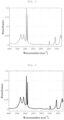
- the physical properties of the separator are listed in the following Table 1, and the FT-IR spectrum measurement results of the separator are shown in Table 3, FIG. 1 , and FIG. 5 .
- a pouch type battery was assembled by stacking the separator manufactured above between the positive electrode and the negative electrode, and in order to fuse the positive electrode, the negative electrode, and the separator together, the assembled battery was heat-fused at 80°C, 1 MPa with a heat press machine. Thereafter, an electrolyte in which 1 M lithium hexafluorophosphate (LiPF 6 ) was dissolved in a solution including ethylene carbonate (EC), ethyl methyl carbonate (EMC), and dimethyl carbonate (DMC) at a volume ratio of 30:50:20 was injected, and the battery was sealed to manufacture a secondary battery having a capacity of 2 Ah.
- the resistance properties of the secondary battery are listed in the following Table 1.
- the process was performed in the same manner as in Example 1, except that 3.5 wt% of a polyacrylamide resin was used instead of using polyvinyl alcohol as the binder and the porous substrate which was pretreated by the following method was used.
- the pretreated porous substrate was manufactured by treating the both surfaces of a polyethylene porous film (porosity: 42%, Gurley permeability: 128 sec/100 cc, tensile strength in MD: 2,317 kgf/cm 2 , tensile strength in TD: 2,514 kgf/cm 2 ) having an average thickness of 10 ⁇ m with corona discharge. At this time, the corona discharge treatment was performed at a power density of 2 W/mm and a rate of 3 to 20 mpm (meter per minute).
- a separator and a secondary battery were manufactured in the same manner as in Example 1, except that when the coating slurry was prepared, boehmite (D10: 0.56 um, D50: 0.85 ⁇ m, D90: 1.93 ⁇ m, BET specific surface area: 4 m 2 /g) was used as the inorganic particles.
- boehmite D10: 0.56 um, D50: 0.85 ⁇ m, D90: 1.93 ⁇ m, BET specific surface area: 4 m 2 /g
- a separator and a secondary battery were manufactured in the same manner as in Example 1, except that when the coating slurry was prepared, boehmite (D10: 0.38 ⁇ m, D50: 0.67 ⁇ m, D90: 1.52 um, BET specific surface area: 6 m 2 /g) was used as the inorganic particles.
- boehmite D10: 0.38 ⁇ m, D50: 0.67 ⁇ m, D90: 1.52 um, BET specific surface area: 6 m 2 /g
- a separator and a secondary battery were manufactured in the same manner as in Example 1, except that polyacrylamide having a weight average molecular weight of 200,000 g/mol was used instead of the polyacrylamide-based resin of Example 1.
- the characteristics of the separator and the secondary battery are listed in the following Tables 1 and 3.
- a separator and a secondary battery were manufactured in the same manner as in Example 2, except that when the separator was manufactured, the inorganic particle layer was formed at an average thickness of 2 ⁇ m on both surfaces of a polyethylene porous film (porosity: 40%, Gurley permeability: 152 sec/100 cc, tensile strength in MD: 2,242 kgf/cm 2 , tensile strength in TD: 1,864 kgf/cm 2 ) having an average thickness of 9 ⁇ m, respectively.
- the characteristics of the separator and the secondary battery are listed in the following Tables 2 and 3.
- a separator and a secondary battery were manufactured in the same manner as in Example 2, except that when the coating slurry was prepared, boehmite (D10: 0.16 ⁇ m, D50: 0.31 ⁇ m, D90: 0.75 um, BET specific surface area: 20 m 2 /g) was used as the inorganic particles.
- boehmite D10: 0.16 ⁇ m, D50: 0.31 ⁇ m, D90: 0.75 um, BET specific surface area: 20 m 2 /g
- the characteristics of the separator and the secondary battery are shown in Tables 2 and 3 and FIG. 5 .
- a separator and a secondary battery were manufactured in the same manner as in Example 2, except that when the coating slurry was prepared, boehmite (D10: 0.79 ⁇ m, D50: 1.64 ⁇ m, D90: 2.85 ⁇ m, BET specific surface area: 2.5 m 2 /g) was used as the inorganic particles.
- the characteristics of the separator and the secondary battery are shown in Tables 2 and 3, and FIGS. 3 and 5 .
- a separator and a secondary battery were manufactured in the same manner as in Example 2, except that when the coating slurry was prepared, boehmite (D10: 0.31 ⁇ m, D50: 0.58 ⁇ m, D90: 1.28 um, BET specific surface area: 8 m 2 /g) was used as the inorganic particles.
- the characteristics of the separator and the secondary battery are shown in Tables 2 and 3, and FIGS. 4 and 5 .
- the separators of Examples 1 to 5 had excellent heat resistance even at a small thickness with a heat shrinkage rate of 5% or less and also had excellent adhesive strength with no adhesion in the adhesive strength test, as compared with the comparative examples. In addition, it was confirmed that the discharge resistance of the battery to which the separators were applied after 600 cycles was low.
- the separators of the examples which had the peak shown in the range of 1082.5 to 1086.5 cm -1 in the FT-IR spectrum and also satisfied the saturated moisture content of 350 to 1000 ppm were all excellent in terms of heat resistance, adhesion, and battery resistance properties, unlike the separators of Comparative Examples 2 and 4 which did not have the peak and the saturated moisture content in the range described above or the separator of Comparative Example 1 which did not have the saturated moisture content in the range described above.
- Examples 1 to 4 used the polyacrylamide-based resin prepared by further including the hydroxyl group-containing (meth)acrylate-based monomer other than the (meth)acrylamide-based monomer as the binder, they were confirmed to have better heat resistance than Example 5 using the (meth)acrylamide-based monomer alone.
- Example 1 further included polyvinyl alcohol as the binder, it was confirmed to have better heat resistance than Example 2, even without pretreatment on the porous substrate.
- the separator of Comparative Example 2 used the inorganic particles having a BET specific surface area of 20 m 2 /g, and as a result, it did not satisfy the peak in the specific range shown in the FT-IR spectrum and the saturated moisture content in the specific range which are to be implemented in the present disclosure, and thus, the discharge resistance of the battery to which the separator was applied after 600 cycles was confirmed to be significantly higher than the examples.
- the separator of Comparative Example 3 used the inorganic particles having a BET specific surface area of 2.5 m 2 /g, and as a result, it did not satisfy the peak in the specific range shown in the FT-IR spectrum and the saturated moisture content in the specific range which are to be implemented in the present disclosure, and thus, was confirmed to have significantly reduced heat resistance and adhesive strength at a small thickness.
- the discharge resistance of the battery to which the separator was applied after 600 cycles was confirmed to be significantly higher than the example.
- the separator of Comparative Example 4 used the inorganic particles having a BET specific surface area of 8 m 2 /g, and as a result, it did not satisfy the peak in the specific range shown in the FT-IR spectrum and the saturated moisture content in the specific range which are to be implemented in the present disclosure, and thus, the discharge resistance of the battery to which the separator was applied after 600 cycles was confirmed to be higher than Example.
- the separator according to the present disclosure may have excellent heat resistance and adhesion even at a small thickness.
- the separator according to the present disclosure may have excellent mechanical strength and permeability even at a small thickness.
- an electrochemical device having excellent resistance properties and thermal safety may be provided.
Landscapes
- Chemical & Material Sciences (AREA)
- Chemical Kinetics & Catalysis (AREA)
- Electrochemistry (AREA)
- General Chemical & Material Sciences (AREA)
- Inorganic Chemistry (AREA)
- Engineering & Computer Science (AREA)
- Materials Engineering (AREA)
- Composite Materials (AREA)
- Manufacturing & Machinery (AREA)
- Ceramic Engineering (AREA)
- Cell Separators (AREA)
Applications Claiming Priority (1)
| Application Number | Priority Date | Filing Date | Title |
|---|---|---|---|
| KR1020230157974A KR102798263B1 (ko) | 2023-11-15 | 2023-11-15 | 분리막 및 이를 포함하는 전기화학소자 |
Publications (2)
| Publication Number | Publication Date |
|---|---|
| EP4557490A2 true EP4557490A2 (de) | 2025-05-21 |
| EP4557490A3 EP4557490A3 (de) | 2025-05-28 |
Family
ID=93562498
Family Applications (1)
| Application Number | Title | Priority Date | Filing Date |
|---|---|---|---|
| EP24212935.1A Pending EP4557490A3 (de) | 2023-11-15 | 2024-11-14 | Separator und elektrochemische vorrichtung damit, verfahren zur bestimmung der stabilität einer batterie und batteriepack |
Country Status (5)
| Country | Link |
|---|---|
| US (1) | US20250158229A1 (de) |
| EP (1) | EP4557490A3 (de) |
| JP (1) | JP2025081275A (de) |
| KR (2) | KR102798263B1 (de) |
| CN (1) | CN120016089A (de) |
Citations (1)
| Publication number | Priority date | Publication date | Assignee | Title |
|---|---|---|---|---|
| KR20160109669A (ko) | 2015-03-12 | 2016-09-21 | 에스케이이노베이션 주식회사 | 내열성이 우수한 이차전지용 분리막 및 이의 제조방법 |
Family Cites Families (5)
| Publication number | Priority date | Publication date | Assignee | Title |
|---|---|---|---|---|
| KR101408844B1 (ko) * | 2010-06-10 | 2014-06-20 | 에스케이이노베이션 주식회사 | 고내열성 유/무기 피복층을 갖는 복합 미세다공막 |
| JP6430839B2 (ja) * | 2015-01-26 | 2018-11-28 | 旭化成株式会社 | 電池用セパレータ、及び非水電解液電池 |
| JP6762349B2 (ja) * | 2018-12-06 | 2020-09-30 | 住友化学株式会社 | 非水電解液二次電池用多孔質膜、非水電解液二次電池用セパレータおよび非水電解液二次電池 |
| WO2022138320A1 (ja) * | 2020-12-24 | 2022-06-30 | 昭和電工株式会社 | 非水系二次電池用セパレータバインダー重合体、非水系二次電池用セパレータ、及び非水系二次電池 |
| KR102862242B1 (ko) * | 2021-03-04 | 2025-09-18 | 삼성에스디아이 주식회사 | 세퍼레이터 코팅용 조성물, 이를 이용한 세퍼레이터의 제조 방법, 세퍼레이터 및 이를 채용한 리튬 전지 |
-
2023
- 2023-11-15 KR KR1020230157974A patent/KR102798263B1/ko active Active
-
2024
- 2024-11-14 US US18/946,940 patent/US20250158229A1/en active Pending
- 2024-11-14 CN CN202411628604.0A patent/CN120016089A/zh active Pending
- 2024-11-14 EP EP24212935.1A patent/EP4557490A3/de active Pending
- 2024-11-14 JP JP2024198872A patent/JP2025081275A/ja active Pending
-
2025
- 2025-04-15 KR KR1020250048748A patent/KR20250071899A/ko active Pending
Patent Citations (1)
| Publication number | Priority date | Publication date | Assignee | Title |
|---|---|---|---|---|
| KR20160109669A (ko) | 2015-03-12 | 2016-09-21 | 에스케이이노베이션 주식회사 | 내열성이 우수한 이차전지용 분리막 및 이의 제조방법 |
Also Published As
| Publication number | Publication date |
|---|---|
| EP4557490A3 (de) | 2025-05-28 |
| CN120016089A (zh) | 2025-05-16 |
| KR102798263B1 (ko) | 2025-04-22 |
| JP2025081275A (ja) | 2025-05-27 |
| US20250158229A1 (en) | 2025-05-15 |
| KR20250071899A (ko) | 2025-05-22 |
Similar Documents
| Publication | Publication Date | Title |
|---|---|---|
| JP6208945B2 (ja) | セパレータ及びこれを備えた電気化学素子 | |
| TWI517483B (zh) | 具多孔活性塗層之有機/無機複合隔離板及包含其之電化學裝置 | |
| CN101960659B (zh) | 具有多孔涂层的隔膜和含有所述隔膜的电化学装置 | |
| TWI443893B (zh) | 具多孔塗層之分隔器及含其之電化學裝置 | |
| RU2460177C2 (ru) | Органический/неорганический композитный сепаратор и электрохимическое устройство, его содержащее | |
| JP5545508B2 (ja) | 非水電解液リチウム二次電池 | |
| EP4358274A2 (de) | Separator und elektrochemische vorrichtung damit | |
| EP2808923A1 (de) | Verfahren zur herstellung eines separators, in diesem verfahren hergestellter separator und elektrochemische vorrichtung damit | |
| JP2012134177A (ja) | 有機無機複合多孔性高分子プラスチック | |
| JP7395213B2 (ja) | 電気化学素子用分離膜及びそれを含む電気化学素子 | |
| EP3968428A1 (de) | Separator für eine lithium-sekundärbatterie, verfahren zu seiner herstellung und elektrochemische vorrichtung damit | |
| EP3624224A2 (de) | Separator ohne separatorsubstrat und elektrochemische vorrichtung damit | |
| KR20120035359A (ko) | 사이클 특성이 개선된 전기화학소자 | |
| US20240195012A1 (en) | Separator, method of manufacturing the separator, and electrochemical device including the separator | |
| EP4557490A2 (de) | Separator und elektrochemische vorrichtung damit, verfahren zur bestimmung der stabilität einer batterie und batteriepack | |
| EP4557421A2 (de) | Separator und elektrochemische vorrichtung damit | |
| EP4528902A2 (de) | Separator und elektrochemische vorrichtung damit | |
| EP4550558A1 (de) | Separator, verfahren zur herstellung davon und elektrochemische vorrichtung mit dem separator | |
| EP4576387A1 (de) | Separator und lithiumsekundärbatterie damit sowie verfahren zur herstellung des separators | |
| JP2025519299A (ja) | Si系負極活物質を備えるリチウム二次電池 |
Legal Events
| Date | Code | Title | Description |
|---|---|---|---|
| PUAI | Public reference made under article 153(3) epc to a published international application that has entered the european phase |
Free format text: ORIGINAL CODE: 0009012 |
|
| STAA | Information on the status of an ep patent application or granted ep patent |
Free format text: STATUS: REQUEST FOR EXAMINATION WAS MADE |
|
| PUAL | Search report despatched |
Free format text: ORIGINAL CODE: 0009013 |
|
| 17P | Request for examination filed |
Effective date: 20241114 |
|
| AK | Designated contracting states |
Kind code of ref document: A2 Designated state(s): AL AT BE BG CH CY CZ DE DK EE ES FI FR GB GR HR HU IE IS IT LI LT LU LV MC ME MK MT NL NO PL PT RO RS SE SI SK SM TR |
|
| AK | Designated contracting states |
Kind code of ref document: A3 Designated state(s): AL AT BE BG CH CY CZ DE DK EE ES FI FR GB GR HR HU IE IS IT LI LT LU LV MC ME MK MT NL NO PL PT RO RS SE SI SK SM TR |
|
| RIC1 | Information provided on ipc code assigned before grant |
Ipc: H01M 50/457 20210101ALI20250423BHEP Ipc: H01M 50/449 20210101ALI20250423BHEP Ipc: H01M 50/431 20210101ALI20250423BHEP Ipc: H01M 50/42 20210101ALI20250423BHEP Ipc: H01M 50/423 20210101ALI20250423BHEP Ipc: H01M 10/0525 20100101ALI20250423BHEP Ipc: H01M 50/451 20210101ALI20250423BHEP Ipc: H01M 50/446 20210101ALI20250423BHEP Ipc: H01M 50/443 20210101ALI20250423BHEP Ipc: H01M 50/417 20210101ALI20250423BHEP Ipc: H01M 50/414 20210101ALI20250423BHEP Ipc: H01M 50/121 20210101ALI20250423BHEP Ipc: H01M 50/489 20210101AFI20250423BHEP |