EP4557280A2 - Vorrichtung und verfahren zur umwandlung eines audiostroms - Google Patents
Vorrichtung und verfahren zur umwandlung eines audiostroms Download PDFInfo
- Publication number
- EP4557280A2 EP4557280A2 EP25168354.6A EP25168354A EP4557280A2 EP 4557280 A2 EP4557280 A2 EP 4557280A2 EP 25168354 A EP25168354 A EP 25168354A EP 4557280 A2 EP4557280 A2 EP 4557280A2
- Authority
- EP
- European Patent Office
- Prior art keywords
- audio stream
- parameters
- signal
- transforming
- audio
- Prior art date
- Legal status (The legal status is an assumption and is not a legal conclusion. Google has not performed a legal analysis and makes no representation as to the accuracy of the status listed.)
- Pending
Links
Images



Classifications
-
- G—PHYSICS
- G10—MUSICAL INSTRUMENTS; ACOUSTICS
- G10L—SPEECH ANALYSIS TECHNIQUES OR SPEECH SYNTHESIS; SPEECH RECOGNITION; SPEECH OR VOICE PROCESSING TECHNIQUES; SPEECH OR AUDIO CODING OR DECODING
- G10L19/00—Speech or audio signals analysis-synthesis techniques for redundancy reduction, e.g. in vocoders; Coding or decoding of speech or audio signals, using source filter models or psychoacoustic analysis
- G10L19/008—Multichannel audio signal coding or decoding using interchannel correlation to reduce redundancy, e.g. joint-stereo, intensity-coding or matrixing
-
- G—PHYSICS
- G10—MUSICAL INSTRUMENTS; ACOUSTICS
- G10L—SPEECH ANALYSIS TECHNIQUES OR SPEECH SYNTHESIS; SPEECH RECOGNITION; SPEECH OR VOICE PROCESSING TECHNIQUES; SPEECH OR AUDIO CODING OR DECODING
- G10L19/00—Speech or audio signals analysis-synthesis techniques for redundancy reduction, e.g. in vocoders; Coding or decoding of speech or audio signals, using source filter models or psychoacoustic analysis
- G10L19/04—Speech or audio signals analysis-synthesis techniques for redundancy reduction, e.g. in vocoders; Coding or decoding of speech or audio signals, using source filter models or psychoacoustic analysis using predictive techniques
- G10L19/06—Determination or coding of the spectral characteristics, e.g. of the short-term prediction coefficients
-
- G—PHYSICS
- G10—MUSICAL INSTRUMENTS; ACOUSTICS
- G10L—SPEECH ANALYSIS TECHNIQUES OR SPEECH SYNTHESIS; SPEECH RECOGNITION; SPEECH OR VOICE PROCESSING TECHNIQUES; SPEECH OR AUDIO CODING OR DECODING
- G10L19/00—Speech or audio signals analysis-synthesis techniques for redundancy reduction, e.g. in vocoders; Coding or decoding of speech or audio signals, using source filter models or psychoacoustic analysis
- G10L19/04—Speech or audio signals analysis-synthesis techniques for redundancy reduction, e.g. in vocoders; Coding or decoding of speech or audio signals, using source filter models or psychoacoustic analysis using predictive techniques
- G10L19/16—Vocoder architecture
- G10L19/173—Transcoding, i.e. converting between two coded representations avoiding cascaded coding-decoding
-
- G—PHYSICS
- G10—MUSICAL INSTRUMENTS; ACOUSTICS
- G10L—SPEECH ANALYSIS TECHNIQUES OR SPEECH SYNTHESIS; SPEECH RECOGNITION; SPEECH OR VOICE PROCESSING TECHNIQUES; SPEECH OR AUDIO CODING OR DECODING
- G10L19/00—Speech or audio signals analysis-synthesis techniques for redundancy reduction, e.g. in vocoders; Coding or decoding of speech or audio signals, using source filter models or psychoacoustic analysis
- G10L19/04—Speech or audio signals analysis-synthesis techniques for redundancy reduction, e.g. in vocoders; Coding or decoding of speech or audio signals, using source filter models or psychoacoustic analysis using predictive techniques
- G10L19/26—Pre-filtering or post-filtering
- G10L19/265—Pre-filtering, e.g. high frequency emphasis prior to encoding
-
- G—PHYSICS
- G10—MUSICAL INSTRUMENTS; ACOUSTICS
- G10L—SPEECH ANALYSIS TECHNIQUES OR SPEECH SYNTHESIS; SPEECH RECOGNITION; SPEECH OR VOICE PROCESSING TECHNIQUES; SPEECH OR AUDIO CODING OR DECODING
- G10L25/00—Speech or voice analysis techniques not restricted to a single one of groups G10L15/00 - G10L21/00
- G10L25/03—Speech or voice analysis techniques not restricted to a single one of groups G10L15/00 - G10L21/00 characterised by the type of extracted parameters
- G10L25/21—Speech or voice analysis techniques not restricted to a single one of groups G10L15/00 - G10L21/00 characterised by the type of extracted parameters the extracted parameters being power information
Definitions
- Embodiments of the present invention refer to an apparatus for transforming an audio stream with more than one channel into another representation. Further embodiments refer to a corresponding method and to a corresponding computer program.
- Further embodiments refer to an apparatus for transforming an audio stream in a directional audio coding system. Further embodiments refer to a corresponding method and computer program.
- Additional embodiments refer to an encoder comprising one of the above-defined apparatuses into a corresponding method for encoding as well as to a decoder comprising one of the above-discussed apparatuses and a corresponding method for decoding.
- Preferred embodiments refer in general to the technical field of compression of audio channels by a prediction based on acoustic model parameters. Relevant prior art for the embodiments mainly comes from two previously known audio coding schemes:
- DirAC is a parametric technique for the encoding and reproduction of spatial sound fields [1, 2, 3, 4]. It is justified by the psychoacoustical argument that human listeners can only process two cues per critical band at a time [4]: the direction of arrival (DOA) of one sound source and the inter-aural coherence [4]. Consequently, it is sufficient to reproduce two streams per critical band: a directional one comprising the coherent channel signals from one point source from a given direction and a diffuse one comprising incoherent diffuse signals [4].
- Fig. 1 shows an encoder claim having at the input side a bandpass filter 11 and two entities 12 and 13 for determining the energy and intensity. Based on the energy and intensity a diffuseness is determined by the diffuseness determiner 14 which may, for example, use a temporal averaging. The output of the diffuseness determiner 14 is ⁇ . Based on the intensity a direction (Azi and Ele) is determined by the direction determiner 15. The information ⁇ , Azi and Ele are output as metadata.
- the input is provided in the form of four B-format channel signals and analyzed with a filter bank (FB).
- FB filter bank
- the DOA of the point source and the diffuseness are extracted[3, 4].
- These two parameters in each band, the DOA represented by the azimuth and elevation angles and the diffuseness, comprise the DirAC metadata[3, 4], whose efficient compression has been treated in Ref. [3, 4, 5].
- the decoder 20 comprises a processor path 21 for processing the metadata ⁇ and a processing path 22 for processing the metadata Azi and Ele. Furthermore, the decoder 20 comprises a processing path 23 including bandpass filter and virtual microphones for processing the B-format signal (cf. Mic signal (W, X, Y, Z)). All the three processing paths 21-23 are then combined by the entity 24 including a decorrelator so as to output the loudspeaker channel signals.
- the directional stream can be obtained by panning a point source to the direction encoded in the DirAC parameters [3, 4] e.g. using vector-based amplitude panning (VBAP) [6]. For the diffuse stream decorrelated signals must be fed to the loudspeakers [4].
- Fig. 2 shows a DirAC encoder from (5). Same comprises a DirAC analysis 31 and a subsequent spatial metadata encoder 32.
- the DirAC analysis processes the B-format so as to output the diffuseness and direction parameter to the spatial meta encoder 32.
- the B-format is performed by an entity for beamforming/signal selection (cf. reference numeral 33).
- the output of the entity 33 is then processed by the EVS encoder 34.
- Fig. 3 shows the corresponding DirAC decoder.
- the DirAC decoder of Fig. 3 comprises a spatial metadata decoder 41 and an EVS decoder 42. Both decoded signals are then used by the DirAC synthesis 43 so as to output the loudspeaker channels or FOA/HOA.
- the decoder output signal can be generated in HOA format again such that an arbitrary renderer can be employed to obtain the headphone or loudspeaker signals.
- the stream of data transmitted from the encoder to the decoder must contain both the EVS bitstreams and the DirAC metadata streams and care must be taken to find the optimal distribution of the available bits between the metadata and the individual EVS-coded channels of the downmix.
- the downmix is performed in such a way that an energy compaction of the FOA signal is achieved (see Fig. 4 ) and then encoded using up to 4 instances of the EVS mono encoder. These steps are analogous to the beamforming or channel selection and EVS encoding steps in DirAC in Fig. 2 .
- the FOA signal is reconstructed from the compacted downmix channels and the metadata, which contain the predictor coefficients (PC) [7]. According to the pseudocode in Ref. [7], this is realized by a band-wise multiplication of a smaller number of channels by a gain matrix.
- HOA signals can also be reconstructed using the transmitted SPAR metadata [7].
- the metadata stream is compressed for transport by Huffman coding [7].
- some of the key challenges are to (i) select the most well-suited channels of the input signal for the transport via EVS, (ii) find a representation of these channels that reduces redundancies between them, and (iii) distribute the available bitrate between the metadata and the individual EVS encoded audio streams such that the best possible perceptual quality is attained.
- signal-adaptive processing must be implemented.
- An embodiment of the present invention provides an apparatus for transforming an audio stream with more than one channel into another representation.
- the apparatus comprises means for transforming and means for deriving and/or means for receiving.
- the means for transforming are configured to transform the audio stream in a signal-adaptive way dependent on one or more parameters.
- the means for deriving are configured to derive the one or more parameters describing an acoustic or psychoacoustic model of the audio stream (signal).
- the prediction parameter can be received (cf. means for receiving).
- Said parameters comprise at least an information on D OA (direction of arrival), where the one or more parameters may be derived from the audio stream, e.g. at the encoder side (or just received, e.g. at the decoder side).
- the means for deriving are configured to calculate prediction coefficients or to calculate prediction coefficients based on a covariance matrix or on parameters of an acoustic signal.
- the means for deriving are configured to calculate a covariance matrix from the model/acoustic model or in general based on the DOA or an additional diffuseness factor or an energy ratio.
- the one or more parameters comprise prediction parameters.
- Embodiments of the present invention are based on the principle that prediction coefficients on both the encoder and decoder side can be approximated from a model like an acoustic model or acoustic model parameters. In directional audio coding systems, these parameters are always present at the decoder side and, consequently, no additional metadata bits are transmitted for the prediction. Thus, the amount of additional metadata required to enable the reconstruction of the downmix channels at the decoder side is strongly reduced as compared to the na ⁇ ve implementation of prediction.
- a DOA parameter has been discussed.
- a diffuseness information/diffuseness factor may be used.
- said parameters used for the means for transforming and derived by the means for deriving may comprise an information on a diffuseness factor or on one or more DOAs or on energy ratios.
- the one or more parameters are derived from the audio stream itself.
- the prediction coefficients are calculated based on the real or complex spherical harmonics Y l,m with degree I and index m evaluated at angles corresponding to a DOA
- the means for deriving are configured to calculate a covariance matrix based on an information about diffuseness, spherical harmonics and a time-dependent scalar-valued signal.
- Y l,m is a spherical harmonic with the degree and index l and m and where s(t) is a time-dependent scalar-valued signal.
- C w , w 1 ⁇ ⁇ E Y 0 , 0 ⁇ D Y 0 , 0 ⁇ D + ⁇ E where E is again the signal energy.
- C x , x 1 ⁇ ⁇ E Y 1 , ⁇ 1 ⁇ D Y 1 , ⁇ 1 ⁇ D + ⁇ 3 E and analogously for the y and z channels .
- the energy E is directly calculated from the audio stream (signal). Alternatively or additionally, the energy E is estimated from the model of the signal.
- the audio stream is preprocessed by a parameter estimator or a parameter estimator comprising as metadata encoder or metadata decoder and/or by an analysis filterbank.
- the input audio stream is a higher-order Ambisonics signal and the parameter estimation is based on all or a subset of these input channels.
- this subset can comprise the channels of the first order.
- it can consist of the planar channels of any order or any other selection of channels.
- embodiments provide an encoder comprising the above-discussed apparatus. Further embodiments provide a decoder comprising the above-discussed apparatus.
- the apparatus On the encoder side, the apparatus may comprise means for transforming which are configured to perform a mixing, e.g. a downmixing of the audio stream.
- the means for transforming are configured to perform a mixing, e.g. an upmixing or an upmix generation of the audio streams.
- the above-discussed apparatus may also be used for transforming an audio stream in a directional audio coding system.
- the apparatus comprises means for transforming and means for deriving.
- the means for transforming are configured to transform the audio stream in a signal-adaptive way dependent on one or more acoustic model parameters.
- the means for deriving are configured to derive the one or more acoustic model parameters of a model of the audio stream (parametrized by the DOA and/or the diffuseness and/or energy-ratio parameter).
- Said acoustic model parameters are transmitted to restore all channels of the audio stream and comprise at least an information on DOA.
- the transmitted audio streams are derived by transforming all or a subset of the channels of the audio stream.
- the transmitted parameters are quantized prior to transmission.
- the parameters are dequantized after transmission.
- the parameters may be smoothed over time.
- the quantized parameters may be compressed by means of entropy coding.
- the transform is computed such that correlations between transport channels are reduced.
- the inter-channel covariance matrix of an input of the audio stream is estimated from a model of the signal of the audio stream.
- a transform matrix is derived from a covariance matrix of a model of the audio stream signal.
- the covariance matrix may be calculated using different methods for different frequency bands.
- at least one of the transform methods is multiplication of the vector of the audio channels by a constant matrix.
- the transform methods use prediction based on the inter-channel covariance matrix of an audio signal vector.
- at least one of the transform methods uses prediction based on the inter-channel covariance matrix of the model signal described by DOAs and/or diffuseness factors and/or energy ratios.
- the scene encoded by the audio stream (signal) is rotatable in such a way that
- the apparatus may be applied to an encoder and a decoder.
- Another embodiment provides a system comprising an encoder and a decoder.
- the encoder and the decoder are configured to calculate a prediction matrix and/or a downmix and/or upmix matrix from the estimated or transform parameters of the acoustic model independently of each other.
- the above-discussed approach may be implemented by a method.
- Another embodiment provides a method for transforming an audio stream with more than one channel into another representation, comprising the following steps:
- Another embodiment provides a method for transforming an audio stream in a directional audio coding system, comprising the steps:
- the method may computer implemented.
- an embodiment provides a computer program for performing, wherein running on a computer, the method according to the above-disclosure.
- KLT Karhunen-Loève transform
- the matrix 2 is diagonalized and all inter-channel correlations are fully removed, therefore yielding the least redundant representation of the signal.
- the computational complexity of the required eigenvector calculations and the metadata bit usage for the transmission of the resulting transform matrices are often considered too high.
- a covariance matrix may be determined from the model signal.
- a B-format or first-order Ambisonics (FOA) signal that comprises a directional part from a panned point source at r DOA and an uncorrelated diffuse part with no correlation between the individual channels.
- Y l,m are the spherical harmonics with the degree and index numbers I and m.
- the other diagonal matrix elements follow in the same way.
- Figs. 5a and 5b show the covariance matrix elements as a function of the time for a signal panned point source and an EigenMike recording respectively.
- the point source Fig. 5a
- the agreement is very accurate as can be seen with respect to the comparison of the DirAC model signal (broken blue line) and the exact calculation signal (solid red line).
- the model captures the signal features qualitatively.
- the model can be enabled for a subset of the frequency bands only. For the other bands the prediction coefficients will then be calculated from the exact covariance matrix and transmitted explicitly. This can be useful in cases where a very accurate prediction is required for the perceptually most relevant frequencies. Often it is desirable to have a more accurate reproduction of the input signal at lower frequencies, e.g. below 2 kHz. The choice of the cross-over frequencies can be motivated from two different arguments.
- the localization of sound sources is known to rely on different mechanisms for low and high frequencies [14]. While the inter-aural phase difference (IPD) is evaluated at low frequencies, the inter-aural level difference (ILD) dominates for the localization of sources at higher frequencies [14]. Therefore, it is more important to achieve a high accuracy of the prediction and a more accurate reproduction of the phases at lower frequencies. Consequently, one may wish to resort to the more demanding but more accurate transmission of the prediction parameters for lower frequencies.
- IPD inter-aural phase difference
- ILD inter-aural level difference
- perceptual audio coders for the resulting downmix channels because of the above argument, often reproduce low frequency bands more accurately than higher ones. For example at low bitrates, higher frequencies can be quantized to zero and restored from a copy of lower ones [15]. In order to deliver consistent quality across the whole system, it can therefore be desirable to implement a cross-over frequency according to the internal parameters of the core coder employed.
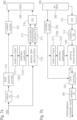
- the signal path of the resulting DirAC system is depicted in Fig. 7a /b.
- the main improvement as compared to the previously presented system in Figs. 2 and 3 is the adaptive compression of the transport channels using the acoustic model parameters.
- the model covariance matrix and the prediction coefficients are calculated according to Eqs. 12 to 14.
- the input channels are mixed down and coded using EVS.
- the prediction coefficients are calculated from the transmitted model parameters again and the transform is inverted. Then the non-transport channels are reconstructed by the DirAC decoder as discussed above.
- S HOA-L ( t ) be the vector of the output channel signals in HOA of order L.
- this signal would first be reconstructed in the DirAC or SPAR decoder and multiplied by a rotation matrix R HOA-L of the size N ⁇ N at each sample of the signal.
- S trans ( t ) be the signal vector of the transported channels after applying the inverse transform as shown in Fig. 7 , numeral 110d .
- the dimension of the vector S trans ( t ) is M ⁇ N since most of the channels of S HOA-N ( t ) are reconstructed parametrically.
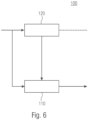
- the above discussed approach can be used by an apparatus as it is shown by Fig. 6 .
- the apparatus 100 may be part of an encoder or decoder and comprises at least means for transforming 110 and means for deriving 120. This apparatus 100 is applicable to the encoder and the decoder side. First the functionality of the apparatus at the encoder side will be discussed.
- the apparatus 100 being part of an encoder receives a HOA representation.
- This representation is provided to the entities 110 and 120.
- a preprocessing of the HOAs signal e.g. by an analysis filterbank or DirAC parameter estimator is performed (not shown).
- the one or more parameters describing an acoustic or psychoacoustic model of the input audio stream HOA may comprise at least an information on a direction of arrival (DOA) or optionally information on a diffuseness or an energy ratio end of insertion.
- DOA direction of arrival
- the entity 120 performs a deriving of one or more parameters, e.g. prediction parameters/prediction coefficients.
- the diffuseness and/or direction of arrival may be parameters of the mentioned acoustic model.
- the prediction coefficients may be calculated by the entity 120.
- an interim step may be used.
- the prediction coefficient according to further embodiments is calculated based on a covariance matrix which is also calculated by the means for deriving 120, e.g. from the acoustic model. Often such a covariance matrix is calculated based on information about the diffuseness, spherical harmonics and/or a time-dependent scalar-valued signal.
- the entity 120 performs the following calculation. Extracting acoustic or psychoacoustic model parameters like a DOA or diffuseness out of the audio stream HOA
- the entity 110 is configured to perform transformation, e.g. downmix generation.
- This downmix generation is based on the input signal, here the HOA signal.
- the transformation is applied in a signal adaptive way dependent on the one or more parameters as derived by the entity 120.
- inter-channel prediction coefficients are derived from the acoustic signal model or the parameters of the acoustic signal model it is possible to perform a transformation like a mixing/down mixing in a signal-adaptive way.
- this principle can be used to develop an extension to the DirAC system for spatial audio signals.
- This extension improves the quality as compared to static selection of a subset of the channel of the HOA input signal as transport channels.
- it reduces the metadata bit usage as compared to previous approaches to signal-adaptive transforms that reduce the inter-channel correlation.
- the savings on the metadata can in turn free more bits for the EVS bitstreams and further improve the perceptual quality of the system.
- the additional computational complexity is negligible.
- the apparatus also comprises transforming means and means for deriving one or more parameters (c.f. reference number 120) which are used at the transforming means 110.
- the decoder receives metadata comprising information on the acoustic/psychoacoustic model or parameters of the acoustic/psychoacoustic model (in general parameters enabling to determine the prediction coefficients) together with a coded signal, like an EVS bitstream.
- the EVS bitstream is provided to the transforming means 110, wherein the metadata are used by the means for deriving 120.
- the means for deriving 120 determine based on the metadata parameters, e.g.
- the parameters to be determined may be prediction parameters.
- metadata are derived from the audio stream e.g. at the encoder side.
- These parameters/prediction parameters are then used by the transforming means 110 which may be configured to perform an inverse transforming like an upmixing so as to output a decoded signal like a FOA signal which can then be further processed so as to determine the HOA signal or directly a loudspeaker signal.
- the further processing may, for example comprise a DirAC synthesis including an analysis filterbank.
- the calculation of the prediction coefficients may be performed in the same way in the decoder as in the encoder.
- the parameters may be preprocessed by a metadata decoder.
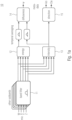
- Fig. 7a shows the encoder 200 having the central entities means for transforming 110e and means for deriving one or more parameters 120e according to embodiments the means for transforming 110e can be implemented as downmix generation processing HOA data received from the input of the encoder 200. These data are processed taking into consideration the parameters received from the entity 120e, e.g. prediction coefficients.
- the output of the downmix generation may be fit to a bit allocation entity 212 and/or to a synthesis filterbank 214. Both data streams processed by the entities 212 and 214 are forwarded to the EVS coder 216.
- the EVS coder 216 performs the coding and outputs the coded stream to the multiplexer 230.
- the entity 120e comprises in this embodiment two entities, namely an entity for determining a model and/or model covariance matrix which is marked by the reference numeral 121 as well as an entity for determining prediction coefficients which is marked by the reference numeral 122.
- the entity 122 performs the determination of the covariance matrix, e.g. based on one or more model parameters, like the DOA .
- the entity 122 determines the prediction coefficients, e.g. based on the covariance matrix.
- the entity 120e may according to further embodiments receive a HOA signal or a derivative of the HOA signal e.g. preprocessed by a DirAC parameter estimator 232 and an analysis filterbank 231.
- the output of the DirAC parameter estimator 232 may give information on a direction of arrival (DOA as it was discussed above). This information is then used by the entity 120e and especially by the entity 121.
- the estimated parameters of the entity 232 may also be used by a metadata encoder 233, wherein the encoded metadata stream is multiplexed together with the EVS coded stream by the multiplexer 230 so as to output the encoded HOA signal/encoded audio stream.
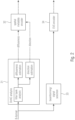
- Fig. 7b shows the decoder 300 which comprises according to embodiments at the input a demultiplexer 330.
- the decoder 300 comprises the central entities 120d and 110d.
- the entity 110d is configured to perform a transformation, e.g. an inverse transformation like an upmixing of a signal received from the demultiplexer 330.
- the received input signal may be a EVS coded signal which is decoded by the entity 316 and further processed by the analysis filterbank 314.
- the output of the transformer 110d is a FOA signal which can then be further processed by a DirAC synthesis taking into account metadata received via the demultiplexer 330.
- the metadata path may comprise a metadata decoder 333.
- the DirAC synthesis entity is marked by the reference numeral 335 the output of the DirAC synthesis entity 335 may be further processed by a synthesis filterbank 336 so as to output a HOA signal or headphone/loudspeaker signal.
- the metadata e.g. the metadata decoded by the metadata decoder 333 are used for determining the parameters obtained by the entity 120d.
- the entity 120d comprised the two entities for determining the model/the model covariance matrix as marked by reference numeral 121 and the entity for determining the prediction coefficients/general parameters (marked by the reference numeral 122).
- the output of the entity 120d is used for the transformation performed by the entity 110d.
- embodiments start from the assumption, that an audio stream with more than one channel should be transformed into another representation.
- the above discussed embodiments may also be applied for transforming audio streams in a directional audio coding system.
- embodiments provide an apparatus and method to transform audio streams in a directional audio coding system where
- the transform is computed such that correlations between the transport channels are reduced.
- an inter-channel covariance matrix may be used.
- the inter-channel covariance matrix of the input signal is estimated from a model of the signal.
- a transform matrix is derived from the covariance matrix of the model. According to embodiments such as for matrices calculated using different methods for different frequency bands.
- an apparatus 100 for transforming an audio stream with more than one channel into another representation comprises: means for deriving 120, 120e, 120d or means for receiving one or more parameters describing an acoustic or psychoacoustic model of the audio stream, wherein the means for deriving 120, 120e, 120d are configured to calculate prediction coefficients as the one or more parameters, means for transforming 110, 110e, 110d the audio stream in a signal-adaptive way dependent on the one or more parameters; and wherein the one or more parameters comprise at least an information on at least one DOA, wherein the means for transforming 110, 110e, 110d are configured to perform a downmixing of the audio stream on the encoder 200 side; and/or wherein the means for transforming 110, 110e, 110d are configured to perform upmix generation of the audio stream on the decoder 300 side.
- the one or more parameters further comprise at least an information on a diffuseness factor or on one or more DOAs or on energy ratios, and/or wherein the one or more parameters are derived from the audio stream.
- the means for deriving 120, 120e, 120d are configured to calculate a covariance matrix or a covariance matrix from the acoustic or psychoacoustic model.
- the means for transforming 110, 110e, 110d are configured to perform a mixing of the audio stream on the encoder 200 side.
- a twelfth aspect relates to an apparatus 100 for transforming an audio stream in a directional audio coding system comprising: means for deriving 120, 120e, 120d or receiving one or more acoustic model parameters of a model of the audio stream, wherein the one or more parameters are transmitted to restore all channels of the audio stream and comprise at least an information on DoA, means for transforming 110, 110e, 110d the audio stream in a signal-adaptive way dependent on the one or more acoustic model parameters; and where the audio stream is derived by transforming all or a subset of the channels of the audio stream; wherein the means for transforming 110, 110e, 110d are configured to perform a downmixing of the audio stream on the encoder 200 side; and/or wherein the means for transforming 110, 110e, 110d are configured to perform upmix generation of the audio stream on the decoder 300 side.
- the parameters are smoothed over time.
- At least one of transform methods used by the means for transforming uses prediction based on the inter-channel covariance matrix based on the DOA and an additional diffuseness factor or an energy ratio.
- the means for deriving 120, 120e, 120d the one or more parameters are configured to process all or a subset of the channels of a first-order or higher-order Ambisonics input signal of the audio stream.
- a sound scene of the audio stream is rotatable in such a way that: a vector of audio transport channel signals is pre-multiplied by a rotation matrix; model parameters and/or prediction coefficients are transformed in accordance with the transform of a transport channel signal; and non-transport channels of an output signal are reconstructed using the transformed model and/or prediction coefficients parameters.
- a twenty-fifth aspect relates to an encoder 200 comprising an apparatus 100 according to one of the first to twenty-fourth aspects.
- a twenty-sixth aspect relates to a decoder 300 comprising an apparatus 100 according to one of the first to twenty-fourth aspects.
- a twenty-seventh aspect relates to a system comprising an encoder 200 according to aspect 25 and a decoder 300 according to aspect 26, wherein the encoder 200 is configured to calculate a prediction matrix and/or a downmix and wherein decoder 300 is configured to calculate an upmix matrix from estimated parameters or the one or more parameters of the acoustic model independently of each other.
- a twenty-eighth aspect relates to a method for transforming an audio stream with more than one channel into another representation, comprising the following steps: deriving or receiving the one or more parameters describing an acoustic or psychoacoustic model of an audio stream from the audio stream, wherein deriving comprises calculating prediction coefficients as the one or more parameters and wherein the one or more parameters comprise at least an information on DOA; and transforming the audio stream in a signal-adaptive way dependent the on one or more parameters; wherein transforming comprises a downmixing of the audio stream on the encoder 200 side; and/or wherein transforming comprises upmixing of the audio stream on the decoder 300 side.
- a twenty-ninth aspect relates to a method for transforming an audio stream in a directional audio coding system, comprising the steps of: deriving or receiving one or more acoustic model parameters of a model of the audio stream parametrized by DOA and diffuseness or energy-ratio parameters, said acoustic model parameters are transmitted to restore all channels of an input of audio stream and comprise at least an information on DOA, wherein the transmitted audio stream is derived by transforming all or a subset of the channels of the audio stream; and transforming the audio stream in a signal-adaptive way dependent on one or more acoustic model parameters, wherein transforming comprises a downmixing of the audio stream on the encoder 200 side; and/or wherein transforming comprises upmixing of the audio stream on the decoder 300 side.
- a thirtieth aspect relates to a computer program for performing, when running on a computer, the method according to the twenty-eight or twenty-ninth aspect.
- aspects have been described in the context of an apparatus, it is clear that these aspects also represent a description of the corresponding method, where a block or device corresponds to a method step or a feature of a method step. Analogously, aspects described in the context of a method step also represent a description of a corresponding block or item or feature of a corresponding apparatus.
- Some or all of the method steps may be executed by (or using) a hardware apparatus, like for example, a microprocessor, a programmable computer or an electronic circuit. In some embodiments, some one or more of the most important method steps may be executed by such an apparatus.
- the inventive encoded audio signal can be stored on a digital storage medium or can be transmitted on a transmission medium such as a wireless transmission medium or a wired transmission medium such as the Internet.
- embodiments of the invention can be implemented in hardware or in software.
- the implementation can be performed using a digital storage medium, for example a floppy disk, a DVD, a Blu-Ray, a CD, a ROM, a PROM, an EPROM, an EEPROM or a FLASH memory, having electronically readable control signals stored thereon, which cooperate (or are capable of cooperating) with a programmable computer system such that the respective method is performed. Therefore, the digital storage medium may be computer readable.
- Some embodiments according to the invention comprise a data carrier having electronically readable control signals, which are capable of cooperating with a programmable computer system, such that one of the methods described herein is performed.
- embodiments of the present invention can be implemented as a computer program product with a program code, the program code being operative for performing one of the methods when the computer program product runs on a computer.
- the program code may for example be stored on a machine readable carrier.
- inventions comprise the computer program for performing one of the methods described herein, stored on a machine readable carrier.
- an embodiment of the inventive method is, therefore, a computer program having a program code for performing one of the methods described herein, when the computer program runs on a computer.
- a further embodiment of the inventive methods is, therefore, a data carrier (or a digital storage medium, or a computer-readable medium) comprising, recorded thereon, the computer program for performing one of the methods described herein.
- the data carrier, the digital storage medium or the recorded medium are typically tangible and/or non-transitionary.
- a further embodiment of the inventive method is, therefore, a data stream or a sequence of signals representing the computer program for performing one of the methods described herein.
- the data stream or the sequence of signals may for example be configured to be transferred via a data communication connection, for example via the Internet.
- a further embodiment comprises a processing means, for example a computer, or a programmable logic device, configured to or adapted to perform one of the methods described herein.
- a processing means for example a computer, or a programmable logic device, configured to or adapted to perform one of the methods described herein.
- a further embodiment comprises a computer having installed thereon the computer program for performing one of the methods described herein.
- a further embodiment according to the invention comprises an apparatus or a system configured to transfer (for example, electronically or optically) a computer program for performing one of the methods described herein to a receiver.
- the receiver may, for example, be a computer, a mobile device, a memory device or the like.
- the apparatus or system may, for example, comprise a file server for transferring the computer program to the receiver .
- a programmable logic device for example a field programmable gate array
- a field programmable gate array may cooperate with a microprocessor in order to perform one of the methods described herein.
- the methods are preferably performed by any hardware apparatus.
Landscapes
- Engineering & Computer Science (AREA)
- Physics & Mathematics (AREA)
- Health & Medical Sciences (AREA)
- Signal Processing (AREA)
- Audiology, Speech & Language Pathology (AREA)
- Human Computer Interaction (AREA)
- Computational Linguistics (AREA)
- Acoustics & Sound (AREA)
- Multimedia (AREA)
- Mathematical Physics (AREA)
- Spectroscopy & Molecular Physics (AREA)
- Compression, Expansion, Code Conversion, And Decoders (AREA)
- Stereophonic System (AREA)
Applications Claiming Priority (3)
| Application Number | Priority Date | Filing Date | Title |
|---|---|---|---|
| PCT/EP2022/052642 WO2023147864A1 (en) | 2022-02-03 | 2022-02-03 | Apparatus and method to transform an audio stream |
| EP23702158.9A EP4473532A1 (de) | 2022-02-03 | 2023-01-31 | Vorrichtung und verfahren zur umwandlung eines audiostroms |
| PCT/EP2023/052331 WO2023148168A1 (en) | 2022-02-03 | 2023-01-31 | Apparatus and method to transform an audio stream |
Related Parent Applications (1)
| Application Number | Title | Priority Date | Filing Date |
|---|---|---|---|
| EP23702158.9A Division EP4473532A1 (de) | 2022-02-03 | 2023-01-31 | Vorrichtung und verfahren zur umwandlung eines audiostroms |
Publications (2)
| Publication Number | Publication Date |
|---|---|
| EP4557280A2 true EP4557280A2 (de) | 2025-05-21 |
| EP4557280A3 EP4557280A3 (de) | 2025-06-11 |
Family
ID=80623856
Family Applications (2)
| Application Number | Title | Priority Date | Filing Date |
|---|---|---|---|
| EP25168354.6A Pending EP4557280A3 (de) | 2022-02-03 | 2023-01-31 | Vorrichtung und verfahren zur umwandlung eines audiostroms |
| EP23702158.9A Pending EP4473532A1 (de) | 2022-02-03 | 2023-01-31 | Vorrichtung und verfahren zur umwandlung eines audiostroms |
Family Applications After (1)
| Application Number | Title | Priority Date | Filing Date |
|---|---|---|---|
| EP23702158.9A Pending EP4473532A1 (de) | 2022-02-03 | 2023-01-31 | Vorrichtung und verfahren zur umwandlung eines audiostroms |
Country Status (11)
| Country | Link |
|---|---|
| US (1) | US20240395263A1 (de) |
| EP (2) | EP4557280A3 (de) |
| JP (1) | JP2025505460A (de) |
| KR (1) | KR20240144993A (de) |
| CN (1) | CN119054018A (de) |
| AU (1) | AU2023214718A1 (de) |
| CA (1) | CA3243653A1 (de) |
| MX (1) | MX2024009592A (de) |
| TW (1) | TWI858529B (de) |
| WO (2) | WO2023147864A1 (de) |
| ZA (1) | ZA202405952B (de) |
Families Citing this family (1)
| Publication number | Priority date | Publication date | Assignee | Title |
|---|---|---|---|---|
| US20250078845A1 (en) * | 2023-08-29 | 2025-03-06 | Samsung Electronics Co., Ltd. | Lossless audio coding for multichannel hierarchical reconstruction |
Citations (1)
| Publication number | Priority date | Publication date | Assignee | Title |
|---|---|---|---|---|
| US20200265851A1 (en) | 2017-11-17 | 2020-08-20 | Fraunhofer-Gesellschaft zur Förderung der angewandten Forschung e.V. | Apparatus and Method for encoding or Decoding Directional Audio Coding Parameters Using Quantization and Entropy Coding |
Family Cites Families (10)
| Publication number | Priority date | Publication date | Assignee | Title |
|---|---|---|---|---|
| MX2011013829A (es) * | 2009-06-24 | 2012-03-07 | Fraunhofer Ges Forschung | Decodificador de señales de audio, metodo para decodificar una señal de audio y programa de computacion que utiliza etapas en cascada de procesamiento de objetos de audio. |
| WO2011072729A1 (en) * | 2009-12-16 | 2011-06-23 | Nokia Corporation | Multi-channel audio processing |
| EP2560161A1 (de) * | 2011-08-17 | 2013-02-20 | Fraunhofer-Gesellschaft zur Förderung der angewandten Forschung e.V. | Optimale Mischmatrizen und Verwendung von Dekorrelatoren in räumlicher Audioverarbeitung |
| EP2743922A1 (de) * | 2012-12-12 | 2014-06-18 | Thomson Licensing | Verfahren und Vorrichtung zur Komprimierung und Dekomprimierung einer High Order Ambisonics-Signaldarstellung für ein Schallfeld |
| CN105612766B (zh) * | 2013-07-22 | 2018-07-27 | 弗劳恩霍夫应用研究促进协会 | 使用渲染音频信号的解相关的多声道音频解码器、多声道音频编码器、方法、以及计算机可读介质 |
| US9794714B2 (en) * | 2014-07-02 | 2017-10-17 | Dolby Laboratories Licensing Corporation | Method and apparatus for decoding a compressed HOA representation, and method and apparatus for encoding a compressed HOA representation |
| RU2736274C1 (ru) * | 2017-07-14 | 2020-11-13 | Фраунхофер-Гезелльшафт Цур Фердерунг Дер Ангевандтен Форшунг Е.Ф. | Принцип формирования улучшенного описания звукового поля или модифицированного описания звукового поля с использованием dirac-технологии с расширением глубины или других технологий |
| EP3915106A1 (de) * | 2019-01-21 | 2021-12-01 | FRAUNHOFER-GESELLSCHAFT zur Förderung der angewandten Forschung e.V. | Vorrichtung und verfahren zur codierung einer räumlichen audiodarstellung oder vorrichtung und verfahren zur decodierung eines codierten audiosignals unter verwendung von transportmetadaten sowie zugehörige computerprogramme |
| AU2020320270B2 (en) * | 2019-08-01 | 2025-10-23 | Dolby Laboratories Licensing Corporation | Encoding and decoding IVAS bitstreams |
| BR112022025161A2 (pt) * | 2020-06-11 | 2022-12-27 | Dolby Laboratories Licensing Corp | Codificação de sinais de áudio de multicanal compreendendo a mixagem de rebaixamento de um canal de entrada primário e de dois ou mais canais de entrada não primária |
-
2022
- 2022-02-03 WO PCT/EP2022/052642 patent/WO2023147864A1/en not_active Ceased
-
2023
- 2023-01-31 KR KR1020247029622A patent/KR20240144993A/ko active Pending
- 2023-01-31 EP EP25168354.6A patent/EP4557280A3/de active Pending
- 2023-01-31 CA CA3243653A patent/CA3243653A1/en active Pending
- 2023-01-31 WO PCT/EP2023/052331 patent/WO2023148168A1/en not_active Ceased
- 2023-01-31 CN CN202380032146.1A patent/CN119054018A/zh active Pending
- 2023-01-31 AU AU2023214718A patent/AU2023214718A1/en active Pending
- 2023-01-31 MX MX2024009592A patent/MX2024009592A/es unknown
- 2023-01-31 JP JP2024546139A patent/JP2025505460A/ja active Pending
- 2023-01-31 EP EP23702158.9A patent/EP4473532A1/de active Pending
- 2023-02-02 TW TW112103655A patent/TWI858529B/zh active
-
2024
- 2024-08-01 ZA ZA2024/05952A patent/ZA202405952B/en unknown
- 2024-08-02 US US18/793,735 patent/US20240395263A1/en active Pending
Patent Citations (1)
| Publication number | Priority date | Publication date | Assignee | Title |
|---|---|---|---|---|
| US20200265851A1 (en) | 2017-11-17 | 2020-08-20 | Fraunhofer-Gesellschaft zur Förderung der angewandten Forschung e.V. | Apparatus and Method for encoding or Decoding Directional Audio Coding Parameters Using Quantization and Entropy Coding |
Non-Patent Citations (16)
| Title |
|---|
| ADAM MCKEAGDAVID S. MCGRATH: "Sound Field Format to Binaural Decoder with Head Tracking.", AUDIO ENGINEERING SOCIETY, August 1996 (1996-08-01) |
| ANDREA EICHENSEERSRIKANTH KORSEOLIVER THIERGARTGUILLAUME FUCHSMARKUS MULTRUSSTEFAN BAYERDOMINIK WECKBECKERJÜRGEN HERREFABIAN KÜCH: "Parametric coding of object-based audio using directional audio coding.", INTERNAL DOCUMENT FRAUNHOFER IIS, 2020 |
| DAI YANGHONGMEI AIC. KYRIAKAKISC.-C.J. KUO: "High-fidelity multichannel audio coding with karhunen-loeve transform", IEEE TRANSACTIONS ON SPEECH AND AUDIO PROCESSING, vol. 11, no. 4, 2003, pages 365 - 380, XP011099062, DOI: 10.1109/TSA.2003.814375 |
| DOLBY LABORATORIES INC: "Technical report", 2018, DOLBY LABORATORIES INC., article "Dolby vrstream audio profile candidate - description of bitstream, decoder, and renderer plus informative encoder description" |
| GUILLAUME FUCHSJÜRGEN HERREFABIAN KÜCHSTEFAN DÖHLAMARKUS MULTRUSOLIVER THIERGARTOLIVER WIBBOLTFLORIN GHIDOSTEFAN BAYERWOLFGANG JAE, APPARATUS AND METHOD FOR ENCODING OR DECODING DIRECTIONALAUDIO CODING PARAMETERS USING QUANTIZATION AND ENTROPY CODING |
| JOSEPH IVANICKLAUS RUEDENBERG: "Rotation matrices for real spherical harmonics. direct determination by recursion.", THE JOURNAL OF PHYSICAL CHEMISTRY, vol. 100, no. 15, 1996, pages 6342 - 6347 |
| M. RISOUDJ.-N. HANSONF. GAUVRITC. RENARDP.-E. LEMESREN.-X. BONNEC. VINCENT.: "Sound source localization", EUROPEAN ANNALS OF OTORHINOLARYNGOLOGY, HEAD AND NECK DISEASES, vol. 135, no. 4, 2018, pages 259 - 264 |
| MARKUS NOISTERNIGALOIS SONTACCHITHOMAS MUSILROBERT HOLDRICH: "A 3d ambisonic based binaural sound reproduction system.", AUDIO ENGINEERING SOCIETY CONFERENCE: 24TH INTERNATIONAL CONFERENCE: MULTICHANNEL AUDIO, June 2003 (2003-06-01) |
| MAXIMILIAN NEUMAYER.: "Master's thesis", 2017, TECHNISCHE UNIVERSITÄT, article "Evaluation of soundfield rotation methods in the context of dynamic binaural rendering of higher order ambisonics." |
| SASCHA DISCHANDREAS NIEDERMEIERCHRISTIAN R. HELMRICHCHRISTIAN NEUKAMKONSTANTIN SCHMIDTRALF GEIGERJE'RE'MIE LECOMTEFLORIN GHIDOFRED: "Intelligent gap filling in perceptual transform coding of audio.", AUDIO ENGINEERING SOCIETY CONVENTION, vol. 141, September 2016 (2016-09-01) |
| SASCHA DISCHANDREAS NIEDERMEIERCHRISTIAN R. HELMRICHCHRISTIAN NEUKAMKONSTANTIN SCHMIDTRALF GEIGERJE'RE'MIE LECOMTEFLORIN GHIDOFRED: "Intelligent gap filling in perceptual transform coding of audio.", IN AUDIO ENGINEERING SOCIETY CONVENTION, vol. 141, September 2016 (2016-09-01) |
| TONI HIRVONENJUKKA AHONENVILLE PULKKI.: "Perceptual compression methods for metadata in directional audio coding applied to audiovisual teleconference.", AUDIO ENGINEERING SOCIETY CONVENTION, vol. 126, May 2009 (2009-05-01) |
| V. PULKKIM-V. LAITINENJ. VILKAMOJ. AHONENT. LOKKIT. PIHLAJAMÄKI, DIRECTIONAL AUDIO CODING - PERCEPTION-BASED REPRODUCTION OF SPATIAL SOUND, 2009 |
| VILLE PULKKI: "Directional audio coding in spatial sound reproduction and stereo upmixing.", AUDIO ENGINEERING SOCIETY CONFERENCE: 28TH INTERNATIONAL CONFERENCE: THE FUTURE OF AUDIO TECHNOLOGY-SURROUND AND BEYOND, June 2006 (2006-06-01) |
| VILLE PULKKI: "Spatial sound reproduction with directional audio coding", J. AUDIO ENG. SOC, vol. 55, no. 6, 2007, pages 503 - 516 |
| VILLE PULKKI: "Virtual sound source positioning using vector base amplitude panning", J. AUDIO ENG. SOC, vol. 45, no. 6, 1997, pages 456 - 466 |
Also Published As
| Publication number | Publication date |
|---|---|
| AU2023214718A1 (en) | 2024-08-15 |
| EP4473532A1 (de) | 2024-12-11 |
| CA3243653A1 (en) | 2023-08-10 |
| CN119054018A (zh) | 2024-11-29 |
| US20240395263A1 (en) | 2024-11-28 |
| EP4557280A3 (de) | 2025-06-11 |
| WO2023148168A1 (en) | 2023-08-10 |
| MX2024009592A (es) | 2024-09-23 |
| TWI858529B (zh) | 2024-10-11 |
| KR20240144993A (ko) | 2024-10-04 |
| JP2025505460A (ja) | 2025-02-26 |
| TW202341128A (zh) | 2023-10-16 |
| WO2023147864A1 (en) | 2023-08-10 |
| ZA202405952B (en) | 2025-07-30 |
Similar Documents
| Publication | Publication Date | Title |
|---|---|---|
| US12205600B2 (en) | Methods, apparatus and systems for encoding and decoding of multi-channel Ambisonics audio data | |
| EP3405948B1 (de) | Vorrichtung und verfahren zur kodierung oder dekodierung eines mehrkanalaudiosignals mit einem breitbandigen ausrichtungsparameter und mehreren schmalbandigen ausrichtungsparametern | |
| EP4550322A2 (de) | Vorrichtung, verfahren und computerprogramm zur codierung eines audiosignals oder zur decodierung einer codierten audioszene | |
| KR20210102300A (ko) | 낮은 차수, 중간 차수 및 높은 차수 컴포넌트 생성기를 사용하는 DirAC 기반 공간 오디오 코딩과 관련된 인코딩, 디코딩, 장면 처리 및 기타 절차를 위한 장치, 방법 및 컴퓨터 프로그램 | |
| US20240379114A1 (en) | Packet loss concealment for dirac based spatial audio coding | |
| US20240395263A1 (en) | Apparatus and method to transform an audio stream | |
| EP4621772A2 (de) | Verarbeitung von parametrisch codiertem audio | |
| RU2807473C2 (ru) | Маскировка потерь пакетов для пространственного кодирования аудиоданных на основе dirac | |
| HK40065485B (en) | Packet loss concealment for dirac based spatial audio coding | |
| HK40065485A (en) | Packet loss concealment for dirac based spatial audio coding | |
| HK1257577A1 (en) | Apparatus and method for encoding or decoding a multi-channel audio signal using a broadband alignment parameter and a plurality of narrowband alignment parameters | |
| HK1257577B (en) | Apparatus and method for encoding or decoding a multi-channel audio signal using a broadband alignment parameter and a plurality of narrowband alignment parameters |
Legal Events
| Date | Code | Title | Description |
|---|---|---|---|
| PUAI | Public reference made under article 153(3) epc to a published international application that has entered the european phase |
Free format text: ORIGINAL CODE: 0009012 |
|
| STAA | Information on the status of an ep patent application or granted ep patent |
Free format text: STATUS: THE APPLICATION HAS BEEN PUBLISHED |
|
| REG | Reference to a national code |
Ref country code: DE Ref legal event code: R079 Free format text: PREVIOUS MAIN CLASS: G10L0019160000 Ipc: G10L0019008000 |
|
| PUAL | Search report despatched |
Free format text: ORIGINAL CODE: 0009013 |
|
| AC | Divisional application: reference to earlier application |
Ref document number: 4473532 Country of ref document: EP Kind code of ref document: P |
|
| AK | Designated contracting states |
Kind code of ref document: A2 Designated state(s): AL AT BE BG CH CY CZ DE DK EE ES FI FR GB GR HR HU IE IS IT LI LT LU LV MC ME MK MT NL NO PL PT RO RS SE SI SK SM TR |
|
| AK | Designated contracting states |
Kind code of ref document: A3 Designated state(s): AL AT BE BG CH CY CZ DE DK EE ES FI FR GB GR HR HU IE IS IT LI LT LU LV MC ME MK MT NL NO PL PT RO RS SE SI SK SM TR |
|
| RIC1 | Information provided on ipc code assigned before grant |
Ipc: G10L 19/16 20130101ALI20250508BHEP Ipc: G10L 19/008 20130101AFI20250508BHEP |
|
| STAA | Information on the status of an ep patent application or granted ep patent |
Free format text: STATUS: REQUEST FOR EXAMINATION WAS MADE |
|
| 17P | Request for examination filed |
Effective date: 20251211 |
|
| GRAP | Despatch of communication of intention to grant a patent |
Free format text: ORIGINAL CODE: EPIDOSNIGR1 |
|
| STAA | Information on the status of an ep patent application or granted ep patent |
Free format text: STATUS: GRANT OF PATENT IS INTENDED |
|
| INTG | Intention to grant announced |
Effective date: 20260123 |