EP4556751A1 - Einheit - Google Patents
Einheit Download PDFInfo
- Publication number
- EP4556751A1 EP4556751A1 EP23839306.0A EP23839306A EP4556751A1 EP 4556751 A1 EP4556751 A1 EP 4556751A1 EP 23839306 A EP23839306 A EP 23839306A EP 4556751 A1 EP4556751 A1 EP 4556751A1
- Authority
- EP
- European Patent Office
- Prior art keywords
- engagement element
- engagement
- rotational
- planetary gear
- unit
- Prior art date
- Legal status (The legal status is an assumption and is not a legal conclusion. Google has not performed a legal analysis and makes no representation as to the accuracy of the status listed.)
- Pending
Links
Images


Classifications
-
- F—MECHANICAL ENGINEERING; LIGHTING; HEATING; WEAPONS; BLASTING
- F16—ENGINEERING ELEMENTS AND UNITS; GENERAL MEASURES FOR PRODUCING AND MAINTAINING EFFECTIVE FUNCTIONING OF MACHINES OR INSTALLATIONS; THERMAL INSULATION IN GENERAL
- F16H—GEARING
- F16H3/00—Toothed gearings for conveying rotary motion with variable gear ratio or for reversing rotary motion
- F16H3/44—Toothed gearings for conveying rotary motion with variable gear ratio or for reversing rotary motion using gears having orbital motion
- F16H3/62—Gearings having three or more central gears
- F16H3/66—Gearings having three or more central gears composed of a number of gear trains without drive passing from one train to another
-
- B—PERFORMING OPERATIONS; TRANSPORTING
- B60—VEHICLES IN GENERAL
- B60Y—INDEXING SCHEME RELATING TO ASPECTS CROSS-CUTTING VEHICLE TECHNOLOGY
- B60Y2200/00—Type of vehicle
- B60Y2200/90—Vehicles comprising electric prime movers
- B60Y2200/91—Electric vehicles
-
- F—MECHANICAL ENGINEERING; LIGHTING; HEATING; WEAPONS; BLASTING
- F16—ENGINEERING ELEMENTS AND UNITS; GENERAL MEASURES FOR PRODUCING AND MAINTAINING EFFECTIVE FUNCTIONING OF MACHINES OR INSTALLATIONS; THERMAL INSULATION IN GENERAL
- F16H—GEARING
- F16H57/00—General details of gearing
- F16H57/08—General details of gearing of gearings with members having orbital motion
- F16H2057/087—Arrangement and support of friction devices in planetary gearings, e.g. support of clutch drums, stacked arrangements of friction devices
-
- F—MECHANICAL ENGINEERING; LIGHTING; HEATING; WEAPONS; BLASTING
- F16—ENGINEERING ELEMENTS AND UNITS; GENERAL MEASURES FOR PRODUCING AND MAINTAINING EFFECTIVE FUNCTIONING OF MACHINES OR INSTALLATIONS; THERMAL INSULATION IN GENERAL
- F16H—GEARING
- F16H2200/00—Transmissions for multiple ratios
- F16H2200/0021—Transmissions for multiple ratios specially adapted for electric vehicles
-
- F—MECHANICAL ENGINEERING; LIGHTING; HEATING; WEAPONS; BLASTING
- F16—ENGINEERING ELEMENTS AND UNITS; GENERAL MEASURES FOR PRODUCING AND MAINTAINING EFFECTIVE FUNCTIONING OF MACHINES OR INSTALLATIONS; THERMAL INSULATION IN GENERAL
- F16H—GEARING
- F16H2200/00—Transmissions for multiple ratios
- F16H2200/003—Transmissions for multiple ratios characterised by the number of forward speeds
- F16H2200/0039—Transmissions for multiple ratios characterised by the number of forward speeds the gear ratios comprising three forward speeds
-
- F—MECHANICAL ENGINEERING; LIGHTING; HEATING; WEAPONS; BLASTING
- F16—ENGINEERING ELEMENTS AND UNITS; GENERAL MEASURES FOR PRODUCING AND MAINTAINING EFFECTIVE FUNCTIONING OF MACHINES OR INSTALLATIONS; THERMAL INSULATION IN GENERAL
- F16H—GEARING
- F16H2200/00—Transmissions for multiple ratios
- F16H2200/20—Transmissions using gears with orbital motion
- F16H2200/2002—Transmissions using gears with orbital motion characterised by the number of sets of orbital gears
- F16H2200/2007—Transmissions using gears with orbital motion characterised by the number of sets of orbital gears with two sets of orbital gears
-
- F—MECHANICAL ENGINEERING; LIGHTING; HEATING; WEAPONS; BLASTING
- F16—ENGINEERING ELEMENTS AND UNITS; GENERAL MEASURES FOR PRODUCING AND MAINTAINING EFFECTIVE FUNCTIONING OF MACHINES OR INSTALLATIONS; THERMAL INSULATION IN GENERAL
- F16H—GEARING
- F16H2200/00—Transmissions for multiple ratios
- F16H2200/20—Transmissions using gears with orbital motion
- F16H2200/203—Transmissions using gears with orbital motion characterised by the engaging friction means not of the freewheel type, e.g. friction clutches or brakes
- F16H2200/2038—Transmissions using gears with orbital motion characterised by the engaging friction means not of the freewheel type, e.g. friction clutches or brakes with three engaging means
Definitions
- the present invention relates to a unit having a power transmission mechanism therein.
- a torque amplification effect due to deceleration becomes higher as the transmission gear ratio at the first speed is increased, so that a maximum torque of a motor can be reduced as the transmission gear ratio at the first speed is increased, and a motor having a small size can be selected.
- the smaller the transmission gear ratio at the second speed the lower a rotation speed of the motor at the time of achieving a certain vehicle speed, which is advantageous during high-speed cruising.
- the present invention has been made in view of such technical problems, and an object of the present invention is to reduce a step ratio at the time of shifting in a unit having a power transmission mechanism therein.
- a unit includes:
- the input element is connected to the third rotational element.
- the output element is connected to the second rotational element and the sixth rotational element.
- One side of the first engagement element is connected to the fifth rotational element.
- the other side of the first engagement element is fixed.
- One side of the second engagement element is connected to the first rotational element and the fourth rotational element.
- the other side of the second engagement element is fixed.
- the third engagement element connects two rotational elements that are selected from the first to sixth rotational elements and are not connected to each other.
- three or more gear positions can be achieved by changing engaged states of the first to third engagement elements.
- the step ratio is reduced as compared to the unit with two forward speeds, and the acceleration and deceleration rates of the output rotation during shifting can be suppressed to be smaller than that of the unit with two forward speeds.
- a more appropriate transmission gear ratio can be set for each gear position.
- the transmission gear ratio becomes 1, and all the rotational elements constituting the first and second planetary gear mechanisms rotate at the same rotation speed, so that a power transmission loss caused by differential rotation between the rotational elements can be reduced.
- unit means a general device having a power transmission mechanism such as a gear mechanism and a differential gear mechanism therein, and includes a motor unit having a motor and a power transmission mechanism, an automatic transmission unit, a reducer unit, and the like.
- transmission gear ratio is a value obtained by dividing an input rotation speed of the unit by an output rotation speed thereof.
- input rotation includes not only rotation input to the unit from a power source outside the unit but also rotation input to the unit from a power source inside the unit.
- step ratio is a value obtained by dividing a larger transmission gear ratio (for low speed) by a smaller transmission gear ratio (for high speed) with respect to two transmission gear ratios achieved by the unit.
- axial direction means an axial direction of a rotating shaft of a component constituting the unit.
- the component includes a motor, a gear mechanism, a differential gear mechanism, or the like.
- radial direction means a radial direction from a central axis of the rotating shaft.
- housing means an accommodation body that accommodates a motor, an inverter, and a power transmission mechanism, and includes one or more cases.
- An aspect in which a case that accommodates the motor, a case that accommodates the inverter, and a case that accommodates the power transmission mechanism are integrally formed is called "3-in-1".
- motor means a rotating electrical machine having a motor function, and may have a generator function in addition to the motor function.
- an element A is connected to an element B
- the element A is connected to the element B on an upstream or downstream side in such a manner that power can be transmitted between the element A and the element B.
- An input side of the power is the upstream side
- an output side of the power is the downstream side.
- the element A is not limited to be connected to the element B directly or via another member, and may be connected to the element B via a clutch or the like.
- the expression of “the element A is fixed to the element B” includes both an aspect in which the element A is directly fixed to the element B and an aspect in which the element A is fixed to the element B via an element C other than the elements A and B.
- the expression of “the element A is fixed” means that the element A is fixed to another element and is in a non-rotatable state.
- the expression of "the element A and the element B overlap each other when viewed in a predetermined direction” refers to a state in which the element A and the element B are arranged in the predetermined direction (axial direction, radial direction, gravity direction, or the like), and the element A and the element B at least partially overlap each other when observed from the predetermined direction.
- This is synonymous with the expression of "the element A and the element B overlap in the predetermined direction".
- the element A and the element B overlap each other when viewed in the axial direction
- the element A and the element B are coaxial.
- the element A and the element B are drawn so as to be arranged in the predetermined direction in the drawings, it means that the element A and the element B overlap each other when viewed in the predetermined direction.
- the expression of "the element A is located between the element B and the element C when viewed in the predetermined direction” means that the element A is observed to be between the element B and the element C when observed from the predetermined direction (axial direction, radial direction, gravity direction, or the like).
- the element B, the element A, and the element C are arranged in this order along the axial direction, it is observed that the element A is located between the element B and the element C when viewed in the radial direction, so that it can be said that the element A is located between the element B and the element C.
- the element A does not need to overlap the elements B and C when viewed in the axial direction.
- the element A is drawn between the element B and the element C in the drawings, it means that the element A is located between the element B and the element C when viewed in the predetermined direction.
- disposed close to each other means a state in which there is a portion where two elements overlap each other when viewed in the axial direction or the radial direction, and no other element is sandwiched between the two elements.
- the expression of "two engagement elements are disposed close to each other” means that no planetary gear mechanism or the like is disposed between the two engagement elements. In a case where no other element is drawn between the element A and the element B in the drawings, it means that the element A and the element B are disposed close to each other.
- one side of the engagement element and “the other side of the engagement element” mean two elements included in the engagement element that become relatively non-rotatable when the engagement element is in an engaged state and become relatively rotatable when the engagement element is in a released state.
- the terms of “one side of the engagement element” and “the other side of the engagement element” may be a combination of rotational elements or a combination of a rotational element and a non-rotational element, and are generally referred to as a clutch for the former and a brake for the latter.
- a single side of the engagement element means either of “one side of the engagement element” and “the other side of the engagement element”.
- FIG. 1 is a skeleton diagram illustrating a basic structure of a unit 100 according to an embodiment of the present invention.
- the unit 100 is an automatic transmission unit with three forward speeds for an electric vehicle that shifts rotation input to an input element IN from a motor (not illustrated), which serves as a power source, at a transmission gear ratio corresponding to a gear position and transmits the shifted rotation from an output element OUT to a drive wheel (not illustrated).
- both the input element IN and the output element OUT are rotating shafts.
- the unit 100 is a so-called 3-in-1 unit in which the input element IN, first and second planetary gear mechanisms PG1 and PG2, first to third engagement elements B1, B2, and CL, the output element OUT, the motor (not illustrated), and an inverter (not illustrated) are accommodated in a housing 1.
- the housing 1 is non-rotatably fixed to the vehicle.
- One end of the input element IN is connected to an output shaft of the motor, and the input element IN rotates by power input from the motor.
- a rotation speed of the input element IN is an input rotation speed of the unit 100.
- the motor is electrically connected to a battery (not illustrated) outside the unit 100 via the inverter, and functions as a motor by receiving power supply from the battery.
- the motor can also function as a generator.
- the first planetary gear mechanism PG1 is a single pinion planetary gear mechanism including a first sun gear S1 serving as a first rotational element, a plurality of first pinion gears (not illustrated), a first carrier C1 serving as a second rotational element that rotatably supports the plurality of first pinion gears, and a first ring gear R1 serving as a third rotational element.
- the first sun gear S1 meshes with the plurality of first pinion gears, and the plurality of first pinion gears mesh with the first ring gear R1.
- the second planetary gear mechanism PG2 is a single pinion planetary gear mechanism including a second sun gear S2 serving as a fourth rotational element, a plurality of second pinion gears (not illustrated), a second carrier C2 serving as a fifth rotational element that rotatably supports the plurality of second pinion gears, and a second ring gear R2 serving as a sixth rotational element.
- the second sun gear S2 meshes with the plurality of second pinion gears, and the plurality of second pinion gears mesh with the second ring gear R2.
- the first sun gear S1 is connected to the second sun gear S2.
- the first carrier C1 is connected to the output element OUT and the second ring gear R2 via inner peripheral sides of the first sun gear S1 and the second sun gear S2 by a member M disposed on the inner peripheral sides of the first sun gear S1 and the second sun gear S2.
- the first ring gear R1 is connected to the input element IN.
- a rotation speed of the output element OUT is an output rotation speed of the unit 100.
- the first engagement element B1 is a brake.
- the first engagement element B1 is implemented by a hydraulic clutch or an electric clutch.
- two portions of the first engagement element B1 to be engaged when the first engagement element B1 is in the engaged state are defined as one side and the other side, the one side is connected to the second carrier C2, and the other side is fixed to the housing 1.
- the second carrier C2 can be fixed to the housing 1.
- the second engagement element B2 is a brake.
- the second engagement element B2 is implemented by a hydraulic clutch or an electric clutch.
- two portions of the second engagement element B2 to be engaged when the second engagement element B2 is in the engaged state are defined as one side and the other side, the one side is connected to the first sun gear S1 and the second sun gear S2, and the other side is fixed to the housing 1.
- the first sun gear S1 and the second sun gear S2 can be fixed to the housing 1.
- the third engagement element CL is a clutch.
- the third engagement element CL is implemented by an electric multi-plate clutch.
- the third engagement element CL includes a hub 11, inner friction plates 12 and outer friction plates 13 disposed in a staggered manner, a drum 14, and an electric actuator 15.
- the inner friction plates 12 are spline-fitted to an outer periphery of the hub 11, and the inner friction plates 12 are relatively displaceable and relatively non-rotatable in the axial direction with respect to the hub 11.
- the hub 11 is spline-fitted to an outer periphery of the first ring gear R1, and is thereby connected to the first ring gear R1 and the input element IN in a relatively non-rotatable manner.
- the outer friction plates 13 are spline-fitted to an inner periphery of the drum 14, and the outer friction plates 13 are relatively displaceable and relatively non-rotatable with respect to the drum 14.
- the drum 14 is connected to the first sun gear S1, the second sun gear S2, and the one side of the second engagement element B2.
- the electric actuator 15 is an actuator that drives the third engagement element CL.
- a motor incorporated in the electric actuator 15 When a motor incorporated in the electric actuator 15 is driven, a piston 15p is drawn out in the axial direction, the inner friction plates 12 and the outer friction plates 13 are pressed against each other and are relatively non-rotatable, and the third engagement element CL enters the engaged state.
- the electric actuator 15 mechanically applies a force to the piston 15p and receives a reaction force thereof from the piston 15p, so that the electric actuator 15 is fixed to the housing 1.
- Oil may be supplied to the hydraulic actuator by a hydraulic supply unit attached to the housing 1 and the like, or may be supplied by a control valve unit including a spool, a solenoid valve, and the like.
- the other side of the third engagement element CL is connected to the one side of the second engagement element B2, and thus these can be used as a common component (integrated component). Accordingly, the number of components of the unit 100 can be reduced.
- the third engagement element CL does not need to be disposed between the first planetary gear mechanism PG1 and the second planetary gear mechanism PG2, and the first engagement element B1, the second engagement element B2, and the third engagement element CL can be integrated into one place. Accordingly, the first engagement element B1, the second engagement element B2, and the third engagement element CL can be disposed close to each other by effectively utilizing a space on an outer side of the first planetary gear mechanism PG1 and the second planetary gear mechanism PG2 in the radial direction. Further, in the disposition illustrated in FIG. 1 , the third engagement element CL overlaps the first planetary gear mechanism PG1 when viewed in the radial direction, whereby the dimension of the unit 100 in the axial direction can be reduced.
- Examples of an actuator that can be used as the third engagement element CL include an actuator that is susceptible to a layout restriction (an electric actuator that needs to be fixed to the housing 1 or the like due to a reaction force, a hydraulic actuator that needs to attach a hydraulic supply unit to the housing 1 or the like, and the like) and an actuator that is less susceptible to the layout restriction (a hydraulic actuator that supplies a hydraulic pressure from a control valve unit and the like).
- a layout restriction an electric actuator that needs to be fixed to the housing 1 or the like due to a reaction force
- an actuator that is less susceptible to the layout restriction a hydraulic actuator that supplies a hydraulic pressure from a control valve unit and the like.
- the third engagement element CL can be disposed radially outward of the first planetary gear mechanism PG1 and the second planetary gear mechanism PG2, and the third engagement element CL can also be easily fixed to the housing 1, so that the layout design is easily performed regardless of a type of the actuator. Therefore, according to the disposition illustrated in FIG. 1 , the degree of freedom in selecting the actuator that drives the third engagement element CL can be increased.
- the first carrier C1 is connected to the second ring gear R2 via the inner peripheral sides of the first sun gear S1 and the second sun gear S2, the first carrier C1 and the second ring gear R2 can be easily connected to each other and the design layout can be easily performed as compared with a case where the first carrier C1 and the second ring gear R2 are connected via the radially outer sides of the first planetary gear mechanism PG1 and the second planetary gear mechanism PG2.
- FIG. 2 is an engagement table showing relations between the engaged states of the first to third engagement elements B1, B2, and CL and gear positions achieved in the unit 100.
- a filled circle indicates an engaged state
- no mark indicates a released state.
- a first speed is achieved by engaging the first engagement element B1 and releasing the second and third engagement elements B2 and CL.
- a second speed is achieved by engaging the second engagement element B2 and releasing the first and third engagement elements B1 and CL.
- a third speed is achieved by engaging the third engagement element CL and releasing the first and second engagement elements B1 and B2.
- FIG. 3 is an alignment chart of the unit 100.
- vertical lines 11 to 14 correspond to respective rotational elements of the first and second planetary gear mechanisms PG1 and PG2, the first sun gear S1, the first carrier C1, and the first ring gear R1 are arranged in this order from a left side in the drawing for the first planetary gear mechanism PG1, and the second sun gear S2, the second carrier C2, and the second ring gear R2 are arranged in this order from the left side in the drawing for the second planetary gear mechanism PG2.
- the first sun gear S1 and the second sun gear S2 are connected to each other, so that the same vertical line 11 corresponds thereto.
- the first carrier C1 and the second ring gear R2 are connected to each other, so that the same vertical line 13 corresponds thereto.
- An interval ⁇ 1 between the vertical line 13 and the vertical line l4, when an interval between the vertical line 11 and the vertical line 13 is defined as 1, is a value obtained by dividing the number of teeth of the first sun gear S1 by the number of teeth of the first ring gear R1.
- an interval ⁇ 2 between the vertical line l2 and the vertical line l3, when an interval between the vertical line 11 and the vertical line l2 is defined as 1, is a value obtained by dividing the number of teeth of the second sun gear S2 by the number of teeth of the second ring gear R2.
- the second carrier C2 is fixed to the housing 1 by engaging the first engagement element B1, and the rotation speed of the second carrier C2 becomes zero, so that the straight line L1 corresponding to the first speed is a straight line passing through a point X1.
- the first sun gear S1 and the second sun gear S2 are fixed to the housing 1 by engaging the second engagement element B2, and the rotation speeds of the first sun gear S1 and the second sun gear S2 become zero, so that the straight line L2 corresponding to the second speed is a straight line passing through a point X2.
- the input rotation speed rin of the unit 100 is equal to the rotation speed r4 of the first ring gear R1
- the first ring gear R1 is connected to the first sun gear S1 and the second sun gear S2 by engaging the third engagement element CL, so that the rotation speeds of the respective rotational elements are all equal to r3.
- the input rotation speed rin and the output rotation speed rout also become equal to each other, and a transmission gear ratio at the third speed is 1, which is smaller than that at the second speed.
- the unit 100 three gear positions including the third speed at which the transmission gear ratio is 1 can be achieved, so that the step ratio is reduced as compared to the unit with two forward speeds, and the acceleration and deceleration rates of the output rotation at the time of shifting can be suppressed to be smaller than that of the unit with two forward speeds.
- the first to third speeds can be used for low speed, medium speed, and high speed, respectively, an appropriate transmission gear ratio can be set according to a speed range.
- the transmission gear ratio is 1. That is, all the rotational elements constituting the first and second planetary gear mechanisms PG1 and PG2 rotate at the same rotation speed, so that a power transmission loss caused by differential rotation between the rotational elements can be reduced.
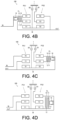
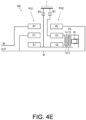
- FIGS. 4A to 4E are skeleton diagrams of the modifications of the unit 100.
- a position of the third engagement element CL is different from that in the skeleton diagram illustrated in FIG. 1 .
- the same elements as those in the skeleton diagram illustrated in FIG. 1 are denoted by the same reference numerals.
- the third engagement element CL is engaged to achieve a transmission gear ratio 1, and thus the position of the third engagement element CL may be a position other than that illustrated in FIG. 1 .
- the straight line L3 corresponding to the third speed is horizontal to achieve the transmission gear ratio 1 on the alignment chart illustrated in FIG. 3 , so that any two of the four vertical lines may be selected and rotational elements corresponding to the selected two vertical lines may be connected to each other.
- a combination of two rotational elements that are not connected to each other may be selected from all combinations in a case of selecting two rotational elements from the six rotational elements S1, C1, R1, S2, C2, and R2 of the first and second planetary gear mechanisms PG1 and PG2, except for the combinations already connected (first sun gear S1 and second sun gear S2, and first carrier C1 and second ring gear R2), and the two rotational elements may be connected to each other.
- the third engagement element CL is disposed at a position where the output element OUT, the first carrier C1, and the second ring gear R2 can be connected to the first sun gear S1 and the second sun gear S2.
- the one side (hub 11) of the third engagement element CL is connected to the first sun gear S1, the second sun gear S2, and the one side of the second engagement element B2, and the other side (drum 14) thereof is connected to the output element OUT, the first carrier C1, and the second ring gear R2.
- the third engagement element CL is disposed radially inward of a member connecting the first carrier C1 and the output element OUT, so that a hydraulic actuator 16 that supplies a hydraulic pressure from the control valve unit with less layout restriction is preferably used as the actuator that drives the third engagement element CL.
- the first carrier C1 is connected to the second ring gear R2 via the inner peripheral sides of the first sun gear S1 and the second sun gear S2, the first carrier C1 and the second ring gear R2 can be easily connected to each other and the layout can be easily designed as compared with a case where the first carrier C1 and the second ring gear R2 are connected via the radially outer sides of the first planetary gear mechanism PG1 and the second planetary gear mechanism PG2.
- the third engagement element CL is disposed coaxially with the first and second planetary gear mechanisms PG1 and PG2, and has a portion overlapping the first planetary gear mechanism PG1 and a portion overlapping the second planetary gear mechanism PG2 when viewed in the axial direction. As a result, the dimension of the unit 100 in the radial direction can be reduced.
- a single side (hub 11) of the third engagement element CL and the one side of the second engagement element B2 are connected to each other, and thus these can be used as a common component (integrated component). Accordingly, the number of components of the unit 100 can be reduced.
- the third engagement element CL is disposed at a position where the input element IN and the first ring gear R1 can be connected to the first carrier C1, the second ring gear R2, and the output element OUT.
- the one side (hub 11) of the third engagement element CL is connected to the first carrier C1, the second ring gear R2, and the output element OUT, and the other side (drum 14) thereof is connected to the input element IN and the first ring gear R1.
- the third engagement element CL is disposed between a member connecting the input element IN and the first ring gear R1 and a member connecting the first carrier C1 and the output element OUT, so that the hydraulic actuator 16 that supplies a hydraulic pressure from the control valve unit with less layout restriction is preferably used as the actuator that drives the third engagement element CL.
- the first carrier C1 is connected to the second ring gear R2 via the inner peripheral sides of the first sun gear S1 and the second sun gear S2, the first carrier C1 and the second ring gear R2 can be easily connected to each other and the layout can be easily designed as compared with a case where the first carrier C1 and the second ring gear R2 are connected via the radially outer sides of the first planetary gear mechanism PG1 and the second planetary gear mechanism PG2.
- the third engagement element CL is disposed coaxially with the first and second planetary gear mechanisms PG1 and PG2, and has a portion overlapping the first planetary gear mechanism PG1 and a portion overlapping the second planetary gear mechanism PG2 when viewed in the axial direction. As a result, the dimension of the unit 100 in the radial direction can be reduced.
- the input element IN and the output element OUT are connected in addition to that the transmission gear ratio 1 can be achieved, so that the power transmission path from the input element IN to the output element OUT becomes the shortest, and the power transmission loss can be further reduced.
- the third engagement element CL is disposed at a position where the second carrier C2 can be connected to the second ring gear R2, the first carrier C1, and the output element OUT.
- the one side (hub 11) of the third engagement element CL is connected to the second carrier C2 and the one side of the first engagement element B1, and the other side (drum 14) thereof is connected to the second ring gear R2, the first carrier C1, and the output element OUT.
- the third engagement element CL is disposed radially inward of the member connecting the second ring gear R2 and the output element OUT, so that the hydraulic actuator 16 that supplies a hydraulic pressure from the control valve unit with less layout restriction is preferably used as the actuator that drives the third engagement element CL.
- the first carrier C1 is connected to the second ring gear R2 via the inner peripheral sides of the first sun gear S1 and the second sun gear S2, the first carrier C1 and the second ring gear R2 can be easily connected to each other and the layout can be easily designed as compared with a case where the first carrier C1 and the second ring gear R2 are connected via the radially outer sides of the first planetary gear mechanism PG1 and the second planetary gear mechanism PG2.
- the third engagement element CL is disposed coaxially with the first and second planetary gear mechanisms PG1 and PG2, and has a portion overlapping the first planetary gear mechanism PG1 and a portion overlapping the second planetary gear mechanism PG2 when viewed in the axial direction. As a result, the dimension of the unit 100 in the radial direction can be reduced.
- the single side (hub 11) of the third engagement element CL and the one side of the first engagement element B1 are connected to each other, and thus these can be used as a common component (integrated component). Accordingly, the number of components of the unit 100 can be reduced.
- the third engagement element CL is disposed at a position where the first sun gear S1 and the second sun gear S2 can be connected to the second ring gear R2, the first carrier C1, and the output element OUT.
- the one side (hub 11) of the third engagement element CL is connected to the first sun gear S1, the second sun gear S2, and the one side of the second engagement element B2, and the other side (drum 14) thereof is connected to the second ring gear R2, the first carrier C1, and the output element OUT.
- the third engagement element CL is disposed radially inward of a member connecting the second ring gear R2 and the output element OUT, so that the hydraulic actuator 16 that supplies a hydraulic pressure from the control valve unit with less layout restriction is preferably used as the actuator that drives the third engagement element CL.
- the first carrier C1 is connected to the second ring gear R2 via the inner peripheral sides of the first sun gear S1 and the second sun gear S2, the first carrier C1 and the second ring gear R2 can be easily connected to each other and the layout can be easily designed as compared with a case where the first carrier C1 and the second ring gear R2 are connected via the radially outer sides of the first planetary gear mechanism PG1 and the second planetary gear mechanism PG2.
- the third engagement element CL is disposed coaxially with the first and second planetary gear mechanisms PG1 and PG2, and has a portion overlapping the first planetary gear mechanism PG1 and a portion overlapping the second planetary gear mechanism PG2 when viewed in the axial direction. As a result, the dimension of the unit 100 in the radial direction can be reduced.
- the single side (hub 11) of the third engagement element CL and the one side of the second engagement element B2 are connected to each other, and thus these can be used as a common component (integrated component). Accordingly, the number of components of the unit 100 can be reduced.
- the third engagement element CL is disposed at a position where the first sun gear S1 and the second sun gear S2 can be connected to the second carrier C2.
- the one side (hub 11) of the third engagement element CL is connected to the first sun gear S1, the second sun gear S2, and the one side of the second engagement element B2, and the other side (drum 14) thereof is connected to the second carrier C2 and the one side of the first engagement element B1.
- the third engagement element CL is disposed radially inward of a member connecting the second ring gear R2 and the output element OUT, so that the hydraulic actuator 16 that supplies a hydraulic pressure from the control valve unit with less layout restriction is preferably used as the actuator that drives the third engagement element CL.
- the first carrier C1 is connected to the second ring gear R2 via the inner peripheral sides of the first sun gear S1 and the second sun gear S2, the first carrier C1 and the second ring gear R2 can be easily connected to each other and the layout can be easily designed as compared with a case where the first carrier C1 and the second ring gear R2 are connected via the radially outer sides of the first planetary gear mechanism PG1 and the second planetary gear mechanism PG2.
- the third engagement element CL is disposed coaxially with the first and second planetary gear mechanisms PG1 and PG2, and has a portion overlapping the first planetary gear mechanism PG1 and a portion overlapping the second planetary gear mechanism PG2 when viewed in the axial direction. As a result, the dimension of the unit 100 in the radial direction can be reduced.
- the single side (hub 11) of the third engagement element CL and the one side of the second engagement element B2 are connected to each other, and the other side (drum 14) thereof is connected to the one side of the first engagement element B1, and thus these can be used as a common component (integrated component). Accordingly, the number of components of the unit 100 can be reduced.
- FIGS. 4A to 4E Engagement tables and alignment charts of the modifications illustrated in FIGS. 4A to 4E are the same as those of the skeleton diagram of FIG. 1 illustrated in FIGS. 2 and 3 .
- the unit 100 according to the embodiment of the present invention includes:
- the input element IN is connected to the first ring gear R1.
- the output element OUT is connected to the first carrier C1 and the second ring gear R2.
- One side of the first engagement element B1 is connected to the second carrier C2.
- the other side of the first engagement element B1 is fixed.
- One side of the second engagement element B2 is connected to the first sun gear S1 and the second sun gear S2.
- the other side of the second engagement element B2 is fixed.
- the third engagement element CL connects two rotational elements that are selected from the first sun gear S1, the first carrier C1, the first ring gear R1, the second sun gear S2, the second carrier C2, and the second ring gear R2 and are not connected to each other.
- three or more gear positions can be achieved by changing the engaged states of the first to third engagement elements B1, B2, and CL.
- the step ratio is reduced as compared to the unit with two forward speeds, and the acceleration and deceleration rates of the output rotation during shifting can be suppressed to be smaller than that of the unit with two forward speeds.
- a more appropriate transmission gear ratio can be set for each gear position.
- the transmission gear ratio becomes 1, and all the rotational elements constituting the first and second planetary gear mechanisms PG1 and PG2 rotate at the same rotation speed, so that a power transmission loss caused by differential rotation between the rotational elements can be reduced.
- the first planetary gear mechanism PG1 and the second planetary gear mechanism PG2 are single pinion planetary gear mechanisms, and the third engagement element CL connects the first sun gear S1 and the first ring gear R1.
- the third engagement element CL does not need to be disposed between the first planetary gear mechanism PG1 and the second planetary gear mechanism PG2, and the first engagement element B1, the second engagement element B2, and the third engagement element CL can be integrated into one place. Accordingly, the first engagement element B1, the second engagement element B2, and the third engagement element CL can be disposed close to each other by effectively utilizing the space on the outer side of the first planetary gear mechanism PG1 and the second planetary gear mechanism PG2 in the radial direction.
- the third engagement element CL can be disposed radially outward of the first planetary gear mechanism PG1 and the second planetary gear mechanism PG2, and the third engagement element CL can be easily fixed to the housing 1, so that the layout design is easily performed regardless of a type of the actuator. Therefore, according to this configuration, the degree of freedom in selecting the actuator that drives the third engagement element CL can be increased.
- a single side (hub 11 or drum 14) of the third engagement element CL is connected to the one side of the first engagement element B1 or the one side of the second engagement element B2.
- the single side of the third engagement element CL and the one side of the first engagement element B1 or the one side of the second engagement element B2 can be used as a common component (integrated component), whereby the number of components of the unit 100 can be reduced.
- the first carrier C1 is connected to the second ring gear R2 via the inner peripheral sides of the first sun gear S1 and the second sun gear S2.
- the first carrier C1 and the second ring gear R2 can be easily connected to each other and the design layout can be easily performed as compared with a case where the first carrier C1 and the second ring gear R2 are connected via the radially outer sides of the first planetary gear mechanism PG1 and the second planetary gear mechanism PG2.
- the skeleton diagrams illustrated in FIGS. 1 and 4A to 4E are some of the application examples of the present invention, and the skeleton diagram of the unit to which the present invention is applied is not limited thereto.
- first planetary gear mechanism PG1 and the second planetary gear mechanism PG2 are each a single pinion planetary gear mechanism, but may be double-pinion planetary gear mechanisms.
Landscapes
- Engineering & Computer Science (AREA)
- General Engineering & Computer Science (AREA)
- Mechanical Engineering (AREA)
- Structure Of Transmissions (AREA)
Applications Claiming Priority (2)
| Application Number | Priority Date | Filing Date | Title |
|---|---|---|---|
| JP2022112101 | 2022-07-13 | ||
| PCT/JP2023/018782 WO2024014129A1 (ja) | 2022-07-13 | 2023-05-19 | ユニット |
Publications (2)
| Publication Number | Publication Date |
|---|---|
| EP4556751A1 true EP4556751A1 (de) | 2025-05-21 |
| EP4556751A4 EP4556751A4 (de) | 2025-11-05 |
Family
ID=89536515
Family Applications (1)
| Application Number | Title | Priority Date | Filing Date |
|---|---|---|---|
| EP23839306.0A Pending EP4556751A4 (de) | 2022-07-13 | 2023-05-19 | Einheit |
Country Status (4)
| Country | Link |
|---|---|
| EP (1) | EP4556751A4 (de) |
| JP (1) | JP7713106B2 (de) |
| CN (1) | CN119546879A (de) |
| WO (1) | WO2024014129A1 (de) |
Family Cites Families (8)
| Publication number | Priority date | Publication date | Assignee | Title |
|---|---|---|---|---|
| JP4758198B2 (ja) * | 2005-10-26 | 2011-08-24 | トヨタ自動車株式会社 | 車両用駆動装置 |
| DE102013226471A1 (de) * | 2013-12-18 | 2015-06-18 | Zf Friedrichshafen Ag | Getriebe |
| DE102014215156B4 (de) * | 2014-08-01 | 2020-11-19 | Zf Friedrichshafen Ag | Gruppengetriebe eines Kraftfahrzeugs |
| CN207333597U (zh) | 2017-09-30 | 2018-05-08 | 上海中科深江电动车辆有限公司 | 两挡变速机构及驱动装置 |
| EP3832161A4 (de) * | 2018-11-19 | 2021-08-11 | Aisin Aw Co., Ltd. | Fahrzeugantriebsvorrichtung |
| DE102019107517B3 (de) | 2019-03-25 | 2020-07-23 | Schaeffler Technologies AG & Co. KG | Antriebsvorrichtung für ein Kraftfahrzeug |
| DE102019119949B4 (de) | 2019-07-24 | 2023-04-27 | Schaeffler Technologies AG & Co. KG | Antriebsvorrichtung für ein Kraftfahrzeug mit drehfester Hohlrad-Sonnenrad- und Planetenradträger-Hohlrad-Bindung |
| DE102019119947A1 (de) | 2019-07-24 | 2021-01-28 | Schaeffler Technologies AG & Co. KG | Antriebsvorrichtung für ein Kraftfahrzeug mit drehfest verbundenen Planeten-radträgern und drehfest verbundenen Sonnenrädern |
-
2023
- 2023-05-19 JP JP2024533541A patent/JP7713106B2/ja active Active
- 2023-05-19 CN CN202380052294.XA patent/CN119546879A/zh active Pending
- 2023-05-19 WO PCT/JP2023/018782 patent/WO2024014129A1/ja not_active Ceased
- 2023-05-19 EP EP23839306.0A patent/EP4556751A4/de active Pending
Also Published As
| Publication number | Publication date |
|---|---|
| JP7713106B2 (ja) | 2025-07-24 |
| WO2024014129A1 (ja) | 2024-01-18 |
| CN119546879A (zh) | 2025-02-28 |
| EP4556751A4 (de) | 2025-11-05 |
| JPWO2024014129A1 (de) | 2024-01-18 |
Similar Documents
| Publication | Publication Date | Title |
|---|---|---|
| EP4556751A1 (de) | Einheit | |
| EP4556748A1 (de) | Einheit | |
| EP4556749A1 (de) | Einheit | |
| EP4556750A1 (de) | Einheit | |
| US20250389326A1 (en) | Unit | |
| US20250389318A1 (en) | Unit | |
| EP4592559A1 (de) | Einheit | |
| EP4592560A1 (de) | Einheit | |
| EP4592562A1 (de) | Einheit | |
| EP4592563A1 (de) | Einheit | |
| EP4592564A1 (de) | Einheit | |
| EP4592561A1 (de) | Einheit | |
| EP4592558A1 (de) | Einheit | |
| EP4592555A1 (de) | Einheit | |
| EP4592557A1 (de) | Einheit | |
| EP4592556A1 (de) | Einheit | |
| EP4592554A1 (de) | Einheit | |
| EP4556752A1 (de) | Einheit | |
| EP4592553A1 (de) | Einheit | |
| WO2024014122A1 (ja) | ユニット | |
| WO2024014121A1 (ja) | ユニット | |
| WO2024014127A1 (ja) | ユニット | |
| WO2024014125A1 (ja) | ユニット | |
| WO2024014119A1 (ja) | ユニット |
Legal Events
| Date | Code | Title | Description |
|---|---|---|---|
| STAA | Information on the status of an ep patent application or granted ep patent |
Free format text: STATUS: THE INTERNATIONAL PUBLICATION HAS BEEN MADE |
|
| PUAI | Public reference made under article 153(3) epc to a published international application that has entered the european phase |
Free format text: ORIGINAL CODE: 0009012 |
|
| STAA | Information on the status of an ep patent application or granted ep patent |
Free format text: STATUS: REQUEST FOR EXAMINATION WAS MADE |
|
| 17P | Request for examination filed |
Effective date: 20241209 |
|
| AK | Designated contracting states |
Kind code of ref document: A1 Designated state(s): AL AT BE BG CH CY CZ DE DK EE ES FI FR GB GR HR HU IE IS IT LI LT LU LV MC ME MK MT NL NO PL PT RO RS SE SI SK SM TR |
|
| DAV | Request for validation of the european patent (deleted) | ||
| DAX | Request for extension of the european patent (deleted) | ||
| A4 | Supplementary search report drawn up and despatched |
Effective date: 20251007 |
|
| RIC1 | Information provided on ipc code assigned before grant |
Ipc: F16H 3/66 20060101AFI20250930BHEP Ipc: F16H 57/08 20060101ALN20250930BHEP |