EP4556654A1 - Modular truck parking system - Google Patents
Modular truck parking system Download PDFInfo
- Publication number
- EP4556654A1 EP4556654A1 EP23210748.2A EP23210748A EP4556654A1 EP 4556654 A1 EP4556654 A1 EP 4556654A1 EP 23210748 A EP23210748 A EP 23210748A EP 4556654 A1 EP4556654 A1 EP 4556654A1
- Authority
- EP
- European Patent Office
- Prior art keywords
- truck
- access restriction
- restriction device
- frame
- barrier
- Prior art date
- Legal status (The legal status is an assumption and is not a legal conclusion. Google has not performed a legal analysis and makes no representation as to the accuracy of the status listed.)
- Withdrawn
Links
Images
Classifications
-
- E—FIXED CONSTRUCTIONS
- E04—BUILDING
- E04H—BUILDINGS OR LIKE STRUCTURES FOR PARTICULAR PURPOSES; SWIMMING OR SPLASH BATHS OR POOLS; MASTS; FENCING; TENTS OR CANOPIES, IN GENERAL
- E04H6/00—Buildings for parking cars, rolling-stock, aircraft, vessels or like vehicles, e.g. garages
- E04H6/08—Garages for many vehicles
- E04H6/10—Garages for many vehicles without mechanical means for shifting or lifting vehicles, e.g. with helically-arranged fixed ramps, with movable ramps
-
- E—FIXED CONSTRUCTIONS
- E04—BUILDING
- E04H—BUILDINGS OR LIKE STRUCTURES FOR PARTICULAR PURPOSES; SWIMMING OR SPLASH BATHS OR POOLS; MASTS; FENCING; TENTS OR CANOPIES, IN GENERAL
- E04H6/00—Buildings for parking cars, rolling-stock, aircraft, vessels or like vehicles, e.g. garages
- E04H6/42—Devices or arrangements peculiar to garages, not covered elsewhere, e.g. securing devices, safety devices, monitoring and operating schemes; centering devices
Definitions
- the present invention relates to a modular truck parking system for providing a plurality of secured parking spaces.
- Truck parking is, in many countries in the world, mandated by law as a day-today function of operating a truck. Millions of trucks rely daily on access to truck parking infrastructure as a means of complying to this law. Without it, the industry suffers a lot of money of operational losses spanning cargo theft, lost driving time, poor working conditions to mention but a few.
- EP 3 564 877 B1 shows a cargo port arrangement for a cargo port comprising a plurality of cargo bays, each cargo bay adapted for accommodating a truck.
- the cargo port arrangement comprises a reservation apparatus for reserving the cargo bays, at least one identification module for identifying the truck, and at least one access module adapted to decide whether to grant or prevent access for a truck to a cargo bay.
- the invention allows for a rapid creation of public (community) parking hubs at existing truck-related properties such as depots, warehouses, terminals, ports, etc.
- truck-related properties such as depots, warehouses, terminals, ports, etc.
- mid-sized freight companies or parcel delivery services may use the invention to convert portions of their parking and loading areas into public parking spaces with little time and expense.
- the truck parking system can be adapted to the needs of the particular company offering it.
- the modular truck parking system comprises a first frame and a second frame arranged opposite and at a distance from each other.
- the first frame and/or the second frame may comprise or consist of metal, especially steel and/or aluminium.
- the distance between the first and the second frames may be determined based on a length of a truck type selected for parking in the truck parking system. For example, the distance may correspond to a length of the chosen truck type plus a length required to drive such a truck straight into a parking space. For example, the distance between the first and the second frame, and thus the length of each parking space may be in a range of 18 m to 28 m.
- the first frame includes a first cross member that extends between two first supports and is spaced from the ground so that a truck can pass under the cross member.
- the second frame includes a second cross member extending between two second supports. A distance between the supports and the ground, or a distance between the cross member and the ground, respectively, may be determined based on a height of the selected truck type. For example, the distance may be in a range of 4 m to 6 m, in particular 5 m.
- the second cross member may be spaced from the ground so that a truck can pass under the second cross member, or alternatively so that a truck cannot pass under the second cross member, i.e. the second cross member may form a barrier in at least one embodiment.
- the first frame further includes at least one (preferably a plurality of) first access restriction device
- the second frame includes at least one (preferably a plurality of) second access restriction device arranged opposite the at least one first access restriction device, wherein the at least one first and the at least one second access restriction devices form a parking space therebetween.
- a plurality of first access restriction devices may be arranged on the first frame adjacent to each other, e.g., in a row.
- a plurality of second access restriction devices may include the same number of devices as the plurality of first access restriction devices and may be arranged on the second frame, e.g., such that each second access restriction device faces a first access restriction device. In this way, a secure parking space can be created between each of the first and the second access restriction devices.
- the at least one first access restriction device is movable in an open position, in which a truck can pass the at least one first access restriction device, and in a closed position, in which a truck cannot pass the at least one first access restriction device.
- the first and/or the second frame may comprise two vertical posts as supports, and a horizontal beam as cross member extending between the two vertical posts, especially at an upper end thereof.
- the distance between the first and/or second supports may be set to provide a predetermined number of parking spaces.
- a width of each parking space may be determined based on a width of the selected truck type taking into account an additionally clearance on both sides of the truck to allow convenient entry and exit from the truck.
- the width of a parking space may be in a range of 3 m to 4 m, in particular 3.5 m. For a predetermined number of parking spaces, for example 10, this therefore means a distance of 35 m between the posts.
- the vertical posts may comprise, e.g., universal beams or I-beams to which the horizontal beam may be attached at an upper end thereof.
- the horizontal beam may comprise e.g. a truss beam, which may be connected to the vertical posts by one or more truss connections.
- Each post may be mounted on a foundation configured to support the first and the second frame, respectively.
- the at least one first access restriction device, or each of the first access restriction devices may comprise a barrier and an access control unit for opening and closing the barrier.
- the access control unit of each first access restriction device may comprise, e.g., a processor, a random-access memory, a read only memory and an input/output unit for performing the access control and opening the barrier accordingly.
- the access control unit of each first access restriction device may be configured to send and receive data from internal and external devices such as sensors, actors, and/or other digital processing devices.
- the access control unit may be a physical unit placed, e.g., above the barrier at the first cross member or may be a software unit assigned to a respective first access restriction device. It may be also possible that a single access control unit controls all first access restriction devices.
- the barrier of each of the first access restriction devices may be attached to the first cross member and may extend downwards in vertical direction if the barrier is closed. In this way, no additional posts or the like are required for fixing the barriers of each parking space so that the construction effort of the truck parking system can be further reduced. If the barrier is closed, the distance between the barrier and the ground is so that a truck cannot pass under the barrier. The distance may be at most 4m. If the barrier is closed, the distance between the barrier and the ground may be so that a person can pass under the barrier, so that injuries may be avoided. The distance may be at least 2m.
- each barrier may include a boom and a driving unit, in particular an electrical driving unit, configured to move the boom from a first position to a second position and vice versa when receiving a respective signal from the access control unit.
- the first position may be, e.g., a position in which the barrier closes the parking space by the boom extending in vertical direction
- the second position may be a position in which the boom is moved from the vertical position to a substantially horizontal position for providing access to the parking space.
- the at least one second access restriction device may comprise a bordering element or blocking element attached to the second cross member.
- the bordering element may be fixedly secured to the second cross member; it may extend in vertical direction.
- the at least one second access restriction device may be formed as a bordering element, which may be arranged opposite a barrier of the at least one first access restriction device.
- the distance between the bordering element and the ground may be so that a person can pass under the barrier, so that injuries may be avoided.
- the distance may be at least 2m.
- the bordering element may be configured to prevent, e.g., access to rear doors of a truck trailer.
- the bordering element may cover at least a part of a rear of a truck when the truck is reversed against it.
- a truck may reverse into a parking space after the barrier of the first access restriction device has been opened and may be positioned between the barrier and the bordering element in such a way that its rear is adjacent to the bordering element.
- the bordering element may be formed as a plate or a grillage, especially comprising metal, e.g. steel and/or aluminium.
- the plate or grillage may have a width and a high suitable to (partially) cover a rear of the truck type for which the truck parking system is designed such that access, e.g., to rear doors of the truck trailer is prevented.
- the plate or the grillage may have a high in a range of 2 m to 3m and a width of 2.5 m to 3.5 m.
- the at least one second access restriction device may comprise a barrier and an access control unit for opening and closing the barrier.
- the second access restriction device may be identical or at least similar to the first access restriction device.
- the access control unit of each second access restriction device may also comprise, e.g., a processor, a random-access memory, a read only memory and an input/output unit for performing the access control and opening the barrier accordingly.
- the access control unit of each second access restriction device may be configured to send and receive data from internal and external devices such as sensors, actors, and/or other digital processing devices.
- the access control unit may be a physical unit placed, e.g., above the barrier at the second cross member or may be a software unit assigned to a respective second access restriction device. It may be also possible that a single access control unit controls all second access restriction devices.
- each barrier of each of the second access restriction devices may be attached to the cross member of the second frame and may extend in vertical direction if the barrier is closed. If the barrier is closed, the distance between the barrier and the ground may be so that a person can pass under the barrier, so that injuries may be avoided. The distance may be at least 2m. Accordingly, each barrier may also include a boom and a driving unit, in particular an electrical driving unit, configured to move the boom from a first position to a second position and vice versa when receiving a respective signal from the access control unit.
- the first position may be, e.g., a position in which the barrier closes the parking space by the boom extending in vertical direction, while the second position may be a position in which the boom is moved from the vertical position to a substantially horizontal position for opening the parking space.
- a truck may be driven forward into a parking space after the barrier of the first access restriction device has been opened by its access control unit. Accordingly, the truck may be driven forward out of the parking space after the barrier of the second access restriction device has been opened by its access control unit. This facilitates driving in and out of the parking space.
- each bordering element and/or each barrier attached to the cross member of the first and/or second frame may be formed such that a lower end thereof exceeds a predetermined height.
- the predetermined height may be at least 2 m, in order to prevent that a person, such as a truck driver, collides with a bordering element or a barrier.
- the access control unit of each of the first and/or second access restriction device may receive identification data from a truck accessing the respective parking space and may compare the received identification data with identification data stored in the access control unit.
- the identification data may comprise data for identifying the truck accessing the parking space, such as its license plate number, and reservation data such as a period of time for which a particular parking space has been reserved in advance for a particular truck. If the received identification data matches the stored identification data, the access control unit may grant access to the parking space, otherwise the access control unit may deny access to the parking space.
- a truck is approaching a first access restriction device of the truck parking system
- its license plate number may be determined, e.g. by a respective sensor attached to the first frame and may be send to the access control unit of the first access restriction device.
- the access control unit may then determine if reservation data for the approaching truck is available.
- the access control unit may receive information, e.g., from a reservation database, in which reservation data from a plurality of trucks wishing to use the truck parking system are stored. If a current reservation is available for the determined license plate number, the access control unit may grant access to the parking space by causing the electric drive of the barrier to move the latter from the first to the second position. Otherwise the access control unit may deny access to the parking space by keeping the barrier in the vertical position.
- the access control unit of each of the first and/or second access restriction devices may comprise a traffic light indicating whether access to the respective parking space is granted or denied.
- the traffic light may be attached, e.g., at the cross member above the barrier of each of the first and/or second access restriction devices.
- a red traffic light may indicate that access to a respective parking space is denied by the corresponding access control unit while a green traffic light may indicate that access is granted to the parking space. This may be particularly the case if a truck is approaching a first access restriction device.
- a green or red traffic light of the second access restriction device may indicate on the other side that permission for leaving the parking space is granted or not. Permission to leave the parking space may be denied, for example, if a parking fee has not been paid or if the license plate number does not match the stored license plate number in case a truck has entered the parking space without permission.
- the truck parking system may further comprise at least one camera and at least one lighting device attached to the first frame and/or to the second frame.
- the truck parking system may comprise a plurality of cameras and a plurality of lighting devices.
- a camera and a lighting device may be installed at each end side of the first and/or the second frame to monitor an open lateral side of the two outer parking spaces of the truck parking system.
- a camera and a lighting device may be installed at each of the first and/or second access restriction devices, to monitor a truck parking on a parking space.
- a camera is installed at each of the first access restriction devices, the latter may also be used for identifying a license plate number of a truck approaching a parking space.
- the truck parking system may further comprise at least one charger being attached to the first frame and/or the second frame.
- the at least one charger may be a battery charger and/or a refrigerated trailer charger.
- the truck parking system may comprise a plurality of chargers for charging traction batteries of electric trucks and/or refrigerator trailers.
- one battery charger for each parking space may be attached to the first or the second frame. This allows charging of traction batteries of electric trucks regardless of the battery's mounting position on/in the truck, as in this case a battery charger in provided either in the front or the rear portion of the truck.
- a refrigerator trailer charger may be provided at each parking space.
- the refrigerator trailer charger may be installed adjacent thereto, as a rear side of the refrigerated trailer may be positioned in close proximity to the bordering element.
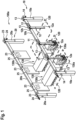
- Figure 1 shows an example of a truck parking system 100a according to an embodiment of the invention.
- the depicted truck parking system 100a comprises a first frame 10 and a second frame 20 being arranged opposite and at a distance from each other.
- the first frame 10 and the second frame 20 may be made of, or comprise metal, e.g. steel and/or aluminium.
- Each of the first and second frames 10, 20 includes two supports in the form of vertical posts 10a, 20a with a cross member in the form of a horizontal beam 10b, 20b extending between the upper ends of the posts.
- the first frame 10 includes three first access restriction devices 11, 12, each comprising a barrier 12 and an access control unit 11 for opening and closing the barrier 12.
- the access control unit 11 of each first access restriction device 11, 12 may comprise, e.g., a processor, a random-access memory, a read only memory and an input/output unit for performing the access control and opening the barrier accordingly.
- each access control unit 11 may be configured to send and receive data from internal and external devices such as sensors, actors, and/or other digital processing devices (not depicted).
- the barrier 12 of each first access restriction device 11, 12 may comprise a boom 12a and a driving unit 12b configured to move the boom 12a from a first position to a second position and vice versa when receiving a respective signal from the access control unit.
- the first position is a closed position in which the barrier closes the parking space by the boom 12a extending vertically downwards ( Fig. 1 ), while the second position is an open position in which the boom 12a is moved into a substantially horizontal position (right barrier in Fig. 2 ) for providing access to the parking space.
- an overhead battery charger (not depicted) may be mounted for charging traction batteries (not depicted) of electric trucks 130.
- the second frame 20 includes three second access restriction devices 25 arranged opposite to the barriers 12 of the first frame 10, which can be formed as plates 25, on which a parking space number may be applied.
- the plates 25 may be made of, or comprise metal, e.g. steel and/or aluminium.
- a parking space 120 is placed between each of the first and the second access restriction devices 11, 12, 25.
- each combination of a first and a second access restriction device 11, 12, 25 defines a parking space 120.
- a truck 130 comprising a tractor 130a and a trailer 130b is parked such that a rear end of the trailer 130b is at least partially covered by the plate 25.
- an opening of rear doors 130c (see Figure 2 ) of each trailer 130b can be prevented while the trucks 130 are parked.
- Adjacent to the plates 25 a refrigerated trailer charger (not depicted) may be attached to the second frame 20 for providing energy to cool refrigerated trailers 130b parked in the truck parking system 100a.
- a lighting device 13 is installed above each barrier 12 and at each end side of the first frame 10.
- a lighting device 23 can be installed above each plate 25 and at each end side of the second frame 20.
- a camera 14, 24 can be mounted at each end side of the first and the second frames 10, 20 to monitor an open lateral side of the parking spaces 120 located on the side of the truck parking system 100a, which form the outer parking spaces 120 thereof.
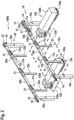
- Figure 2 shows a further embodiment of a truck parking system 100b according to the invention.
- the truck parking system 100b depicted in Figure 2 differs from that depicted in Figure 1 by having alternative second access restriction devices 21, 22 that include a barrier 22 comprising a boom 22a and a driving unit 22b, and an access control unit 21 for opening and closing the barrier 22 analogous to the first access restriction devices 11, 12.
- This embodiment concerns a drive-through solution in which each parking space 120 can be approached and left forwards, as a truck can enter the parking space 120 via an opened barrier 12 of the first access restriction device 11, 12 and leave the parking space 120 via an opened barrier 22 of the second access restriction device 21, 22.
- a truck 130 is parked forwards in the left parking space 120, and a further truck 130 is entering the right parking space 120 through an opened barrier 12, where the boom 12a has been moved from the first position to the second position for opening the parking space 120.
- the boom 12a In the second position, the boom 12a is arranged horizontally above the truck 130.
- each access control unit 11, 21 further comprises a traffic light 11a, 21a indicating whether access to the respective parking space is granted or denied. It should be stressed that such a traffic light 11a may be present in the embodiment 100a of Fig. 1 , too.
- the traffic light 11a attached to the access control unit 11 of the right parking space 120 indicates via a green light that access to the parking space 120 is granted.
- the traffic lights of the left and middle parking spaces are inactive as no further trucks are entering or leaving the truck parking system 100b.
- a lighting device 13 may be placed only at the two end sides of the first and second frames 10, 20.
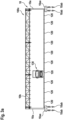
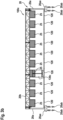
- Figures 3a and 3b exemplarily show a front and a rear view of a truck parking system 100c according to an embodiment of the invention.
- Figure 3a shows a front view of a first frame 10 and Figure 3b shows a rear view of a second frame 20 of the truck parking system 100c.
- the first frame 10 comprises two first supports in the form of vertical posts 10a each formed as a universal beam and mounted on a foundation 10aa, 10ab.
- the foundation 10aa, 10ab may comprise a pile cab with a reinforcement cage 10aa and two screw piles 10ab.
- a cross member in the form of a horizontal beam 10b is formed as truss beam with a plurality of unspecified trusses and extends between upper ends of the two vertical posts 10a of the first frame 10.
- the first access restriction devices on the horizontal beam 10b are not shown in this figure.
- the second frame 20 is built in the same way as the first frame 10 and comprises two vertical posts 20a as second supports each formed as universal beam and mounted on a foundation 20aa, 20ab comprising a pile cab with a reinforcement cage 20aa and two screw piles 20ab.
- a horizontal beam 20b as cross member is formed as truss beam with a plurality of unspecified trusses and extends between upper ends of the two vertical posts 20a of the second frame 20.
- the distance between the two vertical posts 10a, 20a of the first and the second frames 10, 20 is set to provide ten parking spaces 120.
- a grillage e.g. consisting of, or comprising metal, e.g. steel and/or aluminium, is provided for each parking space 120 as second access restriction device 25.
- a truck parks reverse against the grillage 25 such that a part of its rear is covered by the grillage 25 to prevent its rear doors 130c from opening.
Landscapes
- Engineering & Computer Science (AREA)
- Architecture (AREA)
- Civil Engineering (AREA)
- Structural Engineering (AREA)
- Fittings On The Vehicle Exterior For Carrying Loads, And Devices For Holding Or Mounting Articles (AREA)
Abstract
A modular truck parking system for providing a plurality of secured parking spaces (120), comprising a first frame (10) and a second frame (20) arranged opposite and at a distance from each other, each frame including a cross member (10b,20b) extending between two supports (10a,20a), spaced from the ground so that a truck can pass under the cross member, wherein the first frame includes at least one first access restriction device (11, 12), and the second frame includes at least one second access restriction device (21, 22, 25) arranged opposite the at least one first access restriction device (11, 12), the at least one first and the at least one second access restriction devices (11, 12, 21, 22, 25) forming a parking space (120) therebetween, wherein the at least one first access restriction device (11, 12) is movable in an open position and in a closed position.
Description
- The present invention relates to a modular truck parking system for providing a plurality of secured parking spaces.
- Truck parking is, in many countries in the world, mandated by law as a day-today function of operating a truck. Millions of trucks rely daily on access to truck parking infrastructure as a means of complying to this law. Without it, the industry suffers a lot of money of operational losses spanning cargo theft, lost driving time, poor working conditions to mention but a few.
- In order to improve access to suitable parking space,
EP 3 564 877 B1 shows a cargo port arrangement for a cargo port comprising a plurality of cargo bays, each cargo bay adapted for accommodating a truck. The cargo port arrangement comprises a reservation apparatus for reserving the cargo bays, at least one identification module for identifying the truck, and at least one access module adapted to decide whether to grant or prevent access for a truck to a cargo bay. The subject matter of this application is hereby incorporated by reference. - However, there is currently a great demand for additional parking spaces, which must also take into account the needs of trucks with alternative propulsion systems.
- According to the invention, a modular truck parking system for providing a plurality of secured parking spaces is proposed. Further preferred developments are described by the dependent claims and the description below.
- The invention allows for a rapid creation of public (community) parking hubs at existing truck-related properties such as depots, warehouses, terminals, ports, etc. For example, mid-sized freight companies or parcel delivery services may use the invention to convert portions of their parking and loading areas into public parking spaces with little time and expense. In this context, the truck parking system can be adapted to the needs of the particular company offering it.
- Moreover, all equipment installed to make the truck parking system operational are installed above-ground. This drastically decreases the costs for the installation and the risk of trucks driving into them, damaging them and jeopardizing the on-site operations and the site's return on investment.
- The modular truck parking system according to the invention comprises a first frame and a second frame arranged opposite and at a distance from each other. The first frame and/or the second frame may comprise or consist of metal, especially steel and/or aluminium.
- The distance between the first and the second frames, which may define a length of each parking space, may be determined based on a length of a truck type selected for parking in the truck parking system. For example, the distance may correspond to a length of the chosen truck type plus a length required to drive such a truck straight into a parking space. For example, the distance between the first and the second frame, and thus the length of each parking space may be in a range of 18 m to 28 m.
- The first frame includes a first cross member that extends between two first supports and is spaced from the ground so that a truck can pass under the cross member. The second frame includes a second cross member extending between two second supports. A distance between the supports and the ground, or a distance between the cross member and the ground, respectively, may be determined based on a height of the selected truck type. For example, the distance may be in a range of 4 m to 6 m, in particular 5 m. The second cross member may be spaced from the ground so that a truck can pass under the second cross member, or alternatively so that a truck cannot pass under the second cross member, i.e. the second cross member may form a barrier in at least one embodiment.
- The first frame further includes at least one (preferably a plurality of) first access restriction device, and the second frame includes at least one (preferably a plurality of) second access restriction device arranged opposite the at least one first access restriction device, wherein the at least one first and the at least one second access restriction devices form a parking space therebetween.
- In particular, a plurality of first access restriction devices may be arranged on the first frame adjacent to each other, e.g., in a row. A plurality of second access restriction devices may include the same number of devices as the plurality of first access restriction devices and may be arranged on the second frame, e.g., such that each second access restriction device faces a first access restriction device. In this way, a secure parking space can be created between each of the first and the second access restriction devices.
- The at least one first access restriction device is movable in an open position, in which a truck can pass the at least one first access restriction device, and in a closed position, in which a truck cannot pass the at least one first access restriction device. Thus, the invention provides a parking system with individually accessible parking spaces or parking bays.
- According to an embodiment, the first and/or the second frame may comprise two vertical posts as supports, and a horizontal beam as cross member extending between the two vertical posts, especially at an upper end thereof.
- According to an embodiment, the distance between the first and/or second supports may be set to provide a predetermined number of parking spaces. In this context, a width of each parking space may be determined based on a width of the selected truck type taking into account an additionally clearance on both sides of the truck to allow convenient entry and exit from the truck. For example, the width of a parking space may be in a range of 3 m to 4 m, in particular 3.5 m. For a predetermined number of parking spaces, for example 10, this therefore means a distance of 35 m between the posts.
- The vertical posts may comprise, e.g., universal beams or I-beams to which the horizontal beam may be attached at an upper end thereof. The horizontal beam may comprise e.g. a truss beam, which may be connected to the vertical posts by one or more truss connections. Each post may be mounted on a foundation configured to support the first and the second frame, respectively.
- According to an embodiment, the at least one first access restriction device, or each of the first access restriction devices may comprise a barrier and an access control unit for opening and closing the barrier. The access control unit of each first access restriction device may comprise, e.g., a processor, a random-access memory, a read only memory and an input/output unit for performing the access control and opening the barrier accordingly. Furthermore, the access control unit of each first access restriction device may be configured to send and receive data from internal and external devices such as sensors, actors, and/or other digital processing devices. The access control unit may be a physical unit placed, e.g., above the barrier at the first cross member or may be a software unit assigned to a respective first access restriction device. It may be also possible that a single access control unit controls all first access restriction devices.
- According to an embodiment, the barrier of each of the first access restriction devices may be attached to the first cross member and may extend downwards in vertical direction if the barrier is closed. In this way, no additional posts or the like are required for fixing the barriers of each parking space so that the construction effort of the truck parking system can be further reduced. If the barrier is closed, the distance between the barrier and the ground is so that a truck cannot pass under the barrier. The distance may be at most 4m. If the barrier is closed, the distance between the barrier and the ground may be so that a person can pass under the barrier, so that injuries may be avoided. The distance may be at least 2m.
- For example, each barrier may include a boom and a driving unit, in particular an electrical driving unit, configured to move the boom from a first position to a second position and vice versa when receiving a respective signal from the access control unit. The first position may be, e.g., a position in which the barrier closes the parking space by the boom extending in vertical direction, while the second position may be a position in which the boom is moved from the vertical position to a substantially horizontal position for providing access to the parking space.
- According to an embodiment, the at least one second access restriction device may comprise a bordering element or blocking element attached to the second cross member. The bordering element may be fixedly secured to the second cross member; it may extend in vertical direction. In other words, the at least one second access restriction device may be formed as a bordering element, which may be arranged opposite a barrier of the at least one first access restriction device. The distance between the bordering element and the ground may be so that a person can pass under the barrier, so that injuries may be avoided. The distance may be at least 2m.
- The bordering element may be configured to prevent, e.g., access to rear doors of a truck trailer. For this purpose, the bordering element may cover at least a part of a rear of a truck when the truck is reversed against it. This means that a truck may reverse into a parking space after the barrier of the first access restriction device has been opened and may be positioned between the barrier and the bordering element in such a way that its rear is adjacent to the bordering element. Once the vehicle is in a parking position, the barrier of the first access restriction device may be closed by its access control unit. To leave the parking space again, the barrier may be opened again by the access control unit and the vehicle may be driven forward out of the parking space.
- According to an embodiment, the bordering element may be formed as a plate or a grillage, especially comprising metal, e.g. steel and/or aluminium. The plate or grillage may have a width and a high suitable to (partially) cover a rear of the truck type for which the truck parking system is designed such that access, e.g., to rear doors of the truck trailer is prevented. For example, the plate or the grillage may have a high in a range of 2 m to 3m and a width of 2.5 m to 3.5 m.
- Alternatively, the at least one second access restriction device may comprise a barrier and an access control unit for opening and closing the barrier. In this case, the second access restriction device may be identical or at least similar to the first access restriction device. In particular, the access control unit of each second access restriction device may also comprise, e.g., a processor, a random-access memory, a read only memory and an input/output unit for performing the access control and opening the barrier accordingly. Furthermore, the access control unit of each second access restriction device may be configured to send and receive data from internal and external devices such as sensors, actors, and/or other digital processing devices. The access control unit may be a physical unit placed, e.g., above the barrier at the second cross member or may be a software unit assigned to a respective second access restriction device. It may be also possible that a single access control unit controls all second access restriction devices.
- As with the first access restriction device, the barrier of each of the second access restriction devices may be attached to the cross member of the second frame and may extend in vertical direction if the barrier is closed. If the barrier is closed, the distance between the barrier and the ground may be so that a person can pass under the barrier, so that injuries may be avoided. The distance may be at least 2m. Accordingly, each barrier may also include a boom and a driving unit, in particular an electrical driving unit, configured to move the boom from a first position to a second position and vice versa when receiving a respective signal from the access control unit. The first position may be, e.g., a position in which the barrier closes the parking space by the boom extending in vertical direction, while the second position may be a position in which the boom is moved from the vertical position to a substantially horizontal position for opening the parking space.
- In this case, a truck may be driven forward into a parking space after the barrier of the first access restriction device has been opened by its access control unit. Accordingly, the truck may be driven forward out of the parking space after the barrier of the second access restriction device has been opened by its access control unit. This facilitates driving in and out of the parking space.
- According to an embodiment each bordering element and/or each barrier attached to the cross member of the first and/or second frame may be formed such that a lower end thereof exceeds a predetermined height. In particular, the predetermined height may be at least 2 m, in order to prevent that a person, such as a truck driver, collides with a bordering element or a barrier.
- According to an embodiment, the access control unit of each of the first and/or second access restriction device may receive identification data from a truck accessing the respective parking space and may compare the received identification data with identification data stored in the access control unit. The identification data may comprise data for identifying the truck accessing the parking space, such as its license plate number, and reservation data such as a period of time for which a particular parking space has been reserved in advance for a particular truck. If the received identification data matches the stored identification data, the access control unit may grant access to the parking space, otherwise the access control unit may deny access to the parking space.
- In particular, if a truck is approaching a first access restriction device of the truck parking system, its license plate number may be determined, e.g. by a respective sensor attached to the first frame and may be send to the access control unit of the first access restriction device. Based on the determined license plate number, the access control unit may then determine if reservation data for the approaching truck is available. In this context, the access control unit may receive information, e.g., from a reservation database, in which reservation data from a plurality of trucks wishing to use the truck parking system are stored. If a current reservation is available for the determined license plate number, the access control unit may grant access to the parking space by causing the electric drive of the barrier to move the latter from the first to the second position. Otherwise the access control unit may deny access to the parking space by keeping the barrier in the vertical position.
- According to an embodiment, the access control unit of each of the first and/or second access restriction devices may comprise a traffic light indicating whether access to the respective parking space is granted or denied. The traffic light may be attached, e.g., at the cross member above the barrier of each of the first and/or second access restriction devices. For example, a red traffic light may indicate that access to a respective parking space is denied by the corresponding access control unit while a green traffic light may indicate that access is granted to the parking space. This may be particularly the case if a truck is approaching a first access restriction device. A green or red traffic light of the second access restriction device may indicate on the other side that permission for leaving the parking space is granted or not. Permission to leave the parking space may be denied, for example, if a parking fee has not been paid or if the license plate number does not match the stored license plate number in case a truck has entered the parking space without permission.
- According to an embodiment, the truck parking system may further comprise at least one camera and at least one lighting device attached to the first frame and/or to the second frame. In particular the truck parking system may comprise a plurality of cameras and a plurality of lighting devices.
- For example, a camera and a lighting device may be installed at each end side of the first and/or the second frame to monitor an open lateral side of the two outer parking spaces of the truck parking system. In particular, a camera and a lighting device may be installed at each of the first and/or second access restriction devices, to monitor a truck parking on a parking space. In case, a camera is installed at each of the first access restriction devices, the latter may also be used for identifying a license plate number of a truck approaching a parking space.
- According to an embodiment, the truck parking system may further comprise at least one charger being attached to the first frame and/or the second frame. The at least one charger may be a battery charger and/or a refrigerated trailer charger. In particular, the truck parking system may comprise a plurality of chargers for charging traction batteries of electric trucks and/or refrigerator trailers.
- For example, one battery charger for each parking space may be attached to the first or the second frame. This allows charging of traction batteries of electric trucks regardless of the battery's mounting position on/in the truck, as in this case a battery charger in provided either in the front or the rear portion of the truck.
- Alternatively or in addition, a refrigerator trailer charger may be provided at each parking space. For example, if the second access restriction device of each parking space is formed as a bordering element mounted at the horizontal beam of the second frame, the refrigerator trailer charger may be installed adjacent thereto, as a rear side of the refrigerated trailer may be positioned in close proximity to the bordering element.
- Further advantages and embodiments of the invention can be seen in the following description and the accompanying figures. The invention is illustrated schematically by means of examples in the figures and is described below with reference to the figures. Same elements are provided with the same reference signs so that a repeated description is omitted unless necessary.
-
-
Figure 1 shows an example of a truck parking system according to an embodiment of the invention. -
Figure 2 shows an example of a truck parking system according to an embodiment of the invention. -
Figures 3a and3b exemplarily show a front and a rear view of a truck parking system according to an embodiment of the invention. -
Figure 1 shows an example of atruck parking system 100a according to an embodiment of the invention. - The depicted
truck parking system 100a comprises afirst frame 10 and asecond frame 20 being arranged opposite and at a distance from each other. Thefirst frame 10 and thesecond frame 20 may be made of, or comprise metal, e.g. steel and/or aluminium. Each of the first andsecond frames vertical posts horizontal beam - In the present example the
first frame 10 includes three firstaccess restriction devices barrier 12 and anaccess control unit 11 for opening and closing thebarrier 12. Theaccess control unit 11 of each firstaccess restriction device access control unit 11 may be configured to send and receive data from internal and external devices such as sensors, actors, and/or other digital processing devices (not depicted). Thebarrier 12 of each firstaccess restriction device boom 12a and adriving unit 12b configured to move theboom 12a from a first position to a second position and vice versa when receiving a respective signal from the access control unit. The first position is a closed position in which the barrier closes the parking space by theboom 12a extending vertically downwards (Fig. 1 ), while the second position is an open position in which theboom 12a is moved into a substantially horizontal position (right barrier inFig. 2 ) for providing access to the parking space. - Next to the
access control unit 11 an overhead battery charger (not depicted) may be mounted for charging traction batteries (not depicted) ofelectric trucks 130. - The
second frame 20 includes three secondaccess restriction devices 25 arranged opposite to thebarriers 12 of thefirst frame 10, which can be formed asplates 25, on which a parking space number may be applied. Theplates 25 may be made of, or comprise metal, e.g. steel and/or aluminium. - A
parking space 120 is placed between each of the first and the secondaccess restriction devices access restriction device parking space 120. In the shown example, on each of the two most left parking spaces 120 atruck 130 comprising atractor 130a and atrailer 130b is parked such that a rear end of thetrailer 130b is at least partially covered by theplate 25. In this way an opening ofrear doors 130c (seeFigure 2 ) of eachtrailer 130b can be prevented while thetrucks 130 are parked. Adjacent to the plates 25 a refrigerated trailer charger (not depicted) may be attached to thesecond frame 20 for providing energy to coolrefrigerated trailers 130b parked in thetruck parking system 100a. - In the shown example, a
lighting device 13 is installed above eachbarrier 12 and at each end side of thefirst frame 10. Likewise, alighting device 23 can be installed above eachplate 25 and at each end side of thesecond frame 20. Furthermore, acamera second frames parking spaces 120 located on the side of thetruck parking system 100a, which form theouter parking spaces 120 thereof. Thus, atruck 130 without parking permission trying to access theouter parking spaces 120 from their lateral sides can be detected and an unauthorized parking can be avoided. -
Figure 2 shows a further embodiment of atruck parking system 100b according to the invention. - The
truck parking system 100b depicted inFigure 2 differs from that depicted inFigure 1 by having alternative secondaccess restriction devices barrier 22 comprising aboom 22a and adriving unit 22b, and anaccess control unit 21 for opening and closing thebarrier 22 analogous to the firstaccess restriction devices - This embodiment concerns a drive-through solution in which each
parking space 120 can be approached and left forwards, as a truck can enter theparking space 120 via an openedbarrier 12 of the firstaccess restriction device parking space 120 via an openedbarrier 22 of the secondaccess restriction device - E.g., a
truck 130 is parked forwards in theleft parking space 120, and afurther truck 130 is entering theright parking space 120 through an openedbarrier 12, where theboom 12a has been moved from the first position to the second position for opening theparking space 120. In the second position, theboom 12a is arranged horizontally above thetruck 130. - In the present example, each
access control unit traffic light traffic light 11a may be present in theembodiment 100a ofFig. 1 , too. - In the present example, the
traffic light 11a attached to theaccess control unit 11 of theright parking space 120 indicates via a green light that access to theparking space 120 is granted. The traffic lights of the left and middle parking spaces are inactive as no further trucks are entering or leaving thetruck parking system 100b. - In the present case, where each parking space is provided with two
access control units lighting device 13 may be placed only at the two end sides of the first andsecond frames -
Figures 3a and3b exemplarily show a front and a rear view of atruck parking system 100c according to an embodiment of the invention. - In particular,
Figure 3a shows a front view of afirst frame 10 andFigure 3b shows a rear view of asecond frame 20 of thetruck parking system 100c. - The
first frame 10 comprises two first supports in the form ofvertical posts 10a each formed as a universal beam and mounted on a foundation 10aa, 10ab. The foundation 10aa, 10ab may comprise a pile cab with a reinforcement cage 10aa and two screw piles 10ab. - A cross member in the form of a
horizontal beam 10b is formed as truss beam with a plurality of unspecified trusses and extends between upper ends of the twovertical posts 10a of thefirst frame 10. The first access restriction devices on thehorizontal beam 10b are not shown in this figure. - The
second frame 20 is built in the same way as thefirst frame 10 and comprises twovertical posts 20a as second supports each formed as universal beam and mounted on a foundation 20aa, 20ab comprising a pile cab with a reinforcement cage 20aa and two screw piles 20ab. Ahorizontal beam 20b as cross member is formed as truss beam with a plurality of unspecified trusses and extends between upper ends of the twovertical posts 20a of thesecond frame 20. - In the present example the distance between the two
vertical posts second frames parking spaces 120. At thesecond frame 20 a grillage, e.g. consisting of, or comprising metal, e.g. steel and/or aluminium, is provided for eachparking space 120 as secondaccess restriction device 25. In thefourth parking space 120 from the left a truck parks reverse against thegrillage 25 such that a part of its rear is covered by thegrillage 25 to prevent itsrear doors 130c from opening. - From the embodiments shown, it becomes clear that the proposed truck parking system allows a plurality of secure parking spaces to be provided rapidly with minimal effort and cost.
Claims (15)
- A modular truck parking system (100a, b, c) for providing a plurality of secured parking spaces (120), comprisinga first frame (10) and a second frame (20) arranged opposite and at a distance from each other, the first frame (10) including a first cross member (10b) extending between two first supports (10a), spaced from the ground so that a truck can pass under the first cross member (10b), and the second frame (20) including a second cross member (20b) extending between two second supports (20a), whereinthe first frame (10) includes at least one first access restriction device (11, 12), and the second frame (20) includes at least one second access restriction device (21, 22, 25) arranged opposite the at least one first access restriction device (11, 12), the at least one first and the at least one second access restriction devices (11, 12, 21, 22, 25) forming a parking space (120) therebetween,wherein the at least one first access restriction device (11, 12) is movable in an open position, in which a truck can pass the at least one first access restriction device (11, 12), and in a closed position, in which a truck cannot pass the at least one first access restriction device (11, 12).
- The truck parking system (100a, b, c) according to claim 1, wherein the two first and/or second supports (10a, 20a) comprise two vertical posts (10a, 20a), and the first and/or second cross beam (10b, 20b) comprises a horizontal beam (10b, 20b) extending between the two vertical posts (10a, 20a), especially at an upper end thereof.
- The truck parking system (100a, b, c) according to claim 1 or 2, wherein the distance between the two first and/or second supports (10a, 20a) is set to provide a predetermined number of parking spaces (120).
- The truck parking system (100a, b, c) according to any one of the preceding claims, wherein the at least one first access restriction device (11, 12) comprises a barrier (12) and an access control unit (11) for opening and closing the barrier (12).
- The truck parking system (100a, b, c) according to claim 4, wherein the barrier (12) of the at least one first access restriction device (11, 12) is attached to the first cross member (10b) and extends in vertical direction if the barrier is closed.
- The truck parking system (100a, b, c) according to any one of the preceding claims, wherein the at least one second access restriction device (21, 22, 25) comprises a bordering element (25) attached to the second cross member (20b).
- The truck parking system (100a, b, c) according to claim 6, wherein the bordering element (25) is formed as a plate (25) or a grillage (25).
- The truck parking system (100a, b, c) according to claim 6 or 7, wherein the bordering element (25) is configured to cover at least a part of a rear of a truck (130) when the truck (130) is reversed against it.
- The truck parking system (100a, b, c) according to any one of the claims 1 to 5, wherein the at least one second access restriction device (21, 22, 25) comprises a barrier (22) and an access control unit (21) for opening and closing the barrier (22).
- The truck parking system (100a, b, c) according to claim 9, wherein the barrier (22) of the at least one second access restriction device (21, 22) is attached to the second cross member (20b) and extends in vertical direction if the barrier is closed.
- The truck parking system (100a, b, c) according to any one of the claims 6 to 10, wherein each bordering element (25) and each barrier (12, 22) attached to the first and/or second cross member (10b, 20b), respectively, is formed such that a lower end thereof exceeds a predetermined height.
- The truck parking system (100a, b, c) according to any one of the preceding claims referring back at least to one of claims 5 or 9, wherein the access control unit (11, 21) of the at least one first and/or second access restriction device (11, 12, 21, 22, 25) is configured to receive identification data from a truck (130) accessing the respective parking space (120), to compare the received identification data with identification data stored in the access control unit (11, 21) and to grant access to the parking space (120) if the received identification data matches the stored identification data.
- The truck parking system (100a, b, c) according to any one of the preceding claims referring back at least to one of claims 5 or 9, wherein the access control unit (11, 21) of the at least one first and/or second access restriction device (11, 12, 21, 22, 25) comprises a traffic light (11a, 21a) indicating whether access to the respective parking space (120) is granted or denied.
- The truck parking system (100a, b, c) according to any one of the preceding claims, further comprisingat least one camera (14); andat least one lighting device (13), whereinthe at least one camera (14) and the at least one lighting device (13) are attached to the first frame (10) and/or to the second frame (20).
- The truck parking system (100a, b, c) according to any one of the preceding claims, further comprising at least one charger attached to the first frame (10) and/or to the second frame (20), wherein the at least one charger is a battery charger and/or a refrigerated trailer charger.
Priority Applications (1)
| Application Number | Priority Date | Filing Date | Title |
|---|---|---|---|
| EP23210748.2A EP4556654A1 (en) | 2023-11-17 | 2023-11-17 | Modular truck parking system |
Applications Claiming Priority (1)
| Application Number | Priority Date | Filing Date | Title |
|---|---|---|---|
| EP23210748.2A EP4556654A1 (en) | 2023-11-17 | 2023-11-17 | Modular truck parking system |
Publications (1)
| Publication Number | Publication Date |
|---|---|
| EP4556654A1 true EP4556654A1 (en) | 2025-05-21 |
Family
ID=88838975
Family Applications (1)
| Application Number | Title | Priority Date | Filing Date |
|---|---|---|---|
| EP23210748.2A Withdrawn EP4556654A1 (en) | 2023-11-17 | 2023-11-17 | Modular truck parking system |
Country Status (1)
| Country | Link |
|---|---|
| EP (1) | EP4556654A1 (en) |
Citations (3)
| Publication number | Priority date | Publication date | Assignee | Title |
|---|---|---|---|---|
| CN112573218A (en) * | 2019-09-30 | 2021-03-30 | 山东启和云梭物流科技有限公司 | Intelligent inland harbor based on multi-type intermodal transport composite rail transport system |
| EP3564877B1 (en) | 2018-04-30 | 2022-04-20 | Robert Bosch GmbH | Cargo port arrangement |
| DE102012210102B4 (en) * | 2012-06-15 | 2023-01-19 | Robert Bosch Gmbh | Monitoring device for monitoring a parking area and method for monitoring the parking area |
-
2023
- 2023-11-17 EP EP23210748.2A patent/EP4556654A1/en not_active Withdrawn
Patent Citations (3)
| Publication number | Priority date | Publication date | Assignee | Title |
|---|---|---|---|---|
| DE102012210102B4 (en) * | 2012-06-15 | 2023-01-19 | Robert Bosch Gmbh | Monitoring device for monitoring a parking area and method for monitoring the parking area |
| EP3564877B1 (en) | 2018-04-30 | 2022-04-20 | Robert Bosch GmbH | Cargo port arrangement |
| CN112573218A (en) * | 2019-09-30 | 2021-03-30 | 山东启和云梭物流科技有限公司 | Intelligent inland harbor based on multi-type intermodal transport composite rail transport system |
Similar Documents
| Publication | Publication Date | Title |
|---|---|---|
| CA2952156C (en) | Method and system for access control | |
| US5108052A (en) | Passenger transportation system for self-guided vehicles | |
| US20090148259A1 (en) | Automated Vehicle Parking Garage with Catwalk Installation | |
| KR20110044174A (en) | How to handle cargo in containers in warehouse, especially how to handle cargo in standard containers | |
| CN112562308A (en) | Shared bicycle intelligent parking pile system compatible with electronic fence and intelligent parking pile | |
| EP4556654A1 (en) | Modular truck parking system | |
| CN101344972B (en) | Automatic management system for freeway computer network | |
| JPH03253992A (en) | Parking lot managing device | |
| US11263907B2 (en) | System including a user interface application for reserving a parking space | |
| CN209746792U (en) | Automatic parking system | |
| CN107886768A (en) | Intelligent parking management system | |
| JP5173530B2 (en) | Garage system and gate opening / closing control method in the garage system | |
| CN117315982B (en) | Park garage management method and system based on cloud service | |
| EP0282892A2 (en) | Mobile kiosk for toll collection at superhighway toll stations | |
| KR100638328B1 (en) | Parking management system with pedestrian guided breaker | |
| CN215911009U (en) | Shared bicycle intelligent parking pile system compatible with electronic fence and intelligent parking pile | |
| CN112017308B (en) | Non-motor vehicle unattended charging equipment | |
| CN116934560A (en) | Intelligent management technology for automobile passenger station | |
| KR200335461Y1 (en) | Parking structure of the combination of 5flight | |
| CN215867991U (en) | Road gate | |
| CN112767738A (en) | Fast overall parking space sharing system and method based on parking robot | |
| CN114783196B (en) | Traffic participant intelligent management system in traffic control area | |
| JPS5813865A (en) | Three-diminsional parking field | |
| CN112133125A (en) | Parking security protection management system | |
| Sakurai et al. | Its Applied in Bus Rapid Transit |
Legal Events
| Date | Code | Title | Description |
|---|---|---|---|
| PUAI | Public reference made under article 153(3) epc to a published international application that has entered the european phase |
Free format text: ORIGINAL CODE: 0009012 |
|
| STAA | Information on the status of an ep patent application or granted ep patent |
Free format text: STATUS: THE APPLICATION HAS BEEN PUBLISHED |
|
| AK | Designated contracting states |
Kind code of ref document: A1 Designated state(s): AL AT BE BG CH CY CZ DE DK EE ES FI FR GB GR HR HU IE IS IT LI LT LU LV MC ME MK MT NL NO PL PT RO RS SE SI SK SM TR |
|
| STAA | Information on the status of an ep patent application or granted ep patent |
Free format text: STATUS: THE APPLICATION IS DEEMED TO BE WITHDRAWN |
|
| 18D | Application deemed to be withdrawn |
Effective date: 20251122 |