EP4556224A1 - Methods of manufacturing bio-based polymer beverage capsules - Google Patents
Methods of manufacturing bio-based polymer beverage capsules Download PDFInfo
- Publication number
- EP4556224A1 EP4556224A1 EP23210366.3A EP23210366A EP4556224A1 EP 4556224 A1 EP4556224 A1 EP 4556224A1 EP 23210366 A EP23210366 A EP 23210366A EP 4556224 A1 EP4556224 A1 EP 4556224A1
- Authority
- EP
- European Patent Office
- Prior art keywords
- layer
- biopolymer
- pga
- film
- biopolymer film
- Prior art date
- Legal status (The legal status is an assumption and is not a legal conclusion. Google has not performed a legal analysis and makes no representation as to the accuracy of the status listed.)
- Pending
Links
Images

Classifications
-
- B—PERFORMING OPERATIONS; TRANSPORTING
- B32—LAYERED PRODUCTS
- B32B—LAYERED PRODUCTS, i.e. PRODUCTS BUILT-UP OF STRATA OF FLAT OR NON-FLAT, e.g. CELLULAR OR HONEYCOMB, FORM
- B32B27/00—Layered products comprising a layer of synthetic resin
- B32B27/36—Layered products comprising a layer of synthetic resin comprising polyesters
-
- B—PERFORMING OPERATIONS; TRANSPORTING
- B31—MAKING ARTICLES OF PAPER, CARDBOARD OR MATERIAL WORKED IN A MANNER ANALOGOUS TO PAPER; WORKING PAPER, CARDBOARD OR MATERIAL WORKED IN A MANNER ANALOGOUS TO PAPER
- B31B—MAKING CONTAINERS OF PAPER, CARDBOARD OR MATERIAL WORKED IN A MANNER ANALOGOUS TO PAPER
- B31B50/00—Making rigid or semi-rigid containers, e.g. boxes or cartons
- B31B50/59—Shaping sheet material under pressure
- B31B50/592—Shaping sheet material under pressure using punches or dies
-
- B—PERFORMING OPERATIONS; TRANSPORTING
- B31—MAKING ARTICLES OF PAPER, CARDBOARD OR MATERIAL WORKED IN A MANNER ANALOGOUS TO PAPER; WORKING PAPER, CARDBOARD OR MATERIAL WORKED IN A MANNER ANALOGOUS TO PAPER
- B31B—MAKING CONTAINERS OF PAPER, CARDBOARD OR MATERIAL WORKED IN A MANNER ANALOGOUS TO PAPER
- B31B50/00—Making rigid or semi-rigid containers, e.g. boxes or cartons
- B31B50/74—Auxiliary operations
- B31B50/742—Coating; Impregnating; Waterproofing; Decoating
- B31B50/745—Coating or impregnating formed boxes
-
- B—PERFORMING OPERATIONS; TRANSPORTING
- B31—MAKING ARTICLES OF PAPER, CARDBOARD OR MATERIAL WORKED IN A MANNER ANALOGOUS TO PAPER; WORKING PAPER, CARDBOARD OR MATERIAL WORKED IN A MANNER ANALOGOUS TO PAPER
- B31B—MAKING CONTAINERS OF PAPER, CARDBOARD OR MATERIAL WORKED IN A MANNER ANALOGOUS TO PAPER
- B31B50/00—Making rigid or semi-rigid containers, e.g. boxes or cartons
- B31B50/74—Auxiliary operations
- B31B50/742—Coating; Impregnating; Waterproofing; Decoating
- B31B50/747—Coating or impregnating blanks or webs
-
- B—PERFORMING OPERATIONS; TRANSPORTING
- B31—MAKING ARTICLES OF PAPER, CARDBOARD OR MATERIAL WORKED IN A MANNER ANALOGOUS TO PAPER; WORKING PAPER, CARDBOARD OR MATERIAL WORKED IN A MANNER ANALOGOUS TO PAPER
- B31F—MECHANICAL WORKING OR DEFORMATION OF PAPER, CARDBOARD OR MATERIAL WORKED IN A MANNER ANALOGOUS TO PAPER
- B31F1/00—Mechanical deformation without removing material, e.g. in combination with laminating
- B31F1/0077—Shaping by methods analogous to moulding, e.g. deep drawing techniques
-
- B—PERFORMING OPERATIONS; TRANSPORTING
- B32—LAYERED PRODUCTS
- B32B—LAYERED PRODUCTS, i.e. PRODUCTS BUILT-UP OF STRATA OF FLAT OR NON-FLAT, e.g. CELLULAR OR HONEYCOMB, FORM
- B32B1/00—Layered products having a non-planar shape
-
- B—PERFORMING OPERATIONS; TRANSPORTING
- B32—LAYERED PRODUCTS
- B32B—LAYERED PRODUCTS, i.e. PRODUCTS BUILT-UP OF STRATA OF FLAT OR NON-FLAT, e.g. CELLULAR OR HONEYCOMB, FORM
- B32B27/00—Layered products comprising a layer of synthetic resin
- B32B27/06—Layered products comprising a layer of synthetic resin as the main or only constituent of a layer, which is next to another layer of the same or of a different material
- B32B27/08—Layered products comprising a layer of synthetic resin as the main or only constituent of a layer, which is next to another layer of the same or of a different material of synthetic resin
-
- B—PERFORMING OPERATIONS; TRANSPORTING
- B32—LAYERED PRODUCTS
- B32B—LAYERED PRODUCTS, i.e. PRODUCTS BUILT-UP OF STRATA OF FLAT OR NON-FLAT, e.g. CELLULAR OR HONEYCOMB, FORM
- B32B27/00—Layered products comprising a layer of synthetic resin
- B32B27/06—Layered products comprising a layer of synthetic resin as the main or only constituent of a layer, which is next to another layer of the same or of a different material
- B32B27/10—Layered products comprising a layer of synthetic resin as the main or only constituent of a layer, which is next to another layer of the same or of a different material of paper or cardboard
-
- B—PERFORMING OPERATIONS; TRANSPORTING
- B32—LAYERED PRODUCTS
- B32B—LAYERED PRODUCTS, i.e. PRODUCTS BUILT-UP OF STRATA OF FLAT OR NON-FLAT, e.g. CELLULAR OR HONEYCOMB, FORM
- B32B27/00—Layered products comprising a layer of synthetic resin
- B32B27/18—Layered products comprising a layer of synthetic resin characterised by the use of special additives
-
- B—PERFORMING OPERATIONS; TRANSPORTING
- B32—LAYERED PRODUCTS
- B32B—LAYERED PRODUCTS, i.e. PRODUCTS BUILT-UP OF STRATA OF FLAT OR NON-FLAT, e.g. CELLULAR OR HONEYCOMB, FORM
- B32B29/00—Layered products comprising a layer of paper or cardboard
- B32B29/002—Layered products comprising a layer of paper or cardboard as the main or only constituent of a layer, which is next to another layer of the same or of a different material
-
- B—PERFORMING OPERATIONS; TRANSPORTING
- B32—LAYERED PRODUCTS
- B32B—LAYERED PRODUCTS, i.e. PRODUCTS BUILT-UP OF STRATA OF FLAT OR NON-FLAT, e.g. CELLULAR OR HONEYCOMB, FORM
- B32B7/00—Layered products characterised by the relation between layers; Layered products characterised by the relative orientation of features between layers, or by the relative values of a measurable parameter between layers, i.e. products comprising layers having different physical, chemical or physicochemical properties; Layered products characterised by the interconnection of layers
- B32B7/02—Physical, chemical or physicochemical properties
-
- B—PERFORMING OPERATIONS; TRANSPORTING
- B32—LAYERED PRODUCTS
- B32B—LAYERED PRODUCTS, i.e. PRODUCTS BUILT-UP OF STRATA OF FLAT OR NON-FLAT, e.g. CELLULAR OR HONEYCOMB, FORM
- B32B7/00—Layered products characterised by the relation between layers; Layered products characterised by the relative orientation of features between layers, or by the relative values of a measurable parameter between layers, i.e. products comprising layers having different physical, chemical or physicochemical properties; Layered products characterised by the interconnection of layers
- B32B7/02—Physical, chemical or physicochemical properties
- B32B7/027—Thermal properties
-
- B—PERFORMING OPERATIONS; TRANSPORTING
- B32—LAYERED PRODUCTS
- B32B—LAYERED PRODUCTS, i.e. PRODUCTS BUILT-UP OF STRATA OF FLAT OR NON-FLAT, e.g. CELLULAR OR HONEYCOMB, FORM
- B32B7/00—Layered products characterised by the relation between layers; Layered products characterised by the relative orientation of features between layers, or by the relative values of a measurable parameter between layers, i.e. products comprising layers having different physical, chemical or physicochemical properties; Layered products characterised by the interconnection of layers
- B32B7/04—Interconnection of layers
- B32B7/12—Interconnection of layers using interposed adhesives or interposed materials with bonding properties
-
- B—PERFORMING OPERATIONS; TRANSPORTING
- B65—CONVEYING; PACKING; STORING; HANDLING THIN OR FILAMENTARY MATERIAL
- B65B—MACHINES, APPARATUS OR DEVICES FOR, OR METHODS OF, PACKAGING ARTICLES OR MATERIALS; UNPACKING
- B65B29/00—Packaging of materials presenting special problems
- B65B29/02—Packaging of substances, e.g. tea, which are intended to be infused in the package
- B65B29/022—Packaging of substances, e.g. tea, which are intended to be infused in the package packaging infusion material into capsules
-
- B—PERFORMING OPERATIONS; TRANSPORTING
- B65—CONVEYING; PACKING; STORING; HANDLING THIN OR FILAMENTARY MATERIAL
- B65D—CONTAINERS FOR STORAGE OR TRANSPORT OF ARTICLES OR MATERIALS, e.g. BAGS, BARRELS, BOTTLES, BOXES, CANS, CARTONS, CRATES, DRUMS, JARS, TANKS, HOPPERS, FORWARDING CONTAINERS; ACCESSORIES, CLOSURES, OR FITTINGS THEREFOR; PACKAGING ELEMENTS; PACKAGES
- B65D65/00—Wrappers or flexible covers; Packaging materials of special type or form
- B65D65/38—Packaging materials of special type or form
- B65D65/46—Applications of disintegrable, dissolvable or edible materials
- B65D65/466—Bio- or photodegradable packaging materials
-
- B—PERFORMING OPERATIONS; TRANSPORTING
- B65—CONVEYING; PACKING; STORING; HANDLING THIN OR FILAMENTARY MATERIAL
- B65D—CONTAINERS FOR STORAGE OR TRANSPORT OF ARTICLES OR MATERIALS, e.g. BAGS, BARRELS, BOTTLES, BOXES, CANS, CARTONS, CRATES, DRUMS, JARS, TANKS, HOPPERS, FORWARDING CONTAINERS; ACCESSORIES, CLOSURES, OR FITTINGS THEREFOR; PACKAGING ELEMENTS; PACKAGES
- B65D85/00—Containers, packaging elements or packages, specially adapted for particular articles or materials
- B65D85/70—Containers, packaging elements or packages, specially adapted for particular articles or materials for materials not otherwise provided for
- B65D85/804—Disposable containers or packages with contents which are mixed, infused or dissolved in situ, i.e. without having been previously removed from the package
- B65D85/8043—Packages adapted to allow liquid to pass through the contents
-
- B—PERFORMING OPERATIONS; TRANSPORTING
- B31—MAKING ARTICLES OF PAPER, CARDBOARD OR MATERIAL WORKED IN A MANNER ANALOGOUS TO PAPER; WORKING PAPER, CARDBOARD OR MATERIAL WORKED IN A MANNER ANALOGOUS TO PAPER
- B31B—MAKING CONTAINERS OF PAPER, CARDBOARD OR MATERIAL WORKED IN A MANNER ANALOGOUS TO PAPER
- B31B2110/00—Shape of rigid or semi-rigid containers
- B31B2110/10—Shape of rigid or semi-rigid containers having a cross section of varying size or shape, e.g. conical or pyramidal
-
- B—PERFORMING OPERATIONS; TRANSPORTING
- B31—MAKING ARTICLES OF PAPER, CARDBOARD OR MATERIAL WORKED IN A MANNER ANALOGOUS TO PAPER; WORKING PAPER, CARDBOARD OR MATERIAL WORKED IN A MANNER ANALOGOUS TO PAPER
- B31B—MAKING CONTAINERS OF PAPER, CARDBOARD OR MATERIAL WORKED IN A MANNER ANALOGOUS TO PAPER
- B31B2110/00—Shape of rigid or semi-rigid containers
- B31B2110/20—Shape of rigid or semi-rigid containers having a curved cross section, e.g. circular
-
- B—PERFORMING OPERATIONS; TRANSPORTING
- B31—MAKING ARTICLES OF PAPER, CARDBOARD OR MATERIAL WORKED IN A MANNER ANALOGOUS TO PAPER; WORKING PAPER, CARDBOARD OR MATERIAL WORKED IN A MANNER ANALOGOUS TO PAPER
- B31B—MAKING CONTAINERS OF PAPER, CARDBOARD OR MATERIAL WORKED IN A MANNER ANALOGOUS TO PAPER
- B31B2120/00—Construction of rigid or semi-rigid containers
- B31B2120/40—Construction of rigid or semi-rigid containers lined or internally reinforced
-
- B—PERFORMING OPERATIONS; TRANSPORTING
- B31—MAKING ARTICLES OF PAPER, CARDBOARD OR MATERIAL WORKED IN A MANNER ANALOGOUS TO PAPER; WORKING PAPER, CARDBOARD OR MATERIAL WORKED IN A MANNER ANALOGOUS TO PAPER
- B31B—MAKING CONTAINERS OF PAPER, CARDBOARD OR MATERIAL WORKED IN A MANNER ANALOGOUS TO PAPER
- B31B2120/00—Construction of rigid or semi-rigid containers
- B31B2120/40—Construction of rigid or semi-rigid containers lined or internally reinforced
- B31B2120/402—Construction of rigid or semi-rigid containers lined or internally reinforced by applying a liner to already made boxes, e.g. opening or distending of the liner or the box
- B31B2120/407—Construction of rigid or semi-rigid containers lined or internally reinforced by applying a liner to already made boxes, e.g. opening or distending of the liner or the box involving forming of the liner before inserting
-
- B—PERFORMING OPERATIONS; TRANSPORTING
- B32—LAYERED PRODUCTS
- B32B—LAYERED PRODUCTS, i.e. PRODUCTS BUILT-UP OF STRATA OF FLAT OR NON-FLAT, e.g. CELLULAR OR HONEYCOMB, FORM
- B32B2250/00—Layers arrangement
- B32B2250/03—3 layers
-
- B—PERFORMING OPERATIONS; TRANSPORTING
- B32—LAYERED PRODUCTS
- B32B—LAYERED PRODUCTS, i.e. PRODUCTS BUILT-UP OF STRATA OF FLAT OR NON-FLAT, e.g. CELLULAR OR HONEYCOMB, FORM
- B32B2250/00—Layers arrangement
- B32B2250/04—4 layers
-
- B—PERFORMING OPERATIONS; TRANSPORTING
- B32—LAYERED PRODUCTS
- B32B—LAYERED PRODUCTS, i.e. PRODUCTS BUILT-UP OF STRATA OF FLAT OR NON-FLAT, e.g. CELLULAR OR HONEYCOMB, FORM
- B32B2250/00—Layers arrangement
- B32B2250/05—5 or more layers
-
- B—PERFORMING OPERATIONS; TRANSPORTING
- B32—LAYERED PRODUCTS
- B32B—LAYERED PRODUCTS, i.e. PRODUCTS BUILT-UP OF STRATA OF FLAT OR NON-FLAT, e.g. CELLULAR OR HONEYCOMB, FORM
- B32B2250/00—Layers arrangement
- B32B2250/24—All layers being polymeric
- B32B2250/244—All polymers belonging to those covered by group B32B27/36
-
- B—PERFORMING OPERATIONS; TRANSPORTING
- B32—LAYERED PRODUCTS
- B32B—LAYERED PRODUCTS, i.e. PRODUCTS BUILT-UP OF STRATA OF FLAT OR NON-FLAT, e.g. CELLULAR OR HONEYCOMB, FORM
- B32B2250/00—Layers arrangement
- B32B2250/40—Symmetrical or sandwich layers, e.g. ABA, ABCBA, ABCCBA
-
- B—PERFORMING OPERATIONS; TRANSPORTING
- B32—LAYERED PRODUCTS
- B32B—LAYERED PRODUCTS, i.e. PRODUCTS BUILT-UP OF STRATA OF FLAT OR NON-FLAT, e.g. CELLULAR OR HONEYCOMB, FORM
- B32B2262/00—Composition or structural features of fibres which form a fibrous or filamentary layer or are present as additives
- B32B2262/04—Cellulosic plastic fibres, e.g. rayon
-
- B—PERFORMING OPERATIONS; TRANSPORTING
- B32—LAYERED PRODUCTS
- B32B—LAYERED PRODUCTS, i.e. PRODUCTS BUILT-UP OF STRATA OF FLAT OR NON-FLAT, e.g. CELLULAR OR HONEYCOMB, FORM
- B32B2262/00—Composition or structural features of fibres which form a fibrous or filamentary layer or are present as additives
- B32B2262/06—Vegetal fibres
- B32B2262/062—Cellulose fibres, e.g. cotton
-
- B—PERFORMING OPERATIONS; TRANSPORTING
- B32—LAYERED PRODUCTS
- B32B—LAYERED PRODUCTS, i.e. PRODUCTS BUILT-UP OF STRATA OF FLAT OR NON-FLAT, e.g. CELLULAR OR HONEYCOMB, FORM
- B32B2264/00—Composition or properties of particles which form a particulate layer or are present as additives
- B32B2264/04—Cellulosic particles, e.g. rayon
-
- B—PERFORMING OPERATIONS; TRANSPORTING
- B32—LAYERED PRODUCTS
- B32B—LAYERED PRODUCTS, i.e. PRODUCTS BUILT-UP OF STRATA OF FLAT OR NON-FLAT, e.g. CELLULAR OR HONEYCOMB, FORM
- B32B2264/00—Composition or properties of particles which form a particulate layer or are present as additives
- B32B2264/06—Vegetal particles
- B32B2264/062—Cellulose particles, e.g. cotton
-
- B—PERFORMING OPERATIONS; TRANSPORTING
- B32—LAYERED PRODUCTS
- B32B—LAYERED PRODUCTS, i.e. PRODUCTS BUILT-UP OF STRATA OF FLAT OR NON-FLAT, e.g. CELLULAR OR HONEYCOMB, FORM
- B32B2270/00—Resin or rubber layer containing a blend of at least two different polymers
-
- B—PERFORMING OPERATIONS; TRANSPORTING
- B32—LAYERED PRODUCTS
- B32B—LAYERED PRODUCTS, i.e. PRODUCTS BUILT-UP OF STRATA OF FLAT OR NON-FLAT, e.g. CELLULAR OR HONEYCOMB, FORM
- B32B2272/00—Resin or rubber layer comprising scrap, waste or recycling material
-
- B—PERFORMING OPERATIONS; TRANSPORTING
- B32—LAYERED PRODUCTS
- B32B—LAYERED PRODUCTS, i.e. PRODUCTS BUILT-UP OF STRATA OF FLAT OR NON-FLAT, e.g. CELLULAR OR HONEYCOMB, FORM
- B32B2307/00—Properties of the layers or laminate
- B32B2307/70—Other properties
- B32B2307/716—Degradable
- B32B2307/7163—Biodegradable
-
- B—PERFORMING OPERATIONS; TRANSPORTING
- B32—LAYERED PRODUCTS
- B32B—LAYERED PRODUCTS, i.e. PRODUCTS BUILT-UP OF STRATA OF FLAT OR NON-FLAT, e.g. CELLULAR OR HONEYCOMB, FORM
- B32B2307/00—Properties of the layers or laminate
- B32B2307/70—Other properties
- B32B2307/724—Permeability to gases, adsorption
- B32B2307/7242—Non-permeable
- B32B2307/7244—Oxygen barrier
-
- B—PERFORMING OPERATIONS; TRANSPORTING
- B32—LAYERED PRODUCTS
- B32B—LAYERED PRODUCTS, i.e. PRODUCTS BUILT-UP OF STRATA OF FLAT OR NON-FLAT, e.g. CELLULAR OR HONEYCOMB, FORM
- B32B2307/00—Properties of the layers or laminate
- B32B2307/70—Other properties
- B32B2307/724—Permeability to gases, adsorption
- B32B2307/7242—Non-permeable
- B32B2307/7246—Water vapor barrier
-
- B—PERFORMING OPERATIONS; TRANSPORTING
- B32—LAYERED PRODUCTS
- B32B—LAYERED PRODUCTS, i.e. PRODUCTS BUILT-UP OF STRATA OF FLAT OR NON-FLAT, e.g. CELLULAR OR HONEYCOMB, FORM
- B32B2307/00—Properties of the layers or laminate
- B32B2307/70—Other properties
- B32B2307/738—Thermoformability
-
- B—PERFORMING OPERATIONS; TRANSPORTING
- B32—LAYERED PRODUCTS
- B32B—LAYERED PRODUCTS, i.e. PRODUCTS BUILT-UP OF STRATA OF FLAT OR NON-FLAT, e.g. CELLULAR OR HONEYCOMB, FORM
- B32B2439/00—Containers; Receptacles
- B32B2439/40—Closed containers
-
- B—PERFORMING OPERATIONS; TRANSPORTING
- B32—LAYERED PRODUCTS
- B32B—LAYERED PRODUCTS, i.e. PRODUCTS BUILT-UP OF STRATA OF FLAT OR NON-FLAT, e.g. CELLULAR OR HONEYCOMB, FORM
- B32B2439/00—Containers; Receptacles
- B32B2439/70—Food packaging
Definitions
- the present invention relates to methods of manufacturing beverage capsules, wherein the capsule body comprises or consists of a biopolymer film.
- Capsules for beverage preparation in a beverage preparation device are well known, for example coffee capsules.
- Beverage capsules can both reduce the time needed to brew a beverage and simplify the brewing process by eliminating the need to measure out portions, flavourings, and additives from large bulk containers. Beverage capsules can also help to keep the unused product fresher by individually packaging portions separately without exposing the entire batch to air and light.
- Beverage capsules may be manufactured from plastics such as polyolefins, that are generally injected or thermoformed to obtain a cup-shaped body that is subsequently filled with a substance for preparation of a beverage and then closed with a cover to close the capsule in a gas and moisture tight manner.
- plastics such as polyolefins
- the beverage capsule is inserted into a beverage preparation device, liquid is injected under pressure into the capsule, and the beverage is dispensed through the capsule cover.
- biopolyesters do not have sufficient barrier properties, to ensure freshness of the substance for preparation of the beverage over the lifetime of the capsule, and especially during storage of the beverage capsule until use.
- Modification of biopolymers is one way to improve their properties and achieve property combinations required for specific applications.
- One modification technique is blending.
- blending of biopolyesters can be complex.
- multi-layered materials may be considered, since multi-layered films may have better mechanical, barrier and controlled release properties compared to mono-layered films.
- beverage capsules comprising multi-layered bio-based materials that have sufficient barrier properties.
- the present inventors have developed a method of manufacturing a beverage capsule comprising a multi-layered biopolymer film, wherein the biopolymer film comprises PGA.
- the biopolymer film comprises PGA.
- sandwiching the PGA between two biopolymer layers the PGA is protected from hydrolysis and provides excellent long-term moisture and oxygen barrier properties.
- the multi-layer biopolymer film has excellent moisture and oxygen barrier properties and reduced sensitivity to hydrolysis.
- the multi-layer biopolymer film is thermally stable, allowing use under high temperature conditions in a beverage preparation device.
- the multi-layer biopolymer film is biodegradable in soil, home composting, industrial compositing, and marine conditions.
- the present invention provides a method of manufacturing a beverage capsule, the method comprising: (a) providing a biopolymer film, wherein the biopolymer film comprises a layered structure comprising biopolymer layer - polyglycolide (PGA) layer - biopolymer layer; and (b) thermoforming the biopolymer film to form at least one layer of a capsule body comprising or consisting of the biopolymer film.
- PGA polyglycolide
- the capsule body consists of the biopolymer film.
- the method comprises: (i) thermoforming the biopolymer film, optionally into a cup-shape; (ii) inserting the thermoformed biopolymer film into a paper-based capsule body; and (iii) optionally, further forming or moulding the biopolymer film, to provide a capsule body comprising a paper-based layer and the biopolymer film.
- the method comprises thermoforming the biopolymer film inside a paper-based capsule body to provide a capsule body comprising a paper-based layer and the biopolymer film.
- the method comprises: (i) attaching the biopolymer layer to a paper-based layer to provide a multi-layer structure; and (ii) forming the multi-layer structure to provide a capsule body comprising a paper-based layer and the biopolymer film.
- the paper-based layer forms an exterior surface of the capsule body. In one embodiment, the paper-based layer forms an interior surface of the capsule body.
- the present invention provides a method of manufacturing a beverage capsule, the method comprising: (a) providing a biopolymer film, wherein the biopolymer film comprises a layered structure comprising biopolymer layer - polyglycolide (PGA) layer - biopolymer layer; and (b) thermoforming the biopolymer film to form a capsule body consisting of the biopolymer film.
- a biopolymer film comprises a layered structure comprising biopolymer layer - polyglycolide (PGA) layer - biopolymer layer
- thermoforming the biopolymer film to form a capsule body consisting of the biopolymer film.
- the present invention provides a method of manufacturing a beverage capsule, the method comprising: (a) providing a biopolymer film, wherein the biopolymer film comprises a layered structure comprising biopolymer layer - polyglycolide (PGA) layer - biopolymer layer; (b) thermoforming the biopolymer film; (c) inserting the formed biopolymer film into a paper-based capsule body; and (d) optionally, further forming or moulding the biopolymer film, to provide a capsule body comprising or consisting of a paper-based layer and the biopolymer film.
- PGA polyglycolide
- the present invention provides a method of manufacturing a beverage capsule, the method comprising: (a) providing a biopolymer film, wherein the biopolymer film comprises a layered structure comprising biopolymer layer - polyglycolide (PGA) layer - biopolymer layer; and (b) thermoforming the biopolymer film inside a paper-based capsule body, to provide a capsule body comprising or consisting of a paper-based layer and the biopolymer film.
- PGA polyglycolide
- the present invention provides a method of manufacturing a beverage capsule, the method comprising: (a) providing a biopolymer film, wherein the biopolymer film comprises a layered structure comprising biopolymer layer - polyglycolide (PGA) layer - biopolymer layer, and attaching the biopolymer film to a paper-based layer to provide a multi-layer structure comprising a paper-based layer and a biopolymer layer; and (b) forming the multi-layer structure to provide a capsule body comprising or consisting of a paper-based layer and the biopolymer film.
- PGA polyglycolide
- the present invention provides use of a biopolymer film for manufacturing a beverage capsule by thermoforming, wherein the biopolymer film comprises a layered structure comprising biopolymer layer - polyglycolide (PGA) layer - biopolymer layer.
- PGA polyglycolide
- the present invention provides use of a biopolymer film for manufacturing a beverage capsule by lamination and thermoforming, wherein the biopolymer film comprises a layered structure comprising biopolymer layer - polyglycolide (PGA) layer - biopolymer layer.
- PGA polyglycolide
- the biopolymer film is thermoformed at a temperature of at least 60°C, at least 70°C, or at least 80°C.
- the biopolymer film is thermoformed at a temperature of 220°C or lower, 210°C or lower, 200°C or lower, 190°C or lower, 180°C or lower, 170°C or lower, 160°C or lower, 150°C or lower, 140°C or lower, 130°C or lower, 120°C or lower, 110°C or lower, 100°C or lower.
- the biopolymer film is thermoformed at a temperature of from 60°C to 220°C, from 60°C to 200°C, from 60°C to 180°C, from 60°C to 160°C, from 60°C to 140°C, from 60°C to 120°C, or from 70°C to 110°C.
- the biopolymer film is contacted with a mould for at least 1 second, at least 2 seconds, at least 3 seconds, at least 4 seconds, at least 5 seconds, at least 10 seconds, or at least 20 seconds.
- the biopolymer film is contacted with a mould for 30 seconds or less.
- the biopolymer film is contacted with a mould for from 1 to 30 seconds, from 2 to 30 second, or from 3 to 30 seconds.
- the biopolymer film is thermoformed by vacuum forming, pressure forming, or mechanical forming.
- the PGA has a molecular mass of from about 20 kDa to about 500 kDa, from about 30 kDa to about 500 kDa, from about 40 kDa to about 500 kDa, from about 50 kDa to about 500 kDa, from about 60 kDa to about 500 kDa, or from about 70 kDa to about 500 kDa.
- the PGA layer has a melting point of 220°C or lower, 219°C or lower, 218°C or lower, 217°C or lower, 216°C or lower, 215°C or lower, 214°C or lower, 213°C or lower, 212°C or lower, 211°C or lower, or 210°C or lower.
- the PGA layer comprises at least 50 wt% PGA, at least 55 wt% PGA, at least 60 wt% PGA, at least 65 wt% PGA, at least 70 wt% PGA, at least 75 wt% PGA, at least 80 wt% PGA, at least 85 wt% PGA, or at least 90 wt% PGA.
- the PGA layer comprises PGA blended with poly(butylene adipate-co-terephthalate) (PBAT), polycaprolactone (PCL), polylactic acid (PLA), and/or nanocellulose.
- PBAT poly(butylene adipate-co-terephthalate)
- PCL polycaprolactone
- PLA polylactic acid
- the PGA layer further comprises one or more compatibilizers.
- the PGA layer comprises one or more compatibilizers in a total amount of from 0.1 wt% to 10 wt%.
- the PGA layer comprises or consists of a PGA/PBAT blend.
- the PGA/PBAT blend comprises PBAT in an amount of from 5 wt% to 50 wt%, from 5 wt% to 25 wt%, from 5 wt% to 20 wt%, or from 5 wt% to 15 wt%.
- the PGA layer comprises or consists of a PGA/PCL blend.
- the PGA/PCL blend comprises PCL in an amount of from 5 wt% to 50 wt%, from 5 wt% to 25 wt%, from 5 wt% to 20 wt%, or from 5 wt% to 15 wt%.
- the PGA layer comprises or consists of a PGA/PLA blend.
- the PGA/PLA blend comprises PLA in an amount of from 5 wt% to 50 wt%, from 5 wt% to 25 wt%, from 5 wt% to 20 wt%, or from 5 wt% to 15 wt%.
- the PGA layer comprises nanocellulose.
- the nanocellulose may comprise or consist of microfibrillated cellulose (MFC), cellulose nanocrystals (CNC), cellulose nanofibrils (CNF), or any combination thereof.
- the PGA layer comprises nanocellulose in a total amount of from 0.1 wt% to 2 wt%.
- the biopolymer layers are moisture barriers.
- the biopolymer layers comprise or consist of a biopolymer selected from polylactic acid (PLA), poly(butylene adipate-co-terephthalate) (PBAT), polycaprolactone (PCL), polybutylene succinate (PBS), poly (butylene succinate-co-L-lactate) (PBSL), poly(butylene succinate-co-butylene adipate) (PBSA), poly(butylene succinate-co-terephthalate) (PBST), poly(butylene sebacate-co-terephthalate) (PBSeT), Poly(ethylene adipate) (PEA), polyhydroxyalkanoates (PHA), and copolymers and/or blends thereof.
- PLA polylactic acid
- PBAT poly(butylene adipate-co-terephthalate)
- PCL polycaprolactone
- PBS polybutylene succinate
- PBSL poly(butylene succinate-co
- the biopolymer layers comprise or consist of a polyhydroxyalkanoate (PHA).
- PHA polyhydroxyalkanoate
- Any suitable PHA may be used in the present invention.
- the PHA is selected from poly(3-hydroxybutyrate) (PHB), poly(3-hydroxyvalerate) (PHV), poly(3-hydroxybutyrate-co-3-hydroxyvalerate) (PHBV), poly(3-hydroxyhexanoate) (PHHx), poly(3-hydroxybutyrate-co-3-hydroxyhexanoate) (PHBH), poly(3-hydroxyoctanoate) (PHO), poly(3-hydroxydecanoate) (PHD), poly(3-hydroxydodecanoate) (PHDD), poly(3-hydroxy undecenoate) (PHU), poly(3-hydroxy octanoate-co-undecenoate) (PHOU), and any copolymer and/or blend thereof.
- the PHA is selected from medium-chain length PHAs and long-chain length PHAs.
- the PHA has a molecular mass of from about 50 kDa to about 300 kDa.
- the PHA has a melting point of 180°C or less, 170°C or less, 160°C or less, or 150°C or less.
- the biopolymer film may comprise any other suitable layers.
- the biopolymer film further comprises one or more tie layers.
- the biopolymer film comprises a layered structure comprising PHA layer - tie layer - PGA layer - tie layer - PHA layer.
- the tie layers comprise or consist of an adhesive resin and/or a compatibilizer.
- the tie layers comprise or consist of a biodegradable adhesive resin, optionally wherein the tie layers comprise or consist of BTR8002P.
- the biopolymer film further comprises one or more regrind layers.
- the biopolymer film comprises a layered structure comprising PHA layer - regrind layer - tie layer - PGA layer - tie layer - regrind layer - PHA layer.
- the regrind layers comprise a blend of PHA and PGA.
- the regrind layers comprise or consist of a regenerate formed by solid state polymerization (SSP) and/or chain extension.
- each PHA layer has a thickness of from about 0.001 mm to about 0.50 mm, from about 0.002 mm to about 0.10 mm, or from about 0.003 mm to about 0.05 mm.
- the PGA layer has a thickness of from about 0.001 mm to about 0.50 mm, from about 0.002 mm to about 0.10 mm, or from about 0.003 mm to about 0.05 mm.
- the biopolymer film has a total thickness of from about 0.15 mm to about 0.70 mm, from about 0.16 mm to about 0.60 mm, or from about 0.17 mm to about 0.50 mm.
- the biopolymer film may be formed by any suitable method.
- the biopolymer film is formed by co-extrusion or co-injection.
- the biopolymer film is formed by co-extrusion.
- the biopolymer film is formed by co-injection.
- the biopolymer film may have advantageous properties.
- the biopolymer film may be an oxygen barrier.
- the biopolymer film may have an oxygen transmission rate of about 1 cm 3 /m 2 /day/atm or less at 23°C/50%RH.
- the biopolymer film may be a moisture barrier.
- the biopolymer film may have a water vapour transmission rate of about 1 g/m 2 /day or less at 23°C/85% RH.
- the biopolymer film may be thermoformable.
- the biopolymer film may have a melt flow index (MFI) of from 0.5 g/10min to 25 g/10min, from 5 g/10min to 25 g/10min, from 10 g/10min to 25 g/10min, from 15 g/10min to 25 g/10min, or from 15 g/10min to 20 g/10min, optionally wherein the MFI is determined at 190°C or lower with a test load of 2.16 kg or 5 kg.
- MFI melt flow index
- the capsule body may be cup-shaped.
- the capsule body may comprise a bottom wall, a lateral wall and an annular flange for a cover to seal thereon.
- the bottom wall may be suitable for being pierced by a piercing member of a beverage preparation device.
- the method further comprises closing the capsule with a cover for closing the capsule body.
- the method further comprises introducing into the capsule a substance for preparation of a beverage, optionally wherein the substance for preparation of a beverage is roast and ground coffee, a soluble ingredient, or a mix of soluble ingredients.
- the substance for preparation of a beverage is roast and ground coffee.
- the capsule body further comprises a paper-based layer.
- the paper-based layer forms the exterior surface of the capsule body.
- the paper-based layer forms the interior surface of the capsule body.
- the biopolymer film may be attached to the paper-based layer by any suitable thermoforming-based method.
- the capsule of the present invention may have advantageous properties.
- the capsule of the present invention may be compostable.
- the capsule of the present invention may be single-use.
- the capsule of the present invention may have a shelf-life of at least 6 months, at least 9 months, or at least 12 months.
- the present invention provides a capsule obtainable by or obtained by a method according to the present invention.
- the present invention provides use of a capsule according to the present invention to prepare a beverage.
- the present invention provides a method of preparing a beverage, the method comprising injecting pressurized liquid into a capsule according to the present invention and allowing a beverage to flow out of the capsule.
- Numeric ranges are inclusive of the numbers defining the range.
- the term “about” means approximately, in the region of, roughly, or around. When the term “about” is used in conjunction with a numerical value or range, it modifies that value or range by extending the boundaries above and below the numerical value(s) set forth. In general, the terms “about” and “approximately” are used herein to modify a numerical value(s) above and below the stated value(s) by 10%.
- the present invention provides a method of manufacturing a capsule body for a beverage capsule, wherein the capsule body comprises or consists of a layered structure comprising biopolymer layer - polyglycolide (PGA) layer - biopolymer layer.
- PGA polyglycolide
- the method may comprise: (a) providing a biopolymer film, wherein the biopolymer film comprises a layered structure comprising biopolymer layer - polyglycolide (PGA) layer - biopolymer layer; and (b) thermoforming the biopolymer film to form at least one layer of a capsule body comprising or consisting of the biopolymer film.
- the biopolymer film may be attached to any other layers (e.g. a paper based layer), i.e. in the form of a multi-layer structure.
- the capsule body does not comprise a paper-based layer.
- the formed biopolymer film is not inserted into a paper-based capsule body.
- the formed biopolymer film is not attached to a paper-based capsule body
- the capsule body consists of the biopolymer film.
- the method of the present invention comprises: (a) providing a biopolymer film, wherein the biopolymer film comprises a layered structure comprising biopolymer layer - polyglycolide (PGA) layer - biopolymer layer; and (b) thermoforming the biopolymer film to form a capsule body consisting of the biopolymer film.
- the biopolymer film has a thickness of up to about 1.0 mm, for example, from about 0.5 mm to about 1.0 mm.
- the capsule body comprises a paper-based layer.
- the capsule body comprises a single paper-based layer.
- the capsule body comprise or consists of a paper-based layer and the biopolymer film.
- the paper-based layer may form an exterior surface of the capsule body or an interior surface of the capsule body.
- the paper-based layer forms an exterior surface of the capsule body.
- the paper-based layer forms an interior surface of the capsule body.
- the method of the present invention comprises: (a) providing a biopolymer film, wherein the biopolymer film comprises a layered structure comprising biopolymer layer - polyglycolide (PGA) layer - biopolymer layer; (b) thermoforming the biopolymer film e.g. into a cup-shape; (c) inserting the formed biopolymer film into a paper-based capsule body; and (d) optionally, further forming or moulding the biopolymer film, to provide a capsule body comprising or consisting of a paper-based layer and the biopolymer film.
- the paper-based layer may form an exterior surface of the capsule body.
- the biopolymer film has a thickness of up to about 1.0 mm, for example, from about 0.5 mm to about 1.0 mm.
- the method of the present invention comprises: (a) providing a biopolymer film, wherein the biopolymer film comprises a layered structure comprising biopolymer layer - polyglycolide (PGA) layer - biopolymer layer; and (b) thermoforming the biopolymer film inside a paper-based capsule body, to provide a capsule body comprising or consisting of a paper-based layer and the biopolymer film.
- the paper-based layer may form an exterior surface of the capsule body.
- the method of the present invention comprises: (a) providing a biopolymer film, wherein the biopolymer film comprises a layered structure comprising biopolymer layer - polyglycolide (PGA) layer - biopolymer layer, and attaching the biopolymer film to a paper-based layer to provide a multi-layer structure comprising a paper-based layer and a biopolymer layer; and (b) forming the multi-layer structure to provide a capsule body comprising or consisting of a paper-based layer and the biopolymer film.
- the paper-based layer forms an exterior surface of the capsule body.
- the paper-based layer forms an interior surface of the capsule body.
- thermoforming may refer to a manufacturing process where a polymer film is heated to a forming temperature, formed to a specific shape in a mould, and optionally trimmed.
- Common methods of thermoforming include vacuum forming, pressure forming, or mechanical forming.
- the biopolymer film or multi-layer structure is thermoformed by vacuum forming.
- Vacuum forming makes use of a vacuum to shape the film. The film is heated to ensure it is flexible and then a vacuum forming machine pulls the air out, forcing the film against a mould.
- the vacuum process is known for its cost-effectiveness and the speed of the manufacturing process.
- the biopolymer film or multi-layer structure is thermoformed by pressure forming.
- Pressure forming makes further use of pressure to shape the film.
- the film is heated to ensure it is flexible, a vacuum is used to force the film against a mould, and then a pressing tool applies pressure to ensure the shaped film better maintains its shape.
- the biopolymer film or multi-layer structure is thermoformed by mechanical forming.
- Mechanical forming involves the use of a direct mechanical force to shape the preheated film.
- a core plug forces the flexible sheet to fill a space between the plug and the mould.
- thermoform the biopolymer or multi-layer structure Any suitable conditions may be used to thermoform the biopolymer or multi-layer structure.
- the biopolymer film or multi-layer structure is thermoformed a temperature of at least about 50°C, at least about 60°C, at least about 70°C, at least about 80°C, at least about 90°C, or at least about 100°C.
- the biopolymer film or multi-layer structure is thermoformed a temperature of about 220°C or lower, about 210°C or lower, about 200°C or lower, about 190°C or lower, about 180°C or lower, about 170°C or lower, about 160°C or lower, about 150°C or lower, about 140°C or lower, about 130°C or lower, about 120°C or lower, about 110°C or lower, or about 100°C or lower.
- the biopolymer film or multi-layer structure is thermoformed a temperature of from about 60°C to about 220°C, from about 60°C to about 200°C, from about 60°C to about 180°C, from about 60°C to about 160°C, from about 60°C to about 140°C, from about 60°C to about 120°C, or from about 70°C to about 110°C.
- the biopolymer film or multi-layer structure is contacted with a mould for at least about 1 second, at least about 2 seconds, at least about 3 seconds, at least about 4 seconds, at least about 5 seconds, at least about 10 seconds, or at least about 20 seconds.
- the biopolymer film or multi-layer structure is contacted with a mould for about 60 seconds or less, about 50 seconds or less, about 40 seconds or less, or about 30 seconds or less.
- the biopolymer film or multi-layer structure is contacted with a mould for from about 1 to about 60 seconds, from about 1 to about 50 seconds, from about 1 to about 40 seconds, from about 1 to about 30 seconds, from about 2 to about 30 seconds, from about 3 to about 30 seconds, from about 4 to about 30 seconds, or from about 5 to about 30 seconds.
- the biopolymer film or multi-layer structure is: (i) thermoformed at a temperature of from about 60°C to about 220°C, from about 60°C to about 200°C, from about 60°C to about 180°C, from about 60°C to about 160°C, from about 60°C to about 140°C, from about 60°C to about 120°C, or from about 70°C to about 110°C; and (ii) contacted with a mould for from about 1 to about 60 seconds, from about 1 to about 50 seconds, from about 1 to about 40 seconds, from about 1 to about 30 seconds, from about 2 to about 30 seconds, from about 3 to about 30 seconds, from about 4 to about 30 seconds, or from about 5 to about 30 seconds.
- the biopolymer film or multi-layer structure is: (i) thermoformed at a temperature of from about 60°C to about 220°C; and (ii) contacted with a mould for from about 1 to about 60 seconds.
- the biopolymer film or multi-layer structure is: (i) thermoformed at a temperature of from about 60°C to about 220°C; and (ii) contacted with a mould for from about 1 to about 30 seconds.
- the present invention provides a method of manufacturing a beverage capsule, wherein the capsule body is manufactured according to the method of the present invention.
- the method may comprise: (a) manufacturing a capsule body according to the present invention; (b) filling the capsule body with a substance for preparation of a beverage; and (c) closing the capsule body with a cover.
- the capsule body may be filled using an auger filling.
- the method of the present invention may comprise: (a) providing a biopolymer film, wherein the biopolymer film comprises a layered structure comprising biopolymer layer - polyglycolide (PGA) layer - biopolymer layer; (b) thermoforming the biopolymer film to form at least one layer of a capsule body comprising or consisting of the biopolymer film; (c) filling the capsule body with a substance for preparation of a beverage; and (d) closing the capsule body with a cover.
- PGA polyglycolide
- the method of the present invention comprises: (a) providing a biopolymer film, wherein the biopolymer film comprises a layered structure comprising biopolymer layer - polyglycolide (PGA) layer - biopolymer layer; (b) thermoforming the biopolymer film to form a capsule body consisting of the biopolymer film; (c) filling the capsule body with a substance for preparation of a beverage; and (d) closing the capsule body with a cover.
- PGA polyglycolide
- the method of the present invention comprises: (a) providing a biopolymer film, wherein the biopolymer film comprises a layered structure comprising biopolymer layer - polyglycolide (PGA) layer - biopolymer layer; (b) thermoforming the biopolymer film e.g. into a cup-shape; (c) inserting the formed biopolymer film into a paper-based capsule body; (d) optionally, further forming or moulding the biopolymer film, to provide a capsule body comprising or consisting of a paper-based layer and the biopolymer film; (e) filling the capsule body with a substance for preparation of a beverage; and (f) closing the capsule body with a cover.
- PGA polyglycolide
- the method of the present invention comprises: (a) providing a biopolymer film, wherein the biopolymer film comprises a layered structure comprising biopolymer layer - polyglycolide (PGA) layer- biopolymer layer; (b) thermoforming the biopolymerfilm inside a paper-based capsule body, to provide a capsule body comprising or consisting of a paper-based layer and the biopolymer film; (c) filling the capsule body with a substance for preparation of a beverage; and (d) closing the capsule body with a cover.
- PGA polyglycolide
- the method of the present invention comprises: (a) providing a biopolymer film, wherein the biopolymer film comprises a layered structure comprising biopolymer layer - polyglycolide (PGA) layer - biopolymer layer, and attaching the biopolymer film to a paper-based layer to provide a multi-layer structure comprising a paper-based layer and a biopolymer layer; (b) forming the multi-layer structure to provide a capsule body comprising or consisting of a paper-based layer and the biopolymer film; (c) filling the capsule body with a substance for preparation of a beverage; and (d) closing the capsule body with a cover.
- PGA polyglycolide
- the capsule body may be: cleaned and/or sterilised prior to filling and/or after filling and prior to sealing.
- the capsule may be flushed with an inert gas (e.g. nitrogen) and/or pressurised prior to sealing the capsule body with the cover.
- the capsule may be subsequently packaged into boxes etc.
- a "biopolymer film” may refer to a film, coating, or resin, substantially consisting of or consisting of one or more biopolymers.
- a biopolymer film is in the form of a thin continuous material having a thickness of up to about 1.0 mm.
- a biopolymer film is usually formed by melting the biopolymer and then extruding or casting the biopolymer. In preferred embodiments, the biopolymer film is compostable.
- a "biopolymer” or “bio-based polymer” may refer to a natural polymer that may be chemically synthesised from biological material or biosynthesized by living organisms.
- the biopolymers may be unmodified or modified.
- a biopolymer may be functionalised or chemically modified with one or more chain extenders and/or one or more compatibilizers.
- a biopolymer is biosynthesized by living organisms.
- a biopolymer is an aliphatic biopolyester.
- multi-layer biopolymer film may refer to a biopolymer film comprising two or more layers. Each layer may comprise, substantially consist of, or consist of one or more biopolymers.
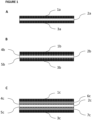
- Example multilayer biopolymer films according to embodiments of the present invention are shown in figures 1A-C .
- the biopolymer film comprises or consists of one or more biopolymer layer and one or more PGA layer.
- the biopolymer film has a layered structure comprising biopolymer layer - PGA layer - biopolymer layer. By sandwiching the PGA between two layers of biopolymer, the PGA is protected from hydrolysis and provides excellent long-term moisture and oxygen barrier properties.
- the biopolymer film may further comprise any suitable layers between the biopolymer and PGA layers and/or outside the biopolymer and PGA layers.
- the biopolymer film may further comprise one or more tie layer and/or one or more regrind layer between the biopolymer and PGA layers.
- the biopolymer film has a layered structure comprising or consisting of biopolymer layer - PGA layer - biopolymer layer.
- a layered structure comprising or consisting of biopolymer layer - PGA layer - biopolymer layer.
- the biopolymer film comprises or consists of biopolymer layer 1a, PGA layer 2a, and biopolymer layer 3a.
- the biopolymer film has a layered structure comprising or consisting of biopolymer layer - tie layer - PGA layer - tie layer - biopolymer layer.
- a layered structure comprising or consisting of biopolymer layer - tie layer - PGA layer - tie layer - biopolymer layer.
- the biopolymer film comprises or consists of biopolymer layer 1b, tie layer 4b, PGA layer 2b, tie layer 5b, and biopolymer layer 3b.
- the biopolymer film has a layered structure comprising or consisting of biopolymer layer - regrind layer - tie layer - PGA layer - tie layer - regrind layer - biopolymer layer.
- a layered structure comprising or consisting of biopolymer layer - regrind layer - tie layer - PGA layer - tie layer - regrind layer - biopolymer layer.
- the biopolymer film comprises or consists of biopolymer layer 1c, regrind layer 6c, tie layer 4c, PGA layer 2c, tie layer 5c, regrind layer 7c, and biopolymer layer 3c.
- the biopolymer film and each of the layers therein may have any suitable thickness.
- any thickness such that the biopolymer film may be used in a beverage capsule as a moisture barrier and a water barrier.
- the biopolymer film has a total thickness of about 0.10 mm or more, about 0.11 mm or more, about 0.12 mm or more, about 0.13 mm or more, about 0.14 mm or more, about 0.15 mm or more, about 0.16 mm or more, or about 0.17 mm or more.
- the biopolymer film has a total thickness of about 1.00 mm or less, about 0.90 mm or less, about 0.80 mm or less, about 0.75 mm or less, about 0.70 mm or less, about 0.65 mm or less, about 0.60 mm or less, about 0.55 mm or less, or about 0.50 mm or less.
- the biopolymer film has a total thickness of from about 0.10 mm to about 1.00 mm, from about 0.15 mm to about 0.70 mm, from about 0.16 mm to about 0.60 mm, or from about 0.17 mm to about 0.50 mm.
- each biopolymer layer has a thickness of about 0.001 mm or more, about 0.002 mm or more, about 0.003 mm or more, about 0.004 mm or more, about 0.005 mm or more, about 0.006 mm or more, about 0.007 mm or more, about 0.008 mm or more, about 0.009 mm or more, or about 0.01 mm or more.
- each biopolymer layer has a thickness of about 0.50 mm or less, about 0.40 mm or less, about 0.30 mm or less, about 0.20 mm or less, about 0.10 mm or less, or about 0.05 mm or less.
- each biopolymer layer has a thickness of from about 0.001 mm to about 0.50 mm, from about 0.002 mm to about 0.10 mm, or from about 0.003 mm to about 0.05 mm.
- each PGA layer has a thickness of about 0.001 mm or more, about 0.002 mm or more, about 0.003 mm or more, about 0.004 mm or more, about 0.005 mm or more, about 0.006 mm or more, about 0.007 mm or more, about 0.008 mm or more, about 0.009 mm or more, or about 0.01 mm or more.
- each PGA layer has a thickness of about 0.50 mm or less, about 0.40 mm or less, about 0.30 mm or less, about 0.20 mm or less, about 0.10 mm or less, or about 0.05 mm or less.
- each PGA layer has a thickness of from about 0.001 mm to about 0.50 mm, from about 0.002 mm to about 0.10 mm, or from about 0.003 mm to about 0.05 mm.
- a tie layer has a thickness of about 0.002 mm or more, about 0.003 mm or more, about 0.004 mm or more, about 0.005 mm or more, about 0.006 mm or more, about 0.007 mm or more, about 0.008 mm or more, about 0.009 mm or more, or about 0.010 mm or more.
- a tie layer has a thickness of about 0.030 mm or less, about 0.025 mm or less, about 0.020 mm or less, about 0.015 mm or less, or about 0.010 mm or less.
- a tie layer has a thickness of from about 0.002 mm to about 0.030 mm.
- a re-grind layer may have a thickness of up to about half the thickness of each PHA layer.
- a re-grind layer has a thickness of about 0.010 mm or more.
- a re-grind layer has a thickness of about 0.025 mm or less.
- a re-grind layer has a thickness of from about 0.010 mm to about 0.025 mm.
- the biopolymer film may be formed by any suitable method. Suitable methods may include co-extrusion, co-injection, lamination, coating, layer-by-layer assembly, electrospinning etc. (see e.g. Anukiruthika, T., et al., 2020. Comprehensive Reviews in Food Science and Food Safety, 19(3), pp.1156-1186 ).
- the biopolymer film is formed by co-extrusion.
- a co-extrusion process involves two or more polymeric materials, usually in the form of granules or pellets, being melted separately and then combined together and extruded as a single film with multiple layers.
- Common co-extrusion methods may include cast extrusion/flat die extrusion, blow extrusion, and sheet extrusion.
- the biopolymer film is formed by co-extrusion on a substrate (e.g. paper).
- the biopolymer film is formed by co-extrusion and subsequently thermoformed (e.g. directly into a capsule body or into a paper-based capsule body).
- the biopolymer film is formed by co-injection.
- Co-injection is a polymer injection technology in which different polymers are injected into the same mould.
- a co-injection process may involve injection of layers of flowing material through a nozzle assembly into a mould. The result is a multilayer film having layers.
- the biopolymer film is formed by annular co-injection.
- the biopolymer film is formed by lamination. Laminates can be manufactured by many methods, such as extrusion lamination, adhesive lamination, wax, and hot melt lamination.
- the biopolymer film is formed by coating. Coating techniques may include solvent-based coating, extrusion coating, aqueous dispersion, hot melt coating, and vacuum coating.
- the biopolymer film is formed by layer-by-layer assembly or by electrospinning.
- the biopolymer film may be used as the sole material forming the body of a beverage capsule or in combination with one or more other layers (e.g. a paper-based layer).
- the biopolymer film may be an oxygen barrier, a moisture barrier, and/or thermoformable.
- the biopolymer film is an oxygen barrier, a moisture barrier and thermoformable.
- the biopolymer film may be an oxygen barrier. Any suitable method may be used to determine whether the biopolymer film is an oxygen barrier.
- the biopolymer film has an oxygen transmission rate of about 1 cm 3 /m 2 /day/atm or less, about 0.5 cm 3 /m 2 /day/atm or less, about 0.4 cm 3 /m 2 /day/atm or less, about 0.3 cm 3 /m 2 /day/atm or less, about 0.2 cm 3 /m 2 /day/atm or less, or about 0.1 cm 3 /m 2 /day/atm or less.
- the oxygen transmission rate may be determined at 23°C/50% RH. In one embodiment, the oxygen transmission rate is determined according to ASTM D3985.
- the biopolymer film may be a moisture barrier. Any suitable method may be used to determine whether the biopolymer film is a moisture barrier.
- the biopolymer film has a water vapour transmission rate of about 10 g/m 2 /day or less, about 5 g/m 2 /day or less, about 4 g/m 2 /day or less, about 3 g/m 2 /day or less, about 2 g/m 2 /day or less, about 1 g/m 2 /day or less, about 0.5 g/m 2 /day or less, about 0.4 g/m 2 /day or less, about 0.3 g/m 2 /day or less, about 0.2 g/m 2 /day or less, or about 0.1 g/m 2 /day or less.
- the water vapour transmission rate may be determined at 23°C/85% RH. In one embodiment, the water vapour transmission rate is determined by ASTM E96. In one embodiment, the water vapour transmission rate is determined by ASTM F
- the biopolymer film may be thermoformable.
- a thermoformable film may be formed or shaped using heat and pressure. Any suitable method may be used to determine whether the biopolymer film is thermoformable.
- the biopolymer film has a melt flow index (MFI) of from about 0.5 g/10min to about 25 g/10min, from about 0.5 g/10min to about 20 g/10min, from about 0.5 g/10min to about 15 g/10min, from about 0.5 g/10min to about 10 g/10min, or from about 0.5 g/10min to about 5 g/10min.
- MFI melt flow index
- the biopolymer film has a melt flow index (MFI) of from about 0.5 g/10min to about 25 g/10min, from about 1 g/10min to about 25 g/10min, from about 2 g/10min to about 25 g/10min, from about 3 g/10min to about 25 g/10min, from about 4 g/10min to about 25 g/10min, from about 5 g/10min to about 25 g/10min, from about 10 g/10min to about 25 g/10min, from about 15 g/10min to about 25 g/10min, or from about 15 g/10min to about 20 g/10min.
- MFI melt flow index
- Suitable test load values for determining MFI are well known of the skilled person who can choose appropriately, for example depending on the type of polymer that is being tested.
- the MFI may be determined at 190°C or lower with a test load of 2.16 kg or 5 kg. In one embodiment, the MFI is determined at 190°C or lower with a test load of 2.16 kg. In one embodiment, the MFI is determined at 190°C or lower with a test load of 5 kg. In one embodiment, the MFI is determined by ASTM D1238.
- the biopolymer film may be resistant to lamination.
- a multi-layer film that is resistant to lamination may have strong adhesion between layers. Any suitable method may be used to determine the bond strength between layers.
- the layers have a bond strength of at least about 0.5 N/25 mm, at least about 1 N/25 mm, at least about 2 N/25 mm, at least about 3 N/25 mm, at least about 4 N/25 mm, or at least about 5 N/25 mm. In one embodiment, the bond strength is determined by ASTM F904.
- Polyglycolide or polyglycolic acid is a biodegradable aliphatic polyester and may have the following general chemical structure:
- PGA can be obtained by a number of processes starting with different reactants.
- Low molecular weight PGA can be obtained by polycondensation of glycolic acid.
- a number of process and technologies have been developed for synthesis of high molecular weight PGA.
- high molecular weight PGA can be obtained through the ring-opening polymerization of glycolide, the cyclic di-ester of glycolic acid (see e.g. Singh, V. and Tiwari, M., 2010. International Journal of Polymer Science, p.652719 ).
- the PGA has a molecular mass of at least about 10 kDa, at least about 15 kDa, at least about 20 kDa, at least about 30 kDa, at least about 40 kDa, at least about 50 kDa, at least about 60 kDa, or at least about 70 kDa.
- the PGA has a molecular mass of about 1000 kDa or less, about 750 kDa or less, or about 500 kDa or less.
- the PGA has a molecular mass of from about 10 kDa to about 1000 kDa, from about 15 kDa to about 750 kDa, from about 20 kDa to about 500 kDa, from about 30 kDa to about 500 kDa, from about 40 kDa to about 500 kDa, from about 50 kDa to about 500 kDa, from about 60 kDa to about 500 kDa, or from about 70 kDa to about 500 kDa.
- the PGA has a melting point of about 250°C or lower, about 240°C or lower, about 230°C or lower, about 220°C or lower, about 219°C or lower, about 218°C or lower, about 217°C or lower, about 216°C or lower, about 215°C or lower, about 214°C or lower, about 213°C or lower, about 212°C or lower, about 211°C or lower, or about 210°C or lower.
- the PGA has a melting point of about 200°C or higher, about 201°C or higher, about 202°C or higher, about 203°C or higher, about 204°C or higher, about 205°C or higher, about 206°C or higher, about 207°C or higher, about 208°C or higher, about 209°C or higher, or about 2010°C or higher.
- the PGA has a melting point of from about 200°C to about 250°C, from about 200°C to about 240°C, from about 200°C to about 230°C, from about 200°C to about 220°C, from about 200°C to about 219°C, from about 200°C to about 218°C, from about 200°C to about 217°C, from about 200°C to about 216°C, from about 200°C to about 215°C, from about 200°C to about 214°C, from about 200°C to about 213°C, from about 200°C to about 212°C, from about 200°C to about 211°C, or from about 200°C to about 210°C.
- the PGA may be functionalised and/or chemically modified by any suitable method.
- the PGA is chemically modified with one or more compatibilizers.
- the PGA is functionalised and chemically modified with one or more compatibilizers. Suitable agents for functionalisation and compatibilization are described herein in the sections entitled “Functionalisation” and “Compatibilizers”, respectively.
- the PGA layer may comprise or consist of a PGA blend.
- a "PGA blend” may consist of PGA and one or more other polymers (e.g. biopolymers). Using a PGA blend may improve the toughness and flexibility of the PGA layer, whilst maintaining temperature stability for hot beverage applications.
- the PGA layer comprises at least about 40 wt% PGA, at least about 45 wt% PGA, at least about 50 wt% PGA, at least about 55 wt% PGA, at least about 60 wt% PGA, at least about 65 wt% PGA, at least about 70 wt% PGA, at least about 75 wt% PGA, at least about 80 wt% PGA, at least about 85 wt% PGA, or at least about 90 wt% PGA.
- the PGA layer comprises about 99 wt% or less PGA, about 98 wt% or less PGA, about 97 wt% or less PGA, about 96 wt% or less PGA, or about 95 wt% or less PGA.
- the PGA layer comprises from about 40 wt% PGA to about 95 wt% PGA, from about 45 wt% PGA to about 95 wt% PGA, from about 50 wt% PGA to about 95 wt% PGA, from about 55 wt% PGA to about 95 wt% PGA, from about 60 wt% PGA to about 95 wt% PGA, from about 65 wt% PGA to about 95 wt% PGA, from about 70 wt% PGA to about 95 wt% PGA, from about 75 wt% PGA to about 95 wt% PGA, from about 80 wt% PGA to about 95 wt% PGA, from about 85 wt% PGA to about 95 wt% PGA, or from about 90 wt% PGA to about 95 wt% PGA.
- the PGA layer may comprise PGA blended with poly(butylene adipate-co-terephthalate) (PBAT), polycaprolactone (PCL), polylactic acid (PLA), and/or nanocellulose.
- PBAT poly(butylene adipate-co-terephthalate)
- PCL polycaprolactone
- PLA polylactic acid
- the PGA layer comprises PGA blended with: (a) PBAT, PCL, PLA, or any combination thereof; and (b) nanocellulose.
- the PGA layer comprises PGA blended with: (a) PBAT, PCL, or PLA; and (b) nanocellulose.
- the PGA layer comprises PGA blended with: (a) PBAT and/or PCL; and (b) nanocellulose.
- the PGA layer comprises PGA blended with: (a) PBAT or PCL; and (b) nanocellulose.
- the PGA layer comprises PGA blended with: (a) PBAT; and (b) nanocellulose. In one embodiment, the PGA layer comprises PGA blended with: (a) PCL; and (b) nanocellulose. In one embodiment, the PGA layer comprises PGA blended with: (a) PLA; and (b) nanocellulose.
- the PGA blend may be obtained by any method known in the art.
- the PGA blend may be obtained by melt blending.
- melt blending is a continuous process in which a polymer is run through a blending extruder and additives are introduced to the molten polymer as required.
- the PGA layer may further comprise one or more compatibilizers.
- a "compatibilizer” may refer to substance which can be added to an immiscible blend of polymers that will increase their stability.
- a compatibilizer may enhance the stability of the interface between two polymers by creating interactions between the two polymers.
- Polymer blends may be compatibilized by reactive or non-reactive strategies. In reactive compatibilization, polymers with reactive functional groups (e.g. anhydride, epoxy, isocyanates, etc.) react with other functional groups of the blended polymers to form graft and/or block copolymers which can act as compatibilizers. In non-reactive compatibilization, pre-made copolymers are used to improve the compatibility between the blended components.
- the PGA layer may comprise the one or more compatibilizers in any suitable amount.
- the PGA layer comprises one or more compatibilizers in a total amount of at least about 0.1 wt%, at least about 0.2 wt%, at least about 0.3 wt%, at least about 0.4 wt%, at least about 0.5 wt%, at least about 0.6 wt%, at least about 0.7 wt%, at least about 0.8 wt%, at least about 0.9 wt%, or at least about 1 wt%.
- the PGA layer comprises one or more compatibilizers in a total amount of about 10 wt% or less, about 9 wt% or less, about 8 wt% or less, about 7 wt% or less, about 6 wt% or less, about 5 wt% or less, about 4 wt% or less, about 3 wt% or less, about 2 wt% or less, or about 1 wt% or less.
- the PGA layer comprises one or more compatibilizers in a total amount of from about 0.1 wt% to about 10 wt%.
- the one or more compatibilizers comprise or consist of reactive compatibilizers. In one embodiment, the one or more compatibilizers consist of reactive compatibilizers. In one embodiment, the PGA is chemically modified with one or more reactive compatibilizers.
- a "reactive compatibilizers" may refer to a compatibilizer suitable for reactive compatibilization. Examples may include epoxy-based compatibilizers, acrylic-based compatibilizers, and maleic anhydride-based compatibilizers. Other compatibilizers with functionalities like isocyanates, silane, and oxazoline could also be used (see e.g. Muthuraj, R., et al., 2018. Journal of Applied Polymer Science, 135(24), p.45726 ).
- the one or more compatibilizers comprise or consist of epoxy-based compatibilizers. In one embodiment, the one or more compatibilizers consist of epoxy-based compatibilizers. In one embodiment, the PGA is chemically modified with one or more epoxy-based compatibilizers. During melt blending, an epoxy functionalised polymer can react with carboxyl and hydroxyl functional groups to form PGA copolymers.
- the one or more compatibilizers comprise or consist of acrylic-based compatibilizers. In one embodiment, the one or more compatibilizers consist of acrylic-based compatibilizers. In one embodiment, the PGA is chemically modified with one or more acrylic-based compatibilizers. During melt blending, an acrylate functionalised polymer can react with hydroxyl functional groups to form PGA copolymers.
- the one or more compatibilizers comprise or consist of maleic anhydride-based compatibilizers. In one embodiment, the one or more compatibilizers consist of maleic anhydride-based compatibilizers. In one embodiment, the PGA is chemically modified with one or more maleic anhydride-based compatibilizers. During melt blending, grafted maleic anhydride groups can react with hydroxyl functional groups to form PGA copolymers.
- the one or more compatibilizers comprise or consist of a terpolymer of ethylene, acrylic ester and glycidyl methacrylate (EMA-GMA), maleic anhydride (MAH), epoxidized soy-bean oil (ESO), epoxidized-acrylated soybean oil (AESO), maleinized soybean oil (MSO), and/or 4,4'-methylenebis(phenyl isocyanate) (MDI).
- EMA-GMA terpolymer of ethylene, acrylic ester and glycidyl methacrylate
- MAH maleic anhydride
- EEO epoxidized soy-bean oil
- AESO epoxidized-acrylated soybean oil
- MSO maleinized soybean oil
- MDI 4,4'-methylenebis(phenyl isocyanate)
- the one or more compatibilizers consist of a terpolymer of ethylene, acrylic ester and glycidyl methacrylate (EMA-GMA), maleic anhydride (MAH), epoxidized soy-bean oil (ESO), epoxidized-acrylated soybean oil (AESO), maleinized soybean oil (MSO), and/or 4,4'-methylenebis(phenyl isocyanate) (MDI).
- EMA-GMA terpolymer of ethylene, acrylic ester and glycidyl methacrylate
- MAH maleic anhydride
- EEO epoxidized soy-bean oil
- AESO epoxidized-acrylated soybean oil
- MSO maleinized soybean oil
- MDI 4,4'-methylenebis(phenyl isocyanate)
- the one or more compatibilizers comprise or consist of a terpolymer of ethylene, acrylic ester and glycidyl methacrylate (EMA-GMA). In one embodiment, the one or more compatibilizers consist of a terpolymer of ethylene, acrylic ester and glycidyl methacrylate (EMA-GMA) (see e.g. Ellingford, C., et al., 2022. Journal of Applied Polymer Science, 139(6), p.51617 ).
- the one or more compatibilizers comprise or consist of maleic anhydride (MAH). In one embodiment, the one or more compatibilizers consist of maleic anhydride (MAH).
- the one or more compatibilizers comprise or consist of epoxidized soy-bean oil (ESO), epoxidized-acrylated soybean oil (AESO), and/or maleinized soybean oil (MSO). In one embodiment, the one or more compatibilizers consist of epoxidized soy-bean oil (ESO), epoxidized-acrylated soybean oil (AESO), and/or maleinized soybean oil (MSO) (see e.g. Garcia-Campo, M.J., et al., 2017. Materials, 10(11), p.1339 ).
- the one or more compatibilizers comprise or consist of 4,4'-methylenebis(phenyl isocyanate) (MDI). In one embodiment, the one or more compatibilizers consist of 4,4'-methylenebis(phenyl isocyanate) (MDI).
- the one or more compatibilizers comprise or consist of one or more block or graft copolymer compatibilizers. In one embodiment, the one or more compatibilizers consist of one or more block or graft copolymer compatibilizers. Pre-made block or graft copolymers may be used to improve the compatibility between the blended components (see e.g. Ma, Z., et al., 2012. Bulletin of Materials Science, 35, pp.575-578 ). For example, when the PGA is blended with PBAT, the one or more compatibilizers may comprise or consist of a PGA/PBAT block copolymer, e.g.
- the one or more compatibilizers may comprise or consist of a PGA/PCL block copolymer, e.g. a poly(caprolactone-co-glycolic acid) (PCLGA) block copolymer, and/or when the PGA is blended with PLA, the one or more compatibilizers may comprise or consist of a PGA/PLA block copolymer, e.g. a poly(lactic-co-glycolic acid) (PDLGA) block copolymer.
- PCLGA poly(caprolactone-co-glycolic acid)
- the PGA layer may comprise any suitable amount of block or graft copolymer compatibilizers.
- the PGA layer comprises one or more block or graft copolymer compatibilizers in a total amount of at least about 0.5 wt%, at least about 1 wt%, at least about 2 wt%, at least about 3 wt%, at least about 4 wt%, or at least about 5 wt%.
- the PGA layer comprises one or more block or graft copolymer compatibilizers in a total amount of about 20 wt% or less, 15 wt% or less, 10 wt% or less, or 5 wt% or less.
- the PGA layer comprises one or more block or graft copolymer compatibilizers in a total amount of from about 0.5 wt% to about 20 wt%, or from about 1 wt% to about 10 wt%.
- the PGA layer comprises or consists of a PGA/PBAT blend. In one embodiment, the PGA layer consists of a PGA/PBAT blend.
- a PGA/PBAT blend may substantially consist of or consist of PGA, PBAT and, optionally, one or more compatibilizers. PGA/PBAT blends are described e.g. in Ellingford, C., et al., 2022. Journal of Applied Polymer Science, 139(6), p.51617 and Wang, R., et al., 2021. RSC advances, 11(3), pp.1241-1249 .
- PBAT Poly(butylene adipate-co-terephthalate)
- PBAT can be produced by polycondensation reaction of adipic acid, 1,4-butanediol, and terephthalic acid using conventional polyester manufacturing technology and equipment (see e.g. Jian, J., et al., 2020. Advanced Industrial and Engineering Polymer Research, 3(1), pp.19-26 ). Any suitable mol% of adipic acid, 1,4-butanediol, and terephthalic acid may be used, for example PBAT having a terephthalic acid of about 50 mol% or less has been reported to be compostable.
- the PBAT may be functionalised, e.g. by any method described in the section herein entitled "Functionalisation". In one embodiment the PBAT is maleated or acetylated.
- the PGA/PBAT blend comprises PBAT in an amount of at least about 1 wt%, at least about 2 wt%, at least about 3 wt%, at least about 4 wt%, at least about 5 wt%, at least about 6 wt%, at least about 7 wt%, at least about 8 wt%, at least about 9 wt%, or at least about 10 wt%.
- the PGA/PBAT blend comprises PBAT in an amount of about 50 wt% or less, about 45 wt% or less, about 40 wt% or less, about 35 wt% or less, about 30 wt% or less, about 25 wt% or less, about 20 wt% or less, about 15 wt% or less, or about 10 wt% or less.
- the PGA/PBAT blend comprises PBAT in an amount of from about 1 wt% to about 50 wt%, from about 5 wt% to about 50 wt%, from about 5 wt% to about 25 wt%, from about 5 wt% to about 20 wt%, or from about 5 wt% to about 15 wt%.
- the PGA/PBAT blend further comprises a terpolymer of ethylene, acrylic ester and glycidyl methacrylate (EMA-GMA), 4,4'-methylenebis(phenyl isocyanate) (MDI), and/or poly(butylene adipic acid/terephthalate-co-glycolic acid) (PBATGA) copolymer.
- EMA-GMA acrylic ester and glycidyl methacrylate
- MDI 4,4'-methylenebis(phenyl isocyanate)
- PBATGA poly(butylene adipic acid/terephthalate-co-glycolic acid) copolymer
- the PGA/PBAT blend comprises a terpolymer of ethylene, acrylic ester and glycidyl methacrylate (EMA-GMA) (see e.g. Ellingford, C., et al., 2022. Journal of Applied Polymer Science, 139(6), p.51617 ).
- EMA-GMA terpolymer of ethylene, acrylic ester and glycidyl methacrylate
- the PGA/PBAT blend comprises EMA-GMA in an amount of at least about 0.1 wt%, at least about 0.2 wt%, at least about 0.3 wt%, at least about 0.4 wt%, at least about 0.5 wt%, at least about 0.6 wt%, at least about 0.7 wt%, at least about 0.8 wt%, at least about 0.9 wt%, or at least about 1 wt%.
- the PGA/PBAT blend comprises EMA-GMA in an amount of about 40 wt% or less, about 35 wt% or less, about 30 wt% or less, about 25 wt% or less, about 20 wt% or less, about 15 wt% or less, or about 10 wt% or less.
- the PGA/PBAT blend comprises EMA-GMA in an amount of from about 1 wt% to about 40 wt%, from about 1 wt% to about 30 wt%, from about 1 wt% to about 25 wt%, from about 1 wt% to about 20 wt%, from about 1 wt% to about 15 wt%, or from about 1 wt% to about 10 wt%.
- the PGA/PBAT blend comprises 4,4'-methylenebis(phenyl isocyanate) (MDI) (see e.g. Wang, R., et al., 2021. RSC advances, 11(3), pp.1241-1249 ).
- MDI 4,4'-methylenebis(phenyl isocyanate)
- the PGA/PBAT blend comprises EMA-GMA in an amount of at least about 0.01 wt%, at least about 0.02 wt%, at least about 0.03 wt%, at least about 0.04 wt%, at least about 0.05 wt%, at least about 0.06 wt%, at least about 0.07 wt%, at least about 0.08 wt%, at least about 0.09 wt%, or at least about 0.1 wt%.
- the PGA/PBAT blend comprises EMA-GMA in an amount of about 5.0 wt% or less, about 4.5 wt% or less, about 4.0 wt% or less, about 3.5 wt% or less, about 3.0 wt% or less, about 2.5 wt% or less, about 2.0 wt% or less, about 1.5 wt% or less, or about 1.0 wt% or less.
- the PGA/PBAT blend comprises EMA-GMA in an amount of from about 0.1 wt% to about 5 wt%, from about 0.1 wt% to about 4 wt%, from about 0.1 wt% to about 3 wt%, or from about 0.1 wt% to about 2.5 wt%.
- the PGA/PBAT blend comprises poly(butylene adipic acid/terephthalate-co-glycolic acid) (PBATGA) copolymer.
- PBATGA poly(butylene adipic acid/terephthalate-co-glycolic acid)
- the PBATGA copolymer is a block copolymer (see e.g. Wang, Y., et al., 2022. International Journal of Molecular Sciences, 23(19), p.11074 ).
- the PGA/PBAT blend comprises PBATGA copolymer in an amount of at least about 0.1 wt%, at least about 0.2 wt%, at least about 0.3 wt%, at least about 0.4 wt%, at least about 0.5 wt%, at least about 0.6 wt%, at least about 0.7 wt%, at least about 0.8 wt%, at least about 0.9 wt%, or at least about 1 wt%.
- the PGA/PBAT blend comprises PBATGA copolymer in an amount of about 20 wt% or less, about 15 wt% or less, or about 10 wt% or less.
- the PGA/PBAT blend comprises PBATGA copolymer in an amount of from about 0.1 wt% to about 20 wt%, from about 0.5 wt% to about 15 wt%, or from about 1 wt% to about 10 wt%.
- the PGA layer comprises or consists of a PGA/PCL blend. In one embodiment, the PGA layer consists of a PGA/PCL blend.
- a PGA/PCL blend may substantially consist of or consist of PGA, PCL and, optionally, one or more compatibilizers. PGA/PCL blends are described e.g. in Aghdam, R.M., et al., 2012Journal of Applied Polymer Science, 124(1), pp.123-131 and Magazzini, L., et al., 2021. Polymers, 13(16), p.2780 .
- PCL Polycaprolactone
- PCL can be produced by ring opening polymerization of ⁇ -caprolactone using a catalyst (see e.g. Labet, M. and Thielemans, W., 2009. Chemical society reviews, 38(12), pp.3484-3504 ).
- the PCL may be functionalised, e.g. by any method described in the section herein entitled "Functionalisation".
- the PCL is maleated or acetylated.
- the PGA/PCL blend comprises PCL in an amount of at least about 1 wt%, at least about 2 wt%, at least about 3 wt%, at least about 4 wt%, at least about 5 wt%, at least about 6 wt%, at least about 7 wt%, at least about 8 wt%, at least about 9 wt%, or at least about 10 wt%.
- the PGA/PCL blend comprises PCL in an amount of about 50 wt% or less, about 45 wt% or less, about 40 wt% or less, about 35 wt% or less, about 30 wt% or less, about 25 wt% or less, about 20 wt% or less, about 15 wt% or less, or about 10 wt% or less.
- the PGA/PCL blend comprises PCL in an amount of from about 1 wt% to about 50 wt%, from about 5 wt% to about 50 wt%, from about 5 wt% to about 25 wt%, from about 5 wt% to about 20 wt%, or from about 5 wt% to about 15 wt%.
- the PGA/PCL blend comprises poly(caprolactone-co-glycolic acid) (PCLGA) copolymer.
- PCLGA poly(caprolactone-co-glycolic acid)
- the PCLGA copolymer is a block copolymer (see e.g. Hu, S., et al., 2023. Journal of Biomaterials Science, Polymer Edition, 34(3), pp.302-314 ).
- the PGA/PCL blend comprises PCLGA copolymer in an amount of at least about 0.1 wt%, at least about 0.2 wt%, at least about 0.3 wt%, at least about 0.4 wt%, at least about 0.5 wt%, at least about 0.6 wt%, at least about 0.7 wt%, at least about 0.8 wt%, at least about 0.9 wt%, or at least about 1 wt%.
- the PGA/PCL blend comprises PCLGA copolymer in an amount of about 20 wt% or less, about 15 wt% or less, or about 10 wt% or less.
- the PGA/PCL blend comprises PCLGA copolymer in an amount of from about 0.1 wt% to about 20 wt%, from about 0.5 wt% to about 15 wt%, or from about 1 wt% to about 10 wt%.
- the PGA layer comprises or consists of a PGA/PLA blend. In one embodiment, the PGA layer consists of a PGA/PLA blend.
- a PGA/PLA blend may substantially consist of or consist of PGA, PLA and, optionally, one or more compatibilizers.
- PGA/PLA blends are described e.g. in Magazzini, L., et al., 2021. Polymers, 13(16), p.2780 ; Ma, Z., et al., 2012. Bulletin of Materials Science, 35, pp.575-578 ; and Jem, K.J. and Tan, B., 2020. Advanced Industrial and Engineering Polymer Research, 3(2), pp.60-70 .
- Polylactic acid (also known as also known as poly(lactic acid) or polylactide) is a polyester composed of lactic acid monomers and may have the following general chemical structure:
- PLA can be produced ring-opening polymerization of lactide or by direct condensation of lactic acid monomers (see e.g. Cheng, Y., et al., 2009. Frontiers of chemistry in China, 4, pp.259-264 .).
- the PLA may be functionalised, e.g. by any method described in the section herein entitled "Functionalisation".
- the PLA is maleated or acetylated.
- the PGA/PLA blend comprises PLA in an amount of at least about 1 wt%, at least about 2 wt%, at least about 3 wt%, at least about 4 wt%, at least about 5 wt%, at least about 6 wt%, at least about 7 wt%, at least about 8 wt%, at least about 9 wt%, or at least about 10 wt%.
- the PGA/PLA blend comprises PLA in an amount of about 50 wt% or less, about 45 wt% or less, about 40 wt% or less, about 35 wt% or less, about 30 wt% or less, about 25 wt% or less, about 20 wt% or less, about 15 wt% or less, or about 10 wt% or less.
- the PGA/PLA blend comprises PLA in an amount of from about 1 wt% to about 50 wt%, from about 5 wt% to about 50 wt%, from about 5 wt% to about 25 wt%, from about 5 wt% to about 20 wt%, or from about 5 wt% to about 15 wt%.
- the PGA/PLA blend comprises poly(lactic-co-glycolic acid) (PDLGA) copolymer.
- PDLGA poly(lactic-co-glycolic acid)
- the PDLGA copolymer is a block copolymer (see e.g. Ma, Z., et al., 2012. Bulletin of Materials Science, 35, pp.575-578 ).
- the PGA/PLA blend comprises PDLGA copolymer in an amount of at least about 0.1 wt%, at least about 0.2 wt%, at least about 0.3 wt%, at least about 0.4 wt%, at least about 0.5 wt%, at least about 0.6 wt%, at least about 0.7 wt%, at least about 0.8 wt%, at least about 0.9 wt%, or at least about 1 wt%.
- the PGA/PLA blend comprises PDLGA copolymer in an amount of about 20 wt% or less, about 15 wt% or less, or about 10 wt% or less.
- the PGA/PLA blend comprises PDLGA copolymer in an amount of from about 0.1 wt% to about 20 wt%, from about 0.5 wt% to about 15 wt%, or from about 1 wt% to about 10 wt%.
- the PGA layer comprises nanocellulose.
- the PGA layer substantially consists of or consists of PGA an nanocellulose.
- the PGA layer substantially consists of or consists of: (a) PGA; (b) PBAT, PCL, PLA, or any combination thereof and, optionally, one or more compatibilizers; and (c) nanocellulose.
- the PGA layer substantially consists of or consists of: (a) PGA; (b) PBAT and optionally, one or more compatibilizers; and (c) nanocellulose.
- the PGA layer substantially consists of or consists of: (a) PGA; (b) PCL and optionally, one or more compatibilizers; and (c) nanocellulose.
- the PGA layer substantially consists of or consists of: (a) PGA; (b) PLA and optionally, one or more compatibilizers; and (c) nanocellulose.
- nanocellulose may refer to nanostructured cellulose and may include cellulose nanocrystal (CNC or NCC), microfibrillated cellulose (MFC), nanofibrillated cellulose (NFC), cellulose nanofibres (CNFs), and the like.
- CNC or NCC cellulose nanocrystal
- MFC microfibrillated cellulose
- NFC nanofibrillated cellulose
- CNFs cellulose nanofibres
- the first step for the preparation of cellulose nanomaterials generally consists in a purification step using chemical treatments to remove most of the non-cellulosic components. Mechanical processing can then be used to release the constitutive microfibrils (see e.g. Dufresne, A., 2018. Philosophical Transactions of the Royal Society A: Mathematical, Physical and Engineering Sciences, 376(2112), p.20170040 ).
- the nanocellulose comprises or consists of microfibrillated cellulose (MFC), cellulose nanocrystals (CNC), cellulose nanofibrils (CNF), or any combination thereof.
- the nanocellulose comprises or consists of microfibrillated cellulose (MFC).
- the nanocellulose comprises or consists of cellulose nanocrystals (CNC).
- the nanocellulose comprises or consists of cellulose nanofibrils (CNF).
- the PGA layer may comprise the nanocellulose in any suitable amount.
- the PGA layer comprises nanocellulose in an amount of at least about 0.01 wt%, at least about 0.02 wt%, at least about 0.03 wt%, at least about 0.04 wt%, at least about 0.05 wt%, at least about 0.06 wt%, at least about 0.07 wt%, at least about 0.08 wt%, at least about 0.09 wt%, or at least about 0.1 wt%.
- the PGA layer comprises nanocellulose in an amount of about 5.0 wt% or less, about 4.5 wt% or less, about 4.0 wt% or less, about 3.5 wt% or less, about 3.0 wt% or less, about 2.5 wt% or less, about 2.0 wt% or less, about 1.5 wt% or less, or about 1.0 wt% or less.
- the PGA layer comprises nanocellulose in an amount of from about 0.1 wt% to about 5.0 wt%, from about 0.1 wt% to about 4.0 wt%, from about 0.1 wt% to about 3.0 wt%, or from about 0.1 wt% to about 2.0 wt%.
- the nanocellulose may be modified, for example to aid blending of the nanocellulose with the PGA (and optionally PBAT, PCL, and/or PLA).
- Nanocellulose may be modified non-covalently (e.g. by anionic surfactant, non-ionic surfactant, or by ionic exchange) or covalently (e.g. by silyation, acetylation, polymer grafting, esterification, alkylation, silanization, or glyoxalization), see e.g. Oksman, K., et al., 2016. Composites Part A: Applied Science and Manufacturing, 83, pp.2-18 .
- the nanocellulose is modified prior to blending.
- the nanocellulose is functionalised.
- the nanocellulose is covalently functionalised.
- the nanocellulose is functionalised by acetylation, esterification, silanization, silylation, glyoxalization, or polymer (e.g. PCL, PEG, or GMA) grafting.
- the PGA layer may further comprise a functionalised biopolymer.
- Addition of a functionalised biopolymer may aid blending of the nanocellulose with the PGA (and optionally PBAT, PCL, and/or PLA) (see e.g. Ghasemi, S., et al., 2018. Journal of Thermoplastic Composite Materials, 31(8), pp.1090-1101 ).
- Any suitable functionalised biopolymer may be used, for example functionalised PBAT, functionalised PCL, and/or functionalised PLA.
- the functionalised biopolymer is maleated or acetylated.
- the PGA layer comprises a functionalised biopolymer in an amount of at least about 0.01 wt%, at least about 0.02 wt%, at least about 0.03 wt%, at least about 0.04 wt%, at least about 0.05 wt%, at least about 0.06 wt%, at least about 0.07 wt%, at least about 0.08 wt%, at least about 0.09 wt%, or at least about 0.1 wt%.
- the PGA layer comprises a functionalised biopolymer in an amount of about 10.0 wt% or less, about 9.0 wt% or less, about 8.0 wt% or less, about 7.0 wt% or less, about 6.0 wt% or less, about 5.0 wt% or less, about 4.5 wt% or less, about 4.0 wt% or less, about 3.5 wt% or less, about 3.0 wt% or less, about 2.5 wt% or less, about 2.0 wt% or less, about 1.5 wt% or less, or about 1.0 wt% or less.
- the PGA layer comprises a functionalised biopolymer in an amount of from about 0.1 wt% to about 10.0 wt%, from about 0.1 wt% to about 9.0 wt%, from about 0.1 wt% to about 8.0 wt%, from about 0.1 wt% to about 7.0 wt%, from about 0.1 wt% to about 6.0 wt%, or from about 0.1 wt% to about 5.0 wt%.
- the biopolymer layers may comprise, substantially consist of, or consist of any suitable biopolymer.
- the biopolymer layer is a moisture barrier. By sandwiching the PGA between two layers of biopolymer, the PGA is protected from hydrolysis.
- the biopolymer is a biodegradable thermoplastic polyester.
- the biopolymer is an aliphatic biopolyester.
- Suitable biopolymers may include polylactic acid (PLA), poly(butylene adipate-co-terephthalate) (PBAT), polycaprolactone (PCL), polybutylene succinate (PBS), poly (butylene succinate-co-L-lactate) (PBSL), poly(butylene succinate-co-butylene adipate) (PBSA), poly(butylene succinate-co-terephthalate) (PBST), poly(butylene sebacate-co-terephthalate) (PBSeT), Poly(ethylene adipate) (PEA), polyhydroxyalkanoates (PHA), and copolymers and/or blends thereof.
- PPA polylactic acid
- PBAT poly(butylene adipate-co-terephthalate)
- PCL polycaprolactone
- PBS polybutylene succ
- the biopolymer layers comprise, substantially consist of, or consist of polylactic acid (PLA), poly(butylene adipate-co-terephthalate) (PBAT), polycaprolactone (PCL), polybutylene succinate (PBS), poly (butylene succinate-co-L-lactate) (PBSL), poly(butylene succinate-co-butylene adipate) (PBSA), poly(butylene succinate-co-terephthalate) (PBST), poly(butylene sebacate-co-terephthalate) (PBSeT), Poly(ethylene adipate) (PEA), or polyhydroxyalkanoates (PHA).
- PLA polylactic acid
- PBAT poly(butylene adipate-co-terephthalate)
- PCL polycaprolactone
- PBS polybutylene succinate
- PBSL poly(butylene succinate-co-L-lactate)
- PBSA poly(butylene succinate-co-butylene a
- the biopolymer may be functionalised and/or chemically modified by any suitable method.
- the biopolymer is chemically modified with one or more compatibilizers.
- the biopolymer is functionalised and chemically modified with one or more compatibilizers. Suitable agents for functionalisation and compatibilization are described in the sections herein entitled “Functionalisation” and “Compatibilizers”, respectively.
- the biopolymer layers comprise or consist of a polyhydroxyalkanoate (PHA).
- PHA polyhydroxyalkanoate
- PHAs Polyhydroxyalkanoates
- PHA monomers More than 150 different PHA monomers have been identified, which renders them the largest group of natural polyester.
- Commonly synthesized PHA monomers include: 3-hydroxybutyrate, 3-hydroxyvalerate, 3-hydroxyhexanoate, 3-hydroxyoctanoate, 3-hydroxydecanoate, 3-hydroxydodecanoate and 3-hydroxyundecenoate.
- Exemplary PHAs include poly(3-hydroxybutyrate) (PHB), poly(3-hydroxyvalerate) (PHV), poly(3-hydroxybutyrate-co-3-hydroxyvalerate) (PHBV), poly(3-hydroxyhexanoate) (PHHx), poly(3-hydroxybutyrate-co-3-hydroxyhexanoate) (PHBH), poly(3-hydroxyoctanoate) (PHO), poly(3-hydroxydecanoate) (PHD), poly(3-hydroxydodecanoate) (PHDD), poly(3-hydroxyundecenoate) (PHU), and poly(3-hydroxyoctanoate-co-undecenoate) (PHOU).
- the PHA is selected from poly(3-hydroxybutyrate) (PHB), poly(3-hydroxyvalerate) (PHV), poly(3-hydroxybutyrate-co-3-hydroxyvalerate) (PHBV), poly(3-hydroxyhexanoate) (PHHx), poly(3-hydroxybutyrate-co-3-hydroxyhexanoate) (PHBH), poly(3-hydroxyoctanoate) (PHO), poly(3-hydroxydecanoate) (PHD), poly(3-hydroxydodecanoate) (PHDD), poly(3-hydroxyundecenoate) (PHU), poly(3-hydroxyoctanoate-co-undecenoate) (PHOU), and any copolymer and/or blend thereof.
- PHAs may be classified based on the chain length of the 3-hydroxyalkanoate repeat units.
- the PHA is selected from short-chain length PHAs, medium-chain length PHAs and long-chain length PHAs.
- the PHA is selected from medium-chain length PHAs and long-chain length PHAs.
- the PHA is selected from medium-chain length PHAs.
- a "short-chain length PHA" may comprise or consist of 3-hydroxyalkanoate repeat units having from 4 to 5 carbon atoms.
- a "medium-chain length PHA” may comprise or consist of 3-hydroxyalkanoate repeat units having from 6 to 14 carbon atoms.
- a "long-chain length PHA” may comprise or consist of 3-hydroxyalkanoate repeat units having greater than 14 carbon atoms.
- the PHA is selected from poly(3-hydroxyhexanoate) (PHHx), poly(3-hydroxybutyrate-co-3-hydroxyhexanoate) (PHBH), poly(3-hydroxyoctanoate) (PHO), poly(3-hydroxydecanoate) (PHD), poly(3-hydroxydodecanoate) (PHDD), poly(3-hydroxy undecenoate) (PHU), poly(3-hydroxy octanoate-co-undecenoate) (PHOU), and any copolymer and/or blend thereof.
- the PHA is selected from poly(3-hydroxyhexanoate) (PHHx), poly(3-hydroxybutyrate-co-3-hydroxyhexanoate) (PHBH), poly(3-hydroxyoctanoate) (PHO), poly(3-hydroxydecanoate) (PHD), poly(3-hydroxydodecanoate) (PHDD), poly(3-hydroxy undecenoate) (PHU), and poly(3-hydroxy octanoate-co-undecenoate) (PHOU).
- the PHA has a molecular mass of about 20 kDa or more, about 30 kDa or more, about 40 kDa or more, or about 50 kDa or more.
- the PHA has a molecular mass of about 1000 kDa or less, about 500 kDa or less, about 400 kDa or less, or about 300 kDa or less.
- the PHA has a molecular mass of from about 20 kDa to about 1000 kDa, from about 30 kDa to about 500 kDa, from about 40 kDa to about 400 kDa, or from about 50 kDa to about 300 kDa.
- the PHA has a molecular mass of from about 50 kDa to about 300 kDa.
- the PHA has a melting point of about 200°C or less, about 190°C or less, about 180°C or less, about 170°C or less, about 160°C or less, or about 150°C or less.
- the PHA has a melting point of about 100°C or more, about 110°C or more, about 120°C or more, about 130°C or more, or about 140°C or more.
- the PHA has a melting point of from about 100°C to about 200°C, from about 110°C to about 190°C, or from about 120°C to about 180°C.
- the polyhydroxyalkanoate may be functionalised and/or chemically modified, for example with one or more chain extenders and/or one or more compatibilizers.
- the PHA is functionalised.
- the PHA is chemically modified with one or more chain extenders and/or one or more compatibilizers.
- the PHA is functionalised and chemically modified with one or more chain extenders and/or one or more compatibilizers. Suitable agents for functionalisation and compatibilization are described herein in the section entitled "Compatibilizers".
- the PHA is functionalised and/or chemically modified by reactive extrusion.
- Reactive extrusion may refer to a method that combines the chemical processes (e.g. polymer synthesis and/or modification) and extrusion into a single process.
- the PHA is functionalised.
- “functionalisation” may refer to the addition of one or more functional group to the polymeric macromere.
- functional groups which may be added include carboxylic functional groups, hydroxyl functional groups, or epoxide functional groups.
- Functional groups may be added by carboxylation, hydroxylation, epoxidation, or by grafting. Suitable reaction conditions will be known to the skilled person (see e.g. Gumel, A.M., et al., 2014. Polyhydroxyalkanoate (PHA) based blends, composites and nanocomposites, pp.141-182 ).
- the PHA may be functionalised by any suitable method.
- the PHA may be functionalised by a method selected from carboxylation, hydroxylation, epoxidation, and grafting.
- the PHA may be functionalised by any suitable combination of methods.
- the PHA may be functionalised by two or more methods selected from carboxylation, hydroxylation, epoxidation, and grafting.
- the PHA is functionalised by carboxylation. In one embodiment, the PHA has carboxylic functional groups. Typically, an oxidative process is employed to carboxylate PHA with an unsaturated group.
- the PHA may be carboxylated using an oxidation agent in the presence of sodium bicarbonate or a crown ether.
- the PHA is functionalised by hydroxylation. In one embodiment, the PHA has hydroxyl functional groups. Typically, acid- or base-catalyzed reactions are used in the modification of PHA by hydroxylation in the presence of low molecular weight mono- or diol compounds.
- the PHA is functionalised by epoxidation.
- the PHA has epoxide functional groups. Epoxidation may be carried out, for example, using m-chloroperoxybenzoic acid.
- the PHA is functionalised by grafting.
- the PHA is a graft copolymer.
- Grafting reactions can be induced by either chemical, radiation or plasma discharge methods. Grafting methods include “grafting to", “grafting from”, and “grafting through” method.
- the "grafting through” approach is typically the simples process and involves copolymerising the PHA macromere with low molecular weight monomer by atom transfer radical polymerisation.
- the PHA is chemically modified with one or more chain extenders. In one embodiment, the PHA is functionalised and chemically modified with one or more chain extenders.
- a "chain extender” may refer to reagent which can link together two or more polymers or polymer chains.
- a chain extender is a low molecular weight molecule which reacts with the ends of polymers or polymer chains.
- Chain extenders may be bi-functional, i.e. have two functional groups which can link together two polymers or polymer chains, or poly-functional/multi-functional, i.e. having more than two functional groups which can link together more than two polymers or polymer chains. Suitable chain extenders will be well known to the skilled person.
- the one or more chain extenders are multi-functional chain extenders. By chemically modifying the PHA with multi-functional chain extenders a branched polymeric structure may be formed, thereby improving compatibility and/or processability of the PHA.
- the one or more chain extenders have two or more functional groups, the one or more chain extenders have three or more functional groups, four or more functional groups, or five or more functional groups.
- the one or more chain extenders can link together two or more polymers or polymer chains, three or more polymers or polymer chains, four or more polymers or polymer chains, or five or more polymers or polymer chains.
- Chain extenders can employ a variety of reaction mechanisms and generally fall into two categories: addition-type chain extenders and activating-type chain extenders.
- Addition-type chain extenders consist of at least two electrophilic sites and can form a permanent bridge between at least two polymers or polymer chains.
- Activating-type chain extenders are composed of an electrophilic site connected to suitably labile substituents and act as intermediate for a substitution reaction linking the ends of two polymers or polymer chains.
- the one or more chain extenders are addition-type chain extenders.
- addition-type chain extenders are typically carbon electrophiles, such as epoxides, isocyanates and anhydrides, or are based on heterocyclic molecules such as phenylene bisoxazolin.
- the one or more chain extenders are addition-type chain extenders that react with carboxyl and/or hydroxyl terminal groups.
- the one or more chain extenders comprise or consist of one or more addition-type chain extenders that react with carboxyl terminal groups.
- the one or more chain extenders consist of one or more addition-type chain extenders that react with carboxyl terminal groups.
- the one or more chain extenders comprise or consist of one or more addition-type chain extenders that react with hydroxyl terminal groups.
- the one or more chain extenders consist of one or more addition-type chain extenders that react with hydroxyl terminal groups. In one embodiment, the one or more chain extenders comprise or consist of one or more addition-type chain extenders that react with carboxyl terminal groups and hydroxyl terminal groups. In one embodiment, the one or more chain extenders consist of one or more addition-type chain extenders that react with carboxyl terminal groups and hydroxyl terminal groups.
- Any suitable chain extender may be used, for example any epoxy-based chain extender, phosphate/phosphite-based chain extender, carbodiimide based chain extender, or an anhydride-based chain extender.
- Suitable chain extenders are known in the art (see e.g. Standau, T., et al., 2019. Polymers, 11(2), p.306 ).
- the one or more chain extenders comprise or consist of (multi-functional) epoxy-based chain extenders. In one embodiment, the one or more chain extenders consist of (multi-functional) epoxy-based chain extenders. Epoxy-based chain extenders may react with both with carboxyl and hydroxyl end groups.
- a particularly preferred epoxy-based chain extender is the Joncryl ® ADR series, including Joncryl ® ADR 4368, Joncryl ® ADR 4468, Joncryl ® ADR 4300, and Joncryl ® ADR 4380 (see e.g. Frenz, V., et al., 2008. In Tech. Pap. Reg. Tech. Conf. Soc. Plast. Eng., Vol. 3, pp. 1678-1682 ).
- the epoxy-based chain extender is Joncryl ® ADR 4368.
- Joncryl ® ADR may have the following chemical structure (see AI-Itry, R., et al., 2012. Polymer Degradation and Stability, 97(10), pp.1898-1914 ): wherein R 1 -R 5 are each independently selected from hydrogen, methyl, and alkyl groups, wherein R 6 is an alkyl group, and wherein x, y and z are independently from 1 to 20.
- z is ⁇ 2, ⁇ 3, ⁇ 4, or > 5.
- the one or more chain extenders comprise or consist of (multi-functional) phosphate/phosphite-based chain extenders. In one embodiment, the one or more chain extenders consist of (multi-functional) phosphate/phosphite-based chain extenders. Phosphate/phosphite-based chain extenders may react with both carboxyl and hydroxyl end-groups. Examples of suitable phosphate/phosphite-based chain extenders include triphenylphosphite (TPP) or tris(nonyl-phenyl)phosphite (TNPP). In one embodiment, the phosphate/phosphite-based chain extender is triphenylphosphite (TPP). In one embodiment, the phosphate/phosphite-based chain extender is tris(nonyl-phenyl)phosphite (TNPP).
- TPP triphenylphosphite
- TNPP tris(nonyl-phenyl)pho
- the one or more chain extenders comprise or consist of (multi-functional) carbodiimide-based chain extenders. In one embodiment, the one or more chain extenders consist of (multi-functional) carbodiimide-based chain extenders. Carbodiimide-based chain extenders may react with hydroxyl end-groups. Examples of suitable carbodiimide-based chain extenders include polycarbodiimide (PCDI).
- PCDI polycarbodiimide
- the one or more chain extenders comprise or consist of (multi-functional) isocyanate-based chain extenders. In one embodiment, the one or more chain extenders consist of (multi-functional) isocyanate-based chain extenders. Isocyanate-based chain extenders may react with hydroxyl end-groups. Examples of suitable carbodiimide-based chain extenders include triisocyanate.
- the one or more chain extenders comprise or consist of (multi-functional) anhydride-based chain extenders.
- the one or more chain extenders consist of (multi-functional) anhydride-based chain extenders.
- Anhydride-based chain extenders may react with hydroxyl end-groups. Examples of suitable anhydride-based chain extenders include pyromellitic dianhydride (PMDA).
- the biopolymer film may comprise any other suitable layers, in addition to biopolymer and PGA layers.
- the biopolymer film may comprise one or more tie layers and/or one or more re-grind layers.
- the biopolymer film comprises one or more tie layers and one or more re-grind layers.
- the biopolymer film comprises one or more tie layers.
- the biopolymer film comprises a layered structure comprising or consisting of biopolymer layer - tie layer - PGA layer - biopolymer layer. In one embodiment, the biopolymer film comprises a layered structure comprising or consisting of biopolymer layer - tie layer - PGA layer - tie layer - biopolymer layer.
- a "tie layer” may refer to a polymer layer designed to provide adhesion between two other polymer layers.
- tie layers may be sandwiched between polymer layers that do not bond on their own, or which only bond weakly.
- tie layers may comprise copolymers of polar and nonpolar repeat units and with or without functional reactive groups.
- the skilled person is able to select a suitable tie layer resin depending on the polymer layers to be bonded and on the adhesive strength needed.
- a tie layer may comprise or consist of an adhesive resin or a compatibilizer.
- the one or more tie layers comprise or consist of one or more adhesive resins. In one embodiment, the one or more tie layers consist of one or more adhesive resins.
- Example adhesive resins include ethylene vinyl acetate (EVA), ethylene methyl acrylate (EMA), ethylene acrylic acid (EAA) and ethylene methacrylic acd (EMAA).
- EVA ethylene vinyl acetate
- EMA ethylene methyl acrylate
- EAA ethylene acrylic acid
- EAA ethylene methacrylic acd
- the one or more tie layers comprise or consist of one or more biodegradable adhesive resins.
- a particularly preferred biodegradable adhesive resin is BTR8002P, which is an acid-modified polyester resin biodegradable tie layer available from Mitsubishi Chemicals.
- the one or more tie layers comprise BTR8002P.
- the one or more tie layers consist of BTR8002P.
- the one or more tie layers comprise or consist of one or more compatibilizers. In one embodiment, the one or more tie layers consist of one or more compatibilizers. Suitable compatibilizers for use in the tie layers are described herein in the section entitled "Compatibilizers”.
- the biopolymer film comprises one or more regrind layers.
- the biopolymer film comprises a layered structure comprising or consisting of biopolymer layer- regrind layer - PGA layer - biopolymer layer. In one embodiment, the biopolymer film comprises a layered structure comprising or consisting of biopolymer layer - regrind layer - PGA layer - regrind layer - biopolymer layer. In one embodiment, the biopolymer film comprises a layered structure comprising or consisting of biopolymer layer - regrind layer - PGA layer - tie layer - biopolymer layer.
- the biopolymer film comprises a layered structure comprising or consisting of biopolymer layer - regrind layer - tie layer - PGA layer - tie layer - biopolymer layer. In one embodiment, the biopolymer film comprises a layered structure comprising or consisting of biopolymer layer - regrind layer - tie layer - PGA layer - tie layer - regrind layer - biopolymer layer. In other embodiments, the biopolymer film comprises a layered structure comprising or consisting of PHA layer - tie layer - regrind layer - PGA layer - regrind layer - tie layer - PHA layer.
- a "regrind layer” may refer to a layer comprising or consisting of a blend of the materials of all layers of the film.
- Regrind may be produced from scrap material and re-used in the film to reduce costs or improve compatibilization.
- including a regrind layer may mean that the thickness of the other layers may be reduced, whilst maintaining barrier properties.
- the one or more regrind layers may be obtained by processing waste biopolymer film.
- the one or more regrind layers may comprise or consist of a blend of the other layers of the biopolymer film.
- the one or more regrind layers comprise a blend of biopolymer and PGA.
- the biopolymer and PGA may be any described herein in the sections entitled "Biopolymer layers” and “Polyglycolide (PGA) layers", respectively.
- the one or more regrind layers further comprises a tie layer resin.
- the tie layer resin may be any described herein in the section entitled "Tie layers".
- the one or more regrind layers consist of biopolymer, PGA, and a tie layer resin. The relative amount of each of the biopolymer, PGA, and optional tie layer resin in the one or more regrind layers may be equal to that found in the biopolymer film.
- the regrind layer resin may undergo any suitable processing steps to improve its properties.
- the one or more regrind layers may comprise or consist of regenerate formed by solid state polymerization (SSP) and/or chain extension.
- the one or more regrind layers comprise or consist of regenerate formed by solid state polymerization (SSP).
- the one or more regrind layers comprise or consist of regenerate formed by chain extension.
- the regrind layers comprise or consist of regenerate formed by chain extension by reactive extrusion.
- Solid State Polymerization (SSP) may refer to a process in which the polymer chain lengths are increased by heat in the absence of oxygen and water.
- Chain extension may refer to a process in which chain extenders react with polymer chains to increase their molecular weight. Suitable chain extenders are described herein in the section entitled "Chain extenders”.
- a "paper-based layer” may comprise or consist of paper pulp.
- the pulp may comprise cellulose fibres. Any suitable source of pulp may be used in the present invention.
- the major industrial source of pulp is vascular plants, e.g. wood.
- the pulp may comprise small amounts of lignin and/or hemicellulose and may comprise water and other additives.
- the paper-based layer comprises or consists of recycled paper pulp. In preferred embodiments, the paper-based layer is compostable.
- a paper-based layer has a thickness of about 0.020 mm or more, about 0.030 mm or more, about 0.040 mm or more, about 0.050 mm or more, about 0.060 mm or more, about 0.070 mm or more, about 0.080 mm or more, about 0.090 mm or more, or about 0.10 mm or more.
- a paper-based layer has a thickness of about 1.2 mm or less, about 1.1 mm or less, about 1.0 mm or less, about 0.9 mm or less, about 0.8 mm or less, about 0.7 mm or less, about 0.6 mm or less, about 0.5 mm or less, about 0.4 mm or less, about 0.3 mm or less, about 0.25 mm or less, about 0.2 mm or less, or about 0.15 mm or less.
- a paper-based layer has a thickness of from about 0.020 mm to about 1.2 mm.
- the paper-based layer has a thickness of from about 0.020 mm to about 0.15 mm. In other embodiments, for example when the biopolymer film is attached to a paper-based layer after moulding of the paper-based layer, the paper-based layer has a thickness of from about 0.08 mm to about 1.2 mm.
- the biopolymer film may be attached to a paper-based layer by any suitable method.
- the biopolymer film may be attached to a paper-based layer prior to moulding (e.g. by co-extrusion lamination or coating of the biopolymer film onto a paper-based substrate).
- the biopolymer film may be attached to a paper-based layer after moulding of the paper-based layer (e.g. by inserting a moulded biopolymer film into the moulded paper-based layer, or by thermoforming the biopolymer film into the moulded paper-based layer).
- the present invention provides a capsule obtainable by or obtained by the method of the present invention.
- the capsule may be used to prepare a beverage, for example by injecting pressurized liquid into the capsule according to the present invention and allowing a beverage to flow out of the capsule.
- beverage capsule encompasses single use packages for preparing beverages by insertion in a beverage preparation device that is adapted to inject a fluid (e.g. hot water) into the package for mixing with a substance contained therein.
- a fluid e.g. hot water
- beverage packages are not limited to rigid or semi-rigid capsules, but may also comprise rigid, semi-rigid, or flexible pods, pads, cartridges of various types, and even sachet-type containers.
- the beverage capsule is a rigid or semi-rigid capsule.
- the beverage capsule is a rigid capsule.
- a beverage capsule may comprise a capsule body defining a compartment for containing a substance for preparation of a beverage, such as roast and ground coffee.
- the present invention provides a capsule body obtainable by or obtained by the method of the present invention.
- the capsule body may be any suitable shape.
- the capsule body is a cup-shaped body.
- the capsule body comprises a bottom wall, a lateral wall and an annular flange or rim for a cover to seal thereon.
- a beverage capsule 8 comprising a capsule body defining a compartment 12 for containing a substance for preparation of a beverage, wherein the capsule body comprises a bottom wall 9, a lateral wall 10 and an annular flange or rim 11.
- the bottom wall 9 may be pierced by a piercing member of a beverage preparation device and liquid injected under pressure into the compartment 12.
- the bottom wall is adapted to be pierced by a piercing member of a beverage preparation device.
- the lateral wall 10 when seen in a longitudinal section, is inclined with respect to a longitudinal axis of the capsule body.
- the capsule body may be closed by attaching (e.g. by sealing) a cover, for instance a membrane or a film, to it.
- the capsule body comprises an annular flange or rim onto which a cover is attached.
- a cover for instance, a membrane or a film
- the capsule body comprises an annular flange or rim onto which a cover is attached.
- a beverage capsule 8 comprising a cover 13.
- the cover is an oxygen barrier and a moisture barrier.
- the cover may be made from any known material, for example an extrusion coated paper, a fiber-spinning coated paper, or a polymer film.
- the cover is made from a compostable material (e.g. a biopolymer film).
- the cover When the pressure increases in the capsule following injection and reaches a certain level, the cover may deflect outwardly and pierce onto a piercing means of the beverage preparation device. When the cover is pierced, the beverage can flow outside the capsule.
- the cover is adapted to pierce onto opening means of a beverage preparation device when pressure inside the capsule reaches a pre-determined value.
- the biopolymer film and the cover overlap.
- the overlap is from about 1 mm to about 3 mm. Such an overlap can reduce gas or moisture penetration.
- the biopolymer film forms the capsule body.
- a paper-based layer forms the capsule body and the biopolymer film is attached to the paper-based layer (e.g. is a barrier layer).
- the paper-based layer forms the exterior surface of the capsule body.
- the paper-based layer forms the interior surface of the capsule body.
- the capsule may contain a substance for preparation of a beverage.
- the substance may be selected from roast and ground coffee, compacted or not, soluble powder coffee, or leaf tea. Dairy ingredients (e.g., milk or creamer) can also be included.
- the substance for preparation of a beverage is roast and ground coffee, a soluble ingredient, or a mix of soluble ingredients.
- the substance for preparation of a beverage is roast and ground coffee.
- the injected liquid may interact with the substance contained therein to obtain a beverage. In preferred embodiments, the injected liquid is hot water.
- the capsule may be essentially oxygen-free. Empty space in the compartment defined by the capsule body and the cover may be saturated with an inert gas such as nitrogen, carbon dioxide, and combinations thereof.
- an inert gas such as nitrogen, carbon dioxide, and combinations thereof.
- the capsule has an internal pressure of gas above atmospheric pressure, due to the gas contained in the coffee and emanating in the compartment after sealing, such as carbon dioxide.
- the capsule is biodegradable. In one embodiment, the capsule is biodegradable in compost, soil, and/or marine environments. In one embodiment, the capsule is biodegradable in compost, soil, and marine environments.
- the capsule is compostable.
- a "compostable" product may be one that is biodegradable under aerobic conditions, without producing any toxic compounds (see e.g. Helanto, K.E., et al., 2019. BioResources, 14(2), pp.4902-49510 ). Any standard may be used to assess whether a product is compostable. Suitable standards to assess compostability include AS 4736, ASTM D5338, ASTM D6002, EN 13432, and ISO 14855.
- the capsule is home compostable.
- Home compostability may be defined on a national level based on international standard EN 13432. Materials or products compliant with these standards can be recognised by a conformity mark stating their home compostability.
- Some examples of home composability certifications at a national level include, but are not limited to, the following.
- the certifier TUV AUSTRIA BELGIUM offers such a home composability certification scheme
- DIN CERTCO offers a certification for home composability according to the Australian standard AS 5810. Italy has a national standard for composting at ambient temperature, UNI 11183:2006. In November 2015, the French Standard "NF T 51-800 Plastics - Specifications for plastics suitable for home composting" was introduced. This standard is covered in the DIN CERTCO scheme.
- the capsule is single-use.
- a "single-use” product may be one that is designed to be used once and then disposed of.
- the capsule is a single-serve beverage capsule.
- a "single-serve” capsule may be one that is designed to prepare only enough beverage for a single portion.
- the capsule has a shelf-life of at least about 2 months, at least about 3 months, at least about 4 months, at least about 5 months, at least about 6 months, at least about 7 months, at least about 8 months, at least about 9 months, or at least about 12 months. In one embodiment, the capsule has a shelf-life of from about 3 to about 12 months or from about 6 to about 9 months.
- the shelf-life may be assessed by any suitable method known in the art, for example by gas chromatography-mass spectrometry and/or consumer evaluation. For example, the shelf-life may be determined by monitoring the ratio of dimethyl disulfide/methanethiol and/or 2-butanone/methanethiol (see e.g. Glöss, A., et al., 2014. Chimia, 68(3), pp.179-182 ).
Landscapes
- Engineering & Computer Science (AREA)
- Mechanical Engineering (AREA)
- Life Sciences & Earth Sciences (AREA)
- Biodiversity & Conservation Biology (AREA)
- Physics & Mathematics (AREA)
- Thermal Sciences (AREA)
- Laminated Bodies (AREA)
Abstract
Description
- The present invention relates to methods of manufacturing beverage capsules, wherein the capsule body comprises or consists of a biopolymer film.
- Capsules for beverage preparation in a beverage preparation device are well known, for example coffee capsules. Beverage capsules can both reduce the time needed to brew a beverage and simplify the brewing process by eliminating the need to measure out portions, flavourings, and additives from large bulk containers. Beverage capsules can also help to keep the unused product fresher by individually packaging portions separately without exposing the entire batch to air and light.
- Beverage capsules may be manufactured from plastics such as polyolefins, that are generally injected or thermoformed to obtain a cup-shaped body that is subsequently filled with a substance for preparation of a beverage and then closed with a cover to close the capsule in a gas and moisture tight manner. Typically, to prepare the beverage, the beverage capsule is inserted into a beverage preparation device, liquid is injected under pressure into the capsule, and the beverage is dispensed through the capsule cover.
- With increasing environmental awareness, and in order to ensure that plastic waste is reduced, there is a need for new beverage capsule packaging solutions that are either biodegradable after use or recyclable. For example, such that the used capsule can either be composted or recycled in a recycling stream. Extensive efforts are being made to develop new beverage capsule packaging materials that are rapidly and easily biodegradable or recyclable, including for example packaging materials comprising biodegradable polymers produced by living organisms, such as aliphatic biopolyesters.
- However, many biopolyesters do not have sufficient barrier properties, to ensure freshness of the substance for preparation of the beverage over the lifetime of the capsule, and especially during storage of the beverage capsule until use. Modification of biopolymers is one way to improve their properties and achieve property combinations required for specific applications. One modification technique is blending. However, blending of biopolyesters can be complex. Alternatively, multi-layered materials may be considered, since multi-layered films may have better mechanical, barrier and controlled release properties compared to mono-layered films.
- However, it is challenging to successfully manufacture beverage capsules comprising multi-layered bio-based materials that have sufficient barrier properties.
- The present inventors have developed a method of manufacturing a beverage capsule comprising a multi-layered biopolymer film, wherein the biopolymer film comprises PGA. By sandwiching the PGA between two biopolymer layers, the PGA is protected from hydrolysis and provides excellent long-term moisture and oxygen barrier properties. The multi-layer biopolymer film has excellent moisture and oxygen barrier properties and reduced sensitivity to hydrolysis. The multi-layer biopolymer film is thermally stable, allowing use under high temperature conditions in a beverage preparation device. The multi-layer biopolymer film is biodegradable in soil, home composting, industrial compositing, and marine conditions.
- In one aspect, the present invention provides a method of manufacturing a beverage capsule, the method comprising: (a) providing a biopolymer film, wherein the biopolymer film comprises a layered structure comprising biopolymer layer - polyglycolide (PGA) layer - biopolymer layer; and (b) thermoforming the biopolymer film to form at least one layer of a capsule body comprising or consisting of the biopolymer film.
- In one embodiment, the capsule body consists of the biopolymer film. In one embodiment, the method comprises: (i) thermoforming the biopolymer film, optionally into a cup-shape; (ii) inserting the thermoformed biopolymer film into a paper-based capsule body; and (iii) optionally, further forming or moulding the biopolymer film, to provide a capsule body comprising a paper-based layer and the biopolymer film. In one embodiment, the method comprises thermoforming the biopolymer film inside a paper-based capsule body to provide a capsule body comprising a paper-based layer and the biopolymer film. In one embodiment, the method comprises: (i) attaching the biopolymer layer to a paper-based layer to provide a multi-layer structure; and (ii) forming the multi-layer structure to provide a capsule body comprising a paper-based layer and the biopolymer film. In one embodiment, the paper-based layer forms an exterior surface of the capsule body. In one embodiment, the paper-based layer forms an interior surface of the capsule body.
- In one aspect, the present invention provides a method of manufacturing a beverage capsule, the method comprising: (a) providing a biopolymer film, wherein the biopolymer film comprises a layered structure comprising biopolymer layer - polyglycolide (PGA) layer - biopolymer layer; and (b) thermoforming the biopolymer film to form a capsule body consisting of the biopolymer film.
- In one aspect, the present invention provides a method of manufacturing a beverage capsule, the method comprising: (a) providing a biopolymer film, wherein the biopolymer film comprises a layered structure comprising biopolymer layer - polyglycolide (PGA) layer - biopolymer layer; (b) thermoforming the biopolymer film; (c) inserting the formed biopolymer film into a paper-based capsule body; and (d) optionally, further forming or moulding the biopolymer film, to provide a capsule body comprising or consisting of a paper-based layer and the biopolymer film.
- In one aspect, the present invention provides a method of manufacturing a beverage capsule, the method comprising: (a) providing a biopolymer film, wherein the biopolymer film comprises a layered structure comprising biopolymer layer - polyglycolide (PGA) layer - biopolymer layer; and (b) thermoforming the biopolymer film inside a paper-based capsule body, to provide a capsule body comprising or consisting of a paper-based layer and the biopolymer film.
- In one aspect, the present invention provides a method of manufacturing a beverage capsule, the method comprising: (a) providing a biopolymer film, wherein the biopolymer film comprises a layered structure comprising biopolymer layer - polyglycolide (PGA) layer - biopolymer layer, and attaching the biopolymer film to a paper-based layer to provide a multi-layer structure comprising a paper-based layer and a biopolymer layer; and (b) forming the multi-layer structure to provide a capsule body comprising or consisting of a paper-based layer and the biopolymer film.
- In another aspect, the present invention provides use of a biopolymer film for manufacturing a beverage capsule by thermoforming, wherein the biopolymer film comprises a layered structure comprising biopolymer layer - polyglycolide (PGA) layer - biopolymer layer.
- In another aspect, the present invention provides use of a biopolymer film for manufacturing a beverage capsule by lamination and thermoforming, wherein the biopolymer film comprises a layered structure comprising biopolymer layer - polyglycolide (PGA) layer - biopolymer layer.
- Any suitable thermoforming conditions may be used. Suitably, the biopolymer film is thermoformed at a temperature of at least 60°C, at least 70°C, or at least 80°C. Suitably, the biopolymer film is thermoformed at a temperature of 220°C or lower, 210°C or lower, 200°C or lower, 190°C or lower, 180°C or lower, 170°C or lower, 160°C or lower, 150°C or lower, 140°C or lower, 130°C or lower, 120°C or lower, 110°C or lower, 100°C or lower. Suitably, the biopolymer film is thermoformed at a temperature of from 60°C to 220°C, from 60°C to 200°C, from 60°C to 180°C, from 60°C to 160°C, from 60°C to 140°C, from 60°C to 120°C, or from 70°C to 110°C. Suitably, the biopolymer film is contacted with a mould for at least 1 second, at least 2 seconds, at least 3 seconds, at least 4 seconds, at least 5 seconds, at least 10 seconds, or at least 20 seconds. Suitably, the biopolymer film is contacted with a mould for 30 seconds or less. Suitably, the biopolymer film is contacted with a mould for from 1 to 30 seconds, from 2 to 30 second, or from 3 to 30 seconds. Suitably, the biopolymer film is thermoformed by vacuum forming, pressure forming, or mechanical forming.
- Any suitable PGA may be used in the present invention. Suitably, the PGA has a molecular mass of from about 20 kDa to about 500 kDa, from about 30 kDa to about 500 kDa, from about 40 kDa to about 500 kDa, from about 50 kDa to about 500 kDa, from about 60 kDa to about 500 kDa, or from about 70 kDa to about 500 kDa. Suitably, the PGA layer has a melting point of 220°C or lower, 219°C or lower, 218°C or lower, 217°C or lower, 216°C or lower, 215°C or lower, 214°C or lower, 213°C or lower, 212°C or lower, 211°C or lower, or 210°C or lower. Suitably, the PGA layer comprises at least 50 wt% PGA, at least 55 wt% PGA, at least 60 wt% PGA, at least 65 wt% PGA, at least 70 wt% PGA, at least 75 wt% PGA, at least 80 wt% PGA, at least 85 wt% PGA, or at least 90 wt% PGA.
- In one embodiment, the PGA layer comprises PGA blended with poly(butylene adipate-co-terephthalate) (PBAT), polycaprolactone (PCL), polylactic acid (PLA), and/or nanocellulose. In one embodiment, the PGA layer further comprises one or more compatibilizers. Suitably, the PGA layer comprises one or more compatibilizers in a total amount of from 0.1 wt% to 10 wt%. In one embodiment, the PGA layer comprises or consists of a PGA/PBAT blend. Suitably, the PGA/PBAT blend comprises PBAT in an amount of from 5 wt% to 50 wt%, from 5 wt% to 25 wt%, from 5 wt% to 20 wt%, or from 5 wt% to 15 wt%. In one embodiment, the PGA layer comprises or consists of a PGA/PCL blend. Suitably, the PGA/PCL blend comprises PCL in an amount of from 5 wt% to 50 wt%, from 5 wt% to 25 wt%, from 5 wt% to 20 wt%, or from 5 wt% to 15 wt%. In one embodiment, the PGA layer comprises or consists of a PGA/PLA blend. Suitably, the PGA/PLA blend comprises PLA in an amount of from 5 wt% to 50 wt%, from 5 wt% to 25 wt%, from 5 wt% to 20 wt%, or from 5 wt% to 15 wt%. In one embodiment, the PGA layer comprises nanocellulose. The nanocellulose may comprise or consist of microfibrillated cellulose (MFC), cellulose nanocrystals (CNC), cellulose nanofibrils (CNF), or any combination thereof. Suitably, the PGA layer comprises nanocellulose in a total amount of from 0.1 wt% to 2 wt%.
- Any suitable biopolymer may be used in the biopolymer layers. Suitably, the biopolymer layers are moisture barriers. In one embodiment, the biopolymer layers comprise or consist of a biopolymer selected from polylactic acid (PLA), poly(butylene adipate-co-terephthalate) (PBAT), polycaprolactone (PCL), polybutylene succinate (PBS), poly (butylene succinate-co-L-lactate) (PBSL), poly(butylene succinate-co-butylene adipate) (PBSA), poly(butylene succinate-co-terephthalate) (PBST), poly(butylene sebacate-co-terephthalate) (PBSeT), Poly(ethylene adipate) (PEA), polyhydroxyalkanoates (PHA), and copolymers and/or blends thereof.
- In one embodiment, the biopolymer layers comprise or consist of a polyhydroxyalkanoate (PHA). Any suitable PHA may be used in the present invention. Suitably, the PHA is selected from poly(3-hydroxybutyrate) (PHB), poly(3-hydroxyvalerate) (PHV), poly(3-hydroxybutyrate-co-3-hydroxyvalerate) (PHBV), poly(3-hydroxyhexanoate) (PHHx), poly(3-hydroxybutyrate-co-3-hydroxyhexanoate) (PHBH), poly(3-hydroxyoctanoate) (PHO), poly(3-hydroxydecanoate) (PHD), poly(3-hydroxydodecanoate) (PHDD), poly(3-hydroxy undecenoate) (PHU), poly(3-hydroxy octanoate-co-undecenoate) (PHOU), and any copolymer and/or blend thereof. Suitably, the PHA is selected from medium-chain length PHAs and long-chain length PHAs. Suitably, the PHA has a molecular mass of from about 50 kDa to about 300 kDa. Suitably, the PHA has a melting point of 180°C or less, 170°C or less, 160°C or less, or 150°C or less.
- The biopolymer film may comprise any other suitable layers. In one embodiment, the biopolymer film further comprises one or more tie layers. In one embodiment, the biopolymer film comprises a layered structure comprising PHA layer - tie layer - PGA layer - tie layer - PHA layer. Suitably, the tie layers comprise or consist of an adhesive resin and/or a compatibilizer. In one embodiment, the tie layers comprise or consist of a biodegradable adhesive resin, optionally wherein the tie layers comprise or consist of BTR8002P. In one embodiment, the biopolymer film further comprises one or more regrind layers. In one embodiment, the biopolymer film comprises a layered structure comprising PHA layer - regrind layer - tie layer - PGA layer - tie layer - regrind layer - PHA layer. Suitably, the regrind layers comprise a blend of PHA and PGA. In one embodiment, the regrind layers comprise or consist of a regenerate formed by solid state polymerization (SSP) and/or chain extension.
- The biopolymer film and each of the layers comprising the same may have any suitable thickness. Suitably, each PHA layer has a thickness of from about 0.001 mm to about 0.50 mm, from about 0.002 mm to about 0.10 mm, or from about 0.003 mm to about 0.05 mm. Suitably, the PGA layer has a thickness of from about 0.001 mm to about 0.50 mm, from about 0.002 mm to about 0.10 mm, or from about 0.003 mm to about 0.05 mm. Suitably, the biopolymer film has a total thickness of from about 0.15 mm to about 0.70 mm, from about 0.16 mm to about 0.60 mm, or from about 0.17 mm to about 0.50 mm.
- The biopolymer film may be formed by any suitable method. Suitably, the biopolymer film is formed by co-extrusion or co-injection. In one embodiment, the biopolymer film is formed by co-extrusion. In one embodiment, the biopolymer film is formed by co-injection.
- The biopolymer film may have advantageous properties. The biopolymer film may be an oxygen barrier. The biopolymer film may have an oxygen transmission rate of about 1 cm3/m2/day/atm or less at 23°C/50%RH. The biopolymer film may be a moisture barrier. The biopolymer film may have a water vapour transmission rate of about 1 g/m2/day or less at 23°C/85% RH. The biopolymer film may be thermoformable. The biopolymer film may have a melt flow index (MFI) of from 0.5 g/10min to 25 g/10min, from 5 g/10min to 25 g/10min, from 10 g/10min to 25 g/10min, from 15 g/10min to 25 g/10min, or from 15 g/10min to 20 g/10min, optionally wherein the MFI is determined at 190°C or lower with a test load of 2.16 kg or 5 kg.
- The capsule body may be cup-shaped. The capsule body may comprise a bottom wall, a lateral wall and an annular flange for a cover to seal thereon. The bottom wall may be suitable for being pierced by a piercing member of a beverage preparation device. In one embodiment, the method further comprises closing the capsule with a cover for closing the capsule body. In one embodiment, the method further comprises introducing into the capsule a substance for preparation of a beverage, optionally wherein the substance for preparation of a beverage is roast and ground coffee, a soluble ingredient, or a mix of soluble ingredients. In one embodiment, the substance for preparation of a beverage is roast and ground coffee.
- In one embodiment, the capsule body further comprises a paper-based layer. In one embodiment, the paper-based layer forms the exterior surface of the capsule body. In one embodiment, the paper-based layer forms the interior surface of the capsule body. The biopolymer film may be attached to the paper-based layer by any suitable thermoforming-based method.
- The capsule of the present invention may have advantageous properties. The capsule of the present invention may be compostable. The capsule of the present invention may be single-use. The capsule of the present invention may have a shelf-life of at least 6 months, at least 9 months, or at least 12 months.
- In another aspect, the present invention provides a capsule obtainable by or obtained by a method according to the present invention.
- In another aspect, the present invention provides use of a capsule according to the present invention to prepare a beverage.
- In another aspect, the present invention provides a method of preparing a beverage, the method comprising injecting pressurized liquid into a capsule according to the present invention and allowing a beverage to flow out of the capsule.
- Additional features and advantages of the present invention are described in, and will be apparent from, the description of the presently preferred embodiments which are set out below with reference to the drawings in which:
-
Figure 1 shows schematic cut views of multilayer biopolymer films according to embodiments of the present invention. (A) shows an embodiment having the layered structure: biopolymer layer - PGA layer - biopolymer layer. (B) shows an embodiment having the layered structure: biopolymer layer - tie layer - PGA layer - tie layer - biopolymer layer. (C) shows an embodiment having the layered structure: biopolymer layer - regrind layer - tie layer - PGA layer - tie layer - regrind layer - biopolymer layer. -
Figure 2 is a schematic cut view of a capsule according to one embodiment of the present invention. - Various preferred features and embodiments of the present invention will now be described by way of non-limiting examples. The skilled person will understand that they can combine all features of the invention disclosed herein without departing from the scope of the invention as disclosed.
- It must be noted that as used herein and in the appended claims, the singular forms "a", "an", and "the" include plural referents unless the context clearly dictates otherwise. The terms "comprising", "comprises" and "comprised of" as used herein are synonymous with "including", "includes", "containing", or "contains", and are inclusive or open-ended and do not exclude additional, non-recited members, elements or steps. The terms "comprising", "comprises" and "comprised of" also include the term "consisting of".
- Numeric ranges are inclusive of the numbers defining the range. As used herein the term "about" means approximately, in the region of, roughly, or around. When the term "about" is used in conjunction with a numerical value or range, it modifies that value or range by extending the boundaries above and below the numerical value(s) set forth. In general, the terms "about" and "approximately" are used herein to modify a numerical value(s) above and below the stated value(s) by 10%.
- All publications mentioned in the specification are herein incorporated by reference. The publications discussed herein are provided solely for their disclosure prior to the filing date of the present application. Nothing herein is to be construed as an admission that such publications constitute prior art to the claims appended hereto.
- The present invention provides a method of manufacturing a capsule body for a beverage capsule, wherein the capsule body comprises or consists of a layered structure comprising biopolymer layer - polyglycolide (PGA) layer - biopolymer layer.
- The method may comprise: (a) providing a biopolymer film, wherein the biopolymer film comprises a layered structure comprising biopolymer layer - polyglycolide (PGA) layer - biopolymer layer; and (b) thermoforming the biopolymer film to form at least one layer of a capsule body comprising or consisting of the biopolymer film. The biopolymer film may be attached to any other layers (e.g. a paper based layer), i.e. in the form of a multi-layer structure.
- In one embodiment, the capsule body does not comprise a paper-based layer. In one embodiment, the formed biopolymer film is not inserted into a paper-based capsule body. In one embodiment, the formed biopolymer film is not attached to a paper-based capsule body
- In one embodiment, the capsule body consists of the biopolymer film. In one embodiment, the method of the present invention comprises: (a) providing a biopolymer film, wherein the biopolymer film comprises a layered structure comprising biopolymer layer - polyglycolide (PGA) layer - biopolymer layer; and (b) thermoforming the biopolymer film to form a capsule body consisting of the biopolymer film. Suitably, the biopolymer film has a thickness of up to about 1.0 mm, for example, from about 0.5 mm to about 1.0 mm.
- In other embodiments, the capsule body comprises a paper-based layer. In one embodiment, the capsule body comprises a single paper-based layer. In one embodiment, the capsule body comprise or consists of a paper-based layer and the biopolymer film. The paper-based layer may form an exterior surface of the capsule body or an interior surface of the capsule body. In one embodiment, the paper-based layer forms an exterior surface of the capsule body. In one embodiment, the paper-based layer forms an interior surface of the capsule body.
- In one embodiment, the method of the present invention comprises: (a) providing a biopolymer film, wherein the biopolymer film comprises a layered structure comprising biopolymer layer - polyglycolide (PGA) layer - biopolymer layer; (b) thermoforming the biopolymer film e.g. into a cup-shape; (c) inserting the formed biopolymer film into a paper-based capsule body; and (d) optionally, further forming or moulding the biopolymer film, to provide a capsule body comprising or consisting of a paper-based layer and the biopolymer film. The paper-based layer may form an exterior surface of the capsule body. Suitably, the biopolymer film has a thickness of up to about 1.0 mm, for example, from about 0.5 mm to about 1.0 mm.
- In one embodiment, the method of the present invention comprises: (a) providing a biopolymer film, wherein the biopolymer film comprises a layered structure comprising biopolymer layer - polyglycolide (PGA) layer - biopolymer layer; and (b) thermoforming the biopolymer film inside a paper-based capsule body, to provide a capsule body comprising or consisting of a paper-based layer and the biopolymer film. The paper-based layer may form an exterior surface of the capsule body.
- In one embodiment, the method of the present invention comprises: (a) providing a biopolymer film, wherein the biopolymer film comprises a layered structure comprising biopolymer layer - polyglycolide (PGA) layer - biopolymer layer, and attaching the biopolymer film to a paper-based layer to provide a multi-layer structure comprising a paper-based layer and a biopolymer layer; and (b) forming the multi-layer structure to provide a capsule body comprising or consisting of a paper-based layer and the biopolymer film. In one embodiment, the paper-based layer forms an exterior surface of the capsule body. In one embodiment, the paper-based layer forms an interior surface of the capsule body.
- As used herein, "thermoforming" may refer to a manufacturing process where a polymer film is heated to a forming temperature, formed to a specific shape in a mould, and optionally trimmed. Common methods of thermoforming include vacuum forming, pressure forming, or mechanical forming.
- In one embodiment, the biopolymer film or multi-layer structure is thermoformed by vacuum forming. Vacuum forming makes use of a vacuum to shape the film. The film is heated to ensure it is flexible and then a vacuum forming machine pulls the air out, forcing the film against a mould. The vacuum process is known for its cost-effectiveness and the speed of the manufacturing process.
- In one embodiment, the biopolymer film or multi-layer structure is thermoformed by pressure forming. Pressure forming makes further use of pressure to shape the film. The film is heated to ensure it is flexible, a vacuum is used to force the film against a mould, and then a pressing tool applies pressure to ensure the shaped film better maintains its shape.
- In one embodiment, the biopolymer film or multi-layer structure is thermoformed by mechanical forming. Mechanical forming involves the use of a direct mechanical force to shape the preheated film. A core plug forces the flexible sheet to fill a space between the plug and the mould.
- Any suitable conditions may be used to thermoform the biopolymer or multi-layer structure. Suitably, the biopolymer film or multi-layer structure is thermoformed a temperature of at least about 50°C, at least about 60°C, at least about 70°C, at least about 80°C, at least about 90°C, or at least about 100°C. Suitably, the biopolymer film or multi-layer structure is thermoformed a temperature of about 220°C or lower, about 210°C or lower, about 200°C or lower, about 190°C or lower, about 180°C or lower, about 170°C or lower, about 160°C or lower, about 150°C or lower, about 140°C or lower, about 130°C or lower, about 120°C or lower, about 110°C or lower, or about 100°C or lower. Suitably, the biopolymer film or multi-layer structure is thermoformed a temperature of from about 60°C to about 220°C, from about 60°C to about 200°C, from about 60°C to about 180°C, from about 60°C to about 160°C, from about 60°C to about 140°C, from about 60°C to about 120°C, or from about 70°C to about 110°C.
- Suitably, the biopolymer film or multi-layer structure is contacted with a mould for at least about 1 second, at least about 2 seconds, at least about 3 seconds, at least about 4 seconds, at least about 5 seconds, at least about 10 seconds, or at least about 20 seconds. Suitably, the biopolymer film or multi-layer structure is contacted with a mould for about 60 seconds or less, about 50 seconds or less, about 40 seconds or less, or about 30 seconds or less. Suitably, the biopolymer film or multi-layer structure is contacted with a mould for from about 1 to about 60 seconds, from about 1 to about 50 seconds, from about 1 to about 40 seconds, from about 1 to about 30 seconds, from about 2 to about 30 seconds, from about 3 to about 30 seconds, from about 4 to about 30 seconds, or from about 5 to about 30 seconds.
- Suitably, the biopolymer film or multi-layer structure is: (i) thermoformed at a temperature of from about 60°C to about 220°C, from about 60°C to about 200°C, from about 60°C to about 180°C, from about 60°C to about 160°C, from about 60°C to about 140°C, from about 60°C to about 120°C, or from about 70°C to about 110°C; and (ii) contacted with a mould for from about 1 to about 60 seconds, from about 1 to about 50 seconds, from about 1 to about 40 seconds, from about 1 to about 30 seconds, from about 2 to about 30 seconds, from about 3 to about 30 seconds, from about 4 to about 30 seconds, or from about 5 to about 30 seconds. Suitably, the biopolymer film or multi-layer structure is: (i) thermoformed at a temperature of from about 60°C to about 220°C; and (ii) contacted with a mould for from about 1 to about 60 seconds. Suitably, the biopolymer film or multi-layer structure is: (i) thermoformed at a temperature of from about 60°C to about 220°C; and (ii) contacted with a mould for from about 1 to about 30 seconds.
- The present invention provides a method of manufacturing a beverage capsule, wherein the capsule body is manufactured according to the method of the present invention.
- The method may comprise: (a) manufacturing a capsule body according to the present invention; (b) filling the capsule body with a substance for preparation of a beverage; and (c) closing the capsule body with a cover. The capsule body may be filled using an auger filling.
- For example, the method of the present invention may comprise: (a) providing a biopolymer film, wherein the biopolymer film comprises a layered structure comprising biopolymer layer - polyglycolide (PGA) layer - biopolymer layer; (b) thermoforming the biopolymer film to form at least one layer of a capsule body comprising or consisting of the biopolymer film; (c) filling the capsule body with a substance for preparation of a beverage; and (d) closing the capsule body with a cover.
- In one embodiment, the method of the present invention comprises: (a) providing a biopolymer film, wherein the biopolymer film comprises a layered structure comprising biopolymer layer - polyglycolide (PGA) layer - biopolymer layer; (b) thermoforming the biopolymer film to form a capsule body consisting of the biopolymer film; (c) filling the capsule body with a substance for preparation of a beverage; and (d) closing the capsule body with a cover.
- In one embodiment, the method of the present invention comprises: (a) providing a biopolymer film, wherein the biopolymer film comprises a layered structure comprising biopolymer layer - polyglycolide (PGA) layer - biopolymer layer; (b) thermoforming the biopolymer film e.g. into a cup-shape; (c) inserting the formed biopolymer film into a paper-based capsule body; (d) optionally, further forming or moulding the biopolymer film, to provide a capsule body comprising or consisting of a paper-based layer and the biopolymer film; (e) filling the capsule body with a substance for preparation of a beverage; and (f) closing the capsule body with a cover.
- In one embodiment, the method of the present invention comprises: (a) providing a biopolymer film, wherein the biopolymer film comprises a layered structure comprising biopolymer layer - polyglycolide (PGA) layer- biopolymer layer; (b) thermoforming the biopolymerfilm inside a paper-based capsule body, to provide a capsule body comprising or consisting of a paper-based layer and the biopolymer film; (c) filling the capsule body with a substance for preparation of a beverage; and (d) closing the capsule body with a cover.
- In one embodiment, the method of the present invention comprises: (a) providing a biopolymer film, wherein the biopolymer film comprises a layered structure comprising biopolymer layer - polyglycolide (PGA) layer - biopolymer layer, and attaching the biopolymer film to a paper-based layer to provide a multi-layer structure comprising a paper-based layer and a biopolymer layer; (b) forming the multi-layer structure to provide a capsule body comprising or consisting of a paper-based layer and the biopolymer film; (c) filling the capsule body with a substance for preparation of a beverage; and (d) closing the capsule body with a cover.
- The method may comprise any other suitable steps. For example, the capsule body may be: cleaned and/or sterilised prior to filling and/or after filling and prior to sealing. The capsule may be flushed with an inert gas (e.g. nitrogen) and/or pressurised prior to sealing the capsule body with the cover. The capsule may be subsequently packaged into boxes etc.
- As used herein, a "biopolymer film" may refer to a film, coating, or resin, substantially consisting of or consisting of one or more biopolymers. Typically, a biopolymer film is in the form of a thin continuous material having a thickness of up to about 1.0 mm. A biopolymer film is usually formed by melting the biopolymer and then extruding or casting the biopolymer. In preferred embodiments, the biopolymer film is compostable.
- As used herein, a "biopolymer" or "bio-based polymer" may refer to a natural polymer that may be chemically synthesised from biological material or biosynthesized by living organisms. The biopolymers may be unmodified or modified. For example, a biopolymer may be functionalised or chemically modified with one or more chain extenders and/or one or more compatibilizers. In preferred embodiments, a biopolymer is biosynthesized by living organisms. In preferred embodiments, a biopolymer is an aliphatic biopolyester.
- As used herein, a "multi-layer biopolymer film" may refer to a biopolymer film comprising two or more layers. Each layer may comprise, substantially consist of, or consist of one or more biopolymers. Example multilayer biopolymer films according to embodiments of the present invention are shown in
figures 1A-C . - In one embodiment, the biopolymer film comprises or consists of one or more biopolymer layer and one or more PGA layer. In one embodiment, the biopolymer film has a layered structure comprising biopolymer layer - PGA layer - biopolymer layer. By sandwiching the PGA between two layers of biopolymer, the PGA is protected from hydrolysis and provides excellent long-term moisture and oxygen barrier properties. The biopolymer film may further comprise any suitable layers between the biopolymer and PGA layers and/or outside the biopolymer and PGA layers. For example, the biopolymer film may further comprise one or more tie layer and/or one or more regrind layer between the biopolymer and PGA layers.
- In one embodiment, the biopolymer film has a layered structure comprising or consisting of biopolymer layer - PGA layer - biopolymer layer. Such an embodiment is shown in
figure 1A , in which the biopolymer film comprises or consists ofbiopolymer layer 1a,PGA layer 2a, and biopolymer layer 3a. - In one embodiment, the biopolymer film has a layered structure comprising or consisting of biopolymer layer - tie layer - PGA layer - tie layer - biopolymer layer. Such an embodiment is shown in
figure 1B , in which the biopolymer film comprises or consists ofbiopolymer layer 1b,tie layer 4b,PGA layer 2b,tie layer 5b, andbiopolymer layer 3b. - In one embodiment, the biopolymer film has a layered structure comprising or consisting of biopolymer layer - regrind layer - tie layer - PGA layer - tie layer - regrind layer - biopolymer layer. Such an embodiment is shown in
figure 1C , in which the biopolymer film comprises or consists ofbiopolymer layer 1c,regrind layer 6c,tie layer 4c,PGA layer 2c,tie layer 5c,regrind layer 7c, andbiopolymer layer 3c. - The biopolymer film and each of the layers therein may have any suitable thickness. For example, any thickness such that the biopolymer film may be used in a beverage capsule as a moisture barrier and a water barrier.
- Suitably, the biopolymer film has a total thickness of about 0.10 mm or more, about 0.11 mm or more, about 0.12 mm or more, about 0.13 mm or more, about 0.14 mm or more, about 0.15 mm or more, about 0.16 mm or more, or about 0.17 mm or more. Suitably, the biopolymer film has a total thickness of about 1.00 mm or less, about 0.90 mm or less, about 0.80 mm or less, about 0.75 mm or less, about 0.70 mm or less, about 0.65 mm or less, about 0.60 mm or less, about 0.55 mm or less, or about 0.50 mm or less. Suitably, the biopolymer film has a total thickness of from about 0.10 mm to about 1.00 mm, from about 0.15 mm to about 0.70 mm, from about 0.16 mm to about 0.60 mm, or from about 0.17 mm to about 0.50 mm.
- Suitably, each biopolymer layer has a thickness of about 0.001 mm or more, about 0.002 mm or more, about 0.003 mm or more, about 0.004 mm or more, about 0.005 mm or more, about 0.006 mm or more, about 0.007 mm or more, about 0.008 mm or more, about 0.009 mm or more, or about 0.01 mm or more. Suitably, each biopolymer layer has a thickness of about 0.50 mm or less, about 0.40 mm or less, about 0.30 mm or less, about 0.20 mm or less, about 0.10 mm or less, or about 0.05 mm or less. Suitably, each biopolymer layer has a thickness of from about 0.001 mm to about 0.50 mm, from about 0.002 mm to about 0.10 mm, or from about 0.003 mm to about 0.05 mm.
- Suitably, each PGA layer has a thickness of about 0.001 mm or more, about 0.002 mm or more, about 0.003 mm or more, about 0.004 mm or more, about 0.005 mm or more, about 0.006 mm or more, about 0.007 mm or more, about 0.008 mm or more, about 0.009 mm or more, or about 0.01 mm or more. Suitably, each PGA layer has a thickness of about 0.50 mm or less, about 0.40 mm or less, about 0.30 mm or less, about 0.20 mm or less, about 0.10 mm or less, or about 0.05 mm or less. Suitably, each PGA layer has a thickness of from about 0.001 mm to about 0.50 mm, from about 0.002 mm to about 0.10 mm, or from about 0.003 mm to about 0.05 mm.
- Suitably, a tie layer has a thickness of about 0.002 mm or more, about 0.003 mm or more, about 0.004 mm or more, about 0.005 mm or more, about 0.006 mm or more, about 0.007 mm or more, about 0.008 mm or more, about 0.009 mm or more, or about 0.010 mm or more. Suitably, a tie layer has a thickness of about 0.030 mm or less, about 0.025 mm or less, about 0.020 mm or less, about 0.015 mm or less, or about 0.010 mm or less. Suitably, a tie layer has a thickness of from about 0.002 mm to about 0.030 mm.
- Suitably, a re-grind layer may have a thickness of up to about half the thickness of each PHA layer. Suitably, a re-grind layer has a thickness of about 0.010 mm or more. Suitably, a re-grind layer has a thickness of about 0.025 mm or less. Suitably, a re-grind layer has a thickness of from about 0.010 mm to about 0.025 mm.
- The biopolymer film may be formed by any suitable method. Suitable methods may include co-extrusion, co-injection, lamination, coating, layer-by-layer assembly, electrospinning etc. (see e.g. Anukiruthika, T., et al., 2020. Comprehensive Reviews in Food Science and Food Safety, 19(3), pp.1156-1186).
- In one embodiment, the biopolymer film is formed by co-extrusion. Typically, a co-extrusion process involves two or more polymeric materials, usually in the form of granules or pellets, being melted separately and then combined together and extruded as a single film with multiple layers. Common co-extrusion methods may include cast extrusion/flat die extrusion, blow extrusion, and sheet extrusion. In one embodiment, the biopolymer film is formed by co-extrusion on a substrate (e.g. paper). In one embodiment, the biopolymer film is formed by co-extrusion and subsequently thermoformed (e.g. directly into a capsule body or into a paper-based capsule body).
- In one embodiment, the biopolymer film is formed by co-injection. Co-injection is a polymer injection technology in which different polymers are injected into the same mould. Typically, a co-injection process may involve injection of layers of flowing material through a nozzle assembly into a mould. The result is a multilayer film having layers. In one embodiment, the biopolymer film is formed by annular co-injection.
- In one embodiment, the biopolymer film is formed by lamination. Laminates can be manufactured by many methods, such as extrusion lamination, adhesive lamination, wax, and hot melt lamination. In one embodiment, the biopolymer film is formed by coating. Coating techniques may include solvent-based coating, extrusion coating, aqueous dispersion, hot melt coating, and vacuum coating. In one embodiment, the biopolymer film is formed by layer-by-layer assembly or by electrospinning.
- The biopolymer film may be used as the sole material forming the body of a beverage capsule or in combination with one or more other layers (e.g. a paper-based layer). The biopolymer film may be an oxygen barrier, a moisture barrier, and/or thermoformable. In preferred embodiments, the biopolymer film is an oxygen barrier, a moisture barrier and thermoformable.
- The biopolymer film may be an oxygen barrier. Any suitable method may be used to determine whether the biopolymer film is an oxygen barrier. Suitably, the biopolymer film has an oxygen transmission rate of about 1 cm3/m2/day/atm or less, about 0.5 cm3/m2/day/atm or less, about 0.4 cm3/m2/day/atm or less, about 0.3 cm3/m2/day/atm or less, about 0.2 cm3/m2/day/atm or less, or about 0.1 cm3/m2/day/atm or less. The oxygen transmission rate may be determined at 23°C/50% RH. In one embodiment, the oxygen transmission rate is determined according to ASTM D3985.
- The biopolymer film may be a moisture barrier. Any suitable method may be used to determine whether the biopolymer film is a moisture barrier. Suitably, the biopolymer film has a water vapour transmission rate of about 10 g/m2/day or less, about 5 g/m2/day or less, about 4 g/m2/day or less, about 3 g/m2/day or less, about 2 g/m2/day or less, about 1 g/m2/day or less, about 0.5 g/m2/day or less, about 0.4 g/m2/day or less, about 0.3 g/m2/day or less, about 0.2 g/m2/day or less, or about 0.1 g/m2/day or less. The water vapour transmission rate may be determined at 23°C/85% RH. In one embodiment, the water vapour transmission rate is determined by ASTM E96. In one embodiment, the water vapour transmission rate is determined by ASTM F1249.
- The biopolymer film may be thermoformable. A thermoformable film may be formed or shaped using heat and pressure. Any suitable method may be used to determine whether the biopolymer film is thermoformable. Suitably, the biopolymer film has a melt flow index (MFI) of from about 0.5 g/10min to about 25 g/10min, from about 0.5 g/10min to about 20 g/10min, from about 0.5 g/10min to about 15 g/10min, from about 0.5 g/10min to about 10 g/10min, or from about 0.5 g/10min to about 5 g/10min. Suitably, the biopolymer film has a melt flow index (MFI) of from about 0.5 g/10min to about 25 g/10min, from about 1 g/10min to about 25 g/10min, from about 2 g/10min to about 25 g/10min, from about 3 g/10min to about 25 g/10min, from about 4 g/10min to about 25 g/10min, from about 5 g/10min to about 25 g/10min, from about 10 g/10min to about 25 g/10min, from about 15 g/10min to about 25 g/10min, or from about 15 g/10min to about 20 g/10min.
- Suitable test load values for determining MFI are well known of the skilled person who can choose appropriately, for example depending on the type of polymer that is being tested. The MFI may be determined at 190°C or lower with a test load of 2.16 kg or 5 kg. In one embodiment, the MFI is determined at 190°C or lower with a test load of 2.16 kg. In one embodiment, the MFI is determined at 190°C or lower with a test load of 5 kg. In one embodiment, the MFI is determined by ASTM D1238.
- The biopolymer film may be resistant to lamination. A multi-layer film that is resistant to lamination may have strong adhesion between layers. Any suitable method may be used to determine the bond strength between layers. Suitably, the layers have a bond strength of at least about 0.5 N/25 mm, at least about 1 N/25 mm, at least about 2 N/25 mm, at least about 3 N/25 mm, at least about 4 N/25 mm, or at least about 5 N/25 mm. In one embodiment, the bond strength is determined by ASTM F904.
- Polyglycolide or polyglycolic acid (PGA) is a biodegradable aliphatic polyester and may have the following general chemical structure:

- PGA can be obtained by a number of processes starting with different reactants. Low molecular weight PGA can be obtained by polycondensation of glycolic acid. A number of process and technologies have been developed for synthesis of high molecular weight PGA. For example, high molecular weight PGA can be obtained through the ring-opening polymerization of glycolide, the cyclic di-ester of glycolic acid (see e.g. Singh, V. and Tiwari, M., 2010. International Journal of Polymer Science, p.652719).
- Suitably, the PGA has a molecular mass of at least about 10 kDa, at least about 15 kDa, at least about 20 kDa, at least about 30 kDa, at least about 40 kDa, at least about 50 kDa, at least about 60 kDa, or at least about 70 kDa. Suitably, the PGA has a molecular mass of about 1000 kDa or less, about 750 kDa or less, or about 500 kDa or less. Suitably, the PGA has a molecular mass of from about 10 kDa to about 1000 kDa, from about 15 kDa to about 750 kDa, from about 20 kDa to about 500 kDa, from about 30 kDa to about 500 kDa, from about 40 kDa to about 500 kDa, from about 50 kDa to about 500 kDa, from about 60 kDa to about 500 kDa, or from about 70 kDa to about 500 kDa.
- Suitably, the PGA has a melting point of about 250°C or lower, about 240°C or lower, about 230°C or lower, about 220°C or lower, about 219°C or lower, about 218°C or lower, about 217°C or lower, about 216°C or lower, about 215°C or lower, about 214°C or lower, about 213°C or lower, about 212°C or lower, about 211°C or lower, or about 210°C or lower. Suitably, the PGA has a melting point of about 200°C or higher, about 201°C or higher, about 202°C or higher, about 203°C or higher, about 204°C or higher, about 205°C or higher, about 206°C or higher, about 207°C or higher, about 208°C or higher, about 209°C or higher, or about 2010°C or higher. Suitably, the PGA has a melting point of from about 200°C to about 250°C, from about 200°C to about 240°C, from about 200°C to about 230°C, from about 200°C to about 220°C, from about 200°C to about 219°C, from about 200°C to about 218°C, from about 200°C to about 217°C, from about 200°C to about 216°C, from about 200°C to about 215°C, from about 200°C to about 214°C, from about 200°C to about 213°C, from about 200°C to about 212°C, from about 200°C to about 211°C, or from about 200°C to about 210°C.
- The PGA may be functionalised and/or chemically modified by any suitable method. In one embodiment, the PGA is chemically modified with one or more compatibilizers. In one embodiment, the PGA is functionalised and chemically modified with one or more compatibilizers. Suitable agents for functionalisation and compatibilization are described herein in the sections entitled "Functionalisation" and "Compatibilizers", respectively.
- The PGA layer may comprise or consist of a PGA blend. As used herein, a "PGA blend" may consist of PGA and one or more other polymers (e.g. biopolymers). Using a PGA blend may improve the toughness and flexibility of the PGA layer, whilst maintaining temperature stability for hot beverage applications.
- Suitably, the PGA layer comprises at least about 40 wt% PGA, at least about 45 wt% PGA, at least about 50 wt% PGA, at least about 55 wt% PGA, at least about 60 wt% PGA, at least about 65 wt% PGA, at least about 70 wt% PGA, at least about 75 wt% PGA, at least about 80 wt% PGA, at least about 85 wt% PGA, or at least about 90 wt% PGA. Suitably, the PGA layer comprises about 99 wt% or less PGA, about 98 wt% or less PGA, about 97 wt% or less PGA, about 96 wt% or less PGA, or about 95 wt% or less PGA. Suitably, the PGA layer comprises from about 40 wt% PGA to about 95 wt% PGA, from about 45 wt% PGA to about 95 wt% PGA, from about 50 wt% PGA to about 95 wt% PGA, from about 55 wt% PGA to about 95 wt% PGA, from about 60 wt% PGA to about 95 wt% PGA, from about 65 wt% PGA to about 95 wt% PGA, from about 70 wt% PGA to about 95 wt% PGA, from about 75 wt% PGA to about 95 wt% PGA, from about 80 wt% PGA to about 95 wt% PGA, from about 85 wt% PGA to about 95 wt% PGA, or from about 90 wt% PGA to about 95 wt% PGA.
- The PGA layer may comprise PGA blended with poly(butylene adipate-co-terephthalate) (PBAT), polycaprolactone (PCL), polylactic acid (PLA), and/or nanocellulose. In one embodiment, the PGA layer comprises PGA blended with: (a) PBAT, PCL, PLA, or any combination thereof; and (b) nanocellulose. In one embodiment, the PGA layer comprises PGA blended with: (a) PBAT, PCL, or PLA; and (b) nanocellulose. In one embodiment, the PGA layer comprises PGA blended with: (a) PBAT and/or PCL; and (b) nanocellulose. In one embodiment, the PGA layer comprises PGA blended with: (a) PBAT or PCL; and (b) nanocellulose. In one embodiment, the PGA layer comprises PGA blended with: (a) PBAT; and (b) nanocellulose. In one embodiment, the PGA layer comprises PGA blended with: (a) PCL; and (b) nanocellulose. In one embodiment, the PGA layer comprises PGA blended with: (a) PLA; and (b) nanocellulose.
- The PGA blend may be obtained by any method known in the art. For example, the PGA blend may be obtained by melt blending. Typically, melt blending is a continuous process in which a polymer is run through a blending extruder and additives are introduced to the molten polymer as required.
- The PGA layer may further comprise one or more compatibilizers. As used herein, a "compatibilizer" may refer to substance which can be added to an immiscible blend of polymers that will increase their stability. A compatibilizer may enhance the stability of the interface between two polymers by creating interactions between the two polymers. Polymer blends may be compatibilized by reactive or non-reactive strategies. In reactive compatibilization, polymers with reactive functional groups (e.g. anhydride, epoxy, isocyanates, etc.) react with other functional groups of the blended polymers to form graft and/or block copolymers which can act as compatibilizers. In non-reactive compatibilization, pre-made copolymers are used to improve the compatibility between the blended components.
- The PGA layer may comprise the one or more compatibilizers in any suitable amount. Suitably, the PGA layer comprises one or more compatibilizers in a total amount of at least about 0.1 wt%, at least about 0.2 wt%, at least about 0.3 wt%, at least about 0.4 wt%, at least about 0.5 wt%, at least about 0.6 wt%, at least about 0.7 wt%, at least about 0.8 wt%, at least about 0.9 wt%, or at least about 1 wt%. Suitably, the PGA layer comprises one or more compatibilizers in a total amount of about 10 wt% or less, about 9 wt% or less, about 8 wt% or less, about 7 wt% or less, about 6 wt% or less, about 5 wt% or less, about 4 wt% or less, about 3 wt% or less, about 2 wt% or less, or about 1 wt% or less. Suitably, the PGA layer comprises one or more compatibilizers in a total amount of from about 0.1 wt% to about 10 wt%.
- In one embodiment, the one or more compatibilizers comprise or consist of reactive compatibilizers. In one embodiment, the one or more compatibilizers consist of reactive compatibilizers. In one embodiment, the PGA is chemically modified with one or more reactive compatibilizers. As used herein, a "reactive compatibilizers" may refer to a compatibilizer suitable for reactive compatibilization. Examples may include epoxy-based compatibilizers, acrylic-based compatibilizers, and maleic anhydride-based compatibilizers. Other compatibilizers with functionalities like isocyanates, silane, and oxazoline could also be used (see e.g. Muthuraj, R., et al., 2018. Journal of Applied Polymer Science, 135(24), p.45726).
- In one embodiment, the one or more compatibilizers comprise or consist of epoxy-based compatibilizers. In one embodiment, the one or more compatibilizers consist of epoxy-based compatibilizers. In one embodiment, the PGA is chemically modified with one or more epoxy-based compatibilizers. During melt blending, an epoxy functionalised polymer can react with carboxyl and hydroxyl functional groups to form PGA copolymers.
- In one embodiment, the one or more compatibilizers comprise or consist of acrylic-based compatibilizers. In one embodiment, the one or more compatibilizers consist of acrylic-based compatibilizers. In one embodiment, the PGA is chemically modified with one or more acrylic-based compatibilizers. During melt blending, an acrylate functionalised polymer can react with hydroxyl functional groups to form PGA copolymers.
- In one embodiment, the one or more compatibilizers comprise or consist of maleic anhydride-based compatibilizers. In one embodiment, the one or more compatibilizers consist of maleic anhydride-based compatibilizers. In one embodiment, the PGA is chemically modified with one or more maleic anhydride-based compatibilizers. During melt blending, grafted maleic anhydride groups can react with hydroxyl functional groups to form PGA copolymers.
- In one embodiment, the one or more compatibilizers comprise or consist of a terpolymer of ethylene, acrylic ester and glycidyl methacrylate (EMA-GMA), maleic anhydride (MAH), epoxidized soy-bean oil (ESO), epoxidized-acrylated soybean oil (AESO), maleinized soybean oil (MSO), and/or 4,4'-methylenebis(phenyl isocyanate) (MDI). In one embodiment, the one or more compatibilizers consist of a terpolymer of ethylene, acrylic ester and glycidyl methacrylate (EMA-GMA), maleic anhydride (MAH), epoxidized soy-bean oil (ESO), epoxidized-acrylated soybean oil (AESO), maleinized soybean oil (MSO), and/or 4,4'-methylenebis(phenyl isocyanate) (MDI).
- In one embodiment, the one or more compatibilizers comprise or consist of a terpolymer of ethylene, acrylic ester and glycidyl methacrylate (EMA-GMA). In one embodiment, the one or more compatibilizers consist of a terpolymer of ethylene, acrylic ester and glycidyl methacrylate (EMA-GMA) (see e.g. Ellingford, C., et al., 2022. Journal of Applied Polymer Science, 139(6), p.51617).
- In one embodiment, the one or more compatibilizers comprise or consist of maleic anhydride (MAH). In one embodiment, the one or more compatibilizers consist of maleic anhydride (MAH).
- In one embodiment, the one or more compatibilizers comprise or consist of epoxidized soy-bean oil (ESO), epoxidized-acrylated soybean oil (AESO), and/or maleinized soybean oil (MSO). In one embodiment, the one or more compatibilizers consist of epoxidized soy-bean oil (ESO), epoxidized-acrylated soybean oil (AESO), and/or maleinized soybean oil (MSO) (see e.g. Garcia-Campo, M.J., et al., 2017. Materials, 10(11), p.1339).
- In one embodiment, the one or more compatibilizers comprise or consist of 4,4'-methylenebis(phenyl isocyanate) (MDI). In one embodiment, the one or more compatibilizers consist of 4,4'-methylenebis(phenyl isocyanate) (MDI).
- In one embodiment, the one or more compatibilizers comprise or consist of one or more block or graft copolymer compatibilizers. In one embodiment, the one or more compatibilizers consist of one or more block or graft copolymer compatibilizers. Pre-made block or graft copolymers may be used to improve the compatibility between the blended components (see e.g. Ma, Z., et al., 2012. Bulletin of Materials Science, 35, pp.575-578). For example, when the PGA is blended with PBAT, the one or more compatibilizers may comprise or consist of a PGA/PBAT block copolymer, e.g. a poly(butylene adipic acid/terephthalate-co-glycolic acid) (PBATGA) block copolymer, when the PGA is blended with PCL, the one or more compatibilizers may comprise or consist of a PGA/PCL block copolymer, e.g. a poly(caprolactone-co-glycolic acid) (PCLGA) block copolymer, and/or when the PGA is blended with PLA, the one or more compatibilizers may comprise or consist of a PGA/PLA block copolymer, e.g. a poly(lactic-co-glycolic acid) (PDLGA) block copolymer.
- The PGA layer may comprise any suitable amount of block or graft copolymer compatibilizers. Suitably, the PGA layer comprises one or more block or graft copolymer compatibilizers in a total amount of at least about 0.5 wt%, at least about 1 wt%, at least about 2 wt%, at least about 3 wt%, at least about 4 wt%, or at least about 5 wt%. Suitably, the PGA layer comprises one or more block or graft copolymer compatibilizers in a total amount of about 20 wt% or less, 15 wt% or less, 10 wt% or less, or 5 wt% or less. Suitably, the PGA layer comprises one or more block or graft copolymer compatibilizers in a total amount of from about 0.5 wt% to about 20 wt%, or from about 1 wt% to about 10 wt%.
- In one embodiment, the PGA layer comprises or consists of a PGA/PBAT blend. In one embodiment, the PGA layer consists of a PGA/PBAT blend. A PGA/PBAT blend may substantially consist of or consist of PGA, PBAT and, optionally, one or more compatibilizers. PGA/PBAT blends are described e.g. in Ellingford, C., et al., 2022. Journal of Applied Polymer Science, 139(6), p.51617 and Wang, R., et al., 2021. RSC advances, 11(3), pp.1241-1249.
- Poly(butylene adipate-co-terephthalate) (PBAT) is a biodegradable random copolyester of adipic acid, 1,4-butanediol, and terephthalic acid and may have the following general chemical structure:

- PBAT can be produced by polycondensation reaction of adipic acid, 1,4-butanediol, and terephthalic acid using conventional polyester manufacturing technology and equipment (see e.g. Jian, J., et al., 2020. Advanced Industrial and Engineering Polymer Research, 3(1), pp.19-26). Any suitable mol% of adipic acid, 1,4-butanediol, and terephthalic acid may be used, for example PBAT having a terephthalic acid of about 50 mol% or less has been reported to be compostable. The PBAT may be functionalised, e.g. by any method described in the section herein entitled "Functionalisation". In one embodiment the PBAT is maleated or acetylated.
- Suitably, the PGA/PBAT blend comprises PBAT in an amount of at least about 1 wt%, at least about 2 wt%, at least about 3 wt%, at least about 4 wt%, at least about 5 wt%, at least about 6 wt%, at least about 7 wt%, at least about 8 wt%, at least about 9 wt%, or at least about 10 wt%. Suitably, the PGA/PBAT blend comprises PBAT in an amount of about 50 wt% or less, about 45 wt% or less, about 40 wt% or less, about 35 wt% or less, about 30 wt% or less, about 25 wt% or less, about 20 wt% or less, about 15 wt% or less, or about 10 wt% or less. Suitably, the PGA/PBAT blend comprises PBAT in an amount of from about 1 wt% to about 50 wt%, from about 5 wt% to about 50 wt%, from about 5 wt% to about 25 wt%, from about 5 wt% to about 20 wt%, or from about 5 wt% to about 15 wt%.
- In one embodiment, the PGA/PBAT blend further comprises a terpolymer of ethylene, acrylic ester and glycidyl methacrylate (EMA-GMA), 4,4'-methylenebis(phenyl isocyanate) (MDI), and/or poly(butylene adipic acid/terephthalate-co-glycolic acid) (PBATGA) copolymer. In one embodiment, the PGA/PBAT blend further comprises EMA-GMA, MDI, or PBATGA copolymer.
- In one embodiment, the PGA/PBAT blend comprises a terpolymer of ethylene, acrylic ester and glycidyl methacrylate (EMA-GMA) (see e.g. Ellingford, C., et al., 2022. Journal of Applied Polymer Science, 139(6), p.51617). Suitably, the PGA/PBAT blend comprises EMA-GMA in an amount of at least about 0.1 wt%, at least about 0.2 wt%, at least about 0.3 wt%, at least about 0.4 wt%, at least about 0.5 wt%, at least about 0.6 wt%, at least about 0.7 wt%, at least about 0.8 wt%, at least about 0.9 wt%, or at least about 1 wt%. Suitably, the PGA/PBAT blend comprises EMA-GMA in an amount of about 40 wt% or less, about 35 wt% or less, about 30 wt% or less, about 25 wt% or less, about 20 wt% or less, about 15 wt% or less, or about 10 wt% or less. Suitably, the PGA/PBAT blend comprises EMA-GMA in an amount of from about 1 wt% to about 40 wt%, from about 1 wt% to about 30 wt%, from about 1 wt% to about 25 wt%, from about 1 wt% to about 20 wt%, from about 1 wt% to about 15 wt%, or from about 1 wt% to about 10 wt%.
- In one embodiment, the PGA/PBAT blend comprises 4,4'-methylenebis(phenyl isocyanate) (MDI) (see e.g. Wang, R., et al., 2021. RSC advances, 11(3), pp.1241-1249). Suitably, the PGA/PBAT blend comprises EMA-GMA in an amount of at least about 0.01 wt%, at least about 0.02 wt%, at least about 0.03 wt%, at least about 0.04 wt%, at least about 0.05 wt%, at least about 0.06 wt%, at least about 0.07 wt%, at least about 0.08 wt%, at least about 0.09 wt%, or at least about 0.1 wt%. Suitably, the PGA/PBAT blend comprises EMA-GMA in an amount of about 5.0 wt% or less, about 4.5 wt% or less, about 4.0 wt% or less, about 3.5 wt% or less, about 3.0 wt% or less, about 2.5 wt% or less, about 2.0 wt% or less, about 1.5 wt% or less, or about 1.0 wt% or less. Suitably, the PGA/PBAT blend comprises EMA-GMA in an amount of from about 0.1 wt% to about 5 wt%, from about 0.1 wt% to about 4 wt%, from about 0.1 wt% to about 3 wt%, or from about 0.1 wt% to about 2.5 wt%.
- In one embodiment, the PGA/PBAT blend comprises poly(butylene adipic acid/terephthalate-co-glycolic acid) (PBATGA) copolymer. In one embodiment, the PBATGA copolymer is a block copolymer (see e.g. Wang, Y., et al., 2022. International Journal of Molecular Sciences, 23(19), p.11074). Suitably, the PGA/PBAT blend comprises PBATGA copolymer in an amount of at least about 0.1 wt%, at least about 0.2 wt%, at least about 0.3 wt%, at least about 0.4 wt%, at least about 0.5 wt%, at least about 0.6 wt%, at least about 0.7 wt%, at least about 0.8 wt%, at least about 0.9 wt%, or at least about 1 wt%. Suitably, the PGA/PBAT blend comprises PBATGA copolymer in an amount of about 20 wt% or less, about 15 wt% or less, or about 10 wt% or less. Suitably, the PGA/PBAT blend comprises PBATGA copolymer in an amount of from about 0.1 wt% to about 20 wt%, from about 0.5 wt% to about 15 wt%, or from about 1 wt% to about 10 wt%.
- In one embodiment, the PGA layer comprises or consists of a PGA/PCL blend. In one embodiment, the PGA layer consists of a PGA/PCL blend. A PGA/PCL blend may substantially consist of or consist of PGA, PCL and, optionally, one or more compatibilizers. PGA/PCL blends are described e.g. in Aghdam, R.M., et al., 2012Journal of Applied Polymer Science, 124(1), pp.123-131 and Magazzini, L., et al., 2021. Polymers, 13(16), p.2780.
- Polycaprolactone (PCL) is an aliphatic polyester composed of hexanoate repeat units and may have the following general chemical structure:

- PCL can be produced by ring opening polymerization of ε-caprolactone using a catalyst (see e.g. Labet, M. and Thielemans, W., 2009. Chemical society reviews, 38(12), pp.3484-3504). The PCL may be functionalised, e.g. by any method described in the section herein entitled "Functionalisation". In one embodiment the PCL is maleated or acetylated.
- Suitably, the PGA/PCL blend comprises PCL in an amount of at least about 1 wt%, at least about 2 wt%, at least about 3 wt%, at least about 4 wt%, at least about 5 wt%, at least about 6 wt%, at least about 7 wt%, at least about 8 wt%, at least about 9 wt%, or at least about 10 wt%. Suitably, the PGA/PCL blend comprises PCL in an amount of about 50 wt% or less, about 45 wt% or less, about 40 wt% or less, about 35 wt% or less, about 30 wt% or less, about 25 wt% or less, about 20 wt% or less, about 15 wt% or less, or about 10 wt% or less. Suitably, the PGA/PCL blend comprises PCL in an amount of from about 1 wt% to about 50 wt%, from about 5 wt% to about 50 wt%, from about 5 wt% to about 25 wt%, from about 5 wt% to about 20 wt%, or from about 5 wt% to about 15 wt%.
- In one embodiment, the PGA/PCL blend comprises poly(caprolactone-co-glycolic acid) (PCLGA) copolymer. In one embodiment, the PCLGA copolymer is a block copolymer (see e.g. Hu, S., et al., 2023. Journal of Biomaterials Science, Polymer Edition, 34(3), pp.302-314). Suitably, the PGA/PCL blend comprises PCLGA copolymer in an amount of at least about 0.1 wt%, at least about 0.2 wt%, at least about 0.3 wt%, at least about 0.4 wt%, at least about 0.5 wt%, at least about 0.6 wt%, at least about 0.7 wt%, at least about 0.8 wt%, at least about 0.9 wt%, or at least about 1 wt%. Suitably, the PGA/PCL blend comprises PCLGA copolymer in an amount of about 20 wt% or less, about 15 wt% or less, or about 10 wt% or less. Suitably, the PGA/PCL blend comprises PCLGA copolymer in an amount of from about 0.1 wt% to about 20 wt%, from about 0.5 wt% to about 15 wt%, or from about 1 wt% to about 10 wt%.
- In one embodiment, the PGA layer comprises or consists of a PGA/PLA blend. In one embodiment, the PGA layer consists of a PGA/PLA blend. A PGA/PLA blend may substantially consist of or consist of PGA, PLA and, optionally, one or more compatibilizers. PGA/PLA blends are described e.g. in Magazzini, L., et al., 2021. Polymers, 13(16), p.2780; Ma, Z., et al., 2012. Bulletin of Materials Science, 35, pp.575-578; and Jem, K.J. and Tan, B., 2020. Advanced Industrial and Engineering Polymer Research, 3(2), pp.60-70.
- Polylactic acid (PLA) (also known as also known as poly(lactic acid) or polylactide) is a polyester composed of lactic acid monomers and may have the following general chemical structure:
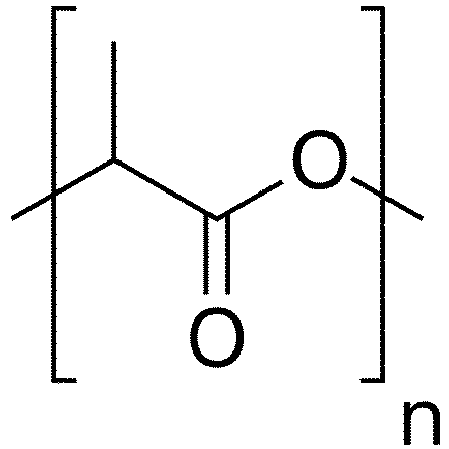
- PLA can be produced ring-opening polymerization of lactide or by direct condensation of lactic acid monomers (see e.g. Cheng, Y., et al., 2009. Frontiers of chemistry in China, 4, pp.259-264.). The PLA may be functionalised, e.g. by any method described in the section herein entitled "Functionalisation". In one embodiment the PLA is maleated or acetylated.
- Suitably, the PGA/PLA blend comprises PLA in an amount of at least about 1 wt%, at least about 2 wt%, at least about 3 wt%, at least about 4 wt%, at least about 5 wt%, at least about 6 wt%, at least about 7 wt%, at least about 8 wt%, at least about 9 wt%, or at least about 10 wt%. Suitably, the PGA/PLA blend comprises PLA in an amount of about 50 wt% or less, about 45 wt% or less, about 40 wt% or less, about 35 wt% or less, about 30 wt% or less, about 25 wt% or less, about 20 wt% or less, about 15 wt% or less, or about 10 wt% or less. Suitably, the PGA/PLA blend comprises PLA in an amount of from about 1 wt% to about 50 wt%, from about 5 wt% to about 50 wt%, from about 5 wt% to about 25 wt%, from about 5 wt% to about 20 wt%, or from about 5 wt% to about 15 wt%.
- In one embodiment, the PGA/PLA blend comprises poly(lactic-co-glycolic acid) (PDLGA) copolymer. In one embodiment, the PDLGA copolymer is a block copolymer (see e.g. Ma, Z., et al., 2012. Bulletin of Materials Science, 35, pp.575-578). Suitably, the PGA/PLA blend comprises PDLGA copolymer in an amount of at least about 0.1 wt%, at least about 0.2 wt%, at least about 0.3 wt%, at least about 0.4 wt%, at least about 0.5 wt%, at least about 0.6 wt%, at least about 0.7 wt%, at least about 0.8 wt%, at least about 0.9 wt%, or at least about 1 wt%. Suitably, the PGA/PLA blend comprises PDLGA copolymer in an amount of about 20 wt% or less, about 15 wt% or less, or about 10 wt% or less. Suitably, the PGA/PLA blend comprises PDLGA copolymer in an amount of from about 0.1 wt% to about 20 wt%, from about 0.5 wt% to about 15 wt%, or from about 1 wt% to about 10 wt%.
- In one embodiment, the PGA layer comprises nanocellulose. In one embodiment, the PGA layer substantially consists of or consists of PGA an nanocellulose. In other embodiments, the PGA layer substantially consists of or consists of: (a) PGA; (b) PBAT, PCL, PLA, or any combination thereof and, optionally, one or more compatibilizers; and (c) nanocellulose. In one embodiment, the PGA layer substantially consists of or consists of: (a) PGA; (b) PBAT and optionally, one or more compatibilizers; and (c) nanocellulose. In one embodiment, the PGA layer substantially consists of or consists of: (a) PGA; (b) PCL and optionally, one or more compatibilizers; and (c) nanocellulose. In one embodiment, the PGA layer substantially consists of or consists of: (a) PGA; (b) PLA and optionally, one or more compatibilizers; and (c) nanocellulose.
- As used herein, "nanocellulose" may refer to nanostructured cellulose and may include cellulose nanocrystal (CNC or NCC), microfibrillated cellulose (MFC), nanofibrillated cellulose (NFC), cellulose nanofibres (CNFs), and the like. The first step for the preparation of cellulose nanomaterials generally consists in a purification step using chemical treatments to remove most of the non-cellulosic components. Mechanical processing can then be used to release the constitutive microfibrils (see e.g. Dufresne, A., 2018. Philosophical Transactions of the Royal Society A: Mathematical, Physical and Engineering Sciences, 376(2112), p.20170040).
- In one embodiment, the nanocellulose comprises or consists of microfibrillated cellulose (MFC), cellulose nanocrystals (CNC), cellulose nanofibrils (CNF), or any combination thereof. In one embodiment, the nanocellulose comprises or consists of microfibrillated cellulose (MFC). In one embodiment, the nanocellulose comprises or consists of cellulose nanocrystals (CNC). In one embodiment, the nanocellulose comprises or consists of cellulose nanofibrils (CNF).
- The PGA layer may comprise the nanocellulose in any suitable amount. Suitably, the PGA layer comprises nanocellulose in an amount of at least about 0.01 wt%, at least about 0.02 wt%, at least about 0.03 wt%, at least about 0.04 wt%, at least about 0.05 wt%, at least about 0.06 wt%, at least about 0.07 wt%, at least about 0.08 wt%, at least about 0.09 wt%, or at least about 0.1 wt%. Suitably, the PGA layer comprises nanocellulose in an amount of about 5.0 wt% or less, about 4.5 wt% or less, about 4.0 wt% or less, about 3.5 wt% or less, about 3.0 wt% or less, about 2.5 wt% or less, about 2.0 wt% or less, about 1.5 wt% or less, or about 1.0 wt% or less. Suitably, the PGA layer comprises nanocellulose in an amount of from about 0.1 wt% to about 5.0 wt%, from about 0.1 wt% to about 4.0 wt%, from about 0.1 wt% to about 3.0 wt%, or from about 0.1 wt% to about 2.0 wt%.
- The nanocellulose may be modified, for example to aid blending of the nanocellulose with the PGA (and optionally PBAT, PCL, and/or PLA). Nanocellulose may be modified non-covalently (e.g. by anionic surfactant, non-ionic surfactant, or by ionic exchange) or covalently (e.g. by silyation, acetylation, polymer grafting, esterification, alkylation, silanization, or glyoxalization), see e.g. Oksman, K., et al., 2016. Composites Part A: Applied Science and Manufacturing, 83, pp.2-18. Typically, the nanocellulose is modified prior to blending. In one embodiment, the nanocellulose is functionalised. In one embodiment, the nanocellulose is covalently functionalised. In one embodiment, the nanocellulose is functionalised by acetylation, esterification, silanization, silylation, glyoxalization, or polymer (e.g. PCL, PEG, or GMA) grafting.
- The PGA layer may further comprise a functionalised biopolymer. Addition of a functionalised biopolymer may aid blending of the nanocellulose with the PGA (and optionally PBAT, PCL, and/or PLA) (see e.g. Ghasemi, S., et al., 2018. Journal of Thermoplastic Composite Materials, 31(8), pp.1090-1101). Any suitable functionalised biopolymer may be used, for example functionalised PBAT, functionalised PCL, and/or functionalised PLA. In one embodiment, the functionalised biopolymer is maleated or acetylated. Suitably, the PGA layer comprises a functionalised biopolymer in an amount of at least about 0.01 wt%, at least about 0.02 wt%, at least about 0.03 wt%, at least about 0.04 wt%, at least about 0.05 wt%, at least about 0.06 wt%, at least about 0.07 wt%, at least about 0.08 wt%, at least about 0.09 wt%, or at least about 0.1 wt%. Suitably, the PGA layer comprises a functionalised biopolymer in an amount of about 10.0 wt% or less, about 9.0 wt% or less, about 8.0 wt% or less, about 7.0 wt% or less, about 6.0 wt% or less, about 5.0 wt% or less, about 4.5 wt% or less, about 4.0 wt% or less, about 3.5 wt% or less, about 3.0 wt% or less, about 2.5 wt% or less, about 2.0 wt% or less, about 1.5 wt% or less, or about 1.0 wt% or less. Suitably, the PGA layer comprises a functionalised biopolymer in an amount of from about 0.1 wt% to about 10.0 wt%, from about 0.1 wt% to about 9.0 wt%, from about 0.1 wt% to about 8.0 wt%, from about 0.1 wt% to about 7.0 wt%, from about 0.1 wt% to about 6.0 wt%, or from about 0.1 wt% to about 5.0 wt%.
- The biopolymer layers may comprise, substantially consist of, or consist of any suitable biopolymer. Suitably, the biopolymer layer is a moisture barrier. By sandwiching the PGA between two layers of biopolymer, the PGA is protected from hydrolysis.
- In one embodiment, the biopolymer is a biodegradable thermoplastic polyester. In one embodiment, the biopolymer is an aliphatic biopolyester. Suitable biopolymers may include polylactic acid (PLA), poly(butylene adipate-co-terephthalate) (PBAT), polycaprolactone (PCL), polybutylene succinate (PBS), poly (butylene succinate-co-L-lactate) (PBSL), poly(butylene succinate-co-butylene adipate) (PBSA), poly(butylene succinate-co-terephthalate) (PBST), poly(butylene sebacate-co-terephthalate) (PBSeT), Poly(ethylene adipate) (PEA), polyhydroxyalkanoates (PHA), and copolymers and/or blends thereof. Other suitable biopolymers will be well known to the skilled person.
- In one embodiment, the biopolymer layers comprise, substantially consist of, or consist of polylactic acid (PLA), poly(butylene adipate-co-terephthalate) (PBAT), polycaprolactone (PCL), polybutylene succinate (PBS), poly (butylene succinate-co-L-lactate) (PBSL), poly(butylene succinate-co-butylene adipate) (PBSA), poly(butylene succinate-co-terephthalate) (PBST), poly(butylene sebacate-co-terephthalate) (PBSeT), Poly(ethylene adipate) (PEA), or polyhydroxyalkanoates (PHA).
- The biopolymer may be functionalised and/or chemically modified by any suitable method. In one embodiment, the biopolymer is chemically modified with one or more compatibilizers. In one embodiment, the biopolymer is functionalised and chemically modified with one or more compatibilizers. Suitable agents for functionalisation and compatibilization are described in the sections herein entitled "Functionalisation" and "Compatibilizers", respectively.
- In one embodiment, the biopolymer layers comprise or consist of a polyhydroxyalkanoate (PHA).
- Polyhydroxyalkanoates (PHAs) comprise a group of natural biodegradable polyesters that are synthesized by microorganisms and may have the following general chemical structure where, typically x=1-8 and n=100 to 1000s (see Li, Z., et al., 2016. NPG Asia Materials, 8(4), pp.e265-e265):

- More than 150 different PHA monomers have been identified, which renders them the largest group of natural polyester. Commonly synthesized PHA monomers include: 3-hydroxybutyrate, 3-hydroxyvalerate, 3-hydroxyhexanoate, 3-hydroxyoctanoate, 3-hydroxydecanoate, 3-hydroxydodecanoate and 3-hydroxyundecenoate. Exemplary PHAs include poly(3-hydroxybutyrate) (PHB), poly(3-hydroxyvalerate) (PHV), poly(3-hydroxybutyrate-co-3-hydroxyvalerate) (PHBV), poly(3-hydroxyhexanoate) (PHHx), poly(3-hydroxybutyrate-co-3-hydroxyhexanoate) (PHBH), poly(3-hydroxyoctanoate) (PHO), poly(3-hydroxydecanoate) (PHD), poly(3-hydroxydodecanoate) (PHDD), poly(3-hydroxyundecenoate) (PHU), and poly(3-hydroxyoctanoate-co-undecenoate) (PHOU).
- In one embodiment, the PHA is selected from poly(3-hydroxybutyrate) (PHB), poly(3-hydroxyvalerate) (PHV), poly(3-hydroxybutyrate-co-3-hydroxyvalerate) (PHBV), poly(3-hydroxyhexanoate) (PHHx), poly(3-hydroxybutyrate-co-3-hydroxyhexanoate) (PHBH), poly(3-hydroxyoctanoate) (PHO), poly(3-hydroxydecanoate) (PHD), poly(3-hydroxydodecanoate) (PHDD), poly(3-hydroxyundecenoate) (PHU), poly(3-hydroxyoctanoate-co-undecenoate) (PHOU), and any copolymer and/or blend thereof.
- PHAs may be classified based on the chain length of the 3-hydroxyalkanoate repeat units. In one embodiment, the PHA is selected from short-chain length PHAs, medium-chain length PHAs and long-chain length PHAs. In one embodiment, the PHA is selected from medium-chain length PHAs and long-chain length PHAs. In one embodiment, the PHA is selected from medium-chain length PHAs. As used herein, a "short-chain length PHA" may comprise or consist of 3-hydroxyalkanoate repeat units having from 4 to 5 carbon atoms. As used herein, a "medium-chain length PHA" may comprise or consist of 3-hydroxyalkanoate repeat units having from 6 to 14 carbon atoms. As used herein, a "long-chain length PHA" may comprise or consist of 3-hydroxyalkanoate repeat units having greater than 14 carbon atoms.
- In one embodiment, the PHA is selected from poly(3-hydroxyhexanoate) (PHHx), poly(3-hydroxybutyrate-co-3-hydroxyhexanoate) (PHBH), poly(3-hydroxyoctanoate) (PHO), poly(3-hydroxydecanoate) (PHD), poly(3-hydroxydodecanoate) (PHDD), poly(3-hydroxy undecenoate) (PHU), poly(3-hydroxy octanoate-co-undecenoate) (PHOU), and any copolymer and/or blend thereof. In one embodiment, the PHA is selected from poly(3-hydroxyhexanoate) (PHHx), poly(3-hydroxybutyrate-co-3-hydroxyhexanoate) (PHBH), poly(3-hydroxyoctanoate) (PHO), poly(3-hydroxydecanoate) (PHD), poly(3-hydroxydodecanoate) (PHDD), poly(3-hydroxy undecenoate) (PHU), and poly(3-hydroxy octanoate-co-undecenoate) (PHOU).
- Suitably, the PHA has a molecular mass of about 20 kDa or more, about 30 kDa or more, about 40 kDa or more, or about 50 kDa or more. Suitably, the PHA has a molecular mass of about 1000 kDa or less, about 500 kDa or less, about 400 kDa or less, or about 300 kDa or less. Suitably, the PHA has a molecular mass of from about 20 kDa to about 1000 kDa, from about 30 kDa to about 500 kDa, from about 40 kDa to about 400 kDa, or from about 50 kDa to about 300 kDa. In one embodiment, the PHA has a molecular mass of from about 50 kDa to about 300 kDa.
- Suitably, the PHA has a melting point of about 200°C or less, about 190°C or less, about 180°C or less, about 170°C or less, about 160°C or less, or about 150°C or less. Suitably, the PHA has a melting point of about 100°C or more, about 110°C or more, about 120°C or more, about 130°C or more, or about 140°C or more. Suitably, the PHA has a melting point of from about 100°C to about 200°C, from about 110°C to about 190°C, or from about 120°C to about 180°C.
- The polyhydroxyalkanoate (PHA) may be functionalised and/or chemically modified, for example with one or more chain extenders and/or one or more compatibilizers. In preferred embodiments, the PHA is functionalised. In other preferred embodiments, the PHA is chemically modified with one or more chain extenders and/or one or more compatibilizers. In more preferred embodiments, the PHA is functionalised and chemically modified with one or more chain extenders and/or one or more compatibilizers. Suitable agents for functionalisation and compatibilization are described herein in the section entitled "Compatibilizers".
- In one embodiment, the PHA is functionalised and/or chemically modified by reactive extrusion. Reactive extrusion may refer to a method that combines the chemical processes (e.g. polymer synthesis and/or modification) and extrusion into a single process.
- In one embodiment, the PHA is functionalised. As used herein, "functionalisation" may refer to the addition of one or more functional group to the polymeric macromere. For example, functional groups which may be added include carboxylic functional groups, hydroxyl functional groups, or epoxide functional groups. Functional groups may be added by carboxylation, hydroxylation, epoxidation, or by grafting. Suitable reaction conditions will be known to the skilled person (see e.g. Gumel, A.M., et al., 2014. Polyhydroxyalkanoate (PHA) based blends, composites and nanocomposites, pp.141-182).
- The PHA may be functionalised by any suitable method. For example, the PHA may be functionalised by a method selected from carboxylation, hydroxylation, epoxidation, and grafting. The PHA may be functionalised by any suitable combination of methods. For example, the PHA may be functionalised by two or more methods selected from carboxylation, hydroxylation, epoxidation, and grafting.
- In one embodiment, the PHA is functionalised by carboxylation. In one embodiment, the PHA has carboxylic functional groups. Typically, an oxidative process is employed to carboxylate PHA with an unsaturated group. For example, the PHA may be carboxylated using an oxidation agent in the presence of sodium bicarbonate or a crown ether.
- In one embodiment, the PHA is functionalised by hydroxylation. In one embodiment, the PHA has hydroxyl functional groups. Typically, acid- or base-catalyzed reactions are used in the modification of PHA by hydroxylation in the presence of low molecular weight mono- or diol compounds.
- In one embodiment, the PHA is functionalised by epoxidation. In one embodiment, the PHA has epoxide functional groups. Epoxidation may be carried out, for example, using m-chloroperoxybenzoic acid.
- In one embodiment, the PHA is functionalised by grafting. In one embodiment, the PHA is a graft copolymer. Grafting reactions can be induced by either chemical, radiation or plasma discharge methods. Grafting methods include "grafting to", "grafting from", and "grafting through" method. The "grafting through" approach is typically the simples process and involves copolymerising the PHA macromere with low molecular weight monomer by atom transfer radical polymerisation.
- In one embodiment, the PHA is chemically modified with one or more chain extenders. In one embodiment, the PHA is functionalised and chemically modified with one or more chain extenders.
- As used herein, a "chain extender" may refer to reagent which can link together two or more polymers or polymer chains. Typically, a chain extender is a low molecular weight molecule which reacts with the ends of polymers or polymer chains. Chain extenders may be bi-functional, i.e. have two functional groups which can link together two polymers or polymer chains, or poly-functional/multi-functional, i.e. having more than two functional groups which can link together more than two polymers or polymer chains. Suitable chain extenders will be well known to the skilled person.
- In preferred embodiments, the one or more chain extenders are multi-functional chain extenders. By chemically modifying the PHA with multi-functional chain extenders a branched polymeric structure may be formed, thereby improving compatibility and/or processability of the PHA. In some embodiments, the one or more chain extenders have two or more functional groups, the one or more chain extenders have three or more functional groups, four or more functional groups, or five or more functional groups. In some embodiments, the one or more chain extenders can link together two or more polymers or polymer chains, three or more polymers or polymer chains, four or more polymers or polymer chains, or five or more polymers or polymer chains.
- Chain extenders can employ a variety of reaction mechanisms and generally fall into two categories: addition-type chain extenders and activating-type chain extenders. Addition-type chain extenders consist of at least two electrophilic sites and can form a permanent bridge between at least two polymers or polymer chains. Activating-type chain extenders are composed of an electrophilic site connected to suitably labile substituents and act as intermediate for a substitution reaction linking the ends of two polymers or polymer chains. In preferred embodiments, the one or more chain extenders are addition-type chain extenders.
- The functional groups of addition-type chain extenders are typically carbon electrophiles, such as epoxides, isocyanates and anhydrides, or are based on heterocyclic molecules such as phenylene bisoxazolin. Suitably, the one or more chain extenders are addition-type chain extenders that react with carboxyl and/or hydroxyl terminal groups. In one embodiment, the one or more chain extenders comprise or consist of one or more addition-type chain extenders that react with carboxyl terminal groups. In one embodiment, the one or more chain extenders consist of one or more addition-type chain extenders that react with carboxyl terminal groups. In one embodiment, the one or more chain extenders comprise or consist of one or more addition-type chain extenders that react with hydroxyl terminal groups. In one embodiment, the one or more chain extenders consist of one or more addition-type chain extenders that react with hydroxyl terminal groups. In one embodiment, the one or more chain extenders comprise or consist of one or more addition-type chain extenders that react with carboxyl terminal groups and hydroxyl terminal groups. In one embodiment, the one or more chain extenders consist of one or more addition-type chain extenders that react with carboxyl terminal groups and hydroxyl terminal groups.
- Any suitable chain extender may be used, for example any epoxy-based chain extender, phosphate/phosphite-based chain extender, carbodiimide based chain extender, or an anhydride-based chain extender. Suitable chain extenders are known in the art (see e.g. Standau, T., et al., 2019. Polymers, 11(2), p.306).
- In one embodiment, the one or more chain extenders comprise or consist of (multi-functional) epoxy-based chain extenders. In one embodiment, the one or more chain extenders consist of (multi-functional) epoxy-based chain extenders. Epoxy-based chain extenders may react with both with carboxyl and hydroxyl end groups. A particularly preferred epoxy-based chain extender is the Joncryl® ADR series, including Joncryl® ADR 4368, Joncryl® ADR 4468, Joncryl® ADR 4300, and Joncryl® ADR 4380 (see e.g. Frenz, V., et al., 2008. In Tech. Pap. Reg. Tech. Conf. Soc. Plast. Eng., Vol. 3, pp. 1678-1682). In one embodiment, the epoxy-based chain extender is Joncryl® ADR 4368. Joncryl® ADR may have the following chemical structure (see AI-Itry, R., et al., 2012. Polymer Degradation and Stability, 97(10), pp.1898-1914):

- In one embodiment, the one or more chain extenders comprise or consist of (multi-functional) phosphate/phosphite-based chain extenders. In one embodiment, the one or more chain extenders consist of (multi-functional) phosphate/phosphite-based chain extenders. Phosphate/phosphite-based chain extenders may react with both carboxyl and hydroxyl end-groups. Examples of suitable phosphate/phosphite-based chain extenders include triphenylphosphite (TPP) or tris(nonyl-phenyl)phosphite (TNPP). In one embodiment, the phosphate/phosphite-based chain extender is triphenylphosphite (TPP). In one embodiment, the phosphate/phosphite-based chain extender is tris(nonyl-phenyl)phosphite (TNPP).
- In one embodiment, the one or more chain extenders comprise or consist of (multi-functional) carbodiimide-based chain extenders. In one embodiment, the one or more chain extenders consist of (multi-functional) carbodiimide-based chain extenders. Carbodiimide-based chain extenders may react with hydroxyl end-groups. Examples of suitable carbodiimide-based chain extenders include polycarbodiimide (PCDI).
- In one embodiment, the one or more chain extenders comprise or consist of (multi-functional) isocyanate-based chain extenders. In one embodiment, the one or more chain extenders consist of (multi-functional) isocyanate-based chain extenders. Isocyanate-based chain extenders may react with hydroxyl end-groups. Examples of suitable carbodiimide-based chain extenders include triisocyanate.
- In one embodiment, the one or more chain extenders comprise or consist of (multi-functional) anhydride-based chain extenders. one embodiment, the one or more chain extenders consist of (multi-functional) anhydride-based chain extenders. Anhydride-based chain extenders may react with hydroxyl end-groups. Examples of suitable anhydride-based chain extenders include pyromellitic dianhydride (PMDA).
- The biopolymer film may comprise any other suitable layers, in addition to biopolymer and PGA layers. For example, the biopolymer film may comprise one or more tie layers and/or one or more re-grind layers. In one embodiment, the biopolymer film comprises one or more tie layers and one or more re-grind layers.
- In one embodiment, the biopolymer film comprises one or more tie layers.
- In one embodiment, the biopolymer film comprises a layered structure comprising or consisting of biopolymer layer - tie layer - PGA layer - biopolymer layer. In one embodiment, the biopolymer film comprises a layered structure comprising or consisting of biopolymer layer - tie layer - PGA layer - tie layer - biopolymer layer.
- As used herein, a "tie layer" may refer to a polymer layer designed to provide adhesion between two other polymer layers. For example, tie layers may be sandwiched between polymer layers that do not bond on their own, or which only bond weakly. Typically, tie layers may comprise copolymers of polar and nonpolar repeat units and with or without functional reactive groups. The skilled person is able to select a suitable tie layer resin depending on the polymer layers to be bonded and on the adhesive strength needed. Suitably, a tie layer may comprise or consist of an adhesive resin or a compatibilizer.
- In one embodiment, the one or more tie layers comprise or consist of one or more adhesive resins. In one embodiment, the one or more tie layers consist of one or more adhesive resins. Example adhesive resins include ethylene vinyl acetate (EVA), ethylene methyl acrylate (EMA), ethylene acrylic acid (EAA) and ethylene methacrylic acd (EMAA). In one embodiment, the one or more tie layers comprise or consist of one or more biodegradable adhesive resins. In preferred embodiments, the one or more tie layers consist of one or more biodegradable adhesive resins. A particularly preferred biodegradable adhesive resin is BTR8002P, which is an acid-modified polyester resin biodegradable tie layer available from Mitsubishi Chemicals. In one embodiment, the one or more tie layers comprise BTR8002P. In one embodiment, the one or more tie layers consist of BTR8002P.
- In one embodiment, the one or more tie layers comprise or consist of one or more compatibilizers. In one embodiment, the one or more tie layers consist of one or more compatibilizers. Suitable compatibilizers for use in the tie layers are described herein in the section entitled "Compatibilizers".
- In one embodiment, the biopolymer film comprises one or more regrind layers.
- In one embodiment, the biopolymer film comprises a layered structure comprising or consisting of biopolymer layer- regrind layer - PGA layer - biopolymer layer. In one embodiment, the biopolymer film comprises a layered structure comprising or consisting of biopolymer layer - regrind layer - PGA layer - regrind layer - biopolymer layer. In one embodiment, the biopolymer film comprises a layered structure comprising or consisting of biopolymer layer - regrind layer - PGA layer - tie layer - biopolymer layer. In one embodiment, the biopolymer film comprises a layered structure comprising or consisting of biopolymer layer - regrind layer - tie layer - PGA layer - tie layer - biopolymer layer. In one embodiment, the biopolymer film comprises a layered structure comprising or consisting of biopolymer layer - regrind layer - tie layer - PGA layer - tie layer - regrind layer - biopolymer layer. In other embodiments, the biopolymer film comprises a layered structure comprising or consisting of PHA layer - tie layer - regrind layer - PGA layer - regrind layer - tie layer - PHA layer.
- As used herein, a "regrind layer" may refer to a layer comprising or consisting of a blend of the materials of all layers of the film. Regrind may be produced from scrap material and re-used in the film to reduce costs or improve compatibilization. Typically, including a regrind layer may mean that the thickness of the other layers may be reduced, whilst maintaining barrier properties.
- The one or more regrind layers may be obtained by processing waste biopolymer film. The one or more regrind layers may comprise or consist of a blend of the other layers of the biopolymer film. In one embodiment, the one or more regrind layers comprise a blend of biopolymer and PGA. The biopolymer and PGA may be any described herein in the sections entitled "Biopolymer layers" and "Polyglycolide (PGA) layers", respectively. In one embodiment, the one or more regrind layers further comprises a tie layer resin. The tie layer resin may be any described herein in the section entitled "Tie layers". In one embodiment, the one or more regrind layers consist of biopolymer, PGA, and a tie layer resin. The relative amount of each of the biopolymer, PGA, and optional tie layer resin in the one or more regrind layers may be equal to that found in the biopolymer film.
- The regrind layer resin may undergo any suitable processing steps to improve its properties. For example, the one or more regrind layers may comprise or consist of regenerate formed by solid state polymerization (SSP) and/or chain extension. In one embodiment, the one or more regrind layers comprise or consist of regenerate formed by solid state polymerization (SSP). In one embodiment, the one or more regrind layers comprise or consist of regenerate formed by chain extension. In one embodiment, the regrind layers comprise or consist of regenerate formed by chain extension by reactive extrusion. Solid State Polymerization (SSP) may refer to a process in which the polymer chain lengths are increased by heat in the absence of oxygen and water. Chain extension may refer to a process in which chain extenders react with polymer chains to increase their molecular weight. Suitable chain extenders are described herein in the section entitled "Chain extenders".
- As used herein, a "paper-based layer" may comprise or consist of paper pulp. The pulp may comprise cellulose fibres. Any suitable source of pulp may be used in the present invention. The major industrial source of pulp is vascular plants, e.g. wood. The pulp may comprise small amounts of lignin and/or hemicellulose and may comprise water and other additives. In one embodiments, the paper-based layer comprises or consists of recycled paper pulp. In preferred embodiments, the paper-based layer is compostable.
- Suitably, a paper-based layer has a thickness of about 0.020 mm or more, about 0.030 mm or more, about 0.040 mm or more, about 0.050 mm or more, about 0.060 mm or more, about 0.070 mm or more, about 0.080 mm or more, about 0.090 mm or more, or about 0.10 mm or more. Suitably, a paper-based layer has a thickness of about 1.2 mm or less, about 1.1 mm or less, about 1.0 mm or less, about 0.9 mm or less, about 0.8 mm or less, about 0.7 mm or less, about 0.6 mm or less, about 0.5 mm or less, about 0.4 mm or less, about 0.3 mm or less, about 0.25 mm or less, about 0.2 mm or less, or about 0.15 mm or less. Suitably, a paper-based layer has a thickness of from about 0.020 mm to about 1.2 mm.
- In one embodiment, for example when the biopolymer film is attached to a paper-based layer prior to moulding, the paper-based layer has a thickness of from about 0.020 mm to about 0.15 mm. In other embodiments, for example when the biopolymer film is attached to a paper-based layer after moulding of the paper-based layer, the paper-based layer has a thickness of from about 0.08 mm to about 1.2 mm.
- The biopolymer film may be attached to a paper-based layer by any suitable method. For example, the biopolymer film may be attached to a paper-based layer prior to moulding (e.g. by co-extrusion lamination or coating of the biopolymer film onto a paper-based substrate). For example, the biopolymer film may be attached to a paper-based layer after moulding of the paper-based layer (e.g. by inserting a moulded biopolymer film into the moulded paper-based layer, or by thermoforming the biopolymer film into the moulded paper-based layer).
- The present invention provides a capsule obtainable by or obtained by the method of the present invention. The capsule may be used to prepare a beverage, for example by injecting pressurized liquid into the capsule according to the present invention and allowing a beverage to flow out of the capsule.
- As used herein, the term "beverage capsule" encompasses single use packages for preparing beverages by insertion in a beverage preparation device that is adapted to inject a fluid (e.g. hot water) into the package for mixing with a substance contained therein. Examples of such beverage packages are not limited to rigid or semi-rigid capsules, but may also comprise rigid, semi-rigid, or flexible pods, pads, cartridges of various types, and even sachet-type containers. In preferred embodiments, the beverage capsule is a rigid or semi-rigid capsule. In more preferred embodiments, the beverage capsule is a rigid capsule.
- A beverage capsule may comprise a capsule body defining a compartment for containing a substance for preparation of a beverage, such as roast and ground coffee. The present invention provides a capsule body obtainable by or obtained by the method of the present invention.
- The capsule body may be any suitable shape. In preferred embodiments, the capsule body is a cup-shaped body. In one embodiment, the capsule body comprises a bottom wall, a lateral wall and an annular flange or rim for a cover to seal thereon. For example, illustrated in the embodiment of
figure 2 is abeverage capsule 8 comprising a capsule body defining acompartment 12 for containing a substance for preparation of a beverage, wherein the capsule body comprises abottom wall 9, alateral wall 10 and an annular flange orrim 11. Thebottom wall 9 may be pierced by a piercing member of a beverage preparation device and liquid injected under pressure into thecompartment 12. In one embodiment, the bottom wall is adapted to be pierced by a piercing member of a beverage preparation device. In one embodiment, thelateral wall 10, when seen in a longitudinal section, is inclined with respect to a longitudinal axis of the capsule body. - The capsule body may be closed by attaching (e.g. by sealing) a cover, for instance a membrane or a film, to it. In one embodiment, the capsule body comprises an annular flange or rim onto which a cover is attached. For example, illustrated in the embodiment of
figure 2 is abeverage capsule 8 comprising acover 13. Preferably the cover is an oxygen barrier and a moisture barrier. The cover may be made from any known material, for example an extrusion coated paper, a fiber-spinning coated paper, or a polymer film. In preferred embodiments, the cover is made from a compostable material (e.g. a biopolymer film). When the pressure increases in the capsule following injection and reaches a certain level, the cover may deflect outwardly and pierce onto a piercing means of the beverage preparation device. When the cover is pierced, the beverage can flow outside the capsule. In one embodiment, the cover is adapted to pierce onto opening means of a beverage preparation device when pressure inside the capsule reaches a pre-determined value. In one embodiment, the biopolymer film and the cover overlap. Suitably, the overlap is from about 1 mm to about 3 mm. Such an overlap can reduce gas or moisture penetration. - In one embodiment, the biopolymer film forms the capsule body. In another embodiment, a paper-based layer forms the capsule body and the biopolymer film is attached to the paper-based layer (e.g. is a barrier layer). In one embodiment, the paper-based layer forms the exterior surface of the capsule body. In one embodiment, the paper-based layer forms the interior surface of the capsule body.
- The capsule may contain a substance for preparation of a beverage. The substance may be selected from roast and ground coffee, compacted or not, soluble powder coffee, or leaf tea. Dairy ingredients (e.g., milk or creamer) can also be included. In one embodiment, the substance for preparation of a beverage is roast and ground coffee, a soluble ingredient, or a mix of soluble ingredients. In preferred embodiments, the substance for preparation of a beverage is roast and ground coffee. The injected liquid may interact with the substance contained therein to obtain a beverage. In preferred embodiments, the injected liquid is hot water.
- The capsule may be essentially oxygen-free. Empty space in the compartment defined by the capsule body and the cover may be saturated with an inert gas such as nitrogen, carbon dioxide, and combinations thereof. In one embodiment, the capsule has an internal pressure of gas above atmospheric pressure, due to the gas contained in the coffee and emanating in the compartment after sealing, such as carbon dioxide.
- In one embodiment, the capsule is biodegradable. In one embodiment, the capsule is biodegradable in compost, soil, and/or marine environments. In one embodiment, the capsule is biodegradable in compost, soil, and marine environments.
- In preferred embodiments, the capsule is compostable. As used herein, a "compostable" product may be one that is biodegradable under aerobic conditions, without producing any toxic compounds (see e.g. Helanto, K.E., et al., 2019. BioResources, 14(2), pp.4902-49510). Any standard may be used to assess whether a product is compostable. Suitable standards to assess compostability include AS 4736, ASTM D5338, ASTM D6002, EN 13432, and ISO 14855.
- In one embodiment, the capsule is home compostable. Home compostability may be defined on a national level based on international standard EN 13432. Materials or products compliant with these standards can be recognised by a conformity mark stating their home compostability. Some examples of home composability certifications at a national level include, but are not limited to, the following. The certifier TUV AUSTRIA BELGIUM offers such a home composability certification scheme, and DIN CERTCO offers a certification for home composability according to the Australian standard AS 5810. Italy has a national standard for composting at ambient temperature, UNI 11183:2006. In November 2015, the French Standard "NF T 51-800 Plastics - Specifications for plastics suitable for home composting" was introduced. This standard is covered in the DIN CERTCO scheme.
- In preferred embodiments, the capsule is single-use. A "single-use" product may be one that is designed to be used once and then disposed of. In one embodiment, the capsule is a single-serve beverage capsule. A "single-serve" capsule may be one that is designed to prepare only enough beverage for a single portion.
- In preferred embodiments, the capsule has a shelf-life of at least about 2 months, at least about 3 months, at least about 4 months, at least about 5 months, at least about 6 months, at least about 7 months, at least about 8 months, at least about 9 months, or at least about 12 months. In one embodiment, the capsule has a shelf-life of from about 3 to about 12 months or from about 6 to about 9 months. The shelf-life may be assessed by any suitable method known in the art, for example by gas chromatography-mass spectrometry and/or consumer evaluation. For example, the shelf-life may be determined by monitoring the ratio of dimethyl disulfide/methanethiol and/or 2-butanone/methanethiol (see e.g. Glöss, A., et al., 2014. Chimia, 68(3), pp.179-182).
- Various preferred features and embodiments of the present invention will now be described with reference to the following numbered paragraphs (paras).
- 1. A method of manufacturing a beverage capsule, the method comprising:
- (a) providing a biopolymer film, wherein the biopolymer film comprises a layered structure comprising biopolymer layer - polyglycolide (PGA) layer - biopolymer layer; and
- (b) thermoforming the biopolymer film to form at least one layer of a capsule body comprising or consisting of the biopolymer film.
- 2. The method according to para 1, wherein the capsule body consists of the biopolymer film.
- 3. The method according to para 1, wherein the method comprises: (i) thermoforming the biopolymer film, optionally into a cup-shape; (ii) inserting the thermoformed biopolymer film into a paper-based capsule body; and (iii) optionally, further forming or moulding the biopolymer film, to provide a multi-layer capsule body comprising a paper-based layer and the biopolymer film.
- 4. The method according to para 1, wherein the method comprises thermoforming the biopolymer film inside a paper-based capsule body to provide a capsule body comprising a paper-based layer and the biopolymer film.
- 5. The method according to para 1, wherein the method comprises:
- (i) attaching the biopolymer layer to a paper-based layer to provide a multi-layer structure; and
- (ii) forming the multi-layer structure to provide a capsule body comprising a paper-based layer and the biopolymer film.
- 6. The method according to para 5, wherein the paper-based layer forms an exterior surface of the capsule body.
- 7. The method according to para 5 or 6, wherein the paper-based layer forms an interior surface of the capsule body.
- 8. The method according to any preceding para, wherein the biopolymer film is thermoformed at a temperature of at least 60°C, at least 70°C, or at least 80°C.
- 9. The method according to any preceding para, wherein the biopolymer film is thermoformed at a temperature of 220°C or lower, 210°C or lower, 200°C or lower, 190°C or lower, 180°C or lower, 170°C or lower, 160°C or lower, 150°C or lower, 140°C or lower, 130°C or lower, 120°C or lower, 110°C or lower, 100°C or lower.
- 10. The method according to any preceding para, wherein the biopolymer film is thermoformed at a temperature of from 60°C to 220°C, from 60°C to 200°C, from 60°C to 180°C, from 60°C to 160°C, from 60°C to 140°C, from 60°C to 120°C, or from 70°C to 110°C.
- 11. The method according to any preceding para, wherein the biopolymer film is contacted with a mould for at least 1 second, at least 2 seconds, at least 3 seconds, at least 4 seconds, at least 5 seconds, at least 10 seconds, or at least 20 seconds.
- 12. The method according to any preceding para, wherein the biopolymer film is contacted with a mould for 30 seconds or less.
- 13. The method according to any preceding para, wherein the biopolymer film is contacted with a mould for from 1 to 30 seconds, from 2 to 30 second, or from 3 to 30 seconds.
- 14. The method according to any preceding para, wherein the biopolymer film is thermoformed by vacuum forming, pressure forming, or mechanical forming.
- 15. The method according to any preceding para, wherein the PGA has a molecular mass of from about 20 kDa to about 500 kDa, from about 30 kDa to about 500 kDa, from about 40 kDa to about 500 kDa, from about 50 kDa to about 500 kDa, from about 60 kDa to about 500 kDa, or from about 70 kDa to about 500 kDa.
- 16. The method according to any preceding para, wherein the PGA layer has a melting point of 220°C or lower, 219°C or lower, 218°C or lower, 217°C or lower, 216°C or lower, 215°C or lower, 214°C or lower, 213°C or lower, 212°C or lower, 211°C or lower, or 210°C or lower.
- 17. The method according to any preceding para, wherein the PGA layer comprises at least 50 wt% PGA, at least 55 wt% PGA, at least 60 wt% PGA, at least 65 wt% PGA, at least 70 wt% PGA, at least 75 wt% PGA, at least 80 wt% PGA, at least 85 wt% PGA, or at least 90 wt% PGA.
- 18. The method according to any preceding para, wherein the PGA layer comprises PGA blended with poly(butylene adipate-co-terephthalate) (PBAT), polycaprolactone (PCL), polylactic acid (PLA), and/or nanocellulose.
- 19. The method according to any preceding para, wherein the PGA layer comprises one or more compatibilizers, optionally in a total amount of from 0.1 wt% to 10 wt%.
- 20. The method according to any preceding para, wherein the PGA layer comprises a PGA/PBAT blend, optionally wherein the PGA/PBAT blend comprises PBAT in an amount of from 5 wt% to 50 wt%, from 5 wt% to 25 wt%, from 5 wt% to 20 wt%, or from 5 wt% to 15 wt%.
- 21. The method according to any preceding para, wherein the PGA layer comprises a PGA/PCL blend, optionally wherein the PGA/PCL blend comprises PCL in an amount of from 5 wt% to 50 wt%, from 5 wt% to 25 wt%, from 5 wt% to 20 wt%, or from 5 wt% to 15 wt%.
- 22. The method according to any preceding para, wherein the PGA layer comprises a PGA/PLA blend, optionally wherein the PGA/PLA blend comprises PLA in an amount of from 5 wt% to 50 wt%, from 5 wt% to 25 wt%, from 5 wt% to 20 wt%, or from 5 wt% to 15 wt%.
- 23. The method according to any preceding para, wherein the PGA layer comprises nanocellulose, optionally in a total amount of from 0.1 wt% to 2 wt%.
- 24. The method according to any preceding para, wherein the biopolymer layers are moisture barriers.
- 25. The method according to any preceding para, wherein the biopolymer layers comprise or consist of a biopolymer selected from polylactic acid (PLA), poly(butylene adipate-co-terephthalate) (PBAT), polycaprolactone (PCL), polybutylene succinate (PBS), poly (butylene succinate-co-L-lactate) (PBSL), poly(butylene succinate-co-butylene adipate) (PBSA), poly(butylene succinate-co-terephthalate) (PBST), poly(butylene sebacate-co-terephthalate) (PBSeT), Poly(ethylene adipate) (PEA), polyhydroxyalkanoates (PHA), and copolymers and/or blends thereof.
- 26. The method according to any preceding para, wherein the biopolymer layers comprise or consist of a polyhydroxyalkanoate (PHA).
- 27. The method according to para 26, wherein the PHA is selected from poly(3-hydroxybutyrate) (PHB), poly(3-hydroxyvalerate) (PHV), poly(3-hydroxybutyrate-co-3-hydroxyvalerate) (PHBV), poly(3-hydroxyhexanoate) (PHHx), poly(3-hydroxybutyrate-co-3-hydroxyhexanoate) (PHBH), poly(3-hydroxyoctanoate) (PHO), poly(3-hydroxydecanoate) (PHD), poly(3-hydroxydodecanoate) (PHDD), poly(3-hydroxy undecenoate) (PHU), poly(3-hydroxy octanoate-co-undecenoate) (PHOU), and any copolymer and/or blend thereof.
- 28. The method according to para 26 or 27, wherein the PHA has a molecular mass of from about 50 kDa to about 300 kDa.
- 29. The method according to any of paras 26 to 28, wherein the PHA has a melting point of 180°C or less, 170°C or less, 160°C or less, or 150°C or less.
- 30. The method according to any of paras 26 to 29, wherein the PHA has been chemically modified with one or more chain extenders and/or one or more compatibilizers.
- 31. The method according to any preceding para, wherein the biopolymer film further comprises one or more tie layers.
- 32. The method according to any preceding para, wherein the biopolymer film comprises a layered structure comprising biopolymer layer - tie layer - PGA layer - tie layer - biopolymer layer.
- 33. The method according to para 31 or 32, wherein the tie layers comprise or consist of an adhesive resin and/or a compatibilizer.
- 34. The method according to any of paras 31-33, wherein the tie layers comprise or consist of a biodegradable adhesive resin, optionally wherein the tie layers comprise or consist of BTR8002P.
- 35. The method according to any preceding para, wherein the biopolymer film further comprises one or more regrind layers.
- 36. The method according to any preceding para, wherein the biopolymer film comprises a layered structure comprising biopolymer layer - regrind layer - tie layer - PGA layer - tie layer - regrind layer - biopolymer layer.
- 37. The method according to para 35 or 36, wherein the regrind layers comprise a blend of a biopolymer and PGA layer.
- 38. The method according to any of paras 35 to 37, wherein the regrind layers comprise or consist of a regenerate formed by solid state polymerization (SSP) and/or chain extension.
- 39. The method according to any preceding para, wherein the PGA layer has a thickness of from about 0.001 mm to about 0.50 mm, from about 0.002 mm to about 0.10 mm, or from about 0.003 mm to about 0.05 mm.
- 40. The method according to any preceding para, wherein each biopolymer layer has a thickness of from about 0.001 mm to about 0.50 mm, from about 0.002 mm to about 0.10 mm, or from about 0.003 mm to about 0.05 mm.
- 41. The method according to any preceding para, wherein the biopolymer film has a total thickness of from about 0.15 mm to about 0.70 mm, from about 0.16 mm to about 0.60 mm, or from about 0.17 mm to about 0.50 mm.
- 42. The method according to any preceding para, wherein the biopolymer film is formed by co-extrusion.
- 43. The method according to any of paras 1 to 41, wherein the biopolymer film is formed by co-injection.
- 44. The method according to any preceding para, wherein the biopolymer film is an oxygen barrier.
- 45. The method according to any preceding para, wherein the biopolymer film has an oxygen transmission rate of about 1 cm3/m2/day/atm or less at 23°C/50%RH.
- 46. The method according to any preceding para, wherein the biopolymer film is a moisture barrier.
- 47. The method according to any preceding para, wherein the biopolymer film has a water vapour transmission rate of about 1 g/m2/day or less at 23°C/85% RH.
- 48. The method according to any preceding para, wherein the biopolymer film has a melt glow index (MFI) of from 0.5 g/10min to 25 g/10min, from 5 g/10min to 25 g/10min, from 10 g/10min to 25 g/10min, from 15 g/10min to 25 g/10min, or from 15 g/10min to 20 g/10min, optionally wherein the MFI is determined at 190°C or lower with a test load of 2.16 kg or 5 kg.
- 49. The method according to any preceding para, wherein the capsule body is cup-shaped and/or wherein the capsule body comprises a bottom wall, a lateral wall and an annular flange for a cover to seal thereon.
- 50. The method according to para 49, wherein the bottom wall is suitable for being pierced by a piercing member of a beverage preparation device.
- 51. The method according to any preceding para, wherein the method further comprises introducing into the capsule a substance for preparation of a beverage, optionally wherein the substance for preparation of a beverage is roast and ground coffee, a soluble ingredient, or a mix of soluble ingredients, preferably wherein the substance for preparation of a beverage is roast and ground coffee.
- 52. The method according to any preceding para, wherein the method further comprises closing the capsule with a cover for closing the capsule body.
- 53. The method according to any preceding para, wherein the capsule is compostable.
- 54. The method according to any preceding para, wherein the capsule is a single use capsule.
- 55. The method according to any preceding para, wherein the capsule has a shelf-life of at least 6 months, at least 9 months, or at least 12 months.
- 56. A capsule obtainable by or obtained by the method according to any preceding para.
- 57. Use of a capsule according to para 56 to prepare a beverage.
- 58. A method of preparing a beverage, the method comprising injecting pressurized liquid into a capsule according to para 56 and allowing a beverage to flow out of the capsule.
- 59. Use of a biopolymer film for manufacturing a beverage capsule by thermoforming, wherein the biopolymer film comprises a layered structure comprising biopolymer layer - polyglycolide (PGA) layer - biopolymer layer.
- 60. Use of a biopolymer film for manufacturing a beverage capsule by lamination and thermoforming, wherein the biopolymer film comprises a layered structure comprising biopolymer layer - polyglycolide (PGA) layer - biopolymer layer.
Claims (15)
- A method of manufacturing a beverage capsule, the method comprising:(a) providing a biopolymer film, wherein the biopolymer film comprises a layered structure comprising biopolymer layer - polyglycolide (PGA) layer - biopolymer layer; and(b) thermoforming the biopolymer film to form at least one layer of a capsule body comprising or consisting of the biopolymer film.
- The method according to claim 1, wherein the capsule body consists of the biopolymer film.
- The method according to claim 1, wherein the method comprises: (i) thermoforming the biopolymer film, optionally into a cup-shape; (ii) inserting the thermoformed biopolymer film into a paper-based capsule body; and (iii) optionally, further forming or moulding the biopolymer film, to provide a capsule body comprising a paper-based layer and the biopolymer film.
- The method according to claim 1, wherein the method comprises thermoforming the biopolymer film inside a paper-based capsule body to provide a capsule body comprising a paper-based layer and the biopolymer film.
- The method according to claim 1, wherein the method comprises:(i) attaching the biopolymer layer to a paper-based layer to provide a multi-layer structure; and(ii) forming the multi-layer structure to provide a capsule body comprising a paper-based layer and the biopolymer film, optionally wherein the paper-based layer forms an exterior surface of the capsule body or an interior surface of the capsule body.
- The method according to any preceding claim, wherein: (a) the biopolymer film is thermoformed at a temperature of from 60°C to 220°C, from 60°C to 200°C, from 60°C to 180°C, from 60°C to 160°C, from 60°C to 140°C, from 60°C to 120°C, or from 70°C to 110°C; and/or (b) the biopolymer film is contacted with a mould for from 1 to 30 seconds, from 2 to 30 second, or from 3 to 30 seconds.
- The method according to any preceding claim, wherein the PGA layer comprises PGA blended with poly(butylene adipate-co-terephthalate) (PBAT), polycaprolactone (PCL), polylactic acid (PLA), and/or nanocellulose.
- The method according to any preceding claim, wherein the biopolymer layers are moisture barriers, optionally wherein the biopolymer layers comprise or consist of a biopolymer selected from polylactic acid (PLA), poly(butylene adipate-co-terephthalate) (PBAT), polycaprolactone (PCL), polybutylene succinate (PBS), poly (butylene succinate-co-L-lactate) (PBSL), poly(butylene succinate-co-butylene adipate) (PBSA), poly(butylene succinate-co-terephthalate) (PBST), poly(butylene sebacate-co-terephthalate) (PBSeT), Poly(ethylene adipate) (PEA), polyhydroxyalkanoates (PHA), and copolymers and/or blends thereof, preferably wherein the biopolymer layers comprise or consist of a polyhydroxyalkanoate (PHA), optionally wherein the PHA has been chemically modified with one or more chain extenders and/or one or more compatibilizers.
- The method according to any preceding claim, wherein the biopolymer film further comprises:(a) one or more tie layers, optionally wherein the biopolymer film comprises a layered structure comprising biopolymer layer - tie layer - PGA layer - tie layer - biopolymer layer, preferably wherein the tie layers comprise or consist of an adhesive resin and/or a compatibilizer, more preferably wherein the tie layers comprise or consist of a biodegradable adhesive resin, optionally wherein the tie layers comprise or consist of BTR8002P;and/or(b) one or more regrind layers, optionally wherein the biopolymer film comprises a layered structure comprising biopolymer layer - regrind layer - tie layer - PGA layer - tie layer - regrind layer - biopolymer layer, preferably wherein the regrind layers comprise or consist of a regenerate formed by solid state polymerization (SSP) and/or chain extension.
- The method according to any preceding claim, wherein:(a) the biopolymer film is an oxygen barrier, optionally wherein the biopolymer film has an oxygen transmission rate of about 1 cm3/m2/day/atm or less at 23°C/50%RH;(b) the biopolymer film is a moisture barrier, optionally wherein the biopolymer film has a water vapour transmission rate of about 1 g/m2/day or less at 23°C/85% RH; and/or(c) the biopolymer film has a melt glow index (MFI) of from 0.5 g/10min to 25 g/10min, from 5 g/10min to 25 g/10min, from 10 g/10min to 25 g/10min, from 15 g/10min to 25 g/10min, or from 15 g/10min to 20 g/10min, optionally wherein the MFI is determined at 190°C or lower with a test load of 2.16 kg or 5 kg.
- The method according to any preceding claim, wherein:(a) the capsule body is cup-shaped and/or comprises a bottom wall, a lateral wall and an annular flange for a cover to seal thereon, preferably wherein the bottom wall is suitable for being pierced by a piercing member of a beverage preparation device;(b) the method further comprises introducing into the capsule a substance for preparation of a beverage, optionally wherein the substance for preparation of a beverage is roast and ground coffee, a soluble ingredient, or a mix of soluble ingredients, preferably wherein the substance for preparation of a beverage is roast and ground coffee; and/or(c) the method further comprises closing the capsule with a cover for closing the capsule body.
- A capsule obtainable by or obtained by the method according to any preceding claim.
- Use of a capsule according to claim 12 to prepare a beverage.
- A method of preparing a beverage, the method comprising injecting pressurized liquid into a capsule according to claim 12 and allowing a beverage to flow out of the capsule.
- Use of a biopolymer film for manufacturing a beverage capsule by thermoforming and, optionally, lamination, wherein the biopolymer film comprises a layered structure comprising biopolymer layer - polyglycolide (PGA) layer - biopolymer layer.
Priority Applications (1)
| Application Number | Priority Date | Filing Date | Title |
|---|---|---|---|
| EP23210366.3A EP4556224A1 (en) | 2023-11-16 | 2023-11-16 | Methods of manufacturing bio-based polymer beverage capsules |
Applications Claiming Priority (1)
| Application Number | Priority Date | Filing Date | Title |
|---|---|---|---|
| EP23210366.3A EP4556224A1 (en) | 2023-11-16 | 2023-11-16 | Methods of manufacturing bio-based polymer beverage capsules |
Publications (1)
| Publication Number | Publication Date |
|---|---|
| EP4556224A1 true EP4556224A1 (en) | 2025-05-21 |
Family
ID=88837092
Family Applications (1)
| Application Number | Title | Priority Date | Filing Date |
|---|---|---|---|
| EP23210366.3A Pending EP4556224A1 (en) | 2023-11-16 | 2023-11-16 | Methods of manufacturing bio-based polymer beverage capsules |
Country Status (1)
| Country | Link |
|---|---|
| EP (1) | EP4556224A1 (en) |
Cited By (1)
| Publication number | Priority date | Publication date | Assignee | Title |
|---|---|---|---|---|
| US20250206509A1 (en) * | 2022-06-23 | 2025-06-26 | Stora Enso Oyj | A barrier film for a packaging material and a packaging material |
Citations (5)
| Publication number | Priority date | Publication date | Assignee | Title |
|---|---|---|---|---|
| US20140190863A1 (en) * | 2011-08-19 | 2014-07-10 | Nestec S.A. | In-mould labelled capsule for beverage preparation |
| US20220267068A1 (en) * | 2019-03-28 | 2022-08-25 | Carbiolice | Multilayer article comprising enzymes |
| WO2023052144A1 (en) * | 2021-09-28 | 2023-04-06 | Societe Des Produits Nestle S.A. | Biodegradable laminating film and container made out of it |
| US20230312229A1 (en) * | 2020-09-02 | 2023-10-05 | Societe Des Produits Nestle S.A. | Biodegradable capsule with integrated opening means |
| WO2023194423A1 (en) * | 2022-04-05 | 2023-10-12 | Societe Des Produits Nestle S.A. | Compostable pod for beverage preparation |
-
2023
- 2023-11-16 EP EP23210366.3A patent/EP4556224A1/en active Pending
Patent Citations (5)
| Publication number | Priority date | Publication date | Assignee | Title |
|---|---|---|---|---|
| US20140190863A1 (en) * | 2011-08-19 | 2014-07-10 | Nestec S.A. | In-mould labelled capsule for beverage preparation |
| US20220267068A1 (en) * | 2019-03-28 | 2022-08-25 | Carbiolice | Multilayer article comprising enzymes |
| US20230312229A1 (en) * | 2020-09-02 | 2023-10-05 | Societe Des Produits Nestle S.A. | Biodegradable capsule with integrated opening means |
| WO2023052144A1 (en) * | 2021-09-28 | 2023-04-06 | Societe Des Produits Nestle S.A. | Biodegradable laminating film and container made out of it |
| WO2023194423A1 (en) * | 2022-04-05 | 2023-10-12 | Societe Des Produits Nestle S.A. | Compostable pod for beverage preparation |
Non-Patent Citations (24)
| Title |
|---|
| "AI-Itry, R.", POLYMER DEGRADATION AND STABILITY, vol. 97, no. 10, 2012, pages 1898 - 1914 |
| AGHDAM, R.M. ET AL., JOURNAL OF APPLIED POLYMER SCIENCE, vol. 124, no. 1, 2012, pages 123 - 131 |
| ANUKIRUTHIKA, T. ET AL., COMPREHENSIVE REVIEWS IN FOOD SCIENCE AND FOOD SAFETY, vol. 19, no. 3, 2020, pages 1156 - 1186 |
| CHENG, Y. ET AL., FRONTIERS OF CHEMISTRY IN CHINA, vol. 4, 2009, pages 259 - 264 |
| ELLINGFORD, C. ET AL., JOURNAL OF APPLIED POLYMER SCIENCE, vol. 139, no. 6, 2022, pages 51617 |
| ENGINEERING POLYMER RESEARCH, vol. 3, no. 1, pages 19 - 26 |
| FRENZ, V. ET AL., IN TECH. PAP. REG. TECH. CONF. SOC. PLAST. ENG., vol. 3, 2008, pages 1678 - 1682 |
| GARCIA-CAMPO, M.J. ET AL., MATERIALS, vol. 10, no. 11, 2017, pages 1339 |
| GHASEMI, S. ET AL., JOURNAL OF THERMOPLASTIC COMPOSITE MATERIALS, vol. 31, no. 8, 2018, pages 1090 - 1101 |
| GLOSS, A. ET AL., CHIMIA, vol. 68, no. 3, 2014, pages 179 - 182 |
| GUMEL, A.M. ET AL., POLYHYDROXYALKANOATE (PHA) BASED BLENDS, COMPOSITES AND NANOCOMPOSITES, 2014, pages 141 - 182 |
| HELANTO, K.E. ET AL., BIORESOURCES, vol. 14, no. 2, 2019, pages 4902 - 49510 |
| HU, S. ET AL., JOURNAL OF BIOMATERIALS SCIENCE, POLYMER, vol. 34, no. 3, 2023, pages 302 - 314 |
| JEM, K.J.TAN, B., ADVANCED INDUSTRIAL AND ENGINEERING POLYMER RESEARCH, vol. 3, no. 2, 2020, pages 60 - 70 |
| LABET, M.THIELEMANS, W., CHEMICAL SOCIETY REVIEWS, vol. 38, no. 12, 2009, pages 3484 - 3504 |
| LI, Z. ET AL., NPG ASIA MATERIALS, vol. 8, no. 4, 2016, pages 265 |
| MA, Z. ET AL., BULLETIN OF MATERIALS SCIENCE, vol. 35, 2012, pages 575 - 578 |
| MAGAZZINI, L. ET AL., POLYMERS, vol. 13, no. 16, 2021, pages 2780 |
| MUTHURAJ, R. ET AL., JOURNAL OF APPLIED POLYMER SCIENCE, vol. 135, no. 24, 2018, pages 45726 |
| OKSMAN, K. ET AL., COMPOSITES PART A: APPLIED SCIENCE AND MANUFACTURING, vol. 83, 2016, pages 2 - 18 |
| SINGH, V.TIWARI, M., INTERNATIONAL JOURNAL OF POLYMER SCIENCE, 2010, pages 652719 |
| STANDAU, T. ET AL., POLYMERS, vol. 11, no. 2, 2019, pages 306 |
| WANG, R. ET AL., RSC ADVANCES, vol. 11, no. 3, 2021, pages 1241 - 1249 |
| WANG, Y. ET AL., INTERNATIONAL JOURNAL OF MOLECULAR SCIENCES, vol. 23, no. 19, 2022, pages 11074 |
Cited By (1)
| Publication number | Priority date | Publication date | Assignee | Title |
|---|---|---|---|---|
| US20250206509A1 (en) * | 2022-06-23 | 2025-06-26 | Stora Enso Oyj | A barrier film for a packaging material and a packaging material |
Similar Documents
| Publication | Publication Date | Title |
|---|---|---|
| JP5052496B2 (en) | Biodegradable fat-aromatic polyester | |
| US10017597B2 (en) | Biodegradable polyester | |
| CN118019639A (en) | Biodegradable laminated film and container made therefrom | |
| WO2003082980A1 (en) | Lactic acid-based resin composition | |
| CN102027037A (en) | Biodegradable Aliphatic-Aromatic Polyesters | |
| CN105793040A (en) | Polymer mixture for barrier film | |
| US10968345B2 (en) | Polyester composition | |
| Kosior et al. | Lightweight compostable packaging: literature review | |
| EP4598978A1 (en) | Biodegradable polymer blend and use thereof | |
| JP2024037690A (en) | Laminates and packaging materials | |
| JP2004002773A (en) | Lactic acid based resin composition | |
| EP4556225A1 (en) | Bio-based polymer beverage capsules | |
| EP4556194A1 (en) | Methods of manufacturing bio-based polymer beverage capsules | |
| EP4556226A1 (en) | Bio-based polymer beverage capsules | |
| CA3241496A1 (en) | Mixed aliphatic-aromatic polyesters | |
| EP4476295A1 (en) | Multilayer films readily disintegrating in a marine environment | |
| JP2006199729A (en) | Aliphatic polyester resin composition | |
| WO2024133477A1 (en) | Polyesters with long-chain dicarboxylic acids | |
| HK1118845B (en) | Biodegradable aliphatic-aromatic polyesters | |
| HK1118850B (en) | Biodegradable aliphatic-aromatic copolyester | |
| HK1118846B (en) | Biodegaradable aliphatic-aromatic polyester |
Legal Events
| Date | Code | Title | Description |
|---|---|---|---|
| PUAI | Public reference made under article 153(3) epc to a published international application that has entered the european phase |
Free format text: ORIGINAL CODE: 0009012 |
|
| STAA | Information on the status of an ep patent application or granted ep patent |
Free format text: STATUS: THE APPLICATION HAS BEEN PUBLISHED |
|
| AK | Designated contracting states |
Kind code of ref document: A1 Designated state(s): AL AT BE BG CH CY CZ DE DK EE ES FI FR GB GR HR HU IE IS IT LI LT LU LV MC ME MK MT NL NO PL PT RO RS SE SI SK SM TR |
|
| P01 | Opt-out of the competence of the unified patent court (upc) registered |
Free format text: CASE NUMBER: UPC_APP_4501_4556224/2025 Effective date: 20250825 |
|
| STAA | Information on the status of an ep patent application or granted ep patent |
Free format text: STATUS: REQUEST FOR EXAMINATION WAS MADE |
|
| 17P | Request for examination filed |
Effective date: 20251121 |