EP4555991A1 - Muscle strength improvement device and program - Google Patents
Muscle strength improvement device and program Download PDFInfo
- Publication number
- EP4555991A1 EP4555991A1 EP23837936.6A EP23837936A EP4555991A1 EP 4555991 A1 EP4555991 A1 EP 4555991A1 EP 23837936 A EP23837936 A EP 23837936A EP 4555991 A1 EP4555991 A1 EP 4555991A1
- Authority
- EP
- European Patent Office
- Prior art keywords
- muscle strength
- stimulus
- muscle
- sound
- frequency
- Prior art date
- Legal status (The legal status is an assumption and is not a legal conclusion. Google has not performed a legal analysis and makes no representation as to the accuracy of the status listed.)
- Pending
Links
Images





Classifications
-
- A—HUMAN NECESSITIES
- A61—MEDICAL OR VETERINARY SCIENCE; HYGIENE
- A61H—PHYSICAL THERAPY APPARATUS, e.g. DEVICES FOR LOCATING OR STIMULATING REFLEX POINTS IN THE BODY; ARTIFICIAL RESPIRATION; MASSAGE; BATHING DEVICES FOR SPECIAL THERAPEUTIC OR HYGIENIC PURPOSES OR SPECIFIC PARTS OF THE BODY
- A61H23/00—Percussion or vibration massage, e.g. using supersonic vibration; Suction-vibration massage; Massage with moving diaphragms
- A61H23/02—Percussion or vibration massage, e.g. using supersonic vibration; Suction-vibration massage; Massage with moving diaphragms with electric or magnetic drive
- A61H23/0218—Percussion or vibration massage, e.g. using supersonic vibration; Suction-vibration massage; Massage with moving diaphragms with electric or magnetic drive with alternating magnetic fields producing a translating or oscillating movement
- A61H23/0236—Percussion or vibration massage, e.g. using supersonic vibration; Suction-vibration massage; Massage with moving diaphragms with electric or magnetic drive with alternating magnetic fields producing a translating or oscillating movement using sonic waves, e.g. using loudspeakers
-
- A—HUMAN NECESSITIES
- A61—MEDICAL OR VETERINARY SCIENCE; HYGIENE
- A61H—PHYSICAL THERAPY APPARATUS, e.g. DEVICES FOR LOCATING OR STIMULATING REFLEX POINTS IN THE BODY; ARTIFICIAL RESPIRATION; MASSAGE; BATHING DEVICES FOR SPECIAL THERAPEUTIC OR HYGIENIC PURPOSES OR SPECIFIC PARTS OF THE BODY
- A61H2201/00—Characteristics of apparatus not provided for in the preceding codes
- A61H2201/01—Constructive details
- A61H2201/0165—Damping, vibration related features
- A61H2201/0169—Noise reduction
-
- A—HUMAN NECESSITIES
- A61—MEDICAL OR VETERINARY SCIENCE; HYGIENE
- A61H—PHYSICAL THERAPY APPARATUS, e.g. DEVICES FOR LOCATING OR STIMULATING REFLEX POINTS IN THE BODY; ARTIFICIAL RESPIRATION; MASSAGE; BATHING DEVICES FOR SPECIAL THERAPEUTIC OR HYGIENIC PURPOSES OR SPECIFIC PARTS OF THE BODY
- A61H2201/00—Characteristics of apparatus not provided for in the preceding codes
- A61H2201/50—Control means thereof
- A61H2201/5005—Control means thereof for controlling frequency distribution, modulation or interference of a driving signal
Definitions
- Patent Document 1 The present inventors have discovered that sound stimulation affects blood flow and have developed a blood flow promotion device utilizing sound stimulation (Patent Document 1).
- This blood flow promotion device promotes blood circulation in the living body by generating a sound (pure tone) stimulus at a specific frequency between 5 Hz and 250 Hz. It is anticipated to provide improvement effects for symptoms caused by blood flow disorders, such as cold sensitivity, pressure ulcers, Raynaud's phenomenon, and diabetic gangrene.
- Figure 10(a) is a graph showing the contractile force in response to electrical stimulus before the rest period.
- Figure 10(b) is a graph comparing the contractile force (average value) during the last 5 muscle contractions (46th to 50th) in response to electrical stimulus before the rest period between the control group and the sound stimulus group, with the contractile force of the control group set to 1. In the measurements taken before the rest period, there was no significant difference in contractile force between the control group and the sound stimulus group. In other words, the control group and the sound stimulus group originally had approximately the same muscle strength.
- the present disclosure has been made to solve the above problem, and its objective is to improve muscle strength through sound stimulus.
- the present inventors conducted extensive research and, as a result, discovered that the above problem can be solved by varying the frequency of the sound stimulus. That is, the present disclosure involves the following aspects.
- the muscle strength improvement device according to clause 1, wherein the difference between the maximum value and the minimum value of the frequency is 60 Hz or less.
- the muscle strength improvement device 1 includes an operation reception unit 2 for receiving operations to output a sound stimulus, a setting unit 3 for configuring the sound stimulus in response to the operation, a sound signal generation unit 4 for generating a signal of the configured sound stimulus, and an output unit 5 for outputting the sound stimulus based on the generated signal.
- the operation reception unit 2 is configured, for example, as a touch panel.
- the setting unit 3 and the sound signal generation unit 4 are built into the main body 6.
- the sound signal generation unit 4 has a function to generate signals of sound stimuli with frequencies that change over time, either continuously or intermittently.
- the output unit 5 is a speaker that may output sound externally from the muscle strength improvement device 1 or a speaker that is connected to the muscle strength improvement device 1.
- the output unit 5 is provided near the area of the body where the muscle targeted for strength improvement is located. As will be described later, since the inner ear function does not contribute to the muscle strength improvement effect of the sound stimulus, the location of this area is not particularly limited and may be a location far from the ears.
- the output unit 5 is installed near the subject 7's arm or leg.
- the output unit 5 is non-contact with the subject 7's arm or leg and that vibrations from components such as the speaker that make up the output unit 5 are not directly transmitted to the target area.
- the output unit 5 is supported by an adjustable arm 8.
- the target area is not limited to the arms or legs; any part of the subject's body containing skeletal muscles, including the torso, face, or other areas, can also be a target.
- the muscle strength improvement device 1 since inner ear function does not contribute to the muscle strength improvement effect of the sound stimulus, it is preferable for the muscle strength improvement device 1 to include a suppression unit 9 that suppresses the sound stimulus from reaching the subject's ears.
- the suppression unit 9 can be provided at any position between the output unit 5 and the ears and may be composed of a material that shields or absorbs sound.
- each element described as a functional block for performing various processes can be implemented in hardware as circuit blocks, memory, or other LSI components, and in software as programs loaded into memory. Accordingly, it will be understood by those skilled in the art that these functional blocks can be realized in various forms, whether through hardware alone, software alone, or a combination of the two, and are not limited to any particular implementation.
- the muscle strength improvement device 1 may also be marketed as a health device and used for the purpose of improving muscle strength in healthy individuals. It is preferable for the muscle strength improvement device 1 to be designed compactly for portability. By distributing the muscle strength improvement device 1 as a health device, it is expected to contribute to promoting health by strengthening the body and improving physical condition, aiding in fatigue recovery, preventing or improving locomotive syndrome, and achieving cosmetic effects through the improvement of facial muscle strength.
- improving muscle strength refers to the presence of a significant difference (p-value less than 0.05) between the muscle strength of muscles subjected to the sound stimulus according to the present disclosure and the muscle strength of muscles not subjected to the sound stimulus, where the muscles have comparable strength prior to stimulation. Additionally, in the present disclosure, improving muscle strength is a concept that involves not only the improvement of muscle strength reduced by muscle fatigue (muscle fatigue recovery) but also the effect of strengthening muscles.
- the sound stimulus generated by the muscle strength improvement device 1 is a sound stimulus with a frequency that changes over time.
- Fig. 2(a) is a graph showing an example of the waveform of the sound stimulus.
- the frequency changes periodically with a cycle time P, but the frequency changes do not necessarily need to be periodic.
- the frequency is not particularly limited as long as it is within the audible range (20 Hz or higher), but it is preferably 90 Hz or lower.
- the frequency range, that is, the difference between the maximum value Fmax and the minimum value Fmin is not particularly limited but is preferably 60 Hz or lower, and more preferably 10 Hz or lower.
- the sound stimulus shown in Fig. 2(a) has a frequency that changes continuously (gradually). Such a sound stimulus will hereinafter be referred to as a "sweep tone.”
- the frequency change in a sweep tone does not need to be linear.
- the frequency may change discontinuously.
- the sound pressure level of the sound stimulus should be at least 70 dBZ, preferably 80 dBZ or higher, and more preferably 85 dBZ or higher.
- sound pressure level refers to the unweighted sound pressure level, without auditory correction.
- the sound pressure level refers to the sound pressure level at the area where the muscle targeted for improvement is located.
- mouse subjects it refers to the sound pressure level at the location where the mouse is present.
- sound pressure level refers to the level measured at the specific area intended for muscle strength improvement through sound exposure, rather than the output setting value.
- the muscle strength improvement device 1 shown in Fig. 1 it is possible to configure the sound stimulus through user operation, but it is not necessary to have a configurable setup.
- the muscle strength improvement device may be designed to output only a single type of sound stimulus by reproducing pre-stored audio data.
- the muscle strength improvement device can be realized by inputting audio data for sound stimuli aimed at improving muscle strength into general-purpose audio equipment or a computer via telecommunications networks or storage media such as compact discs or flash memory.
- mice in the sweep-tone stimulus group were exposed to a sweep tone with a frequency range of 80-90 Hz, varying with a cycle time of 0.1 seconds, at a sound pressure level of 85 dBZ for 1 minute.
- the hindlimb muscles of the mice were subjected to the same electrical stimulation protocol (40 contractions), and the contractile force during this period was measured.
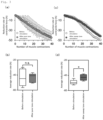
- Figure 3(a) is a graph showing the reduction rate of contractile force relative to the number of muscle contractions before (pre-rest) and after stimulation in the pure-tone stimulus group.
- Figure 3(b) is a graph illustrating the average reduction rate of contractile force during muscle contractions in response to the 38th to 40th electrical stimulations before and after stimulation in the pure-tone stimulus group. From these graphs, no significant improvement in muscle strength due to pure-tone stimulation was observed.
- Figure 3(c) is a graph showing the reduction rate of contractile force relative to the number of muscle contractions before and after stimulation in the sweep-tone stimulus group.
- Figure 3(d) is a graph illustrating the average reduction rate of contractile force during muscle contractions in response to the 31st to 33rd electrical stimulations before and after stimulation in the sweep-tone stimulus group. From these graphs, a significant improvement in muscle strength due to sweep tone stimulation was observed.
- Example 2 investigated whether inner ear function contributes to the muscle strength improvement effect of sound stimulation using inner ear-impaired mice (Vestibular Lesion, VL). Specifically, 11 male mice (2.5 months old) were prepared, and inner ear function was impaired in 5 of them by intratympanic administration of an ototoxic drug. The hindlimb muscles of all 11 mice were subjected to electrical stimulation to induce 80 contractions, during which the contractile force was measured. Afterward, the mice were allowed a 24-hour rest period. Following the rest, a sweep-tone stimulus (frequency range of 80-90 Hz, cycle time of 0.1 seconds, and sound pressure level of 85 dBZ) was applied for 5 minutes. Subsequently, the hindlimb muscles of the mice were subjected to the same electrical stimulation (80 contractions), and the contractile force during this period was measured.
- Vestibular Lesion, VL Inner ear-impaired mice
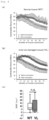
- Figure 4(a) is a graph showing the contractile force relative to the number of muscle contractions before and after stimulation in 6 normal mice (WT) without impaired inner ear function.
- Figure 4(b) is a graph showing the contractile force relative to the number of muscle contractions before and after stimulation in 5 inner ear-damaged mice.
- Figure 4(c) is a graph comparing the shift in the average contractile force during the last 6 contractions (75th to 80th) before and after stimulation between the normal mice and the inner ear-damaged mice.
- Example 3 the effect of sweep tone stimulus on improving muscle weakness was evaluated using mice with reduced muscle strength induced by tail suspension (a model of locomotive syndrome). Specifically, 20 mice (7 weeks old) were prepared, and muscle strength in the hind limbs was reduced in 11 of these mice by performing tail suspension for 2 weeks. Subsequently, a first muscle strength test was conducted on all 20 mice, and the contractile force during the final muscle contraction was measured when 57 electrical stimulations were applied to the hind limbs. Afterward, tail suspension was discontinued for the 11 mice. Of these, 6 mice (tail suspension + stimulation group) with reduced muscle strength received sweep tone stimulus (sound pressure level: 85 dBZ, frequency: 60-120 Hz, cycle time: 0.1 s) for 5 minutes per day over 1 week.
- sweep tone stimulus sound pressure level: 85 dBZ, frequency: 60-120 Hz, cycle time: 0.1 s
- mice with reduced muscle strength did not receive any sound stimulation.
- a second muscle strength test was conducted on all 20 mice using the same procedure as the first test.
- Figure 5 is a graph showing the muscle strength (average contractile force) at the start of the experiment, the first muscle strength test, and the second muscle strength test for the tail suspension + stimulus group, the tail suspension + non-stimulus group, and the control group. From this graph, it was found that the application of a sweep tone stimulus has a significant effect on improving muscle weakness.
- Figures 7(a) to 7(c) show cross-sectional images of the plantar muscle for the control group, the tail suspension + non-stimulus group, and the tail suspension + stimulus group, respectively.
- Figure 7(d) is a graph showing the proportion of slow-twitch fibers in the plantar muscle for the control group, the tail suspension + non-stimulus group, and the tail suspension + stimulus group.
- Figure 7(e) is a graph showing the proportion of fast-twitch fibers in the plantar muscle for these same groups.
- NADH-TR staining reflects mitochondrial activity within muscle fibers. In the cross-sectional images, fast-twitch fibers, which contain more glycolytic enzymes, appear darker, while slow-twitch fibers, which contain more oxidative enzymes, appear lighter.
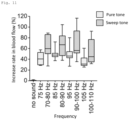
- Figure 11 is a graph showing the relationship between the frequency of sound stimuli applied to mice and the rate of increase in skin blood flow. From these results, it was found that the blood flow increase rate in mice exposed to sweep tones was greater than that in mice exposed to pure tones with a frequency equal to the median frequency of the sweep tone's range. While effects were observed even at frequencies above 100 Hz, it was found that frequencies of 90 Hz or lower, particularly sweep tones varying in the range of 80-90 Hz, exhibited remarkably higher blood flow increase effects.
Landscapes
- Health & Medical Sciences (AREA)
- Epidemiology (AREA)
- Pain & Pain Management (AREA)
- Physical Education & Sports Medicine (AREA)
- Rehabilitation Therapy (AREA)
- Life Sciences & Earth Sciences (AREA)
- Animal Behavior & Ethology (AREA)
- General Health & Medical Sciences (AREA)
- Public Health (AREA)
- Veterinary Medicine (AREA)
- Percussion Or Vibration Massage (AREA)
Abstract
Description
- The present disclosure relates to a technology for improving muscle strength using a sound stimulus.
- The present inventors have discovered that sound stimulation affects blood flow and have developed a blood flow promotion device utilizing sound stimulation (Patent Document 1). This blood flow promotion device promotes blood circulation in the living body by generating a sound (pure tone) stimulus at a specific frequency between 5 Hz and 250 Hz. It is anticipated to provide improvement effects for symptoms caused by blood flow disorders, such as cold sensitivity, pressure ulcers, Raynaud's phenomenon, and diabetic gangrene.
- Additionally, Non-Patent
Document 1 demonstrates that blood flow volume in skeletal muscle, which is related to muscle strength, correlates with the blood flow volume in the skin. - [Patent Document 1] International Publication No.
WO 2020/129433 - [Non-Patent Document 1] Bartlett, et al.,"Impact of cutaneous blood flow on NIR-DCS measures of skeletal muscle blood flow index",Journal of Applied Physiology,2021
- In view of the above, the present inventors hypothesized that the conventional blood flow promotion device described in
Patent Document 1 could also be expected to improve muscle strength. To test the muscle strength improvement effect of sound stimulus, experiments were conducted using mice. Specifically, an electrical stimulus was applied to the hind limbs of 6 mice to induce 50 muscle contractions, during which the contractile force was measured. Subsequently, the mice were allowed to rest for 24 hours. After the rest period, 3 mice in the sound stimulus group (Sound) were exposed to a pure tone stimulus with a sound pressure level of 85 dBZ and a frequency of 70 Hz for one minute, while the other 3 mice in the control group (Control) were not subjected to any sound stimulus. Thereafter, an electrical stimulus was applied 50 times to the hind limbs of all the mice, and the contractile force was measured during this process. -
Figure 10(a) is a graph showing the contractile force in response to electrical stimulus before the rest period.Figure 10(b) is a graph comparing the contractile force (average value) during the last 5 muscle contractions (46th to 50th) in response to electrical stimulus before the rest period between the control group and the sound stimulus group, with the contractile force of the control group set to 1. In the measurements taken before the rest period, there was no significant difference in contractile force between the control group and the sound stimulus group. In other words, the control group and the sound stimulus group originally had approximately the same muscle strength. -
Figure 10(c) is a graph showing the contractile force in response to electrical stimulus after the rest period.Figure 10(d) is a graph comparing the contractile force (average value) during the last 5 muscle contractions (46th to 50th) in response to electrical stimulus after the rest period between the control group and the sound stimulus group, with the contractile force of the control group set to 1. In the measurements taken after the rest period, there was also no significant difference in contractile force between the control group and the sound stimulus group. In other words, with the conventional blood flow promotion device, no muscle strength improvement effect from sound stimulus was observed. - The present disclosure has been made to solve the above problem, and its objective is to improve muscle strength through sound stimulus.
- In light of the above objective, the present inventors conducted extensive research and, as a result, discovered that the above problem can be solved by varying the frequency of the sound stimulus. That is, the present disclosure involves the following aspects.
- A muscle strength improvement device that generates a sound stimulus for improving muscle strength,
wherein the frequency of the sound stimulus changes over time. - The muscle strength improvement device according to
clause 1, wherein the frequency is 140 Hz or less. - The muscle strength improvement device according to
clause 1,
wherein the frequency is 100 Hz or less. - The muscle strength improvement device according to
clause 1, wherein the difference between the maximum value and the minimum value of the frequency is 60 Hz or less. - The muscle strength improvement device according to
clause 1, wherein the difference between the maximum value and the minimum value of the frequency is 10 Hz or less. - The muscle strength improvement device according to any one of
clauses 1 to 5, wherein the frequency changes periodically. - The muscle strength improvement device according to any one of
clauses 1 to 5, wherein the frequency changes continuously. - A program for enabling a computer to implement a function for generating a sound stimulus to improve muscle strength,
wherein the frequency of the sound stimulus changes over time. - According to the present disclosure, muscle strength can be improved through a sound stimulus.
-
-
Figure 1(a) is a block diagram illustrating the configuration of a musclestrength improvement device 1 according to an embodiment of the present disclosure. -
Figure 1(b) is a schematic diagram showing the configuration of the musclestrength improvement device 1. -
Figure 2(a) is a graph showing an example of the waveform of the sound stimulus. -
Figure 2(b) is a graph showing a variation of the waveform of the sound stimulus. -
Figure 3(a) is a graph showing the reduction rate of contractile force relative to the number of muscle contractions before (pre-rest) and after stimulation in the pure tone stimulus group. -
Figure 3(b) is a graph showing the average reduction rate of contractile force for muscle contractions in response to the 38th-40th electrical stimuli before and after stimulation in the pure tone stimulus group. -
Figure 3(c) is a graph showing the reduction rate of contractile force relative to the number of muscle contractions before and after stimulation in the sweep tone stimulus group. -
Figure 3(d) is a graph showing the average reduction rate of contractile force for muscle contractions in response to the 31st-33rd electrical stimuli before and after stimulation in the sweep tone stimulus group. -
Figure 4(a) is a graph showing the contractile force relative to the number of muscle contractions before and after stimulation in 6 normal mice (WT) without inner ear dysfunction. -
Figure 4(b) is a graph showing the contractile force relative to the number of muscle contractions before and after stimulation in 5 inner-ear-damaged mice. -
Figure 4(c) is a graph comparing the shift in the average contractile force during the last 6 muscle contractions (75th-80th) before and after stimulation between normal mice and inner-ear-damaged mice. -
Figure 5 is a graph showing the muscle strength (average contractile force) at the start of the experiment, after the first test, and after the second test in the tail suspension stimulus group, the tail suspension non-stimulus group, and the control group. -
Figure 6(a) is a cross-sectional image of the soleus muscle in the control group. -
Figure 6(b) is a cross-sectional image of the soleus muscle in the tail suspension non-stimulus group. -
Figure 6(c) is a cross-sectional image of the soleus muscle in the tail suspension stimulus group. -
Figure 6(d) is a graph showing the average cross-sectional area of the soleus muscle in the control group, the tail suspension non-stimulus group, and the tail suspension stimulus group. -
Figure 7(a) is a cross-sectional image of the plantar muscle in the control group. -
Figure 7(b) is a cross-sectional image of the plantar muscle in the tail suspension non-stimulus group. -
Figure 7(c) is a cross-sectional image of the plantar muscle in the tail suspension stimulus group. -
Figure 7(d) is a graph showing the proportion of slow-twitch fibers in the plantar muscle in the control group, the tail suspension non-stimulus group, and the tail suspension stimulus group. -
Figure 7(e) is a graph showing the proportion of fast-twitch fibers in the plantar muscle in the control group, the tail suspension non-stimulus group, and the tail suspension stimulus group. -
Figure 8(a) is an explanatory diagram of an experiment (standing heel-raise test) conducted to verify the recovery effect of sound stimulus on muscle fatigue in humans. -
Figure 8(b) is an explanatory diagram of an experiment (standing heel-raise test) conducted to verify the recovery effect of sound stimulus on muscle fatigue in humans. -
Figure 9(a) is a graph showing the evaluation results of muscle fatigue in the pure tone stimulus group. -
Figure 9(b) is a graph showing the evaluation results of muscle fatigue in the sweep tone stimulus group. -
Figure 10(a) is a graph showing the contractile force in response to electrical stimuli before rest. -
Figure 10(b) is a graph comparing the contractile force (average values) of the control group and the sound stimulus group during the last 5 contractions (46th-50th) before rest. -
Figure 10(c) is a graph showing the contractile force in response to electrical stimuli after rest. -
Figure 10(d) is a graph comparing the contractile force (average values) of the control group and the sound stimulus group during the last 5 contractions (46th-50th) after rest. -
Figure 11 is a graph showing the relationship between the frequency of sound stimulus applied to mice and the increase rate in skin blood flow. -
Figure 12 is a graph comparing the vibration levels of the stage in the XYZ-axis directions where the mice are placed, with and without the application of sound stimulus. -
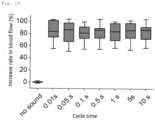
Figure 13 is a graph showing the relationship between the cycle time of sweep tones applied to mice and the increase rate in skin blood flow. -
Figure 14 is a graph showing the relationship between the frequency range of sweep tones applied to mice and the increase rate in blood flow in muscle tissues. - The following describes an embodiment of the present disclosure with reference to the accompanying drawings. It should be noted that the present disclosure is not limited to the embodiment described below, and various modifications may be made without departing from the scope and spirit of the disclosure.
-
Fig. 1(a) is a block diagram illustrating the configuration of the musclestrength improvement device 1 according to the present embodiment, andFig. 1(b) is a schematic diagram showing the configuration of the musclestrength improvement device 1. The musclestrength improvement device 1 is equipped with a function to generate sounds based on a pattern of sound stimuli designed to improve muscle strength. Hereinafter, the sound generated by the musclestrength improvement device 1 will be referred to as a "sound stimulus." - The muscle
strength improvement device 1 includes anoperation reception unit 2 for receiving operations to output a sound stimulus, a setting unit 3 for configuring the sound stimulus in response to the operation, a soundsignal generation unit 4 for generating a signal of the configured sound stimulus, and anoutput unit 5 for outputting the sound stimulus based on the generated signal. - The
operation reception unit 2 is configured, for example, as a touch panel. The setting unit 3 and the soundsignal generation unit 4 are built into themain body 6. The soundsignal generation unit 4 has a function to generate signals of sound stimuli with frequencies that change over time, either continuously or intermittently. - The
output unit 5 is a speaker that may output sound externally from the musclestrength improvement device 1 or a speaker that is connected to the musclestrength improvement device 1. Theoutput unit 5 is provided near the area of the body where the muscle targeted for strength improvement is located. As will be described later, since the inner ear function does not contribute to the muscle strength improvement effect of the sound stimulus, the location of this area is not particularly limited and may be a location far from the ears. - For example, when the area containing the muscle targeted for strength improvement (the target area) is the arm or leg, the
output unit 5 is installed near the subject 7's arm or leg. In this case, it is preferable that theoutput unit 5 is non-contact with the subject 7's arm or leg and that vibrations from components such as the speaker that make up theoutput unit 5 are not directly transmitted to the target area. In the present embodiment, theoutput unit 5 is supported by anadjustable arm 8. It should be noted that the target area is not limited to the arms or legs; any part of the subject's body containing skeletal muscles, including the torso, face, or other areas, can also be a target. - Furthermore, since inner ear function does not contribute to the muscle strength improvement effect of the sound stimulus, it is preferable for the muscle
strength improvement device 1 to include a suppression unit 9 that suppresses the sound stimulus from reaching the subject's ears. The suppression unit 9 can be provided at any position between theoutput unit 5 and the ears and may be composed of a material that shields or absorbs sound. - In
Fig. 1(a) , each element described as a functional block for performing various processes can be implemented in hardware as circuit blocks, memory, or other LSI components, and in software as programs loaded into memory. Accordingly, it will be understood by those skilled in the art that these functional blocks can be realized in various forms, whether through hardware alone, software alone, or a combination of the two, and are not limited to any particular implementation. - As will be described in detail later, the muscle
strength improvement device 1 generates a sound stimulus with a frequency that changes over time to improve muscle strength. The sound stimulus may be a continuous sound emitted continuously over time or a discontinuous sound (intermittent sound) emitted intermittently and/or periodically. The musclestrength improvement device 1 is intended to be installed as medical equipment in healthcare facilities such as hospitals and may be used, for example, to improve the symptoms of athlete patients suffering from muscle fatigue or injuries. Physicians may adjust settings such as the frequency range, the cycle time for frequency changes, and the sound pressure level according to the severity of the patient's symptoms. - The muscle
strength improvement device 1 may also be marketed as a health device and used for the purpose of improving muscle strength in healthy individuals. It is preferable for the musclestrength improvement device 1 to be designed compactly for portability. By distributing the musclestrength improvement device 1 as a health device, it is expected to contribute to promoting health by strengthening the body and improving physical condition, aiding in fatigue recovery, preventing or improving locomotive syndrome, and achieving cosmetic effects through the improvement of facial muscle strength. - In the present disclosure, "improving muscle strength" refers to the presence of a significant difference (p-value less than 0.05) between the muscle strength of muscles subjected to the sound stimulus according to the present disclosure and the muscle strength of muscles not subjected to the sound stimulus, where the muscles have comparable strength prior to stimulation. Additionally, in the present disclosure, improving muscle strength is a concept that involves not only the improvement of muscle strength reduced by muscle fatigue (muscle fatigue recovery) but also the effect of strengthening muscles.
- The sound stimulus generated by the muscle
strength improvement device 1 is a sound stimulus with a frequency that changes over time.Fig. 2(a) is a graph showing an example of the waveform of the sound stimulus. In this sound stimulus, the frequency changes periodically with a cycle time P, but the frequency changes do not necessarily need to be periodic. The frequency is not particularly limited as long as it is within the audible range (20 Hz or higher), but it is preferably 90 Hz or lower. Additionally, the frequency range, that is, the difference between the maximum value Fmax and the minimum value Fmin, is not particularly limited but is preferably 60 Hz or lower, and more preferably 10 Hz or lower. - The sound stimulus shown in
Fig. 2(a) has a frequency that changes continuously (gradually). Such a sound stimulus will hereinafter be referred to as a "sweep tone." The frequency change in a sweep tone does not need to be linear. - Additionally, as shown by the sound stimulus in
Fig. 2(b) , the frequency may change discontinuously. - The sound pressure level of the sound stimulus should be at least 70 dBZ, preferably 80 dBZ or higher, and more preferably 85 dBZ or higher. In the present disclosure, "sound pressure level" refers to the unweighted sound pressure level, without auditory correction. For human subjects, the sound pressure level refers to the sound pressure level at the area where the muscle targeted for improvement is located. For mouse subjects, it refers to the sound pressure level at the location where the mouse is present. Furthermore, in the examples described below, the term "sound pressure level" refers to the level measured at the specific area intended for muscle strength improvement through sound exposure, rather than the output setting value.
- In the muscle
strength improvement device 1 shown inFig. 1 , it is possible to configure the sound stimulus through user operation, but it is not necessary to have a configurable setup. For example, the muscle strength improvement device may be designed to output only a single type of sound stimulus by reproducing pre-stored audio data. Alternatively, the muscle strength improvement device can be realized by inputting audio data for sound stimuli aimed at improving muscle strength into general-purpose audio equipment or a computer via telecommunications networks or storage media such as compact discs or flash memory. - The present inventors have discovered, through experiments and other studies described below, that sounds with frequencies that change over time are sound stimuli suitable for muscle strength improvement.
- Example 1 evaluates the effect of pure tones and sweep tones on muscle strength improvement using an assessment system that induces muscle fatigue through continuous contraction of mouse muscles via electrical stimulation. Specifically, 7 mice (9-10 weeks old, male) were prepared, and the hindlimb muscles of the mice were electrically stimulated to induce 40 contractions, during which the contractile force was measured. Subsequently, the mice were allowed a 24-hour rest period. After the rest, 3 mice in the pure-tone stimulus group were exposed to a pure tone at a frequency of 85 Hz and a sound pressure level of 85 dBZ for 1 minute. Meanwhile, 4 mice in the sweep-tone stimulus group were exposed to a sweep tone with a frequency range of 80-90 Hz, varying with a cycle time of 0.1 seconds, at a sound pressure level of 85 dBZ for 1 minute. After the stimulation, the hindlimb muscles of the mice were subjected to the same electrical stimulation protocol (40 contractions), and the contractile force during this period was measured.
-
Figure 3(a) is a graph showing the reduction rate of contractile force relative to the number of muscle contractions before (pre-rest) and after stimulation in the pure-tone stimulus group.Figure 3(b) is a graph illustrating the average reduction rate of contractile force during muscle contractions in response to the 38th to 40th electrical stimulations before and after stimulation in the pure-tone stimulus group. From these graphs, no significant improvement in muscle strength due to pure-tone stimulation was observed. -
Figure 3(c) is a graph showing the reduction rate of contractile force relative to the number of muscle contractions before and after stimulation in the sweep-tone stimulus group.Figure 3(d) is a graph illustrating the average reduction rate of contractile force during muscle contractions in response to the 31st to 33rd electrical stimulations before and after stimulation in the sweep-tone stimulus group. From these graphs, a significant improvement in muscle strength due to sweep tone stimulation was observed. - Example 2 investigated whether inner ear function contributes to the muscle strength improvement effect of sound stimulation using inner ear-impaired mice (Vestibular Lesion, VL). Specifically, 11 male mice (2.5 months old) were prepared, and inner ear function was impaired in 5 of them by intratympanic administration of an ototoxic drug. The hindlimb muscles of all 11 mice were subjected to electrical stimulation to induce 80 contractions, during which the contractile force was measured. Afterward, the mice were allowed a 24-hour rest period. Following the rest, a sweep-tone stimulus (frequency range of 80-90 Hz, cycle time of 0.1 seconds, and sound pressure level of 85 dBZ) was applied for 5 minutes. Subsequently, the hindlimb muscles of the mice were subjected to the same electrical stimulation (80 contractions), and the contractile force during this period was measured.
-
Figure 4(a) is a graph showing the contractile force relative to the number of muscle contractions before and after stimulation in 6 normal mice (WT) without impaired inner ear function.Figure 4(b) is a graph showing the contractile force relative to the number of muscle contractions before and after stimulation in 5 inner ear-damaged mice.Figure 4(c) is a graph comparing the shift in the average contractile force during the last 6 contractions (75th to 80th) before and after stimulation between the normal mice and the inner ear-damaged mice. - From these results, it was observed that inner ear-damaged mice, like normal mice, also exhibited an improvement in muscle strength due to sweep tone stimulation. This indicates that inner ear function does not contribute to the muscle strength improvement effect induced by sound stimulation.
- In Example 3, the effect of sweep tone stimulus on improving muscle weakness was evaluated using mice with reduced muscle strength induced by tail suspension (a model of locomotive syndrome). Specifically, 20 mice (7 weeks old) were prepared, and muscle strength in the hind limbs was reduced in 11 of these mice by performing tail suspension for 2 weeks. Subsequently, a first muscle strength test was conducted on all 20 mice, and the contractile force during the final muscle contraction was measured when 57 electrical stimulations were applied to the hind limbs. Afterward, tail suspension was discontinued for the 11 mice. Of these, 6 mice (tail suspension + stimulation group) with reduced muscle strength received sweep tone stimulus (sound pressure level: 85 dBZ, frequency: 60-120 Hz, cycle time: 0.1 s) for 5 minutes per day over 1 week. Meanwhile, 5 mice with reduced muscle strength (tail suspension + non-stimulation group) and 9 mice that did not undergo tail suspension (control group) did not receive any sound stimulation. One week after the first muscle strength test, a second muscle strength test was conducted on all 20 mice using the same procedure as the first test.
-
Figure 5 is a graph showing the muscle strength (average contractile force) at the start of the experiment, the first muscle strength test, and the second muscle strength test for the tail suspension + stimulus group, the tail suspension + non-stimulus group, and the control group. From this graph, it was found that the application of a sweep tone stimulus has a significant effect on improving muscle weakness. - Furthermore, after the second muscle strength test, the soleus and plantar muscles of each mouse were stained using NADH-TR staining. Cross-sectional images of these muscles were captured, and the cross-sectional area of each muscle was measured.
-
Figures 6(a) to 6(c) show cross-sectional images of the soleus muscle for the control group, the tail suspension + non-stimulus group, and the tail suspension + stimulus group, respectively.Figure 6(d) is a graph showing the average cross-sectional area of the soleus muscle for the control group, the tail suspension + non-stimulus group, and the tail suspension + stimulus group. As observed in human locomotive syndrome, the cross-sectional area of the soleus muscle in the tail suspension + non-stimulus group was significantly reduced compared to the control group (non-tail-suspended group), indicating muscle atrophy. In contrast, the tail suspension + stimulus group had a larger cross-sectional area of the soleus muscle compared to the tail suspension + non-stimulus group, demonstrating that the application of a sweep tone stimulus has a recovery effect on the soleus muscle. -
Figures 7(a) to 7(c) show cross-sectional images of the plantar muscle for the control group, the tail suspension + non-stimulus group, and the tail suspension + stimulus group, respectively.Figure 7(d) is a graph showing the proportion of slow-twitch fibers in the plantar muscle for the control group, the tail suspension + non-stimulus group, and the tail suspension + stimulus group.Figure 7(e) is a graph showing the proportion of fast-twitch fibers in the plantar muscle for these same groups. NADH-TR staining reflects mitochondrial activity within muscle fibers. In the cross-sectional images, fast-twitch fibers, which contain more glycolytic enzymes, appear darker, while slow-twitch fibers, which contain more oxidative enzymes, appear lighter. In the tail suspension + non-stimulus group, rapid muscle fatigue was observed compared to the control group (non-tail-suspended group). Regarding the proportions of slow-twitch and fast-twitch fibers, the tail suspension + stimulus group showed values comparable to those of the control group, demonstrating a significant improvement effect due to the sweep tone stimulus. - In Example 4, the recovery effect of sweep tone stimulus on muscle fatigue was evaluated in healthy human subjects. Specifically, 10 participants were instructed to perform 30 repetitions of heel-raise exercises to induce transient muscle fatigue, with two electromyographic (EMG)
sensors 10 attached to their calves, as shown inFigure 8(a) . Afterward, the participants rested in a seated position, and as shown inFigure 8(b) , aspeaker 11 was positioned 3 cm from theEMG sensor 10 on the left leg (L) and 40 cm from theEMG sensor 10 on the right leg (R). During the rest period, 4 participants in the pure tone stimulus group received a 5-minute pure tone stimulus at a frequency of 70 Hz, while 6 participants in the sweep tone stimulus group received a 5-minute sweep tone stimulus, with the frequency varying from 60 to 120 Hz in a 0.1-second cycle. The sound pressure level at the attachment site of theEMG sensor 10 on the left leg (L) was 85 dBZ for all participants. The sound pressure level at the attachment site of theEMG sensor 10 on the right leg (R) was 70 dBZ in the pure tone stimulus group and 65 dBZ in the sweep tone stimulus group. Subsequently, muscle fatigue for each participant was evaluated by performing spectrum analysis on the EMG data measured by theEMG sensor 10. -
Figures 9(a) and 9(b) are graphs showing the muscle fatigue evaluation results for the pure tone stimulus group and the sweep tone stimulus group, respectively. The vertical axis of the graph represents the mean frequency shift of the electromyographic (EMG) signal, where smaller values indicate greater muscle fatigue. From these results, it was observed that the sweep tone stimulus group showed a significant recovery effect on muscle fatigue due to the sweep tone stimulus, whereas no such effect was observed in the pure tone stimulus group. - In Example 5, the objective was to screen the conditions of sound stimuli that have a muscle-strengthening effect, using mouse skin blood flow as an indicator. This involved comparing the effects of pure tones with constant frequency, as described in
Patent Document 1, and sweep tones with continuously varying frequencies on the increase in skin blood flow in mice. Specifically, six male mice (3 months old) were prepared. Pure tones at a sound pressure level of 85 dBZ and sweep tones at a sound pressure level of 85 dBZ were applied as stimuli. The average rate of increase in skin blood flow in the hind limbs (calves) before and after the stimulation was measured. The frequency range of the sweep tones (the difference between the maximum and minimum values) was 10 Hz, and the period of frequency change was 0.1 seconds. The same measurements were repeated while varying the frequency of the pure tones and the frequency range of the sweep tones. -
Figure 11 is a graph showing the relationship between the frequency of sound stimuli applied to mice and the rate of increase in skin blood flow. From these results, it was found that the blood flow increase rate in mice exposed to sweep tones was greater than that in mice exposed to pure tones with a frequency equal to the median frequency of the sweep tone's range. While effects were observed even at frequencies above 100 Hz, it was found that frequencies of 90 Hz or lower, particularly sweep tones varying in the range of 80-90 Hz, exhibited remarkably higher blood flow increase effects. - Therefore, it was found that sweep tones with frequencies of 100 Hz or lower exhibited significantly higher blood flow increase effects compared to pure tones of the same frequency level.
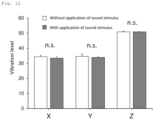
- It is conceivable that the sweep tone stimuli might cause the stage on which the mice were placed to vibrate, potentially increasing blood flow in the mice due to the stage's vibration. However, as shown in
Figure 12 , there were no significant differences in the vibrations of the stage along the X, Y, or Z axes, regardless of the presence or absence of sweep tone stimuli. Therefore, it was confirmed that the increase in blood flow in the mice was due to the sound stimuli and not caused by vibrations of the stage. - In Example 6, the relationship between the frequency change cycle (cycle time) of sweep tones and the skin blood flow increase effect was investigated. Specifically, for the six mice used in Example 5, the sound pressure level was fixed at 85 dBZ, and the frequency range was set to 80-90 Hz. Seven types of sweep tones with cycle times varying from 0.01 seconds to 10 seconds were applied as stimuli. The average rate of increase in skin blood flow in the hind limbs before and after the stimulation was measured.
-
Figure 13 is a graph showing the relationship between the cycle time of sweep tones applied to mice and the rate of increase in skin blood flow. From this graph, it was observed that the blood flow increase effect remained consistent regardless of variations in the cycle time of the sweep tones. Consequently, it was determined that the frequency changes in sweep tones may be either periodic or non-periodic. - In Example 7, the relationship between the frequency and frequency range (difference between maximum and minimum values) of sweep tones and their effect on increasing blood flow in muscle tissue was investigated. Specifically, three male mice (7 weeks old) were prepared, and under anesthesia, the skin tissue was removed to expose the muscle tissue. The blood flow in the muscle tissue was measured using a laser Doppler blood flow imaging device. First, blood flow was measured for 10 seconds without applying any sound stimuli, and the results of this measurement were used as the baseline. Subsequently, 12 types of sweep tones with different frequencies and frequency ranges were applied for 10 seconds each, and the blood flow in the muscle tissue during stimulation was measured.
-
Figure 14 is a graph showing the relationship between the frequency range of sweep tones applied to mice and the rate of increase in blood flow in muscle tissue. The horizontal axis of the graph represents the frequency range of the sweep tones, with each tone having a sound pressure level of 85 dBZ. The vertical axis represents the rate of increase in blood flow (average of three mice) from the baseline. From these results, it was observed that for sweep tones in the frequency range of 80 Hz to 130 Hz, those with a frequency range of 10 Hz exhibited a stronger blood flow increase effect compared to sweep tones with a frequency range of 20 Hz. - As described above, the embodiments and examples of the present disclosure have been explained. However, the present disclosure is not limited to the above embodiments and examples, and various modifications can be made within the scope of the claims. For example, while the above embodiments and examples provide specific numerical values for aspects such as the frequency of sound stimuli that change over time, these numerical values are not particularly limited as long as there is a significant difference in muscle strength between muscles subjected to the sound stimuli and those not subjected to the sound stimuli.
-
- 1
- Muscle strength improvement device
- 2
- Operation reception unit
- 3
- Setting unit
- 4
- Sound signal generation unit
- 5
- Output unit
- 6
- Main body
- 7
- Subject
- 8
- Adjustable arm
- 9
- Suppression unit
- 10
- Electromyographic (EMG) sensor
- 11
- Speaker
Claims (10)
- A muscle strength improvement device that generates a sound stimulus for improving muscle strength,
wherein the frequency of said sound stimulus changes over time. - The muscle strength improvement device according to claim 1,
wherein said frequency is 140 Hz or lower. - The muscle strength improvement device according to claim 1,
wherein said frequency is 100 Hz or lower. - The muscle strength improvement device according to claim 1,
wherein the difference between the maximum value and the minimum value of said frequency is 60 Hz or lower. - The muscle strength improvement device according to claim 1,
wherein the difference between the maximum value and the minimum value of said frequency is 10 Hz or lower. - The muscle strength improvement device according to any one of claims 1 to 5,
wherein said frequency changes periodically. - The muscle strength improvement device according to any one of claims 1 to 5,
wherein said frequency changes continuously. - The muscle strength improvement device according to any one of claims 1 to 5,
wherein said frequency changes with a cycle time of 0.1 seconds to 10 seconds. - The muscle strength improvement device according to claim 9,further comprising an output unit for outputting said sound stimulus,wherein said output unit is non-contact with the subject.
- A program for causing a computer to implement a function for generating a sound stimulus to improve muscle strength,
wherein the frequency of said sound stimulus changes over time.
Applications Claiming Priority (2)
| Application Number | Priority Date | Filing Date | Title |
|---|---|---|---|
| JP2022112197 | 2022-07-13 | ||
| PCT/JP2023/009899 WO2024014054A1 (en) | 2022-07-13 | 2023-03-14 | Muscle strength improvement device and program |
Publications (2)
| Publication Number | Publication Date |
|---|---|
| EP4555991A1 true EP4555991A1 (en) | 2025-05-21 |
| EP4555991A4 EP4555991A4 (en) | 2025-10-22 |
Family
ID=89536442
Family Applications (1)
| Application Number | Title | Priority Date | Filing Date |
|---|---|---|---|
| EP23837936.6A Pending EP4555991A4 (en) | 2022-07-13 | 2023-03-14 | DEVICE AND PROGRAM FOR IMPROVING MUSCLE STRENGTH |
Country Status (4)
| Country | Link |
|---|---|
| US (1) | US20260034024A1 (en) |
| EP (1) | EP4555991A4 (en) |
| JP (1) | JP7787613B2 (en) |
| WO (1) | WO2024014054A1 (en) |
Family Cites Families (10)
| Publication number | Priority date | Publication date | Assignee | Title |
|---|---|---|---|---|
| JP2000079150A (en) * | 1998-09-04 | 2000-03-21 | Hayashibara Takeshi | Mattress with vibrating function |
| ITRM20020308A1 (en) * | 2002-06-03 | 2003-12-03 | Akropolis S R L | THERAPEUTIC TREATMENT EQUIPMENT, AND RELATED METHOD. |
| US8197427B2 (en) * | 2004-08-16 | 2012-06-12 | Virginia Commonwealth University | Acoustical-based tissue resuscitation |
| WO2006124559A2 (en) * | 2005-05-12 | 2006-11-23 | Stimtrainer, Inc. | Frequency stimulation trainer |
| US20070093732A1 (en) * | 2005-10-26 | 2007-04-26 | David Venturi | Vibroacoustic sound therapeutic system and method |
| ITRM20070004A1 (en) * | 2007-01-04 | 2008-07-05 | Sandro Mandolesi | EQUIPMENT WITH FREQUENCY MODULATION AND POWER OF ACOUSTIC PRESSURE WAVE FOR TREATMENT OF PAIN IN MEN AND ANIMALS |
| US20100121131A1 (en) * | 2008-11-11 | 2010-05-13 | Mathes Richard A | Apparatus and methods for stimulating a body's natural healing mechanisms |
| US20190151192A1 (en) * | 2016-05-19 | 2019-05-23 | Yohachi Yamashita | Ultrasonic irradiation apparatus and system, and ultrasonic irradiation method |
| JP7339680B2 (en) * | 2018-12-21 | 2023-09-06 | 国立大学法人東海国立大学機構 | Blood flow promotion device, chair, bed |
| IT202000023704A1 (en) * | 2020-10-08 | 2022-04-08 | Paolo Mencarini | MASSAGER STIMULATOR DEVICE |
-
2023
- 2023-03-14 EP EP23837936.6A patent/EP4555991A4/en active Pending
- 2023-03-14 WO PCT/JP2023/009899 patent/WO2024014054A1/en not_active Ceased
- 2023-03-14 US US18/993,295 patent/US20260034024A1/en active Pending
- 2023-03-14 JP JP2024533508A patent/JP7787613B2/en active Active
Also Published As
| Publication number | Publication date |
|---|---|
| JP7787613B2 (en) | 2025-12-17 |
| JPWO2024014054A1 (en) | 2024-01-18 |
| EP4555991A4 (en) | 2025-10-22 |
| US20260034024A1 (en) | 2026-02-05 |
| WO2024014054A1 (en) | 2024-01-18 |
Similar Documents
| Publication | Publication Date | Title |
|---|---|---|
| US9731125B2 (en) | Method and system for altering body mass composition using galvanic vestibular stimulation | |
| US12364860B2 (en) | Method and system for altering body mass composition using galvanic vestibular stimulation | |
| US10569084B2 (en) | Method and system for altering body mass composition using galvanic vestibular stimulation | |
| Silva et al. | The taping method effects on the trapezius muscle in healthy adults | |
| Contreras‐Hernandez et al. | Load and muscle‐dependent changes in triceps surae motor unit firing properties in individuals with non‐insertional Achilles tendinopathy | |
| US20260034024A1 (en) | Muscle strength improvement device and program | |
| Lee et al. | Brief communication: Effects of external qi-therapy on emotions, electroencephalograms, and plasma cortisol | |
| Yokoyama et al. | Effect of chest mobilization on intercostal muscle stiffness | |
| EP3648836B1 (en) | Cosmetic method and system for altering body mass composition using galvanic vestibular stimulation | |
| RU2715981C1 (en) | Method of individual therapy correction in patients with prolonged disturbed consciousness | |
| McDonald et al. | Neurophysiological insights into sit-to-stand post stroke | |
| Zieliński et al. | The relationship between masticatory muscles activity and tinnitus–preliminary study | |
| CN115768347A (en) | Method and apparatus for assessing or monitoring cutaneous sympathetic nerve activity in a living subject | |
| Kostiuk et al. | Substantiation of relaxings plintused on patients with the parafunction of chewing muscles | |
| Miyamoto et al. | Circulation Dynamics and Local Blood Flow Changes with High-voltage and Low-frequency Electrical Stimulation of Nerves: Proposed Self-care Approaches for Hypertension | |
| RU2778777C1 (en) | Method and apparatus for automated correction of the posture and movements of the upper limb in the elbow joint | |
| CA3069251C (en) | Method and system for altering body mass composition using galvanic vestibular stimulation | |
| 林田ゆり子 | Impact of Visual and Auditory Relaxation Techniques on Autonomic Responses During Dental Procedures: A Randomized Controlled Trial | |
| Fritz et al. | Neuromuscular aging and frailty | |
| Holliger | Contribution of the reticulospinal system to interlimb coordination during bimanual movements and locomotion | |
| Zou et al. | Improvement in the inner ear symptoms of patients with Meniere's disease after treatment using low-frequency vibration: a preliminary report | |
| RU2414846C1 (en) | Method of estimating degree of pain tolerance | |
| RU100907U1 (en) | CONTACT ELECTRIC STIMULATOR | |
| Govender | Physiological properties and clinical characteristics of vestibulo-collic and vestibulo-ocular reflexes in humans | |
| Class et al. | Patent application title: METHOD AND SYSTEM FOR ALTERING BODY MASS COMPOSITION USING GALVANIC VESTIBULAR STIMULATION Inventors: Paul Duncan Mcgeoch (La Jolla, CA, US) Vilayanur S. Ramachandran (La Jolla, CA, US) |
Legal Events
| Date | Code | Title | Description |
|---|---|---|---|
| STAA | Information on the status of an ep patent application or granted ep patent |
Free format text: STATUS: THE INTERNATIONAL PUBLICATION HAS BEEN MADE |
|
| PUAI | Public reference made under article 153(3) epc to a published international application that has entered the european phase |
Free format text: ORIGINAL CODE: 0009012 |
|
| STAA | Information on the status of an ep patent application or granted ep patent |
Free format text: STATUS: REQUEST FOR EXAMINATION WAS MADE |
|
| 17P | Request for examination filed |
Effective date: 20250204 |
|
| AK | Designated contracting states |
Kind code of ref document: A1 Designated state(s): AL AT BE BG CH CY CZ DE DK EE ES FI FR GB GR HR HU IE IS IT LI LT LU LV MC ME MK MT NL NO PL PT RO RS SE SI SK SM TR |
|
| A4 | Supplementary search report drawn up and despatched |
Effective date: 20250919 |
|
| DAV | Request for validation of the european patent (deleted) | ||
| DAX | Request for extension of the european patent (deleted) | ||
| RIC1 | Information provided on ipc code assigned before grant |
Ipc: A61H 1/00 20060101AFI20250915BHEP Ipc: A61H 23/02 20060101ALI20250915BHEP |