EP4555858A2 - Verfahren und system zur automatischen überwachung von fischläusen in fischaquakultur - Google Patents
Verfahren und system zur automatischen überwachung von fischläusen in fischaquakultur Download PDFInfo
- Publication number
- EP4555858A2 EP4555858A2 EP24220187.9A EP24220187A EP4555858A2 EP 4555858 A2 EP4555858 A2 EP 4555858A2 EP 24220187 A EP24220187 A EP 24220187A EP 4555858 A2 EP4555858 A2 EP 4555858A2
- Authority
- EP
- European Patent Office
- Prior art keywords
- fish
- enclosure
- track
- camera
- sea
- Prior art date
- Legal status (The legal status is an assumption and is not a legal conclusion. Google has not performed a legal analysis and makes no representation as to the accuracy of the status listed.)
- Pending
Links
Images

Classifications
-
- A—HUMAN NECESSITIES
- A01—AGRICULTURE; FORESTRY; ANIMAL HUSBANDRY; HUNTING; TRAPPING; FISHING
- A01K—ANIMAL HUSBANDRY; AVICULTURE; APICULTURE; PISCICULTURE; FISHING; REARING OR BREEDING ANIMALS, NOT OTHERWISE PROVIDED FOR; NEW BREEDS OF ANIMALS
- A01K61/00—Culture of aquatic animals
- A01K61/60—Floating cultivation devices, e.g. rafts or floating fish-farms
-
- A—HUMAN NECESSITIES
- A01—AGRICULTURE; FORESTRY; ANIMAL HUSBANDRY; HUNTING; TRAPPING; FISHING
- A01K—ANIMAL HUSBANDRY; AVICULTURE; APICULTURE; PISCICULTURE; FISHING; REARING OR BREEDING ANIMALS, NOT OTHERWISE PROVIDED FOR; NEW BREEDS OF ANIMALS
- A01K61/00—Culture of aquatic animals
- A01K61/10—Culture of aquatic animals of fish
- A01K61/13—Prevention or treatment of fish diseases
-
- A—HUMAN NECESSITIES
- A01—AGRICULTURE; FORESTRY; ANIMAL HUSBANDRY; HUNTING; TRAPPING; FISHING
- A01K—ANIMAL HUSBANDRY; AVICULTURE; APICULTURE; PISCICULTURE; FISHING; REARING OR BREEDING ANIMALS, NOT OTHERWISE PROVIDED FOR; NEW BREEDS OF ANIMALS
- A01K61/00—Culture of aquatic animals
- A01K61/90—Sorting, grading, counting or marking live aquatic animals, e.g. sex determination
-
- Y—GENERAL TAGGING OF NEW TECHNOLOGICAL DEVELOPMENTS; GENERAL TAGGING OF CROSS-SECTIONAL TECHNOLOGIES SPANNING OVER SEVERAL SECTIONS OF THE IPC; TECHNICAL SUBJECTS COVERED BY FORMER USPC CROSS-REFERENCE ART COLLECTIONS [XRACs] AND DIGESTS
- Y02—TECHNOLOGIES OR APPLICATIONS FOR MITIGATION OR ADAPTATION AGAINST CLIMATE CHANGE
- Y02A—TECHNOLOGIES FOR ADAPTATION TO CLIMATE CHANGE
- Y02A40/00—Adaptation technologies in agriculture, forestry, livestock or agroalimentary production
- Y02A40/80—Adaptation technologies in agriculture, forestry, livestock or agroalimentary production in fisheries management
- Y02A40/81—Aquaculture, e.g. of fish
Definitions
- the present invention pertains to a method for automatic sea lice monitoring in fish aquaculture, such as salmon aquaculture, the method comprising submerging a camera in a sea pen comprising fish, using the camera to make an image of at least one of said fish, analysing the image to differentiate between individual sea lice present on the fish, such as salmon and the fish itself, and assessing the number of sea lice present on the fish.
- the invention also pertains to a system for use in fish aquaculture to automatically monitor and report sea lice presence on fish, and to a device for making images of fish present in a sea pen.
- sea lice mainly Lepeophtheirus salmonis and various Caligus species
- sea lice continue to be one of the most important fish health concerns. Even in regions where significant infestations tend not to be experienced, such as British Columbia or the far north of Norway, it is important to monitor sea lice levels to mitigate any potential negative impacts for wild salmon.
- the camera is attached to a device for guiding the fish such as salmon along an imaging track, the camera being directed to the track.
- the principal problem is not that sea lice cannot be distinguished on a fish such as salmon for accurate counting, the problem is that the fish do not appear on the images in a standardised way, for example, the angle and distance may vary considerably depending on the spatial relationship between the camera and the fish at the time of making an image. Also, in many instances far too many fish appear on an image, partly overlapping each other. This on the one hand makes the automatic sea lice monitoring less easy, but more importantly, may prevent that a complete side surface of a fish such as a salmon can be assessed. All of this contributes to less reliability.
- the camera holds a predetermined position with respect to an imaging track (i.e. a path or line along which a fish or salmon may swim, to which path or line the camera is directed to be able and image the fish or salmon when actually passing).
- an imaging track i.e. a path or line along which a fish or salmon may swim, to which path or line the camera is directed to be able and image the fish or salmon when actually passing.
- the track may be wider than the width of just one fish such as salmon, this way the imaging of the fish may take place with substantially improved reliability.
- the distance and orientation of the fish with respect to the camera is better controlled when compared to a method wherein a camera is simply submerged in the sea, without being spatially positioned with respect to an imaging track and thus, with respect to a fish such as salmon to be imaged.
- the chance that an image of fish overlapping each other is decreased, which also contributes to an improved reliability of the automatic monitoring method.
- a system comprising a central processing unit (CPU), and connected to the CPU a camera submerged in a sea pen comprising the fish such as salmons, the camera being devised to make images of said fish or salmons, wherein the camera is attached to a device for guiding the fish or salmons along an imaging track of this device, the camera being directed to the track, imaging software running on the CPU to analyse images of the fish or salmons made by the camera, to differentiate between individual sea lice present on each of the said fish or salmons and the fish or salmons themselves, and to assess the number of sea lice present on the fish or salmons, and a reporting unit connected to the CPU, to display a results corresponding to said assessing.
- This system makes use of the same advantages of the imaging device as described here above.
- the invention also enables the use of a device for making images of fish and especially salmons present in a sea pen, the device comprising a track for guiding a fish or salmon through the device, the device comprising an enclosure that confines the track, wherein the camera is attached to the enclosure and directed to the track.
- Automatic means without requiring operator intervention to perform the action. This does not exclude that an automatic action may be initiated (for example requested), intervened or terminated by an operator.
- Radial means heaving walls or borders arranged around a centre.
- Assessing a number of items means to create a parameter that corresponds to that number of items, for example by explicitly counting the number of items or by establishing the total weight of the items.
- a central processing unit is a hardware system, programmed to process data.
- the hardware does not need to be one single unit, but may comprise several distributed units operatively connected via for example wireless connections.
- An enclosure of a track means that the items that should pass the track cannot freely cross the enclosure. This does not include that other material (for example units smaller than the items, or a liquid or gas) can cross the enclosure.
- a camera being directed to an item means that the camera is positioned to be able and make an image of that item or a second item positioned in a straight line between the camera and the said first item.
- the device comprises a radial enclosure to confine the track. It was found that a very convenient and reliable way of guiding a fish, such as salmon along an imaging track is to use a device that radially confines the track.
- the width of the opening should be chosen such that the salmon is typically not hindered in swimming along the track, but also, not too big to prevent improper guidance.
- the actual measures to allow a fish or salmon to swim through the device, and still give adequate guidance is believed to depend mainly on the age (size) of the fish or salmons and the density of the fish or salmons in the pen. Good results were obtained when the radial enclosure has a diameter or diagonal that is about 90-150% of the girth of the fish.
- the girth of the fish is the distance of the circumference of the fish going round the fish from the back to belly and back to the back of the fish and is the distance around the fattest, thickest or biggest part of the fish, which is usually the midsection.
- Girth may be measured with a fabric ruler, or using a string, and then measuring the length of the string.
- the diameter or diagonal of the enclosure is 90-150% of the girth of the fish.
- the diameter or diagonal of the enclosure is 100-140% of the girth of the fish, more preferably, the diameter or diagonal of the enclosure is 105-130% of the girth of the fish, more preferably, the diameter or diagonal of the enclosure is 110-125% of the girth of the fish, more preferably, the diameter or diagonal of the enclosure is 115-120% of the girth of the fish.
- the above measures ensure the free movement of the fish, and the fish will swim freely along track, without needing any force. It is important for the fish to swim freely, into the device to avoid any stress. If no force is needed for the fish to swim into the device and along the track, then the fish will experience less stress, which is beneficial and no additional devices are needed to force the fish into the device and along the track.
- the above measures also ensure that the fish swim through the enclosure one by one, thereby avoiding overlap of fish that will compromise the counting.
- the above measures have the benefit that the fish will swim through the enclosure in an uniform way. This has the advantage that the cameras may be aligned in the most beneficial way to count the sea lice and that for each fish the sea lice are counted at the same part of the fish for each fish, thus ensuring uniform and thus reliable counting.
- the enclosure is circular enclosure.
- a circular enclosure is easier to position evenly around a longitudinal imaging track, increasing the reliability of the method.
- the enclosure is endless along its circumference, i.e. not having an opening to interrupt the circumference. This provides for an improved stability of the device.
- the device is a circular frame. Such a frame has been found ideally suitable to guide a fish such a salmon over a track corresponding to the axis of the frame.
- the diameter of the circular enclosure is 90-150% of the girth of the fish.
- the diameter of the circular enclosure is 100-140% of the girth of the fish, more preferably, the diameter of the circular enclosure is 105-130% of the girth of the fish, more preferably, the diameter of the circular enclosure is 110-125% of the girth of the fish, more preferably, the diameter of the circular enclosure is 115-120% of the girth of the fish.
- the device is spatially fixed with regard to one or more walls of the sea pen.
- the device would be mechanically connected to a float, the submerged device would bounce with the amplitude of the waves. It is foreseen that this creates too much disturbance around the device, possibly keeping the salmons away from taking the imaging track (depending on the amplitude of the waves).
- spatially fixing the device with respect to one or more walls of the pen for example with respect to the bottom of the pen using an anchor that grasps this bottom, this potential problem may not arise.
- the device comprises at least two cameras directed to the track. Using two or more cameras enables a greater surface of the salmon to be images, thereby increasing the reliability of the assessment of the number of sea lice present on the salmon.
- the device is provided with a thermometer to record the sea water temperature at the time the image is made.
- the seat water temperature is an important factor in sea lice infestations. By recording the sea water temperature, the relation between temperature and sea lice infestations can be better assessed.
- the size of these lice is assessed. This way, information about the stage of life of the sea lice can be obtained. This can be important information to optimize combatting an infestation of sea lice in a pen.
- Another aspect of the invention is directed to a system for use in fish aquaculture to automatically monitor and report sea lice presence on fish, the system comprising
- Another aspect of the invention is directed to a device for making images of fish present in a sea pen, the device comprising a track for guiding a fish through the device, the device comprising an enclosure that confines the track, wherein the camera is attached to the enclosure and is directed to the track.
- the enclosure is a radial enclosure (11, 101) to confine the track.
- the enclosure has a diameter or a diagonal having a length that is 90-150% of the girth of the fish.
- the enclosure is a circular enclosure.
- the enclosure is endless along its circumference.
- the enclosure is a circular frame (101).
- the method, device and system of the present invention are especially well-suited for aquaculture where the fish are cultured in open water such as salmon and trout, and especially for salmon.
- Embodiments and/or features as indicated for the method are expressly envisioned as embodiments for the device and/or system.
- Figure 1 shows three devices for use in the present method.
- a simple open triangle 1 is depicted, comprising two legs 2 and 3, having a length of about 50 cm.
- imaging track 5 (which is viewed from the back in this figure) is depicted.
- Cameras 4 and 4' are directed to this track.
- the triangle legs will typically prevent that salmons will swim very close to the legs, they will keep a certain distance. This distance is such that it coincides with the distance between the track and the two legs. This way, occasionally a salmon will swim along the imaging track.
- one or more pictures or a short film
- FIG. 1B An improved device is depicted in figure 1B .
- This device 10 has as a core part a cylindrical tube 11, which tube represents a radial enclosure to confine the imaging track 5.
- the tube 11 is provided with a funnel 12 to guide a salmon towards the tube 11.
- the diameter of the core is such that a salmon will not enter the core at the non-funnel side, since the salmon will notice the walls of the tube (for a salmon of 3-4 kg this may be a diameter of about 20-25 cm).
- a salmon will not turn when reaching the tube 11 and will swim through, in essence following the imaging track 5.
- Two cameras 4 and 4' are directed towards this track.
- the device is also equipped with a thermometer 6 to measure the temperature of the sea water at the time of taking pictures (images) of the salmon.
- FIG. 1C Another type of device is depicted in figure 1C .
- This device 100 comprises an endless circular frame enclosing an imaging track 5.
- To the frame are connected two cameras 4 and 4', and a thermometer 6, corresponding to the same elements as depicted in figure 1B .
- the diameter of the frame is chosen such that a salmon will swim through the device from either side and be guided in essence along (i.e. coinciding with or at least adjacent) the imaging track.
- a typical diameter is 40-60 cm (depending also on the density of salmons in the pen).
- the frame is provided with means to adapt the circular width to the size of the salmons in a pen.
- indications of length 7 are provided to serve as a ruler.
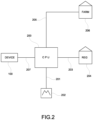
- FIG 2 schematically shows a system according to the invention.
- the system comprises a central processing unit (CPU) 200 and via data line 207 (which may be a wireless connection) connected to the CPU the device 100 (see Figure 1C ) submerged in a sea pen comprising the salmons (not shown; see Figure 3 ).
- the cameras of the device 100 are devised to make images of the salmons when they swim along the corresponding imaging track.
- the CPU comprises imaging software running on the CPU to analyse images of the salmons made by the camera, to differentiate between individual sea lice present on each of the said salmons and the salmons themselves, and to assess the number of sea lice present on the salmons.
- the CPU makes use of a memory 202 which via line 201 forms a part of the CPU as a whole. Data is reported via lines 203 and 205 to the regulating authorities 204 and/or farmer 206 respectively.
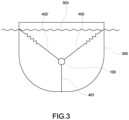
- Figure 3 shows a device 100 according to the invention, spatially fixed with regard to the walls of a sea pen 300 submerged in the sea 301.
- the device 100 is coupled to an anchor 401 that is attached to the bottom of the sea pen 300.
- the device is coupled via two damped lines 402 and 402' to sites of the wall of the pen near the surface of the sea. This makes sure that the device will not bounce with respect to the pens itself, thereby increasing the chance that salmons will be guided along the imaging track.
Landscapes
- Life Sciences & Earth Sciences (AREA)
- Environmental Sciences (AREA)
- Zoology (AREA)
- Marine Sciences & Fisheries (AREA)
- Animal Husbandry (AREA)
- Biodiversity & Conservation Biology (AREA)
- Farming Of Fish And Shellfish (AREA)
- Image Processing (AREA)
Applications Claiming Priority (3)
| Application Number | Priority Date | Filing Date | Title |
|---|---|---|---|
| EP15191108 | 2015-10-22 | ||
| EP16785148.4A EP3364754B1 (de) | 2015-10-22 | 2016-10-21 | Verfahren und system zur automatischen überwachung von fischläusen in fischaquakultur |
| PCT/EP2016/075385 WO2017068127A1 (en) | 2015-10-22 | 2016-10-21 | A method for automatic sea lice monitoring in salmon aquaculture |
Related Parent Applications (1)
| Application Number | Title | Priority Date | Filing Date |
|---|---|---|---|
| EP16785148.4A Division EP3364754B1 (de) | 2015-10-22 | 2016-10-21 | Verfahren und system zur automatischen überwachung von fischläusen in fischaquakultur |
Publications (2)
| Publication Number | Publication Date |
|---|---|
| EP4555858A2 true EP4555858A2 (de) | 2025-05-21 |
| EP4555858A3 EP4555858A3 (de) | 2025-06-11 |
Family
ID=54360893
Family Applications (2)
| Application Number | Title | Priority Date | Filing Date |
|---|---|---|---|
| EP16785148.4A Active EP3364754B1 (de) | 2015-10-22 | 2016-10-21 | Verfahren und system zur automatischen überwachung von fischläusen in fischaquakultur |
| EP24220187.9A Pending EP4555858A3 (de) | 2015-10-22 | 2016-10-21 | Verfahren und system zur automatischen überwachung von fischläusen in fischaquakultur |
Family Applications Before (1)
| Application Number | Title | Priority Date | Filing Date |
|---|---|---|---|
| EP16785148.4A Active EP3364754B1 (de) | 2015-10-22 | 2016-10-21 | Verfahren und system zur automatischen überwachung von fischläusen in fischaquakultur |
Country Status (6)
| Country | Link |
|---|---|
| US (3) | US10863727B2 (de) |
| EP (2) | EP3364754B1 (de) |
| CA (1) | CA3000789C (de) |
| CL (1) | CL2016002664A1 (de) |
| DK (2) | DK3364754T3 (de) |
| WO (1) | WO2017068127A1 (de) |
Families Citing this family (19)
| Publication number | Priority date | Publication date | Assignee | Title |
|---|---|---|---|---|
| CL2016002664A1 (es) | 2015-10-22 | 2018-01-05 | Intervet Int Bv | Un método para monitoreo automático de piojos de mar en acuicultura del salmón |
| EP3726971A1 (de) | 2017-12-20 | 2020-10-28 | Intervet International B.V. | System zur externen fischparasitenüberwachung in aquakultur |
| WO2019121854A1 (en) | 2017-12-20 | 2019-06-27 | Intervet International B.V. | Method and system for external fish parasite monitoring in aquaculture |
| CN116034917B (zh) | 2017-12-20 | 2026-01-13 | 英特维特国际股份有限公司 | 用于水产养殖中的鱼外部寄生虫监测的方法和系统 |
| AU2018387713B2 (en) | 2017-12-20 | 2024-08-08 | Intervet International B.V. | System for external fish parasite monitoring in aquaculture |
| CA3084287A1 (en) | 2017-12-20 | 2019-06-27 | Intervet International B.V. | System for external fish parasite monitoring in aquaculture |
| US10534967B2 (en) | 2018-05-03 | 2020-01-14 | X Development Llc | Fish measurement station keeping |
| WO2019245722A1 (en) | 2018-06-19 | 2019-12-26 | Aquabyte, Inc. | Sea lice detection and classification in an aquaculture environment |
| US20200296925A1 (en) * | 2018-11-30 | 2020-09-24 | Andrew Bennett | Device for, system for, method of identifying and capturing information about items (fish tagging) |
| NO347348B1 (no) * | 2019-06-19 | 2023-09-25 | Subc3D As | System og framgangsmåte for avbildning og telling av eksterne strukturer på en fisk |
| US11297806B2 (en) * | 2020-01-15 | 2022-04-12 | X Development Llc | Lighting controller for sea lice detection |
| US11659820B2 (en) * | 2020-03-20 | 2023-05-30 | X Development Llc | Sea lice mitigation based on historical observations |
| US11657498B2 (en) | 2020-04-10 | 2023-05-23 | X Development Llc | Multi-chamber lighting controller for aquaculture |
| US11611685B2 (en) | 2021-05-10 | 2023-03-21 | X Development Llc | Enhanced synchronization framework |
| US11582397B2 (en) | 2021-05-18 | 2023-02-14 | X Development Llc | Enhanced controller synchronization verification |
| US12078533B2 (en) | 2021-06-02 | 2024-09-03 | Tidalx Ai Inc. | Underwater camera as light sensor |
| US12077263B2 (en) | 2021-06-14 | 2024-09-03 | Tidalx Ai Inc. | Framework for controlling devices |
| EP4608137A1 (de) * | 2022-10-28 | 2025-09-03 | Can Technologies, Inc. | Schädlingsbekämpfungsvorrichtung und verfahren zur bekämpfung von schädlingen in aquakultursystemen |
| KR102726462B1 (ko) * | 2023-12-27 | 2024-11-05 | 익투스에이아이 주식회사 | 모듈식 폐쇄형 양식 장치 및 양식 시스템 |
Family Cites Families (25)
| Publication number | Priority date | Publication date | Assignee | Title |
|---|---|---|---|---|
| US7496228B2 (en) * | 2003-06-13 | 2009-02-24 | Landwehr Val R | Method and system for detecting and classifying objects in images, such as insects and other arthropods |
| NO20033537D0 (no) | 2003-08-11 | 2003-08-11 | Kristian Lillerud | Fremgangsmåte og anordning for telling og beregning av vekt hos fisk |
| EP2178362B1 (de) | 2007-07-09 | 2016-11-09 | Ecomerden A/S | Mittel und verfahren zur durchschnittsgewichtsbestimmung und appetitfütterung |
| NO331345B1 (no) | 2010-02-05 | 2011-12-05 | Esben Beck | Anordning og fremgangsmate for a uskadeliggjore parasitter pa fisk |
| NO332103B1 (no) | 2010-12-13 | 2012-06-25 | Ocea As | System og fremgangsmåte for beregning av størrelse på marine organismer i vann |
| NO333499B1 (no) * | 2011-10-12 | 2013-06-24 | Salvision As | Fremgangsmate og system for a detektere en lus pa fisk |
| NO337305B1 (no) * | 2012-12-20 | 2016-03-07 | Ebtech As | System og fremgangsmåte for beregning av fysiske størrelser for fritt bevegelige objekter i vann |
| WO2014198556A1 (en) | 2013-06-12 | 2014-12-18 | Ardeo Technology As | System and method for systematic evaluation of fish in an aquaculture facility |
| NO336807B1 (no) * | 2013-06-18 | 2015-11-02 | Reidar Aksnes | Anordning og fremgangsmåte ved oppdrettsmerd |
| NO20140640A1 (no) * | 2013-07-18 | 2015-01-19 | Maritime Vision Bergen As | System og anordning for å uskadeliggjøre parasitter |
| ES2552405B1 (es) | 2014-05-27 | 2016-09-14 | Tecnología Marina Ximo, S.L. | Sistema y método de detección de parásitos Anisakis en filetes de pescado |
| EP2962556B1 (de) * | 2014-06-30 | 2018-10-24 | Ardeo Technology AS | System und verfahren zur überwachung und kontrolle von ektoparasiten bei fisch |
| US10222688B2 (en) | 2014-09-22 | 2019-03-05 | Woods Hole Oceanographic Institution | Continuous particle imaging and classification system |
| AU2016208587B2 (en) * | 2015-01-22 | 2020-05-21 | Philips Lighting Holding B.V. | Light unit for counting sea lice |
| CL2016002664A1 (es) | 2015-10-22 | 2018-01-05 | Intervet Int Bv | Un método para monitoreo automático de piojos de mar en acuicultura del salmón |
| NO342604B1 (en) | 2015-12-02 | 2018-06-18 | Intervet Int Bv | A method for automatic sea lice monitoring in salmon aquaculture |
| NO20160880A1 (en) | 2016-05-24 | 2017-11-27 | Itecsolutions Systems & Services As | Arrangement and method for measuring the biological mass of fish and use of the arrangement |
| CN110036310B (zh) * | 2016-10-31 | 2023-05-30 | 法纳电子学农业与环境股份公司 | 用于检测空中动物和水生动物的光学遥感系统 |
| WO2018222048A1 (en) | 2017-05-29 | 2018-12-06 | Ecotone As | Method and system for underwater hyperspectral imaging of fish |
| CA3084287A1 (en) | 2017-12-20 | 2019-06-27 | Intervet International B.V. | System for external fish parasite monitoring in aquaculture |
| AU2018387713B2 (en) | 2017-12-20 | 2024-08-08 | Intervet International B.V. | System for external fish parasite monitoring in aquaculture |
| WO2019121854A1 (en) | 2017-12-20 | 2019-06-27 | Intervet International B.V. | Method and system for external fish parasite monitoring in aquaculture |
| EP3726971A1 (de) | 2017-12-20 | 2020-10-28 | Intervet International B.V. | System zur externen fischparasitenüberwachung in aquakultur |
| CN116034917B (zh) | 2017-12-20 | 2026-01-13 | 英特维特国际股份有限公司 | 用于水产养殖中的鱼外部寄生虫监测的方法和系统 |
| US11297806B2 (en) * | 2020-01-15 | 2022-04-12 | X Development Llc | Lighting controller for sea lice detection |
-
2016
- 2016-10-20 CL CL2016002664A patent/CL2016002664A1/es unknown
- 2016-10-21 WO PCT/EP2016/075385 patent/WO2017068127A1/en not_active Ceased
- 2016-10-21 DK DK16785148.4T patent/DK3364754T3/da active
- 2016-10-21 EP EP16785148.4A patent/EP3364754B1/de active Active
- 2016-10-21 EP EP24220187.9A patent/EP4555858A3/de active Pending
- 2016-10-21 US US15/767,888 patent/US10863727B2/en active Active
- 2016-10-21 CA CA3000789A patent/CA3000789C/en active Active
-
2020
- 2020-11-18 US US16/951,338 patent/US11659821B2/en active Active
-
2023
- 2023-04-19 US US18/303,243 patent/US20230363359A1/en not_active Abandoned
-
2024
- 2024-12-02 DK DKBA202400078U patent/DK202400078Y3/da active IP Right Grant
Also Published As
| Publication number | Publication date |
|---|---|
| CL2016002664A1 (es) | 2018-01-05 |
| DK202400078U1 (da) | 2025-02-12 |
| EP4555858A3 (de) | 2025-06-11 |
| EP3364754A1 (de) | 2018-08-29 |
| CA3000789A1 (en) | 2017-04-27 |
| DK202400078Y3 (da) | 2025-02-12 |
| US10863727B2 (en) | 2020-12-15 |
| US20180303073A1 (en) | 2018-10-25 |
| EP3364754B1 (de) | 2025-01-01 |
| WO2017068127A1 (en) | 2017-04-27 |
| CA3000789C (en) | 2024-07-02 |
| DK3364754T3 (da) | 2025-03-03 |
| US11659821B2 (en) | 2023-05-30 |
| US20230363359A1 (en) | 2023-11-16 |
| US20210068375A1 (en) | 2021-03-11 |
Similar Documents
| Publication | Publication Date | Title |
|---|---|---|
| US11659821B2 (en) | Method for automatic sea lice monitoring in salmon aquaculture | |
| NO342604B1 (en) | A method for automatic sea lice monitoring in salmon aquaculture | |
| DK181217B1 (en) | Method and system for external fish parasite monitoring in aquaculture | |
| NO343899B1 (no) | Anordning og fremgangsmåte for å overvåke fysisk utvikling til fisk i en oppdrettsmerd | |
| WO2014198556A1 (en) | System and method for systematic evaluation of fish in an aquaculture facility | |
| Reed et al. | Quantifying heritable variation in fitness-related traits of wild, farmed and hybrid Atlantic salmon families in a wild river environment | |
| MacKay et al. | Fear responses to novelty in testing environments are related to day-to-day activity in the home environment in dairy cattle | |
| Pullen et al. | Consequences of oral lure retention on the physiology and behaviour of adult northern pike (Esox lucius L.) | |
| Marçalo et al. | Behavioural responses of sardines Sardina pilchardus to simulated purse‐seine capture and slipping | |
| Breen et al. | ICES guidelines on methods for estimating discard survival | |
| Tan et al. | Heritability and genotype by environment interactions for growth and survival in Litopenaeus vannamei at low and high densities | |
| Wei et al. | Review on quantitative methods of fish school behaviors | |
| Tomiyasu et al. | The relationship between body angle and target strength of ribbonfish (Trichiurus japonicus) displaying a vertical swimming motion | |
| Uglem et al. | Discrimination of wild and farmed Atlantic cod (Gadus morhua) based on morphology and scale-circuli pattern | |
| Hamano et al. | Development of a new monitoring methodology for counting bluefin tuna in net pens | |
| JP2005102638A (ja) | 水中における活魚の計数方法及びその装置 | |
| WO2023027647A1 (en) | System and process in monitoring aquatic animals' growth and health status | |
| Ramasamy et al. | Maturation and reproductive biology of Reba Carp Cirrhinus Reba (Hamilton) in Lower Anicut Reservoir, Tamil Nadu, India | |
| Lee et al. | Estimation of genetic parameters for real-time ultrasound measurements for Hanwoo cows at different ages and pregnancy status | |
| Dhal et al. | Genetic studies on reproduction traits in crossbred Jersey cattle in Western Odisha. | |
| Uhlmann et al. | Explanatory variables | |
| Fuller et al. | Cownose Stingrays (Rhinoptera bonasus) enrichment preference and spatial distribution patterns before, during, and after enrichment | |
| CN112931363B (zh) | 基于航道两侧的鱼类感应系统及操作方法、控制方法 | |
| Stavrakidis-Zachou et al. | D6. 3 Sampling in cages | |
| Kamran et al. | Behavioural indices as means of assessing buffalo fly numbers on cattle |
Legal Events
| Date | Code | Title | Description |
|---|---|---|---|
| PUAI | Public reference made under article 153(3) epc to a published international application that has entered the european phase |
Free format text: ORIGINAL CODE: 0009012 |
|
| STAA | Information on the status of an ep patent application or granted ep patent |
Free format text: STATUS: THE APPLICATION HAS BEEN PUBLISHED |
|
| PUAL | Search report despatched |
Free format text: ORIGINAL CODE: 0009013 |
|
| AC | Divisional application: reference to earlier application |
Ref document number: 3364754 Country of ref document: EP Kind code of ref document: P |
|
| AK | Designated contracting states |
Kind code of ref document: A2 Designated state(s): AL AT BE BG CH CY CZ DE DK EE ES FI FR GB GR HR HU IE IS IT LI LT LU LV MC MK MT NL NO PL PT RO RS SE SI SK SM TR |
|
| AK | Designated contracting states |
Kind code of ref document: A3 Designated state(s): AL AT BE BG CH CY CZ DE DK EE ES FI FR GB GR HR HU IE IS IT LI LT LU LV MC MK MT NL NO PL PT RO RS SE SI SK SM TR |
|
| RIC1 | Information provided on ipc code assigned before grant |
Ipc: A01K 61/90 20170101ALI20250508BHEP Ipc: A01K 61/60 20170101AFI20250508BHEP |
|
| STAA | Information on the status of an ep patent application or granted ep patent |
Free format text: STATUS: REQUEST FOR EXAMINATION WAS MADE |
|
| 17P | Request for examination filed |
Effective date: 20251211 |