EP4554259A1 - Übertragungseinheit, empfangseinheit für eine ai/ml-anwendung, datenübertragungsverfahren und datenverarbeitungsverfahren - Google Patents
Übertragungseinheit, empfangseinheit für eine ai/ml-anwendung, datenübertragungsverfahren und datenverarbeitungsverfahren Download PDFInfo
- Publication number
- EP4554259A1 EP4554259A1 EP23835580.4A EP23835580A EP4554259A1 EP 4554259 A1 EP4554259 A1 EP 4554259A1 EP 23835580 A EP23835580 A EP 23835580A EP 4554259 A1 EP4554259 A1 EP 4554259A1
- Authority
- EP
- European Patent Office
- Prior art keywords
- input data
- pieces
- data
- inference
- transmission
- Prior art date
- Legal status (The legal status is an assumption and is not a legal conclusion. Google has not performed a legal analysis and makes no representation as to the accuracy of the status listed.)
- Pending
Links
Images










Classifications
-
- H—ELECTRICITY
- H04—ELECTRIC COMMUNICATION TECHNIQUE
- H04W—WIRELESS COMMUNICATION NETWORKS
- H04W4/00—Services specially adapted for wireless communication networks; Facilities therefor
- H04W4/18—Information format or content conversion, e.g. adaptation by the network of the transmitted or received information for the purpose of wireless delivery to users or terminals
-
- G—PHYSICS
- G06—COMPUTING OR CALCULATING; COUNTING
- G06N—COMPUTING ARRANGEMENTS BASED ON SPECIFIC COMPUTATIONAL MODELS
- G06N3/00—Computing arrangements based on biological models
- G06N3/02—Neural networks
- G06N3/04—Architecture, e.g. interconnection topology
- G06N3/045—Combinations of networks
-
- G—PHYSICS
- G06—COMPUTING OR CALCULATING; COUNTING
- G06N—COMPUTING ARRANGEMENTS BASED ON SPECIFIC COMPUTATIONAL MODELS
- G06N3/00—Computing arrangements based on biological models
- G06N3/02—Neural networks
- G06N3/08—Learning methods
- G06N3/098—Distributed learning, e.g. federated learning
-
- H—ELECTRICITY
- H04—ELECTRIC COMMUNICATION TECHNIQUE
- H04L—TRANSMISSION OF DIGITAL INFORMATION, e.g. TELEGRAPHIC COMMUNICATION
- H04L41/00—Arrangements for maintenance, administration or management of data switching networks, e.g. of packet switching networks
- H04L41/16—Arrangements for maintenance, administration or management of data switching networks, e.g. of packet switching networks using machine learning or artificial intelligence
-
- H—ELECTRICITY
- H04—ELECTRIC COMMUNICATION TECHNIQUE
- H04W—WIRELESS COMMUNICATION NETWORKS
- H04W24/00—Supervisory, monitoring or testing arrangements
- H04W24/02—Arrangements for optimising operational condition
-
- G—PHYSICS
- G06—COMPUTING OR CALCULATING; COUNTING
- G06N—COMPUTING ARRANGEMENTS BASED ON SPECIFIC COMPUTATIONAL MODELS
- G06N3/00—Computing arrangements based on biological models
- G06N3/02—Neural networks
- G06N3/04—Architecture, e.g. interconnection topology
- G06N3/044—Recurrent networks, e.g. Hopfield networks
-
- G—PHYSICS
- G06—COMPUTING OR CALCULATING; COUNTING
- G06N—COMPUTING ARRANGEMENTS BASED ON SPECIFIC COMPUTATIONAL MODELS
- G06N3/00—Computing arrangements based on biological models
- G06N3/02—Neural networks
- G06N3/04—Architecture, e.g. interconnection topology
- G06N3/0464—Convolutional networks [CNN, ConvNet]
Definitions
- the present disclosure relates to a transmission entity, a reception entity, a data transmission method, and a data processing method that are used for an artificial intelligence / machine learning (AI/ML) application.
- AI/ML artificial intelligence / machine learning
- AI/ML applications executed using cellular networks such as 5G, Beyond 5G, and 6G are in the process of being discussed.
- input data acquired by a terminal apparatus with low computational power could be transmitted to a cloud server through a cellular network to perform inference using an AI/ML model by use of high computational power of the cloud server.
- Non-Patent Literature 1 discloses a technology that divides, into pieces of smaller input data, large volumes of input data acquired on a transmission side, that transmits the pieces of smaller input data to an AI/ML model on a reception side through a cellular network, and that parallelizes inference processes performed using the AI/ML model to shorten the time taken until an inference result is obtained.
- Non-Patent Literature 1 Edge Assisted Real-time Object Detection for Mobile Augmented Reality", The 25th Annual International Conference on Mobile Computing and Networking, August 2019, Article No.: 25, Pages 1-16 .
- Non-Patent Literature 1 The technology disclosed in Non-Patent Literature 1 is not allowed to obtain an inference result until transmission of all of the pieces of smaller input data obtained by the division is completed.
- the obtaining of a coarse inference result before a final inference result is obtained may be more advantageous in real-world applications.
- the obtaining of a coarse inference result before a precise inference result is obtained is more advantageous when objects appearing in an image are classified on an automatic guided vehicle (AGV).
- AGV automatic guided vehicle
- the present disclosure addresses the issues described above, and it is an object of the present disclosure to provide a transmission entity and a reception entity that are used for an AI/ML application that enables an inference result to be updated in states until a desired result is obtained.
- a transmission entity used for an AI/ML application includes an acquisition section that acquires original input data; a generator that generates, from the original input data, a plurality of pieces of input data with reduced data amounts; a data transmitter that sequentially transmits pieces of input data of the plurality of pieces of input data; and a request receiver that receives feedback information based on whether there is a need for an additional piece of input data from among the plurality of pieces of input data.
- a reception entity used for an AI/ML application includes a data receiver that sequentially receives pieces of input data of a plurality of pieces of input data; an inference section that sequentially inputs the pieces of input data of the plurality of pieces of input data to a multi-input AI/ML model to sequentially acquire inference values of a plurality of inference values; an output section that sequentially updates inference results on the basis of the respective inference values of the plurality of inference values to output the updated inference results; a determination section that determines whether there is a need for an additional piece of input data from among the plurality of pieces of input data; and a request transmitter that transmits feedback information on the basis of the determination of whether there is a need for the additional piece of input data, the determination being performed by the determination section.
- a data transmission method used for an AI/ML application includes acquiring original input data; generating, from the original input data, a plurality of pieces of input data with reduced data amounts; sequentially transmitting pieces of input data of the plurality of pieces of input data; and receiving feedback information based on whether there is a need for an additional piece of input data from among the plurality of pieces of input data.
- a data processing method used for an AI/ML application includes sequentially receiving pieces of input data of a plurality of pieces of input data; sequentially inputting the pieces of input data of the plurality of pieces of input data to a multi-input AI/ML model to sequentially acquire inference values of a plurality of inference values; sequentially updating inference results on the basis of the respective inference values of the plurality of inference values to output the updated inference results; determining whether there is a need for an additional piece of input data from among the plurality of pieces of input data; and transmitting feedback information on the basis of the determination of whether there is a need for the additional piece of input data.
- FS_AMMT 3GPP securing artificial intelligence
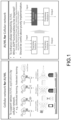
- Fig. 1 illustrates two examples of using AI/ML for a cellular network.
- the first use example is an AI/ML application that is executed using a cellular network.
- AI/ML application it is necessary that the AI/ML application run on a cellular network smoothly.
- AI/ML applications are expected to come into wide use rapidly. This results in there being a need for a cellular network adaptable to such applications.
- the second use example is the construction of a cellular network using AI/ML.
- the replacement of a portion of or all of the functions of a cellular network with AI/ML makes it possible to further optimize communication. In this case, it is expected that there is a need for not only replacement of algorithms but also, for example, a change in parameter for input and output.
- the AI/ML application executed using a cellular network that is, the first use example described above, is discussed in the present disclosure.
- Future cellular networks may not only simply provide communication functions but also provide computational power to an application that is executed using a cellular network.
- AI/ML application executed using a cellular network could include applications related to, for example, extended reality (XR) such as virtual reality (VR), augmented reality (AR), and mixed reality (MR); automated driving; robotics; unmanned transport vehicles; image recognition; and sound recognition.
- XR extended reality
- VR virtual reality
- AR augmented reality
- MR mixed reality
- automated driving robotics
- unmanned transport vehicles image recognition
- image recognition sound recognition
- Low latency and high computational power are two necessary conditions necessary for a cellular network adaptable to AI/ML applications. These necessary conditions are defined as low latency and high computational power that are exhibited upon executing an AI/ML application. Thus, for example, not the low latency exhibited just between a terminal apparatus and a base station, but the low latency exhibited between the terminal apparatus and a server apparatus that performs inference processing in an AI/ML model, is necessary as the necessary condition of the low latency.
- Fig. 2 illustrates three ways of executing the AI/ML application executed using a cellular network.
- the first execution way is cloud learning with which all of the processes of an AI/ML application are performed on a cloud-server side.
- cloud learning When the cloud learning is applied, all of the processes of an AI/ML application are performed on a cloud-server side.
- input data raw data
- the second execution way is in-device learning with which all of the processes of an AI/ML application are performed by the terminal apparatus.
- the in-device learning is applied, it is not necessary that input data be transmitted from the terminal apparatus to the cloud server.
- the second execution way is excellent in low latency, although it is not realistic for the terminal apparatus to perform all of the processes of an AI/ML application alone.
- the third execution way is distributed learning (Distributed Leering) with which processes of an AI/ML application are performed by nodes in a distributed manner, where the nodes are situated between the terminal apparatus and the cloud server.
- the distributed learning makes it possible to distribute calculation loads to the nodes. Further, pieces of input data are sequentially processed in a node and transmitted to a next node as pieces of intermediate data. This makes it possible to reduce an amount of data transmitted, compared to when input data (raw data) is transmitted to the cloud server. This results in avoiding the lack of bandwidth due to an increase in bandwidth usage, and the increase in latency.
- the third execution way is excellent in low latency. Further, depending on the type of AI/ML application, a lower latency can be achieved by using an edge server that is arranged in a cellular network.
- FIG. 3 illustrates an example of a splitting point in a neural network model that is an example of the AI/ML model.
- the calculation load in a node and the delay in transmission between nodes differ depending on a point at which split is performed. Thus, it is important to set a splitting point appropriately.
- an AI/ML model is split, and learning is performed.
- each of AI/ML models obtained by the split performs learning depending on how the split is performed.
- the AI/ML models being obtained by the split and having performed learning are assigned to the respective nodes.
- the nodes Upon inference, the nodes perform inference in a distributed manner.
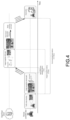
- Fig. 4 illustrates an example of performing distributed learning in an AI/ML application executed using a cellular network.
- Fig. 4 illustrates an example in which an image is captured by a robot and input to an AI/ML model, and necessary movement is performed.
- a portion of inference processes of a neural network model is performed by the robot after the image is captured by the robot.
- intermediate data output from an intermediate node in the neural network model is transmitted to an edge/cloud server.
- the intermediate data has been compressed, and this results in a short transmission delay.
- the rest of the inference processes of the neural network model is performed on an edge/cloud-server side, and an instruction for movement that is given on the basis of a result of the inference is transmitted to the robot.
- Fig. 5 illustrates various ways of performing distributed learning in an AI/ML application executed using a cellular network. Not only a most basic split between a terminal apparatus and a cloud server, but also, for example, split performed using an edge server or split performed between terminal apparatuses is also conceivable.
- An AI/ML application that includes a multi-input AI/ML model is conceivable as an AI/ML application executed using a cellular network.
- Fig. 6 illustrates, as an example of the AI/ML application including a multi-input AI/ML model, a case of using a robot that moves in a factory.
- a robot extracts initial information (initial input) with a limited data amount from an image captured by the robot, and transmits the initial information to an edge/cloud server first.
- the edge/cloud server inputs the received initial information to a multi-input AI/ML model to acquire a coarse recognition result.
- the edge/cloud server transmits, to the robot, an instruction for initial movement on the basis of the coarse recognition result. For example, movement for avoidance is started on the basis of the coarse recognition result showing that an obstacle is situated ahead of the robot.
- the robot receives the instruction for initial movement from the edge/cloud server, the robot starts the movement for avoidance in accordance with the instruction for initial movement.
- the robot extracts, from data of the above-described image captured by the robot, additional information (additional input) that is not included in the initial information, and transmits the additional information to the edge/cloud server.
- the edge/cloud server combines the received additional information with the previously received initial information, and inputs the combined pieces of information to the multi-input AI/ML model to acquire a detailed recognition result.
- the edge/cloud server transmits, to the robot, an instruction to update movement on the basis of the detailed recognition result. For example, a course of the movement for avoidance is corrected on the basis of the detailed recognition result showing that the obstacle situated ahead of the robot is a human, in order to secure adequate safety.
- the robot receives the instruction to update movement from the edge/cloud server, the robot corrects the course of the movement for avoidance in accordance with the instruction to update movement.
- An evaluation indicator such as acquiring an inference result within a specified time period xx with a degree of accuracy that is greater than or equal to yy, is important when the AI/ML application as described above is applied.
- an end-to-end latency that is exhibited from a robot starting transmission of initial information to the robot receiving an instruction to update movement that is given on the basis of a detailed inference result, is important.
- a robot sequentially transmits pieces of additional information in response to a request made by an edge/cloud server for additional information, and sequentially receives instructions to update movement that are given on the basis of the pieces of additional information, it is also necessary to consider the process of sequentially updating inference results until a desired degree of accuracy is obtained in a multi-input AI/ML model. In other words, it is necessary to consider latency of an AI/ML application in consideration of a request for additional information and the process of updating an inference result on the basis of the additional information.
- a transmission entity 10 generates, from original input data, a plurality of pieces of input data with a reduced data amount, and transmits a first piece of input data from among the plurality of pieces of input data to a reception entity 20 first, as illustrated in Fig. 7 .
- the reception entity 20 inputs the first input data to a multi-input AI/ML model to acquire a first inference value, and sets the acquired first inference value as a first inference result.
- the AI/ML model is a neural network model that classifies objects appearing in an image and when neurons in an output layer respectively correspond to the types of objects (such as a human, luggage, and another robot), the type of object corresponding to a neuron for which a largest probability value is output from a softmax function is set to be the first inference result.
- the reception entity 20 gives, to the transmission entity 10, feedback that indicates a request to start transmitting an additional piece of input data from among the plurality of pieces of input data.
- the transmission entity 10 receives the feedback, the transmission entity 10 sequentially transmits, to the reception entity 20, second and subsequent pieces of input data from among the plurality of pieces of input data.
- the reception entity 20 sequentially inputs the second and subsequent pieces of input data to the AI/ML model to acquire second and subsequent inference values, and sequentially updates inference results on the basis of the second and subsequent inference values.
- the reception entity 20 gives, to the transmission entity 10, feedback that indicates a request to stop transmitting the additional input data.
- the transmission entity 10 receives the feedback, the transmission entity 10 stops transmitting the additional input data.
- Fig. 8 illustrating configurations of the transmission entity 10 and reception entity 20 according to the present disclosure. Note that Fig. 8 illustrates logical configurations of the transmission entity 10 and the reception entity 20. Structural elements of each of the entities may be provided to a single apparatus, or may be provided to a plurality of apparatuses in a distributed manner.
- the 5G system illustrated in Fig. 9 includes user equipment (UE) 31, a radio access network / access network (RAN/AN) 32, a core network 33, and a cloud server 35.
- a cellular network 34 includes the RAN/AN 32 and the core network 33.
- the structural elements of the transmission entity 10 may be provided to, for example, the UE 31 connected to the cellular network 34.
- the structural elements of the reception entity 20 may be provided to, for example, the cloud server 35 connected to the cellular network 34.
- a portion of or all of the structural elements of the transmission entity 10 may be provided to the UE 31, the RAN/AN 32, and the core network 33 in a distributed manner.
- a portion of or all of the structural elements of the reception entity 20 may be provided to the RAN/AN 32, the core network 33, and the cloud server 35 in a distributed manner.
- the UE 31 and the RAN/AN 32 are connected to each other via a wireless communication link.
- the RAN/AN 32 and the core network 33 are connected to each other via a wireless communication link or a wired communication link.
- the core network 33 and the cloud server 34 are connected to each other via a wireless communication link or a wired communication link.
- the cellular network 34 may be variously configured by the RAN/AN 32 or the core network 33 in response to a request made by the cloud server 35. Such a configuration may be provided statically or dynamically.
- the UE 31 When the UE 31 is a terminal dedicated to an AI/ML application and has limited uses, the UE 31 may be pre-configured.
- the transmission entity 10 includes an acquisition section 11, a generator 12, a data transmitter 13, and a request receiver 14. Further, a sensing device (not illustrated) such as an imaging sensor is connected to the transmission entity 10.
- the sensing device may be provided to the UE 31 when the transmission entity 10 is provided to the UE 31.
- the sensing device may be provided to the RAN/AN 32 when the transmission entity 10 is provided to the RAN/AN 32.
- the acquisition section 11 acquires original input data generated by a sensing device (not illustrated).
- the original input data is still-image data or moving-image data when the sensing device is an imaging sensor.
- the generator 12 generates, from the original input data, a plurality of pieces of input data with reduced data amounts.
- the original input data is still-image data
- a plurality of still-image data with reduced data amounts that is, for example, a plurality of still-image data with reduced resolutions, is generated from the original still-image data.
- a first piece of still-image data from among the three pieces of still-image data has a lowest resolution, that is, the first still-image data has a smallest data amount.
- a second piece of still-image data from among the three pieces of still-image data has a higher resolution than the first piece of still-image data, that is, the second still-image data has a larger data amount than the first still-image data.
- a third piece of still-image data from among the three pieces of still-image data has a higher resolution than the second piece of still-image data, that is, the third still-image data has a larger data amount than the second still-image data.
- the third still-image data may be identical to the original still-image data.
- the data transmitter 13 sequentially transmits, to the reception entity 20, pieces of input data of a plurality of pieces of input data generated by the generator 12. For example, the pieces of input data of the plurality of pieces of input data are sequentially transmitted from the UE 31 to the cloud server 35 through the cellular network 34 when the transmission entity 10 is provided to the UE 31 and the reception entity 20 is provided to the cloud server 35.
- the request receiver 14 receives feedback information from the reception entity 20.
- the feedback information is received by the UE 31 from the cloud server 35 through the cellular network 34 when the transmission entity 10 is provided to the UE 31 and the reception entity 20 is provided to the cloud server 35.
- the data transmitter 13 transmits, to the reception entity 20, a first piece of input data from among the plurality of pieces of input data in the first transmission.
- the request receiver 14 receives, from the reception entity 20, a request to start transmitting an additional piece of input data from among the plurality of pieces of input data
- the data transmitter 13 starts additional transmission.
- the data transmitter 13 sequentially transmits, to the reception entity 20, second and subsequent pieces of input data from among the plurality of pieces of input data.
- the request receiver 14 receives, from the reception entity 20, a request to stop transmitting the additional input data
- the data transmitter 13 stops the additional transmission.
- the generator 12 may sequentially generate the second and subsequent pieces of input data after the request receiver 14 receives, from the reception entity 20, a request to start transmitting the additional input data. Alternatively, the generator 12 may generate the plurality of pieces of input data collectively.
- the reception entity 20 includes a data receiver 21, an inference section 22 including a multi-input AI/ML model, an output section 23, a determination section 24, and a request transmitter 25.
- the data receiver 21 sequentially receives pieces of input data of a plurality of pieces of input data from the transmission entity 10. For example, the pieces of input data of the plurality of pieces of input data are sequentially received by the cloud server 35 from the UE 31 through the cellular network 34 when the transmission entity 10 is provided to the UE 31 and the reception entity 20 is provided to the cloud server 35.
- the inference section 22 includes therein a multi-input AI/ML model, and sequentially inputs the pieces of input data of the plurality of pieces of input data to the AI/ML model to sequentially acquire inference values of a plurality of inference values.
- the AI/ML model is, for example, a single convolutional neural network (CNN) model that classifies objects appearing in a still image.
- CNN convolutional neural network
- the inference section 22 may include a plurality of CNN models of different numbers of input neurons for the respective numbers of pixels of respective pieces of still-image data.
- the output section 23 sequentially updates inference results on the basis of the inference values of the plurality of inference values acquired by the inference section 22 to output the updated inference results.
- the output section 23 compares the inference results, and selects the inference result with a highest degree of inference accuracy to set the selected inference result as a final inference result (hard-combining), or the output section 23 sequentially updates inference results by updating a previously obtained inference result with an inference result obtained afterward to obtain a final inference result (soft-combining).
- the determination section 24 determines whether there is a need for an additional piece of input data from among the plurality of pieces of input data. For example, the determination section 24 determines whether there is a need for the additional input data, on the basis of the accuracy of a current inference result. When, for example, the accuracy of the current estimation result is greater than or equal to a certain specified threshold, that is, when, for example, a largest probability value output from a softmax function is greater than or equal to another specified threshold, the determination section 24 determines that there is no longer need to update the inference result, and determines that there is no need for the additional input data.
- a certain specified threshold that is, when, for example, a largest probability value output from a softmax function is greater than or equal to another specified threshold
- the determination section 24 determines that there is further a need to update the inference result, and determines that there is a need for the additional input data.
- the request transmitter 25 transmits feedback information to the transmission entity 10.
- the feedback information is transmitted from the cloud server 35 to the UE 31 through the cellular network 34 when the transmission entity 10 is provided to the UE 31 and the reception entity 20 is provided to the cloud server 35.
- the data receiver 21 receives, from the transmission entity 10, a first piece of input data from among the plurality of pieces of input data in the first reception.
- the request transmitter 25 transmits a request to start transmitting the additional input data to the transmission entity 10.
- the data receiver 21 sequentially receives, from the transmission entity 10, second and subsequent pieces of input data from among the plurality of pieces of input data.
- the request transmitter 25 transmits a request to stop transmitting the additional input data to the transmission entity 10.
- a configuration of a multi-input AI/ML model according to the present disclosure and various input data input to the AI/ML model are described.
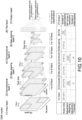
- Fig. 10 illustrates a configuration of a convolutional neural network (CNN) model having input of 28 pixels ⁇ 28 pixels that is an example of the multi-input AI/ML model.
- CNN convolutional neural network
- Fig. 10 illustrates a configuration of a convolutional neural network (CNN) model having input of 28 pixels ⁇ 28 pixels that is an example of the multi-input AI/ML model.
- CNN convolutional neural network
- another AI/ML model that updates an inference result by performing, using a recurrent neural network model, additional input to a neural network model in which inference has been completed, may also be used.
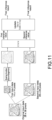
- Fig. 11 illustrates an example of inputting two pieces of still-image data of different resolutions to the CNN model illustrated in Fig. 10 .
- First input data and second input data are generated from original input data, the first input data having a resolution reduced by reducing the number of pixels, the second input data having a higher resolution than the first input data. Note that, here, the second input data has a resolution identical to the resolution of the original input data.
- a scaling function that performs size enlargement is applied to the first input data before the first input data is input to the CNN model.
- a first inference value is acquired on the basis of the first input data and set to be a first inference result.
- a second inference value is acquired on the basis of the second input data.
- the first inference result is updated on the basis of the first inference value and the second inference value. For example, hard-combining with which the first inference value and the second inference value are compared and one of the first inference value and the second inference value that exhibits a higher degree of accuracy is set to be an inference result, is performed, and a final inference result is output.
- Fig. 12 illustrates three methods for generating two pieces of input data of different resolutions from original still-image data.
- Second input data Low-resolution data (on the left in the figure) is generated as first input data, and high-resolution data (on the right in the figure) is generated as second input data.
- Method 3 A portion of low-resolution data (the region A on the left in the figure) is generated as first input data, and a portion of low-resolution data (the region A on the left in the figure) and a portion of high-resolution data (the region B on the right in the figure) are generated as second input data.
- Fig. 13 illustrates an example of inputting two pieces of still-image data of different regions to the CNN model illustrated in Fig. 10 .
- First input data and second input data are generated from original input data, the first input data only including a region situated around a center portion of an image, the second input data only including a region situated around a peripheral edge of the image.
- a first inference value is acquired on the basis of the first input data and set to be a first inference result.
- the first input data and the second input data are combined, and a second inference value is acquired using, as new second input data, input data obtained by the combining.
- the first inference result is updated on the basis of the first inference value and the second inference value. For example, soft-combining with which a latest one of the first inference value and the second inference value is set to be an inference result is performed, and a final inference result is output.
- Fig. 14 illustrates two methods for generating two pieces of input data of different regions from original still-image data.
- Method 1 Data of a certain region (a region C on the left in the figure) is generated as first input data, and data of a region that does not include the certain region of the first input data is generated as second input data, or data of a region (a region D on the left in the figure) that includes the certain region of the first input data is generated as the second input data.
- the regions of the respective pieces of input data may be determined on the side of the transmission entity 10, or the regions of the respective pieces of input data may be determined on the side of the reception entity 20 and reported to the transmission entity 10. Further, the regions of the respective pieces of input data may be determined statically in advance, or may be determined quasi-statically.
- Method 2 Only data of an important region (a region E on the right in the figure) is generated as first input data, and data of a region that does not include the region of the first input data is generated as second input data, or data of a region (a region F on the right in the figure) that includes the region of the first input data is generated as the second input data.
- the important region may be determined on the side of the transmission entity 10, or the important region may be determined on the side of the reception entity 20 and reported to the transmission entity 10.
- the important region may be determined dynamically on the basis of a feature amount.
- the important region may be determined on the basis of a feature amount extracted using an algorithm such as a filter method, a wrapper method, or an embedded method.
- the important region may be determined by a sensing device that includes AI/ML functions and is connected to the transmission entity 10.
- Fig. 15 illustrates an example of a method for generating two pieces of input data of different regions and different resolutions from original still-image data.
- the resolution-based methods in "2-2-1" described above and the region-based methods in "3-2-2" described above may be combined discretionarily when pieces of input data of different regions and different resolutions are generated from original input data.
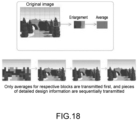
- Fig. 16 illustrates two methods for generating two pieces of input data of different frame rates (frame per second: FPS) from original moving-image data.
- Method 2 Data that only includes a portion of frames (the base layer in the figure) is generated as first input data, and data that includes all of the frames (the base layer and the enhancement layer in the figure) including the frames of the first input data is generated as second input data.
- Method 1 Different proportions of system information to parity information are used for first transmission data and retransmission data (in an upper portion in the figure).
- Method 2 System information is transmitted as first transmission data, and parity information is transmitted as retransmission data (in a middle portion in the figure).
- the processing of generating a plurality of pieces of input data from original input data may be performed on intermediate layer data generated by an AI/ML model being split.
- the intermediate layer data is original input data, and only specific data is extracted from the intermediate layer data to generate a plurality of pieces of input data.
- limitations on data amounts of respective pieces of input data may be set in advance.
- data compression may be performed after only the specific data is extracted from the intermediate layer data.
- the transmission entity 10 may transmit original input data acquired by the transmission entity 10 to the reception entity 20 with no change (single transmission).
- the transmission entity 10 When, for example, there is a reduction in communication performance during single transmission due to, for example, bandwidth limitations of the communication link, the transmission entity 10 generates a plurality of pieces of input data with reduced data amounts from original input data, and sequentially transmits pieces of input data of the plurality of pieces of input data to the reception entity 20, as described above (multi-transmission).
- the transmission entity 10 switches the method for transmitting input data from single transmission to multi-transmission. Further, here, the transmission entity 10 reports to the reception entity 20 that the transmission method is switched from single transmission to multi-transmission.
- Condition 1 When an instruction to perform switching to multi-transmission is received from the RAN/AN 32 in a state in which the transmission entity 10 is provided to the UE 31.
- Condition 2 When an application request to instruct switching to multi-transmission is received from an AI/ML application.
- Condition 3 When a change or variation in communication performance is reported by the RAN/AN 32 in a state in which the transmission entity 10 is provided to the UE 31, and when it is determined that it is difficult to keep single transmission with a communication performance after the change or variation.
- information used to elicit communication performance include information regarding, for example, RSRP / RSRQ / RSSI, delay information, delay-budget information, information regarding throughput, and information regarding an allocated wireless communication resource.
- Condition 4 When the transmission entity 10 measures a communication performance and when it is determined that it is difficult to keep single transmission with the measured communication performance.
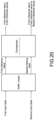
- Fig. 20 is a diagram used to describe an example in which two pieces of input data are used for hard-combining performed by the output section 23 of the reception entity 20.
- a first inference value based on first input data is acquired and set to be a first inference result.
- a second inference value based on second input data is acquired.
- the second inference value and the first inference value are compared, and one of the inference values that exhibits a higher degree of inference accuracy is set to be a final inference result.
- the presence of an obstacle is recognized on the basis of a first inference result, and movement to avoid the obstacle is started as initial movement. Thereafter, the obstacle is recognized as being another moving robot, on the basis of a final inference result, and a course of the movement for avoidance is corrected in order to secure a sufficient distance to the other robot.
- Fig. 21 is a flowchart used to describe details of an operation performed upon hard-combining performed in the above-described case of using a robot.
- first input data is received (S11)
- a first inference value is acquired on the basis of the first input data (S12)
- the first inference value is set to be a first inference result (S13).
- second input data is received (S14), a second inference value is acquired on the basis of the second input data (S15), and the first inference value and the second inference value are compared (S16).
- Fig. 22 is a diagram used to describe an example in which two pieces of input data are used for soft-combining performed by the output section 23 of the reception entity 20.
- a first inference value based on first input data is acquired and set to be a first inference result.
- a second inference value based on second input data is acquired and set to be a final inference result.
- the second input data may include a portion of or all of the first input data.
- the first input data and the second input data may be combined, and the second inference value may be acquired on the basis of data obtained by the combining and used as new second input data.
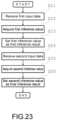
- Fig. 23 is a flowchart used to describe details of an operation performed upon soft-combining performed in the above-described case of using a robot.
- first input data is received (S21)
- a first inference value is acquired on the basis of the first input data (S22)
- the first inference value is set to be a first inference result (S23).
- second input data is received (S24)
- a second inference value is acquired on the basis of the second input data (S25)
- the second inference value is set to be a final inference result (S26).
- the request transmitter 25 of the reception entity 20 transmits a request to start transmitting additional input data as feedback information addressed to the transmission entity 10. For example, the following are conceivable conditions adopted when it is determined that there is a need for additional input data.
- Condition 1 When a degree of accuracy of a first inference result (an inference accuracy) is less than a specified threshold.
- a request to start transmitting additional input data is transmitted when a degree of accuracy of a first inference result obtained on the basis of first input data does not reach a desired degree of accuracy, as illustrated in Fig. 22 .
- a signal-to-noise ratio (SNR), a peak signal-to-noise ratio (PSNR), or a structural simirarity (SSIM) may be used as an indicator for an inference accuracy, in addition to the above-described largest probability value output from a softmax function.
- SNR signal-to-noise ratio
- PSNR peak signal-to-noise ratio
- SSIM structural simirarity
- all of or a portion of an original image may be regularly reported as reference information in order to calculate the inference accuracy. This results in transmitting a request to start transmitting additional input data until next reference information is received when, for example, the degree of inference accuracy does not reach
- Condition 2 When a delay until a first inference result is obtained (an inference delay) is less than a specified threshold. A request to start transmitting additional input data is transmitted when there is a sufficient period of time from the transmission entity 10 transmitting first input data to the reception entity 20 obtaining a first inference result.
- the request transmitter 25 of the reception entity 20 transmits a request to start transmitting additional input data as feedback information addressed to the transmission entity 10. For example, the following are conceivable conditions adopted when it is determined that there is no need for additional input data.
- Condition 1 When a degree of accuracy of an inference result (an inference accuracy) is greater than or equal to a specified threshold. A request to stop transmitting additional input data is transmitted when a degree of accuracy of a current inference result reaches a desired degree of accuracy.
- the threshold used in this case may be different from the threshold used for the above-described request to start the transmission.
- Condition 2 When a delay until an inference result is obtained (an inference delay) is greater than or equal to a specified threshold. A request to stop transmitting additional input data is transmitted when there is not a sufficient period of time from the transmission entity 10 transmitting input data to the reception entity 20 obtaining an inference result.
- the threshold used in this case may be different from the threshold used for the above-described request to start the transmission.
- Condition 3 When a difference in degree of accuracy between a current inference result and an immediately precedent inference result (an amount of improvement in inference accuracy) is less than a specified threshold. A request to stop transmitting additional input data is transmitted when it is determined that the improvement in inference accuracy is no longer expected.
- the stop of transmission of additional input data may be determined on the side of the transmission entity 10, which is different from Conditions 1 to 3 described above.
- the transmission entity 10 could be provided to goggles worn by a user and could track a viewpoint of the user at all times.
- transmission of additional input data used for inference about a target object may be stopped when it is determined that the user looks away from the target object.
- the transmission entity 10 reports to the reception entity 20 about stop of transmission of additional input data.
- ACK / NACK may be used as a method for providing feedback information transmitted by the request transmitter 25 of the reception entity 20, that is, a request to start transmitting additional input data and a request to stop transmitting additional input data.
- ACK is transmitted.
- NACK is transmitted.
- the request transmitter 25 of the reception entity 20 may transmit, for example, associated information as indicated below as feedback information in addition to a request to start transmitting additional input data and a request to stop transmitting additional input data.
- Associated information 1 The number of time of transmission of additional input data. For example, whether it is sufficient if additional input data is transmitted once or the additional input data is to be transmitted multiple times may be reported as the associated information.
- Associated information 2 Specifications of additional input data. For example, specifications such as a data amount (for example, xx MB) of additional input data, a resolution of the additional input data, a region of the additional input data, a code rate of the additional input data, and a proportion of redundancy data in the additional input data may be specified in the form of associated information. Further, for example, data output from a specific neuron in a neural network model may be specified in the form of associated information.
- Associated information 3 Delay of additional input data. For example, delay-budget information indicating that, for example, there is a need to process additional input data within xx milliseconds may be reported in the form of associated information. Further, time specification asking to, for example, transmit additional input data within xx milliseconds may be reported in the form of associated information.
- Associated information 4 A gap between a degree of accuracy of a current inference result and a desired degree of inference accuracy. For example, information regarding a gap between a degree of accuracy of a current inference result and a desired degree of inference accuracy may be reported in the form of associated information.
- Associated information 5 A degree of priority of additional input data.
- a degree of priority of additional input data (for example, high, moderate, and low) may be reported in the form of associated information.
- the transmission entity 10 compares a degree of priority of requested additional input data with a degree of priority of additional input data requested by another user, and determines which of the requests made by the respective users is to be prioritized.
- the transmission entity 10 may change a method for generating additional input data or a method for transmitting the additional input data.
- a method for generating additional input data For example, the following are conceivable change examples.
- a timing of generating additional input data is changed.
- the generator 12 of the transmission entity 10 may generate pieces of additional input data in advance before a request to start transmitting additional input data is received from the reception entity 20.
- the generator 12 of the transmission entity 10 may sequentially generate the pieces of additional input data at a timing at which the request to start the transmission is received.
- the transmission entity 10 may report version information regarding a version of additional input data to the reception entity 20 in advance.
- a resolution of additional input data is changed.
- the generator 12 of the transmission entity 10 may change a resolution of additional input data.
- the generator 12 of the transmission entity 10 may change the resolution of additional input data for each region.
- the generator 12 of the transmission entity 10 may change the resolution of additional input data to a resolution at which no additional input data has been generated.
- a region of additional input data is changed.
- the generator 12 of the transmission entity 10 may change a region of additional input data.
- the generator 12 of the transmission entity 10 may generate pieces of input data in advance by dividing original input data into regions, and may select input data of a region to transmit the selected input data.
- the generator 12 of the transmission entity 10 may change the region of additional input data to a region of which no input data has been generated.
- Change Example 3 Transmission of encoding information regarding encoding of additional input data.
- the data transmitter 12 of the transmission entity 10 may retransmit system information regarding already transmitted additional input data.
- the data transmitter 12 of the transmission entity 10 additionally transmits parity information regarding already transmitted additional input data.
- a 5G system makes it possible to provide communication that supports the multi-input AI/ML model described above in the form of a network slice.
- the UE selects a network slice that provides communication that supports a multi-input AI/ML model, and performs processing of requesting establishment of a protocol data unit (PDU) session that corresponds to the selected network slice.
- PDU protocol data unit
- S-NSSAI is assigned to each network slice as information (network slice selection assistance information) that is used to assist in selecting a network slice, and a network slice is identified by S-NSSAI.
- S-NSSAI includes a pair of a mandatory slice/service type (SST) that includes 8 bits used to identify a slice type, and an optional slice differentiator (SD) that includes 24 bits used to distinguish different slices in a single SST.
- SST mandatory slice/service type
- SD optional slice differentiator
- the core network can select a network function (NF) necessary to provide a PDU session corresponding to a network slice, on the basis of S-NSSAI.
- NF network function
- the Access and Mobility Management Function (AMF) receiving a message that makes a request to establish a PDU session selects one of a plurality of candidates of Session Management Function (SMF) on the basis of S-NSSAI.
- SMF Session Management Function
- the selected SMF selects one of a plurality of candidates of a user plane function (UPF) on the basis of S-NSSAI.
- the UPF is a network function that processes user plane data of a PDU session.
- the UE selects a data network name (DNN) that is connected to the cloud server 35 providing the AI/ML application.
- DNN data network name
- the above-described message making a request to establish a PDU session includes a DNN and S-NSSAI. Further, an established PDU session is associated with a DNN and S-NSSAI.
- the QoS flow is the finest granularity upon distinguishing different kinds of QoS in a PDU session.
- the QoS flow is identified by a QoS flow ID (QFI) in the PDU session.
- the RAN/AN can establish at least one data radio bearer (DRB) between the RAN/AN and each piece of UE together with the PDU session.
- DRB is a logical path used to transmit data.
- a 5G QoS model supports a guaranteed flow bit rate (GBR) with bandwidth guarantees, and a non-guaranteed flow bit rate (Non-GBR) with no bandwidth guarantees.
- GBR guaranteed flow bit rate
- Non-GBR non-guaranteed flow bit rate
- the RAN/AN and the core network assure the service quality by mapping each packet to an appropriate QoS flow and an appropriate DRB.
- two-step mapping including mapping of an IP flow to a QoS flow in a NAS and mapping of the QoS flow to a DRB in an access stratum (AS) is performed.
- the QoS profile includes, for example, a reflective QoS attribute (RQA) and additional QoS flow information.
- the notification control of a QoS parameter indicates whether a request for a report from the RAN/AN is made when a certain QoS flow does not satisfy a GFBR.
- the notification control is "enabled" and it is determined that the GFBR is not satisfied, the RAN/AN transmits a report about this matter to an SMF.
- the RAN/AN has to keep this QoS flow unless the RAN/AN makes a request to release a RAN resource of this GBR QoS flow, which is a special state such as a state of radio link failure or a state of a RAN internal congestion. Further, when it is determined that the GFBR is satisfied again with respect to this QoS flow, the RAN/AN transmits a new report about this matter to the SMF.
- the 5QI is related to QoS features, and provides a policy used to set a node-specific parameter for each QoS flow.
- a 5G QoS feature standardized or set in advance is learned from the 5QI, and is not explicitly signaled.
- a signaled QoS feature can be included as a portion of a QoS profile.
- the QoS features include information regarding, for example, priority, a packet delay budget, a packet error rate, an averaging window, and a maximum data burst volume.
- the packet delay budget may include a packet delay budget in the core network.
- the RAN/AN can be set to signal a QFI over the Uu interface toward the UE. Further, a default DRB can be set for each PDU session. When an uplink packet is not adapted to the explicit configuration or the reflective mapping, the UE maps the packet to a default DRB for a PDU session.
- the core network may transmit, to the RAN/AN, an additional QoS-flow-information parameter related to any QoS flow, in order to give an instruction to make certain traffic more frequent with respect to a certain Non-GBR QoS flow in a PDU session, compared to other Non-GBR QoS flows in the PDU session.
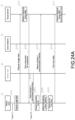
- Fig. 24 illustrates a sequence when a robot in a factory performs automated driving while performing image recognition, which is an example of an AI/ML application including an AI/ML model according to the present disclosure.
- the transmission entity 10 is provided to a robot (UE) 31, and the reception entity 20 is provided to the cloud server 35.
- the robot 31 acquires original image data (S101)
- the robot 31 transmits the original image data to the cloud server in single transmission with no change (S102).
- the cloud server 35 inputs the received image data to a multi-input AI/ML model, and transmits, to the robot 31, an instruction for movement that is given on the basis of an inference result (S104).
- the robot 31 At a time T2, there is a rapid reduction in communication performance due to bandwidth limitations of a wireless communication link between the robot 31 and the RAN/AN 32.
- the RAN/AN 32 detects the reduction, the RAN/AN 32 reports the reduction in communication performance (a change or a variation) to the robot 31 (S105).
- the robot 31 When the robot 31 receives the report, the robot 31 changes the method for transmitting image data from single transmission to multi-transmission (S106), and reports the change to the cloud server 35 (S107).
- the robot 31 When the robot 31 acquires the original image data (S108), the robot 31 generates first input data with a reduced resolution on the basis of the original image data (S109), and transmits the first input data to the cloud server 35 (S110).
- the cloud server 35 receives the first input data, the cloud server 35 inputs the first input data to the multi-input AI/ML model to acquire a first inference result (a coarse recognition result) (S111).
- the cloud server 35 transmits an instruction for initial movement to the robot 31 on the basis of the coarse recognition result (S112). For example, movement for avoidance is started on the basis of the coarse recognition result showing that an obstacle is situated ahead of the robot 31.
- the robot 31 receives the instruction for initial movement from the cloud server 35, the robot 31 starts the movement for avoidance in accordance with the instruction for initial movement (S113).
- the cloud server 35 transmits, to the robot 31, a request to start transmitting additional input data since a degree of accuracy of the first inference result obtained in Step S111 described above is less than a specified threshold (S114).
- the robot 31 receives the request, the robot 31 generates second input data having a higher resolution than the first input data (S115), and transmits the second input data to the cloud server 35 (S116).
- the cloud server 35 receives the second input data, the cloud server 35 inputs the second input data to the multi-input AI/ML model to acquire a second inference result (a detailed recognition result) (S117).
- the cloud server 35 transmits, to the robot 31, an instruction to update movement (S118).
- an instruction to update movement For example, a course of the movement for avoidance is corrected on the basis of the detailed recognition result showing that the obstacle situated ahead of the robot 31 is a human, in order to secure adequate safety.
- the robot 31 receives the instruction to update movement from the cloud server 35, the robot 31 corrects the course of the movement for avoidance in accordance with the instruction to update movement (S119).
- the cloud server 35 determines that there is no need for additional input data since a degree of accuracy of the second inference result obtained in Step S117 described above is greater than or equal to the specified threshold, and transmits, to the robot 31, a request to stop transmitting additional input data (S120). When the robot 31 receives the request, the robot 31 stops transmitting additional input data (S121).
- the transmission entity 10 generates a plurality of pieces of input data with reduced data amounts from original input data.
- the transmission entity 10 receives, from the reception entity 20, a request to start transmitting an additional piece of input data from among the plurality of pieces of input data after transmitting a first piece of input data from among the plurality of pieces of input data, the transmission entity 10 starts transmitting the additional piece of input data.
- the transmission entity 10 receives a request to stop transmitting the additional piece of input data from the reception entity 20, the transmission entity 10 stops transmitting the additional piece of input data.
- the reception entity 20 sequentially inputs, to a multi-input AI/ML model, pieces of input data of a plurality of pieces of input data received from the transmission entity 10 to sequentially update inference results.
- the reception entity 20 transmits, to the transmission entity 10, a request to start transmitting the additional input data.
- the reception entity 20 transmits, to the transmission entity 10, a request to stop transmitting the additional input data.
- the transmission entity 10 and reception entity 20 make it possible to provide an AI/ML application that updates an inference result in stages until a desired result is obtained.
- an inference result can also be updated in stages until an inference result with a desired degree of accuracy is obtained.
- processing procedures described in the present disclosure may be considered a method including a series of the procedures.
- the processing procedures described in the present disclosure may be considered a program used to cause a computer to perform the series of the procedures, or a recording medium that has stored therein the program.
- the processing described above is performed by a processor such as a CPU of a computer.
- the type of the recording medium is not particularly limited since the examples of the present disclosure are not affected by the type of the recording medium.
- each structural element may be a software module provided by software such as a microprogram, and may be provided by a processor executing the software module.
- each structural element may be implemented by a circuit block on a semiconductor chip (a die), that is, for example, an integrated circuit such as an application specific integrated circuit (ASIC) or a field programmable gate array (FPGA).
- ASIC application specific integrated circuit
- FPGA field programmable gate array
- the number of structural elements does not necessarily have to be equal to the number of pieces of hardware by which the structural elements are implemented.
- a plurality of structural elements may be implemented by a single processor or circuit.
- a single structural element may be implemented by a plurality of processors or circuits.
- the type of the processor described in the present disclosure is not limited.
- the processor may be a CPU, a micro processing unit (MPU), or a graphics processing unit (GPU).
Landscapes
- Engineering & Computer Science (AREA)
- Theoretical Computer Science (AREA)
- Physics & Mathematics (AREA)
- Evolutionary Computation (AREA)
- Signal Processing (AREA)
- Computer Networks & Wireless Communication (AREA)
- Artificial Intelligence (AREA)
- Software Systems (AREA)
- Computing Systems (AREA)
- Biomedical Technology (AREA)
- General Health & Medical Sciences (AREA)
- Molecular Biology (AREA)
- Computational Linguistics (AREA)
- General Engineering & Computer Science (AREA)
- General Physics & Mathematics (AREA)
- Mathematical Physics (AREA)
- Biophysics (AREA)
- Data Mining & Analysis (AREA)
- Health & Medical Sciences (AREA)
- Life Sciences & Earth Sciences (AREA)
- Medical Informatics (AREA)
- Databases & Information Systems (AREA)
- Computer Vision & Pattern Recognition (AREA)
- Mobile Radio Communication Systems (AREA)
- Information Retrieval, Db Structures And Fs Structures Therefor (AREA)
Applications Claiming Priority (2)
| Application Number | Priority Date | Filing Date | Title |
|---|---|---|---|
| JP2022109834 | 2022-07-07 | ||
| PCT/JP2023/025014 WO2024010049A1 (ja) | 2022-07-07 | 2023-07-05 | Ai/mlアプリケーションのための送信エンティティ、受信エンティティ、データ送信方法およびデータ処理方法 |
Publications (2)
| Publication Number | Publication Date |
|---|---|
| EP4554259A1 true EP4554259A1 (de) | 2025-05-14 |
| EP4554259A4 EP4554259A4 (de) | 2025-10-29 |
Family
ID=89453519
Family Applications (1)
| Application Number | Title | Priority Date | Filing Date |
|---|---|---|---|
| EP23835580.4A Pending EP4554259A4 (de) | 2022-07-07 | 2023-07-05 | Übertragungseinheit, empfangseinheit für eine ai/ml-anwendung, datenübertragungsverfahren und datenverarbeitungsverfahren |
Country Status (3)
| Country | Link |
|---|---|
| EP (1) | EP4554259A4 (de) |
| CN (1) | CN119498001A (de) |
| WO (1) | WO2024010049A1 (de) |
Families Citing this family (2)
| Publication number | Priority date | Publication date | Assignee | Title |
|---|---|---|---|---|
| WO2024210194A1 (ja) * | 2023-04-06 | 2024-10-10 | 京セラ株式会社 | 通信制御方法 |
| WO2026000115A1 (en) * | 2024-06-24 | 2026-01-02 | Apple Inc. | Systems and methods for artificial intelligence/machine learning based internet protocol flow to quality of service flow mapping design |
Family Cites Families (5)
| Publication number | Priority date | Publication date | Assignee | Title |
|---|---|---|---|---|
| US7024046B2 (en) * | 2000-04-18 | 2006-04-04 | Real Time Image Ltd. | System and method for the lossless progressive streaming of images over a communication network |
| JP4718860B2 (ja) * | 2005-02-17 | 2011-07-06 | 株式会社クリプトン | 遠方監視システムおよび遠方監視方法 |
| WO2014014238A1 (en) * | 2012-07-17 | 2014-01-23 | Samsung Electronics Co., Ltd. | System and method for providing image |
| JP6339951B2 (ja) * | 2015-03-04 | 2018-06-06 | 株式会社日立製作所 | データ収集システム、データ収集方法、サーバ及びゲートウェイ |
| US10848709B2 (en) * | 2017-10-09 | 2020-11-24 | EagleSens Systems Corporation | Artificial intelligence based image data processing method and image processing device |
-
2023
- 2023-07-05 EP EP23835580.4A patent/EP4554259A4/de active Pending
- 2023-07-05 WO PCT/JP2023/025014 patent/WO2024010049A1/ja not_active Ceased
- 2023-07-05 CN CN202380051176.7A patent/CN119498001A/zh active Pending
Also Published As
| Publication number | Publication date |
|---|---|
| EP4554259A4 (de) | 2025-10-29 |
| CN119498001A (zh) | 2025-02-21 |
| WO2024010049A1 (ja) | 2024-01-11 |
Similar Documents
| Publication | Publication Date | Title |
|---|---|---|
| EP4554259A1 (de) | Übertragungseinheit, empfangseinheit für eine ai/ml-anwendung, datenübertragungsverfahren und datenverarbeitungsverfahren | |
| CN112423340A (zh) | 一种用户面信息上报方法及装置 | |
| WO2019065617A1 (en) | OPTIMIZING THE ALLOCATION OF RESOURCES BASED ON QUALITY EXPERIENCE INFORMATION RECEIVED | |
| CN110166377A (zh) | 一种资源分配方法和装置 | |
| WO2019158102A1 (zh) | 一种确定QoS描述信息的方法和装置 | |
| CN115669031A (zh) | 用于边缘计算的端到端深度神经网络自适应 | |
| US20250321788A1 (en) | Computing task processing method and related apparatus | |
| CN111684828B (zh) | 用于v2x服务和v2x应用的实体、网络和用户设备 | |
| US12238585B2 (en) | Client device and network node for indication of quality-of-service (QOS) non-fulfillment | |
| CN113315648A (zh) | 用于执行虚拟化的网络功能的方法及装置 | |
| US20240284241A1 (en) | Data burst volume indication for tsc | |
| EP4487498A1 (de) | Benutzervorrichtungsvorhersagefluss in einem terrestrischen nicht terrestrischen netzwerk | |
| US12501308B2 (en) | Mapping data packets to data radio bearers based on corresponding packet delay budgets | |
| CN103179656A (zh) | 一种异构网络中业务流的同步传输方法及系统 | |
| CN117749694A (zh) | 一种多路径的数据流引流方法及装置 | |
| EP4550876A1 (de) | Verfahren und vorrichtung zur meldung von überlastungssteuerungsereignissen in einem drahtloskommunikationssystem | |
| WO2019158034A1 (zh) | 一种资源分配方法和装置 | |
| WO2018082511A1 (zh) | 一种数据包的预处理方法、装置及设备 | |
| CN116939700A (zh) | 通信方法和通信装置 | |
| US20250053812A1 (en) | Wireless base station, method for controlling wireless base station, communication control device, method for controlling communication control device, and program | |
| US20260101408A1 (en) | Communication method and apparatus | |
| CN121645538A (zh) | 通信方法及相关装置 | |
| WO2025197602A1 (ja) | 情報処理装置、基地局、情報処理方法、通信方法、及び通信システム | |
| WO2025108193A1 (zh) | 一种通信方法及装置 | |
| CN121771816A (zh) | 通信方法及装置 |
Legal Events
| Date | Code | Title | Description |
|---|---|---|---|
| STAA | Information on the status of an ep patent application or granted ep patent |
Free format text: STATUS: THE INTERNATIONAL PUBLICATION HAS BEEN MADE |
|
| PUAI | Public reference made under article 153(3) epc to a published international application that has entered the european phase |
Free format text: ORIGINAL CODE: 0009012 |
|
| STAA | Information on the status of an ep patent application or granted ep patent |
Free format text: STATUS: REQUEST FOR EXAMINATION WAS MADE |
|
| 17P | Request for examination filed |
Effective date: 20250204 |
|
| AK | Designated contracting states |
Kind code of ref document: A1 Designated state(s): AL AT BE BG CH CY CZ DE DK EE ES FI FR GB GR HR HU IE IS IT LI LT LU LV MC ME MK MT NL NO PL PT RO RS SE SI SK SM TR |
|
| RAP3 | Party data changed (applicant data changed or rights of an application transferred) |
Owner name: SONY GROUP CORPORATION |
|
| DAV | Request for validation of the european patent (deleted) | ||
| DAX | Request for extension of the european patent (deleted) | ||
| A4 | Supplementary search report drawn up and despatched |
Effective date: 20250930 |
|
| RIC1 | Information provided on ipc code assigned before grant |
Ipc: H04W 4/18 20090101AFI20250924BHEP Ipc: G06T 7/00 20170101ALI20250924BHEP Ipc: G06V 10/70 20220101ALI20250924BHEP Ipc: H04W 24/02 20090101ALI20250924BHEP Ipc: H04L 41/16 20220101ALI20250924BHEP |