EP4553300A2 - Mikrorohr-gegenstromverdampfer mit streben - Google Patents
Mikrorohr-gegenstromverdampfer mit streben Download PDFInfo
- Publication number
- EP4553300A2 EP4553300A2 EP24199055.5A EP24199055A EP4553300A2 EP 4553300 A2 EP4553300 A2 EP 4553300A2 EP 24199055 A EP24199055 A EP 24199055A EP 4553300 A2 EP4553300 A2 EP 4553300A2
- Authority
- EP
- European Patent Office
- Prior art keywords
- flow
- exhaust gas
- gas flow
- heat exchanger
- recited
- Prior art date
- Legal status (The legal status is an assumption and is not a legal conclusion. Google has not performed a legal analysis and makes no representation as to the accuracy of the status listed.)
- Pending
Links
Images
Classifications
-
- F—MECHANICAL ENGINEERING; LIGHTING; HEATING; WEAPONS; BLASTING
- F02—COMBUSTION ENGINES; HOT-GAS OR COMBUSTION-PRODUCT ENGINE PLANTS
- F02C—GAS-TURBINE PLANTS; AIR INTAKES FOR JET-PROPULSION PLANTS; CONTROLLING FUEL SUPPLY IN AIR-BREATHING JET-PROPULSION PLANTS
- F02C3/00—Gas-turbine plants characterised by the use of combustion products as the working fluid
- F02C3/20—Gas-turbine plants characterised by the use of combustion products as the working fluid using a special fuel, oxidant, or dilution fluid to generate the combustion products
- F02C3/22—Gas-turbine plants characterised by the use of combustion products as the working fluid using a special fuel, oxidant, or dilution fluid to generate the combustion products the fuel or oxidant being gaseous at standard temperature and pressure
-
- F—MECHANICAL ENGINEERING; LIGHTING; HEATING; WEAPONS; BLASTING
- F02—COMBUSTION ENGINES; HOT-GAS OR COMBUSTION-PRODUCT ENGINE PLANTS
- F02C—GAS-TURBINE PLANTS; AIR INTAKES FOR JET-PROPULSION PLANTS; CONTROLLING FUEL SUPPLY IN AIR-BREATHING JET-PROPULSION PLANTS
- F02C7/00—Features, components parts, details or accessories, not provided for in, or of interest apart form groups F02C1/00 - F02C6/00; Air intakes for jet-propulsion plants
- F02C7/08—Heating air supply before combustion, e.g. by exhaust gases
- F02C7/10—Heating air supply before combustion, e.g. by exhaust gases by means of regenerative heat-exchangers
-
- F—MECHANICAL ENGINEERING; LIGHTING; HEATING; WEAPONS; BLASTING
- F02—COMBUSTION ENGINES; HOT-GAS OR COMBUSTION-PRODUCT ENGINE PLANTS
- F02C—GAS-TURBINE PLANTS; AIR INTAKES FOR JET-PROPULSION PLANTS; CONTROLLING FUEL SUPPLY IN AIR-BREATHING JET-PROPULSION PLANTS
- F02C3/00—Gas-turbine plants characterised by the use of combustion products as the working fluid
- F02C3/20—Gas-turbine plants characterised by the use of combustion products as the working fluid using a special fuel, oxidant, or dilution fluid to generate the combustion products
- F02C3/30—Adding water, steam or other fluids for influencing combustion, e.g. to obtain cleaner exhaust gases
- F02C3/305—Increasing the power, speed, torque or efficiency of a gas turbine or the thrust of a turbojet engine by injecting or adding water, steam or other fluids
-
- F—MECHANICAL ENGINEERING; LIGHTING; HEATING; WEAPONS; BLASTING
- F02—COMBUSTION ENGINES; HOT-GAS OR COMBUSTION-PRODUCT ENGINE PLANTS
- F02C—GAS-TURBINE PLANTS; AIR INTAKES FOR JET-PROPULSION PLANTS; CONTROLLING FUEL SUPPLY IN AIR-BREATHING JET-PROPULSION PLANTS
- F02C3/00—Gas-turbine plants characterised by the use of combustion products as the working fluid
- F02C3/34—Gas-turbine plants characterised by the use of combustion products as the working fluid with recycling of part of the working fluid, i.e. semi-closed cycles with combustion products in the closed part of the cycle
-
- F—MECHANICAL ENGINEERING; LIGHTING; HEATING; WEAPONS; BLASTING
- F02—COMBUSTION ENGINES; HOT-GAS OR COMBUSTION-PRODUCT ENGINE PLANTS
- F02C—GAS-TURBINE PLANTS; AIR INTAKES FOR JET-PROPULSION PLANTS; CONTROLLING FUEL SUPPLY IN AIR-BREATHING JET-PROPULSION PLANTS
- F02C7/00—Features, components parts, details or accessories, not provided for in, or of interest apart form groups F02C1/00 - F02C6/00; Air intakes for jet-propulsion plants
- F02C7/12—Cooling of plants
- F02C7/14—Cooling of plants of fluids in the plant, e.g. lubricant or fuel
-
- F—MECHANICAL ENGINEERING; LIGHTING; HEATING; WEAPONS; BLASTING
- F28—HEAT EXCHANGE IN GENERAL
- F28D—HEAT-EXCHANGE APPARATUS, NOT PROVIDED FOR IN ANOTHER SUBCLASS, IN WHICH THE HEAT-EXCHANGE MEDIA DO NOT COME INTO DIRECT CONTACT
- F28D7/00—Heat-exchange apparatus having stationary tubular conduit assemblies for both heat-exchange media, the media being in contact with different sides of a conduit wall
- F28D7/16—Heat-exchange apparatus having stationary tubular conduit assemblies for both heat-exchange media, the media being in contact with different sides of a conduit wall the conduits being arranged in parallel spaced relation
-
- F—MECHANICAL ENGINEERING; LIGHTING; HEATING; WEAPONS; BLASTING
- F05—INDEXING SCHEMES RELATING TO ENGINES OR PUMPS IN VARIOUS SUBCLASSES OF CLASSES F01-F04
- F05D—INDEXING SCHEME FOR ASPECTS RELATING TO NON-POSITIVE-DISPLACEMENT MACHINES OR ENGINES, GAS-TURBINES OR JET-PROPULSION PLANTS
- F05D2260/00—Function
- F05D2260/20—Heat transfer, e.g. cooling
- F05D2260/213—Heat transfer, e.g. cooling by the provision of a heat exchanger within the cooling circuit
-
- F—MECHANICAL ENGINEERING; LIGHTING; HEATING; WEAPONS; BLASTING
- F05—INDEXING SCHEMES RELATING TO ENGINES OR PUMPS IN VARIOUS SUBCLASSES OF CLASSES F01-F04
- F05D—INDEXING SCHEME FOR ASPECTS RELATING TO NON-POSITIVE-DISPLACEMENT MACHINES OR ENGINES, GAS-TURBINES OR JET-PROPULSION PLANTS
- F05D2260/00—Function
- F05D2260/20—Heat transfer, e.g. cooling
- F05D2260/221—Improvement of heat transfer
-
- F—MECHANICAL ENGINEERING; LIGHTING; HEATING; WEAPONS; BLASTING
- F28—HEAT EXCHANGE IN GENERAL
- F28D—HEAT-EXCHANGE APPARATUS, NOT PROVIDED FOR IN ANOTHER SUBCLASS, IN WHICH THE HEAT-EXCHANGE MEDIA DO NOT COME INTO DIRECT CONTACT
- F28D21/00—Heat-exchange apparatus not covered by any of the groups F28D1/00 - F28D20/00
- F28D2021/0019—Other heat exchangers for particular applications; Heat exchange systems not otherwise provided for
- F28D2021/0021—Other heat exchangers for particular applications; Heat exchange systems not otherwise provided for for aircrafts or cosmonautics
Definitions
- the present disclosure relates generally to an aircraft propulsion system that includes a strut mounted heat exchanger where thermal energy is communicated between different flows.
- Turbine engines compress incoming core airflow, mix the compressed airflow with fuel that is ignited in a combustor to generate an exhaust gas flow.
- Steam injection can provide improved operating efficiencies.
- Water recovered from the exhaust gas flow may be transformed into steam using thermal energy from the exhaust gas flow.
- Water recovery and steam generation utilize ducting and heat exchangers exposed to the high temperatures of the exhaust gas. The efficient transfer of thermal energy within heat exchangers may require large surfaces areas that present challenges for implementation as part of an aircraft engine architectures.
- An aircraft propulsion system includes, among other possible things, a core engine section that defines a core flow path where an inlet airflow is compressed, mixed with fuel, and ignited to generate an exhaust gas flow, an inner nacelle assembly that surrounds the core engine section, an outer nacelle assembly that is spaced radially apart from the inner nacelle assembly, and a strut heat exchanger that extends radially between the inner nacelle assembly and the outer nacelle assembly, wherein within the strut heat exchanger a portion of the exhaust gas flow is placed in thermal communication with a second flow for transferring thermal energy.
- the strut heat exchanger includes an outer fairing assembly that defines an outer surface that extends between a leading edge, a trailing edge, a radially inner end at the inner nacelle assembly and a radially outer end at the outer nacelle assembly.
- the strut heat exchanger includes an inner cavity that extends between an inner opening open through the inner nacelle assembly and an outer opening that is open into the outer nacelle assembly, and a plurality of tube assemblies that extend through the inner cavity between the inner nacelle assembly and the outer nacelle assembly.
- the portion of the exhaust gas flow is communicated through the inner cavity and the second flow is communicated through at least one of the plurality of tube assemblies.
- the plurality of tube assemblies include a plurality of micro-tubes that are supported by at least one support member.
- the support member includes a turbulator for disrupting laminar flow adjacent to the plurality of tube assemblies.
- the outer fairing assembly includes a first fairing and a second fairing that are attachable to each other.
- the portion of the exhaust gas flow flows through the inner cavity in a first radial direction and the second flow flows through the plurality of tubes in a second radial direction counter to the first radial direction.
- the aircraft propulsion system further includes a condenser where water is extracted from the exhaust gas flow and an evaporator system where thermal energy from the exhaust gas flow is utilized to generate a steam flow from at least a portion of water that is extracted by the condenser for injection into the core flow path.
- the second flow includes a flow of water and at least a portion of thermal energy from the exhaust gas flow is communicated to the water flow within the strut heat exchanger.
- a portion of the condenser is disposed within the outer nacelle.
- a heat exchanger for an aircraft propulsion system includes, among other possible things, an outer fairing assembly that defines an outer surface that extends between a leading edge, a trailing edge, a radially inner end, and a radially outer end, an inner cavity that is defined within the outer fairing that defines a first flow path that extends between an inner opening that is disposed at the radially inner end and an outer opening that is disposed at the radially outer end, and a plurality of tube assemblies that extend through the inner cavity that define a second flow path between the inner end and the outer end.
- the first flow path and the second flow path are configured to transfer thermal energy between flows within the first flow path and the second flow path.
- the plurality of tube assemblies include a plurality of micro-tubes that are supported by at least one support member.
- the support member includes a turbulator for disrupting laminar flow adjacent to the plurality of tube assemblies.
- the inner cavity is configured to receive a portion of an exhaust gas flow that is generated by the aircraft propulsion system.
- each of the plurality of tube assemblies are configured to receive a portion of a flow that accepts thermal energy from the exhaust gas flow.
- the outer fairing assembly includes a first fairing and a second fairing that are attachable to each other.
- a method of operating a gas turbine engine includes, among other possible things, generating an exhaust gas flow, routing a portion of the exhaust gas flow through an inner cavity of a strut heat exchanger, extracting water from the exhaust gas flow in a condenser, routing a flow of extracted water through a plurality of tubes that extend through the strut heat exchanger that is in thermal communication with the exhaust gas flow, and generating a steam flow by heating the portion of the flow of extracted water with heat from the exhaust gas flow within the strut heat exchanger.
- a portion of the condenser is disposed within an outer nacelle and the method includes routing a portion of the exhaust gas flow through the condenser within the nacelle.
- the method further includes directing the portion of exhaust gas flow through the inner cavity in a first radial direction and directing the flow of extracted water through the plurality of tubes in a second radial direction that is counter to the first radial direction.
- the method further includes disrupting laminar flow of the exhaust gas flow with turbulators that are disposed on structures that support the plurality of tubes.
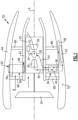
- Figure 1 schematically illustrates an example propulsion system 20 that includes a strut heat exchanger 56 disposed between an inner nacelle 44 and an outer nacelle.
- the strut heat exchanger 56 includes an inner cavity within which thermal energy is transferred between different flows.
- the example propulsion system 20 includes a fan section 24 and a core engine section 22.
- the core engine section 22 includes a compressor section 26, a combustor section 28 and the turbine section 30 disposed along an engine longitudinal axis A.
- the fan section 24 drives inlet airflow as bypass airflow 58 along a bypass flow path B, while the compressor section 26 draws air in along a core flow path C.
- the inlet airflow is compressed and communicated to the combustor section 28 where the compressed core airflow is mixed with a fuel flow 34 from a fuel system 32 and ignited to generate the exhaust gas flow 36.
- the exhaust gas flow 36 expands through the turbine section 30 where energy is extracted to generate a mechanical power output utilized to drive the fan section 24 and the compressor section 26.
- the example core engine section 22 is a reverse flow engine where core flow is drawn through the compressor section 28 and communicated forward through the combustor section 28 and the turbine section 30.
- the exhaust gas flow 36 from the turbine section 30 is communicated through a condenser 42 to generate a water flow 38.
- the water flow 38 is heated within an evaporator 40 to generate a steam flow 54 that maybe injected into the core flow path C to increase power output.
- the core engine section 22 is disposed within the inner nacelle 44 and the fan 24 is disposed within an outer nacelle 46.
- the outer nacelle 46 circumscribes the inner nacelle 44 and the bypass flow path B is disposed within a radial space defined between the inner nacelle 44 and the outer nacelle 46.
- Structural supports 86 extend through the bypass flow path B and support the core engine section 22.
- the example propulsion system includes the strut heat exchangers 56 that are utilized to extract and generate a steam flow 54.
- the strut heat exchanger 56 is part of an evaporator 40 and communicates thermal energy from at least a portion of the exhaust gas flow 36 into a water flow 38 to generate the steam flow 54.
- the transfer of thermal energy between the exhaust gas flow 36 and the water flow 38 occurs within the strut heat exchanger 56.
- the bypass flow is not utilized to provide thermal transfer within the strut heat exchanger 56.
- a portion of the exhaust gas flow 36 is communicated radially outward through the strut heat exchanger 56.
- the water flow 38 is communicated radially inward, counter to the exhaust gas flow 36.
- the example strut heat exchanger 56 is a counter flow heat exchanger.
- the example exhaust gas flow 36 and the water flow 38 are schematically shown.
- the flows 36, 38 would be guided and directed to and through the strut heat exchanger 56 by ducting and conduits disposed within the core engine section 22, the inner nacelle 44 and the outer nacelle 46.
- the strut heat exchanger 56 includes an inner opening 48 that opens through the inner nacelle 44 and an outer opening 50 that opens into a space 52 within the outer nacelle 46.
- An example condenser 42 is disposed within the space 52 of the outer nacelle 46.
- the steam flow 54 from the evaporator 40 is injected into the core flow path C at or upstream of the combustor 28 and increases mass flow through the turbine section 30 and thereby increases engine power and efficiency.
- the propulsion system 20 has an increased power output from the injected steam 54 due to an increasing mass flow through the turbine section 30 without a corresponding increase in work from the compressor section 26.
- the steam flow 54 is shown as being injected into the combustor 28, the steam flow 54 may be injected at other locations along the core flow path C and remain within the contemplation and scope of this disclosure.
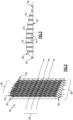
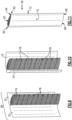
- the disclosed example strut heat exchanger 56 includes a fairing assembly 68 that extends between a leading edge 60, trailing edge 62, first end 64 and a second end 66.
- the first end 64 is disposed on a radially inner side and includes the opening 48 through the inner nacelle 44.
- the second end 66 is disposed on a radially outer side and opens into the space 52 of the outer nacelle 46.
- An inner cavity 74 is defined by the fairing assembly 68 and provides a passage for the exhaust gas flow 36.
- a plurality of tube assemblies 76 extend through the inner cavity 74 between the first end 64 and the second end 66.
- the tube assemblies 76 contain the water flow 38. Accordingly, the exhaust gas flow 36 through the inner cavity 74 is in thermal communication with the water flow 38 within the tube assemblies 76.
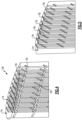
- each of the plurality of tube assemblies 76 include a plurality of supports 78.
- the supports 78 are spaced apart radially between the first end 64 and the second end 66 of the strut heat exchanger 56.
- the example supports 78 provide the additional function of disrupting laminar flow of the exhaust gas flow 36 to improve thermal transfer.
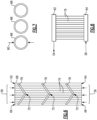
- the supports 78 include a general chevron shaped turbulator 75 that points counter to the direction of the exhaust gas flow 36.
- the point of the chevron shaped turbulator 75 points toward the inner opening 48 and the incoming exhaust gas flow 36.
- the configurations of the supports 78 disrupt the exhaust gas flow 36 along the surface of the tube assemblies 76 and spread the flow and thermal energy outward evenly across the tube assemblies 76.
- a support and turbulator configuration is shown by way of example, other support and flow disrupting turbulator features and configurations may be utilized and are within the contemplation of this disclosure
- tubes 88 of the tube assembly 76 are shown in cross-section.
- the example tubes 88 are provided as micro-tubes with an outer diameter 80 that is less than or equal to about 1 ⁇ 4 inch (6.35 mm).
- the outer diameter 80 is between about 1/8 inch (3.175 mm) and 1.50 inches (38.10 mm).
- the tubes 88 are constructed of material compatible with the temperatures encountered during operation and that provides for the communication of thermal energy between flows.
- the example tubes 88 are disclosed as micro-tubes, other tube configurations and shapes could be utilized and are within the contemplation of this disclosure.
- the tubes 88 may be oval, square, or irregularly shaped to conform to space available space.
- larger tubes may be utilized that provide for thermal transfer between flows.
- an example tube assembly 76 is schematically shown and includes a first manifold 82 and a second manifold 84.
- the manifolds 82, 84 provide for the communication of flow into and out of the tube assemblies 76.
- the water flow 38 is communicated into the example tube assembly 76 through the second manifold 84.
- the water flow 38 accepts heat from the exhaust gas flow 36 within the tube assembly 76 and is transformed into the steam flow 54 that is communicated to the core flow path C.
- the manifolds 82, 84 are shown schematically and may comprise one or several structures for communicating water and steam flow through the strut heat exchanger 56.
- the example fairing assembly 68 includes a first fairing 70 and a second fairing 72 that wrap around the tube assemblies 76.
- the example first and second fairing assemblies 70, 72 are mirror images of each other and are joined at the leading edge 60 and the trailing edge 62.
- the example fairings 70, 72 are formed from sheet material and provided the limited amount of structural rigidity required. Because the example strut heat exchanger 56 is not an engine load bearing structure, the fairings 70, 72 may be formed from relatively light material.
- the fairings 70, 72 are formed from a sheet metal material. In another example embodiment, the fairings may be formed from composite materials.
- all or components of the heat exchanger including the fairings 70, 72 are formed utilizing an additive manufacturing process.
- the entire heat exchange assembly may be formed utilizing additive manufacturing methods and processes. Because the fairings 70, 72 define the inner cavity for the exhaust gas flow 36, the material utilized for the fairings 70, 72 are compatible with the temperatures and pressures generated by the exhaust gas flow 36.
- the example strut heat exchanger 56 provides a radial space between nacelles for the transfer of thermal energy between an exhaust gas flow and a water flow.
Landscapes
- Engineering & Computer Science (AREA)
- Mechanical Engineering (AREA)
- General Engineering & Computer Science (AREA)
- Chemical & Material Sciences (AREA)
- Combustion & Propulsion (AREA)
- Physics & Mathematics (AREA)
- Thermal Sciences (AREA)
- Life Sciences & Earth Sciences (AREA)
- Sustainable Development (AREA)
- Heat-Exchange Devices With Radiators And Conduit Assemblies (AREA)
Applications Claiming Priority (1)
| Application Number | Priority Date | Filing Date | Title |
|---|---|---|---|
| US18/503,279 US12331684B2 (en) | 2023-11-07 | 2023-11-07 | Strut microtube counterflow evaporator |
Publications (2)
| Publication Number | Publication Date |
|---|---|
| EP4553300A2 true EP4553300A2 (de) | 2025-05-14 |
| EP4553300A3 EP4553300A3 (de) | 2025-07-02 |
Family
ID=92711261
Family Applications (1)
| Application Number | Title | Priority Date | Filing Date |
|---|---|---|---|
| EP24199055.5A Pending EP4553300A3 (de) | 2023-11-07 | 2024-09-06 | Mikrorohr-gegenstromverdampfer mit streben |
Country Status (2)
| Country | Link |
|---|---|
| US (1) | US12331684B2 (de) |
| EP (1) | EP4553300A3 (de) |
Family Cites Families (26)
| Publication number | Priority date | Publication date | Assignee | Title |
|---|---|---|---|---|
| US2961150A (en) * | 1958-12-30 | 1960-11-22 | Gen Electric | Frame structure for turbo-machine |
| US3266564A (en) * | 1964-02-11 | 1966-08-16 | Curtiss Wright Corp | Liquid metal rotary heat exchanger |
| US3320749A (en) * | 1965-10-04 | 1967-05-23 | Gen Motors Corp | Regenerative fan engine |
| GB2041090A (en) * | 1979-01-31 | 1980-09-03 | Rolls Royce | By-pass gas turbine engines |
| US6712131B1 (en) * | 1998-03-12 | 2004-03-30 | Nederlandse Organisatie Voor Toegepast - Natuurwetenschappelijk Onderzoek Tno | Method for producing an exchanger and exchanger |
| US6406254B1 (en) * | 1999-05-10 | 2002-06-18 | General Electric Company | Cooling circuit for steam and air-cooled turbine nozzle stage |
| GB0719786D0 (en) * | 2007-10-11 | 2007-11-21 | Rolls Royce Plc | A vane and a vane assembly for a gas turbine engine |
| US7775031B2 (en) * | 2008-05-07 | 2010-08-17 | Wood Ryan S | Recuperator for aircraft turbine engines |
| US7861510B1 (en) * | 2008-11-22 | 2011-01-04 | Florida Turbine Technologies, Inc. | Ceramic regenerator for a gas turbine engine |
| KR101125004B1 (ko) * | 2009-12-04 | 2012-03-27 | 기아자동차주식회사 | 냉각수 및 오일 통합 열교환형 배기열 회수장치 |
| US8616834B2 (en) | 2010-04-30 | 2013-12-31 | General Electric Company | Gas turbine engine airfoil integrated heat exchanger |
| EP2918957A1 (de) * | 2014-03-13 | 2015-09-16 | BAE Systems PLC | Wärmetauscher |
| EP3117169B1 (de) * | 2014-03-13 | 2018-05-09 | BAE Systems PLC | Wärmetauscher |
| US20150354382A1 (en) * | 2014-06-06 | 2015-12-10 | General Electric Company | Exhaust frame cooling via strut cooling passages |
| US20180149085A1 (en) * | 2016-11-28 | 2018-05-31 | General Electric Company | Exhaust frame cooling via cooling flow reversal |
| US10830056B2 (en) | 2017-02-03 | 2020-11-10 | General Electric Company | Fluid cooling systems for a gas turbine engine |
| US11078795B2 (en) | 2017-11-16 | 2021-08-03 | General Electric Company | OGV electroformed heat exchangers |
| DE102018208026A1 (de) * | 2018-05-22 | 2019-11-28 | MTU Aero Engines AG | Abgasbehandlungsvorrichtung, Flugzeugantriebssystem und Verfahren zum Behandeln eines Abgasstromes |
| DE102019203595A1 (de) * | 2019-03-15 | 2020-09-17 | MTU Aero Engines AG | Luftfahrzeug |
| US11650018B2 (en) * | 2020-02-07 | 2023-05-16 | Raytheon Technologies Corporation | Duct mounted heat exchanger |
| US12071889B2 (en) * | 2022-04-05 | 2024-08-27 | General Electric Company | Counter-rotating turbine |
| US12129774B2 (en) * | 2022-05-19 | 2024-10-29 | Rtx Corporation | Hydrogen fueled turbine engine pinch point water separator |
| WO2023237152A1 (de) * | 2022-06-06 | 2023-12-14 | MTU Aero Engines AG | Antriebssystem für ein luftfahrzeug |
| US12092022B2 (en) * | 2023-02-06 | 2024-09-17 | Rtx Corporation | Forward mounted hydrogen steam injected and inter-cooled turbine engine with octopus ducting |
| US12012892B1 (en) * | 2023-05-19 | 2024-06-18 | Rtx Corporation | Water separator for turbine engine |
| US12173669B1 (en) * | 2023-08-18 | 2024-12-24 | General Electric Company | Turbine engine with fan bypass water injection to augment thrust |
-
2023
- 2023-11-07 US US18/503,279 patent/US12331684B2/en active Active
-
2024
- 2024-09-06 EP EP24199055.5A patent/EP4553300A3/de active Pending
Also Published As
| Publication number | Publication date |
|---|---|
| US20250146440A1 (en) | 2025-05-08 |
| EP4553300A3 (de) | 2025-07-02 |
| US12331684B2 (en) | 2025-06-17 |
Similar Documents
| Publication | Publication Date | Title |
|---|---|---|
| EP4279722B1 (de) | Wasserabscheider für wasserstoffgetriebenen turbinenmotor | |
| US11143106B2 (en) | Combustion section heat transfer system for a propulsion system | |
| US12163467B2 (en) | Condenser for hydrogen steam injected turbine engine | |
| EP4279718B1 (de) | Kondensatorkanal eines wasserstoffbetriebenen turbinenmotors | |
| EP2236750B1 (de) | Agencement de refroidissement par projection pour moteur à turbine à gaz | |
| EP4279723A1 (de) | Wasserstoffturbinenmotor mit dampfeinspritzung und zwischenkühlung | |
| EP4656858A2 (de) | Umlaufflusskondensatoranordnung für ein flugzeugantriebssystem | |
| EP4455465B1 (de) | Versetzter kern mit seitlichen ejektordüsen der verkleidung | |
| US11371786B2 (en) | Heat exchanger for a gas turbine engine | |
| EP4089273B1 (de) | Rohrhalterung für wärmetauscher | |
| EP4279721B1 (de) | Wasserstoffdampfeinspritzturbinenmotor mit rückströmung | |
| EP4726197A1 (de) | Schubumkehrvorrichtung in einem kondensatorausgangskanal | |
| EP4089356B1 (de) | Rohrhalterung für wärmetauscher | |
| EP4553300A2 (de) | Mikrorohr-gegenstromverdampfer mit streben | |
| EP4656860A1 (de) | Konische kondensatoranordnung mit axialer strömung für ein flugzeugantriebssystem | |
| US12510023B1 (en) | Fan case mounted evaporator for aircraft turbine engine | |
| EP4474629A1 (de) | Wassergekühlte abgasleitung | |
| EP4502342A1 (de) | Dampfbeheizter flansch zur wärmegradientensteuerung | |
| US20250369393A1 (en) | Axial flow angled condenser arrangement for an aircraft propulsion system |
Legal Events
| Date | Code | Title | Description |
|---|---|---|---|
| PUAI | Public reference made under article 153(3) epc to a published international application that has entered the european phase |
Free format text: ORIGINAL CODE: 0009012 |
|
| STAA | Information on the status of an ep patent application or granted ep patent |
Free format text: STATUS: THE APPLICATION HAS BEEN PUBLISHED |
|
| AK | Designated contracting states |
Kind code of ref document: A2 Designated state(s): AL AT BE BG CH CY CZ DE DK EE ES FI FR GB GR HR HU IE IS IT LI LT LU LV MC ME MK MT NL NO PL PT RO RS SE SI SK SM TR |
|
| PUAL | Search report despatched |
Free format text: ORIGINAL CODE: 0009013 |
|
| AK | Designated contracting states |
Kind code of ref document: A3 Designated state(s): AL AT BE BG CH CY CZ DE DK EE ES FI FR GB GR HR HU IE IS IT LI LT LU LV MC ME MK MT NL NO PL PT RO RS SE SI SK SM TR |
|
| RIC1 | Information provided on ipc code assigned before grant |
Ipc: F28D 7/16 20060101ALI20250527BHEP Ipc: F02C 7/14 20060101ALI20250527BHEP Ipc: F02C 3/34 20060101ALI20250527BHEP Ipc: F02C 3/30 20060101ALI20250527BHEP Ipc: F02C 3/22 20060101AFI20250527BHEP |
|
| STAA | Information on the status of an ep patent application or granted ep patent |
Free format text: STATUS: REQUEST FOR EXAMINATION WAS MADE |
|
| 17P | Request for examination filed |
Effective date: 20251231 |