EP4553143A1 - Measurement system and method for in situ calibration - Google Patents
Measurement system and method for in situ calibration Download PDFInfo
- Publication number
- EP4553143A1 EP4553143A1 EP23208978.9A EP23208978A EP4553143A1 EP 4553143 A1 EP4553143 A1 EP 4553143A1 EP 23208978 A EP23208978 A EP 23208978A EP 4553143 A1 EP4553143 A1 EP 4553143A1
- Authority
- EP
- European Patent Office
- Prior art keywords
- sensor
- calibration
- measurement system
- culture medium
- channel
- Prior art date
- Legal status (The legal status is an assumption and is not a legal conclusion. Google has not performed a legal analysis and makes no representation as to the accuracy of the status listed.)
- Pending
Links
Images


Classifications
-
- C—CHEMISTRY; METALLURGY
- C12—BIOCHEMISTRY; BEER; SPIRITS; WINE; VINEGAR; MICROBIOLOGY; ENZYMOLOGY; MUTATION OR GENETIC ENGINEERING
- C12M—APPARATUS FOR ENZYMOLOGY OR MICROBIOLOGY; APPARATUS FOR CULTURING MICROORGANISMS FOR PRODUCING BIOMASS, FOR GROWING CELLS OR FOR OBTAINING FERMENTATION OR METABOLIC PRODUCTS, i.e. BIOREACTORS OR FERMENTERS
- C12M41/00—Means for regulation, monitoring, measurement or control, e.g. flow regulation
-
- C—CHEMISTRY; METALLURGY
- C12—BIOCHEMISTRY; BEER; SPIRITS; WINE; VINEGAR; MICROBIOLOGY; ENZYMOLOGY; MUTATION OR GENETIC ENGINEERING
- C12M—APPARATUS FOR ENZYMOLOGY OR MICROBIOLOGY; APPARATUS FOR CULTURING MICROORGANISMS FOR PRODUCING BIOMASS, FOR GROWING CELLS OR FOR OBTAINING FERMENTATION OR METABOLIC PRODUCTS, i.e. BIOREACTORS OR FERMENTERS
- C12M29/00—Means for introduction, extraction or recirculation of materials, e.g. pumps
- C12M29/04—Filters; Permeable or porous membranes or plates, e.g. dialysis
-
- C—CHEMISTRY; METALLURGY
- C12—BIOCHEMISTRY; BEER; SPIRITS; WINE; VINEGAR; MICROBIOLOGY; ENZYMOLOGY; MUTATION OR GENETIC ENGINEERING
- C12M—APPARATUS FOR ENZYMOLOGY OR MICROBIOLOGY; APPARATUS FOR CULTURING MICROORGANISMS FOR PRODUCING BIOMASS, FOR GROWING CELLS OR FOR OBTAINING FERMENTATION OR METABOLIC PRODUCTS, i.e. BIOREACTORS OR FERMENTERS
- C12M41/00—Means for regulation, monitoring, measurement or control, e.g. flow regulation
- C12M41/30—Means for regulation, monitoring, measurement or control, e.g. flow regulation of concentration
- C12M41/32—Means for regulation, monitoring, measurement or control, e.g. flow regulation of concentration of substances in solution
-
- G—PHYSICS
- G01—MEASURING; TESTING
- G01N—INVESTIGATING OR ANALYSING MATERIALS BY DETERMINING THEIR CHEMICAL OR PHYSICAL PROPERTIES
- G01N27/00—Investigating or analysing materials by the use of electric, electrochemical, or magnetic means
- G01N27/26—Investigating or analysing materials by the use of electric, electrochemical, or magnetic means by investigating electrochemical variables; by using electrolysis or electrophoresis
- G01N27/416—Systems
- G01N27/4163—Systems checking the operation of, or calibrating, the measuring apparatus
Definitions
- the invention relates to in situ calibration of sensors, especially of Process Analytical Technology (PAT) sensor probes for bioprocess monitoring.
- PAT Process Analytical Technology
- biological cells may be cultured under very controlled sterile conditions inside a bioreactor to maintain an optimal growth environment, where chemical and biochemical parameters may be monitored continuously, in situ. This can be achieved by using so-called “sensor probes” that may be placed inside the bioreactor. Furthermore, the sensors may be required to remain operational over the entire cell culture period, which may last somewhere between 3 and 6 weeks depending on the cell types.
- an object of the invention is to provide a measurement system and a method to facilitate in situ calibration of measurement sensors without needing to collect samples.
- a measurement system for in situ calibration.
- the measurement system comprises a housing comprising a culture medium and at least one measurement probe arranged in the culture medium, wherein the at least one measurement probe comprises an opening, at least one sensor, and at least one channel arranged from the opening to the at least one sensor.
- the measurement system further comprises a calibration unit connected to the opening, configured to supply a calibration fluid to the at least one sensor via the at least one channel.
- the calibration fluid may be sterilized before use.
- the calibration unit may supply the calibration fluid to the sensor to perform in situ calibration without needing to collect samples of the culture medium.
- the at least one measurement probe comprises a membrane encompassing the at least one sensor, configured to confine the calibration fluid at or around the at least one sensor.
- a rapid diffusion and dilution of the calibration fluid into the culture medium may be prevented.
- the calibration accuracy may be improved, e.g., by confining the calibration fluid above the sensor during the calibration measurement.
- the calibration unit comprises a controller configured to control a flow of the calibration fluid in the at least one channel.
- the flow can be bidirectional, i.e., from the calibration unit to the sensor as well as from the sensor to the calibration unit, especially within the channel.
- the controller is further configured to control a flow of the culture medium to the at least one sensor through the membrane.
- the flow can be bidirectional, i.e., from the housing to the sensor as well as from the sensor to the housing, especially through the membrane.
- the membrane may protect the sensors from the culture medium. Furthermore, by controlling the flow of the culture medium through the membrane, the effect of flow during the measurement and/or calibration can be prevented or limited.
- the calibration fluid comprises a calibration solution with a defined concentration.
- the calibration fluid may comprise a calibration solution for a specific sensor, and the calibration unit may comprise such calibration fluids for respective sensors.
- the calibration fluid comprises a plurality of calibration solutions with different concentrations.
- the calibration fluid may comprise a combination of calibration solutions for calibrating multiple sensors, and the calibration unit may comprise such combined calibration solutions of different concentrations.
- the membrane comprises a plurality of pores with an internal width from 1 micrometer to 5 micrometers. More preferably, the membrane may comprise a plurality of pores with an internal width from 10nm to 100nm.
- the pores may allow sample diffusion, e.g., proteins, at the sensor in a controlled manner, while preventing any contamination at the sensor surface.
- the calibration unit is further configured to supply a cleaning fluid to the at least one sensor via the at least one channel.
- measurement and/or calibration accuracy can be further improved.
- the at least one measurement probe further comprises at least one further sensor configured to be in contact with the culture medium.
- the further sensor in direct contact with the culture medium, i.e. external or not confined by the membrane, a differential measurement can be performed, which may further improve the measurement and/or calibration accuracy.
- the at least one sensor and/or the at least one further sensor are electrochemical sensors.
- the at least one sensor and/or the at least one further sensor are optical sensors.
- the at least one sensor and/or the at least one further sensor are mass-sensitive sensors.
- the at least one sensor and/or the at least one further sensor are thermo-sensitive sensors.
- the at least one sensor and/or the at least one further sensor are configured to measure at least one of a physical parameter, a chemical parameter, and a biochemical parameter of the culture medium.
- the parameters can be defined as but not limited to temperature, pH level, dissolved oxygen, glucose, lactate, glutamine and glutamate concentrations, ion concentration (e.g. sodium, calcium, magnesium) cell density, cell viability, electrical conductivity, oxidation reduction potential, and proteins concentrations.
- the housing is a cell culture vessel, preferably a bioreactor vessel.
- the housing may correspond to a sterile environment for environmental and/or industrial monitoring.
- a method for in situ calibration.
- the method comprises the steps of providing a housing comprising a culture medium; arranging at least one measurement probe comprising an opening, at least one sensor, and at least one channel arranged from the opening to the at least one sensor in the culture medium; connecting a calibration unit to the opening; and supplying, by the calibration unit, a calibration fluid to the at least one sensor via the at least one channel.
- the method further comprises the step of providing a membrane encompassing the at least one sensor to confine the calibration fluid at or around the at least one sensor.
- the calibration unit comprises a controller
- the method further comprises the step of controlling, via the controller, a flow of the calibration fluid in the at least one channel.
- the method further comprises the step of controlling, via the controller, a flow of the culture medium to the at least one sensor through the membrane.
- the method according to the second aspect corresponds to the measurement system according to the first aspect and its implementation forms. Accordingly, the method of the second aspect may have corresponding implementation forms. Further, the method of the second aspect achieves the same advantages and effects as the measurement system of the first aspect and its respective implementation forms.
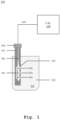
- the measurement system 100 may comprise a housing 101, e.g., a bioreactor vessel, comprising a cell-culture medium 102 and a measurement probe 103 arranged in the cell-culture medium 102, especially inside of the housing 101.
- a housing 101 e.g., a bioreactor vessel, comprising a cell-culture medium 102 and a measurement probe 103 arranged in the cell-culture medium 102, especially inside of the housing 101.
- the measurement probe 103 may comprise an opening 104, an array of sensors 105, herein exemplarily shown with three sensors 105 1 , 105 2 , 105 3 , and a channel 106 arranged from the opening 104 to the array of sensors 105, especially within the measurement probe 103.
- the measurement probe 103 may further comprise a membrane 107 encompassing the array of sensors 105, especially to protect the array of sensors 105 from the cell-culture medium 102.
- the membrane 107 may be arranged, i.e., the position of the membrane 107 may be aligned, with respect to the position/location of the array of sensors 105 in the measurement probe 103.
- the probe material especially of the body of the measurement probe 103
- the measurement probe 103 may comprise a slot or an aperture, especially on the body of the measurement probe 103, corresponding to the position/location of the array of sensors 105, and the membrane 107 may be attached to the measurement probe 103, especially to the body of the measurement probe 103, at the slot or the aperture, especially covering the slot or the aperture.
- the measurement system 100 may further comprise a calibration unit 108 connected to the opening 104 of the measurement probe 103 and further to the channel 106 inside of the measurement probe 103, for example via a flow path 109.
- the calibration unit 108 may supply a calibration fluid to the array of sensors 105 through the channel 106, e.g., via the flow path 109 through the opening 104 of the measurement probe 103.
- the membrane 107 may confine the calibration fluid above the array of sensors 105, especially during the calibration measurement, and may prevent rapid diffusion and dilution of the calibration fluid into the housing 101.
- the membrane 107 may comprise pores having an internal width sufficient to pass molecules, such as proteins, through the membrane 107.
- the pores may have an internal width of about 1 micrometer to 5 micrometers, preferably an internal width of about 10nm to 100nm, especially to allow sample diffusion to the array of sensors 105 while preventing cells contaminate the array of sensors 105, especially the surface of the sensors.
- the membrane 107 may correspond to or be a one-way flow membrane, which may restrict the flow of the calibration fluid from the channel 106 and/or the array of sensors 105 of the measurement probe 103 into the housing 101.
- the membrane 107 may allow sample diffusion, such as protein molecules, to the array of sensors 105, especially by allowing the sample to flow from the housing 101, e.g., through the pores, into the measurement probe 103.
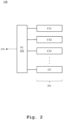
- the calibration unit 108 may comprise a storage section 201 and a flow controller 202 connected to the storage section 201.
- the storage section 201 may act as a reservoir to store one or more calibration fluids or solutions CS1, CS2, CS3 and cleaning fluids CF.
- the calibration fluids CS1, CS2, CS3 may respectively correspond to the sensors 105 1 , 105 2 , 105 3 of the array of sensors 105, e.g., for a respective calibration specie.
- the calibration fluids CS1, CS2, CS3 may comprise different concentration of a mixture of calibration specie.
- the flow controller 202 may comprise flow controlling means, such as a set of valves and a pump, that may be actuated on demand, e.g., via a software interface. As such, the flow controller 202 may push the calibration fluids CS1, CS2, CS3 and/or the cleaning fluid CF through the channel 106 to the array of sensors 105, e.g., via the flow path 109 through the opening 104 of the measurement probe 103.
- flow controlling means such as a set of valves and a pump, that may be actuated on demand, e.g., via a software interface.
- the flow controller 202 may push the calibration fluids CS1, CS2, CS3 and/or the cleaning fluid CF through the channel 106 to the array of sensors 105, e.g., via the flow path 109 through the opening 104 of the measurement probe 103.
- the flow controller 202 may pull a sample from the housing 101 through the membrane 107 onto the array of sensors 105, especially to control the flow during the measurement.
- the array of sensors 105 may comprise three sensors 105 1 , 105 2 , 105 3 ; each may measure or monitor a respective single physical or chemical or biochemical parameter.
- the calibration unit 108 may comprise a first calibration solution storage 301 containing a first calibration solution CS1 corresponding to the sensor 105 1 , a second calibration solution storage 302 containing a second calibration solution CS2 corresponding to the sensor 105 2 , a third calibration solution storage 303 containing a third calibration solution CS3 corresponding to the sensor 105 3 , and a fourth storage 304 containing the cleaning fluid CF.
- the calibration solutions CS1, CS2, CS3 and the cleaning fluid CF may be sterile.
- the flow controller 202 may comprise a first valve 305, e.g., a directional valve, connected to the first calibration solution storage 301 to control a flow of the first calibration solution CS1, a second valve 306 connected to the second calibration solution storage 302 to control a flow of the second calibration solution CS2, a third valve 307 connected to the third calibration solution storage 303 to control a flow of the third calibration solution CS3, and a fourth valve 308 connected to the fourth storage 304 to control a flow of the cleaning fluid CF.
- a first valve 305 e.g., a directional valve
- the flow controller 202 may further comprise a pump 309 connected to the first valve 305, the second valve 306, the third valve 307, and the fourth valve 308, and further to the flow path 109.
- the pump 309 may push one or more of the calibration solutions CS1, CS2, CS3, or the cleaning fluid CF to the sensors 105 1 , 105 2 , 105 3 , via the channel 106 through the opening 104 of the measurement probe 103.
- the first valve 305, the second valve 306, the third valve 307, the fourth valve 308, and the pump 309 may be actuated on demand, e.g., via a software interface.
- the first valve 305 may be operated or activated to enable a flow of the first calibration solution CS1, and the pump 309 may push the first calibration solution CS1 via the flow path 109 through the opening 104 and further through the channel 106 to the sensor 105 1 .
- the fourth valve 308 may be operated or activated to enable a flow of the cleaning fluid CF, and the pump 309 may push the cleaning fluid CF via the flow path 109 through the opening 104 and further through the channel 106 to the sensor 105 1 .
- the pump 309 may pull a sample from the housing through the membrane 107 onto the sensors 105 1 , 105 2 , 105 3 .
- the membrane 107 may comprise a uniform surface or may comprise different surfaces corresponding to the respective sensors 105 1 , 105 1 , 105 3 , e.g., with different pore sizes, especially to allow selective measurements.
- the opening 104 of the measurement probe 103 may additionally act as a sealing around the flow path 109 connecting the channel 106 within the measurement probe 103. Since the measurement probe 103, the calibration solutions CS1, CS2, CS3, and the cleaning fluid CF may be sterilized before use, the in situ calibration may not affect the sterility of the measurement probe 103 and/or the housing 101.
- first valve 305, the second valve 306, the third valve 307, the fourth valve 308, and the pump 309 may be actuated via a software interface, in situ automated calibration of the measurement probe 103, especially of the array of sensors 105, can be achieved without needing to collect samples.
- respective calibration solutions CS1, CS2, CS3 may be fed to the sensors 105 1 , 105 2 , 105 3 , which correspond to a desired or preset value or data of the sensors 105 1 , 105 2 , 105 3 .
- one or more measurement values or data may be collected from the sensors 105 1 , 105 2 , 105 3 , and may be compared with the desired or preset value or data.
- an adjustment or a set of adjustments may be performed to ensure the measurement accuracy of the sensors 105 1 , 105 2 , 105 3 .
- a second exemplary embodiment of the measurement system 400 according to the first aspect of the invention is illustrated.
- the measurement system 400 differs from the measurement system 100 in that the measurement probe 103 of the measurement system 400 may additionally comprise a further sensor or an additional array of sensors 401, especially arranged at the measurement probe 103 to be in direct contact with the cell-culture medium 102.
- the further sensor or the additional array of sensors 401 may be arranged at the measurement probe 103 outside of the membrane 107.
- the membrane 107 may not encompass the further sensor or the additional array of sensors 401, especially to facilitate differential measurements.
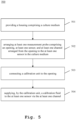
- a housing comprising a culture medium is provided.
- at least one measurement probe comprising an opening, at least one sensor, and at least one channel arranged from the opening to the at least one sensor is arranged in the culture medium.
- a calibration unit is connected to the opening of the at least one measurement probe.
- a calibration fluid is supplied by the calibration unit to the at least one sensor via the at least one channel.
Landscapes
- Chemical & Material Sciences (AREA)
- Life Sciences & Earth Sciences (AREA)
- Health & Medical Sciences (AREA)
- Engineering & Computer Science (AREA)
- Bioinformatics & Cheminformatics (AREA)
- Organic Chemistry (AREA)
- Wood Science & Technology (AREA)
- Zoology (AREA)
- General Health & Medical Sciences (AREA)
- Biochemistry (AREA)
- General Engineering & Computer Science (AREA)
- Sustainable Development (AREA)
- Microbiology (AREA)
- Biotechnology (AREA)
- Genetics & Genomics (AREA)
- Biomedical Technology (AREA)
- Analytical Chemistry (AREA)
- Molecular Biology (AREA)
- Chemical Kinetics & Catalysis (AREA)
- Electrochemistry (AREA)
- Physics & Mathematics (AREA)
- General Physics & Mathematics (AREA)
- Immunology (AREA)
- Pathology (AREA)
- Apparatus Associated With Microorganisms And Enzymes (AREA)
Abstract
A measurement system (100) is provided for in situ calibration. The measurement system comprises a housing (101) comprising a culture medium (102) and at least one measurement probe (103) arranged in the culture medium (102), wherein the at least one measurement probe (103) comprises an opening (104), at least one sensor (105), and at least one channel (106) arranged from the opening (104) to the at least one sensor (105). The measurement system further comprises a calibration unit (108) connected to the opening (104), configured to supply a calibration fluid to the at least one sensor (105) via the at least one channel (106) .
Description
- The invention relates to in situ calibration of sensors, especially of Process Analytical Technology (PAT) sensor probes for bioprocess monitoring.
- Generally, in drug bio-manufacturing, biological cells may be cultured under very controlled sterile conditions inside a bioreactor to maintain an optimal growth environment, where chemical and biochemical parameters may be monitored continuously, in situ. This can be achieved by using so-called "sensor probes" that may be placed inside the bioreactor. Furthermore, the sensors may be required to remain operational over the entire cell culture period, which may last somewhere between 3 and 6 weeks depending on the cell types.
- However, current sensor technology cannot be operated for such an extended period without periodic calibration to guarantee the accuracy of the measurements. In addition, sensors cannot be taken out of the bioreactors to be calibrated, and re-inserted given the high risk of breaking sterility, i.e. introducing contamination into the cell culture.
- In most settings, small samples may be collected from the reactor and may be analyzed off-line, and the results may be used to correct the in situ sensor readings. For example, the document
US 8,117,924 B2 discloses an apparatus that may isolate a sample from a bulk fluid to measure its characteristics. However, this may require skilled personnel, and access to additional analytical facilities that may not necessarily be available immediately. - Accordingly, an object of the invention is to provide a measurement system and a method to facilitate in situ calibration of measurement sensors without needing to collect samples.
- The object is solved by the features of the first independent claim for the measurement system and by the features of the second independent claim for the method. The dependent claims contain further developments.
- According to a first aspect of the invention, a measurement system is provided for in situ calibration. The measurement system comprises a housing comprising a culture medium and at least one measurement probe arranged in the culture medium, wherein the at least one measurement probe comprises an opening, at least one sensor, and at least one channel arranged from the opening to the at least one sensor.
- The measurement system further comprises a calibration unit connected to the opening, configured to supply a calibration fluid to the at least one sensor via the at least one channel. For instance, the calibration fluid may be sterilized before use. Advantageously, by means of the channel arranged in the measurement probe, the calibration unit may supply the calibration fluid to the sensor to perform in situ calibration without needing to collect samples of the culture medium.
- Preferably, the at least one measurement probe comprises a membrane encompassing the at least one sensor, configured to confine the calibration fluid at or around the at least one sensor. Advantageously, a rapid diffusion and dilution of the calibration fluid into the culture medium may be prevented. Furthermore, the calibration accuracy may be improved, e.g., by confining the calibration fluid above the sensor during the calibration measurement.
- Preferably, the calibration unit comprises a controller configured to control a flow of the calibration fluid in the at least one channel. In this regard, the flow can be bidirectional, i.e., from the calibration unit to the sensor as well as from the sensor to the calibration unit, especially within the channel.
- Preferably, the controller is further configured to control a flow of the culture medium to the at least one sensor through the membrane. In this regard, the flow can be bidirectional, i.e., from the housing to the sensor as well as from the sensor to the housing, especially through the membrane.
- Advantageously, the membrane may protect the sensors from the culture medium. Furthermore, by controlling the flow of the culture medium through the membrane, the effect of flow during the measurement and/or calibration can be prevented or limited.
- Preferably, the calibration fluid comprises a calibration solution with a defined concentration. For example, the calibration fluid may comprise a calibration solution for a specific sensor, and the calibration unit may comprise such calibration fluids for respective sensors.
- Preferably, the calibration fluid comprises a plurality of calibration solutions with different concentrations. For example, the calibration fluid may comprise a combination of calibration solutions for calibrating multiple sensors, and the calibration unit may comprise such combined calibration solutions of different concentrations.
- Preferably, the membrane comprises a plurality of pores with an internal width from 1 micrometer to 5 micrometers. More preferably, the membrane may comprise a plurality of pores with an internal width from 10nm to 100nm. Advantageously, the pores may allow sample diffusion, e.g., proteins, at the sensor in a controlled manner, while preventing any contamination at the sensor surface.
- Preferably, the calibration unit is further configured to supply a cleaning fluid to the at least one sensor via the at least one channel. Advantageously, measurement and/or calibration accuracy can be further improved.
- Preferably, the at least one measurement probe, the calibration fluid, and the cleaning fluid are sterile. Advantageously, the sterile conditions of the bioprocess monitoring can be maintained.
- Preferably, the at least one measurement probe further comprises at least one further sensor configured to be in contact with the culture medium. Advantageously, by means of the further sensor in direct contact with the culture medium, i.e. external or not confined by the membrane, a differential measurement can be performed, which may further improve the measurement and/or calibration accuracy.
- Preferably, the at least one sensor and/or the at least one further sensor are electrochemical sensors. Alternatively, the at least one sensor and/or the at least one further sensor are optical sensors. Further alternatively, the at least one sensor and/or the at least one further sensor are mass-sensitive sensors. Further alternatively, the at least one sensor and/or the at least one further sensor are thermo-sensitive sensors.
- Additionally or alternatively, the at least one sensor and/or the at least one further sensor are configured to measure at least one of a physical parameter, a chemical parameter, and a biochemical parameter of the culture medium. The parameters can be defined as but not limited to temperature, pH level, dissolved oxygen, glucose, lactate, glutamine and glutamate concentrations, ion concentration (e.g. sodium, calcium, magnesium) cell density, cell viability, electrical conductivity, oxidation reduction potential, and proteins concentrations.
- Preferably, the housing is a cell culture vessel, preferably a bioreactor vessel. Alternatively, the housing may correspond to a sterile environment for environmental and/or industrial monitoring.
- According to a second aspect of the invention, a method is provided for in situ calibration. The method comprises the steps of providing a housing comprising a culture medium; arranging at least one measurement probe comprising an opening, at least one sensor, and at least one channel arranged from the opening to the at least one sensor in the culture medium; connecting a calibration unit to the opening; and supplying, by the calibration unit, a calibration fluid to the at least one sensor via the at least one channel.
- Preferably, the method further comprises the step of providing a membrane encompassing the at least one sensor to confine the calibration fluid at or around the at least one sensor.
- Preferably, the calibration unit comprises a controller, and the method further comprises the step of controlling, via the controller, a flow of the calibration fluid in the at least one channel. Additionally or alternatively, the method further comprises the step of controlling, via the controller, a flow of the culture medium to the at least one sensor through the membrane.
- It is to be noted that the method according to the second aspect corresponds to the measurement system according to the first aspect and its implementation forms. Accordingly, the method of the second aspect may have corresponding implementation forms. Further, the method of the second aspect achieves the same advantages and effects as the measurement system of the first aspect and its respective implementation forms.
- Exemplary embodiments of the invention are now further explained with respect to the drawings by way of example only, and not for limitation. In the drawings:
- Fig. 1
- shows a first exemplary embodiment of the measurement system according to the first aspect of the invention;
- Fig. 2
- shows an exemplary embodiment of the calibration unit;
- Fig. 3
- shows an exemplary in situ calibration operation;
- Fig. 4
- shows a second exemplary embodiment of the measurement system according to the first aspect of the invention; and
- Fig. 5
- shows an exemplary embodiment of the method according to the second aspect of the invention.
- Reference will now be made in detail to the embodiments of the present invention, examples of which are illustrated in the accompanying drawings. However, the following embodiments of the present invention may be variously modified and the range of the present invention is not limited by the following embodiments.
- In
Fig. 1 , a first exemplary embodiment of themeasurement system 100 according to the first aspect of the invention is illustrated. Themeasurement system 100 may comprise ahousing 101, e.g., a bioreactor vessel, comprising a cell-culture medium 102 and ameasurement probe 103 arranged in the cell-culture medium 102, especially inside of thehousing 101. - The
measurement probe 103 may comprise anopening 104, an array ofsensors 105, herein exemplarily shown with threesensors channel 106 arranged from theopening 104 to the array ofsensors 105, especially within themeasurement probe 103. - The
measurement probe 103 may further comprise amembrane 107 encompassing the array ofsensors 105, especially to protect the array ofsensors 105 from the cell-culture medium 102. For instance, themembrane 107 may be arranged, i.e., the position of themembrane 107 may be aligned, with respect to the position/location of the array ofsensors 105 in themeasurement probe 103. - For example, the probe material, especially of the body of the
measurement probe 103, may differ from the membrane material. In this regard, themeasurement probe 103 may comprise a slot or an aperture, especially on the body of themeasurement probe 103, corresponding to the position/location of the array ofsensors 105, and themembrane 107 may be attached to themeasurement probe 103, especially to the body of themeasurement probe 103, at the slot or the aperture, especially covering the slot or the aperture. - The
measurement system 100 may further comprise acalibration unit 108 connected to theopening 104 of themeasurement probe 103 and further to thechannel 106 inside of themeasurement probe 103, for example via aflow path 109. Thecalibration unit 108 may supply a calibration fluid to the array ofsensors 105 through thechannel 106, e.g., via theflow path 109 through theopening 104 of themeasurement probe 103. - In this regard, the
membrane 107 may confine the calibration fluid above the array ofsensors 105, especially during the calibration measurement, and may prevent rapid diffusion and dilution of the calibration fluid into thehousing 101. - For example, the
membrane 107 may comprise pores having an internal width sufficient to pass molecules, such as proteins, through themembrane 107. For instance, the pores may have an internal width of about 1 micrometer to 5 micrometers, preferably an internal width of about 10nm to 100nm, especially to allow sample diffusion to the array ofsensors 105 while preventing cells contaminate the array ofsensors 105, especially the surface of the sensors. - In other words, the
membrane 107 may correspond to or be a one-way flow membrane, which may restrict the flow of the calibration fluid from thechannel 106 and/or the array ofsensors 105 of themeasurement probe 103 into thehousing 101. However, themembrane 107 may allow sample diffusion, such as protein molecules, to the array ofsensors 105, especially by allowing the sample to flow from thehousing 101, e.g., through the pores, into themeasurement probe 103. - In
Fig. 2 , an exemplary embodiment of thecalibration unit 108 is illustrated. Thecalibration unit 108 may comprise astorage section 201 and aflow controller 202 connected to thestorage section 201. In this regard, thestorage section 201 may act as a reservoir to store one or more calibration fluids or solutions CS1, CS2, CS3 and cleaning fluids CF. - For example, the calibration fluids CS1, CS2, CS3 may respectively correspond to the
sensors sensors 105, e.g., for a respective calibration specie. Alternatively, the calibration fluids CS1, CS2, CS3 may comprise different concentration of a mixture of calibration specie. - The
flow controller 202 may comprise flow controlling means, such as a set of valves and a pump, that may be actuated on demand, e.g., via a software interface. As such, theflow controller 202 may push the calibration fluids CS1, CS2, CS3 and/or the cleaning fluid CF through thechannel 106 to the array ofsensors 105, e.g., via theflow path 109 through theopening 104 of themeasurement probe 103. - Furthermore, the
flow controller 202 may pull a sample from thehousing 101 through themembrane 107 onto the array ofsensors 105, especially to control the flow during the measurement. - In
Fig. 3 , an exemplary in situ calibration operation of themeasurement system 100 is illustrated. For example, the array ofsensors 105 may comprise threesensors - The
calibration unit 108, especially thestorage section 201, may comprise a firstcalibration solution storage 301 containing a first calibration solution CS1 corresponding to thesensor 1051, a secondcalibration solution storage 302 containing a second calibration solution CS2 corresponding to thesensor 1052, a thirdcalibration solution storage 303 containing a third calibration solution CS3 corresponding to thesensor 1053, and afourth storage 304 containing the cleaning fluid CF. The calibration solutions CS1, CS2, CS3 and the cleaning fluid CF may be sterile. - The
flow controller 202 may comprise afirst valve 305, e.g., a directional valve, connected to the firstcalibration solution storage 301 to control a flow of the first calibration solution CS1, asecond valve 306 connected to the secondcalibration solution storage 302 to control a flow of the second calibration solution CS2, athird valve 307 connected to the thirdcalibration solution storage 303 to control a flow of the third calibration solution CS3, and afourth valve 308 connected to thefourth storage 304 to control a flow of the cleaning fluid CF. - The
flow controller 202 may further comprise apump 309 connected to thefirst valve 305, thesecond valve 306, thethird valve 307, and thefourth valve 308, and further to theflow path 109. In this regard, thepump 309 may push one or more of the calibration solutions CS1, CS2, CS3, or the cleaning fluid CF to thesensors channel 106 through theopening 104 of themeasurement probe 103. Thefirst valve 305, thesecond valve 306, thethird valve 307, thefourth valve 308, and thepump 309 may be actuated on demand, e.g., via a software interface. - For instance, if a calibration measurement for the
sensor 1051 is needed, thefirst valve 305 may be operated or activated to enable a flow of the first calibration solution CS1, and thepump 309 may push the first calibration solution CS1 via theflow path 109 through theopening 104 and further through thechannel 106 to thesensor 1051. - Analogously, if the
sensor 1051 is required to be cleaned, thefourth valve 308 may be operated or activated to enable a flow of the cleaning fluid CF, and thepump 309 may push the cleaning fluid CF via theflow path 109 through theopening 104 and further through thechannel 106 to thesensor 1051. - For instance, is case of a parameter measurement, the
pump 309 may pull a sample from the housing through themembrane 107 onto thesensors membrane 107 may comprise a uniform surface or may comprise different surfaces corresponding to therespective sensors - It is to be noted that the
opening 104 of themeasurement probe 103 may additionally act as a sealing around theflow path 109 connecting thechannel 106 within themeasurement probe 103. Since themeasurement probe 103, the calibration solutions CS1, CS2, CS3, and the cleaning fluid CF may be sterilized before use, the in situ calibration may not affect the sterility of themeasurement probe 103 and/or thehousing 101. - Moreover, since the
first valve 305, thesecond valve 306, thethird valve 307, thefourth valve 308, and thepump 309 may be actuated via a software interface, in situ automated calibration of themeasurement probe 103, especially of the array ofsensors 105, can be achieved without needing to collect samples. - For example, especially for calibrating the
sensors sensors sensors sensors - Afterwards, an adjustment or a set of adjustments may be performed to ensure the measurement accuracy of the
sensors - In
Fig. 4 , a second exemplary embodiment of themeasurement system 400 according to the first aspect of the invention is illustrated. Themeasurement system 400 differs from themeasurement system 100 in that themeasurement probe 103 of themeasurement system 400 may additionally comprise a further sensor or an additional array ofsensors 401, especially arranged at themeasurement probe 103 to be in direct contact with the cell-culture medium 102. - For example, the further sensor or the additional array of
sensors 401 may be arranged at themeasurement probe 103 outside of themembrane 107. In other words, themembrane 107 may not encompass the further sensor or the additional array ofsensors 401, especially to facilitate differential measurements. - In
Fig. 5 , an exemplary embodiment of themethod 500 according to the second aspect of the invention is illustrated. In afirst step 501, a housing comprising a culture medium is provided. In asecond step 502, at least one measurement probe comprising an opening, at least one sensor, and at least one channel arranged from the opening to the at least one sensor is arranged in the culture medium. In athird step 503, a calibration unit is connected to the opening of the at least one measurement probe. In afourth step 504, a calibration fluid is supplied by the calibration unit to the at least one sensor via the at least one channel. - It is important to note that, in the description as well as in the claims, the word "comprising" does not exclude other elements or steps and the indefinite article "a" or "an" does not exclude a plurality. A single element or other unit may fulfill the functions of several entities or items recited in the claims. Furthermore, the word "connected" implies that the elements may be directly connected together or may be coupled through one or more intervening elements. Moreover, the disclosure with regard to any of the aspects is also relevant with regard to the other aspects of the disclosure.
- Although the invention has been illustrated and described with respect to one or more implementations, equivalent alterations and modifications will occur to others skilled in the art upon the reading and understanding of this specification and the annexed drawings. In addition, while a particular feature of the invention may have been disclosed with respect to only one of several implementations, such feature may be combined with one or more other features of the other implementations as may be desired and advantageous for any given or particular application.
Claims (15)
- A measurement system (100, 400) for in situ calibration, comprising:a housing (101) comprising a culture medium (102) and at least one measurement probe (103) arranged in the culture medium (102), wherein the at least one measurement probe (103) comprises an opening (104), at least one sensor (105), and at least one channel (106) arranged from the opening (104) to the at least one sensor (105); anda calibration unit (108) connected to the opening (104), configured to supply a calibration fluid to the at least one sensor (105) via the at least one channel (106).
- The measurement system according to claim 1,
wherein the at least one measurement probe (103) comprises a membrane (107) encompassing the at least one sensor (105), configured to confine the calibration fluid at or around the at least one sensor (105). - The measurement system according to claim 1 or 2,
wherein the calibration unit (108) comprises a controller (202) configured to control a flow of the calibration fluid in the at least one channel (106). - The measurement system according to claim 3,
wherein the controller (202) is further configured to control a flow of the culture medium (102) to the at least one sensor (105) through the membrane (107). - The measurement system according to any of claims 1 to 4,
wherein the calibration fluid comprises a calibration solution with a defined concentration. - The measurement system according to any of claims 1 to 4,
wherein the calibration fluid comprises a plurality of calibration solutions with different concentrations. - The measurement system according to claim 2,
wherein the membrane (107) comprises a plurality of pores with an internal width from 1 micrometer to 5 micrometers, preferably from 10nm to 100nm. - The measurement system according to any of claims 1 to 7,
wherein the calibration unit (108) is further configured to supply a cleaning fluid to the at least one sensor (105) via the at least one channel (106). - The measurement system according to claim 8,
wherein the at least one measurement probe (103), the calibration fluid, and the cleaning fluid are sterile. - The measurement system according to any of claims 1 to 9,
wherein the at least one measurement probe (103) further comprises at least one further sensor (401) configured to be in contact with the culture medium (102). - The measurement system according to claim 10,wherein the at least one sensor (105) and/or the at least one further sensor (401) are electrochemical sensors, and/orwherein the at least one sensor (105) and/or the at least one further sensor (401) are configured to measure at least one of a physical parameter, a chemical parameter, and a biochemical parameter of the culture medium (102).
- The measurement system according to any of claims 1 to 11,
wherein the housing (101) is a cell culture vessel, preferably a bioreactor vessel. - A method (500) for in situ calibration, comprising:providing (501) a housing comprising a culture medium;arranging (502) at least one measurement probe comprising an opening, at least one sensor, and at least one channel arranged from the opening to the at least one sensor in the culture medium;connecting (503) a calibration unit to the opening; andsupplying (504), by the calibration unit, a calibration fluid to the at least one sensor via the at least one channel.
- The method according to claim 13,
wherein the method further comprising providing a membrane encompassing the at least one sensor to confine the calibration fluid at or around the at least one sensor. - The method according to claim 13 or 14,
wherein the calibration unit comprises a controller, and the method further comprising:controlling, via the controller, a flow of the calibration fluid in the at least one channel; and/orcontrolling, via the controller, a flow of the culture medium to the at least one sensor through the membrane.
Priority Applications (2)
| Application Number | Priority Date | Filing Date | Title |
|---|---|---|---|
| EP23208978.9A EP4553143A1 (en) | 2023-11-10 | 2023-11-10 | Measurement system and method for in situ calibration |
| US18/942,722 US20250154447A1 (en) | 2023-11-10 | 2024-11-10 | Measurement System and Method for in Situ Calibration |
Applications Claiming Priority (1)
| Application Number | Priority Date | Filing Date | Title |
|---|---|---|---|
| EP23208978.9A EP4553143A1 (en) | 2023-11-10 | 2023-11-10 | Measurement system and method for in situ calibration |
Publications (1)
| Publication Number | Publication Date |
|---|---|
| EP4553143A1 true EP4553143A1 (en) | 2025-05-14 |
Family
ID=88779875
Family Applications (1)
| Application Number | Title | Priority Date | Filing Date |
|---|---|---|---|
| EP23208978.9A Pending EP4553143A1 (en) | 2023-11-10 | 2023-11-10 | Measurement system and method for in situ calibration |
Country Status (2)
| Country | Link |
|---|---|
| US (1) | US20250154447A1 (en) |
| EP (1) | EP4553143A1 (en) |
Citations (3)
| Publication number | Priority date | Publication date | Assignee | Title |
|---|---|---|---|---|
| US8117924B2 (en) | 2006-04-21 | 2012-02-21 | Bayer Healthcare Llc | Apparatus, system, and method for in-situ measurements |
| US20230210419A1 (en) * | 2014-02-04 | 2023-07-06 | Baxter International Inc. | Sensor calibration |
| EP4257667A1 (en) * | 2022-04-06 | 2023-10-11 | Sartorius Stedim Biotech GmbH | Device assembly and method for calibrating a single-use sensor |
-
2023
- 2023-11-10 EP EP23208978.9A patent/EP4553143A1/en active Pending
-
2024
- 2024-11-10 US US18/942,722 patent/US20250154447A1/en active Pending
Patent Citations (3)
| Publication number | Priority date | Publication date | Assignee | Title |
|---|---|---|---|---|
| US8117924B2 (en) | 2006-04-21 | 2012-02-21 | Bayer Healthcare Llc | Apparatus, system, and method for in-situ measurements |
| US20230210419A1 (en) * | 2014-02-04 | 2023-07-06 | Baxter International Inc. | Sensor calibration |
| EP4257667A1 (en) * | 2022-04-06 | 2023-10-11 | Sartorius Stedim Biotech GmbH | Device assembly and method for calibrating a single-use sensor |
Non-Patent Citations (1)
| Title |
|---|
| BRADLEY J ET AL: "Optimisation of the biosensor for in situ fermentation monitoring of glucose concentration", BIOSENSORS AND BIOELECTRONICS, vol. 6, no. 8, 1 January 1991 (1991-01-01), pages 669 - 674, XP026706298, ISSN: 0956-5663, [retrieved on 19910101], DOI: 10.1016/0956-5663(91)87020-C * |
Also Published As
| Publication number | Publication date |
|---|---|
| US20250154447A1 (en) | 2025-05-15 |
Similar Documents
| Publication | Publication Date | Title |
|---|---|---|
| EP0706659B1 (en) | Device for analyzing a fluid medium | |
| EP0702795B1 (en) | Device for analyzing a fluid medium | |
| DE102010063033B4 (en) | Procedure for commissioning a measuring device | |
| JP2755889B2 (en) | Object for forming at least one electrode and / or sensor | |
| KR20090004938A (en) | Multiwell Incubation Apparatus and Analysis Methods Using Them | |
| JP2010507068A (en) | In-situ measurement apparatus, system and method | |
| AU720702B2 (en) | Device for optical and electrochemical measurements in microliter size samples | |
| US20150010994A1 (en) | Non-invasive sensing of bioprocess parameters | |
| EP2443224B1 (en) | Non-invasive sensing of bioprocess parameters | |
| US20100015656A1 (en) | Arrangement For On-Line Measurements on Cells | |
| WO1998013675A9 (en) | Device for optical and electrochemical measurements in microliter size samples | |
| US20250154447A1 (en) | Measurement System and Method for in Situ Calibration | |
| WO2023053691A1 (en) | Automatic analyzer | |
| CN112342130A (en) | Receiving member, bioreactor having the receiving member, and method of manufacturing biomaterial | |
| CN118421456A (en) | Automatic change organoid culture monitoring platform | |
| Palmer et al. | Online analysis and process control in recombinant protein production | |
| WO2005045422A1 (en) | A biosensor having exchangable biopart | |
| Brischwein et al. | Living cells on chip: bioanalytical applications | |
| JP2001330582A (en) | Method and apparatus for evaluating cell respiratory activity | |
| EP4009044B1 (en) | Electrochemical membrane-type sensor and analyzing apparatus including the same | |
| Sonnleitner | Real‐time measurement and monitoring of bioprocesses | |
| Riley | Instrumentation and process control | |
| Gao et al. | Recent advances in real-time imaging of single-bacterium metabolic dynamics | |
| Rusli et al. | Towards Integrated Multi-sensor Array Chip for Bioprocess Monitoring | |
| US20120156711A1 (en) | System and method that allows the joined performance of optoelectric and respirometric sensors for instant and accurate ascertainment of biochemical oxygen demand (BOD) in liquid industrial wastes |
Legal Events
| Date | Code | Title | Description |
|---|---|---|---|
| PUAI | Public reference made under article 153(3) epc to a published international application that has entered the european phase |
Free format text: ORIGINAL CODE: 0009012 |
|
| STAA | Information on the status of an ep patent application or granted ep patent |
Free format text: STATUS: THE APPLICATION HAS BEEN PUBLISHED |
|
| AK | Designated contracting states |
Kind code of ref document: A1 Designated state(s): AL AT BE BG CH CY CZ DE DK EE ES FI FR GB GR HR HU IE IS IT LI LT LU LV MC ME MK MT NL NO PL PT RO RS SE SI SK SM TR |
|
| STAA | Information on the status of an ep patent application or granted ep patent |
Free format text: STATUS: REQUEST FOR EXAMINATION WAS MADE |
|
| 17P | Request for examination filed |
Effective date: 20251016 |