EP4552737A1 - Ammonia synthesis catalyst and ammonia synthesis method - Google Patents
Ammonia synthesis catalyst and ammonia synthesis method Download PDFInfo
- Publication number
- EP4552737A1 EP4552737A1 EP23835450.0A EP23835450A EP4552737A1 EP 4552737 A1 EP4552737 A1 EP 4552737A1 EP 23835450 A EP23835450 A EP 23835450A EP 4552737 A1 EP4552737 A1 EP 4552737A1
- Authority
- EP
- European Patent Office
- Prior art keywords
- catalyst
- energy
- synthesis
- unit
- candidate substances
- Prior art date
- Legal status (The legal status is an assumption and is not a legal conclusion. Google has not performed a legal analysis and makes no representation as to the accuracy of the status listed.)
- Pending
Links
Images








Classifications
-
- C—CHEMISTRY; METALLURGY
- C01—INORGANIC CHEMISTRY
- C01C—AMMONIA; CYANOGEN; COMPOUNDS THEREOF
- C01C1/00—Ammonia; Compounds thereof
- C01C1/02—Preparation, purification or separation of ammonia
- C01C1/04—Preparation of ammonia by synthesis
- C01C1/0405—Preparation of ammonia by synthesis from N2 and H2 in presence of a catalyst
- C01C1/0411—Preparation of ammonia by synthesis from N2 and H2 in presence of a catalyst characterised by the catalyst
-
- B—PERFORMING OPERATIONS; TRANSPORTING
- B01—PHYSICAL OR CHEMICAL PROCESSES OR APPARATUS IN GENERAL
- B01J—CHEMICAL OR PHYSICAL PROCESSES, e.g. CATALYSIS OR COLLOID CHEMISTRY; THEIR RELEVANT APPARATUS
- B01J23/00—Catalysts comprising metals or metal oxides or hydroxides, not provided for in group B01J21/00
- B01J23/002—Mixed oxides other than spinels, e.g. perovskite
-
- B—PERFORMING OPERATIONS; TRANSPORTING
- B01—PHYSICAL OR CHEMICAL PROCESSES OR APPARATUS IN GENERAL
- B01J—CHEMICAL OR PHYSICAL PROCESSES, e.g. CATALYSIS OR COLLOID CHEMISTRY; THEIR RELEVANT APPARATUS
- B01J23/00—Catalysts comprising metals or metal oxides or hydroxides, not provided for in group B01J21/00
- B01J23/38—Catalysts comprising metals or metal oxides or hydroxides, not provided for in group B01J21/00 of noble metals
- B01J23/54—Catalysts comprising metals or metal oxides or hydroxides, not provided for in group B01J21/00 of noble metals combined with metals, oxides or hydroxides provided for in groups B01J23/02 - B01J23/36
- B01J23/56—Platinum group metals
- B01J23/63—Platinum group metals with rare earths or actinides
-
- B—PERFORMING OPERATIONS; TRANSPORTING
- B01—PHYSICAL OR CHEMICAL PROCESSES OR APPARATUS IN GENERAL
- B01J—CHEMICAL OR PHYSICAL PROCESSES, e.g. CATALYSIS OR COLLOID CHEMISTRY; THEIR RELEVANT APPARATUS
- B01J23/00—Catalysts comprising metals or metal oxides or hydroxides, not provided for in group B01J21/00
- B01J23/38—Catalysts comprising metals or metal oxides or hydroxides, not provided for in group B01J21/00 of noble metals
- B01J23/54—Catalysts comprising metals or metal oxides or hydroxides, not provided for in group B01J21/00 of noble metals combined with metals, oxides or hydroxides provided for in groups B01J23/02 - B01J23/36
- B01J23/56—Platinum group metals
- B01J23/64—Platinum group metals with arsenic, antimony, bismuth, vanadium, niobium, tantalum, polonium, chromium, molybdenum, tungsten, manganese, technetium or rhenium
- B01J23/648—Vanadium, niobium or tantalum or polonium
- B01J23/6482—Vanadium
-
- B—PERFORMING OPERATIONS; TRANSPORTING
- B01—PHYSICAL OR CHEMICAL PROCESSES OR APPARATUS IN GENERAL
- B01J—CHEMICAL OR PHYSICAL PROCESSES, e.g. CATALYSIS OR COLLOID CHEMISTRY; THEIR RELEVANT APPARATUS
- B01J23/00—Catalysts comprising metals or metal oxides or hydroxides, not provided for in group B01J21/00
- B01J23/38—Catalysts comprising metals or metal oxides or hydroxides, not provided for in group B01J21/00 of noble metals
- B01J23/54—Catalysts comprising metals or metal oxides or hydroxides, not provided for in group B01J21/00 of noble metals combined with metals, oxides or hydroxides provided for in groups B01J23/02 - B01J23/36
- B01J23/56—Platinum group metals
- B01J23/64—Platinum group metals with arsenic, antimony, bismuth, vanadium, niobium, tantalum, polonium, chromium, molybdenum, tungsten, manganese, technetium or rhenium
- B01J23/652—Chromium, molybdenum or tungsten
- B01J23/6522—Chromium
-
- B—PERFORMING OPERATIONS; TRANSPORTING
- B01—PHYSICAL OR CHEMICAL PROCESSES OR APPARATUS IN GENERAL
- B01J—CHEMICAL OR PHYSICAL PROCESSES, e.g. CATALYSIS OR COLLOID CHEMISTRY; THEIR RELEVANT APPARATUS
- B01J23/00—Catalysts comprising metals or metal oxides or hydroxides, not provided for in group B01J21/00
- B01J23/38—Catalysts comprising metals or metal oxides or hydroxides, not provided for in group B01J21/00 of noble metals
- B01J23/54—Catalysts comprising metals or metal oxides or hydroxides, not provided for in group B01J21/00 of noble metals combined with metals, oxides or hydroxides provided for in groups B01J23/02 - B01J23/36
- B01J23/56—Platinum group metals
- B01J23/64—Platinum group metals with arsenic, antimony, bismuth, vanadium, niobium, tantalum, polonium, chromium, molybdenum, tungsten, manganese, technetium or rhenium
- B01J23/656—Manganese, technetium or rhenium
- B01J23/6562—Manganese
-
- B—PERFORMING OPERATIONS; TRANSPORTING
- B01—PHYSICAL OR CHEMICAL PROCESSES OR APPARATUS IN GENERAL
- B01J—CHEMICAL OR PHYSICAL PROCESSES, e.g. CATALYSIS OR COLLOID CHEMISTRY; THEIR RELEVANT APPARATUS
- B01J23/00—Catalysts comprising metals or metal oxides or hydroxides, not provided for in group B01J21/00
- B01J23/70—Catalysts comprising metals or metal oxides or hydroxides, not provided for in group B01J21/00 of the iron group metals or copper
- B01J23/89—Catalysts comprising metals or metal oxides or hydroxides, not provided for in group B01J21/00 of the iron group metals or copper combined with noble metals
-
- Y—GENERAL TAGGING OF NEW TECHNOLOGICAL DEVELOPMENTS; GENERAL TAGGING OF CROSS-SECTIONAL TECHNOLOGIES SPANNING OVER SEVERAL SECTIONS OF THE IPC; TECHNICAL SUBJECTS COVERED BY FORMER USPC CROSS-REFERENCE ART COLLECTIONS [XRACs] AND DIGESTS
- Y02—TECHNOLOGIES OR APPLICATIONS FOR MITIGATION OR ADAPTATION AGAINST CLIMATE CHANGE
- Y02P—CLIMATE CHANGE MITIGATION TECHNOLOGIES IN THE PRODUCTION OR PROCESSING OF GOODS
- Y02P20/00—Technologies relating to chemical industry
- Y02P20/50—Improvements relating to the production of bulk chemicals
- Y02P20/52—Improvements relating to the production of bulk chemicals using catalysts, e.g. selective catalysts
Definitions
- the present disclosure relates to ammonia synthesis catalysts and ammonia synthesis methods.
- ammonia (NH 3 ) is attracting attention as a component applicable for use as an energy carrier for hydrogen energy or the like.
- the Haber-Bosch (HB) process using an iron-based catalyst is industrially used as the catalyst.
- various kinds of ammonia synthesis catalysts are being studied for the purpose of synthesizing the ammonia under conditions that are milder than the conditions in which the HB process is performed.
- ammonia synthesis catalyst carrying ruthenium in layers on a praseodymium oxide carrier for example, refer to Patent Document 1.
- Patent Document 1 Japanese Laid-Open Patent Publication No. 2016-155123
- the synthesis of the NH 3 is performed under high temperature and high pressure conditions, and thus, from a viewpoint of reducing CO 2 emissions and improving energy efficiency when synthesizing the NH 3 , there are demands for a NH 3 synthesis catalyst which can more efficiently synthesize the NH 3 .
- One object of one aspect of the present invention is to provide an ammonia synthesis catalyst which can more efficiently synthesize NH 3 .
- One aspect of the present invention relates to an ammonia synthesis catalyst including one or more kinds of components selected from a group consisting of IrSc, FePd 3 , MnTc 3 , IrY, CrPd 3 , MnPd 3 , RhY, Co 3 Pt, CrPt 3 , FeRh 3 , CrRh 3 , Ni 3 Ti, Ir 3 V, Pt 3 Ti, Co 3 Rh, Pd 3 Ti, Ni 3 Zr, Co 3 W, NiPd 3 , FeNi 3 , Ir 3 Mn, IrMn, MnPt, MnNi 3 , Ir 3 Re, MnRh, Pd 3 V, MnPt 3 , Rh 3 V, and Rh 3 Ti.
- the NH 3 synthesis catalyst according to the present embodiment includes at least one or more kinds of components selected from IrSc, FePd 3 , MnTc 3 , IrY, CrPd 3 , MnPd 3 , RhY, Co 3 Pt, CrPt 3 , FeRh 3 , CrRh 3 , Ni 3 Ti, Ir 3 V, Pt 3 Ti, Co 3 Rh, Pd 3 Ti, Ni 3 Zr, Co 3 W, NiPd 3 , FeNi 3 , Ir 3 Mn, IrMn, MnPt, MnNi 3 , Ir 3 Re, MnRh, Pd 3 V, MnPt 3 , Rh 3 V, and Rh 3 Ti.
- a single component or a plurality of components, among these components, may be included in the catalyst.
- the NH 3 synthesis catalysts according to the present embodiment preferably includes one kind of component selected from IrSc, FePd 3 , MnTc 3 , IrY, CrPd 3 , MnPd 3 , RhY, Co 3 Pt, CrPt 3 , FeRh 3 , CrRh 3 , Ni 3 Ti, Ir 3 V, Pt 3 Ti, Co 3 Rh, Pd 3 Ti, Ni 3 Zr, Co 3 W, NiPd 3 , FeNi 3 , Ir 3 Mn, IrMn, MnPt, MnNi 3 , Ir 3 Re, MnRh, Pd 3 V, MnPt 3 , Rh 3 V, and Rh 3 Ti.
- component selected from IrSc, FePd 3 , MnTc 3 , IrY, CrPd 3 , MnPd 3 , RhY, Co 3 Pt, CrPt 3 , FeRh 3 , CrRh 3 , Ni 3 Ti, Ir 3
- the NH 3 synthesis catalyst according to the present embodiment is selected by a catalyst selection system and a method for selecting the catalyst, which will be described later. Because the catalyst selection system or the like uses a descriptor that is selected by analyzing elementary reactions of the NH 3 synthesis, it is possible to efficiently and accurately select the catalyst which reduces the activation energy. For this reason, by using the catalyst selected by the catalyst selection system or the like for the NH 3 synthesis, the energy required for the NH 3 synthesis can be reduced, and the NH 3 can be synthesized efficiently.
- the NH 3 is attracting attention as one of the most promising candidates for the hydrogen carrier. Because the NH 3 is generally synthesized by the HB process which is performed at the high temperature and high pressure conditions, from the viewpoint of reducing CO 2 emissions and improving the energy efficiency, it is important to use a NH 3 synthesis catalyst capable of efficiently synthesizing the NH 3 in order to produce the NH 3 with a good production efficiency.
- the NH 3 synthesis catalyst according to the present embodiment can efficiently synthesize the NH 3 , and can thus improve the production of the NH 3 .
- FIG. 1 is a diagram illustrating a configuration of the catalyst selection system to which the method for selecting the catalyst is applied.
- a catalyst selection system 1 includes a catalyst selection device 10, a storage device 20, and a machine learning potential 30.
- the catalyst selection device 10, the storage device 20, and the machine learning potential 30 may be connected via a communication network 40, and input values to the catalyst selection device 10, the storage device 20, and the machine learning potential 30, and output values of the catalyst selection device 10, the storage device 20, and the machine learning potential 30 may be transmitted via the communication network 40.
- At least one of the storage device 20 and the machine learning potential 30 may be stored in a cloud system.
- the catalyst selection device 10, the storage device 20, and the machine learning potential 30 are connected via the communication network 40, but a wired connection may be employed instead.
- the catalyst selection system 1 may be a single apparatus, such as a personal computer (PC) or the like, including each component within the apparatus.
- the catalyst selection device 10 selects candidates for the NH 3 synthesis catalyst to be used for a catalytic reaction for synthesizing the NH 3 , which is the target product, from the H 2 and the N 2 , which are the raw materials, using the machine learning potential 30. Details of the catalyst selection device 10 will be described later.
- the storage device 20 stores a data table including information on the catalyst, an adsorbent, or the like, structures and energies of the catalyst and the adsorbent optimized using the machine learning potential 30, and a deviation or the like from a scaling line.
- FIG. 2 An example of the data table is illustrated in FIG. 2 .
- the data table records the information on the catalyst, the adsorbent, or the like, the structure and energy of the catalyst and the adsorbent optimized using the machine learning potential 30, and information on the deviation or the like from the scaling line.
- the deviation from the scaling line is a difference in the dissociation activation energy of N-N* between coordinates of the energy optimized using the machine learning potential 30 (coordinates of an adsorption energy of N* and the dissociation activation energy of N-N*) and coordinates of the adsorption energy of N* on the scaling line, for the same catalyst composition and the same crystal plane. For this reason, the deviation from the scaling line is calculated only for the dissociation activation energy of N-N*.
- the catalyst may be a single metal or the like, an alloy including a plurality of metals, or a compound including a metal.
- Examples of the information on the catalyst include a catalyst name (catalyst composition), information on the crystal plane of the catalyst, or the like.
- Examples of the catalyst name include CoRh or the like, for example.
- crystal plane of the catalyst examples include [001], [111], [211], or the like, for example.
- the adsorbent is a component used for producing the target product, and is nitrogen (N 2 ) and hydrogen (H 2 ).
- Examples of the information on the adsorbent include a name of the adsorbent or the like.
- Examples of the name of the adsorbent include no adsorbent, N*, N-N*, or the like.
- Examples of the optimized structures of the catalyst and adsorbent include an intermediate structure, a transition state structure, or the like of the substance.
- Energy of the optimized catalyst and adsorbent include an energy of the catalytic reaction or the like.
- the energy of the catalytic reaction include energies of reactants that are generated in a plurality of elementary reactions in the process of synthesizing the target product NH 3 from the raw materials H 2 and N 2 in the catalytic reaction.
- the reactants include the raw materials, the intermediates of the raw materials, transition states of the intermediates, or the like.
- the energy of the reactant include a dissociation activation energy of the transition state of the intermediate of the raw materials generated by the elementary reactions in the process of synthesizing the target product from the raw materials on the catalyst, an adsorption energy of the intermediate on the catalyst, or the like.
- the elementary reactions of the NH 3 synthesis include the following formulas (I) to (VII), for example.
- "*" denotes an empty adsorption site on a surface of the catalyst on which the reactant, such as an element, a molecule, or the like included in the raw materials, is adsorbed.
- the raw materials are N 2 and H 2
- the intermediates of the raw materials are N 2 *, H*, H*, NH 2 *, and NH 3 *
- the transition states of the intermediates are N-N*, N-H*, NH-H*, and NH 2 -H*.
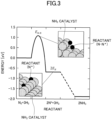
- FIG. 3 illustrates an example of a relationship of energy levels in each of the elementary reactions of NH 3 synthesis using the catalysts in these formulas.
- a dissociation activation energy (E N-N ) of N-N* which is the transition state of nitrogen on the catalyst, is the largest, and the adsorption energy (E N ) of the intermediate N* of nitrogen on the catalyst is substantially constant and most stable in the formula (III) among the formulas (I) to (VII) described above.
- the dissociation activation energy (E N-N ) of N-N* on the catalyst and the adsorption energy (E N ) of N* on the catalyst greatly affect the NH 3 synthesis, and can thus be suitably used as descriptors.
- the machine learning potential 30 is an interatomic potential which outputs an energy from information related to an atomic structure, using a machine learning method.
- the machine learning potential include a neural network potential (NNP), a Gaussian approximation potential (GAP), a spectral neighbor analysis potential (SNAP), a moment tensor potential (MTP), or the like.
- NNP neural network potential
- GAP Gaussian approximation potential
- SNAP spectral neighbor analysis potential
- MTP moment tensor potential
- the NNP is preferable from a viewpoint of a high flexibility of the neural network.
- Matlantis registered trademark
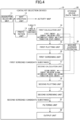
- FIG. 4 is a functional block diagram illustrating a configuration of the catalyst selection device 10.
- the catalyst selection device 10 includes a descriptor selection unit 11, a map creation unit 12, a preparation unit 13, a first calculation unit 14, a first plotting unit 15, a first screening unit 16, a second calculation unit 17, a second plotting unit 18, a second screening unit 19, a filtering unit 21, and an output unit 22.
- the descriptor selection unit 11 selects, as the descriptor, the energy of an intermediate structure or a transition state structure included in the elementary reactions of the catalytic reaction expressed by the formulas (I) to (VII) described above.
- the map creation unit 12 creates a map (activity map) representing the descriptors and a reactivity of the catalytic reaction.
- a map representing the descriptors and a selectivity of catalytic reaction may be created in place of the activity map.
- the activity map may be regarded as a model for predicting the reactivity (selectivity) of the catalyst when the descriptors are input, and the reactivity of the catalyst may be predicted directly from the descriptors.
- the reactivity of the catalyst may be predicted directly from the descriptors obtained by the first calculation unit 14 and the second calculation unit 17, and the candidate substance may be screened according to the reactivity using a data table (refer to FIG. 8 ). In this case, the catalyst selection device 10 does not require the first plotting unit 15 and the second plotting unit 18.
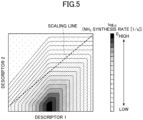
- FIG. 5 represents a relationship between two descriptors of the elementary reactions of the reactants in the NH 3 synthesis (refer to the formulas (I) to (VII) described above) and a synthesis rate of the NH 3 (NH 3 synthesis rate).
- the NH 3 synthesis rate in FIG. 5 represents a yield of the NH 3 that is synthesized.
- the two descriptors used in the activity map illustrated in FIG. 5 will be referred to as descriptors 1 and 2.
- the dissociation activation energy (E N-N ) of the transition state (N-N*) of the intermediate of the nitrogen on the catalyst, and the adsorption energy (E N ) of the intermediate (N*) of nitrogen on the catalyst greatly affect the NH 3 synthesis.
- the descriptors 1 and 2 preferably use the adsorption energy (E N ) of N* on the catalyst and the dissociation activation energy (E N-N ) of N-N* on the catalyst.
- the activity map can be created by microkinetics using the descriptors, for example.
- the catalyst is the NH 3 synthesis catalyst, and a NH 3 synthesis reaction is generated, it is preferable, as described above, to use the energies of N* and N-N* in the formulas of the elementary reactions (refer to the formulas (I) to (VII) described above) of the reactants in the NH 3 synthesis, as the descriptors.
- microkinetics will be described, before describing the microkinetics using the descriptors.
- the general microkinetics include the following enumeration of elementary reactions, energy calculation, and reaction rate calculation.
- a procedure for performing the microkinetics using the descriptors is as follows.
- the energies of all of the intermediates and transition states included in the elementary reactions need to be calculated as described above in order to perform the general microkinetics, it is necessary to calculate an extremely large number of parameters.
- the microkinetics is performed using the descriptors, the energies of all of the intermediates and transition states in the elementary reactions for a standard catalyst are calculated in advance, and thus, only calculations corresponding to two descriptors are required even for an unknown catalyst.
- the two descriptors are plotted on an X-axis and a Y-axis to create the activity map, the NH 3 synthesis catalyst belonging to a region where the reaction rates of the catalyst are high (a high activity region which will be described later) can be intuitively understood from the activity map.
- the number of descriptors is not limited to two, and may be one or three or more, and descriptors which affect the reaction rate of the catalyst are preferably used. Further, for the calculation of the other parameters, not only the linear regression but also a non-linear regression method or the like may be used.
- the preparation unit 13 prepares a plurality of kinds of candidate substances for the catalyst.
- the candidate substances for the catalyst may be a material used in the NH 3 synthesis, a material being considered for use in the NH 3 synthesis, a material never used in the NH 3 synthesis, or the like.
- the material may be an elemental metal, or an alloy including a plurality of metals, or a metal compound such as an oxide, a nitride, a carbide, or the like of a metal.
- the candidate substance may include a substance in which one kind of element on a surface of one candidate substance is substituted with another different element, as another candidate substance different from the one candidate substance.
- the number of candidate substances for the catalyst is not particularly limited and can be selected, as appropriate, and may be several tens, several hundreds, several thousands, or the like, for example.
- FIG. 6 illustrates an example of a relationship between the crystal plane of iron (Fe) and the NH 3 synthesis rate, for a case where the catalyst is iron, for example. As illustrated in FIG.
- the NH 3 synthesis rate differs depending on the crystal plane at the surface of the catalyst, and in a case where the crystal plane is the (111) plane or the (211) plane, the catalyst has a higher NH 3 synthesis rate compared to cases where other crystal planes are present at the surface of the catalyst. For this reason, it is preferable to prepare a plurality of surfaces of the candidate substance for each of the crystal planes.
- the first calculation unit 14 calculates the descriptors related to the catalytic reaction using the candidate substance, in a state where all of the candidate substances prepared by the preparation unit 13 are fixed.
- the present embodiment calculates, as the descriptor, a first energy including a first intermediate energy of an intermediate of a reactant including a substance derived from raw materials (N 2 , H 2 ) and adsorbed on a surface of a candidate substance, and a first transition state energy of a dissociation reaction in which the reactant is separated into two or more substances after a transition state of the intermediate of the reactant is adsorbed on the surface of the candidate substance.
- the state where all of the candidate substances are fixed refers to a state in which positions and crystal structures of the candidate substances are fixed by assuming that that the positions and the crystal structures of the candidate substances do not move when the candidate substances react with the N 2 and the H 2 .
- the first calculation unit 14 may calculate only the first intermediate energy or the first transition state energy as the first energy.
- the first calculation unit 14 preferably calculates the descriptor using the machine learning potential 30.
- the first calculation unit 14 can reduce a calculation time of the descriptor compared to a case where first principles calculation (DFT calculation) or the like based on the density functional theory (DFT) is used.
- DFT calculation first principles calculation
- DFT density functional theory
- the first calculation unit 14 may determine the descriptor by one calculation or may determine the descriptor by a plurality of calculations (for example, 10 calculations). In the case where the calculation is performed a plurality of times, an average value of a plurality of calculated values, or a maximum value or a minimum value of the plurality of calculated values may be used for the descriptor.
- the first calculation unit 14 preferably varies the adsorption position of the reactant including the substance derived from the raw materials on the surface of the candidate substance included in the elementary reaction, in the state where all of the candidate substances are fixed, and optimizes the structure of the intermediate structure including the candidate substance and the reactant. In this case, the first calculation unit 14 can select the intermediate structure having a stable structure.
- Optimization of the structure refers to obtaining an optimum value that minimizes the energy of a predetermined structure. The same applies to the optimization of the structure in the following description.
- the first calculation unit 14 preferably extracts a structure in which the adsorption position of the reactant with respect to the candidate substance is optimal and the first intermediate energy of the candidate substance and the intermediate of the reactant is most stable. In this case, the first calculation unit 14 can acquire the first intermediate energy of the intermediate of the reactant in a short time, although with a low accuracy.
- the first calculation unit 14 preferably includes a first structure optimization unit 141, a second structure optimization unit 142, and a first transition state energy acquisition unit 143.
- the first calculation unit 14 can acquire the first transition state energy in a short time, although with a low accuracy.
- the first structure optimization unit 141 optimizes the structure of an intermediate structure including a candidate substance and a reactant of the reactant on a surface of the candidate substance included in a dissociation reaction from one molecule to two molecules, and calculates a first optimized structure. That is, the first structure optimization unit 141 calculates the first optimized structure by optimizing the structure of the intermediate structure including the candidate substance and the reactant, in a state where all of the structures of the candidate substance are fixed, in the dissociation reaction from one molecule to two molecules.
- the second structure optimization unit 142 optimizes the structure when the reactant is separated into two or more substances including the candidate substance and the reactant, and calculates a second optimized structure.
- the first transition state energy acquisition unit 143 calculates a first transition state energy, which is a transition state energy, from the first optimized structure obtained by the first structure optimization unit 141 and the second optimized structure obtained by the second structure optimization unit 142.
- A-B* is a molecule in a transition state of AB* in a process of separating AB* into A* and B*
- A* is an intermediate of a molecule A
- B* is an intermediate of a molecule B
- the first structure optimization unit 141 arranges AB* on the surface of the candidate substance in a state where all of the structures of the candidate substance are fixed, and optimizes the structure of the intermediate structure including the candidate substance and AB*.
- the second structure optimization unit 142 optimizes the structure so that the structure separates into two molecules A* and B*.
- the first transition state energy acquisition unit 143 calculates, as the first transition state energy, a transition state energy required for one molecule AB* to separate into two molecules A* and B*, using the nudged elastic band (NEB) method.
- NEB nudged elastic band
- the first plotting unit 15 plots the candidate substance based on the first energy (the energy including the first intermediate energy and the first transition state energy), which is the descriptor calculated by the first calculation unit 14, on the activity map (refer to FIG. 5 ) displayed by the map creation unit 12, and creates a first plot map.
- the first screening unit 16 screens the candidate substances based on the first plot map created by the first plotting unit 15, and selects first screened candidate substances. That is, the first screening unit 16 employs a screening method which narrows down the candidate substances to candidate substances plotted in a high activity region including catalysts having a high activity (a high NH 3 synthesis rate), as the first screened candidate substances.
- the high activity region may be a range smaller by a predetermined value or more with respect to the scaling line, by providing the scaling line on the activity map plotted with the candidate substances (refer to FIG. 5 ).
- the candidate substances may be narrowed down to a range less than a NH 3 producing energy of the catalyst by a predetermined value.
- the range may be a range in which the NH 3 synthesis rate is greater than or equal to a predetermined value.
- the predetermined value of the synthesis rate is preferably 10 -4 [1/s] or greater.
- the number of candidate substances to be further narrowed down can be appropriately selected according to the range of the high activity region to be set, and is preferably 5 to 30, more preferably 8 to 55, and still more preferably 10 to 20, for example.
- the activity map can be created by the microkinetics using the descriptors, as described above.
- the activity map can be expressed as having a linear relationship for the descriptors of the standard catalyst, such as elemental metals such as Co, Rh, Ru, Cu, Fe, Re, or the like which will be described later.
- a straight line of this linear relationship can be used as the scaling line (refer to FIG. 5 ).
- the producing energy can be calculated according to the following formula (i). In a case where the producing energy is less than 0 (the producing energy ⁇ 0), it indicates that the alloy is more stable than the element metal.
- Producing Energy E Alloy ⁇ N A ⁇ E A bulk ⁇ N B ⁇ E B bulk (In the formula, E Alloy denotes a bulk energy of the alloy AB, E A(bulk) denotes a bulk energy of a metal A, E B(bulk) denotes a bulk energy of a metal B, N A denotes a number of atoms of the metal A in the alloy, and N B denotes a number of atoms of the metal B in the alloy.)
- the range smaller by the predetermined value or more with respect to the scaling line can be appropriately selected according to the target product to be synthesized, a type of the material to be used, or the like, but in the case of the NH 3 synthesis catalyst, the range is preferably smaller by 0.25 eV or more with respect to the scaling line, for example.
- the range less than the producing energy by the predetermined value can be appropriately selected according on the target product to be synthesized, the type of the material to be used, or the like, but in the case of the NH 3 synthesis catalyst, the range is preferably less than the producing energy by 0.05 eV/atom, for example.
- a number of kinds of first screened candidate substances to be narrowed down to can be appropriately selected according to the number of candidate substances, a number of second screened candidate substances which will be described later, or the like, and may be several tens of kinds or several hundreds of kinds, for example.
- the first screening unit 16 may use a data table in which only information related to candidate substances 1, 2, 3, ..., N (N is an integer greater than or equal to 1) is listed, as illustrated in FIG. 8 .
- the candidate substances in the data table listing only the candidate substances may be sorted in an order included in the high activity region, and the candidate substances included in the high activity region and greater than or equal to a threshold value may be narrowed down as the first screened candidate substances.
- the first screening unit 16 may narrow down the first screened candidate substances by plotting the candidate substances on the activity map by the first plotting unit 15, using the sorted data table.
- the second calculation unit 17 calculates, with respect to the first screened candidate substances, the descriptors related to catalytic reactions using the first screened candidate substances, in a state where the surface of the first screened candidate substances is relaxed.
- the present embodiment calculates, as the descriptor, a second energy including a second intermediate energy of an intermediate of the reactant (N 2 , H 2 ) used for the descriptor and adsorbed on the surface of the first screened candidate substances, and a second transition state energy of a dissociation reaction in which the reactant is separated into two or more substances after the reactant is adsorbed on the surface of the first screened candidate substances, similar to the first energy.
- the state where the surface of the catalyst is relaxed refers to a state in which the catalyst is allowed to move, such that the structure can vary by moving several layers (for example, approximately two layers) from the surface of the catalyst, and is a state close to an actual movement of the catalyst.
- the second calculation unit 17 may calculate only the second intermediate energy or the second transition state energy as the second energy.
- the second calculation unit 17 preferably calculates the descriptor using the machine learning potential 30, similar to the first calculation unit 14. By using the machine learning potential 30, the second calculation unit 17 can reduce the calculation time of the descriptor compared to the case where the DFT calculation or the like is used.
- the second calculation unit 17 preferably varies the adsorption position of the reactant including the substance derived from the raw materials on the surface of the first screened candidate substances included in the elementary reaction, similar to the first calculation unit 14, in the state where the surface of the first screened candidate substances is relaxed, and optimizes the structure of the intermediate structure including the first screened candidate substance and the reactant.
- the second calculation unit 17 can select the intermediate structure having a stable structure.
- the second calculation unit 17 preferably extracts a structure in which the adsorption structure of the reactant with respect to the first screened candidate substances is correct, and the second intermediate energy of the first screened candidate substances and the intermediate of the reactant is most stable.
- the structure may vary from the structure of the molecule (for example, the structure of AB*) in the state adsorbed on the candidate substance, similar to the case where the structure is optimized in the first structure optimization unit 141.
- the second calculation unit 17 can exclude such a structure which varies, and can thus acquire the second intermediate energy of the reactant with a high accuracy.
- the second calculation unit 17 preferably includes a first structure optimization unit 171, a second structure optimization unit 172, and a second transition state energy acquisition unit 173, as illustrated in FIG. 9 .
- the second calculation unit 17 can acquire the second transition state energy with a high accuracy in the case where the descriptor is the transition state energy of the transition state of the intermediate.
- the first structure optimization unit 171 optimizes the structure of the intermediate structure including the first screened candidate substance and the reactant on the surface of the first screened candidate substances included in the dissociation reaction from one molecule to two molecules, and calculates the first optimized structure. That is, the first structure optimization unit 171 optimizes the structure of the intermediate structure including the first screened candidate substance and the reactant in the state where the surface of the first screened candidate substances is relaxed in the dissociation reaction from one molecule to two molecules, and calculates the first optimized structure.
- the second structure optimization unit 172 optimizes a separation structure when the reactant is separated into two or more substances, and calculates the second optimized structure, similar to the second structure optimization unit 142.
- the second transition state energy acquisition unit 173 calculates the second transition state energy, which is the transition state energy, from the first optimized structure obtained by the first structure optimization unit 171 and the second optimized structure obtained by the second structure optimization unit 172, similar to the first transition state energy acquisition unit 143.
- AB* is the molecule in the state adsorbed on the candidate substance
- A-B* is the molecule in the transition state of AB* in the process of separating AB* into A* and B*
- A* is the intermediate of the molecule A
- B* is the intermediate of the molecule B
- the reaction in which one molecule AB* separates into two molecules A* and B* progresses as indicated by the reaction formula (1) described above.
- the first structure optimization unit 171 arranges AB* on the surface of the first screened candidate substances in the state where the surface of the first screened candidate substances is relaxed, and optimizes the structure of the intermediate structure including the first screened candidate substance and AB*, similar to the first structure optimization unit 141.
- the second structure optimization unit 172 optimizes the separation structure so that the separation structure separates into two molecules A* and B*.
- the second transition state energy acquisition unit 173 calculates, as the second transition state energy, the transition state energy required for one molecule AB* to separate into two molecules A* and B*, similar to the first transition state energy acquisition unit 143.
- the second plotting unit 18 plots the first screened candidate substances on the activity map (refer to FIG. 5 ) based on the second energy which is the descriptor calculated by the second calculation unit 17, and creates a second plot map.
- the second screening unit 19 screens the first screened candidate substances based on the second plot map created by the second plotting unit 18, and selects second screened candidate substances. That is, the second screening unit 19 can select the first screened candidate substances plotted in the high activity region of the second plot map as the second screened candidate substances, using the screening method.
- the method of screening the first screened candidate substances is the same as the method of narrowing down the candidate substances to the first screened candidate substances by the first screening unit 16, and thus, details thereof will be omitted.
- a number of kinds of second screened candidate substances to be selected can be appropriately selected according to the number of the first screened candidate substances or the like, and may be several tens of kinds or several hundreds of kinds, for example.
- the filtering unit 21 narrows down the second screened candidate substances selected by the second screening unit 19, based on a catalyst stability, a catalyst cost, or the like.
- the number of kinds of second screened candidate substances to be narrowed down to can be appropriately selected according to the number of second screened candidate substances to be selected or the like, and may be several kinds or several tens of kinds, for example.
- the output unit 22 outputs the second screened candidate substance selected by the second screening unit 19 or the second screened candidate substances narrowed down by the filtering unit 21, to a display or the like.
- the catalyst selection device 10 does not require the first calculation unit 14, the first plotting unit 15, and the first screening unit 16, or the second calculation unit 17, the second plotting unit 18, and the second screening unit 19, according to the number of candidate substances in the preparation unit 13. That is, the catalyst selection device 10 may narrow down the candidate substances by omitting the calculation in the state where all of the candidate substances are fixed or by omitting the calculation in the state where the surface of the candidate substances is relaxed.
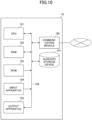
- FIG. 10 is a block diagram illustrating the hardware configuration of the catalyst selection device 10.
- the catalyst selection device 10 is configured by an information processing apparatus (computer), and can be physically configured as a computer system including a central processing unit (CPU: processor) 101 as an arithmetic processing unit, a random access memory (RAM) 102 and a read only memory (ROM) 103 as a main storage device, an input apparatus 104 as an input device, an output apparatus 105, a communication module 106, an auxiliary storage device 107 such as a hard disk or the like, or the like. These components are connected to each other via a bus 108.
- the output apparatus 105 and the auxiliary storage device 107 may be provided externally.
- the CPU 101 controls an overall operation of the catalyst selection device 10, and performs various information processing.
- the CPU 101 can select a catalyst by executing a catalyst selection method or a catalyst selection program which will be described later and is stored in the ROM 103 or the auxiliary storage device 107.
- the RAM 102 may include a non-volatile RAM which is used as a work area of the CPU 101 and stores main control parameters and information.
- the ROM 103 stores a basic input/output system or the like.
- the catalyst selection program may be stored in the ROM 103.
- the input apparatus 104 is an input device, such as a keyboard, a mouse, an operation button, a touchscreen panel, a display screen, or the like, and receives information input by a user as an instruction signal and outputs the instruction signal to the CPU 101.
- the output apparatus 105 is a display device such as a monitor display or the like, a speaker, a printing device such as a printer or the like, or the like.
- information on a catalyst selection result or the like is displayed on the display device such as the monitor display or the like, for example, and a display screen is updated in response to an input operation via the input apparatus 104 or the communication module 106.
- the communication module 106 is a data transmission and reception device, such as a network card or the like, and functions as a communication interface which receives information from an external data recording server or the like, and outputs analysis information to another electronic device.
- the auxiliary storage device 107 is a storage device, such as a solid state drive (SSD), a hard disk drive (HDD), or the like, and stores various data, files, or the like required for the operation of the catalyst selection device 10, for example.
- SSD solid state drive
- HDD hard disk drive
- the functions of the catalyst selection device 10 are implemented by reading predetermined computer software (including the catalyst selection program) from the main storage device such as the RAM 102 or the like, or from the auxiliary storage device 107, and executing the software by the CPU 101, thereby reading data from and writing data to the main storage device such as the RAM 102 or the like, or the auxiliary storage device 107, and operating the input apparatus 104, the output apparatus 105, and the communication module 106.
- predetermined computer software including the catalyst selection program
- each component of the catalyst selection device 10 illustrated in FIG. 4 can be implemented by cooperation of software and hardware, by executing the prestored predetermined computer software (including the catalyst selection program) by the processor in the computer including the catalyst selection device 10.
- the catalyst selection program may be stored in the main storage device or the auxiliary storage device 107 included in the computer, for example.
- the catalyst selection program may be stored in a computer connected to a communication line, such as the Internet or the like, and the catalyst selection program may be provided by downloading a part or all of the catalyst selection program via the communication line. Further, the catalyst selection program may be provided or distributed via the communication line.
- the catalyst selection program may be recorded (including being installed) in the computer from a state where a part or all of the catalyst selection program is stored in a portable storage medium, such as an optical disk such as a CD-ROM, a DVD-ROM, or the like, a semiconductor memory such as a flash memory or the like, or the like.
- a portable storage medium such as an optical disk such as a CD-ROM, a DVD-ROM, or the like, a semiconductor memory such as a flash memory or the like, or the like.
- a method for selecting a catalyst will be described.
- the method for selecting the catalyst can be performed using the catalyst selection system 1 described above. For this reason, a description of the items already described above will be omitted in part.
- FIG. 11 is a flow chart illustrating the method for selecting the catalyst.
- the method for selecting the catalyst is a method for selecting the NH 3 synthesis catalyst to be used for the catalytic reaction for producing NH 3 , which is the target product, from H 2 and N 2 which are the raw materials.
- the descriptor selection unit 11 selects, as the descriptor, the energy of the intermediate structure or the transition state structure included in the elementary reactions of the catalytic reaction expressed by the formulas (I) to (VII) described above (descriptor selection process: step S11).
- adsorption energy when the reactant is adsorbed on the surface of the candidate substance, and transition state energy of the dissociation reaction in which the reactant is separated into two or more substances after the reactant is adsorbed on the surface of the candidate substance.
- the adsorption energy (E N ) of the intermediate of nitrogen (N*) on the catalyst is used as the adsorption energy when the reactant is adsorbed on the surface of the candidate substance.
- the dissociation activation energy (E N-N ) of the transition state (N-N*) of nitrogen on the catalyst is used as the transition state energy of the dissociation reaction in which the reactant is separated into two or more substances after the reactant is adsorbed on the surface of the candidate substance.
- the method for selecting the catalyst analyzes the elementary reactions included in the NH 3 synthesis reaction, and selects and uses as the descriptor, the energy related to the elementary reaction affecting the NH 3 synthesis the most, and thus, it is possible to accurately select the catalyst which can efficiently synthesize the NH 3 .
- the map creation unit 12 creates the activity map representing the descriptors and the reactivity of the catalytic reaction (activity map creation process: step S12).
- FIG. 12 illustrates an example of the activity map for a case where the descriptors of the catalytic reaction are the adsorption energy (E N ) of the intermediate (N*) of nitrogen, and the dissociation activation energy (E N-N ) of the transition state (N-N*) of nitrogen on the catalyst.
- the descriptors of the catalytic reaction are the adsorption energy (E N ) of the intermediate (N*) of nitrogen, and the dissociation activation energy (E N-N ) of the transition state (N-N*) of nitrogen on the catalyst.
- the preparation unit 13 prepares several thousand kinds (for example, 2000 kinds) of candidate substances for the catalyst (preparation process: step S13).
- the number of kinds of candidate substances to be prepared is several thousand in this example, the number of kinds of candidate substances is not limited to such, and may be an arbitrary number, as appropriate.
- the first calculation unit 14 calculates the descriptors related to the catalytic reactions using the candidate substances in a state where all of the candidate substances prepared by the preparation unit 13 are fixed (first calculation process: step S14).
- the present embodiment calculates, as the descriptor, the first energy including the first intermediate energy of the intermediate of the reactant including the substance derived from the raw materials (N 2 , H 2 ) and adsorbed on the surface of the candidate substance, and the first transition state energy of the dissociation reaction in which the reactant is separated into two or more substances after the transition state of the intermediate of the reactant is adsorbed on the surface of the candidate substance.
- the first calculation unit 14 preferably calculates the descriptor of the candidate substance, using the machine learning potential 30.
- the first energy may be determined by one calculation or may be determined by a plurality of calculations (for example, 10 calculations). In the case where the calculation is performed a plurality of times, an average value of a plurality of calculated values, or a maximum value or a minimum value of the plurality of calculated values may be used for the first energy.
- the first calculation unit 14 in the case where the descriptor is the first intermediate energy, the first calculation unit 14 preferably varies the adsorption position of the reactant including the substance derived from the raw materials on the surface of the candidate substance included in the elementary reaction, in the state where all of the candidate substances are fixed, and optimizes the structure of the intermediate structure including the candidate substance and the reactant. In this case, the intermediate structure having a stable structure can be selected.
- the first calculation unit 14 preferably extracts the structure in which the adsorption structure of the reactant with respect to the candidate substance is correct, and the first intermediate energy of the candidate substance and the intermediate of the reactant is most stable.
- the first intermediate energy of the candidate substance and the intermediate of the reactant can be calculated in a short time, although with a low accuracy.
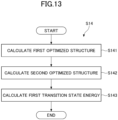
- the first calculation process (step S14) preferably includes a first structure optimization process (step S141), a second structure optimization process (step S142), and a first transition state energy acquisition process (step S143), as illustrated in FIG. 13 .
- the first transition state energy of the transition state of the intermediate can be calculated as the descriptor in a short time, although with a low accuracy.
- the first structure optimization unit 141 optimizes the structure of the intermediate structure including the candidate substance of the reactant and the reactant on the surface of the candidate substance included in the dissociation reaction from one molecule to two molecules, and calculates the first optimized structure. That is, in the first structure optimization process (step S141), the first structure optimization unit 141 optimizes the structure of the intermediate structure including the candidate substance and the reactant, in the state where all of the structures of the candidate substance are fixed, in the dissociation reaction from one molecule to two molecules, and calculates the first optimized structure.
- the second structure optimization process (step S142) optimizes the structure when the reactant is separated into two or more substances including the candidate substance of the reactant and the reactant, and calculates the second optimized structure.
- the first transition state energy acquisition process calculates the first transition state energy, which is the transition state energy, from the first optimized structure obtained in the first structure optimization process (step S141) and the second optimized structure obtained in the second structure optimization process (step S142).
- AB* is the molecule adsorbed on the candidate substance
- A-B* is the molecule in the transition state of AB* in the process of separating AB* into A* and B*
- A* is the intermediate of the molecule A
- B* is the intermediate of the molecule B, as described above
- the reaction in which one molecule AB* separates into two molecules A* and B* is assumed to progress as in the reaction formula (1) described above.
- the first structure optimization process (step S141), arranges by the first structure optimization unit 141, AB* on the surface of the candidate substance in the state where all of the structures of the candidate substances are fixed, and optimizes the structure of the intermediate structure including the candidate substance and AB*.
- the second structure optimization process (step S142) optimizes the structure so that AB* separates into two molecules A* and B*.
- the first transition state energy acquisition unit 143 calculates, as the first transition state energy, the transition state energy required for one molecule AB* to separate into two molecules A* and B*, using the nudged elastic band (NEB) method.
- NEB nudged elastic band
- the first plotting unit 15 plots the candidate substances on the activity map (refer to FIG. 12 ) created in the map creation process (step S12) based on the first energy (the energy including the first intermediate energy and the first transition state energy) which is the descriptor calculated in the first calculation process (step S14), and creates a first plot map (first plotting process: step S15).
- the first screening unit 16 screens the candidate substances based on the first plot map created in the first plotting process (step S15), and selects the first screened candidate substances (first screening process: step S16).
- the first screening unit 16 narrows down the candidate substances plotted in the high activity region including the catalyst having a high activity (high NH 3 synthesis rate) as the first screened candidate substances.
- the first screened candidate substances are narrowed down to 100 kinds to 500 kinds, for example.
- the number of first screened candidate substances to be narrowed down to can be appropriately selected as described above according to the number of candidate substances, the number of second screened candidate substances, or the like, and may be several tens of kinds or several hundreds of kinds, for example.
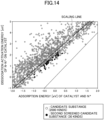
- FIG. 14 illustrates an example of a result of plotting the descriptors of the candidate substances. Similar to FIG. 12 , FIG. 14 illustrates an activity map illustrating the relationship between the adsorption energy (E N ) of the intermediate (N*) of nitrogen, and the dissociation activation energy (E N-N ) of the transition state (N-N*) of nitrogen on the catalyst, as the descriptors. In addition, the illustration of a value of the NH 3 synthesis rate (the yield of the NH 3 ) converted into common logarithm (log 10 ) is omitted in order to clearly illustrate the plotted points.
- E N adsorption energy
- E N-N dissociation activation energy
- the first screening process when narrowing down the first screened candidate substances by plotting the candidate substances on the activity map by the first screening unit 16, the data table listing only the information related to the candidate substances 1, 2, 3, ..., N (N is an integer greater than or equal to 1) may be used as described above (refer to FIG. 8 ). Further, the candidate substances in the data table listing only the candidate substances may be sorted in an order included in the high activity region, and the candidate substances included in the high activity region and greater than or equal to a threshold value may be narrowed down as the first screened candidate substances. The first screening unit 16 may narrow down the first screened candidate substances by plotting the candidate substances on the activity map by the first plotting unit 15, using the sorted data table.
- the second calculation unit 17 calculates the descriptor related to the catalytic reaction with respect to the first screened candidate substances using the first screened candidate substances, in a state where the surface of the first screened candidate substances is relaxed (second calculation process: step S17).
- the present embodiment calculates, as the descriptor, similar to the first energy, the second energy including the second intermediate energy of the intermediate of the reactant (N 2 , H 2 ) used for the descriptor and adsorbed on the surface of the first screened candidate substance, and the second transition state energy of the dissociation reaction in which the reactant is separated into two or more substances after the reactant is adsorbed on the surface of the first screened candidate substance.
- the second calculation unit 17 preferable calculates the second energy of the first screened candidate substance, using the machine learning potential 30.
- the second calculation unit 17 preferably optimizes the structure of the intermediate structure including the first screened candidate substance and the reactant in the state where the surface of the first screened candidate substance is relaxed, similar to in the first calculation process (step S14). In this case, it possible to select the intermediate structure having a stable structure.
- the second calculation unit 17 preferably extracts a structure in which the adsorption position of the reactant with respect to the first screened candidate substance is correct and the second intermediate energy of the first screened candidate substance and the intermediate of the reactant is most stable, similar to the first calculation process (step S14). In this case, it is possible to calculate the second intermediate energy of the reactant with a high accuracy.
- the second calculation unit 17 preferably performs the first structure optimizing process (step S171), the second structure optimization process (step S172), and the second transition state energy acquisition process (step S173), similar to the first calculation process (step S14). In this case, it is possible to calculate the transition state energy of the transition state of the intermediate with a high accuracy.
- the first structure optimization unit 171 optimizes the structure of the intermediate structure including the first screened candidate substance and the reactant on the surface of the first screened candidate substance included in the dissociation reaction from one molecule to two molecules, and calculates the first optimized structure. That is, in the first structure optimization process (step S171), the first structure optimization unit 171 optimizes the structure of the intermediate structure including the first screened candidate substance and the reactant in the state where the surface of the first screened candidate substance is relaxed in the dissociation reaction from one molecule to two molecules, and calculates the first optimized structure.
- the second structure optimization unit 172 optimizes the separation structure of the reactant when the reactant is separated into two or more substances, and calculates the second optimized structure, similar to the second structure optimization unit 142.
- the second transition state energy acquisition unit 173 calculates the second transition state energy, which is the transition state energy, from the first optimized structure obtained in the first structure optimization process (step S171) and the second optimized structure obtained in the second structure optimization process (step S172), similar to the first transition state energy acquisition unit 143.
- AB* is the molecule adsorbed on the candidate substance
- A-B* is the molecule in the transition state of AB* in the process of separating AB* into A* and B*
- A* is the intermediate of the molecule A
- B* is the intermediate of the molecule B, as described above
- the reaction in which one molecule AB* separates into two molecules A* and B* is assumed to progress as in the reaction formula (1) described above.
- the first structure optimization process (step S171), arranges by the first structure optimization unit 171, AB* on the surface of the first screened candidate substance in the state where the surface of the first screened candidate substance is relaxed, and optimizes the structure of the intermediate structure including the first screened candidate substance and AB*, similar to the first structure optimization process (step S141).
- the second structure optimization process (step S172) optimizes the separation structure so that AB* separates into two molecules A* and B*.
- the second transition state energy acquisition unit 173 calculates, as the second transition state energy, the transition state energy required for one molecule AB* to separate into two molecules A* and B*, similar to the transition state energy acquisition process (step S143).
- the second plotting unit 18 plots the first screened candidate substances on the activity map (refer to FIG. 12 ) created by the map creation process (step S12) based on the second energy (the energy including the second intermediate energy and the second transition state energy) which is the descriptor calculated by the second calculation unit 17, and creates the second plot map (second plotting process: step S18).
- the second screening unit 19 screens the first screened candidate substances based on the second plot map created by the second plotting process (step S18), and selects the second screened candidate substances (second screening process: step S19).
- the second screening unit 19 can select, as the second screened candidate substances, the first screened candidate substances plotted in the high activity region including the catalyst having the high activity by the second plotting process (step S18).
- Examples of the second screened candidate substances include alloys, such as IrSc, FePd 3 , MnTc 3 , IrY, CrPd 3 , MnPd 3 , RhY, Co 3 Pt, CrPt 3 , FeRh 3 , CrRh 3 , Ni 3 Ti, Ir 3 V, Pt 3 Ti, Co 3 Rh, Pd 3 Ti, Ni 3 Zr, Co 3 W, NiPd 3 , FeNi 3 , Ir 3 Mn, IrMn, MnPt, MnNi 3 , Ir 3 Re, MnRh, Pd 3 V, MnPt 3 , Rh 3 V, Rh 3 Ti, or the like, for example.
- alloys such as IrSc, FePd 3 , MnTc 3 , IrY, CrPd 3 , MnPd 3 , RhY, Co 3 Pt, CrPt 3 , FeRh 3 , CrRh 3 , Ni 3 Ti, Ir 3 V
- examples of the 30 kinds of second screened candidate substances that are selected include alloys, such as IrSc, FePd 3 , MnTc 3 , IrY, CrPd 3 , MnPd 3 , RhY, Co 3 Pt, CrPt 3 , FeRh 3 , CrRh 3 , Ni 3 Ti, Ir 3 V, Pt 3 Ti, Co 3 Rh, Pd 3 Ti, Ni 3 Zr, Co 3 W, NiPd 3 , FeNi 3 , Ir 3 Mn, IrMn, MnPt, MnNi 3 , Ir 3 Re, MnRh, Pd 3 V, MnPt 3 , Rh 3 V, Rh 3 Ti, or the like.
- alloys such as IrSc, FePd 3 , MnTc 3 , IrY, CrPd 3 , MnPd 3 , RhY, Co 3 Pt, CrPt 3 , FeRh 3 , CrRh 3 , Ni 3 Ti, I
- Table 1 An example of a table illustrating the catalysts selected as the 30 kinds of second screened candidate substances is shown in Table 1.
- Table 1 No. Composition Adsorption energy (E N ) [eV] of catalyst and intermediate (N*) of nitrogen Dissociation activation energy (E N-N ) [eV] of transition state (N-N*) of nitrogen in catalyst NH 3 synthesis rate [1/s] 1 IrSc -0.461 0.716 0.373 2 RhY -0.669 0.560 0.119 3 IrY -0.492 0.851 9.91 ⁇ 10 -3 4 MnTc 3 -0.953 -0.002 5.67 ⁇ 10 -4 5 IrMn -0.521 1.055 4.31 ⁇ 10 -4 6 Ni 3 Ti -0.492 0.968 4.31 ⁇ 10 -4 7 Co 3 Rh -0.325 1.265 4.88 ⁇ 10 -5 8 Co 3 W -0.990 0.202 4.44 ⁇ 10 -5 9 Ni 3 Zr -0.417 1.165 3.09 ⁇ 10
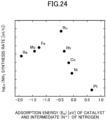
- FIG. 16 illustrates an example of the activity map in which 30 kinds of second screened candidate substances illustrated in Table 1 are plotted.
- the alloys of IrSc, FePd 3 , MnTc 3 , IrY, CrPd 3 , MnPd 3 , RhY, Co 3 Pt, CrPt 3 , FeRh 3 , CrRh 3 , Ni 3 Ti, Ir 3 V, Pt 3 Ti, Co 3 Rh, Pd 3 Ti, Ni 3 Zr, Co 3 W, NiPd 3 , FeNi 3 , Ir 3 Mn, IrMn, MnPt, MnNi 3 , Ir 3 Re, MnRh, Pd 3 V, MnPt 3 , Rh 3 V, and Rh 3 Ti are plotted as the 30 kinds of second screened candidate substances.
- the number of the second screened candidate substances to be selected can be appropriately selected according to the number of the first screened candidate substances or the like as described above, and may be several kinds or several tens of kinds, for example.
- the filtering unit 21 may narrow down the second screened candidate substances obtained in the second screening process (step S19), based on the catalyst stability or the catalyst cost (filtering process: step S20).
- the second screened candidate substances are narrowed down to 30 kinds to 50 kinds, for example.
- the number of second screened candidate substances to be narrowed down to can be appropriately selected according to the number of second screened candidate substances to be selected or the like, and may be several kinds to several tens of kinds, for example.
- step S21 the second screened candidate substances selected by the second screening unit 19 or the second screened candidate substances narrowed down to by the filtering unit 21 are displayed or the like and output by the output unit 22 (output process: step S21).
- the method for selecting the catalyst enables the selection of the NH 3 synthesis catalyst having a good NH 3 production efficiency.
- the alloys of IrSc, FePd 3 , MnTc 3 , IrY, CrPd 3 , MnPd 3 , RhY, Co 3 Pt, CrPt 3 , FeRh 3 , CrRh 3 , Ni 3 Ti, Ir 3 V, Pt 3 Ti, Co 3 Rh, Pd 3 Ti, Ni 3 Zr, Co 3 W, NiPd 3 , FeNi 3 , Ir 3 Mn, IrMn, MnPt, MnNi 3 , Ir 3 Re, MnRh, Pd 3 V, MnPt 3 , Rh 3 V, and Rh 3 Ti are selected as the 30 kinds of NH 3 synthesis catalysts.
- the catalyst selected by the method for selecting the catalyst is a NH 3 synthesis catalyst having a high NH 3 synthesis rate and a good NH 3 production efficiency can be determined, for example, by comparing the energy of the catalyst selected by the method for selecting the catalyst with the energy of the catalyst selected by the conventional quantum chemistry calculation that is generally used, and verifying the deviation therefrom.
- FIG. 17 is a diagram illustrating a correlation between the energy of the intermediate or the transition state of the standard catalyst calculated by the DFT calculation and the energy of the intermediate or the transition state of the standard catalyst, which is the same as the standard catalyst on the abscissa, calculated by the method for selecting the catalyst, which appear in the elementary reactions related to the NH 3 synthesis in the standard catalysts required when creating the activity map.
- the DFT calculation is a technique of the conventional quantum chemistry calculation that is generally used.
- the standard catalyst required when creating the activity map is an elemental metal, such as Co, Rh, Ru, Cu, Fe, Re, Pt, or the like, or the like, or the like. As illustrated in FIG.
- the machine learning potential 30 can reproduce substantially the same result as the calculation result obtained by the DFT calculation. Hence, it may be regarded that the energies of the intermediate and the transition state of various catalysts can be predicted with high accuracy, by using the method for selecting the catalyst.
- FIG. 18 also illustrates the activity map of the catalyst created using the method for selecting the catalyst.
- the activity maps of the catalyst illustrated in (a) and (b) of FIG. 18 were created at a temperature of 400°C and a pressure of 100 bar during the calculation.
- the activity map of the catalyst selected using the method for selecting the catalyst shows substantially the same tendency as the activity map of the catalyst created using the DFT calculation (refer to (a) of FIG. 18 ).
- the energy calculated by the machine learning potential 30 can be used to create and reproduce an activity map that is substantially similar to the activity map created using the energy calculated by the DFT calculation.
- the 30 kinds of alloys described above which are selected by the method for selecting the catalyst as the NH 3 synthesis catalysts having the good NH 3 production efficiency, may be plotted on the activity map of the catalyst created using the method for selecting the catalyst, as illustrated in FIG. 19 , and thus, it may be determined that the NH 3 synthesis catalysts have a high NH 3 synthesis rate and a good NH 3 production efficiency.
- pure metals plotted on the activity map illustrated in FIG. 19 are generally used catalysts, and it may be determined that the 30 kinds of alloys described above can exhibit a high NH 3 synthesis rate and a high NH 3 production efficiency compared to the pure metals generally used as catalysts.
- the activity map illustrated in FIG. 19 was created at the temperature of 400°C and the pressure of 100 bar during the calculation, similar to FIG. 18 .
- the catalyst selected by the method for selecting catalyst is a NH 3 synthesis catalyst having a good NH 3 production efficiency.
- the method for selecting the catalyst may not include or omit the first calculation process (step S14), the first plotting process (step S15), and the first screening process (step S16), or the second calculation process (step S17), the second plotting process (step S18), and the second screening process (step S19), according to the number of candidate substances prepared in the preparation process (step S13). That is, in the method for selecting the catalyst, the candidate substances may be narrowed down by omitting the calculation in the state where all of the candidate substances are fixed, or omitting the calculation in the state where the surface of the candidate substance is relaxed.
- the first calculation process calculates the first energy of the plurality of candidate substances prepared by the preparation process (step S13), and the first screening process (step S16) narrows down the first screened candidate substances from the candidate substances plotted on the first plot map created by the first plotting process (step S15).
- the second calculation process calculates the second energy of the selected first screened candidate substances, and the second screening process (step S16) selects the second screened candidate substances from the first screened candidate substances plotted on the second plot map created by the second plotting process (step S18).
- the descriptors related to the catalytic reactions using the candidate substances are calculated in a short time, although with a low accuracy, in the state where all of candidate substances are fixed, the calculated descriptors are plotted on the activity map, and the first screened candidate substances are narrowed down from the plotted candidate substances.
- the descriptors related to the catalytic reactions using the narrowed down first screened candidate substances are recalculated with a high accuracy in the state where the surface of the first screened candidate substances is relaxed.
- the method for selecting the catalyst narrows down the first screened candidate substances further based on the calculated more accurate descriptors of the first screened candidate substances, and selects the second screened candidate substances.
- the method for selecting the catalyst can select an effective catalyst from candidate substances quickly and with a high accuracy, and can thus efficiently select the NH 3 synthesis catalyst to be used for the catalytic reaction for synthesizing the target product (NH 3 ) from the raw materials (H 2 , N 2 ).
- a method for producing the NH 3 synthesis catalyst according to the present embodiment is not particularly limited, and can be appropriately selected according to the types of components included in the NH 3 synthesis catalyst.
- An example of the method for producing the NH 3 synthesis catalyst is illustrated in FIG. 20 .
- the method for producing the NH 3 synthesis catalyst may include a selection process (step S31) for selecting the catalyst, and a preparation process (step S32) for preparing the catalyst.
- the catalyst is selected by the method for selecting the catalyst described above.
- the catalyst selected by the selection process (step S31) is prepared.
- the method for preparing the catalyst is not particularly limited, and a general preparation method may be used depending on the type of the selected catalyst.
- the selected catalysts can be prepared by searching and referring to documents disclosed in databases or the like which are open to the public, such as the inorganic materials database "AtomWork (atom work)", the substances and materials database “AtomWork Adv (atom work advanced)", or the like provided by the National Institute for Materials Science (NIMS), for example.
- NIMS National Institute for Materials Science
- the method for producing the NH 3 synthesis catalyst can prepare the catalyst selected by the method for selecting catalyst described above, and can thus appropriately produce the NH 3 synthesis catalyst capable of efficiently synthesizing the NH 3 .
- the NH 3 synthesis method according to the present embodiment synthesizes the NH 3 by causing a gas including hydrogen and nitrogen to come into contact with the NH 3 synthesis catalyst according to the present embodiment described above.
- the NH 3 synthesis method according to the present embodiment is not particularly limited as long as the NH 3 synthesis catalyst according to the present embodiment is used as the catalyst, and may use a general method for synthesizing the NH 3 using a catalyst, for example.
- the reaction for synthesizing ammonia from hydrogen and nitrogen theoretically, 2 mol of ammonia is obtained by reacting 1 mol of nitrogen with 3 mol of hydrogen (N 2 + 3H 2 ⁇ 2NH 3 ).
- a gas having a molar ratio of hydrogen and nitrogen (H 2 /N 2 ) of 0.5/1 to 3/1 is preferably used as the gas including hydrogen and nitrogen.
- the gas including hydrogen and nitrogen may further include an inert gas, such as argon or the like, as a carrier gas other than hydrogen gas and nitrogen gas, but from a viewpoint of increasing the amount of NH 3 produced, the gas including hydrogen and nitrogen is preferably composed solely of the hydrogen gas and the nitrogen gas.
- the method for causing the gas including hydrogen and nitrogen to come into contact with the NH 3 synthesis catalyst according to the present embodiment is not particularly limited, and a general method capable of causing a gas to come into contact with the catalyst can be appropriately employed.
- the method for causing the gas including hydrogen and nitrogen to come into contact with the NH 3 synthesis catalyst may be appropriately selected from a method which fills the NH 3 synthesis catalyst in a sealable reaction chamber and thereafter replaces an atmosphere gas inside the reaction chamber with the gas including hydrogen and nitrogen so as to cause the gas including hydrogen and nitrogen to come into contact with the NH 3 synthesis catalyst, a method which disposes the NH 3 synthesis catalyst inside a gas distribution pipe and flows the gas including hydrogen and nitrogen through the gas distribution pipe so as to cause the gas including hydrogen and nitrogen to come into contact with the NH 3 synthesis catalyst, or the like, for example.
- the temperature may be set to 300°C to 500°C because the higher the reaction temperature, the lower the equilibrium concentration becomes.
- the pressure condition for the reaction is not particularly limited, and may be 0.1 MPa to 10 MPa from a viewpoint of further reducing the energy required to synthesize the NH 3 .
- the NH 3 synthesis catalyst according to the present embodiment provides an excellent NH 3 synthesis, and thus, it is possible to more efficiently synthesize the NH 3 .
- the NH 3 synthesis rate was determined by preparing the catalyst, and performing calculations corresponding to catalytic reactions when synthesizing the NH 3 from nitrogen gas and hydrogen gas by the catalytic reactions.
- the catalyst is actually prepared, and a synthesis yield of the NH 3 produced from the nitrogen and hydrogen by the catalytic reaction of the prepared catalyst is measured, so as to calculate the NH 3 synthesis rate.
- a NH 3 synthesis rate that is substantially the same as the NH 3 synthesis rate of the NH 3 actually synthesized using the prepared catalyst.
- MATLANTIS registered trademark
- NNP neural network potential
- the candidate catalyst and the reference catalyst used as the catalysts, and the temperature and the pressure during the calculation are as follows.
- the catalyst When the catalyst is an alloy composed of a plurality of elements, the catalyst needs to be alloyed without aggregation or separation of respective metals in a desired composition. Whether or not alloying occurs when a plurality of elements are mixed can be evaluated by a stability of the catalyst structure. For this reason, the preparation of the catalyst in an experiment substantially corresponds to the stability of the structure of the catalyst (alloy). Accordingly, the stability of the structure of the catalyst, corresponding to the preparation of the catalyst, was calculated by a cluster model.
- the composition was varied on the cluster model, catalysts (alloys) having 2310 kinds of patterns of structures were created, and a stable structure of the catalyst was searched using a genetic algorithm. By calculating the stability of the catalyst having a candidate composition by the search, it was confirmed that the catalyst having the candidate composition is stabilized (alloyed) without aggregation or separation.
- a cluster structure composed of two kinds of elements (elements 1 and 2) and 55 atoms was prepared, and the position of the element that is most stable in each alloy composition was searched using the genetic algorithm.
- Each cluster structure was optimized every time a new structure is generated.
- the stability of the cluster structure composed of the elements 1 and 2 was evaluated from an excess energy E exc .
- the excess energy E exc was obtained from the following formula (11).
- the excess energy E exc indicates how stable the alloy cluster structure is compared to when the elements 1 and 2 are not mixed.
- E exc E cluster ⁇ n Metal 1 ⁇ E Metal 1 ⁇ n Metal 2 ⁇ E Metal 2 / 55 (In the formula, E cluster denotes an energy of the alloyed cluster, n Metal1 denotes an atomic number of the element 1 in the cluster, E Metal1 denotes an energy of the cluster structure when the cluster is composed of a single atom 1, n Metal2 denotes an atomic number of the element 2 in the cluster, and E Metal2 denotes an energy of the cluster structure when the cluster is composed of a single atom 2.)
- the catalyst is a CrRh alloy
- a composition ratio of Cr to Rh is 1:3, that is, a number of elements of Cr is 13 and a number of elements of Rh is 42
- the excess energy E exc of the most stable structure becomes a negative value as illustrated in FIG. 21 , and it was confirmed that the CrRh alloy becomes stabilized (alloyed).
- a diameter of the CrRh alloy was approximately 1.09 nm.
- the catalyst is a IrMn alloy
- a composition ratio of Ir to Mn 1:1, that is, a number of elements of Ir is 27 and a number of elements of Mn is 28, the excess energy E exc of the most stable structure assumes a negative value as illustrated in FIG. 22 , and it was confirmed that the IrMn alloy becomes stabilized (alloyed).
- a diameters of the IrMn alloy was approximately 1.03 nm.
- the catalytic reactions correspond approximately to the results of reaction rate simulations (microkinetics) obtained from all of the elementary reactions related to the NH 3 synthesis of the catalyst.
- microkinetics was performed to calculate the NH 3 synthesis rate of the catalyst.
- the microkinetics includes enumeration of the elementary reactions, calculation of the energy of the elementary reactions, and calculation of the reaction rate.
- the calculation of the energy of all of the elementary reactions related to the NH 3 synthesis of the catalyst was performed in the following manner: First, the structures of the molecules (N 2 , H 2 , NH 3 ) in the vapor phase were optimized in a vacuum. A bulk structure of the alloy was obtained from a known database ( Mamun, O. et al., Sci Data 6, 76 (2019 )), and the structure was optimized while maintaining the crystalline structure of the alloy. A specific surface ((0001) plane, (111) plane, or (101) plane) of the alloy was cut out from the obtained bulk structure, and a slab structure composed of five layers was obtained. Three lower layers among the five layers were fixed, and the two upper layers were relaxed to optimize the structure of the slab structure.
- the intermediate structure included in the elementary reactions disposed an adsorbed molecule on the slab structure, and a stable structure was searched by the minima hopping method.
- the transition state structure was searched by the NEB method after preparing initial and final state structures of the elementary reactions.
- Each structural optimization was performed so that fmax ⁇ 0.01 [eV/ ⁇ ].
- fmax is a convergence condition used for the structure optimization. When a force applied to each atom became fmax or less, it was regarded that a sufficiently stable structure is obtained, and the structure optimization was terminated.
- E reference E slab + ads ⁇ E slab ⁇ xE N + yE H
- E slab+ads denotes an energy of the structure in which the molecules are adsorbed on the surface
- E slab denotes an energy of the slab structure
- E N denotes an energy of the element with reference to N 2 gas
- E H denotes an energy of the element with reference to H 2 gas
- x denotes a number of N of the adsorbed molecules
- y denotes a number of H of the adsorbed molecules.
- Enthalpies and entropies of gas-phase molecules were calculated by ideal gas approximation, and enthalpies and entropies of the intermediate and transition state structures were calculated by harmonic approximation.
- Reaction rate constants of the elementary reactions were calculated by the transition state theory based on vibration calculation results, and the NH 3 synthesis rate was obtained by solving simultaneous ordinary differential equations.
- FIG. 23 illustrates a relationship between an adsorption energy (E N ) of an intermediate (N*) of nitrogen on the catalyst in a candidate catalyst and a reference catalyst, and a calculation result of a synthesis rate of NH 3 using the candidate catalyst and the reference catalyst.
- FIG. 24 illustrates an experimental result of the adsorption energy (E N ) of the intermediate (N*) of nitrogen on the catalyst, and the synthesis rate of NH 3 , for the reference catalyst.
- FIG. 24 is based on Andrew J.
- the NH 3 synthesis rates of the reference catalysts were high in the order of Ru, Re, and Pt, and the NH 3 synthesis rates when using the reference catalysts demonstrated an equivalent relationship between the experimental results and the calculation results.
- the NH 3 synthesis rate was highest for Pd 3 V among Pd 3 V, CrRh 3 , Co 3 Rh, IrMn, and IrSc, and the synthesis rate was high in the order of Pd 3 V, CrRh 3 , Co 3 Rh, IrMn, and IrSc.
- the NH 3 synthesis rate when actually using the candidate catalysts is also the highest for Pd 3 V among Pd 3 V, CrRh 3 , Co 3 Rh, IrMn, and IrSc, and the synthesis rate is high in the order of Pd 3 V, CrRh 3 , Co 3 Rh, IrMn, and IrSc.
- the catalysts selected by the method for selecting the catalyst described above include other 25 kinds of catalysts (FePd 3 , MnTc 3 , IrY, CrPd 3 , MnPd 3 , RhY, Co 3 Pt, CrPt 3 , FeRh 3 , Ni 3 Ti, Ir 3 V, Pt 3 Ti, Pd 3 Ti, Ni 3 Zr, Co 3 W, NiPd 3 , FeNi 3 , Ir 3 Mn, MnPt, MnNi 3 , Ir 3 Re, MnRh, MnPt 3 , Rh 3 V, and Rh 3 Ti.
- the 25 kinds of catalysts were selected by the method for selecting the catalyst described above, similar to the 5 kinds of catalysts (Pd 3 V, CrRh 3 , Co 3 Rh, IrMn, and IrSc) calculated as the candidate catalysts. Hence, it may be regarded that the NH 3 synthesis rate is also increased by the 25 kinds of catalysts, similar to the 5 kinds of catalysts described above.
- all of the candidate catalysts have a NH 3 synthesis rate higher than or equal to that of any of the reference catalysts.
- the catalysts selected by the method for selecting the catalyst described above can be used as NH 3 synthesis catalysts capable of efficiently producing the NH 3 .
Landscapes
- Chemical & Material Sciences (AREA)
- Organic Chemistry (AREA)
- Chemical Kinetics & Catalysis (AREA)
- Engineering & Computer Science (AREA)
- Materials Engineering (AREA)
- Analytical Chemistry (AREA)
- Inorganic Chemistry (AREA)
- Catalysts (AREA)
- Organic Low-Molecular-Weight Compounds And Preparation Thereof (AREA)
Applications Claiming Priority (2)
| Application Number | Priority Date | Filing Date | Title |
|---|---|---|---|
| JP2022107476 | 2022-07-04 | ||
| PCT/JP2023/024491 WO2024009918A1 (ja) | 2022-07-04 | 2023-06-30 | アンモニア合成触媒及びアンモニアの合成方法 |
Publications (1)
| Publication Number | Publication Date |
|---|---|
| EP4552737A1 true EP4552737A1 (en) | 2025-05-14 |
Family
ID=89453473
Family Applications (1)
| Application Number | Title | Priority Date | Filing Date |
|---|---|---|---|
| EP23835450.0A Pending EP4552737A1 (en) | 2022-07-04 | 2023-06-30 | Ammonia synthesis catalyst and ammonia synthesis method |
Country Status (3)
| Country | Link |
|---|---|
| EP (1) | EP4552737A1 (https=) |
| JP (1) | JPWO2024009918A1 (https=) |
| WO (1) | WO2024009918A1 (https=) |
Families Citing this family (1)
| Publication number | Priority date | Publication date | Assignee | Title |
|---|---|---|---|---|
| WO2025239144A1 (ja) * | 2024-05-16 | 2025-11-20 | Eneosホールディングス株式会社 | 触媒反応のエネルギー予測装置、触媒反応の反応速度予測装置、触媒反応のエネルギー予測方法、触媒反応の反応速度予測方法、触媒反応のエネルギー予測プログラム及び触媒反応の反応速度予測プログラム |
Family Cites Families (7)
| Publication number | Priority date | Publication date | Assignee | Title |
|---|---|---|---|---|
| JPS4914632B1 (https=) * | 1970-11-25 | 1974-04-09 | ||
| DK173814B1 (da) * | 1999-03-15 | 2001-11-12 | Topsoe Haldor As | Fremgangsmåde til fremstilling af ammoniak og katalysator til syntese af ammoniak |
| JP2014151290A (ja) * | 2013-02-12 | 2014-08-25 | Denso Corp | アンモニア製造用触媒 |
| JP2016155123A (ja) | 2015-02-20 | 2016-09-01 | 国立大学法人 大分大学 | アンモニア合成触媒とその製造方法 |
| WO2018221699A1 (ja) * | 2017-05-31 | 2018-12-06 | 古河電気工業株式会社 | アンモニア合成触媒構造体及びその製造方法、アンモニア合成装置並びにアンモニアの合成方法 |
| MA50083A (fr) * | 2017-09-08 | 2021-04-07 | Haskoli Islands | Production électrolytique d'ammoniac à l'aide de catalyseurs à base d'oxyde de métal de transition |
| JP7549951B2 (ja) | 2021-01-08 | 2024-09-12 | 日本信号株式会社 | 入力装置 |
-
2023
- 2023-06-30 JP JP2024532102A patent/JPWO2024009918A1/ja active Pending
- 2023-06-30 WO PCT/JP2023/024491 patent/WO2024009918A1/ja not_active Ceased
- 2023-06-30 EP EP23835450.0A patent/EP4552737A1/en active Pending
Also Published As
| Publication number | Publication date |
|---|---|
| JPWO2024009918A1 (https=) | 2024-01-11 |
| WO2024009918A1 (ja) | 2024-01-11 |
Similar Documents
| Publication | Publication Date | Title |
|---|---|---|
| Han et al. | Single-atom alloy catalysts designed by first-principles calculations and artificial intelligence | |
| Gokhale et al. | Molecular-level descriptions of surface chemistry in kinetic models using density functional theory | |
| Chen et al. | Square-pyramidal subsurface oxygen [Ag4OAg] drives selective ethene epoxidation on silver | |
| Sumiya et al. | Rate constant matrix contraction method for systematic analysis of reaction path networks | |
| US20250388480A1 (en) | Method for selecting catalyst, catalyst, and method for producing catalyst | |
| Shu et al. | Structure sensitivity of metal catalysts revealed by interpretable machine learning and first-principles calculations | |
| Dance | Evaluations of the accuracies of DMol3 density functionals for calculations of experimental binding enthalpies of N2, CO, H2, C2H2 at catalytic metal sites | |
| Ishikawa | Heterogeneous catalyst design by generative adversarial network and first-principles based microkinetics | |
| EP4552737A1 (en) | Ammonia synthesis catalyst and ammonia synthesis method | |
| Wang et al. | Structural and electrocatalytic properties of copper clusters: A study via deep learning and first principles | |
| Zhang et al. | Establishing an orbital-level understanding of active origins of heteroatom-coordinated single-atom catalysts: The case of N2 reduction | |
| Lee et al. | An IR matrix isolation and DFT theoretical study of the first steps of the Ti (0) ethylene reaction: vinyl titanium hydride and titanacyclopropene | |
| Knurr et al. | Structures of [CoO (CO2) n]− and [NiO (CO2) n]− clusters studied by infrared spectroscopy | |
| Rodríguez-Kessler et al. | Structures and stabilities Ru-doped Agn (n= 1–13) clusters: Ag10Ru a 18-ve cluster superatom | |
| Farmanzadeh et al. | H2 adsorption on free and graphene-supported Ni nanoclusters: a theoretical study | |
| Wang et al. | Neon Matrix Infrared Spectra and DFT Calculations of Tungsten Hydrides WH x (x= 1− 4, 6) | |
| González-Lafont et al. | Variational transition state theory and tunneling calculations with reorientation of the generalized transition states for methyl cation transfer | |
| Yin et al. | SurFF: a foundation model for surface exposure and morphology across intermetallic crystals | |
| Setiawan et al. | Expanding the reaction network of ethylene epoxidation on partially oxidized silver catalysts | |
| Anderson et al. | Reducing the time-step errors in diffusion Monte Carlo | |
| Kim et al. | Thermochemical studies of reactions of Re+ with SO 2 using guided ion beam experiments and theory | |
| Du et al. | Spectroscopic identification of the dinitrogen fixation and activation by metal carbide cluster anions PtC n–(n= 4–6) | |
| Brüx et al. | Benchmarking crystal structure refinement: A systematic study on Hirshfeld atom refinement | |
| Salem et al. | Single atom alloys segregation in the presence of ligands | |
| Mou et al. | Unveiling universal reactivity descriptors of metal clusters toward dinitrogen activation: a machine learning protocol with three-level feature extraction |
Legal Events
| Date | Code | Title | Description |
|---|---|---|---|
| STAA | Information on the status of an ep patent application or granted ep patent |
Free format text: STATUS: THE INTERNATIONAL PUBLICATION HAS BEEN MADE |
|
| PUAI | Public reference made under article 153(3) epc to a published international application that has entered the european phase |
Free format text: ORIGINAL CODE: 0009012 |
|
| STAA | Information on the status of an ep patent application or granted ep patent |
Free format text: STATUS: REQUEST FOR EXAMINATION WAS MADE |
|
| 17P | Request for examination filed |
Effective date: 20250120 |
|
| AK | Designated contracting states |
Kind code of ref document: A1 Designated state(s): AL AT BE BG CH CY CZ DE DK EE ES FI FR GB GR HR HU IE IS IT LI LT LU LV MC ME MK MT NL NO PL PT RO RS SE SI SK SM TR |
|
| DAV | Request for validation of the european patent (deleted) | ||
| DAX | Request for extension of the european patent (deleted) | ||
| RAP1 | Party data changed (applicant data changed or rights of an application transferred) |
Owner name: ENEOS HOLDINGS, INC. |