EP4550506A2 - Deformable halide ionic conductors for use as anolytes, catholytes or solid electrolytes in solid state batteries - Google Patents
Deformable halide ionic conductors for use as anolytes, catholytes or solid electrolytes in solid state batteries Download PDFInfo
- Publication number
- EP4550506A2 EP4550506A2 EP24207749.3A EP24207749A EP4550506A2 EP 4550506 A2 EP4550506 A2 EP 4550506A2 EP 24207749 A EP24207749 A EP 24207749A EP 4550506 A2 EP4550506 A2 EP 4550506A2
- Authority
- EP
- European Patent Office
- Prior art keywords
- nali
- deformable
- agcl
- halide
- csli
- Prior art date
- Legal status (The legal status is an assumption and is not a legal conclusion. Google has not performed a legal analysis and makes no representation as to the accuracy of the status listed.)
- Pending
Links
Images


Classifications
-
- H—ELECTRICITY
- H01—ELECTRIC ELEMENTS
- H01M—PROCESSES OR MEANS, e.g. BATTERIES, FOR THE DIRECT CONVERSION OF CHEMICAL ENERGY INTO ELECTRICAL ENERGY
- H01M10/00—Secondary cells; Manufacture thereof
- H01M10/05—Accumulators with non-aqueous electrolyte
- H01M10/056—Accumulators with non-aqueous electrolyte characterised by the materials used as electrolytes, e.g. mixed inorganic/organic electrolytes
- H01M10/0561—Accumulators with non-aqueous electrolyte characterised by the materials used as electrolytes, e.g. mixed inorganic/organic electrolytes the electrolyte being constituted of inorganic materials only
- H01M10/0562—Solid materials
-
- H—ELECTRICITY
- H01—ELECTRIC ELEMENTS
- H01M—PROCESSES OR MEANS, e.g. BATTERIES, FOR THE DIRECT CONVERSION OF CHEMICAL ENERGY INTO ELECTRICAL ENERGY
- H01M10/00—Secondary cells; Manufacture thereof
- H01M10/42—Methods or arrangements for servicing or maintenance of secondary cells or secondary half-cells
- H01M10/4235—Safety or regulating additives or arrangements in electrodes, separators or electrolyte
-
- H—ELECTRICITY
- H01—ELECTRIC ELEMENTS
- H01M—PROCESSES OR MEANS, e.g. BATTERIES, FOR THE DIRECT CONVERSION OF CHEMICAL ENERGY INTO ELECTRICAL ENERGY
- H01M10/00—Secondary cells; Manufacture thereof
- H01M10/05—Accumulators with non-aqueous electrolyte
- H01M10/052—Li-accumulators
-
- H—ELECTRICITY
- H01—ELECTRIC ELEMENTS
- H01M—PROCESSES OR MEANS, e.g. BATTERIES, FOR THE DIRECT CONVERSION OF CHEMICAL ENERGY INTO ELECTRICAL ENERGY
- H01M10/00—Secondary cells; Manufacture thereof
- H01M10/05—Accumulators with non-aqueous electrolyte
- H01M10/058—Construction or manufacture
-
- H—ELECTRICITY
- H01—ELECTRIC ELEMENTS
- H01M—PROCESSES OR MEANS, e.g. BATTERIES, FOR THE DIRECT CONVERSION OF CHEMICAL ENERGY INTO ELECTRICAL ENERGY
- H01M4/00—Electrodes
- H01M4/02—Electrodes composed of, or comprising, active material
- H01M4/13—Electrodes for accumulators with non-aqueous electrolyte, e.g. for lithium-accumulators; Processes of manufacture thereof
- H01M4/131—Electrodes based on mixed oxides or hydroxides, or on mixtures of oxides or hydroxides, e.g. LiCoOx
-
- H—ELECTRICITY
- H01—ELECTRIC ELEMENTS
- H01M—PROCESSES OR MEANS, e.g. BATTERIES, FOR THE DIRECT CONVERSION OF CHEMICAL ENERGY INTO ELECTRICAL ENERGY
- H01M50/00—Constructional details or processes of manufacture of the non-active parts of electrochemical cells other than fuel cells, e.g. hybrid cells
- H01M50/40—Separators; Membranes; Diaphragms; Spacing elements inside cells
- H01M50/409—Separators, membranes or diaphragms characterised by the material
- H01M50/431—Inorganic material
-
- H—ELECTRICITY
- H01—ELECTRIC ELEMENTS
- H01M—PROCESSES OR MEANS, e.g. BATTERIES, FOR THE DIRECT CONVERSION OF CHEMICAL ENERGY INTO ELECTRICAL ENERGY
- H01M50/00—Constructional details or processes of manufacture of the non-active parts of electrochemical cells other than fuel cells, e.g. hybrid cells
- H01M50/40—Separators; Membranes; Diaphragms; Spacing elements inside cells
- H01M50/471—Spacing elements inside cells other than separators, membranes or diaphragms; Manufacturing processes thereof
- H01M50/48—Spacing elements inside cells other than separators, membranes or diaphragms; Manufacturing processes thereof characterised by the material
- H01M50/483—Inorganic material
-
- H—ELECTRICITY
- H01—ELECTRIC ELEMENTS
- H01M—PROCESSES OR MEANS, e.g. BATTERIES, FOR THE DIRECT CONVERSION OF CHEMICAL ENERGY INTO ELECTRICAL ENERGY
- H01M50/00—Constructional details or processes of manufacture of the non-active parts of electrochemical cells other than fuel cells, e.g. hybrid cells
- H01M50/40—Separators; Membranes; Diaphragms; Spacing elements inside cells
- H01M50/489—Separators, membranes, diaphragms or spacing elements inside the cells, characterised by their physical properties, e.g. swelling degree, hydrophilicity or shut down properties
- H01M50/497—Ionic conductivity
-
- H—ELECTRICITY
- H01—ELECTRIC ELEMENTS
- H01M—PROCESSES OR MEANS, e.g. BATTERIES, FOR THE DIRECT CONVERSION OF CHEMICAL ENERGY INTO ELECTRICAL ENERGY
- H01M4/00—Electrodes
- H01M4/02—Electrodes composed of, or comprising, active material
- H01M2004/026—Electrodes composed of, or comprising, active material characterised by the polarity
- H01M2004/027—Negative electrodes
-
- H—ELECTRICITY
- H01—ELECTRIC ELEMENTS
- H01M—PROCESSES OR MEANS, e.g. BATTERIES, FOR THE DIRECT CONVERSION OF CHEMICAL ENERGY INTO ELECTRICAL ENERGY
- H01M2300/00—Electrolytes
- H01M2300/0017—Non-aqueous electrolytes
- H01M2300/0065—Solid electrolytes
- H01M2300/0068—Solid electrolytes inorganic
-
- H—ELECTRICITY
- H01—ELECTRIC ELEMENTS
- H01M—PROCESSES OR MEANS, e.g. BATTERIES, FOR THE DIRECT CONVERSION OF CHEMICAL ENERGY INTO ELECTRICAL ENERGY
- H01M2300/00—Electrolytes
- H01M2300/0017—Non-aqueous electrolytes
- H01M2300/0065—Solid electrolytes
- H01M2300/0068—Solid electrolytes inorganic
- H01M2300/008—Halides
-
- Y—GENERAL TAGGING OF NEW TECHNOLOGICAL DEVELOPMENTS; GENERAL TAGGING OF CROSS-SECTIONAL TECHNOLOGIES SPANNING OVER SEVERAL SECTIONS OF THE IPC; TECHNICAL SUBJECTS COVERED BY FORMER USPC CROSS-REFERENCE ART COLLECTIONS [XRACs] AND DIGESTS
- Y02—TECHNOLOGIES OR APPLICATIONS FOR MITIGATION OR ADAPTATION AGAINST CLIMATE CHANGE
- Y02E—REDUCTION OF GREENHOUSE GAS [GHG] EMISSIONS, RELATED TO ENERGY GENERATION, TRANSMISSION OR DISTRIBUTION
- Y02E60/00—Enabling technologies; Technologies with a potential or indirect contribution to GHG emissions mitigation
- Y02E60/10—Energy storage using batteries
Definitions
- Materials according to embodiments relate to ionic conductors for use as anolytes, catholytes or solid electrolytes in Li solid-state batteries.
- halide ionic conductors particularly chlorides
- They are ionically conductive and easily deformable like sulfides, but they do not suffer from the same poor oxidative stability of sulfides.
- the oxidation potential of chlorides and fluorides is generally much higher (comparable to oxides), leading to an excellent compatibility with 4V-class cathodes.
- Interface stability calculations show that some of the new compounds mentioned above are also chemically stable against commonly used oxide SEs, i.e. , Li 7 La 3 Zr 2 O 12 (LLZO), and cathodes, i.e. , Li 3 MnNiCoO 6 (NMC) and LiCoO 2 (LCO).
- LLZO Li 7 La 3 Zr 2 O 12
- NMC Li 3 MnNiCoO 6
- LCO LiCoO 2
- the materials in the present disclosure are newly designed compounds predicted to have favorable mechanical and (electro)chemical properties as well as high ionic conductivity.
- An embodiment of the present disclosure includes a deformable halide-based ionic conductor having one of the following formulas: NaLi 3 I 4 , NaLi 3 Br 4 , NaLi 3 Cl 4 , KLi 2 F 3 , Li 2 HfF 6 , Li 3 AgI 4 , Li 3 SiB 3 (ClF 3 ) 4 , Li 3 AgBr 4 , Li 2 ZnF 4 , wherein the Li 2 ZnF 4 has a trigonal crystal structure with space group R-3, Li 3 AgCl 4 , or Li 2 AgCl 3 .
- Another embodiment includes the aforementioned deformable halide-based ionic conductor, having one of the following formulas: NaLi 3 I 4 , NaLi 3 Br 4 , NaLi 3 Cl 4 , KLi 2 F 3 , Li 2 HfF 6 , Li 3 AgI 4 , Li 3 SiB 3 (ClF 3 ) 4 , Li 3 AgBr 4 , Li 3 AgCl 4 , or Li 2 AgCl 3 .
- Another embodiment includes a catholyte comprising a deformable halide-based ionic conductor having one of the following formulas: CsLi 2 Cl 3 , wherein the CsLi 2 Cl 3 has an orthorhombic crystal structure, KLi 2 F 3 , Li 2 HfF 6 , Li 3 SiB 3 (ClF 3 ) 4 , Li 3 AgBr 4 , Li 2 ZnF 4 , Li 3 AgCl 4 , or Li 2 AgCl 3 .
- Another embodiment includes the aforementioned catholyte, wherein the deformable halide-based ionic conductor has the formula CsLi 2 Cl 3 , wherein the CsLi 2 Cl 3 has an orthorhombic crystal structure.
- Another embodiment includes the aforementioned catholyte, wherein the deformable halide-based ionic conductor has the formula KLi 2 F 3 .
- Another embodiment includes the aforementioned catholyte, wherein the deformable halide-based ionic conductor has the formula Li 2 HfF 6 .
- Another embodiment includes the aforementioned catholyte, wherein the deformable halide-based ionic conductor has the formula Li 3 SiB 3 (ClF 3 ) 4 .
- Another embodiment includes the aforementioned catholyte, wherein the deformable halide-based ionic conductor has the formula Li 2 ZnF 4 .
- Another embodiment includes a solid electrolyte separator comprising a deformable halide-based ionic conductor having one of the following formulas: CsLi 2 Cl 3 , wherein the CsLi 2 Cl 3 has an orthorhombic crystal structure, NaLi 3 I 4 , NaLi 3 Br 4 , NaLi 3 Cl 4 , KLi 2 F 3 , Li 2 HfF 6 , Li 3 AgI 4 , Li 3 SiB 3 (ClF 3 ) 4 , Li 3 AgBr 4 , Li 2 ZnF 4 , Li 3 AgCl 4 , or Li 2 AgCl 3 .
- CsLi 2 Cl 3 wherein the CsLi 2 Cl 3 has an orthorhombic crystal structure, NaLi 3 I 4 , NaLi 3 Br 4 , NaLi 3 Cl 4 , KLi 2 F 3 , Li 2 HfF 6 , Li 3 AgI 4 , Li 3 SiB 3 (ClF 3 ) 4 , Li 3 AgB
- the deformable halide-based ionic conductor can be appropriately protected, e.g., by coating the electrode active materials
- Li 3 AgI 4 can be used as a solid electrolyte if appropriately protected, e.g., by coating the electrode active materials.
- Another embodiment includes the aforementioned solid electrolyte separator, comprising a solid electrolyte having the formula CsLi 2 Cl 3 , wherein the CsLi 2 Cl 3 has an orthorhombic crystal structure.
- Another embodiment includes a solid state battery comprising an anode, a cathode, and a solid electrolyte separator, wherein the solid state battery comprises any aforementioned catholyte or any aforementioned solid electrolyte separator.
- the expression, "at least one of a, b and c,” should be understood as including only a, only b, only c, both a and b, both a and c, both b and c, or all of a, b and c.
- LiX+LiX'+MX" ( ⁇ 40k) and LiX+LiX'+LiX"+MX"' (>265k) combinations were considered, where the anion species X and X' are chalcogenides (O 2- , S 2- , Se 2- , Te 2- ), halides (Cl - , F - , Br - , I - ) or pseudo-halides (BH 4 - , BF 4 - , AlH 4 - , AlF 4 - , OH - , SH - ), and M is Na, Mg, Al, K, Ca, Sc, Ti, Cu, Zn, Ga, Rb, Sr, Y, Zr, Nb, Mo, Pd, Ag, Cd, In, Sn, Cs, Ba, La, Ce, Nd, Hf, Ta, W, Pt, Au, Hg, T
- Structures for the selected compositions were generated by mapping onto ⁇ 1100 prototype crystal structures from the public database AFLOW [ Comp. Mat. Sci. 136, S1-S828 (2017 ), Comp. Mat. Sci. 161, S1-S1011 (2019 ), Comp. Mat. Sci. 199, 110450 (2021 )].
- the obtained compounds were then optimized by DFT relaxation and computationally characterized regarding thermodynamic and electrochemical stability, mechanical deformability (DFT computed hardness) and ionic conductivity (energy barriers for ionic migration estimated on the basis of the empirical Bond Valence Sum method). For some promising candidates, the conductivity was also calculated by ab initio Molecular Dynamics (AIMD).
- Embodiments of the deformable halide ionic conductors of the present disclosure can be made using a standard solid-state method for making halides (e.g., in an air free environment).
- precursor powders are combined in a certain ratio depending on the composition of the target material.
- precursors may consist of a lithium halide (e.g., lithium chloride) and at least one other metal halide precursor, such as a metal fluoride, metal bromide, metal iodide, or metal chloride (e.g., silver chloride).
- the precursor mixture may be mixed by a method such as ball milling or planetary milling to produce a homogeneous mixture. Mixing may be done with a suitable solvent such as ethanol, isopropanol, ethylene glycol, or acetone to assist with the uniform dispersion of the precursors.
- a suitable solvent such as ethanol, isopropanol, ethylene glycol, or acetone to assist with the uniform dispersion of the precursors.
- the precursor mixture may then be heat treated to an appropriate temperature for an appropriate period of time to produce a halide powder with the desired composition and crystal structure.
- the halide powder may be compressed using a hydraulic uniaxial press to form a densely packed pellet.
- Heat treatment may then be applied at an appropriate temperature for an appropriate period of time to produce a dense pellet which may be used as, e.g., a solid electrolyte separator in a solid-state lithium battery cell.
- An embodiment of the aforementioned solid electrolyte separator can be assembled together with a cathode active material layer and an anode active material layer to be used in an embodiment which is a solid state lithium battery comprising a cathode active material layer, an anode active material layer, and a solid electrolyte layer formed between the cathode active material layer and the anode active material layer, wherein the solid electrolyte layer comprises any of the aforementioned materials.
- Interface stability calculations show that some of the new compounds of the present disclosure are also chemically stable against commonly used oxide SEs, i.e., Li 7 La 3 Zr 2 O 12 (LLZO), and cathodes, i.e. , Li 3 MnNiCoO 6 (NMC) and LiCoO 2 (LCO).
- LLZO Li 7 La 3 Zr 2 O 12
- NMC Li 3 MnNiCoO 6
- LCO LiCoO 2
- Table 1 set forth below shows new deformable ionic conductors designed with the computational workflow described in the present disclosure.
- the screening criteria were E hull ⁇ 30 meV/atom (thermodynamic stability), hardness ⁇ 2.5 GPa, energy barrier for ionic migration ⁇ 0.5 eV, and absence from Materials Project database of compounds with either the same composition or the same structure (or both).
- Table 1 New deformable ionic conductors Formula Crystal system Space group symbol E hull (meV/atom) Reduction Voltage Oxidation Voltage Hardness (GPa) Ion-migration Energy barrier (eV) 0 CsLi 2 Cl 3 orthorhombic Cmcm 9 000 4.34 1.352 0.413 1 NaLi 3 I 4 orthorhombic Pmn2_1 13 0.05 2.55 0.537 0.314 2 NaLi 3 Br 4 orthorhombic Pmn2_1 16 0.05 3.25 0.876 0.273 3 NaLi 3 Cl 4 orthorhombic Pmn2_1 18 0.05 3.85 0.989 0.270 4 KLi 2 F 3 orthorhombic Pnma 20 0.45 5.85 1.497 0.411 5 Li 2 HfF 6 cubic Pa-3 0 1.06 6.00 1.600 0.199 6 Li 3 AgI 4 orthorhombic Pmn2_1 3 1.75 2.60 0.968 0.337 7 Li 3 SiB 3 (ClF 3 ) 4 cubic P-
- All of the newly designed compounds are halides, particularly chlorides and fluorides.
- oxi_volt 4.34V vs. Li/Li +
- FIG. 3 is a graph showing the ab initio Molecular Dynamics (AIMD) calculated ionic conductivity for CsLi 2 Cl 3 .
- AIMD ab initio Molecular Dynamics
- KLi 2 F 3 , Li 2 HfF 6 , Li 3 SiB 3 (ClF 3 ) 4 and Li 2 ZnF 4 are stable at high voltage (oxi_volt > 4.5V) and therefore usable as catholytes.
- KLi 2 F 3 is also stable down to 0.45V vs. Li/Li + and might therefore be kinetically stabilized as anolyte vs. Li metal anode.
- Tables 2-4 show the computed interface stability against oxides commonly used in SSBs, namely LLZO (SE), LCO and NMC (cathodes).
- predicted reaction energies are generally low or null for compounds with low valence metals, namely, Cs + , Na + , K + , and Ag + .
Landscapes
- Chemical & Material Sciences (AREA)
- Chemical Kinetics & Catalysis (AREA)
- Electrochemistry (AREA)
- General Chemical & Material Sciences (AREA)
- Engineering & Computer Science (AREA)
- Inorganic Chemistry (AREA)
- Manufacturing & Machinery (AREA)
- Physics & Mathematics (AREA)
- Condensed Matter Physics & Semiconductors (AREA)
- General Physics & Mathematics (AREA)
- Materials Engineering (AREA)
- Conductive Materials (AREA)
Abstract
Description
- Materials according to embodiments relate to ionic conductors for use as anolytes, catholytes or solid electrolytes in Li solid-state batteries.
- The field of battery research is in the midst of a paradigm shift from conventional liquid electrolyte systems to all-solid-state batteries (SSBs) with solid state electrolytes (SEs), owing to their high safety and potentially large volumetric energy density by enabling both the use of lithium metal anodes and the bipolar stacking of electrodes.
- This transition brings a significant change in the kinetics of interfacial electrochemistry governing the battery performance because of the rigid solid-solid interface between active materials and SE in SSBs. In a typical liquid electrolyte cell, the active material surface is completely covered by the fluidic electrolyte, whereas a solid electrolyte forms a point contact with the active material due to its intrinsically rigid nature, thereby inducing sluggish charge transfer and mass transport kinetics at the interface. Thus, to achieve SSBs, an important prerequisite is forming and maintaining a well-defined solid-solid interface with intimate contact between the SE and cathode/anode active materials during electrochemical cycling.
- Recently, halide ionic conductors, particularly chlorides, were raised as a promising class of solid electrolytes. They are ionically conductive and easily deformable like sulfides, but they do not suffer from the same poor oxidative stability of sulfides. The oxidation potential of chlorides and fluorides is generally much higher (comparable to oxides), leading to an excellent compatibility with 4V-class cathodes.
- However, there are problems with some embodiments, including the following:
- A core issue of SSBs is the mechanical, chemical, and electrochemical compatibility of SEs with electrodes. Non-conformal contact at the electrode-electrolyte interface has shown to limit the power density and induces dendrite formation.
- Current oxide SE systems that are considered promising candidates to be employed in SSBs (e.g., garnets) require additional engineering for intimate electrode-electrolyte contact, such as co-sintering, stack pressure, etc. However, these strategies seem inadequate to maintain physical integrity given the reversible volume change of electrodes upon electrochemical cycling.
- Sulfide SEs are highly conductive and easily deformable, but they suffer from limited oxidative stability, thus limiting the capacity of the SSB. While the electrochemical stability of sulfides might be extended by application of protective coatings against the cathode active material, new solid-solid coating/SE and coating/cathode interfaces are introduced, which might aggravate interface resistance and contact issues.
- Information disclosed in this Background section has already been known to the inventors before achieving the disclosure of the present application or is technical information acquired in the process of achieving the disclosure. Therefore, it may contain information that does not form the prior art that is already known to the public.
- An efficient Machine Learning (ML)-driven computational workflow for the design of new deformable SE materials has been devised as shown in the present disclosure.
- Compounds with ML predicted hardness ≤ 2.5GPa (that is the calculated hardness of Li3PS4, here used as a reference) were computationally characterized using density-functional theory (DFT) calculations to identify thermodynamically stable compounds and to confirm their mechanical properties. Potential ionic conductor candidates were then sorted out using migration energy barriers estimated based on the empirical Bond Valence Sum method and in some cases also ab initio Molecular Dynamics (AIMD).
- With the use of the computational screening described above, new deformable halide ionic conductors have been designed with good electrochemical stability against either Li metal or high voltage cathodes (or both), to be employed as anolytes or catholytes (or SEs), respectively.
- Interface stability calculations show that some of the new compounds mentioned above are also chemically stable against commonly used oxide SEs, i.e., Li7La3Zr2O12 (LLZO), and cathodes, i.e., Li3MnNiCoO6 (NMC) and LiCoO2 (LCO). The predicted chemical stability rules out side chemical reactions at the interface with such oxide phases, thus ensuring long cycle life of the SSB.
- The materials in the present disclosure are newly designed compounds predicted to have favorable mechanical and (electro)chemical properties as well as high ionic conductivity.
- An embodiment of the present disclosure includes a deformable halide-based ionic conductor having one of the following formulas:
NaLi3I4,
NaLi3Br4,
NaLi3Cl4,
KLi2F3,
Li2HfF6,
Li3AgI4,
Li3SiB3(ClF3)4,
Li3AgBr4,
Li2ZnF4,
wherein the Li2ZnF4 has a trigonal crystal structure with space group R-3,
Li3AgCl4, or
Li2AgCl3.
- Another embodiment includes the aforementioned deformable halide-based ionic conductor, having one of the following formulas:
NaLi3I4,
NaLi3Br4,
NaLi3Cl4,
KLi2F3,
Li2HfF6,
Li3AgI4,
Li3SiB3(ClF3)4,
Li3AgBr4,
Li3AgCl4, or
Li2AgCl3.
- Another embodiment includes a catholyte comprising a deformable halide-based ionic conductor having one of the following formulas:
CsLi2Cl3,
wherein the CsLi2Cl3 has an orthorhombic crystal structure,
KLi2F3,
Li2HfF6,
Li3SiB3(ClF3)4,
Li3AgBr4,
Li2ZnF4,
Li3AgCl4, or
Li2AgCl3.
- Another embodiment includes the aforementioned catholyte, wherein the deformable halide-based ionic conductor has the formula CsLi2Cl3, wherein the CsLi2Cl3 has an orthorhombic crystal structure.
- Another embodiment includes the aforementioned catholyte, wherein the deformable halide-based ionic conductor has the formula KLi2F3.
- Another embodiment includes the aforementioned catholyte, wherein the deformable halide-based ionic conductor has the formula Li2HfF6.
- Another embodiment includes the aforementioned catholyte, wherein the deformable halide-based ionic conductor has the formula Li3SiB3(ClF3)4.
- Another embodiment includes the aforementioned catholyte, wherein the deformable halide-based ionic conductor has the formula Li2ZnF4.
- Another embodiment includes a solid electrolyte separator comprising a deformable halide-based ionic conductor having one of the following formulas:
CsLi2Cl3,
wherein the CsLi2Cl3 has an orthorhombic crystal structure,
NaLi3I4,
NaLi3Br4,
NaLi3Cl4,
KLi2F3,
Li2HfF6,
Li3AgI4,
Li3SiB3(ClF3)4,
Li3AgBr4,
Li2ZnF4,
Li3AgCl4,
or
Li2AgCl3.
If needed, the deformable halide-based ionic conductor can be appropriately protected, e.g., by coating the electrode active materials For example, Li3AgI4 can be used as a solid electrolyte if appropriately protected, e.g., by coating the electrode active materials. - Another embodiment includes the aforementioned solid electrolyte separator, comprising a solid electrolyte having the formula CsLi2Cl3, wherein the CsLi2Cl3 has an orthorhombic crystal structure.
- Another embodiment includes a solid state battery comprising an anode, a cathode, and a solid electrolyte separator, wherein the solid state battery comprises any aforementioned catholyte or any aforementioned solid electrolyte separator.
- Example embodiments of the present disclosure will be more clearly understood from the following detailed description taken in conjunction with the accompanying drawings in which:
-
FIG. 1 is a graph showing the distribution of ML-predicted hardness for ~40,000 LiX+LiX'+MX" compositions. -
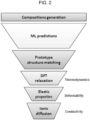
FIG. 2 is a diagram showing the computational workflow for new deformable materials design. -
FIG. 3 is a graph showing the ab initio Molecular Dynamics (AIMD) calculated ionic conductivity for CsLi2Cl3. - The embodiments of the disclosure described herein are example embodiments, and thus, the disclosure is not limited thereto, and may be realized in various other forms. Each of the embodiments provided in the following description is not excluded from being associated with one or more features of another example or another embodiment also provided herein or not provided herein but consistent with the disclosure. For example, even if matters described in a specific example or embodiment are not described in a different example or embodiment thereto, the matters may be understood as being related to or combined with the different example or embodiment, unless otherwise mentioned in descriptions thereof.
- As used herein, expressions such as "at least one of," when preceding a list of elements, modify the entire list of elements and do not modify the individual elements of the list. For example, the expression, "at least one of a, b and c," should be understood as including only a, only b, only c, both a and b, both a and c, both b and c, or all of a, b and c.
- An efficient Machine Learning (ML)-driven computational workflow for the design of new deformable SE materials has been devised as shown in the present disclosure.
- First, thousands of charge-balanced compositions by combinations of LiX and MX' binaries were generated. LiX+LiX'+MX" (~40k) and LiX+LiX'+LiX"+MX"' (>265k) combinations were considered, where the anion species X and X' are chalcogenides (O2-, S2-, Se2-, Te2-), halides (Cl-, F-, Br-, I-) or pseudo-halides (BH4 -, BF4 -, AlH4 -, AlF4 -, OH-, SH-), and M is Na, Mg, Al, K, Ca, Sc, Ti, Cu, Zn, Ga, Rb, Sr, Y, Zr, Nb, Mo, Pd, Ag, Cd, In, Sn, Cs, Ba, La, Ce, Nd, Hf, Ta, W, Pt, Au, Hg, Tl, Pb, Bi. In this regard,
FIG. 1 is a graph showing the distribution of ML-predicted hardness for ~40k LiX+LiX'+MX" compositions. - Then, the hardness of all generated compositions was predicted using a ML model trained exclusively on compositional features and selected compositions with predicted hardness <=2.5GPa, that is the hardness of Li3PS4, used as reference material for good deformability.
- Structures for the selected compositions were generated by mapping onto ~1100 prototype crystal structures from the public database AFLOW [Comp. Mat. Sci. 136, S1-S828 (2017), Comp. Mat. Sci. 161, S1-S1011 (2019), Comp. Mat. Sci. 199, 110450 (2021)]. The obtained compounds were then optimized by DFT relaxation and computationally characterized regarding thermodynamic and electrochemical stability, mechanical deformability (DFT computed hardness) and ionic conductivity (energy barriers for ionic migration estimated on the basis of the empirical Bond Valence Sum method). For some promising candidates, the conductivity was also calculated by ab initio Molecular Dynamics (AIMD).
- That is, compounds with ML predicted hardness <=2.5GPa (that is the hardness of Li3PS4, here used as a reference) were computationally characterized using DFT calculations to identify thermodynamically stable compounds and to confirm their mechanical properties. Potential ionic conductor candidates were then sorted out using the estimated migration energy barriers and in some cases also ab initio Molecular Dynamics (AIMD). The computational workflow for new deformable materials design is shown in
FIG. 2 . - Embodiments of the deformable halide ionic conductors of the present disclosure can be made using a standard solid-state method for making halides (e.g., in an air free environment). In this method, precursor powders are combined in a certain ratio depending on the composition of the target material. In a typical preparation, precursors may consist of a lithium halide (e.g., lithium chloride) and at least one other metal halide precursor, such as a metal fluoride, metal bromide, metal iodide, or metal chloride (e.g., silver chloride).
- The precursor mixture may be mixed by a method such as ball milling or planetary milling to produce a homogeneous mixture. Mixing may be done with a suitable solvent such as ethanol, isopropanol, ethylene glycol, or acetone to assist with the uniform dispersion of the precursors.
- The precursor mixture may then be heat treated to an appropriate temperature for an appropriate period of time to produce a halide powder with the desired composition and crystal structure.
- Subsequently the halide powder may be compressed using a hydraulic uniaxial press to form a densely packed pellet. Heat treatment may then be applied at an appropriate temperature for an appropriate period of time to produce a dense pellet which may be used as, e.g., a solid electrolyte separator in a solid-state lithium battery cell.
- An embodiment of the aforementioned solid electrolyte separator can be assembled together with a cathode active material layer and an anode active material layer to be used in an embodiment which is a solid state lithium battery comprising a cathode active material layer, an anode active material layer, and a solid electrolyte layer formed between the cathode active material layer and the anode active material layer, wherein the solid electrolyte layer comprises any of the aforementioned materials.
- Embodiments will now be illustrated by way of the following examples, which do not limit the embodiments in any way.
- With the use of the computational screening described above, new deformable halide ionic conductors have been designed with good electrochemical stability against either Li metal or high voltage cathodes (or both), to be employed as anolytes or catholytes (or SEs), respectively.
- Interface stability calculations show that some of the new compounds of the present disclosure are also chemically stable against commonly used oxide SEs, i.e., Li7La3Zr2O12 (LLZO), and cathodes, i.e., Li3MnNiCoO6 (NMC) and LiCoO2 (LCO). The predicted chemical stability rules out side chemical reactions at the interface with such oxide phases, thus ensuring long cycle life of the SSB.
- Table 1 set forth below shows new deformable ionic conductors designed with the computational workflow described in the present disclosure. The screening criteria were Ehull ≤ 30 meV/atom (thermodynamic stability), hardness ≤ 2.5 GPa, energy barrier for ionic migration ≤ 0.5 eV, and absence from Materials Project database of compounds with either the same composition or the same structure (or both).
Table 1: New deformable ionic conductors Formula Crystal system Space group symbol Ehull (meV/atom) Reduction Voltage Oxidation Voltage Hardness (GPa) Ion-migration Energy barrier (eV) 0 CsLi2Cl3 orthorhombic Cmcm 9 000 4.34 1.352 0.413 1 NaLi3I4 orthorhombic Pmn2_1 13 0.05 2.55 0.537 0.314 2 NaLi3Br4 orthorhombic Pmn2_1 16 0.05 3.25 0.876 0.273 3 NaLi3Cl4 orthorhombic Pmn2_1 18 0.05 3.85 0.989 0.270 4 KLi2F3 orthorhombic Pnma 20 0.45 5.85 1.497 0.411 5 Li2HfF6 cubic Pa-3 0 1.06 6.00 1.600 0.199 6 Li3AgI4 orthorhombic Pmn2_1 3 1.75 2.60 0.968 0.337 7 Li3SiB3(ClF3)4 cubic P-43n 19 2.10 4.95 1.574 0.305 8 Li3AgBr4 cubic P- 43m 3 2.25 3.30 0.913 0.260 9 Li2ZnF4 trigonal R-3 17 2.37 6.00 1.222 0.187 10 Li3AgCl4 cubic P-43m 0 2.60 3.80 0.875 0.242 11 Li3AgCl4 orthorhombic Pmn2_1 0 2.60 3.90 1.060 0.283 12 Li2AgCl3 orthorhombic Pnma 0 2.67 3.73 0.892 0.232 - The following observations can be made from the aforementioned new deformable ionic conductors designed with the computational workflow described in the present disclosure.
- All of the newly designed compounds are halides, particularly chlorides and fluorides.
- CsLi2Cl3, NaLi3I4, NaLi3Br4 and NaLi3Cl4 are electrochemically stable vs. Li metal (red_volt ≈ 0V) and therefore usable as anolytes.
- CsLi2Cl3 is also stable at high voltage (oxi_volt = 4.34V vs. Li/Li+), and can therefore be used also as a catholyte or solid electrolyte (SE) in a solid-state battery (SSB).
- In regard to CsLi2Cl3,
FIG. 3 is a graph showing the ab initio Molecular Dynamics (AIMD) calculated ionic conductivity for CsLi2Cl3. - KLi2F3, Li2HfF6, Li3SiB3(ClF3)4 and Li2ZnF4 are stable at high voltage (oxi_volt > 4.5V) and therefore usable as catholytes.
- KLi2F3 is also stable down to 0.45V vs. Li/Li+ and might therefore be kinetically stabilized as anolyte vs. Li metal anode.
- All compounds with low valence M cations are thermodynamically stable or have very low reaction energies (indicating low driving force for reaction) against oxides like LLZO, LCO and NMC (see Tables 2-4 below).
Table 2: Predicted interface reactions against Li7La3Zr2O12 (LLZO) Formula Reaction vs. LLZO Reaction energy (eV/atom) 0 CsLi2Cl3 - - 1 NaLi3I4 0.5 Li7La3Zr2O12 + 0.5 NaLi3I4 -> 0.5 Li6Zr2O7 + 0.5 Nal + Li2O + 1.5 LalO -0.015 2 NaLi3Br4 - - 3 NaLi3Cl4 - - 4 KLi2F3 - - 5 Li2HfF6 0.3333 Li7La3Zr2O12 + 0.6667 Li2HfF6 -> 0.3333 La2Hf2O7 + 0.3333 LaOF + 3.667 LiF + 0.6667 ZrO2 -0.165 6 Li3AgI4 0.5 Li7La3Zr2O12 + 0.5 Li3AgI4 -> 0.5 Li6Zr2O7 + 0.5 Agl + Li2O + 1.5 LaIO -0.012 7 Li3SiB3(ClF3)4 0.4717 Li7La3Zr2O12 + 0.5283 Li3SiB3(ClF3)4 -> 0.2264 Li3B7O12 + 2.094 LiF + 0.5283 ZrSiO4 + 2.113 LiCl + 0.4151 ZrO2 + 1.415 LaF3 -0.358 8 Li3AgBr4 - - 9 Li2ZnF4 0.1667 Li7La3Zr2O12 + 0.8333 Li2ZnF4 -> 0.5 LaOF + 0.8333 ZnO + 2.833 LiF + 0.3333 ZrO2 -0.162 10 Li3AgCl4 0.6667 Li3AgCl4 + 0.3333 Li7La3Zr2O12 -> 0.6667 LiAgO + 0.3333 Li6Zr2O7 + 1.667 LiCl + LaClO -0.017 11 Li3AgCl4 0.6667 Li3AgCl4 + 0.3333 Li7La3Zr2O12 -> 0.6667 LiAgO + 0.3333 Li6Zr2O7 + 1.667 LiCl + LaClO -0.017 12 Li2AgCl3 0.6667 Li2AgCl3 + 0.3333 Li7La3Zr2O12 -> 0.6667 LiAgO + 0.3333 Li6Zr2O7 + LiCl + LaClO -0.021 Table 3: Predicted interface reaction against Li3MnCoNiO6 (NMC) Formula Reaction vs. NMC Reaction energy (eV/atom) 0 CsLi2Cl3 - - 1 NaLi3I4 - - 2 NaLi3Br4 - - 3 NaLi3Cl4 - - 4 KLi2F3 - - 5 Li2HfF6 0.68 Li3MnCoNiO6 + 0.32 Li2HfF6 -> 0.1275 Li4MnCo5O12 + 0.0425 Mn2CoO4 + 0.125 Li2Mn3NiO8 + 0.0925 Mn(Ni3O4)2 + 1.92 LiF + 0.32 HfO2 -0.087 6 Li3AgI4 - - 7 Li3SiB3(ClF3)4 0.7152 Li3MnCoNiO6 + 0.2848 Li3SiB3(ClF3)4 -> 0.1904 Li2NiF4 + 0.0894 LiClO4 + 0.2384 Co3(BO3)2 + 0.5248 NiCl2 + 0.7152 MnO2 + 0.1258 Li2B3O4F3 + 2.278 LiF + 0.2848 SiOz -0.232 8 Li3AgBr4 - - 9 Li2ZnF4 0.4853 Li3MnCoNiO6 + 0.5147 Li2ZnF4 -> 0.1276 Li2Mn3NiO8 + 0.04282 Li4MnCo5O12 + 0.01427 Zn5Co19O32 + 0.4433 ZnO + 0.05961 Mn(Ni3O4)2 + 2.059 LiF -0.102 10 Li3AgCl4 - - 11 Li3AgCl4 - - 12 Li2AgCl3 - - Table 4: Predicted interface reactions against LiCoO2 (LCO) Formula Reaction vs. LCO Reaction energy (eV/atom) 0 CsLi2Cl3 - - 1 NaLi3I4 - - 2 NaLi3Br4 - - 3 NaLi3Cl4 - - 4 KLi2F3 - - 5 Li2HfF6 0.8333 LiCoO2 + 0.1667 Li2HfF6 -> 0.1667 Co3O4 + 0.1667 Li(CoO2)2 + LiF + 0.1667 HfO2 -0.027 6 Li3AgI4 - - 7 Li3SiB3(ClF3)4 0.8491 LiCoO2 + 0.1509 Li3SiB3(ClF3)4 -> 0.2264 Co3(BO3)2 + ; 0.1509 Li2SiF6 + 0.1698 ClOz + 0.1698 CoCl2 + 0.9057 LiF + ! 0.09434 LiCl ! -0.214 8 Li3AgBr4 - - 9 Li2ZnF4 0.3333 Li2ZnF4 + 0.6667 LiCoO2 -> 0.03509 Zn5Co19O32 + 0.1579 ZnO + 1.333 LiF + 0.02632 O2 -0.077 10 Li3AgCl4 - - 11 Li3AgCl4 - - 12 Li2AgCl3 - - - Thus, Tables 2-4 show the computed interface stability against oxides commonly used in SSBs, namely LLZO (SE), LCO and NMC (cathodes).
- As shown above, predicted reaction energies (e_rxn) are generally low or null for compounds with low valence metals, namely, Cs+, Na+, K+, and Ag+.
- The foregoing is illustrative of exemplary embodiments and is not to be construed as limiting the disclosure. Although a few exemplary embodiments have been described, those skilled in the art will readily appreciate that many modifications are possible in the above embodiments without materially departing from the disclosure.
Claims (12)
- A deformable halide-based ionic conductor having one of the following formulas:
NaLi3I4,
NaLi3Br4,
NaLi3Cl4,
KLi2F3,
Li2HfF6,
L13AgI4,
Li3SiB3(ClF3)4,
Li3AgBr4,
Li2ZnF4,
wherein the Li2ZnF4 has a trigonal crystal structure with space group R-3,
Li3AgCl4,
or
Li2AgCl3.
- The deformable halide-based ionic conductor according to claim 1, wherein the deformable halide-based ionic conductor has one of the following formulas:
NaLi3I4,
NaLi3Br4,
NaLi3Cl4,
KLi2F3,
Li2HfF6,
Li3AgI4,
Li3SiB3(ClF3)4,
Li3AgBr4,
Li3AgCl4, or
Li2AgCl3.
- A catholyte comprising a deformable halide-based ionic conductor having one of the following formulas:
CsLi2Cl3,
wherein the CsLi2Cl3 has an orthorhombic crystal structure,
KLi2F3,
Li2HfF6,
Li3SiB3(ClF3)4,
Li3AgBr4,
Li2ZnF4,
Li3AgCl4, or
Li2AgCl3.
- The catholyte according to claim 3, wherein the deformable halide-based ionic conductor has the formula CsLi2Cl3, wherein the CsLi2Cl3 has an orthorhombic crystal structure.
- The catholyte according to claim 3, wherein the deformable halide-based ionic conductor has the formula KLi2F3.
- The catholyte according to claim 3, wherein the deformable halide-based ionic conductor has the formula Li2HfF6.
- The catholyte according to claim 3, wherein the deformable halide-based ionic conductor has the formula Li3SiB3(ClF3)4.
- The catholyte according to claim 3, wherein the deformable halide-based ionic conductor has the formula Li2ZnF4.
- A solid electrolyte separator comprising a deformable halide-based ionic conductor having one of the following formulas:
CsLi2Cl3,
wherein the CsLi2Cl3 has an orthorhombic crystal structure,
NaLi3I4,
NaLi3Br4,
NaLi3Cl4,
KLi2F3,
Li2HfF6,
Li3AgI4,
Li3SiB3(ClF3)4,
Li3AgBr4,
Li2ZnF4,
Li3AgCl4, or
Li2AgCl3.
- The solid electrolyte separator according to claim 9, comprising a solid electrolyte having the formula CsLi2Cl3, wherein the CsLi2Cl3 has an orthorhombic crystal structure.
- A solid state battery comprising an anode, a cathode, and a solid electrolyte separator, wherein the solid state battery comprises a catholyte according to one of claims 3 to 8.
- A solid state battery comprising an anode, a cathode, and a solid electrolyte separator according to claim 9 or 10.
Applications Claiming Priority (2)
| Application Number | Priority Date | Filing Date | Title |
|---|---|---|---|
| US202363546793P | 2023-11-01 | 2023-11-01 | |
| US18/439,357 US20250140905A1 (en) | 2023-11-01 | 2024-02-12 | Deformable halide ionic conductors for use as anolytes, catholytes or solid electrolytes in solid state batteries |
Publications (2)
| Publication Number | Publication Date |
|---|---|
| EP4550506A2 true EP4550506A2 (en) | 2025-05-07 |
| EP4550506A3 EP4550506A3 (en) | 2025-07-23 |
Family
ID=93213742
Family Applications (1)
| Application Number | Title | Priority Date | Filing Date |
|---|---|---|---|
| EP24207749.3A Pending EP4550506A3 (en) | 2023-11-01 | 2024-10-21 | Deformable halide ionic conductors for use as anolytes, catholytes or solid electrolytes in solid state batteries |
Country Status (3)
| Country | Link |
|---|---|
| US (1) | US20250140905A1 (en) |
| EP (1) | EP4550506A3 (en) |
| KR (1) | KR20250063721A (en) |
Family Cites Families (2)
| Publication number | Priority date | Publication date | Assignee | Title |
|---|---|---|---|---|
| JP2008234988A (en) * | 2007-03-20 | 2008-10-02 | Sony Corp | Negative electrode and method for producing the same, battery and method for producing the same |
| CN113937352B (en) * | 2021-12-17 | 2022-04-22 | 北京理工大学深圳汽车研究院(电动车辆国家工程实验室深圳研究院) | Composite solid electrolyte, preparation method thereof and battery |
-
2024
- 2024-02-12 US US18/439,357 patent/US20250140905A1/en active Pending
- 2024-06-24 KR KR1020240081990A patent/KR20250063721A/en active Pending
- 2024-10-21 EP EP24207749.3A patent/EP4550506A3/en active Pending
Also Published As
| Publication number | Publication date |
|---|---|
| US20250140905A1 (en) | 2025-05-01 |
| EP4550506A3 (en) | 2025-07-23 |
| KR20250063721A (en) | 2025-05-08 |
Similar Documents
| Publication | Publication Date | Title |
|---|---|---|
| US11404718B2 (en) | Solid electrolyte material and battery | |
| Fan et al. | Recent progress of the solid‐state electrolytes for high‐energy metal‐based batteries | |
| US12095027B2 (en) | Solid electrolyte material and battery | |
| CN111566851B (en) | Cathode materials and batteries | |
| EP3745498B1 (en) | Negative electrode material and battery using same | |
| RU2295178C2 (en) | Solid-state secondary power supply | |
| EP3745422A1 (en) | Solid electrolyte material and battery | |
| EP3736829A1 (en) | Solid electrolyte material and battery | |
| EP3745519B1 (en) | Battery | |
| EP3736825A1 (en) | Solid electrolyte material and battery | |
| CN111279430B (en) | Solid electrolyte material and battery | |
| US20200212478A1 (en) | Solid electrolyte material and battery using same | |
| CN120149365A (en) | Cathode materials and batteries | |
| US10483586B2 (en) | All-solid-state battery using sodium ion intercalation cathode with Li/Na exchanging layer | |
| Jeong et al. | Advances of sulfide‐type solid‐state batteries with negative electrodes: Progress and perspectives | |
| EP2731190A2 (en) | Composition, energy storage device, and related processes | |
| CN115280574A (en) | Dual-electrolyte method for improving energy density of metal-based battery | |
| JP2016021392A (en) | High-performance all-solid-state lithium-sulfur battery with fast lithium ion conductivity | |
| CN116998025A (en) | Solid electrolyte materials including chalcogenide-based ion conductive structures, in particular sulfide-based ion conductive structures | |
| EP0050975B1 (en) | Electrochemical cell | |
| US20260121033A1 (en) | Niobium-based negative electrodes and high energy density rechargeable lithium-ion batteries with the same | |
| Khokhar et al. | Recent advancements in the interfacial stability of garnet solid electrolytes and design strategies for solid-state lithium batteries: a review | |
| US9748564B2 (en) | Electrode compositions and related energy storage devices | |
| EP4550506A2 (en) | Deformable halide ionic conductors for use as anolytes, catholytes or solid electrolytes in solid state batteries | |
| US20250140906A1 (en) | Deformable halide ionic conductors for use as anolytes, solid electrolytes or catholytes in solid state batteries |
Legal Events
| Date | Code | Title | Description |
|---|---|---|---|
| PUAI | Public reference made under article 153(3) epc to a published international application that has entered the european phase |
Free format text: ORIGINAL CODE: 0009012 |
|
| STAA | Information on the status of an ep patent application or granted ep patent |
Free format text: STATUS: THE APPLICATION HAS BEEN PUBLISHED |
|
| AK | Designated contracting states |
Kind code of ref document: A2 Designated state(s): AL AT BE BG CH CY CZ DE DK EE ES FI FR GB GR HR HU IE IS IT LI LT LU LV MC ME MK MT NL NO PL PT RO RS SE SI SK SM TR |
|
| PUAL | Search report despatched |
Free format text: ORIGINAL CODE: 0009013 |
|
| AK | Designated contracting states |
Kind code of ref document: A3 Designated state(s): AL AT BE BG CH CY CZ DE DK EE ES FI FR GB GR HR HU IE IS IT LI LT LU LV MC ME MK MT NL NO PL PT RO RS SE SI SK SM TR |
|
| RIC1 | Information provided on ipc code assigned before grant |
Ipc: H01M 10/0562 20100101AFI20250617BHEP |
|
| STAA | Information on the status of an ep patent application or granted ep patent |
Free format text: STATUS: REQUEST FOR EXAMINATION WAS MADE |
|
| 17P | Request for examination filed |
Effective date: 20250916 |