EP4550228A1 - Mobile body introduction assistance system, and mobile body introduction assistance method - Google Patents
Mobile body introduction assistance system, and mobile body introduction assistance method Download PDFInfo
- Publication number
- EP4550228A1 EP4550228A1 EP23830795.3A EP23830795A EP4550228A1 EP 4550228 A1 EP4550228 A1 EP 4550228A1 EP 23830795 A EP23830795 A EP 23830795A EP 4550228 A1 EP4550228 A1 EP 4550228A1
- Authority
- EP
- European Patent Office
- Prior art keywords
- congestion degree
- information
- heterogeneous
- mobile body
- calculation unit
- Prior art date
- Legal status (The legal status is an assumption and is not a legal conclusion. Google has not performed a legal analysis and makes no representation as to the accuracy of the status listed.)
- Pending
Links
Images


Classifications
-
- G—PHYSICS
- G06—COMPUTING OR CALCULATING; COUNTING
- G06Q—INFORMATION AND COMMUNICATION TECHNOLOGY [ICT] SPECIALLY ADAPTED FOR ADMINISTRATIVE, COMMERCIAL, FINANCIAL, MANAGERIAL OR SUPERVISORY PURPOSES; SYSTEMS OR METHODS SPECIALLY ADAPTED FOR ADMINISTRATIVE, COMMERCIAL, FINANCIAL, MANAGERIAL OR SUPERVISORY PURPOSES, NOT OTHERWISE PROVIDED FOR
- G06Q10/00—Administration; Management
- G06Q10/04—Forecasting or optimisation specially adapted for administrative or management purposes, e.g. linear programming or "cutting stock problem"
-
- B—PERFORMING OPERATIONS; TRANSPORTING
- B66—HOISTING; LIFTING; HAULING
- B66B—ELEVATORS; ESCALATORS OR MOVING WALKWAYS
- B66B1/00—Control systems of elevators in general
- B66B1/24—Control systems with regulation, i.e. with retroactive action, for influencing travelling speed, acceleration, or deceleration
- B66B1/2408—Control systems with regulation, i.e. with retroactive action, for influencing travelling speed, acceleration, or deceleration where the allocation of a call to an elevator car is of importance, i.e. by means of a supervisory or group controller
-
- G—PHYSICS
- G06—COMPUTING OR CALCULATING; COUNTING
- G06Q—INFORMATION AND COMMUNICATION TECHNOLOGY [ICT] SPECIALLY ADAPTED FOR ADMINISTRATIVE, COMMERCIAL, FINANCIAL, MANAGERIAL OR SUPERVISORY PURPOSES; SYSTEMS OR METHODS SPECIALLY ADAPTED FOR ADMINISTRATIVE, COMMERCIAL, FINANCIAL, MANAGERIAL OR SUPERVISORY PURPOSES, NOT OTHERWISE PROVIDED FOR
- G06Q10/00—Administration; Management
- G06Q10/06—Resources, workflows, human or project management; Enterprise or organisation planning; Enterprise or organisation modelling
- G06Q10/063—Operations research, analysis or management
-
- G—PHYSICS
- G06—COMPUTING OR CALCULATING; COUNTING
- G06Q—INFORMATION AND COMMUNICATION TECHNOLOGY [ICT] SPECIALLY ADAPTED FOR ADMINISTRATIVE, COMMERCIAL, FINANCIAL, MANAGERIAL OR SUPERVISORY PURPOSES; SYSTEMS OR METHODS SPECIALLY ADAPTED FOR ADMINISTRATIVE, COMMERCIAL, FINANCIAL, MANAGERIAL OR SUPERVISORY PURPOSES, NOT OTHERWISE PROVIDED FOR
- G06Q50/00—Information and communication technology [ICT] specially adapted for implementation of business processes of specific business sectors, e.g. utilities or tourism
- G06Q50/10—Services
- G06Q50/16—Real estate
- G06Q50/163—Real estate management
-
- B—PERFORMING OPERATIONS; TRANSPORTING
- B66—HOISTING; LIFTING; HAULING
- B66B—ELEVATORS; ESCALATORS OR MOVING WALKWAYS
- B66B2201/00—Aspects of control systems of elevators
- B66B2201/10—Details with respect to the type of call input
- B66B2201/104—Call input for a preferential elevator car or indicating a special request
-
- B—PERFORMING OPERATIONS; TRANSPORTING
- B66—HOISTING; LIFTING; HAULING
- B66B—ELEVATORS; ESCALATORS OR MOVING WALKWAYS
- B66B2201/00—Aspects of control systems of elevators
- B66B2201/20—Details of the evaluation method for the allocation of a call to an elevator car
- B66B2201/222—Taking into account the number of passengers present in the elevator car to be allocated
Definitions
- the present invention relates to a mobile body introduction assistance system and a mobile body introduction assistance method.
- Wheelchairs, personal mobility devices, and service robots (hereinafter, referred to as "heterogeneous agent”) not only take more time to go in and out from the elevator car than people, but also have a larger occupied area in the elevator car than people.
- the installation plan of an elevator is determined on the assumption that people are carried. Thus, when the number of heterogeneous agents increases, the carrying capacity of the elevator assumed in advance cannot be exhibited, and the service performance of the elevator deteriorates.
- Patent Literature 1 describes a technology including an information storage unit, a congestion situation prediction unit, and an operation mode setting unit. Patent Literature 1 describes that an operation mode setting unit sets a robot to one of a plurality of operation modes having different influences on the degree of congestion of a service providing area.
- Patent Literature 1 JP 2019-940 A
- Patent Literature 1 when congestion is predicted, the robot is caused to stand by in a standby area, and its movement is stopped. Thus, service performance of the robot lowers.
- an object of the present invention is to provide a mobile body introduction assistance system and a mobile body introduction assistance method capable of securing the carrying capacity of an elevator and suppressing lowering in service performance of heterogeneous agents.
- a mobile body introduction assistance system includes a congestion degree calculation unit that acquires congestion degree information of people who move in a building and heterogeneous agents that move in the building, the heterogeneous agents being mobile bodies different from people, and a heterogeneous agent operation number calculation unit that determines the number of the heterogeneous agents to operate based on the congestion degree information acquired by the congestion degree calculation unit.
- a mobile body introduction assistance method includes processing shown in the following (1) and (2).
- the mobile body introduction assistance system and the mobile body introduction assistance method having the above-described configurations can secure the carrying capacity of an elevator and suppress lowering in service performance of heterogeneous agents.
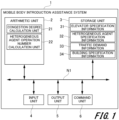
- Fig. 1 is a block diagram illustrating a schematic configuration of a mobile body introduction assistance system according to the present example.
- a mobile body introduction assistance system 1 includes an arithmetic unit 2, a storage unit 3, an input unit 4, an output unit 5, and a command unit 6.
- the arithmetic unit 2, the storage unit 3, the input unit 4, the output unit 5, and the command unit 6 are connected so as to be able to mutually transmit and receive information via a network N1.
- the arithmetic unit 2 is configured using, for example, a central processing unit (CPU), a micro processing unit (MPU), a digital signal processor (DSP), a graphics processing unit (GPU), or the like.
- the arithmetic unit 2 includes a congestion degree calculation unit 21 and a heterogeneous agent operation number calculation unit 22.
- the congestion degree calculation unit 21 calculates the congestion degree in the building based on information stored in the storage unit 3 to be described later. Then, the congestion degree calculation unit 21 outputs the calculated congestion degree to the heterogeneous agent operation number calculation unit 22.
- the heterogeneous agent operation number calculation unit 22 calculates the number of heterogeneous agents such as wheelchairs, personal mobility devices, and service robots as mobile bodies other than people to operate based on the congestion degree calculated by the congestion degree calculation unit 21.
- the heterogeneous agent operation number calculation unit 22 outputs the calculated operation number to the output unit 5 and the command unit 6.
- the storage unit 3 stores elevator specification information 31, heterogeneous agent specification information 32, traffic demand information 33 that is movement amount information of people and heterogeneous agents, and building specification information 34.
- the storage unit 3 also stores past operation information of the elevator.
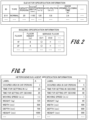
- Figs. 2 to 4 are diagrams illustrating examples of various types of specification information stored in the storage unit 3.
- Fig. 2 illustrates an example of the elevator specification information 31 and the building specification information 34
- Fig. 3 illustrates an example of the heterogeneous agent specification information 32
- Fig. 4 illustrates an example of the traffic demand information 33.
- examples of the elevator specification information 31 include “ID”, “Type”, “Capacity (person)”, “Door width (mm)”, “Speed (m/s)”, “Acceleration (m/s2)", and “Door opening/closing time (s)”.
- the building specification information 34 is, for example, “FLOOR”, “FLOOR HEIGHT (mm)”, “SERVICE FLOOR”, and the like.
- the heterogeneous agent specification information 32 includes, for example, a "Label” indicating the type of heterogeneous agent. Then, “Occupied area in car (person)", “Time for getting in (s)”, “Moving speed (m/s)”, “Weight (kg)”, “Width (mm)”, “Depth (mm)”, “Height (mm)”, and the like are set in advance for each type (label) of heterogeneous agent.
- the "Traffic demand information of people” stores the number of people who get on at a departure place (floor) and the number of people who get off at a destination (floor) assumed in a preset time zone.
- the "Traffic demand information of heterogeneous agent” stores the number of heterogeneous agents that get on at a departure place (floor) and the number of heterogeneous agents that get off at a destination (floor) assumed in a preset time zone.
- the traffic demand information 33 is updated every predetermined time or day.
- the input unit 4 is an input interface that receives information from the outside. Examples of the input unit 4 include various sensors installed in the building, a touch sensor, and a keyboard. The information input to the input unit 4 is output to the arithmetic unit 2, the storage unit 3, and the like via the network N1.
- the output unit 5 is an output interface that provides information to the outside.
- Examples of the output unit 5 include a speaker, a light emitting diode (LED), a screen display device (liquid crystal display, projector, and the like), a printing device, and a device for recording data on a recording medium.
- LED light emitting diode
- screen display device liquid crystal display, projector, and the like
- printing device and a device for recording data on a recording medium.
- the command unit 6 outputs the information calculated by the arithmetic unit 2 and the information input to the input unit 4 to a heterogeneous agent. Then, the heterogeneous agent operates based on the information output from the command unit 6.
- Fig. 5 is a flowchart illustrating an operation example of determining the number of heterogeneous agents to operate.
- the congestion degree calculation unit 21 of the arithmetic unit 2 estimates (calculates) the congestion degree in the building from the past operation information of the elevator and the traffic demand information 33 collected in the storage unit 3 (step S101). Details of a method for calculating the congestion degree will be described later.
- the congestion degree calculation unit 21 outputs the calculated congestion degree to the heterogeneous agent operation number calculation unit 22.
- the heterogeneous agent operation number calculation unit 22 calculates the types and the number of operatable heterogeneous agents based on the calculated congestion degree and information (heterogeneous agent specification information 32) of the heterogeneous agents deployed in the building (step S102). Then, the heterogeneous agent operation number calculation unit 22 outputs the calculated information to the command unit 6.
- the command unit 6 outputs an operation command to the heterogeneous agents based on the information calculated by the heterogeneous agent operation number calculation unit 22 (step S103). The operation of determining the number of heterogeneous agents to operate using the mobile body introduction assistance system 1 is thus completed.
- Examples of the command output to the heterogeneous agents in step S103 include a limit of the number of heterogeneous agents to operate for all floors of the building, a limit of the number of heterogeneous agents to operate for each floor, a limit of the number of heterogeneous agents to operate for a specific floor, and a limit of entry to a specific floor. The operation of determining the number of heterogeneous agents to operate using the mobile body introduction assistance system 1 is thus completed.
- the number of heterogeneous agents to operate is determined according to the congestion degree, instead of stopping the movement of all the heterogeneous agents.
- This configuration can secure the carrying capacity of the elevator and suppress lowering in service performance of heterogeneous agents.
- Fig. 6 is a flowchart illustrating a method for calculating the congestion degree.
- the congestion degree calculation unit 21 determines information to be used for calculating the congestion degree among the collected past operation information of the elevator and the traffic demand information 33 (step S111).
- the information used for calculating the congestion degree include information on "the previous day”, “the same day of the previous month”, “the same day of the previous year”, and “past X days”.
- Examples of the past operation information include an average occupancy rate (%) for X minutes, an average hall call duration (second), and an average hall call passing number (time).
- the congestion degree calculation unit 21 divides the operation information and the traffic demand information 33 to be used for calculating the congestion degree determined in the processing of step S111 by any time section (X minutes) (step S112). Then, the congestion degree calculation unit 21 converts the operation information and the traffic demand information 33 divided in the processing of step S112 into predetermined information (step S113).
- the information to be converted in step S113 is an average value of the divided information, calculation of a median value, clustering, or the like.
- the congestion degree calculation unit 21 extracts any information from the operation information converted in the processing of step S113, and calculates a plurality of evaluation values by using a plurality of evaluation formulas (step S114).
- the congestion degree calculation unit 21 also selects one congestion degree from a plurality of calculated congestion degrees based on a given determination and use. Then, the congestion degree calculation unit 21 determines the selected congestion degree as the congestion degree until X minutes after the current time (step S115). The operation of calculating the congestion degree using the congestion degree calculation unit 21 is thus completed.
- the method for calculating the congestion degree is not limited to the above-described method, and various other calculation methods are applied.
- congestion degree information corresponding to a time zone is created in advance as preset information of the congestion degree and stored in the storage unit 3.
- the congestion degree calculation unit 21 may acquire the congestion degree according to the time zone from the congestion degree information created in advance and stored in the storage unit 3.
- the congestion degree information stored in the storage unit 3 may be appropriately updated through actual operation or machine learning.
- the mobile body introduction assistance system 1 of the present example also outputs an output performance report for the operation number of heterogeneous agents. Next, a method for outputting the operation performance report will be described with reference to Figs. 7 and 8 .
- Fig. 7 is a flowchart illustrating a method for outputting the operation performance report
- Fig. 8 is a diagram illustrating an example of the operation performance report.
- the congestion degree calculation unit 21 of the arithmetic unit 2 calculates the congestion degree from the collected operation information of the elevator of the day and traffic demand information after the elevator operation is finished such as after the end of the business hours (step S121).
- the processing in step S121 is not limited to the end of the business hours, and may be performed at a predetermined timing, for example.
- the operation information collected in step S121 is, for example, "Elevator operation information" illustrated in Fig. 8 .
- the arithmetic unit 2 calculates the operating agent number evaluation and the appropriate number of heterogeneous agents to operate based on the (predicted) congestion degree calculated during the operation of the elevator, the actual congestion degree, and the operation performance of the heterogeneous agents (step S122).
- the "Other operation information” and the “Heterogeneous agent operation information” illustrated in Fig. 8 are thus created. Examples of the “Other operation information” include "Time zone", "Selected congestion degree determination index”, “Calculated predicted congestion degree”, “Actual congestion degree”, “Operating agent number evaluation", “Operating agent number evaluation determination basis", and “Appropriate number of agents".
- the "Operating agent number evaluation determination basis" is calculated based on the "Heterogeneous agent operation information".
- the “Operating agent number evaluation” As the “Operating agent number evaluation”, whether the number of heterogeneous agents is insufficient, excessive, or appropriate is set.
- the “Operating agent number evaluation” is calculated from the difference between the target value stored in advance in the storage unit 3 and the operation performance of the heterogeneous agents. In the “Operating agent number evaluation”, whether the number of heterogeneous agents is insufficient, excessive, or appropriate is set based on the calculated difference.
- the number of heterogeneous agents to be added or reduced is set to the "Appropriate number of agents". Further, when the number is insufficient or excessive, time information (waiting time or the like) serving as a determination basis is simultaneously output.
- Heterogeneous agent operation information examples include “Heterogeneous agent identifier (label)", “Time zone”, “Operation number (unit)", “Service performance”, “Average waiting time (second)", “Average riding time (second)”, “Average service completion time (second)", “Average charging frequency (time)”, “Average used power (kwh)", “Average moving distance (floor)", “Maximum waiting time (second)”, “Maximum riding time (second)”, “Maximum service completion time (second)”, “Maximum charging frequency (time)”, “Maximum used power (kwh)", and “Maximum moving distance (floor)”.
- the output unit 5 collectively outputs the "Operation performance of elevator", the "Operation performance of heterogeneous agent", and the "Other operation performance” illustrated in Fig. 8 calculated by the arithmetic unit 2 as the operation performance report (step S123). The operation of outputting the operation performance report is thus completed.
- the "Operation performance of elevator”, the "Operation performance of heterogeneous agent”, and the “Other operation performance” may be output simultaneously, or the "Operation performance of elevator” and the “Operation performance of heterogeneous agent” may be output, and then the "Other operation performance” may be calculated and output. Only the “Operating agent number evaluation”, “Operating agent number evaluation determination basis”, and “Appropriate number of agents” may be output.
- the mobile body introduction assistance system 1 of the present example by creating and outputting the operation performance report, it is possible to provide appropriate information to maintenance providers of the elevator and the service robot, building owners, and users of the elevator.
- the operation performance of the heterogeneous agents can be presented to the maintenance provider.
- the building owner whether the number of heterogeneous agents to operate is insufficient, excessive, or appropriate can be presented.
- the fact that the probability of riding together with a heterogeneous agent increases or decreases according to the time zone and the reason thereof can be presented. This can improve not only the service performance of the heterogeneous agents but also the convenience of the elevator.
- Fig. 9 is a diagram illustrating another example of the traffic demand information.
- the traffic demand information includes "Traffic demand information of people” and "Traffic demand information of heterogeneous agent”.
- "Traffic demand information of people” and “Traffic demand information of heterogeneous agent” are set for each predetermined time zone.
- information of the moving directions "Up” and “Down” of the elevator car, and information of the number of people who get on and the number of people who get off on each floor are set.
- the traffic demand information 33 is not limited to the examples illustrated in Figs. 4 and 9 , and other various types of information may be set as the traffic demand information.
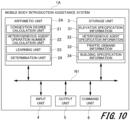
- Fig. 10 is a block diagram illustrating a mobile body introduction assistance system according to the second exemplary embodiment
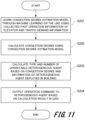
- Fig. 11 is a flowchart illustrating an operation example of the mobile body introduction assistance system according to the second exemplary embodiment.
- the mobile body introduction assistance system according to the second exemplary embodiment is different from the mobile body introduction assistance system according to the first exemplary embodiment in the configuration of the arithmetic unit.
- the same reference numerals are given to the parts common to those of the mobile body introduction assistance system according to the first exemplary embodiment, and redundant description will be omitted.
- a mobile body introduction assistance system 1A includes an arithmetic unit 2A, a storage unit 3, an input unit 4, an output unit 5, and a command unit 6.
- the arithmetic unit 2A includes a congestion degree calculation unit 21, a heterogeneous agent operation number calculation unit 22, a learning unit 23, and a determination unit 24.
- the learning unit 23 learns the congestion degree calculated by the congestion degree calculation unit 21 from the past data to predict the congestion degree.
- the learning unit 23 may learn the operation number of heterogeneous agents from the number of heterogeneous agents to operate calculated by the heterogeneous agent operation number calculation unit 22 and the evaluation information input to the input unit 4. Further, the learning unit 23 learns the actual traffic demand based on the actual traffic volume of people, the operation performance of heterogeneous agents, and the like, and updates the traffic demand information 33.
- the determination unit 24 selects one congestion degree based on a given determination index from a plurality of congestion degrees calculated by the congestion degree calculation unit 21. Then, the arithmetic unit 2A sets the congestion degree selected by the determination unit 24 to the congestion degree until X minutes from the current time.
- Fig. 11 is a flowchart illustrating an operation example of determining the number of heterogeneous agents to operate.
- the learning unit 23 learns a congestion degree estimation model through machine learning or the like using the past operation information of the elevator and the traffic demand information 33 collected in the storage unit 3 (step S201).
- the congestion degree calculation unit 21 calculates the congestion degree using the congestion degree estimation model learned by the learning unit 23 (step S202).
- the heterogeneous agent operation number calculation unit 22 calculates the types and the number of operatable heterogeneous agents based on the calculated congestion degree and information (heterogeneous agent specification information 32) of the heterogeneous agents deployed in the building (step S203).
- the command unit 6 outputs an operation command to the heterogeneous agents based on the information calculated by the heterogeneous agent operation number calculation unit 22 (step S204). The operation of determining the number of heterogeneous agents to operate by the mobile body introduction assistance system 1A is thus completed.
- the mobile body introduction assistance system 1A in which the learning unit 23 learns the congestion degree estimation model, can improve the accuracy of the congestion degree calculated by the congestion degree calculation unit 21 and can determine the more appropriate number of heterogeneous agents to operate.
- a hoisting machine including the mobile body introduction assistance system 1A having such a configuration can also obtain the same operational effects as those of the mobile body introduction assistance system 1 according to the first exemplary embodiment described above.
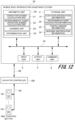
- Fig. 12 is a block diagram illustrating a mobile body introduction assistance system 1B according to the third exemplary embodiment.
- the parts common to the mobile body introduction assistance system 1 according to the first exemplary embodiment and the mobile body introduction assistance system 1A according to the second exemplary embodiment are denoted by the same reference numerals, and redundant description will be omitted.
- the mobile body introduction assistance system 1B is connected to an elevator controller 100 that controls the driving of the elevator via a network N2.
- the operation performance information of the elevator and the traffic important information are input from the elevator controller 100 to the input unit 4 of the mobile body introduction assistance system 1B via the network N2.
- the traffic demand information 33 in the storage unit 3 is updated based on this information.
- a ride together button 101 that allows a person on the elevator car to refuse or permit riding together with a heterogeneous agent is provided.
- the ride together button 101 and the elevator controller 100 are connected via a network N3. Then, the input information to the ride together button 101 is input to the mobile body introduction assistance system 1B via the networks N2 and N3.
- the command unit 6 of the mobile body introduction assistance system 1B Based on the information from the ride together button 101, the command unit 6 of the mobile body introduction assistance system 1B outputs a command to the heterogeneous agent. For example, when riding with a heterogeneous agent is refused, command information is output to the heterogeneous agent so that the heterogeneous agent does not get on the elevator car. This configuration can enhance convenience of the people who use the elevator.
- the mobile body introduction assistance system 1B having such a configuration can also obtain the same operation and effect as those of the mobile body introduction assistance system 1 according to the first exemplary embodiment described above.
- a part of the configuration of a certain embodiment can be replaced with the configuration of another embodiment, and the configuration of another embodiment can be added to the configuration of a certain embodiment. It is also possible to add, delete, and replace other configurations for a part of the configuration of each embodiment.
- Some or all of the above-described configurations, functions, processing units, processing means, and the like may be realized by hardware, for example, by designing with an integrated circuit.
- Each of the above-described configurations, functions, and the like may be realized by software by a processor interpreting and executing a program for realizing each function.
- Information such as a program, a table, and a file for realizing each function can be stored in a recording device such as a memory, a hard disk, and a solid state drive (SSD), or a recording medium such as an IC card, an SD card, or a DVD.
- a recording device such as a memory, a hard disk, and a solid state drive (SSD), or a recording medium such as an IC card, an SD card, or a DVD.
- SSD solid state drive
Landscapes
- Business, Economics & Management (AREA)
- Engineering & Computer Science (AREA)
- Human Resources & Organizations (AREA)
- Economics (AREA)
- Strategic Management (AREA)
- Tourism & Hospitality (AREA)
- General Physics & Mathematics (AREA)
- General Business, Economics & Management (AREA)
- Entrepreneurship & Innovation (AREA)
- Theoretical Computer Science (AREA)
- Marketing (AREA)
- Physics & Mathematics (AREA)
- Game Theory and Decision Science (AREA)
- Quality & Reliability (AREA)
- Operations Research (AREA)
- Development Economics (AREA)
- Automation & Control Theory (AREA)
- Educational Administration (AREA)
- Health & Medical Sciences (AREA)
- General Health & Medical Sciences (AREA)
- Primary Health Care (AREA)
- Elevator Control (AREA)
- Management, Administration, Business Operations System, And Electronic Commerce (AREA)
- Traffic Control Systems (AREA)
Abstract
This mobile body introduction assistance system includes: a congestion degree calculation unit; and a heterogeneous agent operation number calculation unit. The congestion degree calculation unit acquires information about a degree of congestion of people and a heterogeneous agent that are moving within a building, the heterogeneous agent being a mobile body different from the people. The heterogeneous agent operation number calculation unit determines the number of heterogeneous agents to operate on the basis of the congestion degree information acquired by the congestion degree calculation unit.
Description
- The present invention relates to a mobile body introduction assistance system and a mobile body introduction assistance method.
- When an elevator is installed, specifications such as the capacity of the elevator car and the number of elevator cars are determined so that sufficient carrying capacity can be secured for the people flow at the maximum congestion in the building to install the elevator. In recent years, with the progress of barrier-free accessibility and smart building, not only people but also wheelchairs, personal mobility devices, service robots, and the like have increased opportunities to use elevators.
- Wheelchairs, personal mobility devices, and service robots (hereinafter, referred to as "heterogeneous agent") not only take more time to go in and out from the elevator car than people, but also have a larger occupied area in the elevator car than people. In addition, the installation plan of an elevator is determined on the assumption that people are carried. Thus, when the number of heterogeneous agents increases, the carrying capacity of the elevator assumed in advance cannot be exhibited, and the service performance of the elevator deteriorates.
- Technologies for controlling movement of a mobile body other than people include a technology described in
Patent Literature 1, for example.Patent Literature 1 describes a technology including an information storage unit, a congestion situation prediction unit, and an operation mode setting unit.Patent Literature 1 describes that an operation mode setting unit sets a robot to one of a plurality of operation modes having different influences on the degree of congestion of a service providing area. - Patent Literature 1:
JP 2019-940 A - However, in the technology described in
Patent Literature 1, when congestion is predicted, the robot is caused to stand by in a standby area, and its movement is stopped. Thus, service performance of the robot lowers. - In consideration of the above problem, an object of the present invention is to provide a mobile body introduction assistance system and a mobile body introduction assistance method capable of securing the carrying capacity of an elevator and suppressing lowering in service performance of heterogeneous agents.
- To solve the above problem and achieve the object, a mobile body introduction assistance system includes a congestion degree calculation unit that acquires congestion degree information of people who move in a building and heterogeneous agents that move in the building, the heterogeneous agents being mobile bodies different from people, and a heterogeneous agent operation number calculation unit that determines the number of the heterogeneous agents to operate based on the congestion degree information acquired by the congestion degree calculation unit.
- A mobile body introduction assistance method includes processing shown in the following (1) and (2).
- (1) Processing of acquiring congestion degree information of people who move in a building and heterogeneous agents that move in the building, the heterogeneous agents being mobile bodies different from people, by using a congestion degree calculation unit.
- (2) Processing of determining the number of the heterogeneous agents to operate by using a heterogeneous agent operation number calculation unit based on the congestion degree information acquired by the congestion degree calculation unit.
- The mobile body introduction assistance system and the mobile body introduction assistance method having the above-described configurations can secure the carrying capacity of an elevator and suppress lowering in service performance of heterogeneous agents.
-
-
Fig. 1 is a block diagram illustrating a schematic configuration of a mobile body introduction assistance system according to a first exemplary embodiment. -
Fig. 2 is a diagram illustrating an example of specification information of the mobile body introduction assistance system according to the first exemplary embodiment. -
Fig. 3 is a diagram illustrating an example of heterogeneous agent specification information of the mobile body introduction assistance system according to the first exemplary embodiment. -
Fig. 4 is a diagram illustrating traffic demand information of the mobile body introduction assistance system according to the first exemplary embodiment. -
Fig. 5 is a flowchart illustrating an operation example of determining the number of heterogeneous agents to operate that is an operation example of the mobile body introduction assistance system according to the first exemplary embodiment. -
Fig. 6 is a flowchart illustrating a method for calculating the congestion degree of the mobile body introduction assistance system according to the first exemplary embodiment. -
Fig. 7 is a flowchart illustrating a method for outputting an operation performance report of the mobile body introduction assistance system according to the first exemplary embodiment. -
Fig. 8 is a diagram illustrating an operation performance report of the mobile body introduction assistance system according to the first exemplary embodiment. -
Fig. 9 is a diagram illustrating another example of traffic demand information of the mobile body introduction assistance system according to the first exemplary embodiment. -
Fig. 10 is a block diagram illustrating a schematic configuration of a mobile body introduction assistance system according to a second exemplary embodiment. -
Fig. 11 is a flowchart illustrating an operation example of determining the number of heterogeneous agents to operate that is an operation example of the mobile body introduction assistance system according to the second exemplary embodiment. -
Fig. 12 is a block diagram illustrating a schematic configuration of a mobile body introduction assistance system according to a third exemplary embodiment. - Hereinafter, exemplary embodiments of the mobile body introduction assistance system and the mobile body introduction assistance method will be described with reference to
Figs. 1 to 12 . In the drawings, the same members are denoted by the same reference numerals. - First, configurations of a mobile body introduction assistance system and a mobile body introduction assistance method according to a first embodiment (hereinafter, referred to as "present example") will be described with reference to
Figs. 1 to 4 . -
Fig. 1 is a block diagram illustrating a schematic configuration of a mobile body introduction assistance system according to the present example. - As illustrated in
Fig. 1 , a mobile bodyintroduction assistance system 1 includes anarithmetic unit 2, astorage unit 3, aninput unit 4, anoutput unit 5, and acommand unit 6. Thearithmetic unit 2, thestorage unit 3, theinput unit 4, theoutput unit 5, and thecommand unit 6 are connected so as to be able to mutually transmit and receive information via a network N1. - The
arithmetic unit 2 is configured using, for example, a central processing unit (CPU), a micro processing unit (MPU), a digital signal processor (DSP), a graphics processing unit (GPU), or the like. Thearithmetic unit 2 includes a congestiondegree calculation unit 21 and a heterogeneous agent operationnumber calculation unit 22. - The congestion
degree calculation unit 21 calculates the congestion degree in the building based on information stored in thestorage unit 3 to be described later. Then, the congestiondegree calculation unit 21 outputs the calculated congestion degree to the heterogeneous agent operationnumber calculation unit 22. - The heterogeneous agent operation
number calculation unit 22 calculates the number of heterogeneous agents such as wheelchairs, personal mobility devices, and service robots as mobile bodies other than people to operate based on the congestion degree calculated by the congestiondegree calculation unit 21. The heterogeneous agent operationnumber calculation unit 22 outputs the calculated operation number to theoutput unit 5 and thecommand unit 6. - The
storage unit 3 is, for example, a read only memory (ROM), a random access memory (RAM), a non-volatile memory (non-volatile RAM (NVRAM)), a hard disk drive, a solid state drive (SSD), or the like. - The
storage unit 3 storeselevator specification information 31, heterogeneousagent specification information 32,traffic demand information 33 that is movement amount information of people and heterogeneous agents, andbuilding specification information 34. Thestorage unit 3 also stores past operation information of the elevator. -
Figs. 2 to 4 are diagrams illustrating examples of various types of specification information stored in thestorage unit 3.Fig. 2 illustrates an example of theelevator specification information 31 and thebuilding specification information 34,Fig. 3 illustrates an example of the heterogeneousagent specification information 32, andFig. 4 illustrates an example of thetraffic demand information 33. - As illustrated in
Fig. 2 , examples of theelevator specification information 31 include "ID", "Type", "Capacity (person)", "Door width (mm)", "Speed (m/s)", "Acceleration (m/s2)", and "Door opening/closing time (s)". Thebuilding specification information 34 is, for example, "FLOOR", "FLOOR HEIGHT (mm)", "SERVICE FLOOR", and the like. - As illustrated in
Fig. 3 , the heterogeneousagent specification information 32 includes, for example, a "Label" indicating the type of heterogeneous agent. Then, "Occupied area in car (person)", "Time for getting in (s)", "Moving speed (m/s)", "Weight (kg)", "Width (mm)", "Depth (mm)", "Height (mm)", and the like are set in advance for each type (label) of heterogeneous agent. - As illustrated in
Fig. 4 , not only "Traffic demand information of people" but also "Traffic demand information of heterogeneous agent" are set in thetraffic demand information 33. "Traffic demand information of people" and "Traffic demand information of heterogeneous agent" are set for each predetermined time zone. - The "Traffic demand information of people" stores the number of people who get on at a departure place (floor) and the number of people who get off at a destination (floor) assumed in a preset time zone. The "Traffic demand information of heterogeneous agent" stores the number of heterogeneous agents that get on at a departure place (floor) and the number of heterogeneous agents that get off at a destination (floor) assumed in a preset time zone. The
traffic demand information 33 is updated every predetermined time or day. - The
input unit 4 is an input interface that receives information from the outside. Examples of theinput unit 4 include various sensors installed in the building, a touch sensor, and a keyboard. The information input to theinput unit 4 is output to thearithmetic unit 2, thestorage unit 3, and the like via the network N1. - The
output unit 5 is an output interface that provides information to the outside. Examples of theoutput unit 5 include a speaker, a light emitting diode (LED), a screen display device (liquid crystal display, projector, and the like), a printing device, and a device for recording data on a recording medium. - The
command unit 6 outputs the information calculated by thearithmetic unit 2 and the information input to theinput unit 4 to a heterogeneous agent. Then, the heterogeneous agent operates based on the information output from thecommand unit 6. - Next, an operation example of the mobile body
introduction assistance system 1 having the above-described configuration will be described with reference toFigs. 5 to 6 . -
Fig. 5 is a flowchart illustrating an operation example of determining the number of heterogeneous agents to operate. - As illustrated in
Fig. 5 , the congestiondegree calculation unit 21 of thearithmetic unit 2 estimates (calculates) the congestion degree in the building from the past operation information of the elevator and thetraffic demand information 33 collected in the storage unit 3 (step S101). Details of a method for calculating the congestion degree will be described later. - Then, the congestion
degree calculation unit 21 outputs the calculated congestion degree to the heterogeneous agent operationnumber calculation unit 22. Next, the heterogeneous agent operationnumber calculation unit 22 calculates the types and the number of operatable heterogeneous agents based on the calculated congestion degree and information (heterogeneous agent specification information 32) of the heterogeneous agents deployed in the building (step S102). Then, the heterogeneous agent operationnumber calculation unit 22 outputs the calculated information to thecommand unit 6. - Next, the
command unit 6 outputs an operation command to the heterogeneous agents based on the information calculated by the heterogeneous agent operation number calculation unit 22 (step S103). The operation of determining the number of heterogeneous agents to operate using the mobile bodyintroduction assistance system 1 is thus completed. - Examples of the command output to the heterogeneous agents in step S103 include a limit of the number of heterogeneous agents to operate for all floors of the building, a limit of the number of heterogeneous agents to operate for each floor, a limit of the number of heterogeneous agents to operate for a specific floor, and a limit of entry to a specific floor. The operation of determining the number of heterogeneous agents to operate using the mobile body
introduction assistance system 1 is thus completed. - In this manner, in the mobile body
introduction assistance system 1 of the present example, the number of heterogeneous agents to operate is determined according to the congestion degree, instead of stopping the movement of all the heterogeneous agents. This configuration can secure the carrying capacity of the elevator and suppress lowering in service performance of heterogeneous agents. - Next, an example of a method for calculating the congestion degree will be described with reference to
Fig. 6 . -
Fig. 6 is a flowchart illustrating a method for calculating the congestion degree. - As illustrated in
Fig. 6 , the congestiondegree calculation unit 21 determines information to be used for calculating the congestion degree among the collected past operation information of the elevator and the traffic demand information 33 (step S111). Examples of the information used for calculating the congestion degree include information on "the previous day", "the same day of the previous month", "the same day of the previous year", and "past X days". Examples of the past operation information include an average occupancy rate (%) for X minutes, an average hall call duration (second), and an average hall call passing number (time). - Next, the congestion
degree calculation unit 21 divides the operation information and thetraffic demand information 33 to be used for calculating the congestion degree determined in the processing of step S111 by any time section (X minutes) (step S112). Then, the congestiondegree calculation unit 21 converts the operation information and thetraffic demand information 33 divided in the processing of step S112 into predetermined information (step S113). The information to be converted in step S113 is an average value of the divided information, calculation of a median value, clustering, or the like. - Next, the congestion
degree calculation unit 21 extracts any information from the operation information converted in the processing of step S113, and calculates a plurality of evaluation values by using a plurality of evaluation formulas (step S114). The congestiondegree calculation unit 21 also selects one congestion degree from a plurality of calculated congestion degrees based on a given determination and use. Then, the congestiondegree calculation unit 21 determines the selected congestion degree as the congestion degree until X minutes after the current time (step S115). The operation of calculating the congestion degree using the congestiondegree calculation unit 21 is thus completed. - The method for calculating the congestion degree is not limited to the above-described method, and various other calculation methods are applied. For example, congestion degree information corresponding to a time zone is created in advance as preset information of the congestion degree and stored in the
storage unit 3. Then, the congestiondegree calculation unit 21 may acquire the congestion degree according to the time zone from the congestion degree information created in advance and stored in thestorage unit 3. In addition, the congestion degree information stored in thestorage unit 3 may be appropriately updated through actual operation or machine learning. - The mobile body
introduction assistance system 1 of the present example also outputs an output performance report for the operation number of heterogeneous agents. Next, a method for outputting the operation performance report will be described with reference toFigs. 7 and8 . -
Fig. 7 is a flowchart illustrating a method for outputting the operation performance report, andFig. 8 is a diagram illustrating an example of the operation performance report. - As illustrated in
Fig. 7 , the congestiondegree calculation unit 21 of thearithmetic unit 2 calculates the congestion degree from the collected operation information of the elevator of the day and traffic demand information after the elevator operation is finished such as after the end of the business hours (step S121). The processing in step S121 is not limited to the end of the business hours, and may be performed at a predetermined timing, for example. The operation information collected in step S121 is, for example, "Elevator operation information" illustrated inFig. 8 . - Next, the
arithmetic unit 2 calculates the operating agent number evaluation and the appropriate number of heterogeneous agents to operate based on the (predicted) congestion degree calculated during the operation of the elevator, the actual congestion degree, and the operation performance of the heterogeneous agents (step S122). The "Other operation information" and the "Heterogeneous agent operation information" illustrated inFig. 8 are thus created. Examples of the "Other operation information" include "Time zone", "Selected congestion degree determination index", "Calculated predicted congestion degree", "Actual congestion degree", "Operating agent number evaluation", "Operating agent number evaluation determination basis", and "Appropriate number of agents". The "Operating agent number evaluation determination basis" is calculated based on the "Heterogeneous agent operation information". - As the "Operating agent number evaluation", whether the number of heterogeneous agents is insufficient, excessive, or appropriate is set. The "Operating agent number evaluation" is calculated from the difference between the target value stored in advance in the
storage unit 3 and the operation performance of the heterogeneous agents. In the "Operating agent number evaluation", whether the number of heterogeneous agents is insufficient, excessive, or appropriate is set based on the calculated difference. - Then, when the number is insufficient or excessive, the number of heterogeneous agents to be added or reduced is set to the "Appropriate number of agents". Further, when the number is insufficient or excessive, time information (waiting time or the like) serving as a determination basis is simultaneously output.
- Examples of the "Heterogeneous agent operation information" include "Heterogeneous agent identifier (label)", "Time zone", "Operation number (unit)", "Service performance", "Average waiting time (second)", "Average riding time (second)", "Average service completion time (second)", "Average charging frequency (time)", "Average used power (kwh)", "Average moving distance (floor)", "Maximum waiting time (second)", "Maximum riding time (second)", "Maximum service completion time (second)", "Maximum charging frequency (time)", "Maximum used power (kwh)", and "Maximum moving distance (floor)".
- Next, the
output unit 5 collectively outputs the "Operation performance of elevator", the "Operation performance of heterogeneous agent", and the "Other operation performance" illustrated inFig. 8 calculated by thearithmetic unit 2 as the operation performance report (step S123). The operation of outputting the operation performance report is thus completed. - The "Operation performance of elevator", the "Operation performance of heterogeneous agent", and the "Other operation performance" may be output simultaneously, or the "Operation performance of elevator" and the "Operation performance of heterogeneous agent" may be output, and then the "Other operation performance" may be calculated and output. Only the "Operating agent number evaluation", "Operating agent number evaluation determination basis", and "Appropriate number of agents" may be output.
- In this manner, according to the mobile body
introduction assistance system 1 of the present example, by creating and outputting the operation performance report, it is possible to provide appropriate information to maintenance providers of the elevator and the service robot, building owners, and users of the elevator. For example, the operation performance of the heterogeneous agents can be presented to the maintenance provider. To the building owner, whether the number of heterogeneous agents to operate is insufficient, excessive, or appropriate can be presented. To the user of the elevator, the fact that the probability of riding together with a heterogeneous agent increases or decreases according to the time zone and the reason thereof can be presented. This can improve not only the service performance of the heterogeneous agents but also the convenience of the elevator. - Next, another example of the traffic demand information will be described with reference to
Fig. 9. Fig. 9 is a diagram illustrating another example of the traffic demand information. - As illustrated in
Fig. 9 , the traffic demand information includes "Traffic demand information of people" and "Traffic demand information of heterogeneous agent". "Traffic demand information of people" and "Traffic demand information of heterogeneous agent" are set for each predetermined time zone. In the "Traffic demand information of people" and the "Traffic demand information of heterogeneous agent", information of the moving directions "Up" and "Down" of the elevator car, and information of the number of people who get on and the number of people who get off on each floor are set. - The
traffic demand information 33 is not limited to the examples illustrated inFigs. 4 and9 , and other various types of information may be set as the traffic demand information. - Next, a mobile body introduction assistance system according to a second exemplary embodiment will be described with reference to
Figs. 10 and11 . -
Fig. 10 is a block diagram illustrating a mobile body introduction assistance system according to the second exemplary embodiment, andFig. 11 is a flowchart illustrating an operation example of the mobile body introduction assistance system according to the second exemplary embodiment. - The mobile body introduction assistance system according to the second exemplary embodiment is different from the mobile body introduction assistance system according to the first exemplary embodiment in the configuration of the arithmetic unit. Thus, the same reference numerals are given to the parts common to those of the mobile body introduction assistance system according to the first exemplary embodiment, and redundant description will be omitted.
- As illustrated in
Fig. 10 , a mobile bodyintroduction assistance system 1A includes anarithmetic unit 2A, astorage unit 3, aninput unit 4, anoutput unit 5, and acommand unit 6. Thearithmetic unit 2A includes a congestiondegree calculation unit 21, a heterogeneous agent operationnumber calculation unit 22, alearning unit 23, and adetermination unit 24. Thelearning unit 23 learns the congestion degree calculated by the congestiondegree calculation unit 21 from the past data to predict the congestion degree. Thelearning unit 23 may learn the operation number of heterogeneous agents from the number of heterogeneous agents to operate calculated by the heterogeneous agent operationnumber calculation unit 22 and the evaluation information input to theinput unit 4. Further, thelearning unit 23 learns the actual traffic demand based on the actual traffic volume of people, the operation performance of heterogeneous agents, and the like, and updates thetraffic demand information 33. - The
determination unit 24 selects one congestion degree based on a given determination index from a plurality of congestion degrees calculated by the congestiondegree calculation unit 21. Then, thearithmetic unit 2A sets the congestion degree selected by thedetermination unit 24 to the congestion degree until X minutes from the current time. - Next, an operation example of the mobile body
introduction assistance system 1A according to the second exemplary embodiment will be described with reference toFig. 11 . -
Fig. 11 is a flowchart illustrating an operation example of determining the number of heterogeneous agents to operate. - As illustrated in
Fig. 11 , thelearning unit 23 learns a congestion degree estimation model through machine learning or the like using the past operation information of the elevator and thetraffic demand information 33 collected in the storage unit 3 (step S201). Next, the congestiondegree calculation unit 21 calculates the congestion degree using the congestion degree estimation model learned by the learning unit 23 (step S202). - Then, the heterogeneous agent operation
number calculation unit 22 calculates the types and the number of operatable heterogeneous agents based on the calculated congestion degree and information (heterogeneous agent specification information 32) of the heterogeneous agents deployed in the building (step S203). Next, thecommand unit 6 outputs an operation command to the heterogeneous agents based on the information calculated by the heterogeneous agent operation number calculation unit 22 (step S204). The operation of determining the number of heterogeneous agents to operate by the mobile bodyintroduction assistance system 1A is thus completed. - The mobile body
introduction assistance system 1A according to the second exemplary embodiment, in which thelearning unit 23 learns the congestion degree estimation model, can improve the accuracy of the congestion degree calculated by the congestiondegree calculation unit 21 and can determine the more appropriate number of heterogeneous agents to operate. - Since other configurations are the same as those of the mobile body
introduction assistance system 1 according to the first exemplary embodiment, the description thereof will be omitted. A hoisting machine including the mobile bodyintroduction assistance system 1A having such a configuration can also obtain the same operational effects as those of the mobile bodyintroduction assistance system 1 according to the first exemplary embodiment described above. - Next, a mobile body introduction assistance system according to a third exemplary embodiment will be described with reference to
Fig. 12 . -
Fig. 12 is a block diagram illustrating a mobile bodyintroduction assistance system 1B according to the third exemplary embodiment. The parts common to the mobile bodyintroduction assistance system 1 according to the first exemplary embodiment and the mobile bodyintroduction assistance system 1A according to the second exemplary embodiment are denoted by the same reference numerals, and redundant description will be omitted. - As illustrated in
Fig. 12 , the mobile bodyintroduction assistance system 1B is connected to anelevator controller 100 that controls the driving of the elevator via a network N2. The operation performance information of the elevator and the traffic important information are input from theelevator controller 100 to theinput unit 4 of the mobile bodyintroduction assistance system 1B via the network N2. Thetraffic demand information 33 in thestorage unit 3 is updated based on this information. - In addition, in the hall of each floor where the elevator stops, a ride together
button 101 that allows a person on the elevator car to refuse or permit riding together with a heterogeneous agent is provided. The ride togetherbutton 101 and theelevator controller 100 are connected via a network N3. Then, the input information to the ride togetherbutton 101 is input to the mobile bodyintroduction assistance system 1B via the networks N2 and N3. - Based on the information from the ride together
button 101, thecommand unit 6 of the mobile bodyintroduction assistance system 1B outputs a command to the heterogeneous agent. For example, when riding with a heterogeneous agent is refused, command information is output to the heterogeneous agent so that the heterogeneous agent does not get on the elevator car. This configuration can enhance convenience of the people who use the elevator. - Since other configurations are the same as those of the mobile body
introduction assistance system 1 according to the first exemplary embodiment, the description thereof will be omitted. The mobile bodyintroduction assistance system 1B having such a configuration can also obtain the same operation and effect as those of the mobile bodyintroduction assistance system 1 according to the first exemplary embodiment described above. - The present invention is not limited to the embodiments described above and illustrated in the drawings, and various modifications can be made without departing from the gist of the invention described in the claims.
- A part of the configuration of a certain embodiment can be replaced with the configuration of another embodiment, and the configuration of another embodiment can be added to the configuration of a certain embodiment. It is also possible to add, delete, and replace other configurations for a part of the configuration of each embodiment. Some or all of the above-described configurations, functions, processing units, processing means, and the like may be realized by hardware, for example, by designing with an integrated circuit. Each of the above-described configurations, functions, and the like may be realized by software by a processor interpreting and executing a program for realizing each function. Information such as a program, a table, and a file for realizing each function can be stored in a recording device such as a memory, a hard disk, and a solid state drive (SSD), or a recording medium such as an IC card, an SD card, or a DVD.
-
- 1, 1A, 1B Mobile body introduction assistance system
- 2, 2A Arithmetic unit
- 3 Storage unit
- 4 Input unit
- 5 Output unit
- 6 Command unit
- 21 Congestion degree calculation unit
- 22 Heterogeneous agent operation number calculation unit
- 23 Learning unit
- 24 Determination unit
- 31 Elevator specification information
- 32 Heterogeneous agent specification information
- 33 Traffic demand information
- 34 Building specification information
- 100 Elevator controller
- 101 Ride together button
Claims (9)
- A mobile body introduction assistance system comprising:a congestion degree calculation unit that acquires congestion degree information of people who move in a building and heterogeneous agents that move in the building, the heterogeneous agents being mobile bodies different from people; anda heterogeneous agent operation number calculation unit that determines the number of the heterogeneous agents to operate based on the congestion degree information acquired by the congestion degree calculation unit.
- The mobile body introduction assistance system according to claim 1, further comprisinga storage unit that stores traffic demand information that is movement amount information of the people who move in the building and the heterogeneous agents that move in the building, whereinthe congestion degree calculation unit calculates the congestion degree information based on the traffic demand information.
- The mobile body introduction assistance system according to claim 2, wherein
the congestion degree calculation unit calculates the congestion degree information based on past operation information of an elevator installed in the building and the traffic demand information. - The mobile body introduction assistance system according to claim 3, wherein
the congestion degree calculation unit calculates a plurality of congestion degrees by using a plurality of calculation methods, and selects the congestion degree information to be used by the heterogeneous agent operation number calculation unit based on a given determination and use from among the plurality of calculated congestion degrees. - The mobile body introduction assistance system according to claim 2, further comprisinga learning unit that learns a congestion degree estimation model based on past operation information of an elevator installed in the building and the traffic demand information, whereinthe congestion degree calculation unit calculates the congestion degree information by using the congestion degree estimation model learned by the learning unit.
- The mobile body introduction assistance system according to claim 1, further comprising
an arithmetic unit that evaluates the number of the heterogeneous agents to operate based on an operation performance of the heterogeneous agents and a preset target value. - The mobile body introduction assistance system according to claim 6, wherein
the arithmetic unit calculates a difference between the congestion degree information calculated by the congestion degree calculation unit and an actual congestion degree for each time and outputs the difference as an operation performance report. - The mobile body introduction assistance system according to claim 1, further comprising
an output unit that is connected to an elevator controller that controls driving of an elevator installed in the building, and outputs command information to the heterogeneous agents based on information from the elevator controller. - A mobile body introduction assistance method comprising:processing of acquiring congestion degree information of people who move in a building and heterogeneous agents that move in the building, the heterogeneous agents being mobile bodies different from people, by using a congestion degree calculation unit; andprocessing of determining the number of the heterogeneous agents to operate by using a heterogeneous agent operation number calculation unit based on the congestion degree information acquired by the congestion degree calculation unit.
Applications Claiming Priority (2)
| Application Number | Priority Date | Filing Date | Title |
|---|---|---|---|
| JP2022104188A JP7762117B2 (en) | 2022-06-29 | 2022-06-29 | Mobile body introduction support system and mobile body introduction support method |
| PCT/JP2023/015369 WO2024004341A1 (en) | 2022-06-29 | 2023-04-17 | Mobile body introduction assistance system, and mobile body introduction assistance method |
Publications (1)
| Publication Number | Publication Date |
|---|---|
| EP4550228A1 true EP4550228A1 (en) | 2025-05-07 |
Family
ID=89381880
Family Applications (1)
| Application Number | Title | Priority Date | Filing Date |
|---|---|---|---|
| EP23830795.3A Pending EP4550228A1 (en) | 2022-06-29 | 2023-04-17 | Mobile body introduction assistance system, and mobile body introduction assistance method |
Country Status (4)
| Country | Link |
|---|---|
| EP (1) | EP4550228A1 (en) |
| JP (1) | JP7762117B2 (en) |
| CN (1) | CN119343686A (en) |
| WO (1) | WO2024004341A1 (en) |
Family Cites Families (5)
| Publication number | Priority date | Publication date | Assignee | Title |
|---|---|---|---|---|
| JP2018067183A (en) * | 2016-10-20 | 2018-04-26 | アイシン精機株式会社 | Moving body tracking control device |
| JP2019000940A (en) | 2017-06-15 | 2019-01-10 | 株式会社日立製作所 | Robot control system, platform, robot, and robot control method |
| JP6814118B2 (en) * | 2017-09-15 | 2021-01-13 | 株式会社日立製作所 | Robot controls, systems, and methods |
| JP6906484B2 (en) * | 2018-07-09 | 2021-07-21 | 株式会社日立ビルシステム | Guidance robot system and its control method |
| JP7484574B2 (en) * | 2020-08-26 | 2024-05-16 | トヨタ自動車株式会社 | Autonomous mobile robot control system, control method thereof, control program thereof, and autonomous mobile robot control device |
-
2022
- 2022-06-29 JP JP2022104188A patent/JP7762117B2/en active Active
-
2023
- 2023-04-17 WO PCT/JP2023/015369 patent/WO2024004341A1/en not_active Ceased
- 2023-04-17 CN CN202380045916.6A patent/CN119343686A/en active Pending
- 2023-04-17 EP EP23830795.3A patent/EP4550228A1/en active Pending
Also Published As
| Publication number | Publication date |
|---|---|
| CN119343686A (en) | 2025-01-21 |
| JP2024004557A (en) | 2024-01-17 |
| WO2024004341A1 (en) | 2024-01-04 |
| JP7762117B2 (en) | 2025-10-29 |
Similar Documents
| Publication | Publication Date | Title |
|---|---|---|
| US10683189B2 (en) | Contextual awareness-based elevator management | |
| CN107235392B (en) | Elevator device and control method of elevator device | |
| CN103303754B (en) | Elevator group management control system | |
| CN105692366A (en) | Elevator system and elevator system management method | |
| KR102288490B1 (en) | Vehicle rental method, system and program based on limit waiting time | |
| US9682843B2 (en) | Elevator group management system | |
| JP5955664B2 (en) | Elevator group management system | |
| JP2009220906A (en) | Group management control device of elevator system | |
| JP2019081622A (en) | Vehicle allocation system of external system cooperation and method | |
| JP6894982B2 (en) | Group management control device and group management control method | |
| CN111377325A (en) | Enhancing elevator sensor operation for improved maintenance | |
| US20250128910A1 (en) | Elevator system and elevator car assignment method | |
| JP7083786B2 (en) | In-car condition detection system, elevator and in-car condition detection method | |
| JP2017178474A (en) | Elevator device and controlling method of elevator device | |
| EP4550228A1 (en) | Mobile body introduction assistance system, and mobile body introduction assistance method | |
| JP2018081650A (en) | Boarding guidance device, boarding guidance program, and boarding guidance method | |
| CN105984768A (en) | Elevator system and control method thereof | |
| KR102424823B1 (en) | Efficient entry and exit management system using push message | |
| WO2023105762A1 (en) | Elevator system | |
| JP2008056377A (en) | Elevator call registration system | |
| JP2015176589A (en) | information processing system, information processing method and information processing program | |
| CN118354970A (en) | Passenger flow management in elevator systems | |
| JP6776174B2 (en) | Elevator user movement prediction method and elevator user movement prediction device | |
| KR20220068919A (en) | Information processing device, information processing method, and system | |
| JP7388379B2 (en) | Estimation device, estimation method, and estimation program |
Legal Events
| Date | Code | Title | Description |
|---|---|---|---|
| STAA | Information on the status of an ep patent application or granted ep patent |
Free format text: STATUS: THE INTERNATIONAL PUBLICATION HAS BEEN MADE |
|
| PUAI | Public reference made under article 153(3) epc to a published international application that has entered the european phase |
Free format text: ORIGINAL CODE: 0009012 |
|
| STAA | Information on the status of an ep patent application or granted ep patent |
Free format text: STATUS: REQUEST FOR EXAMINATION WAS MADE |
|
| 17P | Request for examination filed |
Effective date: 20250129 |
|
| AK | Designated contracting states |
Kind code of ref document: A1 Designated state(s): AL AT BE BG CH CY CZ DE DK EE ES FI FR GB GR HR HU IE IS IT LI LT LU LV MC ME MK MT NL NO PL PT RO RS SE SI SK SM TR |
|
| DAV | Request for validation of the european patent (deleted) | ||
| DAX | Request for extension of the european patent (deleted) |