EP4549537A1 - Grease composition - Google Patents
Grease composition Download PDFInfo
- Publication number
- EP4549537A1 EP4549537A1 EP23831223.5A EP23831223A EP4549537A1 EP 4549537 A1 EP4549537 A1 EP 4549537A1 EP 23831223 A EP23831223 A EP 23831223A EP 4549537 A1 EP4549537 A1 EP 4549537A1
- Authority
- EP
- European Patent Office
- Prior art keywords
- mass
- grease composition
- group
- load
- base oil
- Prior art date
- Legal status (The legal status is an assumption and is not a legal conclusion. Google has not performed a legal analysis and makes no representation as to the accuracy of the status listed.)
- Pending
Links
Classifications
-
- C—CHEMISTRY; METALLURGY
- C10—PETROLEUM, GAS OR COKE INDUSTRIES; TECHNICAL GASES CONTAINING CARBON MONOXIDE; FUELS; LUBRICANTS; PEAT
- C10M—LUBRICATING COMPOSITIONS; USE OF CHEMICAL SUBSTANCES EITHER ALONE OR AS LUBRICATING INGREDIENTS IN A LUBRICATING COMPOSITION
- C10M169/00—Lubricating compositions characterised by containing as components a mixture of at least two types of ingredient selected from base-materials, thickeners or additives, covered by the preceding groups, each of these compounds being essential
- C10M169/04—Mixtures of base-materials and additives
- C10M169/045—Mixtures of base-materials and additives the additives being a mixture of compounds of unknown or incompletely defined constitution and non-macromolecular compounds
-
- C—CHEMISTRY; METALLURGY
- C10—PETROLEUM, GAS OR COKE INDUSTRIES; TECHNICAL GASES CONTAINING CARBON MONOXIDE; FUELS; LUBRICANTS; PEAT
- C10M—LUBRICATING COMPOSITIONS; USE OF CHEMICAL SUBSTANCES EITHER ALONE OR AS LUBRICATING INGREDIENTS IN A LUBRICATING COMPOSITION
- C10M169/00—Lubricating compositions characterised by containing as components a mixture of at least two types of ingredient selected from base-materials, thickeners or additives, covered by the preceding groups, each of these compounds being essential
- C10M169/04—Mixtures of base-materials and additives
- C10M169/048—Mixtures of base-materials and additives the additives being a mixture of compounds of unknown or incompletely defined constitution, non-macromolecular and macromolecular compounds
-
- C—CHEMISTRY; METALLURGY
- C10—PETROLEUM, GAS OR COKE INDUSTRIES; TECHNICAL GASES CONTAINING CARBON MONOXIDE; FUELS; LUBRICANTS; PEAT
- C10M—LUBRICATING COMPOSITIONS; USE OF CHEMICAL SUBSTANCES EITHER ALONE OR AS LUBRICATING INGREDIENTS IN A LUBRICATING COMPOSITION
- C10M135/00—Lubricating compositions characterised by the additive being an organic non-macromolecular compound containing sulfur, selenium or tellurium
- C10M135/20—Thiols; Sulfides; Polysulfides
- C10M135/22—Thiols; Sulfides; Polysulfides containing sulfur atoms bound to acyclic or cycloaliphatic carbon atoms
-
- C—CHEMISTRY; METALLURGY
- C10—PETROLEUM, GAS OR COKE INDUSTRIES; TECHNICAL GASES CONTAINING CARBON MONOXIDE; FUELS; LUBRICANTS; PEAT
- C10M—LUBRICATING COMPOSITIONS; USE OF CHEMICAL SUBSTANCES EITHER ALONE OR AS LUBRICATING INGREDIENTS IN A LUBRICATING COMPOSITION
- C10M139/00—Lubricating compositions characterised by the additive being an organic non-macromolecular compound containing atoms of elements not provided for in groups C10M127/00 - C10M137/00
-
- C—CHEMISTRY; METALLURGY
- C10—PETROLEUM, GAS OR COKE INDUSTRIES; TECHNICAL GASES CONTAINING CARBON MONOXIDE; FUELS; LUBRICANTS; PEAT
- C10M—LUBRICATING COMPOSITIONS; USE OF CHEMICAL SUBSTANCES EITHER ALONE OR AS LUBRICATING INGREDIENTS IN A LUBRICATING COMPOSITION
- C10M141/00—Lubricating compositions characterised by the additive being a mixture of two or more compounds covered by more than one of the main groups C10M125/00 - C10M139/00, each of these compounds being essential
- C10M141/12—Lubricating compositions characterised by the additive being a mixture of two or more compounds covered by more than one of the main groups C10M125/00 - C10M139/00, each of these compounds being essential at least one of them being an organic compound containing atoms of elements not provided for in groups C10M141/02 - C10M141/10
-
- C—CHEMISTRY; METALLURGY
- C10—PETROLEUM, GAS OR COKE INDUSTRIES; TECHNICAL GASES CONTAINING CARBON MONOXIDE; FUELS; LUBRICANTS; PEAT
- C10M—LUBRICATING COMPOSITIONS; USE OF CHEMICAL SUBSTANCES EITHER ALONE OR AS LUBRICATING INGREDIENTS IN A LUBRICATING COMPOSITION
- C10M159/00—Lubricating compositions characterised by the additive being of unknown or incompletely defined constitution
- C10M159/12—Reaction products
- C10M159/18—Complexes with metals
-
- C—CHEMISTRY; METALLURGY
- C10—PETROLEUM, GAS OR COKE INDUSTRIES; TECHNICAL GASES CONTAINING CARBON MONOXIDE; FUELS; LUBRICANTS; PEAT
- C10M—LUBRICATING COMPOSITIONS; USE OF CHEMICAL SUBSTANCES EITHER ALONE OR AS LUBRICATING INGREDIENTS IN A LUBRICATING COMPOSITION
- C10M163/00—Lubricating compositions characterised by the additive being a mixture of a compound of unknown or incompletely defined constitution and a non-macromolecular compound, each of these compounds being essential
-
- C—CHEMISTRY; METALLURGY
- C10—PETROLEUM, GAS OR COKE INDUSTRIES; TECHNICAL GASES CONTAINING CARBON MONOXIDE; FUELS; LUBRICANTS; PEAT
- C10M—LUBRICATING COMPOSITIONS; USE OF CHEMICAL SUBSTANCES EITHER ALONE OR AS LUBRICATING INGREDIENTS IN A LUBRICATING COMPOSITION
- C10M2205/00—Organic macromolecular hydrocarbon compounds or fractions, whether or not modified by oxidation as ingredients in lubricant compositions
- C10M2205/02—Organic macromolecular hydrocarbon compounds or fractions, whether or not modified by oxidation as ingredients in lubricant compositions containing acyclic monomers
- C10M2205/028—Organic macromolecular hydrocarbon compounds or fractions, whether or not modified by oxidation as ingredients in lubricant compositions containing acyclic monomers containing aliphatic monomers having more than four carbon atoms
- C10M2205/0285—Organic macromolecular hydrocarbon compounds or fractions, whether or not modified by oxidation as ingredients in lubricant compositions containing acyclic monomers containing aliphatic monomers having more than four carbon atoms used as base material
-
- C—CHEMISTRY; METALLURGY
- C10—PETROLEUM, GAS OR COKE INDUSTRIES; TECHNICAL GASES CONTAINING CARBON MONOXIDE; FUELS; LUBRICANTS; PEAT
- C10M—LUBRICATING COMPOSITIONS; USE OF CHEMICAL SUBSTANCES EITHER ALONE OR AS LUBRICATING INGREDIENTS IN A LUBRICATING COMPOSITION
- C10M2207/00—Organic non-macromolecular hydrocarbon compounds containing hydrogen, carbon and oxygen as ingredients in lubricant compositions
- C10M2207/10—Carboxylix acids; Neutral salts thereof
- C10M2207/12—Carboxylix acids; Neutral salts thereof having carboxyl groups bound to acyclic or cycloaliphatic carbon atoms
- C10M2207/125—Carboxylix acids; Neutral salts thereof having carboxyl groups bound to acyclic or cycloaliphatic carbon atoms having hydrocarbon chains of eight up to twenty-nine carbon atoms, i.e. fatty acids
- C10M2207/128—Carboxylix acids; Neutral salts thereof having carboxyl groups bound to acyclic or cycloaliphatic carbon atoms having hydrocarbon chains of eight up to twenty-nine carbon atoms, i.e. fatty acids containing hydroxy groups; Ethers thereof
-
- C—CHEMISTRY; METALLURGY
- C10—PETROLEUM, GAS OR COKE INDUSTRIES; TECHNICAL GASES CONTAINING CARBON MONOXIDE; FUELS; LUBRICANTS; PEAT
- C10M—LUBRICATING COMPOSITIONS; USE OF CHEMICAL SUBSTANCES EITHER ALONE OR AS LUBRICATING INGREDIENTS IN A LUBRICATING COMPOSITION
- C10M2207/00—Organic non-macromolecular hydrocarbon compounds containing hydrogen, carbon and oxygen as ingredients in lubricant compositions
- C10M2207/10—Carboxylix acids; Neutral salts thereof
- C10M2207/12—Carboxylix acids; Neutral salts thereof having carboxyl groups bound to acyclic or cycloaliphatic carbon atoms
- C10M2207/125—Carboxylix acids; Neutral salts thereof having carboxyl groups bound to acyclic or cycloaliphatic carbon atoms having hydrocarbon chains of eight up to twenty-nine carbon atoms, i.e. fatty acids
- C10M2207/128—Carboxylix acids; Neutral salts thereof having carboxyl groups bound to acyclic or cycloaliphatic carbon atoms having hydrocarbon chains of eight up to twenty-nine carbon atoms, i.e. fatty acids containing hydroxy groups; Ethers thereof
- C10M2207/1285—Carboxylix acids; Neutral salts thereof having carboxyl groups bound to acyclic or cycloaliphatic carbon atoms having hydrocarbon chains of eight up to twenty-nine carbon atoms, i.e. fatty acids containing hydroxy groups; Ethers thereof used as thickening agents
-
- C—CHEMISTRY; METALLURGY
- C10—PETROLEUM, GAS OR COKE INDUSTRIES; TECHNICAL GASES CONTAINING CARBON MONOXIDE; FUELS; LUBRICANTS; PEAT
- C10M—LUBRICATING COMPOSITIONS; USE OF CHEMICAL SUBSTANCES EITHER ALONE OR AS LUBRICATING INGREDIENTS IN A LUBRICATING COMPOSITION
- C10M2207/00—Organic non-macromolecular hydrocarbon compounds containing hydrogen, carbon and oxygen as ingredients in lubricant compositions
- C10M2207/26—Overbased carboxylic acid salts
- C10M2207/262—Overbased carboxylic acid salts derived from hydroxy substituted aromatic acids, e.g. salicylates
-
- C—CHEMISTRY; METALLURGY
- C10—PETROLEUM, GAS OR COKE INDUSTRIES; TECHNICAL GASES CONTAINING CARBON MONOXIDE; FUELS; LUBRICANTS; PEAT
- C10M—LUBRICATING COMPOSITIONS; USE OF CHEMICAL SUBSTANCES EITHER ALONE OR AS LUBRICATING INGREDIENTS IN A LUBRICATING COMPOSITION
- C10M2207/00—Organic non-macromolecular hydrocarbon compounds containing hydrogen, carbon and oxygen as ingredients in lubricant compositions
- C10M2207/28—Esters
- C10M2207/285—Esters of aromatic polycarboxylic acids
- C10M2207/2855—Esters of aromatic polycarboxylic acids used as base material
-
- C—CHEMISTRY; METALLURGY
- C10—PETROLEUM, GAS OR COKE INDUSTRIES; TECHNICAL GASES CONTAINING CARBON MONOXIDE; FUELS; LUBRICANTS; PEAT
- C10M—LUBRICATING COMPOSITIONS; USE OF CHEMICAL SUBSTANCES EITHER ALONE OR AS LUBRICATING INGREDIENTS IN A LUBRICATING COMPOSITION
- C10M2209/00—Organic macromolecular compounds containing oxygen as ingredients in lubricant compositions
- C10M2209/02—Macromolecular compounds obtained by reactions only involving carbon-to-carbon unsaturated bonds
- C10M2209/08—Macromolecular compounds obtained by reactions only involving carbon-to-carbon unsaturated bonds containing monomers having an unsaturated radical bound to a carboxyl radical, e.g. acrylate type
- C10M2209/084—Acrylate; Methacrylate
-
- C—CHEMISTRY; METALLURGY
- C10—PETROLEUM, GAS OR COKE INDUSTRIES; TECHNICAL GASES CONTAINING CARBON MONOXIDE; FUELS; LUBRICANTS; PEAT
- C10M—LUBRICATING COMPOSITIONS; USE OF CHEMICAL SUBSTANCES EITHER ALONE OR AS LUBRICATING INGREDIENTS IN A LUBRICATING COMPOSITION
- C10M2215/00—Organic non-macromolecular compounds containing nitrogen as ingredients in lubricant Compositions
- C10M2215/10—Amides of carbonic or haloformic acids
- C10M2215/102—Ureas; Semicarbazides; Allophanates
- C10M2215/1026—Ureas; Semicarbazides; Allophanates used as thickening material
-
- C—CHEMISTRY; METALLURGY
- C10—PETROLEUM, GAS OR COKE INDUSTRIES; TECHNICAL GASES CONTAINING CARBON MONOXIDE; FUELS; LUBRICANTS; PEAT
- C10M—LUBRICATING COMPOSITIONS; USE OF CHEMICAL SUBSTANCES EITHER ALONE OR AS LUBRICATING INGREDIENTS IN A LUBRICATING COMPOSITION
- C10M2215/00—Organic non-macromolecular compounds containing nitrogen as ingredients in lubricant Compositions
- C10M2215/22—Heterocyclic nitrogen compounds
- C10M2215/221—Six-membered rings containing nitrogen and carbon only
- C10M2215/222—Triazines
-
- C—CHEMISTRY; METALLURGY
- C10—PETROLEUM, GAS OR COKE INDUSTRIES; TECHNICAL GASES CONTAINING CARBON MONOXIDE; FUELS; LUBRICANTS; PEAT
- C10M—LUBRICATING COMPOSITIONS; USE OF CHEMICAL SUBSTANCES EITHER ALONE OR AS LUBRICATING INGREDIENTS IN A LUBRICATING COMPOSITION
- C10M2215/00—Organic non-macromolecular compounds containing nitrogen as ingredients in lubricant Compositions
- C10M2215/22—Heterocyclic nitrogen compounds
- C10M2215/223—Five-membered rings containing nitrogen and carbon only
-
- C—CHEMISTRY; METALLURGY
- C10—PETROLEUM, GAS OR COKE INDUSTRIES; TECHNICAL GASES CONTAINING CARBON MONOXIDE; FUELS; LUBRICANTS; PEAT
- C10M—LUBRICATING COMPOSITIONS; USE OF CHEMICAL SUBSTANCES EITHER ALONE OR AS LUBRICATING INGREDIENTS IN A LUBRICATING COMPOSITION
- C10M2219/00—Organic non-macromolecular compounds containing sulfur, selenium or tellurium as ingredients in lubricant compositions
- C10M2219/02—Sulfur-containing compounds obtained by sulfurisation with sulfur or sulfur-containing compounds
- C10M2219/022—Sulfur-containing compounds obtained by sulfurisation with sulfur or sulfur-containing compounds of hydrocarbons, e.g. olefines
-
- C—CHEMISTRY; METALLURGY
- C10—PETROLEUM, GAS OR COKE INDUSTRIES; TECHNICAL GASES CONTAINING CARBON MONOXIDE; FUELS; LUBRICANTS; PEAT
- C10M—LUBRICATING COMPOSITIONS; USE OF CHEMICAL SUBSTANCES EITHER ALONE OR AS LUBRICATING INGREDIENTS IN A LUBRICATING COMPOSITION
- C10M2219/00—Organic non-macromolecular compounds containing sulfur, selenium or tellurium as ingredients in lubricant compositions
- C10M2219/04—Organic non-macromolecular compounds containing sulfur, selenium or tellurium as ingredients in lubricant compositions containing sulfur-to-oxygen bonds, i.e. sulfones, sulfoxides
- C10M2219/046—Overbased sulfonic acid salts
-
- C—CHEMISTRY; METALLURGY
- C10—PETROLEUM, GAS OR COKE INDUSTRIES; TECHNICAL GASES CONTAINING CARBON MONOXIDE; FUELS; LUBRICANTS; PEAT
- C10M—LUBRICATING COMPOSITIONS; USE OF CHEMICAL SUBSTANCES EITHER ALONE OR AS LUBRICATING INGREDIENTS IN A LUBRICATING COMPOSITION
- C10M2219/00—Organic non-macromolecular compounds containing sulfur, selenium or tellurium as ingredients in lubricant compositions
- C10M2219/06—Thio-acids; Thiocyanates; Derivatives thereof
- C10M2219/062—Thio-acids; Thiocyanates; Derivatives thereof having carbon-to-sulfur double bonds
- C10M2219/066—Thiocarbamic type compounds
- C10M2219/068—Thiocarbamate metal salts
-
- C—CHEMISTRY; METALLURGY
- C10—PETROLEUM, GAS OR COKE INDUSTRIES; TECHNICAL GASES CONTAINING CARBON MONOXIDE; FUELS; LUBRICANTS; PEAT
- C10M—LUBRICATING COMPOSITIONS; USE OF CHEMICAL SUBSTANCES EITHER ALONE OR AS LUBRICATING INGREDIENTS IN A LUBRICATING COMPOSITION
- C10M2223/00—Organic non-macromolecular compounds containing phosphorus as ingredients in lubricant compositions
- C10M2223/02—Organic non-macromolecular compounds containing phosphorus as ingredients in lubricant compositions having no phosphorus-to-carbon bonds
- C10M2223/04—Phosphate esters
- C10M2223/045—Metal containing thio derivatives
-
- C—CHEMISTRY; METALLURGY
- C10—PETROLEUM, GAS OR COKE INDUSTRIES; TECHNICAL GASES CONTAINING CARBON MONOXIDE; FUELS; LUBRICANTS; PEAT
- C10M—LUBRICATING COMPOSITIONS; USE OF CHEMICAL SUBSTANCES EITHER ALONE OR AS LUBRICATING INGREDIENTS IN A LUBRICATING COMPOSITION
- C10M2227/00—Organic non-macromolecular compounds containing atoms of elements not provided for in groups C10M2203/00, C10M2207/00, C10M2211/00, C10M2215/00, C10M2219/00 or C10M2223/00 as ingredients in lubricant compositions
- C10M2227/06—Organic compounds derived from inorganic acids or metal salts
- C10M2227/066—Organic compounds derived from inorganic acids or metal salts derived from Mo or W
-
- C—CHEMISTRY; METALLURGY
- C10—PETROLEUM, GAS OR COKE INDUSTRIES; TECHNICAL GASES CONTAINING CARBON MONOXIDE; FUELS; LUBRICANTS; PEAT
- C10N—INDEXING SCHEME ASSOCIATED WITH SUBCLASS C10M RELATING TO LUBRICATING COMPOSITIONS
- C10N2010/00—Metal present as such or in compounds
- C10N2010/12—Groups 6 or 16
-
- C—CHEMISTRY; METALLURGY
- C10—PETROLEUM, GAS OR COKE INDUSTRIES; TECHNICAL GASES CONTAINING CARBON MONOXIDE; FUELS; LUBRICANTS; PEAT
- C10N—INDEXING SCHEME ASSOCIATED WITH SUBCLASS C10M RELATING TO LUBRICATING COMPOSITIONS
- C10N2020/00—Specified physical or chemical properties or characteristics, i.e. function, of component of lubricating compositions
- C10N2020/01—Physico-chemical properties
- C10N2020/02—Viscosity; Viscosity index
-
- C—CHEMISTRY; METALLURGY
- C10—PETROLEUM, GAS OR COKE INDUSTRIES; TECHNICAL GASES CONTAINING CARBON MONOXIDE; FUELS; LUBRICANTS; PEAT
- C10N—INDEXING SCHEME ASSOCIATED WITH SUBCLASS C10M RELATING TO LUBRICATING COMPOSITIONS
- C10N2030/00—Specified physical or chemical properties which is improved by the additive characterising the lubricating composition, e.g. multifunctional additives
- C10N2030/06—Oiliness; Film-strength; Anti-wear; Resistance to extreme pressure
-
- C—CHEMISTRY; METALLURGY
- C10—PETROLEUM, GAS OR COKE INDUSTRIES; TECHNICAL GASES CONTAINING CARBON MONOXIDE; FUELS; LUBRICANTS; PEAT
- C10N—INDEXING SCHEME ASSOCIATED WITH SUBCLASS C10M RELATING TO LUBRICATING COMPOSITIONS
- C10N2030/00—Specified physical or chemical properties which is improved by the additive characterising the lubricating composition, e.g. multifunctional additives
- C10N2030/12—Inhibition of corrosion, e.g. anti-rust agents or anti-corrosives
-
- C—CHEMISTRY; METALLURGY
- C10—PETROLEUM, GAS OR COKE INDUSTRIES; TECHNICAL GASES CONTAINING CARBON MONOXIDE; FUELS; LUBRICANTS; PEAT
- C10N—INDEXING SCHEME ASSOCIATED WITH SUBCLASS C10M RELATING TO LUBRICATING COMPOSITIONS
- C10N2050/00—Form in which the lubricant is applied to the material being lubricated
- C10N2050/10—Form in which the lubricant is applied to the material being lubricated semi-solid; greasy
Definitions
- the present invention relates to a grease composition having an excellent load-bearing characteristic.
- Patent Document 1 there is a description that a grease composition including a base oil, a lithium soap-based thickener, a stearic acid metal salt, a molybdenum dialkyldithiocarbamate sulfide, and a zinc dialkyldithiocarbamate sulfide shows an excellent wear-resisting characteristic and excellent actual machine durability.
- Patent Document 2 there is a description of a grease composition including a lubricating oil base oil, a urea-based thickener, a metal dithiocarbamate, and a thiadiazole compound, the composition being usable for a long time period at high temperature and a high load.
- an object of the present invention is to provide a grease composition having an excellent load-bearing characteristic.
- a grease composition including a specific molybdenum compound, a specific sulfur-based compound, and a base oil has an excellent load-bearing characteristic.
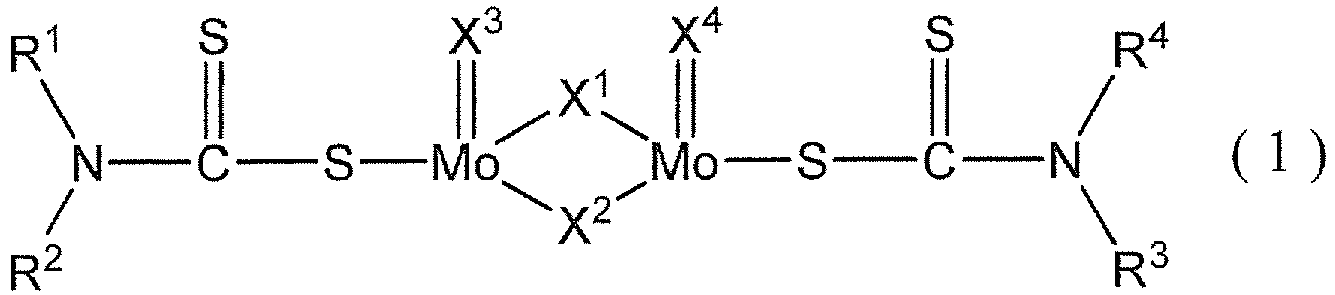
- a grease composition including: a molybdenum compound represented by the following general formula (1); a sulfurized olefin; and a base oil:
- R 1 to R 4 each independently represent an alkyl group having 4 to 18 carbon atoms
- X 1 to X 4 each independently represent an oxygen atom or a sulfur atom
- the grease composition having an excellent load-bearing characteristic can be provided.
- a molybdenum compound to be used in the present invention is represented by the following general formula (1).
- R 1 to R 4 in the general formula (1) each independently represent an alkyl group having 4 to 18 carbon atoms.
- R 1 to R 4 may be identical to or different from each other.
- the alkyl group having 4 to 18 carbon atoms include: linear alkyl groups, such as a n-butyl group, a n-pentyl group, a n-hexyl group, a n-heptyl group, a n-octyl group, a n-nonyl group, a n-decyl group, a n-undecyl group, a n-dodecyl group, a n-tridecyl group, and a n-tetradecyl group; and branched alkyl groups, such as a secondary butyl group, an isobutyl group, a secondary pentyl group, a secondary hexyl group, a secondary heptyl group,
- R 1 to R 4 each independently represent preferably a linear or branched alkyl group having 4 to 14 carbon atoms, more preferably a linear or branched alkyl group having 8 to 13 carbon atoms, still more preferably a linear or branched alkyl group having 8 or 13 carbon atoms.
- X 1 to X 4 in the general formula (1) each independently represent an oxygen atom or a sulfur atom. From the viewpoint of the load-bearing characteristic of the grease composition to be obtained, it is preferred that two or three of X 1 to X 4 represent sulfur atoms, and the others thereof represent oxygen atoms, it is more preferred that two of X 1 to X 4 represent sulfur atoms, and the other two thereof represent oxygen atoms, and it is most preferred that X 1 and X 2 represent sulfur atoms, and X 3 and X 4 represent oxygen atoms.
- the molybdenum compounds each represented by the general formula (1) may be used alone or in combination thereof as the molybdenum compound to be used in the present invention.
- a commercially available product may be used as the molybdenum compound to be used in the present invention, or the compound may be produced by a known production method (e.g., a method described in JP S51-80825 A or JP H08-217782 A ).
- a sulfide of an olefin may be used as a sulfurized olefin to be used in the present invention without any particular limitation, and the sulfide is, for example, a compound (sulfide) obtained by sulfurizing an olefin having 2 to 20 carbon atoms or a dimer to tetramer thereof.
- the sulfurized olefin is preferably a sulfide of an olefin having 2 to 20 carbon atoms, more preferably a sulfide of an olefin having 4 to 12 carbon atoms.
- a sulfur element content in the sulfurized olefin is not particularly limited.
- the sulfur element content in the sulfurized olefin is preferably from 5 mass% to 50 mass%, more preferably from 10 mass% to 45 mass%, still more preferably from 15 mass% to 40 mass%.
- the sulfur element content in the sulfurized olefin is measured by fluorescent X-ray analysis.
- a base oil to be typically used in grease may be used as a base oil to be used in the present invention without any particular limitation.
- a mineral oil, a chemical synthetic base oil, animal and plant base oils, and a mixed base oil thereof may be used.
- the mineral oil include a paraffin-based mineral oil and a naphthene-based mineral oil, and distillate oils, refined oils, treated oils, and the like thereof may also be used.
- Examples of the chemical synthetic base oil include a synthetic hydrocarbon base oil, a monoester, a diester, a polyol ester, an aromatic ester, a silicic acid ester, a polyalkylene glycol, polyphenyl ether, a silicone, a fluorine compound, an alkylbenzene, and a GTL base oil.
- Examples of the synthetic hydrocarbon base oil include: poly- ⁇ -olefins each obtained by polymerizing or oligomerizing 1-butene, 1-hexene, 1-octene, 1-nonene, 1-decene, 1-dodecene, or 1-tetradecene; metallocene poly- ⁇ -olefins each obtained by performing polymerization or oligomerization under a metallocene catalyst; and hydrogenated poly- ⁇ -olefins obtained by hydrogenating those compounds.
- diester examples include diesters of dibasic acids, such as glutaric acid, adipic acid, azelaic acid, sebacic acid, and dodecanedioic acid, and alcohols, such as hexanol, 2-ethylhexanol, octanol, decanol, dodecanol, and tridecanol.
- dibasic acids such as glutaric acid, adipic acid, azelaic acid, sebacic acid, and dodecanedioic acid
- alcohols such as hexanol, 2-ethylhexanol, octanol, decanol, dodecanol, and tridecanol.
- polyol ester examples include esters of polyols, such as neopentyl glycol, trimethylolethane, trimethylolpropane, pentaerythritol, dipentaerythritol, and tripentaerythritol, and fatty acids, such as caproic acid, caprylic acid, 2-ethylhexanoic acid, lauric acid, capric acid, myristic acid, palmitic acid, stearic acid, and oleic acid.
- aromatic ester examples include esters of aromatic compounds, such as phthalic acid, isophthalic acid, trimellitic acid, and pyromellitic acid, and alcohols.
- animal and plant base oils examples include: plant oils and fats, such as castor oil, olive oil, cacao butter, sesame oil, rice bran oil, safflower oil, soybean oil, camellia oil, corn oil, rapeseed oil, palm oil, palm kernel oil, sunflower oil, cotton seed oil, and coconut oil; and animal oils and fats, such as beef tallow, lard, milk fat, fish oil, and whale oil.
- plant oils and fats such as castor oil, olive oil, cacao butter, sesame oil, rice bran oil, safflower oil, soybean oil, camellia oil, corn oil, rapeseed oil, palm oil, palm kernel oil, sunflower oil, cotton seed oil, and coconut oil
- animal oils and fats such as beef tallow, lard, milk fat, fish oil, and whale oil.
- a base oil containing at least one kind selected from the group consisting of: a mineral oil; and a chemical synthetic base oil is preferably used, a base oil containing at least one kind selected from the group consisting of: a paraffin-based mineral oil; a naphthene-based mineral oil; and a synthetic hydrocarbon base oil is more preferably used, and a base oil containing at least one kind selected from the group consisting of: a paraffin-based mineral oil; a naphthene-based mineral oil; polyalphaolein; and a metallocene polyalphaolefin is still more preferably used.
- the viscosity of the base oil to be used is not particularly limited, and may be appropriately adjusted in accordance with purposes.
- a base oil having a kinematic viscosity at 40°C of from 20 cSt to 700 cSt is preferably used
- a base oil having a kinematic viscosity at 40°C of from 40 cSt to 600 cSt is more preferably used
- a base oil having a kinematic viscosity at 40°C of from 50 cSt to 500 cSt is still more preferably used.
- the viscosity of the base oil refers to the viscosity of a mixed base oil obtained by mixing the two or more kinds of base oils.
- the base oil preferably further contains at least one kind of aromatic ester selected from the group consisting of: a trimellitic acid ester; and a pyromellitic acid ester, and the base oil more preferably contains at least one kind selected from the group consisting of: a paraffin-based mineral oil; a naphthene-based mineral oil; and a synthetic hydrocarbon base oil, and at least one kind of aromatic ester selected from the group consisting of: a trimellitic acid ester; and a pyromellitic acid ester.
- trimellitic acid ester out of those aromatic esters include a monoester, a diester, and a triester of trimellitic acid and an alcohol having 4 to 18 carbon atoms
- pyromellitic acid ester examples include a monoester, a diester, a triester, and a tetraester of pyromellitic acid and an alcohol having 4 to 18 carbon atoms.
- the base oil to be used in the present invention contains at least one kind selected from the group consisting of: a paraffin-based mineral oil; a naphthene-based mineral oil; and a synthetic hydrocarbon base oil, and at least one kind of aromatic ester selected from the group consisting of: a trimellitic acid ester; and a pyromellitic acid ester, a ratio between the content of at least one kind selected from the group consisting of: the paraffin-based mineral oil; the naphthene-based mineral oil; and the synthetic hydrocarbon base oil, and the content of at least one kind of aromatic ester selected from the group consisting of: the trimellitic acid ester; and the pyromellitic acid ester is not particularly limited, and may be adjusted in accordance with purposes.
- the ratio between the content of at least one kind selected from the group consisting of: the paraffin-based mineral oil; the naphthene-based mineral oil; and the synthetic hydrocarbon base oil, and the content of at least one kind of aromatic ester selected from the group consisting of: the trimellitic acid ester; and the pyromellitic acid ester is preferably from 50:50 to 99:1, more preferably from 70:30 to 98:2, still more preferably from 80:20 to 97:3 in terms of mass ratio.
- the grease composition of the present invention is a grease composition including the molybdenum compound, the sulfurized olefin, and the base oil described above.
- the content of the molybdenum compound in the grease composition of the present invention is not particularly limited, and may be adjusted in accordance with purposes. However, from the viewpoint of the load-bearing characteristic of the grease composition, the content of the molybdenum compound with respect to the total amount of the grease composition is preferably from 0.10 mass% to 20 mass%, more preferably from 0.20 mass% to 15 mass%, still more preferably from 0.30 mass% to 10 mass%.
- the content of the sulfurized olefin in the grease composition of the present invention is not particularly limited, and may be adjusted in accordance with purposes. However, from the viewpoint of the load-bearing characteristic, the content of the sulfurized olefin with respect to the total amount of the grease composition is preferably from 0.10 mass% to 20 mass%, more preferably from 0.20 mass% to 15 mass%, still more preferably from 0.30 mass% to 10 mass%.
- a ratio between the content of the molybdenum compound and the content of the sulfurized olefin in the grease composition of the present invention is not particularly limited, and may be adjusted in accordance with purposes.
- the ratio between the content of the molybdenum compound and the content of the sulfurized olefin in the grease composition is preferably from 0.1:10 to 10:0.1, more preferably from 1:10 to 10:1, still more preferably from 1:5 to 5:1 in terms of mass ratio.
- the content of the base oil in the grease composition of the present invention is not particularly limited, and may be adjusted in accordance with purposes. However, from the viewpoint of the load-bearing characteristic, the content of the base oil with respect to the total amount of the grease composition is preferably from 50 mass% to 99 mass%, more preferably from 60 mass% to 98 mass%, still more preferably from 70 mass% to 97 mass%.
- the grease composition of the present invention may be blended with any other additive in addition to the molybdenum compound, the sulfurized olefin, and the base oil described above in accordance with purposes.
- the additive that may be blended into the grease composition of the present invention include a thickener, an antiwear additive (excluding the molybdenum compound represented by the general formula (1)), an extreme pressure agent (excluding the sulfurized olefin), a friction modifier, a corrosion inhibitor, a detergent dispersant, an antioxidant, a rust inhibitor, a viscosity index improver, an oiliness agent, a colorant, a surfactant, and a metal deactivator.
- Those additives may be used alone or in combination thereof.
- a known thickener may be used as the thickener without any particular limitation.
- Examples thereof include lithium soap, lithium composite soap, calcium soap, calcium composite soap, and a urea-based compound.
- Those thickeners may be used alone or in combination thereof.
- at least one kind of thickener selected from the group consisting of: the lithium soap; the lithium complex soap; and the urea-based compound is preferably used, and at least one kind of thickener selected from the group consisting of: the lithium soap; and the lithium complex soap is more preferably used.
- the lithium soap is, for example, a lithium salt of a monocarboxylic acid having 12 to 24 carbon atoms.
- the lithium complex soap is, for example, a composite obtained by combining a lithium salt of a monocarboxylic acid having 12 to 24 carbon atoms and a lithium salt of a dicarboxylic acid having 2 to 12 carbon atoms.
- Examples of the urea-based compound include: an aliphatic urea formed of a product of a reaction between an aliphatic amine having 4 to 24 carbon atoms and a diisocyanate; an alicyclic urea formed of a product of a reaction between an alicyclic amine having 6 to 24 carbon atoms and a diisocyanate; an aromatic urea formed of a product of a reaction between an aromatic amine having 6 to 24 carbon atoms and a diisocyanate; and a mixture thereof.
- the content of the thickener is not particularly limited, and may be adjusted in accordance with purposes.
- the content of the thickener with respect to the total amount of the grease composition is preferably from 1.0 mass% to 30 mass%, more preferably from 2.0 mass% to 20 mass%, still more preferably from 3.0 mass% to 15 mass%.
- At least one kind of thickener selected from the group consisting of: the lithium soap; the lithium complex soap; and the urea-based compound is preferably incorporated at from 1.0 mass% to 30 mass%, is more preferably incorporated at from 2.0 mass% to 20 mass%, and is still more preferably incorporated at from 3.0 mass% to 15 mass% with respect to the total amount of the grease composition.
- a known antiwear additive may be used as the antiwear additive without any particular limitation.
- examples thereof include a zinc dialkyldithiophosphate, molybdenum disulfide, a molybdic acid amine salt, polytetrafluoroethylene, chlorinated paraffin, tungsten disulfide, selenium disulfide, graphite fluoride, and zinc oxide.
- Those antiwear additives may be used alone or in combination thereof.
- the zinc dialkyldithiophosphate out of the antiwear additives is, for example, a zinc dialkyldithiophosphate having an alkyl group having 4 to 22 carbon atoms.
- the content of the antiwear additive is not particularly limited, and may be adjusted in accordance with purposes. However, from the viewpoint of the load-bearing property of the grease composition to be obtained, the content of the antiwear additive with respect to the total amount of the grease composition is preferably from 0.10 mass% to 10 mass%, more preferably from 0.20 mass% to 8.0 mass%.
- the zinc dialkyldithiophosphate having alkyl groups each having 4 to 22 carbon atoms be free from being incorporated, or be incorporated at from 0.001 mass% to 3.0 mass% with respect to the total amount of the grease composition.
- the wear resistance of the grease composition to be obtained at high temperature or the corrosion resistance thereof may reduce.
- a known extreme pressure agent may be used as the extreme pressure agent without any particular limitation.
- sulfur-based extreme pressure agents such as a fatty acid sulfide, thiadiazole, and a thioester
- phosphorus-based extreme pressure agents such as a phosphoric acid ester, an acid phosphoric acid ester, an amine salt of an acid phosphoric acid ester, and a phosphorous acid ester.
- Those extreme pressure agents may be used alone or in combination thereof.
- the phosphoric acid ester out of the extreme pressure agents include t-butylphenyldiphenyl phosphate and di-t-butylphenylphenyl phosphate.
- the content of the extreme pressure agent is not particularly limited, and may be adjusted in accordance with purposes. However, from the viewpoint of the load-bearing property of the grease composition to be obtained, the content of the extreme pressure agent with respect to the total amount of the grease composition is preferably from 0.10 mass% to 10 mass%, more preferably from 0.20 mass% to 8.0 mass%.
- the phosphoric acid ester be free from being incorporated, or be incorporated at from 0.001 mass% to 3.0 mass% with respect to the total amount of the grease composition.
- the wear resistance of the grease composition to be obtained at high temperature or the corrosion resistance thereof may reduce.
- a known friction modifier may be used as the friction modifier without any particular limitation.
- examples thereof include a long-chain fatty acid and derivatives thereof, an aliphatic amine or an ethoxylated aliphatic amine, an etheramine, an alkoxylated etheramine, an acylated amine, a tertiary amine, an aliphatic fatty acid amide, an aliphatic carboxylic acid, an aliphatic carboxylic acid ester, a polyol ester, an aliphatic carboxylic acid ester-amide, imidazoline, and an acrylate-based copolymer.
- Those friction modifiers may be used alone or in combination thereof.
- an acrylate-based copolymer including a unit (a) represented by the following general formula (2) and a unit (b) represented by the following general formula (3) at a molar ratio of from 30:70 to 90:10, and having a weight-average molecular weight of from 5,000 to 300,000 is preferably used.
- R 5 in the general formula (2) represents an alkyl group having 4 to 18 carbon atoms.
- Examples of such group include: linear alkyl groups each having 4 to 18 carbon atoms, such as a butyl group, a hexyl group, an octyl group, a decyl group, a dodecyl group, a tetradecyl group, a hexadecyl group, and an octadecyl group; and branched alkyl groups each having 4 to 18 carbon atoms, such as an isobutyl group, an isohexyl group, an isooctyl group, an isodecyl group, an isododecyl group, an isotetradecyl group, an isohexadecyl group, and an isooctadecyl group.
- R 5 in the general formula (2) represents preferably a linear or branched alkyl group having 6 to 16 carbon atoms, more preferably a linear alkyl group having 8 to 16 carbon atoms out of those groups.
- R 6 in the general formula (3) represents an alkylene group having 2 to 4 carbon atoms.
- examples of such group include an ethylene group, a propylene group, an isopropylene group, a butylene group, and an isobutylene group.
- R 6 in the general formula (3) represents preferably an ethylene group, a propylene group, or an isopropylene group, more preferably an ethylene group out of those groups.
- the acrylate-based copolymer that may be suitably used as a friction modifier is an acrylate-based copolymer including the unit (a) represented by the general formula (2) and the unit (b) represented by the general formula (3) at a molar ratio of from 30:70 to 90:10.
- an acrylate-based copolymer including the unit (a) represented by the general formula (2) and the unit (b) represented by the general formula (3) at a molar ratio of from 35:65 to 80:20 is preferred, and an acrylate-based copolymer including the units at a molar ratio of from 40:60 to 70:30 is more preferred.
- the total of the abundance ratios of the unit (a) represented by the general formula (2) and the unit (b) represented by the general formula (3) in all units for forming the acrylate-based copolymer is preferably from 50% to 100%, more preferably from 75% to 100%, still more preferably from 90% to 100%, particularly preferably 100%.
- the acrylate-based copolymer that may be suitably used as a friction modifier is an acrylate-based copolymer having the above-mentioned structure, and having a weight-average molecular weight of from 5,000 to 300,000.
- an acrylate-based copolymer having a weight-average molecular weight of from 10,000 to 250,000 is preferred, and an acrylate-based copolymer having a weight-average molecular weight of from 15,000 to 200,000 is more preferred.
- the above-mentioned acrylate-based copolymer may be produced by a known production method through use of: a monomer that is turned into the unit (a) represented by the general formula (2) by a polymerization reaction; and a monomer that is turned into the unit (b) represented by the general formula (3) by a polymerization reaction.
- the acrylate-based copolymer may be produced by a method including causing one kind or two or more kinds of acrylate monomers each having an alkyl group having 4 to 18 carbon atoms, such as n-butyl acrylate, isobutyl acrylate, n-pentyl acrylate, isopentyl acrylate, n-hexyl acrylate, isohexyl acrylate, n-heptyl acrylate, isoheptyl acrylate, n-octyl acrylate, isooctyl acrylate, ethylhexyl acrylate, n-nonyl acrylate, isononyl acrylate, n-decyl acrylate, isodecyl acrylate, n-dodecyl acrylate, isododecyl acrylate, n-tetradecyl acrylate, is
- the content of the friction modifier is not particularly limited, and may be adjusted in accordance with purposes. However, from the viewpoint of the load-bearing property of the grease composition to be obtained, the content of the friction modifier with respect to the total amount of the grease composition is preferably from 0.10 mass% to 10 mass%, more preferably from 0.20 mass% to 8.0 mass%.
- the above-mentioned acrylate-based copolymer is preferably incorporated at from 0.10 mass% to 10 mass%, is more preferably incorporated at from 0.20 mass% to 8.0 mass%, and is still more preferably incorporated at from 0.30 mass% to 6.0 mass% with respect to the total amount of the grease composition.
- a known corrosion inhibitor may be used as the corrosion inhibitor without any particular limitation.
- Examples thereof include a triazine-based compound, a benzotriazole-based compound, a tolyltriazole-based compound, and a benzimidazole compound.
- Those corrosion inhibitors may be used alone or in combination thereof.
- one or more kinds of corrosion inhibitors selected from the group consisting of: a triazine-based compound; and a benzotriazole-based compound are preferably used.
- benzotriazole-based compound out of those corrosion inhibitors examples include 1,2,3-benzotriazole, 1,H-benzotriazole, 4-methyl-1,H-benzotriazole, 4-carboxyl-1, H-benzotriazole, sodium tolyltriazole, 5-methyl-1,H-benzotriazole, benzotriazole butyl ether, silver benzotriazole, 5-chloro-1,H-benzotriazole, 1-chloro-benzotriazole, 1-di(octyl)aminomethyl-benzotriazole, 2,3-dihydroxypropyl-benzotriazole, 1,2-dicarboxyethyl-benzotriazole, and (octyl)aminomethyl-benzotriazole.
- the content of the corrosion inhibitor is not particularly limited, and may be adjusted in accordance with purposes. However, from the viewpoint of the load-bearing property of the grease composition to be obtained, the content of the corrosion inhibitor with respect to the total amount of the grease composition is preferably from 0.0001 mass% to 1.0 mass%, more preferably from 0.0002 mass% to 0.50 mass%.
- one or more kinds of corrosion inhibitors selected from the group consisting of: the triazine-based compound; and the benzotriazole-based compound are preferably incorporated at from 0.0001 mass% to 1.0 mass%, and are more preferably incorporated at from 0.0002 mass% to 0.50 mass% with respect to the total amount of the grease composition.
- a known detergent dispersant may be used as the detergent dispersant without any particular limitation.
- examples thereof include: an alkaline earth metal-based detergent, such as a sulfonate, a phenate, a salicylate, a phosphonate, or a fatty acid salt of an alkaline earth metal, such as magnesium, calcium, or barium; a succinimide-type dispersant obtained by a condensation reaction between an alkenyl succinic anhydride and a polyamine compound; a succinic acid ester-type dispersant obtained by a condensation reaction between an alkenyl succinic anhydride and a polyol compound; a succinic acid ester amide-type dispersant obtained by a condensation reaction between an alkenyl succinic anhydride and an alkanolamine; a Mannich base-based dispersant obtained by condensing an alkylphenol and a polyamine with formaldehyde; and boric acid-modified products thereof.
- At least one kind of detergent dispersant selected from the group consisting of: basic calcium sulfonate; basic calcium salicylate; a basic fatty acid calcium; basic magnesium sulfonate; basic magnesium salicylate; and a basic fatty acid magnesium is preferably incorporated, and at least one kind of detergent dispersant selected from the group consisting of: basic calcium sulfonate; and basic calcium salicylate is more preferably incorporated.
- the alkaline earth metal-based detergent out of those detergent dispersants is preferably an alkaline earth metal-based detergent having a base number of from 50 mgKOH/g to 600 mgKOH/g, more preferably an alkaline earth metal-based detergent having a base number of from 100 mgKOH/g to 550 mgKOH/g, still more preferably an alkaline earth metal-based detergent having a base number of from 150 mgKOH/g to 500 mgKOH/g.
- At least one kind of basic calcium salt selected from the group consisting of: basic calcium sulfonate having a base number of from 50 mgKOH/g to 600 mgKOH/g; and basic calcium salicylate having a base number of from 50 mgKOH/g to 600 mgKOH/g is preferably used, at least one kind of basic calcium salt selected from the group consisting of: basic calcium sulfonate having a base number of from 100 mgKOH/g to 550 mgKOH/g; and basic calcium salicylate having a base number of from 100 mgKOH/g to 550 mgKOH/g is more preferably used, and at least one kind of basic calcium salt selected from the group consisting of: basic calcium sulfonate having a base number of from 150 mgKOH/g to 500 mgKOH/g; and basic calcium salicylate having a base number of from 150
- the content of the detergent dispersant is not particularly limited, and may be adjusted in accordance with purposes. However, from the viewpoint of the load-bearing property of the grease composition to be obtained, the content of the detergent dispersant with respect to the total amount of the grease composition is preferably from 0.10 mass% to 10 mass%, more preferably from 0.20 mass% to 8.0 mass%.
- At least one kind of detergent dispersant selected from the group consisting of: basic calcium sulfonate; and basic calcium salicylate is preferably incorporated at from 0.10 mass% to 10 mass%, is more preferably incorporated at from 0.20 mass% to 8.0 mass%, is still more preferably incorporated at from 0.30 mass% to 6.0 mass% with respect to the total amount of the grease composition.
- the antioxidant examples include an amine-based antioxidant, a phenol-based antioxidant, a phenothiazine-based antioxidant, and a phosphorous acid ester-based antioxidant. Those antioxidants may be used alone or in combination thereof.
- the content of the antioxidant is not particularly limited, and may be adjusted in accordance with purposes. However, for example, the antioxidant may be incorporated at from 0.10 mass% to 10 mass% with respect to the total amount of the grease composition.
- the rust inhibitor examples include an oxidized paraffin wax calcium salt, an oxidized paraffin wax magnesium salt, a tallow fatty acid alkali metal salt, alkaline earth metal salt, or amine salt, an alkenylsuccinic acid or an alkenylsuccinic acid half ester (the molecular weight of an alkenyl group is from about 100 to about 300), a sorbitan monoester, a pentaerythritol monoester, a glycerin monoester, nonylphenol ethoxylate, a lanolin fatty acid ester, and a lanolin fatty acid calcium salt.
- the rust inhibitors may be used alone or in combination thereof.
- the content of the rust inhibitor is not particularly limited, and may be adjusted in accordance with purposes.
- the rust inhibitor may be incorporated at from 0.10 mass% to 10 mass% with respect to the total amount of the grease composition.
- a glycerin monoester is preferably incorporated as the rust inhibitor, at least one kind selected from the group consisting of: glycerin monooleate; glycerin monostearate; and glycerin monolaurate is more preferably incorporated, and glycerin monooleate is still more preferably incorporated.
- the glycerin monoester is preferably incorporated at from 0.20 mass% to 5.0 mass%, and is more preferably incorporated at from 0.50 mass% to 3.0 mass% with respect to the total amount of the grease composition.
- the viscosity index improver examples include a poly(C1 to 18)alkyl methacrylate, a (C1 to 18)alkyl acrylate/(C1 to 18)alkyl methacrylate copolymer, a diethylaminoethyl methacrylate/(C1 to 18)alkyl methacrylate copolymer, an ethylene/(C1 to 18)alkyl methacrylate copolymer, polyisobutylene, a polyalkylstyrene, an ethylene/propylene copolymer, a styrene/maleic acid ester copolymer, a styrene/maleamide copolymer, a styrene/butadiene hydrogenated copolymer, and a styrene/isoprene hydrogenated copolymer.
- viscosity index improvers may be used alone or in combination thereof.
- the content of the viscosity index improver is not particularly limited, and may be adjusted in accordance with purposes. However, for example, the viscosity index improver may be incorporated at from 0.10 mass% to 10 mass% with respect to the total amount of the grease composition.
- the oiliness improver examples include a fatty acid, an oil and fat, and a hydrogenated product or a partially saponified product thereof, an epoxidized ester, a polycondensate of hydroxystearic acid or an ester of the polycondensate and a fatty acid, a higher alcohol, a higher amide, a glyceride, a polyglycerin ester, a polyglycerin ether, and ⁇ -olefin oxide adducts of those compounds.
- Those oiliness improvers may be used alone or in combination thereof.
- the content of the oiliness improver is not particularly limited, and may be adjusted in accordance with purposes. However, for example, the oiliness improver may be incorporated at from 0.10 mass% to 20 mass% with respect to the total amount of the grease composition.
- the grease composition of the present invention may be used without any particular limitation in applications where grease is used, and the composition may be used in, for example, various sliding members, such as a bearing, a joint, a gear, and a toothed wheel, in a railroad, an aircraft, a ship, a home appliance, an automobile, production equipment, a machine tool, a construction machine, a home appliance, and a precision machine.
- various sliding members such as a bearing, a joint, a gear, and a toothed wheel
- a molybdenum compound, a sulfurized olefin, an acrylate-based copolymer, an extreme pressure agent, a corrosion inhibitor, a rust inhibitor, a detergent dispersant, an antiwear additive, and a base oil used in the present invention are as described below.
- Molybdenum compound 1 molybdenum compound represented by the general formula (1) in which R 1 to R 4 each represent a butyl group, X 1 and X 2 each represent a sulfur atom, and X 3 and X 4 each represent an oxygen atom
- Molybdenum compound 2 molybdenum compound represented by the general formula (1) in which R 1 and R 2 each represent a 2-ethylhexyl group, R 3 and R 4 each represent an isotridecyl group, X 1 and X 2 each represent a sulfur atom, and X 3 and X 4 each represent an oxygen atom
- Sulfurized olefin 1 sulfide of an olefin having 8 carbon atoms (sulfur element content: 30 mass%)
- Acrylate-based copolymer 1 acrylate-based copolymer consisting of a unit (a) represented by the general formula (2) in which R 5 represents a dodecyl group and a unit (b) represented by the general formula (3) in which R 6 represents an ethylene group, having a molar ratio between the unit (a) and the unit (b) of 60:40, and having a weight-average molecular weight of 150,000
- Corrosion inhibitor 1 methyl-1H-benzotriazole
- Rust inhibitor 1 glycerin monooleate
- the molybdenum compound, the sulfurized olefin, the acrylate-based copolymer, the extreme pressure agent, the corrosion inhibitor, the detergent dispersant, the antiwear additive, and the base oil were mixed at mass ratios shown in Tables 1 to 3 to produce grease compositions of Examples 1 to 6 and Comparative Examples 1 to 10.
- Each of the produced grease compositions was subjected to a load-bearing test under a high-load environment on the basis of a method described in ASTM D2596. Specifically, a shell-type high-speed four-ball tester (manufactured by Kobelco Machinery Engineering Co., Ltd.) was used, and a load was increased from an initial load of 100 kgf in increments of 10 kgf under the conditions of the number of revolutions of 1,770 rpm and 27°C ⁇ 8°C, followed by the measurement of the load at which test balls fused to each other as a withstand load. In addition, the composition was evaluated for its load-bearing characteristic on the basis of the measured withstand load and the following evaluation criteria. The evaluation results are shown in Tables 1 to 3.
- the molybdenum compound, the sulfurized olefin, the acrylate-based copolymer, the extreme pressure agent, the corrosion inhibitor, the detergent dispersant, the antiwear additive, and the base oil were mixed at mass ratios shown in Table 4 to produce grease compositions of Examples 7 to 13.
- Each of the produced grease compositions was subjected to a load-bearing test under a high-load environment on the basis of a method described in ASTM D2596. Specifically, a shell-type high-speed four-ball tester (manufactured by Kobelco Machinery Engineering Co., Ltd.) was used, and a load was increased from an initial load of 100 kgf in increments of 10 kgf under the conditions of the number of revolutions of 1,770 rpm and 27°C ⁇ 8°C, followed by the measurement of the load at which test balls fused to each other as a withstand load. In addition, the composition was evaluated for its load-bearing characteristic on the basis of the measured withstand load and the following evaluation criteria. The respective measurement results and evaluation results are shown in Table 4.
- each of the produced grease compositions was subjected to a wear resistance test under a high-load environment in conformity with ASTM D2266. Specifically, the composition was subjected to the test with a shell-type high-speed four-ball tester (manufactured by Kobelco Machinery Engineering Co., Ltd.) under the conditions of 75°C ⁇ 2°C, the number of revolutions of 1,200 rpm, and a test time of 60 minutes, and its wear scar diameter after the test was measured. In addition, the composition was evaluated for its wear-resisting characteristic by the following evaluation criteria on the basis of the measured wear scar diameter. The respective measurement results and evaluation results are shown in Table 4.
- Each of the produced grease compositions was evaluated for its corrosion resistance in conformity with ASTM D4048. Specifically, a washed copper plate was immersed in the grease composition, and was held at 100°C for 24 hours. After that, the copper plate was removed and washed, and then which one of classifications 1a to 4c the color tone of each copper plate after the immersion corresponded to was judged by comparison to a copper plate corrosion standard plate. In addition, the composition was evaluated for its corrosion resistance by the following evaluation criteria on the basis of each judgment result. The respective judgment results and evaluation results are shown in Table 4.
- the molybdenum compound, the sulfurized olefin, the acrylate-based copolymer, the extreme pressure agent, the corrosion inhibitor, the rust inhibitor, the detergent dispersant, and the base oil were mixed at mass ratios shown in Table 5 to produce grease compositions of Examples 14 to 18.
- Each of the produced grease compositions was subjected to a load-bearing test under a high-load environment on the basis of a method described in ASTM D2596. Specifically, a shell-type high-speed four-ball tester (manufactured by Kobelco Machinery Engineering Co., Ltd.) was used, and a load was increased from an initial load of 100 kgf in increments of 10 kgf under the conditions of the number of revolutions of 1,770 rpm and 27°C ⁇ 8°C, followed by the measurement of the load at which test balls fused to each other as a withstand load. In addition, the composition was evaluated for its load-bearing characteristic on the basis of the measured withstand load and the following evaluation criteria. The respective measurement results and evaluation results are shown in Table 5.
- each of the produced grease compositions was subjected to a wear resistance test under a high-load environment in conformity with ASTM D2266. Specifically, the composition was subjected to the test with a shell-type high-speed four-ball tester (manufactured by Kobelco Machinery Engineering Co., Ltd.) under the conditions of 75°C ⁇ 2°C, the number of revolutions of 1,200 rpm, and a test time of 60 minutes, and its wear scar diameter after the test was measured. In addition, the composition was evaluated for its wear-resisting characteristic by the following evaluation criteria on the basis of the measured wear scar diameter. The respective measurement results and evaluation results are shown in Table 5.
- Each of the produced grease compositions was evaluated for its corrosion resistance in conformity with ASTM D4048. Specifically, a washed copper plate was immersed in the grease composition, and was held at 100°C for 24 hours. After that, the copper plate was removed and washed, and then which one of classifications 1a to 4c the color tone of each copper plate after the immersion corresponded to was judged by comparison to a copper plate corrosion standard plate. In addition, the composition was evaluated for its corrosion resistance by the following evaluation criteria on the basis of each judgment result. The respective judgment results and evaluation results are shown in Table 5.
- the grease composition of the present invention was excellent in load-bearing characteristic by including the molybdenum compound represented by the general formula (1), the sulfurized olefin, and the base oil.
- the acrylate-based copolymer, the corrosion inhibitor, or the like was further incorporated, a grease composition excellent in all of a load-bearing property, wear resistance at high temperature, and corrosion resistance was obtained.
Landscapes
- Chemical & Material Sciences (AREA)
- Chemical Kinetics & Catalysis (AREA)
- General Chemical & Material Sciences (AREA)
- Oil, Petroleum & Natural Gas (AREA)
- Organic Chemistry (AREA)
- Lubricants (AREA)
Abstract
Description
- The present invention relates to a grease composition having an excellent load-bearing characteristic.
- In a bearing, a joint, a gear, a toothed wheel, and the like in an automobile, an agricultural machine, an industrial machine, a construction machine, a precision instrument, and the like, various kinds of grease have heretofore been used for lubricating their parts.
- In recent years, along with an increase in output of an apparatus or machinery and a reduction in size thereof, there has been a growing need for grease that properly exhibits its characteristics under a severe environment such as a high load.
- In, for example, Patent Document 1, there is a description that a grease composition including a base oil, a lithium soap-based thickener, a stearic acid metal salt, a molybdenum dialkyldithiocarbamate sulfide, and a zinc dialkyldithiocarbamate sulfide shows an excellent wear-resisting characteristic and excellent actual machine durability. In addition, in Patent Document 2, there is a description of a grease composition including a lubricating oil base oil, a urea-based thickener, a metal dithiocarbamate, and a thiadiazole compound, the composition being usable for a long time period at high temperature and a high load.
- However, even in each of those grease compositions, load-bearing performance has still been insufficient, and hence the development of a grease composition having a more excellent load-bearing characteristic has been required in the market.
-
- Patent Document 1:
JP 2011-079902 A - Patent Document 2:
JP 2018-009101 A - Accordingly, an object of the present invention is to provide a grease composition having an excellent load-bearing characteristic.
- In view of the foregoing, the inventors of the present invention have made extensive investigations, and have found that a grease composition including a specific molybdenum compound, a specific sulfur-based compound, and a base oil has an excellent load-bearing characteristic. Thus, the inventors have completed the present invention. That is, according to one embodiment of the present invention, there is provided a grease composition, including: a molybdenum compound represented by the following general formula (1); a sulfurized olefin; and a base oil:

- where R1 to R4 each independently represent an alkyl group having 4 to 18 carbon atoms, and X1 to X4 each independently represent an oxygen atom or a sulfur atom.
- According to the present invention, the grease composition having an excellent load-bearing characteristic can be provided.
- A molybdenum compound to be used in the present invention is represented by the following general formula (1).
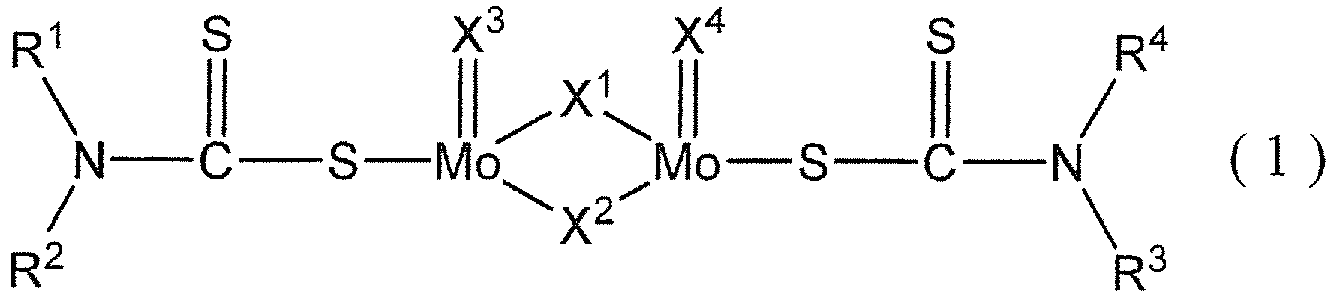
- R1 to R4 in the general formula (1) each independently represent an alkyl group having 4 to 18 carbon atoms. R1 to R4 may be identical to or different from each other. Examples of the alkyl group having 4 to 18 carbon atoms include: linear alkyl groups, such as a n-butyl group, a n-pentyl group, a n-hexyl group, a n-heptyl group, a n-octyl group, a n-nonyl group, a n-decyl group, a n-undecyl group, a n-dodecyl group, a n-tridecyl group, and a n-tetradecyl group; and branched alkyl groups, such as a secondary butyl group, an isobutyl group, a secondary pentyl group, a secondary hexyl group, a secondary heptyl group, a secondary octyl group, an isooctyl group, a 2-ethylhexyl group, a secondary nonyl group, an isononyl group, a secondary decyl group, an isodecyl group, a secondary undecyl group, an isoundecyl group, a secondary dodecyl group, an isododecyl group, a secondary tridecyl group, an isotridecyl group, a secondary tetradecyl group, and an isotetradecyl group. From the viewpoint of the load-bearing characteristic of the grease composition to be obtained, R1 to R4 each independently represent preferably a linear or branched alkyl group having 4 to 14 carbon atoms, more preferably a linear or branched alkyl group having 8 to 13 carbon atoms, still more preferably a linear or branched alkyl group having 8 or 13 carbon atoms.
- X1 to X4 in the general formula (1) each independently represent an oxygen atom or a sulfur atom. From the viewpoint of the load-bearing characteristic of the grease composition to be obtained, it is preferred that two or three of X1 to X4 represent sulfur atoms, and the others thereof represent oxygen atoms, it is more preferred that two of X1 to X4 represent sulfur atoms, and the other two thereof represent oxygen atoms, and it is most preferred that X1 and X2 represent sulfur atoms, and X3 and X4 represent oxygen atoms.
- The molybdenum compounds each represented by the general formula (1) may be used alone or in combination thereof as the molybdenum compound to be used in the present invention. In addition, a commercially available product may be used as the molybdenum compound to be used in the present invention, or the compound may be produced by a known production method (e.g., a method described in
JP S51-80825 A JP H08-217782 A - A sulfide of an olefin may be used as a sulfurized olefin to be used in the present invention without any particular limitation, and the sulfide is, for example, a compound (sulfide) obtained by sulfurizing an olefin having 2 to 20 carbon atoms or a dimer to tetramer thereof. From the viewpoint of the load-bearing characteristic of the grease composition to be obtained, the sulfurized olefin is preferably a sulfide of an olefin having 2 to 20 carbon atoms, more preferably a sulfide of an olefin having 4 to 12 carbon atoms. At this time, a sulfur element content in the sulfurized olefin is not particularly limited. However, from the viewpoint of the load-bearing characteristic of the grease composition to be obtained, the sulfur element content in the sulfurized olefin is preferably from 5 mass% to 50 mass%, more preferably from 10 mass% to 45 mass%, still more preferably from 15 mass% to 40 mass%. In the present invention, the sulfur element content in the sulfurized olefin is measured by fluorescent X-ray analysis.
- A base oil to be typically used in grease may be used as a base oil to be used in the present invention without any particular limitation. For example, a mineral oil, a chemical synthetic base oil, animal and plant base oils, and a mixed base oil thereof may be used. Examples of the mineral oil include a paraffin-based mineral oil and a naphthene-based mineral oil, and distillate oils, refined oils, treated oils, and the like thereof may also be used.
- Examples of the chemical synthetic base oil include a synthetic hydrocarbon base oil, a monoester, a diester, a polyol ester, an aromatic ester, a silicic acid ester, a polyalkylene glycol, polyphenyl ether, a silicone, a fluorine compound, an alkylbenzene, and a GTL base oil. Examples of the synthetic hydrocarbon base oil include: poly-α-olefins each obtained by polymerizing or oligomerizing 1-butene, 1-hexene, 1-octene, 1-nonene, 1-decene, 1-dodecene, or 1-tetradecene; metallocene poly-α-olefins each obtained by performing polymerization or oligomerization under a metallocene catalyst; and hydrogenated poly-α-olefins obtained by hydrogenating those compounds. Examples of the diester include diesters of dibasic acids, such as glutaric acid, adipic acid, azelaic acid, sebacic acid, and dodecanedioic acid, and alcohols, such as hexanol, 2-ethylhexanol, octanol, decanol, dodecanol, and tridecanol. Examples of the polyol ester include esters of polyols, such as neopentyl glycol, trimethylolethane, trimethylolpropane, pentaerythritol, dipentaerythritol, and tripentaerythritol, and fatty acids, such as caproic acid, caprylic acid, 2-ethylhexanoic acid, lauric acid, capric acid, myristic acid, palmitic acid, stearic acid, and oleic acid. Examples of the aromatic ester include esters of aromatic compounds, such as phthalic acid, isophthalic acid, trimellitic acid, and pyromellitic acid, and alcohols.
- Examples of the animal and plant base oils include: plant oils and fats, such as castor oil, olive oil, cacao butter, sesame oil, rice bran oil, safflower oil, soybean oil, camellia oil, corn oil, rapeseed oil, palm oil, palm kernel oil, sunflower oil, cotton seed oil, and coconut oil; and animal oils and fats, such as beef tallow, lard, milk fat, fish oil, and whale oil.
- In the present invention, from the viewpoint of the load-bearing characteristic of the grease composition to be obtained, a base oil containing at least one kind selected from the group consisting of: a mineral oil; and a chemical synthetic base oil is preferably used, a base oil containing at least one kind selected from the group consisting of: a paraffin-based mineral oil; a naphthene-based mineral oil; and a synthetic hydrocarbon base oil is more preferably used, and a base oil containing at least one kind selected from the group consisting of: a paraffin-based mineral oil; a naphthene-based mineral oil; polyalphaolein; and a metallocene polyalphaolefin is still more preferably used.
- In the present invention, the viscosity of the base oil to be used is not particularly limited, and may be appropriately adjusted in accordance with purposes. However, from the viewpoint of the load-bearing characteristic of the grease composition to be obtained, for example, a base oil having a kinematic viscosity at 40°C of from 20 cSt to 700 cSt is preferably used, a base oil having a kinematic viscosity at 40°C of from 40 cSt to 600 cSt is more preferably used, and a base oil having a kinematic viscosity at 40°C of from 50 cSt to 500 cSt is still more preferably used. In the present invention, when two or more kinds of base oils are used, the viscosity of the base oil refers to the viscosity of a mixed base oil obtained by mixing the two or more kinds of base oils.
- In addition, in the present invention, from the viewpoints of the load-bearing property of the grease composition to be obtained, the wear resistance thereof at high temperature, and the corrosion resistance thereof, the base oil preferably further contains at least one kind of aromatic ester selected from the group consisting of: a trimellitic acid ester; and a pyromellitic acid ester, and the base oil more preferably contains at least one kind selected from the group consisting of: a paraffin-based mineral oil; a naphthene-based mineral oil; and a synthetic hydrocarbon base oil, and at least one kind of aromatic ester selected from the group consisting of: a trimellitic acid ester; and a pyromellitic acid ester. Examples of the trimellitic acid ester out of those aromatic esters include a monoester, a diester, and a triester of trimellitic acid and an alcohol having 4 to 18 carbon atoms, and examples of the pyromellitic acid ester include a monoester, a diester, a triester, and a tetraester of pyromellitic acid and an alcohol having 4 to 18 carbon atoms. Of those, from the viewpoints of the load-bearing property of the grease composition to be obtained, the wear resistance thereof at high temperature, and the corrosion resistance thereof, at least one kind selected from the group consisting of: a triester of trimellitic acid and an alcohol having 4 to 18 carbon atoms; and a tetraester of pyromellitic acid and an alcohol having 4 to 18 carbon atoms is preferably used as the aromatic ester, and a triester of trimellitic acid and an alcohol having 4 to 18 carbon atoms is more preferably used.
- When the base oil to be used in the present invention contains at least one kind selected from the group consisting of: a paraffin-based mineral oil; a naphthene-based mineral oil; and a synthetic hydrocarbon base oil, and at least one kind of aromatic ester selected from the group consisting of: a trimellitic acid ester; and a pyromellitic acid ester, a ratio between the content of at least one kind selected from the group consisting of: the paraffin-based mineral oil; the naphthene-based mineral oil; and the synthetic hydrocarbon base oil, and the content of at least one kind of aromatic ester selected from the group consisting of: the trimellitic acid ester; and the pyromellitic acid ester is not particularly limited, and may be adjusted in accordance with purposes. However, from the viewpoints of the load-bearing property of the grease composition to be obtained, the wear resistance thereof at high temperature, and the corrosion resistance thereof, the ratio between the content of at least one kind selected from the group consisting of: the paraffin-based mineral oil; the naphthene-based mineral oil; and the synthetic hydrocarbon base oil, and the content of at least one kind of aromatic ester selected from the group consisting of: the trimellitic acid ester; and the pyromellitic acid ester is preferably from 50:50 to 99:1, more preferably from 70:30 to 98:2, still more preferably from 80:20 to 97:3 in terms of mass ratio.
- The grease composition of the present invention is a grease composition including the molybdenum compound, the sulfurized olefin, and the base oil described above. The content of the molybdenum compound in the grease composition of the present invention is not particularly limited, and may be adjusted in accordance with purposes. However, from the viewpoint of the load-bearing characteristic of the grease composition, the content of the molybdenum compound with respect to the total amount of the grease composition is preferably from 0.10 mass% to 20 mass%, more preferably from 0.20 mass% to 15 mass%, still more preferably from 0.30 mass% to 10 mass%.
- The content of the sulfurized olefin in the grease composition of the present invention is not particularly limited, and may be adjusted in accordance with purposes. However, from the viewpoint of the load-bearing characteristic, the content of the sulfurized olefin with respect to the total amount of the grease composition is preferably from 0.10 mass% to 20 mass%, more preferably from 0.20 mass% to 15 mass%, still more preferably from 0.30 mass% to 10 mass%.
- A ratio between the content of the molybdenum compound and the content of the sulfurized olefin in the grease composition of the present invention is not particularly limited, and may be adjusted in accordance with purposes. However, from the viewpoint of the load-bearing characteristic, the ratio between the content of the molybdenum compound and the content of the sulfurized olefin in the grease composition is preferably from 0.1:10 to 10:0.1, more preferably from 1:10 to 10:1, still more preferably from 1:5 to 5:1 in terms of mass ratio.
- The content of the base oil in the grease composition of the present invention is not particularly limited, and may be adjusted in accordance with purposes. However, from the viewpoint of the load-bearing characteristic, the content of the base oil with respect to the total amount of the grease composition is preferably from 50 mass% to 99 mass%, more preferably from 60 mass% to 98 mass%, still more preferably from 70 mass% to 97 mass%.
- The grease composition of the present invention may be blended with any other additive in addition to the molybdenum compound, the sulfurized olefin, and the base oil described above in accordance with purposes. Examples of the additive that may be blended into the grease composition of the present invention include a thickener, an antiwear additive (excluding the molybdenum compound represented by the general formula (1)), an extreme pressure agent (excluding the sulfurized olefin), a friction modifier, a corrosion inhibitor, a detergent dispersant, an antioxidant, a rust inhibitor, a viscosity index improver, an oiliness agent, a colorant, a surfactant, and a metal deactivator. Those additives may be used alone or in combination thereof.
- A known thickener may be used as the thickener without any particular limitation. Examples thereof include lithium soap, lithium composite soap, calcium soap, calcium composite soap, and a urea-based compound. Those thickeners may be used alone or in combination thereof. Of those, from the viewpoints of the load-bearing characteristic of the grease composition to be obtained, the wear resistance thereof at high temperature, and the corrosion resistance thereof, at least one kind of thickener selected from the group consisting of: the lithium soap; the lithium complex soap; and the urea-based compound is preferably used, and at least one kind of thickener selected from the group consisting of: the lithium soap; and the lithium complex soap is more preferably used. The lithium soap is, for example, a lithium salt of a monocarboxylic acid having 12 to 24 carbon atoms. The lithium complex soap is, for example, a composite obtained by combining a lithium salt of a monocarboxylic acid having 12 to 24 carbon atoms and a lithium salt of a dicarboxylic acid having 2 to 12 carbon atoms. Examples of the urea-based compound include: an aliphatic urea formed of a product of a reaction between an aliphatic amine having 4 to 24 carbon atoms and a diisocyanate; an alicyclic urea formed of a product of a reaction between an alicyclic amine having 6 to 24 carbon atoms and a diisocyanate; an aromatic urea formed of a product of a reaction between an aromatic amine having 6 to 24 carbon atoms and a diisocyanate; and a mixture thereof.
- When the grease composition of the present invention includes the thickener, the content of the thickener is not particularly limited, and may be adjusted in accordance with purposes. However, from the viewpoint of the load-bearing property of the grease composition to be obtained, the content of the thickener with respect to the total amount of the grease composition is preferably from 1.0 mass% to 30 mass%, more preferably from 2.0 mass% to 20 mass%, still more preferably from 3.0 mass% to 15 mass%.
- In addition, in the present invention, from the viewpoints of the load-bearing property of the grease composition to be obtained, the wear resistance thereof at high temperature, and the corrosion resistance thereof, at least one kind of thickener selected from the group consisting of: the lithium soap; the lithium complex soap; and the urea-based compound is preferably incorporated at from 1.0 mass% to 30 mass%, is more preferably incorporated at from 2.0 mass% to 20 mass%, and is still more preferably incorporated at from 3.0 mass% to 15 mass% with respect to the total amount of the grease composition.
- A known antiwear additive may be used as the antiwear additive without any particular limitation. Examples thereof include a zinc dialkyldithiophosphate, molybdenum disulfide, a molybdic acid amine salt, polytetrafluoroethylene, chlorinated paraffin, tungsten disulfide, selenium disulfide, graphite fluoride, and zinc oxide. Those antiwear additives may be used alone or in combination thereof. The zinc dialkyldithiophosphate out of the antiwear additives is, for example, a zinc dialkyldithiophosphate having an alkyl group having 4 to 22 carbon atoms.
- When the grease composition of the present invention includes the antiwear additive, the content of the antiwear additive is not particularly limited, and may be adjusted in accordance with purposes. However, from the viewpoint of the load-bearing property of the grease composition to be obtained, the content of the antiwear additive with respect to the total amount of the grease composition is preferably from 0.10 mass% to 10 mass%, more preferably from 0.20 mass% to 8.0 mass%.
- In addition, in the present invention, from the viewpoints of the wear resistance of the grease composition to be obtained at high temperature and the corrosion resistance thereof, it is preferred that the zinc dialkyldithiophosphate having alkyl groups each having 4 to 22 carbon atoms be free from being incorporated, or be incorporated at from 0.001 mass% to 3.0 mass% with respect to the total amount of the grease composition. In the present invention, when the content of the zinc dialkyldithiophosphate is more than 3.0 mass%, the wear resistance of the grease composition to be obtained at high temperature or the corrosion resistance thereof may reduce.
- A known extreme pressure agent (excluding the sulfurized olefin) may be used as the extreme pressure agent without any particular limitation. Examples thereof include: sulfur-based extreme pressure agents, such as a fatty acid sulfide, thiadiazole, and a thioester; and phosphorus-based extreme pressure agents, such as a phosphoric acid ester, an acid phosphoric acid ester, an amine salt of an acid phosphoric acid ester, and a phosphorous acid ester. Those extreme pressure agents may be used alone or in combination thereof. Examples of the phosphoric acid ester out of the extreme pressure agents include t-butylphenyldiphenyl phosphate and di-t-butylphenylphenyl phosphate.
- When the grease composition of the present invention includes the extreme pressure agent, the content of the extreme pressure agent is not particularly limited, and may be adjusted in accordance with purposes. However, from the viewpoint of the load-bearing property of the grease composition to be obtained, the content of the extreme pressure agent with respect to the total amount of the grease composition is preferably from 0.10 mass% to 10 mass%, more preferably from 0.20 mass% to 8.0 mass%.
- In addition, in the present invention, from the viewpoints of the wear resistance of the grease composition to be obtained at high temperature and the corrosion resistance thereof, it is preferred that the phosphoric acid ester be free from being incorporated, or be incorporated at from 0.001 mass% to 3.0 mass% with respect to the total amount of the grease composition. In the present invention, when the content of the phosphoric acid ester is more than 3.0 mass%, the wear resistance of the grease composition to be obtained at high temperature or the corrosion resistance thereof may reduce.
- A known friction modifier may be used as the friction modifier without any particular limitation. Examples thereof include a long-chain fatty acid and derivatives thereof, an aliphatic amine or an ethoxylated aliphatic amine, an etheramine, an alkoxylated etheramine, an acylated amine, a tertiary amine, an aliphatic fatty acid amide, an aliphatic carboxylic acid, an aliphatic carboxylic acid ester, a polyol ester, an aliphatic carboxylic acid ester-amide, imidazoline, and an acrylate-based copolymer. Those friction modifiers may be used alone or in combination thereof.
- In the present invention, of those, an acrylate-based copolymer including a unit (a) represented by the following general formula (2) and a unit (b) represented by the following general formula (3) at a molar ratio of from 30:70 to 90:10, and having a weight-average molecular weight of from 5,000 to 300,000 is preferably used.

- R5 in the general formula (2) represents an alkyl group having 4 to 18 carbon atoms. Examples of such group include: linear alkyl groups each having 4 to 18 carbon atoms, such as a butyl group, a hexyl group, an octyl group, a decyl group, a dodecyl group, a tetradecyl group, a hexadecyl group, and an octadecyl group; and branched alkyl groups each having 4 to 18 carbon atoms, such as an isobutyl group, an isohexyl group, an isooctyl group, an isodecyl group, an isododecyl group, an isotetradecyl group, an isohexadecyl group, and an isooctadecyl group. From the viewpoints of the load-bearing property of the grease composition to be obtained, the wear resistance thereof at high temperature, and the corrosion resistance thereof, R5 in the general formula (2) represents preferably a linear or branched alkyl group having 6 to 16 carbon atoms, more preferably a linear alkyl group having 8 to 16 carbon atoms out of those groups.

- R6 in the general formula (3) represents an alkylene group having 2 to 4 carbon atoms. Examples of such group include an ethylene group, a propylene group, an isopropylene group, a butylene group, and an isobutylene group. From the viewpoints of the load-bearing property of the grease composition to be obtained, the wear resistance thereof at high temperature, and the corrosion resistance thereof, R6 in the general formula (3) represents preferably an ethylene group, a propylene group, or an isopropylene group, more preferably an ethylene group out of those groups.
- In the present invention, the acrylate-based copolymer that may be suitably used as a friction modifier is an acrylate-based copolymer including the unit (a) represented by the general formula (2) and the unit (b) represented by the general formula (3) at a molar ratio of from 30:70 to 90:10. Of such copolymers, from the viewpoints of the load-bearing property of the grease composition to be obtained, the wear resistance thereof at high temperature, and the corrosion resistance thereof, an acrylate-based copolymer including the unit (a) represented by the general formula (2) and the unit (b) represented by the general formula (3) at a molar ratio of from 35:65 to 80:20 is preferred, and an acrylate-based copolymer including the units at a molar ratio of from 40:60 to 70:30 is more preferred. In addition, from the viewpoints of the load-bearing property of the grease composition to be obtained, the wear resistance thereof at high temperature, and the corrosion resistance thereof, the total of the abundance ratios of the unit (a) represented by the general formula (2) and the unit (b) represented by the general formula (3) in all units for forming the acrylate-based copolymer is preferably from 50% to 100%, more preferably from 75% to 100%, still more preferably from 90% to 100%, particularly preferably 100%.
- In addition, in the present invention, the acrylate-based copolymer that may be suitably used as a friction modifier is an acrylate-based copolymer having the above-mentioned structure, and having a weight-average molecular weight of from 5,000 to 300,000. Of such copolymers, from the viewpoints of the load-bearing property of the grease composition to be obtained, the wear resistance thereof at high temperature, and the corrosion resistance thereof, an acrylate-based copolymer having a weight-average molecular weight of from 10,000 to 250,000 is preferred, and an acrylate-based copolymer having a weight-average molecular weight of from 15,000 to 200,000 is more preferred.
- The above-mentioned acrylate-based copolymer may be produced by a known production method through use of: a monomer that is turned into the unit (a) represented by the general formula (2) by a polymerization reaction; and a monomer that is turned into the unit (b) represented by the general formula (3) by a polymerization reaction. As such method, for example, the acrylate-based copolymer may be produced by a method including causing one kind or two or more kinds of acrylate monomers each having an alkyl group having 4 to 18 carbon atoms, such as n-butyl acrylate, isobutyl acrylate, n-pentyl acrylate, isopentyl acrylate, n-hexyl acrylate, isohexyl acrylate, n-heptyl acrylate, isoheptyl acrylate, n-octyl acrylate, isooctyl acrylate, ethylhexyl acrylate, n-nonyl acrylate, isononyl acrylate, n-decyl acrylate, isodecyl acrylate, n-dodecyl acrylate, isododecyl acrylate, n-tetradecyl acrylate, isotetradecyl acrylate, n-hexadecyl acrylate, isohexadecyl acrylate, n-octadecyl acrylate, and isooctadecyl acrylate, the copolymers each serving as the monomer that is turned into the unit (a) represented by the general formula (2) by the polymerization reaction in the copolymer, and one kind or two or more kinds of hydroxyalkyl acrylate monomers, such as 2-hydroxyethyl acrylate, 2-hydroxypropyl acrylate, 3-hydroxypropyl acrylate, 2-hydroxybutyl acrylate, and 4-hydroxybutyl acrylate, the copolymers each serving as the monomer that is turned into the unit (b) represented by the general formula (3) by the polymerization reaction in the copolymer, to react with each other in such an amount that a molar ratio therebetween is from 30:70 to 90:10 through use of a reaction initiator, a catalyst, a solvent, or the like as required at from room temperature to 150°C for from 10 minutes to 48 hours so as to achieve a weight-average molecular weight of 5,000 to 300,000.
- When the grease composition of the present invention includes the friction modifier, the content of the friction modifier is not particularly limited, and may be adjusted in accordance with purposes. However, from the viewpoint of the load-bearing property of the grease composition to be obtained, the content of the friction modifier with respect to the total amount of the grease composition is preferably from 0.10 mass% to 10 mass%, more preferably from 0.20 mass% to 8.0 mass%.
- In addition, in the present invention, from the viewpoints of the load-bearing property of the grease composition to be obtained, the wear resistance thereof at high temperature, and the corrosion resistance thereof, the above-mentioned acrylate-based copolymer is preferably incorporated at from 0.10 mass% to 10 mass%, is more preferably incorporated at from 0.20 mass% to 8.0 mass%, and is still more preferably incorporated at from 0.30 mass% to 6.0 mass% with respect to the total amount of the grease composition.
- A known corrosion inhibitor may be used as the corrosion inhibitor without any particular limitation. Examples thereof include a triazine-based compound, a benzotriazole-based compound, a tolyltriazole-based compound, and a benzimidazole compound. Those corrosion inhibitors may be used alone or in combination thereof. Of those, from the viewpoints of the load-bearing property of the grease composition to be obtained, the wear resistance thereof at high temperature, and the corrosion resistance thereof, one or more kinds of corrosion inhibitors selected from the group consisting of: a triazine-based compound; and a benzotriazole-based compound are preferably used. Examples of the benzotriazole-based compound out of those corrosion inhibitors include 1,2,3-benzotriazole, 1,H-benzotriazole, 4-methyl-1,H-benzotriazole, 4-carboxyl-1, H-benzotriazole, sodium tolyltriazole, 5-methyl-1,H-benzotriazole, benzotriazole butyl ether, silver benzotriazole, 5-chloro-1,H-benzotriazole, 1-chloro-benzotriazole, 1-di(octyl)aminomethyl-benzotriazole, 2,3-dihydroxypropyl-benzotriazole, 1,2-dicarboxyethyl-benzotriazole, and (octyl)aminomethyl-benzotriazole.
- When the grease composition of the present invention includes the corrosion inhibitor, the content of the corrosion inhibitor is not particularly limited, and may be adjusted in accordance with purposes. However, from the viewpoint of the load-bearing property of the grease composition to be obtained, the content of the corrosion inhibitor with respect to the total amount of the grease composition is preferably from 0.0001 mass% to 1.0 mass%, more preferably from 0.0002 mass% to 0.50 mass%.
- In addition, in the present invention, from the viewpoints of the load-bearing property of the grease composition to be obtained, the wear resistance thereof at high temperature, and the corrosion resistance thereof, one or more kinds of corrosion inhibitors selected from the group consisting of: the triazine-based compound; and the benzotriazole-based compound are preferably incorporated at from 0.0001 mass% to 1.0 mass%, and are more preferably incorporated at from 0.0002 mass% to 0.50 mass% with respect to the total amount of the grease composition.
- A known detergent dispersant may be used as the detergent dispersant without any particular limitation. Examples thereof include: an alkaline earth metal-based detergent, such as a sulfonate, a phenate, a salicylate, a phosphonate, or a fatty acid salt of an alkaline earth metal, such as magnesium, calcium, or barium; a succinimide-type dispersant obtained by a condensation reaction between an alkenyl succinic anhydride and a polyamine compound; a succinic acid ester-type dispersant obtained by a condensation reaction between an alkenyl succinic anhydride and a polyol compound; a succinic acid ester amide-type dispersant obtained by a condensation reaction between an alkenyl succinic anhydride and an alkanolamine; a Mannich base-based dispersant obtained by condensing an alkylphenol and a polyamine with formaldehyde; and boric acid-modified products thereof. Of those, from the viewpoints of the load-bearing property of the grease composition to be obtained, the wear resistance thereof at high temperature, and the corrosion resistance thereof, at least one kind of detergent dispersant selected from the group consisting of: basic calcium sulfonate; basic calcium salicylate; a basic fatty acid calcium; basic magnesium sulfonate; basic magnesium salicylate; and a basic fatty acid magnesium is preferably incorporated, and at least one kind of detergent dispersant selected from the group consisting of: basic calcium sulfonate; and basic calcium salicylate is more preferably incorporated. From the viewpoints of the load-bearing property of the grease composition to be obtained, the wear resistance thereof at high temperature, and the corrosion resistance thereof, the alkaline earth metal-based detergent out of those detergent dispersants is preferably an alkaline earth metal-based detergent having a base number of from 50 mgKOH/g to 600 mgKOH/g, more preferably an alkaline earth metal-based detergent having a base number of from 100 mgKOH/g to 550 mgKOH/g, still more preferably an alkaline earth metal-based detergent having a base number of from 150 mgKOH/g to 500 mgKOH/g. In the present invention, from the viewpoint of particularly improving the load-bearing property of the grease composition to be obtained, the wear resistance thereof at high temperature, and the corrosion resistance thereof, at least one kind of basic calcium salt selected from the group consisting of: basic calcium sulfonate having a base number of from 50 mgKOH/g to 600 mgKOH/g; and basic calcium salicylate having a base number of from 50 mgKOH/g to 600 mgKOH/g is preferably used, at least one kind of basic calcium salt selected from the group consisting of: basic calcium sulfonate having a base number of from 100 mgKOH/g to 550 mgKOH/g; and basic calcium salicylate having a base number of from 100 mgKOH/g to 550 mgKOH/g is more preferably used, and at least one kind of basic calcium salt selected from the group consisting of: basic calcium sulfonate having a base number of from 150 mgKOH/g to 500 mgKOH/g; and basic calcium salicylate having a base number of from 150 mgKOH/g to 500 mgKOH/g is still more preferably used.
- When the grease composition of the present invention includes the detergent dispersant, the content of the detergent dispersant is not particularly limited, and may be adjusted in accordance with purposes. However, from the viewpoint of the load-bearing property of the grease composition to be obtained, the content of the detergent dispersant with respect to the total amount of the grease composition is preferably from 0.10 mass% to 10 mass%, more preferably from 0.20 mass% to 8.0 mass%.
- In addition, in the present invention, from the viewpoints of the load-bearing property of the grease composition to be obtained, the wear resistance thereof at high temperature, and the corrosion resistance thereof, at least one kind of detergent dispersant selected from the group consisting of: basic calcium sulfonate; and basic calcium salicylate is preferably incorporated at from 0.10 mass% to 10 mass%, is more preferably incorporated at from 0.20 mass% to 8.0 mass%, is still more preferably incorporated at from 0.30 mass% to 6.0 mass% with respect to the total amount of the grease composition.
- Examples of the antioxidant include an amine-based antioxidant, a phenol-based antioxidant, a phenothiazine-based antioxidant, and a phosphorous acid ester-based antioxidant. Those antioxidants may be used alone or in combination thereof. When the grease composition of the present invention includes the antioxidant, the content of the antioxidant is not particularly limited, and may be adjusted in accordance with purposes. However, for example, the antioxidant may be incorporated at from 0.10 mass% to 10 mass% with respect to the total amount of the grease composition.
- Examples of the rust inhibitor include an oxidized paraffin wax calcium salt, an oxidized paraffin wax magnesium salt, a tallow fatty acid alkali metal salt, alkaline earth metal salt, or amine salt, an alkenylsuccinic acid or an alkenylsuccinic acid half ester (the molecular weight of an alkenyl group is from about 100 to about 300), a sorbitan monoester, a pentaerythritol monoester, a glycerin monoester, nonylphenol ethoxylate, a lanolin fatty acid ester, and a lanolin fatty acid calcium salt. The rust inhibitors may be used alone or in combination thereof. When the grease composition of the present invention includes the rust inhibitor, the content of the rust inhibitor is not particularly limited, and may be adjusted in accordance with purposes. However, for example, the rust inhibitor may be incorporated at from 0.10 mass% to 10 mass% with respect to the total amount of the grease composition.
- In addition, in the present invention, from the viewpoints of the load-bearing property of the grease composition to be obtained, the wear resistance thereof at high temperature, and the corrosion resistance thereof, a glycerin monoester is preferably incorporated as the rust inhibitor, at least one kind selected from the group consisting of: glycerin monooleate; glycerin monostearate; and glycerin monolaurate is more preferably incorporated, and glycerin monooleate is still more preferably incorporated. At this time, from the viewpoints of the load-bearing property of the grease composition to be obtained, the wear resistance thereof at high temperature, and the corrosion resistance thereof, the glycerin monoester is preferably incorporated at from 0.20 mass% to 5.0 mass%, and is more preferably incorporated at from 0.50 mass% to 3.0 mass% with respect to the total amount of the grease composition.
- Examples of the viscosity index improver include a poly(C1 to 18)alkyl methacrylate, a (C1 to 18)alkyl acrylate/(C1 to 18)alkyl methacrylate copolymer, a diethylaminoethyl methacrylate/(C1 to 18)alkyl methacrylate copolymer, an ethylene/(C1 to 18)alkyl methacrylate copolymer, polyisobutylene, a polyalkylstyrene, an ethylene/propylene copolymer, a styrene/maleic acid ester copolymer, a styrene/maleamide copolymer, a styrene/butadiene hydrogenated copolymer, and a styrene/isoprene hydrogenated copolymer. Those viscosity index improvers may be used alone or in combination thereof. When the grease composition of the present invention includes the viscosity index improver, the content of the viscosity index improver is not particularly limited, and may be adjusted in accordance with purposes. However, for example, the viscosity index improver may be incorporated at from 0.10 mass% to 10 mass% with respect to the total amount of the grease composition.
- Examples of the oiliness improver include a fatty acid, an oil and fat, and a hydrogenated product or a partially saponified product thereof, an epoxidized ester, a polycondensate of hydroxystearic acid or an ester of the polycondensate and a fatty acid, a higher alcohol, a higher amide, a glyceride, a polyglycerin ester, a polyglycerin ether, and α-olefin oxide adducts of those compounds. Those oiliness improvers may be used alone or in combination thereof. When the grease composition of the present invention includes the oiliness improver, the content of the oiliness improver is not particularly limited, and may be adjusted in accordance with purposes. However, for example, the oiliness improver may be incorporated at from 0.10 mass% to 20 mass% with respect to the total amount of the grease composition.
- The grease composition of the present invention may be used without any particular limitation in applications where grease is used, and the composition may be used in, for example, various sliding members, such as a bearing, a joint, a gear, and a toothed wheel, in a railroad, an aircraft, a ship, a home appliance, an automobile, production equipment, a machine tool, a construction machine, a home appliance, and a precision machine.
- The present invention is more specifically described below by way of Examples. In the following Examples, the term "%" is by mass unless otherwise stated.
- A molybdenum compound, a sulfurized olefin, an acrylate-based copolymer, an extreme pressure agent, a corrosion inhibitor, a rust inhibitor, a detergent dispersant, an antiwear additive, and a base oil used in the present invention are as described below.
- Molybdenum compound 1: molybdenum compound represented by the general formula (1) in which R1 to R4 each represent a butyl group, X1 and X2 each represent a sulfur atom, and X3 and X4 each represent an oxygen atom
- Molybdenum compound 2: molybdenum compound represented by the general formula (1) in which R1 and R2 each represent a 2-ethylhexyl group, R3 and R4 each represent an isotridecyl group, X1 and X2 each represent a sulfur atom, and X3 and X4 each represent an oxygen atom
- Sulfurized olefin 1: sulfide of an olefin having 8 carbon atoms (sulfur element content: 30 mass%)
- Acrylate-based copolymer 1: acrylate-based copolymer consisting of a unit (a) represented by the general formula (2) in which R5 represents a dodecyl group and a unit (b) represented by the general formula (3) in which R6 represents an ethylene group, having a molar ratio between the unit (a) and the unit (b) of 60:40, and having a weight-average molecular weight of 150,000
- Extreme pressure agent 1: t-butylphenyldiphenyl phosphate
- Corrosion inhibitor 1: methyl-1H-benzotriazole
- Rust inhibitor 1: glycerin monooleate
-
- Detergent dispersant 1: basic calcium sulfonate having a base number of 400 mgKOH/g
- Detergent dispersant 2: basic calcium salicylate having a base number of 170 mgKOH/g
-
- Antiwear additive 1: molybdic acid diisotridecylamine salt
- Antiwear additive 2: zinc didodecyldithiophosphate
-
- Base oil 1: mixture of 90 mass% of a naphthene-based mineral oil (base oil) having a kinematic viscosity at 40°C of 130 cSt and 10 mass% of lithium 12-hydroxystearate (thickener)
- Base oil 2: tris(2-ethylhexyl) trimellitate
- Base oil 3: mixture of 88 mass% of a poly-α-olefin (base oil) having a kinematic viscosity at 40°C of 65 cSt and 12 mass% of lithium 12-hydroxystearate (thickener)
- Base oil 4: mixture of 88 mass% of a mixed base oil having a kinematic viscosity at 40°C of 320 cSt (mixed base oil formed of 14.5 mass% of a poly-α-olefin having a kinematic viscosity at 40°C of 18 cSt and 85.5 mass% of a metallocene poly-α-olefin having a kinematic viscosity at 40°C of 602 cSt) and 12 mass% of lithium 12-hydroxystearate (thickener)
- Base oil 5: mixture of 88 mass% of a mixed base oil having a kinematic viscosity at 40°C of 460 cSt (mixed base oil formed of 6.0 mass% of a poly-α-olefin having a kinematic viscosity at 40°C of 18 cSt and 94.0 mass% of a metallocene poly-α-olefin having a kinematic viscosity at 40°C of 602 cSt) and 12 mass% of lithium 12-hydroxystearate (thickener)
- The molybdenum compound, the sulfurized olefin, the acrylate-based copolymer, the extreme pressure agent, the corrosion inhibitor, the detergent dispersant, the antiwear additive, and the base oil were mixed at mass ratios shown in Tables 1 to 3 to produce grease compositions of Examples 1 to 6 and Comparative Examples 1 to 10.
- Each of the produced grease compositions was subjected to a load-bearing test under a high-load environment on the basis of a method described in ASTM D2596. Specifically, a shell-type high-speed four-ball tester (manufactured by Kobelco Machinery Engineering Co., Ltd.) was used, and a load was increased from an initial load of 100 kgf in increments of 10 kgf under the conditions of the number of revolutions of 1,770 rpm and 27°C±8°C, followed by the measurement of the load at which test balls fused to each other as a withstand load. In addition, the composition was evaluated for its load-bearing characteristic on the basis of the measured withstand load and the following evaluation criteria. The evaluation results are shown in Tables 1 to 3.
-
- ⊚: The withstand load is 450 kgf or more.
- ∘: The withstand load is 400 kgf or more and less than 450 kgf.
- Δ: The withstand load is 320 kgf or more and less than 400 kgf.
- ×: The withstand load is less than 320 kgf.
- The molybdenum compound, the sulfurized olefin, the acrylate-based copolymer, the extreme pressure agent, the corrosion inhibitor, the detergent dispersant, the antiwear additive, and the base oil were mixed at mass ratios shown in Table 4 to produce grease compositions of Examples 7 to 13.
- Each of the produced grease compositions was subjected to a load-bearing test under a high-load environment on the basis of a method described in ASTM D2596. Specifically, a shell-type high-speed four-ball tester (manufactured by Kobelco Machinery Engineering Co., Ltd.) was used, and a load was increased from an initial load of 100 kgf in increments of 10 kgf under the conditions of the number of revolutions of 1,770 rpm and 27°C±8°C, followed by the measurement of the load at which test balls fused to each other as a withstand load. In addition, the composition was evaluated for its load-bearing characteristic on the basis of the measured withstand load and the following evaluation criteria. The respective measurement results and evaluation results are shown in Table 4.
-
- ⊚: The withstand load is 450 kgf or more.
- ∘: The withstand load is 400 kgf or more and less than 450 kgf.
- Δ: The withstand load is 320 kgf or more and less than 400 kgf.
- ×: The withstand load is less than 320 kgf.
- Each of the produced grease compositions was subjected to a wear resistance test under a high-load environment in conformity with ASTM D2266. Specifically, the composition was subjected to the test with a shell-type high-speed four-ball tester (manufactured by Kobelco Machinery Engineering Co., Ltd.) under the conditions of 75°C±2°C, the number of revolutions of 1,200 rpm, and a test time of 60 minutes, and its wear scar diameter after the test was measured. In addition, the composition was evaluated for its wear-resisting characteristic by the following evaluation criteria on the basis of the measured wear scar diameter. The respective measurement results and evaluation results are shown in Table 4.
-
- ⊚: The wear diameter is less than 0.45 mm.
- ∘: The wear diameter is 0.45 mm or more and less than 0.50 mm.
- Δ: The wear diameter is 0.50 mm or more and less than 0.65 mm.
- ×: The wear diameter is 0.65 mm or more.
- Each of the produced grease compositions was evaluated for its corrosion resistance in conformity with ASTM D4048. Specifically, a washed copper plate was immersed in the grease composition, and was held at 100°C for 24 hours. After that, the copper plate was removed and washed, and then which one of classifications 1a to 4c the color tone of each copper plate after the immersion corresponded to was judged by comparison to a copper plate corrosion standard plate. In addition, the composition was evaluated for its corrosion resistance by the following evaluation criteria on the basis of each judgment result. The respective judgment results and evaluation results are shown in Table 4.
-
- ⊚: The judgment result is from 1a to 1b.
- ∘: The judgment result is from 2a to 2e.
- Δ: The judgment result is from 3a to 3b.
- ×: The judgment result is from 4a to 4c.
- The molybdenum compound, the sulfurized olefin, the acrylate-based copolymer, the extreme pressure agent, the corrosion inhibitor, the rust inhibitor, the detergent dispersant, and the base oil were mixed at mass ratios shown in Table 5 to produce grease compositions of Examples 14 to 18.
- Each of the produced grease compositions was subjected to a load-bearing test under a high-load environment on the basis of a method described in ASTM D2596. Specifically, a shell-type high-speed four-ball tester (manufactured by Kobelco Machinery Engineering Co., Ltd.) was used, and a load was increased from an initial load of 100 kgf in increments of 10 kgf under the conditions of the number of revolutions of 1,770 rpm and 27°C±8°C, followed by the measurement of the load at which test balls fused to each other as a withstand load. In addition, the composition was evaluated for its load-bearing characteristic on the basis of the measured withstand load and the following evaluation criteria. The respective measurement results and evaluation results are shown in Table 5.
-
- ⊚: The withstand load is 450 kgf or more.
- ∘: The withstand load is 400 kgf or more and less than 450 kgf.
- Δ: The withstand load is 320 kgf or more and less than 400 kgf.
- ×: The withstand load is less than 320 kgf.
- Each of the produced grease compositions was subjected to a wear resistance test under a high-load environment in conformity with ASTM D2266. Specifically, the composition was subjected to the test with a shell-type high-speed four-ball tester (manufactured by Kobelco Machinery Engineering Co., Ltd.) under the conditions of 75°C±2°C, the number of revolutions of 1,200 rpm, and a test time of 60 minutes, and its wear scar diameter after the test was measured. In addition, the composition was evaluated for its wear-resisting characteristic by the following evaluation criteria on the basis of the measured wear scar diameter. The respective measurement results and evaluation results are shown in Table 5.
-
- ⊚: The wear diameter is less than 0.45 mm.
- ∘: The wear diameter is 0.45 mm or more and less than 0.50 mm.
- Δ: The wear diameter is 0.50 mm or more and less than 0.65 mm.
- ×: The wear diameter is 0.65 mm or more.
- Each of the produced grease compositions was evaluated for its corrosion resistance in conformity with ASTM D4048. Specifically, a washed copper plate was immersed in the grease composition, and was held at 100°C for 24 hours. After that, the copper plate was removed and washed, and then which one of classifications 1a to 4c the color tone of each copper plate after the immersion corresponded to was judged by comparison to a copper plate corrosion standard plate. In addition, the composition was evaluated for its corrosion resistance by the following evaluation criteria on the basis of each judgment result. The respective judgment results and evaluation results are shown in Table 5.
-
- ⊚: The judgment result is from 1a to 1b.
- ∘: The judgment result is from 2a to 2e.
- Δ: The judgment result is from 3a to 3b.
- ×: The judgment result is from 4a to 4c.
- It was shown that the grease composition of the present invention was excellent in load-bearing characteristic by including the molybdenum compound represented by the general formula (1), the sulfurized olefin, and the base oil. In addition, it was shown that when the acrylate-based copolymer, the corrosion inhibitor, or the like was further incorporated, a grease composition excellent in all of a load-bearing property, wear resistance at high temperature, and corrosion resistance was obtained.
| Example 1 | Example 2 | Example 3 | Example 4 | Example 5 | Example 6 | ||
| Molvbdenum compound 1 | 2.0 mass% | 2.0 mass% | 1.0 mass% | 3.0 mass% | 2.0 mass% | 2.0 mass% | |
| Molvbdenum compound 2 | 1.2 mass% | 1.2 mass% | |||||
| Sulfurized olefin 1 | 2.0 mass% | 2.0 mass% | 3.0 mass% | 2.0 mass% | 1.0 mass% | 1.0 mass% | |
| Acrvlate-based copolymer 1 | 1.0 mass% | 1.5 mass% | 0.50 mass% | 0.50 mass% | 0.50 mass% | ||
| Extreme pressure agent 1 | 1.0 mass% | 1.0 mass% | 1.0 mass% | 1.0 mass% | |||
| Grease composition | Corrosion inhibitor 1 | ||||||
| Detergent dispersant 1 | |||||||
| Antiwear additive 1 | 1.0 mass% | ||||||
| Antiwear additive 2 | 2.0 mass% | 2.0 mass% | 1.0 mass% | ||||
| Base oil 2 | |||||||
| Base oil 1 | Balance | Balance | Balance | Balance | Balance | Balance | |
| Load-bearing test | Withstand load (kgf) | 320 | 420 | 420 | 400 | 470 | 470 |
| Result of load-bearing characteristic evaluation | Δ | ○ | ○ | ○ | ⊚ | ⊚ | |
| Comparative Example 1 | Comparative Example 2 | Comparative Example 3 | Comparative Example 4 | Comparative Example 5 | Comparative Example 6 | Comparative Example 7 | ||
| Molvbdenum compound 1 | 2.0 mass% | |||||||
| Sulfurized olefin 1 | 2.0 mass% | 2.0 mass% | 2.0 mass% | 1.0 mass% | 1.0 mass% | |||
| Acrvlate-based copolymer 1 | 0.25 mass% | 0.50 mass% | ||||||
| Extreme pressure agent 1 | 1.0 mass% | 1.0 mass% | ||||||
| Grease composition | Corrosion inhibitor 1 | |||||||
| Detergent dispersant 1 | 1.0 mass% | |||||||
| Antiwear additive 2 | 1.0 mass% | 2.0 mass% | ||||||
| Base oil 2 | 5.0 mass% | |||||||
| Base oil 1 | 100 mass% | Balance | Balance | Balance | Balance | Balance | Balance | |
| Load-bearing test | Withstand load (kgf) | 120 | 260 | 240 | 300 | 260 | 200 | 270 |
| Result of load-bearing characteristic evaluation | × | × | × | × | × | × | × | |
| Comparative Example 8 | Comparative Example 9 | Comparative Example 10 | ||
| Molvbdenum compound 1 | ||||
| Sulfurized olefin 1 | 2.0 mass% | 2.0 mass% | 2.0 mass% | |
| Acrylate-based copolymer 1 | 1.0 mass% | 1.0 mass% | 1.0 mass% | |
| Extreme pressure agent 1 | 2.0 mass% | 2.0 mass% | ||
| Grease composition | Corrosion inhibitor 1 | |||
| Detergent dispersant 1 | 1.0 mass% | |||
| Antiwear additive 2 | ||||
| Base oil 2 | 5.0 mass% | 10.0 mass% | ||
| Base oil 1 | Balance | Balance | Balance | |
| Load-bearing test | Withstand load (kgf) | 250 | 300 | 300 |
| Result of load-bearing characteristic evaluation | × | × | × | |
| Example 7 | Example 8 | Example 9 | Example 10 | Example 11 | Example 12 | Example 13 | ||
| Molvbdenum compound 1 | 2.0 mass% | 2.0 mass% | 2.0 mass% | 2.0 mass% | 2.0 mass% | 2.0 mass% | 2.0 mass% | |
| Sulfurized olefin 1 | 2.0 mass% | 2.0 mass% | 2.0 mass% | 2.0 mass% | 2.0 mass% | 2.0 mass% | 2.0 mass% | |
| Acrvlate-based copolymer 1 | 1.0 mass% | 1.0 mass% | 1.0 mass% | 1.0 mass% | 1.0 mass% | 1.0 mass% | 1.0 mass% | |
| Grease composition | Extreme pressure agent 1 | 1.0 mass% | ||||||
| Corrosion inhibitor 1 | 0.001 mass% | 0.001 mass% | 0.001 mass% | |||||
| Detergent dispersant 1 | 0.50 mass% | |||||||
| Antiwear additive 2 | 2.0 mass% | 2.0 mass% | ||||||
| Base oil 2 | 3.0 mass% | 5.0 mass% | 10 mass% | 3.0 mass% | ||||
| Base oil 1 | Balance | Balance | Balance | Balance | Balance | Balance | Balance | |
| Load-bearing test | Withstand load (kgf) | 500 | 420 | 420 | 420 | 450 | 500 | 480 |
| Result of load-bearing characteristic evaluation | ⊚ | ○ | ○ | ○ | ⊚ | ⊚ | ⊚ | |
| High-speed four-ball wear test | Wear scar diameter (mm) | 0.42 | 0.43 | 0.64 | 0.51 | 0.45 | 0.44 | 0.44 |
| Result of wear-resisting characteristic evaluation | ⊚ | ⊚ | Δ | Δ | ○ | ⊚ | ⊚ | |
| Corrosion resistance test | Test result | 2c | 2c | 1b | 1b | 2e | 2e | 1b |
| Result of corrosion resistance evaluation | ○ | ○ | ⊚ | ⊚ | ○ | ○ | ⊚ | |
| Example 14 | Example 15 | Example 16 | Example 17 | Example 18 | ||
| Molvbdenum compound 1 | 2.0 mass% | 2.0 mass% | 2.0 mass% | 2.0 mass% | 2.0 mass% | |
| Sulfurized olefin 1 | 2.0 mass% | 2.0 mass% | 2.0 mass% | 2.0 mass% | 2.0 mass% | |
| Acrylate-based copolymer 1 | 1.0 mass% | 1.0 mass% | 1.0 mass% | 1.0 mass% | 1.0 mass% | |
| Extreme pressure agent 1 | ||||||
| Corrosion inhibitor 1 | 0.001 mass% | 0.001 mass% | 0.001 mass% | 0.002 mass% | 0.002 mass% | |
| Rust inhibitor 1 | 1.0 mass% | 1.0 mass% | ||||
| Grease composition | Detergent dispersant 1 | 0.50 mass% | 0.50 mass% | 0.50 mass% | 0.50 mass% | |
| Detergent dispersant 2 | 0.50 mass% | |||||
| Base oil 2 | 3.0 mass% | 3.0 mass% | 3.0 mass% | 3.0 mass% | 3.0 mass% | |
| Base oil 1 | ||||||
| Base oil 3 | Balance | Balance | Balance | |||
| Base oil 4 | Balance | |||||
| Base oil 5 | Balance | |||||
| Load-bearing test | Withstand load (kgf) | 460 | 400 | 460 | 500 | 420 |
| Result of load-bearing characteristic evaluation | ⊚ | ○ | ⊚ | ⊚ | ○ | |
| High-speed four-ball wear test | Wear scar diameter (mm) | 0.41 | 0.46 | 0.42 | 0.42 | 0.43 |
| Result of wear-resisting characteristic evaluation | ⊚ | ○ | ⊚ | ⊚ | ⊚ | |
| Corrosion resistance test | Test result | 1b | 1b | 1b | 1b | 1b |
| Result of corrosion resistance evaluation | ⊚ | ⊚ | ⊚ | ⊚ | ⊚ | |
Claims (8)
- A grease composition, comprising:a molybdenum compound represented by the following general formula (1);a sulfurized olefin; anda base oil:where R1 to R4 each independently represent an alkyl group having 4 to 18 carbon atoms, and X1 to X4 each independently represent an oxygen atom or a sulfur atom.

- The grease composition according to claim 1, wherein the sulfurized olefin is a sulfide of an olefin having 2 to 20 carbon atoms, and a sulfur element content in the sulfurized olefin is from 5 mass% to 50 mass%.
- The grease composition according to claim 1 or 2, further comprising an acrylate-based copolymer, which includes a unit (a) represented by the following general formula (2) and a unit (b) represented by the following general formula (3) at a molar ratio of from 30:70 to 90:10, and has a weight-average molecular weight of from 5,000 to 300,000:


- The grease composition according to claim 1 or 2, further comprising at least one kind of corrosion inhibitor selected from the group consisting of: a triazine-based compound; and a benzotriazole-based compound.
- The grease composition according to claim 1 or 2, further comprising at least one kind of detergent dispersant selected from the group consisting of:basic calcium sulfonate; basic calcium salicylate; a basic fatty acid calcium;basic magnesium sulfonate; basic magnesium salicylate; and a basic fatty acid magnesium.
- The grease composition according to claim 1 or 2, wherein the base oil contains at least one kind selected from the group consisting of: a paraffin-based mineral oil; a naphthene-based mineral oil; and a synthetic hydrocarbon base oil.
- The grease composition according to claim 6, wherein the base oil further contains at least one kind of aromatic ester selected from the group consisting of: a trimellitic acid ester; and a pyromellitic acid ester.
- The grease composition according to claim 1 or 2, further comprising at least one kind of thickener selected from the group consisting of: lithium soap; lithium complex soap; and a urea-based compound.
Applications Claiming Priority (2)
| Application Number | Priority Date | Filing Date | Title |
|---|---|---|---|
| JP2022104589 | 2022-06-29 | ||
| PCT/JP2023/022898 WO2024004777A1 (en) | 2022-06-29 | 2023-06-21 | Grease composition |
Publications (2)
| Publication Number | Publication Date |
|---|---|
| EP4549537A1 true EP4549537A1 (en) | 2025-05-07 |
| EP4549537A4 EP4549537A4 (en) | 2026-05-27 |
Family
ID=89382241
Family Applications (1)
| Application Number | Title | Priority Date | Filing Date |
|---|---|---|---|
| EP23831223.5A Pending EP4549537A4 (en) | 2022-06-29 | 2023-06-21 | LUBRICANT COMPOSITION |
Country Status (5)
| Country | Link |
|---|---|
| EP (1) | EP4549537A4 (en) |
| JP (1) | JPWO2024004777A1 (en) |
| KR (1) | KR20250027791A (en) |
| CN (1) | CN119546735A (en) |
| WO (1) | WO2024004777A1 (en) |
Cited By (1)
| Publication number | Priority date | Publication date | Assignee | Title |
|---|---|---|---|---|
| WO2026024951A1 (en) * | 2024-07-26 | 2026-01-29 | The Lubrizol Corporation | Lubricating automotive or industrial equipment |
Family Cites Families (16)
| Publication number | Priority date | Publication date | Assignee | Title |
|---|---|---|---|---|
| JPS5180825A (en) | 1975-01-14 | 1976-07-15 | Asahi Denka Kogyo Kk | GANMORIBUDENKAGOBUTSUNOSEIZOHOHO |
| JP3659598B2 (en) | 1995-02-15 | 2005-06-15 | 旭電化工業株式会社 | Method for producing sulfurized oxymolybdenum dithiocarbamate |
| US6022835A (en) * | 1997-10-22 | 2000-02-08 | Shell Oil Company | Lubricating composition |
| JPH11131082A (en) * | 1997-10-27 | 1999-05-18 | Asahi Denka Kogyo Kk | Grease composition |
| JP2000303087A (en) * | 1999-04-21 | 2000-10-31 | Showa Shell Sekiyu Kk | Grease composition for constant velocity joints |
| JP4248688B2 (en) * | 1999-06-29 | 2009-04-02 | 協同油脂株式会社 | Grease composition for constant velocity joints |
| JP4004276B2 (en) * | 2001-11-21 | 2007-11-07 | 株式会社松村石油研究所 | Grease composition |
| JP4309637B2 (en) * | 2002-11-05 | 2009-08-05 | 新日鐵化学株式会社 | Lubricant composition for sewing machine |
| JP4473569B2 (en) * | 2003-12-26 | 2010-06-02 | 新日鐵化学株式会社 | Lubricant composition for sewing machine |
| JP4520756B2 (en) * | 2004-02-26 | 2010-08-11 | 新日本石油株式会社 | Grease composition for constant velocity joints |
| JP2006027323A (en) * | 2004-07-12 | 2006-02-02 | Nsk Ltd | Electric power steering device |
| JP5665298B2 (en) | 2009-10-05 | 2015-02-04 | 協同油脂株式会社 | Grease composition and constant velocity joint |
| JP5584049B2 (en) * | 2010-08-17 | 2014-09-03 | 株式会社Adeka | Extreme pressure agent for lubricating oil and lubricating oil composition containing the same |
| JP5822706B2 (en) * | 2011-12-13 | 2015-11-24 | 株式会社Adeka | Friction and wear reducing agent for lubricating oil and lubricating oil composition containing the same |
| JP2018009101A (en) | 2016-07-14 | 2018-01-18 | Jxtgエネルギー株式会社 | Grease composition |
| JP2022092773A (en) * | 2020-12-11 | 2022-06-23 | Eneos株式会社 | Grease composition and method for lubricating sliding part using the grease composition |
-
2023
- 2023-06-21 WO PCT/JP2023/022898 patent/WO2024004777A1/en not_active Ceased
- 2023-06-21 CN CN202380050287.6A patent/CN119546735A/en active Pending
- 2023-06-21 JP JP2024530731A patent/JPWO2024004777A1/ja active Pending
- 2023-06-21 EP EP23831223.5A patent/EP4549537A4/en active Pending
- 2023-06-21 KR KR1020257002730A patent/KR20250027791A/en active Pending
Cited By (1)
| Publication number | Priority date | Publication date | Assignee | Title |
|---|---|---|---|---|
| WO2026024951A1 (en) * | 2024-07-26 | 2026-01-29 | The Lubrizol Corporation | Lubricating automotive or industrial equipment |
Also Published As
| Publication number | Publication date |
|---|---|
| KR20250027791A (en) | 2025-02-27 |
| CN119546735A (en) | 2025-02-28 |
| EP4549537A4 (en) | 2026-05-27 |
| WO2024004777A1 (en) | 2024-01-04 |
| JPWO2024004777A1 (en) | 2024-01-04 |
Similar Documents
| Publication | Publication Date | Title |
|---|---|---|
| US8242065B2 (en) | Grease composition | |
| CN103958653B (en) | grease composition | |
| JP5707589B2 (en) | Lubricant composition and lubricating liquid composition | |
| TWI481704B (en) | Grease composition and a linear mobile device using the grease composition | |
| EP2857481A1 (en) | Grease composition | |
| JP6797033B2 (en) | Urea grease composition | |
| KR20210082522A (en) | Grease composition for conical roller bearings | |
| KR20130001245A (en) | Lubricant composition for continuously variable transmission | |
| EP2264132A1 (en) | Grease composition and bearings | |
| CN107406792A (en) | grease composition | |
| JP2008208240A (en) | Biodegradable grease composition | |
| JP2025105700A (en) | Grease composition and method for lubricating sliding parts using said grease composition | |
| JP2018154818A (en) | Grease composition | |
| WO2024004777A1 (en) | Grease composition | |
| JP2008094991A (en) | Urea grease composition | |
| CN110144255A (en) | A kind of easy cleaning cold heading forming oil and preparation method thereof | |
| JP5349246B2 (en) | Silicone grease composition | |
| JP2000192066A (en) | Lubricating composition | |
| JP3997627B2 (en) | Lubricating oil composition for chains | |
| CN109415653B (en) | Flame Retardant Grease Composition | |
| JP5627921B2 (en) | Grease composition for resin | |
| WO2024166719A1 (en) | Lubricant base oil | |
| KR20250008767A (en) | Base oil and lubricating oil composition containing the same | |
| US11773342B2 (en) | Lubricating oil additive and lubricating oil composition containing same | |
| JP2023146942A (en) | grease composition |
Legal Events
| Date | Code | Title | Description |
|---|---|---|---|
| STAA | Information on the status of an ep patent application or granted ep patent |
Free format text: STATUS: THE INTERNATIONAL PUBLICATION HAS BEEN MADE |
|
| PUAI | Public reference made under article 153(3) epc to a published international application that has entered the european phase |
Free format text: ORIGINAL CODE: 0009012 |
|
| STAA | Information on the status of an ep patent application or granted ep patent |
Free format text: STATUS: REQUEST FOR EXAMINATION WAS MADE |
|
| 17P | Request for examination filed |
Effective date: 20250109 |
|
| AK | Designated contracting states |
Kind code of ref document: A1 Designated state(s): AL AT BE BG CH CY CZ DE DK EE ES FI FR GB GR HR HU IE IS IT LI LT LU LV MC ME MK MT NL NO PL PT RO RS SE SI SK SM TR |
|
| DAV | Request for validation of the european patent (deleted) | ||
| DAX | Request for extension of the european patent (deleted) | ||
| A4 | Supplementary search report drawn up and despatched |
Effective date: 20260424 |
|
| RIC1 | Information provided on ipc code assigned before grant |
Ipc: C10M 169/06 20060101AFI20260420BHEP Ipc: C10N 10/02 20060101ALI20260420BHEP Ipc: C10N 10/04 20060101ALI20260420BHEP Ipc: C10N 10/12 20060101ALI20260420BHEP Ipc: C10N 30/06 20060101ALI20260420BHEP Ipc: C10N 40/02 20060101ALI20260420BHEP Ipc: C10M 169/04 20060101ALI20260420BHEP |