EP4549518A1 - Wärmeleitende zusammensetzung, wärmeleitende folie damit und herstellungsverfahren dafür - Google Patents
Wärmeleitende zusammensetzung, wärmeleitende folie damit und herstellungsverfahren dafür Download PDFInfo
- Publication number
- EP4549518A1 EP4549518A1 EP24814980.9A EP24814980A EP4549518A1 EP 4549518 A1 EP4549518 A1 EP 4549518A1 EP 24814980 A EP24814980 A EP 24814980A EP 4549518 A1 EP4549518 A1 EP 4549518A1
- Authority
- EP
- European Patent Office
- Prior art keywords
- thermally conductive
- component
- mass
- conductive composition
- group
- Prior art date
- Legal status (The legal status is an assumption and is not a legal conclusion. Google has not performed a legal analysis and makes no representation as to the accuracy of the status listed.)
- Granted
Links
Images
Classifications
-
- C—CHEMISTRY; METALLURGY
- C08—ORGANIC MACROMOLECULAR COMPOUNDS; THEIR PREPARATION OR CHEMICAL WORKING-UP; COMPOSITIONS BASED THEREON
- C08K—Use of inorganic or non-macromolecular organic substances as compounding ingredients
- C08K3/00—Use of inorganic substances as compounding ingredients
- C08K3/28—Nitrogen-containing compounds
-
- C—CHEMISTRY; METALLURGY
- C09—DYES; PAINTS; POLISHES; NATURAL RESINS; ADHESIVES; COMPOSITIONS NOT OTHERWISE PROVIDED FOR; APPLICATIONS OF MATERIALS NOT OTHERWISE PROVIDED FOR
- C09K—MATERIALS FOR MISCELLANEOUS APPLICATIONS, NOT PROVIDED FOR ELSEWHERE
- C09K5/00—Heat-transfer, heat-exchange or heat-storage materials, e.g. refrigerants; Materials for the production of heat or cold by chemical reactions other than by combustion
- C09K5/08—Materials not undergoing a change of physical state when used
- C09K5/14—Solid materials, e.g. powdery or granular
-
- C—CHEMISTRY; METALLURGY
- C08—ORGANIC MACROMOLECULAR COMPOUNDS; THEIR PREPARATION OR CHEMICAL WORKING-UP; COMPOSITIONS BASED THEREON
- C08J—WORKING-UP; GENERAL PROCESSES OF COMPOUNDING; AFTER-TREATMENT NOT COVERED BY SUBCLASSES C08B, C08C, C08F, C08G or C08H
- C08J5/00—Manufacture of articles or shaped materials containing macromolecular substances
- C08J5/18—Manufacture of films or sheets
-
- C—CHEMISTRY; METALLURGY
- C08—ORGANIC MACROMOLECULAR COMPOUNDS; THEIR PREPARATION OR CHEMICAL WORKING-UP; COMPOSITIONS BASED THEREON
- C08K—Use of inorganic or non-macromolecular organic substances as compounding ingredients
- C08K3/00—Use of inorganic substances as compounding ingredients
- C08K3/18—Oxygen-containing compounds, e.g. metal carbonyls
- C08K3/20—Oxides; Hydroxides
- C08K3/22—Oxides; Hydroxides of metals
-
- C—CHEMISTRY; METALLURGY
- C08—ORGANIC MACROMOLECULAR COMPOUNDS; THEIR PREPARATION OR CHEMICAL WORKING-UP; COMPOSITIONS BASED THEREON
- C08K—Use of inorganic or non-macromolecular organic substances as compounding ingredients
- C08K5/00—Use of organic ingredients
- C08K5/54—Silicon-containing compounds
- C08K5/541—Silicon-containing compounds containing oxygen
-
- C—CHEMISTRY; METALLURGY
- C08—ORGANIC MACROMOLECULAR COMPOUNDS; THEIR PREPARATION OR CHEMICAL WORKING-UP; COMPOSITIONS BASED THEREON
- C08K—Use of inorganic or non-macromolecular organic substances as compounding ingredients
- C08K7/00—Use of ingredients characterised by shape
-
- C—CHEMISTRY; METALLURGY
- C08—ORGANIC MACROMOLECULAR COMPOUNDS; THEIR PREPARATION OR CHEMICAL WORKING-UP; COMPOSITIONS BASED THEREON
- C08L—COMPOSITIONS OF MACROMOLECULAR COMPOUNDS
- C08L83/00—Compositions of macromolecular compounds obtained by reactions forming in the main chain of the macromolecule a linkage containing silicon with or without sulfur, nitrogen, oxygen or carbon only; Compositions of derivatives of such polymers
- C08L83/04—Polysiloxanes
-
- C—CHEMISTRY; METALLURGY
- C08—ORGANIC MACROMOLECULAR COMPOUNDS; THEIR PREPARATION OR CHEMICAL WORKING-UP; COMPOSITIONS BASED THEREON
- C08G—MACROMOLECULAR COMPOUNDS OBTAINED OTHERWISE THAN BY REACTIONS ONLY INVOLVING UNSATURATED CARBON-TO-CARBON BONDS
- C08G77/00—Macromolecular compounds obtained by reactions forming a linkage containing silicon with or without sulfur, nitrogen, oxygen or carbon in the main chain of the macromolecule
- C08G77/04—Polysiloxanes
-
- C—CHEMISTRY; METALLURGY
- C08—ORGANIC MACROMOLECULAR COMPOUNDS; THEIR PREPARATION OR CHEMICAL WORKING-UP; COMPOSITIONS BASED THEREON
- C08G—MACROMOLECULAR COMPOUNDS OBTAINED OTHERWISE THAN BY REACTIONS ONLY INVOLVING UNSATURATED CARBON-TO-CARBON BONDS
- C08G77/00—Macromolecular compounds obtained by reactions forming a linkage containing silicon with or without sulfur, nitrogen, oxygen or carbon in the main chain of the macromolecule
- C08G77/04—Polysiloxanes
- C08G77/06—Preparatory processes
- C08G77/08—Preparatory processes characterised by the catalysts used
-
- C—CHEMISTRY; METALLURGY
- C08—ORGANIC MACROMOLECULAR COMPOUNDS; THEIR PREPARATION OR CHEMICAL WORKING-UP; COMPOSITIONS BASED THEREON
- C08G—MACROMOLECULAR COMPOUNDS OBTAINED OTHERWISE THAN BY REACTIONS ONLY INVOLVING UNSATURATED CARBON-TO-CARBON BONDS
- C08G77/00—Macromolecular compounds obtained by reactions forming a linkage containing silicon with or without sulfur, nitrogen, oxygen or carbon in the main chain of the macromolecule
- C08G77/04—Polysiloxanes
- C08G77/12—Polysiloxanes containing silicon bound to hydrogen
-
- C—CHEMISTRY; METALLURGY
- C08—ORGANIC MACROMOLECULAR COMPOUNDS; THEIR PREPARATION OR CHEMICAL WORKING-UP; COMPOSITIONS BASED THEREON
- C08G—MACROMOLECULAR COMPOUNDS OBTAINED OTHERWISE THAN BY REACTIONS ONLY INVOLVING UNSATURATED CARBON-TO-CARBON BONDS
- C08G77/00—Macromolecular compounds obtained by reactions forming a linkage containing silicon with or without sulfur, nitrogen, oxygen or carbon in the main chain of the macromolecule
- C08G77/04—Polysiloxanes
- C08G77/20—Polysiloxanes containing silicon bound to unsaturated aliphatic groups
-
- C—CHEMISTRY; METALLURGY
- C08—ORGANIC MACROMOLECULAR COMPOUNDS; THEIR PREPARATION OR CHEMICAL WORKING-UP; COMPOSITIONS BASED THEREON
- C08J—WORKING-UP; GENERAL PROCESSES OF COMPOUNDING; AFTER-TREATMENT NOT COVERED BY SUBCLASSES C08B, C08C, C08F, C08G or C08H
- C08J2383/00—Characterised by the use of macromolecular compounds obtained by reactions forming in the main chain of the macromolecule a linkage containing silicon with or without sulfur, nitrogen, oxygen, or carbon only; Derivatives of such polymers
- C08J2383/04—Polysiloxanes
-
- C—CHEMISTRY; METALLURGY
- C08—ORGANIC MACROMOLECULAR COMPOUNDS; THEIR PREPARATION OR CHEMICAL WORKING-UP; COMPOSITIONS BASED THEREON
- C08J—WORKING-UP; GENERAL PROCESSES OF COMPOUNDING; AFTER-TREATMENT NOT COVERED BY SUBCLASSES C08B, C08C, C08F, C08G or C08H
- C08J2383/00—Characterised by the use of macromolecular compounds obtained by reactions forming in the main chain of the macromolecule a linkage containing silicon with or without sulfur, nitrogen, oxygen, or carbon only; Derivatives of such polymers
- C08J2383/04—Polysiloxanes
- C08J2383/07—Polysiloxanes containing silicon bound to unsaturated aliphatic groups
-
- C—CHEMISTRY; METALLURGY
- C08—ORGANIC MACROMOLECULAR COMPOUNDS; THEIR PREPARATION OR CHEMICAL WORKING-UP; COMPOSITIONS BASED THEREON
- C08J—WORKING-UP; GENERAL PROCESSES OF COMPOUNDING; AFTER-TREATMENT NOT COVERED BY SUBCLASSES C08B, C08C, C08F, C08G or C08H
- C08J2483/00—Characterised by the use of macromolecular compounds obtained by reactions forming in the main chain of the macromolecule a linkage containing silicon with or without sulfur, nitrogen, oxygen, or carbon only; Derivatives of such polymers
-
- C—CHEMISTRY; METALLURGY
- C08—ORGANIC MACROMOLECULAR COMPOUNDS; THEIR PREPARATION OR CHEMICAL WORKING-UP; COMPOSITIONS BASED THEREON
- C08K—Use of inorganic or non-macromolecular organic substances as compounding ingredients
- C08K3/00—Use of inorganic substances as compounding ingredients
- C08K3/18—Oxygen-containing compounds, e.g. metal carbonyls
- C08K3/20—Oxides; Hydroxides
- C08K3/22—Oxides; Hydroxides of metals
- C08K2003/2227—Oxides; Hydroxides of metals of aluminium
-
- C—CHEMISTRY; METALLURGY
- C08—ORGANIC MACROMOLECULAR COMPOUNDS; THEIR PREPARATION OR CHEMICAL WORKING-UP; COMPOSITIONS BASED THEREON
- C08K—Use of inorganic or non-macromolecular organic substances as compounding ingredients
- C08K3/00—Use of inorganic substances as compounding ingredients
- C08K3/28—Nitrogen-containing compounds
- C08K2003/282—Binary compounds of nitrogen with aluminium
-
- C—CHEMISTRY; METALLURGY
- C08—ORGANIC MACROMOLECULAR COMPOUNDS; THEIR PREPARATION OR CHEMICAL WORKING-UP; COMPOSITIONS BASED THEREON
- C08K—Use of inorganic or non-macromolecular organic substances as compounding ingredients
- C08K2201/00—Specific properties of additives
- C08K2201/001—Conductive additives
-
- C—CHEMISTRY; METALLURGY
- C08—ORGANIC MACROMOLECULAR COMPOUNDS; THEIR PREPARATION OR CHEMICAL WORKING-UP; COMPOSITIONS BASED THEREON
- C08K—Use of inorganic or non-macromolecular organic substances as compounding ingredients
- C08K2201/00—Specific properties of additives
- C08K2201/002—Physical properties
- C08K2201/003—Additives being defined by their diameter
-
- C—CHEMISTRY; METALLURGY
- C08—ORGANIC MACROMOLECULAR COMPOUNDS; THEIR PREPARATION OR CHEMICAL WORKING-UP; COMPOSITIONS BASED THEREON
- C08K—Use of inorganic or non-macromolecular organic substances as compounding ingredients
- C08K2201/00—Specific properties of additives
- C08K2201/002—Physical properties
- C08K2201/005—Additives being defined by their particle size in general
-
- C—CHEMISTRY; METALLURGY
- C08—ORGANIC MACROMOLECULAR COMPOUNDS; THEIR PREPARATION OR CHEMICAL WORKING-UP; COMPOSITIONS BASED THEREON
- C08K—Use of inorganic or non-macromolecular organic substances as compounding ingredients
- C08K2201/00—Specific properties of additives
- C08K2201/002—Physical properties
- C08K2201/006—Additives being defined by their surface area
-
- C—CHEMISTRY; METALLURGY
- C08—ORGANIC MACROMOLECULAR COMPOUNDS; THEIR PREPARATION OR CHEMICAL WORKING-UP; COMPOSITIONS BASED THEREON
- C08K—Use of inorganic or non-macromolecular organic substances as compounding ingredients
- C08K2201/00—Specific properties of additives
- C08K2201/014—Additives containing two or more different additives of the same subgroup in C08K
Definitions
- the present invention relates to a thermally conductive composition suitable to be interposed between a heat generating member and a heat dissipator in electrical and electronic components and the like, a thermally conductive sheet formed using the thermally conductive composition, and a method for producing the thermally conductive sheet.
- thermally conductive compositions and thermally conductive sheets formed using such thermally conductive compositions have a problem in that as the thermal conductivity becomes higher, the degree of plasticity of the compositions becomes higher and formability becomes worse. This is because a large amount of thermally conductive particles needs to be added to increase the thermal conductivity, and this increases the degree of plasticity of the compositions and degrades formability.
- the present invention provides a thermally conductive composition that has a high thermal conductivity, a low degree of plasticity, and good formability, a thermally conductive sheet obtained using the thermally conductive composition, and a method for producing the thermally conductive sheet.
- a thermally conductive composition according to the present invention includes: a matrix resin as component A, constituted by a thermosetting resin, a curing catalyst, and thermally conductive particles, wherein the thermally conductive particles include the following components B and C,
- a thermally conductive sheet according to the present invention is formed from the thermally conductive composition described above.
- a method for producing a thermally conductive sheet according to the present invention includes: defoaming the thermally conductive composition in a vacuum; rolling the defoamed thermally conductive composition so as to form a sheet; and heat-curing the sheet so as to obtain a thermally conductive sheet.
- the present invention can provide a thermally conductive composition that has a high thermal conductivity, a low degree of plasticity, and good formability, and a thermally conductive sheet obtained using the thermally conductive composition. That is to say, the thermally conductive composition having a high thermal conductivity, a low degree of plasticity, and good formability can be obtained by using specific types of thermally conductive particles having specific particle sizes in specific amounts. Specifically, the degree of plasticity of the thermally conductive composition after defoaming before curing is preferably less than 100, and the thermal conductivity is preferably 14 W/m ⁇ K or more. Also, the method for producing a thermally conductive sheet according to the present invention enables continuous sheet formation because the composition has a low degree of plasticity and good formability.
- the present invention relates to a thermally conductive composition containing a matrix resin, a curing catalyst, and thermally conductive particles.
- the matrix resin is preferably a thermosetting resin, such as silicone rubber, silicone gel, acrylic rubber, fluorocarbon rubber, an epoxy resin, a phenolic resin, an unsaturated polyester resin, a melamine resin, an acrylic resin, a silicone resin, a fluorocarbon rein, or the like.
- silicone is preferable, and the matrix resin is in the form of elastomer, gel, putty, grease, or the like.
- the silicone may be cured using any method, such as the use of peroxide, an addition reaction, or a condensation reaction. Silicone is preferable because of its high heat resistance.
- An addition reaction-type silicone is preferable because the addition reaction-type silicone is not corrosive to the surroundings, releases little by-products to the outside of the system, and ensures deep curing, and so on.
- thermally conductive particles are used with respect to 100 parts by mass of the matrix resin (component A).
- the component B includes the following components B-1 and B-2.
- Component B-2 alumina having a D50 (median diameter) of 0.3 pm or more and less than 1 pm, contained in an amount of 0 to 70% by mass with respect to 100% by mass of the component B.
- the D50 (median diameter) is preferably 0.3 pm or more and 1.0 pm or less.
- Component C aluminum nitride having a D50 (median diameter) of 0.01 pm or more and 150 pm or less, added in an amount of 1900 to 2500 parts by mass with respect to 100 parts by mass of the matrix resin.
- the D50 (median diameter) is preferably 0.1 ⁇ m or more and 120 ⁇ m or less.
- the amount of the component C is preferably 1920 to 2400 parts by mass, and more preferably 1940 to 2300 parts by mass.
- the component C includes the following components C-1 and C-2.
- Component C-1 having a D50 (median diameter) of 0.01 ⁇ m or more and less than 30 pm.
- Component C-2 having a D50 (median diameter) of 30 pm or more and 150 pm or less.
- a plurality of types of inorganic particles with different average particle sizes are used in combination as the thermally conductive particles.
- small-size thermally conductive inorganic particles fill the gaps between large-size particles, and the particles can be filled in a state close to that having the highest attainable density.
- a thermally conductive composition having a high thermal conductivity, a low degree of plasticity, and good formability can be obtained.
- a mass ratio between the component C-1 and the component C-2 preferably satisfies: component C-2 ⁇ component C-1, or more preferably: the component C-2 ⁇ the component C-1.
- a thermally conductive composition having a high thermal conductivity, a low degree of plasticity, and good formability can be obtained.
- a degree of plasticity of the thermally conductive composition after vacuum defoaming before curing is preferably less than 100, more preferably 10 to 99, further preferably 20 to 99, and particularly preferably 30 to 99. In this case, a thermally conductive composition having a low degree of plasticity and good formability can be obtained.
- a thermal conductivity of a cured product of the thermally conductive composition is preferably 14 W/m ⁇ K or more, more preferably 14 to 20 W/m ⁇ K, and further preferably 14.5 to 20 W/m ⁇ K.
- a cured product has a high thermal conductivity and is suitable as a heat dissipation sheet: TIM (Thermal Interface Material).
- SHORE 00 hardness of the cured product of the thermally conductive composition is preferably 75 or less, more preferably 10 to 75, and further preferably 15 to 72.
- Such a cured product has good conformability to a heat generating member and a heat dissipator (heat sink).
- the matrix resin is preferably at least one polymer selected from the group consisting of an addition curable silicone polymer, a peroxide curable silicone polymer, and a condensation silicone polymer.
- a silane coupling agent in an amount of 0.1 to 10 parts by mass, or more preferably 0.5 to 7 parts by mass, with respect to 100 parts by mass of the matrix resin.
- the silane coupling agent covers the surface of the thermally conductive particles (surface treatment), thereby allowing the thermally conductive particles to be filled in the matrix resin more easily (i.e., functioning as a plasticizer), preventing the adsorption of the curing catalyst onto the thermally conductive particles, and preventing inhibition of curing. This is advantageous in terms of storage stability.
- the silane coupling agent may be, for example, a silane compound represented by R(CH 3 ) a Si(OR) 4-a (where R represents an unsubstituted or substituted organic group having 1 to 20 carbon atoms, R' represents an alkyl group having 1 to 4 carbon atoms, and a represents 0 or 1) or a partial hydrolysate thereof.
- Examples of an alkoxysilane compound represented by R(CH 3 ) a Si(OR') 4-a include silane compounds such as methyltrimethoxysilane, ethyltrimethoxysilane, propyltrimethoxysilane, butyltrimethoxysilane, pentyltrimethoxysilane, hexyltrimethoxysilane, hexyltriethoxysilane, octyltrimethoxysilane, octyltriethoxysilane, decyltrimethoxysilane, decyltriethoxysilane, dodecyltrimethoxysilane, dodecyltriethoxys
- At least one component selected from the group consisting of alumina (aluminum oxide) used as the component B and aluminum nitride used as the component C is preferably in the form of irregularly-shaped crushed particles.
- the irregularly-shaped crushed particles are easily available.
- the "irregularly-shaped crushed” state is also referred to simply as “irregularly-shaped”.
- a thermally conductive sheet formed from the thermally conductive composition according to the present invention is very versatile and suitable as a TIM.
- a thickness of the thermally conductive sheet is preferably 0.2 to 10 mm.
- a method for producing a thermally conductive sheet according to the present invention includes: defoaming the thermally conductive composition in a vacuum; rolling the defoamed thermally conductive composition so as to form a sheet; and heat-curing the sheet so as to obtain a thermally conductive sheet.
- the thermally conductive composition (compound) is defoamed in a vacuum by being left under a reduced pressure of -0.08 to -0.1 Pa for 5 to 10 minutes.
- the rolling may be, for example, rolling using rotating rolls or pressing, and rolling using rotating rolls is preferable because it enables continuous production.
- the thermally conductive composition preferably has a dielectric breakdown voltage (JIS K 6249) of 7 to 16 kV/mm. In this case, a thermally conductive sheet having high electrical insulation properties can be obtained.
- JIS K 6249 dielectric breakdown voltage
- the thermally conductive composition preferably has a volume resistivity (JIS K 6249) of 10 10 to 10 14 ⁇ cm. In this case, a thermally conductive sheet having high electrical insulation properties can be obtained.
- the thermally conductive composition of the present invention is an addition reaction-type silicone composition (uncured composition), for example, the thermally conductive composition is preferably a compound having the following composition.
- the matrix resin contains the following (A1) and (A2).
- the matrix resin may further contain an organopolysiloxane having no reactive group, such as an unreacted silicone oil, e.g., dimethylpolysiloxane.
- a total amount of the base polymer component (A1), the crosslinking component (A2), unreacted silicone oil, and a silane coupling agent is taken to be 100 parts by mass.
- the base polymer component is an organopolysiloxane having two or more silicon-bonded alkenyl groups per molecule.
- the organopolysiloxane having two or more alkenyl groups is the main agent (base polymer component) of a silicone rubber composition according to the present invention.
- the organopolysiloxane has two silicon-bonded alkenyl groups having 2 to 8 carbon atoms, in particular 2 to 6 carbon atoms, such as a vinyl group or an allyl group, per molecule.
- Viscosity of the organopolysiloxane is desirably 10 to 1,000,000 mPa ⁇ s and particularly desirably 100 to 100,000 mPa ⁇ s, at 25°C from the viewpoint of workability and curability.
- an organopolysiloxane having two or more alkenyl groups bonded to silicon atoms that are at both ends of the molecular chain per molecule as represented by the following general formula (Chemical Formula 1) is used.
- Such an organopolysiloxane is a linear organopolysiloxane whose side chains are capped with alkyl groups.
- the viscosity of the organopolysiloxane is desirably 10 to 1,000,000 mPa ⁇ s at 25°C from the viewpoint of workability and curability.
- This linear organopolysiloxane may have a small amount of branched structures (trifunctional siloxane units) in the molecular chain.
- R 1 s are the same as or different from each other, each representing an unsubstituted or substituted monovalent hydrocarbon group having no aliphatic unsaturated bond, R 2 represents an alkenyl group, and k represents 0 or a positive integer.
- the unsubstituted or substituted monovalent hydrocarbon group having no aliphatic unsaturated bond and represented by R 1 preferably has, for example, 1 to 10 carbon atoms, in particular, 1 to 6 carbon atoms, and specific examples thereof include: alkyl groups such as a methyl group, an ethyl group, a propyl group, an isopropyl group, a butyl group, an isobutyl group, a tert-butyl group, a pentyl group, a neopentyl group, a hexyl group, a cyclohexyl group, an octyl group, a nonyl group, and a decyl group; aryl groups such as a phenyl group, a tolyl group, a xylyl group, and a naphthyl group; aralkyl groups such as a benzyl group, a phenylethyl group,
- the alkenyl group represented by R 2 preferably has, for example, 2 to 6 carbon atoms, in particular, 2 or 3 carbon atoms, and specific examples thereof include a vinyl group, an allyl group, a propenyl group, an isopropenyl group, a butenyl group, an isobutenyl group, a hexenyl group, and a cyclohexenyl group, and the vinyl group is preferable.
- k typically represents 0 or a positive integer satisfying 0 ⁇ k ⁇ 10,000, preferably an integer satisfying 5 ⁇ k ⁇ 2,000, and more preferably an integer satisfying 10 ⁇ k ⁇ 1,200.
- an organopolysiloxane having 3 or more, typically 3 to 30, and preferably about 3 to 20 silicon-bonded alkenyl groups per molecule may also be used in combination, wherein each silicon-bonded alkenyl group is an alkenyl group having 2 to 8 carbon atoms, in particular 2 to 6 carbon atoms, such as a vinyl group or an allyl group, or the like.
- a molecular structure of the organopolysiloxane to be used in combination may be a linear, cyclic, branched, or three-dimensional network structure.
- the organopolysiloxane to be used in combination is preferably a linear organopolysiloxane, in which the main chain is formed of repeating diorganosiloxane units and both ends of the molecular chain are capped with triorganosiloxy groups, and which has a viscosity of 10 to 1,000,000 mPa ⁇ s, in particular 100 to 100,000 mPa ⁇ s, at 25°C.
- each alkenyl group may be bonded to any part of the molecule.
- the organopolysiloxane may include alkenyl groups bonded to either a silicon atom that is at the end of the molecular chain or a silicon atom that is not at the end (but in the middle) of the molecular chain.
- a linear organopolysiloxane having 1 to 3 alkenyl groups on a silicon atom at each end of the molecular chain as represented by the following general formula (Chemical Formula 2) and having a viscosity of 10 to 1,000,000 mPa ⁇ s at 25°C is desirable from the viewpoint of workability and curability as described above.
- the linear organopolysiloxane has at least one alkenyl group bound to a silicon atom that is not at the ends (but in the middle) of the molecular chain (for example, as a substituent in a diorganosiloxane unit).
- This linear organopolysiloxane may have a small amount of branched structures (trifunctional siloxane units) in the molecular chain.
- R 3 s are the same as or different from each other, each representing an unsubstituted or substituted monovalent hydrocarbon group, and at least one R 3 is an alkenyl group.
- R 4 s are the same as or different from each other, each representing an unsubstituted or substituted monovalent hydrocarbon group having no aliphatic unsaturated bond, R 5 represents an alkenyl group, and l and m each represent 0 or a positive integer.
- the monovalent hydrocarbon group represented by R 3 preferably has 1 to 10 carbon atoms, in particular, 1 to 6 carbon atoms, and specific examples thereof include: alkyl groups such as a methyl group, an ethyl group, a propyl group, an isopropyl group, a butyl group, an isobutyl group, a tert-butyl group, a pentyl group, a neopentyl group, a hexyl group, a cyclohexyl group, an octyl group, a nonyl group, and a decyl group; aryl groups such as a phenyl group, a tolyl group, a xylyl group, and a naphthyl group; aralkyl groups such as a benzyl group, a phenylethyl group, and a phenylpropyl group; alkenyl groups such as a vinyl group,
- the monovalent hydrocarbon group represented by R 4 preferably has 1 to 10 carbon atoms, in particular, 1 to 6 carbon atoms, and specific examples thereof include the specific examples of R 1 listed above, excluding the alkenyl groups.
- the alkenyl group represented by R 5 preferably has, for example, 2 to 6 carbon atoms, in particular, 2 or 3 carbon atoms, and specific examples thereof include the examples of R 2 in the above formula (Chemical Formula 1), and a vinyl group is preferable.
- l and m each typically represent 0 or a positive integer satisfying 0 ⁇ l+m ⁇ 10,000, preferably 5 ⁇ l+m ⁇ 2,000, more preferably 10 ⁇ l+m ⁇ 1,200, and also satisfying 0 ⁇ l/(l+m) ⁇ 0.2, or more preferably 0.0011 ⁇ l/(l+m) ⁇ 0.1.
- the organohydrogenpolysiloxane used as the component A2 of the present invention acts as a crosslinking agent.
- a cured product is formed through an addition reaction (hydrosilylation) between SiH groups in this component and alkenyl groups in the component A.
- Any organohydrogenpolysiloxane having two or more silicon-bonded hydrogen atoms (i.e., SiH groups) per molecule can be used as the crosslinking component.
- the molecular structure of this organohydrogenpolysiloxane may be a linear, cyclic, branched, or three-dimensional network structure. It is possible to use an organohydrogenpolysiloxane in which a number of silicon atoms per molecule (i.e., the degree of polymerization) is 2 to 1,000, in particular, around 2 to 300.
- the hydrogen atoms may be bonded to the silicon atoms that are at the ends of the molecular chain or are not at the ends (but in the middle) of the molecular chain.
- organic groups bonded to the silicon atoms other than the hydrogen atoms include the unsubstituted or substituted monovalent hydrocarbon groups having no aliphatic unsaturated bond listed above as the examples of R 1 in the general formula (Chemical formula 1).
- organohydrogenpolysiloxane used as the component A2 has the following structure.
- R 6 s are the same as or different from each other, and each represents an alkyl group, a phenyl group, an epoxy group, an acryloyl group, a methacryloyl group, an alkoxy group, or a hydrogen atom, and at least two R 6 s are hydrogen atoms.
- L represents an integer of 0 to 1,000, in particular, an integer of 0 to 300, and M represents an integer of 1 to 200.
- a catalyst used for a hydrosilylation reaction can be used as a catalyst component.
- the catalyst component include platinum group metal catalysts including: platinum-based catalysts, such as platinum black, platinic chloride, chloroplatinic acid, a reaction product of chloroplatinic acid and monohydric alcohol, a complex of chloroplatinic acid with an olefin or vinylsiloxane, platinum-based catalysts such as bisacetoacetate, etc. palladium-based catalysts, and rhodium-based catalysts.
- a two-liquid type room temperature curing silicone polymer contains a platinum group metal catalyst, but an additional platinum group metal catalyst is used to control a curing rate of the thermally conductive composition.
- the thermally conductive particles it is preferable to use as the thermally conductive particles, at least three types of inorganic particles with different average particle sizes in combination.
- the components B-1, C-1, and C-2 are used.
- the component B-2 is additionally used.
- small-size thermally conductive inorganic particles fill the gaps between large-size particles, and the particles can be filled in a state close to that having the highest attainable density and the thermally conductive composition has a high thermal conductivity.
- composition of the present invention may contain components other than the above-described components, when necessary.
- a heat resistance improver such as colcothar, titanium oxide, or cerium oxide
- a flame retardant auxiliary such as a flame retardant auxiliary
- a curing retarder such as a flame retardant auxiliary
- an organic or inorganic pigment may be added for the purpose of coloring and toning.
- the silane coupling agent described above may also be added.
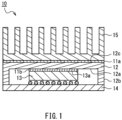
- FIG. 1 is a schematic cross-sectional view illustrating a heat dissipation structure 10 in which thermally conductive sheets of an embodiment of the present invention are incorporated.
- a thermally conductive sheet 11b dissipates heat generated by an electronic component 13, such as a semiconductor element, and is fixed to a main surface 12a of a heat spreader 12 facing the electronic component 13, and is sandwiched between the electronic component 13 and the heat spreader 12. Further, a thermally conductive sheet 11a is sandwiched between the heat spreader 12 and a heat sink 15.
- the thermally conductive sheets 11a and 11b and the heat spreader 2 constitute a heat dissipating member that dissipates heat from the electronic component 13.
- the heat spreader 12 is, for example, in the form of a rectangular plate, and has the main surface 12a facing the electronic component 13 and side walls 12b extending vertically from the periphery of the main surface 12a.
- the thermally conductive sheet 11b is provided on the main surface 12a surrounded by the side walls 12b, and a heat sink 15 is provided via the thermally conductive sheet 11a on a surface 12c of the heat spreader 2, which is on the side opposite to the main surface 12a.
- the electronic component 13 is a semiconductor element, for example, a BGA or the like, and is mounted on a wiring board 14.
- thermal conductivity of a thermally conductive silicone rubber sheet was measured using a hot disk (in accordance with ISO 22007-2:2008).
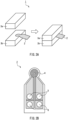
- this thermal conductivity measuring device 1 sandwiches a polyimide film sensor 2 between two samples 3a and 3b, applies a constant power to the sensor 2 to cause a certain amount of heat generation, and analyzes thermal characteristics based on the value of the temperature rise of the sensor 2.
- the sensor 2 has a tip 4 with a diameter of 7 mm.
- the tip 4 has a double spiral electrode structure, and electrodes 5 for applied current and electrodes 6 for a resistance value (temperature measurement electrode) are arranged in a lower portion of the sensor 2.
- the thermal conductivity was calculated using the following equation (Formula 1).
- ⁇ Po ⁇ D ⁇ ⁇ 3 / 2 ⁇ r ⁇ D ⁇ ⁇ T ⁇
- the hardness of the thermally conductive silicone rubber sheet was measured in accordance with SHORE 00.
- the degree of plasticity before defoamed in a vacuum corresponds to a degree of plasticity of a compound that has just been produced.
- the degree of plasticity after defoaming corresponds to a degree of plasticity after the produced compound is defoamed under a reduced pressure of -0.1 Pa for 5 minutes.
- the degree of plasticity after defoaming is important because the compound is formed into a sheet after being defoamed.
- the BET specific surface area of thermally conductive particles was measured in accordance with JIS R 1626-1996. The larger the BET specific surface area, the smaller D50 (median diameter) of the thermally conductive particles in a volume-based cumulative particle size distribution.
- a commercially available two-liquid type room temperature curing silicone polymer (silicone component) containing a polyorganosiloxane was used.
- One of the components (solution A) contained a base polymer component (the component A1 as part of the component A) and a platinum group metal catalyst.
- the other component (solution B) contained a base polymer component (the component A1 as part of the component A) and an organohydrogenpolysiloxane used as a crosslinking component (the component A2 as part of the component A).
- Thermally conductive particles shown in Table 1 were used.
- the average particle size is D50 (median diameter) in a volume-based cumulative particle size distribution measured by a laser diffraction/scattering method.
- a measuring instrument to be used in this method may be, for example, a laser diffraction/scattering particle size distribution analyzer LA-950 S2 manufactured by HORIBA, Ltd.
- Each value before pm in the tables is an average particle size of the particles.
- Thermally conductive particles shown in Table 1 were used.
- the average particle size is D50 (median diameter) in a volume-based cumulative particle size distribution measured by the laser diffraction/scattering method.
- a measuring instrument to be used in this method may be, for example, the laser diffraction/scattering particle size distribution analyzer LA-950 S2 manufactured by HORIBA, Ltd.
- Each value before pm in the tables is an average particle size of the particles.
- AlN in the tables is the abbreviation of aluminum nitride.
- a platinum-vinyldisiloxane complex was used as an additional platinum group metal catalyst.
- the two-liquid type room temperature curing silicone polymer contained a platinum group metal catalyst.
- the additional platinum group metal catalyst was added to ensure sufficient curing of the polyorganosiloxane.
- Dimethylpolysiloxane (with a viscosity of 100 mm 2 /s at 25 °C when measured using a Brookfield rotational viscometer SP No.2) was used as an unreacted silicone oil.
- Decyltrimethoxysilane was used as a silane coupling agent.
- the materials in amounts shown in Table 1 were weighed and mixed in a mixer to obtain a compound.
- the amount of each material is shown as an amount (parts by mass) when the amount of the silicone component (two-liquid type room temperature curing silicone polymer) is taken to be 100 parts by mass (100 g).
- the compound was defoamed under a reduced pressure of -0.1 Pa for 5 minutes.
- the compound was sandwiched between polyethylene terephthalate (PET) films that had been subjected to a release treatment, and then was formed into a sheet having a thickness of 2.0 mm by rolling using even-speed rolls at a temperature of 23°C and a roller speed of 0.5 m/min. Subsequently, the composition in the form of sheet was heat-cured at 100°C for 15 minutes to obtain a thermally conductive silicone rubber sheet.
- the formability was determined to be "formable" when sheet forming under the above-described conditions was possible or to be “failed” when sheet forming under the above-described conditions was not possible.
- Tables 1 and 2 show amounts of the respective components when the total amount of the base polymer component (A1), the crosslinking component (A2), the unreacted silicone oil, and the silane coupling agent is taken to be 100 parts by mass.
- Example 1 Example 2 Example 3
- Comparative Example 1 In contrast, in Comparative Example 1, the degree of plasticity was high due to the absence of the component B-1, and the formability was determined to be "failed". In Comparative Example 2 in which the component B-1 was not used, the degree of plasticity was high even though thermally conductive particles having a larger BET specific surface area were used, and the formability was determined to be "failed". In Comparative Example 3, the amount of the component B was smaller than the lower limit, the degree of plasticity was high, and the formability was determined to be "failed”. In Comparative Example 4, the amount of the component B was larger than the upper limit, and the thermal conductivity was low. In Comparative Example 5, the amount of the component C was smaller than the lower limit, and the thermal conductivity was low.
- a thermally conductive composition and a thermally conductive sheet according to the present invention are suitable as a heat dissipation sheet: TIM (Thermal Interface Material) to be interposed between a heat generating member and a heat dissipator in electrical and electronic components and the like.
- TIM Thermal Interface Material
Landscapes
- Chemical & Material Sciences (AREA)
- Chemical Kinetics & Catalysis (AREA)
- Organic Chemistry (AREA)
- Health & Medical Sciences (AREA)
- Medicinal Chemistry (AREA)
- Polymers & Plastics (AREA)
- Engineering & Computer Science (AREA)
- Manufacturing & Machinery (AREA)
- Materials Engineering (AREA)
- Physics & Mathematics (AREA)
- Combustion & Propulsion (AREA)
- Thermal Sciences (AREA)
- Compositions Of Macromolecular Compounds (AREA)
Applications Claiming Priority (3)
| Application Number | Priority Date | Filing Date | Title |
|---|---|---|---|
| JP2023087807 | 2023-05-29 | ||
| JP2023041437 | 2023-11-17 | ||
| PCT/JP2024/014209 WO2024247493A1 (ja) | 2023-05-29 | 2024-04-08 | 熱伝導性組成物及びこれを用いた熱伝導性シートとその製造方法 |
Publications (3)
| Publication Number | Publication Date |
|---|---|
| EP4549518A1 true EP4549518A1 (de) | 2025-05-07 |
| EP4549518A4 EP4549518A4 (de) | 2025-12-03 |
| EP4549518B1 EP4549518B1 (de) | 2026-04-29 |
Family
ID=92419269
Family Applications (1)
| Application Number | Title | Priority Date | Filing Date |
|---|---|---|---|
| EP24814980.9A Active EP4549518B1 (de) | 2023-05-29 | 2024-04-08 | Wärmeleitende zusammensetzung, wärmeleitende folie damit und herstellungsverfahren dafür |
Country Status (4)
| Country | Link |
|---|---|
| US (1) | US20250376573A1 (de) |
| EP (1) | EP4549518B1 (de) |
| JP (1) | JP7537050B1 (de) |
| CN (1) | CN119855874A (de) |
Family Cites Families (7)
| Publication number | Priority date | Publication date | Assignee | Title |
|---|---|---|---|---|
| JP5664563B2 (ja) * | 2012-01-23 | 2015-02-04 | 信越化学工業株式会社 | 熱伝導性シリコーン組成物及びその硬化物 |
| CN107532001B (zh) * | 2015-05-22 | 2021-05-25 | 迈图高新材料日本合同公司 | 导热性组合物 |
| TWI744361B (zh) * | 2016-07-22 | 2021-11-01 | 日商邁圖高新材料日本合同公司 | 熱傳導性聚矽氧烷組成物 |
| CN112041411B (zh) * | 2018-12-25 | 2022-04-01 | 富士高分子工业株式会社 | 导热性组合物及使用了其的导热性片材 |
| EP3753993B1 (de) * | 2018-12-25 | 2024-10-16 | Fuji Polymer Industries Co., Ltd. | Wärmeleitende zusammensetzung und wärmeleitende platte damit |
| JP6960554B1 (ja) * | 2021-06-16 | 2021-11-05 | デクセリアルズ株式会社 | 熱伝導シート及び熱伝導シートの製造方法 |
| EP4324885B1 (de) * | 2022-01-14 | 2025-08-13 | Fuji Polymer Industries Co., Ltd. | Wärmeleitende zusammensetzung, daraus erhaltene wärmeleitende folie und herstellungsverfahren dafür |
-
2024
- 2024-04-08 JP JP2024524473A patent/JP7537050B1/ja active Active
- 2024-04-08 US US19/102,748 patent/US20250376573A1/en active Pending
- 2024-04-08 CN CN202480003945.0A patent/CN119855874A/zh active Pending
- 2024-04-08 EP EP24814980.9A patent/EP4549518B1/de active Active
Also Published As
| Publication number | Publication date |
|---|---|
| JPWO2024247493A1 (de) | 2024-12-05 |
| EP4549518A4 (de) | 2025-12-03 |
| EP4549518B1 (de) | 2026-04-29 |
| US20250376573A1 (en) | 2025-12-11 |
| CN119855874A (zh) | 2025-04-18 |
| JP7537050B1 (ja) | 2024-08-20 |
Similar Documents
| Publication | Publication Date | Title |
|---|---|---|
| EP3753993B1 (de) | Wärmeleitende zusammensetzung und wärmeleitende platte damit | |
| EP3726573B1 (de) | Wärmeleitfähige folie und verfahren zu ihrer herstellung | |
| JP6692512B1 (ja) | 熱伝導組成物及びこれを用いた熱伝導性シート | |
| WO2023135857A1 (ja) | 熱伝導性組成物及びこれを用いた熱伝導性シートとその製造方法 | |
| TWI732896B (zh) | 熱傳導性薄片 | |
| EP4324885B1 (de) | Wärmeleitende zusammensetzung, daraus erhaltene wärmeleitende folie und herstellungsverfahren dafür | |
| KR102660031B1 (ko) | 열전도성 조성물 및 그 제조 방법 | |
| EP4549518B1 (de) | Wärmeleitende zusammensetzung, wärmeleitende folie damit und herstellungsverfahren dafür | |
| JP7289023B1 (ja) | 熱伝導性組成物、熱伝導性グリース及び熱伝導性シート | |
| EP4549519A1 (de) | Wärmeleitende zusammensetzung, wärmeleitende folie damit und herstellungsverfahren dafür | |
| EP4166614A1 (de) | Silikongelzusammensetzung und silikongelfolie | |
| EP3992251A1 (de) | Wärmeleitfähige silikongelzusammensetzung | |
| JP7553752B1 (ja) | 熱伝導性組成物及びこれを用いた熱伝導性シートとその製造方法 | |
| EP4477713A1 (de) | Wärmeleitende zusammensetzung, wärmeleitende folie und verfahren zur herstellung davon | |
| WO2024247493A1 (ja) | 熱伝導性組成物及びこれを用いた熱伝導性シートとその製造方法 | |
| WO2025052715A1 (ja) | 熱伝導性組成物及びこれを用いた熱伝導性シートとその製造方法 | |
| JP2025167953A (ja) | 熱伝導性組成物及びこれを用いた熱伝導性シートとその製造方法 | |
| WO2025009216A1 (ja) | 熱伝導性組成物及びこれを用いた熱伝導性シートとその製造方法 | |
| KR20260057418A (ko) | 열전도성 조성물 및 이것을 이용한 열전도성 시트와 그 제조 방법 |
Legal Events
| Date | Code | Title | Description |
|---|---|---|---|
| STAA | Information on the status of an ep patent application or granted ep patent |
Free format text: STATUS: THE INTERNATIONAL PUBLICATION HAS BEEN MADE |
|
| PUAI | Public reference made under article 153(3) epc to a published international application that has entered the european phase |
Free format text: ORIGINAL CODE: 0009012 |
|
| STAA | Information on the status of an ep patent application or granted ep patent |
Free format text: STATUS: REQUEST FOR EXAMINATION WAS MADE |
|
| 17P | Request for examination filed |
Effective date: 20250131 |
|
| AK | Designated contracting states |
Kind code of ref document: A1 Designated state(s): AL AT BE BG CH CY CZ DE DK EE ES FI FR GB GR HR HU IE IS IT LI LT LU LV MC ME MK MT NL NO PL PT RO RS SE SI SK SM TR |
|
| REG | Reference to a national code |
Ref country code: DE Ref legal event code: R079 Free format text: PREVIOUS MAIN CLASS: C08L0101000000 Ipc: C08K0003220000 Ref country code: DE Ref legal event code: R079 Ref document number: 602024004456 Country of ref document: DE Free format text: PREVIOUS MAIN CLASS: C08L0101000000 Ipc: C08K0003220000 |
|
| A4 | Supplementary search report drawn up and despatched |
Effective date: 20251105 |
|
| RIC1 | Information provided on ipc code assigned before grant |
Ipc: C08K 3/22 20060101AFI20251030BHEP Ipc: C08K 3/28 20060101ALI20251030BHEP Ipc: C08L 83/04 20060101ALI20251030BHEP Ipc: C08J 5/18 20060101ALI20251030BHEP Ipc: C09K 5/14 20060101ALI20251030BHEP |
|
| GRAP | Despatch of communication of intention to grant a patent |
Free format text: ORIGINAL CODE: EPIDOSNIGR1 |
|
| STAA | Information on the status of an ep patent application or granted ep patent |
Free format text: STATUS: GRANT OF PATENT IS INTENDED |
|
| RIC1 | Information provided on ipc code assigned before grant |
Ipc: C08K 3/22 20060101AFI20260113BHEP Ipc: C08K 3/28 20060101ALI20260113BHEP Ipc: C08L 83/04 20060101ALI20260113BHEP Ipc: C08J 5/18 20060101ALI20260113BHEP Ipc: C09K 5/14 20060101ALI20260113BHEP |
|
| INTG | Intention to grant announced |
Effective date: 20260209 |
|
| GRAS | Grant fee paid |
Free format text: ORIGINAL CODE: EPIDOSNIGR3 |
|
| GRAA | (expected) grant |
Free format text: ORIGINAL CODE: 0009210 |
|
| STAA | Information on the status of an ep patent application or granted ep patent |
Free format text: STATUS: THE PATENT HAS BEEN GRANTED |