EP4548764A1 - Zusammensetzung zur steuerung eines tabaksprösslings und verfahren zur hemmung des tabaksprösslings in tabakpflanzen - Google Patents
Zusammensetzung zur steuerung eines tabaksprösslings und verfahren zur hemmung des tabaksprösslings in tabakpflanzen Download PDFInfo
- Publication number
- EP4548764A1 EP4548764A1 EP23207806.3A EP23207806A EP4548764A1 EP 4548764 A1 EP4548764 A1 EP 4548764A1 EP 23207806 A EP23207806 A EP 23207806A EP 4548764 A1 EP4548764 A1 EP 4548764A1
- Authority
- EP
- European Patent Office
- Prior art keywords
- tobacco
- sucker control
- control composition
- tobacco sucker
- sucker
- Prior art date
- Legal status (The legal status is an assumption and is not a legal conclusion. Google has not performed a legal analysis and makes no representation as to the accuracy of the status listed.)
- Withdrawn
Links
Images



Classifications
-
- A—HUMAN NECESSITIES
- A01—AGRICULTURE; FORESTRY; ANIMAL HUSBANDRY; HUNTING; TRAPPING; FISHING
- A01P—BIOCIDAL, PEST REPELLANT, PEST ATTRACTANT OR PLANT GROWTH REGULATORY ACTIVITY OF CHEMICAL COMPOUNDS OR PREPARATIONS
- A01P21/00—Plant growth regulators
-
- A—HUMAN NECESSITIES
- A01—AGRICULTURE; FORESTRY; ANIMAL HUSBANDRY; HUNTING; TRAPPING; FISHING
- A01N—PRESERVATION OF BODIES OF HUMANS OR ANIMALS OR PLANTS OR PARTS THEREOF; BIOCIDES, e.g. AS DISINFECTANTS, AS PESTICIDES OR AS HERBICIDES; PEST REPELLANTS OR ATTRACTANTS; PLANT GROWTH REGULATORS
- A01N31/00—Biocides, pest repellants or attractants, or plant growth regulators containing organic oxygen or sulfur compounds
- A01N31/02—Acyclic compounds
Definitions
- This invention relates to a tobacco sucker control composition and to a method for inhibiting sucker growth in tobacco plants.
- topping stimulates the growth of auxiliary buds (suckers) at the leaf axil along the length of the stem, which is unwanted.
- Sucker growth is typically controlled by applying sucker control chemicals which contain fatty alcohols in combination with surfactants, in a process commonly referred to a "desuckering".
- sucker control chemicals which contain fatty alcohols in combination with surfactants, in a process commonly referred to a "desuckering".
- the use of sucker control chemicals is a commercially advantageous alternative to what would otherwise be a labour-intensive manual operation of topping (i.e., the removal of buds or flowers) and subsequent removal of suckers by hand.
- Desuckering allows improved nutrient uptake by the tobacco plant by increased root growth, which results in the tobacco plant growing large leaves with a high nicotine content, which is a desired outcome for tobacco production.
- Sucker control chemicals are normally applied to the plant shortly before or after topping, since the buds are only susceptible to chemical control before they start to grow and elongate.
- Tobacco sucker control compositions typically contain a range of alcohols from hexanol (C 6 ) to dodecanol (C 12 ) with Polysorbate 80 (polyoxyethylene (20) sorbitan monooleate) which is a widely used emulsifier in tobacco sucker control compositions.
- the fatty alcohol burns the suckers, while the tobacco leaves remain largely unaffected.
- tobacco sucker control compositions are diluted in water to form aqueous emulsion with typical concentrations of between about 2 wt% to about 6 wt%.
- the emulsifiers used in tobacco sucker control compositions enable aqueous emulsions of the fatty alcohols to be formed in water. In this manner, relatively small amounts of the fatty alcohols in the tobacco sucker control aqueous emulsion can be distributed over the tobacco plant.
- the use of emulsifiers in tobacco sucker control compositions also enables wetting on the tobacco plant.
- a tobacco sucker control composition which, when emulsified in water, forms an emulsion that is at least as stable, but preferably more stable, than known emulsions of tobacco sucker control compositions, and which is effective in tobacco sucker control.
- a tobacco sucker control composition comprising:
- the tobacco sucker control composition comprises from 79 wt% to 85 wt% of the fatty alcohol and from 21 wt% to 15 wt% of the emulsifier, each based on the total weight of the tobacco sucker control composition.
- the tobacco sucker control composition comprises from 79 wt% to 81 wt% of the fatty alcohol and from 21 wt% to 19 wt% of the emulsifier, each based on the total weight of the tobacco sucker control composition.
- the emulsifier may comprise from 80 wt% to 100 wt% of the vegetable oil alkoxylate and from 0 wt% to 20 wt% of the alkyl glycol ester or from 80 wt% to 99.5 wt% of the vegetable oil alkoxylate and from 0.5 wt% to 20 wt% of the alkyl glycol ester, based on the total weight of the emulsifier.
- the emulsifier comprises from 90 wt% to 100 wt% of the vegetable oil alkoxylate and from 0 wt% to 10 wt% of the alkyl glycol ester or from 90 wt% to 99.5 wt% of the vegetable oil alkoxylate and from 0.5 wt% to 10 wt% of the alkyl glycol ester based on the total weight of the emulsifier.
- the emulsifier comprises from 95 wt% to 100 wt% of the vegetable oil alkoxylate and from 0 wt% to 5 wt% of the alkyl glycol ester, based on the total weight of the emulsifier.
- the emulsifier comprises from 95 wt% to 99.5 wt% of the vegetable oil alkoxylate and from 0.5 wt% to 5 wt% of the alkyl glycol ester, based on the total weight of the emulsifier.
- the fatty alcohol is a C 6 to C 12 linear fatty alcohol. More preferably, the fatty alcohol is a C 8 linear fatty alcohol, a C 10 linear fatty alcohol, or a mixture of a C 8 linear fatty alcohol and a C 10 linear fatty alcohol.
- the vegetable oil alkoxylate is an alkoxylated triglyceride, preferably ethoxylated, where the triglyceride comprises at least one ester group with at least one hydroxy group.
- the vegetable oil alkoxylate may be a castor oil alkoxylate.
- the vegetable oil alkoxylate or the castor oil alkoxylate is a vegetable oil ethoxylate / castor oil ethoxylate having from 5 to 50 mol ethoxylate (number average), preferably from 15 to 40 mol ethoxylate (number average).
- the ethoxylation degree refers to the ethoxylation of the molecule, which is per each triglyceride.
- the alkyl glycol ester is obtainable by the alkoxylation of a triglyceride, preferably ethoxylation, in the presence of an alcohol, in particular a polyol.
- the triglyceride preferably has C8 to C22 ester groups and the alcohol preferably has 1 to 6 carbon atoms or in the case of a polyol preferably 2 to 6 carbon atoms.
- a suitable polyol is for example glycerol.
- the alkyl glycol ester is a triglyceride ethoxylated in the presence of glycerol.
- the tobacco sucker control composition may further comprise optional ingredients selected from the group comprising pesticides, fertilizers, growth regulators, foam suppressors, drift control agents, and solubilizers.
- the tobacco sucker control composition may be useful for inhibiting auxiliary bud growth in tobacco plants.
- the tobacco sucker control composition may comprise water to form an aqueous emulsion, e.g. by way of dilution of the sucker control composition in water.
- the water may be water having a certain hardness, such as tap water.
- a tobacco sucker control aqueous emulsion comprising 1 wt% to 10 wt% of a tobacco sucker control composition as hereinbefore described and 99 wt% to 90 wt% water, based on the total weight of the tobacco sucker control aqueous emulsion.
- the tobacco sucker control aqueous emulsion comprises 3 wt% to 8 wt% of a tobacco sucker control composition as hereinbefore described and 97 wt% to 92 wt% water, based on the total weight of the tobacco sucker control aqueous emulsion.
- the tobacco sucker control aqueous emulsion comprises about 5 wt% of a tobacco sucker control composition as hereinbefore described and about 95 wt% water, based on the total weight of the tobacco sucker control aqueous emulsion.
- a fourth aspect of the invention there is provided the use of the tobacco sucker control aqueous emulsion as hereinbefore described for inhibiting sucker growth in tobacco plants.
- a method for inhibiting sucker growth in tobacco plants comprising: applying the tobacco sucker control composition as hereinbefore described to a tobacco plant.
- Applying the tobacco sucker control composition as hereinbefore described to the tobacco plant may be by spray application, in particular by foliar spray application.
- a method for inhibiting sucker growth in tobacco plants comprising: applying the tobacco sucker control aqueous emulsion as hereinbefore described to a tobacco plant.
- Applying the tobacco sucker control aqueous emulsion as hereinbefore described to the tobacco plant may be by spray application, in particular by foliar spray application.
- NACOL 10-98 was emulsified with different grades of Polysorbate 80 in a 79:21 (w/w) ratio.
- NACOL 10-98 is a high purity C 10 linear fatty alcohol commercially available from Sasol Germany GmbH.
- Polysorbate 80 is a commercially available emulsifier used in tobacco sucker control applications.
- Polysorbate 80 is a sorbitan mono-oleate with 20 mol EO.
- the Polysorbate 80 grades are commercially available from several suppliers, and DACOL MOS 20 is commercially available from Sasol Italy S.p.A. (Milan, Italy).
- Inventive tobacco sucker control compositions were prepared by emulsifying NACOL10-98 with each of the emulsifiers MARLOWET R20, MARLOWET R30, and MARLOWET R50, in a 79:21 (w/w) ratio.
- MARLOWET R20, MARLOWET R30, and MARLOWET R50 are castor oil ethoxylates with 20 mol EO, 30 mol EO, and 50 mol EO respectively, commercially available from Sasol Germany GmbH (Hamburg, Germany).
- MARLOWET COE 329 is commercially available from Sasol Italy S.p.A. (Milan, Italy) and is a coconut oil ethoxylated in the presence of glycerol.
- each of the comparative tobacco sucker control compositions and each of the inventive tobacco sucker control compositions were diluted in 95 wt% water of differing hardness (34.2, 342, and 1000 ppm CaCl 2 ) in a 100ml measuring cylinder and shaken 10 times. After being left to stand at ambient temperature (22°C) for 24 hours, the stability of each of the tobacco sucker control aqueous emulsions was evaluated visually.
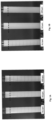
- Figure 1A shows the tobacco sucker control aqueous emulsions formed from the NACOL10-98/Polysorbate 80 (cosmetic grade) tobacco sucker control composition (comparative) after 24 hours
- Figure 1B shows the tobacco sucker control aqueous emulsions formed from the NACOL10-98/Polysorbate 80 (std. grade) tobacco sucker control composition (comparative) after 24 hours.
- the dashed line indicates where separation occurs in the emulsion. No significant difference could be observed in the stability of the tobacco sucker control aqueous emulsions produced from the comparative tobacco sucker control compositions.
- Figure 1C shows the tobacco sucker control aqueous emulsions formed from the NACOL10-98/Polysorbate 80 (cosmetic grade) tobacco sucker control composition (comparative) after 1 hour
- Figure 1D shows the tobacco sucker control aqueous emulsions formed from the NACOL10-98/Polysorbate 80 (std. grade) tobacco sucker control composition (comparative) after 1 hour.
- the dashed line indicates where separation occurs in the emulsion. It is clear that after 60 minutes significant creaming (i.e. separation of the tobacco sucker control aqueous emulsions) had already occurred in the comparative tobacco sucker control aqueous emulsions.
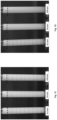
- FIG. 2A, 2B, and 2C show the emulsion stability after 24 hours of a 5wt% emulsion of (from left to right):
- the aqueous emulsions produced from the inventive tobacco sucker control compositions showed far superior emulsion stability for all water hardnesses compared to the aqueous emulsions formed from the comparative tobacco sucker control compositions.
- the inventive tobacco sucker control composition which was prepared with the emulsifier comprising the castor oil ethoxylate MARLOWET R20 showed the best emulsion stability (i.e. the lowest separation creaming) of the inventive tobacco sucker control compositions.
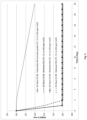
- Emulsion stability curves were generated by measuring the time-dependent transmission profile of each sample at rotation speeds of 1000 rpm, 2000 rpm, 3000 rpm, and 4000 rpm. A transmission offset of 10% was used.
- the emulsion stability was evaluated by the determined separation velocity. All experiments were carried out in duplicate.
- the figures showing the emulsion stability curves indicate the change in height (mm) of the transmission offset of 10% relative to the bottom of the cuvette (where the bottom of the cuvette is 130mm and the top of the cuvette is 0mm) as a function of the calculated time (days).
- the emulsion stability curves for the tobacco sucker control aqueous emulsions pictured in Figure 2 are shown in Figure 3 .
- the inventive composition which was prepared with the emulsifier comprising the castor oil ethoxylate MARLOWET R20 performed best since it showed by far the slowest emulsion separation over time.
- the comparative tobacco sucker control aqueous emulsion comprising Polysorbate 80 (cosmetic grade) showed a tendency to separate or cream relatively quickly, with noticeable creaming already occurring within one day.
- MARLOWET COE 329 is commercially available from Sasol Italy S.p.A. (Milan, Italy).
- NACOL 10-98 was emulsified in a 79:21 (w/w) ratio with various emulsifiers comprising 0.5 wt% to 10 wt% MARLOWET COE 329 and 99.5 wt% to 90 wt% MARLOWET R20.
- the stability of 5wt% emulsions in 342 ppm CaCl 2 water hardness were evaluated visually after 24 hours. The results are shown in Table 2.
- Emulsifier Alcohol Emulsifier ratio (w/w) Emulsi on Water Hardness Appearan ce after 24h, AT Vegetable Oil Alkoxylate Alkyl glycol ester 5 NACOL 10-98 99.5 wt% MARLOWET R20 0.5 wt% MARLOWET COE 329 79:21 5 wt% 342 ppm CaCl 2 Stable emulsion 6 NACOL 10-98 99 wt% MARLOWET R20 1 wt% MARLOWET COE 329 79:21 5 wt% 342 ppm CaCl 2 Stable emulsion 7 NACOL 10-98 98 wt% MARLOWET R20 2 wt% MARLOWET COE 329 79:21 5 wt% 342 ppm CaCl 2 Stable emulsion 8 NACOL 10-98 97 wt% MARLOWET R20 3 wt% MARLOWET COE 329 79:21 5 wt% 342 ppm
- Emulsion stability curves were generated for the aqueous emulsions shown in Table 2 according to the method described above. The results, shown in Figure 5 , indicate that all the emulsions were highly stable. Close inspection indicates an increasing emulsion stability with increasing amount of added alkyl glycol ester MARLOWET COE 329. Nevertheless, even at the lowest concentration of MARLOWET COE 329, the emulsion was stable over several days.
- Emulsifier Alcohol Emulsifier ratio (w/w) Emulsion Water hardness Appearance after 24h, RT Vegetable Oil Alkoxylate Alkyl glycol ester 10 NACOL 10-98 95 wt% MARLOWET R20 5 wt% MARLOWET COE 329 79:21 5 wt% 342 ppm CaCl 2 Stable 13 NACOL 10-98 95 wt% MARLOWET R20 5 wt% MARLOWET COE 329 81:19 5 wt% 342 ppm CaCl 2 Stable
- the aqueous emulsions prepared from the inventive tobacco sucker control compositions showed superior stability over the aqueous emulsions prepared from the comparative tobacco sucker control compositions.
- emulsion stability of the aqueous emulsions prepared from the inventive tobacco sucker control compositions improved even further with the inclusion of the alkyl glycol ester in the emulsifier.
- Tobacco plants were arranged in plots comprising two rows of 20 tobacco plants each (i.e., 40 tobacco plants). Each row of tobacco plants was 12.2 m long and was separated from the adjacent row by 1.2 m.
- Control plots were plots where the tobacco plants were not treated with any tobacco sucker control composition but were otherwise subjected to the same treatment protocol as those plots which were treated with tobacco sucker control compositions.
- Inventive C 10 fatty alcohol-based tobacco sucker control compositions were compared with the commercially available product Antak (tradename) manufactured by the Drexel Chemical Company (Memphis, TN). Antak is 100% n-decanol in a 79 wt% emulsion.
- composition no. 14 An inventive C 8 /C 10 mixed fatty alcohol-based tobacco sucker control composition (composition no. 14) was prepared by mixing 42.9g NACOL 8-98 (n-octanol) with 57.1g NACOL 10-98 (n-decanol) and emulsifying the resultant C 8 /C 10 fatty alcohol mixture in an 85:15 (w/w) ratio with an emulsifier comprising 90 wt% MARLOWET R20 and 10 wt% MARLOWET COE329.
- NACOL 8-98 and NACOL 10-98 are both high purity linear alcohols commercially available from Sasol Germany GmbH (Hamburg, Germany).
- This C 8 /C 10 mixed fatty alcohol-based tobacco sucker control composition was compared to the commercially available product Sucker-Plucker (tradename) manufactured by the Drexel Chemical Company (Memphis, TN), which is a mixture of 42.8 wt% n-octanol, 56.9 wt% n-decanol, and 0.3 wt% n-dodecanol, in an 85 wt% emulsion.
- the first application of the C 10 fatty alcohol-based tobacco sucker control compositions and Antak (tradename) were made using 3% aqueous emulsions of each of the compositions in water
- the second application of the C 10 fatty alcohol-based tobacco sucker control compositions and Antak (tradename) were made using 4% aqueous emulsions of each of the compositions in water.
- the first application of the C 8 /C 10 mixed fatty alcohol-based tobacco sucker control compositions and Sucker-Plucker were made using 4% aqueous emulsions of each of the compositions in water, and the second application of the C 8 /C 10 mixed fatty alcohol-based tobacco sucker control compositions and Sucker-Plucker (tradename) were made using 5% aqueous emulsions of each of the compositions in water.
- Sucker control was calculated based on the weight of suckers present on the control plots where tobacco plants were topped but not suckered. The average weight of the suckers of the control plots was 12.3 kg of suckers removed from 10 plants. The percent sucker control shown in Table 4 represents the reduction in weight of suckers removed from the plots which were treated with the tobacco control compositions, relative to the control plots.
- Sucker control for the treatments using the six C 10 fatty alcohol-based tobacco sucker control compositions ranged from a 61.7% to an 80.6% reduction in the weight of suckers over the control plots.
- the Antak comparative test resulted in a low level of sucker control, with a sucker control only marginally better than inventive tobacco sucker control composition 12, but statistically there is no difference.
- Table 5 Agronomic data are shown in Table 5. Each data point reflects the average of four replications. Table 5 Composi tion No. Alcohol Emulsifier Alcohol: Emulsifer ratio (w/w) Yield (kg/hectare) Grade Index (0-100) Vegetable Oil Alkoxylate Alkyl glycol ester C 10 fatty alcohol-based tobacco sucker control compositions Antak* n-decanol unknown - 79:21 3194 70.5 2* NACOL 10-98 Polysorbate 80 (std.
- Alcohol Emulsifier Alcohol Emulsifer ratio (w/w) Yield (kg/hectare) Grade Index (0-100) Vegetable Oil Alkoxylate Alkyl glycol ester C 10 fatty alcohol-based tobacco sucker control compositions Antak* n-decanol unknown - 79:21 3194 70.5 2* NACOL 10-98 Polysorbate 80 (std.
- Grade index was assigned according to the United States Department of Agriculture (USDA) Official Standard Grades for Flue-Cured Tobacco.
- USDA United States Department of Agriculture
- the Grade Index of the tobacco leaves harvested following the application of inventive tobacco sucker control composition 12 was superior to the two comparative tobacco sucker control compositions.
- inventive tobacco sucker control compositions thus have no negative effect on tobacco leaf quality or crop value.
- Emulsions prepared from the inventive tobacco sucker control composition showed improved emulsion stability over the whole range of water hardness tested, compared to emulsions prepared from the comparative tobacco sucker control compositions.
- Emulsions prepared from the inventive tobacco sucker control compositions comprising the emulsifier comprising the alkyl glycol ester unexpectedly showed even better emulsion stability than emulsions prepared from the inventive tobacco sucker control compositions comprising only the vegetable oil alkoxylate.
- the inventive tobacco sucker control compositions showed no negative effect on tobacco leave yield and no negative effect on tobacco leaf quality or crop value.
- inventive tobacco sucker control compositions thus represent an improvement over commercially available products, given that the emulsions prepared from the inventive tobacco sucker control compositions showed much improved emulsion stability which is an important practical consideration in tobacco farming operations. Furthermore, the inventive tobacco sucker control compositions performed equally well as the commercially available products and showed no negative effects in terms of in-field tobacco sucker control, tobacco leaf yield, and tobacco leaf quality.
Landscapes
- Life Sciences & Earth Sciences (AREA)
- Wood Science & Technology (AREA)
- Environmental Sciences (AREA)
- Pest Control & Pesticides (AREA)
- Plant Pathology (AREA)
- Engineering & Computer Science (AREA)
- Zoology (AREA)
- Health & Medical Sciences (AREA)
- General Health & Medical Sciences (AREA)
- Dentistry (AREA)
- Agronomy & Crop Science (AREA)
- Botany (AREA)
- Chemical & Material Sciences (AREA)
- Chemical Kinetics & Catalysis (AREA)
- General Chemical & Material Sciences (AREA)
- Manufacture Of Tobacco Products (AREA)
- Agricultural Chemicals And Associated Chemicals (AREA)
Priority Applications (2)
| Application Number | Priority Date | Filing Date | Title |
|---|---|---|---|
| EP23207806.3A EP4548764A1 (de) | 2023-11-03 | 2023-11-03 | Zusammensetzung zur steuerung eines tabaksprösslings und verfahren zur hemmung des tabaksprösslings in tabakpflanzen |
| PCT/EP2024/080968 WO2025093758A1 (en) | 2023-11-03 | 2024-11-01 | Tobacco sucker control composition and method for inhibiting sucker growth in tobacco plants |
Applications Claiming Priority (1)
| Application Number | Priority Date | Filing Date | Title |
|---|---|---|---|
| EP23207806.3A EP4548764A1 (de) | 2023-11-03 | 2023-11-03 | Zusammensetzung zur steuerung eines tabaksprösslings und verfahren zur hemmung des tabaksprösslings in tabakpflanzen |
Publications (1)
| Publication Number | Publication Date |
|---|---|
| EP4548764A1 true EP4548764A1 (de) | 2025-05-07 |
Family
ID=88697438
Family Applications (1)
| Application Number | Title | Priority Date | Filing Date |
|---|---|---|---|
| EP23207806.3A Withdrawn EP4548764A1 (de) | 2023-11-03 | 2023-11-03 | Zusammensetzung zur steuerung eines tabaksprösslings und verfahren zur hemmung des tabaksprösslings in tabakpflanzen |
Country Status (2)
| Country | Link |
|---|---|
| EP (1) | EP4548764A1 (de) |
| WO (1) | WO2025093758A1 (de) |
Citations (3)
| Publication number | Priority date | Publication date | Assignee | Title |
|---|---|---|---|---|
| WO1996031749A1 (en) * | 1995-04-04 | 1996-10-10 | Ashland Inc. | Process for increasing cooling tower's thermal capability |
| WO1998051148A1 (en) * | 1997-05-16 | 1998-11-19 | Uniroyal Chemical Company, Inc. | Chemical pinching method and composition |
| US20040054010A1 (en) * | 2000-11-20 | 2004-03-18 | Sutherland Tara D. | Endosulfan formulation and methods of use thereof |
Family Cites Families (1)
| Publication number | Priority date | Publication date | Assignee | Title |
|---|---|---|---|---|
| AU739697B2 (en) | 1997-05-12 | 2001-10-18 | Robert Dymock Mcintyre | An animal feeding device |
-
2023
- 2023-11-03 EP EP23207806.3A patent/EP4548764A1/de not_active Withdrawn
-
2024
- 2024-11-01 WO PCT/EP2024/080968 patent/WO2025093758A1/en active Pending
Patent Citations (3)
| Publication number | Priority date | Publication date | Assignee | Title |
|---|---|---|---|---|
| WO1996031749A1 (en) * | 1995-04-04 | 1996-10-10 | Ashland Inc. | Process for increasing cooling tower's thermal capability |
| WO1998051148A1 (en) * | 1997-05-16 | 1998-11-19 | Uniroyal Chemical Company, Inc. | Chemical pinching method and composition |
| US20040054010A1 (en) * | 2000-11-20 | 2004-03-18 | Sutherland Tara D. | Endosulfan formulation and methods of use thereof |
Also Published As
| Publication number | Publication date |
|---|---|
| WO2025093758A1 (en) | 2025-05-08 |
Similar Documents
| Publication | Publication Date | Title |
|---|---|---|
| EP0357559B1 (de) | Wässrige Formulierungen und deren Verwendung | |
| JP3148812B2 (ja) | じゃがいもの発芽抑制剤 | |
| US3900307A (en) | Composition and method for controlling suckers in tobacco | |
| CN106070207B (zh) | 可降低烟叶中抑芽剂农药残留量的抑芽剂组合物 | |
| MXPA01003132A (es) | Formulaciones de pesticidas estables al almacenamiento que contienen azadiractin. | |
| WO2025093758A1 (en) | Tobacco sucker control composition and method for inhibiting sucker growth in tobacco plants | |
| US20220354111A1 (en) | Emulsifiable concentrate containing allyl isothiocyanate and its use as a nematicide in crop plants | |
| JP7598969B2 (ja) | 摘花方法 | |
| AU2021222964B2 (en) | Pelargonic acid-based herbicide compositions | |
| CN118055698A (zh) | 烷烃植物卫生油组合物 | |
| US5424272A (en) | Fatty alcohol composition and method for controlling axillary and terminal buds of agronomic, horticultural and forestry crops | |
| CA2714483C (en) | Oleic acid or linoleic acid derivative based agent for preventing pollen dispersal | |
| CA3033321C (en) | Use of compositions comprising pelargonic acid and specific non ionic surfactants for inhibiting the growth of suckers on plants | |
| KR20010012220A (ko) | 약제 적심법 및 조성물 | |
| EP0134339B1 (de) | Herbizide Zusammensetzung | |
| US4272277A (en) | 2-Butyl-2-ethyl-1,3-propanediol as a chemical pinching agent | |
| US3706546A (en) | Method of cultivating tobacco and aqueous solution to be used therefor | |
| EP1594361B1 (de) | Wässrige zusammensetzung enthaltend chlorpropham und deren verwendung zur keimhemmung von kartoffeln | |
| US4219350A (en) | 2-Ethyl-1,3-hexanediol as a chemical pinching agent | |
| JPS61212231A (ja) | 農作物被覆剤 | |
| KR800000347B1 (ko) | 연초의 흡지 성장억제용 액체 조성물 | |
| SELTMANN | GL STEFFENS USDA, S&E, Plant Hormone and Regulators Laboratory, Beltsville Agricultural Research Center, Maryland | |
| DE4020499A1 (de) | Hemmung des austreibens bei kartoffeln | |
| JPS63307808A (ja) | 病虫害防除用マシン油乳剤用基油 | |
| DD211704A1 (de) | Mittel zur beeinflussung des pflanzenwachstums und der pflanzenentwicklung |
Legal Events
| Date | Code | Title | Description |
|---|---|---|---|
| PUAI | Public reference made under article 153(3) epc to a published international application that has entered the european phase |
Free format text: ORIGINAL CODE: 0009012 |
|
| STAA | Information on the status of an ep patent application or granted ep patent |
Free format text: STATUS: THE APPLICATION HAS BEEN PUBLISHED |
|
| AK | Designated contracting states |
Kind code of ref document: A1 Designated state(s): AL AT BE BG CH CY CZ DE DK EE ES FI FR GB GR HR HU IE IS IT LI LT LU LV MC ME MK MT NL NO PL PT RO RS SE SI SK SM TR |
|
| STAA | Information on the status of an ep patent application or granted ep patent |
Free format text: STATUS: THE APPLICATION IS DEEMED TO BE WITHDRAWN |
|
| 18D | Application deemed to be withdrawn |
Effective date: 20251108 |