EP4544932A1 - Filter for smoking article comprising chemically unmodified lyocell fiber, and smoking article comprising same - Google Patents
Filter for smoking article comprising chemically unmodified lyocell fiber, and smoking article comprising same Download PDFInfo
- Publication number
- EP4544932A1 EP4544932A1 EP24750620.7A EP24750620A EP4544932A1 EP 4544932 A1 EP4544932 A1 EP 4544932A1 EP 24750620 A EP24750620 A EP 24750620A EP 4544932 A1 EP4544932 A1 EP 4544932A1
- Authority
- EP
- European Patent Office
- Prior art keywords
- lyocell
- tow
- functional additive
- vibration peak
- dispersed
- Prior art date
- Legal status (The legal status is an assumption and is not a legal conclusion. Google has not performed a legal analysis and makes no representation as to the accuracy of the status listed.)
- Pending
Links
Images







Classifications
-
- A—HUMAN NECESSITIES
- A24—TOBACCO; CIGARS; CIGARETTES; SIMULATED SMOKING DEVICES; SMOKERS' REQUISITES
- A24D—CIGARS; CIGARETTES; TOBACCO SMOKE FILTERS; MOUTHPIECES OF CIGARS OR CIGARETTES; MANUFACTURE OF TOBACCO SMOKE FILTERS OR MOUTHPIECES
- A24D3/00—Tobacco smoke filters, e.g. filter tips or filtering inserts; Filters specially adapted for simulated smoking devices; Mouthpieces of cigars or cigarettes
- A24D3/06—Use of materials for tobacco smoke filters
- A24D3/08—Use of materials for tobacco smoke filters of organic materials as carrier or major constituent
- A24D3/10—Use of materials for tobacco smoke filters of organic materials as carrier or major constituent of cellulose or cellulose derivatives
-
- A—HUMAN NECESSITIES
- A24—TOBACCO; CIGARS; CIGARETTES; SIMULATED SMOKING DEVICES; SMOKERS' REQUISITES
- A24D—CIGARS; CIGARETTES; TOBACCO SMOKE FILTERS; MOUTHPIECES OF CIGARS OR CIGARETTES; MANUFACTURE OF TOBACCO SMOKE FILTERS OR MOUTHPIECES
- A24D3/00—Tobacco smoke filters, e.g. filter tips or filtering inserts; Filters specially adapted for simulated smoking devices; Mouthpieces of cigars or cigarettes
- A24D3/06—Use of materials for tobacco smoke filters
- A24D3/067—Use of materials for tobacco smoke filters characterised by functional properties
-
- A—HUMAN NECESSITIES
- A24—TOBACCO; CIGARS; CIGARETTES; SIMULATED SMOKING DEVICES; SMOKERS' REQUISITES
- A24D—CIGARS; CIGARETTES; TOBACCO SMOKE FILTERS; MOUTHPIECES OF CIGARS OR CIGARETTES; MANUFACTURE OF TOBACCO SMOKE FILTERS OR MOUTHPIECES
- A24D3/00—Tobacco smoke filters, e.g. filter tips or filtering inserts; Filters specially adapted for simulated smoking devices; Mouthpieces of cigars or cigarettes
- A24D3/06—Use of materials for tobacco smoke filters
- A24D3/067—Use of materials for tobacco smoke filters characterised by functional properties
- A24D3/068—Biodegradable or disintegrable
-
- A—HUMAN NECESSITIES
- A24—TOBACCO; CIGARS; CIGARETTES; SIMULATED SMOKING DEVICES; SMOKERS' REQUISITES
- A24D—CIGARS; CIGARETTES; TOBACCO SMOKE FILTERS; MOUTHPIECES OF CIGARS OR CIGARETTES; MANUFACTURE OF TOBACCO SMOKE FILTERS OR MOUTHPIECES
- A24D3/00—Tobacco smoke filters, e.g. filter tips or filtering inserts; Filters specially adapted for simulated smoking devices; Mouthpieces of cigars or cigarettes
- A24D3/06—Use of materials for tobacco smoke filters
- A24D3/14—Use of materials for tobacco smoke filters of organic materials as additive
Definitions
- the present disclosure relates to a smoking article filter including lyocell tow in which a functional additive is dispersed, and more particularly, to a smoking article filter that has excellent biodegradability because the lyocell fiber is not chemically modified by the functional additive despite the addition of the functional additive, and a smoking article including the same.
- Typical cigarette filters include cellulose acetate tow, which is obtained by extracting cellulose from wood pulp and acetylating the extracted cellulose.
- cigarette filters are assembled into tobacco products, distributed to consumers, provided for smoking, and finally discarded after smoking the cigarette.
- cigarette filters may be directly discarded as manufacturing residue from cigarette filter manufacturing plants. This cigarette filter waste is collected as waste and landfilled for disposal. In addition, in some cases, smoked cigarettes are not collected as waste and left in the natural environment.
- phenol-related functional materials or phenol-reducing materials
- phenol-related functional materials such as polyethylene glycol (PEG), triethyl citrate (TEC), and triacetin (TA) are added to cellulose acetate tow.
- PEG polyethylene glycol
- TEC triethyl citrate
- TA triacetin
- phenol-related functional materials consisting of PEG and TEC are added to hydrophobic cellulose acetate
- the phenol-related functional materials have the problem of lowering biodegradability by serving as a plasticizer for cellulose acetate fibers and bonding hydrophobic cellulose acetate fibers together.
- One object of the present disclosure is to provide a smoking article filter including lyocell tow in which a functional additive is dispersed, and more particularly, a smoking article filter that has excellent biodegradability because lyocell fibers that constitute lyocell tow are not chemically modified by the functional additive despite the addition of the functional additive.
- Another object of the present disclosure is to provide a smoking article including a smoking article filter including lyocell tow in which a functional additive is dispersed, and more particularly, to a smoking article including a smoking article filter that has excellent biodegradability because lyocell fibers that constitute lyocell tow are not chemically modified by the functional additive despite the addition of the functional additive.
- a smoking article filter includes a lyocell tow including a plurality of lyocell fibers and a functional additive dispersed in the lyocell tow, wherein at least some of the plurality of lyocell fibers are not chemically modified by the functional additive, an FT-IR spectrum of the lyocell tow in which the functional additive is dispersed exhibits a first vibration peak, which is a vibration peak in a range of 1645 cm -1 to 1650 cm -1 .
- the functional additive may include an emulsion and a phenol reducing material, wherein the phenol-reducing material may include at least one of polyethylene glycol (PEG), triethyl citrate (TEC), and triacetin (TA).
- PEG polyethylene glycol
- TEC triethyl citrate
- TA triacetin
- the FT-IR spectrum of the lyocell tow in which the functional additive is dispersed may further exhibit a second vibration peak, which is a vibration peak in a range of 1735 cm -1 to 1745 cm -1 .
- a parameter is defined as a ratio of the height of the second vibration peak to the height of the first vibration peak in the FT-IR spectrum
- a parameter value in the FT-IR spectrum of the lyocell tow in which the functional additive is dispersed may be greater than or equal to a parameter value in the FT-IR spectrum of cleaned lyocell tow in which the functional additive is dispersed and which is cleaned using a detergent.
- a parameter is defined as a ratio of the height of the second vibration peak to the height of the first vibration peak in the FT-IR spectrum, and a parameter value in the FT-IR spectrum of the lyocell tow in which the functional additive is dispersed may range from 1 to 20.
- a parameter value in the FT-IR spectrum of the cleaned lyocell tow may have a value of 1 or less.
- a smoking article filter includes a lyocell tow including a plurality of lyocell fibers and a functional additive dispersed in the lyocell tow, wherein at least some of the plurality of lyocell fibers are not chemically modified by the functional additive, and the FT-IR spectrum of the lyocell tow in which the functional additive is dispersed exhibits a first vibration peak, which is a vibration peak corresponding to a C-H bond.
- a parameter is defined as a ratio of the height of the second vibration peak to the height of the first vibration peak in the FT-IR spectrum
- a parameter value in the FT-IR spectrum of the lyocell tow in which the functional additive is dispersed may be greater than a parameter value in the FT-IR spectrum of cleaned lyocell tow in which the functional additive is dispersed and which is cleaned using a detergent.
- the filter portion includes lyocell tow including a plurality of lyocell fibers and a functional additive dispersed in the lyocell tow, wherein at least some of the plurality of lyocell fibers are not chemically modified by the functional additive, and an FT-IR spectrum of the lyocell tow in which the functional additive is dispersed exhibits a first vibration peak, which is a vibration peak in a range of 1645 cm -1 to 1650 cm -1 .
- the present disclosure can provide a smoking article filter that can maintain the excellent biodegradability of lyocell fibers because the lyocell fibers are not chemically modified by a functional additive even though the functional additive including a phenol-reducing material with phenol-reducing performance is dispersed in the lyocell tow, and a smoking article including the same.
- the present disclosure can provide a smoking article filter having excellent biodegradability and excellent phenol-reducing performance by dispersing a functional additive including a phenol-reducing material with phenol-reducing performance in lyocell tow, and a smoking article including the same.
- first, second, A, B, (a), and (b) may be used. Such terms are only used for distinguishing one component from another component, and the essence, order, sequence, or the like of the corresponding component is not limited by the terms.
- a certain component is described as being “connected,” “coupled,” or “linked” to another component, it should be understood that, although the component may be directly connected or linked to the other component, still another component may also be “connected,” “coupled,” or “linked” between the two components.
- smoking article may refer to any product that can be smoked or any product that can provide a smoking experience, regardless of whether the product is based on tobacco, tobacco derivatives, expanded tobacco, reconstituted tobacco, or tobacco substitutes.
- smoking articles may include smokable products such as cigarettes, cigars, and cigarillos.
- smoking material may refer to any type of material that can be used in a smoking article.
- upstream or “upstream direction” may refer to a direction moving away from an oral region of a smoker
- downstream or “downstream direction” may refer to a direction approaching the oral region of the smoker.
- longitudinal direction may refer to a direction corresponding to a longitudinal axis of a smoking article.
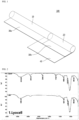
- FIG. 1 is a diagram showing a schematic configuration of a smoking article according to one embodiment of the present disclosure.
- smoking article may refer to an article capable of generating an aerosol, such as tobacco (cigarettes) or cigars.
- the smoking article may include an aerosol-generating material or an aerosol-forming substrate.
- the smoking article may include a solid material based on tobacco raw materials, such as leaf tobacco, cut tobacco, and reconstituted tobacco.
- the smoking material may include volatile compounds.
- upstream or upstream direction may refer to a direction moving away from an oral region of a smoker
- downstream or downstream direction may refer to a direction approaching the oral region of the smoker.
- the smoking material portion 10 is located upstream or in an upstream direction of a filter portion for a smoking article (or smoking article filter portion 20 or filter portion 20).
- the smoking article 100 is a combustion-type cigarette
- the present disclosure is not limited thereto, and the smoking article 100 may also be a heating-type cigarette or the like used along with an aerosol generating device (not shown) such as an electronic cigarette device.
- the present disclosure relates to the smoking article filter (or smoking article filter portion 20 or filter portion 20) included in the smoking article 100, the smoking article filter 20 according to an embodiment of the present disclosure includes lyocell tow including a plurality of lyocell fibers and a functional additive dispersed in the lyocell tow, wherein at least some of the plurality of lyocell fibers may not be chemically modified by the functional additive.
- 'not chemically modified means that, even though a functional additive is added to lyocell tow, the plurality of lyocell fibers that make up lyocell tow are not chemically synthesized, chemically combined, or compositionally modified with the functional additive, so the chemical properties and characteristics of the lyocell fiber do not change.
- the chemical properties and characteristics of the lyocell fibers included in lyocell tow to which a functional additive is added are the same as those of the lyocell fibers included in lyocell tow to which functional additives have not been added.
- the lyocell tow included in the smoking article filter 20 is composed of a plurality of lyocell fibers corresponding to regenerated cellulose, which is a natural polymer that has not been chemically modified despite the addition of the functional additive, the characteristics of lyocell fiber, which has excellent biodegradability, are maintained, so the biodegradability of a smoking article filter including lyocell tow composed of these fibers may also be excellent.
- the functional additive may be added onto lyocell fibers in the process of forming lyocell tow, or may be added onto lyocell tow in the process of forming a smoking article filter using the lyocell tow.
- the functional additive when the functional additive is added onto lyocell fibers in the process of forming lyocell tow, it may be added by spraying it directly onto the surface of the lyocell fiber in a spray type manner.
- the functional additive when the functional additive is added onto the lyocell tow in the process of forming a smoking article filter, it may be added by indirect spraying in a brush type manner.
- the functional additive may include a phenol-related functional material and an emulsion.
- the functional additive may include a phenol-related functional material, and the phenol-related functional material may be a phenol-reducing material.
- phenol may refer to a group of chemical compounds consisting of hydroxyl groups (-OH) directly bonded to an aromatic hydrocarbon functional group, and the phenol group includes phenol, catechol, m+p cresol, and o-cresol.
- phenol-reducing material may correspond to a material that may specifically reduce at least one of phenol-based materials in smoke generated during smoking, such as phenol, catechol, m+p cresol, and o-cresol.
- the phenol-reducing material may include at least one of polyethylene glycol (PEG), triethyl citrate (TEC), and triacetin (TA).
- PEG polyethylene glycol
- TEC triethyl citrate
- TA triacetin
- An FT-IR spectrum of the lyocell tow in which the functional additive according to one embodiment is dispersed may exhibit a first vibration peak, which is a vibration peak in a range of 1645 cm -1 to 1650 cm -1 .
- the first vibration peak within the range of 1645 cm -1 to 1650 cm -1 may be a vibration peak corresponding to a carbon-hydrogen (C-H) bond.
- the vibration peak corresponding to the carbon-hydrogen (C-H) bond may be the vibration peak corresponding to lyocell crystal water.
- the first vibration peak may be a reference value for defining a parameter (PCF) described later.
- the FT-IR spectrum may be obtained according to the ATR method (total reflection method) using "IN10MX (manufactured by Thermo Fisher Scientific)."
- An FT-IR spectrum of the lyocell tow in which the functional additive according to one embodiment is dispersed may further exhibit a second vibration peak, which is a vibration peak in a range of 1735 cm -1 to 1745 cm -1 .
- an FT-IR spectrum obtained by FT-IR analysis of the lyocell tow in which the functional additive is dispersed, and an FT-IR spectrum obtained by FT-IR analysis of cleaned lyocell tow in which the functional additive is dispersed and which is cleaned using a detergent may be used.
- the parameter (PCF) may be defined as a ratio (H2/H1) of the height (H2) of the second vibration peak to the height (H1) of the first vibration peak appearing in the FT-IR spectrum.
- the detergent may include at least one of an HFIP solvent, MeOH, and hexane, but is not limited thereto.
- a parameter (PCF) value in the FT-IR spectrum of lyocell tow in which the functional additive is dispersed may be greater than or equal to the parameter (PCF) value in the FT-IR spectrum of cleaned lyocell tow in which the functional additive is dispersed and which is cleaned using a detergent.
- a parameter (PCF) value in the FT-IR spectrum of lyocell tow in which the functional additive is dispersed may be greater than the parameter (PCF) value in the FT-IR spectrum of cleaned lyocell tow in which the functional additive is dispersed and which is cleaned using a detergent.
- the ratio (H2/H1) of the height (H2) of the second vibration peak to the height (H1) of the first vibration peak shown in the FT-IR spectrum of the lyocell tow in which the functional additive is dispersed may range from 1 to 20, or from more than 1 to less than 20.
- a parameter (PCF) value in the FT-IR spectrum of the cleaned lyocell tow may have a value of 1 or less.
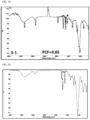
- FIG. 2 is a graph comparing the FT-IR spectra of lyocell tow in which a functional additive is not dispersed before and after cleaning
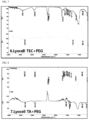
- FIG. 3 is a graph comparing the FT-IR spectra of lyocell tow in which a functional additive including PEG is dispersed before and after cleaning
- FIG. 4 is a graph comparing the FT-IR spectra of lyocell tow in which a functional additive including TEC is dispersed before and after cleaning
- FIG. 5 is a graph comparing the FT-IR spectra of lyocell tow in which a functional additive including TA is dispersed before and after cleaning
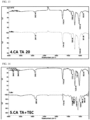
- FIG. 6 is a graph comparing the FT-IR spectra of lyocell tow in which a functional additive including TA and TEC is dispersed before and after cleaning
- FIG. 7 is a graph comparing the FT-IR spectra of lyocell tow in which a functional additive including PEG and TEC is dispersed before and after cleaning
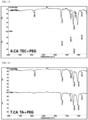
- FIG. 8 is a graph comparing the FT-IR spectra of lyocell tow in which a functional additive including TA and PEG is dispersed before and after cleaning
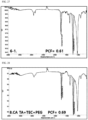
- FIG. 9 is a graph comparing the FT-IR spectra of lyocell tow in which a functional additive including TA, TEC, and PEG is dispersed before and after cleaning.
- FIG. 10 is a graph comparing the FT-IR spectra of cellulose acetate tow in which a functional additive is not dispersed before and after cleaning
- FIG. 11 is a graph comparing the FT-IR spectra of cellulose acetate tow in which a functional additive including PEG is dispersed before and after cleaning
- FIG. 12 is a graph comparing the FT-IR spectra of cellulose acetate tow in which a functional additive including TEC is dispersed before and after cleaning
- FIG. 13 is a graph comparing the FT-IR spectra of cellulose acetate tow in which a functional additive including TA is dispersed before and after cleaning
- FIG. 10 is a graph comparing the FT-IR spectra of cellulose acetate tow in which a functional additive is not dispersed before and after cleaning
- FIG. 11 is a graph comparing the FT-IR spectra of cellulose acetate tow in which a functional additive including PEG is dispersed
- FIG. 14 is a graph comparing the FT-IR spectra of cellulose acetate tow in which a functional additive including TA and TEC is dispersed before and after cleaning
- FIG. 15 is a graph comparing the FT-IR spectra of cellulose acetate tow in which a functional additive including PEG and TEC is dispersed before and after cleaning
- FIG. 16 is a graph comparing the FT-IR spectra of cellulose acetate tow in which a functional additive including TA and PEG is dispersed before and after cleaning
- FIG. 17 is a graph comparing the FT-IR spectra of cellulose acetate tow in which a functional additive including TA, TEC, and PEG is dispersed before and after cleaning.
- FIG. 18 is a graph showing the height of a first vibration peak and the height of a second vibration peak in the FT-IR spectrum of the lyocell tow in which a functional additive including PEG is dispersed
- FIG. 19 is a graph showing the height of a first vibration peak and the height of a second vibration peak in the FT-IR spectrum of the lyocell tow (lyocell tow of FIG. 18 ) in which the functional additive including PEG is dispersed and which is cleaned using a detergent.
- FIG. 20 is a graph showing the height of a first vibration peak and the height of a second vibration peak in the FT-IR spectrum of lyocell tow in which a functional additive including TEC and PEG is dispersed
- FIG. 21 is a graph showing the height of a first vibration peak and the height of a second vibration peak in the FT-IR spectrum of cleaned lyocell tow (lyocell tow of FIG. 20 ) in which the functional additive including TEC and PEG is dispersed and which is cleaned using a detergent.
- FIG. 22 is a graph showing the height of a first vibration peak and the height of a second vibration peak in the FT-IR spectrum of lyocell tow in which a functional additive including TA, TEC, and PEG is dispersed
- FIG. 23 is a graph showing the height of a first vibration peak and the height of a second vibration peak in the FT-IR spectrum of cleaned lyocell tow (lyocell tow of FIG. 22 ) in which the functional additive including TA, TEC, and PEG is dispersed and which is cleaned using a detergent.
- FIG. 24 is a graph showing the height of a third vibration peak and the height of a second vibration peak in the FT-IR spectrum of cellulose acetate tow in which a functional additive including PEG is dispersed
- FIG. 25 is a graph showing the height of a third vibration peak and the height of a second vibration peak in the FT-IR spectrum of cleaned cellulose acetate tow (cellulose acetate tow of FIG. 24 ) in which a functional additive including PEG is dispersed and which is cleaned using a detergent.
- FIG. 26 is a graph showing the height of a third vibration peak and the height of a second vibration peak in the FT-IR spectrum of cellulose acetate tow in which a functional additive including TEC and PEG is dispersed
- FIG. 27 is a graph showing the height of a third vibration peak and the height of a second vibration peak in the FT-IR spectrum of cleaned cellulose acetate tow (cellulose acetate tow of FIG. 26 ) in which a functional additive including TEC and PEG is dispersed and which is cleaned using a detergent.
- FIG. 28 is a graph showing the height of a third vibration peak and the height of a second vibration peak in the FT-IR spectrum of cellulose acetate tow in which a functional additive including TA, TEC, and PEG is dispersed
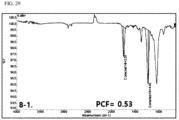
- FIG. 29 is a graph showing the height of a third vibration peak and the height of a second vibration peak in the FT-IR spectrum of cleaned cellulose acetate tow (cellulose acetate tow of FIG. 28 ) in which a functional additive including TA, TEC, and PEG is dispersed and which is cleaned using a detergent.
- Example 1 (lyocell tow + PEG 600)
- a smoking article filter was manufactured using lyocell tow to which 20 uL of PEG 600 was added to meet the following conditions: resistance to draw of 405 mmWG, length of 108 mm, and circumference of 24.2 mm.
- Example 2 (lyocell tow + TEC)
- a smoking article filter was manufactured in the same manner as in Example 1, except that TEC (i.e., 20 uL of TEC) was added instead of PEG 600 to lyocell tow.
- TEC i.e., 20 uL of TEC
- Example 3 (lyocell tow + TA)
- a smoking article filter was manufactured in the same manner as in Example 1, except that TA (i.e., 20 uL of TA) was added instead of PEG 600 to lyocell tow.
- TA i.e., 20 uL of TA
- Example 4 (lyocell tow + TA + TEC)
- a smoking article filter was manufactured in the same manner as in Example 1, except that a total volume of 20 uL of TA and TEC (10 uL each of TA and TEC) with a content ratio of 1:1 was added instead of PEG 600 to lyocell tow.
- Example 5 (lyocell tow + PEG 600 + TEC)
- a smoking article filter was manufactured in the same manner as in Example 1, except that a total volume of 20 uL of PEG 600 and TEC with a content ratio of 1:1 was added instead of PEG 600 to lyocell tow.
- Example 6 (lyocell tow + PEG 600 + TA)
- a smoking article filter was manufactured in the same manner as in Example 1, except that a total volume of 20 uL of PEG 600 and TA with a content ratio of 1:1 was added instead of PEG 600 to lyocell tow.
- Example 7 (lyocell tow + PEG 600 + TA + TEC)
- a smoking article filter was manufactured in the same manner as in Example 1, except that a total volume of 20 uL of TA, TEC, and PEG 600 with a content ratio of 1:1:1 was added instead of PEG 600 to lyocell tow.
- a smoking article filter was manufactured in the same manner as in Example 1, except that a functional additive was not added to lyocell tow.
- the FT-IR spectra for lyocell tow to which a functional additive was added according to Examples 1 to 7 and the FT-IR spectrum for the lyocell tow without the functional additive according to Comparative Example 1 (hereinafter referred to as 'FT-IR spectra before cleaning') were measured by extracting lyocell tow portions from the smoking article filters of Examples 1 to 7 and Comparative Example 1, respectively, and the lyocell tows of Examples 1 to 7 and Comparative Example 1 were cleaned using hexane, and the FT-IR spectra (hereinafter referred to as 'FT-IR spectra after cleaning') for the cleaned lyocell tows was measured respectively.
- IN10MX manufactured by Thermo Fisher Scientific Inc.
- the FT-IR spectra (FT-IR spectra before cleaning) for the lyocell tows prepared in Examples 1 to 7 and Comparative Example 1 and the FT-IR spectra (FT-IR spectra after cleaning) for cleaned lyocell tows after cleaning the lyocell tows prepared in Example 1 to 7 and Comparative Example 1 with hexane were compared and shown in FIGS. 3 to 9 and FIG. 2 , respectively.
- the FT-IR spectra shown at the top in FIGS. 2 to 9 are the FT-IR spectra for the lyocell tows before cleaning
- the FT-IR spectra shown at the bottom in FIGS. 2 to 9 are the FT-IR spectra for the lyocell tows after cleaning.
- a vibration peak with a significantly higher height appears at 1737.23 cm -1 , located in the range of 1735 cm -1 to 1745 cm -1 , compared to the FT-IR spectrum of the lyocell tow shown at the top of FIG. 2 before cleaning, and in the FT-IR spectrum of the TA-added lyocell tow shown at the top of FIG. 5 before cleaning, a vibration peak with a significantly higher height appears at 1739.56 cm -1 , located in the range of 1735 cm -1 to 1745 cm -1 , compared to the FT-IR spectrum of the lyocell tow shown at the top of FIG. 2 before cleaning.
- a smoking article filter was manufactured in the same manner as in Comparative Example 1, except that cellulose acetate tow without a functional additive was used instead of lyocell tow.
- a smoking article filter was manufactured in the same manner as in Comparative Example 2, except that 20 uL of PEG 600 was added to cellulose acetate tow.
- a smoking article filter was manufactured in the same manner as in Comparative Example 3, except that TEC was added instead of PEG 600 to cellulose acetate tow.
- a smoking article filter was manufactured in the same manner as in Comparative Example 3, except that TA was added instead of PEG 600 to cellulose acetate tow.
- a smoking article filter was manufactured in the same manner as in Comparative Example 3, except that a total volume of 20 uL of TA and TEC (10 uL each of TA and TEC) with a content ratio of 1:1 was added instead of PEG 600 to cellulose acetate tow.
- a smoking article filter was manufactured in the same manner as in Comparative Example 3, except that a total volume of 20 uL of PEG 600 and TEC with a content ratio of 1:1 was added instead of PEG 600 to cellulose acetate tow.
- a smoking article filter was manufactured in the same manner as in Comparative Example 3, except that a total volume of 20 uL of PEG 600 and TA with a content ratio of 1:1 was added instead of PEG 600 to cellulose acetate tow.
- a smoking article filter was manufactured in the same manner as in Comparative Example 3, except that a total volume of 20 uL of TA, TEC, and PEG 600 with a content ratio of 1:1:1 was added instead of PEG 600 to cellulose acetate tow.
- the FT-IR spectra for cellulose acetate tow to which a functional additive was added according to Comparative Examples 3 to 9 and the FT-IR spectrum for the cellulose acetate tow without the functional additive of Comparative Example 2 (hereinafter referred to as 'FT-IR spectra before cleaning') were measured by extracting cellulose acetate tow portions from the smoking article filters of Comparative Examples 3 to 9 and Comparative Example 2, respectively, and the cellulose acetate tows of Comparative Examples 3 to 9 and Comparative Example 2 were cleaned using hexane, and the FT-IR spectra (hereinafter referred to as 'FT-IR spectra after cleaning') for the cleaned cellulose acetate tow
- the FT-IR spectra (FT-IR spectra before cleaning) for the cellulose acetate tows prepared in Comparative Examples 2 to 9, and the FT-IR spectra (FT-IR spectrum after cleaning) for the cleaned cellulose acetate tows after cleaning the cellulose acetate tows prepared in Comparative Examples 2 to 9 with hexane are shown in FIGS. 10 to 17 , respectively.
- the FT-IR spectra shown at the top in FIGS. 10 to 17 are the FT-IR spectra for the cellulose acetate tows before cleaning, and the FT-IR spectra shown at the bottom in FIGS. 10 to 17 are the FT-IR spectra for the cellulose acetate tows after cleaning.
- a functional additive including at least one of TA, TEC, and PEG is added to cellulose acetate tow, the functional additive causes a chemical modification in the cellulose acetate tow, thereby forming a chemical bond between the functional additive and the cellulose acetate tow.
- FT-IR was measured before and after cleaning in the same manner as in Experimental Example 1 for the lyocell tows to which the functional additives were added, which were obtained in Example 1, Example 5, and Example 7, the height (H1) of a first vibration peak in the range of 1645 cm -1 to 1650 cm -1 was measured by analyzing each FT-IR spectrum, the height (H2) of a second vibration peak in the range of 1735 cm -1 to 1745 cm -1 was measured (see FIGS. 18 to 23 ), and the ratio (H2/H1) of the height (H2) of the second vibration peak to the height (H1) of the first vibration peak was calculated and shown in Table 1.
- FT-IR was measured before and after cleaning in the same manner as in Experimental Example 1 for the cellulose acetate tows to which the functional additives were added, which were obtained in Comparative Example 3, Comparative Example 7, and Comparative Example 9, the height (H3) of a third vibration peak in the range of 1220 cm -1 to 1230 cm -1 was measured by analyzing each FT-IR spectrum, the height (H2) of the second vibration peak in the range of 1735 cm -1 to 1745 cm -1 was measured (see FIGS. 24 to 29 ), and the ratio (H2/H3) of the height (H2) of the second vibration peak to the height (H3) of the third vibration peak was calculated and shown in Table 2.
- the third vibration peak in the range of 1220 cm -1 to 1230 cm -1 may be a vibration peak, that is, a reference value corresponding to the acetate peak for defining similarly to the parameters of lyocell tow.
- Example 1 Before cleaning After cleaning H1 H2 H2/H1 H1 H2 H2/H1
- Example 1 0.33 0.34 1.03 0.26 0.17 0.65
- Example 5 0.24 1.65 6.88 0.35 0.28 0.80
- Example 7 0.19 3.62 19.05 0.36 0.24 0.63
- Table 2 Before cleaning After cleaning H3 H2 H2/H3 H3 H2 H2/H3 Comparative Example 3 2.17 1.23 0.57 3.11 8.22 2.64 Comparative Example 7 3.07 1.82 0.59 4.72 2.87 0.61 Comparative Example 9 6.55 4.57 0.69 4.40 2.35 0.53
- the ratio (H2/H1) of the height (H2) of the second vibration peak to the height (H1) of the first vibration peak calculated from the FT-IR spectrum before cleaning of the lyocell tow to which the functional additive was added is 1.03, 6.88, and 19.05, which are greater than 1 (in Example 1, Example 5, and Example 7, respectively)
- the ratio (H2/H1) of the height (H2) of the second vibration peak to the height (H1) of the first vibration peak calculated from the FT-IR spectrum after cleaning of the lyocell tow to which the functional additive was added is 0.65, 0.80, and 0.63, which are less than 1 (in Example 1, Example 5, and Example 7, respectively).
- the ratio (H2/H3) of the height (H2) of the second vibration peak to the height (H3) of the third vibration peak calculated from the FT-IR spectrum before cleaning of the cellulose acetate tow to which the functional additive was added is 0.57, 0.59, and 0.69 which are less than 1 (in Comparative Example 3, Comparative Example 7, and Comparative Example 9, respectively)
- the ratio (H2/H3) of the height (H2) of the second vibration peak to the height (H3) of the third vibration peak calculated from the FT-IR spectrum after cleaning the cellulose acetate tow to which the functional additive was added is 2.67, 0.61, and 0.53 which are less than or greater than 1 (in Comparative Example 3, Comparative Example 7, and Comparative Example 9, respectively).
- FIG. 1 is a diagram showing a schematic configuration of a smoking article according to one embodiment of the present disclosure.
- the smoking article 100 includes a smoking material portion 10 and a filter portion 20, and the smoking article filter described above may be applied to the filter portion 20 of the smoking article 100.
- the smoking material portion 10 is located upstream of the filter portion 20.
- the smoking material portion 10 may be filled with a smoking material such as raw tobacco leaves, reconstituted tobacco leaves, or a mixture of tobacco leaves and reconstituted tobacco leaves.
- a processed smoking material may be filled in the smoking material portion 10 in the form of a sheet or shredded tobacco.
- the smoking material portion 10 may have the form of a longitudinally extending rod whose length, circumference, and diameter are not particularly limited, but the length, circumference, and diameter may be adjusted to sizes commonly used in the art in consideration of the filling amount of smoking material, user's preference, and the like.
- the smoking material portion 10 may include at least one aerosol-generating material selected from glycerin, propylene glycol, ethylene glycol, dipropylene glycol, diethylene glycol, triethylene glycol, tetraethylene glycol, and oleyl alcohol.
- the smoking mass portion 10 may contain other additives such as flavoring agents, humectants and/or acetate compounds.
- the aerosol-generating material and additives may be contained in the smoking material.
- the filter portion 20 is disposed downstream of the smoking material portion 10 and serves as a filter through which an aerosol material generated in the smoking material portion 10 passes just before the user inhales it.
- the filter portion 20 may be manufactured using various materials or manufactured in various forms.
- the filter portion 20 basically includes the above-described smoking article filter including lyocell tow including a plurality of lyocell fibers and TEC dispersed on the lyocell tow.
- the smoking article filter including the lyocell tow and TEC can replace all or part of the filter portion 20 of existing smoking articles, and when replacing part of the filter portion 20, a filter material that is used conventionally may be used together.
- Existing filter materials may include, for example, cellulose acetate filters, paper filters, hollow tube filters, or the like.
- the filter portion 20 is shown as a mono filter consisting of a single filter, but the present disclosure is not limited thereto.
- the filter portion 20 may be provided as a dual filter, a triple filter, or the like, which includes two or more filters, to increase filter efficiency.
- one of the plurality of filters is a filter of the present disclosure (hereinafter referred to as lyocell filter) including lyocell tow including lyocell fibers and TEC dispersed in the lyocell tow
- the other filter(s) among the plurality of filters may be a cellulose acetate filter and/or a paper filter.
- a length of the lyocell filter of the present disclosure may be 25% to 50% of the total length of the filter portion 20.
- the smoking article 100 may further include a hollow tube structure, which is a tubular structure including a hollow interior.
- the hollow tube structure may be disposed downstream of the filter portion 20 including the lyocell filter.
- perforations may be formed in the hollow tube structure, but the present disclosure is not limited thereto. Perforations may not be formed in the hollow tube structure. In some embodiments, when perforations are formed in the hollow tube structure, the perforations may be formed at a position located 10 mm to 15 mm from the downstream end of the smoking article 100 in the upstream direction.
- the exterior of the smoking material portion 10 and the filter portion 20 may be wrapped with a wrapper 30a or 30b.
- the smoking material portion 10 may be wrapped with a smoking material portion wrapper 30a.
- Some of the cigarette smoke generated during a typical combustion process of the smoking material portion 10 is released into the atmosphere through the smoking material portion wrapper 30a before passing through the filter portion 20, and sidestream smoke is unpleasant to secondhand smokers.
- sidestream smoke There have been various attempts to reduce sidestream smoke, such as adding fillers such as magnesium oxide, titanium oxide, cerium oxide, aluminum oxide, calcium carbonate, and zirconium carbonate to conventional cigarette paper.
- fillers such as magnesium oxide, titanium oxide, cerium oxide, aluminum oxide, calcium carbonate, and zirconium carbonate
- the smoking material portion wrapper 30a may be filled with a mixture of magnesium oxide (MgO and/or Mg(OH) 2 ) and calcium carbonate (CaCO 3 ) in order to reduce sidestream smoke and at the same time prevent a decrease in smoking taste sensation, a decrease in ash integrity, and loss of combustion.
- MgO and/or Mg(OH) 2 magnesium oxide
- CaCO 3 calcium carbonate
- the filter portion 20 may be wrapped with a filter portion wrapper 30b.
- the filter portion wrapper 30b may be made of grease-resistant wrapping paper, and an aluminum foil may be further included on an inner surface of the filter portion wrapper 30b.
- the filter portion wrapper 30b may have a basis weight of 90 mg -2 or less, but is not limited thereto.
- the smoking material portion 10 wrapped with the smoking material portion wrapper 30a and the filter portion 20 wrapped with the filter portion wrapper 30b may be joined and wrapped with tipping paper 40.
- the tipping paper 40 may be wrapped around at least a portion (for example, a partial downstream area) of the smoking material portion wrapper 30a and the exterior of the filter portion wrapper 30b.
- the tipping paper 40 may be made of non-porous wrapping paper that has not been treated to be grease-resistant, but the present disclosure is not limited thereto.
- the tipping paper 40 may prevent the filter portion 20 from burning by including an incombustible material, but the present disclosure is not limited thereto.
Landscapes
- Chemical & Material Sciences (AREA)
- Engineering & Computer Science (AREA)
- Materials Engineering (AREA)
- Life Sciences & Earth Sciences (AREA)
- Biodiversity & Conservation Biology (AREA)
- Cigarettes, Filters, And Manufacturing Of Filters (AREA)
Abstract
Description
- The present disclosure relates to a smoking article filter including lyocell tow in which a functional additive is dispersed, and more particularly, to a smoking article filter that has excellent biodegradability because the lyocell fiber is not chemically modified by the functional additive despite the addition of the functional additive, and a smoking article including the same.
- Typical cigarette filters include cellulose acetate tow, which is obtained by extracting cellulose from wood pulp and acetylating the extracted cellulose. In addition, cigarette filters are assembled into tobacco products, distributed to consumers, provided for smoking, and finally discarded after smoking the cigarette. In addition, cigarette filters may be directly discarded as manufacturing residue from cigarette filter manufacturing plants. This cigarette filter waste is collected as waste and landfilled for disposal. In addition, in some cases, smoked cigarettes are not collected as waste and left in the natural environment.
- Accordingly, in recent years, research for replacing cellulose acetate tow with an eco-friendly material to protect the natural environment and reduce costs has been carried out. For example, unlike cellulose acetate, the development of tow using lyocell fiber, which is made by fiberizing cellulose itself, is in progress.
- When manufacturing smoking article filters, functional additives are added onto the tow to improve filter performance. For example, when manufacturing smoking article filters, phenol-related functional materials (or phenol-reducing materials) that may specifically reduce phenol-based materials generated during smoking are added to reduce phenol smoke components in mainstream smoke. Conventionally, it is known that phenol-related functional materials such as polyethylene glycol (PEG), triethyl citrate (TEC), and triacetin (TA) are added to cellulose acetate tow. When phenol-related functional materials consisting of PEG and TEC are added to hydrophobic cellulose acetate, the phenol-related functional materials have the problem of lowering biodegradability by serving as a plasticizer for cellulose acetate fibers and bonding hydrophobic cellulose acetate fibers together.
- Even when functional additives are added to highly biodegradable lyocell tow, the lyocell fiber is not chemically modified, so the need for a smoking article filter with excellent biodegradability is emerging. Further, there is a need for a method to accurately analyze whether lyocell fibers have not been chemically modified despite the application of functional additives.
- One object of the present disclosure is to provide a smoking article filter including lyocell tow in which a functional additive is dispersed, and more particularly, a smoking article filter that has excellent biodegradability because lyocell fibers that constitute lyocell tow are not chemically modified by the functional additive despite the addition of the functional additive.
- Another object of the present disclosure is to provide a smoking article including a smoking article filter including lyocell tow in which a functional additive is dispersed, and more particularly, to a smoking article including a smoking article filter that has excellent biodegradability because lyocell fibers that constitute lyocell tow are not chemically modified by the functional additive despite the addition of the functional additive.
- A smoking article filter according to one embodiment for achieving the above object includes a lyocell tow including a plurality of lyocell fibers and a functional additive dispersed in the lyocell tow, wherein at least some of the plurality of lyocell fibers are not chemically modified by the functional additive, an FT-IR spectrum of the lyocell tow in which the functional additive is dispersed exhibits a first vibration peak, which is a vibration peak in a range of 1645 cm-1 to 1650 cm-1.
- In some embodiments, the functional additive may include an emulsion and a phenol reducing material, wherein the phenol-reducing material may include at least one of polyethylene glycol (PEG), triethyl citrate (TEC), and triacetin (TA).
- In some embodiments, the FT-IR spectrum of the lyocell tow in which the functional additive is dispersed may further exhibit a second vibration peak, which is a vibration peak in a range of 1735 cm-1 to 1745 cm-1.
- In some embodiments, a parameter (PCF) is defined as a ratio of the height of the second vibration peak to the height of the first vibration peak in the FT-IR spectrum, a parameter value in the FT-IR spectrum of the lyocell tow in which the functional additive is dispersed may be greater than or equal to a parameter value in the FT-IR spectrum of cleaned lyocell tow in which the functional additive is dispersed and which is cleaned using a detergent.
- In some embodiments, a parameter (PCF) is defined as a ratio of the height of the second vibration peak to the height of the first vibration peak in the FT-IR spectrum, and a parameter value in the FT-IR spectrum of the lyocell tow in which the functional additive is dispersed may range from 1 to 20.
- In some embodiments, after the lyocell tow in which the functional additive is dispersed is cleaned using a detergent, a parameter value in the FT-IR spectrum of the cleaned lyocell tow may have a value of 1 or less.
- A smoking article filter according to another embodiment for achieving the above object includes a lyocell tow including a plurality of lyocell fibers and a functional additive dispersed in the lyocell tow, wherein at least some of the plurality of lyocell fibers are not chemically modified by the functional additive, and the FT-IR spectrum of the lyocell tow in which the functional additive is dispersed exhibits a first vibration peak, which is a vibration peak corresponding to a C-H bond.
- In some embodiments, the FT-IR spectrum of the lyocell tow in which the functional additive is dispersed may further exhibit a second vibration peak, which is a vibration peak corresponding to a C=O bond.
- In some embodiments, a parameter (PCF) is defined as a ratio of the height of the second vibration peak to the height of the first vibration peak in the FT-IR spectrum, a parameter value in the FT-IR spectrum of the lyocell tow in which the functional additive is dispersed may be greater than a parameter value in the FT-IR spectrum of cleaned lyocell tow in which the functional additive is dispersed and which is cleaned using a detergent.
- In a smoking article including a smoking material portion, a filter portion, and a wrapper according to one embodiment for achieving the other object, the filter portion includes lyocell tow including a plurality of lyocell fibers and a functional additive dispersed in the lyocell tow, wherein at least some of the plurality of lyocell fibers are not chemically modified by the functional additive, and an FT-IR spectrum of the lyocell tow in which the functional additive is dispersed exhibits a first vibration peak, which is a vibration peak in a range of 1645 cm-1 to 1650 cm-1.
- According to a smoking article filter according to one embodiment and a smoking article including the same, the present disclosure can provide a smoking article filter that can maintain the excellent biodegradability of lyocell fibers because the lyocell fibers are not chemically modified by a functional additive even though the functional additive including a phenol-reducing material with phenol-reducing performance is dispersed in the lyocell tow, and a smoking article including the same.
- In addition, according to a smoking article filter according to one embodiment and a smoking article including the same, the present disclosure can provide a smoking article filter having excellent biodegradability and excellent phenol-reducing performance by dispersing a functional additive including a phenol-reducing material with phenol-reducing performance in lyocell tow, and a smoking article including the same.
- Further, when a phenol-reducing material is added onto lyocell tow, it can be clearly confirmed using FT-IR analysis that the lyocell fiber is not chemically modified.
-
-
FIG. 1 is a diagram showing a schematic configuration of a smoking article according to one embodiment of the present disclosure. -
FIG. 2 is a graph comparing the FT-IR spectra of lyocell tow in which a functional additive is not dispersed before and after cleaning. -
FIG. 3 is a graph comparing the FT-IR spectra of lyocell tow in which a functional additive including PEG is dispersed before and after cleaning. -
FIG. 4 is a graph comparing the FT-IR spectra of lyocell tow in which a functional additive including TEC is dispersed before and after cleaning. -
FIG. 5 is a graph comparing the FT-IR spectra of lyocell tow in which a functional additive including TA is dispersed before and after cleaning. -
FIG. 6 is a graph comparing the FT-IR spectra of lyocell tow in which a functional additive including TA and TEC is dispersed before and after cleaning. -
FIG. 7 is a graph comparing the FT-IR spectra of lyocell tow in which a functional additive including PEG and TEC is dispersed before and after cleaning. -
FIG. 8 is a graph comparing the FT-IR spectra of lyocell tow in which a functional additive including TA and PEG is dispersed before and after cleaning. -
FIG. 9 is a graph comparing the FT-IR spectra of lyocell tow in which a functional additive including TA, TEC, and PEG is dispersed before and after cleaning. -
FIG. 10 is a graph comparing the FT-IR spectra of cellulose acetate tow in which a functional additive is not dispersed before and after cleaning. -
FIG. 11 is a graph comparing the FT-IR spectra of cellulose acetate tow in which a functional additive including PEG is dispersed before and after cleaning. -
FIG. 12 is a graph comparing the FT-IR spectra of cellulose acetate tow in which a functional additive including TEC is dispersed before and after cleaning. -
FIG. 13 is a graph comparing the FT-IR spectra of cellulose acetate tow in which a functional additive including TA is dispersed before and after cleaning. -
FIG. 14 is a graph comparing the FT-IR spectra of cellulose acetate tow in which a functional additive including TA and TEC is dispersed before and after cleaning. -
FIG. 15 is a graph comparing the FT-IR spectra of cellulose acetate tow in which a functional additive including PEG and TEC is dispersed before and after cleaning. -
FIG. 16 is a graph comparing the FT-IR spectra of cellulose acetate tow in which a functional additive including TA and PEG is dispersed before and after cleaning. -
FIG. 17 is a graph comparing the FT-IR spectra of cellulose acetate tow in which a functional additive including TA, TEC, and PEG is dispersed before and after cleaning. -
FIG. 18 is a graph showing the height of a first vibration peak and the height of a second vibration peak in the FT-IR spectrum of lyocell tow in which a functional additive including PEG is dispersed. -
FIG. 19 is a graph showing the height of a first vibration peak and the height of a second vibration peak in the FT-IR spectrum of lyocell tow (lyocell tow ofFIG. 18 ) in which the functional additive including PEG is dispersed and which is cleaned using a detergent. -
FIG. 20 is a graph showing the height of a first vibration peak and the height of a second vibration peak in the FT-IR spectrum of lyocell tow in which a functional additive including TEC and PEG is dispersed. -
FIG. 21 is a graph showing the height of a first vibration peak and the height of a second vibration peak in the FT-IR spectrum of cleaned lyocell tow (lyocell tow ofFIG. 20 ) in which the functional additive including TEC and PEG is dispersed and which is cleaned using a detergent. -
FIG. 22 is a graph showing the height of a first vibration peak and the height of a second vibration peak in the FT-IR spectrum of lyocell tow in which a functional additive including TA, TEC, and PEG is dispersed. -
FIG. 23 is a graph showing the height of a first vibration peak and the height of a second vibration peak in the FT-IR spectrum of cleaned lyocell tow (lyocell tow ofFIG. 22 ) in which the functional additive including TA, TEC, and PEG is dispersed and which is cleaned using a detergent. -
FIG. 24 is a graph showing the height of a third vibration peak and the height of a second vibration peak in the FT-IR spectrum of cellulose acetate tow in which a functional additive including PEG is dispersed. -
FIG. 25 is a graph showing the height of a third vibration peak and the height of a second vibration peak in the FT-IR spectrum of cleaned cellulose acetate tow (cellulose acetate tow ofFIG. 24 ) in which a functional additive including PEG is dispersed and which is cleaned using a detergent. -
FIG. 26 is a graph showing the height of a third vibration peak and the height of a second vibration peak in the FT-IR spectrum of cellulose acetate tow in which a functional additive including TEC and PEG is dispersed. -
FIG. 27 is a graph showing the height of a third vibration peak and the height of a second vibration peak in the FT-IR spectrum of cleaned cellulose acetate tow (cellulose acetate tow ofFIG. 26 ) in which a functional additive including TEC and PEG is dispersed and which is cleaned using a detergent. -
FIG. 28 is a graph showing the height of a third vibration peak and the height of a second vibration peak in the FT-IR spectrum of cellulose acetate tow in which a functional additive including TA, TEC, and PEG is dispersed. -
FIG. 29 is a graph showing the height of a third vibration peak and the height of a second vibration peak in the FT-IR spectrum of cleaned cellulose acetate tow (cellulose acetate tow ofFIG. 28 ) in which a functional additive including TA, TEC, and PEG is dispersed and which is cleaned using a detergent. - Hereinafter, exemplary embodiments of the present disclosure will be described in detail with reference to the accompanying drawings. Advantages and features of the present disclosure and methods of achieving the same should become clear from embodiments described in detail below with reference to the accompanying drawings. However, the technical spirit of the present disclosure is not limited to the following embodiments and may be implemented in various different forms. The following embodiments only make the technical spirit of the present disclosure complete and are provided to completely inform those of ordinary skill in the art to which the present disclosure pertains of the scope of the disclosure. The technical spirit of the present disclosure is defined only by the scope of the claims.
- In assigning reference numerals to components of each drawing, it should be noted that the same reference numerals are assigned to the same components as much as possible even when the components are illustrated in different drawings. Also, in describing the present disclosure, when detailed description of a known related configuration or function is deemed as having the possibility of obscuring the gist of the present disclosure, the detailed description thereof will be omitted.
- Unless otherwise defined, all terms including technical or scientific terms used in this specification have the same meaning as commonly understood by those of ordinary skill in the art to which the present disclosure pertains. Terms defined in commonly used dictionaries should not be construed in an idealized or overly formal sense unless expressly so defined herein. Terms used in this specification are for describing the embodiments and are not intended to limit the present disclosure. In this specification, a singular expression includes a plural expression unless the context clearly indicates otherwise.
- Also, in describing components of the present disclosure, terms such as first, second, A, B, (a), and (b) may be used. Such terms are only used for distinguishing one component from another component, and the essence, order, sequence, or the like of the corresponding component is not limited by the terms. In a case in which a certain component is described as being "connected," "coupled," or "linked" to another component, it should be understood that, although the component may be directly connected or linked to the other component, still another component may also be "connected," "coupled," or "linked" between the two components.
- The terms "comprises" and/or "comprising" used herein specify the presence of mentioned components, steps, operations, and/or devices but do not preclude the presence or addition of one or more other components, steps, operations, and/or devices.
- First, some terms used in this specification will be clarified.
- In this specification, "smoking article" may refer to any product that can be smoked or any product that can provide a smoking experience, regardless of whether the product is based on tobacco, tobacco derivatives, expanded tobacco, reconstituted tobacco, or tobacco substitutes. For example, smoking articles may include smokable products such as cigarettes, cigars, and cigarillos.
- As used herein, "smoking material" may refer to any type of material that can be used in a smoking article.
- In this specification, "upstream" or "upstream direction" may refer to a direction moving away from an oral region of a smoker, and "downstream" or "downstream direction" may refer to a direction approaching the oral region of the smoker.
- In this specification, "longitudinal direction" may refer to a direction corresponding to a longitudinal axis of a smoking article.
- Hereinafter, various embodiments of the present disclosure will be described in detail with reference to the accompanying drawings.
-
FIG. 1 is a diagram showing a schematic configuration of a smoking article according to one embodiment of the present disclosure. - Throughout this specification, the term "smoking article" may refer to an article capable of generating an aerosol, such as tobacco (cigarettes) or cigars. The smoking article may include an aerosol-generating material or an aerosol-forming substrate. In addition, the smoking article may include a solid material based on tobacco raw materials, such as leaf tobacco, cut tobacco, and reconstituted tobacco. The smoking material may include volatile compounds.
- In addition, throughout the specification, "upstream" or "upstream direction" may refer to a direction moving away from an oral region of a smoker, and "downstream" or "downstream direction" may refer to a direction approaching the oral region of the smoker. For example, in the
smoking article 100 shown inFIG. 1 , thesmoking material portion 10 is located upstream or in an upstream direction of a filter portion for a smoking article (or smokingarticle filter portion 20 or filter portion 20). - Furthermore, in this specification, a case where the
smoking article 100 is a combustion-type cigarette is described as an example, but the present disclosure is not limited thereto, and thesmoking article 100 may also be a heating-type cigarette or the like used along with an aerosol generating device (not shown) such as an electronic cigarette device. - The present disclosure relates to the smoking article filter (or smoking
article filter portion 20 or filter portion 20) included in thesmoking article 100, thesmoking article filter 20 according to an embodiment of the present disclosure includes lyocell tow including a plurality of lyocell fibers and a functional additive dispersed in the lyocell tow, wherein at least some of the plurality of lyocell fibers may not be chemically modified by the functional additive. - In this specification, 'not chemically modified' means that, even though a functional additive is added to lyocell tow, the plurality of lyocell fibers that make up lyocell tow are not chemically synthesized, chemically combined, or compositionally modified with the functional additive, so the chemical properties and characteristics of the lyocell fiber do not change. In other words, it may mean that the chemical properties and characteristics of the lyocell fibers included in lyocell tow to which a functional additive is added are the same as those of the lyocell fibers included in lyocell tow to which functional additives have not been added.
- Because the lyocell tow included in the
smoking article filter 20 according to the present disclosure is composed of a plurality of lyocell fibers corresponding to regenerated cellulose, which is a natural polymer that has not been chemically modified despite the addition of the functional additive, the characteristics of lyocell fiber, which has excellent biodegradability, are maintained, so the biodegradability of a smoking article filter including lyocell tow composed of these fibers may also be excellent. - In some embodiments, the functional additive may be added onto lyocell fibers in the process of forming lyocell tow, or may be added onto lyocell tow in the process of forming a smoking article filter using the lyocell tow. Without being limited thereto, when the functional additive is added onto lyocell fibers in the process of forming lyocell tow, it may be added by spraying it directly onto the surface of the lyocell fiber in a spray type manner. In addition, without being limited thereto, when the functional additive is added onto the lyocell tow in the process of forming a smoking article filter, it may be added by indirect spraying in a brush type manner.
- In some embodiments, the functional additive may include a phenol-related functional material and an emulsion.
- In some embodiments, the functional additive may include a phenol-related functional material, and the phenol-related functional material may be a phenol-reducing material. The term "phenol" may refer to a group of chemical compounds consisting of hydroxyl groups (-OH) directly bonded to an aromatic hydrocarbon functional group, and the phenol group includes phenol, catechol, m+p cresol, and o-cresol. The "phenol-reducing material" may correspond to a material that may specifically reduce at least one of phenol-based materials in smoke generated during smoking, such as phenol, catechol, m+p cresol, and o-cresol.
- In some embodiments, the phenol-reducing material may include at least one of polyethylene glycol (PEG), triethyl citrate (TEC), and triacetin (TA).
- An FT-IR spectrum of the lyocell tow in which the functional additive according to one embodiment is dispersed may exhibit a first vibration peak, which is a vibration peak in a range of 1645 cm-1 to 1650 cm-1. In the FT-IR spectrum, the first vibration peak within the range of 1645 cm-1 to 1650 cm-1 may be a vibration peak corresponding to a carbon-hydrogen (C-H) bond. The vibration peak corresponding to the carbon-hydrogen (C-H) bond may be the vibration peak corresponding to lyocell crystal water. Accordingly, the first vibration peak may be a reference value for defining a parameter (PCF) described later.
- The FT-IR spectrum may be obtained according to the ATR method (total reflection method) using "IN10MX (manufactured by Thermo Fisher Scientific)."
- An FT-IR spectrum of the lyocell tow in which the functional additive according to one embodiment is dispersed may further exhibit a second vibration peak, which is a vibration peak in a range of 1735 cm-1 to 1745 cm-1. The second vibration peak in the range of 1735 cm-1 to 1745 cm-1 in the FT-IR spectrum may be a vibration peak corresponding to a carbon=oxygen (C=O) bond.
- In one embodiment, in order to analyze whether the phenol-reducing material included in the functional additive is added to lyocell tow and the plurality of lyocell fibers constituting the lyocell tow are chemically modified by the phenol-reducing material, an FT-IR spectrum obtained by FT-IR analysis of the lyocell tow in which the functional additive is dispersed, and an FT-IR spectrum obtained by FT-IR analysis of cleaned lyocell tow in which the functional additive is dispersed and which is cleaned using a detergent may be used. Hereinafter, in this specification, in order to analyze whether the lyocell fiber has been chemically modified by the phenol-reducing material, the parameter (PCF) may be defined as a ratio (H2/H1) of the height (H2) of the second vibration peak to the height (H1) of the first vibration peak appearing in the FT-IR spectrum.
- In some embodiments, the detergent may include at least one of an HFIP solvent, MeOH, and hexane, but is not limited thereto.
- In some embodiments, a parameter (PCF) value in the FT-IR spectrum of lyocell tow in which the functional additive is dispersed may be greater than or equal to the parameter (PCF) value in the FT-IR spectrum of cleaned lyocell tow in which the functional additive is dispersed and which is cleaned using a detergent.
- In some other embodiments, a parameter (PCF) value in the FT-IR spectrum of lyocell tow in which the functional additive is dispersed may be greater than the parameter (PCF) value in the FT-IR spectrum of cleaned lyocell tow in which the functional additive is dispersed and which is cleaned using a detergent.
- In some embodiments, the ratio (H2/H1) of the height (H2) of the second vibration peak to the height (H1) of the first vibration peak shown in the FT-IR spectrum of the lyocell tow in which the functional additive is dispersed, that is, the parameter (PCF) may range from 1 to 20, or from more than 1 to less than 20.
- In some embodiments, after the lyocell tow in which the functional additive is dispersed is cleaned using a detergent, a parameter (PCF) value in the FT-IR spectrum of the cleaned lyocell tow may have a value of 1 or less.
-
FIG. 2 is a graph comparing the FT-IR spectra of lyocell tow in which a functional additive is not dispersed before and after cleaning,FIG. 3 is a graph comparing the FT-IR spectra of lyocell tow in which a functional additive including PEG is dispersed before and after cleaning,FIG. 4 is a graph comparing the FT-IR spectra of lyocell tow in which a functional additive including TEC is dispersed before and after cleaning,FIG. 5 is a graph comparing the FT-IR spectra of lyocell tow in which a functional additive including TA is dispersed before and after cleaning,FIG. 6 is a graph comparing the FT-IR spectra of lyocell tow in which a functional additive including TA and TEC is dispersed before and after cleaning,FIG. 7 is a graph comparing the FT-IR spectra of lyocell tow in which a functional additive including PEG and TEC is dispersed before and after cleaning,FIG. 8 is a graph comparing the FT-IR spectra of lyocell tow in which a functional additive including TA and PEG is dispersed before and after cleaning, andFIG. 9 is a graph comparing the FT-IR spectra of lyocell tow in which a functional additive including TA, TEC, and PEG is dispersed before and after cleaning. - In addition,
FIG. 10 is a graph comparing the FT-IR spectra of cellulose acetate tow in which a functional additive is not dispersed before and after cleaning,FIG. 11 is a graph comparing the FT-IR spectra of cellulose acetate tow in which a functional additive including PEG is dispersed before and after cleaning,FIG. 12 is a graph comparing the FT-IR spectra of cellulose acetate tow in which a functional additive including TEC is dispersed before and after cleaning,FIG. 13 is a graph comparing the FT-IR spectra of cellulose acetate tow in which a functional additive including TA is dispersed before and after cleaning,FIG. 14 is a graph comparing the FT-IR spectra of cellulose acetate tow in which a functional additive including TA and TEC is dispersed before and after cleaning,FIG. 15 is a graph comparing the FT-IR spectra of cellulose acetate tow in which a functional additive including PEG and TEC is dispersed before and after cleaning,FIG. 16 is a graph comparing the FT-IR spectra of cellulose acetate tow in which a functional additive including TA and PEG is dispersed before and after cleaning, andFIG. 17 is a graph comparing the FT-IR spectra of cellulose acetate tow in which a functional additive including TA, TEC, and PEG is dispersed before and after cleaning. -
FIG. 18 is a graph showing the height of a first vibration peak and the height of a second vibration peak in the FT-IR spectrum of the lyocell tow in which a functional additive including PEG is dispersed, andFIG. 19 is a graph showing the height of a first vibration peak and the height of a second vibration peak in the FT-IR spectrum of the lyocell tow (lyocell tow ofFIG. 18 ) in which the functional additive including PEG is dispersed and which is cleaned using a detergent. -
FIG. 20 is a graph showing the height of a first vibration peak and the height of a second vibration peak in the FT-IR spectrum of lyocell tow in which a functional additive including TEC and PEG is dispersed, andFIG. 21 is a graph showing the height of a first vibration peak and the height of a second vibration peak in the FT-IR spectrum of cleaned lyocell tow (lyocell tow ofFIG. 20 ) in which the functional additive including TEC and PEG is dispersed and which is cleaned using a detergent. -
FIG. 22 is a graph showing the height of a first vibration peak and the height of a second vibration peak in the FT-IR spectrum of lyocell tow in which a functional additive including TA, TEC, and PEG is dispersed, andFIG. 23 is a graph showing the height of a first vibration peak and the height of a second vibration peak in the FT-IR spectrum of cleaned lyocell tow (lyocell tow ofFIG. 22 ) in which the functional additive including TA, TEC, and PEG is dispersed and which is cleaned using a detergent. -
FIG. 24 is a graph showing the height of a third vibration peak and the height of a second vibration peak in the FT-IR spectrum of cellulose acetate tow in which a functional additive including PEG is dispersed, andFIG. 25 is a graph showing the height of a third vibration peak and the height of a second vibration peak in the FT-IR spectrum of cleaned cellulose acetate tow (cellulose acetate tow ofFIG. 24 ) in which a functional additive including PEG is dispersed and which is cleaned using a detergent. -
FIG. 26 is a graph showing the height of a third vibration peak and the height of a second vibration peak in the FT-IR spectrum of cellulose acetate tow in which a functional additive including TEC and PEG is dispersed, andFIG. 27 is a graph showing the height of a third vibration peak and the height of a second vibration peak in the FT-IR spectrum of cleaned cellulose acetate tow (cellulose acetate tow ofFIG. 26 ) in which a functional additive including TEC and PEG is dispersed and which is cleaned using a detergent. -
FIG. 28 is a graph showing the height of a third vibration peak and the height of a second vibration peak in the FT-IR spectrum of cellulose acetate tow in which a functional additive including TA, TEC, and PEG is dispersed, andFIG. 29 is a graph showing the height of a third vibration peak and the height of a second vibration peak in the FT-IR spectrum of cleaned cellulose acetate tow (cellulose acetate tow ofFIG. 28 ) in which a functional additive including TA, TEC, and PEG is dispersed and which is cleaned using a detergent. - Hereinafter, referring to
FIGS. 2 to 29 , using the FT-IR spectrum obtained by FT-IR analysis of lyocell tow in which the functional additive including the phenol-reducing material is dispersed, and the FT-IR spectrum obtained by FT-IR analysis of cleaned lyocell tow in which the functional additive is dispersed and which is cleaned using a detergent, the present inventors intend to explain that there is no chemical change in lyocell fiber due to the phenol-reducing material included in the functional additive. - A smoking article filter was manufactured using lyocell tow to which 20 uL of PEG 600 was added to meet the following conditions: resistance to draw of 405 mmWG, length of 108 mm, and circumference of 24.2 mm.
- A smoking article filter was manufactured in the same manner as in Example 1, except that TEC (i.e., 20 uL of TEC) was added instead of PEG 600 to lyocell tow.
- A smoking article filter was manufactured in the same manner as in Example 1, except that TA (i.e., 20 uL of TA) was added instead of PEG 600 to lyocell tow.
- A smoking article filter was manufactured in the same manner as in Example 1, except that a total volume of 20 uL of TA and TEC (10 uL each of TA and TEC) with a content ratio of 1:1 was added instead of PEG 600 to lyocell tow.
- A smoking article filter was manufactured in the same manner as in Example 1, except that a total volume of 20 uL of PEG 600 and TEC with a content ratio of 1:1 was added instead of PEG 600 to lyocell tow.
- A smoking article filter was manufactured in the same manner as in Example 1, except that a total volume of 20 uL of PEG 600 and TA with a content ratio of 1:1 was added instead of PEG 600 to lyocell tow.
- A smoking article filter was manufactured in the same manner as in Example 1, except that a total volume of 20 uL of TA, TEC, and PEG 600 with a content ratio of 1:1:1 was added instead of PEG 600 to lyocell tow.
- A smoking article filter was manufactured in the same manner as in Example 1, except that a functional additive was not added to lyocell tow.
- Using IN10MX (manufactured by Thermo Fisher Scientific Inc.) as a Fourier transform infrared spectrometer, under the measurement conditions of a measurement range of 400 cm-1 to 4000 cm-1, an integration number of 32, and an ATR method (total reflection method), the FT-IR spectra for lyocell tow to which a functional additive was added according to Examples 1 to 7 and the FT-IR spectrum for the lyocell tow without the functional additive according to Comparative Example 1 (hereinafter referred to as 'FT-IR spectra before cleaning') were measured by extracting lyocell tow portions from the smoking article filters of Examples 1 to 7 and Comparative Example 1, respectively, and the lyocell tows of Examples 1 to 7 and Comparative Example 1 were cleaned using hexane, and the FT-IR spectra (hereinafter referred to as 'FT-IR spectra after cleaning') for the cleaned lyocell tows was measured respectively.
- Specifically, the FT-IR spectra (FT-IR spectra before cleaning) for the lyocell tows prepared in Examples 1 to 7 and Comparative Example 1 and the FT-IR spectra (FT-IR spectra after cleaning) for cleaned lyocell tows after cleaning the lyocell tows prepared in Example 1 to 7 and Comparative Example 1 with hexane were compared and shown in
FIGS. 3 to 9 andFIG. 2 , respectively. The FT-IR spectra shown at the top inFIGS. 2 to 9 are the FT-IR spectra for the lyocell tows before cleaning, and the FT-IR spectra shown at the bottom inFIGS. 2 to 9 are the FT-IR spectra for the lyocell tows after cleaning. - Comparing the FT-IR spectra of the lyocell tows shown at the top of
FIGS. 2 to 9 before cleaning, it can be confirmed that, in the FT-IR spectra (top ofFIGS. 3 to 9 ) before cleaning of the lyocell tow to which a functional additive including at least one of TEC, PEG, and TA is added, the height of the vibration peak located within the range of 1735 cm-1 to 1745 cm-1 increases significantly compared to the FT-IR spectrum (top ofFIG. 2 ) before cleaning of the lyocell tow without the functional additive. - For example, it can be confirmed that, in the FT-IR spectrum of the PEG-added lyocell tow shown at the top of
FIG. 3 before cleaning, a vibration peak with a significantly higher height appears at 1738.22 cm-1, located in the range of 1735 cm-1 to 1745 cm-1, compared to the FT-IR spectrum of the lyocell tow shown at the top ofFIG. 2 before cleaning, in the FT-IR spectrum of the TEC-added lyocell tow shown at the top ofFIG. 4 before cleaning, a vibration peak with a significantly higher height appears at 1737.23 cm-1, located in the range of 1735 cm-1 to 1745 cm-1, compared to the FT-IR spectrum of the lyocell tow shown at the top ofFIG. 2 before cleaning, and in the FT-IR spectrum of the TA-added lyocell tow shown at the top ofFIG. 5 before cleaning, a vibration peak with a significantly higher height appears at 1739.56 cm-1, located in the range of 1735 cm-1 to 1745 cm-1, compared to the FT-IR spectrum of the lyocell tow shown at the top ofFIG. 2 before cleaning. - Accordingly, when a functional additive including at least one of TA, TEC, and PEG is added to lyocell tow, it can be confirmed that the height of the vibration peak located within the range of 1735 cm-1 to 1745 cm-1 corresponding to the carbon=oxygen (C=O) bond increases, and a carbon=oxygen (C=O) bond is present in at least one of TA, TEC, and PEG that may be included in the functional additive.
- It can be confirmed that, when comparing the FT-IR spectra shown at the top and bottom of
FIGS. 3 to 9 , in the FT-IR spectrum after cleaning of the lyocell tow shown at the bottom of each figure compared to the FT-IR spectrum before cleaning of the lyocell tow shown at the top of each figure, the vibration peak located within the range of 1735 cm-1 to 1745 cm-1 is not measured or is significantly smaller than in the FT-IR spectrum before cleaning of the lyocell tow. - Accordingly, when lyocell tow to which the functional additive including at least one of TA, TEC, and PEG was added is cleaned, it can be confirmed that the carbon=oxygen (C=O) bond measured in the range of 1735 cm-1 to 1745 cm-1 is reduced or eliminated. That is, it can be confirmed that the functional additive including at least one of TA, TEC, and PEG is cleaned and removed by cleaning the lyocell tow. Accordingly, it can be indirectly confirmed that although the functional additive including at least one of TA, TEC, and PEG is added to the lyocell tow, no chemical modification occurs in the lyocell tow due to the functional additive.
- A smoking article filter was manufactured in the same manner as in Comparative Example 1, except that cellulose acetate tow without a functional additive was used instead of lyocell tow.
- A smoking article filter was manufactured in the same manner as in Comparative Example 2, except that 20 uL of PEG 600 was added to cellulose acetate tow.
- A smoking article filter was manufactured in the same manner as in Comparative Example 3, except that TEC was added instead of PEG 600 to cellulose acetate tow.
- A smoking article filter was manufactured in the same manner as in Comparative Example 3, except that TA was added instead of PEG 600 to cellulose acetate tow.
- A smoking article filter was manufactured in the same manner as in Comparative Example 3, except that a total volume of 20 uL of TA and TEC (10 uL each of TA and TEC) with a content ratio of 1:1 was added instead of PEG 600 to cellulose acetate tow.
- A smoking article filter was manufactured in the same manner as in Comparative Example 3, except that a total volume of 20 uL of PEG 600 and TEC with a content ratio of 1:1 was added instead of PEG 600 to cellulose acetate tow.
- A smoking article filter was manufactured in the same manner as in Comparative Example 3, except that a total volume of 20 uL of PEG 600 and TA with a content ratio of 1:1 was added instead of PEG 600 to cellulose acetate tow.
- A smoking article filter was manufactured in the same manner as in Comparative Example 3, except that a total volume of 20 uL of TA, TEC, and PEG 600 with a content ratio of 1:1:1 was added instead of PEG 600 to cellulose acetate tow.
- Using IN10MX (manufactured by Thermo Fisher Scientific Inc.) as a Fourier transform infrared spectrometer, under the measurement conditions of a measurement range of 400 cm-1 to 4000 cm-1, an integration number of 32, and an ATR method (total reflection method), the FT-IR spectra for cellulose acetate tow to which a functional additive was added according to Comparative Examples 3 to 9 and the FT-IR spectrum for the cellulose acetate tow without the functional additive of Comparative Example 2 (hereinafter referred to as 'FT-IR spectra before cleaning') were measured by extracting cellulose acetate tow portions from the smoking article filters of Comparative Examples 3 to 9 and Comparative Example 2, respectively, and the cellulose acetate tows of Comparative Examples 3 to 9 and Comparative Example 2 were cleaned using hexane, and the FT-IR spectra (hereinafter referred to as 'FT-IR spectra after cleaning') for the cleaned cellulose acetate tows was measured respectively.
- Specifically, the FT-IR spectra (FT-IR spectra before cleaning) for the cellulose acetate tows prepared in Comparative Examples 2 to 9, and the FT-IR spectra (FT-IR spectrum after cleaning) for the cleaned cellulose acetate tows after cleaning the cellulose acetate tows prepared in Comparative Examples 2 to 9 with hexane, are shown in
FIGS. 10 to 17 , respectively. The FT-IR spectra shown at the top inFIGS. 10 to 17 are the FT-IR spectra for the cellulose acetate tows before cleaning, and the FT-IR spectra shown at the bottom inFIGS. 10 to 17 are the FT-IR spectra for the cellulose acetate tows after cleaning. - When comparing the FT-IR spectra shown at the top and bottom of
FIGS. 11 to 17 , in the FT-IR spectrum after cleaning of the cellulose acetate tow shown at the bottom of each figure compared to the FT-IR spectrum before cleaning of the cellulose acetate tow shown at the top of each figure, it can be confirmed that the vibration peaks located within the range of 1735 cm-1 to 1745 cm-1 are measured to be generally similar. In addition, in the case of cellulose acetate tow, it can be confirmed that the FT-IR spectra before and after cleaning have vibration peaks in generally similar vibration peak ranges. - Therefore, when cellulose acetate tow to which the functional additive including at least one of TA, TEC, and PEG was added is cleaned, it can be confirmed that the carbon=oxygen (C=O) bond measured in the range of 1735 cm-1 to 1745 cm-1 is maintained. That is, it can be confirmed that the functional additive including at least one of TA, TEC, and PEG is not cleaned by cleaning the cellulose acetate tow and remains in the cellulose acetate. Accordingly, it can be indirectly confirmed that when a functional additive including at least one of TA, TEC, and PEG is added to cellulose acetate tow, the functional additive causes a chemical modification in the cellulose acetate tow, thereby forming a chemical bond between the functional additive and the cellulose acetate tow.
- Referring to
FIGS. 18 to 23 , FT-IR was measured before and after cleaning in the same manner as in Experimental Example 1 for the lyocell tows to which the functional additives were added, which were obtained in Example 1, Example 5, and Example 7, the height (H1) of a first vibration peak in the range of 1645 cm-1 to 1650 cm-1 was measured by analyzing each FT-IR spectrum, the height (H2) of a second vibration peak in the range of 1735 cm-1 to 1745 cm-1 was measured (seeFIGS. 18 to 23 ), and the ratio (H2/H1) of the height (H2) of the second vibration peak to the height (H1) of the first vibration peak was calculated and shown in Table 1. - In addition, referring to
FIGS. 24 to 29 , FT-IR was measured before and after cleaning in the same manner as in Experimental Example 1 for the cellulose acetate tows to which the functional additives were added, which were obtained in Comparative Example 3, Comparative Example 7, and Comparative Example 9, the height (H3) of a third vibration peak in the range of 1220 cm-1 to 1230 cm-1 was measured by analyzing each FT-IR spectrum, the height (H2) of the second vibration peak in the range of 1735 cm-1 to 1745 cm-1 was measured (seeFIGS. 24 to 29 ), and the ratio (H2/H3) of the height (H2) of the second vibration peak to the height (H3) of the third vibration peak was calculated and shown in Table 2. Meanwhile, the third vibration peak in the range of 1220 cm-1 to 1230 cm-1 may be a vibration peak, that is, a reference value corresponding to the acetate peak for defining similarly to the parameters of lyocell tow.[Table 1] Before cleaning After cleaning H1 H2 H2/H1 H1 H2 H2/H1 Example 1 0.33 0.34 1.03 0.26 0.17 0.65 Example 5 0.24 1.65 6.88 0.35 0.28 0.80 Example 7 0.19 3.62 19.05 0.36 0.24 0.63 [Table 2] Before cleaning After cleaning H3 H2 H2/H3 H3 H2 H2/H3 Comparative Example 3 2.17 1.23 0.57 3.11 8.22 2.64 Comparative Example 7 3.07 1.82 0.59 4.72 2.87 0.61 Comparative Example 9 6.55 4.57 0.69 4.40 2.35 0.53 - Referring to Table 1, it can be confirmed that the ratio (H2/H1) of the height (H2) of the second vibration peak to the height (H1) of the first vibration peak calculated from the FT-IR spectrum before cleaning of the lyocell tow to which the functional additive was added is 1.03, 6.88, and 19.05, which are greater than 1 (in Example 1, Example 5, and Example 7, respectively), and the ratio (H2/H1) of the height (H2) of the second vibration peak to the height (H1) of the first vibration peak calculated from the FT-IR spectrum after cleaning of the lyocell tow to which the functional additive was added is 0.65, 0.80, and 0.63, which are less than 1 (in Example 1, Example 5, and Example 7, respectively). Accordingly, it can be indirectly confirmed that, when the lyocell tow to which a functional additive including at least one of TEC, PEG, or TA was added is cleaned, the phenol-reducing material added to the functional additive is removed. That is, it can be indirectly confirmed that even though the phenol-reducing material is added to the lyocell tow, no chemical modification occurs in the lyocell tow due to the phenol-reducing material.
- On the other hand, referring to Table 2, it can be confirmed that the ratio (H2/H3) of the height (H2) of the second vibration peak to the height (H3) of the third vibration peak calculated from the FT-IR spectrum before cleaning of the cellulose acetate tow to which the functional additive was added is 0.57, 0.59, and 0.69 which are less than 1 (in Comparative Example 3, Comparative Example 7, and Comparative Example 9, respectively), and the ratio (H2/H3) of the height (H2) of the second vibration peak to the height (H3) of the third vibration peak calculated from the FT-IR spectrum after cleaning the cellulose acetate tow to which the functional additive was added is 2.67, 0.61, and 0.53 which are less than or greater than 1 (in Comparative Example 3, Comparative Example 7, and Comparative Example 9, respectively). In addition, it can be confirmed that the difference in the ratio (H2/H3) of the height (H2) of the second vibration peak to the height (H3) of the third vibration peak before cleaning and the ratio (H2/H3) of the height (H2) of the second vibration peak to the height (H3) of the third vibration peak after cleaning is not large. Accordingly, it can be indirectly confirmed that, when the cellulose acetate tow to which the functional additive including at least one of PEG, TEC, and TA was added is cleaned, the bonding relationship between the phenol-reducing material added to the functional additive and the cellulose acetate tow is substantially maintained. That is, it can be indirectly confirmed that, when a phenol-reducing material is added to cellulose acetate tow, since it is not cleaned by a detergent, a chemical modification occurs in the cellulose acetate tow due to the phenol-reducing material.
- The smoking article filter according to the present disclosure described above may be applied to a smoking article.
FIG. 1 is a diagram showing a schematic configuration of a smoking article according to one embodiment of the present disclosure. Thesmoking article 100 includes asmoking material portion 10 and afilter portion 20, and the smoking article filter described above may be applied to thefilter portion 20 of thesmoking article 100. In thesmoking article 100, thesmoking material portion 10 is located upstream of thefilter portion 20. - The
smoking material portion 10 may be filled with a smoking material such as raw tobacco leaves, reconstituted tobacco leaves, or a mixture of tobacco leaves and reconstituted tobacco leaves. A processed smoking material may be filled in thesmoking material portion 10 in the form of a sheet or shredded tobacco. Thesmoking material portion 10 may have the form of a longitudinally extending rod whose length, circumference, and diameter are not particularly limited, but the length, circumference, and diameter may be adjusted to sizes commonly used in the art in consideration of the filling amount of smoking material, user's preference, and the like. Thesmoking material portion 10 may include at least one aerosol-generating material selected from glycerin, propylene glycol, ethylene glycol, dipropylene glycol, diethylene glycol, triethylene glycol, tetraethylene glycol, and oleyl alcohol. Thesmoking mass portion 10 may contain other additives such as flavoring agents, humectants and/or acetate compounds. The aerosol-generating material and additives may be contained in the smoking material. - The
filter portion 20 is disposed downstream of thesmoking material portion 10 and serves as a filter through which an aerosol material generated in thesmoking material portion 10 passes just before the user inhales it. Thefilter portion 20 may be manufactured using various materials or manufactured in various forms. Thefilter portion 20 according to one embodiment of the present disclosure basically includes the above-described smoking article filter including lyocell tow including a plurality of lyocell fibers and TEC dispersed on the lyocell tow. The smoking article filter including the lyocell tow and TEC can replace all or part of thefilter portion 20 of existing smoking articles, and when replacing part of thefilter portion 20, a filter material that is used conventionally may be used together. Existing filter materials may include, for example, cellulose acetate filters, paper filters, hollow tube filters, or the like. - In
FIG. 1 , thefilter portion 20 is shown as a mono filter consisting of a single filter, but the present disclosure is not limited thereto. For example, thefilter portion 20 may be provided as a dual filter, a triple filter, or the like, which includes two or more filters, to increase filter efficiency. - In some embodiments, when the
filter portion 20 is provided as a dual filter, triple filter, or the like, one of the plurality of filters is a filter of the present disclosure (hereinafter referred to as lyocell filter) including lyocell tow including lyocell fibers and TEC dispersed in the lyocell tow, and the other filter(s) among the plurality of filters may be a cellulose acetate filter and/or a paper filter. In this case, a length of the lyocell filter of the present disclosure may be 25% to 50% of the total length of thefilter portion 20. - In addition, although not shown in the drawings, the
smoking article 100 may further include a hollow tube structure, which is a tubular structure including a hollow interior. The hollow tube structure may be disposed downstream of thefilter portion 20 including the lyocell filter. - In some embodiments, perforations may be formed in the hollow tube structure, but the present disclosure is not limited thereto. Perforations may not be formed in the hollow tube structure. In some embodiments, when perforations are formed in the hollow tube structure, the perforations may be formed at a position located 10 mm to 15 mm from the downstream end of the
smoking article 100 in the upstream direction. - The exterior of the
smoking material portion 10 and thefilter portion 20 may be wrapped with awrapper - The
smoking material portion 10 may be wrapped with a smokingmaterial portion wrapper 30a. Some of the cigarette smoke generated during a typical combustion process of thesmoking material portion 10 is released into the atmosphere through the smokingmaterial portion wrapper 30a before passing through thefilter portion 20, and sidestream smoke is unpleasant to secondhand smokers. There have been various attempts to reduce sidestream smoke, such as adding fillers such as magnesium oxide, titanium oxide, cerium oxide, aluminum oxide, calcium carbonate, and zirconium carbonate to conventional cigarette paper. However, when sidestream smoke is reduced by simply applying such fillers, a smoking taste sensation is reduced, combustion is lost, and ash integrity is reduced, and it has been difficult to solve the above-mentioned problems through an appropriate combination of materials used in the filler. In some embodiments, the smokingmaterial portion wrapper 30a may be filled with a mixture of magnesium oxide (MgO and/or Mg(OH)2) and calcium carbonate (CaCO3) in order to reduce sidestream smoke and at the same time prevent a decrease in smoking taste sensation, a decrease in ash integrity, and loss of combustion. - The
filter portion 20 may be wrapped with afilter portion wrapper 30b. Thefilter portion wrapper 30b may be made of grease-resistant wrapping paper, and an aluminum foil may be further included on an inner surface of thefilter portion wrapper 30b. As described above, thefilter portion wrapper 30b may have a basis weight of 90 mg-2 or less, but is not limited thereto. - The
smoking material portion 10 wrapped with the smokingmaterial portion wrapper 30a and thefilter portion 20 wrapped with thefilter portion wrapper 30b may be joined and wrapped with tippingpaper 40. As shown inFIG. 1 , the tippingpaper 40 may be wrapped around at least a portion (for example, a partial downstream area) of the smokingmaterial portion wrapper 30a and the exterior of thefilter portion wrapper 30b. In other words, at least a portion of thesmoking material portion 10 and thefilter portion 20 are further wrapped with tippingpaper 40 and may be physically joined. According to one embodiment of the present disclosure, the tippingpaper 40 may be made of non-porous wrapping paper that has not been treated to be grease-resistant, but the present disclosure is not limited thereto. In addition, the tippingpaper 40 may prevent thefilter portion 20 from burning by including an incombustible material, but the present disclosure is not limited thereto. - Although embodiments of the present disclosure have been described above with reference to the accompanying drawings, those of ordinary skill in the art to which the present disclosure pertains should understand that the present disclosure may be embodied in other specific forms without changing the technical spirit or essential features thereof. Therefore, it should be understood that the embodiments described above are illustrative in all respects and not restrictive. The scope of protection of the present disclosure should be interpreted according to the claims below, and all technical ideas within the scope equivalent to the claims should be interpreted as falling within the scope of rights of the technical spirit defined by the present disclosure.
Claims (10)
- A smoking article filter comprising:lyocell tow including a plurality of lyocell fibers; anda functional additive dispersed in the lyocell tow,wherein at least some of the plurality of lyocell fibers are not chemically modified by the functional additive, andan FT-IR spectrum of the lyocell tow in which the functional additive is dispersed exhibits a first vibration peak, which is a vibration peak in a range of 1645 cm-1 to 1650 cm-1.
- The smoking article filter of claim 1, whereinthe functional additive includes an emulsion and a phenol-reducing material, andthe phenol-reducing material includes at least one of polyethylene glycol (PEG), triethyl citrate (TEC), and triacetin (TA).
- The smoking article filter of claim 1, wherein the FT-IR spectrum of the lyocell tow in which the functional additive is dispersed further exhibits a second vibration peak, which is a vibration peak in a range of 1735 cm-1 to 1745 cm-1.
- The smoking article filter of claim 3, whereina parameter (PCF) is defined as a ratio of the height of the second vibration peak to the height of the first vibration peak in the FT-IR spectrum, anda parameter value in the FT-IR spectrum of the lyocell tow in which the functional additive is dispersed is greater than or equal to a parameter value in the FT-IR spectrum of cleaned lyocell tow in which the functional additive is dispersed and which is cleaned using a detergent.
- The smoking article filter of claim 3, whereina parameter (PCF) is defined as a ratio of the height of the second vibration peak to the height of the first vibration peak in the FT-IR spectrum, anda parameter value in the FT-IR spectrum of the lyocell tow in which the functional additive is dispersed ranges from 1 to 20.
- The smoking article filter of claim 5, wherein after the lyocell tow in which the functional additive is dispersed is cleaned using a detergent, a parameter value in the FT-IR spectrum of the cleaned lyocell tow has a value of 1 or less.
- A smoking article filter comprising:lyocell tow including a plurality of lyocell fibers; anda functional additive dispersed in the lyocell tow,wherein at least some of the plurality of lyocell fibers are not chemically modified by the functional additive, andan FT-IR spectrum of the lyocell tow in which the functional additive is dispersed exhibits a first vibration peak, which is a vibration peak corresponding to a C-H bond.
- The smoking article filter of claim 7, wherein the FT-IR spectrum of the lyocell tow in which the functional additive is dispersed further exhibits a second vibration peak, which is a vibration peak corresponding to a C=O bond.
- The smoking article filter of claim 8, whereina parameter (PCF) is defined as a ratio of the height of the second vibration peak to the height of the first vibration peak in the FT-IR spectrum, anda parameter value in the FT-IR spectrum of the lyocell tow in which the functional additive is dispersed is greater than a parameter value in the FT-IR spectrum of cleaned lyocell tow in which the functional additive is dispersed and which is cleaned using a detergent.
- A smoking article comprising a smoking material portion, a filter portion, and a wrapper,wherein the filter portion includes lyocell tow including a plurality of lyocell fibers and a functional additive dispersed in the lyocell tow,at least some of the plurality of lyocell fibers are not chemically modified by the functional additive, andan FT-IR spectrum of the lyocell tow in which the functional additive is dispersed exhibits a first vibration peak, which is a vibration peak in a range of 1645 cm-1 to 1650 cm-1.
Applications Claiming Priority (3)
| Application Number | Priority Date | Filing Date | Title |
|---|---|---|---|
| KR20230014850 | 2023-02-03 | ||
| KR1020240013740A KR20240122340A (en) | 2023-02-03 | 2024-01-30 | Filter for smoking article having chemically unmodified lyocell fiber, smoking article having thereof |
| PCT/KR2024/001604 WO2024162823A1 (en) | 2023-02-03 | 2024-02-02 | Filter for smoking article comprising chemically unmodified lyocell fiber, and smoking article comprising same |
Publications (2)
| Publication Number | Publication Date |
|---|---|
| EP4544932A1 true EP4544932A1 (en) | 2025-04-30 |
| EP4544932A4 EP4544932A4 (en) | 2025-12-24 |
Family
ID=92147060
Family Applications (1)
| Application Number | Title | Priority Date | Filing Date |
|---|---|---|---|
| EP24750620.7A Pending EP4544932A4 (en) | 2023-02-03 | 2024-02-02 | FILTER FOR SMOKING PRODUCTS WITH CHEMICALLY UNMODIFIED LYOCELL FIBER AND SMOKING PRODUCTS SO THAT |
Country Status (5)
| Country | Link |
|---|---|
| EP (1) | EP4544932A4 (en) |
| JP (1) | JP2025536075A (en) |
| CN (1) | CN120456839A (en) |
| TW (1) | TW202500026A (en) |
| WO (1) | WO2024162823A1 (en) |
Cited By (1)
| Publication number | Priority date | Publication date | Assignee | Title |
|---|---|---|---|---|
| EP4599705A1 (en) * | 2023-12-27 | 2025-08-13 | KT&G Corporation | Filter for smoking article and smoking article having thereof |
Family Cites Families (13)
| Publication number | Priority date | Publication date | Assignee | Title |
|---|---|---|---|---|
| TW256860B (en) * | 1993-05-24 | 1995-09-11 | Courtaulds Fibres Holdings Ltd | |
| JP2004043554A (en) * | 2002-07-09 | 2004-02-12 | Konishi Co Ltd | Aqueous solid adhesive and bonding method by using the aqueous solid adhesive |
| WO2014009498A1 (en) * | 2012-07-13 | 2014-01-16 | Philip Morris Products S.A. | Degradable filter for smoking articles |
| CN105658852B (en) * | 2013-09-26 | 2017-12-22 | 可隆工业株式会社 | Cigarette filter lyocell material and preparation method thereof |
| KR101691543B1 (en) * | 2014-10-08 | 2017-01-09 | 주식회사 케이티앤지 | Cigarette filter and manufactureing method thereof |
| KR102211186B1 (en) * | 2014-12-31 | 2021-02-03 | 코오롱인더스트리 주식회사 | Lyocell Material Cigarette Filter and Method for the Same |
| KR101765291B1 (en) * | 2015-02-27 | 2017-08-04 | 주식회사 케이티앤지 | Cigarette filter having lyocell tow and manufacturing method thereof |
| WO2017175855A1 (en) * | 2016-04-08 | 2017-10-12 | Shionogi & Co., Ltd. | Stabilized solid dosage form |
| KR102029981B1 (en) * | 2017-10-31 | 2019-10-08 | 주식회사 케이티앤지 | Cigarette filter, manufacturing method thereof and cigarette containing the same |
| US12564215B2 (en) * | 2020-06-04 | 2026-03-03 | R.J. Reynolds Tobacco Company | Paper sheet filter element for a smoking article, and associated method |
| DE102020119388B4 (en) * | 2020-07-22 | 2023-08-17 | Delfortgroup Ag | PLEATED FILTER MATERIAL FOR SMOKING ARTICLES |
| JP7793781B2 (en) * | 2022-01-19 | 2026-01-05 | ケーティー アンド ジー コーポレイション | Novel cigarette filters containing humectants |
| KR102946086B1 (en) * | 2022-04-21 | 2026-03-30 | 주식회사 케이티앤지 | Filters with functional enhancing binders and smoking articles comprising thereof |
-
2024
- 2024-02-01 TW TW113104036A patent/TW202500026A/en unknown
- 2024-02-02 EP EP24750620.7A patent/EP4544932A4/en active Pending
- 2024-02-02 WO PCT/KR2024/001604 patent/WO2024162823A1/en not_active Ceased
- 2024-02-02 CN CN202480006424.0A patent/CN120456839A/en active Pending
- 2024-02-02 JP JP2025527676A patent/JP2025536075A/en active Pending
Cited By (1)
| Publication number | Priority date | Publication date | Assignee | Title |
|---|---|---|---|---|
| EP4599705A1 (en) * | 2023-12-27 | 2025-08-13 | KT&G Corporation | Filter for smoking article and smoking article having thereof |
Also Published As
| Publication number | Publication date |
|---|---|
| WO2024162823A1 (en) | 2024-08-08 |
| EP4544932A4 (en) | 2025-12-24 |
| JP2025536075A (en) | 2025-10-30 |
| TW202500026A (en) | 2025-01-01 |
| CN120456839A (en) | 2025-08-08 |
Similar Documents
| Publication | Publication Date | Title |
|---|---|---|
| EP4068997B1 (en) | Delivery systems | |
| KR102386078B1 (en) | Reconstituted tobacco sheet comprising clove by-products and a smoking article including the same | |
| US20200178591A1 (en) | Sheet of smokeable material | |
| EP4406427A1 (en) | Cigarette filter comprising lyocell tow and manufacturing method thereof | |
| US20240277030A1 (en) | A component for use in a non-combustible aerosol provision system | |
| EP4544927A1 (en) | Filter for smoking article containing lyocell tow, manufacturing method, and smoking article comprising same | |
| TW202500026A (en) | Filter for smoking article having chemically unmodified lyocell fiber, smoking article having thereof | |
| EP4544930A1 (en) | Smoking product filter comprising lyocell tow, and smoking product comprising same | |
| EP4544931A1 (en) | Smoking product filter comprising lyocell tow that is not chemically modified, and smoking product comprising same | |
| WO2020240185A1 (en) | Cigarillo | |
| RU2859843C2 (en) | Filter for smoking article containing chemically unmodified lyocell fibres, and smoking article containing such filter | |
| EP4544924A1 (en) | Smoking product filter comprising lyocell tow, and smoking product comprising same | |
| EP4544929A1 (en) | Filter for smoking article comprising lyocell tow, and smoking article comprising same | |
| EP4544928A1 (en) | Filter for smoking article comprising lyocell tow, and smoking article comprising same | |
| KR20240122340A (en) | Filter for smoking article having chemically unmodified lyocell fiber, smoking article having thereof | |
| EP4544925A1 (en) | Filter for smoking article, comprising lyocell tow, and smoking article comprising same | |
| KR102450720B1 (en) | Filter for smoking articles with improved biodegradability and smoking articles including the same | |
| KR20240122318A (en) | Filter for smoking article having lyocell tow, manufacturing method thereof, and smoking article having thereof | |
| EP4599705A1 (en) | Filter for smoking article and smoking article having thereof | |
| KR20240079676A (en) | Filter for smoking articles, and smoking articles including the same |
Legal Events
| Date | Code | Title | Description |
|---|---|---|---|
| STAA | Information on the status of an ep patent application or granted ep patent |
Free format text: STATUS: THE INTERNATIONAL PUBLICATION HAS BEEN MADE |
|
| PUAI | Public reference made under article 153(3) epc to a published international application that has entered the european phase |
Free format text: ORIGINAL CODE: 0009012 |
|
| STAA | Information on the status of an ep patent application or granted ep patent |
Free format text: STATUS: REQUEST FOR EXAMINATION WAS MADE |
|
| 17P | Request for examination filed |
Effective date: 20250124 |
|
| AK | Designated contracting states |
Kind code of ref document: A1 Designated state(s): AL AT BE BG CH CY CZ DE DK EE ES FI FR GB GR HR HU IE IS IT LI LT LU LV MC ME MK MT NL NO PL PT RO RS SE SI SK SM TR |
|
| A4 | Supplementary search report drawn up and despatched |
Effective date: 20251121 |
|
| RIC1 | Information provided on ipc code assigned before grant |
Ipc: A24D 3/06 20060101AFI20251118BHEP Ipc: A24D 3/10 20060101ALI20251118BHEP Ipc: A24D 3/08 20060101ALI20251118BHEP Ipc: A24D 1/04 20060101ALI20251118BHEP Ipc: A24D 3/14 20060101ALI20251118BHEP |
|
| DAV | Request for validation of the european patent (deleted) | ||
| DAX | Request for extension of the european patent (deleted) |