EP4541919A1 - Non-oriented electrical steel plate and manufacturing method therefor - Google Patents
Non-oriented electrical steel plate and manufacturing method therefor Download PDFInfo
- Publication number
- EP4541919A1 EP4541919A1 EP23842407.1A EP23842407A EP4541919A1 EP 4541919 A1 EP4541919 A1 EP 4541919A1 EP 23842407 A EP23842407 A EP 23842407A EP 4541919 A1 EP4541919 A1 EP 4541919A1
- Authority
- EP
- European Patent Office
- Prior art keywords
- steel plate
- oriented electrical
- electrical steel
- inclusions
- present disclosure
- Prior art date
- Legal status (The legal status is an assumption and is not a legal conclusion. Google has not performed a legal analysis and makes no representation as to the accuracy of the status listed.)
- Pending
Links
Images


Classifications
-
- C—CHEMISTRY; METALLURGY
- C21—METALLURGY OF IRON
- C21D—MODIFYING THE PHYSICAL STRUCTURE OF FERROUS METALS; GENERAL DEVICES FOR HEAT TREATMENT OF FERROUS OR NON-FERROUS METALS OR ALLOYS; MAKING METAL MALLEABLE, e.g. BY DECARBURISATION OR TEMPERING
- C21D1/00—General methods or devices for heat treatment, e.g. annealing, hardening, quenching or tempering
- C21D1/26—Methods of annealing
-
- C—CHEMISTRY; METALLURGY
- C21—METALLURGY OF IRON
- C21D—MODIFYING THE PHYSICAL STRUCTURE OF FERROUS METALS; GENERAL DEVICES FOR HEAT TREATMENT OF FERROUS OR NON-FERROUS METALS OR ALLOYS; MAKING METAL MALLEABLE, e.g. BY DECARBURISATION OR TEMPERING
- C21D1/00—General methods or devices for heat treatment, e.g. annealing, hardening, quenching or tempering
- C21D1/74—Methods of treatment in inert gas, controlled atmosphere, vacuum or pulverulent material
- C21D1/76—Adjusting the composition of the atmosphere
-
- C—CHEMISTRY; METALLURGY
- C21—METALLURGY OF IRON
- C21D—MODIFYING THE PHYSICAL STRUCTURE OF FERROUS METALS; GENERAL DEVICES FOR HEAT TREATMENT OF FERROUS OR NON-FERROUS METALS OR ALLOYS; MAKING METAL MALLEABLE, e.g. BY DECARBURISATION OR TEMPERING
- C21D6/00—Heat treatment of ferrous alloys
-
- C—CHEMISTRY; METALLURGY
- C21—METALLURGY OF IRON
- C21D—MODIFYING THE PHYSICAL STRUCTURE OF FERROUS METALS; GENERAL DEVICES FOR HEAT TREATMENT OF FERROUS OR NON-FERROUS METALS OR ALLOYS; MAKING METAL MALLEABLE, e.g. BY DECARBURISATION OR TEMPERING
- C21D6/00—Heat treatment of ferrous alloys
- C21D6/008—Heat treatment of ferrous alloys containing Si
-
- C—CHEMISTRY; METALLURGY
- C21—METALLURGY OF IRON
- C21D—MODIFYING THE PHYSICAL STRUCTURE OF FERROUS METALS; GENERAL DEVICES FOR HEAT TREATMENT OF FERROUS OR NON-FERROUS METALS OR ALLOYS; MAKING METAL MALLEABLE, e.g. BY DECARBURISATION OR TEMPERING
- C21D8/00—Modifying the physical properties of ferrous metals or ferrous alloys by deformation combined with, or followed by, heat treatment
- C21D8/02—Modifying the physical properties of ferrous metals or ferrous alloys by deformation combined with, or followed by, heat treatment during manufacturing of plates or strips
-
- C—CHEMISTRY; METALLURGY
- C21—METALLURGY OF IRON
- C21D—MODIFYING THE PHYSICAL STRUCTURE OF FERROUS METALS; GENERAL DEVICES FOR HEAT TREATMENT OF FERROUS OR NON-FERROUS METALS OR ALLOYS; MAKING METAL MALLEABLE, e.g. BY DECARBURISATION OR TEMPERING
- C21D8/00—Modifying the physical properties of ferrous metals or ferrous alloys by deformation combined with, or followed by, heat treatment
- C21D8/02—Modifying the physical properties of ferrous metals or ferrous alloys by deformation combined with, or followed by, heat treatment during manufacturing of plates or strips
- C21D8/0221—Modifying the physical properties of ferrous metals or ferrous alloys by deformation combined with, or followed by, heat treatment during manufacturing of plates or strips characterised by the working steps
- C21D8/0226—Hot rolling
-
- C—CHEMISTRY; METALLURGY
- C21—METALLURGY OF IRON
- C21D—MODIFYING THE PHYSICAL STRUCTURE OF FERROUS METALS; GENERAL DEVICES FOR HEAT TREATMENT OF FERROUS OR NON-FERROUS METALS OR ALLOYS; MAKING METAL MALLEABLE, e.g. BY DECARBURISATION OR TEMPERING
- C21D8/00—Modifying the physical properties of ferrous metals or ferrous alloys by deformation combined with, or followed by, heat treatment
- C21D8/12—Modifying the physical properties of ferrous metals or ferrous alloys by deformation combined with, or followed by, heat treatment during manufacturing of articles with special electromagnetic properties
-
- C—CHEMISTRY; METALLURGY
- C21—METALLURGY OF IRON
- C21D—MODIFYING THE PHYSICAL STRUCTURE OF FERROUS METALS; GENERAL DEVICES FOR HEAT TREATMENT OF FERROUS OR NON-FERROUS METALS OR ALLOYS; MAKING METAL MALLEABLE, e.g. BY DECARBURISATION OR TEMPERING
- C21D8/00—Modifying the physical properties of ferrous metals or ferrous alloys by deformation combined with, or followed by, heat treatment
- C21D8/12—Modifying the physical properties of ferrous metals or ferrous alloys by deformation combined with, or followed by, heat treatment during manufacturing of articles with special electromagnetic properties
- C21D8/1216—Modifying the physical properties of ferrous metals or ferrous alloys by deformation combined with, or followed by, heat treatment during manufacturing of articles with special electromagnetic properties characterised by the working steps
- C21D8/1222—Hot rolling
-
- C—CHEMISTRY; METALLURGY
- C21—METALLURGY OF IRON
- C21D—MODIFYING THE PHYSICAL STRUCTURE OF FERROUS METALS; GENERAL DEVICES FOR HEAT TREATMENT OF FERROUS OR NON-FERROUS METALS OR ALLOYS; MAKING METAL MALLEABLE, e.g. BY DECARBURISATION OR TEMPERING
- C21D8/00—Modifying the physical properties of ferrous metals or ferrous alloys by deformation combined with, or followed by, heat treatment
- C21D8/12—Modifying the physical properties of ferrous metals or ferrous alloys by deformation combined with, or followed by, heat treatment during manufacturing of articles with special electromagnetic properties
- C21D8/1216—Modifying the physical properties of ferrous metals or ferrous alloys by deformation combined with, or followed by, heat treatment during manufacturing of articles with special electromagnetic properties characterised by the working steps
- C21D8/1233—Cold rolling
-
- C—CHEMISTRY; METALLURGY
- C21—METALLURGY OF IRON
- C21D—MODIFYING THE PHYSICAL STRUCTURE OF FERROUS METALS; GENERAL DEVICES FOR HEAT TREATMENT OF FERROUS OR NON-FERROUS METALS OR ALLOYS; MAKING METAL MALLEABLE, e.g. BY DECARBURISATION OR TEMPERING
- C21D8/00—Modifying the physical properties of ferrous metals or ferrous alloys by deformation combined with, or followed by, heat treatment
- C21D8/12—Modifying the physical properties of ferrous metals or ferrous alloys by deformation combined with, or followed by, heat treatment during manufacturing of articles with special electromagnetic properties
- C21D8/1244—Modifying the physical properties of ferrous metals or ferrous alloys by deformation combined with, or followed by, heat treatment during manufacturing of articles with special electromagnetic properties characterised by the heat treatment
- C21D8/1261—Modifying the physical properties of ferrous metals or ferrous alloys by deformation combined with, or followed by, heat treatment during manufacturing of articles with special electromagnetic properties characterised by the heat treatment following hot rolling
-
- C—CHEMISTRY; METALLURGY
- C21—METALLURGY OF IRON
- C21D—MODIFYING THE PHYSICAL STRUCTURE OF FERROUS METALS; GENERAL DEVICES FOR HEAT TREATMENT OF FERROUS OR NON-FERROUS METALS OR ALLOYS; MAKING METAL MALLEABLE, e.g. BY DECARBURISATION OR TEMPERING
- C21D8/00—Modifying the physical properties of ferrous metals or ferrous alloys by deformation combined with, or followed by, heat treatment
- C21D8/12—Modifying the physical properties of ferrous metals or ferrous alloys by deformation combined with, or followed by, heat treatment during manufacturing of articles with special electromagnetic properties
- C21D8/1244—Modifying the physical properties of ferrous metals or ferrous alloys by deformation combined with, or followed by, heat treatment during manufacturing of articles with special electromagnetic properties characterised by the heat treatment
- C21D8/1272—Final recrystallisation annealing
-
- C—CHEMISTRY; METALLURGY
- C21—METALLURGY OF IRON
- C21D—MODIFYING THE PHYSICAL STRUCTURE OF FERROUS METALS; GENERAL DEVICES FOR HEAT TREATMENT OF FERROUS OR NON-FERROUS METALS OR ALLOYS; MAKING METAL MALLEABLE, e.g. BY DECARBURISATION OR TEMPERING
- C21D8/00—Modifying the physical properties of ferrous metals or ferrous alloys by deformation combined with, or followed by, heat treatment
- C21D8/12—Modifying the physical properties of ferrous metals or ferrous alloys by deformation combined with, or followed by, heat treatment during manufacturing of articles with special electromagnetic properties
- C21D8/1277—Modifying the physical properties of ferrous metals or ferrous alloys by deformation combined with, or followed by, heat treatment during manufacturing of articles with special electromagnetic properties involving a particular surface treatment
- C21D8/1283—Application of a separating or insulating coating
-
- C—CHEMISTRY; METALLURGY
- C21—METALLURGY OF IRON
- C21D—MODIFYING THE PHYSICAL STRUCTURE OF FERROUS METALS; GENERAL DEVICES FOR HEAT TREATMENT OF FERROUS OR NON-FERROUS METALS OR ALLOYS; MAKING METAL MALLEABLE, e.g. BY DECARBURISATION OR TEMPERING
- C21D9/00—Heat treatment, e.g. annealing, hardening, quenching or tempering, adapted for particular articles; Furnaces therefor
- C21D9/46—Heat treatment, e.g. annealing, hardening, quenching or tempering, adapted for particular articles; Furnaces therefor for sheet metals
-
- C—CHEMISTRY; METALLURGY
- C22—METALLURGY; FERROUS OR NON-FERROUS ALLOYS; TREATMENT OF ALLOYS OR NON-FERROUS METALS
- C22C—ALLOYS
- C22C33/00—Making ferrous alloys
- C22C33/04—Making ferrous alloys by melting
-
- C—CHEMISTRY; METALLURGY
- C22—METALLURGY; FERROUS OR NON-FERROUS ALLOYS; TREATMENT OF ALLOYS OR NON-FERROUS METALS
- C22C—ALLOYS
- C22C38/00—Ferrous alloys, e.g. steel alloys
- C22C38/002—Ferrous alloys, e.g. steel alloys containing In, Mg, or other elements not provided for in one single group C22C38/001 - C22C38/60
-
- C—CHEMISTRY; METALLURGY
- C22—METALLURGY; FERROUS OR NON-FERROUS ALLOYS; TREATMENT OF ALLOYS OR NON-FERROUS METALS
- C22C—ALLOYS
- C22C38/00—Ferrous alloys, e.g. steel alloys
- C22C38/004—Very low carbon steels, i.e. having a carbon content of less than 0,01%
-
- C—CHEMISTRY; METALLURGY
- C22—METALLURGY; FERROUS OR NON-FERROUS ALLOYS; TREATMENT OF ALLOYS OR NON-FERROUS METALS
- C22C—ALLOYS
- C22C38/00—Ferrous alloys, e.g. steel alloys
- C22C38/02—Ferrous alloys, e.g. steel alloys containing silicon
-
- C—CHEMISTRY; METALLURGY
- C22—METALLURGY; FERROUS OR NON-FERROUS ALLOYS; TREATMENT OF ALLOYS OR NON-FERROUS METALS
- C22C—ALLOYS
- C22C38/00—Ferrous alloys, e.g. steel alloys
- C22C38/04—Ferrous alloys, e.g. steel alloys containing manganese
-
- C—CHEMISTRY; METALLURGY
- C22—METALLURGY; FERROUS OR NON-FERROUS ALLOYS; TREATMENT OF ALLOYS OR NON-FERROUS METALS
- C22C—ALLOYS
- C22C38/00—Ferrous alloys, e.g. steel alloys
- C22C38/06—Ferrous alloys, e.g. steel alloys containing aluminium
-
- C—CHEMISTRY; METALLURGY
- C22—METALLURGY; FERROUS OR NON-FERROUS ALLOYS; TREATMENT OF ALLOYS OR NON-FERROUS METALS
- C22C—ALLOYS
- C22C38/00—Ferrous alloys, e.g. steel alloys
- C22C38/18—Ferrous alloys, e.g. steel alloys containing chromium
-
- C—CHEMISTRY; METALLURGY
- C22—METALLURGY; FERROUS OR NON-FERROUS ALLOYS; TREATMENT OF ALLOYS OR NON-FERROUS METALS
- C22C—ALLOYS
- C22C38/00—Ferrous alloys, e.g. steel alloys
- C22C38/18—Ferrous alloys, e.g. steel alloys containing chromium
- C22C38/34—Ferrous alloys, e.g. steel alloys containing chromium with more than 1.5% by weight of silicon
-
- C—CHEMISTRY; METALLURGY
- C23—COATING METALLIC MATERIAL; COATING MATERIAL WITH METALLIC MATERIAL; CHEMICAL SURFACE TREATMENT; DIFFUSION TREATMENT OF METALLIC MATERIAL; COATING BY VACUUM EVAPORATION, BY SPUTTERING, BY ION IMPLANTATION OR BY CHEMICAL VAPOUR DEPOSITION, IN GENERAL; INHIBITING CORROSION OF METALLIC MATERIAL OR INCRUSTATION IN GENERAL
- C23G—CLEANING OR DE-GREASING OF METALLIC MATERIAL BY CHEMICAL METHODS OTHER THAN ELECTROLYSIS
- C23G1/00—Cleaning or pickling metallic material with solutions or molten salts
- C23G1/02—Cleaning or pickling metallic material with solutions or molten salts with acid solutions
- C23G1/08—Iron or steel
-
- H—ELECTRICITY
- H01—ELECTRIC ELEMENTS
- H01F—MAGNETS; INDUCTANCES; TRANSFORMERS; SELECTION OF MATERIALS FOR THEIR MAGNETIC PROPERTIES
- H01F1/00—Magnets or magnetic bodies characterised by the magnetic materials therefor; Selection of materials for their magnetic properties
- H01F1/01—Magnets or magnetic bodies characterised by the magnetic materials therefor; Selection of materials for their magnetic properties of inorganic materials
- H01F1/03—Magnets or magnetic bodies characterised by the magnetic materials therefor; Selection of materials for their magnetic properties of inorganic materials characterised by their coercivity
- H01F1/12—Magnets or magnetic bodies characterised by the magnetic materials therefor; Selection of materials for their magnetic properties of inorganic materials characterised by their coercivity of soft-magnetic materials
- H01F1/14—Magnets or magnetic bodies characterised by the magnetic materials therefor; Selection of materials for their magnetic properties of inorganic materials characterised by their coercivity of soft-magnetic materials metals or alloys
- H01F1/147—Alloys characterised by their composition
- H01F1/14766—Fe-Si based alloys
- H01F1/14775—Fe-Si based alloys in the form of sheets
- H01F1/14783—Fe-Si based alloys in the form of sheets with insulating coating
-
- H—ELECTRICITY
- H01—ELECTRIC ELEMENTS
- H01F—MAGNETS; INDUCTANCES; TRANSFORMERS; SELECTION OF MATERIALS FOR THEIR MAGNETIC PROPERTIES
- H01F1/00—Magnets or magnetic bodies characterised by the magnetic materials therefor; Selection of materials for their magnetic properties
- H01F1/01—Magnets or magnetic bodies characterised by the magnetic materials therefor; Selection of materials for their magnetic properties of inorganic materials
- H01F1/03—Magnets or magnetic bodies characterised by the magnetic materials therefor; Selection of materials for their magnetic properties of inorganic materials characterised by their coercivity
- H01F1/12—Magnets or magnetic bodies characterised by the magnetic materials therefor; Selection of materials for their magnetic properties of inorganic materials characterised by their coercivity of soft-magnetic materials
- H01F1/14—Magnets or magnetic bodies characterised by the magnetic materials therefor; Selection of materials for their magnetic properties of inorganic materials characterised by their coercivity of soft-magnetic materials metals or alloys
- H01F1/147—Alloys characterised by their composition
- H01F1/14766—Fe-Si based alloys
- H01F1/14791—Fe-Si-Al based alloys, e.g. Sendust
-
- H—ELECTRICITY
- H01—ELECTRIC ELEMENTS
- H01F—MAGNETS; INDUCTANCES; TRANSFORMERS; SELECTION OF MATERIALS FOR THEIR MAGNETIC PROPERTIES
- H01F1/00—Magnets or magnetic bodies characterised by the magnetic materials therefor; Selection of materials for their magnetic properties
- H01F1/01—Magnets or magnetic bodies characterised by the magnetic materials therefor; Selection of materials for their magnetic properties of inorganic materials
- H01F1/03—Magnets or magnetic bodies characterised by the magnetic materials therefor; Selection of materials for their magnetic properties of inorganic materials characterised by their coercivity
- H01F1/12—Magnets or magnetic bodies characterised by the magnetic materials therefor; Selection of materials for their magnetic properties of inorganic materials characterised by their coercivity of soft-magnetic materials
- H01F1/14—Magnets or magnetic bodies characterised by the magnetic materials therefor; Selection of materials for their magnetic properties of inorganic materials characterised by their coercivity of soft-magnetic materials metals or alloys
- H01F1/16—Magnets or magnetic bodies characterised by the magnetic materials therefor; Selection of materials for their magnetic properties of inorganic materials characterised by their coercivity of soft-magnetic materials metals or alloys in the form of sheets
- H01F1/18—Magnets or magnetic bodies characterised by the magnetic materials therefor; Selection of materials for their magnetic properties of inorganic materials characterised by their coercivity of soft-magnetic materials metals or alloys in the form of sheets with insulating coating
Definitions
- the present disclosure relates to a steel plate and a manufacturing method therefor, in particular to a non-oriented electrical steel plate and a manufacturing method therefor.
- the thickness of the finished product commonly used in the industry is generally controlled to be 0.35mm or less, or even 0.27mm or less.
- the magnetic circuit or yoke width of the rotor core is becoming narrower and narrower for the design requirements of miniaturization and lightweighting of the motor core, and the inertia centrifugal force of the rotor core is very large during high-speed operation, thin steel plates are prone to have problems such as deformation and fracture. Therefore, currently, when preparing non-oriented electrical steel plates, the market and users have increasingly high requirements for the strength of the finished thin steel plates.
- non-oriented electrical steel plates are practically prepared for use as stator cores, it is expected to have lower iron loss P 1.0/400 and excellent magnetic induction B 5000 after stress relief annealing. Therefore, it is of great practical significance to develop a non-oriented silicon steel with thin specification, high strength, low iron loss and high magnetic induction and a manufacturing method therefor.
- the Chinese patent document with the publication number of CN107974620A, the publication date of May 1, 2018 , and the title of "A Non-oriented Silicon Steel with Yield Strength ⁇ 600MPa for High Speed Motor Rotors and Productive Method” discloses a high yield strength non-oriented silicon steel and manufacturing method therefor, and the high yield strength non-oriented silicon steel has a chemical composition in wt% of C: 0.001-0.003%, Si: 2.6-3.4%, Mn: 0.20-0.60%, P ⁇ 0.005%, S ⁇ 0.005%, Als:0.75-0.95%, N: 0.002-0.006%, Nb: 0.053-0.20%.
- the production steps adopted in this technical solution comprise: smelting in a converter and casting into a slab; heating a continuous casting slab; conventional roughing rolling and finishing rolling; normalizing; cold rolling after pickling; continuous annealing.
- the finished steel plate with a thickness of not exceeding 0.35mm manufactured by this technical solution has a yield strength of ⁇ 600MPa, a tensile strength of ⁇ 700MPa, a P 1.0/400 of ⁇ 35W/kg, and a B 5000 of ⁇ 1.60T.
- both the tensile strength and yield strength of the finished steel plate are very excellent, reaching 700MPa or more, 600MPa or more respectively, but the iron loss P 1.0/400 is as high as 35 W/kg and the magnetic induction B 5000 is as low as 1.60 T. Its performance is still poor.
- the Japanese patent document with the publication number of JP 2012-136764, the publication date of July 19, 2012 , and the title of " Manufacturing Method for a High-Strength Electromagnetic Steel Plate” discloses a manufacturing method for a high-strength electromagnetic steel plate, which has a chemical composition in wt% of Si: 3.5 ⁇ 5.0%, S: 0.0005 ⁇ 0.0030%, Ca: 0.0015% or more, Sn and/or Sb: 0.01 ⁇ 0.1%.
- a high-strength electromagnetic steel plate was obtained by this technical solution comprising casting into a slab by an arc-continuous-casting machine, and then hot rolling, normalizing, one cold rolling and continuous annealing in sequence.
- the surface center temperature of the continuous casting slab is not lower than 700°C
- the normalizing temperature is 850-1000°C
- the soaking time is 10s - 10min
- the hot-rolled steel plate is required to achieve 100% recrystallization with a grain size of 80-300 ⁇ m after normalizing
- the annealing temperature is 670-800°C
- the soaking time is 2s-1min and it is required to achieve 30-95% recrystallization
- the length of recrystallized grain group is 2.5 mm or less in the rolling direction.
- a tensile strength of nearly 700 MPaand an iron loss of P 10/400 up to 20 W/kg or more are provided, but the yield strength of the finished steel plate is not mentioned.
- the inventors design and expect to obtain a new non-oriented electrical steel plate with thin specification, high strength, low iron loss, and high magnetic induction and manufacturing method therefor, to satisfy the demands of the market and users.
- the non-oriented electrical steel plate can achieve excellent yield strength, tensile strength and electromagnetic properties (the yield strength is ⁇ 600MPa, the tensile strength is ⁇ 700MPa, the iron loss P 10/400 is ⁇ 18.0 W/kg, and the magnetic induction B 5000 is ⁇ 1.62T) , meet the requirements of low cost and low loss, and have the characteristics of low cost, wide application range, and good stability, etc.
- the non-oriented electrical steel plate comprises, in addition to Fe and inevitable impurities, the following chemical elements in percentage by mass: C: 0.001 ⁇ 0.004%, Si: 2.0 ⁇ 3.8%, Mn: 0.05 ⁇ 1.0%, Al ⁇ 1.51%, Ca: 0.0003 ⁇ 0.01%, Cr: 0.005 ⁇ 0.4%.
- the chemical elements in percentage by mass are: C: 0.001 ⁇ 0.004%, Si: 2.0 ⁇ 3.8%, Mn: 0.05 ⁇ 1.0%, Al ⁇ 1.51%, Ca: 0.0003 ⁇ 0.01%, Cr: 0.005 ⁇ 0.4%; the balance being Fe and inevitable impurities.
- the mass percentage content of the Ca element can be further preferably controlled between 0.0005% and 0.004%.
- the Cr element can be combined with N element to form Cr 2 N, which can effectively reduce the hazard to the magnetic property of steel.
- the content of the Cr element in steel is less than 0.005%, the N fixation effect of the Cr element is poor, so it needs to add 0.005% or more Cr to the steel.
- the content of the Cr element in steel should not be too high.
- more than 0.4% Cr is added to the steel, it will cause abnormal grain refinement and a reduction in the proportion of the favorable crystal texture in the finished steel plate, thereby deteriorating the magnetic property of the steel. Based on this, considering the influence of the Cr element content on steel performance, the mass percentage content of the Cr element is controlled between 0.005% and 0.4% in the non-oriented electrical steel plate according to the present disclosure.
- P element, S element, N element, and O element are all impurity elements of the non-oriented electrical steel plate, which are impurity elements introduced into the steel from raw and auxiliary materials or production process. If the technical conditions permit, in order to obtain the steel with better performance and better quality, the content of impurity elements in the steel should be reduced as much as possible.
- the mass percentage content of P element in steel exceeds 0.02%, it is easy to cause the occurrence of cold brittleness and reduce the manufacturability during cold rolling process. Therefore, in the non-oriented electrical steel plate according to the present disclosure, the mass percentage content of P element is controlled to be: P ⁇ 0.02%.
- the mass percentage content of the S element is controlled to be: S ⁇ 0.002%.
- the mass percentage content of the N element in steel exceeds 0.004%, the precipitates of N with Nb, V, Ti, Al, Cr, etc will have a sharp increase in the amount and a coarsening of size, which is not conducive to improve the mechanical strength of the finished steel plate and reduce the iron loss of the finished steel plate. Therefore, in the non-oriented electrical steel plate according to the present disclosure, the mass percentage content of N element is controlled to be: N ⁇ 0.004%.
- the mass percentage content of O element in steel exceeds 0.005%, the quantity of oxide inclusions will increase greatly, which is not conducive to adjusting the proportion of the beneficial inclusions and will deteriorate the magnetic properties of the steel. Therefore, in the non-oriented electrical steel plate according to the present disclosure, the mass percentage content of the O element is controlled to be: O ⁇ 0.005%.
- the Ca element content is 0.0005-0.004%.
- the nitride inclusions in the steel include individual Cr 2 N, AlN or TiN, and composite inclusions formed by at least two of AlN, Cr 2 N and TiN.
- the volume ratio of nitride inclusions [N] I in the steel to all of oxide inclusions [O] I , sulfide inclusions [S] I and nitride inclusions [N] I in the steel satisfies: 0.42 ⁇ [N] I /([O] I +[S] I +[N] I ) ⁇ 0.85.
- the volume ratio of nitride inclusions with a size of 0.2-0.5 ⁇ m to oxide inclusions, sulfide inclusions and nitride inclusions with a size of 0.2-2.0 ⁇ m is 0.7 ⁇ 1.0.
- the thickness of the non-oriented electrical steel plate is 0.15 ⁇ 0.35mm.
- the non-oriented electrical steel plate has a yield strength of ⁇ 600MPa, a tensile strength of ⁇ 700MPa, an iron loss P 10/400 of ⁇ 18.0 W/kg, and a magnetic induction B 5000 of ⁇ 1.62T.
- another object of the present disclosure is to provide a method for manufacturing the above-mentioned non-oriented electrical steel plate.
- the manufacturing method is simple and feasible. Through the manufacturing method, a non-oriented electrical steel plate with excellent mechanical and electromagnetic properties can be obtained, and the non-oriented electrical steel plate has a yield strength of ⁇ 600MPa, a tensile strength of ⁇ 700MPa, an iron loss P 10/400 ⁇ 18.0 W/kg, and a magnetic induction B 5000 ⁇ 1.62T.
- the present disclosure provides a method for manufacturing a non-oriented electrical steel plate, comprising the following steps:
- the inventors optimize the design of the steel's chemical composition and limits the reasonable manufacturing process. After smelting and casting to obtain a continuous casting slab, by optimizing the heating and temperature rising process and hot rolling process for the continuous casting slab, and combining with subsequent normalizing annealing, pickling, cold rolling, continuous annealing and coating process, a non-oriented electrical steel plates with excellent yield strength, tensile strength, and electromagnetic properties can be effectively manufactured.
- the manufactured non-oriented electrical steel plate can effectively meet the requirements of low cost and low loss, and have the characteristics of low cost, wide application range, and good stability, etc.
- smelting and casting may specifically comprise four steps: pretreating molten iron, converter smelting, RH refining, and continuous casting.
- an operator can control the molten iron of blast furnace that has undergone molten iron pretreatment together with an appropriate amount of high-quality scrap steel to be loaded into the converter for rough refining, then perform RH refining to decarburize, deoxidize, desulfurize, adjust the chemical composition of the steel, and perform calcium treatment.
- the operator can adjust the design of the steel's chemical composition (especially to ensure that Ca, Cr, S, and N meet the design conditions) to obtain molten steel that meets the chemical composition design requirements, and then cast the molten steel into a continuous casting slab with a thickness of 120-250mm and a width of 800-1400mm by continuous casting according to the specified size.
- the content of the Ca element in steel can be strictly controlled by the above-mentioned smelting and casting processes, and the calcium content in steel is limited to be0.0003-0.01%, preferably 0.0005-0.004%.
- the amount of oxides and sulfides in the steel will be significantly reduced, the size of residual oxides and sulfides in the steel will be coarsened, and the harmfulness is significantly reducied.
- step (2) when the continuous casting slab is heated in the heating furnace and the temperature is rised to 1020°C or more, the heating rate of the continuous casting slab is controlled to be 0.8-2.0°C/min.
- the heating rate of the continuous casting slab when the heating rate of the continuous casting slab is lower than 0.8°C/min, the solid solution content of AlN inclusions, especially Cr 2 N inclusions, will significantly increase; Correspondingly, during the subsequent finish rolling and coiling processes, as the temperature of the steel plate decreases, AlN and Cr 2 N inclusions will reprecipitate, at this time, the size of the precipitations is small and the quantity of the precipitations is significantly increased, so that the cleanliness of the steel is significantly reduced. At the same time, within this temperature range, the heating rate should not be too high. When the heating rate is higher than 2.0°C/min, the solid solution content of AlN inclusions, especially Cr 2 N inclusions, will be significantly decreased.
- the fine AlN inclusions, especially Cr 2 N inclusions precipitated at the end of casting solidification of the molten steel cannot be fully dissolved and still exist in a single form and a small size, which will harm the recrystallization and the formation of favorable texture of hot-rolled microstructure.
- the inventors also should control the final rolling temperature ⁇ 880°C during the hot rolling process to ensure that nitrides are fully precipitated at a high temperature stage as much as possible; Meanwhile, the residence time after final rolling and before laminar flow cooling is required to be controlled to be 5-40s, to promot the uniform growth and controlled size of the previously precipitated nitrides.
- the volume ratio of nitride inclusions with a size of 0.2-0.5 ⁇ m to oxide inclusions, sulfide inclusions and nitride inclusions with a size of 0.2-2.0 ⁇ m can satisfy: 0.7-1.0.
- Ti in the above-mentioned TiN inclusions originates from the inevitable Ti with an extremely low content in the steel. Due to that Ti is an impurity element with an extremely low content in the present discloure, it is not specifically described or limited in the part of the design of element composition of the present discloure.
- the hot-rolled steel plate obtained by step (2) after normalizing annealing at 830-1000°C for 10-300s under a 100% nitrogen atmosphere, can be rolled to a target thickness of 0.15-0.35mm by a single cold rolling, or rolled to a target thickness of 0.15-0.35mm by a first cold rolling + intermediate annealing + a second cold rolling.
- the desired non-oriented electrical steel plate with thin specification, high-strength, low iron loss and high magnetic induction can be obtained.
- the non-oriented electrical steel plate and manufacturing method therefor according to the present disclosure have the following advantages and beneficial effects:
- the inventors have optimized the chemical element composition ratio and related manufacturing processes.
- the non-oriented electrical steel plate produced by the method herein has the characteristics of thin specification, high strength, low iron loss, and high magnetic induction. After continuous annealing, the non-oriented electrical steel plate has excellent yield strength and tensile strength, and can be well applied in high-frequency and high-speed motors with 20000rpm or less.
- the non-oriented electrical steel plate designed also has the characteristics of low cost, wide application range, and good stability and so on.
- the non-oriented electrical steel plate has a yield strength of ⁇ 600MPa, a tensile strength of ⁇ 700MPa, an iron loss P 10/400 of ⁇ 18.0 W/kg, a magnetic induction B 5000 of ⁇ 1.62T, and has good promotion prospects and application value.
- Table 1 lists the mass percentage of chemical elements in the non-oriented electrical steel plates of Examples 1-12 and the comparative steel plates of Comparative Examples 1-5.
- Table 1 (wt%, the balance being Fe and inevitable impurities other than P, S, O, N) No. chemical elements C Si Mn S Al Ca Cr N P O
- Example 1 0.0022 2.03 0.86 0.0018 1.51 0.0030 0.39 0.0017 0.02 0.0016
- Example 2 0.0027 3.41 0.53 0.0012 0.47 0.0047 0.15 0.0037 0.01 0.0011
- Example 3 0.0033 3.15 0.16 0.0004 1.23 0.0019 0.04 0.0009 0.01 0.0024
- Example 4 0.0019 3.72 0.05 0.0007 0.17 0.0099 0.39 0.0016 0.01 0.0047
- Example 5 0.0015 2.98 0.55 0.0014 1.07 0.0042 0.02 0.0028 0.01 0.0018
- Example 6 0.0039 3.25 0.27 0.0016 0.27 0.0005 0.10 0.0010 0.01 0.0005
- the non-oriented electrical steel plates of Examples 1-12 and the comparative steel plates of Comparative Examples 1-5 are manufactured by the following steps:
- Table 2 lists the specific process parameters in the above-mentioned manufacturing process and final finished product thickness of the non-oriented electrical steel plates of Examples 1-12 and the comparative steel plates of Comparative Examples 1-5.
- Table 2. No. step(2) step(3) step(5) step(6) Finished product thickness (mm) Heating rate when the temperature rises to 1020° C or more (°C/min) Final rolling temperature during rolling (°C) Residence time after final rolling and before laminar flow cooling (s) Normalizing process (°C ⁇ s) Cold rolling mode Continuous annealing process (°C ⁇ s)
- Example 1 0.83 900 8 1000 ⁇ 60 double cold rolling 1000 ⁇ 10 0.15
- Example 2 1.09 900 10 950 ⁇ 120 single cold rolling 800 ⁇ 10 0.25
- Example 3 1.97 900 15 880 ⁇ 200 single cold rolling 880 ⁇ 15 0.25
- Example 4 1.22 920 5 850 ⁇ 150 double cold rolling 960 ⁇ 120 0.35
- Example 6 1.88 940 12 920 ⁇
- the volume ratios of nitride inclusions [N] I to all of oxide inclusions [O] I , sulfide inclusions [S] I , and nitride inclusions [N] I and the volume ratios of nitride inclusions with a size of 0.2-0.5 ⁇ m to oxide inclusions, sulfide inclusions, and nitride inclusions with a size of 0.2-2.0 ⁇ m in the steel plates of each example and comparative example can be respectively obtained.
- the relevant results of observation and analysis are listed in Table 3 below.
- Table 3 lists the observation and analysis results of the inclusions of steel plates of ecah example and comparative example.
- Table 3. No. A B Example 1 0.61 0.72 Example 2 0.52 0.99 Example 3 0.79 0.81 Example 4 0.58 0.90 Example 5 0.42 0.76 Example 6 0.81 0.71 Example 7 0.44 0.82 Example 8 0.83 0.88 Example 9 0.85 0.91 Example 10 0.49 0.73 Example 11 0.65 0.94 Example 12 0.70 0.83 Comparative Example 1 0.37 0.83 Comparative Example 2 0.48 0.64 Comparative Example 3 0.73 0.92 Comparative Example 4 0.92 0.71 Comparative Example 5 0.81 0.59 Note: In the above-mentioned Table 3, "A” represents [N] I /([O] I +[S] I +[N] I ); "B " represents the volume ratio of nitride inclusions with a size of 0.2-0.5 ⁇ m to oxide inclusions, sulfide inclusions, and nitride inclusions with a size of 0.2-2.0 ⁇ m.
- nitride inclusions are mainly single Cr 2 N, AlN, and TiN, and there are also a small amount of composite inclusions formed by at least two of AlN, Cr 2 N, and TiN in the non-oriented electrical steel plates manufactured in Examples 1-12.
- Tensile test According to the "National Standard GB/T 228.1-2010 , Metallic Materials Tensile Test Part 1: Room Temperature Test Method", constant temperature test and single sheet test are performed with test temperature controlled to be 20 °C and sample size controlled to be 35mm x 390mm, to measure the yield strength Y S and tensile strength T S of the steel plates of examples and comparative examples.
- Magnetic induction performance test According to the "National Standard GB/T 3655-2008 , magnetic induction performance test is performed using an Epstein square method. The test temperature is controlled to be 20 °C for constant temperature test, the sample size is controlled to be 30mm x 300mm, and the target mass is 0.5kg. The magnetic induction B 5000 of the steel plates of examples and comparative examples is measured accordingly.
- Iron loss performance test According to the National Standard GB/T 3655-2008 , iron loss performance test is performed using an Epstein square method. The test temperature is controlled to be 20 °C for constant temperature test, the sample size is controlled to be 30mm x 300mm, and the target mass is 0.5kg. The iron loss P 10/400 of the steel plates of examples and comparative examples is measured accordingly.
- Table 4 lists the test results of yield strength Y S , tensile strength T S , magnetic induction B 5000 , and iron loss P10/400 of the non-oriented electrical steel plates of Examples 1-12 and the comparative steel plates of Comparative Examples 1-5. Table 4. No.
- Example 1 613 762 1.63 16.6
- Example 2 632 744 1.63 15.7
- Example 3 614 749 1.63 17.1
- Example 4 652 776 1.65 17.2
- Example 5 621 706 1.66 16.8
- Example 6 741 1.65 15.7
- Example 8 611 718 1.66 16.3
- Example 10 641 745 1.64 16.5
- Example 11 629 713 1.63 15.1
- Example 12 656 785 1.64 14.7 Comparative Example 1 624 734 1.59 24.7 Comparative Example 2 638 725 1.58 15.8 Comparative Example 3 547 679 1.58 18.9 Comparative Example 4 582 711 1.60 22.1 Comparative Example 559 658 1.62 19.4
- the non-oriented electrical steel plates of Examples 1-12 have a yield strength of 611-656MPa, a tensile strength of 706-785MPa, a magnetic induction B 5000 of 1.63-1.66T, and an iron loss P 10/400 of 13.9-17.2W/kg.
- the comprehensive performance of the non-oriented electrical steel plates of Examples 1-12 is significantly better than that of the comparative steel plates of Comparative Examples 1-5. Since comparative examples 1-5 do not meet the conditions specified by the present technical solution, the implementing effect of Comparative Examples 1-5 is also inferior to that of the present technical solution.
- the Mn and S elements added to the steel are 1.22% and 0.0025% respectively, which both exceed the upper limits of 1.0% and 0.002% of the design requirements of the present disclosure.
- the residence time of the continuous casting slab is only 4 seconds, which is lower than the lower limit of 5 seconds of the design requirements of the present disclosure.
- the [N] I /([O] I +[S] I +[N] I ) in steel is only 0.37, which is lower than the lower limit of 0.42 of the design requirements of the present disclosure.
- the yield strength and tensile strength of the finished steel plate correspondingly manufactured by Comparative Example 1 are both qualified, but the magnetic induction B 5000 is lower and the iron loss P 10/400 is higher, which are 1.59 T and 24.7 W/kg respectively, and do not reach the design requirements of the present disclosure.
- the content of Si element added to the steel is 3.90%, which exceeds the upper limit of 3.8% of the design requirements of the present disclosure.
- the heating rate of the continuous casting slab in the temperature range of 1020 °C or more is 2.5 °C/min, which is higher than the upper limit of 2.0 °C/min of the design requirements of the present disclosure.
- the ratio of nitrides with a size of 0.2-0.5 ⁇ m to oxide inclusions, sulfide inclusions, and nitride inclusions with a size of 0.2-2.0 ⁇ m in steel is only 0.64, which is lower than the lower limit of 0.70 of the design requirements of the present disclosure.
- the yield strength, tensile strength, and iron loss P 10/400 of the finished steel plate correspondingly manufactured by Comparative Example 2 are all qualified, but the magnetic induction B 5000 is low at 1.58 T, which does not reach the design requirements of the present disclosure.
- Comparative Example 3 the design of chemical composition in the steel is qualified, but during hot rolling, the final rolling temperature of the continuous casting slab is only 820 °C, which is lower than the lower limit of 880 °C of the design requirements of the present disclosure. Moreover, the target thickness of the finished steel plate is 0.50mm, which is higher than the upper limit of 0.35mm of the design requirements of the present disclosure. Therefore, the yield strength Y S , tensile strength T S , magnetic induction B 5000 , and iron loss P 10/400 of the finished steel plate correspondingly manufactured by Comparative Example 3 are unqualified, which are 547MPa, 679MPa, 1.58 T, and 18.9W/kg, respectively, and all fail to meet the design requirements of the present disclosure.
- the contents of the Cr and N element added to the steel are 0.71% and 0.0051% respectively, which exceed the upper limits of 0.4% and 0.004% of the design requirements of the present disclosure.
- the heating rate of the continuous casting slab in the temperature range of 1020 °C or more is 0.49 °C/min, which is lower than the lower limit of 0.8 °C/min of the design requirements of the present disclosure.
- the [N] I /([O] I +[S] I +[N] I ) in steel is as high as 0.92, which is higher than the upper limit of 0.85 of the design requirements of the present disclosure.
- the yield strength Y S , magnetic induction B 5000 , and iron loss P 10/400 of the finished steel plate correspondingly manufactured by Comparative Example 4 are all unqualified, which are 582 MPa, 1.60 T, and 22.1 W/kg, respectively, and fail to meet the design requirements of the present disclosure.
- the contents of C and Al elements added to the steel are 0.0044% and 1.82% respectively, which exceed the upper limit 0.004% of C and the upper limit 1.5% of Al of the design requirements of the present disclosure.
- the residence time after hot rolling and final rolling and before laminar flow cooling of the continuous casting slab is 55 seconds, which is higher than the upper limit of 40 seconds of the design requirements of the present disclosure.
- the ratio of nitrides with the size of 0.2-0.5 ⁇ m to oxide inclusions, sulfide inclusions, and nitride inclusions with the size of 0.2-2.0 ⁇ m in steel is 0.59, which is lower than the lower limit of 0.70 of the design requirements of the present disclosure.
- the yield strength Y S , tensile strength T S , and iron loss P10/400 of the finished steel plate correspondingly manufactured by Comparative Example 5 are all unqualified, which are 559 MPa, 658 MPa, and 19.4 W/kg, respectively, and fail to meet the design requirements of the present disclosure.
- FIG. 1 schematically shows a relationship between [N] I /([O] I +[S] I +[N] I ) and the yield strength of the finished steel plate in the non-oriented electrical steel plate according to the present disclosure.
- FIG. 2 schematically shows a relationship between nitrides (0.2-0.5 ⁇ m)/oxide inclusions, sulfide inclusions and nitride inclusions (0.2-2.0 ⁇ m) and the magnetic induction B 5000 of the finished steel plate in the non-oriented electrical steel plate according to the present disclosure.
- the magnetic induction of the finished steel plate first increases rapidly, and reaches or exceeds the design requirements of 1.62T or more according to the present disclosure in the range of 0.7-1.0; Then the magnetic induction began to decrease rapidly, thereby failing to meet the design requirements for the control of the magnetic induction of the finished steel plate according to the present disclosure.
- FIG. 3 schematically shows a relationship between the hot rolling heating rate and the quantity of inclusions in the non-oriented electrical steel plate according to the present disclosure.
- FIG. 4 shows a microstructure image of the comparative steel of Comparative Example 1.
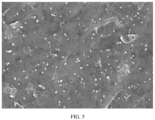
- FIG. 5 shows a microstructure image of the finished non-oriented electrical steel plate of Example 10.
- the size of the inclusions is relatively large and uniform, with regular shapes on the whole and a small quantity, which has little effect on the growth of grain size during heat treatment annealing, and is conducive to improve the electromagnetic properties of the finished steel plate.
Landscapes
- Chemical & Material Sciences (AREA)
- Engineering & Computer Science (AREA)
- Organic Chemistry (AREA)
- Mechanical Engineering (AREA)
- Metallurgy (AREA)
- Materials Engineering (AREA)
- Physics & Mathematics (AREA)
- Thermal Sciences (AREA)
- Crystallography & Structural Chemistry (AREA)
- Electromagnetism (AREA)
- Manufacturing & Machinery (AREA)
- Power Engineering (AREA)
- Dispersion Chemistry (AREA)
- Chemical Kinetics & Catalysis (AREA)
- General Chemical & Material Sciences (AREA)
- Soft Magnetic Materials (AREA)
- Manufacturing Of Steel Electrode Plates (AREA)
Abstract
Description
- The present disclosure relates to a steel plate and a manufacturing method therefor, in particular to a non-oriented electrical steel plate and a manufacturing method therefor.
- In recent years, with the rapid popularization of environmental protection concepts, in order to improve the natural environment, people generally hope to further save electrical energy consumption by improving electricity consuming efficiency. Thus, the requirements for non-oriented electrical steel plates with a thin specification, a high magnetic induction, and a low iron loss are becoming higher and higher currently.
- In order to meet market demand, there is an urgent need to develop a new non-oriented electrical steel plate with thin specification, high magnetic induction, low iron loss, and excellent mechanical properties, which can be used as a steel for driving motors of new energy vehicles, a steel for compressors of inverter air conditioners, and a steel for high-speed rotating power tools.
- In the current prior art, for the steel plate with thin specification, the thickness of the finished product commonly used in the industry is generally controlled to be 0.35mm or less, or even 0.27mm or less. However, due to the reasons such as that the magnetic circuit or yoke width of the rotor core is becoming narrower and narrower for the design requirements of miniaturization and lightweighting of the motor core, and the inertia centrifugal force of the rotor core is very large during high-speed operation, thin steel plates are prone to have problems such as deformation and fracture. Therefore, currently, when preparing non-oriented electrical steel plates, the market and users have increasingly high requirements for the strength of the finished thin steel plates.
- In addition, when non-oriented electrical steel plates are practically prepared for use as stator cores, it is expected to have lower iron loss P1.0/400 and excellent magnetic induction B5000 after stress relief annealing. Therefore, it is of great practical significance to develop a non-oriented silicon steel with thin specification, high strength, low iron loss and high magnetic induction and a manufacturing method therefor.
- For this demand, some researchers have conducted extensive research and achieved certain research results, but the objective application effects of these patent technical documents is not very ideal:
For example, the Chinese patent document with the publication number ofCN107974620A, the publication date of May 1, 2018 , and the title of "A Non-oriented Silicon Steel with Yield Strength≥600MPa for High Speed Motor Rotors and Productive Method" discloses a high yield strength non-oriented silicon steel and manufacturing method therefor, and the high yield strength non-oriented silicon steel has a chemical composition in wt% of C: 0.001-0.003%, Si: 2.6-3.4%, Mn: 0.20-0.60%, P≤0.005%, S≤0.005%, Als:0.75-0.95%, N: 0.002-0.006%, Nb: 0.053-0.20%. The production steps adopted in this technical solution comprise: smelting in a converter and casting into a slab; heating a continuous casting slab; conventional roughing rolling and finishing rolling; normalizing; cold rolling after pickling; continuous annealing. The finished steel plate with a thickness of not exceeding 0.35mm manufactured by this technical solution has a yield strength of ≥600MPa, a tensile strength of ≥700MPa, a P1.0/400 of ≤35W/kg, and a B5000 of ≥1.60T. In this patent document, both the tensile strength and yield strength of the finished steel plate are very excellent, reaching 700MPa or more, 600MPa or more respectively, but the iron loss P1.0/400 is as high as 35 W/kg and the magnetic induction B5000 is as low as 1.60 T. Its performance is still poor. - For another example, the Japanese patent document with the publication number of
JP 2012-136764, the publication date of July 19, 2012 - Based on this, being different from the above-mentioned existing technical solutions, the inventors design and expect to obtain a new non-oriented electrical steel plate with thin specification, high strength, low iron loss, and high magnetic induction and manufacturing method therefor, to satisfy the demands of the market and users.
- One of the objects of the present disclosure is to provide a non-oriented electrical steel plate. By means of reasonable design of chemical composition and optimized manufacturing processes, the non-oriented electrical steel plate can achieve excellent yield strength, tensile strength and electromagnetic properties (the yield strength is ≥600MPa, the tensile strength is ≥700MPa, the iron loss P10/400 is ≤18.0 W/kg, and the magnetic induction B5000 is ≥1.62T) , meet the requirements of low cost and low loss, and have the characteristics of low cost, wide application range, and good stability, etc.
- In order to achieve the above-mentioned object, the present disclosure provides a non-oriented electrical steel plate. The non-oriented electrical steel plate comprises, in addition to Fe and inevitable impurities, the following chemical elements in percentage by mass:
C: 0.001~0.004%, Si: 2.0~3.8%, Mn: 0.05~1.0%, Al≤1.51%, Ca: 0.0003~0.01%, Cr: 0.005~0.4%. - Preferably, in the non-oriented electrical steel plate of the present disclosure, the chemical elements in percentage by mass are:
C: 0.001~0.004%, Si: 2.0~3.8%, Mn: 0.05~1.0%, Al≤1.51%, Ca: 0.0003~0.01%, Cr: 0.005~0.4%; the balance being Fe and inevitable impurities. - In the non-oriented electrical steel plate according to the present disclosure, the design principle of each chemical element is as follows:
- C: The C element can strongly hinder the growth of the grains in the finished strip steel. The C element is easy to combine with Nb, V, Ti, etc. to form fine precipitates, thereby causing loss increasing and arising magnetic aging. Thus, the C element content in steel must be strictly controlled at 0.004% or less. But it should be noted that the content of C element in steel should not be too low. When the content of C element in steel is less than 0.001%, it is not conducive to improve the mechanical strength of the finished steel plate. Based on this, in order to fully exert the beneficial effects of C element, the mass percentage content of C element is controlled between 0.001 and 0.004% in the non-oriented electrical steel plate according to the present disclosure.
- Si: Adding an appropriate amount of Si element to steel can not only increase the electrical resistivity of the steel, but also effectively reduce the iron loss of the steel. When the Si element content in the steel is higher than 3.8%, it will significantly reduce the magnetic induction of the steel and easily lead to breaking of the strip during cold rolling; When the Si element content in the steel is less than 2.0%, the effect of reducing the iron loss of the steel is not significant. Based on this, in order to fully exert the beneficial effects of Si element, the mass percentage content of Si element is controlled between 2.0 and 3.8% in the non-oriented electrical steel plate according to the present disclosure.
- Mn: The Mn element can be combined with S element to form MnS, which can effectively reduce the hazard to the magnetic property of steel. When the content of the Mn element in steel is less than 0.05%, the S fixation effect of the Mn element is poor; When the content of the Mn element in steel exceeds 1.0%, the manufacturing cost of the steel will be significantly increased. Therefore, in order to fully exert the beneficial effects of the Mn element, the mass percentage content of the Mn element is controlled between 0.05% and 1.0% in the non-oriented electrical steel plate according to the present disclosure.
- Al: The Al element can have effects of increasing the electrical resistivity of materials, thereby promoting grain size growth and reducing iron loss of the materials and so on. When the content of Al added to the steel is too high (more than 1.51%), it will cause casting difficulties during continuous casting, lead to a significant increase of manufacturing costs, and significantly deteriorate the stability of cold rolling. Based on this, in the non-oriented electrical steel plate according to the present disclosure, the mass percentage content of the Al element is controlled to be 0<Al≤1.51%.
- Ca: Ca is a strong deoxidizing and desulfurizing element. Ca can easily form large particle inclusions that are prone to float and be removed, and effectively reduce the hazard to the magnetic property of steel. Therefore, in order to fully exert the beneficial effects of the Ca element, it is necessary to add 0.0003% or more Ca to the steel. But it should be noted that the content of the Ca element in steel should not be too high. When more than 0.01% Ca element are added to the steel, it will cause abnormal grain refinement and a reduction in the proportion of the favorable crystal texture in the finished steel plate, thereby deteriorating the magnetic property of the steel. Thus, in order to exert the beneficial effects of the Ca element, the mass percentage content of the Ca element is controlled between 0.0003 and 0.01% in the non-oriented electrical steel plate according to the present disclosure.
- Certainly, in some preferred embodiments, in order to achieve better implementing results, the mass percentage content of the Ca element can be further preferably controlled between 0.0005% and 0.004%.
- Cr: The Cr element can be combined with N element to form Cr2N, which can effectively reduce the hazard to the magnetic property of steel. When the content of the Cr element in steel is less than 0.005%, the N fixation effect of the Cr element is poor, so it needs to add 0.005% or more Cr to the steel. But it should be noted that the content of the Cr element in steel should not be too high. When more than 0.4% Cr is added to the steel, it will cause abnormal grain refinement and a reduction in the proportion of the favorable crystal texture in the finished steel plate, thereby deteriorating the magnetic property of the steel. Based on this, considering the influence of the Cr element content on steel performance, the mass percentage content of the Cr element is controlled between 0.005% and 0.4% in the non-oriented electrical steel plate according to the present disclosure.
- Preferably, in the non-oriented electrical steel plate according to the present disclosure, among the inevitable impurities, P≤0.02%, S≤0.002%, N≤0.004%, O≤0.005%∘
- In the non-oriented electrical steel plate according to the present disclosure, P element, S element, N element, and O element are all impurity elements of the non-oriented electrical steel plate, which are impurity elements introduced into the steel from raw and auxiliary materials or production process. If the technical conditions permit, in order to obtain the steel with better performance and better quality, the content of impurity elements in the steel should be reduced as much as possible.
- P: When the mass percentage content of P element in steel exceeds 0.02%, it is easy to cause the occurrence of cold brittleness and reduce the manufacturability during cold rolling process. Therefore, in the non-oriented electrical steel plate according to the present disclosure, the mass percentage content of P element is controlled to be: P ≤ 0.02%.
- S: When the content of S element in steel exceeds 0.002%, it will greatly increase the quantity of harmful inclusions such as MnS and Cu2S, thereby leading to the deterioration of iron loss of the steel. Thus, in the non-oriented electrical steel plate according to the present disclosure, the mass percentage content of the S element is controlled to be: S≤0.002%.
- N: When the mass percentage content of the N element in steel exceeds 0.004%, the precipitates of N with Nb, V, Ti, Al, Cr, etc will have a sharp increase in the amount and a coarsening of size, which is not conducive to improve the mechanical strength of the finished steel plate and reduce the iron loss of the finished steel plate. Therefore, in the non-oriented electrical steel plate according to the present disclosure, the mass percentage content of N element is controlled to be: N ≤ 0.004%.
- O: When the mass percentage content of O element in steel exceeds 0.005%, the quantity of oxide inclusions will increase greatly, which is not conducive to adjusting the proportion of the beneficial inclusions and will deteriorate the magnetic properties of the steel. Therefore, in the non-oriented electrical steel plate according to the present disclosure, the mass percentage content of the O element is controlled to be: O ≤ 0.005%.
- Preferably, in the non-oriented electrical steel plate according to the present disclosure, the Ca element content is 0.0005-0.004%.
- Preferably, in the non-oriented electrical steel plate of the present disclosure, the nitride inclusions in the steel include individual Cr2N, AlN or TiN, and composite inclusions formed by at least two of AlN, Cr2N and TiN.
- Preferably, in the non-oriented electrical steel plate according to the present disclosure, the volume ratio of nitride inclusions [N]I in the steel to all of oxide inclusions [O]I, sulfide inclusions [S]I and nitride inclusions [N]I in the steel satisfies: 0.42 ≤ [N]I/([O]I+[S]I+[N]I) ≤ 0.85.
- Preferably, in the non-oriented electrical steel plate according to the present disclosure, the volume ratio of nitride inclusions with a size of 0.2-0.5 µm to oxide inclusions, sulfide inclusions and nitride inclusions with a size of 0.2-2.0 µm is 0.7~1.0.
- Preferably, in the non-oriented electrical steel plate according to the present disclosure, the thickness of the non-oriented electrical steel plate is 0.15~0.35mm.
- Preferably, in the non-oriented electrical steel plate according to the present disclosure, the non-oriented electrical steel plate has a yield strength of ≥ 600MPa, a tensile strength of ≥ 700MPa, an iron loss P10/400 of ≤ 18.0 W/kg, and a magnetic induction B5000 of ≥ 1.62T.
- Correspondingly, another object of the present disclosure is to provide a method for manufacturing the above-mentioned non-oriented electrical steel plate. The manufacturing method is simple and feasible. Through the manufacturing method, a non-oriented electrical steel plate with excellent mechanical and electromagnetic properties can be obtained, and the non-oriented electrical steel plate has a yield strength of ≥ 600MPa, a tensile strength of ≥ 700MPa, an iron loss P10/400 ≤ 18.0 W/kg, and a magnetic induction B5000 ≥ 1.62T.
- In order to achieve the above-mentioned object of the present disclosure, the present disclosure provides a method for manufacturing a non-oriented electrical steel plate, comprising the following steps:
- (1) smelting and casting to obtain a continuous casting slab;
- (2) heating and rolling to obtain a steel plate, wherein when the continuous casting slab is heated in a heating furnace and a temperature is rised to 1020 °C or more a heating rate is controlled to be 0.8~2.0 °C/min; a final rolling temperature is controlled to be ≥ 880 °C, and a residence time after final rolling and before laminar flow cooling is controlled to be 5-40s;
- (3) normalizing annealing the steel plate;
- (4) pickling;
- (5) cold rolling;
- (6) continuous annealing to obtain a finished steel plate;
- (7) coating an insulation coating on a surface of the finished steel plate.
- In the present disclosure, the inventors optimize the design of the steel's chemical composition and limits the reasonable manufacturing process. After smelting and casting to obtain a continuous casting slab, by optimizing the heating and temperature rising process and hot rolling process for the continuous casting slab, and combining with subsequent normalizing annealing, pickling, cold rolling, continuous annealing and coating process, a non-oriented electrical steel plates with excellent yield strength, tensile strength, and electromagnetic properties can be effectively manufactured. The manufactured non-oriented electrical steel plate can effectively meet the requirements of low cost and low loss, and have the characteristics of low cost, wide application range, and good stability, etc.
- In the above-mentioned the smelting and casting process of step (1) of the present disclosure, smelting and casting may specifically comprise four steps: pretreating molten iron, converter smelting, RH refining, and continuous casting. In practical implementation, during the steelmaking process, an operator can control the molten iron of blast furnace that has undergone molten iron pretreatment together with an appropriate amount of high-quality scrap steel to be loaded into the converter for rough refining, then perform RH refining to decarburize, deoxidize, desulfurize, adjust the chemical composition of the steel, and perform calcium treatment. During this period, according to the design requirements of the present disclosure, the operator can adjust the design of the steel's chemical composition (especially to ensure that Ca, Cr, S, and N meet the design conditions) to obtain molten steel that meets the chemical composition design requirements, and then cast the molten steel into a continuous casting slab with a thickness of 120-250mm and a width of 800-1400mm by continuous casting according to the specified size.
- The content of the Ca element in steel can be strictly controlled by the above-mentioned smelting and casting processes, and the calcium content in steel is limited to be0.0003-0.01%, preferably 0.0005-0.004%. In this way, after deoxidation, desulfurization, and calcium treatment of the molten steel, the amount of oxides and sulfides in the steel will be significantly reduced, the size of residual oxides and sulfides in the steel will be coarsened, and the harmfulness is significantly reducied. At the same time, in order to achieve good control effect of nitride, it needs to ensure that both the amount and size of the nitride are appropriate; the mechanical strength of the finished steel plate should not be reduced, nor should the grains be refined to deteriorate the electromagnetic property. Therefore, in the above-mentioned heating and rolling process of step (2) according to the present disclosure, when the continuous casting slab is heated in the heating furnace and the temperature is rised to 1020°C or more, the heating rate of the continuous casting slab is controlled to be 0.8-2.0°C/min.
- It should be noted that, within this temperature range, when the heating rate of the continuous casting slab is lower than 0.8°C/min, the solid solution content of AlN inclusions, especially Cr2N inclusions, will significantly increase; Correspondingly, during the subsequent finish rolling and coiling processes, as the temperature of the steel plate decreases, AlN and Cr2N inclusions will reprecipitate, at this time, the size of the precipitations is small and the quantity of the precipitations is significantly increased, so that the cleanliness of the steel is significantly reduced. At the same time, within this temperature range, the heating rate should not be too high. When the heating rate is higher than 2.0°C/min, the solid solution content of AlN inclusions, especially Cr2N inclusions, will be significantly decreased. At this time, the fine AlN inclusions, especially Cr2N inclusions precipitated at the end of casting solidification of the molten steel cannot be fully dissolved and still exist in a single form and a small size, which will harm the recrystallization and the formation of favorable texture of hot-rolled microstructure.
- Moreover, considering the actual situation that during the temperature decreasing process of the continuous casting slab from a high soaking temperature to after rough rolling and finish rolling, the closer to the end of rolling, the lower the temperature of the hot-rolled steel plate, the smaller the size of the precipitated nitride and the greater the harm, when designing, the inventors also should control the final rolling temperature ≥ 880°C during the hot rolling process to ensure that nitrides are fully precipitated at a high temperature stage as much as possible; Meanwhile, the residence time after final rolling and before laminar flow cooling is required to be controlled to be 5-40s, to promot the uniform growth and controlled size of the previously precipitated nitrides.
- Due to this heating and rolling process, nitrides in the steel are mainly single Cr2N, AlN, TiN, and there is a small amount of composite inclusions formed by at least two of AlN, Cr2N and TiN. Wherein the volume ratio of nitride inclusions [N]I in the steel to all of oxide inclusions [O]1, sulfide inclusions [S]I, and nitride inclusions [N]I in the steel satisfies: 0.42 ≤ [N]I/([O]I+[S]I+[N]I) ≤ 0.85.
- Meanwhile, the volume ratio of nitride inclusions with a size of 0.2-0.5 µm to oxide inclusions, sulfide inclusions and nitride inclusions with a size of 0.2-2.0 µm can satisfy: 0.7-1.0.
- It should be noted that the Ti in the above-mentioned TiN inclusions originates from the inevitable Ti with an extremely low content in the steel. Due to that Ti is an impurity element with an extremely low content in the present discloure, it is not specifically described or limited in the part of the design of element composition of the present discloure.
- In addition, it should also be noted that in some embodiments of the above-mentioned manufacturing process of the present disclosure, the hot-rolled steel plate obtained by step (2), after normalizing annealing at 830-1000°C for 10-300s under a 100% nitrogen atmosphere, can be rolled to a target thickness of 0.15-0.35mm by a single cold rolling, or rolled to a target thickness of 0.15-0.35mm by a first cold rolling + intermediate annealing + a second cold rolling. Finally, after the above-mentioned cold-rolled steel plate can be further controlled to be subjected to continuous annealing of 800-1000°C × (10-120) s in a nitrogen-hydrogen mixed atmosphere with an H2 content of 30% or more and subsequent insulation coating, the desired non-oriented electrical steel plate with thin specification, high-strength, low iron loss and high magnetic induction can be obtained.
- Compared to prior art, the non-oriented electrical steel plate and manufacturing method therefor according to the present disclosure have the following advantages and beneficial effects:
In the non-oriented electrical steel plate according to the present disclosure, the inventors have optimized the chemical element composition ratio and related manufacturing processes. The non-oriented electrical steel plate produced by the method herein has the characteristics of thin specification, high strength, low iron loss, and high magnetic induction. After continuous annealing, the non-oriented electrical steel plate has excellent yield strength and tensile strength, and can be well applied in high-frequency and high-speed motors with 20000rpm or less. - In the present disclosure, the non-oriented electrical steel plate designed also has the characteristics of low cost, wide application range, and good stability and so on. The non-oriented electrical steel plate has a yield strength of ≥ 600MPa, a tensile strength of ≥ 700MPa, an iron loss P10/400 of ≤ 18.0 W/kg, a magnetic induction B5000 of ≥ 1.62T, and has good promotion prospects and application value.
-
-
FIG. 1 schematically shows a relationship between [N]I/([O]I+[S]I+[N]I) and the yield strength of the finished steel plate in the non-oriented electrical steel plate according to the present disclosure. -
FIG. 2 schematically shows a relationship between nitrides of 0.2-0.5µm/(oxide inclusions, sulfide inclusions and nitride inclusions of 0.2-2.0µm) and the magnetic induction B5000 of the finished steel plate in the non-oriented electrical steel plate according to the present disclosure. -
FIG. 3 schematically shows a relationship between the hot rolling heating rate and the quantity of inclusions in the non-oriented electrical steel plate according to the present disclosure. -
FIG. 4 shows a microstructure image of the comparative steel of Comparative Example 1. -
FIG. 5 shows a microstructure image of the finished non-oriented electrical steel plate of Example 10. - The non-oriented electrical steel plate and manufacturing method therefor according to the present disclosure will be further explained and illustrated with reference to the accompanying drawings of the description and specific examples. However, the explanations and illustrations do not constitute an undue limitation on the technical solutions of the present disclosure.
- Table 1 lists the mass percentage of chemical elements in the non-oriented electrical steel plates of Examples 1-12 and the comparative steel plates of Comparative Examples 1-5.
Table 1 (wt%, the balance being Fe and inevitable impurities other than P, S, O, N) No. chemical elements C Si Mn S Al Ca Cr N P O Example 1 0.0022 2.03 0.86 0.0018 1.51 0.0030 0.39 0.0017 0.02 0.0016 Example 2 0.0027 3.41 0.53 0.0012 0.47 0.0047 0.15 0.0037 0.01 0.0011 Example 3 0.0033 3.15 0.16 0.0004 1.23 0.0019 0.04 0.0009 0.01 0.0024 Example 4 0.0019 3.72 0.05 0.0007 0.17 0.0099 0.39 0.0016 0.01 0.0047 Example 5 0.0015 2.98 0.55 0.0014 1.07 0.0042 0.02 0.0028 0.01 0.0018 Example 6 0.0039 3.25 0.27 0.0016 0.27 0.0005 0.10 0.0010 0.01 0.0005 Example 7 0.0018 3.45 0.38 0.0002 0.001 0.0008 0.005 0.0040 0.01 0.0011 Example 8 0.0022 2.77 0.99 0.0020 0.16 0.0040 0.18 0.0005 0.02 0.0011 Example 9 0.0013 3.79 0.06 0.0012 0.002 0.0022 0.27 0.0019 0.01 0.0007 Example 10 0.0010 3.58 0.25 0.0009 0.82 0.0032 0.14 0.0012 0.02 0.0013 Example 11 0.0032 3.12 0.31 0.0018 0.99 0.0077 0.31 0.0026 0.01 0.0029 Example 12 0.0020 3.62 0.13 0.0011 0.14 0.0003 0.08 0.0018 0.01 0.0015 Comparative Example 1 0.0028 3.47 1.22 0.0025 0.37 - 0.05 0.0027 0.01 0.0023 Comparative Example 2 0.0008 3.90 0.37 0.0019 0.91 0.0003 0.37 0.0011 0.02 0.0009 Comparative Example 3 0.0028 3.21 0.08 0.0011 0.002 0.0014 0.18 0.0009 0.01 0.0015 Comparative Example 4 0.0037 2.65 0.95 0.0003 1.47 0.0092 0.71 0.0051 0.01 0.0008 Comparative Example 5 0.0044 2.23 0.18 0.0008 1.82 0.0032 0.01 0.0036 0.02 0.0012 - The non-oriented electrical steel plates of Examples 1-12 and the comparative steel plates of Comparative Examples 1-5 are manufactured by the following steps:
- (1) Smelting and casting according to the chemical composition ratios shown in Table 1: during the steelmaking process, the blast furnace molten iron that has undergone molten iron pretreatment and a appropriate amount of high-quality scrap steel are loaded into the converter for rough refining, then followed by performing RH refining to decarburize, deoxidize, desulfurize, adjust the chemical composition of the steel, and perform calcium treatment. During the process, according to the design requirements of the present disclosure, the design of the steel's chemical composition is adjusted (especially ensure that Ca, Cr, S, and N meet the design conditions) to obtain molten steel that meets the chemical composition design requirements. Then, a continuous casting slab with a thickness of 120-250mm and a width of 800-1400mm is cast by continuous casting according to the specified size.
- (2) Heating and rolling: the obtained continuous casting slab is input into a heating furnace for heating and temperature rise. When the continuous casting slabt is heated in the heating furnace and the temperature rises to 1020 °C or more, the heating rate of the continuous casting slab is strictly controlled to be 0.8-2.0 °C/min; And the final rolling temperature should be controlled to be ≥ 880 °C, and the residence time after final rolling and before laminar flow cooling should be controlled to be 5-40s.
- (3) Normalizing annealing: under a 100% nitrogen atmosphere, the normalizing annealing temperature is controled to be 830-1000 °C and the normalizing annealing time is controled to be 60-300s.
- (4) Pickling.
- (5) Cold rolling: rolling to a target thickness of 0.15-0.35mm by a single cold rolling process, or rolling to a target thickness of 0.15-0.35mm by a double cold rolling process including a first cold rolling, intermediate annealing, and a second cold rolling.
- (6) Continuous annealing: performing continuous annealing in a nitrogen-hydrogen mixed atmosphere with an H2 content of 30% or more, controlling the continuous annealing temperature to be 800-1000 °C, and controlling the continuous annealing time to be 10-120s.
- (7) Coating an insulation coating.
- It should be noted that in the present disclosure, the chemical compositions and related process parameters of Examples 1-12 all meet the control requirements of the design specification according to the present disclosure; However, in Comparative Examples 1-5, although the comparative steels are also manufactured by the above-mentioned process steps, there are parameters that do not comply with the design of the present disclosure in their chemical element composition and/or related process parameters.
- Table 2 lists the specific process parameters in the above-mentioned manufacturing process and final finished product thickness of the non-oriented electrical steel plates of Examples 1-12 and the comparative steel plates of Comparative Examples 1-5.
Table 2. No. step(2) step(3) step(5) step(6) Finished product thickness (mm) Heating rate when the temperature rises to 1020° C or more (°C/min) Final rolling temperature during rolling (°C) Residence time after final rolling and before laminar flow cooling (s) Normalizing process (°C×s) Cold rolling mode Continuous annealing process (°C×s) Example 1 0.83 900 8 1000×60 double cold rolling 1000×10 0.15 Example 2 1.09 900 10 950×120 single cold rolling 800×10 0.25 Example 3 1.97 900 15 880×200 single cold rolling 880×15 0.25 Example 4 1.22 920 5 850×150 double cold rolling 960×120 0.35 Example 5 0.89 880 8 920×300 single cold rolling 980×10 0.20 Example 6 1.88 940 12 920×60 single cold rolling 900×20 0.23 Example 7 1.53 880 40 900×90 double cold rolling 980×30 0.27 Example 8 0.99 900 20 980×60 single cold rolling 980×90 0.18 Example 9 1.37 880 15 830×90 double cold rolling 960×60 0.33 Example 10 1.12 880 5 880×60 double cold rolling 820×30 0.25 Example 11 2.00 900 10 900×150 single cold rolling 850×60 0.30 Example 12 1.00 920 8 900×90 double cold rolling 880×20 0.35 Comparative Example 1 0.94 900 4 850×90 single cold rolling 900×30 0.25 Comparative Example 2 2.5 880 8 900×120 double cold rolling 800×10 0.35 Comparative Example 3 1.57 820 35 1000×60 single cold rolling 980×90 0.50 Comparative Example 4 0.49 940 15 940×300 double cold rolling 1000×20 0.35 Comparative Example 5 1.26 880 55 960×60 double cold rolling 850×60 0.15 - The finally obtained finished non-oriented electrical steel plates of Examples 1-12 and the comparative steel plates of Comparative Examples 1-5 are sampled respectively. And the steel plate samples of Examples 1-12 and Comparative Examples 1-5 are observed and analyzed. It is observed and found that the steels of Examples and Comparative Examples all have inclusions such as oxide inclusions, sulfide inclusions and nitride inclusions.
- Through further analysis and testing, the volume ratios of nitride inclusions [N]I to all of oxide inclusions [O]I, sulfide inclusions [S]I, and nitride inclusions [N]I and the volume ratios of nitride inclusions with a size of 0.2-0.5 µm to oxide inclusions, sulfide inclusions, and nitride inclusions with a size of 0.2-2.0 µm in the steel plates of each example and comparative example can be respectively obtained. The relevant results of observation and analysis are listed in Table 3 below.
- The analysis and testing method for inclusions is carried out according to the National Standard GBT 10561.
- Table 3 lists the observation and analysis results of the inclusions of steel plates of ecah example and comparative example.
Table 3. No. A B Example 1 0.61 0.72 Example 2 0.52 0.99 Example 3 0.79 0.81 Example 4 0.58 0.90 Example 5 0.42 0.76 Example 6 0.81 0.71 Example 7 0.44 0.82 Example 8 0.83 0.88 Example 9 0.85 0.91 Example 10 0.49 0.73 Example 11 0.65 0.94 Example 12 0.70 0.83 Comparative Example 1 0.37 0.83 Comparative Example 2 0.48 0.64 Comparative Example 3 0.73 0.92 Comparative Example 4 0.92 0.71 Comparative Example 5 0.81 0.59 Note: In the above-mentioned Table 3, "A" represents [N]I/([O]I+[S]I+[N]I); "B " represents the volume ratio of nitride inclusions with a size of 0.2-0.5 µm to oxide inclusions, sulfide inclusions, and nitride inclusions with a size of 0.2-2.0 µm. - It was observed that the nitride inclusions are mainly single Cr2N, AlN, and TiN, and there are also a small amount of composite inclusions formed by at least two of AlN, Cr2N, and TiN in the non-oriented electrical steel plates manufactured in Examples 1-12.
- After the testing for the inclusions in the sample steel plates of each example and comparative sample, it is found that, it can be seen from the above-mentioned Table 3 that, in Examples 1-12, the ratio of the volume percentage content of nitride inclusions [N]I to that of all the oxide inclusions [O]I, sulfide inclusions [S]I, and nitride inclusions [N]I in the steel is 0.42-0.85 specifically; Moreover, the ratio of nitride inclusions with a size of 0.2-0.5 µm to oxide inclusions, sulfide inclusions, and nitride inclusions with a size of 0.2-2.0 µ m in steel is 0.71-0.99.
- Correspondingly, after the above-mentioned observation and analysis forinclusions are completed, the final manufactured non-oriented electrical steel plates of Examples 1-12 and the comparative steel plates of Comparative Examples 1-5 can be sampled again, and the sample steel plates of Examples 1-12 and Comparative Examples 1-5 are tested for the mechanical properties, magnetic induction B5000, and iron loss P10/400 of. The test results obtained are listed in the following Table 4.
- The relevant performance testing methods are as follows:
Tensile test: According to the "National StandardGB/T 228.1-2010 - Magnetic induction performance test: According to the "National Standard
GB/T 3655-2008 - Iron loss performance test: According to the National Standard
GB/T 3655-2008 - Table 4 lists the test results of yield strength YS, tensile strength TS, magnetic induction B5000, and iron loss P10/400 of the non-oriented electrical steel plates of Examples 1-12 and the comparative steel plates of Comparative Examples 1-5.
Table 4. No. Yield strength YS (MPa) Tensile strength Ts (MPa) Magnetic induction B5000 (T) Iron loss P10/400 (W/kg) Example 1 613 762 1.63 16.6 Example 2 632 744 1.63 15.7 Example 3 614 749 1.63 17.1 Example 4 652 776 1.65 17.2 Example 5 621 706 1.66 16.8 Example 6 622 741 1.65 15.7 Example 7 641 722 1.64 14.2 Example 8 611 718 1.66 16.3 Example 9 627 737 1.65 13.9 Example 10 641 745 1.64 16.5 Example 11 629 713 1.63 15.1 Example 12 656 785 1.64 14.7 Comparative Example 1 624 734 1.59 24.7 Comparative Example 2 638 725 1.58 15.8 Comparative Example 3 547 679 1.58 18.9 Comparative Example 4 582 711 1.60 22.1 Comparative Example 5 559 658 1.62 19.4 - As shown in the above-mentioned Table 4, in the present disclosure, the non-oriented electrical steel plates of Examples 1-12 have a yield strength of 611-656MPa, a tensile strength of 706-785MPa, a magnetic induction B5000 of 1.63-1.66T, and an iron loss P10/400 of 13.9-17.2W/kg. The comprehensive performance of the non-oriented electrical steel plates of Examples 1-12 is significantly better than that of the comparative steel plates of Comparative Examples 1-5. Since comparative examples 1-5 do not meet the conditions specified by the present technical solution, the implementing effect of Comparative Examples 1-5 is also inferior to that of the present technical solution.
- In combination with the datas listed in the above-mentioned Tables 1, 2, 3, and 4, analysis and explanation can be further provided for the five comparative examples manufactured herein.
- In Comparative Example 1, the Mn and S elements added to the steel are 1.22% and 0.0025% respectively, which both exceed the upper limits of 1.0% and 0.002% of the design requirements of the present disclosure. Moreover, after hot rolling and final rolling and before laminar flow cooling, the residence time of the continuous casting slab is only 4 seconds, which is lower than the lower limit of 5 seconds of the design requirements of the present disclosure. Correspondingly, the [N]I/([O]I+[S]I+[N]I) in steel is only 0.37, which is lower than the lower limit of 0.42 of the design requirements of the present disclosure. Therefore, the yield strength and tensile strength of the finished steel plate correspondingly manufactured by Comparative Example 1 are both qualified, but the magnetic induction B5000 is lower and the iron loss P10/400 is higher, which are 1.59 T and 24.7 W/kg respectively, and do not reach the design requirements of the present disclosure.
- In Comparative Example 2, the content of Si element added to the steel is 3.90%, which exceeds the upper limit of 3.8% of the design requirements of the present disclosure. Moreover, during the hot rolling process of the continuous casting slab, the heating rate of the continuous casting slab in the temperature range of 1020 °C or more is 2.5 °C/min, which is higher than the upper limit of 2.0 °C/min of the design requirements of the present disclosure. Correspondingly, the ratio of nitrides with a size of 0.2-0.5 µm to oxide inclusions, sulfide inclusions, and nitride inclusions with a size of 0.2-2.0 µm in steel is only 0.64, which is lower than the lower limit of 0.70 of the design requirements of the present disclosure. Therefore, the yield strength, tensile strength, and iron loss P10/400 of the finished steel plate correspondingly manufactured by Comparative Example 2 are all qualified, but the magnetic induction B5000 is low at 1.58 T, which does not reach the design requirements of the present disclosure.
- In Comparative Example 3, the design of chemical composition in the steel is qualified, but during hot rolling, the final rolling temperature of the continuous casting slab is only 820 °C, which is lower than the lower limit of 880 °C of the design requirements of the present disclosure. Moreover, the target thickness of the finished steel plate is 0.50mm, which is higher than the upper limit of 0.35mm of the design requirements of the present disclosure. Therefore, the yield strength YS, tensile strength TS, magnetic induction B5000, and iron loss P10/400 of the finished steel plate correspondingly manufactured by Comparative Example 3 are unqualified, which are 547MPa, 679MPa, 1.58 T, and 18.9W/kg, respectively, and all fail to meet the design requirements of the present disclosure.
- In Comparative Example 4, the contents of the Cr and N element added to the steel are 0.71% and 0.0051% respectively, which exceed the upper limits of 0.4% and 0.004% of the design requirements of the present disclosure. Moreover, in the manufacturing process, the heating rate of the continuous casting slab in the temperature range of 1020 °C or more is 0.49 °C/min, which is lower than the lower limit of 0.8 °C/min of the design requirements of the present disclosure. Correspondingly, the [N]I/([O]I+[S]I+[N]I) in steel is as high as 0.92, which is higher than the upper limit of 0.85 of the design requirements of the present disclosure. Therefore, the yield strength YS, magnetic induction B5000, and iron loss P10/400 of the finished steel plate correspondingly manufactured by Comparative Example 4 are all unqualified, which are 582 MPa, 1.60 T, and 22.1 W/kg, respectively, and fail to meet the design requirements of the present disclosure.
- In Comparative Example 5, the contents of C and Al elements added to the steel are 0.0044% and 1.82% respectively, which exceed the upper limit 0.004% of C and the upper limit 1.5% of Al of the design requirements of the present disclosure. Moreover, in the manufacturing process, the residence time after hot rolling and final rolling and before laminar flow cooling of the continuous casting slab is 55 seconds, which is higher than the upper limit of 40 seconds of the design requirements of the present disclosure. Correspondingly, the ratio of nitrides with the size of 0.2-0.5 µm to oxide inclusions, sulfide inclusions, and nitride inclusions with the size of 0.2-2.0 µm in steel is 0.59, which is lower than the lower limit of 0.70 of the design requirements of the present disclosure. Therefore, the yield strength YS, tensile strength TS, and iron loss P10/400 of the finished steel plate correspondingly manufactured by Comparative Example 5 are all unqualified, which are 559 MPa, 658 MPa, and 19.4 W/kg, respectively, and fail to meet the design requirements of the present disclosure.
-
FIG. 1 schematically shows a relationship between [N]I/([O]I+[S]I+[N]I) and the yield strength of the finished steel plate in the non-oriented electrical steel plate according to the present disclosure. - As shown in
FIG. 1 , it is observed and found that with the increase of [N]I/([O]I+[S]I+[N]I), the yield strength of the finished steel plate increases rapidly, and when the [N]I/([O]I+[S]I+[N]I) reaches 0.42, the yield strength of the finished steel plate can reach 600 MPa. Afterwards, with the increase of [N]I/([O]I+[S]I+[N]I), the yield strength of the finished steel plate continued to increase by the same proportion, and when the [N]I/([O]I+[S]I+[N]I) reaches 0.85, the yield strength of the finished steel plate reaches a maximum. Then, with the further increase of the [N]I/([O]I+[S]I+[N]I), the yield strength of the finished steel plate rapidly decreases, thereby failing to meet the design requirements of the present disclosure. -
FIG. 2 schematically shows a relationship between nitrides (0.2-0.5 µm)/oxide inclusions, sulfide inclusions and nitride inclusions (0.2-2.0 µm) and the magnetic induction B5000 of the finished steel plate in the non-oriented electrical steel plate according to the present disclosure. - As shown in
FIG. 2 , it is observed and found that for the volume percentage ratio of nitride inclusions with the size of 0.2-0.5 µm to all of oxide inclusions, sulfide inclusions, and nitride inclusions with the size of 0.2-2.0 µm, as the parameter values increase, the magnetic induction of the finished steel plate first increases rapidly, and reaches or exceeds the design requirements of 1.62T or more according to the present disclosure in the range of 0.7-1.0; Then the magnetic induction began to decrease rapidly, thereby failing to meet the design requirements for the control of the magnetic induction of the finished steel plate according to the present disclosure. -
FIG. 3 schematically shows a relationship between the hot rolling heating rate and the quantity of inclusions in the non-oriented electrical steel plate according to the present disclosure. - As shown in
FIG. 3 , it is observed and found that during the hot rolling process, with the increase of the heating rate of the continuous casting slab, the number of inclusions in the steel first decreases rapidly, and when the heating rate is 0.8 °C/min, the quantity of inclusions reaches 3.5×10⁷/mm3 or less, and remains basically stable before 2.0 °C/min, and then, the quantity of inclusions begans to increase rapidly, gradually far exceeding 3.5×10⁷/mm3. -
FIG. 4 shows a microstructure image of the comparative steel of Comparative Example 1. - As shown in
FIG. 4 , by observation for the microstructure of the comparative steel of Comparative Example 1, it is found that the inclusions in the steel of Comparative Example 1 have irregular shapes, small sizes, a numerous number, and a clustered distribution, which seriously hinders the growth of grain size during heat treatment annealing, and deteriorates the favorable crystal texture of the finished steel plate, thereby deteriorating the electromagnetic properties. -
FIG. 5 shows a microstructure image of the finished non-oriented electrical steel plate of Example 10. - As shown in
FIG. 5 , in this embodiment, in the finished non-oriented electrical steel plate of Example 10, the size of the inclusions is relatively large and uniform, with regular shapes on the whole and a small quantity, which has little effect on the growth of grain size during heat treatment annealing, and is conducive to improve the electromagnetic properties of the finished steel plate. - It should be noted that the prior art part inthe protection scope of the present disclosure is not limited to the embodiments given in the application documents, and all prior arts that do not contradict the solution of the present disclosure, including but not limited to the prior patent documents, prior publications, prior public use, etc., can all be included in the protection scope of the present disclosure.
- Moreover, the combination of the technical features of the present disclosure is not limited to the combinations described in the claims or the specific embodiments of the present disclosure, and all the technical features of the present disclosure can be freely combined in any way unless contradicted by each other.
- It should also be noted that the embodiments listed above are only specific examples of the present disclosure. It is obvious that the present disclosure is not limited to the above embodiments, and similar variations or modifications will be obvious for those skilled in the artor can be directly derived by those skilled in the art based on the the present disclosure, all of which fall within the protection scope of the present disclosure.
Claims (12)
- A non-oriented electrical steel plate, wherein the non-oriented electrical steel plate comprising, in addition to Fe and inevitable impurities, the following chemical elements in percentage by mass:
C: 0.001~0.004%, Si: 2.0~3.8%, Mn: 0.05~1.0%, 0<Al≤1.51%, Ca: 0.0003~0.01%, Cr: 0.005~0.4%. - The non-oriented electrical steel plate according to claim 1, wherein the non-oriented electrical steel plate comprises the following chemical elements in percentage by mass:
C: 0.001~0.004%, Si: 2.0~3.8%, Mn: 0.05~1.0%, Al≤1.51%, Ca: 0.0003~0.01%, Cr: 0.005~0.4%, and the balance being Fe and inevitable impurities. - The non-oriented electrical steel plate according to claim 1 or 2, wherein among the inevitable impurities, P≤0.02%, S≤0.002%, N≤0.004%, O≤0.005%∘
- The non-oriented electrical steel plate according to claim 1 or 2, wherein a content of Ca element is 0.0005-0.004%.
- The non-oriented electrical steel plate according to claim 1 or 2, wherein nitride inclusions in the steel include individual Cr2N, AlN or TiN, and composite inclusions formed by at least two of AlN, Cr2N and TiN.
- The non-oriented electrical steel plate according to claim 1 or 2, wherein a volume ratio of nitride inclusions [N]I in the steel to all of oxide inclusions [O]I, sulfide inclusions [S]I and nitride inclusions [N]I in the steel satisfies: 0.42 ≤ [N]I/([O]I+[S]I+[N]I) ≤ 0.85.
- The non-oriented electrical steel plate according to claim 1 or 2, wherein a volume ratio of nitride inclusions with a size of 0.2µm-0.5µm to oxide inclusions, sulfide inclusions and nitride inclusions with a size of 0.2µm-2.0µm is 0.7~1.0.
- The non-oriented electrical steel plate according to claim 1 or 2, wherein a thickness of the non-oriented electrical steel plate is 0.15~0.35mm.
- The non-oriented electrical steel plate according to claim 1 or 2, wherein the non-oriented electrical steel plate has a yield strength of ≥ 600MPa, a tensile strength of ≥ 700MPa, an iron loss P10/400 of ≤ 18.0 W/kg, a magnetic induction B5000 of ≥ 1.62T.
- A method for manufacturing the non-oriented electrical steel plate according to any one of claims 1-9, wherein the method comprises the following steps:(1) smelting and casting to obtain a continuous casting slab;(2) heating and rolling to obtain a steel plate, wherein when the continuous casting slab is heated in the heating furnace and a temperature is rised to 1020 °C or more, a heating rate is controlled to be 0.8~2.0 °C/min; a final rolling temperature is ≥880 °C, and a residence time after final rolling and before laminar flow cooling is controlled to be 5-40s;(3) normalizing annealing the steel plate;(4) pickling;(5) cold rolling;(6) continuous annealing to obtain a finished steel plate;(7) coating an insulation coating on a surface of the finished steel plate.
- The manufacturing method according to claim 10, wherein in step (3), a temperature of the normalizing annealing is controlled to be 830~1000 °C, and a time of the normalizing annealing is 10~300s.
- The manufacturing method according to claim 10, wherein in step (6), a temperature of the continuous annealing is controlled to be 800-1000 °C, and a time of the continuous annealing is 10-120s.
Applications Claiming Priority (2)
| Application Number | Priority Date | Filing Date | Title |
|---|---|---|---|
| CN202210858578.5A CN117467904A (en) | 2022-07-20 | 2022-07-20 | Non-oriented electrical steel plate and manufacturing method thereof |
| PCT/CN2023/108440 WO2024017345A1 (en) | 2022-07-20 | 2023-07-20 | Non-oriented electrical steel plate and manufacturing method therefor |
Publications (2)
| Publication Number | Publication Date |
|---|---|
| EP4541919A1 true EP4541919A1 (en) | 2025-04-23 |
| EP4541919A4 EP4541919A4 (en) | 2025-07-09 |
Family
ID=89617200
Family Applications (1)
| Application Number | Title | Priority Date | Filing Date |
|---|---|---|---|
| EP23842407.1A Pending EP4541919A4 (en) | 2022-07-20 | 2023-07-20 | Non-orientated electrical steel plate and manufacturing method therefor |
Country Status (6)
| Country | Link |
|---|---|
| EP (1) | EP4541919A4 (en) |
| JP (1) | JP2025523697A (en) |
| KR (1) | KR20250022868A (en) |
| CN (1) | CN117467904A (en) |
| CA (1) | CA3260913A1 (en) |
| WO (1) | WO2024017345A1 (en) |
Families Citing this family (1)
| Publication number | Priority date | Publication date | Assignee | Title |
|---|---|---|---|---|
| CN120989521A (en) * | 2024-05-20 | 2025-11-21 | 宝山钢铁股份有限公司 | A non-oriented electrical steel sheet with excellent punching properties and its manufacturing method |
Family Cites Families (19)
| Publication number | Priority date | Publication date | Assignee | Title |
|---|---|---|---|---|
| JP5200376B2 (en) * | 2006-12-26 | 2013-06-05 | Jfeスチール株式会社 | Non-oriented electrical steel sheet and manufacturing method thereof |
| CN102409252A (en) * | 2010-09-21 | 2012-04-11 | 鞍钢股份有限公司 | Ultrahigh-strength cold-rolled steel plate and manufacturing method thereof |
| JP5333415B2 (en) * | 2010-11-08 | 2013-11-06 | 新日鐵住金株式会社 | Non-oriented electrical steel sheet for rotor and manufacturing method thereof |
| JP5817115B2 (en) | 2010-12-28 | 2015-11-18 | Jfeスチール株式会社 | Manufacturing method of high strength electrical steel sheet |
| CN103305748A (en) * | 2012-03-15 | 2013-09-18 | 宝山钢铁股份有限公司 | Non-oriented electrical steel plate and manufacturing method thereof |
| EP2883975B1 (en) * | 2012-08-08 | 2019-09-18 | JFE Steel Corporation | High-strength non-oriented electricomagnetic steel sheet and method for producing same |
| JP6402865B2 (en) * | 2015-11-20 | 2018-10-10 | Jfeスチール株式会社 | Method for producing non-oriented electrical steel sheet |
| WO2017122761A1 (en) * | 2016-01-15 | 2017-07-20 | Jfeスチール株式会社 | Non-oriented electromagnetic steel sheet and method for producing same |
| RU2715586C1 (en) * | 2016-07-29 | 2020-03-02 | Зальцгиттер Флахшталь Гмбх | Steel strip for production of non-oriented electrical steel and method of making such steel strip |
| CN110536971B (en) * | 2017-03-30 | 2022-12-02 | 杰富意钢铁株式会社 | Manufacturing method of non-oriented electrical steel sheet, manufacturing method of motor core, and motor core |
| CN107974620B (en) | 2017-12-01 | 2019-10-25 | 武汉钢铁有限公司 | A kind of yield strength >=600Mpa high speed rotor of motor non-orientation silicon steel and production method |
| KR102177530B1 (en) * | 2018-11-30 | 2020-11-12 | 주식회사 포스코 | Non-oriented electrical steel sheet and method for manufacturing the same |
| US11732319B2 (en) * | 2018-12-27 | 2023-08-22 | Jfe Steel Corporation | Non-oriented electrical steel sheet |
| US12283845B2 (en) * | 2019-01-17 | 2025-04-22 | Nippon Steel Corporation | Non-oriented electrical steel sheet, segmented stator, and rotating electrical machine |
| WO2021117325A1 (en) * | 2019-12-09 | 2021-06-17 | Jfeスチール株式会社 | Non-oriented electromagnetic steel sheet, motor core, and methods respectively for manufacturing same |
| US12348079B2 (en) * | 2019-12-16 | 2025-07-01 | Jfe Steel Corporation | Motor core and method of manufacturing the same |
| CN112030076A (en) * | 2020-08-10 | 2020-12-04 | 武汉科技大学 | A kind of high-strength electrical steel for high-speed motor and preparation method thereof |
| WO2023282071A1 (en) * | 2021-07-05 | 2023-01-12 | Jfeスチール株式会社 | Non-oriented electromagnetic steel sheet and method for manufacturing same |
| CN114086058B (en) * | 2021-10-25 | 2023-05-02 | 马鞍山钢铁股份有限公司 | Non-oriented silicon steel with good notch corrosion resistance and production method thereof |
-
2022
- 2022-07-20 CN CN202210858578.5A patent/CN117467904A/en active Pending
-
2023
- 2023-07-20 JP JP2025501764A patent/JP2025523697A/en active Pending
- 2023-07-20 CA CA3260913A patent/CA3260913A1/en active Pending
- 2023-07-20 WO PCT/CN2023/108440 patent/WO2024017345A1/en not_active Ceased
- 2023-07-20 EP EP23842407.1A patent/EP4541919A4/en active Pending
- 2023-07-20 KR KR1020257001870A patent/KR20250022868A/en active Pending
Also Published As
| Publication number | Publication date |
|---|---|
| CN117467904A (en) | 2024-01-30 |
| KR20250022868A (en) | 2025-02-17 |
| JP2025523697A (en) | 2025-07-23 |
| EP4541919A4 (en) | 2025-07-09 |
| WO2024017345A1 (en) | 2024-01-25 |
| CA3260913A1 (en) | 2025-04-07 |
Similar Documents
| Publication | Publication Date | Title |
|---|---|---|
| US12392009B2 (en) | High-grade non-oriented silicon steel and production method thereof | |
| KR102721285B1 (en) | Method for producing non-oriented electrical steel sheet, method for producing motor core, and motor core | |
| EP3719160B1 (en) | Non-oriented electrical steel sheet with excellent magnetism and manufacturing method therefor | |
| EP4394073A1 (en) | Non-oriented silicon steel for new energy drive motor, and production method therefor | |
| EP3872195A1 (en) | Non-oriented electrical steel, preparation method therefor and use thereof | |
| EP4001450A1 (en) | 600mpa grade non-oriented electrical steel sheet and manufacturing method thereof | |
| EP4617393A1 (en) | Non-oriented silicon steel plate and production method therefor | |
| EP4450661A1 (en) | Non-oriented electrical steel plate with good magnetic performance and manufacturing method therefor | |
| CN114737129B (en) | High-performance non-oriented silicon steel for wound motor iron core and production method thereof | |
| CN111690870A (en) | Method for producing high-magnetic-induction thin-specification non-oriented silicon steel by cold continuous rolling | |
| CN109822070B (en) | A kind of non-oriented electrical steel for electric drive of thin slab full endless rolling and preparation method | |
| EP4001451A1 (en) | Cu-containing non-oriented electrical steel sheet and manufacturing method therefor | |
| CA3260913A1 (en) | Non-oriented electrical steel plate and manufacturing method therefor | |
| EP4592412A1 (en) | Nonoriented electromagnetic steel sheet and method for manufacturing same | |
| WO2024188130A1 (en) | High-strength and low-iron-loss non-oriented electrical steel plate and manufacturing method therefor | |
| CN118835165A (en) | Ultrathin non-oriented silicon steel and preparation method and application thereof | |
| CN114645202A (en) | Method for obtaining high-orientation-degree GOSS texture Fe-3% Si material | |
| CN120719100B (en) | A method for preparing ultrathin non-oriented silicon steel with low magnetic anisotropy | |
| EP4549605A1 (en) | Non-oriented electrical steel sheet and manufacturing method therefor | |
| RU2842343C2 (en) | Sheet of non-textured steel with corresponding magnetic characteristics and method of its manufacturing | |
| EP4541922A1 (en) | Non-oriented electrical steel sheet having high magnetic flux density, and manufacturing method therefor | |
| CN111593262A (en) | Low-cost non-coating non-oriented silicon steel and production method thereof | |
| CN119194023B (en) | Preparation method of non-oriented electrical steel 50W800 and non-oriented electrical steel 50W800 | |
| CN114058961B (en) | Non-oriented silicon steel strip with thickness less than or equal to 0.15mm and production method thereof | |
| EP4715080A1 (en) | Non-oriented electrical steel sheet with excellent fatigue performance and manufacturing method therefor |
Legal Events
| Date | Code | Title | Description |
|---|---|---|---|
| STAA | Information on the status of an ep patent application or granted ep patent |
Free format text: STATUS: THE INTERNATIONAL PUBLICATION HAS BEEN MADE |
|
| PUAI | Public reference made under article 153(3) epc to a published international application that has entered the european phase |
Free format text: ORIGINAL CODE: 0009012 |
|
| STAA | Information on the status of an ep patent application or granted ep patent |
Free format text: STATUS: REQUEST FOR EXAMINATION WAS MADE |
|
| 17P | Request for examination filed |
Effective date: 20250120 |
|
| AK | Designated contracting states |
Kind code of ref document: A1 Designated state(s): AL AT BE BG CH CY CZ DE DK EE ES FI FR GB GR HR HU IE IS IT LI LT LU LV MC ME MK MT NL NO PL PT RO RS SE SI SK SM TR |
|
| REG | Reference to a national code |
Ref country code: DE Ref legal event code: R079 Free format text: PREVIOUS MAIN CLASS: C22C0038000000 Ipc: C21D0001260000 |
|
| A4 | Supplementary search report drawn up and despatched |
Effective date: 20250605 |
|
| RIC1 | Information provided on ipc code assigned before grant |
Ipc: H01F 1/147 20060101ALI20250602BHEP Ipc: C23G 1/08 20060101ALI20250602BHEP Ipc: C22C 38/34 20060101ALI20250602BHEP Ipc: C22C 38/18 20060101ALI20250602BHEP Ipc: C22C 38/06 20060101ALI20250602BHEP Ipc: C22C 38/04 20060101ALI20250602BHEP Ipc: C22C 38/02 20060101ALI20250602BHEP Ipc: C22C 38/00 20060101ALI20250602BHEP Ipc: C22C 33/04 20060101ALI20250602BHEP Ipc: C21D 11/00 20060101ALI20250602BHEP Ipc: C21D 9/46 20060101ALI20250602BHEP Ipc: C21D 8/12 20060101ALI20250602BHEP Ipc: C21D 8/02 20060101ALI20250602BHEP Ipc: C21D 1/76 20060101ALI20250602BHEP Ipc: C21D 7/02 20060101ALI20250602BHEP Ipc: C21D 6/00 20060101ALI20250602BHEP Ipc: C21D 1/74 20060101ALI20250602BHEP Ipc: C21D 1/84 20060101ALI20250602BHEP Ipc: C21D 1/26 20060101AFI20250602BHEP |
|
| DAV | Request for validation of the european patent (deleted) | ||
| DAX | Request for extension of the european patent (deleted) | ||
| STAA | Information on the status of an ep patent application or granted ep patent |
Free format text: STATUS: EXAMINATION IS IN PROGRESS |
|
| 17Q | First examination report despatched |
Effective date: 20260206 |