EP4541915A1 - Method for manufacturing al-zn-mg-cu series aluminum alloy plate, and aluminum alloy plate - Google Patents
Method for manufacturing al-zn-mg-cu series aluminum alloy plate, and aluminum alloy plate Download PDFInfo
- Publication number
- EP4541915A1 EP4541915A1 EP23826383.4A EP23826383A EP4541915A1 EP 4541915 A1 EP4541915 A1 EP 4541915A1 EP 23826383 A EP23826383 A EP 23826383A EP 4541915 A1 EP4541915 A1 EP 4541915A1
- Authority
- EP
- European Patent Office
- Prior art keywords
- aluminum alloy
- treatment
- series aluminum
- temperature
- alloy plate
- Prior art date
- Legal status (The legal status is an assumption and is not a legal conclusion. Google has not performed a legal analysis and makes no representation as to the accuracy of the status listed.)
- Pending
Links
Images
Classifications
-
- C—CHEMISTRY; METALLURGY
- C22—METALLURGY; FERROUS OR NON-FERROUS ALLOYS; TREATMENT OF ALLOYS OR NON-FERROUS METALS
- C22C—ALLOYS
- C22C21/00—Alloys based on aluminium
- C22C21/10—Alloys based on aluminium with zinc as the next major constituent
-
- B—PERFORMING OPERATIONS; TRANSPORTING
- B21—MECHANICAL METAL-WORKING WITHOUT ESSENTIALLY REMOVING MATERIAL; PUNCHING METAL
- B21B—ROLLING OF METAL
- B21B3/00—Rolling materials of special alloys so far as the composition of the alloy requires or permits special rolling methods or sequences ; Rolling of aluminium, copper, zinc or other non-ferrous metals
-
- B—PERFORMING OPERATIONS; TRANSPORTING
- B21—MECHANICAL METAL-WORKING WITHOUT ESSENTIALLY REMOVING MATERIAL; PUNCHING METAL
- B21C—MANUFACTURE OF METAL SHEETS, WIRE, RODS, TUBES, PROFILES OR LIKE SEMI-MANUFACTURED PRODUCTS OTHERWISE THAN BY ROLLING; AUXILIARY OPERATIONS USED IN CONNECTION WITH METAL-WORKING WITHOUT ESSENTIALLY REMOVING MATERIAL
- B21C37/00—Manufacture of metal sheets, rods, wire, tubes, profiles or like semi-manufactured products, not otherwise provided for; Manufacture of tubes of special shape
- B21C37/02—Manufacture of metal sheets, rods, wire, tubes, profiles or like semi-manufactured products, not otherwise provided for; Manufacture of tubes of special shape of sheets
-
- C—CHEMISTRY; METALLURGY
- C21—METALLURGY OF IRON
- C21D—MODIFYING THE PHYSICAL STRUCTURE OF FERROUS METALS; GENERAL DEVICES FOR HEAT TREATMENT OF FERROUS OR NON-FERROUS METALS OR ALLOYS; MAKING METAL MALLEABLE, e.g. BY DECARBURISATION OR TEMPERING
- C21D9/00—Heat treatment, e.g. annealing, hardening, quenching or tempering, adapted for particular articles; Furnaces therefor
- C21D9/0081—Heat treatment, e.g. annealing, hardening, quenching or tempering, adapted for particular articles; Furnaces therefor for slabs; for billets
-
- C—CHEMISTRY; METALLURGY
- C22—METALLURGY; FERROUS OR NON-FERROUS ALLOYS; TREATMENT OF ALLOYS OR NON-FERROUS METALS
- C22C—ALLOYS
- C22C1/00—Making non-ferrous alloys
- C22C1/02—Making non-ferrous alloys by melting
-
- C—CHEMISTRY; METALLURGY
- C22—METALLURGY; FERROUS OR NON-FERROUS ALLOYS; TREATMENT OF ALLOYS OR NON-FERROUS METALS
- C22C—ALLOYS
- C22C1/00—Making non-ferrous alloys
- C22C1/02—Making non-ferrous alloys by melting
- C22C1/03—Making non-ferrous alloys by melting using master alloys
-
- C—CHEMISTRY; METALLURGY
- C22—METALLURGY; FERROUS OR NON-FERROUS ALLOYS; TREATMENT OF ALLOYS OR NON-FERROUS METALS
- C22C—ALLOYS
- C22C23/00—Alloys based on magnesium
- C22C23/04—Alloys based on magnesium with zinc or cadmium as the next major constituent
-
- C—CHEMISTRY; METALLURGY
- C22—METALLURGY; FERROUS OR NON-FERROUS ALLOYS; TREATMENT OF ALLOYS OR NON-FERROUS METALS
- C22F—CHANGING THE PHYSICAL STRUCTURE OF NON-FERROUS METALS AND NON-FERROUS ALLOYS
- C22F1/00—Changing the physical structure of non-ferrous metals or alloys by heat treatment or by hot or cold working
- C22F1/002—Changing the physical structure of non-ferrous metals or alloys by heat treatment or by hot or cold working by rapid cooling or quenching; cooling agents used therefor
-
- C—CHEMISTRY; METALLURGY
- C22—METALLURGY; FERROUS OR NON-FERROUS ALLOYS; TREATMENT OF ALLOYS OR NON-FERROUS METALS
- C22F—CHANGING THE PHYSICAL STRUCTURE OF NON-FERROUS METALS AND NON-FERROUS ALLOYS
- C22F1/00—Changing the physical structure of non-ferrous metals or alloys by heat treatment or by hot or cold working
- C22F1/04—Changing the physical structure of non-ferrous metals or alloys by heat treatment or by hot or cold working of aluminium or alloys based thereon
- C22F1/053—Changing the physical structure of non-ferrous metals or alloys by heat treatment or by hot or cold working of aluminium or alloys based thereon of alloys with zinc as the next major constituent
-
- B—PERFORMING OPERATIONS; TRANSPORTING
- B21—MECHANICAL METAL-WORKING WITHOUT ESSENTIALLY REMOVING MATERIAL; PUNCHING METAL
- B21B—ROLLING OF METAL
- B21B3/00—Rolling materials of special alloys so far as the composition of the alloy requires or permits special rolling methods or sequences ; Rolling of aluminium, copper, zinc or other non-ferrous metals
- B21B2003/001—Aluminium or its alloys
Definitions
- the present disclosure relates to an aluminum alloy plate and a manufacturing method thereof, and in particular to a 7000 series aluminum alloy plate and a manufacturing method thereof.
- Aluminum alloy materials are lightweight materials that have been used early and the technology of which is becoming increasingly mature. In recent years, the use of aluminum alloy materials in automobiles has shown a trend of continuous growth.
- aluminum alloy materials Compared with steel materials, aluminum alloy materials have many advantages such as high thermal conductivity, good corrosion resistance, and excellent processing performance. Although their strength is not as good as high-strength steel, aluminum alloy materials can fully meet the strength requirement of lightweight automobiles when they are modified technologically. In addition, the energy absorption performance of aluminum alloy materials is about twice that of steel, which can improve the collision safety of automobiles effectively. Therefore, in the automotive field, the use of aluminum alloy materials instead of traditional steel materials is an important trend of developing the automotive lightweight technology.
- aluminum alloys for vehicle bodies mainly include 2000 series (Al-Cu series), 5000 series (Al-Mg series), 6000 series (Al-Mg-Si series), and a small amount of 7000 series (Al-Zn-Mg series or Al-Zn-Mg-Cu series).
- Al-Zn-Mg-Cu series aluminum alloy also called 7000 series aluminum alloy material, can acquire very high strength and toughness after quenching and aging treatment. Because of its low density, many automobile manufacturers have begun to consider using this 7000 series aluminum alloy material to replace high-strength steel plates to manufacture some automobile parts, such as B-pillars in automobiles and reinforcement ribs in shock absorbers.
- this 7000 series aluminum alloy that can be used to manufacture automobile safety devices.
- the strength of this alloy is twice as high as that of the existing bumper aluminum alloy.
- this 7000 series aluminum alloy material can ensure the safety of passengers to the greatest extent while reducing the vehicle body weight.
- the 7000 series aluminum alloy in the quenched state has poor plasticity at room temperature, it exhibits high hardening capacity, and it is difficult to be formed directly into complex parts using ordinary forming processes. Therefore, it is usually necessary to anneal the 7000 series aluminum alloy plate to increase the plasticity of the material, and then perform quenching and aging treatment after forming.
- the current research on warm forming conducted by scientific researchers is mainly focused on aluminum alloy materials of 5000 series, 6000 series and the like that do not need heat treatment, and on some magnesium alloy materials, while there are fewer studies on warm forming of heat-treatable 7000 series aluminum alloy materials. Moreover, the fewer studies are all limited to warm forming experiments, the mechanical theories of warm forming, the warm processing performances, and the simulation of the warm forming process. In the prior art, there is still no process technology that is seen clearly for 7000 series aluminum alloy plates used for automobiles.
- the inventors have designed and obtained a new method for manufacturing an Al-Zn-Mg-Cu series aluminum alloy plate, which belongs to a 7000 series aluminum alloy plate.
- the process principle of the manufacturing method is not only applicable to this Al-Zn-Mg-Cu aluminum alloy material, but also applicable to all other heat-treatable strengthened aluminum alloys, such as 2000 series, 6000 series and other 7000 series aluminum alloy materials.
- the present disclosure proposes a method for manufacturing an Al-Zn-Mg-Cu series aluminum alloy plate, comprising the following steps:
- the traditional aluminum alloy plate forming process involves subjecting the aluminum alloy plate to solid solution quenching, aging treatment, and then hot stamping to obtain a finished product. This process is not good at forming, and it is not suitable for Al-Zn-Mg-Cu series alloys.
- the warm forming process is a process that combines hot forming and heat treatment processes. It can be used to form a structural part having a complex shape and high strength from an aluminum alloy plate. It is beneficial to improving the formability of the aluminum alloy. If a 7000 series high-strength aluminum alloy is to be used in the automotive field, production efficiency needs to be improved greatly. The warm forming process is expected to become an optimal process for the production of a 7000 series high-strength aluminum alloy for use in the automotive manufacturing field.
- the inventors have creatively designed and sequentially carried out the following process steps for the prepared Al-Zn-Mg-Cu series (i.e., 7000 series) aluminum alloy ingot: homogenization treatment, hot rolling, cold rolling, solid solution quenching treatment, artificial aging treatment, heating, warm forming, die quenching, pre-aging treatment and paint baking treatment, so as to obtain the finished Al-Zn-Mg-Cu series aluminum alloy plate.
- step (2) makes the process of this case far superior to the prior art process mentioned above.
- the process designed by the present disclosure further adds an artificial aging treatment process step after the solid solution quenching treatment.
- the Al-Zn-Mg-Cu series alloy plate prepared by cold rolling is first heated to the solid solution treatment temperature, and then held at the solid solution treatment temperature for a period of time so that the solute atoms are fully dissolved into the ⁇ aluminum matrix; after full solid dissolution, the Al-Zn-Mg-Cu series alloy plate is quickly transferred to a die for stamping, and then quenched in the die under pressure. Accordingly, after the solid solution quenching treatment is completed, the formed part is finally subjected to artificial aging treatment to control formation of precipitates, thereby ensuring its strength.
- the novel warm forming process designed by the present disclosure not only improves the formability of aluminum alloy materials, but also reduces the resilience of aluminum alloy materials. It can meet the requirements for producing aluminum alloy components of the external surface of a vehicle body with high precision, high strength and complex shapes.
- step (3) the (T6 state) aluminum alloy plate obtained after the artificial aging treatment needs to be heated rapidly to achieve solid dissolution, followed by warm forming and die quenching.
- This process not only exhibits good forming ability, but also can stretch the strength of the Al-Zn-Mg-Cu series alloy to its limit. This is because the Al-Zn-Mg-Cu series alloy still includes some fine strengthening phases after rapid heating and solid dissolution. These strengthening phases have a reinforcing function in the subsequent rapid pre-aging treatment process.
- the purpose of the artificial aging treatment is to keep the unstable supersaturated solid solution of the quenched profile at a certain temperature for a certain period of time, so that the supersaturated solid solution decomposes, causing a significant increase in the strength and hardness of the alloy.
- the main strengthening phases are the GP zones and a small amount of transition phase ( ⁇ ' phase), and the strength can reach a peak value.
- the Al-Zn-Mg-Cu series aluminum alloy ingot comprises the following chemical elements in mass percentages: Cu: 1.6-2.2%, Mg: 1.8-2.4%, Zn: 6.0-8.6%, Zr: 0.10-0.16%, 0 ⁇ Ti ⁇ 0.10%, 0 ⁇ Mn ⁇ 0.05%, 0 ⁇ Cr ⁇ 0.04%, and a balance of Al and unavoidable impurities.
- the content of Ti is 0 ⁇ Ti ⁇ 0.06%. In some embodiments, the content of Ti is 0.01 ⁇ Ti ⁇ 0.10%. In some embodiments, the content of Ti is 0.04 ⁇ Ti ⁇ 0.10%. In some embodiments, the content of Ti is 0.04 ⁇ Ti ⁇ 0.06%.
- the content of Mn is 0.01 ⁇ Mn ⁇ 0.05%.
- the content of Cr is 0.005 ⁇ Ti ⁇ 0.04%. In some embodiments, the content of Cr is 0.005 ⁇ Ti ⁇ 0.01%.
- the design of the Al-Zn-Mg-Cu series aluminum alloy ingot is optimized, and the chemical elements thereof are designed according to the following principles:
- Cu The addition of the Cu element to the Al-Zn-Mg-Cu series aluminum alloy ingot according to the present disclosure can improve the stress corrosion resistance, cracking performance, strength performance, fatigue resistance and processing performance of the alloy, enhance the fluidity of the alloy, enhance the strengthening effect of the second-stage aging in the two-stage aging process, reduce processing defects, and reduce the crack propagation rate of the alloy in a corrosive medium.
- the dissolution of the Cu element into the GP zone can make the GP zone more stable and delay its aging precipitation.
- Cu atoms can dissolve into ⁇ and ⁇ ', reducing the potential difference between the inside of a grain and the boundary of the grain, and improving the corrosion resistance of the alloy.
- an increase in the content of the Cu element will increase the tendency to hot cracking of the material during welding, leading to a decrease in the welding performance.
- the mass percentage of the Cu element is controlled in the range of 1.6-2.2%, so as to take into account the welding performance of the alloy.
- the mass percentage of the Cu element may be further controlled in the range of 1.8-2.2%.
- the alloying elements Zn and Mg can precipitate from the alloy matrix to form a strengthening phase ⁇ ' (MgZn 2 ) phase, thereby improving the yield strength and fracture toughness of the alloy.
- ⁇ ' MgZn 2
- the strength of the alloy is insufficient.
- the toughness of the alloy is low, and the formability is poor.
- the inventors have discovered by research that the Zn and Mg elements can have an aging strengthening effect in the alloy matrix only when their contents are within critical value bounds.
- the mass percentage of the Mg element is controlled in the range of 1.8-2.4%, and the mass percentage of the Zn element is controlled in the range of 6.0-8.6%.
- the mass percentage of the Mg element may be further controlled in the range of 2.0-2.4%, and the mass percentage of the Zn element may be further controlled in the range of 6.1-7.8%.
- the fine dispersive precipitate phase formed by trace amounts of transition elements Mn, Cr, and Zr can improve the yield strength and tensile strength of the alloy. It inhibits recrystallization to provide a fine grain structure including a deformation substructure. This structure is beneficial to improving the fracture toughness of the alloy, causing the alloy to undergo transgranular fracture and thus improving the toughness.
- the corrosion resistance of an alloy containing the Mn and Cr elements is significantly higher than that of an alloy without Mn and Cr. These elements are beneficial to increasing the recrystallization temperature of the alloy, and prevent the recrystallization process during hot deformation and subsequent quenching heating.
- the mass percentage of the Zr element may be further controlled in the range of 0.10-0.13%.
- the Zr element can combine with the Al element to form an intermetallic compound Al 3 Zr.
- This intermetallic compound has two forms of structure: one is a tetragonal structure, which is the structure of Al 3 Zr precipitated directly from the melt and can refine the cast grains of the alloy significantly; and the other is an Ll2 structure, which is the structure of spherical particles precipitated during the homogenization of the ingot, coherent with the matrix, and has a strong effect of inhibiting recrystallization during hot working.
- the addition of a trace amount of the Zr element can improve the strength, fracture toughness and stress corrosion resistance of the aluminum alloy.
- Zr since Zr has a lower quenching sensitivity, Zr can also improve the hardenability and weldability of the alloy.
- the addition of trace amounts of Cr, Mn, Ti, and Zr has a strong grain refining effect, and the ingot structure of the Al-Zn-Mg-Cu series aluminum alloy ingot obtained is uniform and fine equiaxed crystals.
- the refining mechanism in this design is as follows: the atomic clusters containing Cr and Mn, which are completely coherent with ⁇ (A1), replace TiB as the "basis" for the common nucleation of Al 3 Ti and Al 3 Zr, allowing Ti and Zr to participate in the refinement process together.
- Al 3 Ti nucleates through coherent atomic clusters
- A1 3 (Ti, Zr) nucleates through Al 3 Ti
- ⁇ (A1) nucleates through A1 3 (Ti, Zr).
- the mass percentages of the chemical elements in the Al-Zn-Mg-Cu series aluminum alloy ingot further satisfy at least one of the following:
- the unavoidable impurities in the Al-Zn-Mg-Cu series aluminum alloy ingot include at least one of the following: Si ⁇ 0.10%, Fe ⁇ 0.15%, and a total amount of other impurity elements ⁇ 0.100%.
- Si and Fe mentioned above are both impurity elements in the aluminum alloy.
- the impurity elements such as Si and Fe are harmful elements that are difficult to avoid in the smelting process of the Al-Zn-Mg-Cu series aluminum alloy ingot. They can form coarse and brittle phases with very high melting points (such as Al 7 Cu 2 Fe) in the alloy matrix. These phases will be arranged in strings in the deformation direction during processing and deformation. There is a high-energy phase interface between them and the matrix, so that concerted deformation is difficult, and microcracks are prone to occur under stress. When the action of the stress continues, the microcracks aggregate and grow into macrocracks, increasing the crack propagation rate and reducing the plasticity and fracture toughness of the alloy.
- the Fe element dissolves in Al to form FeAl 3 , which can refine the recrystallized grains and thus improve the performances of the alloy.
- the corrosion resistance of the alloy will be degraded.
- (Fe, Mn)Al 6 will be formed in the alloy, which will reduce the electric potential difference between FeAl 3 and Al, and thus improve the corrosion resistance of the alloy.
- the mass percentages of the abovementioned impurity elements it is necessary to strictly control the mass percentages of the abovementioned impurity elements, and control the total amount of other impurity elements to be ⁇ 0.100%, and the mass percentage of each of the other impurity elements to be ⁇ 0.030%, so as to reduce the content of the coarse second phase containing impurity elements such as Si and Fe in the alloy, and ultimately improve the fracture toughness of the alloy and reduce the crack propagation rate.
- the contents of the impurity elements in the Al-Zn-Mg-Cu series aluminum alloy ingot should be minimized.
- step (2) a three-stage homogenization process is used for the homogenization treatment, wherein the first stage homogenization treatment is held at a temperature of 418-430°C for 5-8 hours, the second stage homogenization treatment is held at a temperature of 460-468°C for 8-12 hours, and the third stage homogenization treatment is held at a temperature of 470-480°C for 20-24 hours.
- step (2) in the present disclosure the purpose of homogenizing the Al-Zn-Mg-Cu series aluminum alloy ingot is to eliminate dendrite segregation and component segregation, produce a solid solution with uniform distribution of solute atoms, and reduce the coarse second phase that contributes to the PSN nucleation mechanism of recrystallization.
- the two-stage homogenization treatment system will result in a certain degree of aggregation and growth of the insoluble Fe-containing phase (Al 7 Cu 2 Fe) and S(Al 2 CuMg) phase during the high-temperature holding stage at 473°C.
- These coarse and brittle second phases are not easy to deform, which will reduce the strength of the alloy, hinder the mobility of dislocations, and reduce the plasticity of the alloy.
- a three-stage homogenization process is utilized in the present disclosure is that fine Al 3 Zr particles distributed dispersively and uniformly can be obtained by the three-stage homogenization process.
- the dislocation bypassing mechanism by which the second phase that is difficult to deform impedes dislocation movement, when the Al 3 Zr particles that are not easy to deform have a smaller radius, are distributed with a smaller spacing, and are more dispersive, the critical shear stress that the dislocations have to overcome to continue moving will be larger, the impeding effect on dislocation movement will be stronger, and the alloy strength will be higher.
- the fine and dispersive Al 3 Zr particles can also prevent recrystallization, retain the deformation substructure, and refine the grains, thereby shortening the dislocation slip distance, reducing the strain concentration caused by the intersection of dislocations on different slip planes and the accumulation of dislocations at grain boundaries, and improving the plasticity of aluminum alloy material.
- the three-stage homogenization process can also cause spheroidization of the S(Al 2 CuMg) phase.
- the hot rolling includes the steps of: heating the ingot to 430-440°C, holding for 90-120 minutes, and then performing multiple passes of hot rolling, wherein the hot rolling is carried out in longitudinal and transverse directions alternately, and the total hot rolling deformation rate is controlled to be ⁇ 85%.
- the rolling-end temperature is controlled to be ⁇ 380°C, such as 380-400°C.
- the hot rolling in longitudinal and transverse directions alternately means controlling the hot rolling direction so that the plate is rolled in the length direction and the width direction of the plate alternately.
- the alternating rolling in longitudinal and transverse directions can provide a plate size desired for subsequent warm forming, and the plate has good through-thickness mechanical performances.
- the rolling-start temperature of the hot rolling is about 85-90% of the melting point of the alloy. Nevertheless, the influence of low melting phases in the Al-Zn-Mg-Cu system such as S(Al 2 CuMg) phase and T(AlZnMgCu) phase should also be considered. If the hot rolling temperature is too high, grain coarsening or melting of low melting phases between grains tends to occur, and the ingot will be overheated or overfired, or even cracked or crushed during the hot rolling. If the hot rolling temperature is too low, non-uniform deformation of the ingot will be resulted; the rolling load will be increased; and the tendency to edge cracking of the ingot during rolling will be increased, thereby affecting normal rolling.
- the hot rolling temperature has an influence on the heat resistance and the ambient temperature mechanical performances of the material. Therefore, in order to ensure the performances of the aluminum alloy material, in the present disclosure, the rolling-start temperature of the hot rolling may be controlled in the range of 430-440°C.
- the rolling-end temperature of the hot rolling is determined according to the type II recrystallization diagram of the alloy.
- the rolling-end temperature of the blooming rolling in the hot rolling process for the Al-Zn-Mg-Cu series aluminum alloy is generally controlled above the recrystallization temperature. Therefore, in the present disclosure, the rolling-end temperature may be controlled to be ⁇ 380°C.
- the total rolling deformation rate should be selected in view of the characteristics of the Al-Zn-Mg-Cu series aluminum alloy itself.
- the larger the total rolling deformation rate the more uniform the material structure, and the better the performances.
- the total rolling deformation rate is controlled to be 85% or higher, a rolled plate with the best structure can be obtained.
- the pass processing rate should be selected in view of the high temperature performances of the Al-Zn-Mg-Cu series alloy, the roll bite condition, the product quality requirements, and the like.
- the pass processing rate varies in different rolling stages. In the initial rolling stage, the rolling may be performed for 3-5 passes at a lower pass processing rate (such as 30% or lower); in the middle rolling stage, the pass processing rate may reach 45% or higher; and in the final rolling stage, the pass processing rate is generally reduced (such as 30% or lower), so that good plate shape, thickness deviation and surface quality can be achieved.
- the cold rolling includes the steps of: first air cooling the hot-rolled plate to room temperature, and then performing multiple passes of cold rolling with the total cold rolling deformation rate being controlled to be ⁇ 75%.
- the cold rolled steel plate has a thickness of 1.5-2.5 mm.
- step (2) a two-stage solid solution treatment process is used for the solid solution quenching treatment, wherein the first stage solid solution treatment is held at a temperature of 445-450°C for 20-30 minutes, and the second stage solid solution treatment is held at a temperature of 475-478°C for 10-20 minutes, followed by direct water quenching.
- the reason why a two-stage solid solution treatment process is utilized is that the aluminum alloy matrix obtained by this process has less second phase which is also more uniform.
- the concentration of the solid-dissolved alloy elements will be higher; the concentration of the supersaturated solid solution in the alloy after quenching will be higher; and the strength after aging will be higher.
- the second stage solution treatment as the holding time at 475-478°C extends, the grains in the aluminum alloy microstructure will grow gradually. The growth of the grains will reduce the strength of the alloy. Therefore, in order to improve the degree of solid dissolution of the alloy, it's necessary to control the holding time in the second solid solution treatment so that it's not too long.
- the low solid dissolution temperature in the first stage promotes diffusion of the non-equilibrium phases
- the high solid dissolution temperature in the second stage can increase the elemental concentration in the alloy structure, and increase the concentration of the supersaturated solid solution in the solid solution treatment, so that more of the coarse second phase in the alloy has been dissolved into the aluminum matrix, and an alloy material having better mechanical performances can be obtained finally.
- the solid dissolution time should not be too long; otherwise, a greater degree of recrystallization and grain growth will occur, which will affect the performances of the material.
- the solid solution treatment enables the elements in the Al-Zn-Mg-Cu alloy to be solid-dissolved into the matrix to the largest extent, and enables maximum elimination of the residual primary phase in the alloy and the second phase formed during homogenization, annealing or deformation, so that the microstructure of the article obtained after the solid solution treatment includes a large amount of substructure and fine grain structure.
- the aluminum alloy can acquire excellent strength and toughness, and the strength and toughness of the aluminum alloy article can be further enhanced by precipitation aging treatment.
- a certain quenching rate should be ensured during the process of quenching the Al-Zn-Mg-Cu series aluminum alloy. Rapid quenching can inhibit nucleation and growth of precipitates during the quenching process, so that the solute atoms remain in the solid solution and do not form a second phase, thereby ensuring a higher material strength. Therefore, in the present disclosure, water quenching may be used for quenching, and the quenching transfer time may be controlled within 10s.
- the quenching transfer time i.e., the transfer time from the heat treatment furnace to the cooling water
- the quenching transfer time is controlled to be 10 seconds or less, such as 5-10 seconds.
- step (2) the artificial aging treatment is held at a temperature of 185-205°C for 30-60 minutes.
- the aging temperature for 7000 series aluminum alloys in a T6 state is generally controlled to be 100-150°C, and the holding time is generally 8-36h.
- the microstructure of the high-strength Al-Zn-Mg-Cu series aluminum alloy is closely related with the performances.
- the performances of the alloy are mainly influenced by the size, type and distribution of the precipitate phase in the alloy structure.
- the microstructure of the Al-Zn-Mg-Cu series aluminum alloy mainly consists of three parts, namely, the intragranular precipitation phase (mpt), the grain boundary precipitation phase GBP and the precipitation-free zone (PFZ) around the grain boundaries.
- the intragranular precipitation phase (mpt) plays a decisive role for the strength of the alloy.
- the strengthening effect of the GP zone and ⁇ ' phase precipitated by aging treatment is better than that of the coarse equilibrium phase, namely ⁇ phase.
- the aging precipitation sequence of 7000 series ultra-high strength aluminum alloys is usually as follows: supersaturated solid solution (ss)-GP zone- ⁇ ' transition phase (MgZn 2 )- ⁇ equilibrium phase (MgZn 2 ). Therefore, in view of the influence of the number, distribution and size of the GP zone, ⁇ ' phase and ⁇ phase, T phase and other second phases on the performances of the alloy, how to regulate the number, distribution and size of these phases is a key to artificial aging treatment.
- the aging temperature has a great influence on the precipitation of the precipitates in the alloy.
- the critical nucleation size, type, and aggregation and growth rates of the precipitate phase are different.
- the aging temperature is low, the precipitation phase in the alloy precipitates fast at the beginning, and the aging strengthening effect on the alloy is significant. In the later stage, the precipitation and growth of the precipitation phase are slow.
- Low-temperature aging can afford high strength, but it takes a long time to reach peak aging.
- the diffusion coefficient of the solute atoms increases, and the precipitation rate of the precipitation phase increases.
- high aging temperature is more conducive to formation of the transition phase ( ⁇ ' phase) and the equilibrium phase ( ⁇ phase).
- a high-temperature short-time aging system may be utilized to control the aluminum alloy plate to be held at a temperature in the range of 185-205°C for 30-60 minutes. Under this system, peak aging can be achieved quickly, and the strength of the aluminum alloy plate is optimal.
- the heating is rapid solid solution heating, and includes holding at a temperature of 460-477°C for 5-10 minutes.
- the heating is performed by contact heating.
- the solid solution heating temperature is set in the range of 460-477°C.
- One consideration is that the dissolution temperatures of the S(Al 2 CuMg) phase and the T(AlZnMgCu) phase in the Al-Zn-Mg-Cu series aluminum alloy are within this range; and the other consideration is that the problem of overfiring caused by excessively high temperature should be avoided during rapid solid dissolution.
- the heating process may be contact heating.
- step (3) the pre-aging treatment is held at a temperature of 75-100°C for 30-60 minutes.
- the Al-Zn-Mg-Cu alloy plate is subjected to a pre-aging treatment process for the purpose of ensuring that the aluminum alloy does not undergo natural aging.
- the alloy after the solid solution treatment must be pre-aged within 30 minutes.
- the process of impeding natural aging by the pre-aging treatment is to impede formation of atomic clusters and GP zones in the Al-Zn-Mg-Cu alloy.
- the pre-aging treatment can also promote nucleation of low-temperature precipitation phases. The improvement of strength in the subsequent paint baking stage depends on the nucleation of these precipitation phases.
- step (3) the paint baking treatment is held at a temperature of 170-190°C (such as 180-190°C) for 20-40 minutes.
- paint baking is equivalent to artificial aging.
- T4P+PB pre-aging + paint baking
- a large quantity of fine and dense precipitation phases can be obtained, and the atomic clusters and GP zones in the precipitation phases are increased greatly.
- the paint baking temperature is higher, and the unstable phase in the T4P state structure will continue to nucleate and precipitate, so that the strength is further improved, that is, exhibiting obvious paint baking hardening.
- the preferred design of the paint baking process is based on the process requirements of paint baking on the one hand, and on the other hand, the characteristics of the process by which the Al-Zn-Mg-Cu series aluminum alloy reaches peak aging at a high temperature in a short time are considered.
- another object of the present disclosure is to provide an Al-Zn-Mg-Cu series aluminum alloy plate which is easy to produce.
- the Al-Zn-Mg-Cu series aluminum alloy plate has high tensile strength, yield strength and elongation, and can meet the requirements of automotive plates for material strength and toughness. It can be used effectively in the vehicle manufacturing industry, and meet the requirements of vehicle lightweighting. It has very broad application prospects.
- the present disclosure proposes an Al-Zn-Mg-Cu series aluminum alloy plate, which is obtained by the above method for manufacturing an Al-Zn-Mg-Cu series aluminum alloy plate according to the present disclosure.
- the performances of the Al-Zn-Mg-Cu series aluminum alloy plate according to the present disclosure satisfy the following: tensile strength: 610-650 MPa, yield strength: 580-630 MPa, and elongation: ⁇ 15.0%.
- the performances of the Al-Zn-Mg-Cu series aluminum alloy plate according to the present disclosure satisfy the following: tensile strength: 612-647 MPa, yield strength: 580-630 MPa, and elongation: ⁇ 15.0%.
- the performances of the Al-Zn-Mg-Cu series aluminum alloy plate according to the present disclosure satisfy the following: tensile strength Rm: 612-647 MPa, yield strength Rp0.2: 586-623 MPa, and elongation A: 15.4-17.2%.
- the manufacturing method for the Al-Zn-Mg-Cu series aluminum alloy plate according to the present disclosure has the following advantages and beneficial effects:
- the inventors In order to solve the problems that the current 7000 series aluminum alloys for automobiles have poor forming performance at room temperature and the formed specimens are prone to deformation in heat treatment, the inventors have designed and obtained a new method for manufacturing an Al-Zn-Mg-Cu series aluminum alloy plate.
- a reasonable process is designed for the method for manufacturing the Al-Zn-Mg-Cu series aluminum alloy plate.
- the production flow and process parameters are standardized, and the formability as well as the overall mechanical performances of the Al-Zn-Mg-Cu series aluminum alloy plate obtained can be improved significantly to meet the requirements for use as an automotive plate, thereby overcoming the deficiencies in the prior art.
- the Al-Zn-Mg-Cu series aluminum alloy plate is easy to produce. Moreover, it has high tensile strength, yield strength and elongation, and can meet the requirements of automotive plates for material strength and toughness. It can be used effectively in the vehicle manufacturing industry, and meet the requirements of vehicle lightweighting. It has very broad application prospects.
- the mechanical performances of the Al-Zn-Mg-Cu series aluminum alloy plate satisfy the following: tensile strength: 610-650 MPa, yield strength: 580-630 MPa, and elongation: ⁇ 15.0%.
- the mechanical performances of the Al-Zn-Mg-Cu series aluminum alloy plates prepared by this manufacturing method are improved greatly as compared with the existing 7000 series aluminum alloy plates.
- the process principle of this manufacturing method is not only applicable to this Al-Zn-Mg-Cu aluminum alloy material, but also applicable to all other heat-treatable strengthened aluminum alloys, such as 2000 series, 6000 series and other 7000 series aluminum alloy materials. It has good promotion prospects and application value.
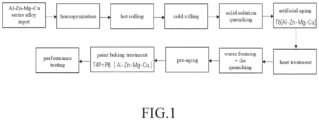
- FIG. 1 schematically shows a process flow chart of the method for manufacturing the Al-Zn-Mg-Cu series aluminum alloy plate material according to the present disclosure.
- Table 1 lists the chemical compositions of the Al-Zn-Mg-Cu series aluminum alloy plates in Examples 1-6.
- Table 1 lists the chemical compositions of the Al-Zn-Mg-Cu series aluminum alloy plates in Examples 1-6.
- Table 1. (the balance is Al) No. Chemical elements Cu (wt%) Mg (wt%) Zn (wt%) Zr (wt%) Si (wt%) Fe (wt%) Mn (wt%) Cr (wt%) Ti (wt%) Total amount of other unavoidable impurity elements Mass percentage of each of other impurity elements Ex. 1 2.2 1.8 7.8 0.13 0.031 0.075 0.01 0.007 0.04 ⁇ 0.100% ⁇ 0.030% Ex.
- the Al-Zn-Mg-Cu series aluminum alloy plates in Examples 1-6 were all prepared by the following steps:
- the Al-Zn-Mg-Cu series aluminum alloy plates designed in Examples 1-6 are all 7055 aluminum alloy plates, and the relevant processes for manufacturing the Al-Zn-Mg-Cu series aluminum alloy plates in Examples 1-6 all meet the design specification requirements of the present disclosure.
- Table 2-1, Table 2-2 and Table 2-3 list the specific process parameters of the above process steps for the Al-Zn-Mg-Cu series aluminum alloy plate in Examples 1-6.
- Tensile test Tensile specimens were prepared according to GB/T 228.1-2010 standard to test and obtain the yield strength, tensile strength and elongation values of the Al-Zn-Mg-Cu series aluminum alloy plates of the Examples.
- Comparative Example 1 was taken from Patent Application with a publication number CN104862551A published on August 26, 2015 . Comparative Example 1 was an Al-Mg-Cu-Zn aluminum alloy plate, with its mechanical performances after T4P+artificial aging shown in Table 3.
- Comparative Example 2 was taken from Patent Application with a publication number CN107686954A published on February 13, 2018 . Comparative Example 2 was a 7075 aluminum alloy hot stamped plate, with its mechanical performances in the T6 state shown in Table 3.
- Table 3 lists the test results of the mechanical performances of the finished Al-Zn-Mg-Cu series aluminum alloy plates in Examples 1-6 and the finished aluminum alloy plates in Comparative Examples 1-2. Table 3. No. Tensile strength R m (MPa) Yield strength R p0.2 (MPa) Elongation A (%) Ex. 1 647 623 15.6 Ex. 2 612 586 15.8 Ex. 3 625 602 16.4 Ex. 4 620 607 15.6 Ex. 5 629 612 15.4 Ex. 6 615 590 17.2 Comp. Ex. 1 367 216 23.1 Comp. Ex. 2 549 - -
- the finished Al-Zn-Mg-Cu series aluminum alloy plates in Examples 1-6 exhibited relatively high mechanical performances, with a tensile strength Rm of 612-647 MPa, a yield strength Rp0.2 of 586-623 MPa, and an elongation A of 15.4-17.2%.
- the process principle provided by the present disclosure is not only applicable to this 7000 series Al-Zn-Mg-Cu aluminum alloy material, but also applicable to all other heat-treatable strengthened aluminum alloys, such as 2000 series, 6000 series and other 7000 series aluminum alloy materials.
- FIG. 1 schematically shows a process flow chart of the method for manufacturing the Al-Zn-Mg-Cu series aluminum alloy plate material according to the present disclosure.
- the present disclosure after the chemical element components designed for the Al-Zn-Mg-Cu series aluminum alloy plate are smelted and cast, a corresponding Al-Zn-Mg-Cu series aluminum alloy ingot can be obtained.
- the Al-Zn-Mg-Cu series aluminum alloy ingot is sequentially subjected to homogenization treatment, hot rolling, cold rolling, solid solution quenching treatment and artificial aging treatment to obtain a T6-state aluminum alloy plate.
Landscapes
- Chemical & Material Sciences (AREA)
- Engineering & Computer Science (AREA)
- Mechanical Engineering (AREA)
- Materials Engineering (AREA)
- Metallurgy (AREA)
- Organic Chemistry (AREA)
- Physics & Mathematics (AREA)
- Thermal Sciences (AREA)
- Crystallography & Structural Chemistry (AREA)
- Metal Rolling (AREA)
Abstract
Description
- The present disclosure relates to an aluminum alloy plate and a manufacturing method thereof, and in particular to a 7000 series aluminum alloy plate and a manufacturing method thereof.
- It's well known that the density of aluminum is about 1/3 of that of steel. It is currently the most widely used lightweight material. Aluminum alloy materials are lightweight materials that have been used early and the technology of which is becoming increasingly mature. In recent years, the use of aluminum alloy materials in automobiles has shown a trend of continuous growth.
- Compared with steel materials, aluminum alloy materials have many advantages such as high thermal conductivity, good corrosion resistance, and excellent processing performance. Although their strength is not as good as high-strength steel, aluminum alloy materials can fully meet the strength requirement of lightweight automobiles when they are modified technologically. In addition, the energy absorption performance of aluminum alloy materials is about twice that of steel, which can improve the collision safety of automobiles effectively. Therefore, in the automotive field, the use of aluminum alloy materials instead of traditional steel materials is an important trend of developing the automotive lightweight technology.
- In the current existing technology, aluminum alloys for vehicle bodies mainly include 2000 series (Al-Cu series), 5000 series (Al-Mg series), 6000 series (Al-Mg-Si series), and a small amount of 7000 series (Al-Zn-Mg series or Al-Zn-Mg-Cu series). Among them, Al-Zn-Mg-Cu series aluminum alloy, also called 7000 series aluminum alloy material, can acquire very high strength and toughness after quenching and aging treatment. Because of its low density, many automobile manufacturers have begun to consider using this 7000 series aluminum alloy material to replace high-strength steel plates to manufacture some automobile parts, such as B-pillars in automobiles and reinforcement ribs in shock absorbers. For example, in the prior art, there is a 7000 series aluminum alloy that can be used to manufacture automobile safety devices. The strength of this alloy is twice as high as that of the existing bumper aluminum alloy. Compared with high-strength steel, this 7000 series aluminum alloy material can ensure the safety of passengers to the greatest extent while reducing the vehicle body weight.
- However, since the 7000 series aluminum alloy in the quenched state has poor plasticity at room temperature, it exhibits high hardening capacity, and it is difficult to be formed directly into complex parts using ordinary forming processes. Therefore, it is usually necessary to anneal the 7000 series aluminum alloy plate to increase the plasticity of the material, and then perform quenching and aging treatment after forming.
- It's found by research that this processing method used currently is very complicated, and the subsequent heat treatment takes a long time, so that the requirements of mass production of parts in the automotive industry cannot be satisfied. Moreover, the material is also easy to deform, which has a certain impact on the size of the parts.
- At the same time, the current research on warm forming conducted by scientific researchers is mainly focused on aluminum alloy materials of 5000 series, 6000 series and the like that do not need heat treatment, and on some magnesium alloy materials, while there are fewer studies on warm forming of heat-treatable 7000 series aluminum alloy materials. Moreover, the fewer studies are all limited to warm forming experiments, the mechanical theories of warm forming, the warm processing performances, and the simulation of the warm forming process. In the prior art, there is still no process technology that is seen clearly for 7000 series aluminum alloy plates used for automobiles.
- Therefore, in order to solve the problems that the current 7000 series aluminum alloys for automobiles have poor forming performance at room temperature and the formed specimens are prone to deformation in heat treatment, the inventors have designed and obtained a new method for manufacturing an Al-Zn-Mg-Cu series aluminum alloy plate, which belongs to a 7000 series aluminum alloy plate. The process principle of the manufacturing method is not only applicable to this Al-Zn-Mg-Cu aluminum alloy material, but also applicable to all other heat-treatable strengthened aluminum alloys, such as 2000 series, 6000 series and other 7000 series aluminum alloy materials.
- One of the objects of the present disclosure is to provide a new method for manufacturing an Al-Zn-Mg-Cu series aluminum alloy plate. A reasonable process design is applied to the method for manufacturing an Al-Zn-Mg-Cu series aluminum alloy plate. The method can improve the formability of the aluminum alloy plate, and meet the use requirement and lightweight requirement of automotive plates. At the same time, the Al-Zn-Mg-Cu series aluminum alloy plate prepared has high tensile strength, yield strength and elongation, which can meet the requirements of automotive plates for material strength and toughness, thereby overcoming the deficiencies existing in the prior art.
- In order to achieve the above object, the present disclosure proposes a method for manufacturing an Al-Zn-Mg-Cu series aluminum alloy plate, comprising the following steps:
- (1) preparing an Al-Zn-Mg-Cu series aluminum alloy ingot;
- (2) subjecting the Al-Zn-Mg-Cu series aluminum alloy ingot to homogenization treatment, hot rolling, cold rolling, solid solution quenching treatment, and artificial aging treatment in sequence to obtain a T6-state aluminum alloy plate;
- (3) subjecting the T6-state aluminum alloy plate to heating, warm forming, die quenching, pre-aging treatment and paint baking treatment to obtain a finished aluminum alloy plate.
- In the current prior art, the traditional aluminum alloy plate forming process involves subjecting the aluminum alloy plate to solid solution quenching, aging treatment, and then hot stamping to obtain a finished product. This process is not good at forming, and it is not suitable for Al-Zn-Mg-Cu series alloys.
- In the present disclosure, in order to solve the problems that 7000 series aluminum alloys have poor forming performance at room temperature and the formed specimens are prone to deformation in heat treatment, the inventors have discovered by extensive research that a new process of integrated warm forming and quenching (Solution Heat treatment-Forming-cold die Quenching), referred to as HFQ process, can be used to treat 7000 series aluminum alloys.
- The warm forming process is a process that combines hot forming and heat treatment processes. It can be used to form a structural part having a complex shape and high strength from an aluminum alloy plate. It is beneficial to improving the formability of the aluminum alloy. If a 7000 series high-strength aluminum alloy is to be used in the automotive field, production efficiency needs to be improved greatly. The warm forming process is expected to become an optimal process for the production of a 7000 series high-strength aluminum alloy for use in the automotive manufacturing field.
- However, in the ordinary warm forming process available nowadays, a solid-dissolved aluminum alloy plate (in a W state) is generally subjected to warm forming and die quenching. This warm forming process exhibits good forming ability, but still cannot stretch the strength to its limit. This is because part of the supersaturated solid solution decomposes during the die quenching process, affecting subsequent precipitation of an aging strengthening phase.
- Therefore, different from the existing warm forming process mentioned above, in the present disclosure, the inventors have creatively designed and sequentially carried out the following process steps for the prepared Al-Zn-Mg-Cu series (i.e., 7000 series) aluminum alloy ingot: homogenization treatment, hot rolling, cold rolling, solid solution quenching treatment, artificial aging treatment, heating, warm forming, die quenching, pre-aging treatment and paint baking treatment, so as to obtain the finished Al-Zn-Mg-Cu series aluminum alloy plate.
- In the present disclosure, a combination of step (2) and step (3) makes the process of this case far superior to the prior art process mentioned above. Compared with the existing warm forming process, the process designed by the present disclosure further adds an artificial aging treatment process step after the solid solution quenching treatment.
- In the warm forming process used in the present disclosure, the Al-Zn-Mg-Cu series alloy plate prepared by cold rolling is first heated to the solid solution treatment temperature, and then held at the solid solution treatment temperature for a period of time so that the solute atoms are fully dissolved into the α aluminum matrix; after full solid dissolution, the Al-Zn-Mg-Cu series alloy plate is quickly transferred to a die for stamping, and then quenched in the die under pressure. Accordingly, after the solid solution quenching treatment is completed, the formed part is finally subjected to artificial aging treatment to control formation of precipitates, thereby ensuring its strength.
- There are two main reasons for pressure quenching in the die: first, rapid quenching prevents formation of coarse precipitates, especially at the grain boundaries; second, deformation of the formed part during the quenching process is avoided.
- The novel warm forming process designed by the present disclosure not only improves the formability of aluminum alloy materials, but also reduces the resilience of aluminum alloy materials. It can meet the requirements for producing aluminum alloy components of the external surface of a vehicle body with high precision, high strength and complex shapes.
- It should be noted that after completing step (2), in step (3), the (T6 state) aluminum alloy plate obtained after the artificial aging treatment needs to be heated rapidly to achieve solid dissolution, followed by warm forming and die quenching. This process not only exhibits good forming ability, but also can stretch the strength of the Al-Zn-Mg-Cu series alloy to its limit. This is because the Al-Zn-Mg-Cu series alloy still includes some fine strengthening phases after rapid heating and solid dissolution. These strengthening phases have a reinforcing function in the subsequent rapid pre-aging treatment process.
- It should be noted that, in the present disclosure, the purpose of the artificial aging treatment is to keep the unstable supersaturated solid solution of the quenched profile at a certain temperature for a certain period of time, so that the supersaturated solid solution decomposes, causing a significant increase in the strength and hardness of the alloy.
- For the Al-Zn-Mg-Cu series aluminum alloy, when simply pursuing high strength, a single-stage aging system can be used to obtain the T6 state. After the aging treatment, the main strengthening phases are the GP zones and a small amount of transition phase (η' phase), and the strength can reach a peak value.
- Further, in the manufacturing method according to the present disclosure, the Al-Zn-Mg-Cu series aluminum alloy ingot comprises the following chemical elements in mass percentages:
Cu: 1.6-2.2%, Mg: 1.8-2.4%, Zn: 6.0-8.6%, Zr: 0.10-0.16%, 0<Ti≤0.10%, 0<Mn≤0.05%, 0<Cr≤0.04%, and a balance of Al and unavoidable impurities. - In some embodiments, the content of Ti is 0<Ti≤0.06%. In some embodiments, the content of Ti is 0.01 ≤ Ti ≤ 0.10%. In some embodiments, the content of Ti is 0.04 ≤ Ti ≤ 0.10%. In some embodiments, the content of Ti is 0.04 ≤ Ti ≤ 0.06%.
- In some embodiments, the content of Mn is 0.01 ≤ Mn ≤ 0.05%.
- In some embodiments, the content of Cr is 0.005 ≤ Ti ≤ 0.04%. In some embodiments, the content of Cr is 0.005 ≤ Ti ≤ 0.01%.
- In the present disclosure, the design of the Al-Zn-Mg-Cu series aluminum alloy ingot is optimized, and the chemical elements thereof are designed according to the following principles:
Cu: The addition of the Cu element to the Al-Zn-Mg-Cu series aluminum alloy ingot according to the present disclosure can improve the stress corrosion resistance, cracking performance, strength performance, fatigue resistance and processing performance of the alloy, enhance the fluidity of the alloy, enhance the strengthening effect of the second-stage aging in the two-stage aging process, reduce processing defects, and reduce the crack propagation rate of the alloy in a corrosive medium. The dissolution of the Cu element into the GP zone can make the GP zone more stable and delay its aging precipitation. In addition, Cu atoms can dissolve into η and η', reducing the potential difference between the inside of a grain and the boundary of the grain, and improving the corrosion resistance of the alloy. On the other hand, an increase in the content of the Cu element will increase the tendency to hot cracking of the material during welding, leading to a decrease in the welding performance. For this reason, when designing the composition of the Al-Zn-Mg-Cu series aluminum alloy, the various performance indicators of the alloy have been given an overall consideration, and an appropriate Cu content is selected. The mass percentage of the Cu element is controlled in the range of 1.6-2.2%, so as to take into account the welding performance of the alloy. - Of course, in some preferred embodiments, in order to achieve better implementation effectiveness, the mass percentage of the Cu element may be further controlled in the range of 1.8-2.2%.
- Mg, Zn: In the Al-Zn-Mg-Cu series aluminum alloy ingot according to the present disclosure, the alloying elements Zn and Mg can precipitate from the alloy matrix to form a strengthening phase η' (MgZn2) phase, thereby improving the yield strength and fracture toughness of the alloy. When the content of the Zn element in the alloy is too low, the strength of the alloy is insufficient. When the content of the Zn element in the alloy is too high, the toughness of the alloy is low, and the formability is poor. The inventors have discovered by research that the Zn and Mg elements can have an aging strengthening effect in the alloy matrix only when their contents are within critical value bounds. If the content exceeds the maximum value of the critical bound, increasing the content of the Zn or Mg element will not increase the aging hardening effect. If the Zn and Mg contents are lower than the minimum values of the critical value bounds, there will be no aging strengthening effect. Therefore, when the Zn/Mg ratio is in the range of 2.6-3.3, the aging precipitation phase of the alloy can be fine and distributed dispersively, and the aging process can proceed rapidly. Therefore, in the present disclosure, the mass percentage of the Mg element is controlled in the range of 1.8-2.4%, and the mass percentage of the Zn element is controlled in the range of 6.0-8.6%.
- Of course, in some preferred embodiments, in order to achieve better implementation effects, the mass percentage of the Mg element may be further controlled in the range of 2.0-2.4%, and the mass percentage of the Zn element may be further controlled in the range of 6.1-7.8%.
- Zr: In the Al-Zn-Mg-Cu series aluminum alloy ingot according to the present disclosure, the fine dispersive precipitate phase formed by trace amounts of transition elements Mn, Cr, and Zr can improve the yield strength and tensile strength of the alloy. It inhibits recrystallization to provide a fine grain structure including a deformation substructure. This structure is beneficial to improving the fracture toughness of the alloy, causing the alloy to undergo transgranular fracture and thus improving the toughness. The corrosion resistance of an alloy containing the Mn and Cr elements is significantly higher than that of an alloy without Mn and Cr. These elements are beneficial to increasing the recrystallization temperature of the alloy, and prevent the recrystallization process during hot deformation and subsequent quenching heating. Besides, low contents of Cr and Mn will not form any harmful coarse phase. Of course, adding Zr is the most effective measure, because it can increase the recrystallization temperature of the aluminum alloy, no matter it's added after heating deformation or after cold deformation, making it possible to obtain a non-recrystallized structure after the heat treatment. Therefore, in the present disclosure, in order to further improve the strength of the Al-Zn-Mg-Cu alloy, Zr is added as a necessary element, and the mass percentage of Zr is controlled in the range of 0.10-0.16%.
- Of course, in some preferred embodiments, in order to obtain better implementation effects, the mass percentage of the Zr element may be further controlled in the range of 0.10-0.13%.
- The Zr element can combine with the Al element to form an intermetallic compound Al3Zr. This intermetallic compound has two forms of structure: one is a tetragonal structure, which is the structure of Al3Zr precipitated directly from the melt and can refine the cast grains of the alloy significantly; and the other is an Ll2 structure, which is the structure of spherical particles precipitated during the homogenization of the ingot, coherent with the matrix, and has a strong effect of inhibiting recrystallization during hot working. The addition of a trace amount of the Zr element can improve the strength, fracture toughness and stress corrosion resistance of the aluminum alloy. In addition, since Zr has a lower quenching sensitivity, Zr can also improve the hardenability and weldability of the alloy.
- In summary, in the Al-Zn-Mg-Cu series aluminum alloy designed by the present disclosure, the addition of trace amounts of Cr, Mn, Ti, and Zr has a strong grain refining effect, and the ingot structure of the Al-Zn-Mg-Cu series aluminum alloy ingot obtained is uniform and fine equiaxed crystals. The refining mechanism in this design is as follows: the atomic clusters containing Cr and Mn, which are completely coherent with α(A1), replace TiB as the "basis" for the common nucleation of Al3Ti and Al3Zr, allowing Ti and Zr to participate in the refinement process together. In the heterogeneous nucleation process, Al3Ti nucleates through coherent atomic clusters, A13(Ti, Zr) nucleates through Al3Ti, and α(A1) nucleates through A13(Ti, Zr).
- Further, in the manufacturing method according to the present disclosure, the mass percentages of the chemical elements in the Al-Zn-Mg-Cu series aluminum alloy ingot further satisfy at least one of the following:
- Cu: 1.8-2.2%,
- Mg: 2.0-2.4%,
- Zn: 6.1-7.8%,
- Zr: 0.10-0.13%.
- Further, in the manufacturing method according to the present disclosure, the unavoidable impurities in the Al-Zn-Mg-Cu series aluminum alloy ingot include at least one of the following: Si≤0.10%, Fe≤0.15%, and a total amount of other impurity elements ≤0.100%.
- In the Al-Zn-Mg-Cu series aluminum alloy ingot according to the present disclosure, Si and Fe mentioned above are both impurity elements in the aluminum alloy. The impurity elements such as Si and Fe are harmful elements that are difficult to avoid in the smelting process of the Al-Zn-Mg-Cu series aluminum alloy ingot. They can form coarse and brittle phases with very high melting points (such as Al7Cu2Fe) in the alloy matrix. These phases will be arranged in strings in the deformation direction during processing and deformation. There is a high-energy phase interface between them and the matrix, so that concerted deformation is difficult, and microcracks are prone to occur under stress. When the action of the stress continues, the microcracks aggregate and grow into macrocracks, increasing the crack propagation rate and reducing the plasticity and fracture toughness of the alloy.
- For example, the Fe element dissolves in Al to form FeAl3, which can refine the recrystallized grains and thus improve the performances of the alloy. However, due to the large electric potential difference between FeAl3 and the Al matrix, the corrosion resistance of the alloy will be degraded. For another example, if Mn is added to an aluminum alloy ingot, (Fe, Mn)Al6 will be formed in the alloy, which will reduce the electric potential difference between FeAl3 and Al, and thus improve the corrosion resistance of the alloy.
- Therefore, in order to ensure the performances and quality of the aluminum alloy, it is necessary to strictly control the mass percentages of the abovementioned impurity elements, and control the total amount of other impurity elements to be ≤0.100%, and the mass percentage of each of the other impurity elements to be ≤0.030%, so as to reduce the content of the coarse second phase containing impurity elements such as Si and Fe in the alloy, and ultimately improve the fracture toughness of the alloy and reduce the crack propagation rate.
- When the technical conditions permit, in order to obtain an aluminum alloy having better performances and higher quality, the contents of the impurity elements in the Al-Zn-Mg-Cu series aluminum alloy ingot should be minimized.
- In some preferred embodiments, in order to achieve better implementation effects and make the quality of the resulting Al-Zn-Mg-Cu series aluminum alloy ingot better, it's preferable to further control Si<0.08%, Fe<0.10%.
- Further, in the manufacturing method according to the present disclosure, in step (2), a three-stage homogenization process is used for the homogenization treatment, wherein the first stage homogenization treatment is held at a temperature of 418-430°C for 5-8 hours, the second stage homogenization treatment is held at a temperature of 460-468°C for 8-12 hours, and the third stage homogenization treatment is held at a temperature of 470-480°C for 20-24 hours.
- In step (2) in the present disclosure, the purpose of homogenizing the Al-Zn-Mg-Cu series aluminum alloy ingot is to eliminate dendrite segregation and component segregation, produce a solid solution with uniform distribution of solute atoms, and reduce the coarse second phase that contributes to the PSN nucleation mechanism of recrystallization.
- Although a two-stage homogenization process can achieve the best aging strengthening effect, the two-stage homogenization treatment system will result in a certain degree of aggregation and growth of the insoluble Fe-containing phase (Al7Cu2Fe) and S(Al2CuMg) phase during the high-temperature holding stage at 473°C. These coarse and brittle second phases are not easy to deform, which will reduce the strength of the alloy, hinder the mobility of dislocations, and reduce the plasticity of the alloy.
- The reason why a three-stage homogenization process is utilized in the present disclosure is that fine Al3Zr particles distributed dispersively and uniformly can be obtained by the three-stage homogenization process. According to the dislocation bypassing mechanism by which the second phase that is difficult to deform impedes dislocation movement, when the Al3Zr particles that are not easy to deform have a smaller radius, are distributed with a smaller spacing, and are more dispersive, the critical shear stress that the dislocations have to overcome to continue moving will be larger, the impeding effect on dislocation movement will be stronger, and the alloy strength will be higher. In addition, the fine and dispersive Al3Zr particles can also prevent recrystallization, retain the deformation substructure, and refine the grains, thereby shortening the dislocation slip distance, reducing the strain concentration caused by the intersection of dislocations on different slip planes and the accumulation of dislocations at grain boundaries, and improving the plasticity of aluminum alloy material. In addition, the three-stage homogenization process can also cause spheroidization of the S(Al2CuMg) phase.
- Further, in the manufacturing method according to the present disclosure, in step (2), the hot rolling includes the steps of: heating the ingot to 430-440°C, holding for 90-120 minutes, and then performing multiple passes of hot rolling, wherein the hot rolling is carried out in longitudinal and transverse directions alternately, and the total hot rolling deformation rate is controlled to be ≥85%. The rolling-end temperature is controlled to be ≥380°C, such as 380-400°C.
- In the above technical solution of the present disclosure, the hot rolling in longitudinal and transverse directions alternately means controlling the hot rolling direction so that the plate is rolled in the length direction and the width direction of the plate alternately. The alternating rolling in longitudinal and transverse directions can provide a plate size desired for subsequent warm forming, and the plate has good through-thickness mechanical performances.
- During the hot rolling process, the rolling-start temperature of the hot rolling is about 85-90% of the melting point of the alloy. Nevertheless, the influence of low melting phases in the Al-Zn-Mg-Cu system such as S(Al2CuMg) phase and T(AlZnMgCu) phase should also be considered. If the hot rolling temperature is too high, grain coarsening or melting of low melting phases between grains tends to occur, and the ingot will be overheated or overfired, or even cracked or crushed during the hot rolling. If the hot rolling temperature is too low, non-uniform deformation of the ingot will be resulted; the rolling load will be increased; and the tendency to edge cracking of the ingot during rolling will be increased, thereby affecting normal rolling. It can be seen that the hot rolling temperature has an influence on the heat resistance and the ambient temperature mechanical performances of the material. Therefore, in order to ensure the performances of the aluminum alloy material, in the present disclosure, the rolling-start temperature of the hot rolling may be controlled in the range of 430-440°C.
- Accordingly, during the hot rolling process, the rolling-end temperature of the hot rolling is determined according to the type II recrystallization diagram of the alloy. The rolling-end temperature of the blooming rolling in the hot rolling process for the Al-Zn-Mg-Cu series aluminum alloy is generally controlled above the recrystallization temperature. Therefore, in the present disclosure, the rolling-end temperature may be controlled to be ≥380°C.
- In addition, during the hot rolling process, the total rolling deformation rate should be selected in view of the characteristics of the Al-Zn-Mg-Cu series aluminum alloy itself. The larger the total rolling deformation rate, the more uniform the material structure, and the better the performances. When the total rolling deformation rate is controlled to be 85% or higher, a rolled plate with the best structure can be obtained.
- In addition, during the hot rolling process, the pass processing rate should be selected in view of the high temperature performances of the Al-Zn-Mg-Cu series alloy, the roll bite condition, the product quality requirements, and the like. The pass processing rate varies in different rolling stages. In the initial rolling stage, the rolling may be performed for 3-5 passes at a lower pass processing rate (such as 30% or lower); in the middle rolling stage, the pass processing rate may reach 45% or higher; and in the final rolling stage, the pass processing rate is generally reduced (such as 30% or lower), so that good plate shape, thickness deviation and surface quality can be achieved.
- Further, in the manufacturing method according to the present disclosure, in step (2), the cold rolling includes the steps of: first air cooling the hot-rolled plate to room temperature, and then performing multiple passes of cold rolling with the total cold rolling deformation rate being controlled to be ≥75%. In some embodiments, the cold rolled steel plate has a thickness of 1.5-2.5 mm.
- Further, in the manufacturing method according to the present disclosure, in step (2), a two-stage solid solution treatment process is used for the solid solution quenching treatment, wherein the first stage solid solution treatment is held at a temperature of 445-450°C for 20-30 minutes, and the second stage solid solution treatment is held at a temperature of 475-478°C for 10-20 minutes, followed by direct water quenching.
- In the above technical solution of the present disclosure, the reason why a two-stage solid solution treatment process is utilized is that the aluminum alloy matrix obtained by this process has less second phase which is also more uniform. Before overfiring occurs in the solid solution treatment of the Al-Zn-Mg-Cu series aluminum alloy, when the solid dissolution temperature is higher, the concentration of the solid-dissolved alloy elements will be higher; the concentration of the supersaturated solid solution in the alloy after quenching will be higher; and the strength after aging will be higher. In the second stage solution treatment, as the holding time at 475-478°C extends, the grains in the aluminum alloy microstructure will grow gradually. The growth of the grains will reduce the strength of the alloy. Therefore, in order to improve the degree of solid dissolution of the alloy, it's necessary to control the holding time in the second solid solution treatment so that it's not too long.
- In the above two-stage solid solution treatment process provided by the present disclosure, the low solid dissolution temperature in the first stage promotes diffusion of the non-equilibrium phases, while the high solid dissolution temperature in the second stage can increase the elemental concentration in the alloy structure, and increase the concentration of the supersaturated solid solution in the solid solution treatment, so that more of the coarse second phase in the alloy has been dissolved into the aluminum matrix, and an alloy material having better mechanical performances can be obtained finally. Accordingly, the solid dissolution time should not be too long; otherwise, a greater degree of recrystallization and grain growth will occur, which will affect the performances of the material.
- In step (2) as described above in the present disclosure, the solid solution treatment enables the elements in the Al-Zn-Mg-Cu alloy to be solid-dissolved into the matrix to the largest extent, and enables maximum elimination of the residual primary phase in the alloy and the second phase formed during homogenization, annealing or deformation, so that the microstructure of the article obtained after the solid solution treatment includes a large amount of substructure and fine grain structure. By optimizing the solid solution system, the aluminum alloy can acquire excellent strength and toughness, and the strength and toughness of the aluminum alloy article can be further enhanced by precipitation aging treatment.
- Correspondingly, quenching is a process that cools the alloy from a solid solution state to room temperature by rapid cooling, so that the high-temperature structure of the alloy is retained in a metastable state. For all heat treatments that change the structure during cooling, an ideal structure can be obtained by reasonably controlling the cooling rate.
- In the present disclosure, a certain quenching rate should be ensured during the process of quenching the Al-Zn-Mg-Cu series aluminum alloy. Rapid quenching can inhibit nucleation and growth of precipitates during the quenching process, so that the solute atoms remain in the solid solution and do not form a second phase, thereby ensuring a higher material strength. Therefore, in the present disclosure, water quenching may be used for quenching, and the quenching transfer time may be controlled within 10s.
- Further, in the manufacturing method according to the present disclosure, in step (2), the quenching transfer time (i.e., the transfer time from the heat treatment furnace to the cooling water) is controlled to be 10 seconds or less, such as 5-10 seconds.
- Further, in the manufacturing method according to the present disclosure, in step (2), the artificial aging treatment is held at a temperature of 185-205°C for 30-60 minutes.
- It should be noted that, in the prior art, the aging temperature for 7000 series aluminum alloys in a T6 state is generally controlled to be 100-150°C, and the holding time is generally 8-36h.
- In the present disclosure, the microstructure of the high-strength Al-Zn-Mg-Cu series aluminum alloy is closely related with the performances. The performances of the alloy are mainly influenced by the size, type and distribution of the precipitate phase in the alloy structure. The microstructure of the Al-Zn-Mg-Cu series aluminum alloy mainly consists of three parts, namely, the intragranular precipitation phase (mpt), the grain boundary precipitation phase GBP and the precipitation-free zone (PFZ) around the grain boundaries. Among them, the intragranular precipitation phase (mpt) plays a decisive role for the strength of the alloy. The strengthening effect of the GP zone and η' phase precipitated by aging treatment is better than that of the coarse equilibrium phase, namely η phase.
- It is generally believed that the aging precipitation sequence of 7000 series ultra-high strength aluminum alloys is usually as follows: supersaturated solid solution (ss)-GP zone-η' transition phase (MgZn2)-η equilibrium phase (MgZn2). Therefore, in view of the influence of the number, distribution and size of the GP zone, η' phase and η phase, T phase and other second phases on the performances of the alloy, how to regulate the number, distribution and size of these phases is a key to artificial aging treatment.
- During the aging treatment process, the aging temperature has a great influence on the precipitation of the precipitates in the alloy. At different aging temperatures, the critical nucleation size, type, and aggregation and growth rates of the precipitate phase are different. When the aging temperature is low, the precipitation phase in the alloy precipitates fast at the beginning, and the aging strengthening effect on the alloy is significant. In the later stage, the precipitation and growth of the precipitation phase are slow. Low-temperature aging can afford high strength, but it takes a long time to reach peak aging. As the aging temperature increases, the diffusion coefficient of the solute atoms increases, and the precipitation rate of the precipitation phase increases. At the same time, high aging temperature is more conducive to formation of the transition phase (η' phase) and the equilibrium phase (η phase). When the aging temperature for the alloy increases gradually, the time it takes for the alloy to reach its peak hardness is shortened.
- Therefore, in the present disclosure, when optimizing the process of artificial aging treatment, a high-temperature short-time aging system may be utilized to control the aluminum alloy plate to be held at a temperature in the range of 185-205°C for 30-60 minutes. Under this system, peak aging can be achieved quickly, and the strength of the aluminum alloy plate is optimal.
- Further, in the manufacturing method according to the present disclosure, in step (3), the heating is rapid solid solution heating, and includes holding at a temperature of 460-477°C for 5-10 minutes. Preferably, the heating is performed by contact heating.
- In the above technical solution according to the present disclosure, the solid solution heating temperature is set in the range of 460-477°C. One consideration is that the dissolution temperatures of the S(Al2CuMg) phase and the T(AlZnMgCu) phase in the Al-Zn-Mg-Cu series aluminum alloy are within this range; and the other consideration is that the problem of overfiring caused by excessively high temperature should be avoided during rapid solid dissolution.
- In some embodiments, the heating process may be contact heating.
- Further, in the manufacturing method according to the present disclosure, in step (3), the pre-aging treatment is held at a temperature of 75-100°C for 30-60 minutes.
- In the present disclosure, the Al-Zn-Mg-Cu alloy plate is subjected to a pre-aging treatment process for the purpose of ensuring that the aluminum alloy does not undergo natural aging. The alloy after the solid solution treatment must be pre-aged within 30 minutes. In essence, the process of impeding natural aging by the pre-aging treatment is to impede formation of atomic clusters and GP zones in the Al-Zn-Mg-Cu alloy. At the same time, the pre-aging treatment can also promote nucleation of low-temperature precipitation phases. The improvement of strength in the subsequent paint baking stage depends on the nucleation of these precipitation phases.
- Further, in the manufacturing method according to the present disclosure, in step (3), the paint baking treatment is held at a temperature of 170-190°C (such as 180-190°C) for 20-40 minutes.
- In the present disclosure, paint baking is equivalent to artificial aging. After the T4P+PB (pre-aging + paint baking) treatment, a large quantity of fine and dense precipitation phases can be obtained, and the atomic clusters and GP zones in the precipitation phases are increased greatly. Compared with the temperature of natural aging, the paint baking temperature is higher, and the unstable phase in the T4P state structure will continue to nucleate and precipitate, so that the strength is further improved, that is, exhibiting obvious paint baking hardening.
- In the above technical solution, the preferred design of the paint baking process is based on the process requirements of paint baking on the one hand, and on the other hand, the characteristics of the process by which the Al-Zn-Mg-Cu series aluminum alloy reaches peak aging at a high temperature in a short time are considered.
- Accordingly, another object of the present disclosure is to provide an Al-Zn-Mg-Cu series aluminum alloy plate which is easy to produce. Moreover, the Al-Zn-Mg-Cu series aluminum alloy plate has high tensile strength, yield strength and elongation, and can meet the requirements of automotive plates for material strength and toughness. It can be used effectively in the vehicle manufacturing industry, and meet the requirements of vehicle lightweighting. It has very broad application prospects.
- In order to achieve the above object, the present disclosure proposes an Al-Zn-Mg-Cu series aluminum alloy plate, which is obtained by the above method for manufacturing an Al-Zn-Mg-Cu series aluminum alloy plate according to the present disclosure.
- Further, the performances of the Al-Zn-Mg-Cu series aluminum alloy plate according to the present disclosure satisfy the following: tensile strength: 610-650 MPa, yield strength: 580-630 MPa, and elongation: ≥15.0%.
- Further, the performances of the Al-Zn-Mg-Cu series aluminum alloy plate according to the present disclosure satisfy the following: tensile strength: 612-647 MPa, yield strength: 580-630 MPa, and elongation: ≥15.0%.
- Further, the performances of the Al-Zn-Mg-Cu series aluminum alloy plate according to the present disclosure satisfy the following: tensile strength Rm: 612-647 MPa, yield strength Rp0.2: 586-623 MPa, and elongation A: 15.4-17.2%.
- Compared with the prior art, the manufacturing method for the Al-Zn-Mg-Cu series aluminum alloy plate according to the present disclosure has the following advantages and beneficial effects:
In order to solve the problems that the current 7000 series aluminum alloys for automobiles have poor forming performance at room temperature and the formed specimens are prone to deformation in heat treatment, the inventors have designed and obtained a new method for manufacturing an Al-Zn-Mg-Cu series aluminum alloy plate. - A reasonable process is designed for the method for manufacturing the Al-Zn-Mg-Cu series aluminum alloy plate. The production flow and process parameters are standardized, and the formability as well as the overall mechanical performances of the Al-Zn-Mg-Cu series aluminum alloy plate obtained can be improved significantly to meet the requirements for use as an automotive plate, thereby overcoming the deficiencies in the prior art.
- The Al-Zn-Mg-Cu series aluminum alloy plate is easy to produce. Moreover, it has high tensile strength, yield strength and elongation, and can meet the requirements of automotive plates for material strength and toughness. It can be used effectively in the vehicle manufacturing industry, and meet the requirements of vehicle lightweighting. It has very broad application prospects.
- In some embodiments, the mechanical performances of the Al-Zn-Mg-Cu series aluminum alloy plate satisfy the following: tensile strength: 610-650 MPa, yield strength: 580-630 MPa, and elongation: ≥15.0%. The mechanical performances of the Al-Zn-Mg-Cu series aluminum alloy plates prepared by this manufacturing method are improved greatly as compared with the existing 7000 series aluminum alloy plates.
- In addition, the process principle of this manufacturing method is not only applicable to this Al-Zn-Mg-Cu aluminum alloy material, but also applicable to all other heat-treatable strengthened aluminum alloys, such as 2000 series, 6000 series and other 7000 series aluminum alloy materials. It has good promotion prospects and application value.
-
FIG. 1 schematically shows a process flow chart of the method for manufacturing the Al-Zn-Mg-Cu series aluminum alloy plate material according to the present disclosure. - The method for manufacturing an Al-Zn-Mg-Cu series aluminum alloy plate according to the present disclosure and the aluminum alloy plate will be further explained and illustrated below with reference to the specific Examples and the accompanying drawing of the specification. However, such explanation and illustration do not constitute any improper limitation on the technical solution of the present disclosure.
- In the present disclosure, the chemical compositions of the Al-Zn-Mg-Cu series aluminum alloy plates in Examples 1-6 are shown in Table 1 below. Table 1 lists the chemical compositions of the Al-Zn-Mg-Cu series aluminum alloy plates in Examples 1-6.
Table 1. (the balance is Al) No. Chemical elements Cu (wt%) Mg (wt%) Zn (wt%) Zr (wt%) Si (wt%) Fe (wt%) Mn (wt%) Cr (wt%) Ti (wt%) Total amount of other unavoidable impurity elements Mass percentage of each of other impurity elements Ex. 1 2.2 1.8 7.8 0.13 0.031 0.075 0.01 0.007 0.04 ≤0.100% ≤0.030% Ex. 2 1.8 2.2 6.0 0.16 0.05 0.09 0.01 0.005 0.10 Ex. 3 1.6 2.4 8.6 0.10 0.08 0.10 0.03 0.01 0.04 Ex. 4 1.8 1.9 6.9 0.15 0.05 0.06 0.02 0.005 0.06 Ex. 5 1.7 2.0 7.4 0.14 0.06 0.07 0.05 0.005 0.05 Ex. 6 2.0 2.4 8.4 0.16 0.05 0.08 0.04 0.005 0.05 - Accordingly, based on the chemical compositions designed above, in the present disclosure, the Al-Zn-Mg-Cu series aluminum alloy plates in Examples 1-6 were all prepared by the following steps:
- (1) A formulation was made according to each chemical composition shown in Table 1, smelted in a smelting furnace, refined, and then cast into an Al-Zn-Mg-Cu series aluminum alloy ingot.
- (2) The Al-Zn-Mg-Cu series aluminum alloy ingot obtained was subjected to homogenization treatment, hot rolling, cold rolling, solid solution quenching treatment and artificial aging treatment in sequence to obtain a T6 state Al-Zn-Mg-Cu series aluminum alloy plate:
- Homogenization treatment: The aluminum alloy ingot was placed in a homogenization furnace for homogenization treatment, and a three-stage homogenization treatment system was utilized, wherein the first stage homogenization treatment was held at a temperature of 418-430°C for 5-8 hours, the second stage homogenization treatment was held at a temperature of 460-468°C for 8-12 hours, and the third stage homogenization treatment was held at a temperature of 470-480°C for 20-24 hours, followed by forced water cooling to room temperature to obtain a homogenized aluminum alloy ingot;
- Hot rolling: The aluminum alloy ingot was heated to 430-440°C and held for 90-120min, and then subjected to multiple passes of hot rolling, wherein the hot rolling was conducted in longitudinal and transverse directions alternately, the total hot rolling deformation rate was controlled to be ≥85%, and the rolling-end temperature was controlled to be ≥380°C, so as to obtain a hot rolled plate having a final thickness of 6mm;
- Cold rolling: The hot rolled plate was first air cooled to room temperature, and then cold rolled to 1.5-2.5mm in multiple passes, wherein the total cold rolling deformation rate was controlled to be ≥75%;
- Solid solution quenching treatment: The cold-rolled plate was subjected to a two-stage solid solution treatment process, wherein the first stage solid solution treatment was held at a temperature of 445-450°C for 20-30 minutes, and the second stage solid solution treatment was held at a temperature of 475-478°C for 10-20 minutes, followed by direct water quenching, wherein the quenching transfer time was controlled to be 10 seconds or less;
- Artificial aging treatment: After the solid solution quenching, the plate was transferred to an aging furnace for artificial aging treatment, wherein the plate was controlled to be held at a temperature of 185-205°C for 30-60 minutes to obtain a T6-state Al-Zn-Mg-Cu series aluminum alloy plate.
- (3) The T6-state Al-Zn-Mg-Cu series aluminum alloy ingot obtained was subjected to heating, warm forming, die quenching, pre-aging treatment and paint baking treatment to obtain a finished Al-Zn-Mg-Cu series aluminum alloy plate:
- Heating: The T6-state Al-Zn-Mg-Cu series aluminum alloy plate obtained after the artificial aging was held at a temperature of 460-477°C for 5-10 minutes, and then directly subjected to warm forming and die quenching;
- Pre-aging treatment: After the warm forming and the die quenching were completed, the Al-Zn-Mg-Cu series aluminum alloy plate was pre-aged in a short period of time to obtain a T4P state Al-Zn-Mg-Cu series aluminum alloy plate, wherein the pre-aging process was to control the plate to be held at a temperature of 75-100°C for 30-60min, followed by paint baking treatment;
- Paint baking treatment: The plate was controlled to be held at a temperature of 170-190°C for 20-40 minutes to obtain a T4P+PB state aluminum alloy plate.
- In the present disclosure, the Al-Zn-Mg-Cu series aluminum alloy plates designed in Examples 1-6 are all 7055 aluminum alloy plates, and the relevant processes for manufacturing the Al-Zn-Mg-Cu series aluminum alloy plates in Examples 1-6 all meet the design specification requirements of the present disclosure.
- Table 2-1, Table 2-2 and Table 2-3 list the specific process parameters of the above process steps for the Al-Zn-Mg-Cu series aluminum alloy plate in Examples 1-6.
Table 2-1. No. Step (2) First stage homogenization temperature (°C) First stage homogenization holding time (h) Second stage homogenization temperature (°C) Second stage homogenization holding time (h) Third stage homogenization temperature (°C) Third stage homogenization holding time (h) Hot rolling-start temperature (°C) Holding time before hot rolling (min) Total hot rolling deformation rate (%) Ex. 1 418 6 465 8 475 20 430 90 85 Ex. 2 430 5 468 8 470 20 440 120 87 Ex. 3 418 7 460 10 478 22 430 95 85 Ex. 4 425 5 460 10 480 22 435 100 90 Ex. 5 420 8 465 12 478 24 435 110 85 Ex. 6 425 5 465 12 475 24 435 120 86 Table 2-2. No. Step (2) Hot rolling-end temperature (°C) Hot-rolled plate thickness (mm) Total cold rolling deformation rate (%) Cold-rolled plate thickness (mm) First stage solid solution treatment temperature (°C) First stage solid solution treatment time (min) Second stage solid solution treatment temperature (°C) Second stage solid solution treatment time (min) Quenching transfer time (s) Artificial aging temperature (°C) Artificial aging holding time (min) Ex. 1 380 6 75 2 445 20 475 10 5 185 30 Ex. 2 390 6 75 2 445 20 475 20 5 205 40 Ex. 3 380 6 75 2 450 20 478 10 8 190 30 Ex. 4 385 6 80 2 450 30 475 15 6 190 50 Ex. 5 385 6 80 2 447 30 476 20 7 200 60 Ex. 6 390 6 80 2 450 30 477 20 9 195 55 Table 2-3. No. Step (3) Heating temperature (°C) Holding time for heating (min) Pre-aging temperature (°C) Pre-aging holding time (min) Paint baking temperature (°C) Paint baking holding time (min) Ex. 1 466 5 90 30 185 20 Ex. 2 470 5 80 30 185 20 Ex. 3 475 8 100 40 190 30 Ex. 4 473 8 85 50 188 30 Ex. 5 468 10 95 60 190 40 Ex. 6 475 10 100 60 185 40 - In order to further illustrate the mechanical performances of the Al-Zn-Mg-Cu series aluminum alloy plates in Examples 1-6 according to the present disclosure, the finished Al-Zn-Mg-Cu series aluminum alloy plates obtained in Examples 1-6 were sampled respectively, and the mechanical performances of the finished aluminum alloy plates in the Examples were tested. The relevant test results of the mechanical performances are listed in Table 3 below.
- The methods for testing the relevant mechanical performances are as follows:
Tensile test: Tensile specimens were prepared according to GB/T 228.1-2010 standard to test and obtain the yield strength, tensile strength and elongation values of the Al-Zn-Mg-Cu series aluminum alloy plates of the Examples. - Accordingly, in order to prove that the Al-Zn-Mg-Cu series aluminum alloy plates in Examples 1-6 prepared by the manufacturing method of the present disclosure have excellent mechanical performances, the inventors further introduced two prior art 7000 series aluminum alloy materials for comparison, namely Comparative Example 1 and Comparative Example 2.
- Comparative Example 1 was taken from Patent Application with a publication number
CN104862551A published on August 26, 2015 . Comparative Example 1 was an Al-Mg-Cu-Zn aluminum alloy plate, with its mechanical performances after T4P+artificial aging shown in Table 3. - Comparative Example 2 was taken from Patent Application with a publication number
CN107686954A published on February 13, 2018 . Comparative Example 2 was a 7075 aluminum alloy hot stamped plate, with its mechanical performances in the T6 state shown in Table 3. - Table 3 lists the test results of the mechanical performances of the finished Al-Zn-Mg-Cu series aluminum alloy plates in Examples 1-6 and the finished aluminum alloy plates in Comparative Examples 1-2.
Table 3. No. Tensile strength Rm (MPa) Yield strength Rp0.2 (MPa) Elongation A (%) Ex. 1 647 623 15.6 Ex. 2 612 586 15.8 Ex. 3 625 602 16.4 Ex. 4 620 607 15.6 Ex. 5 629 612 15.4 Ex. 6 615 590 17.2 Comp. Ex. 1 367 216 23.1 Comp. Ex. 2 549 - - - As shown in Table 3, in the present disclosure, the finished Al-Zn-Mg-Cu series aluminum alloy plates in Examples 1-6 exhibited relatively high mechanical performances, with a tensile strength Rm of 612-647 MPa, a yield strength Rp0.2 of 586-623 MPa, and an elongation A of 15.4-17.2%.
- By comparing the finished Al-Zn-Mg-Cu series aluminum alloy plates in Examples 1-6 with the finished aluminum alloy plates in Comparative Examples 1-2, it's not difficult to find that the mechanical performances of the finished Al-Zn-Mg-Cu series aluminum alloy plates in Examples 1-6 were more than 30% higher than those of the finished aluminum alloy plates in Comparative Example 1. This is mainly because the process route adopted by the present disclosure is different from that of Comparative Example 1. The fundamental reason is that the present disclosure subjects the plate to T6 heat treatment and then to warm forming. Treating the plate this way can achieve a basis by precipitation strengthening in advance, and with the reinforcement of the subsequent paint baking treatment, the material acquires higher strength and toughness.
- In summary, it can be seen that the production flow and process parameters designed by the present disclosure for the method for manufacturing the Al-Zn-Mg-Cu series aluminum alloy plate for automobiles are well standardized, and the overall performances of the product made thereby can be improved significantly to meet the requirements of automobiles for high-performance aluminum alloys.
- The process principle provided by the present disclosure is not only applicable to this 7000 series Al-Zn-Mg-Cu aluminum alloy material, but also applicable to all other heat-treatable strengthened aluminum alloys, such as 2000 series, 6000 series and other 7000 series aluminum alloy materials.
-
FIG. 1 schematically shows a process flow chart of the method for manufacturing the Al-Zn-Mg-Cu series aluminum alloy plate material according to the present disclosure. - As shown by
FIG. 1 , in the present disclosure, after the chemical element components designed for the Al-Zn-Mg-Cu series aluminum alloy plate are smelted and cast, a corresponding Al-Zn-Mg-Cu series aluminum alloy ingot can be obtained. The Al-Zn-Mg-Cu series aluminum alloy ingot is sequentially subjected to homogenization treatment, hot rolling, cold rolling, solid solution quenching treatment and artificial aging treatment to obtain a T6-state aluminum alloy plate. - Based on the resulting T6-state aluminum alloy plate, further heating, warm forming, die quenching, pre-aging and paint baking treatment are performed to obtain a finished Al-Zn-Mg-Cu series aluminum alloy thin plate in a T4P+PB state.
- It should be noted that combinations of the various technical features in this case are not limited to the combinations described in the claims of this case or the combinations described in the specific Examples. All technical features recorded in this case can be combined freely or associated in any way unless a contradiction occurs.
- It should also be noted that the Examples listed above are only specific embodiments of the present disclosure. Obviously, the present disclosure is not limited to the above Examples, and changes or modifications made thereto can be directly derived from the present disclosure or easily conceived of by those skilled in the art, all of which fall within the protection scope of the present disclosure.
Claims (15)
- A method for manufacturing an Al-Zn-Mg-Cu series aluminum alloy plate, comprising steps of:(1) preparing an Al-Zn-Mg-Cu series aluminum alloy ingot;(2) subjecting the Al-Zn-Mg-Cu series aluminum alloy ingot to homogenization treatment, hot rolling, cold rolling, solid solution quenching treatment, and artificial aging treatment in sequence to obtain a T6-state aluminum alloy plate;(3) subjecting the T6-state aluminum alloy plate to heating, warm forming, die quenching, pre-aging treatment and paint baking treatment to obtain a finished aluminum alloy plate.
- The method according to claim 1, wherein the Al-Zn-Mg-Cu series aluminum alloy ingot comprises the following chemical elements in mass percentages:
Cu: 1.6-2.2%, Mg: 1.8-2.4%, Zn: 6.0-8.6%, Zr: 0.10-0.16%, 0<Ti≤0.10%, preferably 0<Ti≤0.06%, 0<Mn≤0.05%, 0<Cr≤0.04%, and a balance of Al and unavoidable impurities. - The method according to claim 2, wherein the mass percentages of the chemical elements of the Al-Zn-Mg-Cu series aluminum alloy ingot further satisfy at least one of:Cu: 1.8-2.2%,Mg: 2.0-2.4%,Zn: 6.1-7.8%,Zr: 0.10-0.13%.
- The method according to claim 1, wherein the unavoidable impurities in the Al-Zn-Mg-Cu series aluminum alloy ingot include at least one of the following: Si≤0.10%, Fe≤0.15%, and a total amount of other impurity elements ≤0.100%; preferably Si≤0.08%, Fe≤0.1%, and a total amount of other impurity elements ≤0.030%.
- The method according to claim 1, wherein in step (2), a three-stage homogenization process is used for the homogenization treatment, wherein a first stage homogenization treatment is held at a temperature of 418-430°C for 5-8 hours, a second stage homogenization treatment is held at a temperature of 460-468°C for 8-12 hours, and a third stage homogenization treatment is held at a temperature of 470-480°C for 20-24 hours.
- The method according to claim 1, wherein in step (2), the hot rolling includes steps of: heating the ingot to 430-440°C, holding for 90-120 minutes, and then performing multiple passes of hot rolling, wherein the hot rolling is carried out in longitudinal and transverse directions alternately, a total hot rolling deformation rate is controlled to be ≥85%, and a rolling-end temperature is controlled to be ≥380°C.
- The method according to claim 1, wherein in step (2), the cold rolling includes steps of: first air cooling a hot-rolled plate to room temperature, and then performing multiple passes of cold rolling with a total cold rolling deformation rate being controlled to be ≥75%.
- The method according to claim 1, wherein in step (2), a two-stage solution treatment process is used for the solid solution quenching treatment, wherein a first stage solid solution treatment is held at a temperature of 445-450°C for 20-30 minutes, and a second stage solid solution treatment is held at a temperature of 475-478°C for 10-20 minutes, followed by direct water quenching.
- The method according to claim 8, wherein in step (2), a quenching transfer time is controlled to be 10 seconds or less.
- The method according to claim 1, wherein in step (2), the artificial aging treatment is held at a temperature of 185-205°C for 30-60 minutes.
- The method according to claim 1, wherein in step (3), the heating is rapid solid solution heating, and includes holding at a temperature of 460-477°C for 5-10 minutes; preferably, the heating is performed by contact heating.
- The method according to claim 1, wherein in step (3), the pre-aging treatment is held at a temperature of 75-100°C for 30-60 minutes.
- The method according to claim 1, wherein in step (3), the paint baking treatment is held at a temperature of 170-190°C for 20-40 minutes.
- An Al-Zn-Mg-Cu series aluminum alloy plate obtained by the method according to any one of claims 1-13.
- The Al-Zn-Mg-Cu series aluminum alloy plate according to claim 14, wherein its performances satisfy: tensile strength: 610-650 MPa, yield strength: 580-630 MPa, and elongation: ≥15.0%.
Applications Claiming Priority (2)
| Application Number | Priority Date | Filing Date | Title |
|---|---|---|---|
| CN202210694056.6A CN117305733B (en) | 2022-06-20 | 2022-06-20 | A method for manufacturing an Al-Zn-Mg-Cu series aluminum alloy plate and an aluminum alloy plate |
| PCT/CN2023/101252 WO2023246736A1 (en) | 2022-06-20 | 2023-06-20 | Method for manufacturing al-zn-mg-cu series aluminum alloy plate, and aluminum alloy plate |
Publications (2)
| Publication Number | Publication Date |
|---|---|
| EP4541915A1 true EP4541915A1 (en) | 2025-04-23 |
| EP4541915A4 EP4541915A4 (en) | 2026-02-18 |
Family
ID=89279832
Family Applications (1)
| Application Number | Title | Priority Date | Filing Date |
|---|---|---|---|
| EP23826383.4A Pending EP4541915A4 (en) | 2022-06-20 | 2023-06-20 | METHOD FOR PRODUCING AN AL-ZN-MG-CU SERIES ALUMINUM ALLOY PLATE AND ALUMINUM ALLOY PLATE |
Country Status (7)
| Country | Link |
|---|---|
| US (1) | US20250382684A1 (en) |
| EP (1) | EP4541915A4 (en) |
| JP (1) | JP2025521321A (en) |
| KR (1) | KR20250025015A (en) |
| CN (1) | CN117305733B (en) |
| CA (1) | CA3260259A1 (en) |
| WO (1) | WO2023246736A1 (en) |
Families Citing this family (10)
| Publication number | Priority date | Publication date | Assignee | Title |
|---|---|---|---|---|
| CN116287900A (en) * | 2022-09-06 | 2023-06-23 | 北京科技大学 | High-strength and high-formability aluminum alloy plate for automotive structural parts and preparation method thereof |
| CN118028635B (en) * | 2024-02-01 | 2024-07-26 | 宁波环球铝业科技有限公司 | Production method of special 7006A aluminum alloy material |
| CN118002674A (en) * | 2024-03-12 | 2024-05-10 | 江西豪斯特汽车零部件有限公司 | A 7xxx series aluminum alloy sheet forming process |
| CN118773527B (en) * | 2024-06-28 | 2025-02-14 | 中国科学院金属研究所 | A 7 series aluminum alloy plate and preparation method thereof |
| CN118639042B (en) * | 2024-08-14 | 2024-12-03 | 中国科学院金属研究所 | Method for reducing harm of iron element in 6101 aluminum alloy |
| CN119442598A (en) * | 2024-10-12 | 2025-02-14 | 山东南山铝业股份有限公司 | Heat treatment process optimization method for heat-treatable and strengthened aluminum alloy based on phase calculation |
| CN119640107B (en) * | 2024-11-04 | 2025-12-12 | 山东南山铝业股份有限公司 | A medium-to-high strength 7020 aluminum alloy profile with complex cross-section and its preparation method |
| CN119615024B (en) * | 2024-12-19 | 2026-02-03 | 武汉理工大学 | Heat treatment method for cooperative reinforcement of deformation and phase change of high-strength aluminum alloy |
| CN120249707B (en) * | 2025-04-02 | 2025-12-09 | 佛山市璟熙金属制品有限公司 | Preparation method of wear-resistant and oxidation-resistant lithium aluminum alloy |
| CN121183260B (en) * | 2025-11-21 | 2026-03-17 | 中南大学 | A heat treatment method to improve the quenching sensitivity and corrosion resistance of 650MPa grade Al-Zn-Mg-Cu alloy |
Family Cites Families (22)
| Publication number | Priority date | Publication date | Assignee | Title |
|---|---|---|---|---|
| US4305763A (en) * | 1978-09-29 | 1981-12-15 | The Boeing Company | Method of producing an aluminum alloy product |
| JPH01290737A (en) * | 1988-05-16 | 1989-11-22 | Kobe Steel Ltd | Aluminum alloy for die |
| US5785777A (en) * | 1996-11-22 | 1998-07-28 | Reynolds Metals Company | Method of making an AA7000 series aluminum wrought product having a modified solution heat treating process for improved exfoliation corrosion resistance |
| JP5276341B2 (en) * | 2008-03-18 | 2013-08-28 | 株式会社神戸製鋼所 | Aluminum alloy material for high pressure gas containers with excellent hydrogen embrittlement resistance |
| JP2014087836A (en) * | 2012-10-31 | 2014-05-15 | Aisin Takaoka Ltd | Method and apparatus for die-quenching aluminum alloy material |
| CN104862551B (en) | 2015-05-21 | 2017-09-29 | 北京科技大学 | Al Mg Cu Zn line aluminium alloys and aluminum alloy plate materials preparation method |
| PT3265595T (en) * | 2015-10-30 | 2019-05-08 | Novelis Inc | High strength 7xxx aluminum alloys and methods of making the same |
| CN105441837B (en) * | 2016-01-07 | 2017-04-26 | 北京科技大学 | Treatment method for improving forming properties and strengths of 7xxx-series aluminium alloy thin plates |
| CN106834986B (en) * | 2017-03-07 | 2018-12-18 | 烟台南山学院 | A kind of aviation alloyed aluminium homogenizing heat treatment |
| CN107686954A (en) | 2017-07-18 | 2018-02-13 | 北京科技大学 | A kind of heat treatment method for improving 7075 aluminum alloy heat press formabilities |
| CN108265246A (en) * | 2018-01-25 | 2018-07-10 | 湖南大学 | A kind of method for improving intensity non-uniformity after 7 line aluminium alloy of large scale quenches |
| WO2019189521A1 (en) * | 2018-03-30 | 2019-10-03 | 株式会社神戸製鋼所 | High-strength aluminum alloy, and aluminum alloy sheet and aluminum alloy member using said aluminum alloy |
| CN108380722A (en) * | 2018-04-27 | 2018-08-10 | 武汉理工大学 | A kind of hot press-formed method of lightweight car body of aluminum alloy component |
| WO2020178076A1 (en) * | 2019-03-01 | 2020-09-10 | Aleris Aluminum Duffel Bvba | Method of manufacturing an automotive part from a 7xxx-series aluminium alloy |
| CN110885942B (en) * | 2019-12-17 | 2021-05-07 | 中铝材料应用研究院有限公司 | Medium-strength 7xxx series aluminum alloy plate suitable for hot stamping forming-quenching integrated process |
| CN111206194B (en) * | 2020-02-24 | 2022-01-28 | 湖南人文科技学院 | Thermal mechanical treatment process for preparing aluminum alloy with high comprehensive performance |
| CN111593239B (en) * | 2020-05-27 | 2021-07-16 | 北京科技大学 | Low-cost and high-formability aluminum alloy sheet for vehicle body structure and preparation method thereof |
| CN111876639A (en) * | 2020-08-06 | 2020-11-03 | 北部湾大学 | A kind of manufacturing method of 7000 series aluminum alloy for automobile column and its plate |
| JP2023545854A (en) * | 2020-10-20 | 2023-10-31 | アーコニック テクノロジーズ エルエルシー | Improved 7XXX aluminum alloy |
| CN114807794B (en) * | 2021-01-28 | 2023-04-11 | 宝山钢铁股份有限公司 | Aluminum alloy product, manufacturing method thereof and automobile structural part |
| JP7410534B2 (en) * | 2021-09-30 | 2024-01-10 | 国立大学法人横浜国立大学 | Forming method of aluminum alloy plate |
| CN114561577B (en) * | 2022-03-03 | 2023-04-07 | 中铝瑞闽股份有限公司 | Preparation method of ultrahigh-strength 7-series aluminum sheet |
-
2022
- 2022-06-20 CN CN202210694056.6A patent/CN117305733B/en active Active
-
2023
- 2023-06-20 EP EP23826383.4A patent/EP4541915A4/en active Pending
- 2023-06-20 US US18/876,267 patent/US20250382684A1/en active Pending
- 2023-06-20 CA CA3260259A patent/CA3260259A1/en active Pending
- 2023-06-20 WO PCT/CN2023/101252 patent/WO2023246736A1/en not_active Ceased
- 2023-06-20 KR KR1020257002054A patent/KR20250025015A/en active Pending
- 2023-06-20 JP JP2024574756A patent/JP2025521321A/en active Pending
Also Published As
| Publication number | Publication date |
|---|---|
| WO2023246736A1 (en) | 2023-12-28 |
| CN117305733B (en) | 2025-10-14 |
| JP2025521321A (en) | 2025-07-08 |
| KR20250025015A (en) | 2025-02-20 |
| EP4541915A4 (en) | 2026-02-18 |
| CN117305733A (en) | 2023-12-29 |
| US20250382684A1 (en) | 2025-12-18 |
| CA3260259A1 (en) | 2025-04-01 |
Similar Documents
| Publication | Publication Date | Title |
|---|---|---|
| US20250382684A1 (en) | Method for manufacturing al-zn-mg-cu series aluminum alloy plate, and aluminum alloy plate | |
| CN106521253B (en) | A kind of high formability Al Mg Si alloys and its manufacture method | |
| JP3705320B2 (en) | High strength heat treatment type 7000 series aluminum alloy with excellent corrosion resistance | |
| CN105441837B (en) | Treatment method for improving forming properties and strengths of 7xxx-series aluminium alloy thin plates | |
| CN113737069A (en) | 7xxx series aluminum alloy for fasteners and processing method of rods and wires thereof | |
| CN107604222B (en) | A kind of Al-Mg series alloy that can be aged and strengthened and its preparation method | |
| CN103509980A (en) | Al-Mg-Si-CU-Zn aluminum alloy and preparation method and application thereof | |
| CN112458344B (en) | High-strength corrosion-resistant aluminum alloy and preparation method and application thereof | |
| CN114807794B (en) | Aluminum alloy product, manufacturing method thereof and automobile structural part | |
| CN112553511A (en) | 6082 aluminum alloy material and preparation method thereof | |
| CN107488823A (en) | Method that is a kind of while improving intensity of aluminum alloy and elongation percentage | |
| CN115216674B (en) | 7000 series aluminum alloy sheet for automobile and preparation method thereof | |
| CN112626386A (en) | High-strength corrosion-resistant Al-Mg-Si-Cu aluminum alloy and preparation method and application thereof | |
| CN111254324A (en) | Al-Mg-Si alloy plate and manufacturing method thereof | |
| CN112522552B (en) | Corrosion-resistant aluminum alloy and preparation method and application thereof | |
| CN111876639A (en) | A kind of manufacturing method of 7000 series aluminum alloy for automobile column and its plate | |
| CN114807696A (en) | Aluminum alloy plate, preparation method thereof and automobile component | |
| CN111074121B (en) | Aluminum alloy and preparation method thereof | |
| JPH04341546A (en) | Production of high strength aluminum alloy-extruded shape material | |
| CN118745542A (en) | A high specific strength aluminum rare earth alloy with high yield ratio and preparation method thereof | |
| CN108193101A (en) | Er, Zr, Si microalloying Al-Mg-Cu alloys and its thermomechanical treatment process | |
| CN117867341A (en) | A high-strength aluminum alloy and a preparation method thereof | |
| WO2024250292A1 (en) | Ultrahigh-strength, high-toughness, high corrosion-resistant and weldable 7000 series aluminum alloy and preparation method therefor | |
| CN117265347A (en) | Yb-Sc alloyed ultrahigh-strength Al-Mg-Zn-Ag alloy and preparation method thereof | |
| CN114561575A (en) | Preparation method of Er and Zr compositely added high-toughness aluminum alloy |
Legal Events
| Date | Code | Title | Description |
|---|---|---|---|
| STAA | Information on the status of an ep patent application or granted ep patent |
Free format text: STATUS: THE INTERNATIONAL PUBLICATION HAS BEEN MADE |
|
| PUAI | Public reference made under article 153(3) epc to a published international application that has entered the european phase |
Free format text: ORIGINAL CODE: 0009012 |
|
| STAA | Information on the status of an ep patent application or granted ep patent |
Free format text: STATUS: REQUEST FOR EXAMINATION WAS MADE |
|
| 17P | Request for examination filed |
Effective date: 20250114 |
|
| AK | Designated contracting states |
Kind code of ref document: A1 Designated state(s): AL AT BE BG CH CY CZ DE DK EE ES FI FR GB GR HR HU IE IS IT LI LT LU LV MC ME MK MT NL NO PL PT RO RS SE SI SK SM TR |
|
| DAV | Request for validation of the european patent (deleted) | ||
| DAX | Request for extension of the european patent (deleted) | ||
| REG | Reference to a national code |
Ref country code: DE Ref legal event code: R079 Free format text: PREVIOUS MAIN CLASS: C22C0021100000 Ipc: C22F0001053000 |
|
| A4 | Supplementary search report drawn up and despatched |
Effective date: 20260116 |
|
| RIC1 | Information provided on ipc code assigned before grant |
Ipc: C22F 1/053 20060101AFI20260112BHEP Ipc: C22C 21/10 20060101ALI20260112BHEP Ipc: C22F 1/00 20060101ALI20260112BHEP Ipc: B21D 22/02 20060101ALI20260112BHEP |