EP4541436A1 - Element of three-dimensional puzzle - Google Patents
Element of three-dimensional puzzle Download PDFInfo
- Publication number
- EP4541436A1 EP4541436A1 EP24207675.0A EP24207675A EP4541436A1 EP 4541436 A1 EP4541436 A1 EP 4541436A1 EP 24207675 A EP24207675 A EP 24207675A EP 4541436 A1 EP4541436 A1 EP 4541436A1
- Authority
- EP
- European Patent Office
- Prior art keywords
- base
- trapezium
- polygon
- deltoid
- trapezia
- Prior art date
- Legal status (The legal status is an assumption and is not a legal conclusion. Google has not performed a legal analysis and makes no representation as to the accuracy of the status listed.)
- Pending
Links
Images




Classifications
-
- A—HUMAN NECESSITIES
- A63—SPORTS; GAMES; AMUSEMENTS
- A63F—CARD, BOARD, OR ROULETTE GAMES; INDOOR GAMES USING SMALL MOVING PLAYING BODIES; VIDEO GAMES; GAMES NOT OTHERWISE PROVIDED FOR
- A63F9/00—Games not otherwise provided for
- A63F9/06—Patience; Other games for self-amusement
- A63F9/12—Three-dimensional [3D] jig-saw puzzles
-
- A—HUMAN NECESSITIES
- A63—SPORTS; GAMES; AMUSEMENTS
- A63F—CARD, BOARD, OR ROULETTE GAMES; INDOOR GAMES USING SMALL MOVING PLAYING BODIES; VIDEO GAMES; GAMES NOT OTHERWISE PROVIDED FOR
- A63F9/00—Games not otherwise provided for
- A63F9/06—Patience; Other games for self-amusement
- A63F9/12—Three-dimensional [3D] jig-saw puzzles
- A63F9/1208—Connections between puzzle elements
-
- A—HUMAN NECESSITIES
- A63—SPORTS; GAMES; AMUSEMENTS
- A63H—TOYS, e.g. TOPS, DOLLS, HOOPS OR BUILDING BLOCKS
- A63H33/00—Other toys
- A63H33/16—Models made by folding paper
-
- A—HUMAN NECESSITIES
- A63—SPORTS; GAMES; AMUSEMENTS
- A63F—CARD, BOARD, OR ROULETTE GAMES; INDOOR GAMES USING SMALL MOVING PLAYING BODIES; VIDEO GAMES; GAMES NOT OTHERWISE PROVIDED FOR
- A63F9/00—Games not otherwise provided for
- A63F9/06—Patience; Other games for self-amusement
- A63F9/12—Three-dimensional [3D] jig-saw puzzles
- A63F2009/124—Three-dimensional [3D] jig-saw puzzles with a final configuration being a sphere
-
- A—HUMAN NECESSITIES
- A63—SPORTS; GAMES; AMUSEMENTS
- A63F—CARD, BOARD, OR ROULETTE GAMES; INDOOR GAMES USING SMALL MOVING PLAYING BODIES; VIDEO GAMES; GAMES NOT OTHERWISE PROVIDED FOR
- A63F9/00—Games not otherwise provided for
- A63F9/06—Patience; Other games for self-amusement
- A63F9/12—Three-dimensional [3D] jig-saw puzzles
- A63F2009/1244—Three-dimensional [3D] jig-saw puzzles with foldable pieces, e.g. pieces having folds or hinges
-
- A—HUMAN NECESSITIES
- A63—SPORTS; GAMES; AMUSEMENTS
- A63F—CARD, BOARD, OR ROULETTE GAMES; INDOOR GAMES USING SMALL MOVING PLAYING BODIES; VIDEO GAMES; GAMES NOT OTHERWISE PROVIDED FOR
- A63F2250/00—Miscellaneous game characteristics
- A63F2250/50—Construction set or kit
- A63F2250/505—Construction set or kit made from a blank
Definitions
- the object of the invention is a element of the three-dimensional puzzle which has the form of a polyhedron, preferably resembling a sphere.
- the first structural component in the folded state is in the form of a truncated prism, the base and the lid of which have a pentagonal shape, and the side walls have a shape similar to a trapezium, with the connection of individual edges of the pentagonal base with the longer horizontal edges of the trapeziform side walls along the bending lines, and each of the trapeziform side walls is provided along both of its sloping edges with semi-elliptical overlaps, the overlaps on one side of the side walls having, in the lower part, closer to the pentagonal base, interlocking projections, which enable the connection of this element with the second structural element, and the sloping edges of the trapeziform walls of the first structural element and the straight edges of the semi-elliptical tabs of these walls connect along the bend lines, while the trapeziform walls along their shorter horizontal edges are connected along the bend lines with the straight edges of the fastening elements, forming the pentagonal lid of the packaging after folding, and from the individual side edges of the prism forming the first
- a element of the three-dimensional puzzle constituting a composite blank of a truncated pyramid is characterised in that the blank is a plane figure consisting of a regular polygon interconnected with isosceles trapezia with a longer base equal to the length of the side of the polygon, abutting on each side of the polygon by the longer base, wherein the shorter base of each trapezium, up to half of its length, has attached thereto a deltoid, by its first side with a length equal to half the length of the shorter base of the trapezium, and the second side of the deltoid, equal to the first side, is inclined with respect to the first side at an angle equal to the angle of the regular polygon, and the third side of the deltoid, perpendicular to the second side, has attached thereto a rectangular hooking element, with a length greater than the length of the third side of the deltoid by a rectangular hook which, next to the second side of the deltoid
- the regular polygon in the blank of the puzzle element is possibly a regular pentagon.
- the regular polygon in the blank of the puzzle element is an equilateral triangle.
- the side of the deltoid located in the vertical axis of the trapezium has a locking protrusion at the shorter base of the trapezium.
- Each of the isosceles trapezia is preferably provided along one arm or both arms thereof with stiffening tabs whose connection to the trapezium is creased.
- the adjacent tabs of the adjacent trapezia are possibly interconnected, with the connection being creased.
- the sides of the regular polygon constituting the base of the composite pyramid preferably have the shape of arcs concave towards the inside of the polygon, due to which the base of the pyramid has a convex rounded top side.
- each side wall of the pyramid is provided with a hook perpendicular to the surface of the side wall on the outside of the pyramid, next to the slot located in the vertical axis of the side wall at its shorter base.
- a element of the three-dimensional puzzle constituting a composite blank of a pyramid is characterised in that the blank is a plane figure consisting of a regular polygon, with a side equal to the side of the regular polygon, interconnected with isosceles trapezia with a longer base equal to the length of the side of the polygon, abutting on each side of the polygon by the longer base, while the shorter base of each isosceles trapezium has attached thereto, by its base, an isosceles triangle element with a truncated apex, provided below the apex of the triangle with a fastening slot, and the trapezium has at the shorter base a slot in the vertical axis, and additionally the connections of the individual sides of the base of the polygon with the longer bases of the isosceles trapezia and the connections of the shorter bases of the trapezia with the triangular elements are creased.
- the regular polygon in the blank of the puzzle element is possibly a regular hexagon.
- the regular polygon in the blank of the puzzle element is a square.
- Each of the isosceles trapezia is preferably provided along one arm or both arms thereof with stiffening tabs whose connection to the trapezium is creased.
- the adjacent tabs of the adjacent trapezia are possibly interconnected, with the connection being creased.
- the sides of the regular polygon constituting the base of the pyramid preferably have the shape of arcs concave towards the inside of the polygon, due to which the base of the pyramid has a convex rounded top side.
- the interconnected element of the three-dimensional puzzles form a puzzle in the form of a polyhedron, in various embodiments using different combinations of individual puzzle elements.
- the puzzle elements can be assembled without difficulty, without the use of glue, and the user gets the impression of an exact fit of the elements while assembling.
- the interconnection of the puzzle elements is tight and stable.
- fig. 1 and fig. 2 show the blanks of the first and second structural elements of the puzzle in the first variant of the element
- fig. 3 and fig. 4 show the blanks of the first and second structural elements of the puzzle in the second variant of the element of the three-dimensional puzzle
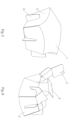
- fig. 5 and fig. 6 show the first structural element in the first variant in an external view of the puzzle and in an internal view
- fig. 7 and fig. 8 show the second structural element in the first variant in an external view of the puzzle and in an internal view
- fig. 9 and fig. 10 show the first structural element in the second variant in an external view of the puzzle and in an internal view, partially assembled, fig.
- FIG. 11 and fig. 12 show the second structural element in the second variant in an external view of the puzzle and in an internal view, partially assembled
- fig. 13 shows the interconnection of two types of structural elements: with a pentagonal and a hexagonal base
- fig. 14 shows the interconnection of three structural elements: with a pentagonal, a triangular, and a square base
- fig. 15 and fig. 16 show perspective views of the spatial puzzle in two embodiments.
- a structural component with a base resembling a regular pentagon has a blank constituting a plane figure consisting of a regular pentagon 1 interconnected with isosceles trapezia 2 with a longer base equal to the length a of the side of the pentagon, abutting on each side of the pentagon by their longer base, wherein the shorter base b of each trapezium 2 , up to half of its length, has attached thereto a deltoid 3, by its first side having a length equal to half the length of the shorter base b of the trapezium, and the second side of the deltoid, equal to the first side, is inclined with respect to the first side at an angle ⁇ equal to an angle of 108°.
- the third side c of the deltoid, perpendicular to the second side, has attached thereto a rectangular hooking element 4 having a length greater than the length of the third side c of the deltoid by a rectangular hook 5, which next to the second side of the deltoid has a hooking slot 6 , while the fourth side of the deltoid, equal to the third side c, is perpendicular to the first side, and it is located in the vertical axis O 1 of the trapezium 2, the fourth side of the deltoid having a locking protrusion 8 at the shorter base b of the trapezium.
- the trapezium has a slot 7 at the shorter base b in the vertical axis O 1.
- connection of the individual sides a of the pentagonal base 1 with the longer bases of the trapezia 2 , and the connections of the shorter bases b of the trapezia with the deltoid 3 , and of the deltoid with the rectangular hooking element 4, are creased.
- Each of the isosceles trapezia 2 is provided along one arm or both arms thereof with stiffening tabs 9 whose connection to the trapezium is creased.
- the sides a of the regular pentagon 1 constituting the base of the composite pyramid have the shape of arcs concave towards the inside of the pentagon. Due to this, the base of the pyramid has a convex rounded top side.
- each side wall of the pyramid is provided with a hook 5 perpendicular to the surface of the side wall on the outside of the pyramid, next to the slot 7 located in the vertical axis O 1 of the side wall at its shorter base.
- the second structural component in the first variant has a base resembling an equilateral triangle whose blank constitutes a plane figure consisting of an equilateral triangle 11 interconnected with isosceles trapezia 12 with a longer base equal to the length a of the side of the triangle, abutting on each side of the triangle by the longer base, wherein the shorter base d of each trapezium, up to half of its length, has attached thereto a deltoid 13, by its first side with a length equal to half the length of the shorter base d of the trapezium, and the second side of the deltoid, equal to the first side, is inclined with respect to the first side at an angle ⁇ equal to the 60° angle of the equilateral triangle, and the third side of the deltoid, perpendicular to the second side, has attached thereto a rectangular hooking element 14 with a length greater than the length of the third side e of the deltoid by a rectangular hook 15, which, next to the second
- the trapezium has a slot 17 at the shorter base in the vertical axis 02.
- the connections of the individual sides a of the triangular base 11 with the longer bases of the trapezia 12, and the connections of the shorter bases d of the trapeziform side walls with the deltoid 13, and of the deltoid with the rectangular hooking element 14, are creased.
- Each of the isosceles trapezia 12 is provided along one arm or both arms thereof with stiffening tabs 19, whose connection to the trapezium is creased..
- the sides of the equilateral triangle 11 constituting the base of the composite pyramid have the shape of arcs concave towards the inside of the triangle. Due to this, the base of the pyramid has a convex rounded top side.
- each side wall of the pyramid is provided with a hook 15 perpendicular to the surface of the side wall 12 on the outside of the pyramid, next to the slot 17 located in the vertical axis O2 of the side wall, at its shorter base d.
- a structural component with a base resembling a regular hexago n has a blank constituting a plane figure consisting of a regular hexagon 21 with a side a equal to the side of the regular pentagon 1 in the first component of the puzzle interconnected with an isosceles trapezium 22 with a longer base equal to the length of the side a of the hexagon, abutting on each side of the hexagon by the longer base.
- the shorter base f of the trapezium has attached thereto, by its base, an isosceles triangle element 23 with a truncated apex provided below the apex of the triangle with a fastening slot 24.
- the trapezium 22 with a blank of a truncated pyramid with a hexagonal base has, at the shorter base f, a slot 25 in the vertical axis O3 .
- the connections of the individual sides a of the regular hexagon 21 with the longer bases of the trapezia 22, and the connections of the shorter bases of the trapezia 22 with the triangular elements 23 are creased.
- Each of the isosceles trapezia 22 is provided along one arm or both arms thereof with stiffening tabs 26 whose connection to the trapezium is creased.
- the sides a of the regular hexagon 21 constituting the base of the composite pyramid have the shape of arcs concave towards the inside of the hexagon. Due to this, the base of the pyramid has a convex rounded top side.
- the second structural component in the second variant has a base resembling a square, whose cross-section constitutes a plane figure consisting of a square 31 with a side a equal to the side of the regular pentagon 1 in the first component of the puzzle, and the side of the equilateral triangle 11 in the second component, interconnected with an isosceles trapezium 32 with a longer base equal to the length of the side a of the square, abutting on each side of the square by the longer base, while the shorter base g of the trapezium has attached thereto, by its base, an isosceles triangular element 33 , provided below the apex of the triangle with a fastening slot 34 , and the trapezium 32 in the blank of the truncated pyramid with a square base has, at the shorter base g, a slot 35 in the vertical axis O 4, and furthermore, the connections of the individual sides of the square base 31 with the longer bases of the trapezia 32, and the connections of the shorter
- the sides of the square 31 constituting the base of the composite pyramid have the shape of arcs concave towards the inside of the square. Due to this, the base of the pyramid has a convex rounded top side.
- the interconnected regular truncated pyramids with pentagonal bases and regular truncated pyramids with hexagonal bases made from the assembled blanks of these pyramids form a spatial puzzle resembling a sphere, shown in fig. 15 .
- the composite blanks constituting regular truncated pyramids with pentagonal bases are connected to the composite blanks constituting regular truncated pyramids with a hexagonal base in such a manner that each side wall of a pyramid with a pentagonal base is adjacent to a side wall of another pyramid with a hexagonal base.
- the hook 5 of the hooking element 4 of the regular pyramid with a pentagonal base slides into the slot 25 of the regular pyramid with a hexagonal base.
- interconnected element of the three-dimensional puzzles in the form of regular truncated pyramids with a pentagonal base, regular truncated pyramids with a triangular base, and regular truncated pyramids with a square base, made of composite blanks of these pyramids, form a spatial puzzle in the form of a polyhedron resembling a sphere, shown in fig. 16 .
- the composite blanks constituting regular truncated pyramids with pentagonal bases are connected to the composite blanks constituting regular truncated pyramids with a triangular and a square base in such a manner that each side wall of a pyramid with a pentagonal base is adjacent to a side wall of another pyramid with a quadrilateral base.
- the hooks 5 of the hooking element 4 of each side wall of the regular pyramid with a pentagonal base are slid into the slots 35 of the side wall in five regular pyramids with a square base.
- pyramids with a triangular base there are situated pyramids with a triangular base, whose hooks 15 of the hooking elements 14 are inserted into the slots 35 of the side walls of the pyramids with a square base, perpendicular to the side wall adjacent to the wall of the pyramid with a pentagonal base.
- a spatial puzzle consisting of the elements according to the invention is applicable as an advertising medium, a sports gadget, a football souvenir, as well as a 3d puzzle-type puzzle for educational purposes, which can have various graphics-reproducing the layout of the outer surfaces of the puzzle, the shape, and the positioning.
- the puzzle elements interconnected like puzzle elements put together on a board form a logical didactic picture.
Landscapes
- Engineering & Computer Science (AREA)
- Multimedia (AREA)
- Toys (AREA)
Abstract
Description
- The object of the invention is a element of the three-dimensional puzzle which has the form of a polyhedron, preferably resembling a sphere.
- From patent description
PL 220061 - In the above spherical composition known from prior art, the interconnection and fit of the individual elements is imperfect. In practice, it turns out that loosely connected elements and the way the structure (composition) is assembled do not ensure a permanent, rigid connection of the elements.
- According to the invention, a element of the three-dimensional puzzle constituting a composite blank of a truncated pyramid is characterised in that the blank is a plane figure consisting of a regular polygon interconnected with isosceles trapezia with a longer base equal to the length of the side of the polygon, abutting on each side of the polygon by the longer base, wherein the shorter base of each trapezium, up to half of its length, has attached thereto a deltoid, by its first side with a length equal to half the length of the shorter base of the trapezium, and the second side of the deltoid, equal to the first side, is inclined with respect to the first side at an angle equal to the angle of the regular polygon, and the third side of the deltoid, perpendicular to the second side, has attached thereto a rectangular hooking element, with a length greater than the length of the third side of the deltoid by a rectangular hook which, next to the second side of the deltoid, has a hooking slot, while the fourth side of the deltoid, equal to the third side, is perpendicular to the first side, and it is located in the vertical axis of the trapezium, wherein the trapezium has, at its shorter base, a slot in the vertical axis, and the connections of the individual sides of the base of the polygon with the longer bases of the isosceles trapezia, and the connections of the shorter bases of the trapezia with the deltoid, and of the deltoid with the rectangular hooking element, are creased.
- The regular polygon in the blank of the puzzle element is possibly a regular pentagon.
- In another embodiment, the regular polygon in the blank of the puzzle element is an equilateral triangle.
- Optionally, the side of the deltoid located in the vertical axis of the trapezium has a locking protrusion at the shorter base of the trapezium.
- Each of the isosceles trapezia is preferably provided along one arm or both arms thereof with stiffening tabs whose connection to the trapezium is creased. The adjacent tabs of the adjacent trapezia are possibly interconnected, with the connection being creased.
- The sides of the regular polygon constituting the base of the composite pyramid preferably have the shape of arcs concave towards the inside of the polygon, due to which the base of the pyramid has a convex rounded top side.
- When the blank elements have been bent in line with all the creases, the arms of the adjacent trapezia meet, and the surface of the stiffening tab at the arm of one trapezium abuts on the surface of the adjacent trapezium, or the surface of the tab at the adjacent trapezium. The hooking slot of the rectangular hooking element connected to the isosceles trapezium via the deltoid is pressed into the slot of an adjacent isosceles trapezium located in the vertical axis of that trapezium near its shorter base, perpendicularly to the surface of that adjacent trapezium. In this manner, the adjacent isosceles trapezia of the blank form a tight connection of the adjacent side walls of the truncated pyramid, which is an element of the puzzle. In addition, each side wall of the pyramid is provided with a hook perpendicular to the surface of the side wall on the outside of the pyramid, next to the slot located in the vertical axis of the side wall at its shorter base.
- In another variant, a element of the three-dimensional puzzle constituting a composite blank of a pyramid is characterised in that the blank is a plane figure consisting of a regular polygon, with a side equal to the side of the regular polygon, interconnected with isosceles trapezia with a longer base equal to the length of the side of the polygon, abutting on each side of the polygon by the longer base, while the shorter base of each isosceles trapezium has attached thereto, by its base, an isosceles triangle element with a truncated apex, provided below the apex of the triangle with a fastening slot, and the trapezium has at the shorter base a slot in the vertical axis, and additionally the connections of the individual sides of the base of the polygon with the longer bases of the isosceles trapezia and the connections of the shorter bases of the trapezia with the triangular elements are creased.
- The regular polygon in the blank of the puzzle element is possibly a regular hexagon.
- In another example, the regular polygon in the blank of the puzzle element is a square.
- Each of the isosceles trapezia is preferably provided along one arm or both arms thereof with stiffening tabs whose connection to the trapezium is creased. The adjacent tabs of the adjacent trapezia are possibly interconnected, with the connection being creased.
- The sides of the regular polygon constituting the base of the pyramid preferably have the shape of arcs concave towards the inside of the polygon, due to which the base of the pyramid has a convex rounded top side.
- When the blank elements have been bent in line with all the creases, the arms of the adjacent trapezia meet, and the surface of the stiffening tab at the arm of one trapezium abuts on the surface of the adjacent trapezium, or on the surface of the tab at the adjacent trapezium. An isosceles triangle element of the blank, provided below the apex of the triangle with a fastening slot, fastens the opposite isosceles triangle elements, tightly connecting the adjacent side walls of the truncated pyramid, which is an element of the puzzle
- The interconnected element of the three-dimensional puzzles form a puzzle in the form of a polyhedron, in various embodiments using different combinations of individual puzzle elements.
- The puzzle elements can be assembled without difficulty, without the use of glue, and the user gets the impression of an exact fit of the elements while assembling. The interconnection of the puzzle elements is tight and stable.
- The object of the invention is illustrated in embodiments in the drawing, in which
fig. 1 and fig. 2 show the blanks of the first and second structural elements of the puzzle in the first variant of the element,fig. 3 and fig. 4 show the blanks of the first and second structural elements of the puzzle in the second variant of the element of the three-dimensional puzzle,fig. 5 and fig. 6 show the first structural element in the first variant in an external view of the puzzle and in an internal view, partially assembled,fig. 7 and fig. 8 show the second structural element in the first variant in an external view of the puzzle and in an internal view, partially assembled,fig. 9 and fig. 10 show the first structural element in the second variant in an external view of the puzzle and in an internal view, partially assembled,fig. 11 and fig. 12 show the second structural element in the second variant in an external view of the puzzle and in an internal view, partially assembled,fig. 13 shows the interconnection of two types of structural elements: with a pentagonal and a hexagonal base, andfig. 14 shows the interconnection of three structural elements: with a pentagonal, a triangular, and a square base,fig. 15 and fig. 16 show perspective views of the spatial puzzle in two embodiments. - In the first variant, a structural component with a base resembling a regular pentagon has a blank constituting a plane figure consisting of a
regular pentagon 1 interconnected withisosceles trapezia 2 with a longer base equal to the length a of the side of the pentagon, abutting on each side of the pentagon by their longer base, wherein the shorter base b of eachtrapezium 2, up to half of its length, has attached thereto adeltoid 3, by its first side having a length equal to half the length of the shorter base b of the trapezium, and the second side of the deltoid, equal to the first side, is inclined with respect to the first side at an angle α equal to an angle of 108°. The third side c of the deltoid, perpendicular to the second side, has attached thereto arectangular hooking element 4 having a length greater than the length of the third side c of the deltoid by arectangular hook 5, which next to the second side of the deltoid has ahooking slot 6, while the fourth side of the deltoid, equal to the third side c, is perpendicular to the first side, and it is located in the vertical axis O1 of thetrapezium 2, the fourth side of the deltoid having alocking protrusion 8 at the shorter base b of the trapezium. The trapezium has aslot 7 at the shorter base b in the vertical axis O1. The connections of the individual sides a of thepentagonal base 1 with the longer bases of thetrapezia 2, and the connections of the shorter bases b of the trapezia with thedeltoid 3, and of the deltoid with therectangular hooking element 4, are creased. Each of theisosceles trapezia 2 is provided along one arm or both arms thereof withstiffening tabs 9 whose connection to the trapezium is creased. - The sides a of the
regular pentagon 1 constituting the base of the composite pyramid have the shape of arcs concave towards the inside of the pentagon. Due to this, the base of the pyramid has a convex rounded top side. - When the blank elements have been bent in line with all the creases, the arms of the adjacent trapezia meet, and the surface of the stiffening tab (9) at the arm of one trapezium abuts on the surface of the adjacent trapezium, or on the surface of the tab at the adjacent trapezium. The
hooking slot 6 of the rectangular hooking element (4) connected to theisosceles trapezium 2 via thedeltoid 3 is pressed into theslot 7 of an adjacent isosceles trapezium located in the vertical axis O1 of that trapezium near its shorter base b, perpendicularly to the surface of that adjacent trapezium. Thelocking protrusion 8 on the fourth side of the deltoid at the shorter base b of the trapezium overlaps the previously bent (folded)deltoid 3, which prevents thehook 5 from sliding out of theslot 7. In this manner, the adjacent isosceles trapezia of the blank form a tight connection of the adjacent side walls of the truncated pyramid, which is an element of the puzzle. In addition, each side wall of the pyramid is provided with ahook 5 perpendicular to the surface of the side wall on the outside of the pyramid, next to theslot 7 located in the vertical axis O1 of the side wall at its shorter base. - The second structural component in the first variant has a base resembling an equilateral triangle whose blank constitutes a plane figure consisting of an
equilateral triangle 11 interconnected withisosceles trapezia 12 with a longer base equal to the length a of the side of the triangle, abutting on each side of the triangle by the longer base, wherein the shorter base d of each trapezium, up to half of its length, has attached thereto adeltoid 13, by its first side with a length equal to half the length of the shorter base d of the trapezium, and the second side of the deltoid, equal to the first side, is inclined with respect to the first side at an angle β equal to the 60° angle of the equilateral triangle, and the third side of the deltoid, perpendicular to the second side, has attached thereto arectangular hooking element 14 with a length greater than the length of the third side e of the deltoid by arectangular hook 15, which, next to the second side of the deltoid, has ahooking slot 16, while the fourth side of the deltoid, equal to the third side e, is perpendicular to the first side, and it is located in the vertical axis O2 of thetrapezium 12, the fourth side of the deltoid having alocking protrusion 18 at the shorter base d of the trapezium. The trapezium has aslot 17 at the shorter base in thevertical axis 02. The connections of the individual sides a of thetriangular base 11 with the longer bases of thetrapezia 12, and the connections of the shorter bases d of the trapeziform side walls with thedeltoid 13, and of the deltoid with therectangular hooking element 14, are creased. Each of theisosceles trapezia 12 is provided along one arm or both arms thereof withstiffening tabs 19, whose connection to the trapezium is creased.. - The sides of the
equilateral triangle 11 constituting the base of the composite pyramid have the shape of arcs concave towards the inside of the triangle. Due to this, the base of the pyramid has a convex rounded top side. - When the blank elements have been bent in line with all the creases, the arms of the
adjacent trapezia 12 meet, and the surface of thestiffening tab 19 at the arm of one trapezium abuts on the surface of the adjacent trapezium, or on the surface of the tab at the adjacent trapezium. Thehooking slot 16 of therectangular hooking element 14 connected to theisosceles trapezium 12 via thedeltoid 13 is pressed into theslot 17 of an adjacent isosceles trapezium located in the vertical axis O2 of that trapezium near its shorter base d, perpendicularly to the surface of that adjacent trapezium. Thelocking protrusion 18 on the fourth side of thedeltoid 13 at the shorter base d of the trapezium overlaps the previously bent (folded) deltoid, which prevents thehook 15 from sliding out of theslot 17. In this manner, theadjacent isosceles trapezia 12 of the blank form a tight connection of the adjacent side walls of the truncated pyramid, which is an element of the puzzle. In addition, each side wall of the pyramid is provided with ahook 15 perpendicular to the surface of theside wall 12 on the outside of the pyramid, next to theslot 17 located in the vertical axis O2 of the side wall, at its shorter base d. - In the second variant, a structural component with a base resembling a regular hexago
n has a blank constituting a plane figure consisting of aregular hexagon 21 with a side a equal to the side of theregular pentagon 1 in the first component of the puzzle interconnected with anisosceles trapezium 22 with a longer base equal to the length of the side a of the hexagon, abutting on each side of the hexagon by the longer base. The shorter base f of the trapezium has attached thereto, by its base, anisosceles triangle element 23 with a truncated apex provided below the apex of the triangle with afastening slot 24. Thetrapezium 22 with a blank of a truncated pyramid with a hexagonal base has, at the shorter base f, aslot 25 in the vertical axis O3. The connections of the individual sides a of theregular hexagon 21 with the longer bases of thetrapezia 22, and the connections of the shorter bases of thetrapezia 22 with thetriangular elements 23 are creased. Each of theisosceles trapezia 22 is provided along one arm or both arms thereof withstiffening tabs 26 whose connection to the trapezium is creased. - The sides a of the
regular hexagon 21 constituting the base of the composite pyramid have the shape of arcs concave towards the inside of the hexagon. Due to this, the base of the pyramid has a convex rounded top side. - When the blank elements have been bent in line with all the creases, the arms of the
adjacent trapezia 22 meet, and the surface of thestiffening tab 26 at the arm of one trapezium abuts on the surface of the adjacent trapezium, or on the surface of the tab at the adjacent trapezium. Anisosceles triangle element 23 of the blank, provided below the apex of the triangle with afastening slot 24, fastens the opposite isosceles triangle elements, tightly connecting the adjacent side walls of the truncated pyramid, which is an element of the puzzle. - The second structural component in the second variant has a base resembling a square, whose cross-section constitutes a plane figure consisting of a
square 31 with a side a equal to the side of theregular pentagon 1 in the first component of the puzzle, and the side of theequilateral triangle 11 in the second component, interconnected with anisosceles trapezium 32 with a longer base equal to the length of the side a of the square, abutting on each side of the square by the longer base, while the shorter base g of the trapezium has attached thereto, by its base, an isoscelestriangular element 33, provided below the apex of the triangle with afastening slot 34, and thetrapezium 32 in the blank of the truncated pyramid with a square base has, at the shorter base g, aslot 35 in the vertical axis O4, and furthermore, the connections of the individual sides of thesquare base 31 with the longer bases of thetrapezia 32, and the connections of the shorter bases g of the trapezia with thetriangular elements 33, are creased. Each of theisosceles trapezia 32 is provided along one arm or both arms thereof withstiffening tabs 36 whose connection to the trapezium is creased. The adjacent tabs of the adjacent trapezia are interconnected, with the connection being creased. - The sides of the
square 31 constituting the base of the composite pyramid have the shape of arcs concave towards the inside of the square.. Due to this, the base of the pyramid has a convex rounded top side. - When the blank elements have been bent in line with all the creases, the arms of the
adjacent trapezia 32 meet, and the surface of thestiffening tab 36 at the arm of one trapezium abuts on the surface of the adjacent trapezium, or on the surface of the tab at the adjacent trapezium. An isosceles triangle element with atruncated apex 33 of the blank, provided below the apex of the triangle with afastening slot 34, fastens the opposite isosceles triangle elements, tightly connecting the adjacent side walls of the truncated pyramid, which is an element of the puzzle. - The interconnected regular truncated pyramids with pentagonal bases and regular truncated pyramids with hexagonal bases made from the assembled blanks of these pyramids form a spatial puzzle resembling a sphere, shown in
fig. 15 . - The composite blanks constituting regular truncated pyramids with pentagonal bases are connected to the composite blanks constituting regular truncated pyramids with a hexagonal base in such a manner that each side wall of a pyramid with a pentagonal base is adjacent to a side wall of another pyramid with a hexagonal base. The
hook 5 of the hookingelement 4 of the regular pyramid with a pentagonal base slides into theslot 25 of the regular pyramid with a hexagonal base. - In another embodiment, interconnected element of the three-dimensional puzzles in the form of regular truncated pyramids with a pentagonal base, regular truncated pyramids with a triangular base, and regular truncated pyramids with a square base, made of composite blanks of these pyramids, form a spatial puzzle in the form of a polyhedron resembling a sphere, shown in
fig. 16 . - The composite blanks constituting regular truncated pyramids with pentagonal bases are connected to the composite blanks constituting regular truncated pyramids with a triangular and a square base in such a manner that each side wall of a pyramid with a pentagonal base is adjacent to a side wall of another pyramid with a quadrilateral base. The
hooks 5 of the hookingelement 4 of each side wall of the regular pyramid with a pentagonal base are slid into theslots 35 of the side wall in five regular pyramids with a square base. Between the successive pyramids with a square base, there are situated pyramids with a triangular base, whose hooks 15 of the hookingelements 14 are inserted into theslots 35 of the side walls of the pyramids with a square base, perpendicular to the side wall adjacent to the wall of the pyramid with a pentagonal base. - A spatial puzzle consisting of the elements according to the invention is applicable as an advertising medium, a sports gadget, a football souvenir, as well as a 3d puzzle-type puzzle for educational purposes, which can have various graphics-reproducing the layout of the outer surfaces of the puzzle, the shape, and the positioning. The puzzle elements interconnected like puzzle elements put together on a board form a logical didactic picture.
Claims (11)
- An element of the three-dimensional puzzle being a regular truncated pyramid, constituting a composite blank of the pyramid, characterised in that the blank is a plane figure consisting of a regular polygon (1, 11) interconnected with isosceles trapezia (2, 12) with a longer base equal to the length (a) of the side of the polygon, abutting on each side of the polygon by the longer base, wherein the shorter base of each trapezium (b, d), up to half of its length, has attached thereto a deltoid (3, 13), by its first side with a length equal to half the length (b/2, d/2) of the shorter base of the trapezium, and the second side of the deltoid, equal to the first side, is inclined with respect to the first side at an angle (α, β) equal to the angle (α, β) of the regular polygon, and the third side (c, e) of the deltoid (3,13), perpendicular to the second side, has attached thereto a rectangular hooking element (4, 14), with a length greater than the length of the third side (c, e) of the deltoid by a rectangular hook (5, 15), which, next to the second side of the deltoid, has a hooking slot (6, 16), while the fourth side of the deltoid, equal to the third side (c, e), is perpendicular to the first side, and it is located in the vertical axis (O1, O2) of the trapezium (2, 12), wherein the trapezium has, at its shorter base, a slot (7, 17) in the vertical axis (O1, O2), and the connections of the individual sides (a) of the base of the polygon (1, 11) with the longer bases of the isosceles trapezia (2, 12), and the connections of the shorter bases (b, d) of the trapezia (2, 12) with the deltoid (3, 13), and of the deltoid with the rectangular hooking element (4, 14), are creased.
- The element of the three-dimensional puzzle according to claim 1, characterised in that the polygon (1) is a regular pentagon.
- The element of the three-dimensional puzzle according to claim 1, characterised in that the polygon (11) is an equilateral triangle.
- The element of the three-dimensional puzzle according to claim 1, characterised in that the fourth side of the deltoid (3, 13), located in the vertical axis (01, 02) of the trapezium (2, 12) has a locking protrusion (8, 18) at the shorter base of the trapezium (2, 12).
- The element of the three-dimensional puzzle according to claim 1, characterised in that each of the side walls of the trapezium (2, 12) is provided along one arm or both arms thereof with stiffening tabs (9, 19) whose connection to the wall of the trapezium (2, 12) is creased.
- The element of the three-dimensional puzzle according to claim 1, characterised in that the sides of the regular polygon (1, 11) constituting the base of the pyramid have the shape of arcs concave towards the inside of the polygon.
- An element of the three-dimensional puzzle being a regular truncated pyramid, constituting a composite blank of the pyramid, characterised in that the blank is a plane figure consisting of a regular polygon (21, 31) with a side (a) equal to the side of the regular polygon (21, 31) interconnected with isosceles trapezia (22, 32) with a longer base equal to the length of the side (a) of the polygon, abutting on each side of the polygon by the longer base, while the shorter base (f, g) of each isosceles trapezium (22, 32) has attached thereto, by its base, an isosceles triangle element (23, 33) with a truncated apex, provided below the apex of the triangle with a fastening slot (24, 34), and the trapezium (22, 32) has, at the shorter base (f, g), a slot (25, 35) in the vertical axis (O3, O4), and additionally, the connections of the individual sides of the base of the polygon (21, 31) with the longer bases of the isosceles trapezia (22, 32), and the connections of the shorter bases of the trapezia (22, 32) with the isosceles triangle elements with a truncated apex (23, 33), are creased.
- The element of the three-dimensional puzzle according to claim 7, characterised in that the polygon (21) is a regular hexagon.
- The element of the three-dimensional puzzle according to claim 7, characterised in that the polygon (31) is a square.
- The element of the three-dimensional puzzle according to claim 7, characterised in that each of the trapezia (22, 32) is provided along one arm or both arms thereof with stiffening tabs (26, 36) whose connection to the trapezia (22, 32) is creased.
- The element of the three-dimensional puzzle according to claim 7, characterised in that the sides of the regular polygon (21, 31) constituting the base of the pyramid have the shape of arcs concave towards the inside of the polygon.
Applications Claiming Priority (1)
| Application Number | Priority Date | Filing Date | Title |
|---|---|---|---|
| PL446448A PL248929B1 (en) | 2023-10-20 | 2023-10-20 | Piece of the spatial puzzle |
Publications (1)
| Publication Number | Publication Date |
|---|---|
| EP4541436A1 true EP4541436A1 (en) | 2025-04-23 |
Family
ID=94128748
Family Applications (1)
| Application Number | Title | Priority Date | Filing Date |
|---|---|---|---|
| EP24207675.0A Pending EP4541436A1 (en) | 2023-10-20 | 2024-10-20 | Element of three-dimensional puzzle |
Country Status (2)
| Country | Link |
|---|---|
| EP (1) | EP4541436A1 (en) |
| PL (1) | PL248929B1 (en) |
Citations (4)
| Publication number | Priority date | Publication date | Assignee | Title |
|---|---|---|---|---|
| US4682726A (en) * | 1986-10-20 | 1987-07-28 | Drueck Jr Fred | Pentagonal dodecahedron |
| PL220061B1 (en) | 2012-03-15 | 2015-08-31 | Werner Kenkel Spółka Z Ograniczoną Odpowiedzialnością | Folding spatial composition |
| US20150314909A1 (en) * | 2012-07-02 | 2015-11-05 | Ricardo VERGÉS ESCUÍN | Laminar blank for assembling polyhedra, corresponding polyhedron and method of assembly |
| US20190344191A1 (en) * | 2018-05-09 | 2019-11-14 | Piotr NAWRACALA | Structural element |
Family Cites Families (3)
| Publication number | Priority date | Publication date | Assignee | Title |
|---|---|---|---|---|
| US5171014A (en) * | 1991-05-28 | 1992-12-15 | Hsieh Jung Yao | Magic folding game |
| US5222896A (en) * | 1991-08-08 | 1993-06-29 | British Technology Group Usa Inc. | Polyhedral approximation of a spherical body and two-dimensional projections therefrom |
| WO2020077321A1 (en) * | 2018-10-12 | 2020-04-16 | Kolev Nikola | Flexible modular interlocking construction device |
-
2023
- 2023-10-20 PL PL446448A patent/PL248929B1/en unknown
-
2024
- 2024-10-20 EP EP24207675.0A patent/EP4541436A1/en active Pending
Patent Citations (4)
| Publication number | Priority date | Publication date | Assignee | Title |
|---|---|---|---|---|
| US4682726A (en) * | 1986-10-20 | 1987-07-28 | Drueck Jr Fred | Pentagonal dodecahedron |
| PL220061B1 (en) | 2012-03-15 | 2015-08-31 | Werner Kenkel Spółka Z Ograniczoną Odpowiedzialnością | Folding spatial composition |
| US20150314909A1 (en) * | 2012-07-02 | 2015-11-05 | Ricardo VERGÉS ESCUÍN | Laminar blank for assembling polyhedra, corresponding polyhedron and method of assembly |
| US20190344191A1 (en) * | 2018-05-09 | 2019-11-14 | Piotr NAWRACALA | Structural element |
Also Published As
| Publication number | Publication date |
|---|---|
| PL446448A1 (en) | 2025-04-22 |
| PL248929B1 (en) | 2026-02-09 |
Similar Documents
| Publication | Publication Date | Title |
|---|---|---|
| US4523418A (en) | Modular construction system | |
| US4778392A (en) | Educational block set | |
| US5489230A (en) | Blank for constructing triangular polyhedra | |
| US4836787A (en) | Construction kit educational aid and toy | |
| US8221183B2 (en) | Universal disc-shaped connectors | |
| EP0520984B1 (en) | A system of structural form bodies | |
| US6665993B2 (en) | Interlockable element for structure assembly set | |
| EP4541436A1 (en) | Element of three-dimensional puzzle | |
| WO1998034695A1 (en) | Fold-through picture puzzle | |
| JPH0282995A (en) | Assembled toy | |
| KR101112165B1 (en) | teaching aids for a regular polyhedron study | |
| JPH05504712A (en) | Improved boards for a wide variety of games | |
| US20070004312A1 (en) | Walled structure apparatus | |
| RU2844598C1 (en) | Game constructor | |
| JP6930173B2 (en) | Paper container | |
| JP3039283U (en) | Mosaic pieces and combinations | |
| JP6780160B1 (en) | Biaxial twisted structure | |
| JPH0737668Y2 (en) | Cubic toy | |
| JP2860774B2 (en) | Building block | |
| KR101112164B1 (en) | teaching aids for a regular polyhedron study | |
| JP7470975B2 (en) | toy | |
| KR20110114796A (en) | Regular polyhedral learning parish | |
| PL220061B1 (en) | Folding spatial composition | |
| DE102004039077B3 (en) | Construction kit for use as e.g. toy kit, learning material for representing simple and complex two dimensional and three dimensional geometric figures, decoration element has strips and rings | |
| RU33027U1 (en) | Three-pole chess board Konnova |
Legal Events
| Date | Code | Title | Description |
|---|---|---|---|
| PUAI | Public reference made under article 153(3) epc to a published international application that has entered the european phase |
Free format text: ORIGINAL CODE: 0009012 |
|
| STAA | Information on the status of an ep patent application or granted ep patent |
Free format text: STATUS: THE APPLICATION HAS BEEN PUBLISHED |
|
| AK | Designated contracting states |
Kind code of ref document: A1 Designated state(s): AL AT BE BG CH CY CZ DE DK EE ES FI FR GB GR HR HU IE IS IT LI LT LU LV MC ME MK MT NL NO PL PT RO RS SE SI SK SM TR |
|
| STAA | Information on the status of an ep patent application or granted ep patent |
Free format text: STATUS: REQUEST FOR EXAMINATION WAS MADE |
|
| 17P | Request for examination filed |
Effective date: 20251020 |
|
| GRAP | Despatch of communication of intention to grant a patent |
Free format text: ORIGINAL CODE: EPIDOSNIGR1 |
|
| STAA | Information on the status of an ep patent application or granted ep patent |
Free format text: STATUS: GRANT OF PATENT IS INTENDED |
|
| INTG | Intention to grant announced |
Effective date: 20260119 |
|
| GRAS | Grant fee paid |
Free format text: ORIGINAL CODE: EPIDOSNIGR3 |
|
| GRAA | (expected) grant |
Free format text: ORIGINAL CODE: 0009210 |
|
| STAA | Information on the status of an ep patent application or granted ep patent |
Free format text: STATUS: THE PATENT HAS BEEN GRANTED |