EP4539433A2 - Systeme und verfahren für sicheren identifizierungsabruf - Google Patents
Systeme und verfahren für sicheren identifizierungsabruf Download PDFInfo
- Publication number
- EP4539433A2 EP4539433A2 EP25160346.0A EP25160346A EP4539433A2 EP 4539433 A2 EP4539433 A2 EP 4539433A2 EP 25160346 A EP25160346 A EP 25160346A EP 4539433 A2 EP4539433 A2 EP 4539433A2
- Authority
- EP
- European Patent Office
- Prior art keywords
- client device
- query
- server
- query token
- database
- Prior art date
- Legal status (The legal status is an assumption and is not a legal conclusion. Google has not performed a legal analysis and makes no representation as to the accuracy of the status listed.)
- Pending
Links
Images


Classifications
-
- H—ELECTRICITY
- H04—ELECTRIC COMMUNICATION TECHNIQUE
- H04L—TRANSMISSION OF DIGITAL INFORMATION, e.g. TELEGRAPHIC COMMUNICATION
- H04L9/00—Cryptographic mechanisms or cryptographic arrangements for secret or secure communications; Network security protocols
- H04L9/32—Cryptographic mechanisms or cryptographic arrangements for secret or secure communications; Network security protocols including means for verifying the identity or authority of a user of the system or for message authentication, e.g. authorization, entity authentication, data integrity or data verification, non-repudiation, key authentication or verification of credentials
- H04L9/321—Cryptographic mechanisms or cryptographic arrangements for secret or secure communications; Network security protocols including means for verifying the identity or authority of a user of the system or for message authentication, e.g. authorization, entity authentication, data integrity or data verification, non-repudiation, key authentication or verification of credentials involving a third party or a trusted authority
- H04L9/3213—Cryptographic mechanisms or cryptographic arrangements for secret or secure communications; Network security protocols including means for verifying the identity or authority of a user of the system or for message authentication, e.g. authorization, entity authentication, data integrity or data verification, non-repudiation, key authentication or verification of credentials involving a third party or a trusted authority using tickets or tokens, e.g. Kerberos
-
- G—PHYSICS
- G06—COMPUTING OR CALCULATING; COUNTING
- G06F—ELECTRIC DIGITAL DATA PROCESSING
- G06F16/00—Information retrieval; Database structures therefor; File system structures therefor
- G06F16/90—Details of database functions independent of the retrieved data types
- G06F16/95—Retrieval from the web
- G06F16/951—Indexing; Web crawling techniques
-
- H—ELECTRICITY
- H04—ELECTRIC COMMUNICATION TECHNIQUE
- H04L—TRANSMISSION OF DIGITAL INFORMATION, e.g. TELEGRAPHIC COMMUNICATION
- H04L63/00—Network architectures or network communication protocols for network security
- H04L63/04—Network architectures or network communication protocols for network security for providing a confidential data exchange among entities communicating through data packet networks
- H04L63/0407—Network architectures or network communication protocols for network security for providing a confidential data exchange among entities communicating through data packet networks wherein the identity of one or more communicating identities is hidden
- H04L63/0421—Anonymous communication, i.e. the party's identifiers are hidden from the other party or parties, e.g. using an anonymizer
-
- H—ELECTRICITY
- H04—ELECTRIC COMMUNICATION TECHNIQUE
- H04L—TRANSMISSION OF DIGITAL INFORMATION, e.g. TELEGRAPHIC COMMUNICATION
- H04L63/00—Network architectures or network communication protocols for network security
- H04L63/08—Network architectures or network communication protocols for network security for authentication of entities
- H04L63/0807—Network architectures or network communication protocols for network security for authentication of entities using tickets, e.g. Kerberos
-
- H—ELECTRICITY
- H04—ELECTRIC COMMUNICATION TECHNIQUE
- H04L—TRANSMISSION OF DIGITAL INFORMATION, e.g. TELEGRAPHIC COMMUNICATION
- H04L63/00—Network architectures or network communication protocols for network security
- H04L63/10—Network architectures or network communication protocols for network security for controlling access to devices or network resources
- H04L63/102—Entity profiles
-
- H—ELECTRICITY
- H04—ELECTRIC COMMUNICATION TECHNIQUE
- H04L—TRANSMISSION OF DIGITAL INFORMATION, e.g. TELEGRAPHIC COMMUNICATION
- H04L63/00—Network architectures or network communication protocols for network security
- H04L63/30—Network architectures or network communication protocols for network security for supporting lawful interception, monitoring or retaining of communications or communication related information
- H04L63/308—Network architectures or network communication protocols for network security for supporting lawful interception, monitoring or retaining of communications or communication related information retaining data, e.g. retaining successful, unsuccessful communication attempts, internet access, or e-mail, internet telephony, intercept related information or call content
-
- H—ELECTRICITY
- H04—ELECTRIC COMMUNICATION TECHNIQUE
- H04L—TRANSMISSION OF DIGITAL INFORMATION, e.g. TELEGRAPHIC COMMUNICATION
- H04L67/00—Network arrangements or protocols for supporting network services or applications
- H04L67/01—Protocols
- H04L67/02—Protocols based on web technology, e.g. hypertext transfer protocol [HTTP]
-
- H—ELECTRICITY
- H04—ELECTRIC COMMUNICATION TECHNIQUE
- H04L—TRANSMISSION OF DIGITAL INFORMATION, e.g. TELEGRAPHIC COMMUNICATION
- H04L67/00—Network arrangements or protocols for supporting network services or applications
- H04L67/2866—Architectures; Arrangements
- H04L67/30—Profiles
- H04L67/303—Terminal profiles
-
- H—ELECTRICITY
- H04—ELECTRIC COMMUNICATION TECHNIQUE
- H04L—TRANSMISSION OF DIGITAL INFORMATION, e.g. TELEGRAPHIC COMMUNICATION
- H04L9/00—Cryptographic mechanisms or cryptographic arrangements for secret or secure communications; Network security protocols
- H04L9/32—Cryptographic mechanisms or cryptographic arrangements for secret or secure communications; Network security protocols including means for verifying the identity or authority of a user of the system or for message authentication, e.g. authorization, entity authentication, data integrity or data verification, non-repudiation, key authentication or verification of credentials
- H04L9/3236—Cryptographic mechanisms or cryptographic arrangements for secret or secure communications; Network security protocols including means for verifying the identity or authority of a user of the system or for message authentication, e.g. authorization, entity authentication, data integrity or data verification, non-repudiation, key authentication or verification of credentials using cryptographic hash functions
-
- H—ELECTRICITY
- H04—ELECTRIC COMMUNICATION TECHNIQUE
- H04L—TRANSMISSION OF DIGITAL INFORMATION, e.g. TELEGRAPHIC COMMUNICATION
- H04L9/00—Cryptographic mechanisms or cryptographic arrangements for secret or secure communications; Network security protocols
- H04L9/32—Cryptographic mechanisms or cryptographic arrangements for secret or secure communications; Network security protocols including means for verifying the identity or authority of a user of the system or for message authentication, e.g. authorization, entity authentication, data integrity or data verification, non-repudiation, key authentication or verification of credentials
- H04L9/3247—Cryptographic mechanisms or cryptographic arrangements for secret or secure communications; Network security protocols including means for verifying the identity or authority of a user of the system or for message authentication, e.g. authorization, entity authentication, data integrity or data verification, non-repudiation, key authentication or verification of credentials involving digital signatures
Definitions
- Third parties associated with the web pages and domains may be able to identify the computing devices used to visit the web pages and use various techniques (e.g., third party cookies) to identify information about the computing devices.
- the third parties are often content providers that provide content to people when the people visit web pages and domains with their computing devices.
- the third parties may store the information along with device identifiers identifying the computing devices associated with the stored information in a database of the content servers.
- computing devices may provide device information (e.g., device identifiers associated with the computing devices) to the third parties when making requests if the third parties did not already have information about the device. Further, the third parties may be reluctant to reliably answer the requests from the computing devices because malicious parties may eavesdrop on the requests to determine how much information the third parties have.
- the systems and methods discussed herein provide a method of secure identification retrieval so computing devices need not provide information to content servers or content providers that the content servers or content providers do not already have when making a request to determine whether the content servers or content providers have already collected data about the computing devices.
- the computing devices may calculate query tokens specific to each computing device and, in some implementations, based on a periodic variable with a value that continually changes over time.
- the computing devices may be synchronized with various content servers so the content servers can calculate stored query tokens for device identifiers in databases of the content servers using the same periodic variable and crypto technique as the computing devices.
- the content server may calculate multiple query tokens for each device identifier in a database of the content server.
- the content servers may compare the query tokens to the stored query tokens in the database to identify a match. If a content server identifies a match, the content server may transmit a response signal (e.g., an answer) indicating a match was found.
- the content server may also include an identification of characteristics about the computing device associated with the matching stored query token in the response signal. If a content server is not able to identify a matching stored query token to a query token of a query, the content server may send a response signal to the computing device associated with the query indicating that no match was found.
- content servers may confirm that a computing device is associated with the queries that the content servers receive and encrypt any answers that the content servers send to the querying computing devices.
- the content servers may verify the identity of computing devices by using public keys associated with device identifiers of the computing devices on a digital signature generated by the computing devices to sign their queries.
- the content servers may encrypt answers to the computing devices using the public keys associated with the computing devices. Consequently, only the computing devices associated with their device identifiers may obtain information from content servers about whether the content servers have collected data about them.
- the response signal indicating no match may be padded to a predetermined length, may include default or null information, and/or may be hashed or encrypted such that the negative response signal appears similar to a positive response signal to any eavesdropping device or to a malicious computing device attempting to probe for information.
- the systems and methods described herein may also be used by browsers to determine which domains have collected data about the browsers.
- the browsers can use similar crypto techniques as described above, but with values of domains and cookies to calculate cookie query tokens.
- the domains can calculate stored cookie query tokens for browsers for which the domains have stored data using the same techniques and values that the browsers use to calculate cookie query tokens.
- the domains can compare the cookie query tokens they receive from the browsers to the stored cookie query tokens to determine if the domains have stored data for the browser.
- the domains may store data about the browser at a server that is hosting the domain.
- the domains can send a response signal to the browsers indicating whether any information about the browsers is stored and categories of the information.
- the domain can encrypt the response signal so malicious third parties may not be able to determine how much or what type of data the domain has gathered.
- computing devices may securely query content servers for identifications of whether the content servers have information about the computing devices without providing content providers with any device identifying information that the content servers did not already have stored.
- the query tokens may continually change so content servers that did not have device identifiers of the querying devices may not obtain any lasting information about the devices.
- the systems may be secure against probing attempts for information, through the use of hashed or encrypted responses and padding of negative acknowledgements.
- the communication between the devices and the content servers may be secure to protect the content servers from providing data to malicious third parties indicating how much information the content servers have collected. Consequently, the systems and methods discussed provide a secure method of communication between computing devices and content servers so the computing devices may ask for information from content server without providing any new device identifying information and the content servers may respond without providing data to malicious third parties.
- a method for secure identification retrieval may include retrieving, by a server device, a value of a periodic variable and calculating, by the server device, a plurality of query tokens from a corresponding plurality of client device identifiers and the value of the periodic variable.
- Each query token may be associated with a corresponding client device identifier in a first database.
- the method may further comprise receiving, by the server device from a first client device, a first query token calculated from a client device identifier of the first client device and the value of the periodic variable; identifying, by the server device, a second query token of the calculated plurality of query tokens in the first database matching the first query token; and, responsive to the identification, retrieving, by the server device, the associated client device identifier.
- the method may further comprise retrieving, by the server device from a second database, one or more characteristics of the first client device according to the associated client device identifier and transmitting, by the server device to the client device, the retrieved one or more characteristics.
- the method may further comprise generating, by the server device, a probabilistic data structure based on the calculated plurality of query tokens; and comparing, by the server device, the first query token to the probabilistic data structure. Identifying the second query token may be performed responsive to the first query token matching the probabilistic data structure.
- the probabilistic data structure may comprise a Bloom filter.
- the periodic variable may comprise a present date a stock exchange closing price, or a mutually verifiable value.
- calculating the plurality of query tokens may comprise calculating a second plurality of query tokens from the corresponding plurality of client device identifiers and a previous value of the periodic variable, the second plurality of query tokens stored in the first database in association with the corresponding client device identifier.
- the method may further comprise removing, by the server device, a third plurality of query tokens from the first database, the third plurality of query tokens calculated from the plurality of client device identifiers and a twice-previous value of the periodic variable.
- calculating the plurality of query tokens further comprises calculating, for each of the plurality of query tokens, a one-way hash (e.g., any of the hashing functions published by the National Institute of Standards and Technology such as Secure Hash Algorithm-256) of a combination of the value of the periodic variable and the corresponding client device identifier.
- retrieving the one or more characteristics of the first client device further comprises retrieving a public encryption key of the first client device from the second database. Transmitting the retrieved one or more characteristics may further comprise encrypting the one or more characteristics with the retrieved public encryption key of the first client device.
- the method may further comprise receiving, by the server device from a second client device, a third query token calculated from a client device identifier of the second client device and the value of the periodic variable; and determining, by the server device, that an entry does not exist in the first database corresponding to the third query token.
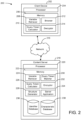
- a server device for secure identification retrieval may comprise a network interface in communication with a first client device of a plurality of client devices; a memory device storing a first database comprising a plurality of query tokens and a corresponding plurality of associated client device identifiers, and a second database comprising the plurality of client device identifiers and associated device characteristics; and a processor.
- Processor 204 can send the concatenated identifier to content server 218 in a query to determine if content server 218 has one or more characteristics about client device 202.
- Processor 204 can receive an encrypted answer from content server 218, encrypted with a public key of client device 202, and decrypt the answer using a private key specific to client device 202.
- the answer or response may not be encrypted (e.g., in some implementations in which negative responses or affirmative responses without additional data are utilized, or in which other security measures are utilized to prevent interception such as transport layer security).
- periodic variables include, but are not limited to, a present date in a specified time zone (e.g., 6/21/19), a closing value of a stock on the New York Stock Exchange (e.g., $200), a nonce value that continually increments at a set frequency, etc.
- the periodic variable may comprise any information or combination of information that updates periodically and is independently determinable or retrievable both by client devices and content servers.
- the nonce may be synchronized between content server 218 and client device 202 so client device 202 will know the nonce that encryptor 232 used to encrypt the answer.
- all or a portion of the nonce may be sent to client device 202 with the answer so client device 202 can identify the nonce and decrypt the answer, or may be received from client device 202 as part of the query.
- Encryptor 232 may generate the time stamp by retrieving the time from an internal clock of server 218. Each of the nonce and the timestamp may be concatenated with the answer in any order and any number of times.
- Server application 234 may store the calculated stored cookie query tokens in identifier database 236. Server application 234 may store any number of stored cookie query tokens for any number of cookies in the database. In some implementations, for each day that passes, server application 234 may remove the stored cookie query token associated with the value of yesterday's date and calculate a new stored cookie query token associated with a value of tomorrow's date.
- the server device may use the public key to encrypt the one or more characteristics in an answer to the query from the client device.
- the encrypted answer may include a concatenated value that the server device calculates by concatenating the answer, a nonce, and a time stamp together.
- the answer may include binary values (e.g., whether the server device has collected data for the client device) and/or an identification of different categories of user data (e.g., one or more characteristics) that the server device has collected about the client device.
- the server device may transmit the one or more characteristics to the client device.
- the client device may decrypt the encrypted answer using the private key of the client device based on the digital signature.
- implementations of the subject matter described in this specification can be implemented on a computer having a display device, e.g., a CRT (cathode ray tube), LCD (liquid crystal display), OLED (organic light emitting diode), TFT (thin-film transistor), plasma, other flexible configuration, or any other monitor for displaying information to the user and a keyboard, a pointing device, e.g., a mouse, trackball, etc., or a touch screen, touch pad, etc., by which the user can provide input to the computer.
- a display device e.g., a CRT (cathode ray tube), LCD (liquid crystal display), OLED (organic light emitting diode), TFT (thin-film transistor), plasma, other flexible configuration, or any other monitor for displaying information to the user and a keyboard, a pointing device, e.g., a mouse, trackball, etc., or a touch screen, touch pad, etc., by which the user can provide input to the computer
- Example statement 1 A method for secure identification retrieval, comprising: retrieving, by a server device, a value of a periodic variable; calculating, by the server device, a plurality of query tokens from a corresponding plurality of client device identifiers and the value of the periodic variable, each query token associated with a corresponding client device identifier in a first database; receiving, by the server device from a first client device, a first query token calculated from a client device identifier of the first client device and the value of the periodic variable; identifying, by the server device, a second query token of the calculated plurality of query tokens in the first database matching the first query token; responsive to the identification, retrieving, by the server device, the associated client device identifier; retrieving, by the server device from a second database, one or more characteristics of the first client device according to the associated client device identifier; and transmitting, by the server device to the client device, the retrieved one or more characteristics.
- Example statement 2 The method of example statement 1, further comprising: generating, by the server device, a probabilistic data structure based on the calculated plurality of query tokens; and comparing, by the server device, the first query token to the probabilistic data structure; and wherein identifying the second query token is performed responsive to the first query token matching the probabilistic data structure.
- Example statement 4 The method of example statement 1, wherein the periodic variable comprises a present date a stock exchange closing price, or a mutually verifiable value.
- Example statement 5 The method of example statement 1, wherein calculating the plurality of query tokens further comprises calculating a second plurality of query tokens from the corresponding plurality of client device identifiers and a previous value of the periodic variable, the second plurality of query tokens stored in the first database in association with the corresponding client device identifier.
- Example statement 6 The method of example statement 5, further comprising removing, by the server device, a third plurality of query tokens from the first database, the third plurality of query tokens calculated from the plurality of client device identifiers and a twice-previous value of the periodic variable.
- Example statement 7 The method of example statement 1, wherein calculating the plurality of query tokens further comprises calculating, for each of the plurality of query tokens, a one-way hash of a combination of the value of the periodic variable and the corresponding client device identifier.
- Example statement 8 The method of example statement 1, wherein retrieving the one or more characteristics of the first client device further comprises retrieving a public encryption key of the first client device from the second database; and wherein transmitting the retrieved one or more characteristics further comprises encrypting the one or more characteristics with the retrieved public encryption key of the first client device.
- Example statement 9 The method of example statement 1, further comprising: receiving, by the server device from a second client device, a third query token calculated from a client device identifier of the second client device and the value of the periodic variable; and determining, by the server device, that an entry does not exist in the first database corresponding to the third query token.
- Example statement 10 The method of example statement 9, further comprising: responsive to the determination that an entry does not exist in the first database corresponding to the third query token, transmitting, by the server device to the second client device, one of a random data string or a null data string.
- Example statement 11 The method of example statement 1, wherein the plurality of client device identifiers comprise cookie values.
- Example statement 12 The method of example statement 11, wherein the plurality of query tokens are calculated from the periodic value, the cookie values, and a plurality of domain identifiers, each cookie value corresponding to a domain identifier of the plurality of domain identifiers.
- Example statement 13 The method of example statement 12, wherein a first cookie value is associated with each of a first domain and is shared with a second domain.
- Example statement 14 The method of example statement 13, wherein the server device is associated with one of the first domain or the second domain, and a second server device is associated with the other of the first domain or the second domain.
- Example statement 15 The method of example statement 12, wherein retrieving the associated client device identifier further comprises retrieving a first cookie value and a first domain identifier; and wherein transmitting the retrieved one or more characteristics further comprises encrypting, by the server device that is associated with the second domain, the retrieved one or more characteristics with the first cookie value and the first domain identifier.
- a server device for secure identification retrieval comprising: a network interface in communication with a first client device of a plurality of client devices; a memory device storing a first database comprising a plurality of query tokens and a corresponding plurality of associated client device identifiers, and a second database comprising the plurality of client device identifiers and associated device characteristics; and a processor, configured to: retrieve a value of a periodic variable, calculate the plurality of query tokens from the corresponding plurality of client device identifiers and the value of the periodic variable, receive, via the network interface from the first client device, a first query token calculated from a client device identifier of the first client device and the value of the periodic variable, identify a second query token of the calculated plurality of query tokens in the first database matching the first query token, responsive to the identification, retrieve, from the first database, the associated client device identifier, retrieve, from the second database, one or more characteristics of the first client device according to the associated client device identifier, and transmit, via
- Example statement 17 The system of example statement 16, wherein the processor is further configured to: generate a probabilistic data structure based on the calculated plurality of query tokens; and compare the first query token to the probabilistic data structure; and wherein identifying the second query token is performed responsive to the first query token matching the probabilistic data structure.
- Example statement 18 The system of example statement 16, wherein the processor is further configured to: calculate a second plurality of query tokens from the corresponding plurality of client device identifiers and a previous value of the periodic variable, the second plurality of query tokens stored in the first database in association with the corresponding client device identifier.
- Example statement 19 The system of example statement 18, wherein the processor is further configured to: remove a third plurality of query tokens from the first database, the third plurality of query tokens calculated from the plurality of client device identifiers and a twice-previous value of the periodic variable.
- Example statement 20 The system of example statement 16, wherein the processor is further configured to: calculate, for each of the plurality of query tokens, a one-way hash of a combination of the value of the periodic variable and the corresponding client device identifier.
Landscapes
- Engineering & Computer Science (AREA)
- Computer Security & Cryptography (AREA)
- Computer Networks & Wireless Communication (AREA)
- Signal Processing (AREA)
- General Engineering & Computer Science (AREA)
- Computer Hardware Design (AREA)
- Computing Systems (AREA)
- Theoretical Computer Science (AREA)
- Databases & Information Systems (AREA)
- Technology Law (AREA)
- General Physics & Mathematics (AREA)
- Physics & Mathematics (AREA)
- Data Mining & Analysis (AREA)
- Information Retrieval, Db Structures And Fs Structures Therefor (AREA)
- Storage Device Security (AREA)
- Computer And Data Communications (AREA)
Priority Applications (1)
| Application Number | Priority Date | Filing Date | Title |
|---|---|---|---|
| EP25160346.0A EP4539433A3 (de) | 2019-09-03 | 2019-09-03 | Systeme und verfahren für sicheren identifizierungsabruf |
Applications Claiming Priority (3)
| Application Number | Priority Date | Filing Date | Title |
|---|---|---|---|
| EP19769957.2A EP4026289B1 (de) | 2019-09-03 | 2019-09-03 | Systeme und verfahren für sicheren identifizierungsabruf |
| PCT/US2019/049333 WO2021045727A1 (en) | 2019-09-03 | 2019-09-03 | Systems and methods for secure identification retrieval |
| EP25160346.0A EP4539433A3 (de) | 2019-09-03 | 2019-09-03 | Systeme und verfahren für sicheren identifizierungsabruf |
Related Parent Applications (1)
| Application Number | Title | Priority Date | Filing Date |
|---|---|---|---|
| EP19769957.2A Division EP4026289B1 (de) | 2019-09-03 | 2019-09-03 | Systeme und verfahren für sicheren identifizierungsabruf |
Publications (2)
| Publication Number | Publication Date |
|---|---|
| EP4539433A2 true EP4539433A2 (de) | 2025-04-16 |
| EP4539433A3 EP4539433A3 (de) | 2025-07-02 |
Family
ID=67989082
Family Applications (2)
| Application Number | Title | Priority Date | Filing Date |
|---|---|---|---|
| EP25160346.0A Pending EP4539433A3 (de) | 2019-09-03 | 2019-09-03 | Systeme und verfahren für sicheren identifizierungsabruf |
| EP19769957.2A Active EP4026289B1 (de) | 2019-09-03 | 2019-09-03 | Systeme und verfahren für sicheren identifizierungsabruf |
Family Applications After (1)
| Application Number | Title | Priority Date | Filing Date |
|---|---|---|---|
| EP19769957.2A Active EP4026289B1 (de) | 2019-09-03 | 2019-09-03 | Systeme und verfahren für sicheren identifizierungsabruf |
Country Status (6)
| Country | Link |
|---|---|
| US (3) | US11310046B2 (de) |
| EP (2) | EP4539433A3 (de) |
| JP (2) | JP7322283B2 (de) |
| KR (3) | KR102780804B1 (de) |
| CN (3) | CN114600421B (de) |
| WO (1) | WO2021045727A1 (de) |
Families Citing this family (9)
| Publication number | Priority date | Publication date | Assignee | Title |
|---|---|---|---|---|
| US11310046B2 (en) * | 2019-09-03 | 2022-04-19 | Google Llc | Systems and methods for secure identification retrieval |
| US11645273B2 (en) * | 2021-05-28 | 2023-05-09 | Ocient Holdings LLC | Query execution utilizing probabilistic indexing |
| US11899560B2 (en) * | 2022-04-27 | 2024-02-13 | Microsoft Technology Licensing, Llc | Automatic correctness validation of database management systems |
| US12493651B2 (en) * | 2023-01-09 | 2025-12-09 | Dynatrace Llc | Compact probabilistic data structure for storing streamed log lines |
| US12487980B2 (en) | 2023-01-09 | 2025-12-02 | Dynatrace Llc | Compact probabilistic data structure for storing log data |
| US12229107B2 (en) * | 2023-01-09 | 2025-02-18 | Dynatrace Llc | Compact probabilistic data structure for storing streamed log lines |
| CN117112549B (zh) * | 2023-10-20 | 2024-03-26 | 中科星图测控技术股份有限公司 | 一种基于布隆过滤器的大数据归并方法 |
| US20250322023A1 (en) * | 2024-04-10 | 2025-10-16 | Shopify Inc. | Methods and systems for spillover from cookie to database |
| DE102024203499B4 (de) | 2024-04-16 | 2026-04-02 | Siemens Aktiengesellschaft | Computer-implementiertes Rollenverwaltungsverfahren und zugehöriges System |
Family Cites Families (36)
| Publication number | Priority date | Publication date | Assignee | Title |
|---|---|---|---|---|
| US10326798B2 (en) * | 1998-07-16 | 2019-06-18 | Grid7, LLC | System and method for secure data transmission and storage |
| US7231526B2 (en) * | 2001-10-26 | 2007-06-12 | Authenex, Inc. | System and method for validating a network session |
| FR2844942B1 (fr) | 2002-09-24 | 2004-11-26 | Radiotelephone Sfr | Procede de production, pour un fournisseur d'acces, d'un identifiant isolant multimedia |
| US7296158B2 (en) | 2002-11-08 | 2007-11-13 | Palo Alto Research Center Incorporated | Methods, apparatus, and program products for inferring service usage |
| US8024308B2 (en) * | 2006-08-07 | 2011-09-20 | Chacha Search, Inc | Electronic previous search results log |
| CN101563880A (zh) * | 2006-10-25 | 2009-10-21 | 约维申有限公司 | 全球唯一设备专用标识符的创建和验证 |
| JP4818975B2 (ja) | 2007-03-30 | 2011-11-16 | 西日本電信電話株式会社 | 情報通信システム |
| EP2020797B1 (de) * | 2007-08-02 | 2016-06-15 | Apple Inc. | Opake Client-Server-Token-Passing-Vorrichtung und Verfahren dafür |
| US9256686B2 (en) * | 2008-09-15 | 2016-02-09 | International Business Machines Corporation | Using a bloom filter in a web analytics application |
| US8527774B2 (en) * | 2009-05-28 | 2013-09-03 | Kaazing Corporation | System and methods for providing stateless security management for web applications using non-HTTP communications protocols |
| US8528069B2 (en) * | 2010-09-30 | 2013-09-03 | Microsoft Corporation | Trustworthy device claims for enterprise applications |
| US9805122B2 (en) * | 2011-08-12 | 2017-10-31 | Nec Europe Ltd. | Search engine and method for performing a search for objects that correspond to a search request |
| WO2013033122A1 (en) | 2011-08-31 | 2013-03-07 | Google Inc. | Method and system for providing efficient and accurate estimates of tv viewership ratings |
| US20130080690A1 (en) * | 2011-09-23 | 2013-03-28 | William Brooks Barrett | Method to emulate eeprom using flash memory |
| ES2680152T3 (es) * | 2012-08-03 | 2018-09-04 | OneSpan International GmbH | Método y aparato de autenticación conveniente para el usuario usando una aplicación de autenticación móvil |
| US9172687B2 (en) | 2012-12-28 | 2015-10-27 | Nok Nok Labs, Inc. | Query system and method to determine authentication capabilities |
| EP3014803B1 (de) * | 2013-06-25 | 2019-09-25 | Nokia Technologies Oy | Verfahren und vorrichtung zur anonymen vertrauenswürdigen authentifizierung in pervasiven sozialen netzwerken |
| US10445769B2 (en) | 2013-12-24 | 2019-10-15 | Google Llc | Systems and methods for audience measurement |
| US10600076B2 (en) * | 2014-08-14 | 2020-03-24 | Google Llc | Systems and methods for obfuscated audience measurement |
| CN105471826B (zh) * | 2014-09-04 | 2019-08-20 | 中电长城网际系统应用有限公司 | 密文数据查询方法、装置和密文查询服务器 |
| US9654916B2 (en) * | 2014-10-09 | 2017-05-16 | Tile, Inc. | Secure and private cloud based broadcast identification |
| US9679024B2 (en) * | 2014-12-01 | 2017-06-13 | Facebook, Inc. | Social-based spelling correction for online social networks |
| US9342617B1 (en) * | 2015-05-19 | 2016-05-17 | Parrable, Inc. | Unique identifiers for browsers |
| WO2017093990A1 (en) * | 2015-12-03 | 2017-06-08 | Orca Interactive Ltd | A method and system for securing a client's access to a drm agent's services for a video player |
| CN106230603B (zh) * | 2016-09-19 | 2019-08-16 | 中国传媒大学 | 一种认证授权方法 |
| US20180082284A1 (en) * | 2016-09-20 | 2018-03-22 | Paypal, Inc. | Processing a transaction using a multiple-use token |
| JP6764115B2 (ja) * | 2017-01-31 | 2020-09-30 | 富士通株式会社 | 表示プログラム、表示方法および表示装置 |
| US10498718B2 (en) | 2017-06-16 | 2019-12-03 | Amazon Technologies, Inc. | Device identification and authentication in a network |
| CN108881132B (zh) * | 2017-07-25 | 2021-03-23 | 北京旷视科技有限公司 | 应用授权方法、客户端、服务器和计算机可读介质 |
| US10991014B2 (en) * | 2017-07-26 | 2021-04-27 | Solstice Equity Partners, Inc. | Templates and events for customizable notifications on websites |
| JP6904857B2 (ja) * | 2017-08-31 | 2021-07-21 | キヤノン株式会社 | 権限委譲システム、制御方法、およびプログラム |
| US11558193B2 (en) * | 2018-08-13 | 2023-01-17 | Google Llc | Location-based access to controlled access resources |
| US10839320B2 (en) * | 2018-12-18 | 2020-11-17 | Rokfin, Inc. | Determining network-effects with decentralized applications |
| US20200250666A1 (en) * | 2019-02-06 | 2020-08-06 | Mastercard International Incorporated | Method and system for generation of a high assurance payment token |
| US11586470B2 (en) * | 2019-08-07 | 2023-02-21 | International Business Machines Corporation | Scalable workflow engine with a stateless orchestrator |
| US11310046B2 (en) * | 2019-09-03 | 2022-04-19 | Google Llc | Systems and methods for secure identification retrieval |
-
2019
- 2019-09-03 US US16/757,835 patent/US11310046B2/en active Active
- 2019-09-03 KR KR1020247029547A patent/KR102780804B1/ko active Active
- 2019-09-03 CN CN201980101624.3A patent/CN114600421B/zh active Active
- 2019-09-03 JP JP2022514227A patent/JP7322283B2/ja active Active
- 2019-09-03 KR KR1020227010944A patent/KR102703672B1/ko active Active
- 2019-09-03 WO PCT/US2019/049333 patent/WO2021045727A1/en not_active Ceased
- 2019-09-03 KR KR1020247029546A patent/KR102780805B1/ko active Active
- 2019-09-03 EP EP25160346.0A patent/EP4539433A3/de active Pending
- 2019-09-03 EP EP19769957.2A patent/EP4026289B1/de active Active
- 2019-09-03 CN CN202410824617.9A patent/CN118842592A/zh active Pending
- 2019-09-03 CN CN202410824642.7A patent/CN118842593A/zh active Pending
-
2022
- 2022-03-21 US US17/699,434 patent/US11784817B2/en active Active
-
2023
- 2023-06-26 US US18/341,689 patent/US12244716B2/en active Active
- 2023-07-25 JP JP2023120733A patent/JP2023162169A/ja active Pending
Also Published As
| Publication number | Publication date |
|---|---|
| US20230336351A1 (en) | 2023-10-19 |
| CN114600421B (zh) | 2024-07-02 |
| JP2022545847A (ja) | 2022-10-31 |
| KR102780804B1 (ko) | 2025-03-12 |
| JP2023162169A (ja) | 2023-11-08 |
| US11784817B2 (en) | 2023-10-10 |
| JP7322283B2 (ja) | 2023-08-07 |
| EP4026289A1 (de) | 2022-07-13 |
| EP4539433A3 (de) | 2025-07-02 |
| WO2021045727A1 (en) | 2021-03-11 |
| KR20240134405A (ko) | 2024-09-09 |
| KR102780805B1 (ko) | 2025-03-12 |
| US20220209953A1 (en) | 2022-06-30 |
| CN118842592A (zh) | 2024-10-25 |
| US11310046B2 (en) | 2022-04-19 |
| EP4026289B1 (de) | 2025-03-12 |
| US12244716B2 (en) | 2025-03-04 |
| KR102703672B1 (ko) | 2024-09-05 |
| KR20220059506A (ko) | 2022-05-10 |
| CN114600421A (zh) | 2022-06-07 |
| CN118842593A (zh) | 2024-10-25 |
| US20210075614A1 (en) | 2021-03-11 |
| KR20240134406A (ko) | 2024-09-09 |
Similar Documents
| Publication | Publication Date | Title |
|---|---|---|
| US12244716B2 (en) | Systems and methods for secure identification retrieval | |
| US12166886B2 (en) | Systems and methods for authenticated control of content delivery | |
| US10268834B2 (en) | Privacy-preserving querying mechanism on privately encrypted data on semi-trusted cloud | |
| US9298940B1 (en) | Secure storage for shared documents | |
| US20180212753A1 (en) | End-To-End Secure Operations Using a Query Vector | |
| US20090300351A1 (en) | Fast searchable encryption method | |
| CN110096899A (zh) | 一种数据查询方法及装置 | |
| WO2018140146A1 (en) | Establishing a link between identifiers without disclosing specific identifying information | |
| WO2018116826A1 (ja) | メッセージ送信システム、通信端末、サーバ装置、メッセージ送信方法、およびプログラム | |
| US9825920B1 (en) | Systems and methods for multi-function and multi-purpose cryptography | |
| US9178855B1 (en) | Systems and methods for multi-function and multi-purpose cryptography | |
| Lee et al. | A study of practical proxy reencryption with a keyword search scheme considering cloud storage structure | |
| US9189638B1 (en) | Systems and methods for multi-function and multi-purpose cryptography | |
| EP4697220A1 (de) | Sicherer datenaustausch |
Legal Events
| Date | Code | Title | Description |
|---|---|---|---|
| PUAI | Public reference made under article 153(3) epc to a published international application that has entered the european phase |
Free format text: ORIGINAL CODE: 0009012 |
|
| STAA | Information on the status of an ep patent application or granted ep patent |
Free format text: STATUS: REQUEST FOR EXAMINATION WAS MADE |
|
| 17P | Request for examination filed |
Effective date: 20250226 |
|
| AC | Divisional application: reference to earlier application |
Ref document number: 4026289 Country of ref document: EP Kind code of ref document: P |
|
| AK | Designated contracting states |
Kind code of ref document: A2 Designated state(s): AL AT BE BG CH CY CZ DE DK EE ES FI FR GB GR HR HU IE IS IT LI LT LU LV MC MK MT NL NO PL PT RO RS SE SI SK SM TR |
|
| REG | Reference to a national code |
Ref country code: DE Ref legal event code: R079 Free format text: PREVIOUS MAIN CLASS: H04L0067303000 Ipc: H04L0009400000 |
|
| PUAL | Search report despatched |
Free format text: ORIGINAL CODE: 0009013 |
|
| RIN1 | Information on inventor provided before grant (corrected) |
Inventor name: YUNG, MARCEL M. MOTI Inventor name: WANG, GANG |
|
| AK | Designated contracting states |
Kind code of ref document: A3 Designated state(s): AL AT BE BG CH CY CZ DE DK EE ES FI FR GB GR HR HU IE IS IT LI LT LU LV MC MK MT NL NO PL PT RO RS SE SI SK SM TR |
|
| RIC1 | Information provided on ipc code assigned before grant |
Ipc: H04L 67/303 20220101ALI20250527BHEP Ipc: H04L 9/40 20220101AFI20250527BHEP |
|
| GRAP | Despatch of communication of intention to grant a patent |
Free format text: ORIGINAL CODE: EPIDOSNIGR1 |
|
| STAA | Information on the status of an ep patent application or granted ep patent |
Free format text: STATUS: GRANT OF PATENT IS INTENDED |