EP4539177A1 - Fuel cell membrane humidifier - Google Patents
Fuel cell membrane humidifier Download PDFInfo
- Publication number
- EP4539177A1 EP4539177A1 EP22945928.4A EP22945928A EP4539177A1 EP 4539177 A1 EP4539177 A1 EP 4539177A1 EP 22945928 A EP22945928 A EP 22945928A EP 4539177 A1 EP4539177 A1 EP 4539177A1
- Authority
- EP
- European Patent Office
- Prior art keywords
- housing
- cartridge
- fuel cell
- flow
- hollow fiber
- Prior art date
- Legal status (The legal status is an assumption and is not a legal conclusion. Google has not performed a legal analysis and makes no representation as to the accuracy of the status listed.)
- Pending
Links
Images


Classifications
-
- H—ELECTRICITY
- H01—ELECTRIC ELEMENTS
- H01M—PROCESSES OR MEANS, e.g. BATTERIES, FOR THE DIRECT CONVERSION OF CHEMICAL ENERGY INTO ELECTRICAL ENERGY
- H01M8/00—Fuel cells; Manufacture thereof
- H01M8/04—Auxiliary arrangements, e.g. for control of pressure or for circulation of fluids
- H01M8/04082—Arrangements for control of reactant parameters, e.g. pressure or concentration
- H01M8/04089—Arrangements for control of reactant parameters, e.g. pressure or concentration of gaseous reactants
- H01M8/04119—Arrangements for control of reactant parameters, e.g. pressure or concentration of gaseous reactants with simultaneous supply or evacuation of electrolyte; Humidifying or dehumidifying
- H01M8/04126—Humidifying
- H01M8/04141—Humidifying by water containing exhaust gases
-
- H—ELECTRICITY
- H01—ELECTRIC ELEMENTS
- H01M—PROCESSES OR MEANS, e.g. BATTERIES, FOR THE DIRECT CONVERSION OF CHEMICAL ENERGY INTO ELECTRICAL ENERGY
- H01M8/00—Fuel cells; Manufacture thereof
- H01M8/04—Auxiliary arrangements, e.g. for control of pressure or for circulation of fluids
- H01M8/04082—Arrangements for control of reactant parameters, e.g. pressure or concentration
- H01M8/04089—Arrangements for control of reactant parameters, e.g. pressure or concentration of gaseous reactants
- H01M8/04119—Arrangements for control of reactant parameters, e.g. pressure or concentration of gaseous reactants with simultaneous supply or evacuation of electrolyte; Humidifying or dehumidifying
- H01M8/04126—Humidifying
- H01M8/04149—Humidifying by diffusion, e.g. making use of membranes
-
- H—ELECTRICITY
- H01—ELECTRIC ELEMENTS
- H01M—PROCESSES OR MEANS, e.g. BATTERIES, FOR THE DIRECT CONVERSION OF CHEMICAL ENERGY INTO ELECTRICAL ENERGY
- H01M8/00—Fuel cells; Manufacture thereof
- H01M8/02—Details
- H01M8/0271—Sealing or supporting means around electrodes, matrices or membranes
- H01M8/0276—Sealing means characterised by their form
- H01M8/0278—O-rings
-
- H—ELECTRICITY
- H01—ELECTRIC ELEMENTS
- H01M—PROCESSES OR MEANS, e.g. BATTERIES, FOR THE DIRECT CONVERSION OF CHEMICAL ENERGY INTO ELECTRICAL ENERGY
- H01M8/00—Fuel cells; Manufacture thereof
- H01M8/10—Fuel cells with solid electrolytes
-
- H—ELECTRICITY
- H01—ELECTRIC ELEMENTS
- H01M—PROCESSES OR MEANS, e.g. BATTERIES, FOR THE DIRECT CONVERSION OF CHEMICAL ENERGY INTO ELECTRICAL ENERGY
- H01M8/00—Fuel cells; Manufacture thereof
- H01M8/10—Fuel cells with solid electrolytes
- H01M8/1004—Fuel cells with solid electrolytes characterised by membrane-electrode assemblies [MEA]
-
- B—PERFORMING OPERATIONS; TRANSPORTING
- B01—PHYSICAL OR CHEMICAL PROCESSES OR APPARATUS IN GENERAL
- B01D—SEPARATION
- B01D2313/00—Details relating to membrane modules or apparatus
- B01D2313/04—Specific sealing means
-
- B—PERFORMING OPERATIONS; TRANSPORTING
- B01—PHYSICAL OR CHEMICAL PROCESSES OR APPARATUS IN GENERAL
- B01D—SEPARATION
- B01D2313/00—Details relating to membrane modules or apparatus
- B01D2313/04—Specific sealing means
- B01D2313/041—Gaskets or O-rings
-
- B—PERFORMING OPERATIONS; TRANSPORTING
- B01—PHYSICAL OR CHEMICAL PROCESSES OR APPARATUS IN GENERAL
- B01D—SEPARATION
- B01D2313/00—Details relating to membrane modules or apparatus
- B01D2313/20—Specific housing
-
- B—PERFORMING OPERATIONS; TRANSPORTING
- B01—PHYSICAL OR CHEMICAL PROCESSES OR APPARATUS IN GENERAL
- B01D—SEPARATION
- B01D2315/00—Details relating to the membrane module operation
- B01D2315/22—Membrane contactor
-
- B—PERFORMING OPERATIONS; TRANSPORTING
- B01—PHYSICAL OR CHEMICAL PROCESSES OR APPARATUS IN GENERAL
- B01D—SEPARATION
- B01D63/00—Apparatus in general for separation processes using semi-permeable membranes
- B01D63/02—Hollow fibre modules
-
- H—ELECTRICITY
- H01—ELECTRIC ELEMENTS
- H01M—PROCESSES OR MEANS, e.g. BATTERIES, FOR THE DIRECT CONVERSION OF CHEMICAL ENERGY INTO ELECTRICAL ENERGY
- H01M8/00—Fuel cells; Manufacture thereof
- H01M8/10—Fuel cells with solid electrolytes
- H01M2008/1095—Fuel cells with polymeric electrolytes
-
- H—ELECTRICITY
- H01—ELECTRIC ELEMENTS
- H01M—PROCESSES OR MEANS, e.g. BATTERIES, FOR THE DIRECT CONVERSION OF CHEMICAL ENERGY INTO ELECTRICAL ENERGY
- H01M2250/00—Fuel cells for particular applications; Specific features of fuel cell system
- H01M2250/20—Fuel cells in motive systems, e.g. vehicle, ship, plane
-
- Y—GENERAL TAGGING OF NEW TECHNOLOGICAL DEVELOPMENTS; GENERAL TAGGING OF CROSS-SECTIONAL TECHNOLOGIES SPANNING OVER SEVERAL SECTIONS OF THE IPC; TECHNICAL SUBJECTS COVERED BY FORMER USPC CROSS-REFERENCE ART COLLECTIONS [XRACs] AND DIGESTS
- Y02—TECHNOLOGIES OR APPLICATIONS FOR MITIGATION OR ADAPTATION AGAINST CLIMATE CHANGE
- Y02E—REDUCTION OF GREENHOUSE GAS [GHG] EMISSIONS, RELATED TO ENERGY GENERATION, TRANSMISSION OR DISTRIBUTION
- Y02E60/00—Enabling technologies; Technologies with a potential or indirect contribution to GHG emissions mitigation
- Y02E60/30—Hydrogen technology
- Y02E60/50—Fuel cells
Definitions
- hydrogen fuel cells that utilize electricity generated by the reaction between hydrogen fuel and oxygen are being developed in various types, such as a polymer electrolyte membrane fuel cell (PEMFC), a phosphoric acid fuel cell (PAFC), and a dual exchange membrane fuel cell.
- PEMFC polymer electrolyte membrane fuel cell
- PAFC phosphoric acid fuel cell
- dual exchange membrane fuel cell a polymer electrolyte membrane fuel cell
- Polymer electrolyte membrane fuel cells are known to be promising for use in not only small-scale stationary power generation equipment but also transportation equipment such as hydrogen vehicles because they operate at lower temperatures than other fuel cells and can be miniaturized due to their high output density.
- One of the key factors in improving the performance of such polymer electrolyte membrane fuel cells is to maintain the moisture content by supplying a predetermined amount or more of moisture to a polymer electrolyte membrane (PEM, also called proton exchange membrane) of a membrane electrode assembly (MEA) provided inside a fuel cell stack.
- PEM polymer electrolyte membrane
- MEA membrane electrode assembly
- membrane humidification technology is regarded very important in maintaining the moisture content or humidity of the supplied gas at a required level through humidification of the gas.
- a membrane humidifier for a fuel cell using a humidification system using a hollow fiber membrane is disclosed in Korean Patent Application Publication No. 10-2019-0138529 .
- the above-described conventional membrane humidifier for the fuel cell is configured to include a middle casing in which a plurality of hollow fiber membranes are accommodated; a cap casing coupled to the middle casing; a potting portion formed at an end of the plurality of hollow fiber membranes; an assembly member disposed between the cap casing and an end of the middle casing to hermetically connect the cap casing and the middle casing to each other; and a protrusion extending from the inside of the cap casing toward an edge of the potting portion to hermetically connect the cap casing and the potting portion to each other.
- the membrane humidifier for the fuel cell has an assembly structure in which the assembly member is disposed between the cap casing and the end of the middle casing and the protrusion between the cap casing and the potting portion extends from the inside of the cap casing toward the edge of the potting portion, so an airtight function can be achieved in a high temperature/high pressure/high humidity environment.
- the conventional membrane humidifier described above is problematic in that contact between gas introduced from a stack and the hollow fiber membranes is concentrated on an inlet side of the middle casing, forming a dead zone at the bottom of the middle casing, and the humidifying efficiency of the introduced gas in the dead zone becomes poor, thereby worsening the overall humidifying efficiency.
- One objective of the present disclosure is to provide a fuel cell membrane humidifier that enables a high-humidity gas discharged from a stack of a hydrogen fuel cell to form a contact path with the entire upper, middle, and lower parts of a hollow fiber membrane module without a dead zone within a main housing, and sufficiently humidifies air supplied to the stack.
- Another objective of the present disclosure is to provide a fuel cell membrane humidifier having a structure advantageous in airtightness and assemblability between housings and a cartridge for the membrane humidifier for productivity and humidifying efficiency in manufacturing the membrane humidifier.
- the hollow fiber membrane cartridge may include:
- the distribution ports may be formed in a multi-layer array so that an opening area thereof gradually increases from upstream to downstream, and the discharge ports may be formed in a multi-layer array so that an opening area thereof gradually increases from downstream to upstream.
- a middle seal may be coupled to an outside of the second outer flange of the cartridge, and airtightness of the support portions of the main housing may be maintained by the middle seal.
- the distribution port array may include through-holes that increase in opening area the farther they are away from the flow-in section.
- the discharge port array may include through-holes that decrease in opening area the farther they are away from the flow-out section.
- the step seal may include one of a V-shaped seal, an O-ring, and a face seal.
- the fuel cell membrane humidifier may further include: a gasket installed at a first end of the main housing, wherein the gasket provides airtightness to the inlet housing.
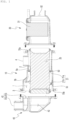
- FIG. 1 is a sectional view illustrating a fuel cell membrane humidifier according to an embodiment of the present disclosure.
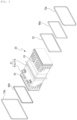
- FIG. 2 is an exploded perspective view illustrating a coupling relationship between a cartridge and a seal element according to the embodiment of the present disclosure.
- FIG. 3 is view illustrating an operating state of the fuel cell membrane humidifier according to the embodiment of the present disclosure.
- FIG. 4 is a main-part enlarged view illustrating a seal coupling state of a main housing, an inlet housing, and an outlet housing according to the embodiment of the present disclosure.
- FIG. 5 is a main-part enlarged view illustrating a V-seal as an example of a step seal illustrated in FIG. 4 .
- FIG. 6 is a main-part enlarged view illustrating an O-ring coupling structure according to another embodiment of the present disclosure.
- FIG. 7 is a main-part enlarged view illustrating a face seal coupling structure according to another embodiment of the present disclosure.
- the fuel cell membrane humidifier according to the embodiment of the present disclosure has an assembly structure in which a hollow fiber membrane cartridge 200 is inserted in a sliding manner on an inner surface of a main housing 100 during an assembly process, and flanges are each seated on a support provided inside the main housing 100.
- the flow-out section 4 forms a flow space where the humid gas, which circulates inside the cartridge housing 30 to be described later and comes into sufficient contact with hollow fiber membranes, flows to the outside of the cartridge and is discharged.
- the cartridge support portions 5 include a first support portion 5a that fixes an upper portion of the cartridge housing 20 by bolting, a second support portion 5b that is formed to be spaced apart from the first support portion 5a toward the longitudinal center and restricts lateral movement of the cartridge housing 30, and a third support portion 5c that fixes a lower portion of the cartridge housing 20 by fitting.
- the second support portion 5b includes a step structure protruding toward the inside of the main body 10.
- the third support portion 5c includes a flange insertion groove 6.
- the lateral movement of the cartridge housing 20 described above may be interpreted as a force acting on the cartridge housing 20 by fluid pressure applied to the cartridge housing 20 when high-pressure humid gas flows into the flow-in section 3, and a resulting microscopic movement.
- the lateral movement of the cartridge housing 20 described above may be interpreted as an external force acting on the cartridge housing 20 in a flow direction formed from the flow-in section 3 to the flow-out section 4 in the absence of the configuration of the support portion 5a, 5b, or 5c.
- An inlet housing 30 is connected to the flow-out section 4 of the main housing 100 and guides inflow of relatively dry external air compared to the humid gas.
- external air is supplied into the inlet housing 30 through a compressor, and the external air is introduced in a high-temperature, dry state.
- the cooler 31 performs the function of maintaining the external air at a preset temperature. At this time, the external air is still in a dry state.
- an outlet housing 40 is connected to the flow-in section 3 of the main housing 100 and includes a humid gas inlet 41 for guiding the humid gas provided from the hydrogen fuel cell and an external air outlet 42 adjacent to the humid gas inlet 41.
- the external air outlet 42 of the outlet housing 40 forms a path through which humidified air sufficiently humidified while passing through a membrane region of the hollow fiber membrane module is provided into a stack of the hydrogen fuel cell.
- the cartridge housing 20 includes at least one or more outer flanges 21 formed spaced apart from each other on the outside of the cartridge housing 20 corresponding to the cartridge support portions 5 of the main housing 100.
- a plurality of hollow fiber membrane modules are arranged inside the cartridge housing 20.
- the flow-in section 2 and the flow-out section 4 are structurally isolated from each other by the outer flanges 21.
- the outer flanges 21 include a first outer flange 21a that is bound to the first support portion 5a during assembly and a second outer flange 21b that is bound to the second support portion 5b.
- the distribution ports 22a, 22b, and 22c are formed in a multi-layer array so that the opening area thereof gradually increases from upstream to downstream.
- the distribution ports may have a through-hole structure in which the number of through-holes gradually increases toward the downstream distribution port 22c from the upstream distribution port 22a.
- the distribution port array 22 includes through-holes that increase in opening area the farther they are away from the flow-in section 2.
- the upstream discharge port 23a, the midstream discharge port 23b, and the downstream discharge port 23c may have through-hole structures having different opening areas, and may have various geometrical variations including circular holes, triangular holes, and rectangular holes.
- the step seal 60 enables simple seal assembly without the need for separate epoxy potting and drying processes in case of damage or A/S of the cartridge or hollow fiber membrane module (hollow fiber membrane filter), thereby providing speed in replacement and assembly work and economic efficiency in cost reduction.
- the fuel cell membrane humidifier according to the present disclosure configured with the above-described step seal 60 eliminates complex secondary potting and drying processes that were essential for conventional cartridge and hollow fiber membrane filter replacement work, thereby significantly reducing the number of man-hours required for replacement work.
Landscapes
- Life Sciences & Earth Sciences (AREA)
- Engineering & Computer Science (AREA)
- Manufacturing & Machinery (AREA)
- Sustainable Development (AREA)
- Sustainable Energy (AREA)
- Chemical & Material Sciences (AREA)
- Chemical Kinetics & Catalysis (AREA)
- Electrochemistry (AREA)
- General Chemical & Material Sciences (AREA)
- Fuel Cell (AREA)
Abstract
Description
- The present disclosure relates generally to a fuel cell membrane humidifier. More particularly, the present disclosure relates to a fuel cell membrane humidifier that can maintain high humidifying efficiency by enabling high-humidity gas discharged from a stack of a hydrogen fuel cell to make uniform contact with the entire upper, middle, and lower parts of a hollow fiber membrane module without a dead zone, and improve airtightness and assemblability between a main housing coupled to a cartridge, an inlet housing, and an outlet housing.
- Unless otherwise indicated herein, the approaches described in this section are not teachings or suggestions of the prior art to the claims in this application and are not admitted to be prior art by inclusion in this section.
- In general, hydrogen fuel cells that utilize electricity generated by the reaction between hydrogen fuel and oxygen are being developed in various types, such as a polymer electrolyte membrane fuel cell (PEMFC), a phosphoric acid fuel cell (PAFC), and a dual exchange membrane fuel cell.
- Polymer electrolyte membrane fuel cells are known to be promising for use in not only small-scale stationary power generation equipment but also transportation equipment such as hydrogen vehicles because they operate at lower temperatures than other fuel cells and can be miniaturized due to their high output density.
- One of the key factors in improving the performance of such polymer electrolyte membrane fuel cells is to maintain the moisture content by supplying a predetermined amount or more of moisture to a polymer electrolyte membrane (PEM, also called proton exchange membrane) of a membrane electrode assembly (MEA) provided inside a fuel cell stack. This is because the power generation efficiency rapidly decreases when the polymer electrolyte membrane dries.
- Since the performance of the fuel cell is greatly affected by the moisture content of gas supplied to the stack, membrane humidification technology is regarded very important in maintaining the moisture content or humidity of the supplied gas at a required level through humidification of the gas.
- As one of the conventional techniques in this regard, a membrane humidifier for a fuel cell using a humidification system using a hollow fiber membrane is disclosed in
Korean Patent Application Publication No. 10-2019-0138529 - The above-described conventional membrane humidifier for the fuel cell is configured to include a middle casing in which a plurality of hollow fiber membranes are accommodated; a cap casing coupled to the middle casing; a potting portion formed at an end of the plurality of hollow fiber membranes; an assembly member disposed between the cap casing and an end of the middle casing to hermetically connect the cap casing and the middle casing to each other; and a protrusion extending from the inside of the cap casing toward an edge of the potting portion to hermetically connect the cap casing and the potting portion to each other.
- The membrane humidifier for the fuel cell has an assembly structure in which the assembly member is disposed between the cap casing and the end of the middle casing and the protrusion between the cap casing and the potting portion extends from the inside of the cap casing toward the edge of the potting portion, so an airtight function can be achieved in a high temperature/high pressure/high humidity environment.
- Despite these advantages, the conventional membrane humidifier described above is problematic in that contact between gas introduced from a stack and the hollow fiber membranes is concentrated on an inlet side of the middle casing, forming a dead zone at the bottom of the middle casing, and the humidifying efficiency of the introduced gas in the dead zone becomes poor, thereby worsening the overall humidifying efficiency.
- Meanwhile, since airtightness between housings and a cartridge that constitute the membrane humidifier and assemblability therebetween are very important factors for improving the productivity and humidifying efficiency for manufacturing the membrane humidifier, various research and development attempts concerning this are being carried out.
- One objective of the present disclosure is to provide a fuel cell membrane humidifier that enables a high-humidity gas discharged from a stack of a hydrogen fuel cell to form a contact path with the entire upper, middle, and lower parts of a hollow fiber membrane module without a dead zone within a main housing, and sufficiently humidifies air supplied to the stack.
- Another objective of the present disclosure is to provide a fuel cell membrane humidifier having a structure advantageous in airtightness and assemblability between housings and a cartridge for the membrane humidifier for productivity and humidifying efficiency in manufacturing the membrane humidifier.
- According to one aspect of the present disclosure,
- there is provided a fuel cell membrane humidifier, including: a main housing in which a flow-in section forming an inlet portion for humid gas discharged from a fuel cell, a flow-out section forming an outlet portion for the humid gas, and at least one or more cartridge support portions formed inside a main body between the inlet portion and the outlet portion are integrally formed; and
- a hollow fiber membrane cartridge including at least one or more outer flanges formed to be spaced apart from each other on an outside of a cartridge housing corresponding to the cartridge support portions, having a plurality of hollow fiber membrane modules arranged inside the cartridge housing, and structurally separating the flow-in section from the flow-out section by the flanges during assembly inside the main housing.
- The hollow fiber membrane cartridge may include:
- a distribution port array including an upstream distribution port, a midstream distribution port, and a downstream distribution port formed on a first sidewall of the cartridge housing; and
- a discharge port array including an upstream discharge port, a midstream discharge port, and a downstream discharge port formed on a second sidewall of the cartridge housing.
- The distribution ports may be formed in a multi-layer array so that an opening area thereof gradually increases from upstream to downstream, and
the discharge ports may be formed in a multi-layer array so that an opening area thereof gradually increases from downstream to upstream. - According to another aspect of the present disclosure, a middle seal may be coupled to an outside of the second outer flange of the cartridge, and airtightness of the support portions of the main housing may be maintained by the middle seal.
- According to another aspect of the present disclosure, a step seal may be provided at an end of each side of the cartridge housing, and airtightness between the outlet housing and the inlet housing may be maintained by the step seal.
- According to another aspect of the present disclosure, the distribution port array may include through-holes that increase in opening area the farther they are away from the flow-in section.
- According to another aspect of the present disclosure, the discharge port array may include through-holes that decrease in opening area the farther they are away from the flow-out section.
- According to another aspect of the present disclosure, the step seal may include one of a V-shaped seal, an O-ring, and a face seal.
- According to another aspect of the present disclosure, the fuel cell membrane humidifier may further include: a gasket installed at a first end of the main housing, wherein the gasket provides airtightness to the inlet housing.
- According to another aspect of the present disclosure, the fuel cell membrane humidifier may further include: a gasket installed at a second end of the main housing, wherein the gasket provides airtightness to the outlet housing.
- According to one embodiment disclosed in the present specification, humid gas circulates and flows within a hollow fiber membrane module by distribution port and discharge port arrangement structures having different opening areas from the upstream side toward the midstream side and the downstream side of a cartridge, thereby providing maximized humidifying efficiency without a dead zone for dry compressed air passing through the inside of the cartridge and a hollow fiber membrane.
- Furthermore, according to one embodiment disclosed in the present specification, a structural isolation state is formed by a second outer flange of the cartridge, so an entering flow of humid gas filled in a flow-in section and a discharge flow of humid gas formed in a flow-out section are stably maintained.
- Furthermore, according to one embodiment disclosed in the present specification, structurally simple assembly elements are provided between the cartridge and a main housing as well as an inlet housing and an outlet housing, thereby maintaining strong airtightness after replacement and assembly.
- Furthermore, according to one embodiment disclosed in the present specification, separate epoxy potting and drying processes required in case of damage or A/S of the cartridge or hollow fiber membrane module (hollow fiber membrane filter), thereby providing speed in replacement and assembly work and economic efficiency in cost reduction.
- The effects of the present disclosure are naturally exhibited from the specification of the present disclosure irrespective of whether the inventors recognize the effects of the present disclosure. Consequently, the effects of the present disclosure are some effects of the present disclosure based on the specification of the present disclosure, and do not include all effects that the inventors have found or that actually exist.
- Additionally, the effects of the present disclosure are further recognized through the specification of the present disclosure. Although not described clearly, any effects that can be recognized by those skilled in the art to which the present disclosure pertains from the specification of the present disclosure may be included in the effects of the present disclosure.
-
-
FIG. 1 is a sectional view illustrating a fuel cell membrane humidifier according to an embodiment of the present disclosure. -
FIG. 2 is an exploded perspective view illustrating a coupling relationship between a cartridge and a seal element according to the embodiment of the present disclosure. -
FIG. 3 is view illustrating an operating state of the fuel cell membrane humidifier according to the embodiment of the present disclosure. -
FIG. 4 is a main-part enlarged view illustrating a seal coupling state of a main housing, an inlet housing, and an outlet housing according to the embodiment of the present disclosure. -
FIG. 5 is a main-part enlarged view illustrating a V-seal as an example of a step seal illustrated inFIG. 4 . -
FIG. 6 is a main-part enlarged view illustrating an O-ring coupling structure according to another embodiment of the present disclosure. - FIG. 7 is a main-part enlarged view illustrating a face seal coupling structure according to another embodiment of the present disclosure.
- Hereinafter, the configuration, operation, and effects of a fuel cell membrane humidifier according to an exemplary embodiment of the disclosure will be described with reference to the accompanying drawings. For reference, in these drawings, each component is omitted or schematically illustrated for convenience and clarity, and the size of each component does not reflect the actual size. The same reference numerals will refer to the same or like parts throughout the drawings, and reference numerals for the same or like parts in individual drawings will be omitted.
-
FIG. 1 is a sectional view illustrating a fuel cell membrane humidifier according to an embodiment of the present disclosure.FIG. 2 is an exploded perspective view illustrating a coupling relationship between a cartridge and a seal element according to the embodiment of the present disclosure.FIG. 3 is view illustrating an operating state of the fuel cell membrane humidifier according to the embodiment of the present disclosure.FIG. 4 is a main-part enlarged view illustrating a seal coupling state of a main housing, an inlet housing, and an outlet housing according to the embodiment of the present disclosure.FIG. 5 is a main-part enlarged view illustrating a V-seal as an example of a step seal illustrated inFIG. 4 .FIG. 6 is a main-part enlarged view illustrating an O-ring coupling structure according to another embodiment of the present disclosure. FIG. 7 is a main-part enlarged view illustrating a face seal coupling structure according to another embodiment of the present disclosure. - The fuel cell membrane humidifier according to the embodiment of the present disclosure has an assembly structure in which a hollow fiber membrane cartridge 200 is inserted in a sliding manner on an inner surface of a main housing 100 during an assembly process, and flanges are each seated on a support provided inside the main housing 100.
- More specifically, referring to
FIGS. 1 and2 , the main housing 100 includes a flow-in section 3 forming an inlet portion 1 for humid gas discharged from a fuel cell, a flow-outsection 4 forming an outlet portion 2 for the humid gas, and at least one or more cartridge support portions 5 formed inside amain body 10 between the inlet portion 1 and the outlet portion 2. The inlet portion 1, the outlet portion 2, and the cartridge support portions 5 are integrally formed by molding. - The flow-in section 3 forms a flow space where humid gas with high pressure and high humidity or water vapor, which is typically formed in a hydrogen fuel cell, is introduced through the inlet portion 1.
- The flow-out
section 4 forms a flow space where the humid gas, which circulates inside thecartridge housing 30 to be described later and comes into sufficient contact with hollow fiber membranes, flows to the outside of the cartridge and is discharged. - The cartridge support portions 5 include a
first support portion 5a that fixes an upper portion of thecartridge housing 20 by bolting, asecond support portion 5b that is formed to be spaced apart from thefirst support portion 5a toward the longitudinal center and restricts lateral movement of thecartridge housing 30, and athird support portion 5c that fixes a lower portion of thecartridge housing 20 by fitting. - The
second support portion 5b includes a step structure protruding toward the inside of themain body 10. Thethird support portion 5c includes a flange insertion groove 6. - The lateral movement of the
cartridge housing 20 described above may be interpreted as a force acting on thecartridge housing 20 by fluid pressure applied to thecartridge housing 20 when high-pressure humid gas flows into the flow-in section 3, and a resulting microscopic movement. - Additionally, the lateral movement of the
cartridge housing 20 described above may be interpreted as an external force acting on thecartridge housing 20 in a flow direction formed from the flow-in section 3 to the flow-outsection 4 in the absence of the configuration of thesupport portion - An
inlet housing 30 is connected to the flow-outsection 4 of the main housing 100 and guides inflow of relatively dry external air compared to the humid gas. - Generally, external air is supplied into the
inlet housing 30 through a compressor, and the external air is introduced in a high-temperature, dry state. - The
outlet housing 30 includes a cooler 31 installed therein, and guides the external air into a hollow fiber membrane module inside the cartridge. - The cooler 31 performs the function of maintaining the external air at a preset temperature. At this time, the external air is still in a dry state.
- Meanwhile, an
outlet housing 40 is connected to the flow-in section 3 of the main housing 100 and includes ahumid gas inlet 41 for guiding the humid gas provided from the hydrogen fuel cell and anexternal air outlet 42 adjacent to thehumid gas inlet 41. - The
external air outlet 42 of theoutlet housing 40 forms a path through which humidified air sufficiently humidified while passing through a membrane region of the hollow fiber membrane module is provided into a stack of the hydrogen fuel cell. - Meanwhile, referring to
FIG. 2 , thecartridge housing 20 according to the embodiment of the present disclosure includes at least one or moreouter flanges 21 formed spaced apart from each other on the outside of thecartridge housing 20 corresponding to the cartridge support portions 5 of the main housing 100. A plurality of hollow fiber membrane modules are arranged inside thecartridge housing 20. - When the cartridge housing is assembled within the main housing 100, the flow-in section 2 and the flow-out
section 4 are structurally isolated from each other by theouter flanges 21. - Preferably, the
outer flanges 21 include a firstouter flange 21a that is bound to thefirst support portion 5a during assembly and a secondouter flange 21b that is bound to thesecond support portion 5b. - The flow-in section 2 and the flow-out
section 4 formed on the outside of thecartridge housing 20 form predetermined chambers that are structurally separated or blocked from each other by the secondouter flange 21b that is bound to thesecond support portion 5b. - In the process of flowing humid air, the humid air of the flow-in section 2 is guided from a first side of the second
outer flange 21b and directed to the hollow fiber membranes inside thecartridge housing 20. - On the other hand, the humid air of the flow-out section 2 is guided from a second side of the second
outer flange 21b and directed to the outlet portion 2 or a discharge portion. - The hollow fiber membrane cartridge according to the present disclosure includes: a distribution port array 22 including an
upstream distribution port 22a, amidstream distribution port 22b, and adownstream distribution port 22c formed on a first sidewall of thecartridge housing 10; and a discharge port array 23 including anupstream discharge port 23a, amidstream discharge port 23b, and adownstream discharge port 23c formed on a second sidewall of thecartridge housing 10. - The
distribution ports downstream distribution port 22c from theupstream distribution port 22a. - The distribution port array 22 includes through-holes that increase in opening area the farther they are away from the flow-in section 2.
- Although not illustrated, as another modified embodiment, the
upstream distribution port 22a, themidstream distribution port 22b, and thedownstream distribution port 22c may have through-hole structures having different opening areas, and may have various geometrical variations including circular holes, triangular holes, and rectangular holes. - Meanwhile, the
discharge ports upstream discharge port 23a from thedownstream discharge port 23c. - The
discharge port array section 4. - Although not illustrated, as another modified embodiment, the
upstream discharge port 23a, themidstream discharge port 23b, and thedownstream discharge port 23c may have through-hole structures having different opening areas, and may have various geometrical variations including circular holes, triangular holes, and rectangular holes. - Of course, the hollow fiber membrane cartridge described above includes a plurality of through-
holes 24 in the upper and lower portions of thecartridge housing 10 so as to communicate with the inside of the hollow fiber membrane cartridge. - Meanwhile, according to the embodiment of the present disclosure, a middle seal is coupled to the outside of the second
outer flange 21b of thecartridge housing 20. - Preferably, the middle seal is coupled to the outside of the second outer flange of the cartridge, and airtightness of the support portions of the main housing is maintained by the middle seal.
- The second
outer flange 21b to which themiddle seal 50 is coupled maintains a structurally sufficiently sealed state with respect to the flow-in section 2 and the flow-outsection 4 formed on the outside of thecartridge housing 10 during assembly. - A step seal 60 is provided at an end of each side of the
cartridge housing 20, and maintains airtightness between theoutlet housing 30 and theinlet housing 40 during assembly. - The step seal 60 enables simple seal assembly without the need for separate epoxy potting and drying processes in case of damage or A/S of the cartridge or hollow fiber membrane module (hollow fiber membrane filter), thereby providing speed in replacement and assembly work and economic efficiency in cost reduction.
- In detail, the fuel cell membrane humidifier according to the present disclosure configured with the above-described step seal 60 eliminates complex secondary potting and drying processes that were essential for conventional cartridge and hollow fiber membrane filter replacement work, thereby significantly reducing the number of man-hours required for replacement work.
- Preferably, as illustrated in
FIG. 4 , the step seal 60 structurally includes a V-shaped seal orlip seal 60a and is provided at a connecting portion of thecartridge housing 20 on each of first and second sides of the cartridge housing. Accordingly, airtightness between theinlet housing 30 and theoutlet housing 40 assembled to opposite sides of thecartridge housing 20 is maintained without separate potting and drying processes. - According to another embodiment of the present disclosure, as illustrated in
FIGS. 5 and6 , the step seal 60 may be modified into an O-ring 60b or aface seal 60c. Depending on the seal performance and requirements, one of the V-shaped seal (lip seal), the O-ring, and the face seal may be selectively provided. - Meanwhile, a
gasket 70a is formed at a first end of themain housing 10. Thegasket 70a provides strong airtightness to theinlet housing 40. - A
gasket 70b may be further provided at a second end of the main housing 70. In this case, thegasket 70b provides airtightness to theoutlet housing 30. - Hereinafter, the operating principle of the fuel cell membrane humidifier according to the present disclosure will be described.
- Referring to
FIG. 3 , humid gas generated in a hydrogen fuel cell stack is supplied through thehumid gas inlet 41 of theoutlet housing 40. - The supplied humid gas is first filled into a space between the inside of the
main housing 10 and the outer flanges of thecartridge housing 20, for example, the flow-in section 3 of themain housing 10 formed on the outside of the secondouter flange 21b. - At this time, a structural isolation state is formed by the second
outer flange 21b of thecartridge housing 20, so an entering inflow of the humid gas filled in the flow-in section 3 is stably maintained. - Generally, the humid gas supplied from the hydrogen fuel cell stack is provided in the form of a preset high-pressure steam. Therefore, the humid gas filled in the flow-in section 3 is introduced into the hollow fiber membrane modules through the
upstream distribution port 22a, themidstream distribution port 22b, and thedownstream distribution port 22c sequentially provided on the first sidewall of thecartridge housing 10. - In this process, the supplied humid gas passes through side inflow paths F1 to F3 formed by the distribution ports of the distribution port array 22 arranged to have an opening area (e.g., through-hole diameter) that gradually increases from the upstream side to the downstream side of the
cartridge housing 10, and enters the inside of the hollow fiber membrane modules. - The humid gas entering through the inflow paths F1 to F3 forms predetermined circulating airflow and vortex flow (see spiral arrow in
FIG. 3 ) between upper, middle, and lower regions of the hollow fiber membranes in thecartridge housing 20, and flows toward the discharge ports. - Ultimately, the humid gas passes through the hollow fiber membranes without forming a dead zone at opposite sides of the hollow fiber membranes as well as upper and lower portions thereof in the cartridge housing, and then reaches the flow-out
section 4 through thedischarge ports cartridge housing 10, and finally exits through the outlet portion 2. - In this process, a structural isolation state is formed by the second
outer flange 21b of thecartridge housing 10, so a discharge flow of the humid gas formed in the flow-outsection 4 is also stably maintained. - Meanwhile, dry external air introduced from the
inlet housing 30 passes through the hollow fiber membranes in a state where moisture of the humid gas has been filtered and is sufficiently humidified without a dead zone. The air sufficiently humidified in this way (meaning humidified compressed air) is provided to the hydrogen fuel cell through theexternal air outlet 42 of the outlet housing. - As described above, the fuel cell membrane humidifier according to the present disclosure enables the humid gas to make uniform contact with the entire upper, middle, and lower parts of the hollow fiber membrane modules, thereby forming a sufficient humidifying action without a dead zone for dry compressed air entering from the inlet housing, thereby achieving maximized humidifying efficiency.
- In describing the present disclosure, a moisture filtration function of the hollow fiber membrane (membrane region) in the above-described process of flowing the humid gas through the circulating airflow or vortex flow is well known, so a detailed description thereof is omitted.
- Specific structural and functional descriptions of embodiments of the present disclosure disclosed herein are only for illustrative purposes of the preferred embodiments of the present disclosure, and the present description is not intended to represent all of the technical spirit of the present disclosure. On the contrary, the present disclosure is intended to cover not only the exemplary embodiments, but also various alternatives, modifications, equivalents and other embodiments that may be included within the spirit and scope of the present disclosure as defined by the appended claims. Therefore, the preferred embodiments of the present disclosure should be understood as illustrative and not limiting in all respects. The scope of the present disclosure is defined by the accompanying claims rather than the description which is presented above. Moreover, the scope of the present disclosure should be determined on the basis of the descriptions in the appended claims, not any specific embodiment, and all equivalents thereof should belong to the scope of the present disclosure.
- A fuel cell membrane humidifier according to the present disclosure can maintain high humidifying efficiency by enabling high-humidity gas discharged from a stack of a hydrogen fuel cell to make uniform contact with the entire upper, middle, and lower parts of a hollow fiber membrane module without a dead zone, and improve airtightness and assemblability between a main housing coupled to a cartridge, an inlet housing, and an outlet housing.
Claims (8)
- A fuel cell membrane humidifier, comprising:a main housing in which a flow-in section forming an inlet portion for humid gas discharged from a fuel cell, a flow-out section forming an outlet portion for the humid gas, and at least one or more cartridge support portions formed inside a main body between the inlet portion and the outlet portion are integrally formed; anda hollow fiber membrane cartridge comprising at least one or more outer flanges formed to be spaced apart from each other on an outside of a cartridge housing corresponding to the cartridge support portions, having a plurality of hollow fiber membrane modules arranged inside the cartridge housing, and structurally separating the flow-in section from the flow-out section by the flanges during assembly inside the main housing,wherein the hollow fiber membrane cartridge comprises:a distribution port array comprising an upstream distribution port, a midstream distribution port, and a downstream distribution port formed on a first sidewall of the cartridge housing; anda discharge port array comprising an upstream discharge port, a midstream discharge port, and a downstream discharge port formed on a second sidewall of the cartridge housing,wherein the distribution ports are formed in a multi-layer array so that an opening area thereof gradually increases from upstream to downstream, andthe discharge ports are formed in a multi-layer array so that an opening area thereof gradually increases from downstream to upstream.
- The fuel cell membrane humidifier of claim 1, wherein a middle seal is coupled to an outside of the second outer flange of the cartridge, and airtightness of the support portions of the main housing is maintained by the middle seal.
- The fuel cell membrane humidifier of claim 1, wherein a step seal is provided at an end of each side of the cartridge housing, and airtightness between the outlet housing and the inlet housing is maintained by the step seal.
- The fuel cell membrane humidifier of claim 1, wherein the distribution port array comprises through-holes that increase in opening area the farther they are away from the flow-in section.
- The fuel cell membrane humidifier of claim 1, wherein the discharge port array comprises through-holes that decrease in opening area the farther they are away from the flow-out section.
- The fuel cell membrane humidifier of claim 3, wherein the step seal comprises one of a V-shaped seal, an O-ring, and a face seal.
- The fuel cell membrane humidifier of any one of claims 1 to 6, further comprising:
a gasket installed at a first end of the main housing, wherein the gasket provides airtightness to the inlet housing. - The fuel cell membrane humidifier of claim 7, further comprising:
a gasket installed at a second end of the main housing, wherein the gasket provides airtightness to the outlet housing. upstream distribution port, a midstream distribution port, and a downstream distribution port formed in one sidewall of the cartridge housing; and an arrangement of an upstream discharge port, a midstream discharge port, and a downstream discharge port formed in the other sidewall of the cartridge housing.
Applications Claiming Priority (1)
| Application Number | Priority Date | Filing Date | Title |
|---|---|---|---|
| PCT/KR2022/008157 WO2023238968A1 (en) | 2022-06-09 | 2022-06-09 | Fuel cell membrane humidifier |
Publications (2)
| Publication Number | Publication Date |
|---|---|
| EP4539177A1 true EP4539177A1 (en) | 2025-04-16 |
| EP4539177A4 EP4539177A4 (en) | 2026-04-01 |
Family
ID=89118496
Family Applications (1)
| Application Number | Title | Priority Date | Filing Date |
|---|---|---|---|
| EP22945928.4A Pending EP4539177A4 (en) | 2022-06-09 | 2022-06-09 | HUMIDIFIER FOR FUEL CELL MEMBRANE |
Country Status (5)
| Country | Link |
|---|---|
| US (1) | US20250357509A1 (en) |
| EP (1) | EP4539177A4 (en) |
| JP (1) | JP2025518338A (en) |
| CN (1) | CN119343791A (en) |
| WO (1) | WO2023238968A1 (en) |
Family Cites Families (16)
| Publication number | Priority date | Publication date | Assignee | Title |
|---|---|---|---|---|
| JP2002066265A (en) * | 2000-08-31 | 2002-03-05 | Honda Motor Co Ltd | Humidifier |
| JP2003265933A (en) * | 2002-03-15 | 2003-09-24 | Nok Corp | Hollow fiber membrane module, humidification apparatus, and dehumidification apparatus |
| JP2005156039A (en) * | 2003-11-26 | 2005-06-16 | Nissan Motor Co Ltd | Hollow fiber membrane module and hollow fiber membrane humidifier |
| JP4720458B2 (en) * | 2005-11-25 | 2011-07-13 | 日産自動車株式会社 | Humidifier |
| JP2008014592A (en) * | 2006-07-07 | 2008-01-24 | Kojima Press Co Ltd | Humidifier device and assembly method for the humidifier device |
| JP2009016230A (en) * | 2007-07-06 | 2009-01-22 | Toyota Motor Corp | Humidifier and fuel cell system |
| JP5071070B2 (en) * | 2007-09-18 | 2012-11-14 | Nok株式会社 | Hollow fiber membrane module and method for producing hollow fiber membrane module |
| DE102008034406B4 (en) * | 2008-07-23 | 2023-05-17 | Cellcentric Gmbh & Co. Kg | Humidifier device for humidifying a fluid in a fuel cell system |
| JP6091601B2 (en) * | 2013-03-22 | 2017-03-08 | 三菱電機株式会社 | Plate heat exchanger and refrigeration cycle apparatus equipped with the same |
| KR102507047B1 (en) * | 2016-12-09 | 2023-03-06 | 현대자동차주식회사 | Membrane humidifier for fuel cell |
| WO2019132141A1 (en) * | 2017-12-29 | 2019-07-04 | 코오롱인더스트리 주식회사 | Membrane humidifier for fuel cell |
| JP2021524133A (en) * | 2018-06-04 | 2021-09-09 | コーロン インダストリーズ インク | Fuel cell membrane humidifier |
| KR102265021B1 (en) | 2018-06-05 | 2021-06-14 | 코오롱인더스트리 주식회사 | A membrane humidifier for fuel cell |
| KR102346538B1 (en) * | 2020-05-21 | 2022-01-04 | 주식회사 케이퓨얼셀 | High efficient humidification device for fuel cell |
| KR102538321B1 (en) * | 2020-12-23 | 2023-06-01 | 엔브이에이치코리아(주) | Membrane Humidifier for Fuel Cell |
| KR102886570B1 (en) * | 2021-09-30 | 2025-11-13 | 코오롱인더스트리 주식회사 | Hollow fiber membrane cartridge and Hollow fiber membrane module having the same |
-
2022
- 2022-06-09 US US18/871,395 patent/US20250357509A1/en active Pending
- 2022-06-09 EP EP22945928.4A patent/EP4539177A4/en active Pending
- 2022-06-09 WO PCT/KR2022/008157 patent/WO2023238968A1/en not_active Ceased
- 2022-06-09 JP JP2024571357A patent/JP2025518338A/en active Pending
- 2022-06-09 CN CN202280096911.1A patent/CN119343791A/en active Pending
Also Published As
| Publication number | Publication date |
|---|---|
| US20250357509A1 (en) | 2025-11-20 |
| CN119343791A (en) | 2025-01-21 |
| EP4539177A4 (en) | 2026-04-01 |
| JP2025518338A (en) | 2025-06-12 |
| WO2023238968A1 (en) | 2023-12-14 |
Similar Documents
| Publication | Publication Date | Title |
|---|---|---|
| JP7325163B2 (en) | fuel cell membrane humidifier | |
| KR102538321B1 (en) | Membrane Humidifier for Fuel Cell | |
| US12191539B2 (en) | Cartridge of fuel cell humidifier and fuel cell humidifier | |
| CN113557619B (en) | Membrane humidifier for fuel cell and fuel cell system including the same | |
| CN114747055B (en) | Humidifier for fuel cell | |
| JP7639158B2 (en) | Fuel Cell Membrane Humidifier | |
| CN117730440A (en) | fuel cell membrane humidifier | |
| JP7639154B2 (en) | Fuel Cell Membrane Humidifier | |
| US12394808B2 (en) | Humidifier for fuel cell | |
| CN117795712A (en) | fuel cell membrane humidifier | |
| EP4539177A1 (en) | Fuel cell membrane humidifier | |
| CN116801964A (en) | Fuel cell humidifier cartridges and fuel cell humidifiers | |
| CN117795711A (en) | Fuel cell membrane humidifier | |
| KR102607764B1 (en) | Membrane Humidifier for Fuel Cell | |
| JP7639157B2 (en) | Fuel Cell Membrane Humidifier | |
| US12620608B2 (en) | Fuel cell humidifier | |
| KR20260005749A (en) | Fuel cell membrane humidifier for increasing fluid residence time | |
| CN120380623A (en) | Cartridge for fuel cell humidifier and fuel cell humidifier | |
| CN121532872A (en) | Filter cartridges for membrane humidifiers and membrane humidifiers including the same. |
Legal Events
| Date | Code | Title | Description |
|---|---|---|---|
| STAA | Information on the status of an ep patent application or granted ep patent |
Free format text: STATUS: THE INTERNATIONAL PUBLICATION HAS BEEN MADE |
|
| PUAI | Public reference made under article 153(3) epc to a published international application that has entered the european phase |
Free format text: ORIGINAL CODE: 0009012 |
|
| STAA | Information on the status of an ep patent application or granted ep patent |
Free format text: STATUS: REQUEST FOR EXAMINATION WAS MADE |
|
| 17P | Request for examination filed |
Effective date: 20241209 |
|
| AK | Designated contracting states |
Kind code of ref document: A1 Designated state(s): AL AT BE BG CH CY CZ DE DK EE ES FI FR GB GR HR HU IE IS IT LI LT LU LV MC MK MT NL NO PL PT RO RS SE SI SK SM TR |
|
| DAV | Request for validation of the european patent (deleted) | ||
| DAX | Request for extension of the european patent (deleted) | ||
| A4 | Supplementary search report drawn up and despatched |
Effective date: 20260304 |
|
| RIC1 | Information provided on ipc code assigned before grant |
Ipc: H01M 8/04119 20160101AFI20260226BHEP Ipc: B01D 63/02 20060101ALI20260226BHEP Ipc: H01M 8/10 20160101ALI20260226BHEP Ipc: H01M 8/1004 20160101ALI20260226BHEP |