EP4538697A1 - Trägergasionenfänger zur reduzierung von spitzenausbruch und reaktionen - Google Patents
Trägergasionenfänger zur reduzierung von spitzenausbruch und reaktionen Download PDFInfo
- Publication number
- EP4538697A1 EP4538697A1 EP24205182.9A EP24205182A EP4538697A1 EP 4538697 A1 EP4538697 A1 EP 4538697A1 EP 24205182 A EP24205182 A EP 24205182A EP 4538697 A1 EP4538697 A1 EP 4538697A1
- Authority
- EP
- European Patent Office
- Prior art keywords
- gas
- carrier gas
- scavenger
- helium
- mass
- Prior art date
- Legal status (The legal status is an assumption and is not a legal conclusion. Google has not performed a legal analysis and makes no representation as to the accuracy of the status listed.)
- Pending
Links
Images


Classifications
-
- G—PHYSICS
- G01—MEASURING; TESTING
- G01N—INVESTIGATING OR ANALYSING MATERIALS BY DETERMINING THEIR CHEMICAL OR PHYSICAL PROPERTIES
- G01N30/00—Investigating or analysing materials by separation into components using adsorption, absorption or similar phenomena or using ion-exchange, e.g. chromatography or field flow fractionation
- G01N30/02—Column chromatography
- G01N30/62—Detectors specially adapted therefor
- G01N30/72—Mass spectrometers
- G01N30/7206—Mass spectrometers interfaced to gas chromatograph
-
- G—PHYSICS
- G01—MEASURING; TESTING
- G01N—INVESTIGATING OR ANALYSING MATERIALS BY DETERMINING THEIR CHEMICAL OR PHYSICAL PROPERTIES
- G01N30/00—Investigating or analysing materials by separation into components using adsorption, absorption or similar phenomena or using ion-exchange, e.g. chromatography or field flow fractionation
- G01N30/02—Column chromatography
- G01N30/86—Signal analysis
- G01N30/8624—Detection of slopes or peaks; baseline correction
- G01N30/8631—Peaks
Definitions
- the present disclosure generally relates to the field of mass spectrometry including a carrier gas ion scavenger to reduce peak tailing and reactions.
- a system for performing gas chromatography-mass spectrometry(GC-MS) using a carrier gas other than helium includes a gas chromatography instrument including an injection port and a gas chromatography column; a carrier gas source coupled to an injection port of a gas chromatography instrument; a mass spectrometry instrument including an ionization chamber and a mass analyzer, the ionization chamber fluidly coupled with the gas chromatography column; and a scavenger gas supply for providing a scavenger gas to the ionization chamber.
- the scavenger gas is methane
- the scavenger gas includes two or more gas species.
- each of the scavenger gas species has a lower ionization energy than the carrier gas.
- the scavenger gas includes methane and ammonia, such as the methane/ammonia mixture having a concentration of ammonia between about 1% and about 10%.
- a method of reducing peak tailing and reactions when using a carrier gas other than helium for gas chromatography-mass spectrometry(GC-MS) including separating compounds using a gas chromatography column using a carrier gas other than helium; providing the column output to an ionization chamber of a mass spectrometer; providing a scavenger gas to the ionization chamber of the mass spectrometer; ionizing the compounds in the presence of the carrier gas and the scavenger gas; and analyzing the ionized compounds using the mass spectrometer.
- the scavenger gas has a lower ionization energy then the carrier gas.
- the scavenger gas is methane
- the scavenger gas includes two or more gas species.
- each of the carrier gas species has a lower ionization energy than the carrier gas.
- the scavenger gas includes methane and ammonia, such as a mixture of methane and ammonia with a concentration of ammonia between about 1% and about 10%.
- the carrier gas is nitrogen
- the carrier gas is hydrogen
- Embodiments of systems and methods for using a carrier gas ion scavenger to reduce peak tailing and reactions and increase response are described herein and in the accompanying exhibits.
- the scavenger may have low ionization cross section to reduce direct formation of scavenger gas ions.
- Table 1 shows the ionization energy (eV) and relative ionization cross section for some of the various gases that could be used as a scavenger gas. These scavenger gases have a lower ionization energy than nitrogen (15.581 eV) and hydrogen (15.42593 eV). Table 1.
- the scavenger gas can include methane, ammonia, isobutane, or any combination thereof.
- the scavenger gas can include a mixture of gases, such as a mixture of methane and ammonia, for example a mixture of methane and ammonia with a concentration of ammonia between about 1% and about 10%.
- Fig. 4A is a flow diagram illustrating a method of using a scavenger gas to improve the peak shape and reduce reactions when using a carrier gas other than helium.
- compounds can be separated using a GC column with a carrier gas other than helium.
- the carrier gas can be hydrogen or nitrogen.
- the column output can be fed into an ionization chamber of a mass spectrometer.
- a scavenger gas can be supplied to the ionization chamber.
- the scavenger gas can be supplied directly into the ionization chamber.
- the scavenger gas can be supplied to an area around the ionization chamber and can diffuse into the ionization chamber.
- the scavenger gas can be mixed with the output of the column prior to being fed into the ionization chamber.
- the scavenger gas can be mixed with the carrier gas prior to the GC column such that the column output contains the carrier gas along with the scavenger gas.
- the scavenger gas can include methane, ammonia, isobutane, or any combination thereof.
- the compounds can be ionized in the presence of the carrier gas and the scavenger gas, and at 410, the ionized compounds can be analyzed by mass spectrometry.
- Fig. 4B illustrates an exemplary GC-MS system 450 using a scavenger gas to reduce tailing and reactions with a non-helium carrier gas.
- a carrier gas supply 452 can provide a flow of carrier gas to an injection port 454 of a gas chromatography system 456.
- the carrier gas supply 452 can be a hydrogen gas supply, such as a hydrogen generator or a hydrogen gas cylinder.
- the carrier gas supply 452 can be a nitrogen supply, such as a nitrogen gas cylinder or a nitrogen generator.
- the carrier gas supply 452 can be a supply of any gas compatible with gas chromatography other than helium.
- the carrier gas can flow from the injection port 454 into a GC column 458.
- the carrier gas can be mixed with compounds of a sample within the injection port 454 and carry the compounds into the GC column 458.
- the GC column 458 can be used to separate compounds in the sample based on the interactions between the compounds and a stationary phase of the GC column 458. These interactions can result in different retention times for different compounds.
- the output of the GC column 458 feeds into an ionization chamber 460 of a mass spectrometer 462.
- a scavenger gas supply 464 can supply scavenger gas into the ionization chamber.
- the scavenger gas can include multiple scavenger gas species.
- the multiple scavenger gas species can be a premixed supply or can be separate supplies that are mixed together when mixed with the carrier gas.
- one or more of the scavenger gas species can be provided as a liquid that is volatilized prior to or at the same time as being mixed with the carrier gas. In the embodiment shown in Fig. 4B , the scavenger gas can be fed directly into the ionization chamber 458.
- the scavenger gas can be fed into an area adjacent to the ionization chamber 460 and diffuse into the ionization chamber 460.
- the scavenger gas may be mixed with the carrier gas either before the injection port 454, between the injection port 454 and the GC column 458, or after the GC column 458 and supplied to the ionization chamber 460 along with the carrier gas.
- the ionization chamber 460 can ionize the compounds, such as by electron ionization or chemical ionization.
- the ionized compounds can go to a mass analyzer 466.
- the mass analyzer 466 can be a quadrupole mass filter analyzer, a quadrupole ion trap analyzer, a time-of-flight (TOF) analyzer, an electrostatic trap (e.g., ORBITRAP) mass analyzer, Fourier transform ion cyclotron resonance (FT-ICR) mass analyzer, other suitable mass analyzers, or any combination thereof.
- the mass analyzer 466 can analyze the compounds to determine the mass-to-charge (m/z) ratio of the ionized compounds, m/z ratio of ion fragments produced from the ionized compounds, or any combination thereof.
- the specification may have presented a method and/or process as a particular sequence of steps.
- the method or process should not be limited to the particular sequence of steps described.
- other sequences of steps may be possible. Therefore, the particular order of the steps set forth in the specification should not be construed as limitations on the claims.
- the claims directed to the method and/or process should not be limited to the performance of their steps in the order written, and one skilled in the art can readily appreciate that the sequences may be varied and still remain within the spirit and scope of the various embodiments.
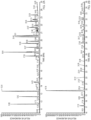
- Fig. 5A shows a chromatogram of Restek GC Multiresidue Pesticides Standard #6 using nitrogen as the carrier gas with the addition of 0.3 mL/min of methane.
- Fig. 5B shows a chromatogram of Restek GC Multiresidue Pesticides Standard #6 using nitrogen as a carrier gas with the addition of 1.5 mL/min of methane.
- Fig. 5C shows a chromatogram of Restek GC Multiresidue Pesticides Standard #6 using nitrogen as a carrier gas with the addition of 1.5 mL/min of methane with 5% ammonia. Peak trailing and reactions are still observable at the lower amount of methane as seen in Fig. 5A . Increasing the methane significantly reduces the peak trailing and reactions but, but results in a high baseline, as seen in Fig. 5B . The addition of 5% ammonia results in good peak shape, no reactions, and a lower baseline, as seen in Fig. 5C .
Landscapes
- Physics & Mathematics (AREA)
- Health & Medical Sciences (AREA)
- Life Sciences & Earth Sciences (AREA)
- Chemical & Material Sciences (AREA)
- Analytical Chemistry (AREA)
- Biochemistry (AREA)
- General Health & Medical Sciences (AREA)
- General Physics & Mathematics (AREA)
- Immunology (AREA)
- Pathology (AREA)
- Other Investigation Or Analysis Of Materials By Electrical Means (AREA)
Applications Claiming Priority (1)
| Application Number | Priority Date | Filing Date | Title |
|---|---|---|---|
| US202363589389P | 2023-10-11 | 2023-10-11 |
Publications (1)
| Publication Number | Publication Date |
|---|---|
| EP4538697A1 true EP4538697A1 (de) | 2025-04-16 |
Family
ID=93037350
Family Applications (1)
| Application Number | Title | Priority Date | Filing Date |
|---|---|---|---|
| EP24205182.9A Pending EP4538697A1 (de) | 2023-10-11 | 2024-10-08 | Trägergasionenfänger zur reduzierung von spitzenausbruch und reaktionen |
Country Status (3)
| Country | Link |
|---|---|
| US (1) | US20250123250A1 (de) |
| EP (1) | EP4538697A1 (de) |
| CN (1) | CN119804744A (de) |
Citations (7)
| Publication number | Priority date | Publication date | Assignee | Title |
|---|---|---|---|---|
| US5012052A (en) * | 1988-03-22 | 1991-04-30 | Indiana University Foundation | Isotope-ratio-monitoring gas chromatography-mass spectrometry apparatus and method |
| US20030086826A1 (en) * | 1999-01-25 | 2003-05-08 | Nippon Sanso Corporation | Method and an apparatus for analyzing trace impurities in gases |
| US20100101304A1 (en) * | 2008-10-23 | 2010-04-29 | Woods Hole Oceanographic Institution | Gas chromatograph-combustion system and method for mass spectrometry |
| US8371152B2 (en) * | 2010-10-27 | 2013-02-12 | Thermo Finnigan Llc | Helium conservation device for a gas chromatograph |
| US10012623B2 (en) | 2014-11-24 | 2018-07-03 | Marco CISTERNI | Apparatus and method for mitigation of alterations in mass spectrometry in the presence of hydrogen |
| EP3454359A1 (de) | 2017-09-08 | 2019-03-13 | Cisterni, Marco | Ionenquelle |
| US20210305036A1 (en) | 2020-03-26 | 2021-09-30 | Agilent Technologies, Inc. | Ion source |
-
2024
- 2024-10-08 US US18/909,067 patent/US20250123250A1/en active Pending
- 2024-10-08 EP EP24205182.9A patent/EP4538697A1/de active Pending
- 2024-10-10 CN CN202411409468.6A patent/CN119804744A/zh active Pending
Patent Citations (7)
| Publication number | Priority date | Publication date | Assignee | Title |
|---|---|---|---|---|
| US5012052A (en) * | 1988-03-22 | 1991-04-30 | Indiana University Foundation | Isotope-ratio-monitoring gas chromatography-mass spectrometry apparatus and method |
| US20030086826A1 (en) * | 1999-01-25 | 2003-05-08 | Nippon Sanso Corporation | Method and an apparatus for analyzing trace impurities in gases |
| US20100101304A1 (en) * | 2008-10-23 | 2010-04-29 | Woods Hole Oceanographic Institution | Gas chromatograph-combustion system and method for mass spectrometry |
| US8371152B2 (en) * | 2010-10-27 | 2013-02-12 | Thermo Finnigan Llc | Helium conservation device for a gas chromatograph |
| US10012623B2 (en) | 2014-11-24 | 2018-07-03 | Marco CISTERNI | Apparatus and method for mitigation of alterations in mass spectrometry in the presence of hydrogen |
| EP3454359A1 (de) | 2017-09-08 | 2019-03-13 | Cisterni, Marco | Ionenquelle |
| US20210305036A1 (en) | 2020-03-26 | 2021-09-30 | Agilent Technologies, Inc. | Ion source |
Also Published As
| Publication number | Publication date |
|---|---|
| CN119804744A (zh) | 2025-04-11 |
| US20250123250A1 (en) | 2025-04-17 |
Similar Documents
| Publication | Publication Date | Title |
|---|---|---|
| US11017990B2 (en) | Compact mass spectrometer | |
| EP2667401B1 (de) | Glimmentladungsionenquelle | |
| US10978288B2 (en) | Compact mass spectrometer | |
| CN106687807B (zh) | 用于定量分析的基于受调节的辉光放电的软电离 | |
| US10784097B2 (en) | Atmospheric-pressure ionization and fragmentation of molecules for structural elucidation | |
| GB2451768A (en) | A method of supplying a cone gas/curtain gas for a mass spectrometer | |
| US10354847B2 (en) | Compact mass spectrometer | |
| WO2014191747A1 (en) | Compact mass spectrometer | |
| CN113675070A (zh) | 一种基于等离子体原理的质谱源内解离方法和装置 | |
| GB2520788A (en) | Compact mass spectrometer | |
| EP4538697A1 (de) | Trägergasionenfänger zur reduzierung von spitzenausbruch und reaktionen | |
| US20250104993A1 (en) | Deuterium gas generator and devices for conservation thereof | |
| Le Vot et al. | Implementation of a Penning ionization source on a FTICR instrument with ion funnel optics | |
| GB2520785A (en) | Compact mass spectrometer | |
| Peng | Chemical mass shifts in quadrupole ion traps, miniature cylindrical ion trap and chiral analysis of amino acids using ESI-mass spectrometry | |
| Carnahan et al. | Determination of Active Pharmaceutical Ingredients by Heteroatom Selective Detection Using Inductively Coupled Plasma Mass Spectrometry with Ultrasonic Nebuilization and Membrane Desolvation Sample Introduction | |
| Kurimoto et al. | Energy-Resolved Mass Spectrometry (ERMS) of Oligosaccharide |
Legal Events
| Date | Code | Title | Description |
|---|---|---|---|
| PUAI | Public reference made under article 153(3) epc to a published international application that has entered the european phase |
Free format text: ORIGINAL CODE: 0009012 |
|
| STAA | Information on the status of an ep patent application or granted ep patent |
Free format text: STATUS: THE APPLICATION HAS BEEN PUBLISHED |
|
| AK | Designated contracting states |
Kind code of ref document: A1 Designated state(s): AL AT BE BG CH CY CZ DE DK EE ES FI FR GB GR HR HU IE IS IT LI LT LU LV MC ME MK MT NL NO PL PT RO RS SE SI SK SM TR |
|
| STAA | Information on the status of an ep patent application or granted ep patent |
Free format text: STATUS: REQUEST FOR EXAMINATION WAS MADE |
|
| 17P | Request for examination filed |
Effective date: 20251003 |
|
| STAA | Information on the status of an ep patent application or granted ep patent |
Free format text: STATUS: EXAMINATION IS IN PROGRESS |
|
| 17Q | First examination report despatched |
Effective date: 20260324 |