EP4538440A2 - Schuhartikel und bekleidung mit einem teilweise verschweissten stoffteil und herstellungsverfahren dafür - Google Patents
Schuhartikel und bekleidung mit einem teilweise verschweissten stoffteil und herstellungsverfahren dafür Download PDFInfo
- Publication number
- EP4538440A2 EP4538440A2 EP25150725.7A EP25150725A EP4538440A2 EP 4538440 A2 EP4538440 A2 EP 4538440A2 EP 25150725 A EP25150725 A EP 25150725A EP 4538440 A2 EP4538440 A2 EP 4538440A2
- Authority
- EP
- European Patent Office
- Prior art keywords
- fabric
- footwear
- yarns
- partially fused
- article
- Prior art date
- Legal status (The legal status is an assumption and is not a legal conclusion. Google has not performed a legal analysis and makes no representation as to the accuracy of the status listed.)
- Pending
Links
Images




Classifications
-
- A—HUMAN NECESSITIES
- A41—WEARING APPAREL
- A41B—SHIRTS; UNDERWEAR; BABY LINEN; HANDKERCHIEFS
- A41B17/00—Selection of special materials for underwear
-
- A—HUMAN NECESSITIES
- A41—WEARING APPAREL
- A41D—OUTERWEAR; PROTECTIVE GARMENTS; ACCESSORIES
- A41D31/00—Materials specially adapted for outerwear
-
- A—HUMAN NECESSITIES
- A43—FOOTWEAR
- A43B—CHARACTERISTIC FEATURES OF FOOTWEAR; PARTS OF FOOTWEAR
- A43B23/00—Uppers; Boot legs; Stiffeners; Other single parts of footwear
- A43B23/02—Uppers; Boot legs
- A43B23/0205—Uppers; Boot legs characterised by the material
- A43B23/0215—Plastics or artificial leather
-
- A—HUMAN NECESSITIES
- A43—FOOTWEAR
- A43B—CHARACTERISTIC FEATURES OF FOOTWEAR; PARTS OF FOOTWEAR
- A43B23/00—Uppers; Boot legs; Stiffeners; Other single parts of footwear
- A43B23/02—Uppers; Boot legs
- A43B23/0205—Uppers; Boot legs characterised by the material
- A43B23/0225—Composite materials, e.g. material with a matrix
-
- A—HUMAN NECESSITIES
- A43—FOOTWEAR
- A43B—CHARACTERISTIC FEATURES OF FOOTWEAR; PARTS OF FOOTWEAR
- A43B23/00—Uppers; Boot legs; Stiffeners; Other single parts of footwear
- A43B23/02—Uppers; Boot legs
- A43B23/0205—Uppers; Boot legs characterised by the material
- A43B23/0235—Different layers of different material
-
- A—HUMAN NECESSITIES
- A43—FOOTWEAR
- A43B—CHARACTERISTIC FEATURES OF FOOTWEAR; PARTS OF FOOTWEAR
- A43B23/00—Uppers; Boot legs; Stiffeners; Other single parts of footwear
- A43B23/02—Uppers; Boot legs
- A43B23/0245—Uppers; Boot legs characterised by the constructive form
-
- A—HUMAN NECESSITIES
- A43—FOOTWEAR
- A43B—CHARACTERISTIC FEATURES OF FOOTWEAR; PARTS OF FOOTWEAR
- A43B23/00—Uppers; Boot legs; Stiffeners; Other single parts of footwear
- A43B23/02—Uppers; Boot legs
- A43B23/0245—Uppers; Boot legs characterised by the constructive form
- A43B23/0255—Uppers; Boot legs characterised by the constructive form assembled by gluing or thermo bonding
-
- A—HUMAN NECESSITIES
- A43—FOOTWEAR
- A43B—CHARACTERISTIC FEATURES OF FOOTWEAR; PARTS OF FOOTWEAR
- A43B23/00—Uppers; Boot legs; Stiffeners; Other single parts of footwear
- A43B23/02—Uppers; Boot legs
- A43B23/0245—Uppers; Boot legs characterised by the constructive form
- A43B23/026—Laminated layers
-
- A—HUMAN NECESSITIES
- A43—FOOTWEAR
- A43B—CHARACTERISTIC FEATURES OF FOOTWEAR; PARTS OF FOOTWEAR
- A43B23/00—Uppers; Boot legs; Stiffeners; Other single parts of footwear
- A43B23/02—Uppers; Boot legs
- A43B23/04—Uppers made of one piece; Uppers with inserted gussets
-
- A—HUMAN NECESSITIES
- A43—FOOTWEAR
- A43B—CHARACTERISTIC FEATURES OF FOOTWEAR; PARTS OF FOOTWEAR
- A43B23/00—Uppers; Boot legs; Stiffeners; Other single parts of footwear
- A43B23/02—Uppers; Boot legs
- A43B23/04—Uppers made of one piece; Uppers with inserted gussets
- A43B23/042—Uppers made of one piece
-
- A—HUMAN NECESSITIES
- A43—FOOTWEAR
- A43B—CHARACTERISTIC FEATURES OF FOOTWEAR; PARTS OF FOOTWEAR
- A43B5/00—Footwear for sporting purposes
- A43B5/02—Football boots or shoes, i.e. for soccer, football or rugby
-
- A—HUMAN NECESSITIES
- A43—FOOTWEAR
- A43B—CHARACTERISTIC FEATURES OF FOOTWEAR; PARTS OF FOOTWEAR
- A43B5/00—Footwear for sporting purposes
- A43B5/06—Running shoes; Track shoes
-
- A—HUMAN NECESSITIES
- A43—FOOTWEAR
- A43D—MACHINES, TOOLS, EQUIPMENT OR METHODS FOR MANUFACTURING OR REPAIRING FOOTWEAR
- A43D8/00—Machines for cutting, ornamenting, marking or otherwise working up shoe part blanks
-
- B—PERFORMING OPERATIONS; TRANSPORTING
- B29—WORKING OF PLASTICS; WORKING OF SUBSTANCES IN A PLASTIC STATE IN GENERAL
- B29C—SHAPING OR JOINING OF PLASTICS; SHAPING OF MATERIAL IN A PLASTIC STATE, NOT OTHERWISE PROVIDED FOR; AFTER-TREATMENT OF THE SHAPED PRODUCTS, e.g. REPAIRING
- B29C43/00—Compression moulding, i.e. applying external pressure to flow the moulding material; Apparatus therefor
- B29C43/02—Compression moulding, i.e. applying external pressure to flow the moulding material; Apparatus therefor of articles of definite length, i.e. discrete articles
- B29C43/18—Compression moulding, i.e. applying external pressure to flow the moulding material; Apparatus therefor of articles of definite length, i.e. discrete articles incorporating preformed parts or layers, e.g. compression moulding around inserts or for coating articles
- B29C43/183—Compression moulding, i.e. applying external pressure to flow the moulding material; Apparatus therefor of articles of definite length, i.e. discrete articles incorporating preformed parts or layers, e.g. compression moulding around inserts or for coating articles the preformed layer being a lining, e.g. shaped in the mould before compression moulding, or a preformed shell adapted to the shape of the mould
- B29C43/184—Compression moulding, i.e. applying external pressure to flow the moulding material; Apparatus therefor of articles of definite length, i.e. discrete articles incorporating preformed parts or layers, e.g. compression moulding around inserts or for coating articles the preformed layer being a lining, e.g. shaped in the mould before compression moulding, or a preformed shell adapted to the shape of the mould shaped by the compression of the material during moulding
-
- B—PERFORMING OPERATIONS; TRANSPORTING
- B29—WORKING OF PLASTICS; WORKING OF SUBSTANCES IN A PLASTIC STATE IN GENERAL
- B29C—SHAPING OR JOINING OF PLASTICS; SHAPING OF MATERIAL IN A PLASTIC STATE, NOT OTHERWISE PROVIDED FOR; AFTER-TREATMENT OF THE SHAPED PRODUCTS, e.g. REPAIRING
- B29C51/00—Shaping by thermoforming, i.e. shaping sheets or sheet like preforms after heating, e.g. shaping sheets in matched moulds or by deep-drawing; Apparatus therefor
- B29C51/26—Component parts, details or accessories; Auxiliary operations
- B29C51/42—Heating or cooling
- B29C51/421—Heating or cooling of preforms, specially adapted for thermoforming
-
- B—PERFORMING OPERATIONS; TRANSPORTING
- B29—WORKING OF PLASTICS; WORKING OF SUBSTANCES IN A PLASTIC STATE IN GENERAL
- B29C—SHAPING OR JOINING OF PLASTICS; SHAPING OF MATERIAL IN A PLASTIC STATE, NOT OTHERWISE PROVIDED FOR; AFTER-TREATMENT OF THE SHAPED PRODUCTS, e.g. REPAIRING
- B29C51/00—Shaping by thermoforming, i.e. shaping sheets or sheet like preforms after heating, e.g. shaping sheets in matched moulds or by deep-drawing; Apparatus therefor
- B29C51/26—Component parts, details or accessories; Auxiliary operations
- B29C51/46—Measuring, controlling or regulating
-
- B—PERFORMING OPERATIONS; TRANSPORTING
- B29—WORKING OF PLASTICS; WORKING OF SUBSTANCES IN A PLASTIC STATE IN GENERAL
- B29D—PRODUCING PARTICULAR ARTICLES FROM PLASTICS OR FROM SUBSTANCES IN A PLASTIC STATE
- B29D35/00—Producing footwear
- B29D35/0054—Producing footwear by compression moulding, vulcanising or the like; Apparatus therefor
-
- D—TEXTILES; PAPER
- D04—BRAIDING; LACE-MAKING; KNITTING; TRIMMINGS; NON-WOVEN FABRICS
- D04B—KNITTING
- D04B1/00—Weft knitting processes for the production of fabrics or articles not dependent on the use of particular machines; Fabrics or articles defined by such processes
- D04B1/14—Other fabrics or articles characterised primarily by the use of particular thread materials
- D04B1/16—Other fabrics or articles characterised primarily by the use of particular thread materials synthetic threads
-
- D—TEXTILES; PAPER
- D04—BRAIDING; LACE-MAKING; KNITTING; TRIMMINGS; NON-WOVEN FABRICS
- D04B—KNITTING
- D04B21/00—Warp knitting processes for the production of fabrics or articles not dependent on the use of particular machines; Fabrics or articles defined by such processes
- D04B21/14—Fabrics characterised by the incorporation by knitting, in one or more thread, fleece, or fabric layers, of reinforcing, binding, or decorative threads; Fabrics incorporating small auxiliary elements, e.g. for decorative purposes
- D04B21/16—Fabrics characterised by the incorporation by knitting, in one or more thread, fleece, or fabric layers, of reinforcing, binding, or decorative threads; Fabrics incorporating small auxiliary elements, e.g. for decorative purposes incorporating synthetic threads
-
- A—HUMAN NECESSITIES
- A41—WEARING APPAREL
- A41B—SHIRTS; UNDERWEAR; BABY LINEN; HANDKERCHIEFS
- A41B2500/00—Materials for shirts, underwear, baby linen or handkerchiefs not provided for in other groups of this subclass
- A41B2500/50—Synthetic resins or rubbers
-
- A—HUMAN NECESSITIES
- A41—WEARING APPAREL
- A41D—OUTERWEAR; PROTECTIVE GARMENTS; ACCESSORIES
- A41D2500/00—Materials for garments
- A41D2500/50—Synthetic resins or rubbers
-
- B—PERFORMING OPERATIONS; TRANSPORTING
- B29—WORKING OF PLASTICS; WORKING OF SUBSTANCES IN A PLASTIC STATE IN GENERAL
- B29L—INDEXING SCHEME ASSOCIATED WITH SUBCLASS B29C, RELATING TO PARTICULAR ARTICLES
- B29L2031/00—Other particular articles
- B29L2031/48—Wearing apparel
- B29L2031/50—Footwear, e.g. shoes or parts thereof
- B29L2031/505—Uppers
-
- D—TEXTILES; PAPER
- D10—INDEXING SCHEME ASSOCIATED WITH SUBLASSES OF SECTION D, RELATING TO TEXTILES
- D10B—INDEXING SCHEME ASSOCIATED WITH SUBLASSES OF SECTION D, RELATING TO TEXTILES
- D10B2401/00—Physical properties
- D10B2401/04—Heat-responsive characteristics
- D10B2401/041—Heat-responsive characteristics thermoplastic; thermosetting
-
- D—TEXTILES; PAPER
- D10—INDEXING SCHEME ASSOCIATED WITH SUBLASSES OF SECTION D, RELATING TO TEXTILES
- D10B—INDEXING SCHEME ASSOCIATED WITH SUBLASSES OF SECTION D, RELATING TO TEXTILES
- D10B2403/00—Details of fabric structure established in the fabric forming process
- D10B2403/01—Surface features
- D10B2403/011—Dissimilar front and back faces
- D10B2403/0114—Dissimilar front and back faces with one or more yarns appearing predominantly on one face, e.g. plated or paralleled yarns
-
- D—TEXTILES; PAPER
- D10—INDEXING SCHEME ASSOCIATED WITH SUBLASSES OF SECTION D, RELATING TO TEXTILES
- D10B—INDEXING SCHEME ASSOCIATED WITH SUBLASSES OF SECTION D, RELATING TO TEXTILES
- D10B2403/00—Details of fabric structure established in the fabric forming process
- D10B2403/02—Cross-sectional features
- D10B2403/021—Lofty fabric with equidistantly spaced front and back plies, e.g. spacer fabrics
-
- D—TEXTILES; PAPER
- D10—INDEXING SCHEME ASSOCIATED WITH SUBLASSES OF SECTION D, RELATING TO TEXTILES
- D10B—INDEXING SCHEME ASSOCIATED WITH SUBLASSES OF SECTION D, RELATING TO TEXTILES
- D10B2403/00—Details of fabric structure established in the fabric forming process
- D10B2403/03—Shape features
- D10B2403/032—Flat fabric of variable width, e.g. including one or more fashioned panels
-
- D—TEXTILES; PAPER
- D10—INDEXING SCHEME ASSOCIATED WITH SUBLASSES OF SECTION D, RELATING TO TEXTILES
- D10B—INDEXING SCHEME ASSOCIATED WITH SUBLASSES OF SECTION D, RELATING TO TEXTILES
- D10B2501/00—Wearing apparel
- D10B2501/04—Outerwear; Protective garments
- D10B2501/043—Footwear
Definitions
- the disclosed embodiments relate to footwear and methods of making footwear having a fabric portion with partially fused yarns and filaments.
- An article of footwear can be multi-functional.
- an article of footwear can provide cushioning to a user's foot, support a user's foot, and protect a user's foot.
- Each of these functions alone or in combination, provides for a comfortable article of footwear suitable for use in a variety of scenarios (e.g., during leisure activities or during exercise or sports activities).
- the characteristics of an article of footwear e.g., shape and materials used to make footwear
- Durable footwear functions properly for an extended period of time, which instills a user's trust in specific manufacture's footwear and, in turn, leading to repeat sales.
- an article of footwear, or a portion thereof may be configured to provide various degrees of durability, weight, and breathability.
- the cost to manufacturing an article of footwear is another design consideration. Footwear, or a portion thereof, that can be manufactured at a relatively low cost is desirable for manufactures and consumers. Footwear that can be manufactured using a relatively small amount of resources (e.g., energy and man power), materials, and time reduces manufacturing costs and may also reduce the environmental impact of manufacturing. Accordingly, designing footwear having a manufacturing cost is also desirable.
- the article of footwear includes an upper made, at least in part, of fabric-a sheet material made textile monofilament yarns, multifilament yarns and/or yarns that are, for example, woven, knitted, braided, netted, felted, plaited, laid, embroidered, or otherwise bonded together to give the material mechanical strength.
- the fabric of an upper can be a knitted fabric made by interlocking series of loops of one or more yarns.
- the fabric of an upper can be a woven fabric made of two series of yarn-warp and filling-that are interlaced to form the fabric.
- the fabric can be nonwoven such that the filaments may or may not be interlaced with each other depending on the means of construction of the nonwoven fabric.
- a “yarn” is a continuous strand made of a plurality of filaments that are twisted or otherwise held together, and correspondingly, a “filament” is the fundamental component of a yarn that, for example, can be spun into a yarn.
- the fabric of the upper can be a mesh, which may be open with holes or closed without visible holes.
- a "mesh” is a fabric (e.g., knitted, woven, crocheted, laced, or knotted) having open spaces between the yarns.
- the fabric of the upper can be a sandwich mesh.
- a "sandwich mesh” is a multilayer layer fabric that includes at least a first layer of mesh, a second layer of mesh, and spacer yarns between the first and second layers of mesh that connects the first and second layers of mesh.
- the spacer yarns can be, for example, monofilament or multifilament.
- the fabric forming at least a portion of the upper includes a portion that is fused.
- fused means yarns composing the portion and filaments composing those yarns are joined by melting.
- Fully fused means that the yarns and filaments composing the yarns are melted such that the fabric portion is transformed into a unitary layer in which the yarns and filaments are no longer individually identifiable.
- partially fused means the yarns and filaments composing the yarns are fused to a degree such that the yarns and the filaments are still individually identifiable after being fused.
- the partially fused yarns and filaments do not melt and transform into a unitary layer in which the yarns and filaments are no longer individually identifiable.
- the fabric comprises low-melting-temperature and higher-melting-temperature yarns
- the low-melting-temperature yarns of the partially fused portion melt completely such that the yarn structure of the low-melting-temperature yarns may not be visible, but the structure of the higher-melting-temperature yarns are still identifiable.
- FIGs. 1A-1C illustrate magnified views of knitted fabric that are (a) not fused, (b) partially fused, and (c) fully fused, respectively, according to an embodiment.
- the yarns 100 and the filaments 102 composing the yarns 100 are not joined by melting-not fused-and each of the yarns 100 and each filament 100 composing the yarns are identifiable.
- yarns 100 are not fused together at, for example, interface 104 and are free to move independently relative to each other, and the filaments 102 composing yarns 100 are not fused to adjacent filaments at their respective interfaces and are free to move independently relative to each other.
- yarns 100 and the filaments 102 are partially fused.
- Yarns 100 and filaments 102 composing yarns 100 are melted to a degree such that yarns 100 and the filaments 102 composing these yarns 100 are still individually identifiable after being partially fused.
- one yarn 100 is fused to an adjacent yarn 100 at interface 104, and filaments 102 composing yarns 100 are fused to adjacent filaments 102.
- the individual yarns 100 cannot move independently relative to adjacent yarns 100, and individual filaments 102 cannot move independent relative to adjacent filaments 102.
- a partially fused fabric portion can have a tear strength such that the portion does not tear when a 40 N force is applied to the portion. Accordingly, an upper of the article of footwear having a partially fused portion can have improved stretch and support characteristics without significantly compromising tear strength.
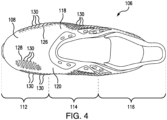
- Article of footwear 106 includes a forefoot region 112, a midfoot region 114, and a heel region 116.
- Forefoot region 112 generally corresponds with the portion of article of footwear 106 that receives the toes and the joints that connect the metatarsals with the phalanges.
- Midfoot region 114 generally corresponds with the portion of article of footwear 106 that receives the arch of the foot.
- heel region 116 generally corresponds with the portion of article of footwear 106 that receives the calcaneus bone.
- Regions 112, 114, and 116 are not intended to demarcate precise areas of article of footwear 106. Rather, regions 112, 114, and 116 are intended to represent general areas of article of footwear 106 that provide a frame of reference.
- Upper 108 can be made, at least in part, of a fabric having at least one partially fused portion in which yarns are partially fused to adjacent yarns and filaments of the partially fused yarns are partially fused to adjacent filaments.
- upper 108 has three discrete partially fused portions 126, 128, and 130. In other embodiments (not shown), upper 108 can have more than or less than three discrete partially portions.
- partially fused portion 126 is on lateral side 118 of article of footwear 106.
- Partially fused potion 126 extends from forefoot region 112 to heel region 116.
- partially fused portion 126 is located at only one or two of regions 112, 114, and 116.
- partially fused portion 126 can be shaped to just be at forefoot region 112, or partially fused portion 126 can be shaped to just be at midfoot region 114 and heel region 116.
- upper 108 can have three discrete partially fused portions at each of regions 112, 114, and 116 on lateral side 118.
- partially fused portion 126 has an undulated, non-linear shape.
- partially fused portion 126 can have other shapes, for example, a linear shape, an arcuate shape, an oval shape, or a triangular shape.
- partially fused portion 128 is on medial side 120 and on top of forefoot region 112 of upper 108.
- partially fused portion 128 can be positioned such that it overlaps the big toe of a user's foot received within upper 108.
- partially fused portion 128 can extend from medial side 120 to lateral side 118.
- partially fused portion 128 extends from forefoot region 112 to at least midfoot region 114.
- upper 108 can include more than one discrete and partially fused portions on top of forefoot region 112 of upper 108. As best seen in FIG.
- partially fused portion 128 can have a substantially linear shape when viewed from above.
- partially fused portion 128 can have other shapes, for example, a non-linear shape, a circular shape, a triangular shape, an undulating shape, an arcuate shape, when view from above.
- partially fused portion 128 can cover substantially the entire top of forefoot region 112.
- partially fused portion 130 is on medial side 120 of article of footwear 106. Partially fused portion 130 extends from forefoot region 112 to heel region 116. In other embodiments (not shown), partially fused portion 130 is positioned at only one or two of regions 112, 114, and 116. For example, partially fused portion 130 can be shaped to just be at forefoot region 112, or partially fused portion 126 can be shaped to just be at midfoot region 114 and heel region 116. In other embodiments (not shown), upper 108 can have three discrete partially fused portions at each of portions 126, 128, and 130 on medial side 120. As best seen in FIG. 3 , partially fused portion 130 has an undulated, non-linear shape. In other embodiments, partially fused portion 126 can have other shapes, for example, a linear shape, an arcuate shape, an oval shape, or a triangular shape.
- upper instead of three discrete portions 126, 128, and 130 covering, at least in part, lateral side 118 from forefoot region 112 to heel region 116, the top of forefoot region 112, and medial side 120 from forefoot region 112 to heel region 116, upper can have one continuous partially fused fabric portion that covers each of these three areas. And in some embodiments, substantially the entire upper 108 is composed of partially fused fabric.
- upper 108 includes at least one partially fused fabric portion that is embossed.
- one or more of partially fused portions 126, 128, and 130 can be embossed.
- each of partially fused portions 126, 128, and 130 includes a plurality of embossed portions 130 that are part of a repeating undulating pattern.
- embossed portions 130 are plurality of substantially linear ribs having a semi-circular cross-sectional shape, and embossed portions 130 are substantially evenly spaced apart from each other.
- embossed portions 130 can be non-linear, have other cross-sectional shapes, or be part of a non-repeating or irregular pattern. Embossing portions of the partially fused fabric can provide additional structural support to upper 108. Additionally, embossing can be used to provide three-dimensional aesthetic designs in upper 108.
- upper 108 includes at least one partially fused fabric portion that has tensile and tear mechanical properties that are advantageous for footwear applications.
- one or more of partially fused portions 126, 128, and 130 have tensile and tear mechanical properties that are advantageous for footwear applications.
- each of partially fused portions 126, 128, and 130 has a tensile strength such that the respective partially fused portion displaces less than 10 percent of the respective partially fused fabric portion's unstressed dimension when a 100 N force is applied to the fabric portion.
- each of partially fused fabric portions 126, 128, and 130 also has a tensile strength such that the respective partially fused fabric portion does not plastically deform when a 150 N force is applied to the fabric portion.
- each of partially fused fabric portions 126, 128, and 130 has a tear strength such that the respective portion does not tear when a 40 N force is applied to the portion in some embodiments.
- Uppers having partially fused portions with one or more of the above mechanical properties have desired compliance, breathability, and support to be used for footwear, for example, shoes for leisure, running, soccer, American football, and basketball. Uppers having partially fused portions with one or more of the above mechanical properties are not too brittle or stiff to be used in footwear applications.
- upper 108 to be manufactured substantially as one unitary piece.
- the fabric composing upper 108 is continuous from forefoot region 112 to heel region 116, and upper 108 is continuous from lateral side 118 to medial side 120.
- a one-piece upper 108 can reduce the total weight of article of footwear 106, improving user comfort and performance.
- a one-piece upper 108 can reduce manufacturing costs by reducing the amount of required material and manufacturing time.
- upper 108 can include a knitted fabric that comprises the partially fused portion.
- upper 108 can be made of a knitted mesh fabric.
- the knitted mesh fabric can be a single layer mesh fabric.
- the knitted mesh fabric can be a multi-layer sandwich mesh fabric.
- upper 108 can be made, at least in part, of a sandwich mesh fabric including an outer layer (i.e., facing away from the foot), an inner layer (i.e., facing the foot), and spacer yarns (e.g., a monofilament spacer yarns) in between the outer layer and the inner layer that connects the outer and inner layers.
- a sandwich mesh fabric including an outer layer (i.e., facing away from the foot), an inner layer (i.e., facing the foot), and spacer yarns (e.g., a monofilament spacer yarns) in between the outer layer and the inner layer that connects the outer and inner layers.
- the outer layer comprises one or more of polyester, polyamide (for example, nylon such as PA6), and segmented polyurethane (for example, spandex);
- the inner layer comprises one or more of polyester, polyamide (for example, nylon such as PA6), and segmented polyurethane (for example, spandex);
- the spacer yarns comprise one or more of polyamide (for example, a nylon monofilament) or polyester (for example, a polyester monofilament).
- any one of these materials can be a thermoplastic.
- a thermoplastic is a material that has a lower melting point than other yarns used in the fabric.
- the thermoplastic can be a thermoplastic polyester, a thermoplastic polyurethane (for example, an ether type 64 shore D TPU), a thermoplastic nylon such as PA6, a thermoplastic co-polyester, or a thermoplastic co-polyamide.
- the outer layer can be made of nylon and spandex
- the spacer yarns can be nylon monofilament
- the inner layer can be made of polyester and spandex.
- the total composition of the sandwich mesh is about 60 percent to about 70 percent (for example, about 67 percent) nylon, about 5 percent to about 15 percent (for example, about 10 percent) spandex, and about 20 percent to about 25 percent (for example, about 23 percent) polyester.
- the outer layer can be made of nylon (for example, about 45 percent to about 50 percent-for example, about 48 percent-of the total composition of the mesh)
- the spacer yarns can be nylon monofilament (for example, about 20 percent to about 25 percent-for example, about 23 percent-of the total composition of the mesh)
- the inner layer can be made of polyester (for example, about 25 percent to about 30 percent-for example, about 29 percent-the total composition of the mesh).
- the outer layer can be made of 210D nylon and 140D nylon; the inner layer can be made of 100D polyester and 75D polyester; and the spacer yarns can be nylon (for example, a nylon monofilament).
- the outer layer is about 25 percent to about 30 percent (for example, about 29 percent) 210 D nylon, and about 25 percent to about 35 percent (for example, about 26 percent) 140 D nylon; the inner layer is about 10 percent to about 20 percent (for example, about 15 percent) 100D polyester, and about 10 percent to about 15 percent (for example, about 14 percent 75D) polyester.
- the mesh is 100 of upper 108 percent nylon or 100 percent polyester. In some sandwich mesh embodiments, the mesh of upper 108 is 100 percent thermoplastic polyurethane. In some sandwich mesh embodiments, the mesh of upper 108 includes about 20 percent to about 30 percent (for example, about 25 percent) low melt co-polyester coated polyester yarn, and about 70 percent to about 80 percent (for example, about 75 percent) polyester yarn that form, for example, a circular knit or a flat knit. In some flat knit embodiments, the mesh of upper 108 includes about 25 percent to about 50 percent low melt co-polyester, and about 75 percent to about 50 percent polyester yarn.
- FIGs. 5-7 illustrate an article of footwear 206 that includes an upper that has at least one fabric portion having yarns partially fused to adjacent yarns and filaments fused to adjacent filaments, according to another embodiment.
- Article of footwear 206 includes an upper 208 and a sole 210 coupled to upper 208.
- Article of footwear 206 includes a forefoot region 212, a midfoot region 214, and a heel region 216.
- Article of footwear 206 also includes a lateral side 218 (see FIGs. 5 and 7 ) and a medial side 220 (see FIGs. 6 and 7 ) that each extend from forefoot region 212 to heel region 216.
- Upper 208 can be made of, at least in part, a fabric having at least one partially fused portion in which yarns are partially fused to adjacent yarns and filaments of the partially fused yarns are partially fused to adjacent filaments.
- upper 208 can have a first portion 232 that is partially fused.
- Partially fused portion 232 is in forefoot region 212 and overlaps with the distal ends of a user's toes in the forefoot region 212.
- Fused portion 232 wraps around the front edge of upper 208 from lateral side 218 to medial side 220.
- fused portion 232 is embossed as shown.
- Upper 208 also includes a region 240 at heel region 216 that includes a plurality of portions 242 that are partially fused.
- Partially fused portions 242 of region 240 are on both lateral side 218 and medial side 220.
- partially fused portions 242 are non-linear elongated ribs that are spaced apart.
- the shape of partially fused portions 242 correspond to the shape of partially fused portions 238 in region 236.
- portions 242 can be linear or not elongated.
- partially fused portions 242 are embossed as shown. In other embodiments, partially fused portions 242 are not embossed.
- Partially fused portions 232, 234, 238, and 242 can have tensile and tear mechanical properties that are advantageous for footwear applications.
- each of partially fused portions 232, 234, 238, and 242 can have a tensile strength such that the respective partially fused portion displaces less than 10% of the respective partially fused fabric portion's unstressed dimension when a 100 N force is applied to the fabric portion in some embodiments.
- each of partially fused fabric portions 232, 234, 238, and 242 can also have a tensile strength such that the respective partially fused fabric portion does not plastically deform when a 150 N force is applied to the fabric portion in some embodiments.
- each of partially fused fabric portions 232, 234, 238, and 242 can have a tear strength such that the respective portion does not tear when a 40 N force is applied to the portion in some embodiments.
- Uppers having partially fused portions with one or more of the above mechanical properties have desired compliance, breathability, and support to be used for footwear, for example, shoes for leisure, running, soccer, American football, and basketball. That is, uppers having partially fused portions with one or more of the above mechanical properties are not too brittle or stiff to be used in footwear applications. Moreover, having at least one partially fused portion with one or more of the above mechanical properties allows upper 208 to be manufactured substantially as one unitary piece. In some one-piece embodiments, the fabric composing upper 208 is continuous from forefoot region 212 to heel region 216, and upper 208 is continuous from lateral side 218 to medial side 220. A one-piece upper 208 can reduce the total weight of article of footwear 106, improving user comfort and performance.
- Upper 208 can be made of fabric and yarn as described in any one of the embodiments related to upper 108 above.
- the partially fused portion(s) can be generated by thermal compression molding, RF welding, ultrasonic welding, or any other suitable molding technique.
- applying heat to the fabric blank for example, using a thermal compression molding apparatus, at a predetermined temperature and at a predetermined pressure for a predetermined time period partially fuses yarns to adjacent yarns and partially fuses filaments of the partially fused yarns to adjacent filaments.
- the partially fused fabric portion can have tensile and tear mechanical properties that are advantageous for footwear applications.
- applying heat to the fabric blank at a predetermined temperature and at a predetermined pressure for a predetermined time period can partially fuse yarns to adjacent yarns and partially fuse filaments of the partially fused yarns to adjacent filaments such that the partially fused portion can have a tensile strength such that the partially fused portion displaces less than 10% of the partially fused fabric portion's unstressed dimension when a 100 N force is applied to the fabric portion.
- the partially fused fabric portion can also have a tensile strength such that the partially fused fabric portion does not plastically deform when a 150 N force is applied to the fabric portion.
- the partially fused fabric portion can have a tear strength such that the portion does not tear when a 40 N force is applied to the portion. In some embodiments, the partially fused portion will have one or more of these tensile and tear mechanical properties.
- At least one of the predetermined temperature, the predetermined pressure, and the predetermined time period is selected based on characteristics of the fabric forming fabric blank.
- characteristics include the fabric construction type (e.g., woven, knitted, braided, netted, felted, plaited, single layer, multiple layer, etc.), yarn construction type (e.g., cabled yarn, core yarn, coated yarn, etc.), yarn weight (e.g., Denier), the color of the filaments forming the yarn, material content of the fabric (e.g., polyester, nylon, thermoplastic, spandex, and materials having different melting temperatures).
- fabric construction type e.g., woven, knitted, braided, netted, felted, plaited, single layer, multiple layer, etc.
- yarn construction type e.g., cabled yarn, core yarn, coated yarn, etc.
- yarn weight e.g., Denier
- the color of the filaments forming the yarn e.g., polyester, nylon, thermoplastic, spandex, and
- the fabric blank is a knitted sandwich mesh in which (a) the outer layer is a thermoplastic polyurethane, (b) the spacer yarns are polyester, and (c) the inner layer is polyester and spandex with the total composition of the mesh being about 35 percent to about 40 percent (for example, about 37 percent) thermoplastic polyurethane, about 5 percent to about 10 percent (for example, about 7 percent) spandex, and about 55 percent to about 60 percent (for example, about 56 percent) polyester, the predetermined temperature is selected to be in the range of about 160 °C to about 185 °C (for example, about 165 °C or about 175 °C), the predetermined time period is selected to be in the range from about 25 seconds to about 35 seconds (for example, about 30 seconds), and the predetermined pressure selected to be about 5 kgf/cm 2 .
- the fabric blank is then than pressed at the selected parameters.
- the cut fabric blank is formed into an upper of the article of footwear.
- ends 136 and 138 of cut fabric blank 134 are coupled together, for example, stitched together.
- a back strip of material may be coupled to, for example, sewn or adhered, to the inside or outside of fabric blank 134 at the seam at which ends 136 and 138 are stitched together to form upper 700.
- fabric blank 134 is configured with a bellows tongue arrangement to allow for a one piece construction and thereby reducing the number of upper pieces and manufacturing steps required.
- a tongue (not shown) in FIG. 8 is coupled, for example, sewn, to fabric blank 134.
- cut fabric blank 134 is shaped over a last (not shown), and an interlining and/or a strobel sock are coupled to fabric blank 134 to form the upper of the article of footwear.
- the separate tongue is also pressed to form partially fused portions as described above.
- the fabric blank is embroidered before or after heat is applied to the fabric blank to partially fuse at least one portion of the fabric blank. Embroidering the fabric blank can increase the tear strength of the partially fused portion(s) of the fabric blank.
- the predetermined temperature at which the fabric blank is heated is based on whether the fabric blank is embroidered. For example, in some embodiments, the predetermined temperature at which an embroidered fabric blank is heated can be higher than the predetermined temperature at which an unembroidered fabric blank is heated.
- the method of manufacturing uppers having at least one partially fused portion also includes heat transfer printing (also known as sublimation transfer printing).
- a design can be preprinted on transfer paper with disperse dyes that sublime onto the fabric upper.
- the heat transfer paper with the design is placed in the mold in contact with the fabric blank.
- the mold is then placed onto the thermal compression molding apparatus, and heat and pressure are applied to the transfer paper and fabric blank to transfer the design from the paper onto the fabric blank and to partially fuse a portion of the fabric blank.
- the transfer paper and fabric blank are heated to a temperature (for example, about 180 °C to about 190 °C, e.g., about 180 °C) to both transfer the design to the fabric blank and to partially fuse a portion of the fabric blank. Then the mold is removed from the compression molding apparatus, and the transfer paper and the fabric blank with a partially fused portion are removed from the mold. The fabric blank can then be formed into an upper.
- a temperature for example, about 180 °C to about 190 °C, e.g., about 180 °C
- a portion of the design transferred from the transfer paper is positioned on the partially fused portion of the upper.
- Other articles of apparel include, but are not limited to, pants, shorts, leggings, a sock, a jacket, a coat, a hat, a sleeve, a sweater, a jersey, a bootie, and a glove.
- the fabric on areas of apparel that are subject to excessive wear and tear can be partially fused for durability.
- the fabric at the knee area of pants can be partially fused to provide increase durability to the knee area
- the fabric at the elbow area of shirts, jackets, and coats can be partially fused to provide increase durability to the elbow area.
- the fabric of apparel can be partially fused and embossed with aesthetic pattern.
- any one of pants, shorts, leggings, a sock, a jacket, a coat, a hat, a sleeve, a sweater, a jersey, a bootie, and a glove can be embossed with aesthetic pattern.
- any one of pants, shorts, leggings, a sock, a jacket, a coat, a hat, a sleeve, a sweater, a jersey, a bootie, and a glove can be partially fused to increase the strength of the fabric and reduce number of required layers or materials to manufacture the apparel item, decreasing both weight and manufacturing costs of the apparel item.
Landscapes
- Engineering & Computer Science (AREA)
- Chemical & Material Sciences (AREA)
- Materials Engineering (AREA)
- Mechanical Engineering (AREA)
- Textile Engineering (AREA)
- Health & Medical Sciences (AREA)
- General Health & Medical Sciences (AREA)
- Physical Education & Sports Medicine (AREA)
- Composite Materials (AREA)
- Footwear And Its Accessory, Manufacturing Method And Apparatuses (AREA)
- Knitting Of Fabric (AREA)
Applications Claiming Priority (3)
| Application Number | Priority Date | Filing Date | Title |
|---|---|---|---|
| CN201610388509.7A CN107455840B (zh) | 2016-06-02 | 2016-06-02 | 具有部分熔合的织物部分的鞋和服饰制品及其制造方法 |
| EP23154107.9A EP4190199B1 (de) | 2016-06-02 | 2016-08-29 | Schuh- und bekleidungsartikel mit teilweise schmelzgebundenem stoffteil und verfahren zur herstellung davon |
| EP16186117.4A EP3260005B1 (de) | 2016-06-02 | 2016-08-29 | Schuh- und bekleidungsartikel mit teilweise schmelzgebundenem stoffteil und verfahren zur herstellung davon |
Related Parent Applications (2)
| Application Number | Title | Priority Date | Filing Date |
|---|---|---|---|
| EP16186117.4A Division EP3260005B1 (de) | 2016-06-02 | 2016-08-29 | Schuh- und bekleidungsartikel mit teilweise schmelzgebundenem stoffteil und verfahren zur herstellung davon |
| EP23154107.9A Division EP4190199B1 (de) | 2016-06-02 | 2016-08-29 | Schuh- und bekleidungsartikel mit teilweise schmelzgebundenem stoffteil und verfahren zur herstellung davon |
Publications (2)
| Publication Number | Publication Date |
|---|---|
| EP4538440A2 true EP4538440A2 (de) | 2025-04-16 |
| EP4538440A3 EP4538440A3 (de) | 2025-07-30 |
Family
ID=56802422
Family Applications (3)
| Application Number | Title | Priority Date | Filing Date |
|---|---|---|---|
| EP16186117.4A Active EP3260005B1 (de) | 2016-06-02 | 2016-08-29 | Schuh- und bekleidungsartikel mit teilweise schmelzgebundenem stoffteil und verfahren zur herstellung davon |
| EP25150725.7A Pending EP4538440A3 (de) | 2016-06-02 | 2016-08-29 | Schuhartikel und bekleidung mit einem teilweise verschweissten stoffteil und herstellungsverfahren dafür |
| EP23154107.9A Active EP4190199B1 (de) | 2016-06-02 | 2016-08-29 | Schuh- und bekleidungsartikel mit teilweise schmelzgebundenem stoffteil und verfahren zur herstellung davon |
Family Applications Before (1)
| Application Number | Title | Priority Date | Filing Date |
|---|---|---|---|
| EP16186117.4A Active EP3260005B1 (de) | 2016-06-02 | 2016-08-29 | Schuh- und bekleidungsartikel mit teilweise schmelzgebundenem stoffteil und verfahren zur herstellung davon |
Family Applications After (1)
| Application Number | Title | Priority Date | Filing Date |
|---|---|---|---|
| EP23154107.9A Active EP4190199B1 (de) | 2016-06-02 | 2016-08-29 | Schuh- und bekleidungsartikel mit teilweise schmelzgebundenem stoffteil und verfahren zur herstellung davon |
Country Status (3)
| Country | Link |
|---|---|
| US (3) | US10703060B2 (de) |
| EP (3) | EP3260005B1 (de) |
| CN (2) | CN112971272B (de) |
Families Citing this family (29)
| Publication number | Priority date | Publication date | Assignee | Title |
|---|---|---|---|---|
| US9573331B2 (en) * | 2010-12-10 | 2017-02-21 | Converse Inc. | Thermoplastic polyurethane infused mesh |
| US20130255103A1 (en) | 2012-04-03 | 2013-10-03 | Nike, Inc. | Apparel And Other Products Incorporating A Thermoplastic Polymer Material |
| USD834799S1 (en) * | 2017-01-12 | 2018-12-04 | Adidas Ag | Sole |
| USD834796S1 (en) * | 2017-01-12 | 2018-12-04 | Adidas Ag | Sole |
| USD834797S1 (en) * | 2017-01-12 | 2018-12-04 | Adidas Ag | Sole |
| USD829422S1 (en) * | 2017-01-12 | 2018-10-02 | Adidas Ag | Sole |
| USD834798S1 (en) * | 2017-01-12 | 2018-12-04 | Adidas Ag | Sole |
| USD829421S1 (en) * | 2017-01-12 | 2018-10-02 | Adidas Ag | Sole |
| USD829420S1 (en) * | 2017-01-12 | 2018-10-02 | Adidas Ag | Sole |
| USD829423S1 (en) * | 2017-01-12 | 2018-10-02 | Adidas Ag | Sole |
| US10694817B2 (en) * | 2017-03-07 | 2020-06-30 | Adidas Ag | Article of footwear with upper having stitched polymer thread pattern and methods of making the same |
| US10194714B2 (en) | 2017-03-07 | 2019-02-05 | Adidas Ag | Article of footwear with upper having stitched polymer thread pattern and methods of making the same |
| EP3697955A1 (de) | 2017-10-20 | 2020-08-26 | NIKE Innovate C.V. | Gestrickte blähbereiche |
| DE102017223750B4 (de) * | 2017-12-22 | 2021-10-07 | Adidas Ag | Gestrickte oder gewirkte Komponente |
| US10791791B2 (en) | 2018-01-20 | 2020-10-06 | Nike, Inc. | Articles of footwear reinforced with high tenacity yarn |
| USD881536S1 (en) | 2018-02-08 | 2020-04-21 | Adidas Ag | Shoe |
| EP4623746A3 (de) | 2018-04-10 | 2025-12-17 | NIKE Innovate C.V. | Mehrschichtige extrudierte oberteile für schuhartikel und andere fussaufnahmevorrichtungen |
| USD885020S1 (en) | 2018-04-13 | 2020-05-26 | Adidas Ag | Sole |
| HUP1800163A1 (hu) * | 2018-05-16 | 2019-12-30 | Laszlo Oroszi | Labdakezelést segítõ mintázat sportcipõkhöz |
| HUP1800162A2 (hu) * | 2018-05-16 | 2019-12-30 | Laszlo Oroszi | Labdakezelést segítõ sávos mintázat sportcipõkhöz |
| USD899035S1 (en) | 2019-03-08 | 2020-10-20 | Adidas Ag | Shoe |
| CN114468459B (zh) | 2019-08-02 | 2024-09-10 | 耐克创新有限合伙公司 | 用于鞋类物品的鞋外底 |
| EP4155444A1 (de) | 2019-11-18 | 2023-03-29 | NIKE Innovate C.V. | Oberteil für schuhwerk und verfahren zur herstellung desselben |
| TWI771648B (zh) * | 2020-02-11 | 2022-07-21 | 黃詠 | 鞋面及鞋面製造方法 |
| EP4125484A1 (de) * | 2020-03-29 | 2023-02-08 | NIKE Innovate C.V. | Sohlenstruktur eines schuhwerks |
| TWI751535B (zh) * | 2020-04-24 | 2022-01-01 | 三芳化學工業股份有限公司 | 織物結構及其製造方法 |
| US12171303B2 (en) * | 2022-09-14 | 2024-12-24 | Lululemon Athletica Canada Inc. | Upper for article of footwear with forefoot airflow features |
| CN115404606B (zh) * | 2022-09-26 | 2024-09-24 | 安踏(中国)有限公司 | 一种改进型弦丝绣织面料的制造方法 |
| USD1119199S1 (en) * | 2025-01-10 | 2026-03-24 | Converse Inc. | Shoe |
Family Cites Families (29)
| Publication number | Priority date | Publication date | Assignee | Title |
|---|---|---|---|---|
| US2641004A (en) | 1950-12-26 | 1953-06-09 | David V Whiting | Method for producing knitted shoe uppers of shrinkable yarn |
| US3311692A (en) * | 1963-05-08 | 1967-03-28 | Union Carbide Corp | Gravure embossing of thermoplastics |
| US5707925A (en) * | 1986-04-11 | 1998-01-13 | Dai Nippon Insatsu Kabushiki Kaisha | Image formation on objective bodies |
| GB0104143D0 (en) | 2001-02-20 | 2001-04-11 | Courtaulds Textiles Holdings | Knitted fabric |
| JP4004471B2 (ja) * | 2001-10-31 | 2007-11-07 | 旭化成せんい株式会社 | 多層構造を有する弾性編地及びその製造方法 |
| US7611999B2 (en) * | 2002-11-16 | 2009-11-03 | Mcmurray Brian | Decorative faced multi-layer weft knit spacer fabric, method, and articles made therefrom |
| US6910288B2 (en) | 2002-12-18 | 2005-06-28 | Nike, Inc. | Footwear incorporating a textile with fusible filaments and fibers |
| WO2009058720A1 (en) * | 2007-10-29 | 2009-05-07 | The Keds Corporation | Articles of footwear |
| DE102008006504A1 (de) * | 2008-01-25 | 2009-07-30 | Sipra Patententwicklungs- Und Beteiligungsgesellschaft Mbh | Abstandsgestrick sowie Verfahren und Strickmaschine zu seiner Herstellung |
| US20100199520A1 (en) * | 2009-02-06 | 2010-08-12 | Nike, Inc. | Textured Thermoplastic Non-Woven Elements |
| US8850719B2 (en) * | 2009-02-06 | 2014-10-07 | Nike, Inc. | Layered thermoplastic non-woven textile elements |
| US8429835B2 (en) * | 2009-10-21 | 2013-04-30 | Nike, Inc. | Composite shoe upper and method of making same |
| US8321984B2 (en) * | 2009-10-21 | 2012-12-04 | Nike, Inc. | Composite shoe upper and method of making same |
| US9150986B2 (en) * | 2011-05-04 | 2015-10-06 | Nike, Inc. | Knit component bonding |
| DE102012202866A1 (de) * | 2012-02-24 | 2013-08-29 | Adidas Ag | Material für Schuhoberteil |
| US20130255103A1 (en) * | 2012-04-03 | 2013-10-03 | Nike, Inc. | Apparel And Other Products Incorporating A Thermoplastic Polymer Material |
| US20130260104A1 (en) * | 2012-04-03 | 2013-10-03 | Nike, Inc. | Yarns, Threads, And Textiles Incorporating A Thermoplastic Polymer Material |
| DE102012206062B4 (de) * | 2012-04-13 | 2019-09-12 | Adidas Ag | Schuhoberteil |
| US10132012B2 (en) | 2013-03-14 | 2018-11-20 | Federal-Mogul Powertrain Llc | End-fray resistant heat-shrinkable woven sleeve, assembly therewith and methods of construction thereof |
| DE102013207153B4 (de) * | 2013-04-19 | 2019-11-07 | Adidas Ag | An die Fußform angepasster Schuh |
| US10299531B2 (en) * | 2013-05-14 | 2019-05-28 | Nike, Inc. | Article of footwear incorporating a knitted component for a heel portion of an upper |
| CN113186623A (zh) * | 2013-05-29 | 2021-07-30 | 英威达技术有限公司 | 可熔双组分氨纶 |
| JP5597784B1 (ja) * | 2013-10-15 | 2014-10-01 | 有限会社Itoi生活文化研究所 | 織物 |
| US10544528B2 (en) * | 2013-12-23 | 2020-01-28 | The North Face Apparel Corp. | Textile constructs formed with fusible filaments |
| DE102014103861B4 (de) * | 2014-03-20 | 2016-12-22 | Müller Textil GmbH | Abstandsgewirke sowie Verfahren zur Herstellung eines Abstandsgewirkes |
| CN105077847A (zh) * | 2014-05-24 | 2015-11-25 | 安踏(中国)有限公司 | 一种鞋面成型工艺 |
| JP6276906B2 (ja) * | 2014-07-25 | 2018-02-07 | 美津濃株式会社 | スポーツシューズのアッパー構造およびその製造方法 |
| US10721997B2 (en) * | 2015-09-11 | 2020-07-28 | Nike, Inc. | Method of manufacturing article of footwear with graduated projections |
| US9888742B2 (en) * | 2015-09-11 | 2018-02-13 | Nike, Inc. | Article of footwear with knitted component having plurality of graduated projections |
-
2016
- 2016-06-02 CN CN202110319588.7A patent/CN112971272B/zh active Active
- 2016-06-02 CN CN201610388509.7A patent/CN107455840B/zh active Active
- 2016-06-24 US US15/192,351 patent/US10703060B2/en active Active
- 2016-08-29 EP EP16186117.4A patent/EP3260005B1/de active Active
- 2016-08-29 EP EP25150725.7A patent/EP4538440A3/de active Pending
- 2016-08-29 EP EP23154107.9A patent/EP4190199B1/de active Active
-
2020
- 2020-06-29 US US16/915,111 patent/US12269231B2/en active Active
-
2025
- 2025-03-28 US US19/094,424 patent/US20250222670A1/en active Pending
Also Published As
| Publication number | Publication date |
|---|---|
| US10703060B2 (en) | 2020-07-07 |
| EP3260005A1 (de) | 2017-12-27 |
| US12269231B2 (en) | 2025-04-08 |
| CN107455840B (zh) | 2021-04-16 |
| EP3260005B1 (de) | 2023-02-01 |
| US20170348935A1 (en) | 2017-12-07 |
| US20200324499A1 (en) | 2020-10-15 |
| CN107455840A (zh) | 2017-12-12 |
| US20250222670A1 (en) | 2025-07-10 |
| EP4538440A3 (de) | 2025-07-30 |
| CN112971272B (zh) | 2022-06-24 |
| EP4190199A1 (de) | 2023-06-07 |
| CN112971272A (zh) | 2021-06-18 |
| EP4190199B1 (de) | 2025-01-22 |
Similar Documents
| Publication | Publication Date | Title |
|---|---|---|
| US20250222670A1 (en) | Articles of footwear and apparel having a partially fused fabric portion and methods of making the same | |
| US12522960B2 (en) | Knit component bonding | |
| US20220256972A1 (en) | Three-dimensionally thermo-molded footwear | |
| TWI646911B (zh) | 具有編織組件之鞋類物件 | |
| CN103620100B (zh) | 层状热塑性非编织织物元件 | |
| US10779616B2 (en) | Three-dimensional thermo-molding of footwear | |
| JP5336663B2 (ja) | 伸張要素を組み込んだ履物物品 | |
| US11788219B2 (en) | Knitted textile and method of forming | |
| US12514334B2 (en) | Lightweight knitted upper and methods of manufacture |
Legal Events
| Date | Code | Title | Description |
|---|---|---|---|
| PUAI | Public reference made under article 153(3) epc to a published international application that has entered the european phase |
Free format text: ORIGINAL CODE: 0009012 |
|
| STAA | Information on the status of an ep patent application or granted ep patent |
Free format text: STATUS: REQUEST FOR EXAMINATION WAS MADE |
|
| 17P | Request for examination filed |
Effective date: 20250108 |
|
| AC | Divisional application: reference to earlier application |
Ref document number: 3260005 Country of ref document: EP Kind code of ref document: P Ref document number: 4190199 Country of ref document: EP Kind code of ref document: P |
|
| AK | Designated contracting states |
Kind code of ref document: A2 Designated state(s): AL AT BE BG CH CY CZ DE DK EE ES FI FR GB GR HR HU IE IS IT LI LT LU LV MC MK MT NL NO PL PT RO RS SE SI SK SM TR |
|
| REG | Reference to a national code |
Ref country code: DE Ref legal event code: R079 Free format text: PREVIOUS MAIN CLASS: D04B0001160000 Ipc: A43B0023020000 |
|
| PUAL | Search report despatched |
Free format text: ORIGINAL CODE: 0009013 |
|
| AK | Designated contracting states |
Kind code of ref document: A3 Designated state(s): AL AT BE BG CH CY CZ DE DK EE ES FI FR GB GR HR HU IE IS IT LI LT LU LV MC MK MT NL NO PL PT RO RS SE SI SK SM TR |
|
| RIC1 | Information provided on ipc code assigned before grant |
Ipc: A43B 23/02 20060101AFI20250623BHEP Ipc: D04H 1/14 20060101ALI20250623BHEP Ipc: D04H 1/54 20120101ALI20250623BHEP Ipc: D03D 15/00 20210101ALI20250623BHEP Ipc: D04B 1/16 20060101ALI20250623BHEP |
|
| STAA | Information on the status of an ep patent application or granted ep patent |
Free format text: STATUS: EXAMINATION IS IN PROGRESS |
|
| 17Q | First examination report despatched |
Effective date: 20260217 |