EP4538249A1 - Verbindung - Google Patents
Verbindung Download PDFInfo
- Publication number
- EP4538249A1 EP4538249A1 EP23203354.8A EP23203354A EP4538249A1 EP 4538249 A1 EP4538249 A1 EP 4538249A1 EP 23203354 A EP23203354 A EP 23203354A EP 4538249 A1 EP4538249 A1 EP 4538249A1
- Authority
- EP
- European Patent Office
- Prior art keywords
- formula
- ratio
- compound
- containing precursor
- bis
- Prior art date
- Legal status (The legal status is an assumption and is not a legal conclusion. Google has not performed a legal analysis and makes no representation as to the accuracy of the status listed.)
- Pending
Links
Images
Classifications
-
- C—CHEMISTRY; METALLURGY
- C03—GLASS; MINERAL OR SLAG WOOL
- C03C—CHEMICAL COMPOSITION OF GLASSES, GLAZES OR VITREOUS ENAMELS; SURFACE TREATMENT OF GLASS; SURFACE TREATMENT OF FIBRES OR FILAMENTS MADE FROM GLASS, MINERALS OR SLAGS; JOINING GLASS TO GLASS OR OTHER MATERIALS
- C03C17/00—Surface treatment of glass, not in the form of fibres or filaments, by coating
- C03C17/22—Surface treatment of glass, not in the form of fibres or filaments, by coating with other inorganic material
- C03C17/23—Oxides
- C03C17/245—Oxides by deposition from the vapour phase
-
- B—PERFORMING OPERATIONS; TRANSPORTING
- B32—LAYERED PRODUCTS
- B32B—LAYERED PRODUCTS, i.e. PRODUCTS BUILT-UP OF STRATA OF FLAT OR NON-FLAT, e.g. CELLULAR OR HONEYCOMB, FORM
- B32B18/00—Layered products essentially comprising ceramics, e.g. refractory products
-
- C—CHEMISTRY; METALLURGY
- C01—INORGANIC CHEMISTRY
- C01B—NON-METALLIC ELEMENTS; COMPOUNDS THEREOF; METALLOIDS OR COMPOUNDS THEREOF NOT COVERED BY SUBCLASS C01C
- C01B25/00—Phosphorus; Compounds thereof
- C01B25/16—Oxyacids of phosphorus; Salts thereof
- C01B25/26—Phosphates
- C01B25/38—Condensed phosphates
-
- C—CHEMISTRY; METALLURGY
- C01—INORGANIC CHEMISTRY
- C01B—NON-METALLIC ELEMENTS; COMPOUNDS THEREOF; METALLOIDS OR COMPOUNDS THEREOF NOT COVERED BY SUBCLASS C01C
- C01B25/00—Phosphorus; Compounds thereof
- C01B25/16—Oxyacids of phosphorus; Salts thereof
- C01B25/26—Phosphates
- C01B25/45—Phosphates containing plural metal, or metal and ammonium
-
- C—CHEMISTRY; METALLURGY
- C01—INORGANIC CHEMISTRY
- C01G—COMPOUNDS CONTAINING METALS NOT COVERED BY SUBCLASSES C01D OR C01F
- C01G39/00—Compounds of molybdenum
-
- C—CHEMISTRY; METALLURGY
- C01—INORGANIC CHEMISTRY
- C01G—COMPOUNDS CONTAINING METALS NOT COVERED BY SUBCLASSES C01D OR C01F
- C01G39/00—Compounds of molybdenum
- C01G39/006—Compounds containing molybdenum, with or without oxygen or hydrogen, and containing two or more other elements
-
- C—CHEMISTRY; METALLURGY
- C03—GLASS; MINERAL OR SLAG WOOL
- C03C—CHEMICAL COMPOSITION OF GLASSES, GLAZES OR VITREOUS ENAMELS; SURFACE TREATMENT OF GLASS; SURFACE TREATMENT OF FIBRES OR FILAMENTS MADE FROM GLASS, MINERALS OR SLAGS; JOINING GLASS TO GLASS OR OTHER MATERIALS
- C03C17/00—Surface treatment of glass, not in the form of fibres or filaments, by coating
- C03C17/22—Surface treatment of glass, not in the form of fibres or filaments, by coating with other inorganic material
- C03C17/23—Oxides
- C03C17/25—Oxides by deposition from the liquid phase
-
- C—CHEMISTRY; METALLURGY
- C03—GLASS; MINERAL OR SLAG WOOL
- C03C—CHEMICAL COMPOSITION OF GLASSES, GLAZES OR VITREOUS ENAMELS; SURFACE TREATMENT OF GLASS; SURFACE TREATMENT OF FIBRES OR FILAMENTS MADE FROM GLASS, MINERALS OR SLAGS; JOINING GLASS TO GLASS OR OTHER MATERIALS
- C03C17/00—Surface treatment of glass, not in the form of fibres or filaments, by coating
- C03C17/34—Surface treatment of glass, not in the form of fibres or filaments, by coating with at least two coatings having different compositions
- C03C17/3411—Surface treatment of glass, not in the form of fibres or filaments, by coating with at least two coatings having different compositions with at least two coatings of inorganic materials
- C03C17/3417—Surface treatment of glass, not in the form of fibres or filaments, by coating with at least two coatings having different compositions with at least two coatings of inorganic materials all coatings being oxide coatings
-
- C—CHEMISTRY; METALLURGY
- C04—CEMENTS; CONCRETE; ARTIFICIAL STONE; CERAMICS; REFRACTORIES
- C04B—LIME, MAGNESIA; SLAG; CEMENTS; COMPOSITIONS THEREOF, e.g. MORTARS, CONCRETE OR LIKE BUILDING MATERIALS; ARTIFICIAL STONE; CERAMICS; REFRACTORIES; TREATMENT OF NATURAL STONE
- C04B35/00—Shaped ceramic products characterised by their composition; Ceramics compositions; Processing powders of inorganic compounds preparatory to the manufacturing of ceramic products
- C04B35/01—Shaped ceramic products characterised by their composition; Ceramics compositions; Processing powders of inorganic compounds preparatory to the manufacturing of ceramic products based on oxide ceramics
- C04B35/447—Shaped ceramic products characterised by their composition; Ceramics compositions; Processing powders of inorganic compounds preparatory to the manufacturing of ceramic products based on oxide ceramics based on phosphates, e.g. hydroxyapatite
-
- C—CHEMISTRY; METALLURGY
- C04—CEMENTS; CONCRETE; ARTIFICIAL STONE; CERAMICS; REFRACTORIES
- C04B—LIME, MAGNESIA; SLAG; CEMENTS; COMPOSITIONS THEREOF, e.g. MORTARS, CONCRETE OR LIKE BUILDING MATERIALS; ARTIFICIAL STONE; CERAMICS; REFRACTORIES; TREATMENT OF NATURAL STONE
- C04B35/00—Shaped ceramic products characterised by their composition; Ceramics compositions; Processing powders of inorganic compounds preparatory to the manufacturing of ceramic products
- C04B35/01—Shaped ceramic products characterised by their composition; Ceramics compositions; Processing powders of inorganic compounds preparatory to the manufacturing of ceramic products based on oxide ceramics
- C04B35/495—Shaped ceramic products characterised by their composition; Ceramics compositions; Processing powders of inorganic compounds preparatory to the manufacturing of ceramic products based on oxide ceramics based on vanadium, niobium, tantalum, molybdenum or tungsten oxides or solid solutions thereof with other oxides, e.g. vanadates, niobates, tantalates, molybdates or tungstates
-
- C—CHEMISTRY; METALLURGY
- C04—CEMENTS; CONCRETE; ARTIFICIAL STONE; CERAMICS; REFRACTORIES
- C04B—LIME, MAGNESIA; SLAG; CEMENTS; COMPOSITIONS THEREOF, e.g. MORTARS, CONCRETE OR LIKE BUILDING MATERIALS; ARTIFICIAL STONE; CERAMICS; REFRACTORIES; TREATMENT OF NATURAL STONE
- C04B35/00—Shaped ceramic products characterised by their composition; Ceramics compositions; Processing powders of inorganic compounds preparatory to the manufacturing of ceramic products
- C04B35/622—Forming processes; Processing powders of inorganic compounds preparatory to the manufacturing of ceramic products
- C04B35/626—Preparing or treating the powders individually or as batches ; preparing or treating macroscopic reinforcing agents for ceramic products, e.g. fibres; mechanical aspects section B
- C04B35/62605—Treating the starting powders individually or as mixtures
- C04B35/6261—Milling
- C04B35/62615—High energy or reactive ball milling
-
- C—CHEMISTRY; METALLURGY
- C04—CEMENTS; CONCRETE; ARTIFICIAL STONE; CERAMICS; REFRACTORIES
- C04B—LIME, MAGNESIA; SLAG; CEMENTS; COMPOSITIONS THEREOF, e.g. MORTARS, CONCRETE OR LIKE BUILDING MATERIALS; ARTIFICIAL STONE; CERAMICS; REFRACTORIES; TREATMENT OF NATURAL STONE
- C04B35/00—Shaped ceramic products characterised by their composition; Ceramics compositions; Processing powders of inorganic compounds preparatory to the manufacturing of ceramic products
- C04B35/622—Forming processes; Processing powders of inorganic compounds preparatory to the manufacturing of ceramic products
- C04B35/626—Preparing or treating the powders individually or as batches ; preparing or treating macroscopic reinforcing agents for ceramic products, e.g. fibres; mechanical aspects section B
- C04B35/62605—Treating the starting powders individually or as mixtures
- C04B35/62645—Thermal treatment of powders or mixtures thereof other than sintering
- C04B35/62655—Drying, e.g. freeze-drying, spray-drying, microwave or supercritical drying
-
- C—CHEMISTRY; METALLURGY
- C04—CEMENTS; CONCRETE; ARTIFICIAL STONE; CERAMICS; REFRACTORIES
- C04B—LIME, MAGNESIA; SLAG; CEMENTS; COMPOSITIONS THEREOF, e.g. MORTARS, CONCRETE OR LIKE BUILDING MATERIALS; ARTIFICIAL STONE; CERAMICS; REFRACTORIES; TREATMENT OF NATURAL STONE
- C04B35/00—Shaped ceramic products characterised by their composition; Ceramics compositions; Processing powders of inorganic compounds preparatory to the manufacturing of ceramic products
- C04B35/622—Forming processes; Processing powders of inorganic compounds preparatory to the manufacturing of ceramic products
- C04B35/626—Preparing or treating the powders individually or as batches ; preparing or treating macroscopic reinforcing agents for ceramic products, e.g. fibres; mechanical aspects section B
- C04B35/62605—Treating the starting powders individually or as mixtures
- C04B35/62645—Thermal treatment of powders or mixtures thereof other than sintering
- C04B35/62675—Thermal treatment of powders or mixtures thereof other than sintering characterised by the treatment temperature
-
- C—CHEMISTRY; METALLURGY
- C03—GLASS; MINERAL OR SLAG WOOL
- C03C—CHEMICAL COMPOSITION OF GLASSES, GLAZES OR VITREOUS ENAMELS; SURFACE TREATMENT OF GLASS; SURFACE TREATMENT OF FIBRES OR FILAMENTS MADE FROM GLASS, MINERALS OR SLAGS; JOINING GLASS TO GLASS OR OTHER MATERIALS
- C03C2218/00—Methods for coating glass
- C03C2218/10—Deposition methods
- C03C2218/11—Deposition methods from solutions or suspensions
-
- C—CHEMISTRY; METALLURGY
- C03—GLASS; MINERAL OR SLAG WOOL
- C03C—CHEMICAL COMPOSITION OF GLASSES, GLAZES OR VITREOUS ENAMELS; SURFACE TREATMENT OF GLASS; SURFACE TREATMENT OF FIBRES OR FILAMENTS MADE FROM GLASS, MINERALS OR SLAGS; JOINING GLASS TO GLASS OR OTHER MATERIALS
- C03C2218/00—Methods for coating glass
- C03C2218/10—Deposition methods
- C03C2218/15—Deposition methods from the vapour phase
-
- C—CHEMISTRY; METALLURGY
- C04—CEMENTS; CONCRETE; ARTIFICIAL STONE; CERAMICS; REFRACTORIES
- C04B—LIME, MAGNESIA; SLAG; CEMENTS; COMPOSITIONS THEREOF, e.g. MORTARS, CONCRETE OR LIKE BUILDING MATERIALS; ARTIFICIAL STONE; CERAMICS; REFRACTORIES; TREATMENT OF NATURAL STONE
- C04B2235/00—Aspects relating to ceramic starting mixtures or sintered ceramic products
- C04B2235/02—Composition of constituents of the starting material or of secondary phases of the final product
- C04B2235/30—Constituents and secondary phases not being of a fibrous nature
- C04B2235/32—Metal oxides, mixed metal oxides, or oxide-forming salts thereof, e.g. carbonates, nitrates, (oxy)hydroxides, chlorides
- C04B2235/3205—Alkaline earth oxides or oxide forming salts thereof, e.g. beryllium oxide
- C04B2235/3215—Barium oxides or oxide-forming salts thereof
-
- C—CHEMISTRY; METALLURGY
- C04—CEMENTS; CONCRETE; ARTIFICIAL STONE; CERAMICS; REFRACTORIES
- C04B—LIME, MAGNESIA; SLAG; CEMENTS; COMPOSITIONS THEREOF, e.g. MORTARS, CONCRETE OR LIKE BUILDING MATERIALS; ARTIFICIAL STONE; CERAMICS; REFRACTORIES; TREATMENT OF NATURAL STONE
- C04B2235/00—Aspects relating to ceramic starting mixtures or sintered ceramic products
- C04B2235/02—Composition of constituents of the starting material or of secondary phases of the final product
- C04B2235/30—Constituents and secondary phases not being of a fibrous nature
- C04B2235/32—Metal oxides, mixed metal oxides, or oxide-forming salts thereof, e.g. carbonates, nitrates, (oxy)hydroxides, chlorides
- C04B2235/3231—Refractory metal oxides, their mixed metal oxides, or oxide-forming salts thereof
- C04B2235/3256—Molybdenum oxides, molybdates or oxide forming salts thereof, e.g. cadmium molybdate
-
- C—CHEMISTRY; METALLURGY
- C04—CEMENTS; CONCRETE; ARTIFICIAL STONE; CERAMICS; REFRACTORIES
- C04B—LIME, MAGNESIA; SLAG; CEMENTS; COMPOSITIONS THEREOF, e.g. MORTARS, CONCRETE OR LIKE BUILDING MATERIALS; ARTIFICIAL STONE; CERAMICS; REFRACTORIES; TREATMENT OF NATURAL STONE
- C04B2235/00—Aspects relating to ceramic starting mixtures or sintered ceramic products
- C04B2235/02—Composition of constituents of the starting material or of secondary phases of the final product
- C04B2235/30—Constituents and secondary phases not being of a fibrous nature
- C04B2235/44—Metal salt constituents or additives chosen for the nature of the anions, e.g. hydrides or acetylacetonate
- C04B2235/447—Phosphates or phosphites, e.g. orthophosphate or hypophosphite
-
- C—CHEMISTRY; METALLURGY
- C04—CEMENTS; CONCRETE; ARTIFICIAL STONE; CERAMICS; REFRACTORIES
- C04B—LIME, MAGNESIA; SLAG; CEMENTS; COMPOSITIONS THEREOF, e.g. MORTARS, CONCRETE OR LIKE BUILDING MATERIALS; ARTIFICIAL STONE; CERAMICS; REFRACTORIES; TREATMENT OF NATURAL STONE
- C04B2235/00—Aspects relating to ceramic starting mixtures or sintered ceramic products
- C04B2235/65—Aspects relating to heat treatments of ceramic bodies such as green ceramics or pre-sintered ceramics, e.g. burning, sintering or melting processes
- C04B2235/656—Aspects relating to heat treatments of ceramic bodies such as green ceramics or pre-sintered ceramics, e.g. burning, sintering or melting processes characterised by specific heating conditions during heat treatment
- C04B2235/6567—Treatment time
-
- C—CHEMISTRY; METALLURGY
- C04—CEMENTS; CONCRETE; ARTIFICIAL STONE; CERAMICS; REFRACTORIES
- C04B—LIME, MAGNESIA; SLAG; CEMENTS; COMPOSITIONS THEREOF, e.g. MORTARS, CONCRETE OR LIKE BUILDING MATERIALS; ARTIFICIAL STONE; CERAMICS; REFRACTORIES; TREATMENT OF NATURAL STONE
- C04B2235/00—Aspects relating to ceramic starting mixtures or sintered ceramic products
- C04B2235/65—Aspects relating to heat treatments of ceramic bodies such as green ceramics or pre-sintered ceramics, e.g. burning, sintering or melting processes
- C04B2235/66—Specific sintering techniques, e.g. centrifugal sintering
- C04B2235/666—Applying a current during sintering, e.g. plasma sintering [SPS], electrical resistance heating or pulse electric current sintering [PECS]
-
- C—CHEMISTRY; METALLURGY
- C04—CEMENTS; CONCRETE; ARTIFICIAL STONE; CERAMICS; REFRACTORIES
- C04B—LIME, MAGNESIA; SLAG; CEMENTS; COMPOSITIONS THEREOF, e.g. MORTARS, CONCRETE OR LIKE BUILDING MATERIALS; ARTIFICIAL STONE; CERAMICS; REFRACTORIES; TREATMENT OF NATURAL STONE
- C04B2235/00—Aspects relating to ceramic starting mixtures or sintered ceramic products
- C04B2235/70—Aspects relating to sintered or melt-casted ceramic products
- C04B2235/96—Properties of ceramic products, e.g. mechanical properties such as strength, toughness, wear resistance
- C04B2235/9646—Optical properties
- C04B2235/9653—Translucent or transparent ceramics other than alumina
Definitions
- the present invention relates to a compound, a sintered body comprising the compound, a glass article coated with the compound, a method of manufacturing the glass article and the use of the compound.
- Coatings on substrate surfaces find uses in many fields. Some of the more useful coatings are metal oxides, for example, tin oxide. Some metal oxides (including doped tin oxide) can form transparent conductive oxide (TCO) coatings. TCOs have high optical transmission at visible wavelengths and electrical conductivity that is close to that of metals.
- TCOs are as energy saving, low-emissivity coatings for architectural windows, as high scattering layers that form the front electrical contact of a wide variety of photovoltaic (PV) thin film modules and as glass coatings in a number of electronic devices including liquid-crystal displays, OLEDs and touchscreens.
- PV photovoltaic
- TCOs include doped zinc oxide (e.g. ZnO:Al [ZAO] or ZnO: B), tin oxide doped with fluorine (SnO 2 :F) and an oxide of indium and tin (ITO).
- ZnO:Al [ZAO] or ZnO: B tin oxide doped with fluorine
- ITO oxide of indium and tin
- TCMs transparent conductive materials
- TCOs are wide band gap semiconductors that rely on heavy doping to improve the carrier concentration.
- correlated metals provide an alternative route to thin film TCMs. Due to the large intrinsic carrier density in conventional metals, the free carrier reflection is generally within or above the visible spectrum. However, in a correlated metal transparent conductor, interelectron repulsion shifts the plasma frequency out of the visible region to enhance optical transmission, while the high carrier density of the metal retains sufficient conductivity.
- compounds according to the first aspect are useful as semiconductors, for example in some cases as TCMs, and provide useful optical properties.
- a layer is said to be "based on” a particular material or materials, this means that the layer predominantly consists of the corresponding said material or materials, which means typically that it comprises at least about 50 at.% of said material or materials.
- compositions consisting essentially of a set of components will comprise less than 5% by weight, typically less than 3% by weight, more typically less than 1% by weight of non-specified components.
- a transparent material or a transparent substrate is a material or a substrate that is capable of transmitting visible light so that objects or images situated beyond or behind said material can be distinctly seen through said material or substrate.
- the "thickness" of a layer is, for any given location at a surface of the layer, represented by the distance through the layer, in the direction of the smallest dimension of the layer, from said location at a surface of the layer to a location at an opposing surface of said layer.
- the ratio of a:b is from 1:50 to 50:1, more preferably from 1:50 to 1:1.5 or from 1.5:1 to 50:1, even more preferably from 1:40 to 1:1.8 or from 1.8:1 to 40:1, even more preferably from 1:30 to 1:2 or from 2:1 to 30:1.
- the ratio of c:(a+b) is greater than 1:1, more preferably greater than 1.05:1, even more preferably greater than 1.1:1, even more preferably greater than 1.2:1, most preferably greater than 1.3:1, but preferably less than 10:1, more preferably less than 5:1, even more preferably less than 4:1, most preferably less than 3:1.
- the ratio of d:e is from 1:50 to 0.95:1 or from 1.05:1 to 50:1, more preferably the ratio of d:e is from 1:30 to 0.9:1 or from 1.1:1 to 30:1, even more preferably the ratio of d:e is from 1:30 to 0.8:1 or from 1.2:1 to 30:1.
- the ratio of f:(d+e) is greater than 2:1, more preferably greater than 2.05:1, even more preferably greater than 2.1:1, even more preferably greater than 2.13:1, most preferably greater than 2.15:1, but preferably less than 5:1, more preferably less than 3:1, even more preferably less than 2.5:1, most preferably less than 2.4:1.
- the ratio of g:h is from 1:50 to 1.45:1, more preferably from 1:50 to 1.4:1, even more preferably from 1:40 to 1.3:1, even more preferably from 1:30 to 1.2:1.
- the ratio of g:i is from 1:50 to 50:1, more preferably from 1:20 to 10:1, even more preferably from 1:18 to 2:1, even more preferably from 1:16 to 1.5:1.
- the ratio of h:i is from 1:50 to 1:2.05, or from 1:1.95 to 1.95:1, or from 2.05:1 to 50:1; more preferably from 1:30 to 1:2.05, or from 1:1.95 to 1.95:1, or from 2.05:1 to 30:1; more preferably from 1:10 to 1:2.1, or from 1:1.9 to 1.9:1, or from 2.1:1 to 10:1; even more preferably from 1:3 to 1:2.1, or from 1:1.9 to 1.9:1, or from 2.1:1 to 3:1; most preferably from 1:3 to 1:2.15, or from 1:1.85 to 1.85:1, or from 2.15:1 to 3:1.
- the ratio of j:(g+h+i) is greater than 1:1, more preferably greater than 1.5:1, even more preferably greater than 1.9:1, even more preferably greater than 2:1, most preferably greater than 2.1:1, but preferably less than 10:1, more preferably less than 3:1, even more preferably less than 2.5:1, most preferably less than 2.4:1.
- each of a, b and c may be multiplied by an integer, provided the integer is the same, plus or minus 1, for each of a, b and c, i.e. the compound may be a compositional equivalent of formula (1).
- the compound represented by formula (1) is selected from BaMo 2 O 6 , Ba 2 Mo 6 O 17 , Ba 4 Mo 2 O 9 , and Ba 6 Mo 2 O 11 , or a compositional equivalent of any of these compounds, meaning that for each of these compounds, each of a, b and c may be multiplied by an integer, provided the integer is the same, plus or minus 1, for each of a, b and c.
- each of d, e and f may be multiplied by an integer, provided the integer is the same, plus or minus 1, for each of d, e and f, i.e. the compound may be a compositional equivalent of formula (2).
- the compound represented by formula (2) is selected from MoP 3 O 10 , Mo 3 PO 10 , and Mo 4 P 2 O 15 , or a compositional equivalent of any of these compounds, meaning that for each of these compounds, each of d, e and f may be multiplied by an integer, provided the integer is the same, plus or minus 1, for each of d, e and f.
- each of g, h, i and j may be multiplied by an integer, provided the integer is the same, plus or minus 1, for each of g, h, i and j, i.e. the compound may be a compositional equivalent of formula (3).
- BaMo 2 P 2 O 11 is a compositional equivalent of Ba 5 Mo 8 P 12 O 55 .
- the compound represented by formula (3) is selected from BaMoPOe, BaMo 4 P 4 O 21 , Ba 5 Mo 8 P 12 O 55 , or a compositional equivalent of any of these compounds, meaning that for each of these compounds, each of g, h, i and j may be multiplied by an integer, provided the integer is the same, plus or minus 1, for each of g, h, i and j.
- the compound is represented by formula (1) or formula (3) only, more preferably the compound is represented by formula (3) only.
- a sintered body comprising a compound represented by one of the formulae: Ba a Mo b O c (1), Mo d P e O f (2) or Ba g Mo h P i O j (3)
- the ratio of a:b is from 1:50 to 50:1, more preferably the ratio of a:b is from 1:10 to 10:1, even more preferably the ratio of a:b is from 1:5 to 5:1.
- the ratio of d:e is from 1:50 to 50:1, more preferably the ratio of d:e is from 1:10 to 10:1.
- the ratio of g:h is from 1:50 to 50:1, more preferably from 1:50 to 10:1, even more preferably from 1:50 to 2:1, even more preferably from 1:50 to 1.2:1.
- the ratio of g:i is from 1:40 to 40:1, more preferably from 1:30 to 20:1, even more preferably from 1:20 to 10:1, even more preferably from 1:18 to 3:1.
- the compound of the sintered body of the second aspect is the compound of the first aspect.
- a coated glass article comprising:
- the compound of the first layer of the coating of the third aspect is the compound of the first aspect or the compound of the second aspect.
- the first layer may be directly or indirectly formed on the glass substrate.
- the first layer has a thickness of at least 10 nm, more preferably at least 100 nm, even more preferably at least 150 nm, most preferably at least 180 nm, but preferably at most 700 nm, more preferably at most 500 nm, even more preferably at most 400 nm, most preferably at most 300 nm.
- the coating may further comprise one or more lower layer between the glass substrate and the first layer.
- the coating may further comprise one or more upper layer located further from the glass substrate than the first layer.
- Said lower layer and/or said upper layer may each comprise one or more dielectric layer.
- said dielectric layers comprise one or more anti-reflective layers that enable the coated glass article to exhibit a visible light reflection that is lower than the visible light reflection exhibited by the glass substrate alone.
- the coating is located on a first major surface of the glass substrate.
- the coating coats the majority of the first major surface. More preferably the coating coats substantially all of the first major surface. Most preferably the coating coats all of the first major surface.
- at least one, more preferably each, of the first layer and any other layer that is present is a continuous layer.
- the lower layer directly coats all of the first major surface, i.e. the lower layer is in direct contact with all of the first major surface.
- at least one, more preferably each, of the first layer and the upper layer indirectly coats all of the first major surface.
- the glass substrate is transparent.
- the transparent glass substrate may be clear or tinted.
- the transparent glass substrate is a clear transparent glass substrate.
- the transparent glass substrate may be a metal oxide-based glass pane.
- the glass pane may be a clear or tinted float glass pane.
- the glass pane is a clear glass pane.
- a typical soda-lime-silicate glass composition is (by weight), SiOz 69 - 74 %; Al 2 O 3 0 - 3 %; Na 2 O 10 - 16 %; K 2 O 0 - 5 %; MgO 0 - 6 %; CaO 5 - 14 %; SO 3 0 - 2 % and Fe 2 O 3 0.005 - 2 %.
- the glass composition may also contain other additives, for example, refining aids, which would normally be present in an amount of up to 2 %.
- clear float glass it is meant a glass having a composition as defined in BS EN 572-1 and BS EN 572-2 (2004).
- the Fe 2 O 3 level by weight is typically 0.11%.
- Float glass with an Fe 2 O 3 content less than about 0.05% by weight is typically referred to as low iron float glass.
- Such glass usually has the same basic composition of the other component oxides i.e. low iron float glass is also a soda-lime-silicate glass, as is clear float glass.
- tinted float glass has at least 0.5% by weight Fe 2 O 3 , e.g. 1.0% by weight Fe 2 O 3 .
- the glass pane is a borosilicate-based glass pane, an alkali-aluminosilicate-based glass pane, or an aluminium oxide-based crystal glass pane.
- the coated glass article exhibits a visible light transmittance of at least 60%, more preferably at least 70%, even more preferably at least 80%, even more preferably at least 90.
- the coated glass article exhibits a sheet resistance (Rs) of less than 8 ohms/sq, more preferably less than 7 ohms/sq, even more preferably less than 6 ohms/sq, most preferably less than 5 ohms/sq.
- Rs sheet resistance
- the coated glass article may further comprise a second coating located on an opposing major surface of the glass substrate, i.e. the coating referred to in the preceding paragraphs is located on a first major surface of the glass substrate and the second coating is located on the opposing major surface of the glass substrate.
- the second coating may comprise an antireflection, low-emissivity and/or solar control coating.
- an opposing major surface of the glass substrate may be bonded to a second glass substrate by a ply of plastics interlayer.
- the plastics interlayer comprises polyvinyl butyral (PVB).
- PVB polyvinyl butyral
- the coated glass article e.g. the coated glass article of the two immediately preceding paragraphs, may be combined with further glass substrates (e.g. one or two further glass substrates) to form a glazing unit.
- the coated glass article may be held in a spaced apart relationship with any adjacent further glass substrate to form an insulated glazing unit.
- Any further glass substrate may be held in a spaced apart relationship with any adjacent further glass substrate to form an insulated glazing unit.
- the Mo-containing precursor may comprise one or more of MoO 2 , Ba 2 MoO 5 , BaMoO 4 , MoO 3 , MoO 2 (thd) 2 (Molybdenum(VI) di-oxo bis(2,2,6,6-tetramethyl-3,5-heptanedionate), MoCl 5 , Mo(CO) 6 , MoO 2 (acac) 2 , Bis(t-butylimido)bis(dimethylamino)molybdenum(VI), Bis(ethylbenzene)molybdenum, and Cycloheptatriene molybdenum tricarbonyl.
- the P-containing precursor may comprise one or more of a trialkyl phosphate e.g. Triethylphosphate or Trimethylphosphate, P 2 O 5 , NH 4 H 2 PO 4 , (NH 4 ) 2 HPO 4 , H 3 PO 4 , triethylphosphite, phosphorus chloride, phosphorus oxychloride, and Tris(dimethylamino)phosphine.
- a trialkyl phosphate e.g. Triethylphosphate or Trimethylphosphate
- P 2 O 5 e.g. Triethylphosphate or Trimethylphosphate
- NH 4 H 2 PO 4 NH 4 ) 2 HPO 4
- H 3 PO 4 triethylphosphite
- phosphorus chloride phosphorus oxychloride
- Tris(dimethylamino)phosphine Tris(dimethylamino)phosphine.
- the compound may be formed by a physical vapour deposition process, such as sputtering or pulsed laser deposition.
- a physical vapour deposition process such as sputtering or pulsed laser deposition.
- the sputtering is carried out using a sintered body according to the second aspect as a ceramic sputtering target, more preferably in a substantially inert atmosphere.
- a substantially inert atmosphere is defined herein as an atmosphere with less than or equal to 10% oxygen.
- the compound may be formed by chemical vapour deposition (CVD) e.g. metalorganic CVD (MOCVD), aerosol assisted CVD (AACVD or mist CVD), atomic layer deposition, a sol-gel process, spray pyrolysis or another solution-based process.
- CVD chemical vapour deposition
- MOCVD metalorganic CVD
- AACVD or mist CVD aerosol assisted CVD
- atomic layer deposition e.g. metalorganic CVD (MOCVD), aerosol assisted CVD (AACVD or mist CVD)
- sol-gel process e.g. sol-gel process
- spray pyrolysis e.g., spray pyrolysis or another solution-based process.
- a method of manufacturing the coated glass article according to the third aspect comprising depositing a coating on a glass substrate, wherein the coating comprises a first layer based on a compound represented by one of the formulae: Ba a Mo b O c (1) , Mo d P e O f (2) or Ba g Mo h P i O j (3)
- the coating is deposited by a physical vapour deposition process, such as sputtering or pulsed laser deposition.
- a physical vapour deposition process such as sputtering or pulsed laser deposition.
- the sputtering is carried out using a sintered body according to the second aspect as a ceramic sputtering target, more preferably in a substantially inert atmosphere.
- a substantially inert atmosphere is defined herein as an atmosphere with less than or equal to 10% oxygen.
- the coating may be deposited by chemical vapour deposition (CVD), a sol-gel process or another solution-based process.
- CVD chemical vapour deposition
- sol-gel process a sol-gel process or another solution-based process.
- said use occurs in architectural or automotive applications. Said use may occur in a glazing frame, wall, bulkhead, blind, door, electronic device such as a PV module, liquid-crystal display or OLED, a touchscreen, mirror, container, furniture, splashback and/or vehicle window.
- electronic device such as a PV module, liquid-crystal display or OLED, a touchscreen, mirror, container, furniture, splashback and/or vehicle window.
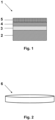
- FIG. 1 shows a cross-section of a coated glass article 1 according to certain embodiments of the present invention.
- Coated glass article 1 comprises a transparent float glass substrate 2 that has been sequentially coated using magnetron sputtering with one or more lower layers based on dielectric material 3, a layer based on a compound according to the present invention 4, and one or more upper layers based on dielectric material 5.
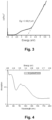
- Figure 2 shows a perspective view of a sintered body 6 in accordance with the present invention which is a ceramic sputtering target comprising a compound according to the present invention.
- BaCO 3 , NH 4 H 2 PO 4 , and MoO 3 were mixed in a 1:2:1.667 (0.99 g, 1.20 g and 1.15 g respectively) molar ratio to obtain the composition BaMo 1.667 P 2 O 11 which was heated in air at 600 °C for 10 hr to eliminate CO 2 , H 2 O, and NH 3 .
- the resulting product was mixed with the required amount of Mo metal (0.333 mol equivalent, 0.16 g) and heated to 850 °C for 12 hr in an evacuated (>10 -3 mTorr) quartz tube.
- Single crystals were produced within the solidified product which were hand-selected and analysed by X-ray diffraction and energy dispersive X-ray spectrometry on a transmission electron microscopy instrument and were determined to have the composition Ba 5 Mo 8 P 12 O 55 .
- a bulk powder synthesis of Ba 5 Mo 8 P 12 O 55 was also carried out using BaCO 3 , NH 4 H 2 PO 4 , and MoO 3 mixed in a 5:12:6.667 molar ratio (0.99 g, 1.38 g and 0.96 g respectively) to obtain the composition Ba 5 Mo 6.667 P 12 O 55 which was heated in air at 600 °C for 10 hr to eliminate CO 2 , H 2 O, and NH 3 . The resulting product was then added to the required amount of Mo (1.333 mol equivalent, 0.13 g) and heated to 850°C for 24 hr in an evacuated quartz tube. As a result, a high-level purity sample of Ba 5 Mo 8 P 12 O 55 was obtained, as determined from an X-ray diffraction model and energy dispersive X-ray spectrometry on a transmission electron microscopy instrument.
- Ba 5 Mo 8 P 12 O 55 was found to be a wide band gap semiconductor that demonstrates selective absorption.
- Figure 3 shows a Tauc plot to determine the band gap of Ba 5 Mo 8 P 12 O 55 .
- the plot is a function of the Kubelka-Munk approximation of the absorption co-efficient against the photon energy.
- the Kubelka-Munk co-efficient was determined from UVvis diffuse reflectance spectroscopy of a powder sample.
- Figure 4 shows a plot of absorption against wavelength/photon energy for Ba 5 Mo 8 P 12 O 55 .
- BaCOs was heated overnight at 500 °C, while MoO 3 was heated overnight at 200 °C. 10.51 g BaCOs and 3.83 g MoO 3 were weighed out whilst hot and mixed together. The mixture was ball milled in ethanol at 350 rpm for 15 mins, followed by 10 mins rest, for 10 cycles, reversing the direction between each cycle. The powder mixture was then dried on a hot plate overnight before being heated in an alumina crucible at 1200 °C for 25 hr. The powder mixture was reground in a pestle and mortar and heated in an alumina crucible at 1200 °C for 25 hr. A pure product was confirmed by XRD.
- Ba 2 MoO 5 powder (9.50 g) was formed into a 25 mm diameter dense pellet using direct current sintering at 1050 °C and 50 MPa in a graphite die.
- the dense pellet of Ba 2 MoO 5 was loaded into the vacuum chamber of a pulsed laser deposition system and a thin film of Ba 4 Mo 2 O 9 was deposited onto a SrTiO 3 (111) single crystal substrate at 850 °C, 30 mTorr 5%H 2 in Ar (25 sccm), 220 mJ laser energy, 2 Hz, 5000 pulses.
- a SrTiO 3 target was used which was prepared from SrCO 3 (8.05 g) and TiOz (4.35 g) by grinding with a pestle and mortar, heating at 1000 °C for 12 hr, regrinding, pressing into a 25 mm diameter pellet and heating at 1300 °C for 12 hr.
Landscapes
- Chemical & Material Sciences (AREA)
- Engineering & Computer Science (AREA)
- Organic Chemistry (AREA)
- Ceramic Engineering (AREA)
- Manufacturing & Machinery (AREA)
- Materials Engineering (AREA)
- Inorganic Chemistry (AREA)
- Structural Engineering (AREA)
- Life Sciences & Earth Sciences (AREA)
- Chemical Kinetics & Catalysis (AREA)
- General Chemical & Material Sciences (AREA)
- Geochemistry & Mineralogy (AREA)
- Thermal Sciences (AREA)
- Physics & Mathematics (AREA)
- Inorganic Compounds Of Heavy Metals (AREA)
Priority Applications (1)
| Application Number | Priority Date | Filing Date | Title |
|---|---|---|---|
| EP23203354.8A EP4538249A1 (de) | 2023-10-12 | 2023-10-12 | Verbindung |
Applications Claiming Priority (1)
| Application Number | Priority Date | Filing Date | Title |
|---|---|---|---|
| EP23203354.8A EP4538249A1 (de) | 2023-10-12 | 2023-10-12 | Verbindung |
Publications (1)
| Publication Number | Publication Date |
|---|---|
| EP4538249A1 true EP4538249A1 (de) | 2025-04-16 |
Family
ID=88412382
Family Applications (1)
| Application Number | Title | Priority Date | Filing Date |
|---|---|---|---|
| EP23203354.8A Pending EP4538249A1 (de) | 2023-10-12 | 2023-10-12 | Verbindung |
Country Status (1)
| Country | Link |
|---|---|
| EP (1) | EP4538249A1 (de) |
Citations (4)
| Publication number | Priority date | Publication date | Assignee | Title |
|---|---|---|---|---|
| US4054532A (en) * | 1975-01-28 | 1977-10-18 | Siemens Aktiengesellschaft | Ceramic dielectric material |
| US20100102450A1 (en) * | 2008-10-28 | 2010-04-29 | Jagdish Narayan | Zinc oxide based composites and methods for their fabrication |
| US20190041550A1 (en) * | 2017-08-04 | 2019-02-07 | Vitro Flat Glass Llc | Flash Annealing of Transparent Conductive Oxide and Semiconductor Coatings |
| US11152625B2 (en) * | 2019-08-28 | 2021-10-19 | Robert Bosch Gmbh | Intermediate temperature solid oxide fuel cell cathode material |
-
2023
- 2023-10-12 EP EP23203354.8A patent/EP4538249A1/de active Pending
Patent Citations (4)
| Publication number | Priority date | Publication date | Assignee | Title |
|---|---|---|---|---|
| US4054532A (en) * | 1975-01-28 | 1977-10-18 | Siemens Aktiengesellschaft | Ceramic dielectric material |
| US20100102450A1 (en) * | 2008-10-28 | 2010-04-29 | Jagdish Narayan | Zinc oxide based composites and methods for their fabrication |
| US20190041550A1 (en) * | 2017-08-04 | 2019-02-07 | Vitro Flat Glass Llc | Flash Annealing of Transparent Conductive Oxide and Semiconductor Coatings |
| US11152625B2 (en) * | 2019-08-28 | 2021-10-19 | Robert Bosch Gmbh | Intermediate temperature solid oxide fuel cell cathode material |
Non-Patent Citations (5)
| Title |
|---|
| KUCHINA I YU ET AL: "Experimental Support of the Magnetron Nickel Oxide Cathode Fabrication Process", RUSSIAN MICROELECTRONICS, NEW YORK, NY, US, vol. 47, no. 8, 20 March 2019 (2019-03-20), pages 613 - 618, XP036737129, ISSN: 1063-7397, [retrieved on 20190320], DOI: 10.1134/S1063739718080061 * |
| LEZAMA L ET AL: "Reduced molybdenum phosphates: synthesis, characterization and magnetic properties", SOLID STATE IONICS, NORTH HOLLAND PUB. COMPANY. AMSTERDAM; NL, NL, vol. 63-65, 1 September 1993 (1993-09-01), pages 657 - 665, XP025854038, ISSN: 0167-2738, [retrieved on 19930901], DOI: 10.1016/0167-2738(93)90175-3 * |
| LII K H ET AL: "Zigzag octahedral cluster chains in BaMo"6O"1"0", JOURNAL OF SOLID STATE CHEMISTRY, ORLANDO, FL, US, vol. 77, no. 2, 1 December 1988 (1988-12-01), pages 407 - 411, XP024195042, ISSN: 0022-4596, [retrieved on 19881201], DOI: 10.1016/0022-4596(88)90265-4 * |
| YANG L ET AL: "J_1-J_2 square lattice antiferromagnetism in the orbitally quenched insulator MoOPO_4", ARXIV.ORG, CORNELL UNIVERSITY LIBRARY, 201 OLIN LIBRARY CORNELL UNIVERSITY ITHACA, NY 14853, 18 May 2017 (2017-05-18), XP080948631, DOI: 10.1103/PHYSREVB.96.024445 * |
| YUN-FEI LIU ET AL: "Surfactant-free microwave-assisted hydrothermal synthesis of BaMoOhierarchical self-assemblies and enhanced photoluminescence properties", JOURNAL OF COLLOID AND INTERFACE SCIENCE, ACADEMIC PRESS,INC, US, vol. 381, no. 1, 14 May 2012 (2012-05-14), pages 24 - 29, XP028501266, ISSN: 0021-9797, [retrieved on 20120523], DOI: 10.1016/J.JCIS.2012.05.028 * |
Similar Documents
| Publication | Publication Date | Title |
|---|---|---|
| Gordon | Chemical vapor deposition of coatings on glass | |
| US9765431B2 (en) | Atomic layer deposition of metal phosphates and lithium silicates | |
| EP2128876B1 (de) | Prozess zum herstellen eines elektroleiters | |
| EP0686982A1 (de) | Elektrisch leitende Oxide und Elektrode die diese verwendet | |
| US5635287A (en) | Pane provided with a functional film | |
| US10311992B2 (en) | Transparent conducting films including complex oxides | |
| EP2184743A1 (de) | Verfahren zur herstellung einer leiterschicht | |
| JP2004091265A (ja) | 酸化物焼結体 | |
| KR20090020136A (ko) | 습기제거용 불소 함유 산화주석(fto) 투명전도막 유리및 이의 제조방법 | |
| US5348805A (en) | Formation of a layer of aluminum and tin or titanium oxides on a glass substrate | |
| EP3792371A1 (de) | Wolframoxidverbundfilm und verfahren zur herstellung davon und aus dem film geformtes substrat und artikel mit besagtem film | |
| EP1693482A1 (de) | Ti-oxid-film mit photokatalytischer aktivität bei bestrahlung mit sichtbarem licht und herstellungsverfahren dafür | |
| JP6220782B2 (ja) | ドープ酸化チタンのapcvd、およびそれによって作製されるコーティング物品 | |
| JPH04275949A (ja) | ガラス上に酸化アルミニウムを基礎材料とする層を形成するための方法及びその層を備えた製品 | |
| CN102640254B (zh) | 通过UV-辅助的化学气相沉积在聚合物基底上沉积掺杂的ZnO薄膜 | |
| Sanchez-Perez et al. | Aerosol-assisted route to low-E transparent conductive gallium-doped zinc oxide coatings from pre-organized and halogen-free precursor | |
| EP1635361B1 (de) | Verfahren zur Herstellung eines Fotoelektrischen Wandlers aufweisend ein transparentes leitfähiges Substrat | |
| EP4538249A1 (de) | Verbindung | |
| EP1735479B1 (de) | Thermochrome beschichtungen | |
| US20240124308A1 (en) | Compound | |
| EP4538248A1 (de) | Verbindung | |
| US20240124351A1 (en) | Compound | |
| US8778514B2 (en) | Heat stable SnAl and SnMg based dielectrics | |
| JP3280043B2 (ja) | 亜鉛およびインジウムを含む透明な導電膜を担持したガラス基板を有する製品、その製造および使用方法 | |
| US20030057495A1 (en) | P-type transparent copper-aluminum-oxide semiconductor |
Legal Events
| Date | Code | Title | Description |
|---|---|---|---|
| PUAI | Public reference made under article 153(3) epc to a published international application that has entered the european phase |
Free format text: ORIGINAL CODE: 0009012 |
|
| STAA | Information on the status of an ep patent application or granted ep patent |
Free format text: STATUS: THE APPLICATION HAS BEEN PUBLISHED |
|
| AK | Designated contracting states |
Kind code of ref document: A1 Designated state(s): AL AT BE BG CH CY CZ DE DK EE ES FI FR GB GR HR HU IE IS IT LI LT LU LV MC ME MK MT NL NO PL PT RO RS SE SI SK SM TR |
|
| STAA | Information on the status of an ep patent application or granted ep patent |
Free format text: STATUS: REQUEST FOR EXAMINATION WAS MADE |
|
| 17P | Request for examination filed |
Effective date: 20251016 |