EP4537751A1 - Blutzuckermessvorrichtung und -verfahren - Google Patents
Blutzuckermessvorrichtung und -verfahren Download PDFInfo
- Publication number
- EP4537751A1 EP4537751A1 EP23820006.7A EP23820006A EP4537751A1 EP 4537751 A1 EP4537751 A1 EP 4537751A1 EP 23820006 A EP23820006 A EP 23820006A EP 4537751 A1 EP4537751 A1 EP 4537751A1
- Authority
- EP
- European Patent Office
- Prior art keywords
- blood glucose
- measurement device
- glucose measurement
- display
- execution screen
- Prior art date
- Legal status (The legal status is an assumption and is not a legal conclusion. Google has not performed a legal analysis and makes no representation as to the accuracy of the status listed.)
- Pending
Links
Images







Classifications
-
- G—PHYSICS
- G01—MEASURING; TESTING
- G01N—INVESTIGATING OR ANALYSING MATERIALS BY DETERMINING THEIR CHEMICAL OR PHYSICAL PROPERTIES
- G01N33/00—Investigating or analysing materials by specific methods not covered by groups G01N1/00 - G01N31/00
- G01N33/48—Biological material, e.g. blood, urine; Haemocytometers
- G01N33/483—Physical analysis of biological material
- G01N33/487—Physical analysis of biological material of liquid biological material
- G01N33/49—Blood
-
- A—HUMAN NECESSITIES
- A61—MEDICAL OR VETERINARY SCIENCE; HYGIENE
- A61B—DIAGNOSIS; SURGERY; IDENTIFICATION
- A61B5/00—Measuring for diagnostic purposes; Identification of persons
- A61B5/74—Details of notification to user or communication with user or patient; User input means
- A61B5/7475—User input or interface means, e.g. keyboard, pointing device, joystick
-
- A—HUMAN NECESSITIES
- A61—MEDICAL OR VETERINARY SCIENCE; HYGIENE
- A61B—DIAGNOSIS; SURGERY; IDENTIFICATION
- A61B5/00—Measuring for diagnostic purposes; Identification of persons
-
- A—HUMAN NECESSITIES
- A61—MEDICAL OR VETERINARY SCIENCE; HYGIENE
- A61B—DIAGNOSIS; SURGERY; IDENTIFICATION
- A61B5/00—Measuring for diagnostic purposes; Identification of persons
- A61B5/145—Measuring characteristics of blood in vivo, e.g. gas concentration or pH-value ; Measuring characteristics of body fluids or tissues, e.g. interstitial fluid or cerebral tissue
-
- A—HUMAN NECESSITIES
- A61—MEDICAL OR VETERINARY SCIENCE; HYGIENE
- A61B—DIAGNOSIS; SURGERY; IDENTIFICATION
- A61B5/00—Measuring for diagnostic purposes; Identification of persons
- A61B5/74—Details of notification to user or communication with user or patient; User input means
- A61B5/742—Details of notification to user or communication with user or patient; User input means using visual displays
- A61B5/7445—Display arrangements, e.g. multiple display units
-
- G—PHYSICS
- G16—INFORMATION AND COMMUNICATION TECHNOLOGY [ICT] SPECIALLY ADAPTED FOR SPECIFIC APPLICATION FIELDS
- G16H—HEALTHCARE INFORMATICS, i.e. INFORMATION AND COMMUNICATION TECHNOLOGY [ICT] SPECIALLY ADAPTED FOR THE HANDLING OR PROCESSING OF MEDICAL OR HEALTHCARE DATA
- G16H10/00—ICT specially adapted for the handling or processing of patient-related medical or healthcare data
- G16H10/60—ICT specially adapted for the handling or processing of patient-related medical or healthcare data for patient-specific data, e.g. for electronic patient records
-
- G—PHYSICS
- G16—INFORMATION AND COMMUNICATION TECHNOLOGY [ICT] SPECIALLY ADAPTED FOR SPECIFIC APPLICATION FIELDS
- G16H—HEALTHCARE INFORMATICS, i.e. INFORMATION AND COMMUNICATION TECHNOLOGY [ICT] SPECIALLY ADAPTED FOR THE HANDLING OR PROCESSING OF MEDICAL OR HEALTHCARE DATA
- G16H40/00—ICT specially adapted for the management or administration of healthcare resources or facilities; ICT specially adapted for the management or operation of medical equipment or devices
- G16H40/60—ICT specially adapted for the management or administration of healthcare resources or facilities; ICT specially adapted for the management or operation of medical equipment or devices for the operation of medical equipment or devices
- G16H40/63—ICT specially adapted for the management or administration of healthcare resources or facilities; ICT specially adapted for the management or operation of medical equipment or devices for the operation of medical equipment or devices for local operation
-
- G—PHYSICS
- G16—INFORMATION AND COMMUNICATION TECHNOLOGY [ICT] SPECIALLY ADAPTED FOR SPECIFIC APPLICATION FIELDS
- G16H—HEALTHCARE INFORMATICS, i.e. INFORMATION AND COMMUNICATION TECHNOLOGY [ICT] SPECIALLY ADAPTED FOR THE HANDLING OR PROCESSING OF MEDICAL OR HEALTHCARE DATA
- G16H40/00—ICT specially adapted for the management or administration of healthcare resources or facilities; ICT specially adapted for the management or operation of medical equipment or devices
- G16H40/60—ICT specially adapted for the management or administration of healthcare resources or facilities; ICT specially adapted for the management or operation of medical equipment or devices for the operation of medical equipment or devices
- G16H40/67—ICT specially adapted for the management or administration of healthcare resources or facilities; ICT specially adapted for the management or operation of medical equipment or devices for the operation of medical equipment or devices for remote operation
-
- A—HUMAN NECESSITIES
- A61—MEDICAL OR VETERINARY SCIENCE; HYGIENE
- A61B—DIAGNOSIS; SURGERY; IDENTIFICATION
- A61B2562/00—Details of sensors; Constructional details of sensor housings or probes; Accessories for sensors
- A61B2562/02—Details of sensors specially adapted for in-vivo measurements
- A61B2562/0295—Strip shaped analyte sensors for apparatus classified in A61B5/145 or A61B5/157
-
- A—HUMAN NECESSITIES
- A61—MEDICAL OR VETERINARY SCIENCE; HYGIENE
- A61B—DIAGNOSIS; SURGERY; IDENTIFICATION
- A61B5/00—Measuring for diagnostic purposes; Identification of persons
- A61B5/0002—Remote monitoring of patients using telemetry, e.g. transmission of vital signals via a communication network
- A61B5/0004—Remote monitoring of patients using telemetry, e.g. transmission of vital signals via a communication network characterised by the type of physiological signal transmitted
-
- A—HUMAN NECESSITIES
- A61—MEDICAL OR VETERINARY SCIENCE; HYGIENE
- A61B—DIAGNOSIS; SURGERY; IDENTIFICATION
- A61B5/00—Measuring for diagnostic purposes; Identification of persons
- A61B5/145—Measuring characteristics of blood in vivo, e.g. gas concentration or pH-value ; Measuring characteristics of body fluids or tissues, e.g. interstitial fluid or cerebral tissue
- A61B5/14532—Measuring characteristics of blood in vivo, e.g. gas concentration or pH-value ; Measuring characteristics of body fluids or tissues, e.g. interstitial fluid or cerebral tissue for measuring glucose, e.g. by tissue impedance measurement
-
- A—HUMAN NECESSITIES
- A61—MEDICAL OR VETERINARY SCIENCE; HYGIENE
- A61B—DIAGNOSIS; SURGERY; IDENTIFICATION
- A61B5/00—Measuring for diagnostic purposes; Identification of persons
- A61B5/74—Details of notification to user or communication with user or patient; User input means
- A61B5/742—Details of notification to user or communication with user or patient; User input means using visual displays
- A61B5/7435—Displaying user selection data, e.g. icons in a graphical user interface
-
- G—PHYSICS
- G06—COMPUTING OR CALCULATING; COUNTING
- G06F—ELECTRIC DIGITAL DATA PROCESSING
- G06F3/00—Input arrangements for transferring data to be processed into a form capable of being handled by the computer; Output arrangements for transferring data from processing unit to output unit, e.g. interface arrangements
- G06F3/01—Input arrangements or combined input and output arrangements for interaction between user and computer
- G06F3/048—Interaction techniques based on graphical user interfaces [GUI]
- G06F3/0484—Interaction techniques based on graphical user interfaces [GUI] for the control of specific functions or operations, e.g. selecting or manipulating an object, an image or a displayed text element, setting a parameter value or selecting a range
-
- G—PHYSICS
- G06—COMPUTING OR CALCULATING; COUNTING
- G06F—ELECTRIC DIGITAL DATA PROCESSING
- G06F3/00—Input arrangements for transferring data to be processed into a form capable of being handled by the computer; Output arrangements for transferring data from processing unit to output unit, e.g. interface arrangements
- G06F3/01—Input arrangements or combined input and output arrangements for interaction between user and computer
- G06F3/048—Interaction techniques based on graphical user interfaces [GUI]
- G06F3/0487—Interaction techniques based on graphical user interfaces [GUI] using specific features provided by the input device, e.g. functions controlled by the rotation of a mouse with dual sensing arrangements, or of the nature of the input device, e.g. tap gestures based on pressure sensed by a digitiser
- G06F3/0488—Interaction techniques based on graphical user interfaces [GUI] using specific features provided by the input device, e.g. functions controlled by the rotation of a mouse with dual sensing arrangements, or of the nature of the input device, e.g. tap gestures based on pressure sensed by a digitiser using a touch-screen or digitiser, e.g. input of commands through traced gestures
Definitions
- a blood glucose measurement device may measure a blood glucose value by collecting blood through a separately prepared needle and placing the blood on a sensor strip of the blood glucose measurement device. Recently, a blood glucose value is continuously measured by invasively inserting and fixedly attaching a needle-type sensor into a part of a human body.
- various embodiments described in the disclosure are not limited to such a blood glucose measurement device.
- a patient may install a program to monitor a blood glucose value on a user terminal and record and check blood glucose values collected hourly.
- a blood glucose measurement device to perform monitoring tasks using the user terminal, communication between a blood glucose measurement device and the user terminal must be established, and thus, some blood glucose measurement devices are equipped with antennas for wireless communication.
- the disclosure provides a communication method between a blood glucose measurement device and an external terminal, or a control method based on the communication method.
- the blood glucose measurement device may further include a control pad configured to receive a control input
- the processor may be further configured to display, on the display, a third execution screen in response to receiving one or more control inputs through the control pad while the second execution screen is displayed, wherein the third execution screen may be identical to the first execution screen or include a user interface representation to output the first execution screen.
- the first execution screen may include a first user interface representation to collect one or more pieces of information for diabetes diagnosis
- the second execution screen may include a second user interface representation including a menu to switch to a plurality of user interface representations.
- the blood glucose measurement device may further include one or more antennas, wherein the processor may be further configured to activate the one or more antennas in response to the display of the fourth execution screen on the display.
- the blood glucose measurement device may further include one or more antennas, wherein the processor may be further configured to control the one or more antennas to transmit a message requesting feedback to an external device in response to opening of an electrical coupling between the sensor strip and the one or more contact electrodes.
- the processor may be further configured to store blood glucose information obtained by using the sensor strip in a memory, select at least a portion of the blood glucose information stored in the memory based on at least one of an obtaining time of the blood glucose information or a transmission status of the blood glucose information, and include, to the message, the selected portion of the blood glucose information and transmit the message to the external device.
- the display may include a touch sensor configured to receive a control input
- the one or more processors may be further configured to display, on the display, a third execution screen in response to receiving one or more control inputs through the touch sensor while the second execution screen is displayed, wherein the third execution screen may be identical to the first execution screen or include a user interface representation to output the first execution screen.
- the first execution screen may include a first user interface representation to collect one or more pieces of information for diabetes diagnosis
- the second execution screen may include a second user interface representation including a menu to switch to a plurality of user interface representations.
- the display may include a touch sensor configured to receive a control input
- the one or more processors may be further configured to obtain blood glucose information based on at least one of one or more additionally-input control inputs and one or more sensing values detected by using the one or more glucose sensors after the first execution screen or the second execution screen is displayed, and display, on the display, a fourth execution screen indicating the blood glucose information.
- the blood glucose measurement device may further include one or more antennas, and the one or more processors may be further configured to store, in a memory, one or more pieces of blood glucose information obtained by the one or more glucose sensors, and include, to a message requesting feedback, at least some of the pieces of blood glucose information stored in the memory and transmit the message to an external device.
- the one or more openings may be formed to penetrate the housing in a moving direction of the introducer.
- the blood glucose measurement device 10 refers to a device that detects blood glucose components within a body and may output the blood glucose components as blood glucose values.
- the blood glucose measurement device 10 may measure blood glucose concentration through an electrochemical method, a reflectance photometry method, a micro-needle method, or the like according to a measurement principle, and the blood glucose measurement device 10 applied to the disclosure is not limited any of the above.
- the external terminal 20 refers to a terminal capable of receiving a user input or providing a user with information.
- the external terminal 20 includes, for example, a smartphone, a laptop computer, a wearable device, and a server, but is not limited to thereto.
- the external terminal 20 may be communicatively or electrically connected to the blood glucose measurement device 10 and may output various pieces of information through a connected output unit (e.g., a display, a speaker, a vibrator, or the like) (not shown).
- a connected output unit e.g., a display, a speaker, a vibrator, or the like
- the external terminal 20 connected to the blood glucose measurement device 10 may output information related to blood glucose values received from the blood glucose measurement device 10 through a display.
- the information related to blood glucose values is not limited to blood glucose values and may further include diagnostic information determined based on at least one of the user's health status, habits, meal times, meal contents, and underlying diseases.
- the term “external terminal” may be interchangeably used with “external device.”
- the processors 11 and 21 may include a storage and processing circuit unit for supporting operations of an electronic device according to an embodiment.
- the storage and processing circuit unit may include storage such as non-volatile memory (e.g., flash memory or other electrically programmable read-only memory (ROM) configured to form a solid-state drive (SSD)) and volatile memory (e.g., static or dynamic random-access memory (RAM)).
- Processing circuit units within the processors 11 and 21 may be used to control the operation of an electronic device according to an embodiment.
- the processing circuit units may be based on one or more microprocessor(s), microcontroller(s), digital signal processor(s), baseband processor(s), power management section(s), audio chip(s), application-specific integrated circuit(s), or the like.
- the memories 12 and 22 may include memory areas for one or more processors 11 and 21 to store variables used in the protocol, configuration, control, and other functions of the device, including operations corresponding to or including any of the methods and/or procedures described as examples in the disclosure.
- the memories 12 and 22 may include non-volatile memory, volatile memory, or a combination thereof.
- the memories 12 and 22 may interface with a memory slot allowing insertion and removal of removable memory cards of one or more formats (e.g., SD card, Memory Stick, Compact Flash, or the like).
- the blood glucose measurement device 10 may establish communication based on encrypted images.
- the encrypted images include, for example, QR code images.
- the blood glucose measurement device 10 may display a QR code image through a display module, and the user may be linked to a web page for communication setup by capturing an image of the QR code image through a user terminal.
- the user may fill out a setup application form by using the user terminal and provide the completed application form to a communication station.
- NFC and/or BT communication may be used instead of a setup procedure for encrypted images.
- the user terminal may be linked to a web page for communication setup based on the NFC connection and/or BT connection between the user terminal and the blood glucose measurement device 10. Thereafter, the user may fill out a setup application form and provide the completed application form to a communication station.
- the blood glucose measurement device 10 may be divided into an invasive device and a non-invasive device based on whether the device invades the skin of the user.
- the blood glucose measurement device 10 may be divided into a sampling blood glucose measurement system and a continuous blood glucose measurement system based on whether the device is attached to the body of the user and is able to continuously measure blood glucose levels.
- the blood glucose measurement device 10 according to an embodiment is applicable to all of the above devices and is not limited thereto.
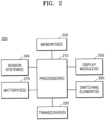
- FIG. 2 is a block diagram of a blood glucose measurement device according to an embodiment.
- a blood glucose measurement device 200 may include one or more processors 210, one or more memories 220, and one or more transceivers 230, and additional descriptions thereof are omitted.
- the blood glucose measurement device 200 may include a sensor system 240, and the sensor system 240 may include one or more sensors and sensor circuits.
- a sensor may be configured to electrically couplable to a sensor circuit, and the sensor may be manufactured in a state of being electrically coupled to the sensor circuit, or may be manufactured in a method of being provided at a position that may come into contact with the sensor circuit by an external force.
- the sensor In an operational state in which the blood glucose measurement device 200 is used by a user, the sensor is maintained in electrical contact with the sensor circuit, and a sensing signal (or sensing information) obtained from the sensor is transmitted to the sensor circuit.
- the sensor may be provided as an analyte sensor for measuring the user's blood glucose values as a component of the blood glucose measurement device 200, but the disclosure is not limited thereto.
- the sensor circuit may be implemented as at least a portion of a processing circuit or may be configured in a form electrically coupled to the processing circuit, but is not limited thereto.
- the blood glucose measurement device 200 may include a display module 250.
- the processor 210 may output information related to a measured blood glucose value through the display module 250.
- the information related to a blood glucose value may include, for example, diagnostic information determined based on the measured blood glucose value.
- the diagnostic information may be generated by one or more processors 210 provided in the blood glucose measurement device 200 or may be generated by one or more processors 210 provided in an external terminal (refer to 20 of FIG. 1 ) capable of communication with the blood glucose measurement device 200.
- the external terminal 20 refers to various communication-capable devices including, for example, mobile terminals, personal computers (PC), cloud servers, edge computing servers, or the like.
- the external terminal 20 (refer to FIG. 1 ) may also correspond to any one of the user terminals described above in FIG. 1 .
- the blood glucose measurement device 200 may transmit sensing information obtained by the sensor system 240 to the external terminal 20 (refer to FIG. 1 ), and the external terminal 20 (refer to FIG. 1 ) may generate information related to a blood glucose value based on the sensing information.
- the external terminal 20 (refer to FIG. 1 ) may transmit the generated information related to the blood glucose value to the blood glucose measurement device 200, and the blood glucose measurement device 200 may display the obtained information through the display module 250.
- the blood glucose measurement device 200 may generate information to be displayed on the display module 250 regardless of the external terminal 20 (refer to FIG. 1 ).
- the blood glucose measurement device 200 may generate information related to a blood glucose value based on sensing information obtained by the sensor system 240.
- the blood glucose measurement device 200 may display information related to a blood glucose value through the display module 250 provided therein.
- the display module 250 may include a touch screen panel for interacting with the user.
- the touch screen panel refers to a display panel including a resistive or capacitive touch sensor.
- the user may apply an input to the touch screen panel, and the display module 250 transmits the touch input to the processor 210.
- the processor 210 interacts with the user based on the user's touch input.
- the blood glucose measurement device 200 may output information related to a blood glucose value and also interact with the user based on the user's touch input.
- the display module 250 applied to an embodiment may include a flat display or a flexible display.
- the flat display is manufactured by using an inflexible substrate, and conversely, the flexible display is manufactured by using a flexible substrate.
- the flexible display includes a bendable display module 250, a rollable display, a foldable display, or the like, but is not limited thereto.
- the display panel may include or consist of an organic light-emitting diode (OLED), a liquid crystal display (LCD), an electrochromic display (ECD), an electrophoretic display (EPD), or the like, and the above examples are distinguished based on the type of display panel.
- OLED organic light-emitting diode
- LCD liquid crystal display
- ECD electrochromic display
- EPD electrophoretic display
- the blood glucose measurement device 200 may further include a battery 270.
- the battery 270 may be electrically connected to at least some of the components of the blood glucose measurement device 200 and supply power to each component.
- the blood glucose measurement device 200 including the battery 270 may operate electrically even when not being electrically connected to an external power source. That is, the blood glucose measurement device 200 according to an embodiment may be used as a portable device.
- the blood glucose measurement device 200 may include one or more switching elements 260.
- the switching element 260 may include, for example, an operating switch and/or a transfer switch.
- the operating switch refers to the switching element 260 for activating at least one component of the blood glucose measurement device 200.
- the operating switch may be controlled to a turn-on state or a turn-off state.
- the operating switch may connect two or more nodes in a circuit in the turn-on state and open two or more nodes in the turn-off state.
- the operating switch may be electrically connected to the battery 270 to control the supply and cut-off of power.
- the operating switch may be electrically connected to the sensor system 240 to control the activation and inactivation of the sensor system 240.
- the operating switch may be electrically connected to the transceiver 230 to control activation or inactivation of a communication function.
- the operating switch may be understood to include a combination of an electronic element on a circuit provided inside the blood glucose measurement device 200, such as a processing circuit and a sensor circuit, or a physical button provided on the outside of the device to enable an interaction with the user, and the switching element 260 connected to the electronic element or the physical button.
- the operating switch applied to various elements may be activated by another component inserted into the housing of the blood glucose measurement device 200.
- the operating switch may be activated in response to the insertion of another component (e.g., a strip, an introducer needle) into the blood glucose measurement device 200.
- the processor 210 may switch the operating switch from a turn-off state to a turn-on state in response to the insertion of the strip into the blood glucose measurement device 200.
- the processor 210 may switch the operating switch from the turn-off state to the turn-on state in response to the insertion of a needle into the blood glucose measurement device 200.
- the transfer switch refers to the switching element 260 for transmitting a message or request to the external terminal 20 (refer to FIG. 1 ) by using the one or more transceivers 230 of the blood glucose measurement device 200.
- the transfer switch may also be integral with other components instead of being provided as a separate switching element 260.
- the transfer switch may be integral with the display module 250.
- the processor 210 may activate the transceiver 230 to transmit a message in response to the turning-on (or activation) of the display module 250.
- the processor 210 may activate the transceiver 230 to transmit a message in response to the display of a certain user interface representation by the display module 250.
- the transfer switch may be integral as a function of the processor 210 and the display module 250.
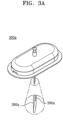
- a patch-type device 300a is configured to continuously measure blood glucose, which is attached to the inside of a user's body and may periodically or continuously obtain blood glucose values through an analyte sensor 390a invading the lower surface of the user's skin.
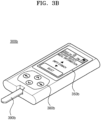
- a strip-type device 300b includes a space on one side of the housing thereof to accommodate a strip 390b, and blood glucose values may be obtained by applying blood to the strip 390b while the strip 390b is maintained in a state of being attached to the inside of the device.
- the one or more processors may request the external terminal for a text message by using the antenna module while the antenna module is supplied with power.
- the term 'request' may be interchangeably used as a 'request message' or 'a message including a request.
- Display information includes one or more preset parameters with respect to a method of outputting information through the display module.
- the display information includes at least one of a text size, a font type, and a display dimension of the display on which a feedback message will be displayed.
- the external terminal may modify at least a portion of the content of the feedback message that responds to the blood glucose measurement device based on the display information.
- the external terminal may abbreviate or omit at least a portion of the content of the feedback message so that the feedback message may be entirely displayed on a single screen to fit the display dimension of the blood glucose measurement device. A detailed description is given below with reference to FIG. 9 .
- the one or more processors may output the feedback message received from the external terminal on the display.
- the feedback message may include diagnostic information for the user.
- the user may easily determine an action related to health maintenance, such as visiting the hospital, by checking the feedback message.
- FIG. 5 is a flowchart illustrating a blood glucose measurement method according to another embodiment.
- FIGS. 6A and 6B are diagrams illustrating an example of a process of activating one or more components of a blood glucose measurement device based on an interaction with an external element.
- the blood glucose measurement method includes operation S510 of supplying power to a display module and an antenna module in response to identification of strip insertion, operation S520 of switching the antenna module to an active state in response to switching the display module to an active state, operation S530 of requesting an external terminal (e.g., a server) for a feedback message (e.g., a feedback message) by using the antenna module, and operation S540 of displaying, on the display, a feedback message received from the external terminal.
- an external terminal e.g., a server
- a feedback message e.g., a feedback message
- the one or more processors may supply power to the display module and the antenna module in response to the identification of strip insertion.
- a battery, the display module, and the antenna module may be maintained in an open state before the strip is inserted.
- the one or more processors may electrically couple the battery to the display module to supply power to the display module, in response to the identification of strip insertion.
- the one or more processors may electrically couple the battery to the antenna module to supply power to the antenna module, in response to the identification of strip insertion.
- power supply to the display module and the antenna module may also be performed simultaneously in response to the identification of strip insertion.
- one or more switching elements may be provided between the display module and the battery and/or between the antenna module and the battery.
- the one or more processors may determine whether to supply or cut off power by controlling the one or more switching elements.
- the supply of power and the switching to an active state may be operationally separated.
- the one or more processors may output information through the display module while the display module is maintained in the active state.
- the one or more processors may transmit information through the antenna module while the antenna module is maintained in the active state.
- the one or more processors of the blood glucose measurement device 600 may supply power to the display module 650 or switch the display module 650 from the idle state to the active state while power supply is maintained.
- An operation of supply power to the display module 650 and an operation of switching from an idle state to an active state duplicate the descriptions with respect to the above embodiments, and thus the descriptions thereof are omitted.
- the one or more processors may request the external terminal (e.g., a server) for a text message by using the antenna module while the antenna module is maintained in the active state.
- the request may include at least one of sensing data, status information, and display information as described above in operation S430.
- the one or more processors may display, on the display, a text message received in response to the request.
- FIG. 7 is a flowchart for describing operation S430 of FIG. 4 and operation S530 of FIG. 5 .
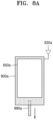
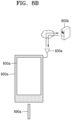
- FIGS. 8A and 8B are diagrams illustrating an example of a process of transmitting a feedback message request to an external device based on an interaction with an external element.
- operation S430 of FIG. 4 and operation S530 of FIG. 5 include operation S710 of requesting an external terminal for a text message in response to extraction of strip outside a housing, operation S720 of receiving a text message in response to the request while an antenna module is maintained in an active state, and operation S730 of displaying the received text message on a display.
- the antenna module may also be maintained in the active state until the display module is switched to an idle state or power supply to the display module is blocked even when the strip is separated from the housing.
- the term 'extraction' in the disclosure may be interchangeably used with 'separation.'
- FIG. 9 is a sequence diagram of a blood glucose measurement method according to an embodiment.
- the request transmitted to the external terminal may include one or more pieces of sensing information.
- the sensing information refers to data related to a blood glucose value obtained by the sensor system.
- the request transmitted to a server may further include user information.
- the user information may further include display information of the blood glucose measurement device and the user's status information.
- the status information may include various pieces of information related to the user.
- the status information may include at least one of eating statuses, meal times, and underlying diseases.
- the eating statuses may include, for example, a status before a meal and a status after a meal.
- the meal times may include, for example, breakfast, lunch, dinner, and before bedtime.
- the underlying diseases may include, for example, high blood pressure, low blood pressure, and diabetes.
- the various pieces of status information may be used when generating diagnostic information together with sensing information.
- the status information may be transmitted to the external terminal separately or together with the sensing information to generate diagnostic information.
- a first text message and a second text message may have different contents.
- the external terminal may correct the feedback message so that the context information of the first text message matches with the context information of the second text message.
- the context information with respect to the second text message is set to have higher priority than the context information with respect to the first text message.
- the request mentioned in operation S910 may further include preset display information of the blood glucose measurement device, and the context of the feedback message may also be corrected based on the preset display information.
- the external terminal may modify the context of the feedback message based on at least one of a text size, a font type, and a display dimension of the display on which the feedback message will be displayed. In other words, the character count and expression of the content of the feedback message may be changed so that the feedback message may be entirely displayed through a single screen.
- the external terminal may correct the context of the feedback message so that the feedback message is displayed with a single screen while maintaining a preset text size when the feedback message is displayed through the display module of the blood glucose measurement device.
- the feedback message generated in this way may be transmitted from the external terminal to the blood glucose measurement device, stored in the memory of the blood glucose measurement device, and displayed through the display module of the blood glucose measurement device (operations S950 and S960).
- the request may include one or more pieces of sensing information.
- the transmission of the request to the external terminal is successful, at least a portion of the transmitted sensing information may be excluded from a memory.
- the second sensing information may be understood as sensing information obtained at a time point adjacent to a time point at which transmission of a request was triggered most recently.
- the first sensing information may be understood as one or more pieces of sensing information obtained temporally prior to the second sensing information, and the first sensing information may include or consist of one or two or more pieces of sensing information.
- the external terminal may generate a feedback message by using at least some of the plurality of pieces of sensing information.
- the external terminal may select at least some pieces of sensing information based on an obtaining time of each piece of sensing information and generate a feedback message based on the at least some selected pieces of sensing information.
- the external terminal may generate a feedback message based on sensing information that is the most recently obtained.
- the external terminal may generate a feedback message by selecting sensing information that is the most recently obtained and at least one piece of sensing information that is temporally adjacent to the most recently obtained sensing information.
- the blood glucose measurement device may transmit at least some pieces of the first and second sensing information and/or the first and second user information to the external terminal to generate a feedback message.
- the blood glucose measurement device may select and transmit the first sensing information and the first user information related to the first sensing information to the external terminal, or may select and transmit the second sensing information and the second user information related to the second sensing information to the external terminal.
- the blood glucose measurement device may request the external terminal for generation of a feedback message.
- the blood glucose measurement device may supply power to another component, cut off power, or switch the other component to an active state based on insertion and separation of an external element, such as a strip.
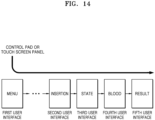
- the blood glucose measurement device may switch an antenna module from an idle state to an active state before, simultaneously with, or immediately after the sixth user interface representation is displayed on the display.
- the blood glucose measurement device may switch the antenna module from the idle state to the active state in response to display of the fifth user interface representation on the display.
- the antenna module may be switched to the active state in response to insertion of the external element or may be switched to the active state in response to switching of a display module to an active state.
- the switching of the antenna module to the active state may also be performed based on switching of user interface representation.
- the antenna module may be maintained in the idle state until sensing information (e.g., a blood glucose value) is displayed through the fifth user interface representation, and the antenna module may be switched to the active state in response to display of the fifth user interface representation.
- the fifth user interface representation is changed to a sixth user interface representation, and the sixth user interface representation is displayed.
- the sixth user interface representation may include or consist of an animation or icon indicating transmission of a message.
- the blood glucose measurement device may change the sixth user interface representation to a seventh user interface representation and display the seventh user interface representation in response to completion of transmission of a message, that is, a request for a feedback message.
- the seventh user interface representation includes at least a portion of a feedback message received from the external terminal.
- the feedback message may be generated based on sensing information, user information, and/or display information, which is transmitted to the external terminal.
- the feedback message may include or consist of diagnostic information generated based on one or more pieces of information included in the request.
- An electronic device may be various forms of devices.
- the electronic device may include, for example, a display device, a portable communication device (e.g., a smartphone), a computer device, a portable multimedia device, a portable medical device, a camera, a wearable device, or a home-appliance device.
- a portable communication device e.g., a smartphone
- a program executed by the blood glucose measurement devices 10, 200, 300a, and 300b described in the disclosure may be implemented as a hardware component, a software component, and/or a combination of a hardware component and a software component.
- the program may be performed by any system that may execute computer-readable instructions.
- each of the components described above may include a plurality of entities, and some of the entities may also be separately arranged in other components.
- one or more components among the components described above or operations or operations may be omitted, or one or more other components or operations may be added.
- a plurality of components e.g., modules or programs
- the integrated component may perform one or more functions of each of the plurality of components identically or similarly to those performed by a corresponding component among the plurality of components before integration.
Landscapes
- Health & Medical Sciences (AREA)
- Life Sciences & Earth Sciences (AREA)
- Engineering & Computer Science (AREA)
- Biomedical Technology (AREA)
- General Health & Medical Sciences (AREA)
- Physics & Mathematics (AREA)
- Public Health (AREA)
- Medical Informatics (AREA)
- Molecular Biology (AREA)
- Pathology (AREA)
- Biophysics (AREA)
- Surgery (AREA)
- Animal Behavior & Ethology (AREA)
- Heart & Thoracic Surgery (AREA)
- Veterinary Medicine (AREA)
- Primary Health Care (AREA)
- Epidemiology (AREA)
- Optics & Photonics (AREA)
- Business, Economics & Management (AREA)
- General Business, Economics & Management (AREA)
- Hematology (AREA)
- Chemical & Material Sciences (AREA)
- Emergency Medicine (AREA)
- Biochemistry (AREA)
- General Physics & Mathematics (AREA)
- Immunology (AREA)
- Urology & Nephrology (AREA)
- Ecology (AREA)
- Analytical Chemistry (AREA)
- Medicinal Chemistry (AREA)
- Food Science & Technology (AREA)
- Measurement Of The Respiration, Hearing Ability, Form, And Blood Characteristics Of Living Organisms (AREA)
Applications Claiming Priority (2)
| Application Number | Priority Date | Filing Date | Title |
|---|---|---|---|
| KR1020220070876A KR20230170423A (ko) | 2022-06-10 | 2022-06-10 | 혈당 측정 장치 및 방법 |
| PCT/KR2023/006481 WO2023239070A1 (ko) | 2022-06-10 | 2023-05-12 | 혈당 측정 장치 및 방법 |
Publications (1)
| Publication Number | Publication Date |
|---|---|
| EP4537751A1 true EP4537751A1 (de) | 2025-04-16 |
Family
ID=89118605
Family Applications (1)
| Application Number | Title | Priority Date | Filing Date |
|---|---|---|---|
| EP23820006.7A Pending EP4537751A1 (de) | 2022-06-10 | 2023-05-12 | Blutzuckermessvorrichtung und -verfahren |
Country Status (4)
| Country | Link |
|---|---|
| US (1) | US20250180540A1 (de) |
| EP (1) | EP4537751A1 (de) |
| KR (1) | KR20230170423A (de) |
| WO (1) | WO2023239070A1 (de) |
Families Citing this family (1)
| Publication number | Priority date | Publication date | Assignee | Title |
|---|---|---|---|---|
| CN121208099B (zh) * | 2025-12-01 | 2026-02-17 | 歌尔股份有限公司 | 血糖监测方法、装置、连续血糖监测设备及存储介质 |
Family Cites Families (5)
| Publication number | Priority date | Publication date | Assignee | Title |
|---|---|---|---|---|
| SG193205A1 (en) * | 2008-08-15 | 2013-09-30 | Lifescan Scotland Ltd | Analyte testing method and system |
| US9883834B2 (en) * | 2012-04-16 | 2018-02-06 | Farid Amirouche | Medication delivery device with multi-reservoir cartridge system and related methods of use |
| KR101604027B1 (ko) * | 2012-11-30 | 2016-03-25 | 에스디 바이오센서 주식회사 | 근거리무선통신을 이용한 혈당측정시스템 및 방법 |
| US20140299483A1 (en) * | 2013-04-05 | 2014-10-09 | Lifescan Scotland Limited | Analyte meter and method of operation |
| EP4093281A1 (de) * | 2020-01-24 | 2022-11-30 | Ascensia Diabetes Care Holdings AG | Tragbare vorrichtungen, verfahren zum bilden von tragbaren vorrichtungen und verfahren zur wiederverwendung von sendereinheiten von tragbaren vorrichtungen in kontinuierlichen analytischen überwachungssystemen |
-
2022
- 2022-06-10 KR KR1020220070876A patent/KR20230170423A/ko active Pending
-
2023
- 2023-05-12 WO PCT/KR2023/006481 patent/WO2023239070A1/ko not_active Ceased
- 2023-05-12 EP EP23820006.7A patent/EP4537751A1/de active Pending
- 2023-05-12 US US18/873,321 patent/US20250180540A1/en active Pending
Also Published As
| Publication number | Publication date |
|---|---|
| WO2023239070A1 (ko) | 2023-12-14 |
| US20250180540A1 (en) | 2025-06-05 |
| KR20230170423A (ko) | 2023-12-19 |
Similar Documents
| Publication | Publication Date | Title |
|---|---|---|
| JP7705697B2 (ja) | 被分析物監視システム用のグラフィカル・ユーザー・インターフェース | |
| EP3389348B1 (de) | Tragstruktur mit leiterbahnen und elektronische vorrichtung damit | |
| EP3984447B1 (de) | Verfahren zum verlustfreien übertragen/empfangen biometrischer informationen in einem system zur kontinuierlichen glukoseüberwachung | |
| JP2022001267A (ja) | インビボ検体モニタリング環境における電力供給方法 | |
| JP2021191489A (ja) | 表示デバイス及びセンサ電子機器ユニットの通信のためのシステム及び方法 | |
| KR102516797B1 (ko) | 전극 배치 방법과 이를 지원하는 전자 장치 | |
| CN105686807B (zh) | 医疗设备 | |
| EP3106085A1 (de) | Verfahren zur messung biometrischer informationen elektronische vorrichtung zur durchführung davon | |
| KR102240512B1 (ko) | 혈당 측정 장치, 혈당 측정 방법 및 혈당 측정 모듈을 포함하는 전자 장치 | |
| EP3822985A1 (de) | Tragbare blutzuckerüberwachungsvorrichtung mit nachrichtenübermittlung | |
| US20110015502A1 (en) | Analyte Monitoring and Management System and Methods Therefor | |
| JP5878424B2 (ja) | 試料測定装置および試料測定システム | |
| KR20080012944A (ko) | 데이터 수집 시스템 및 인터페이스 | |
| EP2517626B1 (de) | Proben-Messvorrichtung und Proben-Messsystem | |
| KR20180088020A (ko) | 전자 장치 및 그의 동작 방법 | |
| JPWO2012127870A1 (ja) | 生体情報測定装置 | |
| CN104602591A (zh) | 用于在分析物监测系统提供不利状况通知的方法和装置 | |
| EP4537751A1 (de) | Blutzuckermessvorrichtung und -verfahren | |
| EP3378382B1 (de) | Tragbare komplexe sensorvorrichtung zur messung mehrerer biometrischer informationen und messverfahren | |
| KR20210047041A (ko) | 다중 디바이스 간의 생리적 데이터 통합 및 도시화 장치 및 그 방법 | |
| US8895316B2 (en) | Transferring blood glucose measures seamlessly from a handheld glucose meter | |
| KR101320555B1 (ko) | 혈당측정 시스템 | |
| JP4944083B2 (ja) | 生体試料測定用試験片および生体試料測定装置 | |
| CN118251729A (zh) | 使用区块链追踪患者标识的系统、设备和方法 | |
| KR20140141104A (ko) | 스마트 혈당 자가 측정기 및 휴대 단말기를 이용한 혈당 자가 측정방법 |
Legal Events
| Date | Code | Title | Description |
|---|---|---|---|
| STAA | Information on the status of an ep patent application or granted ep patent |
Free format text: STATUS: THE INTERNATIONAL PUBLICATION HAS BEEN MADE |
|
| PUAI | Public reference made under article 153(3) epc to a published international application that has entered the european phase |
Free format text: ORIGINAL CODE: 0009012 |
|
| STAA | Information on the status of an ep patent application or granted ep patent |
Free format text: STATUS: REQUEST FOR EXAMINATION WAS MADE |
|
| 17P | Request for examination filed |
Effective date: 20241205 |
|
| AK | Designated contracting states |
Kind code of ref document: A1 Designated state(s): AL AT BE BG CH CY CZ DE DK EE ES FI FR GB GR HR HU IE IS IT LI LT LU LV MC ME MK MT NL NO PL PT RO RS SE SI SK SM TR |
|
| DAV | Request for validation of the european patent (deleted) | ||
| DAX | Request for extension of the european patent (deleted) |