EP4535872A2 - Verfahren zur autorisierung für netzwerk-slicing - Google Patents
Verfahren zur autorisierung für netzwerk-slicing Download PDFInfo
- Publication number
- EP4535872A2 EP4535872A2 EP25153398.0A EP25153398A EP4535872A2 EP 4535872 A2 EP4535872 A2 EP 4535872A2 EP 25153398 A EP25153398 A EP 25153398A EP 4535872 A2 EP4535872 A2 EP 4535872A2
- Authority
- EP
- European Patent Office
- Prior art keywords
- slice
- amf
- specific
- radio access
- access network
- Prior art date
- Legal status (The legal status is an assumption and is not a legal conclusion. Google has not performed a legal analysis and makes no representation as to the accuracy of the status listed.)
- Pending
Links
Images


Classifications
-
- H—ELECTRICITY
- H04—ELECTRIC COMMUNICATION TECHNIQUE
- H04W—WIRELESS COMMUNICATION NETWORKS
- H04W48/00—Access restriction; Network selection; Access point selection
- H04W48/02—Access restriction performed under specific conditions
- H04W48/04—Access restriction performed under specific conditions based on user or terminal location or mobility data, e.g. moving direction, speed
-
- H—ELECTRICITY
- H04—ELECTRIC COMMUNICATION TECHNIQUE
- H04W—WIRELESS COMMUNICATION NETWORKS
- H04W48/00—Access restriction; Network selection; Access point selection
- H04W48/18—Selecting a network or a communication service
-
- H—ELECTRICITY
- H04—ELECTRIC COMMUNICATION TECHNIQUE
- H04L—TRANSMISSION OF DIGITAL INFORMATION, e.g. TELEGRAPHIC COMMUNICATION
- H04L41/00—Arrangements for maintenance, administration or management of data switching networks, e.g. of packet switching networks
- H04L41/08—Configuration management of networks or network elements
- H04L41/0894—Policy-based network configuration management
-
- H—ELECTRICITY
- H04—ELECTRIC COMMUNICATION TECHNIQUE
- H04L—TRANSMISSION OF DIGITAL INFORMATION, e.g. TELEGRAPHIC COMMUNICATION
- H04L47/00—Traffic control in data switching networks
- H04L47/10—Flow control; Congestion control
- H04L47/24—Traffic characterised by specific attributes, e.g. priority or QoS
-
- H—ELECTRICITY
- H04—ELECTRIC COMMUNICATION TECHNIQUE
- H04L—TRANSMISSION OF DIGITAL INFORMATION, e.g. TELEGRAPHIC COMMUNICATION
- H04L63/00—Network architectures or network communication protocols for network security
- H04L63/08—Network architectures or network communication protocols for network security for authentication of entities
- H04L63/0892—Network architectures or network communication protocols for network security for authentication of entities by using authentication-authorization-accounting [AAA] servers or protocols
-
- H—ELECTRICITY
- H04—ELECTRIC COMMUNICATION TECHNIQUE
- H04M—TELEPHONIC COMMUNICATION
- H04M15/00—Arrangements for metering, time-control or time indication ; Metering, charging or billing arrangements for voice wireline or wireless communications, e.g. VoIP
- H04M15/66—Policy and charging system
-
- H—ELECTRICITY
- H04—ELECTRIC COMMUNICATION TECHNIQUE
- H04W—WIRELESS COMMUNICATION NETWORKS
- H04W12/00—Security arrangements; Authentication; Protecting privacy or anonymity
- H04W12/06—Authentication
-
- H—ELECTRICITY
- H04—ELECTRIC COMMUNICATION TECHNIQUE
- H04W—WIRELESS COMMUNICATION NETWORKS
- H04W12/00—Security arrangements; Authentication; Protecting privacy or anonymity
- H04W12/08—Access security
-
- H—ELECTRICITY
- H04—ELECTRIC COMMUNICATION TECHNIQUE
- H04W—WIRELESS COMMUNICATION NETWORKS
- H04W28/00—Network traffic management; Network resource management
- H04W28/02—Traffic management, e.g. flow control or congestion control
- H04W28/0252—Traffic management, e.g. flow control or congestion control per individual bearer or channel
- H04W28/0257—Traffic management, e.g. flow control or congestion control per individual bearer or channel the individual bearer or channel having a maximum bit rate or a bit rate guarantee
-
- H—ELECTRICITY
- H04—ELECTRIC COMMUNICATION TECHNIQUE
- H04W—WIRELESS COMMUNICATION NETWORKS
- H04W28/00—Network traffic management; Network resource management
- H04W28/02—Traffic management, e.g. flow control or congestion control
- H04W28/0268—Traffic management, e.g. flow control or congestion control using specific QoS parameters for wireless networks, e.g. QoS class identifier [QCI] or guaranteed bit rate [GBR]
-
- H—ELECTRICITY
- H04—ELECTRIC COMMUNICATION TECHNIQUE
- H04W—WIRELESS COMMUNICATION NETWORKS
- H04W28/00—Network traffic management; Network resource management
- H04W28/16—Central resource management; Negotiation of resources or communication parameters, e.g. negotiating bandwidth or QoS [Quality of Service]
- H04W28/24—Negotiating SLA [Service Level Agreement]; Negotiating QoS [Quality of Service]
-
- H—ELECTRICITY
- H04—ELECTRIC COMMUNICATION TECHNIQUE
- H04W—WIRELESS COMMUNICATION NETWORKS
- H04W8/00—Network data management
- H04W8/02—Processing of mobility data, e.g. registration information at HLR [Home Location Register] or VLR [Visitor Location Register]; Transfer of mobility data, e.g. between HLR, VLR or external networks
- H04W8/04—Registration at HLR or HSS [Home Subscriber Server]
-
- H—ELECTRICITY
- H04—ELECTRIC COMMUNICATION TECHNIQUE
- H04L—TRANSMISSION OF DIGITAL INFORMATION, e.g. TELEGRAPHIC COMMUNICATION
- H04L69/00—Network arrangements, protocols or services independent of the application payload and not provided for in the other groups of this subclass
-
- H—ELECTRICITY
- H04—ELECTRIC COMMUNICATION TECHNIQUE
- H04W—WIRELESS COMMUNICATION NETWORKS
- H04W4/00—Services specially adapted for wireless communication networks; Facilities therefor
- H04W4/60—Subscription-based services using application servers or record carriers, e.g. SIM application toolkits
-
- H—ELECTRICITY
- H04—ELECTRIC COMMUNICATION TECHNIQUE
- H04W—WIRELESS COMMUNICATION NETWORKS
- H04W52/00—Power management, e.g. Transmission Power Control [TPC] or power classes
- H04W52/04—Transmission power control [TPC]
- H04W52/18—TPC being performed according to specific parameters
- H04W52/26—TPC being performed according to specific parameters using transmission rate or quality of service QoS [Quality of Service]
Definitions
- the disclosure relates generally to wireless communications and, more particularly, to systems and methods for authorizing network slicing.
- example embodiments disclosed herein are directed to solving the issues relating to one or more of the problems presented in the prior art, as well as providing additional features that will become readily apparent by reference to the following detailed description when taken in conjunction with the accompany drawings.
- example systems, methods, devices and computer program products are disclosed herein. It is understood, however, that these embodiments are presented by way of example and are not limiting, and it will be apparent to those of ordinary skill in the art who read the present disclosure that various modifications to the disclosed embodiments can be made while remaining within the scope of this disclosure.
- a wireless communication method includes receiving, by a mobility management function (AMF) from a network function (NF), slice information comprising at least one of a quality of service (QoS) profile for a slice or a service area of the slice, and at least one of determining, by the AMF, that a wireless communication device is authorized to access a slice based on the service area of the slice, or sending, by the AMF, the QoS profile comprising a slice-specific AMBR specific to the slice to the radio access network.
- the radio access network enforces rate control with respect to the slice for the wireless communication device based on the slice-specific AMBR.
- a wireless communication method includes receiving, by a radio access network from an AMF for the radio access network, a QoS profile including a slice-specific AMBR specific to the slice, and enforcing, by the radio access network, rate control with respect to the slice for the wireless communication device based on the slice-specific AMBR.
- a maximum flow bit rate is QoS parameter used for rate control.
- an AMBR which is a type of MBR, is used to control the rate of a non-guaranteed flow bit rate (non-GBR) flow.
- the AMBR can be a protocol data unit (PDU) session-AMBR, a user equipment (UE)-AMBR, or so on.
- PDU session-AMBR controls the aggregate maximum bit rate for a PDU session.
- the UE-AMBR controls an aggregate maximum bit rate for all activate PDU sessions of a given UE.
- the next generation radio access network (NR) can enforce the UE-AMBR and PDU-AMBR.
- network slicing can be used by an operator to deploy multiple network slices for delivering same features for different groups of UEs.
- Network slicing is a network architecture having software or virtual network functions that partition physical network architectures into software/virtual components.
- a slice refers to a portion of a physical network infrastructure that is provided for a particular scenarios or a customer use case (e.g., under a service level agreement (SLA)).
- SLA service level agreement
- Each slice includes resources (dedicated to that slice or shared among multiple slices) such as but not limited to, network bandwidth, processing power, storage, and so on.
- a UE can access multiple slices simultaneously using network slicing as the UE accesses a network.
- Network slices can differ for various supported features and different network function optimizations.
- the requirements for enforcing a slice-specific AMBR are proposed by operators.
- a slice-specific AMBR (or slice-AMBR) is the AMBR that limits an aggregate bit rate of all the non-GBR radio bearers of a given slice. Retrieving and enforcing the slice-specific AMBR has not been specified.
- authorization of slice does not factor a current location of the UE into consideration.
- access to such slices is not limited in terms of the geographical extent in any way.
- the AMF 102 includes functionalities such as but not limited to, UE mobility management, reachability management, connection management, and so on.
- the AMF 102 is where a communication protocol (CP) interface N2 of a radio access network (RAN) and a non-access stratum (NAS) CP interface N1 determinate.
- the CP interface N2 is used for a communication link between the RAN (e.g., a 5G-access network (AN) 104) and the AMF 102.
- the NAS CP interface N1 is used for a communication link between a UE 101 (e.g., a wireless communication device) and the AMF 102.
- the AMF 102 also performs NAS ciphering and integrity protection.
- the UE 101 is connected to the 5G-AN 104.
- the PCF 114 can generate police (e.g., policing and enforcement elements) to govern network behaviors based on subscription and indication from the AF 116.
- the PCF 114 is connected to the AF 116 via a suitable communication link.
- the PCF 114 can further provide policy rules to CP functions (e.g., the AMF 102 and the SMF 106), which are configured to enforce those policy rules.
- the PCF 114 can provide the policy rules to the SMF 106 via CP interface N7.
- the NR 202 can enforce the rate control for an entire slice (e.g., the slice 203) in the scenario in which the UE 101 accesses multiple SMFs (e.g., the SMFs 232, 233, and 234) in the same slice.
- the NR 202 (including base stations such as but not limited to, the gNBs) can enforce the slice-AMBR as the rate of the multiple SMFs 232, 233, and 234 of the same slice 203 as accessed by the UE 101.
- the AMF 102 can determine to skip the network slice-specific authentication and authorization for one or more of the S-NSSAIs responsive to determining that the one or more of the S-NSSAIs have been successfully authenticated and authorized during the network slice-specific authentication and authorization for the first access.
- the second access is subsequent to the first access.
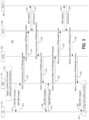
- the AMF 102 sends a message (e.g., via Nausf_Communication_EAPMessage_Transfer) to an authentication server function (AUSF) 302.
- AUSF authentication server function
- Such message includes the EAP ID response (which contains the requested EAP ID for the S-NSSAI), an AAA-S address of the AAA-S 306, a generic public subscription identifier (GIPSI), and the S-NSSAI.
- the AMF 102 sends a current location of the UE 101 to the AAA-S 306, the current location of the UE 101 can also be included in the message sent at 314.
- the current location can be one or more of a current TA, an NR node ID, or a cell ID used for the UE 101.
- the AAA-S 306 can provide the service area of the slice to the AMF 102 regardless of the current location of the UE 101, the current location of the UE 101 is not sent at 314.
- the AAA-P 304 associates the AAA-S address of the AAA-S 306 with the S-NSSAI and forwards, to the AAA-S 306 (using the AAA-S address of the AAA-S 306), the EAP ID response (which contains the EAP ID for the S-NSSAI), the GIPSI, and the S-NSSAI.
- the AMF 102 sends a current location of the UE 101 to the AAA-S 306
- the current location of the UE 101 can also be included in the message forwarded at 316.
- the current location of the UE 101 is not forwarded at 316.
- the EAP ID response can also be referred to as an EAP identity message.
- the current location of the UE 101 (in the first example but not in the second example), the EAP ID response, the GIPSI, and the S-NSSAI can be sent to the AAA-S 306 in an authentication request as a part of the authentication and authorization procedures in which other aspects are subject to other types of authentication and authorization.
- the other aspects include at least the AAA-S 306 authenticating the UE 101 using the EAP procedure based on the EAP ID, and in response to determining that the EAP authentication fails, the UE 101 is not allowed to access the slice.
- the AAA-S 306 can determine whether the current location of the UE 101 is in the service area of the slice, in response to receiving the current location of the UE 101 (e.g., at 316 or directly from the AUSF 302). In response to determining that the current location of the UE 101 is not within the service area of the slice, the authentication request (e.g., received by the AAA-S 306 at 316) is rejected. For example, the AAA-S 306 can send an authentication response (including at least an EAP message, the GPSI, and the S-NSSAI) to the AAA-P 304 at 317.
- an authentication response including at least an EAP message, the GPSI, and the S-NSSAI
- the EAP message includes at least one an indication of the rejection or a proper cause (e.g., failure to authenticate due to the current location of the UE 101 is outside of the service area of the slice).
- the AAA-S 306 sends the authentication response to the AAA-P 304 at 317, and the AAA-P 304 forwards the EAP message, the GPSI, and the S-NSSAI to the AUSF 302 via Nausf_Communication_EAPMessageTransfer at 318.
- the AAA-S 306 sends the authentication response to the AUSF 302 directly.
- the AAA-S 306 can provide the service area at 317.
- the AAA-S 306 can send an authentication response (including at least an EAP message, the GPSI, and the S-NSSAI) to the AAA-P 304 at 317.
- the EAP message includes at least an indication of the authorization and the service area.
- the AUSF 302 can forward the EAP message (including the service area), the GPSI, and the S-NSSAI via Namf_Communication_NIN2MessageTranfser to the AMF 102, at 319.
- the AMF 102 accordingly receives the indication of authorization and the service area.
- the AMF 102 determines whether the UE 101 is allowed to access the slice based on the current UE location. In response to the AMF 102 determining that the current location of the UE 101 is not within the service area of the slice, the AMF 102 can abort the slice authentication and authorization procedure, and 320-329 can be omitted. In the scenario in which the authentication and authorization procedure is triggered by allowed S-NSSAI allocation or update (e.g. during a registration process), the S-NSSAI of the slice is excluded from the allowed NSSAI.
- the AAA-S 306 sends the EAP-success/failure message, the GPSI, and the S-NSSAI directly to the AUSF 302.
- the AUSF 302 sends the EAP-success/failure message, the GPSI, and the S-NSSAI to the AMF 102 via Namf_Communication_N1N2messageTransfer.
- the AAA-S 306 can send the QoS profile directly to the AUSF 302 along with the EAP-success/failure message, the GPSI, and the S-NSSAI.
- the AUSF 302 can forward the QoS profile as part of the Namf_Communication_N1N2messageTransfer message to the AMF 102, at 327.
- the AMF 102 determines the slice-specific AMBR contained in the QoS profile based on any operator policy and sends the slice-specific AMBR to the NR 202.
- the service area of the slice can be conveyed using 325-327.
- the current location of the UE 101 is within the service area of the slice in the first example or in the second example in which the AAA-S 306 can provide the service area of the slice to the AMF 102 regardless of the current location of the UE 101
- the AAA-S 306 can provide the service area at 325.
- the AAA-S 306 sends the service area of the slice as part of the authentication response to the AAA-P 304 at 325, and the AAA-P 304 forwards the service area of the slice as part of the authentication response to the AUSF 302 via Nausf_Communication_EAPMessageTransfer at 326.
- the AAA-S 306 sends the service area of the slice to the AUSF 302 directly.
- the AUSF 302 can forward the service area of the slice via Namf_Communication_NIN2MessageTranfser to the AMF 102, at 327.
- the AMF 102 accordingly receives the indication of authorization and the service area.
- the AMF 102 can determine whether the UE 101 is allowed to access the slice based on the current UE location.
- the AMF 102 transmits a NAS MM transport message including the EAP-success/failure message to the UE 101.
- the AMF 102 initiates the UE configuration update procedure (for each Access Type), at 329.
- the AAA-S 306 can request the revocation of authorization for the network slice specified by the S-NSSAI in the revoke authorization request message. During such a procedure, the AAA-S 306 can update the QoS profile and service area of the slice. The updated QoS profile (with an updated slice-specific AMBR) and the updated service area can be transmitted to the AMF 102 in any suitable manner.
- the AAA-S 306 can request the re-authentication and re-authorization for the slice specified by the S-NSSAI in the re-authentication request message. Responsive to the AMF 102 receiving the re-authentication request, the AMF 102 triggers the slice-specific authentication and authorization procedure such as but not limited to the one described with reference to FIG. 3 .
- the AAA-S 306 can also include the update slice information at 317 or 325.
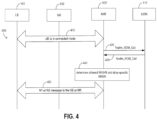
- FIG. 4 is a signal diagram illustrating an example procedure 400 for retrieving slice information from the UDM 112 ( FIG. 1 ), in accordance with an embodiment of the present disclosure.
- the procedure 400 relates to the AMF 102 retrieving the slice information such as but not limited to, the QoS profile (including at least the slice-specific AMBR) and the service area of the slice from the UDM 112.
- the slice information can be requested at 420 and received at 430 together with the access and mobility subscription data, SMF selection subscription data, and UE context in SMF data from the UDM 112 (e.g., using Nudm_SDM_Get) responsive to determining that the AMF 102 does not have subscription data for the UE 101.
- the UDM 112 can obtain the slice information from a unified data repository (UDR) (not shown) responsive to the AMF 102 sending a Nudm_SDM_Get message to the UDM 112.
- the UDM 112 retrieves the slice information from the UDR by querying the UDR for the slice information (e.g., using Nudr_DM_Query).
- the AMF 102 can determine the allowed NSSAI and the slice-specific AMBR. For example, if a subscribed NSSAI is included in the Nudm_SDM_Get message at 430 as part of subscription data in the Nudm_SDM_Get message, slice QoS profile of each subscribed S-NSSAI is also included. The AMF 102 can determine whether there is an active PDU session of the slice corresponding to each subscribed S-NSSAI. In response to determining the active PDU session of a slice, the AMF 102 generates the slice-specific AMBR included in the subscribed slice QoS profile based on operator policies.
- the AMF 102 Responsive to determining the slice-specific AMBR, the AMF 102 sends the slice-specific AMBR to the UE 450 via CP interface N1 or the NR 202 (e.g., the 5G-AN 104) via CP interface N2.
- the AMF 102 can determine whether the UE 101 is allowed to access the slice based on the current UE location. In response to determining that the UE 101 is not allowed to access the slice because the current UE location is outside of the service area and that this registration procedure or the HO procedure is triggered by allowed S-NSSAI allocation or update (e.g., during registration), the S-NSSAI corresponding to the slice is excluded from the allowed NSSAI.
- the AMF 102 subscribes (e.g., using Nudm_SDM Subscribe) to the UDM 112 to be notified responsive to any changes to the requested subscription data.
- the UDM 112 subscribes (e.g., using Nudr_DM_Subscribe) to the UDR to be notified responsive to any modification the requested subscription data.
- the AMF 102 In response to determining that the slice-specific AMBR has changed and that there is an active PDU session for the slice, the AMF 102 updates the slice-specific AMBR for that slice to be the updated slice-specific AMBR included in the updated subscribed QoS profile and then sends the updated slice-specific AMBR to the NR 202 (e.g., the 5G-AN 104) via CP interface N2.
- the NR 202 e.g., the 5G-AN 104
- the AMF 102 in response to determining that a service area of an S-NSSAI has changed and such S-NSSAI is included in the allowed NSSAI, the AMF 102 checks whether the UE 101 is allowed to access the slice based on the current UE location. In response to determining that the current location of the UE 101 is outside of the service area of the slice, the AMF 102 can release all PDU sessions for such slice. The AMF 102 can generate a new allowed NSSAI or a new registration area based on the service area of slice and the current location UE of the UE 101. As the UE 101 moves inside of a registration area, the UE 101 does not need to initiate mobility registration.
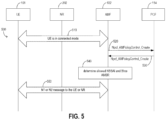
- FIG. 5 is a signal diagram illustrating an example procedure 500 for retrieving slice information from the PCF 114 ( FIG. 1 ), in accordance with an embodiment of the present disclosure.
- the procedure 500 relates to the AMF 102 retrieving the slice information such as but not limited to, the QoS profile (including at least the slice-specific AMBR) and the service area of the slice from the PCF 114.
- the procedure 500 is similar to the procedure 400, except that the slice information is retrieved from the PCF 114 instead of the UDM 112.
- the AMF 102 retrieves the slice information from a V-PCF (visited-PCF), and the V-PCF can retrieves the slice information from a H-PCF (home-PCF).
- the V-PCF can modify the slice information such as but not limited to, adjusting the slice-specific AMBR based on a visited operator, adding/removing a service area of the slice, and so on.
- the H-PLMN may not have knowledge of the topology in visited PLMN (V-PLMN)
- the service area of the slice can be generated by the V-PCF.
- the PCF 114 can represent both the V-PCF and the H-PCF.
- the AMF 102 In response to determining that the AMF 102 has not yet obtained the access and mobility policies for the UE 101 or in response to determining that the access and mobility policies in the AMF 102 are no longer valid, the AMF 102 requests the PCF 114 to apply operator policies for the UE 101 from the PCF 114.
- the AMF 102 sends a Npcf_AMPolicyControl_Create message to the PCF 114 to establish an access and mobility policy control association with the PCF 114.
- the PCF 114 responds to the Npcf_AMPolicyControl_Create service operation by providing the AM-related policy information (e.g., service area restrictions) at 530 in a Npcf_AMPolicyControl_Create message.
- the PCF 114 can also include the slice information in the Npcf_AMPolicyControl_Create message at 530.
- the AMF 102 can determine the allowed NSSAI and the slice-specific AMBR.
- the slice information includes the slice QoS profile of each subscribed S-NSSAI in the Npcf_AMPolicyControl_Create message received by the AMF 102 at 530.
- the AMF 102 can determine whether there is an active PDU session of a slice corresponding to each subscribed S-NSSAI.
- the AMF 102 sends the slice-specific AMBR to the NR 202 (e.g., the 5G-AN 104) to be enforced.
- the slice information includes the service area of each subscribed S-NSSAI in the Npcf_AMPolicyControl_Create message received by the AMF 102 at 530.
- the AMF 102 can determine whether the UE 101 is allowed to access the slice based on the current UE location. In response to determining that the current location of the UE 101 is outside of the service area of a slice and this procedure 500 is triggered by allowed S-NSSAI allocation or update (e.g. during registration), the S-NSSAI corresponding to the slice is excluded from the allowed NSSAI.
- the AMF 102 can subscribe to the PCF 114 to be notified responsive to any changes to the slice information. If the slice information changes and the AMF 102 is subscribed to the PCF 114 to be notified of such change, the PCF 114 pushes (transmits) the updated slice information to the AMF 102.
- the updated slice information can include an updated slice-specific AMBR for a given slice, where the updated slice-specific AMBR is included as part of the updated slice information.
- the AMF 102 determines to trigger some procedure.
- the AMF 102 can update the slice-specific AMBR included in the updated subscribed QoS profile and sends the updated slice AMBR to the NR 202 (the 5G-AN 104) to be enforced.
- the AMF 102 in response to determining that a service area of an S-NSSAI has changed and such S-NSSAI is included in the allowed NSSAI, the AMF 102 checks whether the UE 101 is allowed to access the slice based on the current UE location. In response to determining that the current location of the UE 101 is outside of the service area of the slice, the AMF 102 can release all the PDU sessions for such slice. The AMF 102 can generate a new allowed NSSAI or a new registration area based on the service area of slice and the current location UE of the UE 101.
- FIG. 6 is a flow diagram illustrating an example method 600 for retrieving and using slice information from a NF, in accordance with an embodiment of the present disclosure.
- the method 600 is performed by the AMF 102.
- the NF can be the AAA-S 306 (as shown in FIG. 3 ), the UDM 112 (as shown in FIG. 4 ), the PCF 114 (as shown in FIG. 5 ), or a network slice selection function (NSSF).
- AAA-S 306 as shown in FIG. 3
- the UDM 112 as shown in FIG. 4
- the PCF 114 as shown in FIG. 5
- NSSF network slice selection function
- the NSSF responsive to the NSSF receiving the request from the AMF 102, the NSSF sends a response to the AMF 102 that includes the allowed NSSAI for an applicable access type(s).
- the NSSF can include the slice information in the response.
- the slice information includes at least the QoS profile (containing the slice-specific AMBR) for each slice identified by a S-NSSAI and a service area for each slice identified S-NSSAI.
- the AMF 102 can store the slice information in the UE context in a storage device of the AMF 102. During the registration and HO procedure (with the AMF 102 unchanged), the AMF 102 can check the slice information stored in the UE context for allowed NSSAI generation or update.
- the AMF 102 responsive to the AMF 102 receiving the service area, the AMF 102 can generate the registration area based on the allowed NSSAI and the corresponding service area. Responsive to the AMF 102 receiving the QoS profile, the AMF 102 can sending the QoS profile including the AMBR specific to the slice to the RN 202.
- the AMF 102 can send the slice QoS profile for that slice to the NR 202.
- the NR 202 can use the parameter of the QoS profile (e.g., the slice-specific AMBR) to control the bit rate of non-GBR flows for the whole slice.
- the AMF 102 finds the S-NSSAI identifying the slice related with a PDU session ID of the PDU session and confirms the slice-specific AMBR.
- the AMF 102 can include only the slice-specific AMBR to the NR 202 when the first PDU session of the slice is established or the first UP connection for an established PDU session in the slice is activated.
- the AMF 102 can initiate a CP interface N2 request that includes the updated slice-specific AMBR to the NR 202.
- the AMF 102 can notify the new NR the updated slice-specific AMBR responsive to the AMF 102 receiving the updated slice-specific AMBR from the NF (e.g., the UDM 112 or the PCF 114).
- This notification (including the updated slice-specific AMBR) can be combined with any existing N2 message sent from the AMF 102 to the NF, for example, by extending an information element (IE) to transfer the notification with the existing N2 message.
- IE information element
- the AMF 102 can send notification by itself, in a separated N2 message.
- Figure 7A illustrates a block diagram of an example base station 702, in accordance with some embodiments of the present disclosure.
- Figure 7B illustrates a block diagram of an example the UE 101, in accordance with some embodiments of the present disclosure.
- the base station 702 and the UE 101 can include components and elements configured to support known or conventional operating features that need not be described in detail herein.
- the base station 702 and the UE 101 can be used to communicate (e.g., transmit and receive) data symbols in a wireless communication environment such as the network system architecture 100 and the slice deployment 200, as described above.
- the operations of the two transceiver modules 710 and 730 can be coordinated in time such that the receiver circuitry is coupled to the antenna 732 for reception of transmissions over a wireless transmission link at the same time that the transmitter is coupled to the antenna 712. In some embodiments, there is close time synchronization with a minimal guard time between changes in duplex direction.
- any of the various illustrative logical blocks, modules, processors, means, circuits, methods and functions described in connection with the aspects disclosed herein can be implemented by electronic hardware (e.g., a digital implementation, an analog implementation, or a combination of the two), firmware, various forms of program or design code incorporating instructions (which can be referred to herein, for convenience, as "software” or a "software module), or any combination of these techniques.
- electronic hardware e.g., a digital implementation, an analog implementation, or a combination of the two
- firmware various forms of program or design code incorporating instructions
- software or a "software module”
- IC integrated circuit
- DSP digital signal processor
- ASIC application specific integrated circuit
- FPGA field programmable gate array
- the logical blocks, modules, and circuits can further include antennas and/or transceivers to communicate with various components within the network or within the device.
- a general purpose processor can be a microprocessor, but in the alternative, the processor can be any conventional processor, controller, or state machine.
Landscapes
- Engineering & Computer Science (AREA)
- Computer Networks & Wireless Communication (AREA)
- Signal Processing (AREA)
- Computer Security & Cryptography (AREA)
- Quality & Reliability (AREA)
- Business, Economics & Management (AREA)
- Accounting & Taxation (AREA)
- Computer Hardware Design (AREA)
- Computing Systems (AREA)
- General Engineering & Computer Science (AREA)
- Databases & Information Systems (AREA)
- Mobile Radio Communication Systems (AREA)
Priority Applications (1)
| Application Number | Priority Date | Filing Date | Title |
|---|---|---|---|
| EP25153398.0A EP4535872A3 (de) | 2019-07-03 | 2019-07-03 | Verfahren zur autorisierung für netzwerk-slicing |
Applications Claiming Priority (3)
| Application Number | Priority Date | Filing Date | Title |
|---|---|---|---|
| PCT/CN2019/094516 WO2021000283A1 (en) | 2019-07-03 | 2019-07-03 | Method of authorization for network slicing |
| EP19936507.3A EP3994914B1 (de) | 2019-07-03 | 2019-07-03 | Verfahren und vorrichtung zur autorisierung von netzwerk-slicing |
| EP25153398.0A EP4535872A3 (de) | 2019-07-03 | 2019-07-03 | Verfahren zur autorisierung für netzwerk-slicing |
Related Parent Applications (2)
| Application Number | Title | Priority Date | Filing Date |
|---|---|---|---|
| EP19936507.3A Division EP3994914B1 (de) | 2019-07-03 | 2019-07-03 | Verfahren und vorrichtung zur autorisierung von netzwerk-slicing |
| EP19936507.3A Division-Into EP3994914B1 (de) | 2019-07-03 | 2019-07-03 | Verfahren und vorrichtung zur autorisierung von netzwerk-slicing |
Publications (2)
| Publication Number | Publication Date |
|---|---|
| EP4535872A2 true EP4535872A2 (de) | 2025-04-09 |
| EP4535872A3 EP4535872A3 (de) | 2025-06-25 |
Family
ID=74100214
Family Applications (2)
| Application Number | Title | Priority Date | Filing Date |
|---|---|---|---|
| EP19936507.3A Active EP3994914B1 (de) | 2019-07-03 | 2019-07-03 | Verfahren und vorrichtung zur autorisierung von netzwerk-slicing |
| EP25153398.0A Pending EP4535872A3 (de) | 2019-07-03 | 2019-07-03 | Verfahren zur autorisierung für netzwerk-slicing |
Family Applications Before (1)
| Application Number | Title | Priority Date | Filing Date |
|---|---|---|---|
| EP19936507.3A Active EP3994914B1 (de) | 2019-07-03 | 2019-07-03 | Verfahren und vorrichtung zur autorisierung von netzwerk-slicing |
Country Status (4)
| Country | Link |
|---|---|
| US (1) | US12317122B2 (de) |
| EP (2) | EP3994914B1 (de) |
| KR (2) | KR20250136936A (de) |
| WO (1) | WO2021000283A1 (de) |
Families Citing this family (13)
| Publication number | Priority date | Publication date | Assignee | Title |
|---|---|---|---|---|
| US10834591B2 (en) * | 2018-08-30 | 2020-11-10 | At&T Intellectual Property I, L.P. | System and method for policy-based extensible authentication protocol authentication |
| CN112566186B (zh) * | 2019-09-26 | 2022-04-05 | 华为技术有限公司 | 通信方法及装置 |
| CN113206747B (zh) * | 2020-01-30 | 2023-06-27 | 中国移动通信有限公司研究院 | 一种信息处理方法及相关网络设备 |
| US11026149B1 (en) * | 2020-01-31 | 2021-06-01 | Dish Wireless Llc | Systems and methods for reducing slice access failures |
| US12615190B2 (en) * | 2021-02-17 | 2026-04-28 | At&T Intellectual Property I, L.P. | Apparatuses and methods for facilitating automated interdomain communications analytics automation functionality and profiling |
| KR20220138662A (ko) * | 2021-04-06 | 2022-10-13 | 삼성전자주식회사 | 통신 시스템에서 네트워크 슬라이스 제어를 위한 장치 및 방법 |
| US11490328B1 (en) * | 2021-04-16 | 2022-11-01 | Sprint Communications Company Lp | Data communication system to serve a user equipment (UE) over a third generation partnership project (3GPP) network core |
| CN113573367B (zh) * | 2021-07-05 | 2023-07-14 | 中国联合网络通信集团有限公司 | 无线资源的分配方法及装置 |
| CN117322043A (zh) | 2021-07-29 | 2023-12-29 | 中兴通讯股份有限公司 | 无线通信的方法、设备和计算机程序产品 |
| CN117062179A (zh) * | 2022-05-06 | 2023-11-14 | 华为技术有限公司 | 一种网络切片的通信方法、通信装置、接入网设备和终端设备 |
| US12177663B2 (en) * | 2022-05-24 | 2024-12-24 | Cisco Technology, Inc. | Selective network slice authentication and authorization in a mobile network environment |
| CN120201476A (zh) * | 2023-12-22 | 2025-06-24 | 华为技术有限公司 | 通信方法和通信装置 |
| WO2025175201A1 (en) * | 2024-02-15 | 2025-08-21 | Interdigital Patent Holdings, Inc. | Methods for user authentication in wireless systems associated with users behind an rg or gateway |
Family Cites Families (14)
| Publication number | Priority date | Publication date | Assignee | Title |
|---|---|---|---|---|
| US10652809B2 (en) * | 2016-05-15 | 2020-05-12 | Lg Electronics Inc. | Method and apparatus for supporting network slicing selection and authorization for new radio access technology |
| US10362511B2 (en) * | 2016-05-17 | 2019-07-23 | Lg Electronics Inc. | Method and apparatus for determining PDU session identity in wireless communication system |
| CN109548090B (zh) * | 2016-05-24 | 2020-07-07 | 华为技术有限公司 | QoS控制方法及设备 |
| KR102493348B1 (ko) | 2017-04-27 | 2023-01-31 | 삼성전자 주식회사 | 네트워크 슬라이스를 이용할 수 있는 지역에 대한 정보를 획득하는 방법 |
| KR102355678B1 (ko) * | 2017-05-08 | 2022-01-26 | 삼성전자 주식회사 | 이동 통신 시스템에서의 QoS(Quality Of Service) Flow의 설정 방법 및 장치 |
| EP3641424B1 (de) * | 2017-06-17 | 2022-05-04 | LG Electronics Inc. | Verfahren zur registrierung eines benutzergeräts in einer netzwerkscheibe in einem drahtlosen kommunikationssystem und benutzergerät dafür |
| CN117320091A (zh) | 2017-08-15 | 2023-12-29 | 华为技术有限公司 | 会话处理方法及相关设备 |
| EP3695653B1 (de) * | 2017-10-11 | 2025-09-24 | Nec Corporation | Ue-konfiguration und -aktualisierung mit netzwerk-slice-auswahlrichtlinien |
| US10721648B2 (en) * | 2017-10-12 | 2020-07-21 | Apple Inc. | Device requested protocol data unit session modification in the 5G system |
| EP3471464B1 (de) * | 2017-10-16 | 2020-04-01 | Ntt Docomo, Inc. | Verfahren und vorrichtung zur gewährung von zugriffsrechten eines kommunikationsdienstes |
| CN109842910A (zh) | 2017-11-28 | 2019-06-04 | 中国移动通信有限公司研究院 | 一种网络切片的处理方法及接入网网元 |
| WO2019114938A1 (en) | 2017-12-12 | 2019-06-20 | Nokia Solutions And Networks Oy | Method, system and apparatus for multicast session management in a 5g communication network |
| CN109743213B (zh) * | 2019-02-28 | 2021-08-13 | 腾讯科技(深圳)有限公司 | 一种网络切片处理方法和设备以及系统 |
| US11490291B2 (en) * | 2019-03-28 | 2022-11-01 | Ofinno, Llc | Handover for closed access group |
-
2019
- 2019-07-03 KR KR1020257029852A patent/KR20250136936A/ko active Pending
- 2019-07-03 WO PCT/CN2019/094516 patent/WO2021000283A1/en not_active Ceased
- 2019-07-03 KR KR1020227002457A patent/KR20220024922A/ko not_active Ceased
- 2019-07-03 EP EP19936507.3A patent/EP3994914B1/de active Active
- 2019-07-03 EP EP25153398.0A patent/EP4535872A3/de active Pending
-
2021
- 2021-12-23 US US17/560,842 patent/US12317122B2/en active Active
Also Published As
| Publication number | Publication date |
|---|---|
| US20220116816A1 (en) | 2022-04-14 |
| US12317122B2 (en) | 2025-05-27 |
| KR20220024922A (ko) | 2022-03-03 |
| EP4535872A3 (de) | 2025-06-25 |
| WO2021000283A1 (en) | 2021-01-07 |
| EP3994914B1 (de) | 2025-12-17 |
| EP3994914A1 (de) | 2022-05-11 |
| EP3994914A4 (de) | 2022-12-07 |
| CN114270931A (zh) | 2022-04-01 |
| KR20250136936A (ko) | 2025-09-16 |
Similar Documents
| Publication | Publication Date | Title |
|---|---|---|
| US12317122B2 (en) | Method of authorization for network slicing | |
| US12550206B2 (en) | User plane function selection for isolated network slice | |
| US10979886B2 (en) | UE configuration and update with network slice selection policy | |
| WO2021031065A1 (en) | A method of registration with access and mobility management function re-allocation | |
| WO2021098104A1 (en) | Method of authorization for network slicing | |
| CN111918271A (zh) | 一种信息配置方法及装置 | |
| US12402069B2 (en) | Method for slice information update | |
| US12574834B2 (en) | Network slice selection, management, and policy control for vehicle-to-everything (V2X) services | |
| US20220400460A1 (en) | Communication method for controlling packet data unit session | |
| KR20220152950A (ko) | 네트워크 슬라이스 승인 제어(nsac) 발견 및 로밍 향상들 | |
| WO2018205145A1 (en) | Method and apparatus for allocating registration area | |
| US20250324381A1 (en) | Method for performing a de-mapping of a replaced s-nssai and an alternative s-nssai | |
| CN118355694A (zh) | 用于切片资源释放的方法 | |
| CN114270931B (zh) | 用于网络切片的授权方法 | |
| WO2023077391A1 (en) | Method for access and mobility policy decision | |
| CN117135610A (zh) | 策略控制的方法与装置 | |
| KR20220163439A (ko) | 네트워크 요청 등록 절차 개시 | |
| US20250324380A1 (en) | Operation method due to slice deregistration inactivity timer expiry | |
| US12238636B2 (en) | Systems and methods for 5G core network access control | |
| WO2025076714A1 (en) | Systems and methods for user equipment registration | |
| US12452376B2 (en) | Systems and methods for generating network policy decisions for data sessions | |
| WO2022233030A1 (en) | A method for network slice admission control |
Legal Events
| Date | Code | Title | Description |
|---|---|---|---|
| PUAI | Public reference made under article 153(3) epc to a published international application that has entered the european phase |
Free format text: ORIGINAL CODE: 0009012 |
|
| STAA | Information on the status of an ep patent application or granted ep patent |
Free format text: STATUS: THE APPLICATION HAS BEEN PUBLISHED |
|
| AC | Divisional application: reference to earlier application |
Ref document number: 3994914 Country of ref document: EP Kind code of ref document: P |
|
| AK | Designated contracting states |
Kind code of ref document: A2 Designated state(s): AL AT BE BG CH CY CZ DE DK EE ES FI FR GB GR HR HU IE IS IT LI LT LU LV MC MK MT NL NO PL PT RO RS SE SI SK SM TR |
|
| REG | Reference to a national code |
Ref country code: DE Ref legal event code: R079 Free format text: PREVIOUS MAIN CLASS: H04W0048040000 Ipc: H04W0012080000 |
|
| PUAL | Search report despatched |
Free format text: ORIGINAL CODE: 0009013 |
|
| AK | Designated contracting states |
Kind code of ref document: A3 Designated state(s): AL AT BE BG CH CY CZ DE DK EE ES FI FR GB GR HR HU IE IS IT LI LT LU LV MC MK MT NL NO PL PT RO RS SE SI SK SM TR |
|
| RIC1 | Information provided on ipc code assigned before grant |
Ipc: H04W 48/18 20090101ALN20250520BHEP Ipc: H04W 28/24 20090101ALN20250520BHEP Ipc: H04W 48/04 20090101ALI20250520BHEP Ipc: H04W 12/08 20210101AFI20250520BHEP |
|
| STAA | Information on the status of an ep patent application or granted ep patent |
Free format text: STATUS: REQUEST FOR EXAMINATION WAS MADE |
|
| 17P | Request for examination filed |
Effective date: 20250717 |
|
| STAA | Information on the status of an ep patent application or granted ep patent |
Free format text: STATUS: EXAMINATION IS IN PROGRESS |
|
| 17Q | First examination report despatched |
Effective date: 20260227 |