EP4535795A2 - Adaptives bitratenstreaming mit videoqualitätsinformationen - Google Patents
Adaptives bitratenstreaming mit videoqualitätsinformationen Download PDFInfo
- Publication number
- EP4535795A2 EP4535795A2 EP24200879.5A EP24200879A EP4535795A2 EP 4535795 A2 EP4535795 A2 EP 4535795A2 EP 24200879 A EP24200879 A EP 24200879A EP 4535795 A2 EP4535795 A2 EP 4535795A2
- Authority
- EP
- European Patent Office
- Prior art keywords
- profile
- levels
- segment
- level
- quality metric
- Prior art date
- Legal status (The legal status is an assumption and is not a legal conclusion. Google has not performed a legal analysis and makes no representation as to the accuracy of the status listed.)
- Pending
Links
Images





Classifications
-
- H—ELECTRICITY
- H04—ELECTRIC COMMUNICATION TECHNIQUE
- H04N—PICTORIAL COMMUNICATION, e.g. TELEVISION
- H04N21/00—Selective content distribution, e.g. interactive television or video on demand [VOD]
- H04N21/20—Servers specifically adapted for the distribution of content, e.g. VOD servers; Operations thereof
- H04N21/23—Processing of content or additional data; Elementary server operations; Server middleware
- H04N21/234—Processing of video elementary streams, e.g. splicing of video streams or manipulating encoded video stream scene graphs
- H04N21/2343—Processing of video elementary streams, e.g. splicing of video streams or manipulating encoded video stream scene graphs involving reformatting operations of video signals for distribution or compliance with end-user requests or end-user device requirements
- H04N21/23439—Processing of video elementary streams, e.g. splicing of video streams or manipulating encoded video stream scene graphs involving reformatting operations of video signals for distribution or compliance with end-user requests or end-user device requirements for generating different versions
-
- H—ELECTRICITY
- H04—ELECTRIC COMMUNICATION TECHNIQUE
- H04N—PICTORIAL COMMUNICATION, e.g. TELEVISION
- H04N21/00—Selective content distribution, e.g. interactive television or video on demand [VOD]
- H04N21/20—Servers specifically adapted for the distribution of content, e.g. VOD servers; Operations thereof
- H04N21/23—Processing of content or additional data; Elementary server operations; Server middleware
- H04N21/24—Monitoring of processes or resources, e.g. monitoring of server load, available bandwidth, upstream requests
- H04N21/2402—Monitoring of the downstream path of the transmission network, e.g. bandwidth available
-
- H—ELECTRICITY
- H04—ELECTRIC COMMUNICATION TECHNIQUE
- H04N—PICTORIAL COMMUNICATION, e.g. TELEVISION
- H04N21/00—Selective content distribution, e.g. interactive television or video on demand [VOD]
- H04N21/20—Servers specifically adapted for the distribution of content, e.g. VOD servers; Operations thereof
- H04N21/25—Management operations performed by the server for facilitating the content distribution or administrating data related to end-users or client devices, e.g. end-user or client device authentication, learning user preferences for recommending movies
- H04N21/262—Content or additional data distribution scheduling, e.g. sending additional data at off-peak times, updating software modules, calculating the carousel transmission frequency, delaying a video stream transmission, generating play-lists
- H04N21/26208—Content or additional data distribution scheduling, e.g. sending additional data at off-peak times, updating software modules, calculating the carousel transmission frequency, delaying a video stream transmission, generating play-lists the scheduling operation being performed under constraints
-
- H—ELECTRICITY
- H04—ELECTRIC COMMUNICATION TECHNIQUE
- H04N—PICTORIAL COMMUNICATION, e.g. TELEVISION
- H04N21/00—Selective content distribution, e.g. interactive television or video on demand [VOD]
- H04N21/80—Generation or processing of content or additional data by content creator independently of the distribution process; Content per se
- H04N21/83—Generation or processing of protective or descriptive data associated with content; Content structuring
- H04N21/845—Structuring of content, e.g. decomposing content into time segments
- H04N21/8456—Structuring of content, e.g. decomposing content into time segments by decomposing the content in the time domain, e.g. in time segments
Definitions
- content e.g., a video or audio
- segments are encoded at multiple levels, which may be referred to as profile levels.
- Each profile level may be associated with a different characteristic, which may be based on bitrate or quality.
- a content provider may use a content delivery network to deliver the segments to client devices.
- An adaptive bitrate algorithm may monitor the available bandwidth and dynamically adjust the profile level that is requested for content. The adaptive bitrate algorithm may ensure that an optimal viewing experience occurs at the client device because the client device may request a profile level that may be considered optimal for the available bandwidth.
- a content delivery network may charge the content provider based on the amount of data that is transferred. The amount charged may be based on a rate times the amount of data that is transferred during a period.
- content delivery networks may charge more during certain periods of the day, which may be referred to as a peak period. For example, a peak period may be considered a time in the evening when a large number of client devices are streaming content via playback sessions.
- a non-peak period may be during the day when a large number of users are not streaming content, which results in a smaller number of active playback sessions. Accordingly, for a content provider, transferring a large amount of data during a peak period may result in higher costs.
- the amount of data that is transferred may depend on the profile level that is being selected. For example, a higher profile level may have a higher bitrate and quality, and thus use more bitrate to transfer the data through the content delivery network. In contrast, using a lower profile level may use less bitrate.
- the content delivery network may measure the amount of data based on bytes that are transferred. Thus, the costs would thus be lower if a lower quality profile level with a lower bitrate is used compared to a higher quality profile level with a higher bitrate.
- the adaptive bitrate algorithm is configured to request a profile level that is based on the available bandwidth and may determine a profile level with a highest possible bitrate that is predicted to not cause rebuffering.
- FIG. 1 depicts a simplified system 100 performing an adaptive bitrate algorithm that uses bitrate and quality according to some embodiments.
- System 100 includes a server system 102 and a client device 104. Although a single instance of server system 102 and client device 104 are shown, multiple instances of server system 102 and client device 104 may be appreciated. For example, multiple client devices 104 may be requesting content from a single server system 102 or multiple server systems 102.
- a video may be encoded in multiple profile levels that correspond to different levels, which may be different levels of bitrates or quality (e.g., resolution).
- Client device 104 may request a segment of video from one of the profile levels based on current network conditions. For example, client device 104 may use an adaptive bitrate algorithm to select the profile level for the video based on the estimated current available bandwidth and other network conditions.
- Client device 104 may include a mobile phone, smartphone, set top box, television, living room device, tablet device, or other computing device.
- Client device 104 may include a media player 110 that is displayed on an interface 112.
- Media player 110 or client device 104 may request content from the content delivery network 118.
- a peak period prediction system 108 may predict when a peak period may occur. For example, there may be a peak period that may occur during a day.
- the peak period may be defined by content delivery network 118 and may be based on a number of playback sessions that are presently active, such as a number of playback sessions may meet a threshold (e.g., above the threshold).
- a content delivery network 118 may designate a period as being a peak period when an average of 1 million playback sessions are happening simultaneously in the period. Other criteria may be used to determine when a peak period occurs, such as a total count of playback sessions during a period.
- Content management system 106 may not know when a peak period may be designated by a content delivery network 118. Accordingly, peak period prediction system 108 may analyze historical data and determine when a peak period may be designated by a content delivery network 118. If there are multiple content delivery networks 118, peak period prediction system 108 may perform the same process for each content delivery network 118.
- a quality determination system 116 may determine a quality metric value for profile levels.
- the quality metric value may be a numeric value that measures a quality characteristic.
- the quality metric value may indicate a perceived quality of content.
- video multi-method assessment fusion (VMAF) may be used as a quality metric because it may have a high correlation with the perceived video quality.
- the perceived video quality may estimate the video quality that is perceived by a human user when watching the content. If the perceived quality difference is negligible, then a human user may not be able to tell the negligible difference in quality.
- Other metrics may also be used, such as peak signal to noise ratio (PSNR).
- PSNR peak signal to noise ratio
- the metric may be different from the parameters that are used to encode the profile levels of a segment, which may be bitrate and resolution. That is, VMAF is a metric that is different from resolution.
- Quality determination system 116 may analyze segments for each profile level and determine a quality metric value for each profile level of each segment.
- Content management system 106 may provide the peak period prediction and the quality metric values to client device 104, such as via content delivery network 118.
- the peak period prediction and quality metric values may be provided via a communication that is sent using a streaming protocol, such as dynamic adaptive streaming over HTTP (DASH) or HTTP live streaming (HLS).
- the streaming protocol may refer to the communication differently, such as a manifest in DASH or a playlist in HLS.
- the communication may send information that is needed to request segments for content for the playback session, such as links to segments in the content, control information (e.g., segment length, etc.), and other information.
- the peak period prediction and quality metric values may also be provided using other methods, such as in out-of-band communications in a control channel.
- the communications are sent in-band using DASH or HLS because the information for the peak periods and quality metric values are sent in manifests or playlists that are being sent to enable the streaming of content.
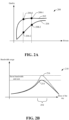
- FIG. 2A shows a graph 200 for selecting a profile level when the quality difference is minimal according to some embodiments.
- the Y-axis is a quality metric and the X-axis is bitrate.
- a first curve 202 is based on characteristics of a first instance of content and a second curve 204 is based on characteristics of a second instance of content.
- the difference in quality between selecting the first profile level at 206-1 and the second profile level at 208-1 is minimal and may not be perceived by a user.
- the change in quality between selecting the first profile level at 206-2 and the second profile level 208-2 is not minimal and may be perceived by a user.
- a threshold may be used to determine when a difference in quality is minimal (e.g., difference ⁇ threshold). Accordingly, when curve 202 occurs, the profile level with the lower bitrate at 206-1 may be selected. However, when curve 204 is encountered, the profile level at 208-2 may be selected with the higher bitrate because its perceived quality may be much more likely to be noticed by a user.
- FIG. 2B depicts an example of the cost savings when using the quality metric value to select a profile level according to some embodiments.
- the Y-axis may be bandwidth usage and the X-axis may be the hour of a day.
- a curve 214 indicates the bandwidth usage when selecting the profile level at 206-1.
- a curve at 214 shows the bandwidth usage when selecting the profile level at 208-1. Accordingly, a saved cost occurs when selecting the profile level with the lower bitrate. However, the perceived quality difference is minimal and may not be perceived by a human user.
- FIG. 3 depicts a simplified flowchart 300 of a method for determining the peak period and quality metric values according to some embodiments.
- server system 102 receives historical data.
- the historical data may be from a period, such as N Days, where N is a number.
- the historical data may indicate a number of playback sessions that were active during portions of a day.
- each day may have a cumulative playback session count for each hour of the day.
- one or more hours that have a number of session counts above a threshold may be denoted as a peak hour.
- Other methods may also be used to determine the peak periods, such as analyzing the number of bytes that are transferred in a day, and periods with the largest number of bytes transferred are selected.
- peak period prediction system 108 may determine the peak period from historical data. When the peak period is volatile, peak period prediction system 108 may use a prediction method to predict the peak period based on predicted traffic.
- days D 1 ... D N are sorted by time and D N is the data of the latest day.
- the variables v 1 ... v k are the k nearest days to the day N, sorted by closeness.
- Peak period prediction system 108 calculates the peak hour h in D ⁇ N +1 , where [ h - ⁇ , h + ⁇ ] is the peak period, wherein h is the hour, and ⁇ is a parameter that is measured in hours and could be tuned.
- a first column lists the day
- a second column lists the traffic data
- a third column lists the distance between the day and the current day
- a fourth column lists the variables v 1 ... v k that are the k nearest days to the day N, sorted by closeness
- a fifth column lists the value for the variable ⁇ j .
- the value of [6,7] is thus the predicted active playback session count of each of the candidates for the peak hour.
- the second hour that has more sessions may be regarded as the peak hour of D 6 .
- the candidates for the peak hour are usually all the hours of a day, so the traffic data for each day is 24-hour data, which means D i is a 24-dimension vector.
- server system 102 causes the peak period to be sent to client device 104, such via a content delivery network 118.
- the peak period can be inserted in a communication that is sent during the playback session or in an out of band communication. Examples of sending the peak period will be described below.
- server system 102 may cause the quality metric values to be sent to client device 104, such as via content delivery network 118.
- the quality metric values can be inserted in a communication that is sent during the playback session or in an out of band communication. Examples of sending the quality metric values will be described below.
- FIG. 4 depicts an example of quality metric values according to some embodiments.
- a graph 400 shows the quality levels of three segments of segment 1, segment 2, and segment 3 at 402, but the instance of content may have multiple segments.
- the Y-axis shows the quality and the X-axis shows time in the instance of content.
- a profile level 1, a profile level 2, a profile level 3 are shown, but other profile levels may be appreciated.
- the peak period and quality metric values may be sent using in-band communications during the playback session or via out of band communications.
- the communication may be sent using different protocols that are used to perform messaging during the playback session.
- Adaptive bitrate algorithm 114 may be configured to receive the quality metric values when a communication is received during the playback process.
- a manifest file is sent that describes the segments that can be requested.
- HLS a multi-variant playlist and multiple media playlists may be sent to describe the profile levels and the segments that can be requested.
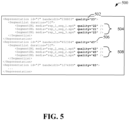
- FIG. 5 depicts an example of sending the peak period and quality metric values using the DASH protocol according to some embodiments.
- the quality metric values are sent as a property of the DASH protocol.
- the average quality for a profile level 1 is sent using the representation tag.
- the average value is 23 for profile level 1.
- the quality metric value for each segment for profile level 1 is sent using the segment URL property. For example, the quality metric value for segment 1, seg_1 is 22, for segment 2, seg_2 is 21, and for segment 3, seg_3 is 23.
- the quality metric value for profile level 2 is shown as the average value of 43 at 506. Then, for profile level 2, at 508, the quality metric values for segments segment 1, segment 2, and segment 3 are 43, 45, and 42, respectively. Although the above quality metric values are sent using these properties, other properties may be used. Also, the peak period may be sent using another property or via a separate communication outside of the communications for the streaming protocol.
- FIG. 6 depicts an example of a playlist 600 for sending the quality metric values using the HLS protocol according to some embodiments.
- the quality metric values may be sent using properties of HLS.
- the multi-variant playlist tag, EXT-X-Stream-INF may be used to specify the content-level video quality with a new attribute of AVERAGE-QUALITY.
- a media playlist tag may be defined that specifies the segment level quality metric values for each segment.
- a media playlist tag EXT-X-Quality may specify the segment level quality metric of each segment. For example, at 602, the average quality is 23 for a first profile level; at 604, the average quality is 43 for a second profile level; and at 606, the average quality is 83 for a third profile level.
- a media playlist tag of EXT-X-Quality specifies the segment level quality metric value of each segment. For example, at 608, a media playlist for a first profile level is shown. At 610, the quality metric value may be 22 for segment 1, at 612, the quality metric value may be 21 for segment 2, and at 614, the quality metric value may be 22 for segment 3. Also, the peak period may be sent using another property or via a separate communication outside of the communications for the streaming protocol.
- FIG. 7 depicts a simplified flowchart 700 of a profile selection method using adaptive bitrate algorithm 114 according to some embodiments.
- client device 104 receives a communication with the quality metric values.
- the quality metric values may have been received in a communication that is sent using a streaming protocol.
- adaptive bitrate algorithm 114 determines an estimate for rebuffering time.
- the estimate for rebuffering time may estimate the potential rebuffering time in a future period for each profile level.
- a rebuffer may occur when there is not enough data in a buffer to support continuous playback of content.
- the estimate of rebuffering time may be used to evaluate the risk of rebuffering when selecting different profile levels.
- the rebuffering time may be the amount of time in which rebuffering may occur in the future. For example, the rebuffering time may be three seconds. A zero rebuffering time may indicate that rebuffering may not occur.
- adaptive bitrate algorithm 114 estimates the potential buffering time in a future period for each profile level. This step is to evaluate the risk of rebuffering when choosing different profile levels.
- Adaptive bitrate algorithm 114 calculates the rebuffering time r ij for every quality level j ⁇ [1, M ], where the rebuffering time be an M-dimensional vector R .
- the current "adjusted" buffer length but + ⁇ is one second, and the duration of each segment d i is also constant at 5 seconds.
- Adaptive bitrate algorithm 114 simulates the downloading of the segment i + 1 (e.g., from five seconds to 11 seconds).
- the estimated buffer length before downloading the segment i + 1 is five seconds.
- the estimated download time is six seconds (because segment i + 1 has a larger size).
- the rebuffering will occur at ten seconds and last for one second until the segment i + 1 is finally downloaded at 11 seconds.
- the buffer will be filled with new content then and the buffer length will be five seconds, equal to the duration of segment i + 1.
- Adaptive bitrate algorithm 114 simulates the downloading of the segment i + 2 (from 11 seconds to 15 seconds).
- the estimated download time is four seconds. Since the buffer still has five seconds of the content to be played, no rebuffering will occur until the segment i + 2 is finally downloaded at 15 seconds. Therefore, the total estimated rebuffering time for quality j at segment i r ij is five seconds in total (four seconds for the segment i and 1 second for segment i + 1).
- adaptive bitrate algorithm 114 determines a bitrate decision.
- Adaptive bitrate algorithm 114 may use the bitrates for profile levels for a segment and the estimated rebuffering time to determine a profile level to select.
- Adaptive bitrate algorithm 114 may use a similar function to determine the bitrate decision and the quality decision that is described below.
- the function may use the bitrate when calculating the bitrate decision or a quality metric value when calculating the quality decision.
- the function estimates rebuffering time for profile levels, outputs scores, and selects a profile level based on the scores.
- a threshold ⁇ is a threshold to indicate whether two profile levels of the same segment have similar perceived quality, which means a first profile level j 1 and a second profile level j 2 could be regarded as having similar quality (e.g., within a threshold) when
- the threshold ⁇ may be different when analzying bitrate versus quality.
- adaptive bitrate algorithm 114 can determine a quality decision.
- adaptive bitrate algorithm 114 determines the quality metric values for profile levels of the segment.
- adaptive bitrate algorithm 114 selects a profile level based on the bitrate decision and the quality decision. Different methods may be used to select the profile level. In some embodiments, adaptive bitrate algorithm 114 may select the lower profile level of the profile levels that were selected from the bitrate decision and the quality decision. For example, adaptive bitrate algorithm 114 selects the lower profile level for segment i using min ( j b ,j q ). In some examples, if a profile level 8 and a profile level 6 have been selected, adaptive bitrate algorithm 114 selects profile level 6 as the selected profile level. It is expected that profile level 6 may have a lower bitrate compared to profile level 8.
- the bitrate decision and the quality decision depend on the thresholds ⁇ b and ⁇ q .
- the threshold ⁇ b may be set to be 0. Therefore, the bitrate decision will be the profile level 6 with the highest score of 2100 at 814.
- the method of FIG. 7 may be performed based on when a peak period is specified. For example, the process may be more aggressive in reducing the bitrate during peak periods.
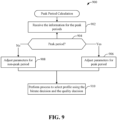
- FIG. 9 depicts a simplified flowchart 900 of a method for performing an adaptive bitrate algorithm based on peak periods according to some embodiments.
- adaptive bitrate algorithm 114 receives information for the peak periods.
- the information for the peak periods may be received in a communication, such as via a manifest or a playlist, or an out of band communication.
- adaptive bitrate algorithm 114 determines if a peak period is being experienced at a future time. For example, a peak period may indicate an hour of the day, minutes in a day, a portion of the day, etc. When a peak period is upcoming, at 906, adaptive bitrate algorithm 114 adjusts parameters for the peak period. For example, adaptive bitrate algorithm 114 may adjust parameters in the bitrate decision or the quality decision based on a peak period being experienced. In some embodiments, when in a peak period, adaptive bitrate algorithm 114 may adjust a parameter to loosen the requirements for determining the similarity in quality metric values between two profile levels to save more bandwidth.
- adaptive bitrate algorithm 114 performs a process to select a profile level using the bitrate decision and the quality decision. If not in a peak period, the parameter for the non-peak period may be used for the bitrate decision and the quality decision. If a peak period is being experienced, then the parameter for the peak period may be used in the bitrate decision and the quality decision. Other processes may also be used. For example, when not in a peak period, the quality decision may not be calculated. Rather, the profile level that is determined by the bitrate decision may only be used.
- adaptive bitrate algorithm 114 may reduce the average bitrate during peak periods while also maintaining a similar perceived quality.
- bandwidth is saved during the peak periods, which may lower costs.
- the perceived quality may be similar and not perceptible by a user.
- adjustments to the buffer offset may be used such that the buffer length may increase. The increased buffer length may improve the playback performance by reducing the rebuffering that may occur.
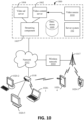
- the video streaming system 1000 may include one or more computer servers or modules 1002, 1004, and 1007 distributed over one or more computers. Each server 1002, 1004, 1007 may include, or may be operatively coupled to, one or more data stores 1009, for example databases, indexes, files, or other data structures.
- a video content server 1002 may access a data store (not shown) of various video segments.
- the video content server 1002 may serve the video segments as directed by a user interface controller communicating with a client device.
- a video segment refers to a definite portion of frame-based video data, such as may be used in a streaming video session to view a television episode, motion picture, recorded live performance, or other video content.
- a video advertising server 1004 may access a data store of relatively short videos (e.g., 10 second, 30 second, or 60 second video advertisements) configured as advertising for a particular advertiser or message.
- the advertising may be provided for an advertiser in exchange for payment of some kind or may comprise a promotional message for the system 1000, a public service message, or some other information.
- the video advertising server 1004 may serve the video advertising segments as directed by a user interface controller (not shown).
- the video streaming system 1000 may further include an integration and streaming component 1007 that integrates video content and video advertising into a streaming video segment.
- streaming component 1007 may be a content server or streaming media server.
- a controller (not shown) may determine the selection or configuration of advertising in the streaming video based on any suitable algorithm or process.
- the video streaming system 1000 may include other modules or units not depicted in FIG. 10 , for example, administrative servers, commerce servers, network infrastructure, advertising selection engines, and so forth.
- One or more client devices 1020 may be in communication with the video streaming system 1000, via the data communication network 1012, wireless network 1014, or another network.
- client devices may include, for example, one or more laptop computers 1020-1, desktop computers 1020-2, "smart" mobile phones 1020-3, tablet devices 1020-4, network-enabled televisions 1020-5, or combinations thereof, via a router 1018 for a LAN, via a base station 1017 for wireless network 1014, or via some other connection.
- client devices 1020 may send and receive data or instructions to the system 1000, in response to user input received from user input devices or other input.
- the system 1000 may serve video segments and metadata from the data store 1009 responsive to selection of media programs to the client devices 1020.
- Client devices 1020 may output the video content from the streaming video segment in a media player using a display screen, projector, or other video output device, and receive user input for interacting with the video content.
- Distribution of audio-video data may be implemented from streaming component 1007 to remote client devices over computer networks, telecommunications networks, and combinations of such networks, using various methods, for example streaming.
- a content server streams audio-video data continuously to a media player component operating at least partly on the client device, which may play the audio-video data concurrently with receiving the streaming data from the server.
- streaming is discussed, other methods of delivery may be used.
- the media player component may initiate play of the video data immediately after receiving an initial portion of the data from the content provider.
- Traditional streaming techniques use a single provider delivering a stream of data to a set of end users. High bandwidth and processing power may be required to deliver a single stream to a large audience, and the required bandwidth of the provider may increase as the number of end users increases.
- Streaming media can be delivered on-demand or live. Streaming enables immediate playback at any point within the file. End-users may skip through the media file to start playback or change playback to any point in the media file. Hence, the end-user does not need to wait for the file to progressively download.
- streaming media is delivered from a few dedicated servers having high bandwidth capabilities via a specialized device that accepts requests for video files, and with information about the format, bandwidth, and structure of those files, delivers just the amount of data necessary to play the video, at the rate needed to play it.
- Streaming media servers may also account for the transmission bandwidth and capabilities of the media player on the destination client.
- Streaming component 1007 may communicate with client device 1020 using control messages and data messages to adjust to changing network conditions as the video is played.
- control messages can include commands for enabling control functions such as fast forward, fast reverse, pausing, or seeking to a particular part of the file at the client.
- streaming component 1007 transmits video data only as needed and at the rate that is needed, precise control over the number of streams served can be maintained. The viewer will not be able to view high data rate videos over a lower data rate transmission medium.
- streaming media servers (1) provide users random access to the video file, (2) allow monitoring of who is viewing what video programs and how long they are watched (3) use transmission bandwidth more efficiently, since only the amount of data required to support the viewing experience is transmitted, and (4) the video file is not stored in the viewer's computer, but discarded by the media player, thus allowing more control over the content.
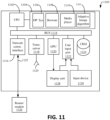
- a bus 1114 or other communication components may support communication of information within the apparatus 1100.
- the processor 1102 may be a specialized or dedicated microprocessor configured or operable to perform particular tasks in accordance with the features and aspects disclosed herein by executing machine-readable software code defining the particular tasks.
- Processor memory 1104 e.g., random access memory (RAM) or other dynamic storage device
- RAM random access memory
- the memory 1104 may also store temporary variables or other intermediate information during execution of such instructions.
- One or more input devices 1130 may be connected to the bus 1114 via a user input port 1122 to communicate information and commands to the apparatus 1100.
- an input device 1130 may provide or support control over the positioning of a cursor.
- a cursor control device also called a pointing device, may be configured as a mouse, a trackball, a track pad, touch screen, cursor direction keys or other device for receiving or tracking physical movement and translating the movement into electrical signals indicating cursor movement.
- the cursor control device may be incorporated into the display unit 1128, for example using a touch sensitive screen.
- a cursor control device may communicate direction information and command selections to the processor 1102 and control cursor movement on the display 1128.
- a cursor control device may have two or more degrees of freedom, for example allowing the device to specify cursor positions in a plane or three-dimensional space.
Landscapes
- Engineering & Computer Science (AREA)
- Multimedia (AREA)
- Signal Processing (AREA)
- Databases & Information Systems (AREA)
- Two-Way Televisions, Distribution Of Moving Picture Or The Like (AREA)
- Testing, Inspecting, Measuring Of Stereoscopic Televisions And Televisions (AREA)
Applications Claiming Priority (2)
| Application Number | Priority Date | Filing Date | Title |
|---|---|---|---|
| CN202311286724.2A CN119815085A (zh) | 2023-10-07 | 2023-10-07 | 使用视频质量信息的自适应比特率流传输 |
| US18/531,560 US12501087B2 (en) | 2023-10-07 | 2023-12-06 | Adaptive bitrate streaming using video quality information |
Publications (2)
| Publication Number | Publication Date |
|---|---|
| EP4535795A2 true EP4535795A2 (de) | 2025-04-09 |
| EP4535795A3 EP4535795A3 (de) | 2025-05-21 |
Family
ID=92900136
Family Applications (1)
| Application Number | Title | Priority Date | Filing Date |
|---|---|---|---|
| EP24200879.5A Pending EP4535795A3 (de) | 2023-10-07 | 2024-09-17 | Adaptives bitratenstreaming mit videoqualitätsinformationen |
Country Status (2)
| Country | Link |
|---|---|
| EP (1) | EP4535795A3 (de) |
| JP (1) | JP7848281B2 (de) |
Cited By (1)
| Publication number | Priority date | Publication date | Assignee | Title |
|---|---|---|---|---|
| US12501087B2 (en) | 2023-10-07 | 2025-12-16 | Beijing Hulu Software Technology Development Co., Ltd. | Adaptive bitrate streaming using video quality information |
Family Cites Families (7)
| Publication number | Priority date | Publication date | Assignee | Title |
|---|---|---|---|---|
| US9538220B2 (en) * | 2009-06-12 | 2017-01-03 | Wi-Lan Labs, Inc. | Video streaming quality of experience degradation control using a video quality metric |
| WO2014113486A1 (en) * | 2013-01-15 | 2014-07-24 | Futurewei Technologies, Inc. | Using quality information for adaptive streaming of media content |
| US10349104B2 (en) * | 2015-08-19 | 2019-07-09 | Ericsson Ab | System and method for managing segment delivery and bandwidth responsive to encoding complexity metrics |
| JP6611748B2 (ja) * | 2017-03-23 | 2019-11-27 | Kddi株式会社 | 画質情報でセグメント受信を制御するクライアント、システム、プログラム及び方法 |
| US11812081B2 (en) * | 2020-11-02 | 2023-11-07 | Hulu, LLC | Session based adaptive playback profile decision for video streaming |
| US11743313B2 (en) * | 2021-09-17 | 2023-08-29 | Comcast Cable Communications, Llc | Methods, systems, and apparatuses for adaptive bitrate ladder construction based on dynamically adjustable neural networks |
| US11616993B1 (en) * | 2021-10-22 | 2023-03-28 | Hulu, LLC | Dyanamic parameter adjustment for adaptive bitrate algorithm |
-
2024
- 2024-09-17 EP EP24200879.5A patent/EP4535795A3/de active Pending
- 2024-10-01 JP JP2024172456A patent/JP7848281B2/ja active Active
Cited By (1)
| Publication number | Priority date | Publication date | Assignee | Title |
|---|---|---|---|---|
| US12501087B2 (en) | 2023-10-07 | 2025-12-16 | Beijing Hulu Software Technology Development Co., Ltd. | Adaptive bitrate streaming using video quality information |
Also Published As
| Publication number | Publication date |
|---|---|
| EP4535795A3 (de) | 2025-05-21 |
| JP7848281B2 (ja) | 2026-04-20 |
| JP2025065046A (ja) | 2025-04-17 |
Similar Documents
| Publication | Publication Date | Title |
|---|---|---|
| KR102652518B1 (ko) | 비디오 스트리밍을 위한 세션 기반 적응적 재생 프로파일 판정 | |
| CN114448967B (zh) | 用于视频的配置文件阶梯的自适应转码 | |
| US11218663B2 (en) | Video chunk combination optimization | |
| US11082741B2 (en) | Dynamic multi-content delivery network selection during video playback | |
| US20160234069A1 (en) | Dynamic Content Delivery Network Allocation System | |
| KR102791298B1 (ko) | 비디오 플레이백에서 예측-기반의 표현 선택 | |
| US20250133254A1 (en) | Cross-period quality smoothing in adaptive bitrate algorithm | |
| US20260101078A1 (en) | Bitrate selection using stored information | |
| EP4535795A2 (de) | Adaptives bitratenstreaming mit videoqualitätsinformationen | |
| US11140060B2 (en) | Dynamic variation of media segment durations for optimization of network round trip times | |
| US12501087B2 (en) | Adaptive bitrate streaming using video quality information | |
| US12212798B1 (en) | Cross-period quality smoothing in adaptive bitrate algorithm | |
| US20250254337A1 (en) | Encoding operational points selection for video encoding |
Legal Events
| Date | Code | Title | Description |
|---|---|---|---|
| PUAI | Public reference made under article 153(3) epc to a published international application that has entered the european phase |
Free format text: ORIGINAL CODE: 0009012 |
|
| STAA | Information on the status of an ep patent application or granted ep patent |
Free format text: STATUS: THE APPLICATION HAS BEEN PUBLISHED |
|
| AK | Designated contracting states |
Kind code of ref document: A2 Designated state(s): AL AT BE BG CH CY CZ DE DK EE ES FI FR GB GR HR HU IE IS IT LI LT LU LV MC ME MK MT NL NO PL PT RO RS SE SI SK SM TR |
|
| PUAL | Search report despatched |
Free format text: ORIGINAL CODE: 0009013 |
|
| AK | Designated contracting states |
Kind code of ref document: A3 Designated state(s): AL AT BE BG CH CY CZ DE DK EE ES FI FR GB GR HR HU IE IS IT LI LT LU LV MC ME MK MT NL NO PL PT RO RS SE SI SK SM TR |
|
| RIC1 | Information provided on ipc code assigned before grant |
Ipc: H04N 21/845 20110101ALI20250414BHEP Ipc: H04N 21/24 20110101ALI20250414BHEP Ipc: H04N 21/2343 20110101AFI20250414BHEP |
|
| STAA | Information on the status of an ep patent application or granted ep patent |
Free format text: STATUS: REQUEST FOR EXAMINATION WAS MADE |
|
| 17P | Request for examination filed |
Effective date: 20251110 |