EP4535524A2 - Bipolar battery - Google Patents
Bipolar battery Download PDFInfo
- Publication number
- EP4535524A2 EP4535524A2 EP24201467.8A EP24201467A EP4535524A2 EP 4535524 A2 EP4535524 A2 EP 4535524A2 EP 24201467 A EP24201467 A EP 24201467A EP 4535524 A2 EP4535524 A2 EP 4535524A2
- Authority
- EP
- European Patent Office
- Prior art keywords
- current collector
- layer
- bipolar
- insulator
- battery
- Prior art date
- Legal status (The legal status is an assumption and is not a legal conclusion. Google has not performed a legal analysis and makes no representation as to the accuracy of the status listed.)
- Pending
Links
Images







Classifications
-
- H—ELECTRICITY
- H01—ELECTRIC ELEMENTS
- H01M—PROCESSES OR MEANS, e.g. BATTERIES, FOR THE DIRECT CONVERSION OF CHEMICAL ENERGY INTO ELECTRICAL ENERGY
- H01M4/00—Electrodes
- H01M4/02—Electrodes composed of, or comprising, active material
-
- H—ELECTRICITY
- H01—ELECTRIC ELEMENTS
- H01M—PROCESSES OR MEANS, e.g. BATTERIES, FOR THE DIRECT CONVERSION OF CHEMICAL ENERGY INTO ELECTRICAL ENERGY
- H01M10/00—Secondary cells; Manufacture thereof
- H01M10/04—Construction or manufacture in general
- H01M10/0413—Large-sized flat cells or batteries for motive or stationary systems with plate-like electrodes
- H01M10/0418—Large-sized flat cells or batteries for motive or stationary systems with plate-like electrodes with bipolar electrodes
-
- H—ELECTRICITY
- H01—ELECTRIC ELEMENTS
- H01M—PROCESSES OR MEANS, e.g. BATTERIES, FOR THE DIRECT CONVERSION OF CHEMICAL ENERGY INTO ELECTRICAL ENERGY
- H01M10/00—Secondary cells; Manufacture thereof
- H01M10/05—Accumulators with non-aqueous electrolyte
- H01M10/058—Construction or manufacture
- H01M10/0585—Construction or manufacture of accumulators having only flat construction elements, i.e. flat positive electrodes, flat negative electrodes and flat separators
-
- H—ELECTRICITY
- H01—ELECTRIC ELEMENTS
- H01M—PROCESSES OR MEANS, e.g. BATTERIES, FOR THE DIRECT CONVERSION OF CHEMICAL ENERGY INTO ELECTRICAL ENERGY
- H01M10/00—Secondary cells; Manufacture thereof
- H01M10/42—Methods or arrangements for servicing or maintenance of secondary cells or secondary half-cells
- H01M10/4235—Safety or regulating additives or arrangements in electrodes, separators or electrolyte
-
- H—ELECTRICITY
- H01—ELECTRIC ELEMENTS
- H01M—PROCESSES OR MEANS, e.g. BATTERIES, FOR THE DIRECT CONVERSION OF CHEMICAL ENERGY INTO ELECTRICAL ENERGY
- H01M4/00—Electrodes
- H01M4/02—Electrodes composed of, or comprising, active material
- H01M4/64—Carriers or collectors
- H01M4/70—Carriers or collectors characterised by shape or form
-
- H—ELECTRICITY
- H01—ELECTRIC ELEMENTS
- H01M—PROCESSES OR MEANS, e.g. BATTERIES, FOR THE DIRECT CONVERSION OF CHEMICAL ENERGY INTO ELECTRICAL ENERGY
- H01M50/00—Constructional details or processes of manufacture of the non-active parts of electrochemical cells other than fuel cells, e.g. hybrid cells
- H01M50/10—Primary casings; Jackets or wrappings
- H01M50/102—Primary casings; Jackets or wrappings characterised by their shape or physical structure
- H01M50/105—Pouches or flexible bags
-
- H—ELECTRICITY
- H01—ELECTRIC ELEMENTS
- H01M—PROCESSES OR MEANS, e.g. BATTERIES, FOR THE DIRECT CONVERSION OF CHEMICAL ENERGY INTO ELECTRICAL ENERGY
- H01M50/00—Constructional details or processes of manufacture of the non-active parts of electrochemical cells other than fuel cells, e.g. hybrid cells
- H01M50/10—Primary casings; Jackets or wrappings
- H01M50/172—Arrangements of electric connectors penetrating the casing
- H01M50/174—Arrangements of electric connectors penetrating the casing adapted for the shape of the cells
- H01M50/178—Arrangements of electric connectors penetrating the casing adapted for the shape of the cells for pouch or flexible bag cells
-
- H—ELECTRICITY
- H01—ELECTRIC ELEMENTS
- H01M—PROCESSES OR MEANS, e.g. BATTERIES, FOR THE DIRECT CONVERSION OF CHEMICAL ENERGY INTO ELECTRICAL ENERGY
- H01M50/00—Constructional details or processes of manufacture of the non-active parts of electrochemical cells other than fuel cells, e.g. hybrid cells
- H01M50/40—Separators; Membranes; Diaphragms; Spacing elements inside cells
- H01M50/463—Separators, membranes or diaphragms characterised by their shape
-
- H—ELECTRICITY
- H01—ELECTRIC ELEMENTS
- H01M—PROCESSES OR MEANS, e.g. BATTERIES, FOR THE DIRECT CONVERSION OF CHEMICAL ENERGY INTO ELECTRICAL ENERGY
- H01M50/00—Constructional details or processes of manufacture of the non-active parts of electrochemical cells other than fuel cells, e.g. hybrid cells
- H01M50/50—Current conducting connections for cells or batteries
- H01M50/572—Means for preventing undesired use or discharge
- H01M50/584—Means for preventing undesired use or discharge for preventing incorrect connections inside or outside the batteries
- H01M50/586—Means for preventing undesired use or discharge for preventing incorrect connections inside or outside the batteries inside the batteries, e.g. incorrect connections of electrodes
-
- H—ELECTRICITY
- H01—ELECTRIC ELEMENTS
- H01M—PROCESSES OR MEANS, e.g. BATTERIES, FOR THE DIRECT CONVERSION OF CHEMICAL ENERGY INTO ELECTRICAL ENERGY
- H01M10/00—Secondary cells; Manufacture thereof
- H01M10/05—Accumulators with non-aqueous electrolyte
- H01M10/052—Li-accumulators
- H01M10/0525—Rocking-chair batteries, i.e. batteries with lithium insertion or intercalation in both electrodes; Lithium-ion batteries
-
- H—ELECTRICITY
- H01—ELECTRIC ELEMENTS
- H01M—PROCESSES OR MEANS, e.g. BATTERIES, FOR THE DIRECT CONVERSION OF CHEMICAL ENERGY INTO ELECTRICAL ENERGY
- H01M4/00—Electrodes
- H01M4/02—Electrodes composed of, or comprising, active material
- H01M2004/026—Electrodes composed of, or comprising, active material characterised by the polarity
- H01M2004/029—Bipolar electrodes
-
- H—ELECTRICITY
- H01—ELECTRIC ELEMENTS
- H01M—PROCESSES OR MEANS, e.g. BATTERIES, FOR THE DIRECT CONVERSION OF CHEMICAL ENERGY INTO ELECTRICAL ENERGY
- H01M50/00—Constructional details or processes of manufacture of the non-active parts of electrochemical cells other than fuel cells, e.g. hybrid cells
- H01M50/50—Current conducting connections for cells or batteries
- H01M50/572—Means for preventing undesired use or discharge
- H01M50/584—Means for preventing undesired use or discharge for preventing incorrect connections inside or outside the batteries
- H01M50/59—Means for preventing undesired use or discharge for preventing incorrect connections inside or outside the batteries characterised by the protection means
- H01M50/593—Spacers; Insulating plates
-
- Y—GENERAL TAGGING OF NEW TECHNOLOGICAL DEVELOPMENTS; GENERAL TAGGING OF CROSS-SECTIONAL TECHNOLOGIES SPANNING OVER SEVERAL SECTIONS OF THE IPC; TECHNICAL SUBJECTS COVERED BY FORMER USPC CROSS-REFERENCE ART COLLECTIONS [XRACs] AND DIGESTS
- Y02—TECHNOLOGIES OR APPLICATIONS FOR MITIGATION OR ADAPTATION AGAINST CLIMATE CHANGE
- Y02E—REDUCTION OF GREENHOUSE GAS [GHG] EMISSIONS, RELATED TO ENERGY GENERATION, TRANSMISSION OR DISTRIBUTION
- Y02E60/00—Enabling technologies; Technologies with a potential or indirect contribution to GHG emissions mitigation
- Y02E60/10—Energy storage using batteries
-
- Y—GENERAL TAGGING OF NEW TECHNOLOGICAL DEVELOPMENTS; GENERAL TAGGING OF CROSS-SECTIONAL TECHNOLOGIES SPANNING OVER SEVERAL SECTIONS OF THE IPC; TECHNICAL SUBJECTS COVERED BY FORMER USPC CROSS-REFERENCE ART COLLECTIONS [XRACs] AND DIGESTS
- Y02—TECHNOLOGIES OR APPLICATIONS FOR MITIGATION OR ADAPTATION AGAINST CLIMATE CHANGE
- Y02P—CLIMATE CHANGE MITIGATION TECHNOLOGIES IN THE PRODUCTION OR PROCESSING OF GOODS
- Y02P70/00—Climate change mitigation technologies in the production process for final industrial or consumer products
- Y02P70/50—Manufacturing or production processes characterised by the final manufactured product
Definitions
- This disclosure generally relates to batteries, more particularly, to a bipolar battery.
- bipolar batteries come with their own set of problems. Specifically, they present a risk of shortage: if current collectors from different layers come into contact, the battery cells fail to exhibit the necessary voltage, leading to lower overall voltage. Similarly, if the electrolytes of different battery layers touch, the cells likewise fail to produce the required voltage.
- separators made of inorganic solid electrolyte to avoid electrical short circuits. This particular method involves covering the current collector with an insulating polymer to prevent electrical short circuits. This approach, however, still leaves open the risk of ionic short circuits. Specifically, if the electrolyte collapses due to external shock, the separator may generate small particles, causing the electrolytes of different layers to come into contact and resulting in an ionic short circuit. The separator, in that case, is not covered, which leaves it vulnerable to these issues. Therefore, a need exists to provide a bipolar battery that helps to prevent a short circuit in bipolar stacked cells.
- a bipolar stacked battery has a plurality of bipolar electrodes. Each of the bipolar electrodes has a current collector. A cathode layer containing a cathode active material is formed on a first surface of the current collector. An anode layer containing an anode active material is formed on a second surface of the current collector. A separator layer is formed on the cathode layer and the anode layer, wherein the separator layer extends past opposing side edges of the cathode layer and the anode layer. An insulator is formed on exposed side edges on at least one side of the current collector and extends past the current collector. A pair of terminal stacks is provided, wherein one of the pair of terminal stacks is formed at a higher voltage side of the bipolar stacked battery and a second of the pair of terminal stacks is formed on a lower voltage side of the bipolar stacked battery.
- FIGURES 1-20 together show an embodiment of a bipolar battery of the present invention.
- the bipolar battery comprises a stacked cell 13, an insulator 5 that covers the entire surface of electrode and separator 4 allowing for a much lower risk of an ionic short.
- the components of the bipolar battery may be formed in an air-tight pouch 23, and a unique battery casing which has electric connector 36 in a concavity 38.
- the stacked cell 13 comprises the layer of the current collector 1, the cathode layer 2, the separator 4, the anode layer 3, the current collector 1, the cathode layer 2, the separator 4, the anode layer 3 and so on in this repeating order.
- Possible carbon filler materials include acetylene black (AB), Ketjen black (KB), vapor grown carbon fiber (VGCF), carbon nanotubes, carbon nanohorns, and fullerenes.
- Possible filler metals include stainless steel, Cu, Ni, Cr, Au, Pt, Ag, Au, Al, Fe, Ti, Zn, Co.
- the shape of the filler may be spherical, fibrous, needle-like, or hollow. When needle or fiber-shaped fillers are used, it may be effective to make them oriented. This is because the orientation controls the flow of electrons and makes it easier to interrupt the current in the event of an abnormality.
- the thickness of the current collector 1 may be of any suitable thickness.
- the thickness of the current collector 1 is preferably between 0.1 um to 1 mm, and is more preferably between 1 um to 50 um.
- the cathode layer 2 is a layer containing at least a cathode active material (CAM).
- the CAM include, layered lithium containing oxide materials, such as LiCoO 2 , LiMnO 2 , LiNiO 2 , LiNi x Mn y Co 1-x-y O 2 , LiNi x Co y Al 1-x-y O 2 , lithium containing phosphate with olivine structure, such as LiFePO 4 , LiFe x Mn 1-x PO 4 , LiMnPO 4 , LiFe x Co 1-x PO 4 , LiCoPO 4 , lithium containing oxide materials with spinel structure, such as LiNi 0.5 Mn 1.5 O 4 , LiMn 2 O 4 , lithium excess layered structured oxide, such as Li 2 MnO 3 , Li 2 RuO 3 , Li 2 Ru x Ti 1-x O 3 , Li 2 Ru x Sn 1-x O 3 , Li 2 Mn x Ti 1-x O 3 , Li 2 M
- Examples of a binder that may be contained in the cathode layer 2 include butadiene rubber (BR), butyl rubber (IIR), acrylate butadiene rubber (ABR), polyvinylidene difluoride (PVDF), and Polytetrafluoroethylene (PTFE). Side chains of the binder may be modified by functional groups.
- BR butadiene rubber
- IIR butyl rubber
- ABR acrylate butadiene rubber
- PVDF polyvinylidene difluoride
- PTFE Polytetrafluoroethylene
- the anode layer 3 may further contain solid electrolytes, binders, electron conductive additives, in addition to AAM.
- electrolyte include organic liquid, organic polymer, inorganic solids.
- the electrolyte comprises inorganic solids because of higher transference number of lithium compared to liquid and higher ionic conductivity than organic polymer.
- inorganic solids are usually rigid and do not show liquidity which is preferred to compose stacked cell 13 without ionic shorting.
- binder examples include butadiene rubber (BR), butyl rubber (IIR), acrylate butadiene rubber (ABR), polyvinylidene difluoride (PVDF), Polytetrafluoroethylene (PTFE). Side chains of the binder may be modified by functional groups.
- BR butadiene rubber
- IIR butyl rubber
- ABR acrylate butadiene rubber
- PVDF polyvinylidene difluoride
- PTFE Polytetrafluoroethylene
- the separator 4 is an electron insulator but an ionic conductor.
- the electrolyte can be either organic liquid, organic polymer or inorganic solid. If an organic based electrolyte (liquid or polymer) is chosen, the separator 4 might be porous membrane comprising polymers such as Polyethylene (PE), Polypropylene (PP) and any combination of those; the membrane is immersed by organic based electrolyte.
- PE Polyethylene
- PP Polypropylene
- separator 4 is comprised of inorganic solids because of higher transference number of lithium compared to liquid and higher ionic conductivity than organic polymer. This is also because inorganic solids are usually rigid and do not show liquidity which is preferred to compose stacked cell 13 without ionic shorting.
- the solid electrolyte layer may contain a binder in addition to the above-mentioned solid electrolyte material.
- a binder may include butadiene rubber (BR), butyl rubber (IIR), acrylate butadiene rubber (ABR), polyvinylidene difluoride (PVDF), Polytetrafluoroethylene (PTFE). Side chains of the binder may be modified by functional groups.
- the electron and ion insulator 5 is made to enhance of insulation between layers and thus enable the stacked cell 13 to exhibit high voltage. It is intricately formed on the current collector 1, enveloping both its longer and shorter sides meticulously. Its very presence is to ensure that any surface area of the current collector 1, which remains unoccupied by the cathode layer 2 or anode layer 3, is fully shielded.
- the position of the electron and ion insulator 5 is not bound by stringent restrictions.
- the guiding principle is that the current collector 1 should be comprehensively shielded. In practical terms, this might mean that the insulator 5 could grace both sides of the current collector - one side that faces the cathode layer 2 and the other that faces the anode layer 3.
- the exact area of the insulator 5 on the current collector's 1 surface is not strictly defined, it's essential for it to sufficiently cover any regions left exposed from the edge of the electrode active material layer. The key is for it to insulate the current collector's 1 surface electronically. Yet, it's vital to avoid the formation of the insulator 5 on either the cathode layer 2 or the anode layer 3. Such a placement could be problematic during the bonding process when creating the stacked cells 13. Overlaps between the electrode and insulator layers could create regions of uneven pressure. Such disparities in pressure could damage the current collector 1 or even the separator layer. Moreover, overlapping areas would naturally be bulkier than the mere edges of the electrode, compromising the insulator's sealing capabilities.
- the gap or distance between the cathode layer 2 and the insulator 5, denoted as width (r) of the bare surface of the current collector 1, should be carefully calibrated to ensure insulation between layers. It is not limited by rigid parameters, but the width r should ideally span a range from 0.0001 % to 10% of the square root of S, where S represents the area of the cathode layer 2, measured in cm 2 . This ensures a balanced design, offering optimum insulation while maintaining the structural integrity and performance of the battery.
- the gap or distance criteria between cathode layer 2 and insulator 5 is applicable to those between anode layer 3 and insulator 5.
- Examples of materials for the electron and ion insulator 5 include; Acrylic, such as Polyacrylic acids (PAA), Poly(methyl methacrylate) (PMMA); Acrylonitrile butadiene styrene (ABS); Polyamide (PA); Polyimide (PI); Polyamide-imide (PAI); Polycarbonate (PC); Polyoxymethylene (POM); Polyether ether ketone (PEEK); Polyetherimide (PEI); Polyethylene (PE); Polyethylene terephthalate (PET); Polyphenylene oxide (PPO); Polyphenylene sulfide (PPS); Polypropylene (PP); Polyvinyl chloride (PVC); Polyvinylidene fluoride (PVDF); Polytetrafluoroethylene (PTFE).
- Acrylic such as Polyacrylic acids (PAA), Poly(methyl methacrylate) (PMMA); Acrylonitrile butadiene styrene (ABS); Polyamide (PA); Polyimide (PI); Polyamide-imide
- the air-tight pouch 23 shown in FIGURES 15-18 plays a multifaceted role in the overall architecture of the proposed battery system.
- the air-tight pouch 23 comprises the current collector 21 and the insulator 20 and the pouch 23 serves several functions.
- the air-tight pouch 23 One of the primary roles of the air-tight pouch 23 is its robust protection against moisture intrusion. With air-tightness, it forms an impenetrable barrier, ensuring that no moisture makes its way into the stacked cells 13 housed within it. The significance of this feature cannot be overstated, as moisture ingress can be detrimental to the overall health, efficiency, and life of battery cells.
- the pouch 23 has a salient feature that allows the creation of a vacuum environment for the stacked cell 13. By doing so, the environment within the pouch 23 remains inert, which is crucial for maintaining the chemical and physical integrity of the stacked cell 13. An inert environment ensures that there's no undesired chemical reaction that might otherwise compromise the performance or safety of the cell. Also, air-tight pouch 23 is the provision of atmospheric pressure to the stacked cell 13. This feature is ingeniously designed without the addition of any mechanical parts. Subjecting the battery to a modicum of pressure can have a plethora of benefits. It can aid in the reduction of internal resistance within the battery, thereby enhancing its cycling capabilities and overall efficiency.
- the air-tight pouch 23 is compatible with further densification of the stacked cell 13 using an isostatic press. This ensures that the cell components are compacted uniformly, ensuring optimum performance and longevity.
- the air-tight pouch 23 plays a role in facilitating vacuum operations of the system. Since the current collector 21 of the airtight pouch 23 establishes an electrical connection with the stacked cell 13, it ensures that the cell operates seamlessly under vacuum conditions.
- Plastic materials for insulator 20 include Acrylic, such as Polyacrylic acids (PAA), Poly (methyl methacrylate) (PMMA); Acrylonitrile butadiene styrene (ABS); Polyamide (PA); Polyimide (PI); Polyamide-imide (PAI); Polycarbonate (PC); Polyoxymethylene (POM); Polyether ether ketone (PEEK); Polyetherimide (PEI); Polyethylene (PE); Polyethylene terephthalate (PET); Polyphenylene oxide (PPO); Polyphenylene sulfide (PPS); Polypropylene (PP); Polyvinyl chloride (PVC); Polyvinylidene fluoride (PVDF); Polytetrafluoroethylene (PTFE).
- PAA Polyacrylic acids
- PMMA Poly (methyl methacrylate)
- ABS Acrylonitrile butadiene styrene
- PA Polyamide
- PI Polyimide
- PAI Polycarbonate
- PC Polyoxymethylene
- thermoplastic material 22 inside insulator 20. This is expected to improve the thermal weldability of insulator 20, reduce moisture permeability, and maintain a high vacuum. If thermoplastic material 22 is used, its welding temperature should be lower than that of insulator 20. This will improve the air-tightness of the air-tight pouch 23 while maintaining the mechanical strength of the insulator 20.
- the thermoplastic layer 22 may consist of a single material or may be multilayered, consisting of multiple materials.
- Acrylic such as Polyacrylic acids (PAA), Poly(methyl methacrylate) (PMMA); Acrylonitrile butadiene styrene (ABS); Polyamide (PA); Polyimide (PI); Polyamide-imide (PAI); Polycarbonate (PC); Polyoxymethylene (POM); Polyether ether ketone (PEEK); Polyetherimide (PEI); Polyethylene (PE); Polyethylene terephthalate (PET); Polyphenylene oxide (PPO); Polyphenylene sulfide (PPS); Polypropylene (PP); Polyvinyl chloride (PVC); Polyvinylidene fluoride (PVDF); Polytetrafluoroethylene (PTFE) are candidates for materials.
- PAA Polyacrylic acids
- PMMA Poly(methyl methacrylate)
- ABS Acrylonitrile butadiene styrene
- PA Polyamide
- the thickness of insulator 20 is not specifically limited, but a thinner layer may be preferred when higher capacity is required.
- the thickness of insulator 20 is preferably between 1 um to 2 mm, and is more preferably between 10um to 1,000 um.
- the current collector 21 of the air-tight pouch 23 may be composed of metal foil, a metal mesh, etc., and is especially preferably metal foil.
- metal constituting the current collector 1 include Cu, Ni, Cr, Au, Pt, Ag, Au, Al, Fe, Ti, Zn, Co and stainless steel. It can be the metal pure element, doped, alloy, or clad.
- the surface of the metal may also be covered with carbon or other material. This will ensure good adhesion with the cathode layer 2 and anode layer 3.
- carbon can also be used for the current collector 21.
- Resin composites with an electron conductor (metal or carbon) as filler can also be used for the current collector 1.
- Possible carbon filler materials include acetylene black (AB), Ketjen black (KB), VGCF, carbon nanotubes, carbon nanohorns, and fullerenes.
- Possible filler metals include stainless steel, Cu, Ni, Cr, Au, Pt, Ag, Au, Al, Fe, Ti, Zn, Co.
- the shape of the filler can be spherical, fibrous, needle-like, or hollow. When needle or fiber-shaped fillers are used, it may be effective to make them oriented. This is because the orientation controls the flow of electrons and makes it easier to interrupt the current in the event of an abnormality.
- the bipolar battery of the present invention is an improvement over currently existing bipolar batteries, because the air-tight pouch 23 is equipped with a current collector 21 and insulating surface 20. Furthermore, the air-tight pouch 23 allows the densification process of the stack and the air-tight pouch 23 is positioned inside a vacuum.
- a bipolar battery is preferably accommodated in the battery casing as a whole stacked cell 13, as shown in FIGURES 19-20 , to prevent external impact and environmental deterioration in use. Also, the casing enables one to handle the high voltage battery system during operation, installation to device, disassembly or maintenance.
- the battery casing comprises a housing 37 that protects the stacked cell 13 (which may or may not be in air-tight pouch 23) from outside air and shock during actual use.
- housing 37 should be of a more insulating construction because stacked cell 13 has a higher voltage than a normal electrochemical cell.
- the material should be composed exclusively of electrically insulating materials.
- a metal housing such as those normally used for lithium-ion batteries or nickel-metal hydride, is not desirable, as there is concern that battery performance may be compromised by insulation breakdown.
- housing 37 is a sealed structure.
- o-rings, welds, adhesives, etc. may be used to create a sealed structure.
- the internal atmosphere should be considered from two perspectives. First, from the standpoint of the chemical stability of the battery itself, the concentration of moisture and oxygen should preferably be low.
- noble gases such as He, Ar, and Xe should be avoided, as these gases tend to cause dielectric breakdown under high voltage conditions.
- the atmosphere inside stacked cell 13 should be vacuum, N 2 , SF 6 , etc.
- the method for manufacturing a high-voltage electrochemical cell comprises the following steps described below.
- the method of manufacturing a high voltage electrochemical cell comprises the following steps: a process for protecting the edge of the current collector 1 by placing an insulator 5 on the edge of the current collector 1, a process for manufacturing an electrode layer by creating a free-standing film of cathode layer 2 and anode layer 3, a process for placing the free-standing film created by the above process at a position r inside the current collector 1 of the insulator 5 formed on the edge of the current collector 1, and a process for manufacturing a cathode layer 2 and anode layer 3.
- Cathode terminal stack 9 or 10 where only cathode layer 2 is formed on current collector 1 and anode terminal stack 11 or 12 where only anode layer 3 is formed on current collector 1 are created.
- Stack 11 or 12 is created where only anode layer 3 is formed on current collector 1.
- the individual processes are the same as the bipolar stack process, so the description here is omitted.
- the stacked cell 13' may have an insulator 5.
- the insulator 5 may be made to enhance insulation between layers and thus enable the stacked cell 13' to exhibit high voltage.
- the insulator 5 may be intricately formed on the current collector 1.
- the insulator 5 may be configured to ensure that any surface area of the current collector 1, which remains unoccupied by the cathode layer 2 or anode layer 3, is fully shielded.
- the exact area of the insulator 5 on the exposed surfaces of the current collector 1 may not be strictly defined, it may be essential for the insulator 5 to sufficiently cover any regions left exposed from the edge of the electrode active material layer.
- the key may be for the insulator 5 to insulate the surfaces of the current collector 1 electronically.
- it may be important to avoid the formation of the insulator 5 on exposed areas of either the cathode layer 2 or the anode layer 3.
- Such a placement could be problematic during the bonding process when creating the stacked cell 13'. Overlaps between the electrode and insulator 5 could create regions of uneven pressure. Such disparities in pressure could damage the current collector 1 or even the separator 4.
- overlapping areas would naturally be bulkier than the mere edges of the electrode, compromising the insulating capabilities.
- a gap T on the current collectors 1 may be formed.
- the distance of the gap T on the current collector 1 should be carefully calibrated to ensure insulation between layers. It is not limited by rigid parameters, but the distance should span a range from 0.0001 % to 10% of the square root of S6, where S6 may represents the area of the anode layer 3, measured in cm 2 . This may ensure a balanced design, offering optimum insulation while maintaining the structural integrity and performance of the stacked cell 13'.
- the gap or distance criteria between the anode layer 3 and insulator 5 may also be applicable to those between cathode layer 2 and insulator 5.
- the materials used for the insulating 5 is not limited to specific materials as long as the material has required capability for insulations.
- the materials used may have been listed previously above.
- a thermosoft plastic may be preferred because softened plastic can fill the gap or void that may be created during lamination process, and may also cover the edge of current collector 1 and separator 4 after the lamination process due to liquidity or plastic deformation.
- Examples of the insulator 5 may include, but not limited to: Acrylic, such as Polyacrylic acids (PAA), Poly(methyl methacrylate) (PMMA); Acrylonitrile butadiene styrene (ABS); Polyamide (PA); Polyimide (PI); Polyamide-imide (PAI); Polycarbonate (PC); Polyoxymethylene (POM); Polyether ether ketone (PEEK); Polyetherimide (PEI); Polyethylene (PE); Polyethylene terephthalate (PET); Polyphenylene oxide (PPO); Polyphenylene sulfide (PPS); Polypropylene (PP); Polyvinyl chloride (PVC); Polyvinylidene fluoride (PVDF); Polytetrafluoroethylene (PTFE).
- the insulator 5 can consist of multiple different materials, such as combinations of the above listed.
- the stacked cell 13" may consist of the current collector 1, the cathode layer 2, the separator 4, the anode layer 3, and another current collector 1.
- This configuration of elements 1, 2, 4, 3, 1, 2,.... 2, 4, 3, 1 may be repeated in this repeating order forming the stacked cell 13".
- Each of the layers are formed so that none of the layers are contacting any of the other layers in/between the electric stacks.
- the current collector 1 When the insulator 5 is attached on the exposed surface of current collector 1 adjacent the anode layer 3 as shown in FIGURES 25-26 , the current collector 1 may be designed to bend up at the edge of the anode layer 3, generating an angled edge 1A for the stacked cell 13". This angled edge 1A may enhance the structural integrity and ionic insulation of the cells by covering the separator 4 up from the external of cells.
- the insulator 5 may be laminated onto the current collector 1 and bends up together with the current collector 1, ensuring proper insulation and alignment within the stacked cell 13" configuration.
- the same criteria used between the anode layer 3 and insulator 5 is applicable to those between the cathode layer 2 and insulator 5.
- the angle X may range from 3 degrees to 90 degrees. More specifically, the angle X may range from 5 degrees to 80 degrees.
- the stacked cell 13" has been formulated and test as described below.
- the stacked cell 13" formed may satisfy the area relationship of: S1 > S3 > S4 > S 2 > S5 ⁇ S6 or S1 > S3 > S4 > S2 > S6 ⁇ S5 where:
- the cathode layer 2 may be fabricated of a powder of Cathode Active Material (LiNi 1/3 Co 1/3 Mn 1/3 O 2 , MTI corporation), solid electrolyte (SSE-10, NEI) and PTFE (Daikin America) mixed in the ratio of 87:12:1 (wt%). Then the mixture was extended to the sheet with the thickness 120um to form the cathode layer 2. The area of the cathode layer 2 is S5.
- the anode layer 3 may be fabricated of a powder of Anode Active Material (Li 4 Ti 5 O 12 , MSE supplies LLC), solid electrolyte (SSE-10, NEI), carbon black (Imerys) and PTFE (Daikin America) mixed in the ratio of 80:15:1:4 (wt%). Then the mixture was extended to the sheet with the thickness 300um to form the anode layer 3. The area of anode layer 3 is S6.
- the separator 4 may be fabricated of a powder of solid electrolyte (SSE-10, NEI) and PTFE (Daikin America) mixed in the ratio of 97:3 (wt%). Then the mixture was extended to the sheet with the thickness 120um to form the separator 4. The area of the separator 4 is S4.
- the bipolar stacked cell 13" may be charged and discharged at a current density of 1.0 mA/cm 2 in the voltage range of 15 V to 27 V.
- the bipolar stacked cell 13" was able to charge and discharge without any ionic or electronic short.
- the charge and discharge profile may be shown in FIGURE 31 .
- the stacked cell 13" was formulated and tested again as described below.
- the stacked cell 13" satisfied the same area relationships as described above.
- the current collector 1 was formed in the same manner as in the previous test embodiment except for the thickness of Polyetherimide (PEI) film.
- PEI Polyetherimide
- PIB adhesive Polyisobutene
Landscapes
- Chemical & Material Sciences (AREA)
- Chemical Kinetics & Catalysis (AREA)
- Electrochemistry (AREA)
- General Chemical & Material Sciences (AREA)
- Engineering & Computer Science (AREA)
- Manufacturing & Machinery (AREA)
- Secondary Cells (AREA)
- Connection Of Batteries Or Terminals (AREA)
Abstract
Description
- This patent application is related to
U.S. Provisional Application No. 63/542,587 filed October 5, 2023 - This disclosure generally relates to batteries, more particularly, to a bipolar battery.
- Electric vehicles (EVs) have become increasingly prevalent in the market as an alternative to traditional internal combustion vehicles, largely due to their environmentally friendly nature and advanced technological features. The operation of electric vehicles heavily relies on their battery systems, which provide the necessary electrical energy to power the motors.
- Conventionally, in order to generate sufficient voltage to operate high torque motors in vehicles, a large number of batteries are connected in series. However, this design has several inherent drawbacks. One drawback, for example, is that the stacking of batteries in series necessitates a significant number of joint parts. Joint parts not only contribute to a loss of energy density and power density due to volumetric loss, but they also introduce additional resistance, leading to a decrease in power density. Moreover, joint parts tend to focus current around the jointed areas, resulting in inhomogeneous temperature and current distribution across the batteries. This can ultimately contribute to the premature degradation of the battery system.
- To address these challenges, bipolar batteries have been developed. In these bipolar batteries, a positive electrode and a negative electrode are arranged on both sides of a collector, significantly reducing the need for joint parts.
- However, these bipolar batteries come with their own set of problems. Specifically, they present a risk of shortage: if current collectors from different layers come into contact, the battery cells fail to exhibit the necessary voltage, leading to lower overall voltage. Similarly, if the electrolytes of different battery layers touch, the cells likewise fail to produce the required voltage.
- Some have used separators made of inorganic solid electrolyte to avoid electrical short circuits. This particular method involves covering the current collector with an insulating polymer to prevent electrical short circuits. This approach, however, still leaves open the risk of ionic short circuits. Specifically, if the electrolyte collapses due to external shock, the separator may generate small particles, causing the electrolytes of different layers to come into contact and resulting in an ionic short circuit. The separator, in that case, is not covered, which leaves it vulnerable to these issues. Therefore, a need exists to provide a bipolar battery that helps to prevent a short circuit in bipolar stacked cells.
- This summary is provided to introduce a selection of concepts in a simplified form that are further described below in the DETAILED DESCRIPTION OF THE INVENTION. This summary is not intended to identify key features of the claimed subject matter, nor is it intended to be used as an aid in determining the scope of the claimed subject matter.
- In accordance with one embodiment of the present invention, a bipolar stacked battery is disclosed. The bipolar stacked battery has a plurality of bipolar electrodes. Each of the bipolar electrodes has a current collector. A cathode layer containing a cathode active material is formed on a first surface of the current collector. An anode layer containing an anode active material is formed on a second surface of the current collector. A separator layer is formed on the cathode layer and the anode layer, wherein the separator layer extends past opposing side edges of the cathode layer and the anode layer. An insulator is formed on exposed side edges on at least one side of the current collector and extends past the current collector. A pair of terminal stacks is provided, wherein one of the pair of terminal stacks is formed at a higher voltage side of the bipolar stacked battery and a second of the pair of terminal stacks is formed on a lower voltage side of the bipolar stacked battery.
- In accordance with one embodiment of the present invention, a bipolar stacked battery is disclosed. The bipolar stacked battery has a plurality of bipolar electrodes. Each of the bipolar electrodes has a current collector. A cathode layer containing a cathode active material is formed on a first surface of the current collector. A anode layer containing an anode active material is formed on a second surface of the current collector. A separator layer is formed on the cathode layer and the anode layer, wherein the separator layer extends past opposing side edges of the cathode layer and the anode layer. An insulator is formed on exposed side edges on at least one side of the current collector and extending past the current collector. A gap is formed between at least one of the anode layer and the insulator, the insulator formed on exposed areas on the first surface of the current collector where the anode layer is formed, wherein the separator is positioned within the gap between the anode layer and the insulator or between the cathode layer and the insulator, the insulator formed on exposed areas on the second surface of the current collector where the cathode layer is formed, wherein the separator is positioned within the gap between the cathode layer and the insulator.
- The present application is further detailed with respect to the following drawings. These figures are not intended to limit the scope of the present application, but rather, illustrate certain attributes thereof.
-
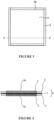
FIGURE 1 is a top view of an exemplary stacked cell in accordance with one embodiment of the disclosure; -
FIGURE 2 is a cross-sectional view of the exemplary stacked cell ofFIGURE 1 , taken along line A-A' in accordance with one embodiment of the disclosure; -
FIGURE 3 is a top view of a layer of the exemplary stacked cell ofFIGURE 1 in accordance with one embodiment of the disclosure; -
FIGURE 4 is a cross-sectional view of the exemplary layer ofFIGURE 3 , taken along line A-A' in accordance with one embodiment of the disclosure; -
FIGURE 5 is a top view of another exemplary layer of the stacked cell ofFIGURE 1 in accordance with one embodiment of the disclosure; -
FIGURE 6 is a cross-sectional view of the exemplary layer ofFIGURE 5 , taken along line A-A' in accordance with one embodiment of the disclosure; -
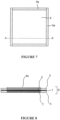
FIGURE 7 is a top view of another exemplary layer of the stacked cell ofFIGURE 1 in accordance with one embodiment of the disclosure; -
FIGURE 8 is a cross-sectional view of the exemplary layer ofFIGURE 7 , taken along line A-A' in accordance with one embodiment of the disclosure; -
FIGURE 9 is a cross-sectional view of an exemplary cathode terminal stack in accordance with one embodiment of the disclosure; -
FIGURE 10 is a cross-sectional view of another exemplary cathode terminal stack in accordance with one embodiment of the disclosure; -
FIGURE 11 is a cross-sectional view of an exemplary anode terminal stack in accordance with one embodiment of the disclosure; -
FIGURE 12 is a cross-sectional view of another exemplary anode terminal stack in accordance with one embodiment of the disclosure; -
FIGURE 13 is a front view of the exemplary stacked cell ofFIGURE 1 in accordance with one embodiment of the disclosure; -
FIGURE 14 is an exploded front view of the exemplary stacked cell ofFIGURE 13 in accordance with one embodiment of the disclosure; -
FIGURE 15 is a top view of an exemplary air-tight pouch in accordance with one embodiment of the disclosure; -
FIGURE 16 is a cross-sectional view of the exemplary air-tight pouch ofFIGURE 15 in accordance with one embodiment of the disclosure; -
FIGURE 17 is a top view of the exemplary air-tight pouch with the stacked cell contained therein in accordance with one embodiment of the disclosure; -
FIGURE 18 is a cross-sectional view of the exemplary air-tight pouch ofFIGURE 17 in accordance with one embodiment of the disclosure; -
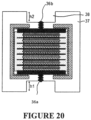
FIGURE 19 is a top view of an exemplary battery casing with the stacked cell contained therein in accordance with one embodiment of the disclosure; -
FIGURE 20 is a cross-sectional view of the exemplary battery casing ofFIGURE 19 in accordance with one embodiment of the disclosure; -
FIGURE 21 is a cross-sectional view of an exemplary stacked cell in accordance with one embodiment of the disclosure; -
FIGURE 22 is a magnified view of the exemplary stacked cell ofFIGURE 21 in accordance with one embodiment of the disclosure; -
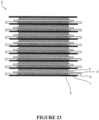
FIGURE 23 is a cross-sectional view of an exemplary stacked cell in accordance with one embodiment of the disclosure; -
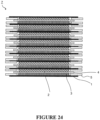
FIGURE 24 is a cross-sectional view of an exemplary stacked cell in accordance with one embodiment of the disclosure; -
FIGURE 25 is a cross-sectional view of an exemplary stacked cell in accordance with one embodiment of the disclosure; -
FIGURE 26 is a magnified view of the exemplary stacked cell ofFIGURE 25 in accordance with one embodiment of the disclosure; -
FIGURE 27 a cross-sectional view of an exemplary stacked cell in accordance with one embodiment of the disclosure; -
FIGURE 28 is a cross-sectional view of an exemplary stacked cell in accordance with one embodiment of the disclosure; -
FIGURE 29 is a magnified view of the exemplary stacked cell ofFIGURE 28 in accordance with one embodiment of the disclosure; -
FIGURE 30 is a cross-sectional view of an exemplary stacked cell in accordance with one embodiment of the disclosure; -
FIGURE 31 is a graph showing a charge and discharge profile of an exemplary stacked cell in accordance with one embodiment of the disclosure; and -
FIGURE 32 is a graph showing a charge and discharge profile of an exemplary stacked cell in accordance with one embodiment of the disclosure. - The description set forth below is intended as a description of presently preferred embodiments of the disclosure and is not intended to represent the only forms in which the present disclosure can be constructed and/or utilized. The description sets forth the functions and the sequence of steps for constructing and operating the disclosure. It is to be understood, however, that the same or equivalent functions and sequences can be accomplished by different embodiments that are also intended to be encompassed within the spirit and scope of this disclosure.
-
FIGURES 1-20 together show an embodiment of a bipolar battery of the present invention. In its simplest form, the bipolar battery comprises astacked cell 13, aninsulator 5 that covers the entire surface of electrode andseparator 4 allowing for a much lower risk of an ionic short. In accordance with one embodiment, the components of the bipolar battery may be formed in an air-tight pouch 23, and a unique battery casing which haselectric connector 36 in aconcavity 38. -
FIGURE 1 shows a schematic of astacked cell 13.FIGURES 3-12 schematically show the structure of layers of an electric element 6-12, which are components of thestacked cell 13. AndFIGURES 13-14 show side views of thestacked cell 13. - At the terminal of the stack at the higher voltage side, an electric cathode terminal stack (either
cathode terminal stack 9 or cathode terminal stack 10) is used depending on the position ofseparator 4. At the terminal of the stack at the lower voltage side, an anode terminal stack (eitheranode terminal stack 11 or anode terminal stack 12) is used depending on the position ofseparator 4. From the second layer counting from the terminal, theelectric components electric components separator 4. As the result, in the direction from the high voltage side to the low voltage side, thestacked cell 13 comprises the layer of thecurrent collector 1, thecathode layer 2, theseparator 4, theanode layer 3, thecurrent collector 1, thecathode layer 2, theseparator 4, theanode layer 3 and so on in this repeating order. - As shown in
FIGURE 1 , the edge of the stack is covered by reinforcement which comprises aninsulator 5. Theinsulator 5 does not have conductivity of either electrons or ions. As shown inFIGURE 1 top view andFIGURE 2 cross section, the reinforcement (insulator 5) covers the exposed edge of thecurrent collector 1, thecathode layer 2, theanode layer 3, and theseparator 4. Namely, none of the layers are contacting any of the other layers in/between the electric stacks. The side of thestack cell 13 is completely covered by theinsulator 5 and none of thecurrent collector 1, thecathode layer 2, theanode layer 3, nor theseparator 4 is exposed to the edge ofstacked cell 13. - The
current collector 1 may be composed of metal foil, a metal mesh, or any other suitable material, while metal foil is preferable. Examples of metal that may be used in thecurrent collector 1 include but are not limited to Cu, Ni, Cr, Au, Pt, Ag, Au, Al, Fe, Ti, Zn, Co and stainless steel. It can be the metal pure element, doped, alloy or clad. The surface of the metal may also be covered with carbon or other material. This will ensure good adhesion with thecathode layer 2 and theanode layer 3. In addition to metal, carbon may also be used for thecurrent collector 1. Resin composites with an electron conductor (metal or carbon) as filler can also be used for thecurrent collector 1. Possible carbon filler materials include acetylene black (AB), Ketjen black (KB), vapor grown carbon fiber (VGCF), carbon nanotubes, carbon nanohorns, and fullerenes. Possible filler metals include stainless steel, Cu, Ni, Cr, Au, Pt, Ag, Au, Al, Fe, Ti, Zn, Co. The shape of the filler may be spherical, fibrous, needle-like, or hollow. When needle or fiber-shaped fillers are used, it may be effective to make them oriented. This is because the orientation controls the flow of electrons and makes it easier to interrupt the current in the event of an abnormality. - The thickness of the
current collector 1 may be of any suitable thickness. For example, the thickness of thecurrent collector 1 is preferably between 0.1 um to 1 mm, and is more preferably between 1 um to 50 um. - The
cathode layer 2 is a layer containing at least a cathode active material (CAM). Examples of the CAM include, layered lithium containing oxide materials, such as LiCoO2, LiMnO2, LiNiO2, LiNixMnyCo1-x-yO2, LiNixCoyAl1-x-yO2, lithium containing phosphate with olivine structure, such as LiFePO4, LiFexMn1-xPO4, LiMnPO4, LiFexCo1-xPO4, LiCoPO4, lithium containing oxide materials with spinel structure, such as LiNi0.5Mn1.5O4, LiMn2O4, lithium excess layered structured oxide, such as Li2MnO3, Li2RuO3, Li2RuxTi1-xO3, Li2RuxSn1-xO3, Li2MnxTi1-xO3, Li2MnxSn1-xO3, layered lithium containing sulfide materials, such as TiS2, MoS2, NbS2, TaS2, Sulfur, or lithium containing sulfide with Chevrel structure, such as LiCuxMoS1-z. - The surface of CAM may be coated by thin layer of materials (coating). Examples of coating include crystalline phase, such as Li2ZrO3, LiNbOs, Li3BO3, Li3B11O18, LiPOs, Li3PO4, LiTi2(PO4)3, LiZr(PO4)3, ZrO2, B2O3, Al2O3, Nb2O5, EtOLi, MtOLi, LiOH, Li2CO3 and/or amorphous phase, such as metal alkoxide, metal phosphate. The
cathode layer 2 may further contain solid electrolytes, binders, electron conductive additives, in addition to CAM. Examples of electrolytes include organic liquid, organic polymer, inorganic solids. Preferably, the electrolytes comprise inorganic solids because of a higher transference number of lithium compared to liquid and because of a higher ionic conductivity than organic polymer. Furthermore, inorganic solids are usually rigid and do not show liquidity which is preferred in order to buildstacked cell 13 without ionic shorting. - Preferred examples of electrolytes include the materials of Li-P-O-N, Li-Si-O, LiB-Si-O, Li-B-O, Li-C-B-O, Li-Al-Si-O, Li-Ti-Al-P-O, Li-Zr-Al-P-O, Li-La-Zr-O, Li-La-Ta-Zr-O, Li-La-Nb-Zr-O, Li-M-S (M is B, Al, Si, P, Zn, Ge, Zr, Sn or any combination of those), Li-M'-S-O(M' is B, Al, Si, P, Zn, Ge, Zr, Sn or any combination of those), Li-P-S-X (X is F, Cl, Br or any combination of those), Li-P-S-O-X' (X' is F, Cl, Br or any combination of those), Li-B-H, LiB-N-H, Li-B-H-O, Li-B-N-H-O, Li-M"-X" (M is In, Zr, Sc, Ga, Nb, Ta or any combination of those; X" is F, Cl, Br or any combination of those), Li-M"-X"-O(M" is In, Zr, Sc, Ga, Nb, Ta or any combination of those; X" is F, Cl, Br or any combination of those).
- Examples of a binder that may be contained in the
cathode layer 2 include butadiene rubber (BR), butyl rubber (IIR), acrylate butadiene rubber (ABR), polyvinylidene difluoride (PVDF), and Polytetrafluoroethylene (PTFE). Side chains of the binder may be modified by functional groups. - In addition, the
cathode layer 2 may contain electron conductive additives. For example, various types of carbon may include acetylene black (AB), Ketjen black (KB), VGCF, carbon nanotubes, carbon nanohorns, and fullerenes. - The thickness of the
cathode layer 2 is not specifically limited, but a thicker layer may be preferred when higher capacity is required. For example, the thickness ofcathode layer 2 is preferably between 0.1 um to 1 mm, and is ideally between 60um to 500 um. - The
anode layer 3 is a layer containing at least an anode active material (AAM). Examples of the AAM include, layered lithium containing sulfide materials, such as TiS2, MoS2, NbS2, TaS2, titanium containing oxides, such as, Li4Ti5O12, TixNbyOz, LixTi2(PO4)3, tungsten containing oxides, such as Nb16W5O55, Nb18W16O93, vanadium containing oxide, such as LiVO2, Artificial carbon (or hard carbon), Graphite, Li-metal alloy, such as LixIn, LixSn, LixSi, LixGe, LixAl, or metallic lithium. - The
anode layer 3 may further contain solid electrolytes, binders, electron conductive additives, in addition to AAM. Examples of electrolyte include organic liquid, organic polymer, inorganic solids. Preferably, the electrolyte comprises inorganic solids because of higher transference number of lithium compared to liquid and higher ionic conductivity than organic polymer. Furthermore, it is also because inorganic solids are usually rigid and do not show liquidity which is preferred to composestacked cell 13 without ionic shorting. - Preferred examples of electrolyte include the materials those have composition of Li-P-O-N, Li-Si-O, Li-B-Si-O, Li-B-O, Li-C-B-O, Li-Al-Si-O, Li-Ti-Al-P-O, Li-Zr-Al-P-O, Li-La-Zr-O, Li-La-Ta-Zr-O, Li-La-Nb-Zr-O, Li-M-S (M is B, Al, Si, P, Zn, Ge, Zr, Sn or any combination of those), Li-M'-S-O(M' is B, Al, Si, P, Zn, Ge, Zr, Sn or any combination of those), Li-P-S-X (X is F, Cl, Br or any combination of those), Li-P-S-O-X' (X' is F, Cl, Br or any combination of those), Li-B-H, Li-B-N-H, Li-B-H-O, Li-B-N-H-O, Li-M"-X" (M" is In, Zr, Sc, Ga, Nb, Ta or any combination of those; X" is F, Cl, Br or any combination of those), Li-M"-X"-O(M" is In, Zr, Sc, Ga, Nb, Ta or any combination of those; X" is F, Cl, Br or any combination of those).
- Examples of a binder that may be contained in the
anode layer 3 include butadiene rubber (BR), butyl rubber (IIR), acrylate butadiene rubber (ABR), polyvinylidene difluoride (PVDF), Polytetrafluoroethylene (PTFE). Side chains of the binder may be modified by functional groups. - In addition, the
anode layer 3 may contain electron conductive additives. For example, various types of carbon may include acetylene black (AB), Ketjen black (KB), VGCF, carbon nanotubes, carbon nanohorns, and fullerenes. - The thickness of the
anode layer 3 is not specifically limited, but a thicker layer may be preferred when higher capacity is required. For example, the thickness of theanode layer 3 is preferably between 0.1 um to 1 mm, and is more preferably between 60um to 500 um. - The
separator 4 is an electron insulator but an ionic conductor. The electrolyte can be either organic liquid, organic polymer or inorganic solid. If an organic based electrolyte (liquid or polymer) is chosen, theseparator 4 might be porous membrane comprising polymers such as Polyethylene (PE), Polypropylene (PP) and any combination of those; the membrane is immersed by organic based electrolyte. - Preferably,
separator 4 is comprised of inorganic solids because of higher transference number of lithium compared to liquid and higher ionic conductivity than organic polymer. This is also because inorganic solids are usually rigid and do not show liquidity which is preferred to composestacked cell 13 without ionic shorting. - Examples of electrolyte include organic liquid, organic polymer, inorganic solids. Preferably, electrolytes are inorganic solids because of higher transference number of lithium compared to liquid and higher ionic conductivity than organic polymer. Which is also because inorganic solids are usually rigid and do not show liquidity which is preferred to compose the stacked
sell 13 without ionic shorting. Preferred examples of electrolyte include the materials those have composition of Li-P-O-N, Li-Si-O, Li-B-Si-O, Li-B-O, Li-C-B-O, Li-Al-Si-O, Li-Ti-Al-P-O, Li-Zr-Al-P-O, Li-La-Zr-O, Li-La-Ta-Zr-O, Li-La-Nb-Zr-O, Li-M-S (M is B, Al, Si, P, Zn, Ge, Zr, Sn or combination of those), Li-M'-S-O(M' is B, Al, Si, P, Zn, Ge, Zr, Sn or combination of those), Li-P-S-X (X is F, Cl, Br or combination of those), Li-P-S-O-X' (X' is F, Cl, Br or combination of those), Li-B-H, Li-B-N-H, Li-B-H-O, Li-B-N-H-O, Li-M"-X" (M" is In, Zr, Sc, Ga, Nb, Ta or combination of those; X" is F, Cl, Br or combination of those), Li-M"-X"-O(M" is In, Zr, Sc, Ga, Nb, Ta or combination of those; X" is F, Cl, Br or combination of those). - The solid electrolyte layer may contain a binder in addition to the above-mentioned solid electrolyte material. Examples of a binder that may include butadiene rubber (BR), butyl rubber (IIR), acrylate butadiene rubber (ABR), polyvinylidene difluoride (PVDF), Polytetrafluoroethylene (PTFE). Side chains of the binder may be modified by functional groups.
- The thickness of the
separator 4 is not specifically limited, but a thinner layer may be preferred when higher capacity is required. For example, the thickness ofseparator 4 is preferably between 0.1 um to 1 mm, and is more preferably between 0.1um to 50 um. - The electron and
ion insulator 5 is made to enhance of insulation between layers and thus enable thestacked cell 13 to exhibit high voltage. It is intricately formed on thecurrent collector 1, enveloping both its longer and shorter sides meticulously. Its very presence is to ensure that any surface area of thecurrent collector 1, which remains unoccupied by thecathode layer 2 oranode layer 3, is fully shielded. - In terms of its electrical properties, the electron and
ion insulator 5 is built to be an exceptional insulator. Its electric conductivity must fall below 10-8 S/cm, with a stricter and more desirable threshold being below 10-10 S/cm. This ensures that the insulator performs at its optimum, providing maximum protection against any undesirable electrical currents. - The position of the electron and
ion insulator 5 is not bound by stringent restrictions. The guiding principle is that thecurrent collector 1 should be comprehensively shielded. In practical terms, this might mean that theinsulator 5 could grace both sides of the current collector - one side that faces thecathode layer 2 and the other that faces theanode layer 3. - While the exact area of the
insulator 5 on the current collector's 1 surface is not strictly defined, it's essential for it to sufficiently cover any regions left exposed from the edge of the electrode active material layer. The key is for it to insulate the current collector's 1 surface electronically. Yet, it's vital to avoid the formation of theinsulator 5 on either thecathode layer 2 or theanode layer 3. Such a placement could be problematic during the bonding process when creating thestacked cells 13. Overlaps between the electrode and insulator layers could create regions of uneven pressure. Such disparities in pressure could damage thecurrent collector 1 or even the separator layer. Moreover, overlapping areas would naturally be bulkier than the mere edges of the electrode, compromising the insulator's sealing capabilities. Any laxity in sealing could lead to ionic shorting, with ion conductors possibly seeping or gliding out of the separator. In the direst of circumstances, direct contact between separator layers could induce an ionic short circuit, severely hampering the battery's functionality. - The gap or distance between the
cathode layer 2 and theinsulator 5, denoted as width (r) of the bare surface of thecurrent collector 1, should be carefully calibrated to ensure insulation between layers. It is not limited by rigid parameters, but the width r should ideally span a range from 0.0001 % to 10% of the square root of S, where S represents the area of thecathode layer 2, measured in cm2. This ensures a balanced design, offering optimum insulation while maintaining the structural integrity and performance of the battery. The gap or distance criteria betweencathode layer 2 andinsulator 5 is applicable to those betweenanode layer 3 andinsulator 5. - The materials used for the electron and
ion insulator 5 is not limited to specific materials as long as the material has required capability for insulations. May be thermosoft plastic are preferred because softened plastic can fill the gap or void those are created during lamination process, and also can cover the edge of thecurrent collector 1 and theseparator 4 after the lamination process due to liquidity or plastic deformation. Examples of materials for the electron andion insulator 5 include; Acrylic, such as Polyacrylic acids (PAA), Poly(methyl methacrylate) (PMMA); Acrylonitrile butadiene styrene (ABS); Polyamide (PA); Polyimide (PI); Polyamide-imide (PAI); Polycarbonate (PC); Polyoxymethylene (POM); Polyether ether ketone (PEEK); Polyetherimide (PEI); Polyethylene (PE); Polyethylene terephthalate (PET); Polyphenylene oxide (PPO); Polyphenylene sulfide (PPS); Polypropylene (PP); Polyvinyl chloride (PVC); Polyvinylidene fluoride (PVDF); Polytetrafluoroethylene (PTFE). - The
insulator 5 can consist of multiple different materials. For example, as shown inFIGURE 1 , thevertical edge 5a does not need to be same materials ashorizontal edge 5b. - The bipolar battery of the present invention is an improvement over currently existing bipolar batteries, because in the
stacked cell 13, thecurrent collector 1 of only the top layer and the bottom layer are exposed to the external environment. In thestacked cell 13, the edge of stack is fully covered by reinforcement made ofinsulator 5 and none ofcurrent collector 1,cathode layer 2,anode layer 3, norseparator 4 is exposed. Furthermore, in thestacked cell 13, theseparator 4 area is larger than bothcathode layer 2 andanode layer 3, but smaller thancurrent collector 1. With this configuration, the short circuit due to ionic contact to another layer can be avoided while internal short circuit (cathode and anode) is avoided. Finally, in thestacked cell 13, none ofcurrent collector 1 norseparator 4 at different layers are touched. - The air-
tight pouch 23 shown inFIGURES 15-18 plays a multifaceted role in the overall architecture of the proposed battery system. The air-tight pouch 23 comprises thecurrent collector 21 and theinsulator 20 and thepouch 23 serves several functions. - One of the primary roles of the air-
tight pouch 23 is its robust protection against moisture intrusion. With air-tightness, it forms an impenetrable barrier, ensuring that no moisture makes its way into thestacked cells 13 housed within it. The significance of this feature cannot be overstated, as moisture ingress can be detrimental to the overall health, efficiency, and life of battery cells. - Apart from moisture protection, the
pouch 23 has a salient feature that allows the creation of a vacuum environment for thestacked cell 13. By doing so, the environment within thepouch 23 remains inert, which is crucial for maintaining the chemical and physical integrity of thestacked cell 13. An inert environment ensures that there's no undesired chemical reaction that might otherwise compromise the performance or safety of the cell. Also, air-tight pouch 23 is the provision of atmospheric pressure to thestacked cell 13. This feature is ingeniously designed without the addition of any mechanical parts. Subjecting the battery to a modicum of pressure can have a plethora of benefits. It can aid in the reduction of internal resistance within the battery, thereby enhancing its cycling capabilities and overall efficiency. - After the vacuum lamination process, the air-
tight pouch 23 is compatible with further densification of thestacked cell 13 using an isostatic press. This ensures that the cell components are compacted uniformly, ensuring optimum performance and longevity. - The air-
tight pouch 23 plays a role in facilitating vacuum operations of the system. Since thecurrent collector 21 of theairtight pouch 23 establishes an electrical connection with thestacked cell 13, it ensures that the cell operates seamlessly under vacuum conditions. -
Insulator 20 can be the same material as the electron andion insulator 5 used instacked cell 13 or a different material. Any suitable material may be used, as long as it is not electron and ion conductive. It can be ceramics or plastic, especially if it has low permeability to moisture and oxygen. If the process requires pressurization ofstack cell 13 using an air-tight pouch 23, plastic is especially desirable. This is because plastic is generally more pliable than ceramics, and some plastic deformation is expected during pressurization, and the risk of cracking is expected to be less than that of fragile ceramics. - Plastic materials for
insulator 20 include Acrylic, such as Polyacrylic acids (PAA), Poly (methyl methacrylate) (PMMA); Acrylonitrile butadiene styrene (ABS); Polyamide (PA); Polyimide (PI); Polyamide-imide (PAI); Polycarbonate (PC); Polyoxymethylene (POM); Polyether ether ketone (PEEK); Polyetherimide (PEI); Polyethylene (PE); Polyethylene terephthalate (PET); Polyphenylene oxide (PPO); Polyphenylene sulfide (PPS); Polypropylene (PP); Polyvinyl chloride (PVC); Polyvinylidene fluoride (PVDF); Polytetrafluoroethylene (PTFE). - There can be a further different
thermoplastic material 22 insideinsulator 20. This is expected to improve the thermal weldability ofinsulator 20, reduce moisture permeability, and maintain a high vacuum. Ifthermoplastic material 22 is used, its welding temperature should be lower than that ofinsulator 20. This will improve the air-tightness of the air-tight pouch 23 while maintaining the mechanical strength of theinsulator 20. - The
thermoplastic layer 22 may consist of a single material or may be multilayered, consisting of multiple materials. For example, if it is a single material, Acrylic, such as Polyacrylic acids (PAA), Poly(methyl methacrylate) (PMMA); Acrylonitrile butadiene styrene (ABS); Polyamide (PA); Polyimide (PI); Polyamide-imide (PAI); Polycarbonate (PC); Polyoxymethylene (POM); Polyether ether ketone (PEEK); Polyetherimide (PEI); Polyethylene (PE); Polyethylene terephthalate (PET); Polyphenylene oxide (PPO); Polyphenylene sulfide (PPS); Polypropylene (PP); Polyvinyl chloride (PVC); Polyvinylidene fluoride (PVDF); Polytetrafluoroethylene (PTFE) are candidates for materials. In the case of multilayer, it is a combination of the above materials. For example, but not limited to, a PP/PE duplex structure, a PP/PE/PP triplex structure, a PE/PP/PE triplex structure, etc. are possible. - The position of
thermoplastic layer 22 is not specified as long as sufficient sealing can be ensured at the junction of oneinsulator 20 and anotherinsulator 20 as well as at a junction between aninsulator 20 andcurrent collector 21. For example, it may cover the entire surface ofinsulator 20, or it may cover only the junction between twoinsulators 20, or it may cover only the junction betweencurrent collector 21 andinsulator 20. - The thickness of
insulator 20 is not specifically limited, but a thinner layer may be preferred when higher capacity is required. For example, the thickness ofinsulator 20 is preferably between 1 um to 2 mm, and is more preferably between 10um to 1,000 um. - The
current collector 21 of the air-tight pouch 23 may be composed of metal foil, a metal mesh, etc., and is especially preferably metal foil. Examples of metal constituting thecurrent collector 1 include Cu, Ni, Cr, Au, Pt, Ag, Au, Al, Fe, Ti, Zn, Co and stainless steel. It can be the metal pure element, doped, alloy, or clad. The surface of the metal may also be covered with carbon or other material. This will ensure good adhesion with thecathode layer 2 andanode layer 3. In addition to metal, carbon can also be used for thecurrent collector 21. Resin composites with an electron conductor (metal or carbon) as filler can also be used for thecurrent collector 1. Possible carbon filler materials include acetylene black (AB), Ketjen black (KB), VGCF, carbon nanotubes, carbon nanohorns, and fullerenes. - Possible filler metals include stainless steel, Cu, Ni, Cr, Au, Pt, Ag, Au, Al, Fe, Ti, Zn, Co. The shape of the filler can be spherical, fibrous, needle-like, or hollow. When needle or fiber-shaped fillers are used, it may be effective to make them oriented. This is because the orientation controls the flow of electrons and makes it easier to interrupt the current in the event of an abnormality.
- The thickness of the
current collector 21 is not specifically limited, and for example, is preferably between 0.1 um to 2 mm, and is more preferably between 10 um to 1,000 um. - The bipolar battery of the present invention is an improvement over currently existing bipolar batteries, because the air-
tight pouch 23 is equipped with acurrent collector 21 and insulatingsurface 20. Furthermore, the air-tight pouch 23 allows the densification process of the stack and the air-tight pouch 23 is positioned inside a vacuum. - A bipolar battery is preferably accommodated in the battery casing as a whole
stacked cell 13, as shown inFIGURES 19-20 , to prevent external impact and environmental deterioration in use. Also, the casing enables one to handle the high voltage battery system during operation, installation to device, disassembly or maintenance. - The battery casing comprises a
housing 37 that protects the stacked cell 13 (which may or may not be in air-tight pouch 23) from outside air and shock during actual use. In addition to the mechanical strength as required for a normal battery cell,housing 37 should be of a more insulating construction becausestacked cell 13 has a higher voltage than a normal electrochemical cell. The material should be composed exclusively of electrically insulating materials. For example, a metal housing, such as those normally used for lithium-ion batteries or nickel-metal hydride, is not desirable, as there is concern that battery performance may be compromised by insulation breakdown. - Ceramics, rubber, or plastic are possible materials for
housing 37. For ceramics, alumina, silica, or zirconia could be considered. For plastics, examples include, acrylic, such as Polyacrylic acids (PAA), Poly(methyl methacrylate) (PMMA); Acrylonitrile butadiene styrene (ABS); Polyamide (PA); Polyimide (PI); Polyamide-imide (PAI); Polycarbonate (PC); Polyoxymethylene (POM); Polyether ether ketone (PEEK); Polyetherimide (PEI); Polyethylene (PE); Polyethylene terephthalate (PET); Polyphenylene oxide (PPO); Polyphenylene sulfide (PPS); Polypropylene (PP); Polyvinyl chloride (PVC); Polyvinylidene fluoride (PVDF); and Polytetrafluoroethylene (PTFE). - To ensure the performance of
stacked cell 13, preferablyhousing 37 is a sealed structure. For example, o-rings, welds, adhesives, etc. may be used to create a sealed structure. When sealinghousing 37, the internal atmosphere should be considered from two perspectives. First, from the standpoint of the chemical stability of the battery itself, the concentration of moisture and oxygen should preferably be low. In addition, considering the possibility of high voltage instacked cell 13, noble gases such as He, Ar, and Xe should be avoided, as these gases tend to cause dielectric breakdown under high voltage conditions. Considering the above, the atmosphere insidestacked cell 13 should be vacuum, N2, SF6, etc. -
Housing 37 is equipped withelectric connector 36 for electrical connection tostacked cell 13, characterized in thatelectric connector 36 is located at a height h lower than the top surface ofhousing 37. For this purpose,housing 37 has aconcavity 38, into whichelectric connector 36 is placed. Such a structure reduces the risk of inadvertent external shorting of thestacked cell 13 during battery mounting, transport, and maintenance. The risk of external shorts due to creepage discharge is also reduced due to the distance of theelectric connectors housing 37. -
Concavity 38 has a depth h and has anelectric connector 36 in it. The shape of the concavity can be cylindrical, square, polygonal, hemispherical, or any other shape. Its low area should be as small as possible to reduce the risk of accidental external shorts. In other words, theconcavity 38 should be larger than theelectric connector 36, the connector to the external circuit, and the wiring, and should be large enough for maintenance, etc., but not unnecessarily larger than that. The depth h ofconcavity 38 is not specified, h should be as small as possible in terms of energy density, but larger is preferable in terms of insulation resistance and external short circuit risk. It can be designed accordingly depending on the battery voltage. For example, h could be between 2 mm and 100 mm, although it is not limited to this value. The depth h1 on the positive electrode side and h2 on the negative electrode side need not be the same. For example, one of them can be set to zero. - The shape of the
electric connector 36 can be, for example, a screw (male or female thread), pin, foil, plate, needle, etc. Preferred materials are metals such as Cu, Al, and stainless steel. - The bipolar battery of the present invention is an improvement over currently existing bipolar batteries, because the battery casing is made of electron/ion insulator. The battery casing has
electric connectors 36 that are placed in theconcavity 38 to avoid shorting while handling/installation/disassembling/connection. Furthermore, the battery casing is sealed and inside is filled with inert such as vacuum, N2, SF6, but not with noble gases. - The method for manufacturing a high-voltage electrochemical cell comprises the following steps described below.
- The method of manufacturing a high voltage electrochemical cell comprises the following steps: a process for protecting the edge of the
current collector 1 by placing aninsulator 5 on the edge of thecurrent collector 1, a process for manufacturing an electrode layer by creating a free-standing film ofcathode layer 2 andanode layer 3, a process for placing the free-standing film created by the above process at a position r inside thecurrent collector 1 of theinsulator 5 formed on the edge of thecurrent collector 1, and a process for manufacturing acathode layer 2 andanode layer 3. The process includes the electrode bonding process, in which the freestanding film created in the above process is placed at the position r inside thecurrent collector 1 of theinsulator 5 formed on the edge ofcurrent collector 1,cathode layer 2 andanode layer 3 are bonded tocurrent collector 1, and theanode layer 3/current collector 1/cathode layer 2/anode layer 3 created in the above process is bonded to both sides or one side ofcathode layer 2.Cathode layer 2 is formed on both sides or one side ofcathode layer 2, andstack -
Cathode terminal stack cathode layer 2 is formed oncurrent collector 1 andanode terminal stack layer 3 is formed oncurrent collector 1 are created.Stack only anode layer 3 is formed oncurrent collector 1. The individual processes are the same as the bipolar stack process, so the description here is omitted. - Stacks and terminal stacks created by the processes described above are stacked to obtain
stacked cell 13 by compaction under high pressure. Air-tight pouch 23 may or may not be equipped at this time. -
Stacked Cell 13 made by the above process is inserted into casing 30 and sealed. This process produces a high-voltage electrochemical cell. - Referring to
FIGURES 21-24 , another embodiment of the stacked cell 13' may be shown. Similar to thestacked cell 13, in the direction from high voltage side to low voltage, the stacked cell 13' may consist of thecurrent collector 1, thecathode layer 2, theseparator 4, theanode layer 3, and anothercurrent collector 1. This configuration ofelements - The stacked cell 13' may have an
insulator 5. Theinsulator 5 may be made to enhance insulation between layers and thus enable the stacked cell 13' to exhibit high voltage. Theinsulator 5 may be intricately formed on thecurrent collector 1. Theinsulator 5 may be configured to ensure that any surface area of thecurrent collector 1, which remains unoccupied by thecathode layer 2 oranode layer 3, is fully shielded. - In terms of its electrical properties, the
insulator 5 may be built to be an exceptional insulator. Theinsulator 5 may be formed of a material that does not have conductivity of either electrons or ions. Theinsulator 5 may have an electric conductivity below 10-8 S/cm, with a stricter and more desirable threshold being below 10-10 S/cm. This ensures that theinsulator 5 may perform at its optimum, providing maximum protection against any undesirable electrical currents. - The position of the
insulator 5 isn't bound by stringent restrictions. The guiding principle is that at least one of the exposed sides of thecurrent collector 1 should be comprehensively shielded. For example, theinsulator 5 may cover a portion of the exposed edge of one side of thecurrent collector 1. In the embodiment shown inFIGURES 21 and 22 , theinsulator 5 may be formed on a surface 1A of eachcurrent collector 1 located adjacent theanode layer 3. As may be seen inFIGURE 22 , a height of theinsulator 5 may be less than a height of theanode layer 3. Alternatively, theinsulator 5 may be formed on a surface 1B of eachcurrent collector 1 located adjacent to thecathode layer 2 as may be seen inFIGURE 23 . As may be seen inFIGURE 23 , a height of theinsulator 5 may be less than a height of thecathode layer 2. Alternatively, theinsulator 5 may be formed on both surfaces 1A and 1B of eachcurrent collector 1 that is attached to both thecathode layer 2 and theanode layer 3 as may be seen inFIGURE 24 . As may be seen inFIGURE 24 , a height of theinsulator 5 may be less than a height of theanode layer 3 and a height of thecathode layer 2. - The
insulator 5 can be laminated onto thecurrent collector 1, though this is not strictly necessary. Laminating theinsulator 5 onto thecurrent collector 1 may simplify the production process. - The
insulator 5 may not completely seal the edges of thecurrent collector 1. This configuration may allow gas to escape. Complete sealing of the edges of thecurrent collector 1 may result in gas being trapped during the densification process, causing bubble formation. These bubbles may increase the impedance of the stacked cell 13' and may accelerate degradation. Additionally, a complete seal may trap gases during prolonged cycling may lead to increased impedance and further degradation of the stacked cell 13'. - Moreover, leaving the edges unsealed can be beneficial in releasing stress during the pressuring step in the fabrication process of the stacked cell 13', thereby avoiding breakage of the
current collector 1 or theinsulator 5. - While the exact area of the
insulator 5 on the exposed surfaces of thecurrent collector 1 may not be strictly defined, it may be essential for theinsulator 5 to sufficiently cover any regions left exposed from the edge of the electrode active material layer. The key may be for theinsulator 5 to insulate the surfaces of thecurrent collector 1 electronically. However, it may be important to avoid the formation of theinsulator 5 on exposed areas of either thecathode layer 2 or theanode layer 3. Such a placement could be problematic during the bonding process when creating the stacked cell 13'. Overlaps between the electrode andinsulator 5 could create regions of uneven pressure. Such disparities in pressure could damage thecurrent collector 1 or even theseparator 4. Moreover, overlapping areas would naturally be bulkier than the mere edges of the electrode, compromising the insulating capabilities. - When applying the
insulator 5, a gap T on thecurrent collectors 1 may be formed. The distance of the gap T on thecurrent collector 1 should be carefully calibrated to ensure insulation between layers. It is not limited by rigid parameters, but the distance should span a range from 0.0001 % to 10% of the square root of S6, where S6 may represents the area of theanode layer 3, measured in cm2. This may ensure a balanced design, offering optimum insulation while maintaining the structural integrity and performance of the stacked cell 13'. The gap or distance criteria between theanode layer 3 andinsulator 5 may also be applicable to those betweencathode layer 2 andinsulator 5. - The materials used for the insulating 5 is not limited to specific materials as long as the material has required capability for insulations. The materials used may have been listed previously above. A thermosoft plastic may be preferred because softened plastic can fill the gap or void that may be created during lamination process, and may also cover the edge of
current collector 1 andseparator 4 after the lamination process due to liquidity or plastic deformation. Examples of theinsulator 5 may include, but not limited to: Acrylic, such as Polyacrylic acids (PAA), Poly(methyl methacrylate) (PMMA); Acrylonitrile butadiene styrene (ABS); Polyamide (PA); Polyimide (PI); Polyamide-imide (PAI); Polycarbonate (PC); Polyoxymethylene (POM); Polyether ether ketone (PEEK); Polyetherimide (PEI); Polyethylene (PE); Polyethylene terephthalate (PET); Polyphenylene oxide (PPO); Polyphenylene sulfide (PPS); Polypropylene (PP); Polyvinyl chloride (PVC); Polyvinylidene fluoride (PVDF); Polytetrafluoroethylene (PTFE). Theinsulator 5 can consist of multiple different materials, such as combinations of the above listed. - Referring to
FIGURES 25-30 , another embodiment of thestacked cell 13" may be shown. Similar to thestacked cell 13 and 13', in the direction from high voltage side to low voltage, the stacked cell 13' may consist of thecurrent collector 1, thecathode layer 2, theseparator 4, theanode layer 3, and anothercurrent collector 1. This configuration ofelements stacked cell 13". Each of the layers are formed so that none of the layers are contacting any of the other layers in/between the electric stacks. - The exposed edge of the
current collector 1 may be covered by theinsulator 5. Theinsulator 5 does not have conductivity of either electrons or ions. Theinsulator 5 may cover a portion of the exposed edge of one side of thecurrent collector 1. In the embodiment shown inFIGURES 25-26 and 28-29, theinsulator 5 may be formed on a surface 1A of eachcurrent collector 1 located adjacent theanode layer 3. Alternatively, theinsulator 5 may be formed on a surface 1B of eachcurrent collector 1 located adjacent to thecathode layer 2 as may be seen inFIGURE 27 . Alternatively, theinsulator 5 may be formed on both surfaces 1A and 1B of eachcurrent collector 1 that is attached to both thecathode layer 2 and theanode layer 3 as may be seen inFIGURE 30 . - When the
insulator 5 is attached on the exposed surface ofcurrent collector 1 adjacent theanode layer 3 as shown inFIGURES 25-26 , thecurrent collector 1 may be designed to bend up at the edge of theanode layer 3, generating an angled edge 1A for thestacked cell 13". This angled edge 1A may enhance the structural integrity and ionic insulation of the cells by covering theseparator 4 up from the external of cells. Theinsulator 5 may be laminated onto thecurrent collector 1 and bends up together with thecurrent collector 1, ensuring proper insulation and alignment within thestacked cell 13" configuration. - The
separator 4 may also bend up with thecurrent collector 1. Notably, theseparator 4 may be smaller than thecurrent collector 1 and theinsulator 5, ensuring that theseparator 4 may not be exposed to the external surface. This design may minimize the risk of damage to theseparator 4 and may maintain insulation integrity. - The angle X of the angled edge 1A against the base of the
current collector 1, which may be laminated to theanode layer 3 may range from 3 degrees to 90 degrees. More specifically, the angle X may range from 5 degrees to 80 degrees. The angled edges 1A may be beneficial for improving the insulation between each layer and preventing electrical short circuits. - If the
insulator 5 is attached to the cathode side of surface of thecurrent collectors 1 as may be seen inFIGURE 27 , the same criteria used between theanode layer 3 andinsulator 5 is applicable to those between thecathode layer 2 andinsulator 5. Also, if theinsulator 5 is laminated on both side of thecurrent collector 1 as may be seen inFIGURE 30 , the angle X may range from 3 degrees to 90 degrees. More specifically, the angle X may range from 5 degrees to 80 degrees. - In the
stacked cell 13", like the stacked cell 13', a gap T on thecurrent collectors 1 may be formed. Theseparator 4 may be applied and is squeezed in the gap T between thecathode layer 2 oranode layer 3 when forming the angled edge 1A as may be seenFIGURE 30 . With the squeezedseparator 4, the electric insulation of thestacked cell 13" may be improved since the anode layer 3 (orcathode layer 2 or both) may be covered by theseparator 4. - The
stacked cell 13" has been formulated and test as described below. Thestacked cell 13" formed may satisfy the area relationship of:
- S1 = area generated by outer edge of
insulator 5 - S2 = area generated by inner edge of
insulator 5 - S3 = area of
current collector 1 - S4 = area of
separator 4 - S5 = area of
cathode layer 2 - S6 = area of
anode layer 3 - A 40 µm thick carbon coated Aluminum foil (area S3) may have been prepared as the
current collector 1, and a 25 µm thick Polyetherimide (PEI) film, which may equip adhesive Polyisobutene (PIB), may be attached on to the one of the carbon coated Aluminum foil as aninsulator 5. The area generated by outer edge ofinsulator 5, and that of its inner edge are S1 and S2, respectively. - The
cathode layer 2 may be fabricated of a powder of Cathode Active Material (LiNi1/3Co1/3Mn1/3O2, MTI corporation), solid electrolyte (SSE-10, NEI) and PTFE (Daikin America) mixed in the ratio of 87:12:1 (wt%). Then the mixture was extended to the sheet with the thickness 120um to form thecathode layer 2. The area of thecathode layer 2 is S5. - The
anode layer 3 may be fabricated of a powder of Anode Active Material (Li4Ti5O12, MSE supplies LLC), solid electrolyte (SSE-10, NEI), carbon black (Imerys) and PTFE (Daikin America) mixed in the ratio of 80:15:1:4 (wt%). Then the mixture was extended to the sheet with the thickness 300um to form theanode layer 3. The area ofanode layer 3 is S6. - The
separator 4 may be fabricated of a powder of solid electrolyte (SSE-10, NEI) and PTFE (Daikin America) mixed in the ratio of 97:3 (wt%). Then the mixture was extended to the sheet with the thickness 120um to form theseparator 4. The area of theseparator 4 is S4. - The cells of the
stacked cell 13" may be fabricated with stacking the unit cell consisting of thecurrent collector 1,anode layer 3,separator 4, andcathode layer 2. The layers may be stacked in the order ofcurrent collector 1,anode layer 3,separator 4,cathode layer 2,current collector 1. This configuration ofelements stacked cell 13". The lastcurrent collector 1 touching to only thecathode layer 2 may not have the insulator on the surface. The area of S1, S2, S3, S4, S5 and S6 is listed on the table 1 below. The area satisfies S1 > S3 > S4 > S2 > S6 ≥ S5. - The angled edge 1A edge of the
stacked cell 13" may be bent to have the angle (X) of 80 degree.Table 1 S1 / cm2 S2 / cm2 S3 / cm2 S4 / cm2 S5 / cm2 S6 / cm2 9.07 6.15 8.04 7.07 3.80 4.91 - The bipolar
stacked cell 13" may be charged and discharged at a current density of 1.0 mA/cm2 in the voltage range of 15 V to 27 V. The bipolarstacked cell 13" was able to charge and discharge without any ionic or electronic short. The charge and discharge profile may be shown inFIGURE 31 . - As a comparison to the example above, the
stacked cell 13" was formulated and tested again as described below. In this embodiment, thestacked cell 13" satisfied the same area relationships as described above. Thecurrent collector 1 was formed in the same manner as in the previous test embodiment except for the thickness of Polyetherimide (PEI) film. In this test embodiment, a 250 µm thick PEI film, which equips adhesive Polyisobutene (PIB), was attached on to one of the carbon coated Aluminum foil as an insulating frame. The remaining structure of thestacked cell 13" remained the same. Thus, the fabrication of thecathode layer 2, theanode layer 3, theseparator 4, and the fabrication of thestacked cell 13" was the same as in the previous test embodiment. - In this test embodiment, the edge of the
stacked cell 13" was not bent. Thus, the angle X was at 0°.Table 2 S1 / cm2 S2 / cm2 S3 / cm2 S4 / cm2 S5 / cm2 S6 / cm2 9.07 6.15 8.04 7.07 3.80 4.91 Table 3 X (degree) Coulombic efficiency at 2nd cycle (%) Example 80 94.4 Comparative Example 0 64.9 - The bipolar
stacked cell 13" was charged and discharged at a current density of 1.0 mA/cm2 in the voltage range of 15 V to 27 V. However, it shows low coulombic efficiency (64.9%) at the 2nd cycle. Also, the voltage profile is lower than the previous test embodiment although it had the same number of stacks. Low coulombic efficiency and overall low voltage profile are the indication of short happening in the cell. The charge and discharge profile may be shown inFIGURE 32 . - The foregoing description is provided to enable any person skilled in the relevant art to practice the various embodiments described herein. Various modifications to these embodiments will be readily apparent to those skilled in the relevant art, and generic principles defined herein can be applied to other embodiments. Thus, the claims are not intended to be limited to the embodiments shown and described herein, but are to be accorded the full scope consistent with the language of the claims, wherein reference to an element in the singular is not intended to mean "one and only one" unless specifically stated, but rather "one or more." All structural and functional equivalents to the elements of the various embodiments described throughout this disclosure that are known or later come to be known to those of ordinary skill in the relevant art are expressly incorporated herein by reference and intended to be encompassed by the claims. Moreover, nothing disclosed herein is intended to be dedicated to the public.
Claims (12)
- A bipolar stacked battery, comprising:
a plurality of bipolar electrodes, wherein each of the bipolar electrodes comprises:a current collector;a cathode layer containing a cathode active material formed on a first surface of the current collector;an anode layer containing an anode active material formed on a second surface of the current collector;a separator layer formed on the cathode layer and the anode layer, wherein the separator layer extends past opposing side edges of the cathode layer and the anode layer; andan insulator formed on exposed side edges on at least one side of the current collector and extending past the current collector;a pair of terminal stacks, wherein one of the pair of terminal stacks is formed at a higher voltage side of the bipolar stacked battery and a second of the pair of terminal stacks is formed on a lower voltage side of the bipolar stacked battery. - The bipolar staked battery of Claim 1, wherein the insulator covers all exposed surfaces of the current collector, the cathode layer, the anode layer, and the separator of the plurality of bipolar electrodes.
- The bipolar staked battery of Claim 1 or 2, wherein the pair of terminal stacks comprises:
a cathode terminal stack formed on a higher voltage side of the bipolar stacked battery, the cathode terminal stack comprising:a cathode terminal current collector; anda cathode terminal layer containing a cathode terminal active material formed on a first surface of the cathode terminal current collector; andan anode terminal stack formed at a lower voltage side of the bipolar stacked battery, the anode terminal stack comprising:an anode terminal current collector; andan anode terminal layer containing an anode terminal active material formed on a first surface of the anode terminal current collector. - The bipolar staked battery of Claim 3, wherein the insulator covers all exposed surfaces of the current collector, the cathode layer, the anode layer, and the separator of the plurality of bipolar electrodes, the exposed surfaces of the cathode terminal layer and exposed areas on the first surface of the cathode terminal current collector, and the exposed surfaces of the anode terminal layer and exposed areas on the first surface of the anode terminal current collector.
- The bipolar staked battery of any preceding Claim, comprising an air-tight pouch surrounding the plurality of bipolar electrodes.
- The bipolar staked battery of Claim 5, comprising a battery casing surrounding the plurality of bipolar electrodes and the air-tight pouch, wherein an electric connector is positioned within a concavity of the battery casing.
- The bipolar staked battery of any preceding Claim, wherein opposing side edges of the current collector of the plurality of bipolar electrodes are bent upwards or downwards with respect to the plane of the current collector.
- The bipolar staked battery of Claim 7, wherein the opposing side edges of the current collector of the plurality of bipolar electrodes are bent upwards at an angle ranging from 5° to 85°.
- The bipolar staked battery of any preceding Claim, comprising a gap formed between the anode layer and the insulator, the insulator formed on exposed areas on the second surface of the current collector where the anode layer is formed, wherein a section of the separator is positioned within the gap.
- The bipolar staked battery of any of Claims 1 to 8, comprising a gap formed between the cathode layer and the insulator, the insulator formed on exposed areas on the first surface of the current collector where the cathode layer is formed, wherein a section of the separator is positioned within the gap.
- The bipolar staked battery of any of Claims 1 to 8, comprising:a first gap formed between the anode layer and the insulator, the insulator formed on exposed areas on the first surface of the current collector where the anode layer is formed; anda second gap formed between the cathode layer and the insulator, the insulator formed on exposed areas on the second surface of the current collector where the cathode layer is formed, wherein the separator is positioned within the second gap.
- The bipolar staked battery of any of Claims 9 to 11, wherein a distance of the gap ranges from 0.0001 % to 10% of the square root of an area of the anode layer measured in cm2.
Applications Claiming Priority (2)
| Application Number | Priority Date | Filing Date | Title |
|---|---|---|---|
| US202363542587P | 2023-10-05 | 2023-10-05 | |
| US18/809,612 US20250118877A1 (en) | 2023-10-05 | 2024-08-20 | Bipolar battery |
Publications (2)
| Publication Number | Publication Date |
|---|---|
| EP4535524A2 true EP4535524A2 (en) | 2025-04-09 |
| EP4535524A3 EP4535524A3 (en) | 2025-07-16 |
Family
ID=92882515
Family Applications (1)
| Application Number | Title | Priority Date | Filing Date |
|---|---|---|---|
| EP24201467.8A Pending EP4535524A3 (en) | 2023-10-05 | 2024-09-19 | Bipolar battery |
Country Status (5)
| Country | Link |
|---|---|
| US (1) | US20250118877A1 (en) |
| EP (1) | EP4535524A3 (en) |
| JP (1) | JP2025072295A (en) |
| KR (1) | KR20250049956A (en) |
| CN (1) | CN119786641A (en) |
Family Cites Families (7)
| Publication number | Priority date | Publication date | Assignee | Title |
|---|---|---|---|---|
| US5254415A (en) * | 1992-04-09 | 1993-10-19 | Saft America Inc. | Stacked cell array bipolar battery with thermal sprayed container and cell seal |
| JP4238645B2 (en) * | 2003-06-12 | 2009-03-18 | 日産自動車株式会社 | Bipolar battery |
| DE102014210803A1 (en) * | 2014-06-05 | 2015-12-17 | Fraunhofer-Gesellschaft zur Förderung der angewandten Forschung e.V. | Electric energy storage element, method and apparatus for its manufacture |
| US11127999B2 (en) * | 2016-03-15 | 2021-09-21 | Intel Corporation | Package-less battery cell apparatus, and method for forming the same |
| CN112913065B (en) * | 2018-12-28 | 2024-10-01 | 松下知识产权经营株式会社 | Battery cell |
| JP7491776B2 (en) * | 2020-08-25 | 2024-05-28 | 株式会社豊田自動織機 | Power storage device |
| CN116615793A (en) * | 2020-11-24 | 2023-08-18 | 株式会社丰田自动织机 | Power storage device |
-
2024
- 2024-08-20 US US18/809,612 patent/US20250118877A1/en active Pending
- 2024-09-19 EP EP24201467.8A patent/EP4535524A3/en active Pending
- 2024-09-20 JP JP2024163878A patent/JP2025072295A/en active Pending
- 2024-09-30 KR KR1020240133009A patent/KR20250049956A/en active Pending
- 2024-10-08 CN CN202411393268.6A patent/CN119786641A/en active Pending
Also Published As
| Publication number | Publication date |
|---|---|
| CN119786641A (en) | 2025-04-08 |
| KR20250049956A (en) | 2025-04-14 |
| EP4535524A3 (en) | 2025-07-16 |
| JP2025072295A (en) | 2025-05-09 |
| US20250118877A1 (en) | 2025-04-10 |
Similar Documents
| Publication | Publication Date | Title |
|---|---|---|
| CN101252208B (en) | Stacked non-aqueous electrolyte battery, manufacturing method and stacking device | |
| CN108336256B (en) | All-solid-state battery | |
| JP4555549B2 (en) | Battery with case | |
| CN103069614B (en) | Current collector with built-in sealing device, and bipolar battery comprising such current collector | |
| KR101154881B1 (en) | Secondary Battery Containing Bi-polar Cell | |
| EP2405506B1 (en) | Pouch, and secondary battery comprising same | |
| CN104752657B (en) | Nonaqueous electrolyte battery, battery pack and storage battery apparatus | |
| EP1531505B1 (en) | Flat battery | |
| KR20190030176A (en) | Electrode for all solid battery including solid electrolyte | |
| KR20150081662A (en) | Hybrid Electrode Assembly of Stair-like Structure | |
| EP2662920A2 (en) | Electrode assembly including asymmetrically coated separation membrane and electrochemical device including electrode assembly | |
| EP3905416A1 (en) | Battery | |
| US8003241B2 (en) | Lithium battery with external positive thermal coefficient layer | |
| KR101515672B1 (en) | Electrode assembly including anode and cathod electrode more than 2 and electrochemical device using the same | |
| EP4535524A2 (en) | Bipolar battery | |
| KR20220014767A (en) | The Electrode, The Electrode Assembly And The Secondary Battery | |
| JP2011060564A (en) | Method of manufacturing power storage device | |
| KR102052920B1 (en) | Battery Cell Having Folded Portion for Sealing | |
| EP4607625A1 (en) | Prevention of air trap formation during bipolar stack battery fabrication | |
| KR101656082B1 (en) | Battery Cell Comprising Unit Cells Having Different Electrode Structures | |
| US20250210670A1 (en) | Current collector for bipolar stacked batteries | |
| US20250046893A1 (en) | Device and method for manufacturing device | |
| KR20250155807A (en) | Electrode assembly for rechargeable lithium battery and rechargeable lithium battery | |
| KR20250088155A (en) | Positive electrode, electrode assembly comprising the positive electrode, and lithium secondary battery comprising the electrode assembly | |
| KR101522655B1 (en) | Cable-Type Secondary Battery |
Legal Events
| Date | Code | Title | Description |
|---|---|---|---|
| PUAI | Public reference made under article 153(3) epc to a published international application that has entered the european phase |
Free format text: ORIGINAL CODE: 0009012 |
|
| STAA | Information on the status of an ep patent application or granted ep patent |
Free format text: STATUS: THE APPLICATION HAS BEEN PUBLISHED |
|
| AK | Designated contracting states |
Kind code of ref document: A2 Designated state(s): AL AT BE BG CH CY CZ DE DK EE ES FI FR GB GR HR HU IE IS IT LI LT LU LV MC ME MK MT NL NO PL PT RO RS SE SI SK SM TR |
|
| PUAL | Search report despatched |
Free format text: ORIGINAL CODE: 0009013 |
|
| AK | Designated contracting states |
Kind code of ref document: A3 Designated state(s): AL AT BE BG CH CY CZ DE DK EE ES FI FR GB GR HR HU IE IS IT LI LT LU LV MC ME MK MT NL NO PL PT RO RS SE SI SK SM TR |
|
| RIC1 | Information provided on ipc code assigned before grant |
Ipc: H01M 50/172 20210101AFI20250610BHEP Ipc: H01M 50/463 20210101ALI20250610BHEP Ipc: H01M 50/471 20210101ALI20250610BHEP |
|
| STAA | Information on the status of an ep patent application or granted ep patent |
Free format text: STATUS: REQUEST FOR EXAMINATION WAS MADE |
|
| 17P | Request for examination filed |
Effective date: 20260115 |