EP4535371A2 - Modular radioisotope production capsules and related method - Google Patents
Modular radioisotope production capsules and related method Download PDFInfo
- Publication number
- EP4535371A2 EP4535371A2 EP25152910.3A EP25152910A EP4535371A2 EP 4535371 A2 EP4535371 A2 EP 4535371A2 EP 25152910 A EP25152910 A EP 25152910A EP 4535371 A2 EP4535371 A2 EP 4535371A2
- Authority
- EP
- European Patent Office
- Prior art keywords
- capsule
- target material
- container
- recited
- inner container
- Prior art date
- Legal status (The legal status is an assumption and is not a legal conclusion. Google has not performed a legal analysis and makes no representation as to the accuracy of the status listed.)
- Pending
Links
Images




Classifications
-
- G—PHYSICS
- G21—NUCLEAR PHYSICS; NUCLEAR ENGINEERING
- G21G—CONVERSION OF CHEMICAL ELEMENTS; RADIOACTIVE SOURCES
- G21G1/00—Arrangements for converting chemical elements by electromagnetic radiation, corpuscular radiation or particle bombardment, e.g. producing radioactive isotopes
- G21G1/02—Arrangements for converting chemical elements by electromagnetic radiation, corpuscular radiation or particle bombardment, e.g. producing radioactive isotopes in nuclear reactors
-
- G—PHYSICS
- G21—NUCLEAR PHYSICS; NUCLEAR ENGINEERING
- G21C—NUCLEAR REACTORS
- G21C23/00—Adaptations of reactors to facilitate experimentation or irradiation
-
- Y—GENERAL TAGGING OF NEW TECHNOLOGICAL DEVELOPMENTS; GENERAL TAGGING OF CROSS-SECTIONAL TECHNOLOGIES SPANNING OVER SEVERAL SECTIONS OF THE IPC; TECHNICAL SUBJECTS COVERED BY FORMER USPC CROSS-REFERENCE ART COLLECTIONS [XRACs] AND DIGESTS
- Y02—TECHNOLOGIES OR APPLICATIONS FOR MITIGATION OR ADAPTATION AGAINST CLIMATE CHANGE
- Y02E—REDUCTION OF GREENHOUSE GAS [GHG] EMISSIONS, RELATED TO ENERGY GENERATION, TRANSMISSION OR DISTRIBUTION
- Y02E30/00—Energy generation of nuclear origin
- Y02E30/30—Nuclear fission reactors
Definitions
- the present disclosure relates to radioisotopes, and more particularly to a device for capturing radioisotopes during nuclear power production.
- Radioactive isotopes are used commercially in a variety of industries, such as medicine where gamma rays emitted by radioactive elements are used to detect tumors, in the food industry where food is sometimes irradiated by exposure to gamma rays to kill certain bacteria, in agriculture, pest control, and in archeology where radiocarbon dating uses carbon-14 to measure the age of carbon-bearing items.
- Radioisotopes are highly unstable and readily decay, emitting radiation in the form of alpha, beta and gamma rays.
- a class of radioisotopes is produced as a by-product of typical nuclear power plant operation.
- Co-60 Co-60
- Ac-225 Ac-225
- W-188 The production of commercially valuable radioisotopes, such as Co-60, Ac-225, and W-188, requires the capture of at least one neutron by a target material placed inside a reactor core.
- Cobalt-60 Co-60
- Co-60 produces high energy gamma rays, which may be used for radiotherapy, equipment sterilization, and food irradiation.
- Co-60 is a synthetic radioisotope of cobalt that is produced artificially in nuclear reactors. Deliberate industrial production depends on neutron activation of bulk samples of the monoisotopic and mononuclidic cobalt isotope Co-59.
- Actinium-225 (Ac-225) is produced by the decay of thorium-229.
- Ac-225 can be used in nuclear medicine for treatment of malignancies.
- Tungsten-188 (W-188) is produced in a nuclear reactor by irradiation of tungsten oxide with thermal and high energy neutrons. W-188 is used to produce Rhenium-188 (Re-188), a high energy ⁇ -emitting radioisotope which has shown utility for a variety of therapeutic applications in nuclear medicine, oncology, radiology, and cardiology.
- the rate of production of the desired radioisotope depends on the numbers and energy spectrum of neutrons surrounding the target material (e.g., Co-59, thorium-229 etc.) and the probability that the target material captures neutrons within the energy range.
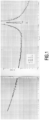
- An example of this phenomena is revealed by the neutron "capture cross section" measurements for Co-59, shown in FIG. 1 as a function of neutron energy.
- the neutron capture cross section is shown to be about 50 barns (b) at 0.025 eV.
- the neutron capture cross section increases dramatically at the capture resonance present at a neutron energy of approximately 107 eV where it increases to approximately 7000b. In U-235 fission, the most probable neutron energy is 0.73 MeV.
- Another method is to increase the amount of 107 eV neutrons surrounding the target material without needing to increase the fission rate. This can be accomplished by surrounding the target material with an optimal amount of neutron energy moderating material with a high neutron lethargy and slowing down more of the neutrons with higher energies that wouldn't normally be captured by the Co-59 target before they diffuse away from the area of the target. This effectively increases the number of fission neutrons that are in the desired energy range to maximize the neutron captures in the target material. Optimizing the amount and distribution of water surrounding the Co-60 target will allow the average neutron energy spectrum around the target to be controlled to maximize the Co-60 production rate. The same approach can be used to increase the production rates of other desired radioisotopes.
- Described herein are devices and methods to generate the maximum amount of desired radioisotope from irradiation targets designed to fit into the guide thimbles present in conventional reactors, such as PWR fuel assemblies, with the intent to benefit the radioisotope production economics.
- a radioisotope production capsule used for this purpose comprises an inner container for housing one of a target material and a neutron moderator, an outer container surrounding the inner container for housing the one of the target material and the neutron moderator not housed by the inner container, and cladding for isolating the target material from the neutron moderator.
- the neutron moderator in various aspects, may be a coolant such as water.
- the inner container is in various aspects a cylinder and the outer container is an annular cylinder concentric with the axis of the inner container.
- the inner cylinder holds the neutron moderator and the annular cylinder holds the target material for irradiation.
- the inner cylinder holds the target material for irradiation and the annular cylinder holds the neutron moderator.
- a method for producing a desired radioisotope comprises providing at least one capsule, each capsule having an inner container and an outer container surrounding the inner container, and a cladding material isolating the inner container from the outer container, inserting a target material that will produce the desired radioisotope upon irradiation into one of the inner or the outer container, surrounding the target material with the cladding material to isolate the target material within the capsule, inserting a neutron moderator into the one of the remaining inner or outer container in which the target material was not inserted, inserting at least one capsule having target material and neutron moderator-filled inner and outer containers into an insert component of a nuclear fuel assembly, irradiating the target material to form the radioisotope from such target material, and removing the at least one inserted capsule from the insert component.
- the modular radioisotope production capsules described herein allow the neutron energy spectrum to be optimized for the target capture cross section and the minimum reactor fuel assembly reactivity reduction with the capability to adjust the total activity contained in a module outer envelope.
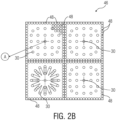
- a nuclear fuel assembly 46 commonly includes a plurality of fuel rods 48 (only a few rods are shown around the perimeter for clarity, but in use, the rods would occupy most of the fuel assembly space), and a set of guide thimble tubes 30.
- Guide thimbles 30 are vacant tubes provided to hold control rods or in-core instrumentation used in a reactor (not shown).
- Each guide thimble 30, as shown, includes a neck 38, a mid-section 32 and a tapered end 34.
- Several guide thimbles 30 are suspended from a plate 40, which is itself suspended by a hold down spring 44 from the upper core plate 42 of the fuel assembly 46. In the illustration shown in FIG. 2 B , there are 25 guide thimbles 30 in each fuel assembly 46. The number may vary depending on factors such as the size of the reactor.
- FIG. 2 C illustrates a section view of an exemplary thimble plug finger 26 dimensioned to fit within a guide thimble 30.
- the plug finger 26 includes an outer sheath 36, a cap 28 for closing the open end of finger 26, and a tapered closed end 24.
- the plug fingers 26 are meant to fit in the interior of the guide thimbles 30, so the outer dimensions of the fingers 26 will be equal to or less than the inner diameter of the guide thimble mid-section 30. Either the juncture between the mid-section 32 and the tip 34 or the mid-section 32 and the neck 38 may be opened for insertion of the plug fingers 26.
- the target material 12 will vary depending on the desired radioisotope to be produced, and the appropriate target material for production of the desired radioisotope can be selected.
- the target material 12 may be in any suitable form, including, but not limited to a solid block, a powder, pellets, spheres, or a liquid.
- the top and bottom ends of the inner container in this embodiment that holds the neutron moderator and coolant are open to the plug finger interior as indicated by in FIG. 3 by open ends 22.
- the top and bottom ends of the outer container that holds the target material is closed by top and bottom extensions of outer cladding 18 to isolate the target material from the neutron moderator and coolant.
- two or more modular capsules 10 may be stacked axially within a plug finger 26 and may be connected to each other by locking rings or pegs 20 or a similar mechanism for joining adjacent capsules 10.
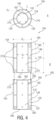
- FIGS. 4 A and B illustrate an alternative embodiment of a radioisotope production capsule 100.
- Capsule 100 includes an inner container, such as inner cylinder 152 that holds target material 120 and an outer container, such as outer annular cylinder 154 that holds neutron moderator 140 and coolant in a PWR.
- Inner cladding 160 surrounds the top, bottom and sides of the target material and separates the inner cylinder from the annular cylinder.
- Outer cladding 180 surrounds the sides of the annular cylinder. If the irradiated target material is a solid, the cladding may simply be deposited on the target material. If the target material is a powder, pellet, sphere, or liquid, the cladding forms the walls of the container for the target material to isolate the target material from the neutron moderator and coolant.
- Support members 210 support the inner cylinder 152 in position within the annular cylinder 154.
- the support members may be any suitable device for either or both centering and rigidly mechanically supporting, the inner cylinder 152 within the annular cylinder 154.
- the support members 210 may be fingers or post-like structures that extend radially outwardly from the inner cladding 160 or which extend radially inwardly from the outer cladding 180 to connect with an engagement surface on the opposite cladding surface.
- the support members 210 may be made of a material that undergoes thermal expansion under the temperatures typical of a nuclear reactor to create a pressure fit, but which shrink enough as the surrounding temperature cools to allow the inner cylinder 152 to be removed from the annular cylinder 154.
- the ratio of the thickness of the annular cylinder 54/154 to the diameter of the inner cylinder 52/152 can be adjusted using commercially available nuclear design tools, such as software packages utilizing advanced nodal code (ANC TM ) for reactor core analysis or similar packages sold under the mark PALADIN ® , which are understood by those skilled in the art to calculate the dimensions needed to maximize the rate of production of the desired radioisotope.
- ANC TM advanced nodal code
- the ideal diameter (Ds) of the inner cylinder 152, or the target material 120 held within the inner cylinder 152 as shown in FIG. 4 is less than or equal to the diameter (Dc) of the inner cylinder 52, as shown in FIG. 3 .
- FIGS. 3 and 4 show exemplary modular capsules 10 and 100, respectively, which may be spaced from each other, or which may be stacked one on top of the other, in the interior cavity of a plug finger 26.
- means to mechanically join the adjacent capsule modules 10 or adjacent capsule modules 100 together such as locking rings 20 or 200, may optionally be provided, for example, to minimize the potential for mechanical vibration of the modules from causing failures of the outer sheath of the plug fingers.
- An example of the type of connection method is use of a quarter turn quick disconnect design. Numerous examples of quick-disconnect designs are known in the art.
- the modules 10 or 100 can be joined until the total length and total activity meets the end user needs.
- one or more capsule 100 modules would be placed in each of a plurality of plug finger 26.
- Each single plug finger 26 loaded with one or more capsules 100 would be inserted into the mid-section 32 of a guide thimble 30.
- Each of the individual guide thimbles 30 in an array of guide thimbles, as shown in FIG. 2 B may receive a plug fingers 26 which itself has been loaded with one or more capsules 100.
- only one or a few of the guide thimbles 30 in an array of guide thimble need be used to house the plug fingers 26 and capsules 100.
- a large number of capsules 100 may be inserted, via multiple plug fingers 26, into one or multiple guide thimbles 30 and exposed to the radiation within a nuclear reactor to produce the desired radioisotope.
- the capsules 10/100 and plug fingers 26 must be removed from the guide thimbles 30.
- the guide thimbles would be withdrawn from the fuel assembly 46 by known means.
- the mid-section 34 of a withdrawn guide thimble 30 may opened, for example, by removing either or both of the tip 34 and the neck 38.
- the plug finger or fingers 26 would be removed from the guide thimbles 30 and the capsules 10 and 100 would be removed from the plug fingers 26 and transported to a radioisotope production facility.
- the capsules 10/100 may be harvested from the plug fingers 26 by cutting the fingers 26 into appropriate length to fit into a transport container. Upon arrival at a production facility, the irradiated target material will be removed from the capsule and the desired radioisotope will be separated by known techniques from the irradiated material.
- capsules 10 and 100 have been described as having inner cylinders and annular outer cylinders, other shapes may be used. Cylinders fit best with existing fuel assembly insert components but the concept described of a container housing a target material for irradiation adjacent to (for example, either surrounded by or positioned within) a container of a neutron moderator, both housed in a capsule that can be inserted into insert components for a nuclear fuel assembly so that radiation from the nuclear reactor can be absorbed by the target material to produce a desired radioisotope is not limited to cylinders and may vary depending on the geometry of the reactor components.
- the modular radioisotope production capsules 10/100 described herein allow the neutron energy spectrum to be optimized for the target capture cross section and the minimum reactor fuel assembly reactivity reduction with the capability to adjust the total activity contained in a module outer envelope.
- Example 1 A radioisotope production capsule comprising: an inner container for housing one of a target material and a neutron moderator; an outer container surrounding the inner container for housing the one of the target material and the neutron moderator not housed by the inner container; and, cladding for isolating the target material from the neutron moderator.
- Example 3 The capsule recited in any of Examples 1 or 2, wherein the outer container is defined between an outer wall of the cladding material and the inner wall of the cladding material.
- Example 4 The capsule recited in any of Examples 1-3, further comprising locking members for axially joining adjacent capsules.
- Example 5 The capsule recited in Example 4, wherein the locking members are mounted on the outer container.
- Example 6 The capsule recited in any of Examples 4 or 5, wherein the locking members are quick-disconnect locking members.
- Example 9 The capsule recited in any of Examples 7 or 8, wherein the posts are made of a material that expands at temperatures within a nuclear reactor to provide a pressure fit for the posts between the outer wall of the outer container and the inner wall of the inner container and contracts when the material is cooled to a temperature lower than the temperatures within a nuclear reactor.
- Example 10 The capsule recited in any of Examples 7-9, wherein the desired position of the inner container is axially centered within the outer container.
- Example 11 The capsule recited in any of Examples 1-10, wherein the inner container is a cylinder and the outer container is an annular cylinder concentric with the axis of the inner container.
- Example 12 The capsule recited in Example 11, wherein the inner cylinder holds the neutron moderator and the annular cylinder holds the target material for irradiation.
- Example 14 - A method for producing a desired radioisotope comprising: providing at least one capsule, each capsule having an inner container and an outer container surrounding the inner container and a cladding material isolating the inner container from the outer container; inserting a target material that will produce the desired radioisotope upon irradiation into one of the inner or the outer container; surrounding the target material with the cladding material to isolate the target material within the capsule; inserting a neutron moderator into the one of the remaining inner or outer container in which the target material was not inserted; inserting at least one capsule having target material and neutron moderator-filled inner and outer containers into an insert component of a nuclear fuel assembly; irradiating the target material to form the radioisotope for such target material; and, removing the capsule from the insert component.
- Example 15 The method recited in claim 14, further comprising: removing the irradiated target material from the capsule and separating the desired radioisotope from the irradiated material.
Landscapes
- Physics & Mathematics (AREA)
- Engineering & Computer Science (AREA)
- General Engineering & Computer Science (AREA)
- High Energy & Nuclear Physics (AREA)
- Plasma & Fusion (AREA)
- Chemical & Material Sciences (AREA)
- Chemical Kinetics & Catalysis (AREA)
- General Chemical & Material Sciences (AREA)
- Radiation-Therapy Devices (AREA)
- Particle Accelerators (AREA)
Abstract
Description
- This application claims the benefit of
U.S. provisional Application No. 62/914,661, filed October 14, 2019 - The present disclosure relates to radioisotopes, and more particularly to a device for capturing radioisotopes during nuclear power production.
- Radioactive isotopes, or radioisotopes, are used commercially in a variety of industries, such as medicine where gamma rays emitted by radioactive elements are used to detect tumors, in the food industry where food is sometimes irradiated by exposure to gamma rays to kill certain bacteria, in agriculture, pest control, and in archeology where radiocarbon dating uses carbon-14 to measure the age of carbon-bearing items. Radioisotopes are highly unstable and readily decay, emitting radiation in the form of alpha, beta and gamma rays. A class of radioisotopes is produced as a by-product of typical nuclear power plant operation.
- The production of commercially valuable radioisotopes, such as Co-60, Ac-225, and W-188, requires the capture of at least one neutron by a target material placed inside a reactor core. Cobalt-60 (Co-60), for example, produces high energy gamma rays, which may be used for radiotherapy, equipment sterilization, and food irradiation. Co-60 is a synthetic radioisotope of cobalt that is produced artificially in nuclear reactors. Deliberate industrial production depends on neutron activation of bulk samples of the monoisotopic and mononuclidic cobalt isotope Co-59. Actinium-225 (Ac-225) is produced by the decay of thorium-229. Ac-225 can be used in nuclear medicine for treatment of malignancies. Tungsten-188 (W-188) is produced in a nuclear reactor by irradiation of tungsten oxide with thermal and high energy neutrons. W-188 is used to produce Rhenium-188 (Re-188), a high energy β-emitting radioisotope which has shown utility for a variety of therapeutic applications in nuclear medicine, oncology, radiology, and cardiology.
- The rate of production of the desired radioisotope depends on the numbers and energy spectrum of neutrons surrounding the target material (e.g., Co-59, thorium-229 etc.) and the probability that the target material captures neutrons within the energy range. An example of this phenomena is revealed by the neutron "capture cross section" measurements for Co-59, shown in
FIG. 1 as a function of neutron energy. The neutron capture cross section is shown to be about 50 barns (b) at 0.025 eV. The neutron capture cross section increases dramatically at the capture resonance present at a neutron energy of approximately 107 eV where it increases to approximately 7000b. In U-235 fission, the most probable neutron energy is 0.73 MeV. Ideally, the number of neutrons in the 104 eV or below range needs to be maximized in order to maximize the rate at which Co-60 is produced. This can be done by simply increasing the number of fissions that occur. This may be accomplished by increasing the amount of U-235 present in the fuel. However, the economic cost of that approach significantly increases the cost of the radioisotope being produced. - Another method is to increase the amount of 107 eV neutrons surrounding the target material without needing to increase the fission rate. This can be accomplished by surrounding the target material with an optimal amount of neutron energy moderating material with a high neutron lethargy and slowing down more of the neutrons with higher energies that wouldn't normally be captured by the Co-59 target before they diffuse away from the area of the target. This effectively increases the number of fission neutrons that are in the desired energy range to maximize the neutron captures in the target material. Optimizing the amount and distribution of water surrounding the Co-60 target will allow the average neutron energy spectrum around the target to be controlled to maximize the Co-60 production rate. The same approach can be used to increase the production rates of other desired radioisotopes.
- One way to accomplish the desired shifting of the fission neutron energy spectrum around an irradiation target is to change the amount of neutron energy moderator, such as water, or other material with a low neutron capture cross section and a high neutron scattering cross section, between the target and the neutrons produced by fission. The hydrogen in a water moderator is very effective at slowing down high energy neutrons, but not capturing them so they can't interact at all with the irradiation target material. Adjusting the amount of water surrounding the irradiation target can be accomplished in a water cooled and moderated reactor core by controlling the geometry of the irradiation target. Materials other than water, such as low atomic number metallic substances with small neutron capture cross sections (e. g. Zirconium, Nickle, Graphite) may also be used to increase the neutron captures in the target material.
FR 2 647 945 A1 EP 2 599 087 A1 discloses an isotope production target with an outer diameter wall and an inner diameter wall, between which is located an isotope source comprising fissile material interspersed with one or more voids. - It has been shown by calculations performed by those skilled in the art that the use of pressurized water reactor (PWR) fuel assembly inserts similar to thimble flow plugs or burnable absorber rods containing rod-shaped slugs of Co-59 for the production of Co-60 can be used to produce commercially valuable amounts of Co-60. However, the predicted specific activity (SA) in Ci/cm3 and the Ci per unit length of the current irradiation target shape of the Co-60 in the irradiated material at the end of the desired irradiation period is less than needed to support economically favorable production useful for current application practices.
- The following summary is provided to facilitate an understanding of some of the innovative features unique to the embodiments disclosed and is not intended to be a full description. A full appreciation of the various aspects of the embodiments can be gained by taking the entire specification, claims, abstract and drawings as a whole.
- Described herein are devices and methods to generate the maximum amount of desired radioisotope from irradiation targets designed to fit into the guide thimbles present in conventional reactors, such as PWR fuel assemblies, with the intent to benefit the radioisotope production economics.
- A radioisotope production capsule used for this purpose comprises an inner container for housing one of a target material and a neutron moderator, an outer container surrounding the inner container for housing the one of the target material and the neutron moderator not housed by the inner container, and cladding for isolating the target material from the neutron moderator. The neutron moderator, in various aspects, may be a coolant such as water.
- In various aspects, the inner container is defined by an inner wall of a cladding material. In various aspects, the outer container is defined between an outer wall of the cladding material and the inner wall of the cladding material. The capsule may also include locking members for axially joining adjacent capsules within an insert component of a fuel assembly of a nuclear reactor. The locking members may in various aspects be mounted on the outer container. In certain aspects, the locking members may be quick-disconnect locking members.
- The capsule may also include support members for holding the inner container in a desired position within the outer container. The support members may be posts that extend from an outer wall of the cladding material that forms the outer container to an inner wall of a cladding material that defines the inner container. The posts are preferably made of a material that expands at temperatures within a nuclear reactor to provide a pressure fit for the posts between the outer wall of the outer container and the inner wall of the inner container and contracts when the material is cooled to a temperature lower than the temperatures within a nuclear reactor.
- The inner container is in various aspects a cylinder and the outer container is an annular cylinder concentric with the axis of the inner container. In certain aspects, the inner cylinder holds the neutron moderator and the annular cylinder holds the target material for irradiation. In certain aspects, the inner cylinder holds the target material for irradiation and the annular cylinder holds the neutron moderator.
- A method for producing a desired radioisotope is described herein. The method comprises providing at least one capsule, each capsule having an inner container and an outer container surrounding the inner container, and a cladding material isolating the inner container from the outer container, inserting a target material that will produce the desired radioisotope upon irradiation into one of the inner or the outer container, surrounding the target material with the cladding material to isolate the target material within the capsule, inserting a neutron moderator into the one of the remaining inner or outer container in which the target material was not inserted, inserting at least one capsule having target material and neutron moderator-filled inner and outer containers into an insert component of a nuclear fuel assembly, irradiating the target material to form the radioisotope from such target material, and removing the at least one inserted capsule from the insert component.
- The modular radioisotope production capsules described herein allow the neutron energy spectrum to be optimized for the target capture cross section and the minimum reactor fuel assembly reactivity reduction with the capability to adjust the total activity contained in a module outer envelope.
- The characteristics and advantages of the present disclosure may be better understood by reference to the accompanying figures.
-
FIG. 1 is an image of a graph of a neutron capture cross section of Co-59 as a function of neutron energy (BNL-325). -
FIGS. 2A-C illustrate an exemplary group of guide thimbles (A), a top section schematic view of the guide thimbles as they are positioned within a fuel assembly (B), and (C) a schematic illustration of a thimble plug finger and radioisotope production capsule for insertion in a guide thimble. -
FIGS. 3A and B are schematic top section and side section views, respectively, of an exemplary modular radioisotope production capsules having an outer annular target material placement. -
FIGS. 4A and B are schematic top section and side section views, respectively, of an exemplary modular radioisotope production capsules having a centrally placed target material. -
FIG. 5 is a schematic illustration of the target material of a capsule shown inFIG. 4 being inserted into the moderator-filled core of the capsule ofFIG. 3 . - As used herein, the singular form of "a", "an", and "the" include the plural references unless the context clearly dictates otherwise.
- Directional phrases used herein, such as, for example and without limitation, top, bottom, left, right, lower, upper, front, back, and variations thereof, shall relate to the orientation of the elements shown in the accompanying drawing and are not limiting upon the claims unless otherwise expressly stated.
- In the present application, including the claims, other than where otherwise indicated, all numbers expressing quantities, values or characteristics are to be understood as being modified in all instances by the term "about." Thus, numbers may be read as if preceded by the word "about" even though the term "about" may not expressly appear with the number. Accordingly, unless indicated to the contrary, any numerical parameters set forth in the following description may vary depending on the desired properties one seeks to obtain in the compositions and methods according to the present disclosure. At the very least, each numerical parameter described in the present description should at least be construed in light of the number of reported significant digits and by applying ordinary rounding techniques.
- Any numerical range recited herein is intended to include all sub-ranges subsumed therein. For example, a range of "1 to 10" is intended to include all sub-ranges between (and including) the recited minimum value of 1 and the recited maximum value of 10, that is, having a minimum value equal to or greater than 1 and a maximum value of equal to or less than 10.
- Referring to
FIGS. 2 A andB , anuclear fuel assembly 46 commonly includes a plurality of fuel rods 48 (only a few rods are shown around the perimeter for clarity, but in use, the rods would occupy most of the fuel assembly space), and a set ofguide thimble tubes 30.Guide thimbles 30 are vacant tubes provided to hold control rods or in-core instrumentation used in a reactor (not shown). Eachguide thimble 30, as shown, includes a neck 38, a mid-section 32 and a tapered end 34.Several guide thimbles 30 are suspended from a plate 40, which is itself suspended by a hold down spring 44 from the upper core plate 42 of thefuel assembly 46. In the illustration shown inFIG. 2 B , there are 25guide thimbles 30 in eachfuel assembly 46. The number may vary depending on factors such as the size of the reactor. -
FIG. 2 C illustrates a section view of an exemplary thimble plugfinger 26 dimensioned to fit within aguide thimble 30. Theplug finger 26 includes anouter sheath 36, acap 28 for closing the open end offinger 26, and a taperedclosed end 24. Theplug fingers 26 are meant to fit in the interior of theguide thimbles 30, so the outer dimensions of thefingers 26 will be equal to or less than the inner diameter of theguide thimble mid-section 30. Either the juncture between the mid-section 32 and the tip 34 or the mid-section 32 and the neck 38 may be opened for insertion of theplug fingers 26. - An exemplary radioisotope production capsule 100 (see
FIG. 4 ) is shown positioned within theplug finger 26. If there were noplug fingers 26 inserted into the fuel assembly guidethimbles 30 during reactor operation, the guide thimble tubes would be filled with the neutron moderator and coolant used in a PWR, such as water, with a flow rate that exceeds the neutron moderator and coolant flow through thefuel rods 48 included in thefuel assembly 46. Theplug fingers 26 block this flow and consequently increase the neutron moderator and coolant flow among thefuel rods 48. Including the irradiation target material inside theplug fingers 26 allows theplug fingers 26 to both serve their intended function and to produce the desired radioisotopes. - While those skilled in the art will appreciate that a variety of different geometries for the
plug fingers 26 andradioisotope production capsules thimbles 30 avoids the need to make any modifications to the fuel assembly mechanical design. This approach greatly reduces the costs associated with implementing the radioisotope production in commercial light water reactors (LWR) designs. -
FIGS. 3 A and B illustrate an exemplary embodiment ofmodular radioisotope capsules 10 for insertion in aplug finger 26. Eachcapsule 10 shown includes an inner container, such asinner cylinder 52 defined byinner cladding 16. The inner cylinder in this embodiment houses theneutron moderator 14 and coolant, which in various aspects, is water. Surrounding theinner cylinder 52 is an outer container, such as outerannular cylinder 54 defined between theinner cladding 16 and anouter cladding 18. In various aspects, theinner cylinder 52 is positioned such that its axis is concentric with the axis of the outerannular cylinder 54. Theannular cylinder 54 in this embodiment holds thetarget material 12 to be irradiated during the nuclear power generation cycle. Thetarget material 12 will vary depending on the desired radioisotope to be produced, and the appropriate target material for production of the desired radioisotope can be selected. Thetarget material 12 may be in any suitable form, including, but not limited to a solid block, a powder, pellets, spheres, or a liquid. The top and bottom ends of the inner container in this embodiment that holds the neutron moderator and coolant are open to the plug finger interior as indicated by inFIG. 3 by open ends 22. The top and bottom ends of the outer container that holds the target material is closed by top and bottom extensions ofouter cladding 18 to isolate the target material from the neutron moderator and coolant. In various aspects, two or moremodular capsules 10 may be stacked axially within aplug finger 26 and may be connected to each other by locking rings or pegs 20 or a similar mechanism for joiningadjacent capsules 10. -
FIGS. 4 A and B illustrate an alternative embodiment of aradioisotope production capsule 100.Capsule 100 includes an inner container, such asinner cylinder 152 that holdstarget material 120 and an outer container, such as outerannular cylinder 154 that holdsneutron moderator 140 and coolant in a PWR.Inner cladding 160 surrounds the top, bottom and sides of the target material and separates the inner cylinder from the annular cylinder.Outer cladding 180 surrounds the sides of the annular cylinder. If the irradiated target material is a solid, the cladding may simply be deposited on the target material. If the target material is a powder, pellet, sphere, or liquid, the cladding forms the walls of the container for the target material to isolate the target material from the neutron moderator and coolant. -
Support members 210 support theinner cylinder 152 in position within theannular cylinder 154. The support members may be any suitable device for either or both centering and rigidly mechanically supporting, theinner cylinder 152 within theannular cylinder 154. For example, thesupport members 210 may be fingers or post-like structures that extend radially outwardly from theinner cladding 160 or which extend radially inwardly from theouter cladding 180 to connect with an engagement surface on the opposite cladding surface. Alternatively, thesupport members 210 may be made of a material that undergoes thermal expansion under the temperatures typical of a nuclear reactor to create a pressure fit, but which shrink enough as the surrounding temperature cools to allow theinner cylinder 152 to be removed from theannular cylinder 154. - In various aspects, two or more
modular capsules 100 may be stacked axially within aplug finger 26 and may be connected to each other by locking rings or pegs 200 or a similar mechanism for joiningadjacent capsules 100. - The
capsule inner cylinder 52 orannular cylinder 154 enters and exits theplug finger 26outer sheath 36 throughsmall holes 50 that penetrate thefinger 26outer sheath 36 andtip 24 at the top and bottom, respectively, of theplug fingers 26. (SeeFIG. 2 C .) As described above, the portions of thecapsules 10/100 that contain the moderator and coolant are not capped so the top and bottom of the capsules in this portion are open to the liquid moderator and coolant environment inside the PWR thimble plugfingers 26. - The
claddings target material 12/120, such as Co-60, from leaching out of the cylinder holding the target material into the cylinder that holds the neutron moderator. - The most appropriate material will depend on the target material and the desired radioisotope to be produced. Exemplary materials for Co-60 include Ni and Zr. Exemplary materials for Ac-225 and W-188 include Zr and stainless steel. The material for the cladding will depend on factors such as the corrosion resistance of the target material relative to the irradiation of the target material and the need to avoid chemical reactions that would cause perforations in the cladding.
- The ratio of the thickness of the
annular cylinder 54/154 to the diameter of theinner cylinder 52/152 can be adjusted using commercially available nuclear design tools, such as software packages utilizing advanced nodal code (ANC™) for reactor core analysis or similar packages sold under the mark PALADIN®, which are understood by those skilled in the art to calculate the dimensions needed to maximize the rate of production of the desired radioisotope. - The maximum value of the outer diameter of the
capsule FIGS. 3 and4 as Dm, is equal to the inner diameter (ID) of theplug finger 26, shown inFIG. 2 C . An example of the ID of theplug finger 26 is 6.1 mm. The length of theirradiation target material 12/120 contained in thecapsule 10/100 is shown onFIGS. 3 and4 as the dimension Lt. This length is determined by the needs of the end-user of the radioisotope. For example, the irradiation activity of a selected radioisotope needed for a particular application may be calculated per unit length of the target material in thecapsule 10/100. For reasons explained in more detail below, the ideal diameter (Ds) of theinner cylinder 152, or thetarget material 120 held within theinner cylinder 152 as shown inFIG. 4 , is less than or equal to the diameter (Dc) of theinner cylinder 52, as shown inFIG. 3 . - One or
more capsules plug finger 26.FIGS. 3 and4 show exemplarymodular capsules plug finger 26. In various aspects, means to mechanically join theadjacent capsule modules 10 oradjacent capsule modules 100 together, such as locking rings 20 or 200, may optionally be provided, for example, to minimize the potential for mechanical vibration of the modules from causing failures of the outer sheath of the plug fingers. An example of the type of connection method is use of a quarter turn quick disconnect design. Numerous examples of quick-disconnect designs are known in the art. Themodules - The connected or stacked modules can be spaced from each other and separated within the
fingers 26 to allow themodule capsules support members 210 that hold the capsules from the sides, mounts on the outer container rims or on the joiningmechanisms 20/ 200 (e.g., the quick disconnect member on the rim) to separate adjacent modules axially within aplug finger 26, or a similar mechanical attachments known to those skilled in the art. A suitable design of the attachment or suspension supports will allow thecapsules 10/100 andtarget material 12/120 to be easily withdrawn at low temperatures to facilitate removal of the target material from thecapsules 10/100 in an irradiated material processing facility. - In practice, one or
more capsule 10 modules would be placed in each of a plurality ofplug fingers 26. Eachsingle plug finger 26 loaded with one ormore capsules 10 would be inserted into the mid-section 32 of aguide thimble 30. Each of theindividual guide thimbles 30 in an array of guide thimbles, as shown inFIG. 2 B , may receive aplug fingers 26 which itself has been loaded with one ormore capsules 10. In various aspects, only one or a few of theguide thimbles 30 in an array of guide thimble need be used to house theplug fingers 26 andcapsules 10. Thus, a large number ofcapsules 10 may be inserted, viamultiple plug fingers 26, into one ormultiple guide thimbles 30 and exposed to the radiation within a nuclear reactor to produce the desired radioisotope. - Alternatively, one or
more capsule 100 modules would be placed in each of a plurality ofplug finger 26. Eachsingle plug finger 26 loaded with one ormore capsules 100 would be inserted into the mid-section 32 of aguide thimble 30. Each of theindividual guide thimbles 30 in an array of guide thimbles, as shown inFIG. 2 B , may receive aplug fingers 26 which itself has been loaded with one ormore capsules 100. In various aspects, only one or a few of theguide thimbles 30 in an array of guide thimble need be used to house theplug fingers 26 andcapsules 100. Thus, a large number ofcapsules 100 may be inserted, viamultiple plug fingers 26, into one ormultiple guide thimbles 30 and exposed to the radiation within a nuclear reactor to produce the desired radioisotope. - In a third alternative approach, one or
more capsule 10 modules would be placed in one or moresingle plug finger 26 and one ormore capsule 100 modules would be placed in one or more differentsingle plug finger 26. Theplug finger 26 loaded with one ormore capsules 10 and theplug finger 26 loaded with one ormore capsules 100 would be inserted into the mid-sections 32 ofdifferent guide thimbles 30. Each of theindividual guide thimbles 30 in an array of guide thimbles, as shown inFIG. 2 B , may receive aplug fingers 26 which itself has been loaded either with one ormore capsules 10 or with one ormore capsules 100. In various aspects, only one or a few of theguide thimbles 30 in an array of guide thimble need be used to house theplug fingers 26 withcapsules - Following irradiation, the
capsules 10/100 and plugfingers 26 must be removed from the guide thimbles 30. The guide thimbles would be withdrawn from thefuel assembly 46 by known means. The mid-section 34 of a withdrawnguide thimble 30 may opened, for example, by removing either or both of the tip 34 and the neck 38. The plug finger orfingers 26 would be removed from theguide thimbles 30 and thecapsules plug fingers 26 and transported to a radioisotope production facility. In one aspect, thecapsules 10/100 may be harvested from theplug fingers 26 by cutting thefingers 26 into appropriate length to fit into a transport container. Upon arrival at a production facility, the irradiated target material will be removed from the capsule and the desired radioisotope will be separated by known techniques from the irradiated material. -
FIG. 5 illustrates an exemplary method that can be used to increase the activity contained within the module shown onFigure 3 . The method involves irradiating (e.g., simultaneously or sequentially) modules like those shown inFIGS. 3 and4 in the same reactor or in different reactor cores. Once the levels of the desired radioisotope have reached the desired activity levels and have been shipped to the processing facility, the linkedcapsule cylinders 152, for example ofcapsule 100 contained in the modules shown inFIG. 4 may be pushed out of the center of the module and intocylinder 52 of the module ofcapsule 10 shown inFIG. 3 . The diameter of theinner cylinder 152 in this procedure will be smaller than the diameter ofinner cylinder 52. The material that is received incylinder 52 will be prevented from passing completely through the bottom of thecylinder 52 by the rims and locking rings 20 around the bottom ofcylinder 52. This will increase the net activity and activity per unit length of theannular cylinder 54irradiation capsule 10 module to essentially be the sum of the activity of both thecapsule - While the
capsules - The
modular capsule 10/100 designs and associated methods allow the maximum amount of desired radioisotope production with the minimal disruption in fuel assembly power distribution and minimal detrimental fuel assembly enrichment impacts. The methods and capsule designs described herein allow desired radioisotopes to be produced within an existing fuel assembly using existing guide thimble insert designs. - The modular
radioisotope production capsules 10/100 described herein allow the neutron energy spectrum to be optimized for the target capture cross section and the minimum reactor fuel assembly reactivity reduction with the capability to adjust the total activity contained in a module outer envelope. - While the
modular capsules 10/100 have been described as being inserted intoguide thimbles 30, they may in addition, or alternatively, be installed into other existing fuel assembly inserts, such as wet annular burnable absorber assemblies. Themodular capsule 10/100 designs provide the radioisotope product supplier with a significant increase in product flexibility in terms of source activity levels and the distribution of activity levels within a source assembly. - Various aspects of the subject matter described herein are set out in the following examples.
- Example 1 - A radioisotope production capsule comprising: an inner container for housing one of a target material and a neutron moderator; an outer container surrounding the inner container for housing the one of the target material and the neutron moderator not housed by the inner container; and, cladding for isolating the target material from the neutron moderator.
- Example 2 - The capsule recited in Example 1, wherein the inner container is defined by an inner wall of a cladding material.
- Example 3 - The capsule recited in any of Examples 1 or 2, wherein the outer container is defined between an outer wall of the cladding material and the inner wall of the cladding material.
- Example 4 - The capsule recited in any of Examples 1-3, further comprising locking members for axially joining adjacent capsules.
- Example 5 - The capsule recited in Example 4, wherein the locking members are mounted on the outer container.
- Example 6 - The capsule recited in any of Examples 4 or 5, wherein the locking members are quick-disconnect locking members.
- Example 7 - The capsule recited in any of Examples 1-6, further comprising support members for holding the inner container in a desired position within the outer container.
- Example 8 - The capsule recited in Example 7, wherein the support members are posts that extend from an outer wall of the cladding material that forms the outer container to an inner wall of a cladding material that defines the inner container.
- Example 9 - The capsule recited in any of Examples 7 or 8, wherein the posts are made of a material that expands at temperatures within a nuclear reactor to provide a pressure fit for the posts between the outer wall of the outer container and the inner wall of the inner container and contracts when the material is cooled to a temperature lower than the temperatures within a nuclear reactor.
- Example 10 - The capsule recited in any of Examples 7-9, wherein the desired position of the inner container is axially centered within the outer container.
- Example 11 - The capsule recited in any of Examples 1-10, wherein the inner container is a cylinder and the outer container is an annular cylinder concentric with the axis of the inner container.
- Example 12 - The capsule recited in Example 11, wherein the inner cylinder holds the neutron moderator and the annular cylinder holds the target material for irradiation.
- Example 13 - The capsule recited in Example 11, wherein the inner cylinder holds the target material for irradiation and the annular cylinder holds the neutron moderator.
- Example 14 - A method for producing a desired radioisotope comprising: providing at least one capsule, each capsule having an inner container and an outer container surrounding the inner container and a cladding material isolating the inner container from the outer container; inserting a target material that will produce the desired radioisotope upon irradiation into one of the inner or the outer container; surrounding the target material with the cladding material to isolate the target material within the capsule; inserting a neutron moderator into the one of the remaining inner or outer container in which the target material was not inserted; inserting at least one capsule having target material and neutron moderator-filled inner and outer containers into an insert component of a nuclear fuel assembly; irradiating the target material to form the radioisotope for such target material; and, removing the capsule from the insert component.
- Example 15 - The method recited in
claim 14, further comprising: removing the irradiated target material from the capsule and separating the desired radioisotope from the irradiated material. - The present invention has been described with reference to various exemplary and illustrative embodiments. The embodiments described herein are understood as providing illustrative features of varying detail of various embodiments of the disclosed invention; and therefore, unless otherwise specified, it is to be understood that, to the extent possible, one or more features, elements, components, constituents, ingredients, structures, modules, and/or aspects of the disclosed embodiments may be combined, separated, interchanged, and/or rearranged with or relative to one or more other features, elements, components, constituents, ingredients, structures, modules, and/or aspects of the disclosed invention, which is defined by the appended claims. Accordingly, it will be recognized by persons having ordinary skill in the art that various substitutions, modifications or combinations of any of the exemplary embodiments may be made without departing from the scope of the invention. In addition, persons skilled in the art will recognize, or be able to ascertain using no more than routine experimentation, many equivalents to the various embodiments of the invention described herein upon review of this specification. Thus, the invention is not limited by the description of the various embodiments, but rather by the claims.
Claims (15)
- A radioisotope production capsule (10, 100) comprising:an inner container (52, 152) for housing one of a target material (12, 120) and a neutron moderator (14, 140);an outer container (54, 154) surrounding the inner container (52, 152) for housing the one of the target material (12, 120) and the neutron moderator (14, 140) not housed by the inner container (52, 152); and,cladding (16, 18) for isolating the target material (12, 120) from the neutron moderator (14, 140).
- The capsule recited in claim 1, wherein the inner container (52, 152) is defined by an inner wall of a cladding material.
- The capsule recited in claim 2, wherein the outer container (54, 154) is defined between an outer wall of the cladding material and the inner wall of the cladding material.
- The capsule recited in claim 1, further comprising locking members (20) for axially joining adjacent capsules (10).
- The capsule recited in claim 4, wherein the locking members (20, 200) are mounted on the outer container (54).
- The capsule recited in claim 4, wherein the locking members (20, 200) are quick-disconnect locking members.
- The capsule recited in claim 1, further comprising support members (210) for holding the inner container (152) in a desired position within the outer container (154).
- The capsule recited in claim 7, wherein the support members (210) are posts that extend from an outer wall of the cladding material that forms the outer container (154) to an inner wall of a cladding material that defines the inner container (152).
- The capsule recited in claim 8, wherein the posts are made of a material that expands at temperatures within a nuclear reactor to provide a pressure fit for the posts between the outer wall of the outer container (154) and the inner wall of the inner container (152) and contracts when the material is cooled to a temperature lower than the temperatures within a nuclear reactor.
- The capsule recited in claim 7, wherein the desired position of the inner container (152) is axially centered within the outer container (154).
- The capsule recited in claim 1, wherein the inner container (52, 152) is a cylinder and the outer container (54, 154) is an annular cylinder concentric with the axis of the inner container (52, 152).
- The capsule recited in claim 11, wherein the inner cylinder holds the neutron moderator (14, 140) and the annular cylinder holds the target material (12, 120) for irradiation.
- The capsule recited in claim 11, wherein the inner cylinder holds the target material (12, 120) for irradiation and the annular cylinder holds the neutron moderator (14, 140).
- A method for producing a desired radioisotope comprising:providing at least one capsule (10, 100), each capsule having an inner container (52,152) and an outer container (54, 154) surrounding the inner container (52, 152) and a cladding material isolating the inner container (52, 152) from the outer container (54, 154);inserting a target material (12, 120) that will produce the desired radioisotope upon irradiation into one of the inner or the outer container (52, 54; 152, 154);surrounding the target material (12, 120) with the cladding material to isolate the target material within the capsule (10, 100);inserting a neutron moderator (14, 140) into the one of the remaining inner or outer container (52, 54; 152, 154) in which the target material (12, 120) was not inserted;inserting at least one capsule having target material (12, 120) and neutron moderator-filled inner and outer containers (52, 54; 152, 154) into an insert component (26) of a nuclear fuel assembly;irradiating the target material (12, 120) to form the radioisotope for such target material; and,removing the at least one inserted capsule (10, 100) from the insert component (26).
- The method recited in claim 14, further comprising:
removing the irradiated target material (12, 120) from the capsule (10, 100) and separating the desired radioisotope from the irradiated material.
Applications Claiming Priority (3)
| Application Number | Priority Date | Filing Date | Title |
|---|---|---|---|
| US201962914661P | 2019-10-14 | 2019-10-14 | |
| EP20800523.1A EP4046172B1 (en) | 2019-10-14 | 2020-10-14 | Modular radioisotope production capsules and related method |
| PCT/US2020/055640 WO2021076673A1 (en) | 2019-10-14 | 2020-10-14 | Modular radioisotope production capsules and related method |
Related Parent Applications (1)
| Application Number | Title | Priority Date | Filing Date |
|---|---|---|---|
| EP20800523.1A Division EP4046172B1 (en) | 2019-10-14 | 2020-10-14 | Modular radioisotope production capsules and related method |
Publications (2)
| Publication Number | Publication Date |
|---|---|
| EP4535371A2 true EP4535371A2 (en) | 2025-04-09 |
| EP4535371A3 EP4535371A3 (en) | 2025-06-18 |
Family
ID=73040372
Family Applications (2)
| Application Number | Title | Priority Date | Filing Date |
|---|---|---|---|
| EP20800523.1A Active EP4046172B1 (en) | 2019-10-14 | 2020-10-14 | Modular radioisotope production capsules and related method |
| EP25152910.3A Pending EP4535371A3 (en) | 2019-10-14 | 2020-10-14 | Modular radioisotope production capsules and related method |
Family Applications Before (1)
| Application Number | Title | Priority Date | Filing Date |
|---|---|---|---|
| EP20800523.1A Active EP4046172B1 (en) | 2019-10-14 | 2020-10-14 | Modular radioisotope production capsules and related method |
Country Status (8)
| Country | Link |
|---|---|
| US (1) | US12476017B2 (en) |
| EP (2) | EP4046172B1 (en) |
| JP (1) | JP7626762B2 (en) |
| KR (1) | KR20220076477A (en) |
| CN (1) | CN114556491A (en) |
| CA (1) | CA3154972A1 (en) |
| TW (1) | TWI769552B (en) |
| WO (1) | WO2021076673A1 (en) |
Families Citing this family (9)
| Publication number | Priority date | Publication date | Assignee | Title |
|---|---|---|---|---|
| TWI769552B (en) | 2019-10-14 | 2022-07-01 | 美商西屋電器公司 | Modular radioisotope production capsules and related method |
| US12080434B2 (en) * | 2020-11-16 | 2024-09-03 | Westinghouse Electric Company Llc | Radioisotope activity surveillance apparatus, system, and method |
| CN116601722B (en) * | 2020-12-23 | 2025-11-04 | 法玛通公司 | Apparatus for use in fuel assemblies in nuclear power plants, methods for manufacturing the apparatus, and methods for activating materials in nuclear power plants. |
| US11817223B2 (en) | 2021-06-23 | 2023-11-14 | Westinghouse Electric Company Llc | Device for magnetically removing a capsule containing Co-60 from a burnable absorber rodlet |
| US20240233974A9 (en) * | 2022-10-25 | 2024-07-11 | Westinghouse Electric Company Llc | Production of radioisotopes with highly enriched target enclosure material |
| US20240233973A9 (en) * | 2022-10-25 | 2024-07-11 | Westinghouse Electric Company Llc | Additively manufactured cobalt burnable absorber capsules |
| CN116705373B (en) * | 2023-05-06 | 2025-11-18 | 北京中子探索科技有限公司 | An irradiation target for isotope production and an isotope production reactor |
| US12625050B2 (en) | 2023-11-01 | 2026-05-12 | Westinghouse Electric Company Llc | Expandable plug and pressure tool for use in metallic wick pore size testing |
| CN120108806B (en) * | 2025-02-19 | 2026-01-02 | 华能国际电力股份有限公司 | Isotope Production Method Based on Side Reflector Irradiation in Pellet Bed High-Temperature Gas-Cooled Reactors |
Citations (2)
| Publication number | Priority date | Publication date | Assignee | Title |
|---|---|---|---|---|
| FR2647945A1 (en) | 1989-06-02 | 1990-12-07 | Commissariat Energie Atomique | Device for producing radioisotopes, especially cobalt-60 |
| EP2599087A1 (en) | 2010-07-29 | 2013-06-05 | The State Of Oregon Acting By And Through The State Board Of Higher Education On Behalf Of Oregon State University | Isotope production target |
Family Cites Families (14)
| Publication number | Priority date | Publication date | Assignee | Title |
|---|---|---|---|---|
| BE638862A (en) * | 1963-10-18 | |||
| US4696793A (en) * | 1984-03-28 | 1987-09-29 | Westinghouse Electric Corp. | Burnable poison rod for use in a nuclear reactor |
| US9362009B2 (en) * | 2007-11-28 | 2016-06-07 | Ge-Hitachi Nuclear Energy Americas Llc | Cross-section reducing isotope system |
| US8638899B2 (en) * | 2009-07-15 | 2014-01-28 | Ge-Hitachi Nuclear Energy Americas Llc | Methods and apparatuses for producing isotopes in nuclear fuel assembly water rods |
| RU93175U1 (en) * | 2009-11-17 | 2010-04-20 | Общество с ограниченной ответственностью "Научно-производственное объединение "ИЗОТОП" | IRREGULAR ASSEMBLY FOR PRODUCING RADIOACTIVE MEDICAL ISOTOPES IN AN ATOMIC CHANNEL REACTOR |
| US8873694B2 (en) * | 2010-10-07 | 2014-10-28 | Westinghouse Electric Company Llc | Primary neutron source multiplier assembly |
| US9997267B2 (en) * | 2013-02-13 | 2018-06-12 | Battelle Memorial Institute | Nuclear reactor target assemblies, nuclear reactor configurations, and methods for producing isotopes, modifying materials within target material, and/or characterizing material within a target material |
| CN104900288A (en) * | 2015-04-08 | 2015-09-09 | 中科华核电技术研究院有限公司 | Novel choke plug assembly for using pressurized water reactor to prepare radioactive source, and radioactive rod |
| CN105244069A (en) * | 2015-08-31 | 2016-01-13 | 中科华核电技术研究院有限公司 | High-specific-activity radioactive source core target, radioactive rod and novel thimble plug assembly |
| US10446283B2 (en) * | 2016-11-02 | 2019-10-15 | Westinghouse Electric Company Llc | System and process for production and collection of radioisotopes |
| DE102017125606A1 (en) * | 2017-11-02 | 2019-05-02 | Kernkraftwerk Gösgen-Däniken Ag | Valve block for a piggable and / or solid-conducting line system and distribution line system |
| RU183971U1 (en) * | 2018-04-27 | 2018-10-11 | федеральное государственное бюджетное образовательное учреждение высшего образования "Ульяновский государственный университет" | TARGET FOR ACCUMULATION OF THE LUTETIA-177 ISOTOP |
| CN112789689B (en) * | 2018-08-27 | 2024-04-09 | Bwxt同位素技术集团有限公司 | Target irradiation system for producing radioisotopes |
| TWI769552B (en) | 2019-10-14 | 2022-07-01 | 美商西屋電器公司 | Modular radioisotope production capsules and related method |
-
2020
- 2020-10-13 TW TW109135405A patent/TWI769552B/en active
- 2020-10-14 JP JP2022522331A patent/JP7626762B2/en active Active
- 2020-10-14 EP EP20800523.1A patent/EP4046172B1/en active Active
- 2020-10-14 EP EP25152910.3A patent/EP4535371A3/en active Pending
- 2020-10-14 KR KR1020227013215A patent/KR20220076477A/en active Pending
- 2020-10-14 WO PCT/US2020/055640 patent/WO2021076673A1/en not_active Ceased
- 2020-10-14 CN CN202080071827.5A patent/CN114556491A/en active Pending
- 2020-10-14 US US17/768,927 patent/US12476017B2/en active Active
- 2020-10-14 CA CA3154972A patent/CA3154972A1/en active Pending
Patent Citations (2)
| Publication number | Priority date | Publication date | Assignee | Title |
|---|---|---|---|---|
| FR2647945A1 (en) | 1989-06-02 | 1990-12-07 | Commissariat Energie Atomique | Device for producing radioisotopes, especially cobalt-60 |
| EP2599087A1 (en) | 2010-07-29 | 2013-06-05 | The State Of Oregon Acting By And Through The State Board Of Higher Education On Behalf Of Oregon State University | Isotope production target |
Also Published As
| Publication number | Publication date |
|---|---|
| EP4046172A1 (en) | 2022-08-24 |
| CN114556491A (en) | 2022-05-27 |
| KR20220076477A (en) | 2022-06-08 |
| TWI769552B (en) | 2022-07-01 |
| WO2021076673A1 (en) | 2021-04-22 |
| US20240105354A1 (en) | 2024-03-28 |
| JP2022553924A (en) | 2022-12-27 |
| EP4535371A3 (en) | 2025-06-18 |
| JP7626762B2 (en) | 2025-02-04 |
| US12476017B2 (en) | 2025-11-18 |
| TW202129659A (en) | 2021-08-01 |
| CA3154972A1 (en) | 2021-04-22 |
| EP4046172B1 (en) | 2025-01-22 |
Similar Documents
| Publication | Publication Date | Title |
|---|---|---|
| EP4046172B1 (en) | Modular radioisotope production capsules and related method | |
| EP1667166B1 (en) | Method for producing isotopes in power nuclear reactors | |
| CA2900685C (en) | Nuclear reactor target assemblies, nuclear reactor configurations, and methods for producing isotopes, modifying materials within target material, and/or characterizing material within a target material | |
| US6678344B2 (en) | Method and apparatus for producing radioisotopes | |
| EP2599087B1 (en) | Isotope production target | |
| US8625733B2 (en) | Neutron source assembly | |
| CA3207357C (en) | Irradiation target containing support rod for producing mo-99 isotope in heavy water reactor | |
| JP2022062962A (en) | Method for producing actinium 225 | |
| US20250226122A1 (en) | Core Component Rodlet for Irradiating Isotope Targets in Pressurized Water Reactor Conditions | |
| CA3207357A1 (en) | Irradiation target containing support rod for producing mo-99 isotope in heavy water reactor | |
| AU2015200445B2 (en) | Isotope production target |
Legal Events
| Date | Code | Title | Description |
|---|---|---|---|
| PUAI | Public reference made under article 153(3) epc to a published international application that has entered the european phase |
Free format text: ORIGINAL CODE: 0009012 |
|
| STAA | Information on the status of an ep patent application or granted ep patent |
Free format text: STATUS: THE APPLICATION HAS BEEN PUBLISHED |
|
| AC | Divisional application: reference to earlier application |
Ref document number: 4046172 Country of ref document: EP Kind code of ref document: P |
|
| AK | Designated contracting states |
Kind code of ref document: A2 Designated state(s): AL AT BE BG CH CY CZ DE DK EE ES FI FR GB GR HR HU IE IS IT LI LT LU LV MC MK MT NL NO PL PT RO RS SE SI SK SM TR |
|
| REG | Reference to a national code |
Ref country code: DE Ref legal event code: R079 Free format text: PREVIOUS MAIN CLASS: G21C0023000000 Ipc: G21G0001020000 |
|
| PUAL | Search report despatched |
Free format text: ORIGINAL CODE: 0009013 |
|
| AK | Designated contracting states |
Kind code of ref document: A3 Designated state(s): AL AT BE BG CH CY CZ DE DK EE ES FI FR GB GR HR HU IE IS IT LI LT LU LV MC MK MT NL NO PL PT RO RS SE SI SK SM TR |
|
| RIC1 | Information provided on ipc code assigned before grant |
Ipc: G21C 23/00 20060101ALN20250515BHEP Ipc: G21G 1/02 20060101AFI20250515BHEP |
|
| STAA | Information on the status of an ep patent application or granted ep patent |
Free format text: STATUS: THE APPLICATION IS DEEMED TO BE WITHDRAWN |