EP4535367A1 - Systeme und verfahren für intelligente medizinische editoren - Google Patents
Systeme und verfahren für intelligente medizinische editoren Download PDFInfo
- Publication number
- EP4535367A1 EP4535367A1 EP24200784.7A EP24200784A EP4535367A1 EP 4535367 A1 EP4535367 A1 EP 4535367A1 EP 24200784 A EP24200784 A EP 24200784A EP 4535367 A1 EP4535367 A1 EP 4535367A1
- Authority
- EP
- European Patent Office
- Prior art keywords
- medical
- report
- edit
- patient
- module
- Prior art date
- Legal status (The legal status is an assumption and is not a legal conclusion. Google has not performed a legal analysis and makes no representation as to the accuracy of the status listed.)
- Pending
Links
Images







Classifications
-
- G—PHYSICS
- G16—INFORMATION AND COMMUNICATION TECHNOLOGY [ICT] SPECIALLY ADAPTED FOR SPECIFIC APPLICATION FIELDS
- G16H—HEALTHCARE INFORMATICS, i.e. INFORMATION AND COMMUNICATION TECHNOLOGY [ICT] SPECIALLY ADAPTED FOR THE HANDLING OR PROCESSING OF MEDICAL OR HEALTHCARE DATA
- G16H10/00—ICT specially adapted for the handling or processing of patient-related medical or healthcare data
- G16H10/60—ICT specially adapted for the handling or processing of patient-related medical or healthcare data for patient-specific data, e.g. for electronic patient records
-
- G—PHYSICS
- G06—COMPUTING OR CALCULATING; COUNTING
- G06F—ELECTRIC DIGITAL DATA PROCESSING
- G06F3/00—Input arrangements for transferring data to be processed into a form capable of being handled by the computer; Output arrangements for transferring data from processing unit to output unit, e.g. interface arrangements
- G06F3/01—Input arrangements or combined input and output arrangements for interaction between user and computer
- G06F3/02—Input arrangements using manually operated switches, e.g. using keyboards or dials
- G06F3/023—Arrangements for converting discrete items of information into a coded form, e.g. arrangements for interpreting keyboard generated codes as alphanumeric codes, operand codes or instruction codes
- G06F3/0233—Character input methods
- G06F3/0237—Character input methods using prediction or retrieval techniques
-
- G—PHYSICS
- G06—COMPUTING OR CALCULATING; COUNTING
- G06F—ELECTRIC DIGITAL DATA PROCESSING
- G06F40/00—Handling natural language data
- G06F40/10—Text processing
- G06F40/166—Editing, e.g. inserting or deleting
-
- G—PHYSICS
- G06—COMPUTING OR CALCULATING; COUNTING
- G06F—ELECTRIC DIGITAL DATA PROCESSING
- G06F40/00—Handling natural language data
- G06F40/30—Semantic analysis
-
- G—PHYSICS
- G16—INFORMATION AND COMMUNICATION TECHNOLOGY [ICT] SPECIALLY ADAPTED FOR SPECIFIC APPLICATION FIELDS
- G16H—HEALTHCARE INFORMATICS, i.e. INFORMATION AND COMMUNICATION TECHNOLOGY [ICT] SPECIALLY ADAPTED FOR THE HANDLING OR PROCESSING OF MEDICAL OR HEALTHCARE DATA
- G16H10/00—ICT specially adapted for the handling or processing of patient-related medical or healthcare data
-
- G—PHYSICS
- G16—INFORMATION AND COMMUNICATION TECHNOLOGY [ICT] SPECIALLY ADAPTED FOR SPECIFIC APPLICATION FIELDS
- G16H—HEALTHCARE INFORMATICS, i.e. INFORMATION AND COMMUNICATION TECHNOLOGY [ICT] SPECIALLY ADAPTED FOR THE HANDLING OR PROCESSING OF MEDICAL OR HEALTHCARE DATA
- G16H15/00—ICT specially adapted for medical reports, e.g. generation or transmission thereof
-
- G—PHYSICS
- G16—INFORMATION AND COMMUNICATION TECHNOLOGY [ICT] SPECIALLY ADAPTED FOR SPECIFIC APPLICATION FIELDS
- G16H—HEALTHCARE INFORMATICS, i.e. INFORMATION AND COMMUNICATION TECHNOLOGY [ICT] SPECIALLY ADAPTED FOR THE HANDLING OR PROCESSING OF MEDICAL OR HEALTHCARE DATA
- G16H70/00—ICT specially adapted for the handling or processing of medical references
- G16H70/20—ICT specially adapted for the handling or processing of medical references relating to practices or guidelines
Definitions
- Medical reports, documents, and records are an important part of healthcare around the world. These may be radiology reports, lists of chronic health conditions, medication lists, imaging results, diagnostic reports, department reports, clinical notes, staff action orders, and the like. Information in the medical reports, documents, and records are used to make important decisions affecting human health.
- Ambiguity of meaning and word usage may exist instead of clarity. Ambiguity may include poor phasing, or different types of phrasing for the same issue across medical professions in different regions or languages. Contradictions inside a record or between different records for a given patient may exist instead of correctness. Incomplete materials or information may cause issues, instead of full and complete data. Information may be missed, instead of captured. For example, a lesion in a medical image is not found by a radiologist reviewing a Computed Tomography (CT) scan. Further, inconsistencies of information between the medical materials and medical standards or guidelines may lead to legal or medical issues. And, of course, information may just be wrong instead of right.
- CT Computed Tomography
- IT computer and information technology
- a medical professional may be required to use multiple tools on different platforms during the course of a patient journey and manually work with IT systems, which include Electronic Medical Records (EMR) and Electronic Health Records (EHR).
- EMR Electronic Medical Records
- EHR Electronic Health Records
- the errors or improvements may comprise clinical incorrectness where the report contains findings on absent or incorrect anatomy of the patient, a treatment plan that is incompatible with the clinical care guidelines, information in the report about prior medical appointments or prior medical exams that is incomplete, detected differences between the report and a related synoptic reporting standard related to the report type, suggested links to source data from the patient EMR or patient images stored in a PACS.
- a number of technical effects are produced by the systems and methods herein, including identifying edit-candidates using masked and causal Large Language Models (LLM), factual contradiction and incompleteness detection using patient data model, clinical guidelines and medical ontologies, incompleteness detection and report structure recommendation using synoptic reporting standards, cross-reference recommendation, providing a standard tool for writing medical reports providing the suggesting the alternative words using medical standards vocabulary, and linking using patient data model and clinical guidelines, and re-aligning reports to different templates using Large Language Models (LLM).
- Further technical effects produced by the systems and methods herein include automatically identifying missing body parts (due to biological sex or a past surgery where the body part was removed), e.g., a male patient is diagnosed with ovarian cancer, and medical guideline compatibility detection. For example, warnings can be popped up if a treatment decision is taken which is not present in any of the treatment options suggested by care guidelines.
- the time taken and redundancy can be reduced with the help of a smart annotation and editing tool which can help annotate the reports while writing the report itself by providing label suggestions for each word.
- the tool helps us to get annotated data quickly.
- the model can be tuned at the end of each report by comparing the predictions with actual annotation selection by doctors there by improving the adaptability of model for specific doctor or type of report.
- Post-treatment phase 136 of the patient journey may include treatment conclusion 124 and follow-up 126.
- Treatment conclusion 124 occurs when a medical condition is at the point of taking a break or being complete with treatment.
- the patient manages his or her care between clinical visits; meanwhile, the health system fosters engagement between the patient and physician in order to enable the patient to address symptoms and maintain good health.
- This patient follow up and retention phase is a crucial part of the patient journey that is often forgotten after a patient receives treatment. Getting feedback through follow up 126 is necessary so the system can gather insights into patient experiences and satisfaction. The patient's input can then be used to improve patient journey mapping, which ultimately helps to improve the patient experience, quality of care and process efficiency.
- the plurality of detectors 20 sense the projected x-rays that pass through a subject 24, and DAS 22 converts the data to digital signals for subsequent processing.
- Each detector 20 produces an analog or digital electrical signal that represents the intensity of an impinging x-ray beam and hence the attenuated beam as it passes through subject 24.
- rotary member 13 and the components mounted thereon can rotate about a center of rotation.
- EMR editor 302 can provide an initial EMR record or template report that is prepopulated with data, and then overlaid with suggestions and edit recommendations. And while a user is interacting with the EMR record or report, the system can continually adapt its suggestions and information in real time. This provides real-time assistance to medical professionals as they are working on creating and updating medical materials. In addition to suggestions and edit recommendations, the EMR editor can provide annotations of information, text, images, and other data objects while preparing the report. This helps to reduce the time to annotate the reports after completing the reports by doctors.
- clinical information extraction module 304 may receive text data and structured data from EMR editor 302.
- Clinical information extraction module 304 may receive medical data structures 318 and NLU modules 320.
- Clinical information extraction module 304 may put information to storage data, including in medical data structures 318.
- Medical ontologies help recognize medical vocabulary and medical reasoning. If a medical word is identified, the system can standardize the mentions, and provide an on screen definition and materials. And based on the user behavior, the system can learn and make our model more accurate.
- Patient profile and past EMR records, images and test results of a patient allow for personalization of edit recommendation to patient's situation.
- Clinical guidelines both global and specific to a hospital or practitioner
- Past patient's EMRs help with customization of edit recommendations to personal/department styles and treatment approaches.
- User profile and usage logs of user activity allow for personalization of edit recommendations to personal styles and preferences.
- EMR structured and unstructured
- Language models may ensure grammatical and logical consistency and help generate edit-candidates.
- Synoptic reporting standards 328 such as template suggestions can help identify mandatory items.
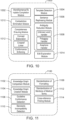
- FIG. 9 shows further detail in regards to the clinical information extraction module 900, in an embodiment. These features may be in clinical information extraction module 304.
- FIG. 9 includes EHR 902, entity recognition 904, assertion recognition 906, relation recognition 908, and ontology linking 910.
- Clinical information extraction module 900 takes in electronical health record text in EHR 902. Then, pre-existing neural large language models can be created from large clinical text datasets. These may be fine tuned with granular oncology-specific (or other medical expertise), specially annotated and augmented textual data, followed by being mapped to oncology-specific (as an example) dictionaries, taxonomies, and ontologies.
- TUMOR a subset of text that has a recognized type
- the text indicates the patient has such a tumor.
- the tumor exists in the patient and the clinical information extraction module 900 asserts the TUMOR is PRESENT.
- Imaging test label 1402 is an example of enriched information overlayed on report text on a display screen.
- entity label 1404 Imaging Test
- temporal assertion 1408 ((-).
- imaging test label 1402 is showing the text broken down into categories that can be linked and understood with other information. This is also helpful for clicking on each to get more information.
- an enriched information overlay module can seek out and/or receive additional information from internal and worldwide sources that can be provided to the user as more information if labels are interacted with.
- Imaging test label 1402 is indicating in an alternate manner that no previous imaging test of CT type has been done. And the related CPT code for such a CT examination would be CT70498.
- CPT codes offer doctors and health care professionals a uniform language for coding medical services and procedures.
- a user could click, in an embodiment, on the CPT code to get listings of other CPT codes and/or more information on the details of this code.
- This information could be provided by an enriched information overlay module, such as that of enriched information overlay module 306.
- the relationship and/or association between labeled entities can be very important when performing machine learning or artificial intelligence analysis as part of an intelligent medical editor. These provide additional enriched information both to the user and the intelligent medical editor. Enriched information from enriched information overlay module is provided both to the user as well as to other modules within an intelligent medical editor.
- Word/sentence/template completion module 1002 suggests text and other outputs that may be what the user would prefer and/or intend for the rest of the word, sentence, or template to have in it. This may provide helpful auto-complete suggestions for partially typed words, partially typed sentences, partially typed templates, and various report fields such as in EMRs.
- the type of report and related template may be detected by the system through template detection module 1004. In certain medical environments there may be a library of relevant templates that template detection module 1004 can be aware of and help to pre-populate.
- NLU model updation module 316 receives usage logs 332 as well as Federated NLU models.
- NLU model updation module 316 provides updated NLU models to NLU models 320.
- These NLU (natural language understanding) models may include NLP (natural language processing), NLG (natural language generation) and NWP (natural word processing) models as well. These will be further explained in connection with FIGS. 5, 6 , 8A , 8B , and herein throughout.
- NLU models 320 are provided throughout an intelligent medical editor as many parts of the system need natural language processing, generation, and understanding, such as to clinical information extraction module 304, enriched information overlay module 306, edit recommendation module 308, usage and feedback logging module 310, contradiction and incompleteness detection module 312, and language model finetuning module 314.
- Patient profile and past Dx/Tx data 324 is a collection of all the patient data throughout the system. The more accurate data about a patient, the more insights and recommendations an intelligent medical editor can make.
- Patient profile data may be from an EMR, medical reports, medical imaging scans, medical notes, communication from a patient, and more.
- Patient profile data can include their allergies, problems, history, and medications.
- FIG. 19 discusses more about patient data present in hospital premises and using patient profile data to determine insights and recommendations.
- User profile and preferences 334 stores and analyzes information about past, current, and future users of EMR editor 302. Each user may have a different role (such as nurse, primary care physician, radiologist), a different aptitude for using software technologies, a different knowledge of medical terminology, a different knowledge of medical standards, and the like.
- User profile and preferences 334 takes information in from usage and feedback logging module 310 and can provide output to any module, but in specific to edit recommendation module 308.
- An edit related to a report may be different based on the user involved at times. For example, one user consistently uses abbreviations vs. another user always types out the full word. Or if one user has a pattern of using a certain medication to treat the same patient disease, it can be suggested as a recommendation in the future. Thus, pattern recognition and artificial intelligence learning is helpful for user profile and preferences 334, and the module may have such technology built in.
- EMR editor 402 interacts with user 404 through computer input and output systems.
- User 404 uses EMR editor 402 as an intelligent medical editor to generate, edit, and improve medical materials, such as radiology reports, electronic medical records, and prescription orders.
- Clinical incorrectness detection 406 and clinical warnings 408 may be modules that receive medication information from input modules such as medical ontologies 414, causal pair 416, patient history 418, clinical care guidelines 420.
- EMR editor 402 may have an edit recommendation module within it.
- EMR editor 402 can receive warnings and incorrectness detection and determine edit suggestions with the help of language interaction enabled in the system.
- EMR editor 402 provides displayed edit suggestions to a user for the user to select and interact with, as shown in FIG. 13 , for example.
- FIG. 5 shows a natural language processing (NLP) model update module, according to an embodiment.
- FIG. 5 includes networked system 500, base NLP model 502, remote sites 504, model finetune 506, new models 508, and model aggregation 510.
- Base NLP model 502 is an NLP model that is trained in generic enough tasks to do downstream applications.
- a goal of networked system 500 is to provide the benefits of long-term improvement of NLP due to higher volume of manually annotated data. This also may help improve downstream clinical applications.
- Networked system 500 in FIG. shows how NLP models may be improved through crowdsourcing of feedback and improvements. This allows for getting clinicians (oncologists, nurses, and primary care physicians) to participate in crowdsourcing of technology. Ensuring that the AI and NLP models are performing adequately to meet clinical standards is crucial before integrating them with a critical clinical system like EMR or other medical reports. High volume, variety and veracity of manual feedback is essential for validating and continuously improving the AI and NLP models. The two roadblocks which hinder such a collection of feedback are the high time and cost of high-quality manual feedback, and the data privacy requirements which result in administrative and data anonymization overheads.
- FIG. 7 shows a block diagram supporting natural report generation, according to an embodiment.
- FIG. 7 includes system 700, standard report generation 702, medical information 704, patient EHR DB (database) 706, disease DB 708, text parser 710, language system 712, generative artificial intelligence & large language model service 714 (GAI LLM service), word prediction 716, backend apps (applications) 718, medical dictionary 720, user interface 722, security layer 724, patient history 726, record from other hospital 728, family history 730, and patient physical activities 732.
- standard report generation 702 includes patient EHR DB (database) 706, disease DB 708, text parser 710, language system 712, generative artificial intelligence & large language model service 714 (GAI LLM service), word prediction 716, backend apps (applications) 718, medical dictionary 720, user interface 722, security layer 724, patient history 726, record from other hospital 728, family history 730, and patient physical activities 732.
- standard report generation 702 includes patient E
- Standard report generation 702 may take in information from text parser that has come to text parser from a variety of sources, such as patient history 726, user input through user interface 722, backend apps 718, and medical information 704. Standard report generation takes report templates or previous report examples and generates a new report. Then it prepopulates areas that it knows are related (such as patient names and other factual data from the record). It also, in an intelligent medical editor descripted throughout, can provide edit recommendations and suggestions for other parts of the report that are not fully known or may need a medical professional to make the selection.
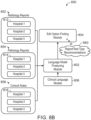
- FIG. 8A shows a local model for language fine tuning, according to an embodiment.
- FIG. 8A includes finetuning system 800, language fine tuning module 802, edit option finding module 804, clinical language models 806, hospital-1 810, radiology reports 812, pathology reports 814, consult notes 816, hospital specific model 820, and hospital specific recommendations 822.
- Hospitals may have specific recommendations 822 provided to its users by edit option finding modules 804, also called edit recommendation modules, of intelligent medical editors. Hospital specific recommendations 822 may be from hospital guidelines or rules. These recommendations may also be based on detected best practices from medical materials of hospital-1 810 such as radiology reports 812, pathology reports 814, and/or consult notes 816.
- hospital specific models 820 can be generated for language and edit recommendations.
- Clinical models 806 can provide publicly available language models trained on large corpus of medical documents which can then be specialized by language model finetuning module 802 and/or edit option finding module 804 to perform hospital specific downstream tasks.
- a model can be fine-tuned not just on the users of the system or requirements from the hospital or government, but also based on the patient. For example, fine tuning may be based on the timeline history of patients, type of disease, type of treatment, equipment use, medication dosages, and other factors along a patient j ourney. To effectively aid the aid the recommendations, multiple models could be aggregated, and recommendations could be based on the certain criterion / domain specific rules.
- FIG. 13 shows a user interface with suggested edits for a digital document, according to an embodiment.
- FIG. 13 includes medical editor 1300, user interface 1302, event date recommendation 1304, internal conflict recommendation 1306, date recommendation 1308, missing information recommendation 1310, formatting recommendation 1312, spelling recommendation 1314, acronym expansion recommendation 1316, image source recommendation 1318, ontology code linking recommendation 1320, contradiction notice 1322, and diagnosis recommendation 1324.
- User interface 1302 shows a medical report that already has some content. This content may have been typed in, prepopulated by the intelligent medical editor, or a combination of the two. The report has headings for different sections of the report that are shown in capital letters on the left.
- a system such as that of FIG. 2 , reviews the material in the report and can provide alerts, notices, and recommendations to help improve the content of the report.
- Event date recommendation 1304 is an example of adding additional information to the report that helps provide full detail.
- medical editor 1300 recommends adding "on Aug 23 rd , 2022" to the report referring to the day the patient presented their medical complaints. This improves precision via event date recommendation 1304 using a patient's past data. This may be done through a patient profile as further discussed with reference to FIG. 19 .
- a medical editor may detect a reference to a past event in a report based on a language model that looks at past tense words, tracks the patient j ourney, and/or certain fields in an EMR, as examples. If more information is available about the past event, an edit recommendation module may make a recommendation like event date recommendation 1304.
- Internal conflict recommendation 1306 may use the rest of the report or other patient profile information to detect conflicts.
- the report in the fourth line states the "left breast.”
- an intelligent medical editor for example through a contradiction and incompleteness detection module 312 can detect internal inconsistencies and ask a user for clarification. If a user clicks on the internal conflict recommendation 1306 which is "left?" in this case, the intelligent medical editor can automatically change the word right into left.
- Another internal conflict example is the wrong date listed in a report, such as those related to event date recommendations.
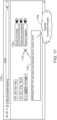
- FIG. 16 shows a user interface with suggested edits to a digital document, according to an embodiment.
- FIG. 16 includes intelligent medical editor 1600 which includes a user interface to interact with a user on a computing device. This may be a personal computer, a smartphone, a tablet, a medical imaging device screen, or other input/output device.
- FIG. 16 shows medical record 1602 that includes information about a patient.
- Clinical information extraction module 304 determines that "lung" is a body part 104 and medicine name is a medicine that can be compared by contradiction and incompleteness detection module 312 to verify it is a correct medicine name 1608. This is done through a medical spell correction pop up recommendation and annotation popup, which is different than the above line recommendations shown in FIG. 13 .
- FIG. 16 shows an intelligent medical editor that is focused on specific domain knowledge the medical field and enables auto annotations and suggestions.
- FIG. 18 shows a block diagram related to edit recommendations leveraging predictive and generative models, according to an embodiment.
- FIG. 18 shows components that can be in an edit recommendation module 1800, edit recommendations 1802, current EMR report and details 1804, medical inputs 1806, finetuned module 1808, patient data 1810, prompt selection 1812, predictive models 1814, generative models 1816, grounding module 1820, and edit option finding module 1822.
- Input into edit recommendation module 1800 includes medical inputs 1806 that provide a baseline for the grounding module, medical ontologies, medical dictionaries and other medical inputs.
- medical input 1806 includes MeSH tree structure data for medical conditions.
- the Medical Subject Headings (MeSH) thesaurus is a controlled and hierarchically-organized vocabulary produced by the National Library of Medicine. It is used for indexing, cataloging, and searching of biomedical and health-related information.
- Input into edit recommendation module 1800 also includes patent data from EMR reports and details 1804 as well as patient data 1810 including timeline metadata, such as from the internal hosted data within a hospital system.
- Prompt selection 1812 selects the most relevant information from the multiple options of data suitable for the current report.
- Finetuned module 1808 receives clinical language predictive models (performing tasks like classification and extraction) and fine tunes them based on feedback and usage information from within the system, and provides finetuned models to grounding module 1820.
- Finetuned module 1808 picks task specific models based on the current activity of the intelligent medical editor and its users. This may mean finetuned module 1808 picks models specific to the hospital, a disease, or a patient, in various examples. The finetuning process helps the model access external knowledge sources and improve its performance.
- Grounding module 1820 takes in fine tuned models from finetuned module 1808, selected information and data from prompt selection 1812, clinical language generative models 1816, metadata, ontologies, clinicians, and other system inputs. Grounding module 1820 determines factual information in the content it generates. This reduces hallucination and inaccuracy issues, and helps minimize randomness that may come from GAI usages.
- Clinical language generative models 1816 are generative artificial intelligence (GAI), generative language models (GLMs), foundational models, and large language models (LLMs) that perform tasks such as summary generation, text generation, conversational agents, among other tasks.
- Intelligent medical editor systems and methods ensure that the AI models are performing adequately to meet clinical standards is crucial before integrating them with a critical clinical system like EMR.
- High volume, variety and veracity of manual feedback is essential for validating and continuously improving the AI models.
- the two roadblocks which hinder such a collection of feedback are (1) the high time and cost of high-quality manual feedback, (2) the data privacy requirements which result in administrative and data anonymization overheads.
- Intelligent medical editor systems and methods help (1) creating a low-intrusion way for clinicians to provide in-place feedback to AI as well as by (2) creating a federated method to improve the AI models which eliminate the need to share patient data outside of the organization/legal boundaries, thereby enabling wide crowdsourcing of training/validation data for AI models.
- various components described in this description can include electrical circuit(s) that can include components and circuitry elements of suitable value in order to implement the embodiments of the subject innovation(s).
- many of the various components can be implemented on one or more integrated circuit (IC) chips.
- IC integrated circuit
- a set of components can be implemented in a single IC chip.
- one or more of respective components are fabricated or implemented on separate IC chips.
- one or more of the subject front end-components can be deployed as hardware and/or software at a client 2102 and one or more of the subject back-end components can be deployed as hardware and/or software at server 2104.
- One possible communication between a client 2102 and a server 2104 can be in the form of a data packet transmitted between two or more computer processes wherein the data packet may include video data.
- the data packet can include a metadata, e.g., associated contextual information, for example.
- the computing environment 2100 includes a communication framework 2106 (e.g., a global communication network such as the Internet, or mobile network(s)) that can be employed to facilitate communications between the client(s) 2102 and the server(s) 2104.
- a communication framework 2106 e.g., a global communication network such as the Internet, or mobile network(s)
- a client 2102 can transfer an encoded file, in accordance with the disclosed subject matter, to server 2104.
- Server 2104 can store the file, decode the file, or transmit the file to another client 2102. It is to be appreciated, that a client 2102 can also transfer uncompressed file to a server 2104 and server 2104 can compress the file in accordance with the disclosed subject matter.
- server 2104 can encode video information and transmit the information via communication framework 2106 to one or more clients 2102.
- the clients 2202 can include one or more clients devices (e.g., a mobile device, a laptop computer, a desktop computer, etc.) which can include or employ a suitable application (e.g., a native mobile application, a web-based application, a thin/thick client application, etc.) to access and employ one or more features and functionalities of the subject native/reconstructed medical imaging systems deployed in the system cloud 2204.
- a suitable application e.g., a native mobile application, a web-based application, a thin/thick client application, etc.
- the one or more components of system 100 can be distributed between the clients 2202 and the system cloud 2204.
- the system bus 2608 can be any of several types of bus structure(s) including the memory bus or memory controller, a peripheral bus or external bus, and/or a local bus using any variety of available bus architectures including, but not limited to, Industrial Standard Architecture (ISA), Micro-Channel Architecture (MSA), Extended ISA (EISA), Intelligent Drive Electronics (IDE), VESA Local Bus (VLB), Peripheral Component Interconnect (PCI), Card Bus, Universal Serial Bus (USB), Advanced Graphics Port (AGP), Personal Computer Memory Card International Association bus (PCMCIA), Firewire (IEEE 22104), and Small Computer Systems Interface (SCSI).
- ISA Industrial Standard Architecture
- MSA Micro-Channel Architecture
- EISA Extended ISA
- IDE Intelligent Drive Electronics
- VLB VESA Local Bus
- PCI Peripheral Component Interconnect
- Card Bus Universal Serial Bus
- USB Universal Serial Bus
- AGP Advanced Graphics Port
- PCMCIA Personal Computer Memory Card International Association bus
- Firewire IEEE 22104
- SCSI Small Computer Systems Interface
- non-volatile memory 2612 can include read only memory (ROM), programmable ROM (PROM), electrically programmable ROM (EPROM), electrically erasable programmable ROM (EEPROM), or flash memory.
- Volatile memory 2210 includes random access memory (RAM), which acts as external cache memory. According to present aspects, the volatile memory may store the write operation retry logic and the like.
- RAM is available in many forms such as static RAM (SRAM), dynamic RAM (DRAM), synchronous DRAM (SDRAM), double data rate SDRAM (DDR SDRAM), and enhanced SDRAM (ESDRAM).
- Computer 2602 can operate in a networked environment using logical connections to one or more remote computers, such as remote computer(s) 2638.
- the remote computer(s) 2638 can be a personal computer, a server, a router, a network PC, a workstation, a microprocessor based appliance, a peer device, a smart phone, a tablet, or other network node, and typically includes many of the elements described relative to computer 2602. For purposes of brevity, only a memory storage device 2640 is illustrated with remote computer(s) 2638.
- Remote computer(s) 2638 is logically connected to computer 2602 through a network interface 2642 and then connected via communication connection(s) 2644.
Landscapes
- Engineering & Computer Science (AREA)
- Health & Medical Sciences (AREA)
- General Health & Medical Sciences (AREA)
- Theoretical Computer Science (AREA)
- Epidemiology (AREA)
- Medical Informatics (AREA)
- Primary Health Care (AREA)
- Public Health (AREA)
- General Engineering & Computer Science (AREA)
- Physics & Mathematics (AREA)
- General Physics & Mathematics (AREA)
- Audiology, Speech & Language Pathology (AREA)
- Computational Linguistics (AREA)
- Artificial Intelligence (AREA)
- Bioethics (AREA)
- Human Computer Interaction (AREA)
- Medical Treatment And Welfare Office Work (AREA)
- Measuring And Recording Apparatus For Diagnosis (AREA)
Applications Claiming Priority (1)
| Application Number | Priority Date | Filing Date | Title |
|---|---|---|---|
| IN202341066971 | 2023-10-06 |
Publications (1)
| Publication Number | Publication Date |
|---|---|
| EP4535367A1 true EP4535367A1 (de) | 2025-04-09 |
Family
ID=92816348
Family Applications (1)
| Application Number | Title | Priority Date | Filing Date |
|---|---|---|---|
| EP24200784.7A Pending EP4535367A1 (de) | 2023-10-06 | 2024-09-17 | Systeme und verfahren für intelligente medizinische editoren |
Country Status (3)
| Country | Link |
|---|---|
| US (1) | US20250118399A1 (de) |
| EP (1) | EP4535367A1 (de) |
| CN (1) | CN119785962A (de) |
Families Citing this family (2)
| Publication number | Priority date | Publication date | Assignee | Title |
|---|---|---|---|---|
| US20260066066A1 (en) * | 2024-08-28 | 2026-03-05 | Orchid Exchange Inc. | Generating Clinical Documentation Using Large Language Models and Artificial Intelligence |
| CN120832956B (zh) * | 2025-09-17 | 2025-12-23 | 北京惠每云科技有限公司 | 医学推理大模型构建方法、装置、电子设备及存储介质 |
Citations (3)
| Publication number | Priority date | Publication date | Assignee | Title |
|---|---|---|---|---|
| US20110301966A1 (en) * | 2010-06-07 | 2011-12-08 | Microsoft Corporation | Real-time synchronous semantic processing in electronic documentation |
| US20200321085A1 (en) * | 2019-04-04 | 2020-10-08 | International Business Machines Corporation | Notation assistant system for providing feedback on a clinical narrative note |
| US20210398630A1 (en) * | 2013-03-12 | 2021-12-23 | Nuance Communications, Inc. | Systems and methods for identifying errors and/or critical results in medical reports |
-
2024
- 2024-09-17 EP EP24200784.7A patent/EP4535367A1/de active Pending
- 2024-09-27 CN CN202411355991.5A patent/CN119785962A/zh active Pending
- 2024-10-04 US US18/906,528 patent/US20250118399A1/en active Pending
Patent Citations (3)
| Publication number | Priority date | Publication date | Assignee | Title |
|---|---|---|---|---|
| US20110301966A1 (en) * | 2010-06-07 | 2011-12-08 | Microsoft Corporation | Real-time synchronous semantic processing in electronic documentation |
| US20210398630A1 (en) * | 2013-03-12 | 2021-12-23 | Nuance Communications, Inc. | Systems and methods for identifying errors and/or critical results in medical reports |
| US20200321085A1 (en) * | 2019-04-04 | 2020-10-08 | International Business Machines Corporation | Notation assistant system for providing feedback on a clinical narrative note |
Non-Patent Citations (1)
| Title |
|---|
| YUAN ANN ET AL: "Wordcraft: Story Writing With Large Language Models", PROCEEDINGS OF THE 27TH ACM SYMPOSIUM ON VIRTUAL REALITY SOFTWARE AND TECHNOLOGY, ACMPUB27, NEW YORK, NY, USA, 22 March 2022 (2022-03-22), pages 841 - 852, XP058790070, ISBN: 978-1-4503-9148-1, DOI: 10.1145/3490099.3511105 * |
Also Published As
| Publication number | Publication date |
|---|---|
| US20250118399A1 (en) | 2025-04-10 |
| CN119785962A (zh) | 2025-04-08 |
Similar Documents
| Publication | Publication Date | Title |
|---|---|---|
| US20240265209A1 (en) | Nlu training with user corrections to engine annotations | |
| US11101024B2 (en) | Medical coding system with CDI clarification request notification | |
| US20210398630A1 (en) | Systems and methods for identifying errors and/or critical results in medical reports | |
| US10956860B2 (en) | Methods and apparatus for determining a clinician's intent to order an item | |
| US10949602B2 (en) | Sequencing medical codes methods and apparatus | |
| US11152084B2 (en) | Medical report coding with acronym/abbreviation disambiguation | |
| US11024424B2 (en) | Computer assisted coding systems and methods | |
| US9971848B2 (en) | Rich formatting of annotated clinical documentation, and related methods and apparatus | |
| US20190385202A1 (en) | User and engine code handling in medical coding system | |
| US10331763B2 (en) | NLU training with merged engine and user annotations | |
| US20180373844A1 (en) | Computer assisted coding systems and methods | |
| CN105190628B (zh) | 确定临床医生的预订项目的意图的方法和设备 | |
| US20150006199A1 (en) | Methods and apparatus for extracting facts from a medical text | |
| EP4535367A1 (de) | Systeme und verfahren für intelligente medizinische editoren | |
| Macri et al. | Automated identification of clinical procedures in free-text electronic clinical records with a low-code named entity recognition workflow | |
| EP3011489B1 (de) | Arbeitsablaufintegration für ärztlichen oder klinischen dokumentatonsspezialisten | |
| Parchuri | AI Medical Document Generation |
Legal Events
| Date | Code | Title | Description |
|---|---|---|---|
| PUAI | Public reference made under article 153(3) epc to a published international application that has entered the european phase |
Free format text: ORIGINAL CODE: 0009012 |
|
| STAA | Information on the status of an ep patent application or granted ep patent |
Free format text: STATUS: REQUEST FOR EXAMINATION WAS MADE |
|
| 17P | Request for examination filed |
Effective date: 20240917 |
|
| AK | Designated contracting states |
Kind code of ref document: A1 Designated state(s): AL AT BE BG CH CY CZ DE DK EE ES FI FR GB GR HR HU IE IS IT LI LT LU LV MC ME MK MT NL NO PL PT RO RS SE SI SK SM TR |